Questions 
In this lesson we will learn all about asking questions in 
Hebrew.
Questions 
Most questions in Hebrew use an interrogative pronoun. 
These pronouns are the words who? What? When? Where? 
Etc. 
Hebrew, like English usually places these words at the 
beginning of a sentence. 
Also like English, these words are not dependent on gender. 
They are always the same. 
The interrogative pronouns will be introduced in this lesson.
Demonstrative Pronouns 
There are however some question words that are a bit 
different. These words will be the subject of this lesson. 
If you recall from lesson 14, we learned about the 
demonstrative pronouns זה and זאת meaning ‘this’. One of 
the most common questions in Hebrew is ‘What is this?’ and 
the demonstrative pronoun is used to form this construction. 
In Hebrew, normally you would construct a sentence based 
on gender, but this question is independent of gender. You 
use the question word מה (ma) meaning what in conjunction 
with the word .זה
Demonstrative Pronouns 
To ask the question ‘what is this?’ you would say ? מה זה 
regardless of whether the object you are referring to is 
masculine or feminine. This is because if you are asking 
what it is, you probably don’t know the gender either. 
The answer to this question will tell you what gender the 
object is 
זה תות שדה (it is a strawberry) mas because of זה 
זאת פסטה (it is pasta) feminine because of זאת
Demonstrative Pronouns 
On the other hand, if you are asking the question ‘who is 
this?’ then the gender must match the person you are 
referring to. You should know if the person you are asking 
about is male or female. 
The question word מי (mi) meaning who is used in this 
construction. 
מי זה? 
מי זאת? 
The answers are the same as for ‘what is it?’ 
זאת שרה (this is Sarah) 
זה דוד (this is David)
Where are you from? 
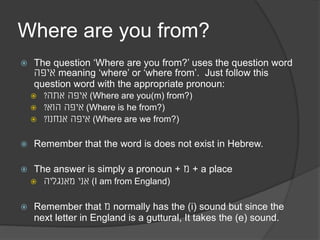
The question ‘Where are you from?’ uses the question word 
איפה meaning ‘where’ or ‘where from’. Just follow this 
question word with the appropriate pronoun: 
איפה אתה? (Where are you(m) from?) 
איפה הוא? (Where is he from?) 
איפה אנחנו? (Where are we from?) 
Remember that the word ‘is’ does not exist in Hebrew. 
The answer is simply a pronoun + מ + a place 
אני מאנגליה (I am from England) 
Remember that מ normally has the (i) sound but since the 
next letter in England is a guttural, It takes the (e) sound.
Which/ What? 
The question word ‘which?’ is a bit different than the other 
question words in this lesson. It is dependent on the noun that 
follows it for gender and number. The three forms of this 
question word are as follows: 
איזה (masculine singular) 
איזו (feminine singular) 
אילו (plural) 
Simply determine the gender and number of the noun and add the 
appropriate word from the list above to form a proper question. 
The masculine singular form is sometimes used regardless of the 
gender and number of the noun in colloquial Hebrew.
Prepositions in Questions 
As we mentioned before, questions usually begin with a 
question word. Sometimes however you may see a preposition 
as the first word in a question. We do this in English too 
In what house? 
To whom is he speaking? 
Any preposition can function this way. Some examples are ,על 
מ… ,ב… , and even the definite marker את . Remember that 
even with questions, it is necessary to use the definite marker. 
Usually you only use it when referring to people and not objects 
when asking a question though. 
If a question starts with a preposition, the answer will contain 
that same preposition.
Prepositions in Questions 
Here is an example to illustrate this. 
באיזה בית אתה? (IN which house are you?) 
אני בבית הכחול (I am IN the blue house.) 
למי אתה כותב? (To whom are you writing?) 
אני כותב לדוד (I am writing to David.)
Questions 
You can also form a question by simply changing the inflection of 
your voice. We do this in English as well. Think of the difference in 
pronunciation in the following statement and question: 
This is your dog. 
This is your dog? 
The last syllable is slightly raised indicating that the statement is a 
question. 
There are more aspects of questions, but we will examine those in 
another lesson.

Questions

  • 1.
    Questions In thislesson we will learn all about asking questions in Hebrew.
  • 2.
    Questions Most questionsin Hebrew use an interrogative pronoun. These pronouns are the words who? What? When? Where? Etc. Hebrew, like English usually places these words at the beginning of a sentence. Also like English, these words are not dependent on gender. They are always the same. The interrogative pronouns will be introduced in this lesson.
  • 3.
    Demonstrative Pronouns Thereare however some question words that are a bit different. These words will be the subject of this lesson. If you recall from lesson 14, we learned about the demonstrative pronouns זה and זאת meaning ‘this’. One of the most common questions in Hebrew is ‘What is this?’ and the demonstrative pronoun is used to form this construction. In Hebrew, normally you would construct a sentence based on gender, but this question is independent of gender. You use the question word מה (ma) meaning what in conjunction with the word .זה
  • 4.
    Demonstrative Pronouns Toask the question ‘what is this?’ you would say ? מה זה regardless of whether the object you are referring to is masculine or feminine. This is because if you are asking what it is, you probably don’t know the gender either. The answer to this question will tell you what gender the object is זה תות שדה (it is a strawberry) mas because of זה זאת פסטה (it is pasta) feminine because of זאת
  • 5.
    Demonstrative Pronouns Onthe other hand, if you are asking the question ‘who is this?’ then the gender must match the person you are referring to. You should know if the person you are asking about is male or female. The question word מי (mi) meaning who is used in this construction. מי זה? מי זאת? The answers are the same as for ‘what is it?’ זאת שרה (this is Sarah) זה דוד (this is David)
  • 6.
    Where are youfrom? The question ‘Where are you from?’ uses the question word איפה meaning ‘where’ or ‘where from’. Just follow this question word with the appropriate pronoun: איפה אתה? (Where are you(m) from?) איפה הוא? (Where is he from?) איפה אנחנו? (Where are we from?) Remember that the word ‘is’ does not exist in Hebrew. The answer is simply a pronoun + מ + a place אני מאנגליה (I am from England) Remember that מ normally has the (i) sound but since the next letter in England is a guttural, It takes the (e) sound.
  • 7.
    Which/ What? Thequestion word ‘which?’ is a bit different than the other question words in this lesson. It is dependent on the noun that follows it for gender and number. The three forms of this question word are as follows: איזה (masculine singular) איזו (feminine singular) אילו (plural) Simply determine the gender and number of the noun and add the appropriate word from the list above to form a proper question. The masculine singular form is sometimes used regardless of the gender and number of the noun in colloquial Hebrew.
  • 8.
    Prepositions in Questions As we mentioned before, questions usually begin with a question word. Sometimes however you may see a preposition as the first word in a question. We do this in English too In what house? To whom is he speaking? Any preposition can function this way. Some examples are ,על מ… ,ב… , and even the definite marker את . Remember that even with questions, it is necessary to use the definite marker. Usually you only use it when referring to people and not objects when asking a question though. If a question starts with a preposition, the answer will contain that same preposition.
  • 9.
    Prepositions in Questions Here is an example to illustrate this. באיזה בית אתה? (IN which house are you?) אני בבית הכחול (I am IN the blue house.) למי אתה כותב? (To whom are you writing?) אני כותב לדוד (I am writing to David.)
  • 10.
    Questions You canalso form a question by simply changing the inflection of your voice. We do this in English as well. Think of the difference in pronunciation in the following statement and question: This is your dog. This is your dog? The last syllable is slightly raised indicating that the statement is a question. There are more aspects of questions, but we will examine those in another lesson.