Gjimnazi “Jeta e re”
Lenda : Gjuha Angleze
Tema :Literal and Idiomatic PhrasalVerbs
Prof : Shkurte Morina
Punoi : Jetlira Bytyqi
PhrasalVerbs
• A phrasal verb is a combination of a verb and preposition, a verb and an
adverb, or a verb with both an adverb and a preposition.
Ex.. Verb ~ Preposition Who is looking after the kids ?
• They are also known as ‘compound verbs’, ‘verb-adverb combinations’,
‘verb-particle constructions", “two-part words/verbs’ and ‘three-part
words/verbs’ (depending on the number of words).
Some facts about phrasal verbs
• Phrasal verbs are mainly used in spoken English and informal texts.
• The more formal a conversation or text, the less phrasal verbs are found.
• The particle can change the meaning of the verb completely.
• There are no rules that might explain how phrasal verbs are formed correctly - all you can do is look
them up in a good dictionary and study their meanings.
• Verb and adverb constructions are also easy to understand when used literally.
She opened the shutters and looked outside
When he heard the crash, he looked up
Types
• Phrasal verbs sometimes have a literal meaning and sometimes an
idiomatic meaning.
I looked up the tree, but I couldn't see my cat.(Literal)
I looked up the word in the dictionary.(Idiomatic)
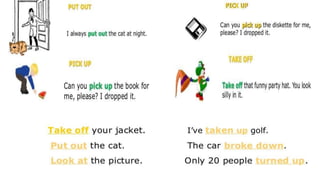
Literal phrasal verbs
• Literal usage. Many verbs in English can be combined with an adverb or a
preposition, a phrasal verb used in a literal sense with a preposition is easy
to understand.Verb and adverb constructions are also easy to understand
when used literally.
When he heard the crash, he looked up (looked + up)
Ex.
She give away all her money (give + away)
Idiomatic PhrasalVerbs
• Some phrasal verbs are idiomatic.
• The literal meaning of “to get over”, in the sense of “to climb over
something to get to the other side”, is not relevant here. Here "get over"
means "recover from" or "feel better".
• The figurative or idiomatic application in everyday speech makes phrasal
verbs so important.
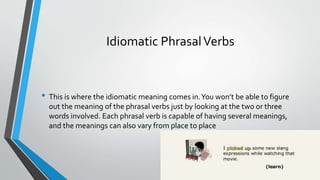
Idiomatic PhrasalVerbs
• This is where the idiomatic meaning comes in.You won’t be able to figure
out the meaning of the phrasal verbs just by looking at the two or three
words involved. Each phrasal verb is capable of having several meanings,
and the meanings can also vary from place to place
What is an idiom ?
• Phrasal verbs are usually used informally in everyday speech as opposed to the
more formal Latinate verbs, such as “to get together” rather than “to congregate”,
“to put off” rather than “to postpone”, or “to get out” rather than “to exit”.They
should be avoided in academic writing.
• An idiom (also called idiomatic expression) is an expression, word, or phrase that
has a figurative meaning conventionally understood by native speakers.This
meaning is different from the literal meaning of the idiom's individual elements. In
other words, idioms don't mean exactly what the words say.
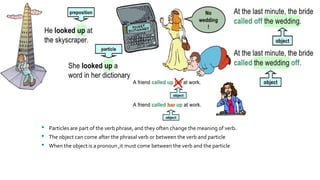
• Particles are part of the verb phrase, and they often change the meaning of verb.
• The object can come after the phrasal verb or between the verb and particle
• When the object is a pronoun ,it must come between the verb and the particle
Literal and Idiomatic Phrasal Verbs

Literal and Idiomatic Phrasal Verbs

  • 1.
    Gjimnazi “Jeta ere” Lenda : Gjuha Angleze Tema :Literal and Idiomatic PhrasalVerbs Prof : Shkurte Morina Punoi : Jetlira Bytyqi
  • 3.
    PhrasalVerbs • A phrasalverb is a combination of a verb and preposition, a verb and an adverb, or a verb with both an adverb and a preposition. Ex.. Verb ~ Preposition Who is looking after the kids ? • They are also known as ‘compound verbs’, ‘verb-adverb combinations’, ‘verb-particle constructions", “two-part words/verbs’ and ‘three-part words/verbs’ (depending on the number of words).
  • 4.
    Some facts aboutphrasal verbs • Phrasal verbs are mainly used in spoken English and informal texts. • The more formal a conversation or text, the less phrasal verbs are found. • The particle can change the meaning of the verb completely. • There are no rules that might explain how phrasal verbs are formed correctly - all you can do is look them up in a good dictionary and study their meanings. • Verb and adverb constructions are also easy to understand when used literally. She opened the shutters and looked outside When he heard the crash, he looked up
  • 5.
    Types • Phrasal verbssometimes have a literal meaning and sometimes an idiomatic meaning. I looked up the tree, but I couldn't see my cat.(Literal) I looked up the word in the dictionary.(Idiomatic)
  • 6.
    Literal phrasal verbs •Literal usage. Many verbs in English can be combined with an adverb or a preposition, a phrasal verb used in a literal sense with a preposition is easy to understand.Verb and adverb constructions are also easy to understand when used literally. When he heard the crash, he looked up (looked + up) Ex. She give away all her money (give + away)
  • 8.
    Idiomatic PhrasalVerbs • Somephrasal verbs are idiomatic. • The literal meaning of “to get over”, in the sense of “to climb over something to get to the other side”, is not relevant here. Here "get over" means "recover from" or "feel better". • The figurative or idiomatic application in everyday speech makes phrasal verbs so important.
  • 9.
    Idiomatic PhrasalVerbs • Thisis where the idiomatic meaning comes in.You won’t be able to figure out the meaning of the phrasal verbs just by looking at the two or three words involved. Each phrasal verb is capable of having several meanings, and the meanings can also vary from place to place
  • 10.
    What is anidiom ? • Phrasal verbs are usually used informally in everyday speech as opposed to the more formal Latinate verbs, such as “to get together” rather than “to congregate”, “to put off” rather than “to postpone”, or “to get out” rather than “to exit”.They should be avoided in academic writing. • An idiom (also called idiomatic expression) is an expression, word, or phrase that has a figurative meaning conventionally understood by native speakers.This meaning is different from the literal meaning of the idiom's individual elements. In other words, idioms don't mean exactly what the words say.

  • 12.
    • Particles arepart of the verb phrase, and they often change the meaning of verb. • The object can come after the phrasal verb or between the verb and particle • When the object is a pronoun ,it must come between the verb and the particle