LAB REPORTS
PREPARED BY THE STUDENT SUCCESS AND TUTORING CENTER
WHAT IS A LAB REPORT?
 What is a lab report?
 a complete and detailed record of
an experiment.
 The information provided in a lab
report should be specific enough
that the reader would be able to
replicate the experiment.
https://academichelp.net/wp-content/uploads/2013/01/lab-repo
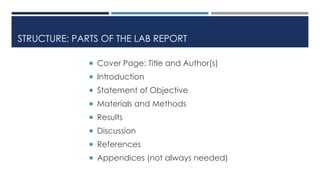
STRUCTURE: PARTS OF THE LAB REPORT
 Cover Page: Title and Author(s)
 Introduction
 Statement of Objective
 Materials and Methods
 Results
 Discussion
 References
 Appendices (not always needed)
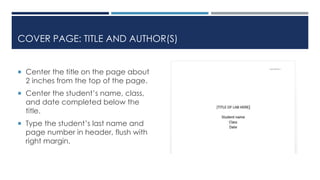
COVER PAGE: TITLE AND AUTHOR(S)
 Center the title on the page about
2 inches from the top of the page.
 Center the student’s name, class,
and date completed below the
title.
 Type the student’s last name and
page number in header, flush with
right margin.
INTRODUCTION
What it contains:
 Context of study
 Pertinent background
information
 Written in Past Passive tense
 Should be one to two
paragraphs long depending
upon the experiment
conducted
What it does not contain:
 Results
 Conclusions about the study
 Non-relevant information
STATEMENT OF OBJECTIVE
 Objective of the experiment
 Answers two questions:
 Why is this experiment being performed?
 What information can I learn?
 Hypothesis
 The student’s educated prediction
about the outcome of the
experiment
 Must be clearly stated and specific
 It’s okay for your hypothesis to be
wrong!
MATERIALS AND METHODS
 Contains materials and equipment used along with any explanation(s) of
equipment, if necessary.
 Contains the step-by-step process followed to conduct the experiment.
 Written in paragraph form, NOT a bulleted list.
 Always written in third person (do not use “I”).
 Be as detailed as possible.
 The purpose of this section is to allow another person to follow the instructions
and replicate the experiment.
RESULTS
 Summarize the results in paragraph
form.
 Create tables or charts of the data
collected, if applicable.
 If using tables or charts be sure to
label them clearly.
 DO NOT interpret the data. This
section should only contain the raw
facts. 0
1
2
3
4
5
6
Category 1 Category 2 Category 3 Category 4
Chart Title
Series 1 Series 2 Series 3
Sales
1st Qtr 2nd Qtr 3rd Qtr 4th Qtr
DISCUSSION
 Interpretation of data collected
 Did the experiment prove or disprove the hypothesis?
 If hypothesis was wrong, why and how was it wrong?
 Did any errors occur during the procedure?
 How might these errors be avoided in the future?
 Discussion of the implication of results
REFERENCES
 See your professor to determine if outside sources are necessary and what
format to cite them in.
 Your lab manual counts as a source.
 All sources used should be recorded on a separate page at the end of the
report.
 This page is titled either References (APA) or Works Cited (MLA).
 References should be organized alphabetically by authors’ last names.
Need citation help? See a Writing Center Coach or check out the SSTC’s Online Resource Cente
THINGS TO KEEP IN MIND!
 Remember to keep your writing in Past Passive tense.
 Everything is presented as if by a passive-third party observer.
 Ex. You would not say “Timmy ate the bagel.” Rather, you would say “The bagel was
eaten.”
 There is an example of a lab report in your lab manual. You can always
refer to that if necessary.
 Have a question? Remember you can always check with your
professor!
 Do you need to have an Abstract?
 Do you need to have Appendices?
PLEASE CONTACT US!
Conway 349-7872
Grand Strand 477-2113
Georgetown 520-1455
Email: sstc@hgtc.edu
Website: http://www.hgtc.edu/sstc
RESOURCES
 Successful Lab Reports
 Purdue OWL https://owl.english.purdue.edu/owl/resource/726/06/
 Hamilton College http://www.hamilton.edu/writing/writing-resources/lab-reports-for-biology
 Duke University http://twp.duke.edu/uploads/assets/lab_reports.pdf

How to Write a Lab Report

  • 1.
    LAB REPORTS PREPARED BYTHE STUDENT SUCCESS AND TUTORING CENTER
  • 2.
    WHAT IS ALAB REPORT?  What is a lab report?  a complete and detailed record of an experiment.  The information provided in a lab report should be specific enough that the reader would be able to replicate the experiment. https://academichelp.net/wp-content/uploads/2013/01/lab-repo
  • 3.
    STRUCTURE: PARTS OFTHE LAB REPORT  Cover Page: Title and Author(s)  Introduction  Statement of Objective  Materials and Methods  Results  Discussion  References  Appendices (not always needed)
  • 4.
    COVER PAGE: TITLEAND AUTHOR(S)  Center the title on the page about 2 inches from the top of the page.  Center the student’s name, class, and date completed below the title.  Type the student’s last name and page number in header, flush with right margin.
  • 5.
    INTRODUCTION What it contains: Context of study  Pertinent background information  Written in Past Passive tense  Should be one to two paragraphs long depending upon the experiment conducted What it does not contain:  Results  Conclusions about the study  Non-relevant information
  • 6.
    STATEMENT OF OBJECTIVE Objective of the experiment  Answers two questions:  Why is this experiment being performed?  What information can I learn?  Hypothesis  The student’s educated prediction about the outcome of the experiment  Must be clearly stated and specific  It’s okay for your hypothesis to be wrong!
  • 7.
    MATERIALS AND METHODS Contains materials and equipment used along with any explanation(s) of equipment, if necessary.  Contains the step-by-step process followed to conduct the experiment.  Written in paragraph form, NOT a bulleted list.  Always written in third person (do not use “I”).  Be as detailed as possible.  The purpose of this section is to allow another person to follow the instructions and replicate the experiment.
  • 8.
    RESULTS  Summarize theresults in paragraph form.  Create tables or charts of the data collected, if applicable.  If using tables or charts be sure to label them clearly.  DO NOT interpret the data. This section should only contain the raw facts. 0 1 2 3 4 5 6 Category 1 Category 2 Category 3 Category 4 Chart Title Series 1 Series 2 Series 3 Sales 1st Qtr 2nd Qtr 3rd Qtr 4th Qtr
  • 9.
    DISCUSSION  Interpretation ofdata collected  Did the experiment prove or disprove the hypothesis?  If hypothesis was wrong, why and how was it wrong?  Did any errors occur during the procedure?  How might these errors be avoided in the future?  Discussion of the implication of results
  • 10.
    REFERENCES  See yourprofessor to determine if outside sources are necessary and what format to cite them in.  Your lab manual counts as a source.  All sources used should be recorded on a separate page at the end of the report.  This page is titled either References (APA) or Works Cited (MLA).  References should be organized alphabetically by authors’ last names. Need citation help? See a Writing Center Coach or check out the SSTC’s Online Resource Cente
  • 11.
    THINGS TO KEEPIN MIND!  Remember to keep your writing in Past Passive tense.  Everything is presented as if by a passive-third party observer.  Ex. You would not say “Timmy ate the bagel.” Rather, you would say “The bagel was eaten.”  There is an example of a lab report in your lab manual. You can always refer to that if necessary.  Have a question? Remember you can always check with your professor!  Do you need to have an Abstract?  Do you need to have Appendices?
  • 12.
    PLEASE CONTACT US! Conway349-7872 Grand Strand 477-2113 Georgetown 520-1455 Email: sstc@hgtc.edu Website: http://www.hgtc.edu/sstc
  • 13.
    RESOURCES  Successful LabReports  Purdue OWL https://owl.english.purdue.edu/owl/resource/726/06/  Hamilton College http://www.hamilton.edu/writing/writing-resources/lab-reports-for-biology  Duke University http://twp.duke.edu/uploads/assets/lab_reports.pdf