Reading skills
Reading skills
• Effective reading skills are very important at college
for one to succeed.
• Without acquiring them a student is bound to fail
IMPORTANCE OF READING/STUDYING
AND READING SKILLS AT COLLEGE
• Reading is how we discover new things. [Academic
questions are answered through reading a lot]
• One develops his/her point of view through
reading. Reading develops one’s imagination or
creativity
• Reading is fundamental to function in today’s
society.
Cont’d
• At college reading expert advice is required and
therefore provided through the reading skills.
• Academic work is demanding and requires new
reading skills which simplify everything.
SKILLS WHEN READING
• When reading do not rush to find meanings from a
dictionary if you do not know the meaning of the
word you come across. It is as if you are reading
two books. (The Dictionary and the actual book you
are reading).
• There is already help in the passage itself. Our task
is just to find this help.
USING CONTEXT
This is what to do
• Read on and look at words you already know and
try to link them to the new word.
• They will help you guess the meaning of the new
words.
• Is it possible to use this skill and know the
meaning of words?
• When we help people to use the context to find the
meanings of words, we are helping them to rely on
their natural intelligence, and not first use a
dictionary or ask another person. If there is
something in a passage that one does not know he
should not stop because by reading on the
problem is often cleared up. The skillful reader
understands as he iwots the meaning of the
unknown words from the context. Even if he does
not get the full meaning, he gets enough to
continue for awhile. People who are reading in their
mother tongue, even when their vocabulary is
limited, do not often stop to ask for the meaning of
a word in the story. They read on because the story
itself is what is important and not the word.
Cont’d
• What could be the meaning of IWOTS?
USING EXPERIENCE
• On his shaven head the man wore a puggree to
protect it from the sunlight.
USING REPETITIONS
Cont’d
Here we use one word to interpret the other and fit
the new word in what we already know.
• She poured water into a tock then lifting the tock
she drank. Unfortunately, as she was setting it
down again the tock slipped from her hand and
broke only the handle remained in one piece.
USING SPACES BETWEEN LINES.
• Wide spaces between lines are sometimes used to
mean another idea is being started or a shift from
the topic.
• Two paragraphs mean we have two ideas being
presented.
USING BOLD WORDS OR ITALICS.
• You have to ask yourself why the writer thought of
putting that word into italics or dark ink.
• Why do you think a writer could write in bold or
italics.
TYPES OF READING
• Could reading be put in types. There are various types of
reading. Did you know that?
• Do not use the same approach to reading all the time.
• Choose your approach to reading to suit the task at hand
since it could not be only you who would want to read
the book that time.
Studying vs. Reading
• Studying is reading with a focus and purpose – reading for
meaning / comprehension. There’s much attention involved
and it is more serious than reading. When studying, you
hope to retain the information for a long time
• Reading is casual and could simply be for leisure.
Sometimes reading can be for an appreciation of a subject
for the sake of intellectual pleasure. When reading, you
don’t pay much attention and you don’t aim at retaining the
information for a long time, unless you read and read again, which in a
way becomes studying
RAPID SURVEY/SCANNING
• You check for the exact information particular or
specific detail
• Check what you are reading - a rapid glance is all that
is necessary
• Is it what you need?
SKIMMING
• This is making a rapid survey of the subject
• This is may be to get a rough idea or to get a gist of the
information contained in a book
• Glance through the book quickly and pick up the main
point and try to get a general picture of what it is all about
• This is a very useful skill which becomes easier with
practice.
STUDYING
• It is the most common approach in any serious form
of study .Here you are reading to understand the
contents of a book
• You need to concentrate whilst reading
• You try to understand what the writer means
• You might also be taking notes whilst reading
• The reading may be part of your coursework or
research for a project
• You might also need to read a book more than once
to grasp the point it is making
Cont’d
• Look at the rest of the selection for possible clues
to important points ,are there any subheads you
can relate in some way to the title
• Are there any words author emphasized by putting
them in italics or boldface type are there any major
lists of items signaled by words such as first,
second, also another and so on
• Next formulate basic questions out of the title and
the other parts that you skim.
FACTORS AFFECTING STUDYING
• There are so many factors that affect studying. Four are
outlined here:
HEALTH I.E. MENTAL AND
PHYSICAL CONDITION
• Stay in good mental and physical condition, sickness
would make one not to concentrate properly.
• If you are tired give yourself a simple subject to study
AVAILABILITY OF ASSISTANCE FRIENDS OR LECTURERS
Use available assistance
• Studying with other people is important so that you
can discuss wherever you did not understand at the
end of the study time if you study with other people
bear in mind that you have to study same topic.
• If you study with friends. Force yourself to make the
group to stay on track and be helpful
• If the institution has tutorial services – do not hesitate
to get the service
ABILITY TO MANAGE TIME
• Plan properly how to use your time
• All of us need free time, it’s easy to lose track of time if you
do not manage it.
• Every one is given equal time per day it is management that
matters.
Cont’d
[To manage time a student needs to have:
• A large monthly calendar to scribble onto it
deadlines of assignments and should make sure to
put it at a position that he will not miss to look at it
every day
• Master study program that should guide him what
to read on weekly basis. The program should have
some breathing spaces for some unexpected
things.
• Weekly to do list or daily to do list. A list of priority
things to be done and not be missed]
ENVIRONMENT
• If possible study in a well lighted place where you
can sit comfortably and be quiet.
• The place should have nothing to disturb you.
• Get used to your study place so that you shift into
gear and begin studying when you go to that place
ITEMS THAT HELP A STUDENT TO
MANAGE TIME
There are three things at college that assist in time
management:
• A large monthly calendar
• A weekly study programme
• A weekly or daily to do list
A LARGE MONTHLY CALENDAR
• You should buy or make a large monthly calendar
• Such a calendar is your first method of time control, because it allows you,
in one quick glance to get a clear picture of what you need to do in the
weeks to come.
• Be sure your monthly has a good sized block of white space for each date.
• Then as soon as you learn about exam dates and paper deadlines enter
them in the appropriate spot on the calendar.
• Hang the calendar in a place where you will see it everyday
A WEEKLY
SCHEDULE/PROGRAMME
• A weekly study schedule will make you aware of
how much time you actually have each week and
will help you use that time effectively.
POINTS ABOUT MAKING A WEEKLY STUDY SCHEDULE/PROGRAM
• Plan at least one hour of study time each hour of
class time
Depending on the course, the grade you want and your
study efficiency, you may schedule more time later.
A difficult course, for example, may require three hours
or more of study time each course hour.
Remember that learning is what counts and not the
time taken to learn
Cont’d
• Schedule regular study time
To succeed in your college work , you need to establish
definite study hours
If you do not set aside and stick to such hours on daily
basis you are bound to lose control of your time.
When you are used to this study time you will not have
to remind yourself about it, it will be as if you are
programmed.
Cont’d
• Plan at least one hour blocks of study time
Regular study sessions are better than a single long cram
of session
If you schedule less than one hour period will be over
when you are just fully warmed up.
Cont’d
• Reward yourself for using study time effectively
As the section on operant conditioning in the chapter on
learning in your Psychology textbook explains positive
reinforcement a certain behavior will likely lead to an
increase in the probability of its occurrence
Cont’d
• Try to schedule periods before and after classes
Ideally you should read a textbook chapter before a
lecturer covers it
When it is being covered in class it is like second
exposure when one is exposed to a thing for the second
time the thing is always remembered easily
Cont’d
• Work on your most difficult subjects when you are
very alert and fresh
When tired you can not study effectively
Cont’d
• Balance your activities
Allow free time for family and friends, sports and
entertainment
Keep your schedule flexible, have some open spaces
When unexpected events occur trade your time on the
schedule
A DAILY OR WEEKLY TO DO LIST
• If you wish you may want to carry your to do list in
case you may forget
• A weekly to do list should be prepared on a Sunday
for the week ahead; while a daily to do list should
be made the evening before or first thing in the
morning
• The monthly calendar, master study schedule and
to do list combined with your own determination
to apply them, can reduce the disorder of everyday
life
STRATEGIES FOR STUDY
• Although you are expected to study and learn a
wide range of materials you are rarely taught any
systematic strategies allowing you to study more
effectively
• You can increase your ability to learn and retain
information by employing them in any subject
SQ3R
• These are standing for the steps that are involved in
the strategy itself.
• Lets look at each letter.
S
• 1. Survey the material by reading the parts of the
chapter that give an overview of the whole of it.
Read chapter title, introduction, prologue and
epilogues, learning objectives, summary and end of
chapter questions.
• Also check bold face headings and subheadings,
graphics and italics throughout the chapter
• This will provide an overview of the chapter and
create a mental framework for understanding the
chapter more thoroughly as you read
Q
• 2. Formulate questions related to what you are
expected to read in the chapter some books
already have these questions at the beginning of
each chapter.
• Before reading each section, turn each heading into
one or more questions you think the section should
answer.
• Some books already have these questions at the
end of the chapter.
• This step helps one’s mind engage and concentrate
and creates an active learning environment.
1st R
• 3. Read the material carefully and answer the questions
that you gave yourself to see if you have understood the
passage.
• Think of what the material means to you and what it implies
• Find if there are any contradictions
• This fills in the info. around the mental framework you have
created in the previous steps
2nd R
• 4. Recite or explain to yourself or a partner what the
chapter is all about.
• Before moving on to next chapter go back to see if you can
answer the questions.
• If you can then you are ready to move on to the next
chapter.
3rd R
• 5. Review or look over again the information that you
read.
• Amend the notes you made
• Compare it with some relevant material you have.
• Again review the questions and see if you can answer them
VOCABULARY
• When reading any text, you are likely to have a
better understanding if you know the meaning of
the words.
• If you are not familiar with the specialised
vocabulary used in a particular field of study, you
may not understand, and your listening and reading
may well be affected.
• Many students fail to perform well because they
are handicapped by a poor vocabulary.
Cont’d
• To expand your vocabulary, choose a larger
dictionary. Do not usually use dictionaries when
studying refer to them only when you really stuck.
(Meanings of words are in the sections we are
reading, use your experience).
• If you have not mastered the skill of finding
meanings of words on your own, keep your
dictionaries at hand when studying. Improve your
vocabulary by reading widely
• Names in science have their roots from classical
languages – LATIN in some cases: memorise them.
NOTE TAKING
Note-taking -
• Note-taking is writing in condensed form the
content of a chapter or a whole book or classroom
lectures or speeches.
• It also requires the ability to select and organize
ideas or concepts to be taken down.
• It involves activities that require mental alertness,
concentration, reflection and analysis.
Purpose of note taking during
lectures
• To enable active listening, since it is impossible to take
every word and detail that is presented in the lecture;
you need to take down important points. If you attempt
to take every word and detail you will be unable to
listen actively.
• To identify the key ideas, if you pre-read, you easily find
key ideas in the lecture and you take them into your
notes.
• To gain information that is not available in texts.
• To record facts that are being presented for reference
sake.
• To clarify the subject matter.
Taking Notes
Involves 3 major tasks:
• Effective listening
• Effective observation
• Effective note taking
Effective and active Listening: In
Class
• Find a good seat, comfortable
• Pay attention purposefully
• Listen for cues
• Resist distractions
• Don’t let your mind wander
• Take notes while you listen
• Be in the moment
Methods of Note Taking
• The Outline Method
• The Mapping Method
• The Cornell Method
• The Charting or PEPPS Method
• The Sentence Method
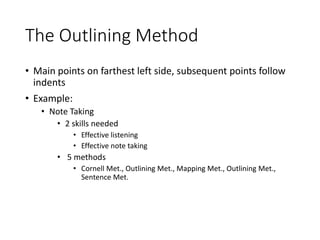
The Outlining Method
• Main points on farthest left side, subsequent points follow
indents
• Example:
• Note Taking
• 2 skills needed
• Effective listening
• Effective note taking
• 5 methods
• Cornell Met., Outlining Met., Mapping Met., Outlining Met.,
Sentence Met.
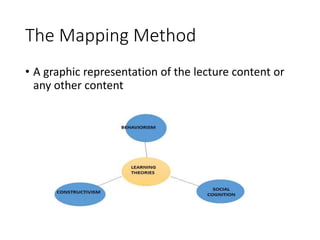
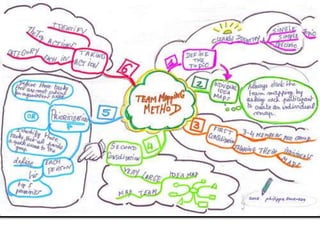
The Mapping Method
• A graphic representation of the lecture content or
any other content
The Cornell Method
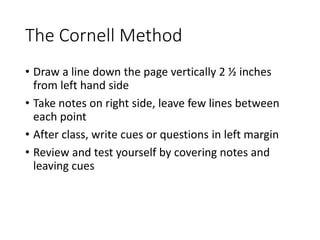
• Draw a line down the page vertically 2 ½ inches
from left hand side
• Take notes on right side, leave few lines between
each point
• After class, write cues or questions in left margin
• Review and test yourself by covering notes and
leaving cues
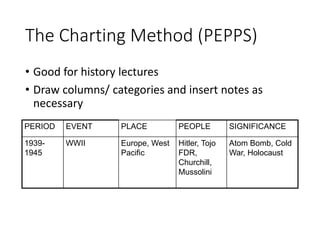
The Charting Method (PEPPS)
• Good for history lectures
• Draw columns/ categories and insert notes as
necessary
PERIOD EVENT PLACE PEOPLE SIGNIFICANCE
1939-
1945
WWII Europe, West
Pacific
Hitler, Tojo
FDR,
Churchill,
Mussolini
Atom Bomb, Cold
War, Holocaust
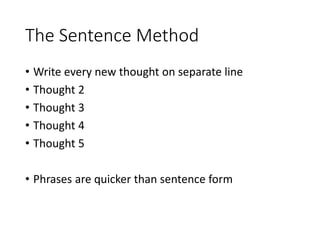
The Sentence Method
• Write every new thought on separate line
• Thought 2
• Thought 3
• Thought 4
• Thought 5
• Phrases are quicker than sentence form
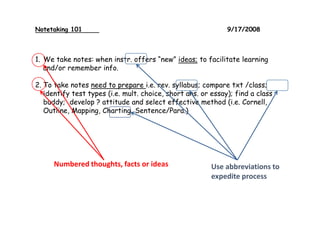
Notetaking 101 9/17/2008
1. We take notes: when instr. offers “new” ideas; to facilitate learning
and/or remember info.
2. To take notes need to prepare i.e. rev. syllabus; compare txt /class;
identify test types (i.e. mult. choice, short ans. or essay); find a class
buddy; develop ? attitude and select effective method (i.e. Cornell,
Outline, Mapping, Charting, Sentence/Para.)
Numbered thoughts, facts or ideas Use abbreviations to
expedite process
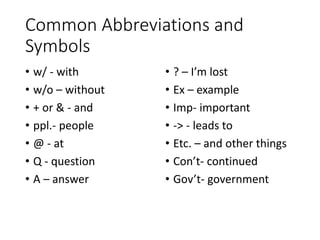
Common Abbreviations and
Symbols
• w/ - with
• w/o – without
• + or & - and
• ppl.- people
• @ - at
• Q - question
• A – answer
• ? – I’m lost
• Ex – example
• Imp- important
• -> - leads to
• Etc. – and other things
• Con’t- continued
• Gov’t- government

Reading skills - Pharmacy.pptx

  • 1.
  • 2.
    Reading skills • Effectivereading skills are very important at college for one to succeed. • Without acquiring them a student is bound to fail
  • 3.
    IMPORTANCE OF READING/STUDYING ANDREADING SKILLS AT COLLEGE • Reading is how we discover new things. [Academic questions are answered through reading a lot] • One develops his/her point of view through reading. Reading develops one’s imagination or creativity • Reading is fundamental to function in today’s society.
  • 4.
    Cont’d • At collegereading expert advice is required and therefore provided through the reading skills. • Academic work is demanding and requires new reading skills which simplify everything.
  • 5.
    SKILLS WHEN READING •When reading do not rush to find meanings from a dictionary if you do not know the meaning of the word you come across. It is as if you are reading two books. (The Dictionary and the actual book you are reading). • There is already help in the passage itself. Our task is just to find this help.
  • 6.
    USING CONTEXT This iswhat to do • Read on and look at words you already know and try to link them to the new word. • They will help you guess the meaning of the new words. • Is it possible to use this skill and know the meaning of words?
  • 7.
    • When wehelp people to use the context to find the meanings of words, we are helping them to rely on their natural intelligence, and not first use a dictionary or ask another person. If there is something in a passage that one does not know he should not stop because by reading on the problem is often cleared up. The skillful reader understands as he iwots the meaning of the unknown words from the context. Even if he does not get the full meaning, he gets enough to continue for awhile. People who are reading in their mother tongue, even when their vocabulary is limited, do not often stop to ask for the meaning of a word in the story. They read on because the story itself is what is important and not the word.
  • 8.
    Cont’d • What couldbe the meaning of IWOTS?
  • 9.
    USING EXPERIENCE • Onhis shaven head the man wore a puggree to protect it from the sunlight.
  • 10.
  • 11.
    Cont’d Here we useone word to interpret the other and fit the new word in what we already know. • She poured water into a tock then lifting the tock she drank. Unfortunately, as she was setting it down again the tock slipped from her hand and broke only the handle remained in one piece.
  • 12.
    USING SPACES BETWEENLINES. • Wide spaces between lines are sometimes used to mean another idea is being started or a shift from the topic. • Two paragraphs mean we have two ideas being presented.
  • 13.
    USING BOLD WORDSOR ITALICS. • You have to ask yourself why the writer thought of putting that word into italics or dark ink. • Why do you think a writer could write in bold or italics.
  • 14.
    TYPES OF READING •Could reading be put in types. There are various types of reading. Did you know that? • Do not use the same approach to reading all the time. • Choose your approach to reading to suit the task at hand since it could not be only you who would want to read the book that time.
  • 15.
    Studying vs. Reading •Studying is reading with a focus and purpose – reading for meaning / comprehension. There’s much attention involved and it is more serious than reading. When studying, you hope to retain the information for a long time • Reading is casual and could simply be for leisure. Sometimes reading can be for an appreciation of a subject for the sake of intellectual pleasure. When reading, you don’t pay much attention and you don’t aim at retaining the information for a long time, unless you read and read again, which in a way becomes studying
  • 16.
    RAPID SURVEY/SCANNING • Youcheck for the exact information particular or specific detail • Check what you are reading - a rapid glance is all that is necessary • Is it what you need?
  • 17.
    SKIMMING • This ismaking a rapid survey of the subject • This is may be to get a rough idea or to get a gist of the information contained in a book • Glance through the book quickly and pick up the main point and try to get a general picture of what it is all about • This is a very useful skill which becomes easier with practice.
  • 18.
    STUDYING • It isthe most common approach in any serious form of study .Here you are reading to understand the contents of a book • You need to concentrate whilst reading • You try to understand what the writer means
  • 19.
    • You mightalso be taking notes whilst reading • The reading may be part of your coursework or research for a project • You might also need to read a book more than once to grasp the point it is making
  • 20.
    Cont’d • Look atthe rest of the selection for possible clues to important points ,are there any subheads you can relate in some way to the title • Are there any words author emphasized by putting them in italics or boldface type are there any major lists of items signaled by words such as first, second, also another and so on • Next formulate basic questions out of the title and the other parts that you skim.
  • 21.
    FACTORS AFFECTING STUDYING •There are so many factors that affect studying. Four are outlined here:
  • 22.
    HEALTH I.E. MENTALAND PHYSICAL CONDITION • Stay in good mental and physical condition, sickness would make one not to concentrate properly. • If you are tired give yourself a simple subject to study
  • 23.
    AVAILABILITY OF ASSISTANCEFRIENDS OR LECTURERS Use available assistance • Studying with other people is important so that you can discuss wherever you did not understand at the end of the study time if you study with other people bear in mind that you have to study same topic. • If you study with friends. Force yourself to make the group to stay on track and be helpful • If the institution has tutorial services – do not hesitate to get the service
  • 24.
    ABILITY TO MANAGETIME • Plan properly how to use your time • All of us need free time, it’s easy to lose track of time if you do not manage it. • Every one is given equal time per day it is management that matters.
  • 25.
    Cont’d [To manage timea student needs to have: • A large monthly calendar to scribble onto it deadlines of assignments and should make sure to put it at a position that he will not miss to look at it every day • Master study program that should guide him what to read on weekly basis. The program should have some breathing spaces for some unexpected things. • Weekly to do list or daily to do list. A list of priority things to be done and not be missed]
  • 26.
    ENVIRONMENT • If possiblestudy in a well lighted place where you can sit comfortably and be quiet. • The place should have nothing to disturb you. • Get used to your study place so that you shift into gear and begin studying when you go to that place
  • 27.
    ITEMS THAT HELPA STUDENT TO MANAGE TIME There are three things at college that assist in time management: • A large monthly calendar • A weekly study programme • A weekly or daily to do list
  • 28.
    A LARGE MONTHLYCALENDAR • You should buy or make a large monthly calendar • Such a calendar is your first method of time control, because it allows you, in one quick glance to get a clear picture of what you need to do in the weeks to come. • Be sure your monthly has a good sized block of white space for each date. • Then as soon as you learn about exam dates and paper deadlines enter them in the appropriate spot on the calendar. • Hang the calendar in a place where you will see it everyday
  • 29.
    A WEEKLY SCHEDULE/PROGRAMME • Aweekly study schedule will make you aware of how much time you actually have each week and will help you use that time effectively.
  • 30.
    POINTS ABOUT MAKINGA WEEKLY STUDY SCHEDULE/PROGRAM • Plan at least one hour of study time each hour of class time Depending on the course, the grade you want and your study efficiency, you may schedule more time later. A difficult course, for example, may require three hours or more of study time each course hour. Remember that learning is what counts and not the time taken to learn
  • 31.
    Cont’d • Schedule regularstudy time To succeed in your college work , you need to establish definite study hours If you do not set aside and stick to such hours on daily basis you are bound to lose control of your time. When you are used to this study time you will not have to remind yourself about it, it will be as if you are programmed.
  • 32.
    Cont’d • Plan atleast one hour blocks of study time Regular study sessions are better than a single long cram of session If you schedule less than one hour period will be over when you are just fully warmed up.
  • 33.
    Cont’d • Reward yourselffor using study time effectively As the section on operant conditioning in the chapter on learning in your Psychology textbook explains positive reinforcement a certain behavior will likely lead to an increase in the probability of its occurrence
  • 34.
    Cont’d • Try toschedule periods before and after classes Ideally you should read a textbook chapter before a lecturer covers it When it is being covered in class it is like second exposure when one is exposed to a thing for the second time the thing is always remembered easily
  • 35.
    Cont’d • Work onyour most difficult subjects when you are very alert and fresh When tired you can not study effectively
  • 36.
    Cont’d • Balance youractivities Allow free time for family and friends, sports and entertainment Keep your schedule flexible, have some open spaces When unexpected events occur trade your time on the schedule
  • 37.
    A DAILY ORWEEKLY TO DO LIST • If you wish you may want to carry your to do list in case you may forget • A weekly to do list should be prepared on a Sunday for the week ahead; while a daily to do list should be made the evening before or first thing in the morning • The monthly calendar, master study schedule and to do list combined with your own determination to apply them, can reduce the disorder of everyday life
  • 38.
    STRATEGIES FOR STUDY •Although you are expected to study and learn a wide range of materials you are rarely taught any systematic strategies allowing you to study more effectively • You can increase your ability to learn and retain information by employing them in any subject
  • 39.
    SQ3R • These arestanding for the steps that are involved in the strategy itself. • Lets look at each letter.
  • 40.
    S • 1. Surveythe material by reading the parts of the chapter that give an overview of the whole of it. Read chapter title, introduction, prologue and epilogues, learning objectives, summary and end of chapter questions. • Also check bold face headings and subheadings, graphics and italics throughout the chapter • This will provide an overview of the chapter and create a mental framework for understanding the chapter more thoroughly as you read
  • 41.
    Q • 2. Formulatequestions related to what you are expected to read in the chapter some books already have these questions at the beginning of each chapter. • Before reading each section, turn each heading into one or more questions you think the section should answer. • Some books already have these questions at the end of the chapter. • This step helps one’s mind engage and concentrate and creates an active learning environment.
  • 42.
    1st R • 3.Read the material carefully and answer the questions that you gave yourself to see if you have understood the passage. • Think of what the material means to you and what it implies • Find if there are any contradictions • This fills in the info. around the mental framework you have created in the previous steps
  • 43.
    2nd R • 4.Recite or explain to yourself or a partner what the chapter is all about. • Before moving on to next chapter go back to see if you can answer the questions. • If you can then you are ready to move on to the next chapter.
  • 44.
    3rd R • 5.Review or look over again the information that you read. • Amend the notes you made • Compare it with some relevant material you have. • Again review the questions and see if you can answer them
  • 45.
    VOCABULARY • When readingany text, you are likely to have a better understanding if you know the meaning of the words. • If you are not familiar with the specialised vocabulary used in a particular field of study, you may not understand, and your listening and reading may well be affected. • Many students fail to perform well because they are handicapped by a poor vocabulary.
  • 46.
    Cont’d • To expandyour vocabulary, choose a larger dictionary. Do not usually use dictionaries when studying refer to them only when you really stuck. (Meanings of words are in the sections we are reading, use your experience). • If you have not mastered the skill of finding meanings of words on your own, keep your dictionaries at hand when studying. Improve your vocabulary by reading widely • Names in science have their roots from classical languages – LATIN in some cases: memorise them.
  • 47.
  • 48.
    Note-taking - • Note-takingis writing in condensed form the content of a chapter or a whole book or classroom lectures or speeches. • It also requires the ability to select and organize ideas or concepts to be taken down. • It involves activities that require mental alertness, concentration, reflection and analysis.
  • 49.
    Purpose of notetaking during lectures • To enable active listening, since it is impossible to take every word and detail that is presented in the lecture; you need to take down important points. If you attempt to take every word and detail you will be unable to listen actively. • To identify the key ideas, if you pre-read, you easily find key ideas in the lecture and you take them into your notes. • To gain information that is not available in texts. • To record facts that are being presented for reference sake. • To clarify the subject matter.
  • 50.
    Taking Notes Involves 3major tasks: • Effective listening • Effective observation • Effective note taking
  • 51.
    Effective and activeListening: In Class • Find a good seat, comfortable • Pay attention purposefully • Listen for cues • Resist distractions • Don’t let your mind wander • Take notes while you listen • Be in the moment
  • 52.
    Methods of NoteTaking • The Outline Method • The Mapping Method • The Cornell Method • The Charting or PEPPS Method • The Sentence Method
  • 53.
    The Outlining Method •Main points on farthest left side, subsequent points follow indents • Example: • Note Taking • 2 skills needed • Effective listening • Effective note taking • 5 methods • Cornell Met., Outlining Met., Mapping Met., Outlining Met., Sentence Met.
  • 54.
    The Mapping Method •A graphic representation of the lecture content or any other content
  • 56.
    The Cornell Method •Draw a line down the page vertically 2 ½ inches from left hand side • Take notes on right side, leave few lines between each point • After class, write cues or questions in left margin • Review and test yourself by covering notes and leaving cues
  • 57.
    The Charting Method(PEPPS) • Good for history lectures • Draw columns/ categories and insert notes as necessary PERIOD EVENT PLACE PEOPLE SIGNIFICANCE 1939- 1945 WWII Europe, West Pacific Hitler, Tojo FDR, Churchill, Mussolini Atom Bomb, Cold War, Holocaust
  • 58.
    The Sentence Method •Write every new thought on separate line • Thought 2 • Thought 3 • Thought 4 • Thought 5 • Phrases are quicker than sentence form
  • 59.
    Notetaking 101 9/17/2008 1.We take notes: when instr. offers “new” ideas; to facilitate learning and/or remember info. 2. To take notes need to prepare i.e. rev. syllabus; compare txt /class; identify test types (i.e. mult. choice, short ans. or essay); find a class buddy; develop ? attitude and select effective method (i.e. Cornell, Outline, Mapping, Charting, Sentence/Para.) Numbered thoughts, facts or ideas Use abbreviations to expedite process
  • 60.
    Common Abbreviations and Symbols •w/ - with • w/o – without • + or & - and • ppl.- people • @ - at • Q - question • A – answer • ? – I’m lost • Ex – example • Imp- important • -> - leads to • Etc. – and other things • Con’t- continued • Gov’t- government

Editor's Notes

  • #9 Is it still advisable to have a dictionary when reading?
  • #10 Pugree, is this an English word? No its not, what is the meaning then?
  • #11  Writers often repeat words that carry their message. So we can run our eyes over the passage and look for repeated words or words that are related.
  • #12 Is it a tumbler? Or a cup? – how do you know?
  • #16 Studying is an intellectual activity involving the application of the mind for the purpose of gaining knowledge or understanding
  • #65 Note taking is of paramount importance when one is attending lectures. Some of the aims of note-making are the following:
  • #67 Thought speed. We think up to four times as fast as we listen and this can lead our mind to race ahead and away from the speakers words, drift off
  • #68 Many methods, 5 outlined here:
  • #72 Saves you having to rewrite your notes to study for exams
  • #73 Also called PEPPS. PEPPS is an acronym for Period, Event, Place, People and Significance
  • #76 For your own notes you can create your own symbols and abbreviations, for notes to be written in the patient’s health passbook or elsewhere for use by professionals, symbols or abbreviations recognized by all users have to be used.