Some Important Formula's in Personal Finance   1. Compound Interest :  2. Annuity  3. CAGR Manish Chauhan http://www.jagoinvestor.com
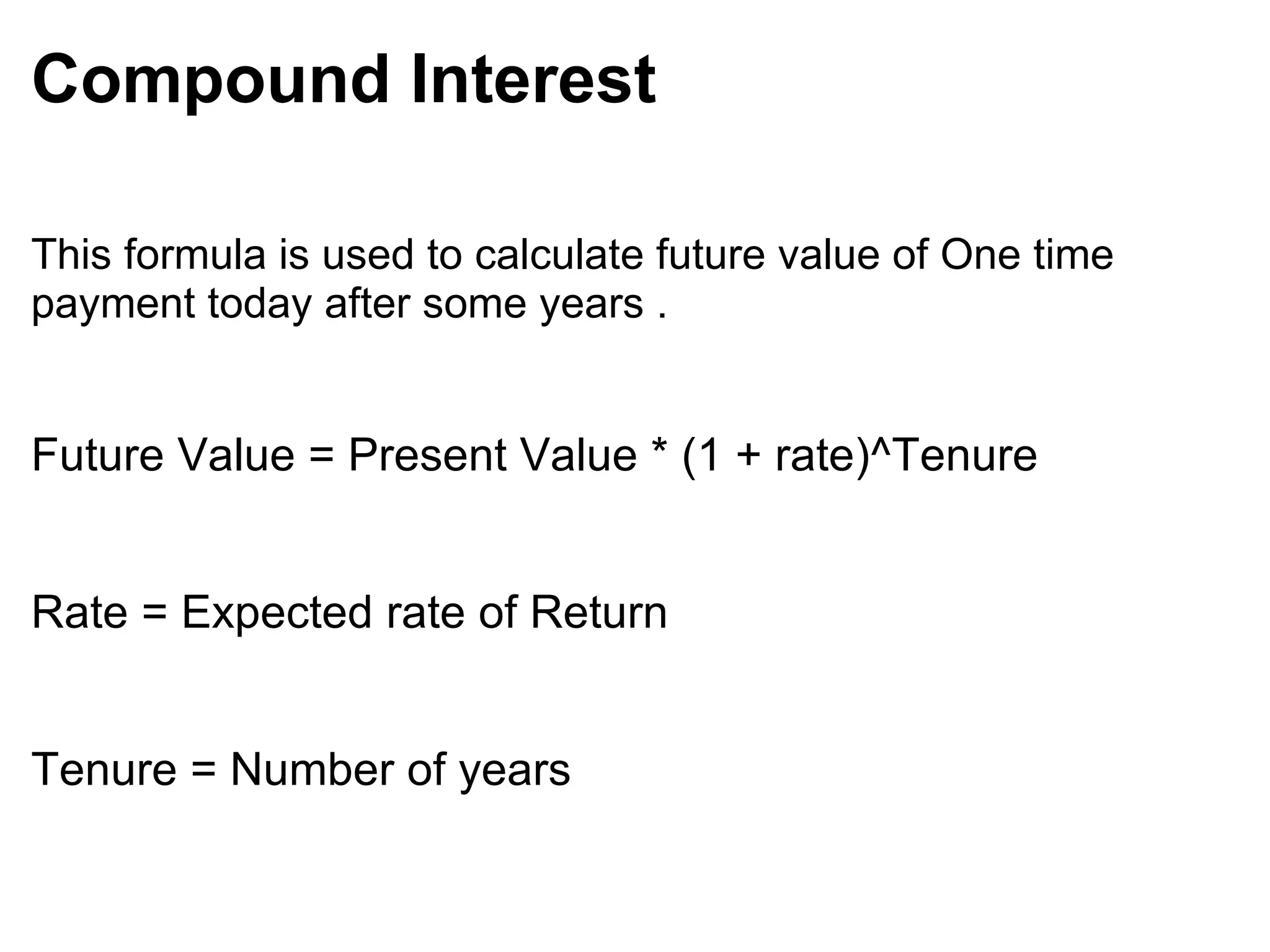
Compound Interest       This formula is used to calculate future value of One time payment today after some years . Future Value = Present Value * (1 + rate)^Tenure Rate = Expected rate of Return  Tenure = Number of years
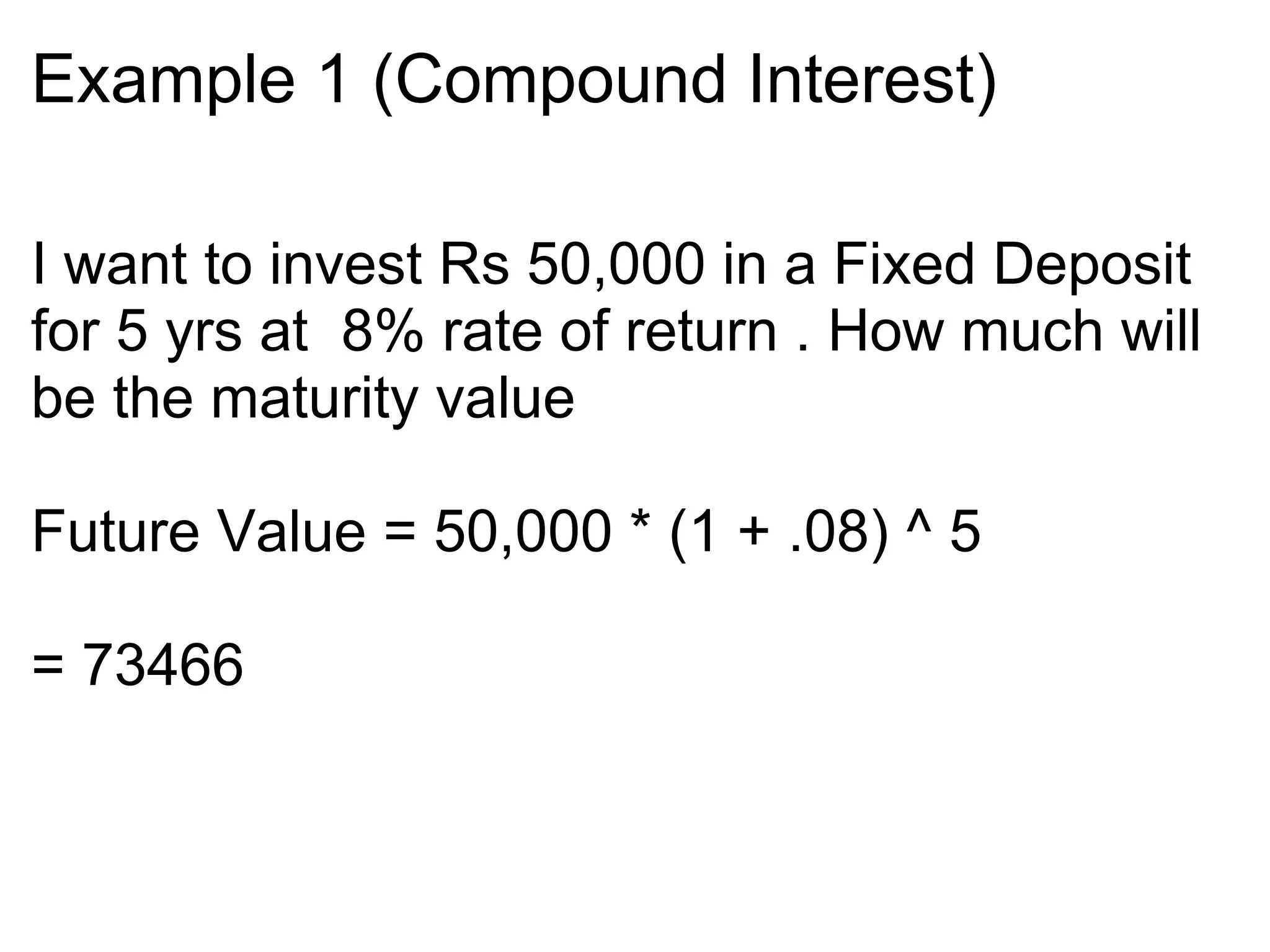
Example 1 (Compound Interest)‏ I want to invest Rs 50,000 in a Fixed Deposit for 5 yrs at  8% rate of return . How much will be the maturity value  Future Value = 50,000 * (1 + .08) ^ 5 = 73466 
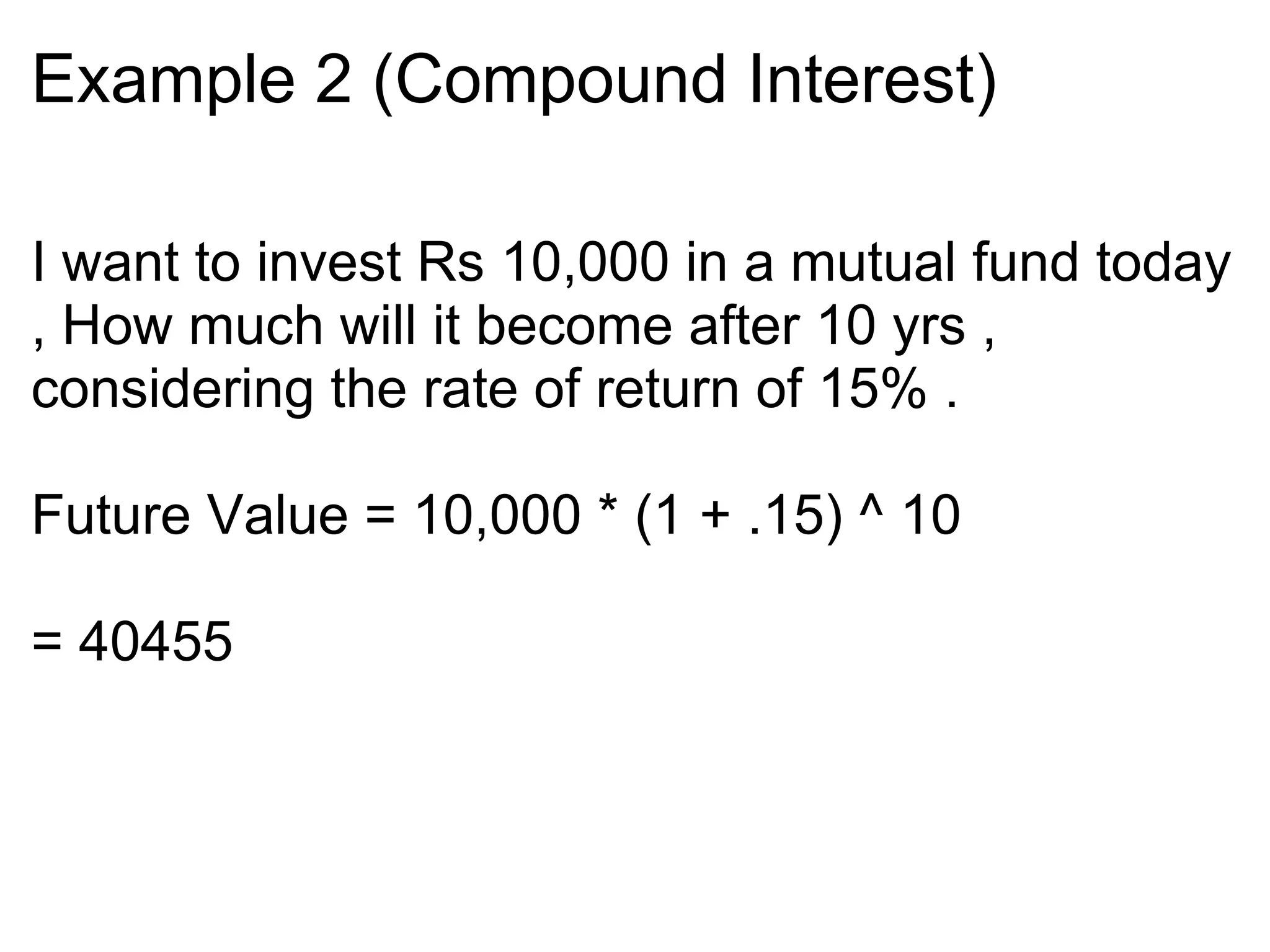
Example 2 (Compound Interest)‏ I want to invest Rs 10,000 in a mutual fund today , How much will it become after 10 yrs , considering the rate of return of 15% .    Future Value = 10,000 * (1 + .15) ^ 10   = 40455
Annuity   This formula is used to calculate the future value when we do investment on a regular basis after a fixed interval .       Example  - when we invest in a mutual fund per month through SIP . - When we put money in our PPF account each year .  Formula Future value = Amount per installment * (1+r) * [(1+r) ^n  - 1]/ r 
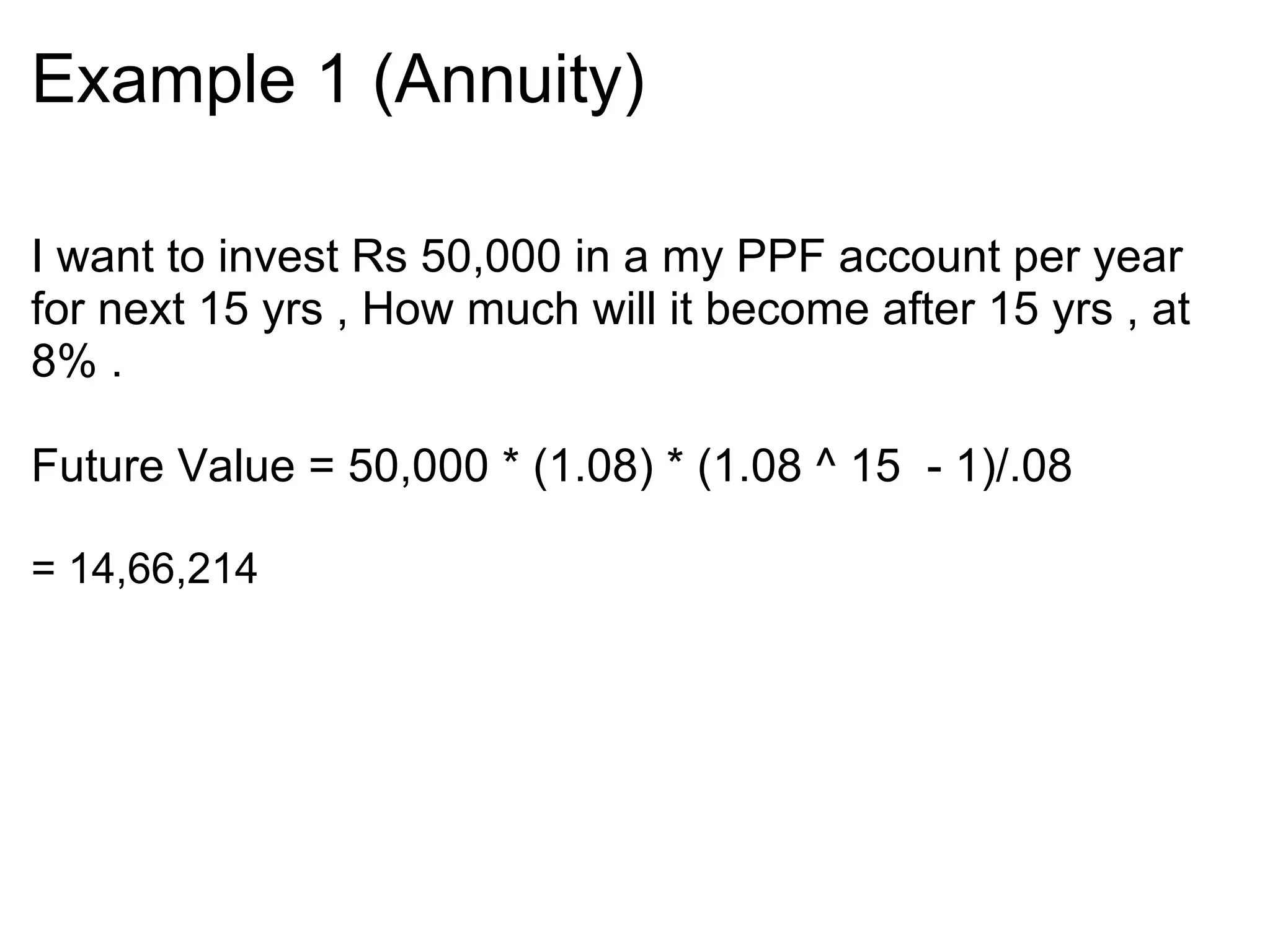
Example 1 (Annuity)‏ I want to invest Rs 50,000 in a my PPF account per year for next 15 yrs , How much will it become after 15 yrs , at 8% .    Future Value = 50,000 * (1.08) * (1.08 ^ 15  - 1)/.08 = 14,66,214
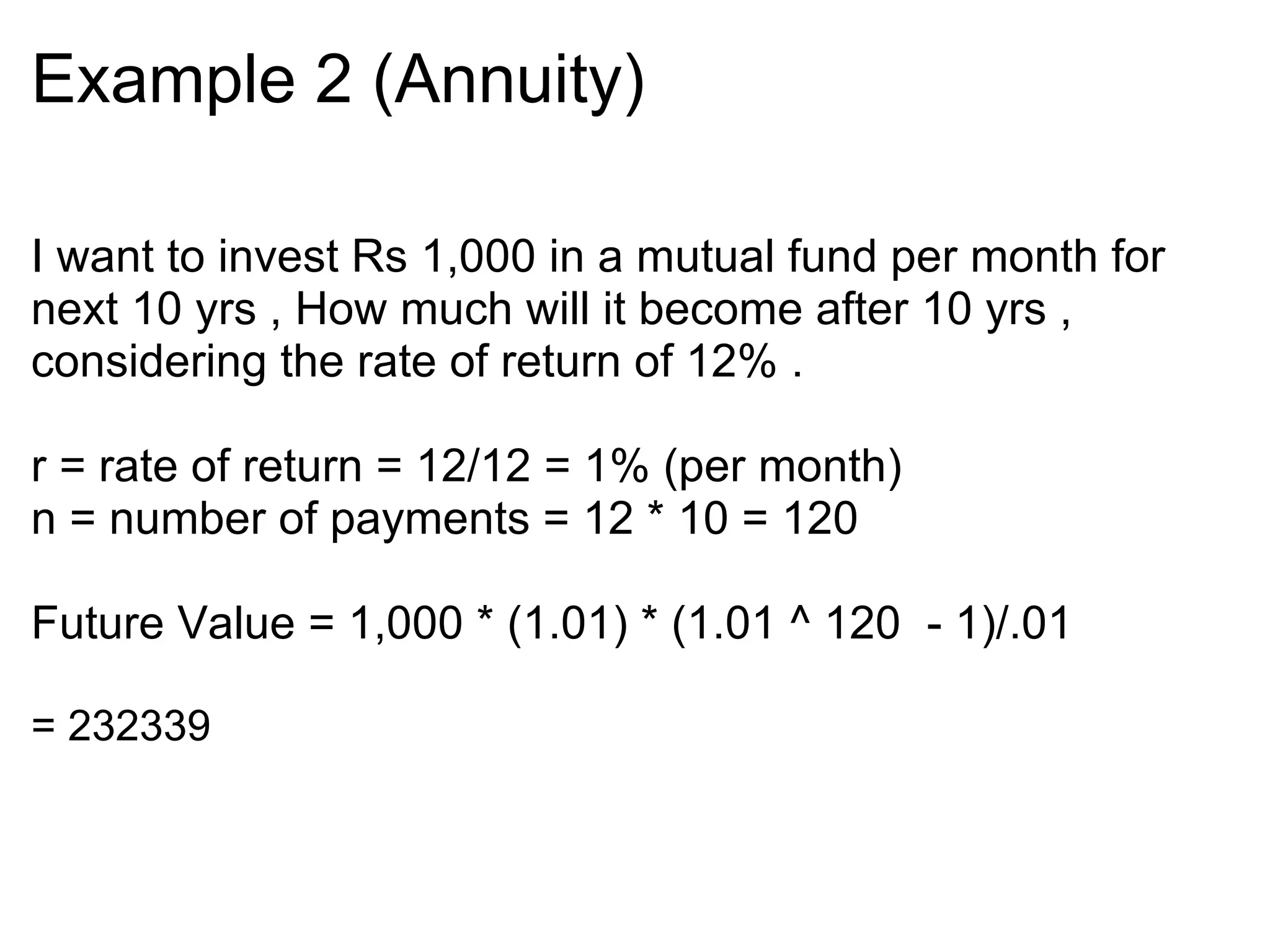
Example 2 (Annuity)‏ I want to invest Rs 1,000 in a mutual fund per month for next 10 yrs , How much will it become after 10 yrs , considering the rate of return of 12% .    r = rate of return = 12/12 = 1% (per month)  n = number of payments = 12 * 10 = 120   Future Value = 1,000 * (1.01) * (1.01 ^ 120  - 1)/.01  = 232339
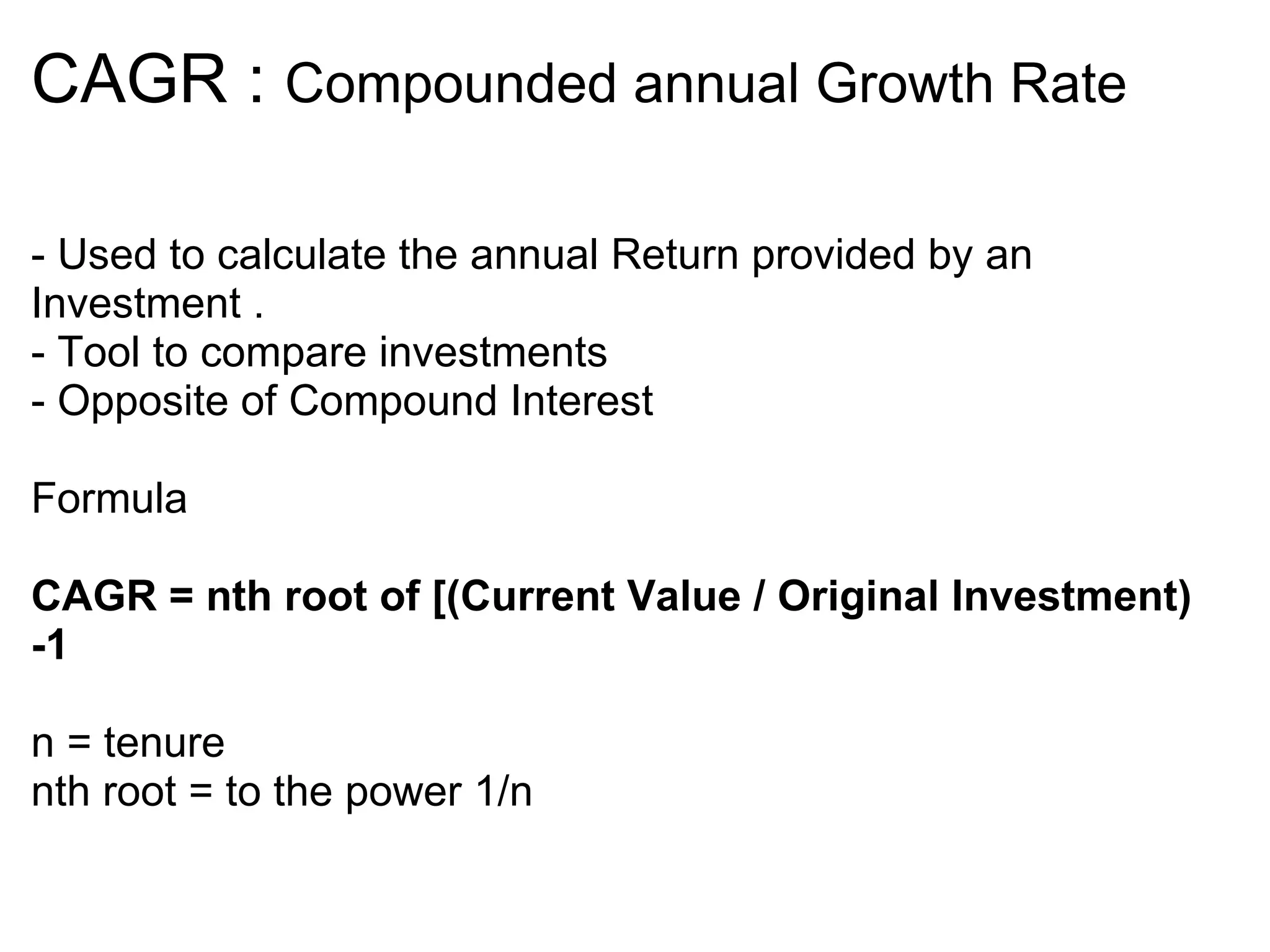
CAGR :  Compounded annual Growth Rate - Used to calculate the annual Return provided by an Investment . - Tool to compare investments  - Opposite of Compound Interest Formula  CAGR = nth root of [(Current Value / Original Investment) -1  n = tenure  nth root = to the power 1/n   
Example 1 (CAGR)‏ I Invested Rs 50,000 in a mutual fund on June 2005 , Its value after 4 yrs is Rs 1,00,000 . What is the annual returns it has provided to me ?  CAGR = [(100000 /50000)^ (1/4)   - 1 ] = 2 ^ .25   - 1 = .1892  = 18.92% Annual return
Example 2 (CAGR)‏ Which investment is Better ?    Investment 1 : 50,000 invested in 2000 became 2,00,000 in 2009   Investment 2 : 10,000 invested in 2004 became 25,000 in 2008 CAGR for Investment 1 = [200000/50000]^(1/9) - 1 = 16.65 %    CAGR for Investment 2 = [25000/10000] ^ (1/4) - 1 = 25.74%    Hence , Investment 2 is better than Investment 1 .           
                         Thanks

Important Calculations In Personal Finance

  • 1.
    Some Important Formula'sin Personal Finance   1. Compound Interest : 2. Annuity  3. CAGR Manish Chauhan http://www.jagoinvestor.com
  • 2.
    Compound Interest      This formula is used to calculate future value of One time payment today after some years . Future Value = Present Value * (1 + rate)^Tenure Rate = Expected rate of Return Tenure = Number of years
  • 3.
    Example 1 (CompoundInterest)‏ I want to invest Rs 50,000 in a Fixed Deposit for 5 yrs at  8% rate of return . How much will be the maturity value  Future Value = 50,000 * (1 + .08) ^ 5 = 73466 
  • 4.
    Example 2 (CompoundInterest)‏ I want to invest Rs 10,000 in a mutual fund today , How much will it become after 10 yrs , considering the rate of return of 15% .    Future Value = 10,000 * (1 + .15) ^ 10   = 40455
  • 5.
    Annuity  Thisformula is used to calculate the future value when we do investment on a regular basis after a fixed interval .      Example - when we invest in a mutual fund per month through SIP . - When we put money in our PPF account each year .  Formula Future value = Amount per installment * (1+r) * [(1+r) ^n  - 1]/ r 
  • 6.
    Example 1 (Annuity)‏I want to invest Rs 50,000 in a my PPF account per year for next 15 yrs , How much will it become after 15 yrs , at 8% .    Future Value = 50,000 * (1.08) * (1.08 ^ 15  - 1)/.08 = 14,66,214
  • 7.
    Example 2 (Annuity)‏I want to invest Rs 1,000 in a mutual fund per month for next 10 yrs , How much will it become after 10 yrs , considering the rate of return of 12% .    r = rate of return = 12/12 = 1% (per month) n = number of payments = 12 * 10 = 120   Future Value = 1,000 * (1.01) * (1.01 ^ 120  - 1)/.01  = 232339
  • 8.
    CAGR : Compounded annual Growth Rate - Used to calculate the annual Return provided by an Investment . - Tool to compare investments - Opposite of Compound Interest Formula  CAGR = nth root of [(Current Value / Original Investment) -1  n = tenure  nth root = to the power 1/n  
  • 9.
    Example 1 (CAGR)‏I Invested Rs 50,000 in a mutual fund on June 2005 , Its value after 4 yrs is Rs 1,00,000 . What is the annual returns it has provided to me ?  CAGR = [(100000 /50000)^ (1/4)   - 1 ] = 2 ^ .25   - 1 = .1892  = 18.92% Annual return
  • 10.
    Example 2 (CAGR)‏Which investment is Better ?    Investment 1 : 50,000 invested in 2000 became 2,00,000 in 2009   Investment 2 : 10,000 invested in 2004 became 25,000 in 2008 CAGR for Investment 1 = [200000/50000]^(1/9) - 1 = 16.65 %   CAGR for Investment 2 = [25000/10000] ^ (1/4) - 1 = 25.74%    Hence , Investment 2 is better than Investment 1 .           
  • 11.
                            Thanks