










How to grow your own
Microservice?
Dmitry Buzdin
Started a small consultancy company
• DevOps
• Test Automation
• Software Architecture
• Java/JVM
• Other Stuff: Agile/Web/Mobile
@buzdin
About Presenter
Agenda
• Why (not) microservices?
• Modular architecture
• Micromodule architecture
• Migrating to microservices
• Practical Advices
Welcome to the Wonderful World
of Microservices!
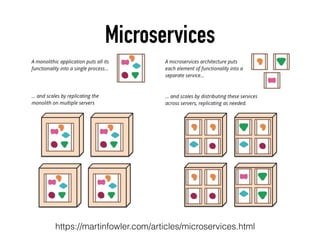
Microservices
https://martinfowler.com/articles/microservices.html
Splitting your system into
manageable, self-sufficient
services
http://microservices.io/
Why Microservices?
• Delivering value faster
• Easier to maintain then monolith
• Easier to change tech stack
• Easier to replace parts of your system
• More scalable
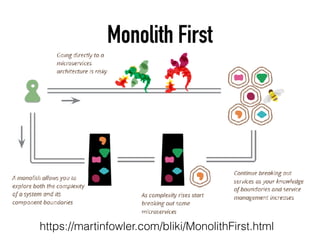
Monolith First
https://martinfowler.com/bliki/MonolithFirst.html
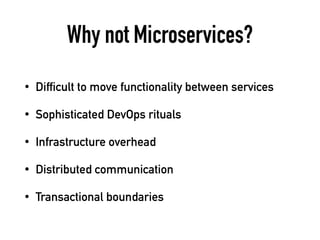
Why not Microservices?
• Difficult to move functionality between services
• Sophisticated DevOps rituals
• Infrastructure overhead
• Distributed communication
• Transactional boundaries
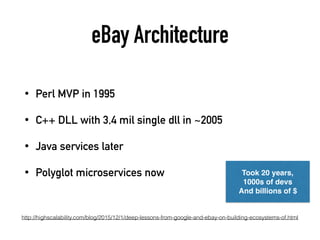
eBay Architecture
• Perl MVP in 1995
• C++ DLL with 3,4 mil single dll in ~2005
• Java services later
• Polyglot microservices now
http://highscalability.com/blog/2015/12/1/deep-lessons-from-google-and-ebay-on-building-ecosystems-of.html
Took 20 years,
1000s of devs
And billions of $
How do you start and improve an
Evolutionary Architecture?
Modular Architecture
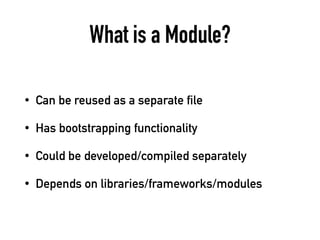
What is a Module?
• Can be reused as a separate file
• Has bootstrapping functionality
• Could be developed/compiled separately
• Depends on libraries/frameworks/modules
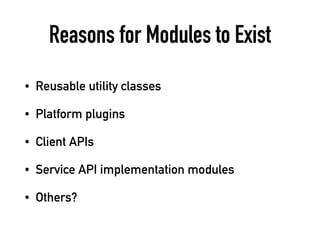
Reasons for Modules to Exist
• Reusable utility classes
• Platform plugins
• Client APIs
• Service API implementation modules
• Others?
Modular Architecture
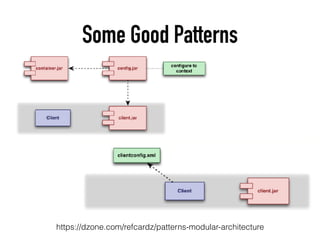
Some Good Patterns
https://dzone.com/refcardz/patterns-modular-architecture
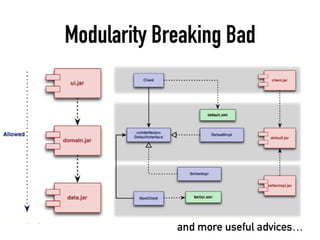
Modularity Breaking Bad
and more useful advices…
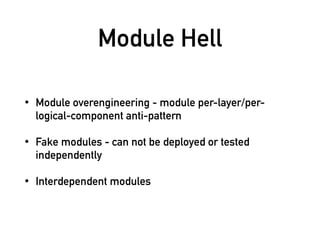
Module Hell
• Module overengineering - module per-layer/per-
logical-component anti-pattern
• Fake modules - can not be deployed or tested
independently
• Interdependent modules
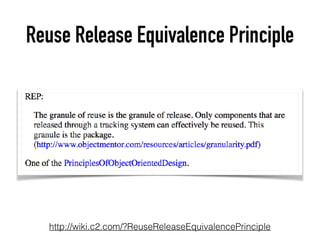
Reuse Release Equivalence Principle
http://wiki.c2.com/?ReuseReleaseEquivalencePrinciple
How to use modules properly?
Micromodules Architecture
Splitting your system into
manageable, self-sufficient
services modules
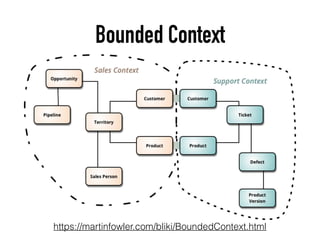
Bounded Context
https://martinfowler.com/bliki/BoundedContext.html
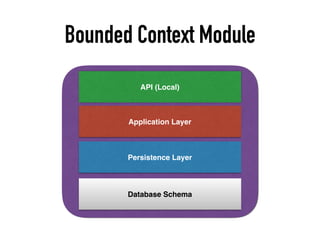
Bounded Context Module
Database Schema
Persistence Layer
Application Layer
API (Local)
Lots of micromodules are
deployed together
Micromodules
• Micromodules can be started and tested independently
• Deployed on same technological platform
• Runs in a single process/VM
• One or multiple deployable artifacts in the end
Same Storage
• Common database for many micromodules
• Separate schema for every bounded context
• Compatible approach for schema migrations
Module Types
• Bounded context (documents, users, payments)
• Aggregates
• Service provider interface modules
• Third-party integrations
• API Facade
• Client API
• Products
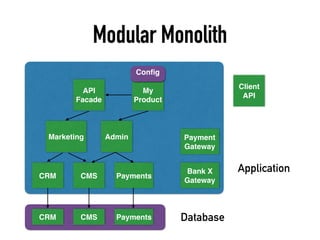
Modular Monolith
CRM CMS Payments
CRM CMS Payments
AdminMarketing
API
Facade
Database
Application
Payment
Gateway
Bank X
Gateway
Client
API
My
Product
Config
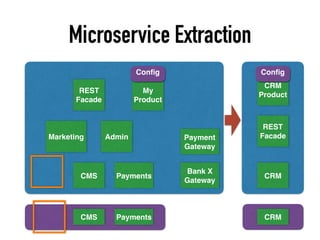
Microservice Extraction
CMS Payments
CRMCMS Payments
AdminMarketing
REST
Facade
Payment
Gateway
Bank X
Gateway
My
Product
Config
CRM
CRM
Product
REST
Facade
Config
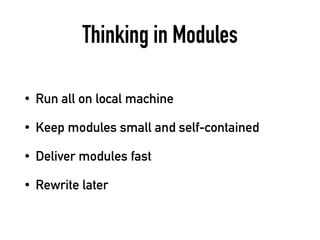
Thinking in Modules
• Run all on local machine
• Keep modules small and self-contained
• Deliver modules fast
• Rewrite later
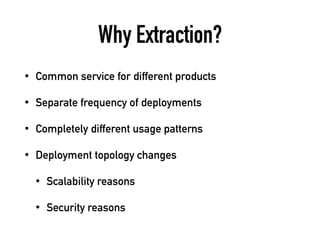
Why Extraction?
• Common service for different products
• Separate frequency of deployments
• Completely different usage patterns
• Deployment topology changes
• Scalability reasons
• Security reasons
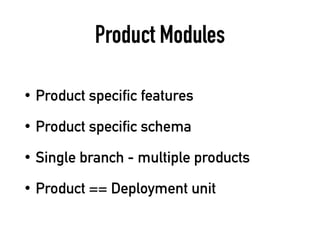
Product Modules
• Product specific features
• Product specific schema
• Single branch - multiple products
• Product == Deployment unit
Growing Microservices
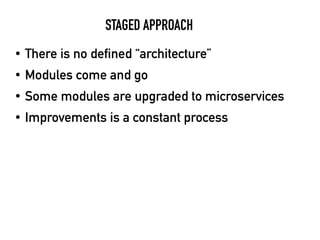
STAGED APPROACH
• There is no defined “architecture”
• Modules come and go
• Some modules are upgraded to microservices
• Improvements is a constant process
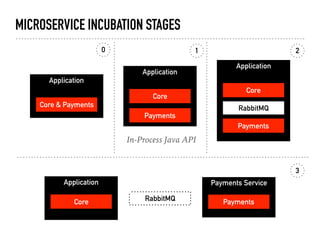
MICROSERVICE INCUBATION STAGES
Application
Core & Payments
Application
Payments
Core
RabbitMQ
Payments ServiceApplication
PaymentsCore RabbitMQ
0 1 2
3
Application
Payments
Core
In-Process Java API
Database
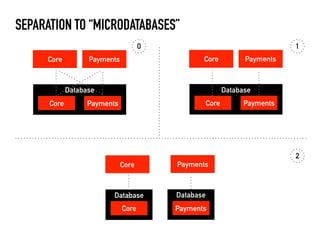
SEPARATION TO “MICRODATABASES”
Core
Core
0
2
Payments
Payments
Database
Core
Core
Payments
Payments
DatabaseDatabase
Core
Core
Payments
Payments
1
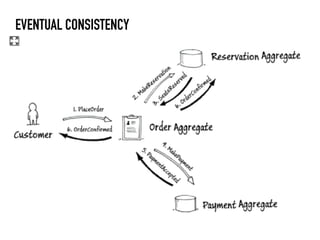
EVENTUAL CONSISTENCY
REFACTORING TO MICROSERVICES
• Staged refactoring approach would increase
confidence and success rate significantly
• Every “iteration” of changes ends up in a release and
being tested together with the product
• Existing code gets refactored
• Possibility to stop and re-plan at any time
Practical Advices
Don’t Write Reusable Frameworks
• Keep technical reusable code to minimum
• Reuse open sources packages
• Minimal common platform code
API-First Design
• Sync/Async
• REST API
• Event-based
• Test-driven development
• Documented (Swagger, RAML, ProtoBuf,
json-schema)
Do Not Expose Internals
• API contract annotations with generated client
• Defensive coding and validation in the service
• Event-based decoupling
• Do not expose persistent objects
Persistence
• ORM - data preparation and updates
• Direct SQL - read-only data retrieval and
aggregation
Schema per Bounded Context
• It is ok to have a lot of schemas in a single DB
• Schemas ensure logical data separation
• Cross-schema requests are possible
• Security control on schema level, not on table level!
Data Modeling
• No foreign keys between different bounded contexts
• Simple data structures - use JSON if required
• No deletes, few updates - insert only
• Everything is auditable
SQL/NoSQL
• PostgreSQL
• Relational data model (sql)
• Property based (jsonb)
• Key-value (hstore)
• Full-text search
Testing
• Integration testing is a must
• Relaxed approach to unit testing
• Docker for testing and local dev
• Acceptance testing is great, but expensive!
DevOps
• Automated Jenkins Pipelines
• Dev -> Test -> Stage -> Prod
• One-click deployments
• Limited use of Nexus/Artifactory (artifact in pipeline)
Kubernetes
• Becomes the default platform for
microservices
• Managed platform on Cloud – maybe ok
• Local installation, or manual support – think
twice!
Summary
Micromodules
• Same benefits as micro services, except
scalability and hybrid technologies
• Greatly reduced complexity
• On-demand upgrade to micro services
Start using micromodules now!
Migrate to micro services later, when you have lots of
money, devops and teams
How to grow your own Microservice?

How to grow your own Microservice?