Understanding
Microservices
Lego building for your platform
About Me


M A Hossain Tonu


@Vantage Labs Dhaka
mahtonu@vantage.com


Authored the title “PHP Application
Development with NetBeans:
Beginner's Guide”
mahtonu.wordpress.com
Imagine a local
railway platform…
Scenarios!
• Few small agile teams (co-located in different
offices + remote team) working on multiple
products
• When it comes to Refactor
• Failure and blame game is On
• New members joins in
• Worried about scalability?
• and so on..
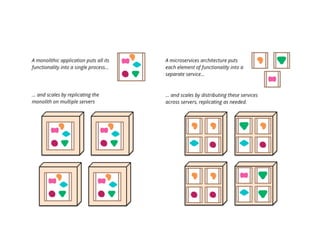
Monolithic App vs
Microservices
• A monolithic application built as a single unit.
• Enterprise Applications = a client-side user interface + a
database + a server-side application.
• Change cycles are tied together - a change made to a
small part of the application, requires the entire
monolith to be rebuilt and deployed.
• Over time it's often hard to keep a good modular
structure, making it harder to keep changes that ought
to only affect one module within that module.
• Scaling requires scaling of the entire application rather
than parts of it that require greater resource.
Microservice?
No official definition, No
Standards, 

But has a set of Characteristics
In short, the microservice architectural style is
an approach to developing a single application as
a suite of small services, each running in its own
process and communicating with lightweight
mechanisms, often an HTTP resource API.
Architectural Pattern
• The microservices approach is a first realisation of
SOA that followed the introduction of DevOps and
is becoming more popular for building continuously
deployed systems.
• In a microservices architecture, services should
have a small granularity and the protocols should
be lightweight.
• Reinforced by the Single Responsibility Principle
Why?
• Failure isolation (yes, you’ll be greatful when it comes
to debugging issue in production, and you have clear
boundaries of each service responsibilities)
• Decentralized data management
• Super fast deployments to independent components
(microservices)
• Scalability
• Flexibility
Benefits
• Distributing different responsibilities of the system into
different smaller services
• Decreases the coupling
• Easier to change and add functions and qualities to the
system
• Allows the architecture of an individual service to
emerge through continuous refactoring
• Reduces the need for a big up-front design and allows for
releasing software early and continuously.
Benefits
• Implemented using different programming
languages, databases, hardware and software
environment, depending on what fits best.
• Small in size, messaging enabled, bounded by
contexts, autonomously developed, independently
deployable, decentralized and built and released
with automated processes
• Design for Failures
Criticism
• Network latency, message formats, load balancing
and fault tolerance
• Inter-service calls over a network have a higher cost in
terms of network latency and message processing
time than in-process calls within a monolithic service
process
• Moving responsibilities between services is more
difficult. It may involve communication between
different teams, rewriting the functionality in another
language or fitting it into a different infrastructure
Prerequisites
• Rapid Provisioning
• Basic Monitoring
• Rapid Application Deployment
• Devops Culture
Case Study: 

Sample Microservices for an

E-Commerce Platform
An e-commerce platform
that
• Talks JSON over HTTP
• User interface:
• Web frontend (javascript client)
• iOS app
• Android app
• Third-party clients
E-commerce: Define Scopes
• User accounts
• Catalog
• Cart and Checkout
• Orders processing
• Inventory
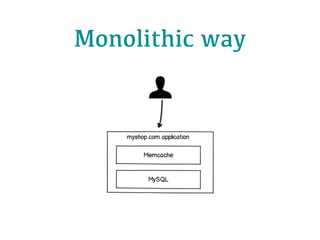
Monolithic way
• ALL requests that user makes follow this pattern:
• Request delivered to app
• App reaches out to memcache to see if there’s cached version of that resource
• If no, then it makes query to get resource from database
• Simple, easy, not so scalable. From both: development and performance
perspectives.
• Imagine 30 people working on same app codebase - nightmare! I bet in effective agile
environment, they’ll have quite a few problems and these will be amongst them:
• Slow and clumsy releases
• Hard to manage incoming changes
• Lack of continuous delivery
• Struggling with time it takes to manage codebase and keep all in sync
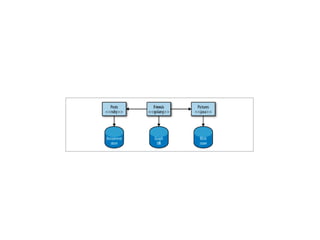
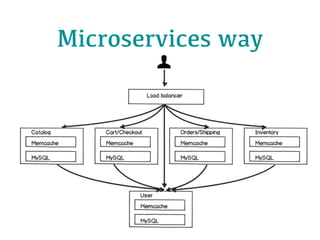
Microservices way
• Talks json
• Logically (and ideally physically) isolated from
others
• Doesn’t share resources with other apps
• Has it’s own codebase
• Has clearly defined data ownership
• Independent deployments
• Issues are easier to diagnose and debug
• More maintainable codebase
• More testable application
Known users
• Pivotal
• Uber
• Netflix
• Google
• Amazon
• Salesforce
• Soundcloud
Implementations
Docker
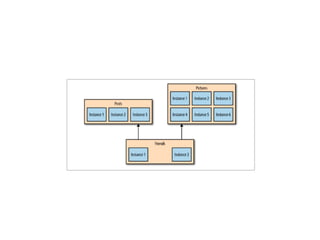
• Package the microservice as a (Docker) container
image.
• Deploy each service instance as a container.
• Scaling is done based on changing the number of
container instances.
• Building, deploying, and starting microservice will
be much faster as we are using Docker containers
(which is much faster than a regular VM)
References
• Martin Fowler’s Microservices: https://
martinfowler.com/articles/microservices.html
• Photo courtesy: martinfowler.com
Understanding Microservices

Understanding Microservices

  • 1.
  • 2.
    About Me 
 
 M AHossain Tonu
 
 @Vantage Labs Dhaka mahtonu@vantage.com 
 Authored the title “PHP Application Development with NetBeans: Beginner's Guide” mahtonu.wordpress.com
  • 3.
  • 5.
  • 6.
    • Few smallagile teams (co-located in different offices + remote team) working on multiple products • When it comes to Refactor • Failure and blame game is On • New members joins in • Worried about scalability? • and so on..
  • 7.
  • 9.
    • A monolithicapplication built as a single unit. • Enterprise Applications = a client-side user interface + a database + a server-side application. • Change cycles are tied together - a change made to a small part of the application, requires the entire monolith to be rebuilt and deployed. • Over time it's often hard to keep a good modular structure, making it harder to keep changes that ought to only affect one module within that module. • Scaling requires scaling of the entire application rather than parts of it that require greater resource.
  • 10.
  • 11.
    No official definition,No Standards, 
 But has a set of Characteristics
  • 12.
    In short, themicroservice architectural style is an approach to developing a single application as a suite of small services, each running in its own process and communicating with lightweight mechanisms, often an HTTP resource API.
  • 13.
    Architectural Pattern • Themicroservices approach is a first realisation of SOA that followed the introduction of DevOps and is becoming more popular for building continuously deployed systems. • In a microservices architecture, services should have a small granularity and the protocols should be lightweight. • Reinforced by the Single Responsibility Principle
  • 14.
    Why? • Failure isolation(yes, you’ll be greatful when it comes to debugging issue in production, and you have clear boundaries of each service responsibilities) • Decentralized data management • Super fast deployments to independent components (microservices) • Scalability • Flexibility
  • 15.
    Benefits • Distributing differentresponsibilities of the system into different smaller services • Decreases the coupling • Easier to change and add functions and qualities to the system • Allows the architecture of an individual service to emerge through continuous refactoring • Reduces the need for a big up-front design and allows for releasing software early and continuously.
  • 16.
    Benefits • Implemented usingdifferent programming languages, databases, hardware and software environment, depending on what fits best. • Small in size, messaging enabled, bounded by contexts, autonomously developed, independently deployable, decentralized and built and released with automated processes • Design for Failures
  • 19.
    Criticism • Network latency,message formats, load balancing and fault tolerance • Inter-service calls over a network have a higher cost in terms of network latency and message processing time than in-process calls within a monolithic service process • Moving responsibilities between services is more difficult. It may involve communication between different teams, rewriting the functionality in another language or fitting it into a different infrastructure
  • 20.
    Prerequisites • Rapid Provisioning •Basic Monitoring • Rapid Application Deployment • Devops Culture
  • 22.
    Case Study: 
 SampleMicroservices for an
 E-Commerce Platform
  • 23.
    An e-commerce platform that •Talks JSON over HTTP • User interface: • Web frontend (javascript client) • iOS app • Android app • Third-party clients
  • 24.
    E-commerce: Define Scopes •User accounts • Catalog • Cart and Checkout • Orders processing • Inventory
  • 25.
  • 26.
    • ALL requeststhat user makes follow this pattern: • Request delivered to app • App reaches out to memcache to see if there’s cached version of that resource • If no, then it makes query to get resource from database • Simple, easy, not so scalable. From both: development and performance perspectives. • Imagine 30 people working on same app codebase - nightmare! I bet in effective agile environment, they’ll have quite a few problems and these will be amongst them: • Slow and clumsy releases • Hard to manage incoming changes • Lack of continuous delivery • Struggling with time it takes to manage codebase and keep all in sync
  • 27.
  • 28.
    • Talks json •Logically (and ideally physically) isolated from others • Doesn’t share resources with other apps • Has it’s own codebase • Has clearly defined data ownership
  • 29.
    • Independent deployments •Issues are easier to diagnose and debug • More maintainable codebase • More testable application
  • 30.
    Known users • Pivotal •Uber • Netflix • Google • Amazon • Salesforce • Soundcloud
  • 31.
  • 33.
    Docker • Package themicroservice as a (Docker) container image. • Deploy each service instance as a container. • Scaling is done based on changing the number of container instances. • Building, deploying, and starting microservice will be much faster as we are using Docker containers (which is much faster than a regular VM)
  • 34.
    References • Martin Fowler’sMicroservices: https:// martinfowler.com/articles/microservices.html • Photo courtesy: martinfowler.com