David Blevins / Apache Software Foundation


Fun with EJB 3.1 //
And OpenEJB
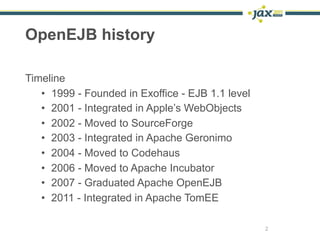
OpenEJB history

Timeline
   • 1999 - Founded in Exoffice - EJB 1.1 level
   • 2001 - Integrated in Apple’s WebObjects
   • 2002 - Moved to SourceForge
   • 2003 - Integrated in Apache Geronimo
   • 2004 - Moved to Codehaus
   • 2006 - Moved to Apache Incubator
   • 2007 - Graduated Apache OpenEJB
   • 2011 - Integrated in Apache TomEE

                                                  2
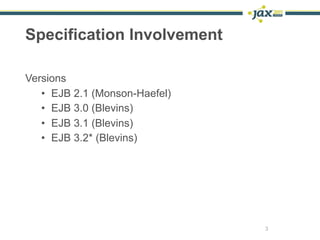
Specification Involvement

Versions
   • EJB 2.1 (Monson-Haefel)
   • EJB 3.0 (Blevins)
   • EJB 3.1 (Blevins)
   • EJB 3.2* (Blevins)


                               3
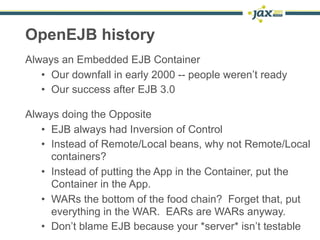
OpenEJB history
Always an Embedded EJB Container
   • Our downfall in early 2000 -- people weren’t ready
   • Our success after EJB 3.0

Always doing the Opposite
   • EJB always had Inversion of Control
   • Instead of Remote/Local beans, why not Remote/Local
     containers?
   • Instead of putting the App in the Container, put the
     Container in the App.
   • WARs the bottom of the food chain? Forget that, put
     everything in the WAR. EARs are WARs anyway.
   • Don’t blame EJB because your *server* isn’t testable
                                                    4
Primer
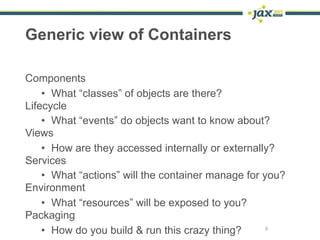
Generic view of Containers

Components
    • What “classes” of objects are there?
Lifecycle
    • What “events” do objects want to know about?
Views
    • How are they accessed internally or externally?
Services
    • What “actions” will the container manage for you?
Environment
    • What “resources” will be exposed to you?
Packaging
    • How do you build & run this crazy thing?      6
EJB through 3.0
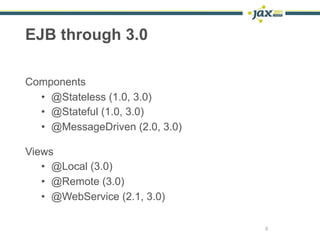
EJB through 3.0

Components
  • @Stateless (1.0, 3.0)
  • @Stateful (1.0, 3.0)
  • @MessageDriven (2.0, 3.0)

Views
   • @Local (3.0)
   • @Remote (3.0)
   • @WebService (2.1, 3.0)

                                8
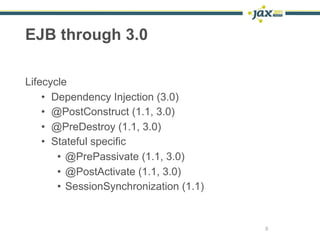
EJB through 3.0

Lifecycle
    • Dependency Injection (3.0)
    • @PostConstruct (1.1, 3.0)
    • @PreDestroy (1.1, 3.0)
    • Stateful specific
       • @PrePassivate (1.1, 3.0)
       • @PostActivate (1.1, 3.0)
       • SessionSynchronization (1.1)


                                        9
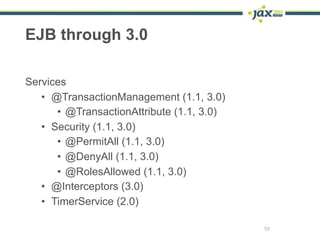
EJB through 3.0

Services
   • @TransactionManagement (1.1, 3.0)
      • @TransactionAttribute (1.1, 3.0)
   • Security (1.1, 3.0)
      • @PermitAll (1.1, 3.0)
      • @DenyAll (1.1, 3.0)
      • @RolesAllowed (1.1, 3.0)
   • @Interceptors (3.0)
   • TimerService (2.0)

                                           10
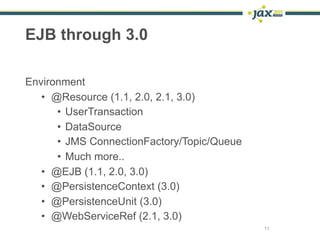
EJB through 3.0

Environment
   • @Resource (1.1, 2.0, 2.1, 3.0)
      • UserTransaction
      • DataSource
      • JMS ConnectionFactory/Topic/Queue
      • Much more..
   • @EJB (1.1, 2.0, 3.0)
   • @PersistenceContext (3.0)
   • @PersistenceUnit (3.0)
   • @WebServiceRef (2.1, 3.0)
                                            11
EJB through 3.0

Packaging
   • Java EE Server
      • Standalone EJB jar file
         • No standard mechanism for 3rd party libs
      • Combined in an EAR file


                                                12
EJB 3.1
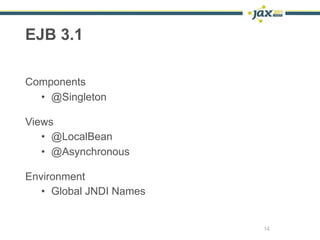
EJB 3.1

Components
  • @Singleton

Views
   • @LocalBean
   • @Asynchronous

Environment
   • Global JNDI Names


                         14
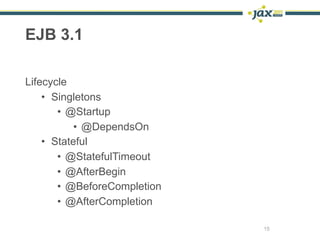
EJB 3.1

Lifecycle
    • Singletons
       • @Startup
           • @DependsOn
    • Stateful
       • @StatefulTimeout
       • @AfterBegin
       • @BeforeCompletion
       • @AfterCompletion

                             15
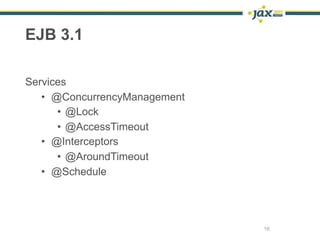
EJB 3.1

Services
   • @ConcurrencyManagement
      • @Lock
      • @AccessTimeout
   • @Interceptors
      • @AroundTimeout
   • @Schedule


                              16
EJB 3.1

Packaging
   • Java EE
      • EJB jars in WAR files
   • Java SE VM
      • Embedded EJBContainer API
         • Jar scanning a plain classpath
         • Modules: File/File[]/String/String[]


                                                  17
Next Gen EJB
Next Gen EJB

Components
  • @ManagedBean (plain cheese pizza, no toppings)

Services
   • Split them out individually (the toppings)

Meta Annotations
  • Rename the annotations to your liking
  • Summarize complex config easily
  • Reduce impact of change
                                                  19
Next Gen EJB

Interceptors
    • Multiple, qualified, @AroundInvoke methods
    • Middle ground between Loose & Strong typing
       • aka between Interceptor and Decorator
    • Fix Invoke signature mismatch

ApplicationException
  • Needs finer-grained control


                                               20
Next Gen EJB

Message Driven 2.0
  • Allow Connector annotations to be used
     • Eliminate loosely typed activation-config
  • Allow No-Interface MDBs
     • Connector Annotations are all that is needed
  • Psst, MDBs are really just Session beans
     • Why not allow @Singleton message consumers?

Non-AppClient injection
  • Non-AppClient lookup, check. Where’s injection?
  • @LocalClient and @RemoteClient
                                              21
Apache TomEE: Tomcat with a Kick
   2:25 - 3:15 | Beatrice Suite 1
            Wednesday

David Blevins & Jonathan Gallimore
Thank You!
openejb.apache.org

   David Blevins
dblevins@apache.org
 twitter.com/dblevins

Fun with EJB 3.1 and Open EJB

  • 1.
    David Blevins /Apache Software Foundation Fun with EJB 3.1 // And OpenEJB
  • 2.
    OpenEJB history Timeline • 1999 - Founded in Exoffice - EJB 1.1 level • 2001 - Integrated in Apple’s WebObjects • 2002 - Moved to SourceForge • 2003 - Integrated in Apache Geronimo • 2004 - Moved to Codehaus • 2006 - Moved to Apache Incubator • 2007 - Graduated Apache OpenEJB • 2011 - Integrated in Apache TomEE 2
  • 3.
    Specification Involvement Versions • EJB 2.1 (Monson-Haefel) • EJB 3.0 (Blevins) • EJB 3.1 (Blevins) • EJB 3.2* (Blevins) 3
  • 4.
    OpenEJB history Always anEmbedded EJB Container • Our downfall in early 2000 -- people weren’t ready • Our success after EJB 3.0 Always doing the Opposite • EJB always had Inversion of Control • Instead of Remote/Local beans, why not Remote/Local containers? • Instead of putting the App in the Container, put the Container in the App. • WARs the bottom of the food chain? Forget that, put everything in the WAR. EARs are WARs anyway. • Don’t blame EJB because your *server* isn’t testable 4
  • 5.
  • 6.
    Generic view ofContainers Components • What “classes” of objects are there? Lifecycle • What “events” do objects want to know about? Views • How are they accessed internally or externally? Services • What “actions” will the container manage for you? Environment • What “resources” will be exposed to you? Packaging • How do you build & run this crazy thing? 6
  • 7.
  • 8.
    EJB through 3.0 Components • @Stateless (1.0, 3.0) • @Stateful (1.0, 3.0) • @MessageDriven (2.0, 3.0) Views • @Local (3.0) • @Remote (3.0) • @WebService (2.1, 3.0) 8
  • 9.
    EJB through 3.0 Lifecycle • Dependency Injection (3.0) • @PostConstruct (1.1, 3.0) • @PreDestroy (1.1, 3.0) • Stateful specific • @PrePassivate (1.1, 3.0) • @PostActivate (1.1, 3.0) • SessionSynchronization (1.1) 9
  • 10.
    EJB through 3.0 Services • @TransactionManagement (1.1, 3.0) • @TransactionAttribute (1.1, 3.0) • Security (1.1, 3.0) • @PermitAll (1.1, 3.0) • @DenyAll (1.1, 3.0) • @RolesAllowed (1.1, 3.0) • @Interceptors (3.0) • TimerService (2.0) 10
  • 11.
    EJB through 3.0 Environment • @Resource (1.1, 2.0, 2.1, 3.0) • UserTransaction • DataSource • JMS ConnectionFactory/Topic/Queue • Much more.. • @EJB (1.1, 2.0, 3.0) • @PersistenceContext (3.0) • @PersistenceUnit (3.0) • @WebServiceRef (2.1, 3.0) 11
  • 12.
    EJB through 3.0 Packaging • Java EE Server • Standalone EJB jar file • No standard mechanism for 3rd party libs • Combined in an EAR file 12
  • 13.
  • 14.
    EJB 3.1 Components • @Singleton Views • @LocalBean • @Asynchronous Environment • Global JNDI Names 14
  • 15.
    EJB 3.1 Lifecycle • Singletons • @Startup • @DependsOn • Stateful • @StatefulTimeout • @AfterBegin • @BeforeCompletion • @AfterCompletion 15
  • 16.
    EJB 3.1 Services • @ConcurrencyManagement • @Lock • @AccessTimeout • @Interceptors • @AroundTimeout • @Schedule 16
  • 17.
    EJB 3.1 Packaging • Java EE • EJB jars in WAR files • Java SE VM • Embedded EJBContainer API • Jar scanning a plain classpath • Modules: File/File[]/String/String[] 17
  • 18.
  • 19.
    Next Gen EJB Components • @ManagedBean (plain cheese pizza, no toppings) Services • Split them out individually (the toppings) Meta Annotations • Rename the annotations to your liking • Summarize complex config easily • Reduce impact of change 19
  • 20.
    Next Gen EJB Interceptors • Multiple, qualified, @AroundInvoke methods • Middle ground between Loose & Strong typing • aka between Interceptor and Decorator • Fix Invoke signature mismatch ApplicationException • Needs finer-grained control 20
  • 21.
    Next Gen EJB MessageDriven 2.0 • Allow Connector annotations to be used • Eliminate loosely typed activation-config • Allow No-Interface MDBs • Connector Annotations are all that is needed • Psst, MDBs are really just Session beans • Why not allow @Singleton message consumers? Non-AppClient injection • Non-AppClient lookup, check. Where’s injection? • @LocalClient and @RemoteClient 21
  • 22.
    Apache TomEE: Tomcatwith a Kick 2:25 - 3:15 | Beatrice Suite 1 Wednesday David Blevins & Jonathan Gallimore
  • 23.
    Thank You! openejb.apache.org David Blevins dblevins@apache.org twitter.com/dblevins