Top 50+ Microservices Interview Questions
and Answers 2024
Microservices Interview Questions
Microservices are a software architectural style in which an application is divided into small,
loosely coupled services that can be developed, deployed, and maintained independently.
Whether you work with Python, Java, or some other technology, you can still find yourself on a
team dealing with microservices. So while interviewing interviewer may ask you some
microservices interview questionsespecially those related to server-side development.
Considering all these aspects in mind, In this Microservices tutorial, we have prepared a
comprehensive guide on the Microservices Interview Questions and Answers. These 50+
Microservices Interview Questions and Answers are well-framed and designed by experts
after proper research and analysis. It will help you counter some of the many challenges the
interviewers throw in your microservices interviews.
Basic Microservices Interview Questions and
Answers for Beginners
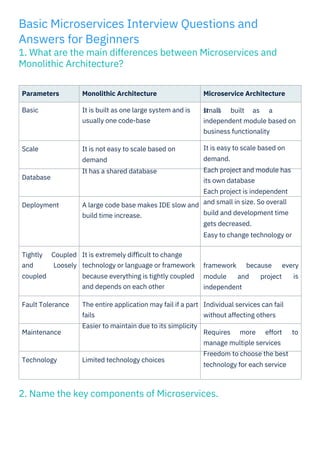
1. What are the main differences between Microservices and
Monolithic Architecture?
2. Name the key components of Microservices.
Parameters
Basic
Monolithic Architecture
It is built as one large system and is
usually one code-base
Microservice Architecture
It is built as a
small
independent module based on
business functionality
It is easy to scale based on
demand.
Each project and module has
its own database
Each project is independent
and small in size. So overall
build and development time
gets decreased.
Easy to change technology or
Scale It is not easy to scale based on
demand
It has a shared database
Database
Deployment A large code base makes IDE slow and
build time increase.
Tightly
and
coupled
Coupled
Loosely
It is extremely difficult to change
technology or language or framework
because everything is tightly coupled
and depends on each other
framework because every
is
module and project
independent
Fault Tolerance The entire application may fail if a part
fails
Easier to maintain due to its simplicity
Individual services can fail
without affecting others
Maintenance Requires more effort to
manage multiple services
Freedom to choose the best
technology for each service
Technology Limited technology choices
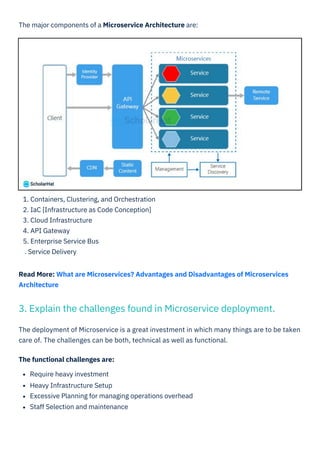
1. Containers, Clustering, and Orchestration
2. IaC [Infrastructure as Code Conception]
3. Cloud Infrastructure
4. API Gateway
5. Enterprise Service Bus
. Service Delivery
The major components of a Microservice Architecture are:
The deployment of Microservice is a great investment in which many things are to be taken
care of. The challenges can be both, technical as well as functional.
The functional challenges are:
Require heavy investment
Heavy Infrastructure Setup
Excessive Planning for managing operations overhead
Staff Selection and maintenance
Read More: What are Microservices? Advantages and Disadvantages of Microservices
Architecture
3. Explain the challenges found in Microservice deployment.
Course Name
.Net Microservices Certification
Training Type
Live Training
The various technical challenges that come to the surface are:
Communication between different microservices in the application.
Component automation
Application maintenance
Configuration Management
Heavy Operations Overhead
Deployment Challenges
Testing and Debugging Challenges
In the following cases there can be a need to implement Microservices Architecture:
Book a FREE Live Demo!
Access your Free Demo
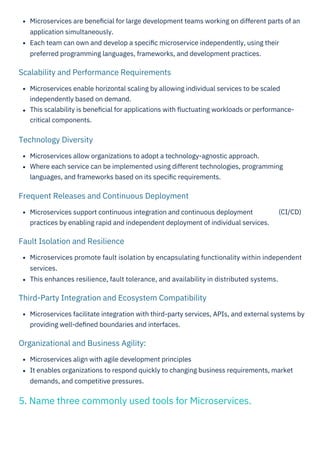
Microservices are well-suited for complex applications with evolving requirements, where
different parts of the system have varying scalability, performance, and deployment needs.
4. What are the cases when you need to consider microservice
architecture?
Level up your career with a .Net Microservices Certification |
Enroll in a .Net Microservices Certification course now.
Large Development Teams
Complex and Evolving Applications
Microservices support continuous integration and continuous deployment
practices by enabling rapid and independent deployment of individual services.
Microservices allow organizations to adopt a technology-agnostic approach.
Where each service can be implemented using different technologies, programming
languages, and frameworks based on its specific requirements.
Microservices facilitate integration with third-party services, APIs, and external systems by
providing well-defined boundaries and interfaces.
(CI/CD)
Microservices are beneficial for large development teams working on different parts of an
application simultaneously.
Each team can own and develop a specific microservice independently, using their
preferred programming languages, frameworks, and development practices.
Microservices promote fault isolation by encapsulating functionality within independent
services.
This enhances resilience, fault tolerance, and availability in distributed systems.
Microservices align with agile development principles
It enables organizations to respond quickly to changing business requirements, market
demands, and competitive pressures.
Microservices enable horizontal scaling by allowing individual services to be scaled
independently based on demand.
This scalability is beneficial for applications with fluctuating workloads or performance-
critical components.
Technology Diversity
Fault Isolation and Resilience
Organizational and Business Agility:
Scalability and Performance Requirements
Frequent Releases and Continuous Deployment
Third-Party Integration and Ecosystem Compatibility
5. Name three commonly used tools for Microservices.
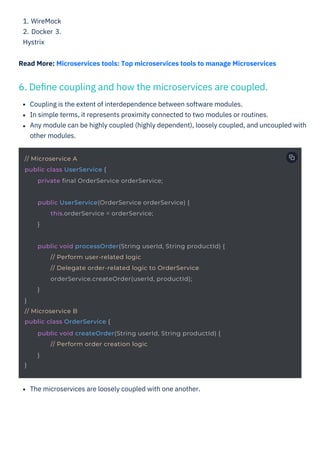
1. WireMock
2. Docker 3.
Hystrix
The microservices are loosely coupled with one another.
Read More: Microservices tools: Top microservices tools to manage Microservices
Coupling is the extent of interdependence between software modules.
In simple terms, it represents proximity connected to two modules or routines.
Any module can be highly coupled (highly dependent), loosely coupled, and uncoupled with
other modules.
6. Define coupling and how the microservices are coupled.
// Microservice A
public class UserService {
private final OrderService orderService;
public UserService(OrderService orderService) {
this.orderService = orderService;
}
}
// Microservice B
public class OrderService {
public void processOrder(String userId, String productId) {
// Perform user-related logic
// Delegate order-related logic to OrderService
orderService.createOrder(userId, productId);
}
}
public void createOrder(String userId, String productId) {
// Perform order creation logic
}
8. Describe the three types of tests for Microservices.
The three types of tests are mentioned below:
7. Which are the popular companies implementing Microservices
architecture?
Tech giants like Microsoft, Twitter, Amazon, Uber, Netflix, etc. are implementing Microservices
architecture.
Read More: Why 73% of Big Companies are using Microservices Architecture?
Containers are the easiest and most effective method to manage the microservice-based
application. There are several reasons to support this:
1. General tests: In this category come the performance and unit tests at the bottom level.
Such tests are fully automated.
2. Exploratory tests: These tests are performed at the middle level. Usability tests and stress
tests fall into this category.
3. Acceptance tests: These tests are performed at the top level. Mostly, they are fewer in
numbers. The same assists stakeholders in getting an idea of varied software features.
Isolation: Containers provide lightweight, isolated environments for running individual
microservices. Each microservice can be packaged as a container image along with its
dependencies, libraries, and runtime environment. Portability: Microservices packaged as
containers can be easily moved and deployed
across various infrastructure platforms, such as on-premises servers, public clouds, and
hybrid environments.
9. Why do Microservices use containers?
RESTful also known as REST (Representational State Transfer) web service is an
architectural style that assists the computer systems in seamlessly communicating across
the Internet.
Such web services make it easier to understand and deploy microservices.
API Gateway is an exceptional class of microservices that fulfills the requirement of a single
client application. Itacts as a central entry point that handles client requests and then routes
them to the appropriate microservices. It serves several purposes:
1. Aggregation: The API gateway can combine multiple backend microservices' responses
into a single cohesive response to fulfill a client request. This reduces round-trips.
2. Load balancing: The gateway can distribute incoming requests across multiple instances
of the same microservice to ensure optimal resource utilization and high availability.
3. Authentication and authorization: It can handle security-related concerns by
authenticating clients and authorizing access to specific microservices.
4. Caching: The API gateway can cache responses from microservices to improve
performance and reduce redundant requests.
5. Protocol translation: It can translate client requests from one protocol (e.g., HTTP/REST)
to the appropriate protocol used by the underlying microservices.
Consistency: By packaging microservices as container images, organizations can maintain
consistent runtime environments and dependencies across different stages of the software
development lifecycle. Resource Efficiency: Containers are lightweight and consume
fewer resources compared
to virtual machines (VMs). This resource efficiency is particularly beneficial in
microservices architectures with large numbers of services and instances.
Scalability: Containers support horizontal scaling, allowing organizations to scale
individual microservices independently based on demand. Lifecycle Management:
Containers provide tools and APIs for managing the lifecycle of microservices, including
image creation, deployment, versioning, scaling, and orchestration. DevOps Practices:
Containers align with DevOps practices and enable organizations to automate the software
delivery pipeline from development to production.
10. What is API Gateway?
11. What is RESTful? What is the role of RESTful APIs in
Microservices?
Spring Boot is an open-sourced, Java-based framework that provides an excellent platform
for developing a stand-alone and production-grade spring application.
It is easy to understand, increases productivity, and reduces development time.
A microservice is based on the concept that all its component services interact with one
another to complete the business functionality.
This requires each microservice to have an interface.
RESTful APIs provide a logical model for building these interfaces.
It is based on the open networking principles of the Web.
Thus, it serves as the most critical enabler of microservices.
Implementing end-to-end testing involves:
1. Test data preparation: Prepare a set of test data representing different scenarios and
expected outcomes.
2. Test environment setup: Set up a test environment that closely resembles the production
environment, including the necessary microservices and databases.
3. Test orchestration: Create test scripts that simulate user interactions and exercise the
application's end-to-end flow, including API calls between microservices.
4. Test frameworks: Use testing frameworks like Selenium for frontend testing and tools like
Postman or RestAssured for API testing.
5. Mocking: Mock external services or use service virtualization to simulate dependencies
and external interactions during testing.
. Automation: Automate end-to-end tests to enable continuous testing and faster feedback
during development.
7. Data cleanup: Implement data cleanup mechanisms to reset test data after each test run to
ensure test independence.
End-to-end testing authenticates every workflow process to ensure everything works
flawlessly.
The corresponding tests can encompass the gaps during integration testing or unit testing.
Also, it makes sure that the network parameters are properly configured and facilitates the
advancement of microservices.
12. What is end-to-end testing of Microservices? How to
implement it for microservices applications?
13. What Is Spring Boot? How to implement Microservices using
Spring Boot?
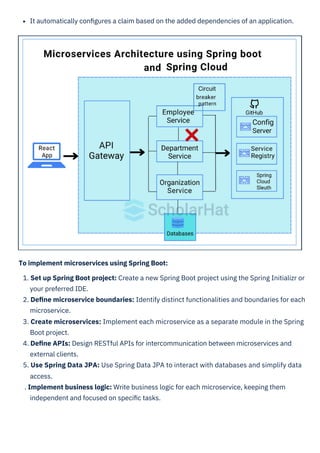
It automatically configures a claim based on the added dependencies of an application.
To implement microservices using Spring Boot:
1. Set up Spring Boot project: Create a new Spring Boot project using the Spring Initializr or
your preferred IDE.
2. Define microservice boundaries: Identify distinct functionalities and boundaries for each
microservice.
3. Create microservices: Implement each microservice as a separate module in the Spring
Boot project.
4. Define APIs: Design RESTful APIs for intercommunication between microservices and
external clients.
5. Use Spring Data JPA: Use Spring Data JPA to interact with databases and simplify data
access.
. Implement business logic: Write business logic for each microservice, keeping them
independent and focused on specific tasks.
Spring Cloud can deal with the following problems:
Redundancy issues occurring in distributed systems
Network issues, bandwidth issues, latency overhead, and security issues
Stabilizing the allotment of load amongst resources like CPU, network links, clusters, etc
Service discovery issues to guarantee flawless communication amid services in a cluster
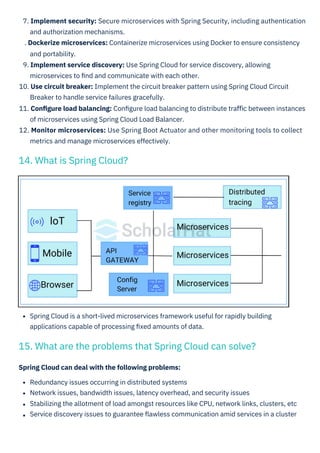
Spring Cloud is a short-lived microservices framework useful for rapidly building
applications capable of processing fixed amounts of data.
7. Implement security: Secure microservices with Spring Security, including authentication
and authorization mechanisms.
. Dockerize microservices: Containerize microservices using Docker to ensure consistency
and portability.
9. Implement service discovery: Use Spring Cloud for service discovery, allowing
microservices to find and communicate with each other.
10. Use circuit breaker: Implement the circuit breaker pattern using Spring Cloud Circuit
Breaker to handle service failures gracefully.
11. Configure load balancing: Configure load balancing to distribute traffic between instances
of microservices using Spring Cloud Load Balancer.
12. Monitor microservices: Use Spring Boot Actuator and other monitoring tools to collect
metrics and manage microservices effectively.
14. What is Spring Cloud?
15. What are the problems that Spring Cloud can solve?
Performance issues arising due to operational overheads
Pros of Microservice Architecture:
Flexibility to use different technologies
Every microservices work on a single capability
Guarantees security of each service
Multiple services are simultaneously developed and deployed
Supports frequent software releases
Cons of Microservice Architecture:
Needs more effort from the user end for configuration and other tasks
Difficult to troubleshoot
Raises delay because of remote calls
Difficult to keep up with transaction safety
Difficult to track data over different boundaries
Reports and dashboards are useful for monitoring and maintenance of microservices.
Multiple tools are available to accomplish this purpose. Reports and dashboards help to:
Determine which resources are supported by which Microservices.
Determine which services are impacted when components are changed or replaced.
Make documentation accessible at all times.
Examine the component versions that have been deployed.
Determine the components' maturity and compliance levels.
The actuator is primarily used to render operational information regarding the various
parameters of a running application.
These parameters are metrics, health, dump, info, env, etc.
For smooth interaction, it makes use of JMX beans or HTTP endpoints.
16. What is an Actuator?
18. What are the pros and cons of Microservice Architecture?
17. What is the need for reports and dashboards in Microservices?
20. What is OAuth?
21. What is Continuous Integration (CI) in Microservices?
19. What is Distributed Transaction? What are its associated
challenges?
Continuous Integration (CI) in microservices is the practice of integrating code changes
from multiple developers into a shared repository frequently.
Distributed Transaction is a situation where a single event leads to the transformation of
two or more disconnected sources of data that could not be allocated atomically.
Transactions are handled by a transaction manager responsible for developing and
handling transactions.
If the transaction involves more than one peer, transaction managers of each peer
communicate with each other using subordinate or superior relationships.
In the same way, resources are handled by the resource manager who also coordinates with
the distributed transaction coordinator for transaction atomicity and isolation.
Challenges of Distributed Transactions:
Maintaining transactional consistency across multiple services and databases.
Handling partial failures or rollbacks when one or more services encounter errors.
Avoiding long-running transactions that may impact system performance and scalability.
Managing distributed locks and preventing deadlocks.
OAuth is the full form of Open-standard Authorization Protocol.
It is a framework that depicts how distinct services and servers can safely enable authentic
access to their assets.
For the same, there is no need to share the interrelated, single login credentials.
It is possible to share resources saved on one website with another website; no need to use
their credentials.
OAuth also enables access to the resources from the resource owner.
It does so by permitting the client applications on third-party providers like GitHub,
Facebook, etc.
Microservices Interview Questions for Intermediate
In the context of microservices architecture, CI involves automating the process of
building, testing, and deploying individual microservices to ensure that changes are
integrated smoothly and reliably into the system.
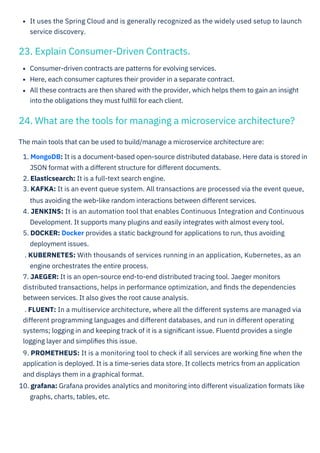
Eureka is alternatively famous as the Netflix Service Discovery Server.
It's an implementation of a service discovery pattern, where microservices can register
themselves so others can discover them.
This server holds information about the client service applications.
Each microservice registers into the Eureka server and the Eureka server knows all client
applications running on each port and IP address.
22. What is Eureka concerning Microservices?
It uses the Spring Cloud and is generally recognized as the widely used setup to launch
service discovery.
Consumer-driven contracts are patterns for evolving services.
Here, each consumer captures their provider in a separate contract.
All these contracts are then shared with the provider, which helps them to gain an insight
into the obligations they must fulfill for each client.
The main tools that can be used to build/manage a microservice architecture are:
1. MongoDB: It is a document-based open-source distributed database. Here data is stored in
JSON format with a different structure for different documents.
2. Elasticsearch: It is a full-text search engine.
3. KAFKA: It is an event queue system. All transactions are processed via the event queue,
thus avoiding the web-like random interactions between different services.
4. JENKINS: It is an automation tool that enables Continuous Integration and Continuous
Development. It supports many plugins and easily integrates with almost every tool.
5. DOCKER: Docker provides a static background for applications to run, thus avoiding
deployment issues.
. KUBERNETES: With thousands of services running in an application, Kubernetes, as an
engine orchestrates the entire process.
7. JAEGER: It is an open-source end-to-end distributed tracing tool. Jaeger monitors
distributed transactions, helps in performance optimization, and finds the dependencies
between services. It also gives the root cause analysis.
. FLUENT: In a multiservice architecture, where all the different systems are managed via
different programming languages and different databases, and run in different operating
systems; logging in and keeping track of it is a significant issue. Fluentd provides a single
logging layer and simplifies this issue.
9. PROMETHEUS: It is a monitoring tool to check if all services are working fine when the
application is deployed. It is a time-series data store. It collects metrics from an application
and displays them in a graphical format.
10. grafana: Grafana provides analytics and monitoring into different visualization formats like
graphs, charts, tables, etc.
23. Explain Consumer-Driven Contracts.
24. What are the tools for managing a microservice architecture?
We can follow the following approach to monitor microservices deployments and rollbacks:
1. Version tracking: Keep a record of the deployed versions of each microservice to track
changes and rollbacks accurately.
2. Real-time monitoring: Utilize monitoring and observability tools to monitor the
performance, health, and error rates of the new deployment.
3. Canary deployments: Deploy new versions to a subset of users (canary deployments) to
assess their behavior and performance before a full rollout.
4. A/B testing: Conduct A/B testing during deployments to compare the performance and
user experience of different versions.
A method (or API) is idempotent if it can be invoked multiple times with an identical request
without having adverse consequences.
In a microservices architecture, it is recommended to implement retry mechanisms for
improved overall resiliency of the system.
This however can lead to the invoked microservice or consumer receiving more than one
identical request.
If the microservice is not built to be idempotent, this can lead to multiple copies of the
same transaction and/or other adverse effects.
It is therefore important for microservices that expose APIs or consume messages to
implement idempotency in a microservices architecture.
North-South traffic is the network traffic that flows from external consumers such as end-
users, and mobile or web applications.
East-West traffic in a microservices architecture is the network traffic that flows between
internal services or components, such as different microservices within an application.
11. NGINX: It acts as a reverse proxy. It acts as a single point entry through which all the API
calls are made.
27. How will you monitor microservices deployments and
rollbacks effectively?
26. What is north-south and east-west traffic in Microservices
Architecture?
25. What is idempotency and how does it relate to a microservices
architecture?
It is an open-source tool that allows testing interactions between service providers and
consumers.
However, it is separated from the contract made.
This increases the reliability of the Microservices applications.
5. Feature flags: Use feature flags to enable or disable specific features, allowing easy
rollbacks by simply toggling the feature flag.
. Automated rollbacks: Set up automated rollback mechanisms triggered by predefined
health and performance criteria.
7. Post-deployment verification: Perform thorough post-deployment testing to ensure that
the new version behaves as expected and meets performance requirements.
1. Small or simple applications: For such applications, a microservices architecture may
become an unnecessary complexity and overhead.
2. Early-stage startups: Startups with limited resources and evolving business requirements
may benefit from a monolithic architecture. It allows for faster development and easier
iteration.
3. Inexperienced team: Implementing microservices requires a good understanding of
distributed systems, network communication, and other complexities. If your team lacks
experience with microservices, it might be better to start with a monolithic architecture and
gradually transition to microservices.
4. Insufficient infrastructure and DevOps capabilities: Effective microservices adoption
requires robust infrastructure and DevOps practices. If your organization lacks the necessary
infrastructure or DevOps expertise, adopting microservices could be challenging.
5. Inadequate organizational support: Adopting microservices often requires a cultural shift
and alignment across development, operations, and business teams. If your organization is not
ready for this change, it might be difficult.
30. What is Semantic Monitoring?
29. What is PACT in Microservices Architecture?
28. What are the cases where we cannot use microservices?
Explore our developer-friendly HTML to PDF API Printed using PDFCrowd HTML to PDF
Aspect
Focus
Isolation
Efficiency
Team
Autonomy
Flexibility
Por tability
Scalability
Rapid
Deployment
Modularity
Containers
Deployment
applications.
Ensures process and file system
isolation.
Microservices
Architectural approach to building
applications.
Promotes
independence.
and isolation of
modularity and
Enables consistent deployment Enhances development flexibility.
across environments.
Shares host OS kernel, efficient
resource utilization
Quick creation and startup for
efficient scaling
Not inherently modular
Supports
autonomy.
Enables independent deployment
and scaling
Inherently modular, each service is
a component
Scales individual services based
on demand
Teams work independently on
services
Supports diverse technologies per
service
scalability and
Supports scaling applications within
containers
Decoupled
architecture
Less flexible in terms of application
architecture
from application
Semantic Monitoring or Synthetic Monitoring is running a subset of the application’s
automated tests against the live production system.
These results are monitored, and alerts are generated in case of failures.
Semantic Monitoring approaches microservice monitoring from the business transaction
perspective.
Instead of monitoring each component, its semantic monitoring ascertains how well the
transaction performs for the business and the users.
It also detects the faulty service layer and the corresponding microservice instance, all at
the same flow.
This approach allows for faster triaging and reduces the meantime to repair.
31. Differentiate Microservices from Containers.
33. What is Canary Releasing?
34. What is Mike Cohn’s Test Pyramid?
32. What is the Spring Batch Framework?
35. What are the differences between Microservices Architecture
and Service-Oriented Architecture (SOA)?
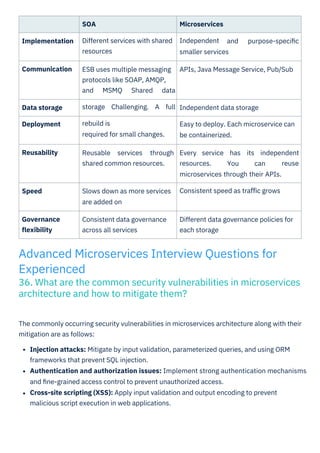
Mike Cohn’s Test Pyramid describes the type of automated tests required for software
development. The Test Pyramid is only a metaphor that implies a grouping of tests based on
their granularity. This Pyramid tells which kind of tests should be applied to different levels of
the pyramid.
Mike Cohn’s test pyramid consists of three layers that a test suite should have:
1. Unit Testing
2. Service Testing
3. User Interface Testing
We can derive the following two tests from Cohn’s pyramid:
1. Define tests with different granularity
2. The higher the level you get, the fewer tests you should have.
Canary releasing is a technique by which new software versions are introduced by rolling
out the updated version to a small subset of users before rolling it out to the entire
infrastructure and making it available to everybody. This technique is so-called because it
is based on canary releases in coal mines to alert miners when the toxic gases reach
dangerous levels.
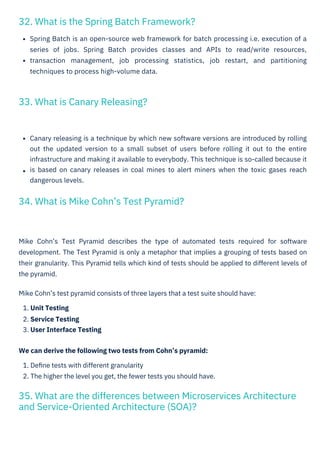
Spring Batch is an open-source web framework for batch processing i.e. execution of a
series of jobs. Spring Batch provides classes and APIs to read/write resources,
transaction management, job processing statistics, job restart, and partitioning
techniques to process high-volume data.
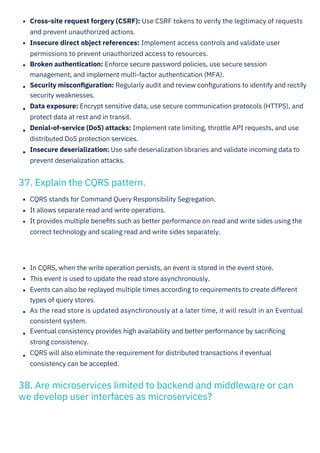
Speed
Reusability
Governance
flexibility
Data storage
Deployment
Implementation
Communication
SOA
Different services with shared
resources
Microservices
Independent and purpose-specific
smaller services
ESB uses multiple messaging
protocols like SOAP, AMQP,
and MSMQ Shared data
storage Challenging. A full
rebuild is
required for small changes.
APIs, Java Message Service, Pub/Sub
Independent data storage
Easy to deploy. Each microservice can
be containerized.
Reusable
shared common resources.
services through Every
resources.
service has its independent
reuse
You can
microservices through their APIs.
Consistent speed as traffic grows
Slows down as more services
are added on
Consistent data governance
across all services
Different data governance policies for
each storage
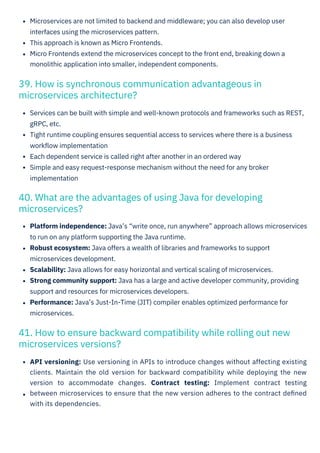
The commonly occurring security vulnerabilities in microservices architecture along with their
mitigation are as follows:
Injection attacks: Mitigate by input validation, parameterized queries, and using ORM
frameworks that prevent SQL injection.
Authentication and authorization issues: Implement strong authentication mechanisms
and fine-grained access control to prevent unauthorized access.
Cross-site scripting (XSS): Apply input validation and output encoding to prevent
malicious script execution in web applications.
Advanced Microservices Interview Questions for
Experienced
36. What are the common security vulnerabilities in microservices
architecture and how to mitigate them?
CQRS stands for Command Query Responsibility Segregation.
It allows separate read and write operations.
It provides multiple benefits such as better performance on read and write sides using the
correct technology and scaling read and write sides separately.
Cross-site request forgery (CSRF): Use CSRF tokens to verify the legitimacy of requests
and prevent unauthorized actions.
Insecure direct object references: Implement access controls and validate user
permissions to prevent unauthorized access to resources.
Broken authentication: Enforce secure password policies, use secure session
management, and implement multi-factor authentication (MFA).
Security misconfiguration: Regularly audit and review configurations to identify and rectify
security weaknesses.
Data exposure: Encrypt sensitive data, use secure communication protocols (HTTPS), and
protect data at rest and in transit.
Denial-of-service (DoS) attacks: Implement rate limiting, throttle API requests, and use
distributed DoS protection services.
Insecure deserialization: Use safe deserialization libraries and validate incoming data to
prevent deserialization attacks.
In CQRS, when the write operation persists, an event is stored in the event store.
This event is used to update the read store asynchronously.
Events can also be replayed multiple times according to requirements to create different
types of query stores.
As the read store is updated asynchronously at a later time, it will result in an Eventual
consistent system.
Eventual consistency provides high availability and better performance by sacrificing
strong consistency.
CQRS will also eliminate the requirement for distributed transactions if eventual
consistency can be accepted.
37. Explain the CQRS pattern.
38. Are microservices limited to backend and middleware or can
we develop user interfaces as microservices?
API versioning: Use versioning in APIs to introduce changes without affecting existing
clients. Maintain the old version for backward compatibility while deploying the new
version to accommodate changes. Contract testing: Implement contract testing
between microservices to ensure that the new version adheres to the contract defined
with its dependencies.
Microservices are not limited to backend and middleware; you can also develop user
interfaces using the microservices pattern.
This approach is known as Micro Frontends.
Micro Frontends extend the microservices concept to the front end, breaking down a
monolithic application into smaller, independent components.
Platform independence: Java’s “write once, run anywhere” approach allows microservices
to run on any platform supporting the Java runtime.
Robust ecosystem: Java offers a wealth of libraries and frameworks to support
microservices development.
Scalability: Java allows for easy horizontal and vertical scaling of microservices.
Strong community support: Java has a large and active developer community, providing
support and resources for microservices developers.
Performance: Java’s Just-In-Time (JIT) compiler enables optimized performance for
microservices.
Services can be built with simple and well-known protocols and frameworks such as REST,
gRPC, etc.
Tight runtime coupling ensures sequential access to services where there is a business
workflow implementation
Each dependent service is called right after another in an ordered way
Simple and easy request-response mechanism without the need for any broker
implementation
40. What are the advantages of using Java for developing
microservices?
39. How is synchronous communication advantageous in
microservices architecture?
41. How to ensure backward compatibility while rolling out new
microservices versions?
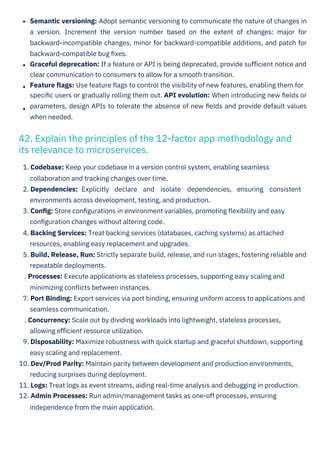
Semantic versioning: Adopt semantic versioning to communicate the nature of changes in
a version. Increment the version number based on the extent of changes: major for
backward-incompatible changes, minor for backward-compatible additions, and patch for
backward-compatible bug fixes.
Graceful deprecation: If a feature or API is being deprecated, provide sufficient notice and
clear communication to consumers to allow for a smooth transition.
Feature flags: Use feature flags to control the visibility of new features, enabling them for
specific users or gradually rolling them out. API evolution: When introducing new fields or
parameters, design APIs to tolerate the absence of new fields and provide default values
when needed.
1. Codebase: Keep your codebase in a version control system, enabling seamless
collaboration and tracking changes over time.
2. Dependencies: Explicitly declare and isolate dependencies, ensuring consistent
environments across development, testing, and production.
3. Config: Store configurations in environment variables, promoting flexibility and easy
configuration changes without altering code.
4. Backing Services: Treat backing services (databases, caching systems) as attached
resources, enabling easy replacement and upgrades.
5. Build, Release, Run: Strictly separate build, release, and run stages, fostering reliable and
repeatable deployments.
. Processes: Execute applications as stateless processes, supporting easy scaling and
minimizing conflicts between instances.
7. Port Binding: Export services via port binding, ensuring uniform access to applications and
seamless communication.
. Concurrency: Scale out by dividing workloads into lightweight, stateless processes,
allowing efficient resource utilization.
9. Disposability: Maximize robustness with quick startup and graceful shutdown, supporting
easy scaling and replacement.
10. Dev/Prod Parity: Maintain parity between development and production environments,
reducing surprises during deployment.
11. Logs: Treat logs as event streams, aiding real-time analysis and debugging in production.
12. Admin Processes: Run admin/management tasks as one-off processes, ensuring
independence from the main application.
42. Explain the principles of the 12-factor app methodology and
its relevance to microservices.
44. What is the Strangler Application?
The Strangler Application pattern involves gradually replacing parts of a monolithic application
with microservices.
43. Explain the role of Spring Cloud Gateway and how can it be
used for API routing and filtering in Java microservices.
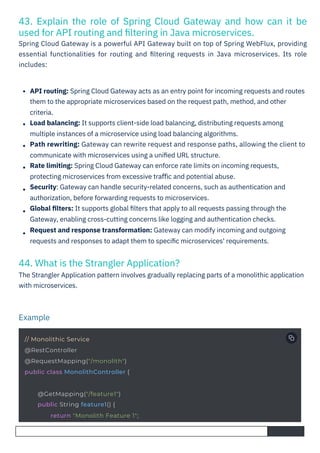
Spring Cloud Gateway is a powerful API Gateway built on top of Spring WebFlux, providing
essential functionalities for routing and filtering requests in Java microservices. Its role
includes:
API routing: Spring Cloud Gateway acts as an entry point for incoming requests and routes
them to the appropriate microservices based on the request path, method, and other
criteria.
Load balancing: It supports client-side load balancing, distributing requests among
multiple instances of a microservice using load balancing algorithms.
Path rewriting: Gateway can rewrite request and response paths, allowing the client to
communicate with microservices using a unified URL structure.
Rate limiting: Spring Cloud Gateway can enforce rate limits on incoming requests,
protecting microservices from excessive traffic and potential abuse.
Security: Gateway can handle security-related concerns, such as authentication and
authorization, before forwarding requests to microservices.
Global filters: It supports global filters that apply to all requests passing through the
Gateway, enabling cross-cutting concerns like logging and authentication checks.
Request and response transformation: Gateway can modify incoming and outgoing
requests and responses to adapt them to specific microservices' requirements.
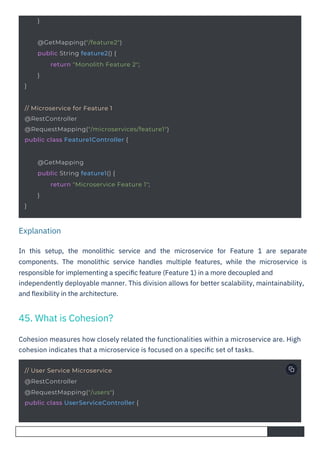
Example
// Monolithic Service
@RestController
@RequestMapping("/monolith")
public class MonolithController {
@GetMapping("/feature1")
public String feature1() {
return "Monolith Feature 1";
Explanation
Cohesion measures how closely related the functionalities within a microservice are. High
cohesion indicates that a microservice is focused on a specific set of tasks.
In this setup, the monolithic service and the microservice for Feature 1 are separate
components. The monolithic service handles multiple features, while the microservice is
responsible for implementing a specific feature (Feature 1) in a more decoupled and
independently deployable manner. This division allows for better scalability, maintainability,
and flexibility in the architecture.
45. What is Cohesion?
}
}
@GetMapping("/feature2")
public String feature2() {
return "Monolith Feature 2";
}
// User Service Microservice
@RestController
@RequestMapping("/users")
public class UserServiceController {
}
@GetMapping
public String feature1() {
return "Microservice Feature 1";
}
// Microservice for Feature 1
@RestController
@RequestMapping("/microservices/feature1")
public class Feature1Controller {
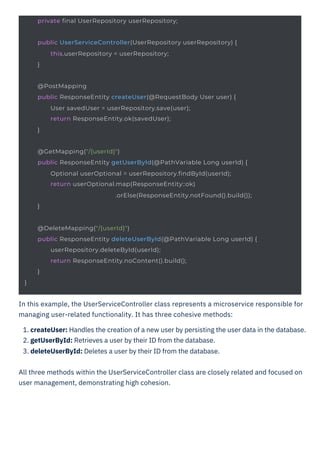
All three methods within the UserServiceController class are closely related and focused on
user management, demonstrating high cohesion.
In this example, the UserServiceController class represents a microservice responsible for
managing user-related functionality. It has three cohesive methods:
1. createUser: Handles the creation of a new user by persisting the user data in the database.
2. getUserById: Retrieves a user by their ID from the database.
3. deleteUserById: Deletes a user by their ID from the database.
private final UserRepository userRepository;
@PostMapping
public ResponseEntity createUser(@RequestBody User user) {
User savedUser = userRepository.save(user);
return ResponseEntity.ok(savedUser);
}
public UserServiceController(UserRepository userRepository) {
this.userRepository = userRepository;
}
}
@DeleteMapping("/{userId}")
public ResponseEntity deleteUserById(@PathVariable Long userId) {
userRepository.deleteById(userId);
return ResponseEntity.noContent().build();
}
@GetMapping("/{userId}")
public ResponseEntity getUserById(@PathVariable Long userId) {
Optional userOptional = userRepository.findById(userId);
return userOptional.map(ResponseEntity::ok)
.orElse(ResponseEntity.notFound().build());
}
47. What are the communication patterns between
microservices?
There are two types of communication patterns between microservices:
48. What is the CAP theorem, and how does it relate to
microservices?
The CAP theorem defines the challenges faced in distributed systems, focusing on three
fundamental attributes
46. What are the most common mistakes while transitioning to
Microservices?
49. How do independent Microservices communicate with each
other?
Failure to outline the main challenges.
I am rewriting already existing programs.
Vague definitions of responsibilities, timeline, and boundaries.
Failure to identify and implement automation.
1. Asynchronous Messaging: In this communication pattern, communication between
microservices is asynchronous. This is well suited in use cases where the user or system
triggering the communication is not waiting for a response.
2. Synchronous Messaging (Remote Procedure Invocation):Communication between
microservices is synchronous in this communication pattern. i.e. the system or user
initiating the communication waits for a response.
1. Consistency: All nodes in the system see the same data at the same time.
2. Availability: Every request receives a response, without guarantee that it contains the most
recent version of the information.
3. Partition Tolerance: The system continues to operate despite network partitions that
prevent communication between some nodes.
CAP Theorem in Microservices: In a microservices architecture, where services communicate
over a network, achieving all three attributes simultaneously is challenging. It involves trade-
offs, and the system must prioritize two out of the three CAP properties.
Microservices can communicate with each other through:
1. HTTP for traditional Request-Response.
2. Websockets for streaming.
3. Brokers or Server Programs running Advanced Routing Algorithms.
The circuit breaker pattern is used to detect failures.
It prevents the failure from constantly recurring, allowing the system to maintain
performance.
When a failure threshold is exceeded, the circuit breaker trips and further calls are directed
to a fallback mechanism until the service recovers.
service discovery is the process by which a microservice searches the network location of
another microservice which needs to communicate with.
Service discovery includes a registry where each service registers itself and looks up
others.
However, Tools such as Eureka, Consul, and Zookeeper are commonly used for service
discovery.
End-to-end Visibility: APM tools provide end-to-end visibility into the performance of
microservices-based applications by monitoring various components and layers of the
application stack. Service Dependency Mapping: APM tools map out the dependencies
between microservices and external services, providing insights into how services interact
with each other. Distributed Tracing: APM tools use distributed tracing techniques to trace
requests as they
traverse multiple microservices.
Performance Monitoring and Alerting: APM tools continuously monitor the performance
of microservices in real-time, alerting developers and operations teams about deviations
from expected behavior.
Root Cause Analysis: APM tools facilitate root cause analysis by correlating performance
metrics with system events, logs, and infrastructure data.
50. Describe the use of APM (application performance
monitoring) tools in microservices.
51. What is service discovery in microservices architecture?
52. How does the circuit breaker pattern work in microservices?
57. How does API versioning work in microservices?
54. What is the difference between orchestration and
choreography in microservices?
56. What is the role of a sidecar pattern in microservices?
53. What are the advantages of using a message broker in
microservices architecture?
55. Explain the concept of a bounded context in microservices.
A bounded context is a central pattern in domain-driven design (DDD) that defines a clear
boundary within which a particular model is defined and applicable.
Each microservice typically represents a bounded context, ensuring that its data and
functionality are self-contained and loosely coupled with other services.
Generally, Orchestration includes a central controller (orchestrator) that manages the
interactions between two services.
While choreography includes each service that interacts with others through events, that
too without a central controller.
Orchestration is more structured as compared to choreography, whereas choreography is
more flexible and decentralized.
Message broker is a part of microservices architecture.
It facilitates asynchronous communication, decoupling services, improving fault tolerance,
and load balancing.
message broker specifically enables complex workflows.
There are some Popular message brokers such as RabbitMQ, Apache Kafka, and Amazon
SQS.
API versioning works as backward compatibility in microservices by allowing multiple
versions of an API to coexist. API versioning has methods that include URI versioning (e.g.,
/api/v1/resource), header versioning (e.g., using a version header), and query parameter
versioning (e.g.,
The sidecar pattern is used to deploy a helper service alongside a main service in a
separate container but within the same pod in Kubernetes.
This helper service handles various kinds of tasks such as logging, monitoring,
configuration, and networking, enhancing the functionality.
/api/resource?version=1).
Eventual consistency is nothing but a distributed system, updates to data will propagate
and reach a consistent state across all nodes.
This is critical in microservices to ensure availability and partition tolerance (as per the CAP
theorem) while accepting temporary inconsistencies.
Sagas are a pattern for managing distributed transactions in microservices.
A saga is a sequence of local transactions, where each step is completed and followed by a
compensating action in case of failure, ensuring eventual consistency across services.
It collects logs from multiple services, aggregating them centrally, and analyzing them for
insights.
Tools like ELK Stack (Elasticsearch, Logstash, Kibana), Prometheus, Grafana, and Jaeger
are commonly used for centralized logging and distributed tracing.
It enables efficient monitoring and troubleshooting.
A strong understanding of theory and real-world application is essential for preparing for a
microservices interview. Begin by learning the fundamentals:
What microservices are, their benefits (such as scalability and flexibility), and their
disadvantages (like complexity and data management).
In this article, we have covered Microservices Interview Questions and Answers from basic to
advanced levels. Just refer to it in your interview preparation and crack the interview. However,
if you want to start your Microservices journey you can go through our Microservices
Roadmap. Also, consider the .NET Microservices Course Certification to become a master in it.
59. What are sagas in microservices architecture?
58. What is the significance of eventual consistency in
microservices?
Q1. How can I prepare for specific microservices interview
questions?
60. How do you handle logging and monitoring in microservices?
Summary
FAQs
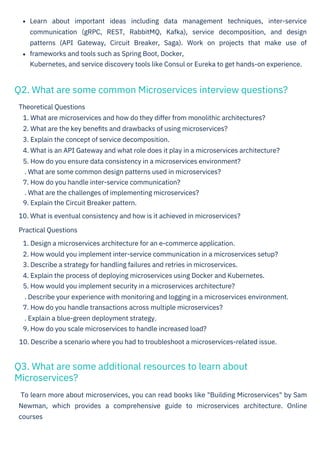
Theoretical Questions
1. What are microservices and how do they differ from monolithic architectures?
2. What are the key benefits and drawbacks of using microservices?
3. Explain the concept of service decomposition.
4. What is an API Gateway and what role does it play in a microservices architecture?
5. How do you ensure data consistency in a microservices environment?
. What are some common design patterns used in microservices?
7. How do you handle inter-service communication?
. What are the challenges of implementing microservices?
9. Explain the Circuit Breaker pattern.
10. What is eventual consistency and how is it achieved in microservices?
Practical Questions
1. Design a microservices architecture for an e-commerce application.
2. How would you implement inter-service communication in a microservices setup?
3. Describe a strategy for handling failures and retries in microservices.
4. Explain the process of deploying microservices using Docker and Kubernetes.
5. How would you implement security in a microservices architecture?
. Describe your experience with monitoring and logging in a microservices environment.
7. How do you handle transactions across multiple microservices?
. Explain a blue-green deployment strategy.
9. How do you scale microservices to handle increased load?
10. Describe a scenario where you had to troubleshoot a microservices-related issue.
To learn more about microservices, you can read books like "Building Microservices" by Sam
Newman, which provides a comprehensive guide to microservices architecture. Online
courses
Learn about important ideas including data management techniques, inter-service
communication (gRPC, REST, RabbitMQ, Kafka), service decomposition, and design
patterns (API Gateway, Circuit Breaker, Saga). Work on projects that make use of
frameworks and tools such as Spring Boot, Docker,
Kubernetes, and service discovery tools like Consul or Eureka to get hands-on experience.
Q3. What are some additional resources to learn about
Microservices?
Q2. What are some common Microservices interview questions?
on platforms like Udemy, Coursera, and Pluralsight offer structured learning and hands-on
practice. Websites such as Medium, DZone, and InfoQ feature articles and case studies on
microservices. Additionally, you can join online communities and forums like Stack Overflow
and Reddit to engage with practitioners and experts in the field.
You can find more information on microservices in various resources. Books like "Building
Microservices" by Sam Newman offer in-depth knowledge. Online learning platforms such
as Udemy, Coursera, and Pluralsight provide courses with practical exercises. Websites like
Medium, DZone, and InfoQ publish articles, tutorials, and case studies on microservices.
Additionally, forums and communities on Stack Overflow and Reddit are valuable for
discussions and expert advice.
Q4. Where Can I Find More Information on Microservices?