Microservices - Why?
Or why not?
Speaker: Sascha Düpre
Agenda
Microservice and Monolith Architectural Style
Brief introductions
Comparison
Microservices
Project management view
Team/Microservice size
Roles
Process model assumptions
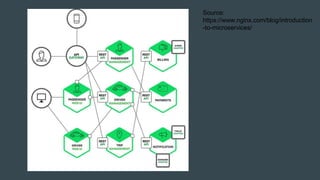
What are microservices?
“In short, the microservice architectural style [1] is an approach to developing a single
application as a suite of small services, each running in its own process and
communicating with lightweight mechanisms, often an HTTP resource API.” - Martin
Fowler
Many “small” services (business logic is split up)
Independent and automatically deployable
Lightweight Communication
Source:
https://www.nginx.com/blog/introduction
-to-microservices/
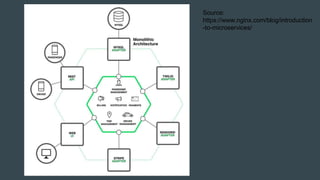
What is a monolith?
Traditionally split into 3 parts (3-Tier-Architecture)
UI (Client), AS (Business logic), DB (Data)
AS is the core (should be modularized)
Gets Requests
Handles business logic
Makes DB transactions/calls
Populates HTML-Views
Source:
https://www.nginx.com/blog/introduction
-to-microservices/
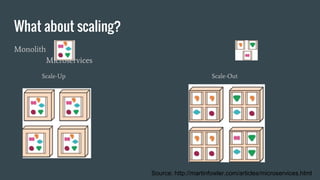
What about scaling?
Monolith
Microservices
Source: http://martinfowler.com/articles/microservices.html
Scale-Up Scale-Out
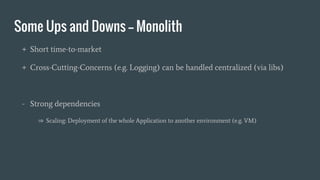
Some Ups and Downs -- Monolith
+ Short time-to-market
+ Cross-Cutting-Concerns (e.g. Logging) can be handled centralized (via libs)
- Strong dependencies
⇒ Scaling: Deployment of the whole Application to another environment (e.g. VM)
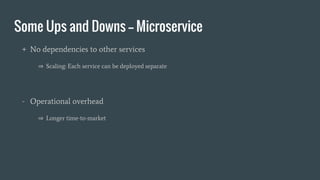
Some Ups and Downs -- Microservice
+ No dependencies to other services
⇒ Scaling: Each service can be deployed separate
- Operational overhead
⇒ Longer time-to-market
Where to start?
Under the assumption this is a pioneer project with “enough” resources….
How big should a team be? And therefore the Microservice?
Which roles exist in a team? (This is a general topic)
[More explicit] What personnel is needed?
What process model should be used?
What are the requirements?
How many services/teams do we need?
Team size (1/2)
Group question:
Of what sizes are you thinking for each team per service? And maybe why?
Some responsibilities (while the product is not live)
Testing
UI
Logic
DB(s)
Team size (2/2)
Less than 10 as a rule of thumb.
Amazon says 6-8 -- Two-Pizza-Rule
Should be small enough to decrease the complexity of communication
Big enough to build and run the product
All competences must be covered
Conway’s law: The size will determine the structure and LOC of the service
Which roles exist in a team? (1/2)
Source: http://martinfowler.com/articles/microservices.html
Conway’s law:
“Organizations which design systems
[…] are constrained to produce designs
which are copies of the communication
structures of these organizations.” -
Melvin E. Conway
● Driven by the management
because they see the technology
stack
Which roles exist in a team? (2/2)
Source: http://martinfowler.com/articles/microservices.html
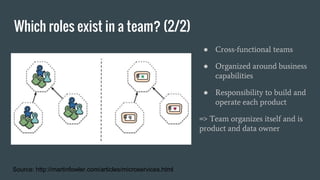
● Cross-functional teams
● Organized around business
capabilities
● Responsibility to build and
operate each product
=> Team organizes itself and is
product and data owner
Team roles - Conclusion
Operators are needed
Developers are needed
Consider DevOpsGeneral Problem: From the moment the product runs in production you will need to have a team
member for emergency cases available.
“I work from 9-5, no interest in working more besides overtime.” - Random Employee
“I love my work. I like to work more if it’s interesting.” - Another Random Employee
People don’t want to work on attendance (“9-5”, “Not interesting”)
In the US: One may get fired if they won’t do it.
In Germany: It’s on free will, a “fair” model or you have an explicit operator.
Considerations for the process model
Agile development (it’s a methodology)
Iterative (work a while then review and again)
Streamlined (getting to work)
Time-boxed (you work in time boxes)
Very collaborative (you are talking to your team and other teams all time)
Test-driven-design
Domain-driven-design
Conclusion to those “management” questions
In case of a pioneer project ….
Lack of experiences with microservices => High Risk Level
Wrong interpretation of the whole
Operations will overwhelm you
Longer time-to-market if not even failure
With experience => Low Risk Level
Short delivery cycles (agile dev)
Extremely modular / Independent development & deployment
Microservices Why?
Modularity, independent development and operations
Scaling can be done per service
Technology diversity -- Polyglott presence
Right technology stack for the problem (languages, libraries, middleware, databases)
Exchangeable
You can replace a service with “no effort” regarding to a monolith architecture
Effective and not more communication
Microservices Why not?
Lack of needed experience
Not enough resources to buy it
Long(er) time-to-market
(Highly) distributed system
Therefore: Eventual consistency
System and Operational complexity
Cross service testing is hard
And now?
If you consider using a microservice approach
Do we have the capabilities (resources)?
Do we have organizational complexity?
Do we need the scaling abilities?
Do we need to deliver software faster and maybe deliver regular updates?
As one can see these points are project dependent. Therefore you may not say: “Let’s
make everything as a MS.”. One need to reconsider it all the time!
Want to dive deeper?
We got a project management view on that topic? Yes!
We can answer the central question? Yes!
Whats missing?
Use-Case - Technical details
With concrete services
Overview of cross-cutting-concerns
Let’s get rid of the abstraction in the previous part!
Profit: You will see more of the whole microservice thing!Yes! No!
Who is living microservices? (1/4)
Walmart
Bought OneOps and worked 2 years on a DevOps API
OpenSource (oneops.com)
“Four years ago, the Walmart Global eCommerce system was a monolithic
application, deployed once every 2 months.” - walmart.com [2016]
“On a typical day there are now over 1,000 deployments, executed on-demand by
development teams, each taking only minutes on average to complete.”
Who is living microservices? (2/4)
Netflix
They obviously need microservices
Contribute to the OpenSource community (only some well-known)
Hystrix
Chaos Monkey
https://github.com/Netflix/ & https://netflix.github.io/
Who is living microservices? (3/4)
Twitter
http://twitter.github.io/
Finagle
Own MySQL fork
History
Started with a three-tier ruby on rails architecture
Switched to a more Services oriented approach
Who is living microservices? (4/4)
Many more
Amazon
Ebay
Google
PayPal
Soundcloud
In common: Evolved from monolith architectural style
Use-case -- Shopsystem
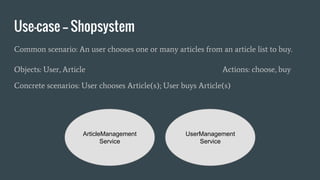
Common scenario: An user chooses one or many articles from an article list to buy.
Objects: User, Article Actions: choose, buy
Concrete scenarios: User chooses Article(s); User buys Article(s)
ArticleManagement
Service
UserManagement
Service
Use-case -- Shopsystem
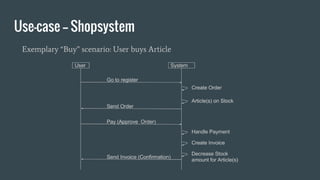
Exemplary “Buy” scenario: User buys Article
Possible services -- Shopsystem
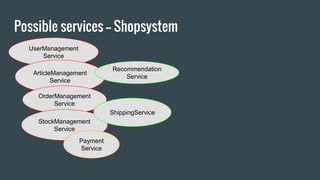
UserManagement
Service
ArticleManagement
Service
OrderManagement
Service
StockManagement
Service
Payment
Service
Recommendation
Service
ShippingService
Routing or Service-Discovery (1/3)
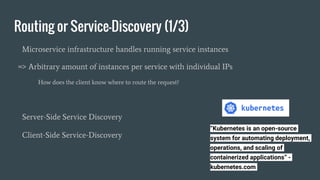
Microservice infrastructure handles running service instances
=> Arbitrary amount of instances per service with individual IPs
How does the client know where to route the request?
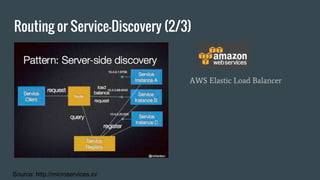
Server-Side Service Discovery
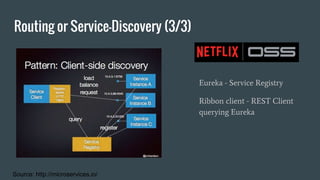
Client-Side Service-Discovery
“Kubernetes is an open-source
system for automating deployment,
operations, and scaling of
containerized applications” -
kubernetes.com
Routing or Service-Discovery (2/3)
Source: http://microservices.io/
AWS Elastic Load Balancer
Routing or Service-Discovery (3/3)
Source: http://microservices.io/
Eureka - Service Registry
Ribbon client - REST Client
querying Eureka
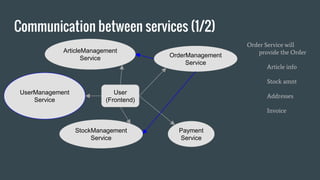
Communication between services (1/2)
UserManagement
Service
ArticleManagement
Service OrderManagement
Service
StockManagement
Service
Payment
Service
User
(Frontend)
Order Service will
provide the Order
Article info
Stock amnt
Addresses
Invoice
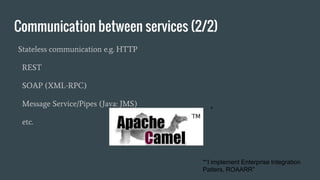
Communication between services (2/2)
Stateless communication e.g. HTTP
REST
SOAP (XML-RPC)
Message Service/Pipes (Java: JMS)
etc.
*
*“I implement Enterprise Integration
Patters, ROAARR”
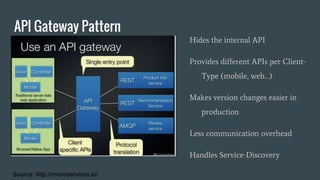
API Gateway Pattern
Source: http://microservices.io/
Hides the internal API
Provides different APIs per Client-
Type (mobile, web…)
Makes version changes easier in
production
Less communication overhead
Handles Service-Discovery
Unavailable services
Services should be deployable and runnable on it’s own
If ArticleService is down OrderService will be in serious troubles
OrderService must respond even if ArticleService is down
Fault tolerance
Cross-cutting concern
Solution: Respond with the correct HTTP StatusCode or send an uncomplete Order
Microservice Requirements (1/2)
Small footprint
Responsive
Rapid and consistent response times
Resilient
Fault tolerant → Let it fail!
replication, containment, isolation and delegation
Elastic
System stays responsive regardless to its workload http://www.reactivemanifesto.org/
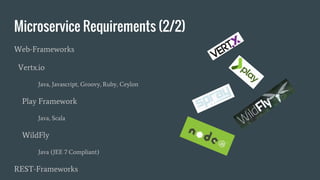
Microservice Requirements (2/2)
Web-Frameworks
Vertx.io
Java, Javascript, Groovy, Ruby, Ceylon
Play Framework
Java, Scala
WildFly
Java (JEE 7 Compliant)
REST-Frameworks
Databases
One Database for each service
Database may run on n nodes
One Database for each service instance
Additional problems are awaiting (Consistency, Routing…)
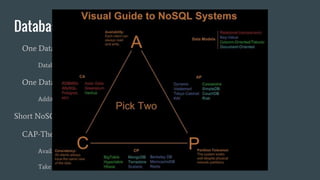
Short NoSQL Excursion
CAP-Theorem
Availability, Consistence, Partition Tolerance
Take two!
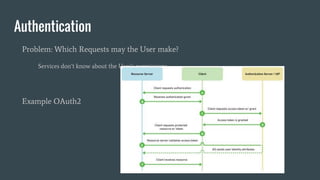
Authentication
Problem: Which Requests may the User make?
Services don’t know about the User’s permissions
Example OAuth2
Sources
http://martinfowler.com/articles/microservices.html
https://www.nginx.com/blog/introduction-to-microservices/
http://microservices.io/patterns/monolithic.html
http://microservices.io/patterns/microservices.html
http://microservices.io/patterns/microservice-chassis.html
http://thenewstack.io/agile-management-how-to-manage-microservices-with-your-
team/
http://www.baselinemag.com/enterprise-apps/walmart-embraces-microservices-to-
get-more-agile.html
http://techblog.netflix.com/
http://www.artima.com/scalazine/articles/twitter_on_scala.html
Microservices - Why?
Or why not?
Speaker: Sascha Düpre
Questions?
Feel free to ask!

Microservices why?

  • 1.
    Microservices - Why? Orwhy not? Speaker: Sascha Düpre
  • 2.
    Agenda Microservice and MonolithArchitectural Style Brief introductions Comparison Microservices Project management view Team/Microservice size Roles Process model assumptions
  • 3.
    What are microservices? “Inshort, the microservice architectural style [1] is an approach to developing a single application as a suite of small services, each running in its own process and communicating with lightweight mechanisms, often an HTTP resource API.” - Martin Fowler Many “small” services (business logic is split up) Independent and automatically deployable Lightweight Communication
  • 4.
  • 5.
    What is amonolith? Traditionally split into 3 parts (3-Tier-Architecture) UI (Client), AS (Business logic), DB (Data) AS is the core (should be modularized) Gets Requests Handles business logic Makes DB transactions/calls Populates HTML-Views
  • 6.
  • 7.
    What about scaling? Monolith Microservices Source:http://martinfowler.com/articles/microservices.html Scale-Up Scale-Out
  • 8.
    Some Ups andDowns -- Monolith + Short time-to-market + Cross-Cutting-Concerns (e.g. Logging) can be handled centralized (via libs) - Strong dependencies ⇒ Scaling: Deployment of the whole Application to another environment (e.g. VM)
  • 9.
    Some Ups andDowns -- Microservice + No dependencies to other services ⇒ Scaling: Each service can be deployed separate - Operational overhead ⇒ Longer time-to-market
  • 10.
    Where to start? Underthe assumption this is a pioneer project with “enough” resources…. How big should a team be? And therefore the Microservice? Which roles exist in a team? (This is a general topic) [More explicit] What personnel is needed? What process model should be used? What are the requirements? How many services/teams do we need?
  • 11.
    Team size (1/2) Groupquestion: Of what sizes are you thinking for each team per service? And maybe why? Some responsibilities (while the product is not live) Testing UI Logic DB(s)
  • 12.
    Team size (2/2) Lessthan 10 as a rule of thumb. Amazon says 6-8 -- Two-Pizza-Rule Should be small enough to decrease the complexity of communication Big enough to build and run the product All competences must be covered Conway’s law: The size will determine the structure and LOC of the service
  • 13.
    Which roles existin a team? (1/2) Source: http://martinfowler.com/articles/microservices.html Conway’s law: “Organizations which design systems […] are constrained to produce designs which are copies of the communication structures of these organizations.” - Melvin E. Conway ● Driven by the management because they see the technology stack
  • 14.
    Which roles existin a team? (2/2) Source: http://martinfowler.com/articles/microservices.html ● Cross-functional teams ● Organized around business capabilities ● Responsibility to build and operate each product => Team organizes itself and is product and data owner
  • 15.
    Team roles -Conclusion Operators are needed Developers are needed Consider DevOpsGeneral Problem: From the moment the product runs in production you will need to have a team member for emergency cases available. “I work from 9-5, no interest in working more besides overtime.” - Random Employee “I love my work. I like to work more if it’s interesting.” - Another Random Employee People don’t want to work on attendance (“9-5”, “Not interesting”) In the US: One may get fired if they won’t do it. In Germany: It’s on free will, a “fair” model or you have an explicit operator.
  • 16.
    Considerations for theprocess model Agile development (it’s a methodology) Iterative (work a while then review and again) Streamlined (getting to work) Time-boxed (you work in time boxes) Very collaborative (you are talking to your team and other teams all time) Test-driven-design Domain-driven-design
  • 17.
    Conclusion to those“management” questions In case of a pioneer project …. Lack of experiences with microservices => High Risk Level Wrong interpretation of the whole Operations will overwhelm you Longer time-to-market if not even failure With experience => Low Risk Level Short delivery cycles (agile dev) Extremely modular / Independent development & deployment
  • 18.
    Microservices Why? Modularity, independentdevelopment and operations Scaling can be done per service Technology diversity -- Polyglott presence Right technology stack for the problem (languages, libraries, middleware, databases) Exchangeable You can replace a service with “no effort” regarding to a monolith architecture Effective and not more communication
  • 19.
    Microservices Why not? Lackof needed experience Not enough resources to buy it Long(er) time-to-market (Highly) distributed system Therefore: Eventual consistency System and Operational complexity Cross service testing is hard
  • 20.
    And now? If youconsider using a microservice approach Do we have the capabilities (resources)? Do we have organizational complexity? Do we need the scaling abilities? Do we need to deliver software faster and maybe deliver regular updates? As one can see these points are project dependent. Therefore you may not say: “Let’s make everything as a MS.”. One need to reconsider it all the time!
  • 21.
    Want to divedeeper? We got a project management view on that topic? Yes! We can answer the central question? Yes! Whats missing? Use-Case - Technical details With concrete services Overview of cross-cutting-concerns Let’s get rid of the abstraction in the previous part! Profit: You will see more of the whole microservice thing!Yes! No!
  • 22.
    Who is livingmicroservices? (1/4) Walmart Bought OneOps and worked 2 years on a DevOps API OpenSource (oneops.com) “Four years ago, the Walmart Global eCommerce system was a monolithic application, deployed once every 2 months.” - walmart.com [2016] “On a typical day there are now over 1,000 deployments, executed on-demand by development teams, each taking only minutes on average to complete.”
  • 23.
    Who is livingmicroservices? (2/4) Netflix They obviously need microservices Contribute to the OpenSource community (only some well-known) Hystrix Chaos Monkey https://github.com/Netflix/ & https://netflix.github.io/
  • 24.
    Who is livingmicroservices? (3/4) Twitter http://twitter.github.io/ Finagle Own MySQL fork History Started with a three-tier ruby on rails architecture Switched to a more Services oriented approach
  • 25.
    Who is livingmicroservices? (4/4) Many more Amazon Ebay Google PayPal Soundcloud In common: Evolved from monolith architectural style
  • 26.
    Use-case -- Shopsystem Commonscenario: An user chooses one or many articles from an article list to buy. Objects: User, Article Actions: choose, buy Concrete scenarios: User chooses Article(s); User buys Article(s) ArticleManagement Service UserManagement Service
  • 27.
    Use-case -- Shopsystem Exemplary“Buy” scenario: User buys Article
  • 28.
    Possible services --Shopsystem UserManagement Service ArticleManagement Service OrderManagement Service StockManagement Service Payment Service Recommendation Service ShippingService
  • 29.
    Routing or Service-Discovery(1/3) Microservice infrastructure handles running service instances => Arbitrary amount of instances per service with individual IPs How does the client know where to route the request? Server-Side Service Discovery Client-Side Service-Discovery “Kubernetes is an open-source system for automating deployment, operations, and scaling of containerized applications” - kubernetes.com
  • 30.
    Routing or Service-Discovery(2/3) Source: http://microservices.io/ AWS Elastic Load Balancer
  • 31.
    Routing or Service-Discovery(3/3) Source: http://microservices.io/ Eureka - Service Registry Ribbon client - REST Client querying Eureka
  • 32.
    Communication between services(1/2) UserManagement Service ArticleManagement Service OrderManagement Service StockManagement Service Payment Service User (Frontend) Order Service will provide the Order Article info Stock amnt Addresses Invoice
  • 33.
    Communication between services(2/2) Stateless communication e.g. HTTP REST SOAP (XML-RPC) Message Service/Pipes (Java: JMS) etc. * *“I implement Enterprise Integration Patters, ROAARR”
  • 34.
    API Gateway Pattern Source:http://microservices.io/ Hides the internal API Provides different APIs per Client- Type (mobile, web…) Makes version changes easier in production Less communication overhead Handles Service-Discovery
  • 35.
    Unavailable services Services shouldbe deployable and runnable on it’s own If ArticleService is down OrderService will be in serious troubles OrderService must respond even if ArticleService is down Fault tolerance Cross-cutting concern Solution: Respond with the correct HTTP StatusCode or send an uncomplete Order
  • 36.
    Microservice Requirements (1/2) Smallfootprint Responsive Rapid and consistent response times Resilient Fault tolerant → Let it fail! replication, containment, isolation and delegation Elastic System stays responsive regardless to its workload http://www.reactivemanifesto.org/
  • 37.
    Microservice Requirements (2/2) Web-Frameworks Vertx.io Java,Javascript, Groovy, Ruby, Ceylon Play Framework Java, Scala WildFly Java (JEE 7 Compliant) REST-Frameworks
  • 38.
    Databases One Database foreach service Database may run on n nodes One Database for each service instance Additional problems are awaiting (Consistency, Routing…) Short NoSQL Excursion CAP-Theorem Availability, Consistence, Partition Tolerance Take two!
  • 39.
    Authentication Problem: Which Requestsmay the User make? Services don’t know about the User’s permissions Example OAuth2
  • 40.
  • 41.
    Microservices - Why? Orwhy not? Speaker: Sascha Düpre Questions? Feel free to ask!

Editor's Notes

  • #11 First two questions are more general. And the last ones will answered with regard to the use case.
  • #16 Consider a problem in the production. Now the operator will try his best, but if it will fail over and over again because of a software lack, he won’t be able to find a solution -- he will need a dev.
  • #17 Iterative: Instead of planning everything front up and then implementing one will plan and then implement some features and maybe replan e.g.. Streamlined: Instead of long meetings. There are daily short meetings (15 mins) where everybody has a stand up. And then there is some time to talk to each other. Time-Boxed: You say okay lets work 3 weeks and see what gets done. In SCRUM you are using a backlog which contains the requirements broken down to features. And you’ll say we try to implement features a,c,g,e and another team makes f,b,d. Basic conclusion: This topic could fill plenty of hours. You may need to fit it according to your needs.
  • #27 Before Iam showing the use case, I must mention that this process is just for conceptional reasons. You might use your own techniques for Requirements Engineering.
  • #42 Thank you for listening. Special thanks to the organizators especially Randy who invited me to have a talk. Thanks.