
By
Vikash Jaiswal – 30
&
Aakash Mishra - 49
Background
 Founded in 1916, Boeing is the world's largest aerospace company.
 Two main businesses:
a) Commercial Airplanes.
b) Defence, Space & Security.
 The company supports airlines and U.S. and allied government customers in more
than 150 countries.
 Today, the company manufactures the 737, 747, 767, 777 and 787 families of
airplanes and the Boeing Business Jet range.
 For this company has around 26,500 contract with suppliers.
Road to launch (1996-2000)
 In 1996, Phil Condit , CEO of Boeing, merged Boeing with Rockwell Aerospace &
Defence Unit.
 In 1997, Boeing merged with Mcdonnell Douglas, its main rival in defense aircraft
& space contracts.
 Condit immediately unveiled a vision for the merged company, “People working
together as one global company for aerospace leadership”
 The Vision specified Boeing’s three core competencies:
a) Large-scale system Integration.
b) Detailed customer knowledge & focus.
c) Lean, Efficient design & production systems.
Road to launch (Cont.)
 In 2000, Boeing main rival Airbus announced the launch of A380, a super Jumbo jet.
 A380 could carry 555 passenger, 35% more than the Boeing’s 747.
 According to Boeing customer prefer point-to-point (city-to-city) rather than Hub-
Spoke Network.
 According to Airbus, world lacked the airports which point-to-point model demands
& super-jumbos are necessary to reduce congestion at global hubs.
 Airbus announced the delivery of super jumbo by 2004.
Blueprint
 In 2003, Boeing lost its title of worlds largest builder of commercial planes.
 Stock price of Boeing reduced from 70$ to 29$.
 In 2004 Airbus’s A380 was launched.
 To tackle the situation, Boeing announced to launch a modified 747 and later a fast
subsonic airplane, the Sonic Cruiser.
 However both failed to excite potential airplane customer.
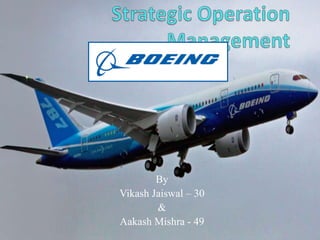
 Boeing later turned to a radical new airplane :787 Dreamliner – as fast as fastest
commercial airplane while using 20% less fuel.
Product Architecture
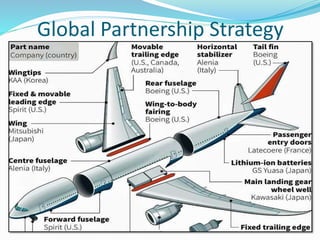
 Wings & Fuselage of 787 were made of advance composites.
 More than 12 aerospace companies helped Boeing to select composites & alloy for
structure.
 787 was the first commercial all-composite airplane.
 This enabled Boeing to build large integrated assemblies in different part of the
world.
 The 787 Standard engine interface would accommodate two type of engines:
i. GE Next Generation.
ii. Rolls-Royce Trent 1000.
 Distributed Engineering & manufacturing.
Global Partnership Strategy
Transportation & Final Assembly
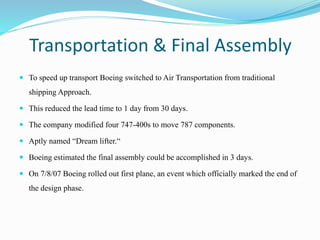
 To speed up transport Boeing switched to Air Transportation from traditional
shipping Approach.
 This reduced the lead time to 1 day from 30 days.
 The company modified four 747-400s to move 787 components.
 Aptly named “Dream lifter.“
 Boeing estimated the final assembly could be accomplished in 3 days.
 On 7/8/07 Boeing rolled out first plane, an event which officially marked the end of
the design phase.
Dream lifter
Dream lifter
Delays & Boeing’s Response
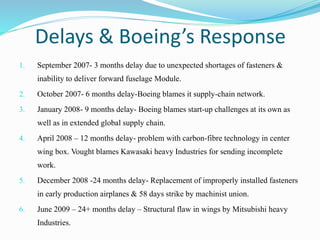
1. September 2007- 3 months delay due to unexpected shortages of fasteners &
inability to deliver forward fuselage Module.
2. October 2007- 6 months delay-Boeing blames it supply-chain network.
3. January 2008- 9 months delay- Boeing blames start-up challenges at its own as
well as in extended global supply chain.
4. April 2008 – 12 months delay- problem with carbon-fibre technology in center
wing box. Vought blames Kawasaki heavy Industries for sending incomplete
work.
5. December 2008 -24 months delay- Replacement of improperly installed fasteners
in early production airplanes & 58 days strike by machinist union.
6. June 2009 – 24+ months delay – Structural flaw in wings by Mitsubishi heavy
Industries.
Responding to delays
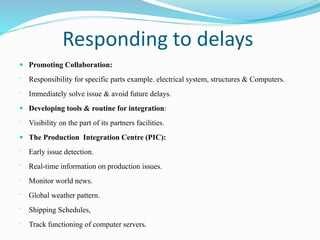
 Promoting Collaboration:
⁻ Responsibility for specific parts example. electrical system, structures & Computers.
⁻ Immediately solve issue & avoid future delays.
 Developing tools & routine for integration:
⁻ Visibility on the part of its partners facilities.
 The Production Integration Centre (PIC):
⁻ Early issue detection.
⁻ Real-time information on production issues.
⁻ Monitor world news.
⁻ Global weather pattern.
⁻ Shipping Schedules,
⁻ Track functioning of computer servers.
Decisions Going Forward
 On September 26,2011, after a delay of three and a half year, Boeing delivered first 787
airplane to All Nippon Airways.
 The production rate was increased to 10 airplanes per month, to reduce the backlog of over
800 orders.
 On January 7, 2013, fire broke out aboard empty Japan Airlines 787.
 Two days later United Airlines reported problems with wiring in battery area,.
 One week later ANA 787 had to make landing due to smoke inside electrical compartment.
 The Airplane was grounded for several months due to issues associated with Lithium-ion
battery.
 On April 19,2013, U.S Federal Aviation Authority (FAA) permitted the new Boeing 787
airplanes.
 50 airplanes already delivered were retrofitted with Boeings safety solution
PQCDSM
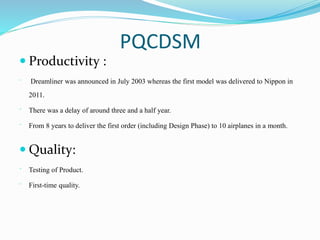
 Productivity :
⁻ Dreamliner was announced in July 2003 whereas the first model was delivered to Nippon in
2011.
⁻ There was a delay of around three and a half year.
⁻ From 8 years to deliver the first order (including Design Phase) to 10 airplanes in a month.
 Quality:
⁻ Testing of Product.
⁻ First-time quality.
PQCDSM (Cont.)
 Cost
⁻ Logistic cost: As Boeing uses a modified 747, it saves around 20% - 40% over
shipping.
⁻ Cut Development cost from$7.3 to $4.2 billion.
⁻ R&D was done by risk sharing partners.
PQCDSM (Cont.)
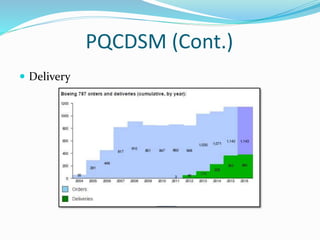
 Delivery
PQCDSM (Cont.)
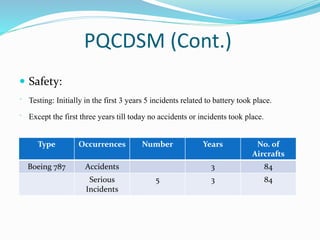
 Safety:
⁻ Testing: Initially in the first 3 years 5 incidents related to battery took place.
⁻ Except the first three years till today no accidents or incidents took place.
Type Occurrences Number Years No. of
Aircrafts
Boeing 787 Accidents 3 84
Serious
Incidents
5 3 84
PQCDSM (Cont.)
 Morale
⁻ Goodwill.
⁻ Customer Satisfaction.
⁻ Faith in product .
Strategic Operation Management - Boeing

Strategic Operation Management - Boeing

  • 1.
    By Vikash Jaiswal –30 & Aakash Mishra - 49
  • 2.
    Background  Founded in1916, Boeing is the world's largest aerospace company.  Two main businesses: a) Commercial Airplanes. b) Defence, Space & Security.  The company supports airlines and U.S. and allied government customers in more than 150 countries.  Today, the company manufactures the 737, 747, 767, 777 and 787 families of airplanes and the Boeing Business Jet range.  For this company has around 26,500 contract with suppliers.
  • 3.
    Road to launch(1996-2000)  In 1996, Phil Condit , CEO of Boeing, merged Boeing with Rockwell Aerospace & Defence Unit.  In 1997, Boeing merged with Mcdonnell Douglas, its main rival in defense aircraft & space contracts.  Condit immediately unveiled a vision for the merged company, “People working together as one global company for aerospace leadership”  The Vision specified Boeing’s three core competencies: a) Large-scale system Integration. b) Detailed customer knowledge & focus. c) Lean, Efficient design & production systems.
  • 4.
    Road to launch(Cont.)  In 2000, Boeing main rival Airbus announced the launch of A380, a super Jumbo jet.  A380 could carry 555 passenger, 35% more than the Boeing’s 747.  According to Boeing customer prefer point-to-point (city-to-city) rather than Hub- Spoke Network.  According to Airbus, world lacked the airports which point-to-point model demands & super-jumbos are necessary to reduce congestion at global hubs.  Airbus announced the delivery of super jumbo by 2004.
  • 5.
    Blueprint  In 2003,Boeing lost its title of worlds largest builder of commercial planes.  Stock price of Boeing reduced from 70$ to 29$.  In 2004 Airbus’s A380 was launched.  To tackle the situation, Boeing announced to launch a modified 747 and later a fast subsonic airplane, the Sonic Cruiser.  However both failed to excite potential airplane customer.  Boeing later turned to a radical new airplane :787 Dreamliner – as fast as fastest commercial airplane while using 20% less fuel.
  • 6.
    Product Architecture  Wings& Fuselage of 787 were made of advance composites.  More than 12 aerospace companies helped Boeing to select composites & alloy for structure.  787 was the first commercial all-composite airplane.  This enabled Boeing to build large integrated assemblies in different part of the world.  The 787 Standard engine interface would accommodate two type of engines: i. GE Next Generation. ii. Rolls-Royce Trent 1000.  Distributed Engineering & manufacturing.
  • 7.
  • 8.
    Transportation & FinalAssembly  To speed up transport Boeing switched to Air Transportation from traditional shipping Approach.  This reduced the lead time to 1 day from 30 days.  The company modified four 747-400s to move 787 components.  Aptly named “Dream lifter.“  Boeing estimated the final assembly could be accomplished in 3 days.  On 7/8/07 Boeing rolled out first plane, an event which officially marked the end of the design phase.
  • 9.
  • 10.
  • 11.
    Delays & Boeing’sResponse 1. September 2007- 3 months delay due to unexpected shortages of fasteners & inability to deliver forward fuselage Module. 2. October 2007- 6 months delay-Boeing blames it supply-chain network. 3. January 2008- 9 months delay- Boeing blames start-up challenges at its own as well as in extended global supply chain. 4. April 2008 – 12 months delay- problem with carbon-fibre technology in center wing box. Vought blames Kawasaki heavy Industries for sending incomplete work. 5. December 2008 -24 months delay- Replacement of improperly installed fasteners in early production airplanes & 58 days strike by machinist union. 6. June 2009 – 24+ months delay – Structural flaw in wings by Mitsubishi heavy Industries.
  • 12.
    Responding to delays Promoting Collaboration: ⁻ Responsibility for specific parts example. electrical system, structures & Computers. ⁻ Immediately solve issue & avoid future delays.  Developing tools & routine for integration: ⁻ Visibility on the part of its partners facilities.  The Production Integration Centre (PIC): ⁻ Early issue detection. ⁻ Real-time information on production issues. ⁻ Monitor world news. ⁻ Global weather pattern. ⁻ Shipping Schedules, ⁻ Track functioning of computer servers.
  • 13.
    Decisions Going Forward On September 26,2011, after a delay of three and a half year, Boeing delivered first 787 airplane to All Nippon Airways.  The production rate was increased to 10 airplanes per month, to reduce the backlog of over 800 orders.  On January 7, 2013, fire broke out aboard empty Japan Airlines 787.  Two days later United Airlines reported problems with wiring in battery area,.  One week later ANA 787 had to make landing due to smoke inside electrical compartment.  The Airplane was grounded for several months due to issues associated with Lithium-ion battery.  On April 19,2013, U.S Federal Aviation Authority (FAA) permitted the new Boeing 787 airplanes.  50 airplanes already delivered were retrofitted with Boeings safety solution
  • 14.
    PQCDSM  Productivity : ⁻Dreamliner was announced in July 2003 whereas the first model was delivered to Nippon in 2011. ⁻ There was a delay of around three and a half year. ⁻ From 8 years to deliver the first order (including Design Phase) to 10 airplanes in a month.  Quality: ⁻ Testing of Product. ⁻ First-time quality.
  • 15.
    PQCDSM (Cont.)  Cost ⁻Logistic cost: As Boeing uses a modified 747, it saves around 20% - 40% over shipping. ⁻ Cut Development cost from$7.3 to $4.2 billion. ⁻ R&D was done by risk sharing partners.
  • 16.
  • 17.
    PQCDSM (Cont.)  Safety: ⁻Testing: Initially in the first 3 years 5 incidents related to battery took place. ⁻ Except the first three years till today no accidents or incidents took place. Type Occurrences Number Years No. of Aircrafts Boeing 787 Accidents 3 84 Serious Incidents 5 3 84
  • 18.
    PQCDSM (Cont.)  Morale ⁻Goodwill. ⁻ Customer Satisfaction. ⁻ Faith in product .