BUSINESS LETTERS
BUSINESS LETTERS
 A business letter is the official
communication made by the
organisation written typically on the
organisational letterhead and
addressed to the external audience
such as customer, supplier,
shareholder or government agency.
PURPOSE OF BUSINESS
LETTERS
 Companies have to correspond with other enterprises
for varied reasons:
◦ Placing orders for goods & services required from
other firms
◦ Acknowledging and executing orders for other firms
◦ Granting credits to other parties
◦ Negotiating credits from other parties
◦ To file complaints and for their follow up
◦ Sending statement of accounts for debtors
◦ Receiving statement of accounts from suppliers etc
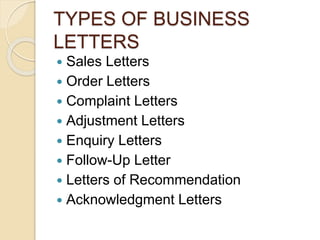
TYPES OF BUSINESS
LETTERS
 Sales Letters
 Order Letters
 Complaint Letters
 Adjustment Letters
 Enquiry Letters
 Follow-Up Letter
 Letters of Recommendation
 Acknowledgment Letters
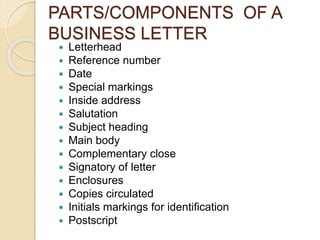
PARTS/COMPONENTS OF A
BUSINESS LETTER
 Letterhead
 Reference number
 Date
 Special markings
 Inside address
 Salutation
 Subject heading
 Main body
 Complementary close
 Signatory of letter
 Enclosures
 Copies circulated
 Initials markings for identification
 Postscript
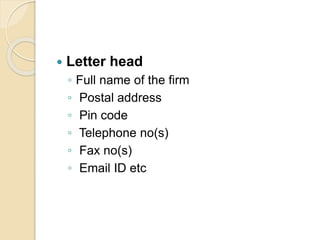
 Letter head
◦ Full name of the firm
◦ Postal address
◦ Pin code
◦ Telephone no(s)
◦ Fax no(s)
◦ Email ID etc
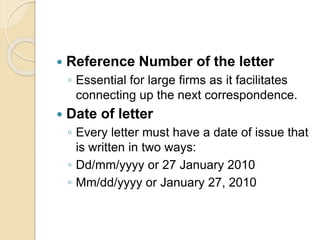
 Reference Number of the letter
◦ Essential for large firms as it facilitates
connecting up the next correspondence.
 Date of letter
◦ Every letter must have a date of issue that
is written in two ways:
◦ Dd/mm/yyyy or 27 January 2010
◦ Mm/dd/yyyy or January 27, 2010
 Special markings
◦ Many letters need to be given special
markings:
◦ Confidential
◦ Airmail
◦ Registered post
◦ Speed post
◦ Courier etc
◦ These markings carry special meaning and
are also put on the envelope.
 Inside address
◦ complete name and address of the
recipient
 Salutation
◦ It is a formal greeting to the recipient of
the letter message. Its choice is directly
dependent upon the extent of formality
one wishes to observe
 Dear Sir / Madam
 Dear Mr Dhingra / Ms Gautam
 Subject heading
◦ Appropriate heading denoting the subject
of the letter being written is usually given
e.g., Application for loan, Bill No -------- for
------- dated ------
Body
 Opening Part
◦ Devoted to a brief introduction and stating
the purpose of the letter
◦ Attention of the reader should be drawn to
the previous correspondence, if any.
 For example with reference to your letter no. 326
dated. 12th March 2003....
 Main part
◦ Longer and presents the relevant facts in a
logical sequence.
◦ Should be precise and written in clear words.
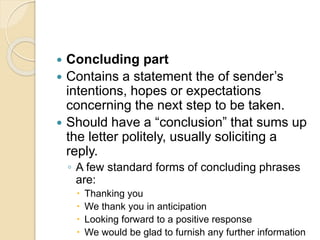
 Concluding part
 Contains a statement the of sender’s
intentions, hopes or expectations
concerning the next step to be taken.
 Should have a “conclusion” that sums up
the letter politely, usually soliciting a
reply.
◦ A few standard forms of concluding phrases
are:
 Thanking you
 We thank you in anticipation
 Looking forward to a positive response
 We would be glad to furnish any further information
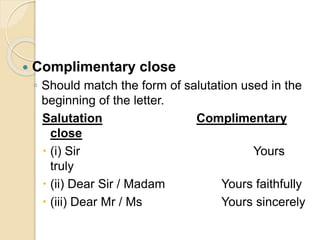
 Complimentary close
◦ Should match the form of salutation used in the
beginning of the letter.
Salutation Complimentary
close
 (i) Sir Yours
truly
 (ii) Dear Sir / Madam Yours faithfully
 (iii) Dear Mr / Ms Yours sincerely
 Signatory of letter
◦ The name and official designation of the
sender should be clearly stated .
 Enclosures
◦ These must be stated clearly after the
signature of the sender. Any document
sent must be stated clearly for future
reference.
 Copies distributed
◦ Usually, copies of the letter are sent to
persons for the following reasons:
 For information only
 For complementary action(s) as appropriate
 Post script
◦ People write postscript as a last minute
addition to what has been said in the
letter.

17.business letters

  • 1.
  • 2.
    BUSINESS LETTERS  Abusiness letter is the official communication made by the organisation written typically on the organisational letterhead and addressed to the external audience such as customer, supplier, shareholder or government agency.
  • 3.
    PURPOSE OF BUSINESS LETTERS Companies have to correspond with other enterprises for varied reasons: ◦ Placing orders for goods & services required from other firms ◦ Acknowledging and executing orders for other firms ◦ Granting credits to other parties ◦ Negotiating credits from other parties ◦ To file complaints and for their follow up ◦ Sending statement of accounts for debtors ◦ Receiving statement of accounts from suppliers etc
  • 4.
    TYPES OF BUSINESS LETTERS Sales Letters  Order Letters  Complaint Letters  Adjustment Letters  Enquiry Letters  Follow-Up Letter  Letters of Recommendation  Acknowledgment Letters
  • 5.
    PARTS/COMPONENTS OF A BUSINESSLETTER  Letterhead  Reference number  Date  Special markings  Inside address  Salutation  Subject heading  Main body  Complementary close  Signatory of letter  Enclosures  Copies circulated  Initials markings for identification  Postscript
  • 6.
     Letter head ◦Full name of the firm ◦ Postal address ◦ Pin code ◦ Telephone no(s) ◦ Fax no(s) ◦ Email ID etc
  • 7.
     Reference Numberof the letter ◦ Essential for large firms as it facilitates connecting up the next correspondence.  Date of letter ◦ Every letter must have a date of issue that is written in two ways: ◦ Dd/mm/yyyy or 27 January 2010 ◦ Mm/dd/yyyy or January 27, 2010
  • 8.
     Special markings ◦Many letters need to be given special markings: ◦ Confidential ◦ Airmail ◦ Registered post ◦ Speed post ◦ Courier etc ◦ These markings carry special meaning and are also put on the envelope.
  • 9.
     Inside address ◦complete name and address of the recipient  Salutation ◦ It is a formal greeting to the recipient of the letter message. Its choice is directly dependent upon the extent of formality one wishes to observe  Dear Sir / Madam  Dear Mr Dhingra / Ms Gautam
  • 10.
     Subject heading ◦Appropriate heading denoting the subject of the letter being written is usually given e.g., Application for loan, Bill No -------- for ------- dated ------
  • 11.
    Body  Opening Part ◦Devoted to a brief introduction and stating the purpose of the letter ◦ Attention of the reader should be drawn to the previous correspondence, if any.  For example with reference to your letter no. 326 dated. 12th March 2003....  Main part ◦ Longer and presents the relevant facts in a logical sequence. ◦ Should be precise and written in clear words.
  • 12.
     Concluding part Contains a statement the of sender’s intentions, hopes or expectations concerning the next step to be taken.  Should have a “conclusion” that sums up the letter politely, usually soliciting a reply. ◦ A few standard forms of concluding phrases are:  Thanking you  We thank you in anticipation  Looking forward to a positive response  We would be glad to furnish any further information
  • 13.
     Complimentary close ◦Should match the form of salutation used in the beginning of the letter. Salutation Complimentary close  (i) Sir Yours truly  (ii) Dear Sir / Madam Yours faithfully  (iii) Dear Mr / Ms Yours sincerely
  • 14.
     Signatory ofletter ◦ The name and official designation of the sender should be clearly stated .  Enclosures ◦ These must be stated clearly after the signature of the sender. Any document sent must be stated clearly for future reference.
  • 15.
     Copies distributed ◦Usually, copies of the letter are sent to persons for the following reasons:  For information only  For complementary action(s) as appropriate  Post script ◦ People write postscript as a last minute addition to what has been said in the letter.