Launch: 9/17 3.  Which of the following is true for isotopes? a. they change the identity of an atom to a different element b. they have varying atomic numbers c. they have varying atomic masses d. they have varying numbers of electrons 5.  On the periodic table, why is Co (Cobalt) placed before Ni (Nickel) even though Ni has a lower atomic mass? a. Nickel has one more proton b. Cobalt has fewer electrons c. Nickel has a few more electrons d. Cobalt has a lower density
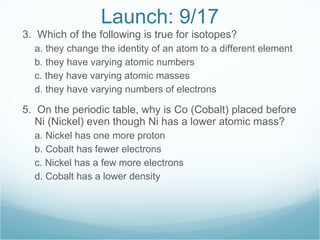
Launch: 9/17 3.  Which of the following is true for isotopes? a. they change the identity of an atom to a different element b. they have varying atomic numbers c. they have varying atomic masses d. they have varying numbers of electrons 4.  Why are atomic masses listed as decimals on the periodic table instead of whole numbers? a. they are a weighted average of the naturally occurring isotopes b. their units are grams/moles c. they were measured with a balance that read to only two decimal places d. none of the above
How many electrons? Mr. Heffner Chemistry 9/17/09
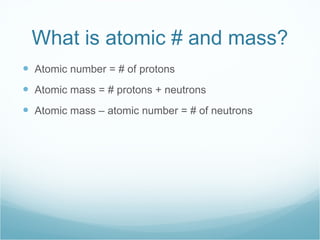
What is atomic # and mass? Atomic number = # of protons Atomic mass = # protons + neutrons Atomic mass – atomic number = # of neutrons
How many electrons? In a neutral atom, The # of electrons = # of protons The # of electrons = atomic number
How many electrons? Atomic number 1 H Hydrogen
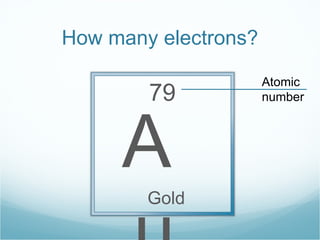
How many electrons? Atomic number 79 Au Gold
How many electrons? Not all atoms are neutral! An ion is… a charged atom with an unequal number of protons and electrons Two types of ions Negatively-charged Positively-charged
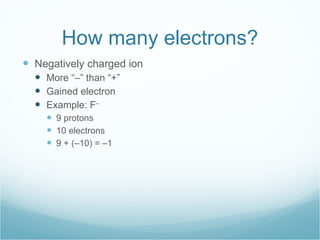
How many electrons? Negatively charged ion More “–” than “+” Gained electron Example: F – 9 protons 10 electrons 9 + (–10) = –1
How many electrons? Positively-charged ion Less “–” than “+” Lost electrons Example: F + 9 protons 8 electrons 9 + (–8) = +1
Summary For an atom of a specific element Things that can be different # of neutrons = isotopes # of electrons = ions Things that must be the same # of protons!
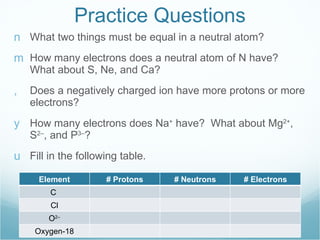
Practice Questions What two things must be equal in a neutral atom? How many electrons does a neutral atom of N have?  What about S, Ne, and Ca? Does a negatively charged ion have more protons or more electrons? How many electrons does Na +  have?  What about Mg 2+ , S 2– , and P 3– ? Fill in the following table. Element # Protons # Neutrons # Electrons C  Cl O 2– Oxygen-18
Exit Slip 1.  In a neutral atom, the number of protons is equal to the a. number of neutrons b. number of electrons c. number of isotopes d. charge on the ion
Exit Slip 2.  Which of the following is the correct definition of an ion? a. an atom with at least three different isotopes b. an atom that has they same number of electrons as it’s atomic number c. an uncharged atom that has an equal number of protons and neutrons d. a charged atom that has an unequal number of protons and electrons
Exit Slip 3.  Which of the following is true for an isotope? a. it is not considered an element b. it can have a variety of atomic numbers c. it can have a variety of atomic masses d. it can have a different number of protons than an atom of the same element 4.  A neutral atom that has 15 electrons could be a. P (Phosphorus). b. O (Oxygen). c. N (Nitrogen). d. K (Potassium).
Exit Slip 5.  Which of the following correctly lists the number of protons, neutrons, and electrons in the negatively charged ion Cl – ? a. 17 protons, 18 neutrons, 17 electrons b. 17 protons, 18 neutrons, 18 electrons c. 17 protons, 17 neutrons, 17 electrons d. 17 protons, 17 neutrons, 18 electrons
Homework Finish practice questions Pg. 86 Practice: #1 Pg. 89 Practice: #1 Pg. 107-108 Chapter Review: #5, 16, 30, 32, 33, 35

How many electrons?

  • 1.
    Launch: 9/17 3. Which of the following is true for isotopes? a. they change the identity of an atom to a different element b. they have varying atomic numbers c. they have varying atomic masses d. they have varying numbers of electrons 5. On the periodic table, why is Co (Cobalt) placed before Ni (Nickel) even though Ni has a lower atomic mass? a. Nickel has one more proton b. Cobalt has fewer electrons c. Nickel has a few more electrons d. Cobalt has a lower density
  • 2.
    Launch: 9/17 3. Which of the following is true for isotopes? a. they change the identity of an atom to a different element b. they have varying atomic numbers c. they have varying atomic masses d. they have varying numbers of electrons 4. Why are atomic masses listed as decimals on the periodic table instead of whole numbers? a. they are a weighted average of the naturally occurring isotopes b. their units are grams/moles c. they were measured with a balance that read to only two decimal places d. none of the above
  • 3.
    How many electrons?Mr. Heffner Chemistry 9/17/09
  • 4.
    What is atomic# and mass? Atomic number = # of protons Atomic mass = # protons + neutrons Atomic mass – atomic number = # of neutrons
  • 5.
    How many electrons?In a neutral atom, The # of electrons = # of protons The # of electrons = atomic number
  • 6.
    How many electrons?Atomic number 1 H Hydrogen
  • 7.
    How many electrons?Atomic number 79 Au Gold
  • 8.
    How many electrons?Not all atoms are neutral! An ion is… a charged atom with an unequal number of protons and electrons Two types of ions Negatively-charged Positively-charged
  • 9.
    How many electrons?Negatively charged ion More “–” than “+” Gained electron Example: F – 9 protons 10 electrons 9 + (–10) = –1
  • 10.
    How many electrons?Positively-charged ion Less “–” than “+” Lost electrons Example: F + 9 protons 8 electrons 9 + (–8) = +1
  • 11.
    Summary For anatom of a specific element Things that can be different # of neutrons = isotopes # of electrons = ions Things that must be the same # of protons!
  • 12.
    Practice Questions Whattwo things must be equal in a neutral atom? How many electrons does a neutral atom of N have? What about S, Ne, and Ca? Does a negatively charged ion have more protons or more electrons? How many electrons does Na + have? What about Mg 2+ , S 2– , and P 3– ? Fill in the following table. Element # Protons # Neutrons # Electrons C Cl O 2– Oxygen-18
  • 13.
    Exit Slip 1. In a neutral atom, the number of protons is equal to the a. number of neutrons b. number of electrons c. number of isotopes d. charge on the ion
  • 14.
    Exit Slip 2. Which of the following is the correct definition of an ion? a. an atom with at least three different isotopes b. an atom that has they same number of electrons as it’s atomic number c. an uncharged atom that has an equal number of protons and neutrons d. a charged atom that has an unequal number of protons and electrons
  • 15.
    Exit Slip 3. Which of the following is true for an isotope? a. it is not considered an element b. it can have a variety of atomic numbers c. it can have a variety of atomic masses d. it can have a different number of protons than an atom of the same element 4. A neutral atom that has 15 electrons could be a. P (Phosphorus). b. O (Oxygen). c. N (Nitrogen). d. K (Potassium).
  • 16.
    Exit Slip 5. Which of the following correctly lists the number of protons, neutrons, and electrons in the negatively charged ion Cl – ? a. 17 protons, 18 neutrons, 17 electrons b. 17 protons, 18 neutrons, 18 electrons c. 17 protons, 17 neutrons, 17 electrons d. 17 protons, 17 neutrons, 18 electrons
  • 17.
    Homework Finish practicequestions Pg. 86 Practice: #1 Pg. 89 Practice: #1 Pg. 107-108 Chapter Review: #5, 16, 30, 32, 33, 35