Downloaded 10 times


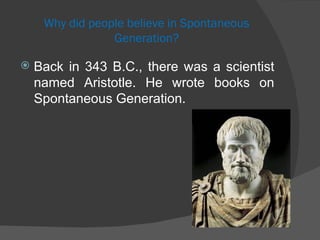
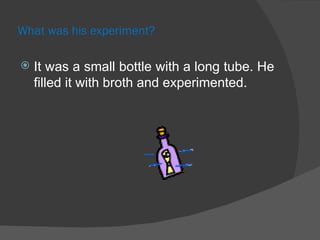

Spontaneous generation was a once widely held theory that certain forms of life could arise from non-living matter, but it has since been proven wrong. The theory was first proposed by Aristotle, who suggested that life arose from "vital heat" in the air. However, in the 19th century, Louis Pasteur designed an experiment using a flask with a long neck that allowed air in but prevented dust and microbes from entering, disproving the theory when nothing grew in the sealed flask. The theory of spontaneous generation has now been superseded due to scientific evidence showing all life arises from reproduction of existing living organisms.


