EDUCATION QUARTERLY, December 2008, Vol. 66 (1), 22-33 
U.P. College of Education 
Creative Activities and Students’ Higher Order 
Thinking Skills 
University of the Philippines Integrated 
University of the Philippines, Diliman 
Abstract 
Rachel Patricia B. Ramirez 
School 
Philippines 
1Mildred S. Ganaden 
Science Education Area 
College of Education 
University of the Philippines, Diliman 
Philippines 
This study investigated the effects of creative activities on high school chemistry 
students’ higher order thinking skills. Sixty (60) students were assigned randomly into 
Instruction with Creative Activities (ICA) group and Instruction with No Creative 
Activities (INCA) group. Various creative activities were incorporated into fourteen 
lessons of the ICA group in the intervention which lasted for ten weeks. The group 
exposed to the ICA was expected to have a higher mean score in the Chemistry Test 
for Higher Order Thinking Skills (ChemTHOTS). However, no significant difference 
was found between the mean posttest scores of the ICA and INCA in the 
ChemTHOTS. Moreover, no significant difference was found between the mean gain 
score from pretest to posttest of the two groups. 
Keywords: creative activities, higher order thinking skills, Bloom’s revised 
taxonomy, divergent thinking1 
Our nation’s quest for economic stability, genuine democracy, and high-quality life 
requires a scientifically literate Filipino citizenry possessing advanced skills in reasoning, 
creative thinking, decision-making, and problem solving. The youth of today will compose the 
voting public, the consumers, and the workforce in the near future. It is therefore imperative 
that they acquire critical thinking abilities that will enable them to make sound decisions and 
informed choices. 
No less than the 1986 Constitution of the Republic of the Philippines calls for all 
educational institutions to “encourage critical and creative thinking” (Constitution of the 
Philippines, 2005, p. 55) among all Filipinos. The 2002 Basic Education Curriculum (BEC) 
echoes the same need to empower the students for lifelong learning. Science program at the 
secondary level aims to promote students’ awareness of the relevance of science in life and to 
Correspondence should be sent to Rachel Patricia Ramirez. Email: zerimarsha@yahoo.com or 
rachel_equality@yahoo.com
Creative Activities Ramirez & Ganaden 
develop critical and creative thinking as well as skills in problem solving (Department of 
Education, 2002). 
Despite the need to build a Philippine citizenry possessing higher level cognitive 
abilities, the current classroom instruction appears ineffective in developing students’ thinking 
skills. Referring to the performance of Filipino high school students in various competency-based 
examinations in 2004, the then Secretary of Education, Florencio Abad lamented, “The 
mastery levels for all three subjects [Science, Mathematics and English] are in fact disastrous” 
(Abad, 2005, p.8). The continuing decline in the quality of Philippine education is also 
reflected in the Filipino students’ performance in an international achievement test. Of the 45 
participating countries in the Trends in International Mathematics and Science Study (TIMSS) 
in 2003, the Philippines ranked near the bottom, higher only than Botswana, Ghana and South 
Africa (Martin et al., 2004). Such poor performance strongly indicates weakness in our 
students’ higher order thinking abilities because the test required skills in reasoning and 
analysis, as well as factual knowledge and conceptual understanding. 
The poor performance of Filipinos in the previous TIMSS (1998 & 2003) and in various 
national achievement tests has sparked local research interest in physics (Pagar, 1999), 
biology (Jacob, 2000; Tobing, 2004), environmental science (Garcia, 2001) and chemistry 
(Handa, 2000) education. These studies were all concerned with the development of problem 
solving and critical thinking abilities of students. Similarly, this study is interested in the 
advancement of higher order cognitive abilities of students. Unlike Handa’s research which 
focused on practical problem solving tasks, this study aimed at enhancing students’ higher 
order thinking skills, using creative activities in classroom instruction. The main purpose of 
this study was to investigate the possible influence of creative activities in chemistry on third 
year high school students’ higher order thinking skills. 
This study addressed the following questions: Do students who were exposed to 
Instruction with Creative Activities (ICA) have a higher mean posttest score than the students 
who were exposed to Instruction with No Creative Activities (INCA) in the Chemistry Test 
for Higher Order Thinking Skills (ChemTHOTS)? And, do students who were exposed to ICA 
have a higher mean gain score from pretest to posttest in the ChemTHOTS than the mean gain 
score of students with no creative activities? 
23 
Higher order thinking skills 
Several authors have offered their descriptions of what exemplifies a higher order 
thinking skill (Resnick as cited by Lawrenz, 1990; Callison, 2002; Presseisen as cited by 
Hernandez, 1991; Zoller, 1993; Zoller, Lubezky, Nakhleh, Tessier, & Dori, 1995). Bloom’s 
Taxonomy of Educational Objectives (Bloom, Englehart, Furst, Hill, & Krathwohl, 1956) for 
designing instruction has also been widely used to distinguish lower and higher order thinking 
skills. Anderson and Krathwohl (2001) revised this taxonomy by classifying the six cognitive 
processes according to whether the student is able or learns to (1) remember, (2) understand, 
(3) apply, (4) analyze, (5) evaluate, and (6) create. Like the original framework, the new 
taxonomy assumes the continuum underlying these processes to be cognitive complexity.
Creative Activities Ramirez & Ganaden 
24 
This study focused on the top three cognitive processes considered as higher order 
thinking skills. Hence, Table 1 presents the processes—analyze, evaluate, and create—as 
described by Anderson and Krathwohl (2001). 
Table 1 
Cognitive process dimension 
Categories and 
cognitive processes 
Alternative names definition 
ANALYZE¾Break material into its constituent parts and determine how the parts relate to one another 
and to an overall structure or purpose 
1. Differentiating 
2. Organizing 
3. Attributing 
discriminating, 
distinguishing, focusing 
finding coherence, 
integrating, outlining 
deconstructing 
distinguishing relevant or important from 
irrelevant or unimportant parts of presented 
material 
determining how elements fit or function within a 
structure 
determine a point of view, bias, values, or intent 
underlying presented material 
EVALUATE¾Make judgments based on criteria and standards 
1. Checking 
2. Critiquing 
coordinating, detecting, 
monitoring, testing 
judging 
detecting inconsistencies within a process or 
product; detecting the effectiveness of a 
procedure as it is being implemented 
detecting inconsistencies between a product and 
external criteria; detecting the appropriateness of 
a procedure for a given problem 
CREATE¾Put elements together to form a coherent or functional whole; reorganize elements into a 
new pattern or structure 
1. Generating 
2. Planning 
3. Producing 
hypothesizing 
designing 
constructing 
coming up with alternative hypotheses based on 
criteria 
devising a procedure for accomplishing some 
task 
inventing a product 
Note. From “A Taxonomy for Learning, Teaching, and Assessing”, by L. W. Anderson and D. 
R. Krathwohl, 2001, New York: Longman, p. 68. 
Tobin, Capie and Bettencourt (1988) reviewed the research related to teaching and 
learning higher cognitive level objectives in science. To promote learning of higher cognitive 
level objectives, they encouraged an active teaching role with emphasis on “monitoring and
Creative Activities Ramirez & Ganaden 
sustaining overt engagement of all students” (p. 17). They recommended less use of whole 
class and more of small groups or individualized activities, to engage students more actively. 
The value of active student engagement was confirmed in a study by Fisher, Gerdes, 
Logue, Smith and Zimmerman (1998). They reported an increase in knowledge and use of 
higher order thinking skills after implementing an experiential learning program. Jackson 
(2000) supported the idea of students carrying out their own investigations. He maintained that 
by allowing this scenario, teachers encourage the students to become “active creative members 
of a learning team” (p. 15). 
A link between class activities and development of higher order thinking skills was 
suggested by Shepardson (1993). Findings revealed that textbook and supplemental guide 
activities put more emphasis on information gathering, remembering, and organizing skills 
than on focusing, integrating, evaluating, and analyzing skills. He stressed the importance of 
cognitive engagement in making classroom activities effective. This was reflected in studies 
conducted by Zoller (1993) and Zohar, Schwartzer and Tamir (1998). 
25 
Creative activities in chemistry 
Torrance (1962) defined creativity as “the process of sensing gaps or disturbing, missing 
elements; forming ideas or hypotheses concerning them; testing these hypotheses; and 
communicating the results, possibly modifying and retesting the hypotheses” (p.16). Dass 
(2004) pointed out that these components of creativity are the usual features of a scientific 
activity. To promote creativity in science classrooms, he cited the following strategies: 
visualization, divergent thinking, open-ended questioning, consideration of alternative 
viewpoints, generation of unusual ideas and metaphors, novelty, solving problems and 
puzzles, designing devices and machines, and multiple modes of communicating results. 
In chemistry, most of the studies found in the literature involve games (Campbell & 
Muzyka, 2002; Welsh, 2003; Dkeidek, 2003; Koether, 2003; and Myers, 2003) and puzzles 
(Castro-Acuña, Dominguez-Danache, Kelter & Grundman, 1999; Helser, 2003; and Kelkar, 
2003) which were incorporated in the lesson mainly to arouse and retain student interest. 
Alber (2001) explored the role of literature and poetry in chemistry by having students 
write a poem about Joseph Priestley, a renowned chemist. Similarly, Abisdris and Casuga 
(2001) used Robert Frost’s poems to help students understand Rutherford’s model of the atom. 
Ibañez (2002) devised short exercises where students matched a proverb or a popular saying to 
its counterpart chemical phenomenon or application. Labianca and Reeves (1981) developed a 
program called “Studies in Detective Fiction”, to integrate chemistry and literature. These 
activities in chemistry have been found to increase student interest, provide a more relaxed 
atmosphere in the classroom as well as contribute to the reversal of negative attitude towards 
the subject.
Creative Activities Ramirez & Ganaden 
26 
Haugh (2002) used the construction of snow globes for an open-ended inquiry-based 
chemistry laboratory. He found that the activity gave students first-hand experience with using 
science as a tool, as well as encouraged creative expression. Lunsford and Strope (2002) 
developed a module utilizing a familiar problem of baking sugar cookies to help students 
develop basic understanding of how to balance chemical reactions. In a similar study, 
Johnstone and Al-Naeme (1995) determined the applicability of mini-projects to various 
learning and motivational styles. 
Observations in the studies reviewed support the existence of a connection between 
creative activities and higher order cognitive skills. Davis (2004) underscored this connection 
when he included in his list of creative abilities the three higher order thinking skills in 
Bloom’s taxonomy ¾ analysis, synthesis, and evaluation. 
Sample 
The study involved all of the 60 third-year students (20 males and 40 females) in a 
regional science high school. On the first day of classes of the school year 2006-7, the students 
were divided into two groups by random assignment. Each group consisted of 10 males and 20 
females. The INCA class met from 8:30 to 9:30 in the morning, followed immediately by the 
ICA class, from 9:30 to 10:30. The students followed this grouping only during these two 
hours at which one group had its chemistry class while the other, another subject, on the first 
hour. This was followed by a cross-over on the second hour. For the rest of the subjects, they 
were in their original sections, which were determined by straight ranking based on their 
academic performance in the previous school year. Both classes were handled by the 
researcher from June 5, 2006 until August 16, 2006 when the posttest was given. The total 
contact time was five hours a week for ten weeks. 
Instruments 
The study used the Chemistry Test for Higher Order Thinking Skills or ChemTHOTS to 
measure the skills of the students in analyzing, evaluating, and creating. The researcher-made 
test was examined by a panel of experts and revised accordingly before it was pilot-tested on 
students who were comparable to the sample. The test consisted of these item types: (a) 
multiple choice (MC), with four plausible options per item; (b) short constructed response 
(SCR), where students answer with a brief statement; and (c) extended constructed response 
(ECR), where students give a detailed answer, such as a solution to a mathematical problem, 
or an experimental design. 
All in all, the ChemTHOTS included 14 MC questions, seven SCR questions, and five 
ECR questions corresponding to 43 points. The 26-item test covered the specific cognitive 
processes involved in analyzing, evaluating and creating. The Cronbach Alpha reliability 
coefficient was computed and found to be .7012. To gain insight into the learning experience 
of the students during the intervention, the researcher required the students to keep journals 
which were submitted weekly.
Creative Activities Ramirez & Ganaden 
27 
Intervention 
Fourteen lesson plans were prepared for each group and submitted to a panel of experts 
for their comments and suggestions. The topics covered were: (1) Scientific Method; (2) 
Laboratory Apparatus and Safety; (3) Mathematical Concepts in Chemistry; (4) Properties and 
Phases of Matter; (5) Different Chemical Systems; (6) Elements and Compounds in Daily 
Life; and (7) Changes in Matter. 
A. Instruction with creative activities (ICA) 
The study involved the intervention called Instruction with Creative Activities (ICA) 
based on the creative teaching model developed by Vicencio (1991). The model involves five 
alternating divergent and convergent stages described in Table 2. 
Table 2 
Summary of the creative teaching model (Vicencio, 1991) 
Stage Type of thinking Description 
Prime 
Present 
Probe and Pry 
Pinpoint and Ponder 
Pursue 
Divergent 
Convergent 
Divergent 
Convergent 
Divergent 
Prepares students for the learning activity that will 
follow 
Presents facts, concepts and ideas 
Explores topic 
Summarizes and generalizes what has been learned 
Extends learning to new concepts and situations 
The creative activities were incorporated in the lesson during the divergent stages 
(prime, probe and pry, and pursue). These activities were designed using standard and 
personal creative techniques. Standard techniques are well-known methods usually taught in 
university and professional creativity courses. Personal techniques are those developed by the 
researcher. 
Direct analogy is a standard strategy that requires students to find connections between 
two unlike ideas, objects or situations. In Lesson 2, the students were asked “How is the life of 
the scientist like a (board game, movie, song, telenovela, book, game show)?” The answers 
given by the students served as a springboard for a discussion on the many aspects of a 
scientist’s life. 
Synectics is another standard technique that helps students understand new content by 
tying it on to something that is familiar to them. In Lesson 9, the students identified familiar 
terms that they usually use interchangeably with the word “pure.” Then, they identified 
things or objects that they would like to be pure. This led to a discussion on the difference 
between substances and mixtures. 
Attribute listing, new uses, What if..?. questions, and Just suppose…statements are 
standard strategies used to develop the ability to think of many different responses to a given 
situation. Attribute listing involves dividing a problem into its important features, then
Creative Activities Ramirez & Ganaden 
addressing each component separately. In Lesson 7, the students were asked to choose a 
building material for houses and to identify its properties. Then, they listed down ideas for 
changing these properties and were asked to come up with a new and improved material. This 
allowed them to share many ideas and think of various ways of how a common material can 
still be improved. New uses and What if...? questions are two conventional subtypes for 
assessing the cognitive process, generating, under the Create category (Anderson & 
Krathwohl, 2001). In new uses, students are given a familiar object and are asked to write as 
many new uses of the item as they can. What if…? questions and Just suppose… statements 
are techniques that encourage students to generate novel solutions or ideas. In Lesson 4, the 
students identified the different ways our ancestors measured distance, volume and area. Then 
they were asked “What would life be like if we still use these old methods of measuring?” 
Discussion of the students’ responses led to the introduction of the International System of 
Units. The use of this technique also distinguished the experiments done by the ICA group 
from those by the INCA group. In most of the laboratory experiments, those done by the ICA 
group had one or two What if…? questions in addition to the end-of-experiment questions. For 
example, in Activity 10.2, the following question was added: “Will this experiment lead you 
to the same conclusions if you use tincture of iodine and sugar syrup, instead of iodine and 
sugar crystals?” 
28 
Question stem is a strategy patterned after Schack & Starko’s (1998) All Kinds of 
Questions, as cited by Starko (2005). In Lesson 2, the students were given samples of sugar 
crystals and asked to complete a number of question stems such as who, what, where, when, 
how, what if, and why. The questions raised by the students served as examples to emphasize 
the importance of asking questions in a scientific study. 
Changing words is a personal strategy developed by the researcher which stemmed from 
a combination of analogy and synectics. In Lesson 5, the students were asked to change some 
of the words used in the rules in determining the number of significant figures and turn them 
into rules in life. In so doing, the rules became more relevant to the students’ lives. 
Silent demonstration coupled with the questions “what?”, “so what?” and “now what?” 
is another strategy designed by the researcher. In Lesson 11, the researcher performed a silent 
demonstration to introduce the topic on acids and bases. She gave no introductions before the 
demonstration and deliberately presented the short experiment without identifying the 
materials used or describing the procedure. After the demonstration, the students were asked 
the questions (1) “What?”, which prompted them to give their observations; (2) “So what?”, 
which led them to make conclusions about the experiment; and (3) “Now what?”, which 
elicited more questions about acids and bases. 
Brainstorming is a popular creative technique for generating new ideas. In Lesson 13, 
the students discussed other ways by which salt could be recovered from seawater aside from 
solar evaporation. After identifying several methods, they chose the best method and shared its 
strong points with the class.
Creative Activities Ramirez & Ganaden 
Creating a product involves the skills in planning, designing and constructing. In Lesson 
3, they created safety symbols or logos that served as constant reminders for them to practice 
safety precautions when doing laboratory experiments. 
29 
B. Instruction with no creative activities (INCA) 
For the INCA group, the classroom activities they performed were not based on 
standard creative techniques. Games, experiments and individual exercises were used in the 
control group to compensate for the time spent on creative activities of the experimental 
group. Although some games and group projects required the students to express their 
creativity, these activities were those typically found in Chemistry classrooms. Although the 
INCA group also performed the same laboratory experiments as the ICA group, the end-of-experiment 
questions were all convergent—there were no What if…? questions or Just 
suppose… statements. Also, instead of a silent demonstration, the researcher described and 
explained the materials, procedures and observations which made the instruction more 
teacher-centered. Nevertheless, the lesson presentation and development were made similar to 
the convergent stages in the lesson plans for the experimental group. 
Data analysis 
Before the intervention began, the mean pretest scores in the Chem THOTS of the two 
groups were computed and compared using the two-tailed t-test for independent samples. 
To determine if there was a significant difference in the higher order thinking skills of 
the ICA and INCA groups, a one-tailed t-test of significance of the difference was performed 
on their mean scores in the posttest of the instrument. Similarly, a one-tailed t-test was 
performed on the mean gain scores of the two groups from pretest to posttest to determine the 
extent of their improvement in the higher order thinking skills after the intervention. 
Results and discussion 
The mean pretest scores in the ChemTHOTS of the ICA (14.20) and INCA (12.70) 
groups were not significantly different (p value = .189,  = 0.05). This indicates that the two 
groups had comparable skills before the intervention. 
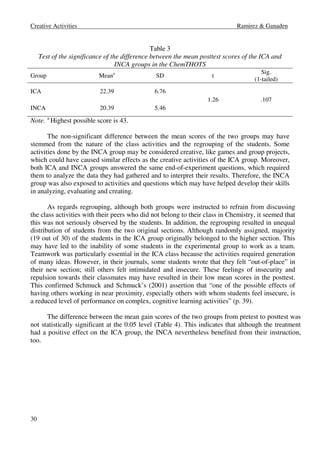
The mean posttest score of the ICA group was numerically higher than the mean 
posttest score of the INCA group. However, the difference between the mean scores of the two 
groups was not significant at the 0.05 level (Table 3). This indicates that the use of creative 
activities during Chemistry instruction is not significantly different from instruction with no 
creative activities in terms of scores in the ChemTHOTS. Despite the lack of significant 
difference, it is worth mentioning that the mean score of the ICA is numerically higher than 
the passing score of 50% (21.5). Conversely, that of the INCA is lower than the passing score.
Creative Activities Ramirez  Ganaden 
30 
Table 3 
Test of the significance of the difference between the mean posttest scores of the ICA and 
INCA groups in the ChemTHOTS 
Group Meana SD t 
Sig. 
(1-tailed) 
ICA 22.39 6.76 
1.26 .107 
INCA 20.39 5.46 
Note. a Highest possible score is 43. 
The non-significant difference between the mean scores of the two groups may have 
stemmed from the nature of the class activities and the regrouping of the students. Some 
activities done by the INCA group may be considered creative, like games and group projects, 
which could have caused similar effects as the creative activities of the ICA group. Moreover, 
both ICA and INCA groups answered the same end-of-experiment questions, which required 
them to analyze the data they had gathered and to interpret their results. Therefore, the INCA 
group was also exposed to activities and questions which may have helped develop their skills 
in analyzing, evaluating and creating. 
As regards regrouping, although both groups were instructed to refrain from discussing 
the class activities with their peers who did not belong to their class in Chemistry, it seemed that 
this was not seriously observed by the students. In addition, the regrouping resulted in unequal 
distribution of students from the two original sections. Although randomly assigned, majority 
(19 out of 30) of the students in the ICA group originally belonged to the higher section. This 
may have led to the inability of some students in the experimental group to work as a team. 
Teamwork was particularly essential in the ICA class because the activities required generation 
of many ideas. However, in their journals, some students wrote that they felt “out-of-place” in 
their new section; still others felt intimidated and insecure. These feelings of insecurity and 
repulsion towards their classmates may have resulted in their low mean scores in the posttest. 
This confirmed Schmuck and Schmuck’s (2001) assertion that “one of the possible effects of 
having others working in near proximity, especially others with whom students feel insecure, is 
a reduced level of performance on complex, cognitive learning activities” (p. 39). 
The difference between the mean gain scores of the two groups from pretest to posttest was 
not statistically significant at the 0.05 level (Table 4). This indicates that although the treatment 
had a positive effect on the ICA group, the INCA nevertheless benefited from their instruction, 
too.
Creative Activities Ramirez  Ganaden 
31 
Table 4 
Test of significance of the difference between the mean gain score from pretest to posttest of 
the ICA and INCA groups in the ChemTHOTS 
Group Mean Gain SD T 
Sig. 
(1-tailed) 
ICA 8.189 5.29 
0.412 .341 
INCA 7.689 4.04 
The comments made by the students regarding the use of creative activities during 
instruction confirm the activities’ positive effect on students’ understanding of concepts, as 
reported by Vicencio (1991). In her study, Vicencio noted that the pupils gained better 
understanding of science concepts because the creative activities made their learning 
experience more enjoyable. This was also reflected in the students’ journal entries, as 
observed by this researcher. 
In sum, the results of the study showed that instruction with creative activities is not 
significantly different from instruction with no creative activities in terms of the improvement 
of higher order thinking skills of students. However, students from both groups appreciated 
the activities that were used during instruction. 
Conclusions and recommendations 
The following conclusions may be deduced from the results of the study: (1) Students 
exposed to ICA do not score significantly higher than the students exposed to INCA in the test 
for higher order thinking skills; and (2) students exposed to ICA do not have a significantly 
higher mean gain score compared to those in the INCA group. 
Based on the results of the study, it is recommended that researchers (1) use more 
varied creative activities during instruction or authentic and/or alternative assessment; (2) 
replicate this study for a longer period to find out if the results will change; (3) use other 
qualitative research techniques to validate results from the quasi-experimental study; and (4) 
use intact classes as samples to reduce chances of students discussing their class activities with 
their peers who belong to the other group.
Creative Activities Ramirez  Ganaden 
32 
References 
Abad, F. (2005). Why the crisis in education. BizNews Asia, 3(26), 8-12. 
Abisdris, G.  Casuga, A. (2001). Atomic poetry. The Science Teacher, 68(6), 58-62. 
Alber, M. (2001). Creative writing and chemistry. Journal of Chemical Education, 78(4), 478-480. 
Anderson, L. W.  Krathwohl, D. R. (Eds.) (2001). A taxonomy for learning, teaching, and assessing: 
A revision of Bloom’s taxonomy of educational objectives. New York: Longman. 
Bloom, B. S., Engelhart, M. D., Furst, E. J., Hill, W. H.,  Krathwohl, D. R. (1956). Taxonomy of 
educational objectives: Handbook I: Cognitive domain. New York: David McKay. 
Callison, D. (2002). Thinking (higher order) skills. School Library Media Activities Monthly, 18(8), 38- 
40. Abstract retrieved September 12, 2005, from Proquest database. 
Campbell, S.  Muzyka, J. (2002). Chemistry game shows. Journal of Chemical Education, 79(4), 458. 
Castro-Acuña, C. M., Dominguez-Danache, R. E., Kelter, P. B.  Grundman, J. (1999). Puzzles in 
chemistry and logic. Journal of Chemical Education, 76(4), 496-8. 
Constitutions of the Philippines. (2005). Manila: Anvil Publishing. 
Dass, P. M. (2004). New science coaches: Preparation in the new rules of science education. In J. Weld 
(Ed.). The game of science education (pp. 48-79). Boston: Pearson. 
Davis, G. A. (2004). Creativity is forever (5th ed.). Dubuque, I.A.: Kendall/Hunt. 
Department of Education. (2002). Basic education curriculum operations handbook. Manila, 
Philippines: Department of Education. 
Dkeidek, I. M. (2003). The elements drawing. Journal of Chemical Education, 80(5), 501-2. 
Fisher, N., Gerdes, K., Logue, T., Smith, L.  Zimmerman, I. (1998). Improving students’ knowledge 
and attitudes of science through the use of hands-on activities. Abstract retrieved September 12, 
2005, from ERIC CD-ROM. (ED436352). 
Garcia, L. C. (2001). Utilizing local environmental issues in developing critical thinking in high school 
students. Unpublished master’s thesis. University of the Philippines Diliman, Quezon City. 
Handa, V. C. (2000). Influence of practical problem solving tasks on meaningful learning and retention 
in college chemistry. Unpublished master’s thesis. University of the Philippines Diliman, Quezon 
City. 
Haugh, T. (2002). Snow globe science. The Science Teacher, 69(3), 36-39. 
Helser, T. L. (2003). Terminology: Four puzzles from one wordsearch. Journal of Chemical Education, 
80(4), 414-6. 
Hernandez, D. F. (1991). Developing and assessing higher order thinking skills. Monograph 46. 
Quezon City: Institute for Science and Mathematics Education Development. 
Ibanez, J. G. (2002). Using proverbs in chemistry. Journal of Chemical Education, 79(4), 454-455. 
Jackson, B. (2000). Chemistry teachers do it with bangs, smells and colours! Science Education 
International, 11(3), 13-8. 
Jacob, P. M. J. (2000). Dimension modification approach and problem solving performance of high 
school students in genetics. Unpublished master’s thesis. University of the Philippines Diliman, 
Quezon City. 
Johnstone, A. H.  Al-Naeme, F. F. (1995). Filling a curriculum gap in chemistry. International 
Journal of Science Education, 17(2), 219-32. 
Kelkar, V. D. (2003). Find the symbols of elements using a letter matrix puzzle. Journal of Chemical 
Education, 80(4), 411-3. 
Koether, M. (2003). The name game: Learning the connectivity between the concepts. Journal of 
Chemical Education, 80(4), 421-2. 
Labianca, D.A.  Reeves, W.J. (1981). Chemistry and detective fiction: An interdisciplinary program 
for the nonscience major. Journal of Chemical Education, 58(8), 683-685.
Creative Activities Ramirez  Ganaden 
Lawrenz, F. (1990). Science teaching techniques associated with higher order thinking skills. Journal of 
33 
Research in Science Teaching, 27(9), 835-47. 
Lunsford, S.  Strope, C. (2002). A sweet balance. The Science Teacher, 69(8), 42-5. 
Martin, M.O., Mullis, I. V.S., Gonzales, E.J., Gregory, K.D., Smith, T.A.,  Chrostowski, S.J. (2004). 
TIMSS 2003: International science report; findings from IEA’s report of the Trends in 
International Mathematics and Science Study. Chestnut Hill, MA: The International Study Center, 
Lynch School of Education, Boston College. 
Myers, S. A. (2003). The molecular model game. Journal of Chemical Education, 80(4), 423-4. 
Pagar, A. G. (1999). A metacognitive model-building approach and physics students’ problem solving 
performance and strategies. Unpublished master’s thesis. University of the Philippines, Diliman, 
Quezon City. 
Schmuck, R. A.  Schmuck, P. A. (2001). Group processes in the classroom (8th ed.). Boston: 
McGraw-Hill. 
Shepardson, D. P. (1993). Publisher-based science activities of the 1980s and thinking skills. School 
Science and Mathematics, 93(5), 264-8. 
Starko, A. J. (2005). Creativity in the classroom: Schools of curious delight (3rd ed.). Mahwah, N.J.: 
Lawrence Erlbaum. 
Tobin, K., Capie, W.  Bettencourt, A. (1988). Active teaching for higher cognitive learning in science. 
International Journal of Science Education, 10(1), 17-27. 
Tobing, J. H. L. (2004). Issue-based teaching of biology integrating religious concepts and critical 
thinking skills development. Unpublished doctoral dissertation. University of the Philippines, 
Diliman, Quezon City. 
Torrance, E. P. (1962). Guiding creative talent. New Delhi: Prentice-Hall of India. 
Vicencio, E. M. (1991). Creative teaching in science and health: Effect on pupil creativity and 
achievement. Unpublished doctoral dissertation, University of the Philippines, Diliman, Quezon 
City. 
Welsh, M. J, (2003). Organic functional group playing card deck. Journal of Chemical Education, 
80(4), 426-7. 
Zohar, A., Schwartzer, N.  Tamir, P. (1998). Assessing the cognitive demands required of students in 
class discourse, homework assignments and tests. International Journal of Science Education, 
20(7), 769-82. 
Zoller, U. (1993). Are lecture and learning compatible? Journal of Chemical Education, 70(3), 195-7. 
Zoller, U., Lubezky, A., Nakhleh, M. B., Tessier, B.  Dori, Y. J. (1995). Success on algorithmic and 
LOCS vs. conceptual chemistry exam questions. Journal of Chemical Education, 72(11), 987-9.2 
Date submitted: June 2008 
Rachel Patricia B. Ramirez is Assistant Professor of Chemistry at the University of the Philippines 
Integrated School, Diliman. She had been resource speaker, facilitator and teacher-demonstrator in 
various teacher-training programs. She works with the Foundation for Upgrading the Standard of 
Education (FUSE) as facilitator in the training of high school chemistry teachers on the use of 
Continuing Studies via Technology (CONSTEC) materials. She is also a member of the Philippine 
Association of Chemistry Teachers (PACT). 
Mildred S. Ganaden is retired Professor of Science Education from the College of Education, 
University of the Philippines, Diliman.

journal article

  • 1.
    EDUCATION QUARTERLY, December2008, Vol. 66 (1), 22-33 U.P. College of Education Creative Activities and Students’ Higher Order Thinking Skills University of the Philippines Integrated University of the Philippines, Diliman Abstract Rachel Patricia B. Ramirez School Philippines 1Mildred S. Ganaden Science Education Area College of Education University of the Philippines, Diliman Philippines This study investigated the effects of creative activities on high school chemistry students’ higher order thinking skills. Sixty (60) students were assigned randomly into Instruction with Creative Activities (ICA) group and Instruction with No Creative Activities (INCA) group. Various creative activities were incorporated into fourteen lessons of the ICA group in the intervention which lasted for ten weeks. The group exposed to the ICA was expected to have a higher mean score in the Chemistry Test for Higher Order Thinking Skills (ChemTHOTS). However, no significant difference was found between the mean posttest scores of the ICA and INCA in the ChemTHOTS. Moreover, no significant difference was found between the mean gain score from pretest to posttest of the two groups. Keywords: creative activities, higher order thinking skills, Bloom’s revised taxonomy, divergent thinking1 Our nation’s quest for economic stability, genuine democracy, and high-quality life requires a scientifically literate Filipino citizenry possessing advanced skills in reasoning, creative thinking, decision-making, and problem solving. The youth of today will compose the voting public, the consumers, and the workforce in the near future. It is therefore imperative that they acquire critical thinking abilities that will enable them to make sound decisions and informed choices. No less than the 1986 Constitution of the Republic of the Philippines calls for all educational institutions to “encourage critical and creative thinking” (Constitution of the Philippines, 2005, p. 55) among all Filipinos. The 2002 Basic Education Curriculum (BEC) echoes the same need to empower the students for lifelong learning. Science program at the secondary level aims to promote students’ awareness of the relevance of science in life and to Correspondence should be sent to Rachel Patricia Ramirez. Email: zerimarsha@yahoo.com or rachel_equality@yahoo.com
  • 2.
    Creative Activities Ramirez& Ganaden develop critical and creative thinking as well as skills in problem solving (Department of Education, 2002). Despite the need to build a Philippine citizenry possessing higher level cognitive abilities, the current classroom instruction appears ineffective in developing students’ thinking skills. Referring to the performance of Filipino high school students in various competency-based examinations in 2004, the then Secretary of Education, Florencio Abad lamented, “The mastery levels for all three subjects [Science, Mathematics and English] are in fact disastrous” (Abad, 2005, p.8). The continuing decline in the quality of Philippine education is also reflected in the Filipino students’ performance in an international achievement test. Of the 45 participating countries in the Trends in International Mathematics and Science Study (TIMSS) in 2003, the Philippines ranked near the bottom, higher only than Botswana, Ghana and South Africa (Martin et al., 2004). Such poor performance strongly indicates weakness in our students’ higher order thinking abilities because the test required skills in reasoning and analysis, as well as factual knowledge and conceptual understanding. The poor performance of Filipinos in the previous TIMSS (1998 & 2003) and in various national achievement tests has sparked local research interest in physics (Pagar, 1999), biology (Jacob, 2000; Tobing, 2004), environmental science (Garcia, 2001) and chemistry (Handa, 2000) education. These studies were all concerned with the development of problem solving and critical thinking abilities of students. Similarly, this study is interested in the advancement of higher order cognitive abilities of students. Unlike Handa’s research which focused on practical problem solving tasks, this study aimed at enhancing students’ higher order thinking skills, using creative activities in classroom instruction. The main purpose of this study was to investigate the possible influence of creative activities in chemistry on third year high school students’ higher order thinking skills. This study addressed the following questions: Do students who were exposed to Instruction with Creative Activities (ICA) have a higher mean posttest score than the students who were exposed to Instruction with No Creative Activities (INCA) in the Chemistry Test for Higher Order Thinking Skills (ChemTHOTS)? And, do students who were exposed to ICA have a higher mean gain score from pretest to posttest in the ChemTHOTS than the mean gain score of students with no creative activities? 23 Higher order thinking skills Several authors have offered their descriptions of what exemplifies a higher order thinking skill (Resnick as cited by Lawrenz, 1990; Callison, 2002; Presseisen as cited by Hernandez, 1991; Zoller, 1993; Zoller, Lubezky, Nakhleh, Tessier, & Dori, 1995). Bloom’s Taxonomy of Educational Objectives (Bloom, Englehart, Furst, Hill, & Krathwohl, 1956) for designing instruction has also been widely used to distinguish lower and higher order thinking skills. Anderson and Krathwohl (2001) revised this taxonomy by classifying the six cognitive processes according to whether the student is able or learns to (1) remember, (2) understand, (3) apply, (4) analyze, (5) evaluate, and (6) create. Like the original framework, the new taxonomy assumes the continuum underlying these processes to be cognitive complexity.
  • 3.
    Creative Activities Ramirez& Ganaden 24 This study focused on the top three cognitive processes considered as higher order thinking skills. Hence, Table 1 presents the processes—analyze, evaluate, and create—as described by Anderson and Krathwohl (2001). Table 1 Cognitive process dimension Categories and cognitive processes Alternative names definition ANALYZE¾Break material into its constituent parts and determine how the parts relate to one another and to an overall structure or purpose 1. Differentiating 2. Organizing 3. Attributing discriminating, distinguishing, focusing finding coherence, integrating, outlining deconstructing distinguishing relevant or important from irrelevant or unimportant parts of presented material determining how elements fit or function within a structure determine a point of view, bias, values, or intent underlying presented material EVALUATE¾Make judgments based on criteria and standards 1. Checking 2. Critiquing coordinating, detecting, monitoring, testing judging detecting inconsistencies within a process or product; detecting the effectiveness of a procedure as it is being implemented detecting inconsistencies between a product and external criteria; detecting the appropriateness of a procedure for a given problem CREATE¾Put elements together to form a coherent or functional whole; reorganize elements into a new pattern or structure 1. Generating 2. Planning 3. Producing hypothesizing designing constructing coming up with alternative hypotheses based on criteria devising a procedure for accomplishing some task inventing a product Note. From “A Taxonomy for Learning, Teaching, and Assessing”, by L. W. Anderson and D. R. Krathwohl, 2001, New York: Longman, p. 68. Tobin, Capie and Bettencourt (1988) reviewed the research related to teaching and learning higher cognitive level objectives in science. To promote learning of higher cognitive level objectives, they encouraged an active teaching role with emphasis on “monitoring and
  • 4.
    Creative Activities Ramirez& Ganaden sustaining overt engagement of all students” (p. 17). They recommended less use of whole class and more of small groups or individualized activities, to engage students more actively. The value of active student engagement was confirmed in a study by Fisher, Gerdes, Logue, Smith and Zimmerman (1998). They reported an increase in knowledge and use of higher order thinking skills after implementing an experiential learning program. Jackson (2000) supported the idea of students carrying out their own investigations. He maintained that by allowing this scenario, teachers encourage the students to become “active creative members of a learning team” (p. 15). A link between class activities and development of higher order thinking skills was suggested by Shepardson (1993). Findings revealed that textbook and supplemental guide activities put more emphasis on information gathering, remembering, and organizing skills than on focusing, integrating, evaluating, and analyzing skills. He stressed the importance of cognitive engagement in making classroom activities effective. This was reflected in studies conducted by Zoller (1993) and Zohar, Schwartzer and Tamir (1998). 25 Creative activities in chemistry Torrance (1962) defined creativity as “the process of sensing gaps or disturbing, missing elements; forming ideas or hypotheses concerning them; testing these hypotheses; and communicating the results, possibly modifying and retesting the hypotheses” (p.16). Dass (2004) pointed out that these components of creativity are the usual features of a scientific activity. To promote creativity in science classrooms, he cited the following strategies: visualization, divergent thinking, open-ended questioning, consideration of alternative viewpoints, generation of unusual ideas and metaphors, novelty, solving problems and puzzles, designing devices and machines, and multiple modes of communicating results. In chemistry, most of the studies found in the literature involve games (Campbell & Muzyka, 2002; Welsh, 2003; Dkeidek, 2003; Koether, 2003; and Myers, 2003) and puzzles (Castro-Acuña, Dominguez-Danache, Kelter & Grundman, 1999; Helser, 2003; and Kelkar, 2003) which were incorporated in the lesson mainly to arouse and retain student interest. Alber (2001) explored the role of literature and poetry in chemistry by having students write a poem about Joseph Priestley, a renowned chemist. Similarly, Abisdris and Casuga (2001) used Robert Frost’s poems to help students understand Rutherford’s model of the atom. Ibañez (2002) devised short exercises where students matched a proverb or a popular saying to its counterpart chemical phenomenon or application. Labianca and Reeves (1981) developed a program called “Studies in Detective Fiction”, to integrate chemistry and literature. These activities in chemistry have been found to increase student interest, provide a more relaxed atmosphere in the classroom as well as contribute to the reversal of negative attitude towards the subject.
  • 5.
    Creative Activities Ramirez& Ganaden 26 Haugh (2002) used the construction of snow globes for an open-ended inquiry-based chemistry laboratory. He found that the activity gave students first-hand experience with using science as a tool, as well as encouraged creative expression. Lunsford and Strope (2002) developed a module utilizing a familiar problem of baking sugar cookies to help students develop basic understanding of how to balance chemical reactions. In a similar study, Johnstone and Al-Naeme (1995) determined the applicability of mini-projects to various learning and motivational styles. Observations in the studies reviewed support the existence of a connection between creative activities and higher order cognitive skills. Davis (2004) underscored this connection when he included in his list of creative abilities the three higher order thinking skills in Bloom’s taxonomy ¾ analysis, synthesis, and evaluation. Sample The study involved all of the 60 third-year students (20 males and 40 females) in a regional science high school. On the first day of classes of the school year 2006-7, the students were divided into two groups by random assignment. Each group consisted of 10 males and 20 females. The INCA class met from 8:30 to 9:30 in the morning, followed immediately by the ICA class, from 9:30 to 10:30. The students followed this grouping only during these two hours at which one group had its chemistry class while the other, another subject, on the first hour. This was followed by a cross-over on the second hour. For the rest of the subjects, they were in their original sections, which were determined by straight ranking based on their academic performance in the previous school year. Both classes were handled by the researcher from June 5, 2006 until August 16, 2006 when the posttest was given. The total contact time was five hours a week for ten weeks. Instruments The study used the Chemistry Test for Higher Order Thinking Skills or ChemTHOTS to measure the skills of the students in analyzing, evaluating, and creating. The researcher-made test was examined by a panel of experts and revised accordingly before it was pilot-tested on students who were comparable to the sample. The test consisted of these item types: (a) multiple choice (MC), with four plausible options per item; (b) short constructed response (SCR), where students answer with a brief statement; and (c) extended constructed response (ECR), where students give a detailed answer, such as a solution to a mathematical problem, or an experimental design. All in all, the ChemTHOTS included 14 MC questions, seven SCR questions, and five ECR questions corresponding to 43 points. The 26-item test covered the specific cognitive processes involved in analyzing, evaluating and creating. The Cronbach Alpha reliability coefficient was computed and found to be .7012. To gain insight into the learning experience of the students during the intervention, the researcher required the students to keep journals which were submitted weekly.
  • 6.
    Creative Activities Ramirez& Ganaden 27 Intervention Fourteen lesson plans were prepared for each group and submitted to a panel of experts for their comments and suggestions. The topics covered were: (1) Scientific Method; (2) Laboratory Apparatus and Safety; (3) Mathematical Concepts in Chemistry; (4) Properties and Phases of Matter; (5) Different Chemical Systems; (6) Elements and Compounds in Daily Life; and (7) Changes in Matter. A. Instruction with creative activities (ICA) The study involved the intervention called Instruction with Creative Activities (ICA) based on the creative teaching model developed by Vicencio (1991). The model involves five alternating divergent and convergent stages described in Table 2. Table 2 Summary of the creative teaching model (Vicencio, 1991) Stage Type of thinking Description Prime Present Probe and Pry Pinpoint and Ponder Pursue Divergent Convergent Divergent Convergent Divergent Prepares students for the learning activity that will follow Presents facts, concepts and ideas Explores topic Summarizes and generalizes what has been learned Extends learning to new concepts and situations The creative activities were incorporated in the lesson during the divergent stages (prime, probe and pry, and pursue). These activities were designed using standard and personal creative techniques. Standard techniques are well-known methods usually taught in university and professional creativity courses. Personal techniques are those developed by the researcher. Direct analogy is a standard strategy that requires students to find connections between two unlike ideas, objects or situations. In Lesson 2, the students were asked “How is the life of the scientist like a (board game, movie, song, telenovela, book, game show)?” The answers given by the students served as a springboard for a discussion on the many aspects of a scientist’s life. Synectics is another standard technique that helps students understand new content by tying it on to something that is familiar to them. In Lesson 9, the students identified familiar terms that they usually use interchangeably with the word “pure.” Then, they identified things or objects that they would like to be pure. This led to a discussion on the difference between substances and mixtures. Attribute listing, new uses, What if..?. questions, and Just suppose…statements are standard strategies used to develop the ability to think of many different responses to a given situation. Attribute listing involves dividing a problem into its important features, then
  • 7.
    Creative Activities Ramirez& Ganaden addressing each component separately. In Lesson 7, the students were asked to choose a building material for houses and to identify its properties. Then, they listed down ideas for changing these properties and were asked to come up with a new and improved material. This allowed them to share many ideas and think of various ways of how a common material can still be improved. New uses and What if...? questions are two conventional subtypes for assessing the cognitive process, generating, under the Create category (Anderson & Krathwohl, 2001). In new uses, students are given a familiar object and are asked to write as many new uses of the item as they can. What if…? questions and Just suppose… statements are techniques that encourage students to generate novel solutions or ideas. In Lesson 4, the students identified the different ways our ancestors measured distance, volume and area. Then they were asked “What would life be like if we still use these old methods of measuring?” Discussion of the students’ responses led to the introduction of the International System of Units. The use of this technique also distinguished the experiments done by the ICA group from those by the INCA group. In most of the laboratory experiments, those done by the ICA group had one or two What if…? questions in addition to the end-of-experiment questions. For example, in Activity 10.2, the following question was added: “Will this experiment lead you to the same conclusions if you use tincture of iodine and sugar syrup, instead of iodine and sugar crystals?” 28 Question stem is a strategy patterned after Schack & Starko’s (1998) All Kinds of Questions, as cited by Starko (2005). In Lesson 2, the students were given samples of sugar crystals and asked to complete a number of question stems such as who, what, where, when, how, what if, and why. The questions raised by the students served as examples to emphasize the importance of asking questions in a scientific study. Changing words is a personal strategy developed by the researcher which stemmed from a combination of analogy and synectics. In Lesson 5, the students were asked to change some of the words used in the rules in determining the number of significant figures and turn them into rules in life. In so doing, the rules became more relevant to the students’ lives. Silent demonstration coupled with the questions “what?”, “so what?” and “now what?” is another strategy designed by the researcher. In Lesson 11, the researcher performed a silent demonstration to introduce the topic on acids and bases. She gave no introductions before the demonstration and deliberately presented the short experiment without identifying the materials used or describing the procedure. After the demonstration, the students were asked the questions (1) “What?”, which prompted them to give their observations; (2) “So what?”, which led them to make conclusions about the experiment; and (3) “Now what?”, which elicited more questions about acids and bases. Brainstorming is a popular creative technique for generating new ideas. In Lesson 13, the students discussed other ways by which salt could be recovered from seawater aside from solar evaporation. After identifying several methods, they chose the best method and shared its strong points with the class.
  • 8.
    Creative Activities Ramirez& Ganaden Creating a product involves the skills in planning, designing and constructing. In Lesson 3, they created safety symbols or logos that served as constant reminders for them to practice safety precautions when doing laboratory experiments. 29 B. Instruction with no creative activities (INCA) For the INCA group, the classroom activities they performed were not based on standard creative techniques. Games, experiments and individual exercises were used in the control group to compensate for the time spent on creative activities of the experimental group. Although some games and group projects required the students to express their creativity, these activities were those typically found in Chemistry classrooms. Although the INCA group also performed the same laboratory experiments as the ICA group, the end-of-experiment questions were all convergent—there were no What if…? questions or Just suppose… statements. Also, instead of a silent demonstration, the researcher described and explained the materials, procedures and observations which made the instruction more teacher-centered. Nevertheless, the lesson presentation and development were made similar to the convergent stages in the lesson plans for the experimental group. Data analysis Before the intervention began, the mean pretest scores in the Chem THOTS of the two groups were computed and compared using the two-tailed t-test for independent samples. To determine if there was a significant difference in the higher order thinking skills of the ICA and INCA groups, a one-tailed t-test of significance of the difference was performed on their mean scores in the posttest of the instrument. Similarly, a one-tailed t-test was performed on the mean gain scores of the two groups from pretest to posttest to determine the extent of their improvement in the higher order thinking skills after the intervention. Results and discussion The mean pretest scores in the ChemTHOTS of the ICA (14.20) and INCA (12.70) groups were not significantly different (p value = .189, = 0.05). This indicates that the two groups had comparable skills before the intervention. The mean posttest score of the ICA group was numerically higher than the mean posttest score of the INCA group. However, the difference between the mean scores of the two groups was not significant at the 0.05 level (Table 3). This indicates that the use of creative activities during Chemistry instruction is not significantly different from instruction with no creative activities in terms of scores in the ChemTHOTS. Despite the lack of significant difference, it is worth mentioning that the mean score of the ICA is numerically higher than the passing score of 50% (21.5). Conversely, that of the INCA is lower than the passing score.
  • 9.
    Creative Activities Ramirez Ganaden 30 Table 3 Test of the significance of the difference between the mean posttest scores of the ICA and INCA groups in the ChemTHOTS Group Meana SD t Sig. (1-tailed) ICA 22.39 6.76 1.26 .107 INCA 20.39 5.46 Note. a Highest possible score is 43. The non-significant difference between the mean scores of the two groups may have stemmed from the nature of the class activities and the regrouping of the students. Some activities done by the INCA group may be considered creative, like games and group projects, which could have caused similar effects as the creative activities of the ICA group. Moreover, both ICA and INCA groups answered the same end-of-experiment questions, which required them to analyze the data they had gathered and to interpret their results. Therefore, the INCA group was also exposed to activities and questions which may have helped develop their skills in analyzing, evaluating and creating. As regards regrouping, although both groups were instructed to refrain from discussing the class activities with their peers who did not belong to their class in Chemistry, it seemed that this was not seriously observed by the students. In addition, the regrouping resulted in unequal distribution of students from the two original sections. Although randomly assigned, majority (19 out of 30) of the students in the ICA group originally belonged to the higher section. This may have led to the inability of some students in the experimental group to work as a team. Teamwork was particularly essential in the ICA class because the activities required generation of many ideas. However, in their journals, some students wrote that they felt “out-of-place” in their new section; still others felt intimidated and insecure. These feelings of insecurity and repulsion towards their classmates may have resulted in their low mean scores in the posttest. This confirmed Schmuck and Schmuck’s (2001) assertion that “one of the possible effects of having others working in near proximity, especially others with whom students feel insecure, is a reduced level of performance on complex, cognitive learning activities” (p. 39). The difference between the mean gain scores of the two groups from pretest to posttest was not statistically significant at the 0.05 level (Table 4). This indicates that although the treatment had a positive effect on the ICA group, the INCA nevertheless benefited from their instruction, too.
  • 10.
    Creative Activities Ramirez Ganaden 31 Table 4 Test of significance of the difference between the mean gain score from pretest to posttest of the ICA and INCA groups in the ChemTHOTS Group Mean Gain SD T Sig. (1-tailed) ICA 8.189 5.29 0.412 .341 INCA 7.689 4.04 The comments made by the students regarding the use of creative activities during instruction confirm the activities’ positive effect on students’ understanding of concepts, as reported by Vicencio (1991). In her study, Vicencio noted that the pupils gained better understanding of science concepts because the creative activities made their learning experience more enjoyable. This was also reflected in the students’ journal entries, as observed by this researcher. In sum, the results of the study showed that instruction with creative activities is not significantly different from instruction with no creative activities in terms of the improvement of higher order thinking skills of students. However, students from both groups appreciated the activities that were used during instruction. Conclusions and recommendations The following conclusions may be deduced from the results of the study: (1) Students exposed to ICA do not score significantly higher than the students exposed to INCA in the test for higher order thinking skills; and (2) students exposed to ICA do not have a significantly higher mean gain score compared to those in the INCA group. Based on the results of the study, it is recommended that researchers (1) use more varied creative activities during instruction or authentic and/or alternative assessment; (2) replicate this study for a longer period to find out if the results will change; (3) use other qualitative research techniques to validate results from the quasi-experimental study; and (4) use intact classes as samples to reduce chances of students discussing their class activities with their peers who belong to the other group.
  • 11.
    Creative Activities Ramirez Ganaden 32 References Abad, F. (2005). Why the crisis in education. BizNews Asia, 3(26), 8-12. Abisdris, G. Casuga, A. (2001). Atomic poetry. The Science Teacher, 68(6), 58-62. Alber, M. (2001). Creative writing and chemistry. Journal of Chemical Education, 78(4), 478-480. Anderson, L. W. Krathwohl, D. R. (Eds.) (2001). A taxonomy for learning, teaching, and assessing: A revision of Bloom’s taxonomy of educational objectives. New York: Longman. Bloom, B. S., Engelhart, M. D., Furst, E. J., Hill, W. H., Krathwohl, D. R. (1956). Taxonomy of educational objectives: Handbook I: Cognitive domain. New York: David McKay. Callison, D. (2002). Thinking (higher order) skills. School Library Media Activities Monthly, 18(8), 38- 40. Abstract retrieved September 12, 2005, from Proquest database. Campbell, S. Muzyka, J. (2002). Chemistry game shows. Journal of Chemical Education, 79(4), 458. Castro-Acuña, C. M., Dominguez-Danache, R. E., Kelter, P. B. Grundman, J. (1999). Puzzles in chemistry and logic. Journal of Chemical Education, 76(4), 496-8. Constitutions of the Philippines. (2005). Manila: Anvil Publishing. Dass, P. M. (2004). New science coaches: Preparation in the new rules of science education. In J. Weld (Ed.). The game of science education (pp. 48-79). Boston: Pearson. Davis, G. A. (2004). Creativity is forever (5th ed.). Dubuque, I.A.: Kendall/Hunt. Department of Education. (2002). Basic education curriculum operations handbook. Manila, Philippines: Department of Education. Dkeidek, I. M. (2003). The elements drawing. Journal of Chemical Education, 80(5), 501-2. Fisher, N., Gerdes, K., Logue, T., Smith, L. Zimmerman, I. (1998). Improving students’ knowledge and attitudes of science through the use of hands-on activities. Abstract retrieved September 12, 2005, from ERIC CD-ROM. (ED436352). Garcia, L. C. (2001). Utilizing local environmental issues in developing critical thinking in high school students. Unpublished master’s thesis. University of the Philippines Diliman, Quezon City. Handa, V. C. (2000). Influence of practical problem solving tasks on meaningful learning and retention in college chemistry. Unpublished master’s thesis. University of the Philippines Diliman, Quezon City. Haugh, T. (2002). Snow globe science. The Science Teacher, 69(3), 36-39. Helser, T. L. (2003). Terminology: Four puzzles from one wordsearch. Journal of Chemical Education, 80(4), 414-6. Hernandez, D. F. (1991). Developing and assessing higher order thinking skills. Monograph 46. Quezon City: Institute for Science and Mathematics Education Development. Ibanez, J. G. (2002). Using proverbs in chemistry. Journal of Chemical Education, 79(4), 454-455. Jackson, B. (2000). Chemistry teachers do it with bangs, smells and colours! Science Education International, 11(3), 13-8. Jacob, P. M. J. (2000). Dimension modification approach and problem solving performance of high school students in genetics. Unpublished master’s thesis. University of the Philippines Diliman, Quezon City. Johnstone, A. H. Al-Naeme, F. F. (1995). Filling a curriculum gap in chemistry. International Journal of Science Education, 17(2), 219-32. Kelkar, V. D. (2003). Find the symbols of elements using a letter matrix puzzle. Journal of Chemical Education, 80(4), 411-3. Koether, M. (2003). The name game: Learning the connectivity between the concepts. Journal of Chemical Education, 80(4), 421-2. Labianca, D.A. Reeves, W.J. (1981). Chemistry and detective fiction: An interdisciplinary program for the nonscience major. Journal of Chemical Education, 58(8), 683-685.
  • 12.
    Creative Activities Ramirez Ganaden Lawrenz, F. (1990). Science teaching techniques associated with higher order thinking skills. Journal of 33 Research in Science Teaching, 27(9), 835-47. Lunsford, S. Strope, C. (2002). A sweet balance. The Science Teacher, 69(8), 42-5. Martin, M.O., Mullis, I. V.S., Gonzales, E.J., Gregory, K.D., Smith, T.A., Chrostowski, S.J. (2004). TIMSS 2003: International science report; findings from IEA’s report of the Trends in International Mathematics and Science Study. Chestnut Hill, MA: The International Study Center, Lynch School of Education, Boston College. Myers, S. A. (2003). The molecular model game. Journal of Chemical Education, 80(4), 423-4. Pagar, A. G. (1999). A metacognitive model-building approach and physics students’ problem solving performance and strategies. Unpublished master’s thesis. University of the Philippines, Diliman, Quezon City. Schmuck, R. A. Schmuck, P. A. (2001). Group processes in the classroom (8th ed.). Boston: McGraw-Hill. Shepardson, D. P. (1993). Publisher-based science activities of the 1980s and thinking skills. School Science and Mathematics, 93(5), 264-8. Starko, A. J. (2005). Creativity in the classroom: Schools of curious delight (3rd ed.). Mahwah, N.J.: Lawrence Erlbaum. Tobin, K., Capie, W. Bettencourt, A. (1988). Active teaching for higher cognitive learning in science. International Journal of Science Education, 10(1), 17-27. Tobing, J. H. L. (2004). Issue-based teaching of biology integrating religious concepts and critical thinking skills development. Unpublished doctoral dissertation. University of the Philippines, Diliman, Quezon City. Torrance, E. P. (1962). Guiding creative talent. New Delhi: Prentice-Hall of India. Vicencio, E. M. (1991). Creative teaching in science and health: Effect on pupil creativity and achievement. Unpublished doctoral dissertation, University of the Philippines, Diliman, Quezon City. Welsh, M. J, (2003). Organic functional group playing card deck. Journal of Chemical Education, 80(4), 426-7. Zohar, A., Schwartzer, N. Tamir, P. (1998). Assessing the cognitive demands required of students in class discourse, homework assignments and tests. International Journal of Science Education, 20(7), 769-82. Zoller, U. (1993). Are lecture and learning compatible? Journal of Chemical Education, 70(3), 195-7. Zoller, U., Lubezky, A., Nakhleh, M. B., Tessier, B. Dori, Y. J. (1995). Success on algorithmic and LOCS vs. conceptual chemistry exam questions. Journal of Chemical Education, 72(11), 987-9.2 Date submitted: June 2008 Rachel Patricia B. Ramirez is Assistant Professor of Chemistry at the University of the Philippines Integrated School, Diliman. She had been resource speaker, facilitator and teacher-demonstrator in various teacher-training programs. She works with the Foundation for Upgrading the Standard of Education (FUSE) as facilitator in the training of high school chemistry teachers on the use of Continuing Studies via Technology (CONSTEC) materials. She is also a member of the Philippine Association of Chemistry Teachers (PACT). Mildred S. Ganaden is retired Professor of Science Education from the College of Education, University of the Philippines, Diliman.