LEAN & GREEN OPERATIONS in local restaurantsA Survey of Lean and Green Practices in the Restaurant Industry in Northeastern PennsylvaniaJennifer J. Edmonds, PhDAssociate Professor, Statistics & Operations ManagementWilkes UniversityWilkes-Barre, PennsylvaniaPresented at POMS 2011 in Reno, Nevada
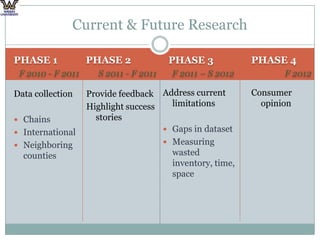
LEAN & GREEN OPERATIONS in local restaurantsBackground on Lean & GreenWhat this means for RestaurantsProject ScopeLuzerne County RestaurantsLean & Green PracticesSummaryCurrent & Future Research
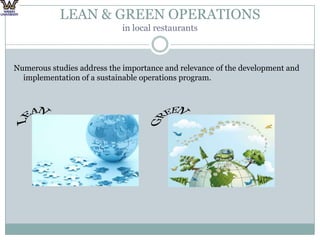
LEAN & GREEN OPERATIONS in local restaurantsNumerous studies address the importance and relevance of the development and implementation of a sustainable operations program. LEANGREEN
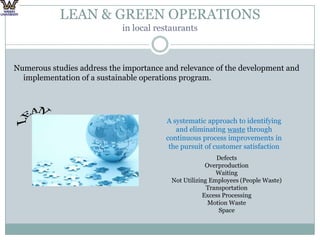
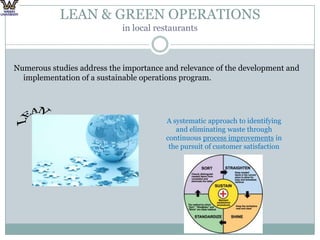
LEAN & GREEN OPERATIONS in local restaurantsNumerous studies address the importance and relevance of the development and implementation of a sustainable operations program. LEANA systematic approach to identifying and eliminating waste through continuous process improvements in the pursuit of customer satisfactionDefectsOverproductionWaitingNot Utilizing Employees (People Waste)TransportationExcess ProcessingMotion WasteSpace
LEAN & GREEN OPERATIONS in local restaurantsNumerous studies address the importance and relevance of the development and implementation of a sustainable operations program. LEANA systematic approach to identifying and eliminating waste through continuous process improvements in the pursuit of customer satisfaction
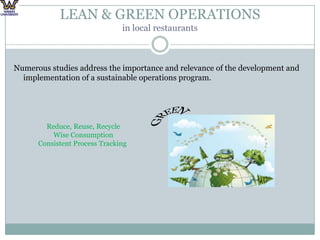
LEAN & GREEN OPERATIONS in local restaurantsNumerous studies address the importance and relevance of the development and implementation of a sustainable operations program. GREENReduce, Reuse, RecycleWise ConsumptionConsistent Process Tracking
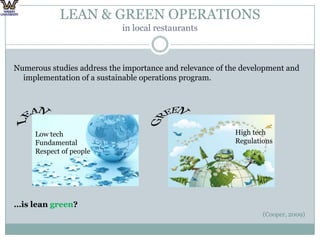
LEAN & GREEN OPERATIONS in local restaurantsNumerous studies address the importance and relevance of the development and implementation of a sustainable operations program. …is lean green?(Cooper, 2009)LEANGREENHigh techRegulations Low techFundamentalRespect of people
LEAN & GREEN OPERATIONS in local restaurantsNumerous studies address the importance and relevance of the development and implementation of a sustainable operations program. However, very few empirical studies highlight the prevalence of such practices in the restaurant industry. (Greathouse, 2010)‘Pays to be Green’ Empirical ResearchExpenditures on pollution control are positively correlated with financial performance in pulp and paper firms(Spicer, 1978)Positive link between environmental and financial performance in manufacturing firms(King & Lennox, 2001)					…and future cost savings(Porter & van derLinde, 1995)Positive relationship between environmental and financial performance for scrap steel yards(Clemens, 2006)
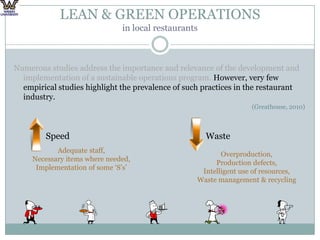
LEAN & GREEN OPERATIONS in local restaurantsNumerous studies address the importance and relevance of the development and implementation of a sustainable operations program. However, very few empirical studies highlight the prevalence of such practices in the restaurant industry. (Greathouse, 2010)		Speed					WasteAdequate staff,Necessary items where needed,Implementation of some ‘S’s’Overproduction,Production defects,Intelligent use of resources,Waste management & recycling
LEAN & GREEN OPERATIONS in local restaurantsNumerous studies address the importance and relevance of the development and implementation of a sustainable operations program. However, very few studies highlight the prevalence of such practices in the restaurant industry. The purpose of this study is to highlight lean and green programs' implementation observed within smaller organizations in the restaurant industry of Northeastern Pennsylvania. Why small businesses? an excellent opportunity to conduct system-wide research large numbers of homogenous firms(Rigg & Bracker, 1986)Hold a relatively small share of the market,Fewer than 500 employeesSmall businesses report 20-30% cost savings by making energy saving moves….Byron KennardCenter for Small Business and the EnvironmentUSA Today, December 2007
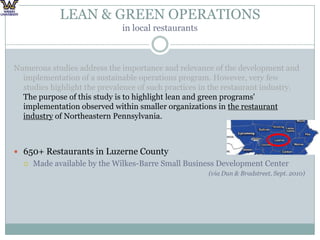
LEAN & GREEN OPERATIONS in local restaurantsNumerous studies address the importance and relevance of the development and implementation of a sustainable operations program. However, very few studies highlight the prevalence of such practices in the restaurant industry. The purpose of this study is to highlight lean and green programs' implementation observed within smaller organizations in the restaurant industry of Northeastern Pennsylvania. 650+ Restaurants in Luzerne County Made available by the Wilkes-Barre Small Business Development Center (via Dun & Bradstreet, Sept. 2010)
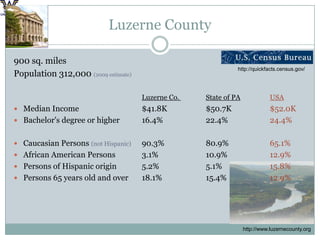
Luzerne Countyhttp://quickfacts.census.gov/http://www.luzernecounty.org900 sq. milesPopulation 312,000 (2009 estimate)Luzerne Co. State of PAUSAMedian Income		$41.8K		$50.7K		$52.0KBachelor's degree or higher	16.4%		22.4%		24.4%Caucasian Persons (not Hispanic)	90.3%80.9%		65.1%African American Persons	3.1%		10.9%		12.9%	Persons of Hispanic origin	5.2%		5.1%		15.8%Persons 65 years old and over	18.1%		15.4%		12.9%
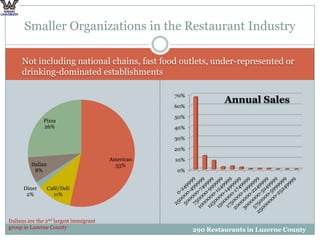
Not including national chains, fast food outlets, under-represented or drinking-dominated establishmentsAnnual SalesSmaller Organizations in the Restaurant IndustryItalians are the 2nd largest immigrant group in Luzerne County290 Restaurants in Luzerne County
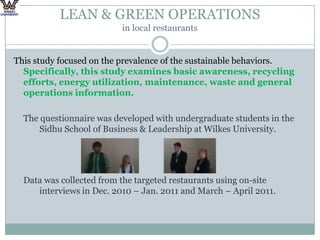
LEAN & GREEN OPERATIONS in local restaurantsThis study focused on the prevalence of the sustainable behaviors. Specifically, this study examines basic awareness, recycling efforts, energy utilization, maintenance, waste and general operations information.The questionnaire was developed with undergraduate students in the Sidhu School of Business & Leadership at Wilkes University.Data was collected from the targeted restaurants using on-site interviews in Dec. 2010 – Jan. 2011 and March – April 2011.
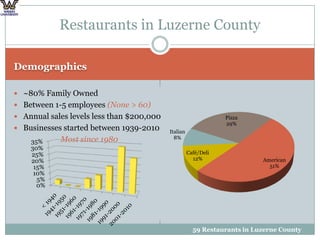
Demographics~80% Family OwnedBetween 1-5 employees (None > 60)Annual sales levels less than $200,000Businesses started between 1939-2010 Most since 1980Restaurants in Luzerne County59 Restaurants in Luzerne County
LEAN & GREEN OPERATIONS in local restaurantsThis study focused on the prevalence of the sustainable behaviors. Specifically, this study examines basic awareness, recycling efforts, energy utilization, maintenance, waste and general operations information.Newer and larger establishments are more progressive.More aware, more interested, actively practicing lean and green
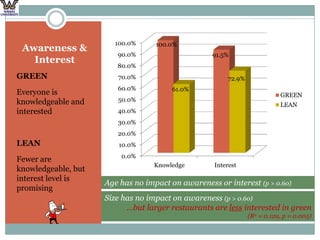
Awareness & InterestGREENEveryone is knowledgeable and interestedLEANFewer are knowledgeable, but interest level is promisingAge has no impact on awareness or interest (p > 0.60)Size has no impact on awareness (p > 0.60) …but larger restaurants are less interested in green (R2 = 0.129, p = 0.005)
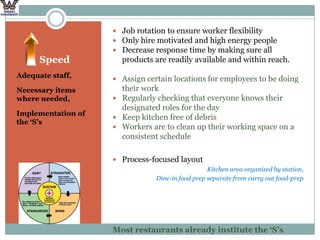
Speed Adequate staff,Necessary items where needed,Implementation of the ‘S’sJob rotation to ensure worker flexibilityOnly hire motivated and high energy peopleDecrease response time by making sure all products are readily available and within reach. Assign certain locations for employees to be doing their workRegularly checking that everyone knows their designated roles for the dayKeep kitchen free of debrisWorkers are to clean up their working space on a consistent scheduleProcess-focused layout Kitchen area organized by station,Dine-in food prep separate from carry out food-prepMost restaurants already institute the ‘S’s
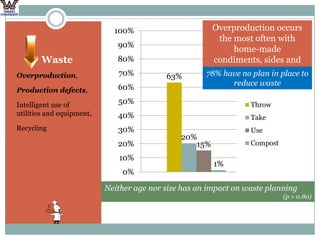
  WasteOverproduction,Production defects,Intelligent use of utilities and equipment,RecyclingOverproduction occurs the most often with home-made condiments, sides and sauces78% have no plan in place to reduce wasteNeither age nor size has an impact on waste planning(p > 0.80)
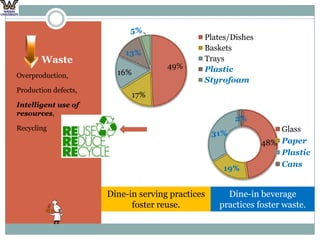
  WasteOverproduction,Production defects,Intelligent use of resources,RecyclingDine-in beverage practices foster waste.Dine-in serving practices foster reuse.
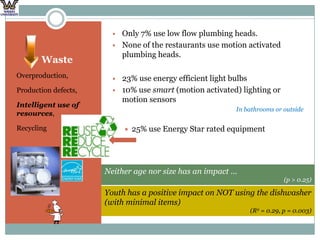
  WasteOverproduction,Production defects,Intelligent use of resources,RecyclingOnly 7% use low flow plumbing heads.
None of the restaurants use motion activated plumbing heads.
23%use energy efficient light bulbs
10% use smart (motion activated) lighting or motion sensorsIn bathrooms or outside25%use Energy Star rated equipmentNeither age nor size has an impact …(p > 0.25)Youth has a positive impact on NOT using the dishwasher (with minimal items)(R2 = 0.29, p = 0.003)
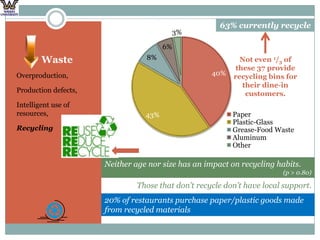
  WasteOverproduction,Production defects,Intelligent use of resources,Recycling63% currently recycleNot even 1/3of these 37 provide recycling bins for their dine-in customers.Neither age nor size has an impact on recycling habits. (p > 0.80)Those that don’t recycle don’t have local support.20% of restaurants purchase paper/plastic goods made from recycled materials

Lean & Green at Local Restaurants

  • 1.
    LEAN & GREENOPERATIONS in local restaurantsA Survey of Lean and Green Practices in the Restaurant Industry in Northeastern PennsylvaniaJennifer J. Edmonds, PhDAssociate Professor, Statistics & Operations ManagementWilkes UniversityWilkes-Barre, PennsylvaniaPresented at POMS 2011 in Reno, Nevada
  • 2.
    LEAN & GREENOPERATIONS in local restaurantsBackground on Lean & GreenWhat this means for RestaurantsProject ScopeLuzerne County RestaurantsLean & Green PracticesSummaryCurrent & Future Research
  • 3.
    LEAN & GREENOPERATIONS in local restaurantsNumerous studies address the importance and relevance of the development and implementation of a sustainable operations program. LEANGREEN
  • 4.
    LEAN & GREENOPERATIONS in local restaurantsNumerous studies address the importance and relevance of the development and implementation of a sustainable operations program. LEANA systematic approach to identifying and eliminating waste through continuous process improvements in the pursuit of customer satisfactionDefectsOverproductionWaitingNot Utilizing Employees (People Waste)TransportationExcess ProcessingMotion WasteSpace
  • 5.
    LEAN & GREENOPERATIONS in local restaurantsNumerous studies address the importance and relevance of the development and implementation of a sustainable operations program. LEANA systematic approach to identifying and eliminating waste through continuous process improvements in the pursuit of customer satisfaction
  • 6.
    LEAN & GREENOPERATIONS in local restaurantsNumerous studies address the importance and relevance of the development and implementation of a sustainable operations program. GREENReduce, Reuse, RecycleWise ConsumptionConsistent Process Tracking
  • 7.
    LEAN & GREENOPERATIONS in local restaurantsNumerous studies address the importance and relevance of the development and implementation of a sustainable operations program. …is lean green?(Cooper, 2009)LEANGREENHigh techRegulations Low techFundamentalRespect of people
  • 8.
    LEAN & GREENOPERATIONS in local restaurantsNumerous studies address the importance and relevance of the development and implementation of a sustainable operations program. However, very few empirical studies highlight the prevalence of such practices in the restaurant industry. (Greathouse, 2010)‘Pays to be Green’ Empirical ResearchExpenditures on pollution control are positively correlated with financial performance in pulp and paper firms(Spicer, 1978)Positive link between environmental and financial performance in manufacturing firms(King & Lennox, 2001) …and future cost savings(Porter & van derLinde, 1995)Positive relationship between environmental and financial performance for scrap steel yards(Clemens, 2006)
  • 9.
    LEAN & GREENOPERATIONS in local restaurantsNumerous studies address the importance and relevance of the development and implementation of a sustainable operations program. However, very few empirical studies highlight the prevalence of such practices in the restaurant industry. (Greathouse, 2010) Speed WasteAdequate staff,Necessary items where needed,Implementation of some ‘S’s’Overproduction,Production defects,Intelligent use of resources,Waste management & recycling
  • 10.
    LEAN & GREENOPERATIONS in local restaurantsNumerous studies address the importance and relevance of the development and implementation of a sustainable operations program. However, very few studies highlight the prevalence of such practices in the restaurant industry. The purpose of this study is to highlight lean and green programs' implementation observed within smaller organizations in the restaurant industry of Northeastern Pennsylvania. Why small businesses? an excellent opportunity to conduct system-wide research large numbers of homogenous firms(Rigg & Bracker, 1986)Hold a relatively small share of the market,Fewer than 500 employeesSmall businesses report 20-30% cost savings by making energy saving moves….Byron KennardCenter for Small Business and the EnvironmentUSA Today, December 2007
  • 11.
    LEAN & GREENOPERATIONS in local restaurantsNumerous studies address the importance and relevance of the development and implementation of a sustainable operations program. However, very few studies highlight the prevalence of such practices in the restaurant industry. The purpose of this study is to highlight lean and green programs' implementation observed within smaller organizations in the restaurant industry of Northeastern Pennsylvania. 650+ Restaurants in Luzerne County Made available by the Wilkes-Barre Small Business Development Center (via Dun & Bradstreet, Sept. 2010)
  • 12.
    Luzerne Countyhttp://quickfacts.census.gov/http://www.luzernecounty.org900 sq.milesPopulation 312,000 (2009 estimate)Luzerne Co. State of PAUSAMedian Income $41.8K $50.7K $52.0KBachelor's degree or higher 16.4% 22.4% 24.4%Caucasian Persons (not Hispanic) 90.3%80.9% 65.1%African American Persons 3.1% 10.9% 12.9% Persons of Hispanic origin 5.2% 5.1% 15.8%Persons 65 years old and over 18.1% 15.4% 12.9%
  • 13.
    Not including nationalchains, fast food outlets, under-represented or drinking-dominated establishmentsAnnual SalesSmaller Organizations in the Restaurant IndustryItalians are the 2nd largest immigrant group in Luzerne County290 Restaurants in Luzerne County
  • 14.
    LEAN & GREENOPERATIONS in local restaurantsThis study focused on the prevalence of the sustainable behaviors. Specifically, this study examines basic awareness, recycling efforts, energy utilization, maintenance, waste and general operations information.The questionnaire was developed with undergraduate students in the Sidhu School of Business & Leadership at Wilkes University.Data was collected from the targeted restaurants using on-site interviews in Dec. 2010 – Jan. 2011 and March – April 2011.
  • 15.
    Demographics~80% Family OwnedBetween1-5 employees (None > 60)Annual sales levels less than $200,000Businesses started between 1939-2010 Most since 1980Restaurants in Luzerne County59 Restaurants in Luzerne County
  • 16.
    LEAN & GREENOPERATIONS in local restaurantsThis study focused on the prevalence of the sustainable behaviors. Specifically, this study examines basic awareness, recycling efforts, energy utilization, maintenance, waste and general operations information.Newer and larger establishments are more progressive.More aware, more interested, actively practicing lean and green
  • 17.
    Awareness & InterestGREENEveryoneis knowledgeable and interestedLEANFewer are knowledgeable, but interest level is promisingAge has no impact on awareness or interest (p > 0.60)Size has no impact on awareness (p > 0.60) …but larger restaurants are less interested in green (R2 = 0.129, p = 0.005)
  • 18.
    Speed Adequate staff,Necessaryitems where needed,Implementation of the ‘S’sJob rotation to ensure worker flexibilityOnly hire motivated and high energy peopleDecrease response time by making sure all products are readily available and within reach. Assign certain locations for employees to be doing their workRegularly checking that everyone knows their designated roles for the dayKeep kitchen free of debrisWorkers are to clean up their working space on a consistent scheduleProcess-focused layout Kitchen area organized by station,Dine-in food prep separate from carry out food-prepMost restaurants already institute the ‘S’s
  • 19.
    WasteOverproduction,Productiondefects,Intelligent use of utilities and equipment,RecyclingOverproduction occurs the most often with home-made condiments, sides and sauces78% have no plan in place to reduce wasteNeither age nor size has an impact on waste planning(p > 0.80)
  • 20.
    WasteOverproduction,Productiondefects,Intelligent use of resources,RecyclingDine-in beverage practices foster waste.Dine-in serving practices foster reuse.
  • 21.
    WasteOverproduction,Productiondefects,Intelligent use of resources,RecyclingOnly 7% use low flow plumbing heads.
  • 22.
    None of therestaurants use motion activated plumbing heads.
  • 23.
  • 24.
    10% use smart(motion activated) lighting or motion sensorsIn bathrooms or outside25%use Energy Star rated equipmentNeither age nor size has an impact …(p > 0.25)Youth has a positive impact on NOT using the dishwasher (with minimal items)(R2 = 0.29, p = 0.003)
  • 25.
    WasteOverproduction,Productiondefects,Intelligent use of resources,Recycling63% currently recycleNot even 1/3of these 37 provide recycling bins for their dine-in customers.Neither age nor size has an impact on recycling habits. (p > 0.80)Those that don’t recycle don’t have local support.20% of restaurants purchase paper/plastic goods made from recycled materials