Hospital Services and Management

              Nawanan Theera-Ampornpunt, MD, PhD
    Faculty of Medicine Ramathibodi Hospital, Mahidol University, Thailand
               Modified from slides of Assoc.Prof. Artit Ungkanont


 Parts of this material were based on materials developed by Johns Hopkins University, funded by the Office of the
National Coordinator for Health Information Technology, U.S. Department of Health and Human Services under Award
               Number IU24OC000013 (Health IT Workforce Curriculum v.2.0, Component 7/Units 2-3).
A Bit About Myself
        2003 M.D. (Ramathibodi)
        2009 M.S. in Health Informatics (U of MN)
        2011 Ph.D. in Health Informatics (U of MN)
        Medical Systems Analyst
        Health Informatics Division
        Faculty of Medicine Ramathibodi Hospital
        Mahidol University
        ranta@mahidol.ac.th
        www.SlideShare.net/Nawanan

        Research interests:
        •   Health IT applications in clinical settings (including EHRs)
        •   Health IT “adoption”
        •   Health informatics education
Outline

•   Overview of the healthcare system
•   Hospitals as a key component
•   Nature of hospital services
•   Contrast with ambulatory & emergency settings
•   Management of hospital operations
•   Needs for health IT in hospitals
•   Conclusion
The Healthcare System


                    Government


    Hospital A                     Hospital B


                                    Clinic C
      Lab        Patient at Home
Stakeholders in Health Care
                                                   • Want to deliver the best
 • Want a high-quality care and                    outcomes to patients with limited
 satisfactory service                              resources
 experience for an acceptable      Providers
                                                   • Needs to satisfy many “bosses”
 cost


                                                                  • Want data for
• High bargaining                                                 policy-making and
power                                                  Policy-    management
• Want to pay less      Payers    Patients             Makers     • Limited budget
money for more                                                    • Often face
quality                                                           bureaucracies
                                                                  • Highly political


                                    Public     • Concerns about resource allocation &
                                               community’s well-being, but not
                                               necessarily individual patients
Providers

• Provide health care services to patients
• Hire or employ health care professionals, including
  physicians, nurses, pharmacists, etc.
• Receive payment from patients or third-party
  payers
  –   National Health Security Office
  –   Social Security Office
  –   Comptroller-General Department
  –   Private insurance companies
Providers in Thailand’s Various Settings

• Ambulatory Setting
  –   Private clinics (sometimes called physician’s offices)
  –   Outpatient departments of hospitals
  –   Private pharmacies
  –   Dental clinics
  –   MOPH’s community health centers
       • Currently called “health promotion hospitals”
       • They are not really hospitals!! Just a political marketing tool!
Providers in Thailand’s Various Settings

• Emergency Setting
  – Emergency rooms of hospitals
  – Ambulances and pre-hospital care
  – Incident management and command
Providers in Thailand’s Various Settings

• Inpatient Setting
  – Inpatient wards for
     • Acute care hospitals
     • Nursing homes (for the elderly and chronic patients)
     • Hospice (for the terminally ills)


  – Special cases
     • Delivery room
     • Patients being observed in emergency rooms
     • Short stay services
Transitions Between Settings

                      Healthy


      Ambulatory
      (Outpatient)                    Emergency
         Care                           Care


                        Hospital
                     Inpatient Care
Hospital Services in Thailand

                    Inpatient Care


     Ambulatory
                                     Emergency
     (Outpatient)
                                       Care
        Care


                      Surgery
                     (Operating
                      Rooms)
Why We Need To Hospitalize (Admit) Patients

• Serious illness or injury
• Need to monitor patient status closely
• Need to observe progression of illness
• Need to administer intravenous drugs or fluids
• Need extensive/ongoing investigations
• Need to observe response to treatment and adjust
  plans, or because of potential treatment side effects
• Before and after major surgery or procedures
• Etc.
Importance of Hospital Services

• Sophisticated capabilities & technologies
   –   Labs
   –   X-rays
   –   Surgeries
   –   Other treatments and technologies
• Integrated services by multiple specialties
• Ability to provide level of care needed by each patient
   – General wards for different specialties (medicine, surgery, OB-GYN,
     pediatrics, orthopedics, eye, ENT, etc.)
   – Intensive Care Units (ICUs), Cardiac Care Units (CCU)
   – Public (shared) wards vs. private rooms
• Referral systems of increasing capabilities
Class Discussion #1

• What are some different types of hospitals you can
  think of?

• What characteristics do you think make these
  hospitals different?
Types of Hospitals in Thailand

             Hospital Category                                     Number of                          Percentage of All
                                                                   Hospitals                             Hospitals
   District hospitals (MOPH)                                         737                                   56.4%
   General hospitals (MOPH)                                           68                                    5.2%
   Regional hospitals (MOPH)                                          26                                    2.0%
   Other hospitals under MOPH*                                        50                                    3.8%
   Other public hospitals                                            111                                    8.5%
   outside MOPH†
   Private hospitals                                                    315                                     24.1%
   Total                                                                1307                                    100.0%


*Including general and specialty hospitals under other departments within the Ministry of Public Health.
†Including university hospitals, military hospitals, autonomous public hospitals, prison hospitals, hospitals of state enterprises, and public
hospitals under local governments.
MOPH = Ministry of Public Health
Source: Bureau of Policy and Strategy, Ministry of Public Health (November 2010).
Hospital Characteristics

• Geographic location
  – Province
  – Urban/rural
• Size
  – Bed size
  – Number of employees
  – Patient volume
Hospital Characteristics

• Level of services
  –   Primary care
  –   Secondary care
  –   Tertiary care
  –   Supertertiary care
• Ownership
  – Public/private status
  – Parent organization
  – Being in a multi-hospital system
Hospital Characteristics

• Teaching status
  – Non-teaching hospitals
  – Teaching hospitals
• Budget
• Service capabilities
  – Medical technologies available
  – Medical specialties available
• etc.
Class Discussion #2

• How many of you have had an experience being
  admitted to a hospital or had a relative who was
  admitted?

• Can you share some non-confidential parts of the
  story?
  – Describe what happened.
  – What did the providers do to you/your relative in the
    hospital?
  – How was the experience (your feeling of the
    experience)?
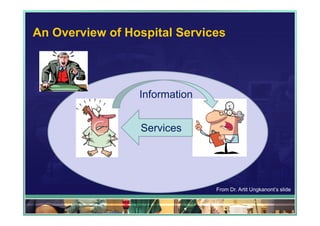
An Overview of Hospital Services


                 Information


                 Services


                               From Dr. Artit Ungkanont’s slide
Nature of Emergency Care


                           Source: nj.com
Nature of Ambulatory Care
Ambulatory Processes
       • Check-in
               – Verify Appointment; Update Info; Pull Medical Record
       • Move to exam room
               – Vital Signs; Review Reason for Visit; Document
               – Examination; Discussion of Findings; Plan; Order; Documents
       • Check-out
               – Schedule appointment
               – Payment
       • After the fact
               – Complete Documentation/Dictate
               – Code Visit & File Insurance Claim

Health IT Workforce Curriculum
Version 3.0/Spring 2012          Working with Health IT Systems, Under the Hood, Lecture a
A Typical Process for Outpatient Care

                                                                             OPD nurse performs
                                                    Verify appointment,
   Registration (New                                                         brief history taking,
                             OPD Check-in           insurance eligibility,
    patients only)                                                                vital signs
                                                    pull medical records
                                                                                measurement


                              Doctor orders                                  Doctor takes history
                                                       Doctor writes
 Doctor reviews results   investigations (lab, x-                               and physical
                                                      documentation
                                rays, etc.)                                     examination


                            OPD Check-out
                          OPD nurse reviews                                   Patient receives
     Doctor writes                                     Patient makes
                            order, educates                                  medications and go
     prescription                                        payment
                            patient, makes                                         home
                          appointment (if any)
Nature of Inpatient Care
A Typical Process for Inpatient Care

                                                 Admission processing
                                                   (verify admission
      Entry Point         Patient registration                             Patient stays in a ward
                                                 paperwork, insurance
                                                       eligibility)


                                                 Doctor writes order for
                                                                           Doctor takes history &
     Doctor reviews       Nurse reviews and      investigations (lab, x-
                                                                           physical examination
  investigation results   processes orders          rays, etc.) and
                                                                           in an admission note
                                                       treatment


 Nurse measures vital                                Patient makes
                                                                           Hospital makes claims
 signs every 6 hours or                            payment, receives
                          Discharge planning                                   and receives
   as ordered, writes                             home medications &
                                                                             reimbursements
     nurse’s notes                               education, discharged
Inpatient Processes
       1.       Register
       2.       Review Patient Info
       3.       Talk, Observe, Examine
       4.       Document
                     *H&P, PMH, Signs/Symptoms, etc.
       5.       Take Actions “Orders”
                           *Meds, Labs, Procedures, Consults, Admit, Next Appt.
       6.       Discharge
       7.       Patient Education (could occur anywhere in the process)
       8.       Health Data Reporting
       9.       Link to Reimbursement
Health IT Workforce Curriculum
Version 3.0/Spring 2012             Working with Health IT Systems, Under the Hood, Lecture a
Entry Point for Inpatient Admissions

•   From outpatient visits
•   From emergency room
•   Referred from another facility
•   Scheduled inpatient appointment
    – Pre-operative (before surgery) admissions
    – Chemotherapy
    – Other procedures that require hospitalization
• Operating room
    – Post-operative (after surgery) care
    – One-day surgery with unexpected complications requiring admission
Routine Ward Work for Physicians
•   Morning Ward Rounds
    – Check patient’s illness progression, changes from previous rounds, lab/x-ray
      results, response to treatment
    – Plan next steps
•   Ordering investigations and treatments
    –   Lab tests
    –   X-rays
    –   Medications and IV fluids
    –   Surgeries & bed-side procedures
    –   Nursing procedures
    –   Diet
    –   Patient activity
•   (Optional) Afternoon Ward Rounds
•   Progress notes & other documentation
•   Providing treatments during the day as necessary (e.g. CPR)
Routine Ward Work for Nurses
•   Typically an 8-hour shift
•   Observe and document patient status, illness progression, and changes
•   Measure routine vital signs and intake/output
•   Review and process doctor’s orders
•   If patient condition is serious or urgent, inform physicians
•   Perform nursing interventions as ordered
•   Coordinate with other departments and staff
•   Assist physicians in bed-side procedures
•   Documentation
    –   Nurse’s notes
    –   Medication administration records (MARs)
    –   Vital sign
    –   Kardex (for within-shift communications and between-shift hand-over)
    –   Other administrative documents
Discharge Status

•   Discharged home with approval
•   Left against medical advice
•   Escape
•   Referred to another facility
•   Expired (Dead)
What Is Different?
       •     Access to systems & data
       •     Challenges of geography
       •     Patient Load
       •     Episode of Care
       •     Facilities and technologies available
       •     Level of monitoring and control of environment
       •     Coordination, Communication, Consultation


Health IT Workforce Curriculum
Version 3.0/Spring 2012          Modified from “Working with Health IT Systems, Under the Hood, Lecture a”
Inpatient vs. Ambulatory Processes:
       Comparing and Contrasting
       How do they differ?
               – Inpatient 4 phases
                      •   Initial evaluation
                      •   Ongoing Management
                      •   Pre-discharge
                      •   Discharge
               – Ambulatory
                      • Episodic
                      • Coordination across providers and locations
                      • Monitoring/treatment chronic & acute
Health IT Workforce Curriculum
Version 3.0/Spring 2012          Working with Health IT Systems, Under the Hood, Lecture a
Managing Hospital Operations
• Typical Organizational Structure
  – Hospital Director as top executive
  – Various clinical departments depending on medical
    specialties and services available
  – Nursing Department
• Important Administrative Departments
  –   Director’s Office
  –   Quality improvement, Risk management
  –   IT
  –   Finance, Human Resource (HR), Procurement
  –   Academic/Education/Research
Supporting Care Processes with HIT

       •     Facilitate filtering, organizing, & access
       •     Thoroughness and currency imperative
       •     Reviewing & Documenting
       •     Planning
       •     “Doing” – ordering
       •     Educating


Health IT Workforce Curriculum
Version 3.0/Spring 2012          Working with Health IT Systems, Under the Hood, Lecture a
Supporting Care Processes with HIT

       • Communicating
               – High risk, high stress
               – Teams – working independently but
                 with constant information exchange
               – Moving patients, moving providers, rapidly changing
                 situations


Health IT Workforce Curriculum
Version 3.0/Spring 2012          Working with Health IT Systems, Under the Hood, Lecture a
IT Management in Hospitals

• Front Office
   – Hospital Information Systems (or Clinical Information Systems)
• Back Office
   –   Management Information Systems
   –   Including Enterprise Resource Planning (ERP) systems
   –   Research and Education
   –   Office Automation Tools
• Data Warehouse, Data Analysis & Reporting
• IT Infrastructure
   – Systems & Network Administration, including Security
   – Web Sites
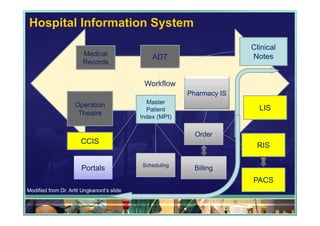
Hospital Information System
                                                                        Clinical
                        Medical                 ADT                     Notes
                        Records


                                             Workflow
                                                          Pharmacy IS
                    Operation                 Master
                                              Patient                     LIS
                     Theatre
                                            Index (MPI)

                                                            Order
                       CCIS
                                                                         RIS

                                            Scheduling
                       Portals                              Billing
                                                                        PACS
Modified from Dr. Artit Ungkanont’s slide
Clinical Decision Support:
                                   “Any system designed to
HIT Systems (Inpatient)            improve clinical decision making
                                   related to diagnostic or
                                   therapeutic processes of care.”


From Dr. Artit Ungkanont’s slide
Care Processes: HIT Support
       • Registration
               – Admission, Discharge Transfer Systems (ADT)
               – Bed Management Systems (BMS)
               – Unique Identifier – i.e. Hospital Number (HN),
                 sometimes called Medical Record Number (MRN)


Health IT Workforce Curriculum
Version 3.0/Spring 2012          Working with Health IT Systems, Under the Hood, Lecture b
Care Processes: HIT Support
       • Reviewing Patient Information
               – Retrieve patient record
                      • Verifying demographics, etc.
                      • Past medical history, etc.
       • Talking, Observing, Examining


Health IT Workforce Curriculum
Version 3.0/Spring 2012          Working with Health IT Systems, Under the Hood, Lecture b
Care Processes: HIT Support
       Documentation
               – Copious
                      • Pick lists, Voice Recognition, Structured Notes, Integrated
                        Records, Patient-Centered, Kiosks, PHRs …
               – Knowledge Resources & Decision Support


Health IT Workforce Curriculum
Version 3.0/Spring 2012          Working with Health IT Systems, Under the Hood, Lecture b
Care Processes: HIT Support
       Taking Action Performing/Ordering/Reviewing
               – CPOE – Computerized Prescriber Order Entry
                      • E-prescribing, Consults, Treatments, Diets, Labs, Tests…
               – Guideline-based Care http://www.guideline.gov/


Health IT Workforce Curriculum
Version 3.0/Spring 2012          Modified from Working with Health IT Systems, Under the Hood, Lecture b
Computerized Physician Order Entry (CPOE)
Care Processes: HIT Support
       • Pre-Discharge/Discharge
               – Ties into ADT, bed management, discharge planning
                 …
       • Education


Health IT Workforce Curriculum
Version 3.0/Spring 2012          Working with Health IT Systems, Under the Hood, Lecture b
Care Processes: HIT Support
       • Reporting & Reimbursement
               – External (Disease Control & Prevention, Immunization
                 Registries, Payers for reimbursement, etc.) & Internal
                 (Practice Improvement, Trending, etc.)
               – $$$


Health IT Workforce Curriculum
Version 3.0/Spring 2012          Working with Health IT Systems, Under the Hood, Lecture b
Summary
• Hospitals are an important setting in health care
• Nature and work processes in the inpatient,
  outpatient, and emergency settings are quite
  different
• These settings have some common needs for
  health IT, but each also has unique needs
• Hospitals are just one part of the whole
  healthcare system


Health IT Workforce Curriculum   Working with Health IT Systems
Version 3.0/Spring 2012                 Under the Hood
                                           Lecture b
Healthcare System: The Big Picture


                     Government


     Hospital A                     Hospital B


                                     Clinic C
       Lab        Patient at Home
QUESTIONS?

Hospital Services & Management

  • 1.
    Hospital Services andManagement Nawanan Theera-Ampornpunt, MD, PhD Faculty of Medicine Ramathibodi Hospital, Mahidol University, Thailand Modified from slides of Assoc.Prof. Artit Ungkanont Parts of this material were based on materials developed by Johns Hopkins University, funded by the Office of the National Coordinator for Health Information Technology, U.S. Department of Health and Human Services under Award Number IU24OC000013 (Health IT Workforce Curriculum v.2.0, Component 7/Units 2-3).
  • 2.
    A Bit AboutMyself 2003 M.D. (Ramathibodi) 2009 M.S. in Health Informatics (U of MN) 2011 Ph.D. in Health Informatics (U of MN) Medical Systems Analyst Health Informatics Division Faculty of Medicine Ramathibodi Hospital Mahidol University ranta@mahidol.ac.th www.SlideShare.net/Nawanan Research interests: • Health IT applications in clinical settings (including EHRs) • Health IT “adoption” • Health informatics education
  • 3.
    Outline • Overview of the healthcare system • Hospitals as a key component • Nature of hospital services • Contrast with ambulatory & emergency settings • Management of hospital operations • Needs for health IT in hospitals • Conclusion
  • 4.
    The Healthcare System Government Hospital A Hospital B Clinic C Lab Patient at Home
  • 5.
    Stakeholders in HealthCare • Want to deliver the best • Want a high-quality care and outcomes to patients with limited satisfactory service resources experience for an acceptable Providers • Needs to satisfy many “bosses” cost • Want data for • High bargaining policy-making and power Policy- management • Want to pay less Payers Patients Makers • Limited budget money for more • Often face quality bureaucracies • Highly political Public • Concerns about resource allocation & community’s well-being, but not necessarily individual patients
  • 6.
    Providers • Provide healthcare services to patients • Hire or employ health care professionals, including physicians, nurses, pharmacists, etc. • Receive payment from patients or third-party payers – National Health Security Office – Social Security Office – Comptroller-General Department – Private insurance companies
  • 7.
    Providers in Thailand’sVarious Settings • Ambulatory Setting – Private clinics (sometimes called physician’s offices) – Outpatient departments of hospitals – Private pharmacies – Dental clinics – MOPH’s community health centers • Currently called “health promotion hospitals” • They are not really hospitals!! Just a political marketing tool!
  • 8.
    Providers in Thailand’sVarious Settings • Emergency Setting – Emergency rooms of hospitals – Ambulances and pre-hospital care – Incident management and command
  • 9.
    Providers in Thailand’sVarious Settings • Inpatient Setting – Inpatient wards for • Acute care hospitals • Nursing homes (for the elderly and chronic patients) • Hospice (for the terminally ills) – Special cases • Delivery room • Patients being observed in emergency rooms • Short stay services
  • 10.
    Transitions Between Settings Healthy Ambulatory (Outpatient) Emergency Care Care Hospital Inpatient Care
  • 11.
    Hospital Services inThailand Inpatient Care Ambulatory Emergency (Outpatient) Care Care Surgery (Operating Rooms)
  • 12.
    Why We NeedTo Hospitalize (Admit) Patients • Serious illness or injury • Need to monitor patient status closely • Need to observe progression of illness • Need to administer intravenous drugs or fluids • Need extensive/ongoing investigations • Need to observe response to treatment and adjust plans, or because of potential treatment side effects • Before and after major surgery or procedures • Etc.
  • 13.
    Importance of HospitalServices • Sophisticated capabilities & technologies – Labs – X-rays – Surgeries – Other treatments and technologies • Integrated services by multiple specialties • Ability to provide level of care needed by each patient – General wards for different specialties (medicine, surgery, OB-GYN, pediatrics, orthopedics, eye, ENT, etc.) – Intensive Care Units (ICUs), Cardiac Care Units (CCU) – Public (shared) wards vs. private rooms • Referral systems of increasing capabilities
  • 14.
    Class Discussion #1 •What are some different types of hospitals you can think of? • What characteristics do you think make these hospitals different?
  • 15.
    Types of Hospitalsin Thailand Hospital Category Number of Percentage of All Hospitals Hospitals District hospitals (MOPH) 737 56.4% General hospitals (MOPH) 68 5.2% Regional hospitals (MOPH) 26 2.0% Other hospitals under MOPH* 50 3.8% Other public hospitals 111 8.5% outside MOPH† Private hospitals 315 24.1% Total 1307 100.0% *Including general and specialty hospitals under other departments within the Ministry of Public Health. †Including university hospitals, military hospitals, autonomous public hospitals, prison hospitals, hospitals of state enterprises, and public hospitals under local governments. MOPH = Ministry of Public Health Source: Bureau of Policy and Strategy, Ministry of Public Health (November 2010).
  • 16.
    Hospital Characteristics • Geographiclocation – Province – Urban/rural • Size – Bed size – Number of employees – Patient volume
  • 17.
    Hospital Characteristics • Levelof services – Primary care – Secondary care – Tertiary care – Supertertiary care • Ownership – Public/private status – Parent organization – Being in a multi-hospital system
  • 18.
    Hospital Characteristics • Teachingstatus – Non-teaching hospitals – Teaching hospitals • Budget • Service capabilities – Medical technologies available – Medical specialties available • etc.
  • 19.
    Class Discussion #2 •How many of you have had an experience being admitted to a hospital or had a relative who was admitted? • Can you share some non-confidential parts of the story? – Describe what happened. – What did the providers do to you/your relative in the hospital? – How was the experience (your feeling of the experience)?
  • 20.
    An Overview ofHospital Services Information Services From Dr. Artit Ungkanont’s slide
  • 21.
    Nature of EmergencyCare Source: nj.com
  • 22.
  • 23.
    Ambulatory Processes • Check-in – Verify Appointment; Update Info; Pull Medical Record • Move to exam room – Vital Signs; Review Reason for Visit; Document – Examination; Discussion of Findings; Plan; Order; Documents • Check-out – Schedule appointment – Payment • After the fact – Complete Documentation/Dictate – Code Visit & File Insurance Claim Health IT Workforce Curriculum Version 3.0/Spring 2012 Working with Health IT Systems, Under the Hood, Lecture a
  • 24.
    A Typical Processfor Outpatient Care OPD nurse performs Verify appointment, Registration (New brief history taking, OPD Check-in insurance eligibility, patients only) vital signs pull medical records measurement Doctor orders Doctor takes history Doctor writes Doctor reviews results investigations (lab, x- and physical documentation rays, etc.) examination OPD Check-out OPD nurse reviews Patient receives Doctor writes Patient makes order, educates medications and go prescription payment patient, makes home appointment (if any)
  • 25.
  • 26.
  • 27.
    A Typical Processfor Inpatient Care Admission processing (verify admission Entry Point Patient registration Patient stays in a ward paperwork, insurance eligibility) Doctor writes order for Doctor takes history & Doctor reviews Nurse reviews and investigations (lab, x- physical examination investigation results processes orders rays, etc.) and in an admission note treatment Nurse measures vital Patient makes Hospital makes claims signs every 6 hours or payment, receives Discharge planning and receives as ordered, writes home medications & reimbursements nurse’s notes education, discharged
  • 28.
    Inpatient Processes 1. Register 2. Review Patient Info 3. Talk, Observe, Examine 4. Document *H&P, PMH, Signs/Symptoms, etc. 5. Take Actions “Orders” *Meds, Labs, Procedures, Consults, Admit, Next Appt. 6. Discharge 7. Patient Education (could occur anywhere in the process) 8. Health Data Reporting 9. Link to Reimbursement Health IT Workforce Curriculum Version 3.0/Spring 2012 Working with Health IT Systems, Under the Hood, Lecture a
  • 29.
    Entry Point forInpatient Admissions • From outpatient visits • From emergency room • Referred from another facility • Scheduled inpatient appointment – Pre-operative (before surgery) admissions – Chemotherapy – Other procedures that require hospitalization • Operating room – Post-operative (after surgery) care – One-day surgery with unexpected complications requiring admission
  • 30.
    Routine Ward Workfor Physicians • Morning Ward Rounds – Check patient’s illness progression, changes from previous rounds, lab/x-ray results, response to treatment – Plan next steps • Ordering investigations and treatments – Lab tests – X-rays – Medications and IV fluids – Surgeries & bed-side procedures – Nursing procedures – Diet – Patient activity • (Optional) Afternoon Ward Rounds • Progress notes & other documentation • Providing treatments during the day as necessary (e.g. CPR)
  • 31.
    Routine Ward Workfor Nurses • Typically an 8-hour shift • Observe and document patient status, illness progression, and changes • Measure routine vital signs and intake/output • Review and process doctor’s orders • If patient condition is serious or urgent, inform physicians • Perform nursing interventions as ordered • Coordinate with other departments and staff • Assist physicians in bed-side procedures • Documentation – Nurse’s notes – Medication administration records (MARs) – Vital sign – Kardex (for within-shift communications and between-shift hand-over) – Other administrative documents
  • 32.
    Discharge Status • Discharged home with approval • Left against medical advice • Escape • Referred to another facility • Expired (Dead)
  • 33.
    What Is Different? • Access to systems & data • Challenges of geography • Patient Load • Episode of Care • Facilities and technologies available • Level of monitoring and control of environment • Coordination, Communication, Consultation Health IT Workforce Curriculum Version 3.0/Spring 2012 Modified from “Working with Health IT Systems, Under the Hood, Lecture a”
  • 34.
    Inpatient vs. AmbulatoryProcesses: Comparing and Contrasting How do they differ? – Inpatient 4 phases • Initial evaluation • Ongoing Management • Pre-discharge • Discharge – Ambulatory • Episodic • Coordination across providers and locations • Monitoring/treatment chronic & acute Health IT Workforce Curriculum Version 3.0/Spring 2012 Working with Health IT Systems, Under the Hood, Lecture a
  • 35.
    Managing Hospital Operations •Typical Organizational Structure – Hospital Director as top executive – Various clinical departments depending on medical specialties and services available – Nursing Department • Important Administrative Departments – Director’s Office – Quality improvement, Risk management – IT – Finance, Human Resource (HR), Procurement – Academic/Education/Research
  • 36.
    Supporting Care Processeswith HIT • Facilitate filtering, organizing, & access • Thoroughness and currency imperative • Reviewing & Documenting • Planning • “Doing” – ordering • Educating Health IT Workforce Curriculum Version 3.0/Spring 2012 Working with Health IT Systems, Under the Hood, Lecture a
  • 37.
    Supporting Care Processeswith HIT • Communicating – High risk, high stress – Teams – working independently but with constant information exchange – Moving patients, moving providers, rapidly changing situations Health IT Workforce Curriculum Version 3.0/Spring 2012 Working with Health IT Systems, Under the Hood, Lecture a
  • 38.
    IT Management inHospitals • Front Office – Hospital Information Systems (or Clinical Information Systems) • Back Office – Management Information Systems – Including Enterprise Resource Planning (ERP) systems – Research and Education – Office Automation Tools • Data Warehouse, Data Analysis & Reporting • IT Infrastructure – Systems & Network Administration, including Security – Web Sites
  • 39.
    Hospital Information System Clinical Medical ADT Notes Records Workflow Pharmacy IS Operation Master Patient LIS Theatre Index (MPI) Order CCIS RIS Scheduling Portals Billing PACS Modified from Dr. Artit Ungkanont’s slide
  • 40.
    Clinical Decision Support: “Any system designed to HIT Systems (Inpatient) improve clinical decision making related to diagnostic or therapeutic processes of care.” From Dr. Artit Ungkanont’s slide
  • 41.
    Care Processes: HITSupport • Registration – Admission, Discharge Transfer Systems (ADT) – Bed Management Systems (BMS) – Unique Identifier – i.e. Hospital Number (HN), sometimes called Medical Record Number (MRN) Health IT Workforce Curriculum Version 3.0/Spring 2012 Working with Health IT Systems, Under the Hood, Lecture b
  • 42.
    Care Processes: HITSupport • Reviewing Patient Information – Retrieve patient record • Verifying demographics, etc. • Past medical history, etc. • Talking, Observing, Examining Health IT Workforce Curriculum Version 3.0/Spring 2012 Working with Health IT Systems, Under the Hood, Lecture b
  • 43.
    Care Processes: HITSupport Documentation – Copious • Pick lists, Voice Recognition, Structured Notes, Integrated Records, Patient-Centered, Kiosks, PHRs … – Knowledge Resources & Decision Support Health IT Workforce Curriculum Version 3.0/Spring 2012 Working with Health IT Systems, Under the Hood, Lecture b
  • 44.
    Care Processes: HITSupport Taking Action Performing/Ordering/Reviewing – CPOE – Computerized Prescriber Order Entry • E-prescribing, Consults, Treatments, Diets, Labs, Tests… – Guideline-based Care http://www.guideline.gov/ Health IT Workforce Curriculum Version 3.0/Spring 2012 Modified from Working with Health IT Systems, Under the Hood, Lecture b
  • 45.
  • 46.
    Care Processes: HITSupport • Pre-Discharge/Discharge – Ties into ADT, bed management, discharge planning … • Education Health IT Workforce Curriculum Version 3.0/Spring 2012 Working with Health IT Systems, Under the Hood, Lecture b
  • 47.
    Care Processes: HITSupport • Reporting & Reimbursement – External (Disease Control & Prevention, Immunization Registries, Payers for reimbursement, etc.) & Internal (Practice Improvement, Trending, etc.) – $$$ Health IT Workforce Curriculum Version 3.0/Spring 2012 Working with Health IT Systems, Under the Hood, Lecture b
  • 48.
    Summary • Hospitals arean important setting in health care • Nature and work processes in the inpatient, outpatient, and emergency settings are quite different • These settings have some common needs for health IT, but each also has unique needs • Hospitals are just one part of the whole healthcare system Health IT Workforce Curriculum Working with Health IT Systems Version 3.0/Spring 2012 Under the Hood Lecture b
  • 49.
    Healthcare System: TheBig Picture Government Hospital A Hospital B Clinic C Lab Patient at Home
  • 50.