CLINICAL AND NON-CLINICAL,
SUPPORTIVE AND ANCILLARY
SERVICE DEPARTMENTS
by
ROJA.C
Definition of Hospital
In general hospital is an institution in which sick and injured patients are
treated.
WHO defines Hospital as “an integral part of a social and medical
organisation, the functions of which is to provide the population complete
health care, both curative and preventive with out patient services reaching
out to the family and also to carry out training of health workers and the bio-
socialresearch.”
DEPARTMENTS IN HOSPITAL
CLINICAL
DEPARTMENTS
A. Specialty
General Medicine
General Surgery
Paediatrics
Orthopedics
ENT
Psychiatry
Ophthalmology
Dermatology
Gynaecology
B. Super Specialty
Cardiology
Neurology
Urology
Endocrinology
NON CLINICAL DEPARTMENTS
A. Supporting Services
Nursing Service
Dietary
Medical Records
Laboratory Services
Blood Bank
Radiology
CSSD
Pharmacy
Physiotherapy
Occupational Therapy
B. Ancillary Services
House Keeping
Laundry Services
Electrical and Security
Ambulance, etc.
CLINICAL DEPARTMENTS
A. Specialty
 General Medicine
General Medicine is the branch of medicine that
deals with the diagnosis and nonsurgical treatment ofdiseases
of the internal organs. Here you will find the causes,
symptoms, diagnosis and treatment of a hugerangeof
disorders affecting everypart of the body.
 General Surgery
As the name suggests includes a wide variety of
surgical procedures like Thyroid surgery, Kidney transplants,
endoscopy etc.,
These procedures are normally performed by general
surgeons and do not normally require special surgeons.
Paediatrics
All facilities concerning giving birth and child care is
provided in this department.
Someofthe facilities ortreatments include:
Child birth
Antenatal and post natal care
Pregnancy checkups
Surgical procedures on children.
Orthopedic
This department deals with problems that affect the
musculoskeletal system.
Includes Diagnosis and treatment of problems related to
bones, muscles, tendons, ligaments, and nerves.
Services include bone setting, surgeries to repair damaged
bones or ligaments or tendons, hip replacement, knee cap
replacement etc,
ENT (EARS, NOSE AND THROAT)
This department deals with diagnosis and treatment of a
variety ofdiseases like:
General ear,nose andthroat diseases
Balance and hearing disorders
Snoring
ENT allergyproblems
Voice disorders
ENT surgical procedures
Psychiatry
This department deals with investigating and treating
patients with a wide rangeof mental illnesses and disorders. Some
services include: Providing psychosocial counselling, Investigating,
diagnosing and treating psychiatric illnesses, Conducting IQ tests,
De-addiction services.
Ophthalmology
This department deals with the investigation and
treatment of eye problems of adults and children. Their services
include:
Optometry
Laser treatments
Prosthetic eye services
Ophthalmic imaging
Dermatology
This department deals with investigating and treating of
diseases relatedto
Skin: Cosmetic surgery, acne scar, skin canceretc,
Hair: Hair removal, transplant etc,
Nails: Fungus, nail infections etc,
Mucous membranes (e.g.,lining inside the mouth, nose,
and eyelids.)
Gynaecology
This department deals with the investigation and
treatment of problems related to the female reproductive system.
Infertility, urinary tract infection are someof the problems
investigated in this department.
B. Super Specialty
Cardiology
This department deals with problems of the human heart
orcirculation. Someof their procedures includes:
 Electrocardiogram (ECG) and exercise tests to measure
the heartfunction
 Ultrasound scan ofthe heart ( Echocardiogram)
 Insertion of pacemakers
 Cardiac surgeryetc,
Neurology
Neurology deals with the human nervous system.
Thedoctors in this department (Neurologist) investigate & treat
patients for problems that affect their brain and spinal cord. Some
of the procedure includes:
 Treatment for the brain, spinal cord, and spinal cord
injuries.
 Stroke etc,
Urology
This department deals with surgical and medical
treatment of urinary tract diseases of male and female, Some
services includes:
 Flexible cystoscopy bladderchecks
 Urodynamic research
 Shockwavelithotripsy to break up kidneystones
Endocrinology
Endocrinology department deals with the diagnosis and treatment of endocrine
system and its secretions i.e.Hormones. Endocrinologist is the person who treats :
 endocrine diseases
 injury to endocrine glands
 Diabetes
 Hypertension
 Obesity
 Thyroidism etc.
NON CLINICAL DEPARTMENTS
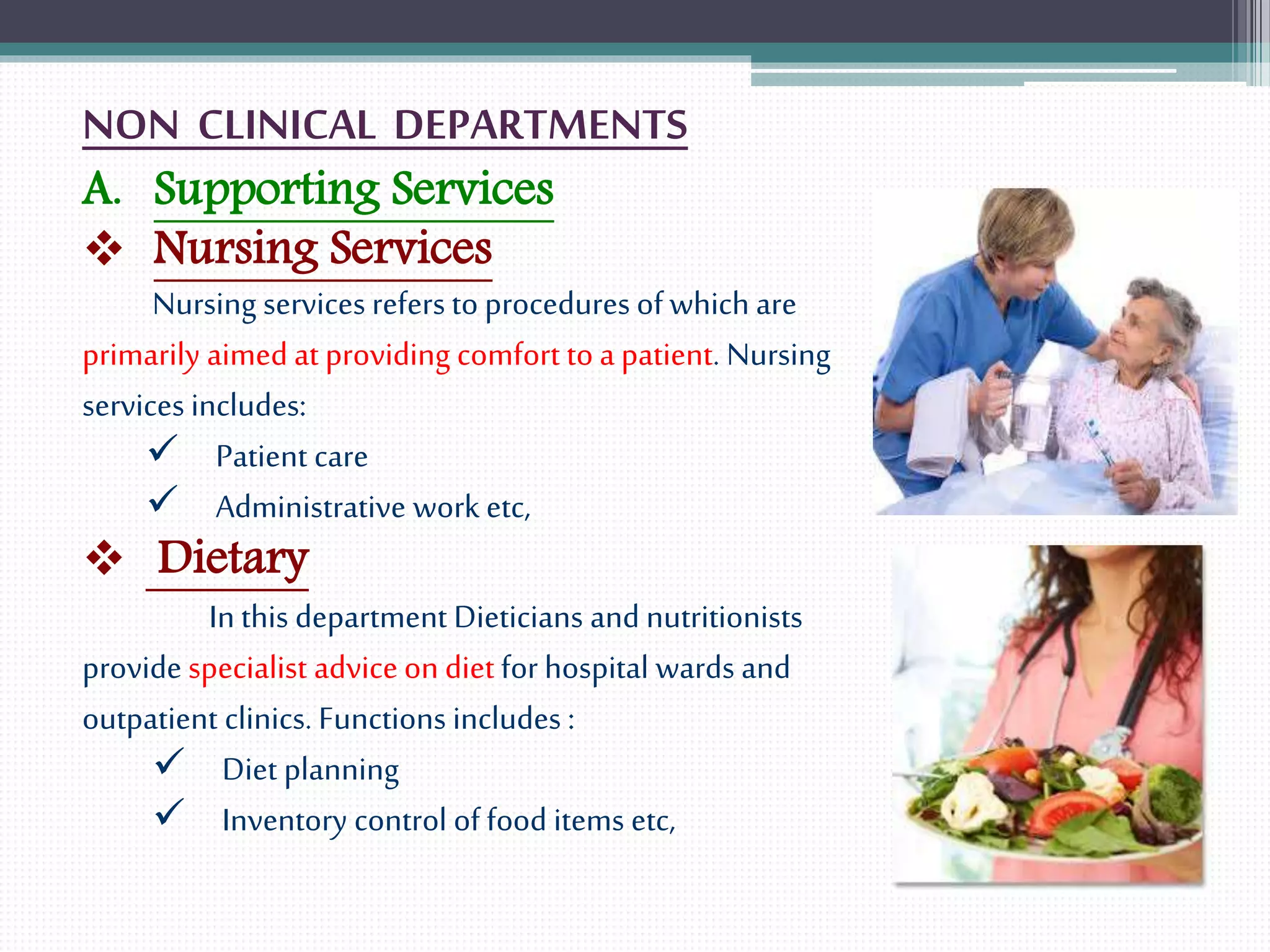
A. Supporting Services
 Nursing Services
Nursing services refers to procedures of which are
primarily aimed at providing comfort to a patient. Nursing
services includes:
 Patient care
 Administrative work etc,
 Dietary
In this department Dieticians and nutritionists
provide specialist adviceon diet for hospital wards and
outpatient clinics. Functions includes :
 Diet planning
 Inventory control of food items etc,
 Medical Records
This department deals with recording, and maintaining
all the records/files of inpatients as well as outpatients.
It is with these records that medical statistics can be
formulated and it servesas a referencefor future purposes.
 Laboratory Services
In Laboratory services, tests are usually done on
clinical specimens in order to obtain information about the
health ofa patient aspertaining to thediagnosis, treatment,
and prevention of disease.
 Blood bank
This department deals with transfusion of blood
from donor, processing, storage and distribution of human
blood andderivatives to recipient.
 Radiology
This deals with application of imaging
technology like x-ray and radiation for diagnosing and
treating disease. It includes
General radiology (X-rays)
Mammography (breast scans)
Ultrasound scans
Angiography (x-ray of blood vessels)
CT scanning
MRI scanning (3D scans using magnetic and radio
waves) etc,
 CSSD(Central Sterile Supply
Department)
This department is in charge of keeping all the
instruments used in the hospital clean and sterilised to
avoid spreading of infections throughout the hospital.
 Pharmacy
Responsible for purchase, supply and
distribution of drugs in a hospital.
 Physiotherapy
In the department of Physiotherapy,
Physiotherapists provides physical therapies such as
exercise, massage, and manipulation of bones, joints and
muscle tissues.
 Occupational Therapy
 Helps physically or mentally impaired people,
including temporary disability, practices in the fields of
both healthcare as well as social care,
 It promotes health by enabling people to perform
meaningful and purposeful occupations.
B. Ancillary Services :
 House Keeping
 In charge of keeping the hospital clean and neat.
 It involves doing the laundry and cleaning all the
rooms of the hospital and effectively disposing of medical
waste according to strict hospital disposal procedures.
 Laundry
 This department is responsible for providing safe,
clean, adequate and timely supply of linen to the users
units of the hospital at right time, right priceand right price.
 Electricity and Security
 This department makes sure that all electrical facilities
are in perfect condition, carries out repair and replacement
work for air-conditioning units, plumbing, steel works, and
general takes care of the overall maintenance of the
hospital.
 The Security department provides security to the
hospital.
 Ambulance Services
 Ambulance is meant for providing life support to critically ill patient while
speeding them to hospital.
 It is a vehicle equipped with medication and devices intended to stabilize a
patient’s life.
These are the different departments in a hospital.
Hpp

Hpp

  • 1.
    CLINICAL AND NON-CLINICAL, SUPPORTIVEAND ANCILLARY SERVICE DEPARTMENTS by ROJA.C
  • 2.
    Definition of Hospital Ingeneral hospital is an institution in which sick and injured patients are treated. WHO defines Hospital as “an integral part of a social and medical organisation, the functions of which is to provide the population complete health care, both curative and preventive with out patient services reaching out to the family and also to carry out training of health workers and the bio- socialresearch.”
  • 3.
    DEPARTMENTS IN HOSPITAL CLINICAL DEPARTMENTS A.Specialty General Medicine General Surgery Paediatrics Orthopedics ENT Psychiatry Ophthalmology Dermatology Gynaecology B. Super Specialty Cardiology Neurology Urology Endocrinology NON CLINICAL DEPARTMENTS A. Supporting Services Nursing Service Dietary Medical Records Laboratory Services Blood Bank Radiology CSSD Pharmacy Physiotherapy Occupational Therapy B. Ancillary Services House Keeping Laundry Services Electrical and Security Ambulance, etc.
  • 4.
    CLINICAL DEPARTMENTS A. Specialty General Medicine General Medicine is the branch of medicine that deals with the diagnosis and nonsurgical treatment ofdiseases of the internal organs. Here you will find the causes, symptoms, diagnosis and treatment of a hugerangeof disorders affecting everypart of the body.  General Surgery As the name suggests includes a wide variety of surgical procedures like Thyroid surgery, Kidney transplants, endoscopy etc., These procedures are normally performed by general surgeons and do not normally require special surgeons.
  • 5.
    Paediatrics All facilities concerninggiving birth and child care is provided in this department. Someofthe facilities ortreatments include: Child birth Antenatal and post natal care Pregnancy checkups Surgical procedures on children. Orthopedic This department deals with problems that affect the musculoskeletal system. Includes Diagnosis and treatment of problems related to bones, muscles, tendons, ligaments, and nerves. Services include bone setting, surgeries to repair damaged bones or ligaments or tendons, hip replacement, knee cap replacement etc,
  • 6.
    ENT (EARS, NOSEAND THROAT) This department deals with diagnosis and treatment of a variety ofdiseases like: General ear,nose andthroat diseases Balance and hearing disorders Snoring ENT allergyproblems Voice disorders ENT surgical procedures Psychiatry This department deals with investigating and treating patients with a wide rangeof mental illnesses and disorders. Some services include: Providing psychosocial counselling, Investigating, diagnosing and treating psychiatric illnesses, Conducting IQ tests, De-addiction services.
  • 7.
    Ophthalmology This department dealswith the investigation and treatment of eye problems of adults and children. Their services include: Optometry Laser treatments Prosthetic eye services Ophthalmic imaging Dermatology This department deals with investigating and treating of diseases relatedto Skin: Cosmetic surgery, acne scar, skin canceretc, Hair: Hair removal, transplant etc, Nails: Fungus, nail infections etc, Mucous membranes (e.g.,lining inside the mouth, nose, and eyelids.)
  • 8.
    Gynaecology This department dealswith the investigation and treatment of problems related to the female reproductive system. Infertility, urinary tract infection are someof the problems investigated in this department. B. Super Specialty Cardiology This department deals with problems of the human heart orcirculation. Someof their procedures includes:  Electrocardiogram (ECG) and exercise tests to measure the heartfunction  Ultrasound scan ofthe heart ( Echocardiogram)  Insertion of pacemakers  Cardiac surgeryetc,
  • 9.
    Neurology Neurology deals withthe human nervous system. Thedoctors in this department (Neurologist) investigate & treat patients for problems that affect their brain and spinal cord. Some of the procedure includes:  Treatment for the brain, spinal cord, and spinal cord injuries.  Stroke etc, Urology This department deals with surgical and medical treatment of urinary tract diseases of male and female, Some services includes:  Flexible cystoscopy bladderchecks  Urodynamic research  Shockwavelithotripsy to break up kidneystones
  • 10.
    Endocrinology Endocrinology department dealswith the diagnosis and treatment of endocrine system and its secretions i.e.Hormones. Endocrinologist is the person who treats :  endocrine diseases  injury to endocrine glands  Diabetes  Hypertension  Obesity  Thyroidism etc.
  • 11.
    NON CLINICAL DEPARTMENTS A.Supporting Services  Nursing Services Nursing services refers to procedures of which are primarily aimed at providing comfort to a patient. Nursing services includes:  Patient care  Administrative work etc,  Dietary In this department Dieticians and nutritionists provide specialist adviceon diet for hospital wards and outpatient clinics. Functions includes :  Diet planning  Inventory control of food items etc,
  • 12.
     Medical Records Thisdepartment deals with recording, and maintaining all the records/files of inpatients as well as outpatients. It is with these records that medical statistics can be formulated and it servesas a referencefor future purposes.  Laboratory Services In Laboratory services, tests are usually done on clinical specimens in order to obtain information about the health ofa patient aspertaining to thediagnosis, treatment, and prevention of disease.
  • 13.
     Blood bank Thisdepartment deals with transfusion of blood from donor, processing, storage and distribution of human blood andderivatives to recipient.  Radiology This deals with application of imaging technology like x-ray and radiation for diagnosing and treating disease. It includes General radiology (X-rays) Mammography (breast scans) Ultrasound scans Angiography (x-ray of blood vessels) CT scanning MRI scanning (3D scans using magnetic and radio waves) etc,
  • 14.
     CSSD(Central SterileSupply Department) This department is in charge of keeping all the instruments used in the hospital clean and sterilised to avoid spreading of infections throughout the hospital.  Pharmacy Responsible for purchase, supply and distribution of drugs in a hospital.  Physiotherapy In the department of Physiotherapy, Physiotherapists provides physical therapies such as exercise, massage, and manipulation of bones, joints and muscle tissues.
  • 15.
     Occupational Therapy Helps physically or mentally impaired people, including temporary disability, practices in the fields of both healthcare as well as social care,  It promotes health by enabling people to perform meaningful and purposeful occupations. B. Ancillary Services :  House Keeping  In charge of keeping the hospital clean and neat.  It involves doing the laundry and cleaning all the rooms of the hospital and effectively disposing of medical waste according to strict hospital disposal procedures.
  • 16.
     Laundry  Thisdepartment is responsible for providing safe, clean, adequate and timely supply of linen to the users units of the hospital at right time, right priceand right price.  Electricity and Security  This department makes sure that all electrical facilities are in perfect condition, carries out repair and replacement work for air-conditioning units, plumbing, steel works, and general takes care of the overall maintenance of the hospital.  The Security department provides security to the hospital.
  • 17.
     Ambulance Services Ambulance is meant for providing life support to critically ill patient while speeding them to hospital.  It is a vehicle equipped with medication and devices intended to stabilize a patient’s life. These are the different departments in a hospital.