Frequently Asked Question (FAQ)
What is the Mission for Integrated Development of Horticulture (MIDH)
Mission for Integrated Development of Horticulture (MIDH) is a Centrally
Sponsored Scheme is being implemented w.e.f. 2014-15 for holistic growth of the
horticulture sector covering fruits, vegetables, root and tuber crops, mushrooms, spices,
flowers, aromatic plants, coconut, cashew, cocoa. MIDH subsumed ongoing
missions/schemes of the Ministry- National Horticulture Mission (NHM), Horticulture
Mission for North East & Himalayan States (HMNEH), National Horticulture Board
(NHB), Coconut Development Board (CDB) and Central Institute for Horticulture
(CIH), Nagaland. All States including North Eastern States and UTs are covered under
MIDH.
Main objectives of Mission are to promote holistic growth of horticulture sector,
including coconut through area based regionally differentiated strategies which include
research, technology promotion, extension, post harvest management, processing and
marketing in consonance with comparative advantage of each State/region and its
diverse agri-climatic features, encourage aggregation of farmers into farmers groups
like FIGs/FPOs and FPCs to bring economy of scale and scope, enhance horticulture
production, augment farmer’s income, strengthen nutritional security, improve
productivity by way of quality germ-plasm, planting material and water use efficiency
through Micro Irrigation, support skill development and create employment generation
opportunities for rural youth in horticulture and post harvest management, especially in
the cold chain sector. Capacity buildings of farmers and technicians is also supported
for adopting improved technologies through existing institutions like State Agriculture
Universities, Krishi Vigyan Kendras and Institutes with Department of Horticulture in
States.
What are the schemes of MIDH?
Mission has the following sub-schemes as its component:
• National Horticulture Mission (NHM)
• Horticulture Mission for North East & Himalayan States (HMNEH)
• National Horticulture Board (NHB)
• Coconut Development Board (CDB)
• Central Institute for Horticulture (CIH), Nagaland
What is the Strategy of the Mission?
To achieve the objectives of the Mission, the broad strategy comprise the
following:
a. Adopt an end-to-end holistic approach covering production, post harvest
management, processing and marketing to assure appropriate returns to
growers/producers;
b. Promote R&D technologies for production, post-harvest management and
processing;
c. Enhance acreage, coverage, and productivity through:-
i. Diversification, from traditional crops to plantations, orchards, vineyards,
flower and vegetable gardens.
ii. Extension of appropriate technology to farmers for high-tech horticulture
cultivation and precision farming.
d. Improve post harvest management, processing for value addition and
marketing infrastructure.
e. Adopt a coordinated approach and promote partnership, convergence and
synergy among R&D, processing and marketing agencies in public as well as private
sectors, at the national, regional, State and sub-State levels;
f. Promote capacity-building and Human Resource Development at all levels,
including, if need be, change in syllabus and curriculum of graduation courses at
Colleges and Universities.
What is the Structure of the Mission?
The Mission has a three tier structure – National, State and District levels. At
the National level, there is a General Council (GC) and an Executive Committee (EC).
The GC, which provides overall direction, is chaired by the Union Agriculture Minister.
The Executive Committee (EC) headed by the Secretary (Agriculture & Cooperation)
oversees the activities of the Mission, approves the Annual Action (AAPs) of the States
and National Level Agencies and reviews the progress. Similarly, at the State level, an
Executive Committee under the Chairmanship of the Agriculture Production
Commissioner, or Secretary Horticulture /Agriculture oversees the implementation of
the Mission. At the District level, the District Mission Committee (DMC) under the
Chairmanship of Chief Executive Officer (CEO) of Zila Parishad / CEO of District
Rural Development Agency (DRDA) is responsible for project formulation and
monitoring
What is the mechanism for implementation of MIDH scheme?
MIDH is Centrally Sponsored Scheme wherein the implementing agencies are State
Horticulture Mission (SHM). In the total outlay of SHM, centre contributes 60% for
general States and 90% for NE and Himalayan States whereas general States contribute
40 % and NE and Himalayan States contribute 10%. Government of India contributes
100% for UTs and National Level Agencies (NLAs).
Executive Committee of MIDH decides the annual outlay to various implementing
agencies (SHMs and NLAs). Accordingly, implementing agencies submit a Annual
Action Plan (AAP) for the approval supported with data/write up on outcome of past
interventions and also covering the details of various interventions proposed to be taken
up during the current financial year.
While finalizing the AAPs, due attention is paid for earmarking specific targets for
Scheduled Caste, Scheduled Tribe and women beneficiaries. As an inbuilt provision
under MIDH scheme, higher rates of subsidy have been envisaged for taking up
activities like creation of infrastructure for post harvest management and marketing of
horticulture produce along with area expansion by beneficiaries in the North Eastern
States, Himalayan States, Tribal Sub Plan areas, Andaman & Nicobar and
Lakshadweep Islands
What is the Monitoring Mechanism of the Scheme?
The Executive Committee headed by Secretary (DAC&FW) monitors the progress
of Mission. The Empowered Committee under the Chairmanship of Additional
Secretary (DAC& FW) also monitors the progress while approving project based
proposals of State Governments on a quarterly basis. The Joint Inspection Teams (JITs),
comprising officers from DAC & FW , State Agricultural Universities and Precision
Farming Development Centers undertake regular visits to States for on –the-spot
monitoring of the Mission.
What are the Major Interventions of MIDH?
Under MIDH, financial assistance is provided for following major
interventions/activities:
• Setting up of nurseries, tissue culture units for production of quality seed and
planting material.
• Area expansion i.e. Establishment of new orchards and gardens for fruits,
vegetables, and flowers.
• Rejuvenation of unproductive, old, and senile orchards.
• Protected cultivation, i.e. poly-house, green-house, etc, to improve the
productivity & grow off season high value vegetables and flowers.
• Organic farming and certification.
• Creation of water resources structures and watershed management.
• Bee-keeping for pollination.
• Horticulture Mechanization.
• Creation of Post Harvest Management and Marketing infrastructure.
How many districts are covered under the MIDH, across the country?
A total of 384 districts from 23 States & UTs have been identified for
implementation of NHM. All 117 districts of North East and Himalayan States (11) are
covered under HMNEH (Thus. 501 districts are covered under NHM & HMNEH).
ote: Horticulture Mission for North East and Himalayan States (HMNEH) : All
the districts of North-Eastern and three Himalayan States namely Arunachal Pradesh,
Assam, Manipur, Mizoram, Nagaland, Meghalaya, Sikkim, Tripura, Himachal
Pradesh, Uttarakhand and Jammu & Kashmir are covered under HMNEH scheme
Is there any provision for assistance to the Districts not covered under NHM?
On this issue consistent view of the department is that while finalizing/identifying
districts for inclusion under NHM, a cluster approaches for developing potential
horticultural crops while ensuring backward and forwarded linkages was adopted. The
selection of the District was decided on the comparative advantage of crops based on
agro climatic conditions, potential for developing marketing opportunities were taken
into consideration. No new districts are being added as this may result in thinning out
of already limited resources.
However, there is a provision under NHM scheme for setting up of infrastructure
units relating to post harvest management, marketing and other project based activities
in non NHM districts, provided there is a clear linkage of the units with the horticulture
produce. Apart from this, activities for development of horticulture in non-NHM
districts can be carried out under other Government schemes like Rashtriya Krishi
Vikas Yojana (RKVY), Mahatma Gandhi National Rural Employment Guarantee Act
(MGNREGA), Paramparagat Krishi Vikas Yojana (PKVY) etc.
What are the other steps being taken under MIDH for promotion of horticulture in the
country?
Apart from providing assistance to the States for holistic development of
horticulture, there are National Level Agencies (NLAs) like DCCD, DASD, NHRDF,
NBB, Spices Board etc. for which 100% grant is provided under MIDH for carrying
out various interventions like Research & Development, capacity building, Skill
development leading to overall development of horticulture in the country.
What is the pattern of Assistance under MIDH for organizing Seminars, Workshops and other
HRD activities?
Provision exists under MIDH for organizing seminars, conferences, workshops,
exhibitions, Kisan Melas, horticulture shows etc for creating awareness among farmers.
Assistance is provided for organizing event at international level @100% of the cost to
the maximum of Rs. 7.50 lakh per event of 4 days. At national level, assistance is
provided @ 100% of cost to the maximum of Rs 5.00 lakh per event of two days, at
State level, assistance is provided @ 100% of cost to the maximum of Rs 3.00 lakh per
event of two days and at district level, assistance is provided @ 100% of cost to the
maximum of Rs 2.00 lakh per event of two days
What is the pattern of Assistance under MIDH for promotion of FPOs?
Promotion and strengthening of Farmer Interest Groups (FIG), Farmer Producer
Organizations (FPO) and Growers Associations have been included as a component
under MIDH. Assistance is provided to such groups, as per the norms specified by
SFAC, for taking up of innovative projects in the area of horticulture development, post
harvest management, processing and marketing.
What is the pattern of Assistance under MIDH for promoting Women Farmers in
Horticulture?
All categories of farmers, including women beneficiaries, are covered under MIDH.
As per directives of Planning Commission, implementing agencies viz. State
Horticulture Missions have been directed to ensure that at least 30% of annual budget
allocation is earmarked for women beneficiaries/ farmers. Activities such as floriculture
including protected cultivation of flowers, mushroom production and beekeeping are
some of the activities which are attractive to women farmers. Besides, under training
and capacity building on horticulture, women beneficiaries are also covered. However,
since the scheme is mainly area oriented for development of horticulture, gender wise
and beneficiary wise information is not being maintained in the horticulture division
What is Coordinated Programme on Horticulture Assessment and Management using geo-
informatics (CHAMAN)?
The Department of Agriculture and Cooperation, Ministry of Agriculture and
Farmers Welfare had launched a project called Coordinated Programme on
Horticulture Assessment and Management using geo-informatics
(CHAMAN) under Mission for Integrated Development of Horticulture (MIDH) with
an objective to develop and firm up scientific methodology for estimation of area and
production under Horticulture crops. The programme also uses GIS (Geographical
Information System) tools along with remote sensing data for generating action plans
for horticultural development (site suitability, infrastructure development, crop
intensification, orchard rejuvenation, aqua-horticulture, etc.). Another component of
CHAMAN is to carry out research activities on horticultural crop condition studies,
diseases assessment and precision farming. Duration of project was 2014- 2017 which
was later extended to 2018. However, the CHAMAN Phase II has been launched on
20.09.2018
What is Horticulture Area Production Information System (HAPIS)
Horticulture Statistics Division of Department of Agriculture and Cooperation has
introduced a web enabled work flow based system namely Horticulture Area
Production Information System (HAPIS) for ensuring the timely availability of
relevant and latest data on horticulture crops at sub-national level.
The system provides online interface enabling data flow from Districts to States and
Thereon to the centre. It is accessible within the NIC network. web enabled work flow
based system for monitoring area and production of horticultural crops. It was launched
in 2015
What is HORTNET?
HORTNET project is a unique intervention to accomplish e-Governance in NHM
where-in total transparency has been envisaged in all the processes of workflow i.e.,
online application filing, authentication, processing and online payment to the
beneficiary’s bank account through DBT. Web enabled work flow based system for
providing financial assistance under MIDH
What is the fund flow mechanism in MIDH scheme?
Under MIDH scheme, while ongoing schemes of NHM, HMNEH, NHB, CDB and
CIH will have distinct identity as sub-schemes of MIDH, fund flow for NHM and
HMNEH beneficiaries will be routed through the State Horticulture Missions.
However, release of funds from DAC to the SHMs will be routed through the State
Government. In other words, in the case of NHM scheme, which involves 40%
contribution by the State Government, GOI share of 60% will be released to the State
Government. Thereafter, State Govt. will release 100% funds to the SHMs along with
State share. In the case of HMNEH schemes, 90% funds will be released to the State
Governments, who turn will make available funds to the SHMs / Implementing
Agencies. In the case of NHB, CDB, CIH and NLAs, funds will be released directly to
the respective Agencies.
What is the effective date of implementation of MIDH scheme?
The scheme becomes operational from 1st April, 2014. New cost norms and pattern
of assistance are applicable from 01.04.2014. However, assistance for spill over works
of previous year and maintenance of area expansion activities taken up during 2012-13
and 2013-14 will be in accordance with pre-revised norms
Can a beneficiary avail assistance for similar activity from two sub schemes of MIDH, like
for cold storage?
No. As a general principle subsidy assistance for similar activity cannot be availed
from two different schemes. Moreover, there is distinct demarcation of crops and cut
off level for availing assistance under different sub schemes of MIDH. In the case of
cold storages, assistance will be available under NHM, HMNEH schemes for storage
capacity upto 5000 MT and for cold storages above 5000 MT NHB would provide the
assistance.
Centre of Excellence (CoE)
Centre of Excellence (CoE) is an approved component under Mission for Integrated
Development of Horticulture (MIDH) to be established for different horticulture crops
which will serve as demonstration and training centre as well as source of quality
planting material and vegetable seedlings for farmers.
Maximum eligible cost for setting up of CoE is Rs. 1000.00 lakh per centre with
100% assistance to be established only in public sector. The CoE can be established
through bilateral Cooperation also.
What is the role of MIDH in the improvement of production and productivity?
Focus of Mission is primarily on increasing both production and productivity
through adoption of improved and appropriate technologies for ensuring quality,
including genetic upgradation of all horticultural crops and addressing challenges of
climate change. Special emphasis is also given for adoption of area based cluster
approach towards developing regionally differentiated crops, which are agro-
climatically most suitable for the State/region. Cluster approach is also helpful in
aggregation of farmers into FPOs/FPCs. Attention is given to the availability of good
quality planting material and establishment and upgradation of nurseries and TC Units.
It is supplemented through plantation development programmes through addition of
new areas under improved varieties to meet market demand. Planting material of seed
origin for fruit crops which can be vegetatively propagated is not qualified for subsidy
assistance
What is the role of MIDH in production and distribution of planting material?
Production and distribution of good quality seeds and planting material is on top
priority. States have a network of nurseries for producing planting material, which were
established through Central or State assistance. To meet the requirement of planting
material (for bringing additional area under improved varieties of horticultural crops
and for rejuvenation programme for old/senile plantations), assistance is provided for
setting up new hi-tech & small nurseries under the Public as well as Private sector,
establishment of new Tissue Culture (TC) units, strengthening of existing TC units,
vegetable seed production, import of planting material and establishment of seed
infrastructure
What is the role of MIDH in establishment of new garden?
The Mission envisages coverage of area under improved varieties of horticultural
crops. MIDH supports the production of horticultural crops through assistance under
area expansion for fruits, vegetables, flowers, spices, aromatics and plantation crop.
The major focus of mission under establishment of new garden is
• To focus on high yielding varieties for productivity enhancement.
• New areas to be taken up in identified clusters of mandated crop.
• Micro Irrigation to be integrated for better survival
• Planting material to be sourced from accredited nurseries
• Payment to be released to the beneficiary as per norms prescribed
Cost of raising new plantations vary from crop to crop which is taken into
consideration while providing assistance to the beneficiary.
What is the assistance under MIDH for creation of water infrastructure?
MIDH provides assistance for creation of water resources through construction of
community tanks, farm ponds/reservoirs/tubewells/dugwells etc. to ensure life saving
irrigation to horticulture crops. For the construction of community tanks, farm
ponds/reservoirs with plastic / RCC lining, MIDH provides assistance @100% of cost
Rs.20 lakh/unit in case of plain areas and Rs.25 lakh/unit for hilly areas. Assistance is
also provided for the construction of water harvesting system for individuals for storage
of water @50% of cost Rs.1.50 lakh/unit in plain areas and Rs.1.80 lakh/unit in hilly
areas. For smaller size of the ponds/tube wells/dug wells, cost is admissible on pro rata
basis depending upon the command area
What is the assistance under MIDH for protected cultivation?
MIDH provides assistance for the promotion of protected cultivation through
establishment of poly houses, shade net house, plastic tunnels, anti-bird/anti hail nets
and plastic mulching. The work relating to construction of poly houses are undertaken
by the approved/listed fabricators, approved by State Horticulture Missions.
Under the scheme, assistance is provided for establishment of green houses. For
Fan & Pad and Naturally ventilated system Green house (Tubular structure),
assistance is provided @ 50% of cost for a maximum area of 4000 sq. mtrs. per
beneficiary. For wooden and bamboo structure green house, assistance is provided @
50% of cost limited to 20 units per beneficiary and each unit not exceeding 200sq.
mtrs. For shade net houses, assistance is extended @50% of cost limited to 4000 sq
.mtrs per beneficiary under tubular structures and in case of wooden and bamboo
structures, 50% of cost limited to 20 units per beneficiary each unit not exceeding 200
sq. mtrs per beneficiary. For Plastic tunnels, assistance is provided 50% of cost
limited to 1000 sq. mtr. per beneficiary. Assistance is provided @50% of cost limited
to 5000 sq. mtr. per beneficiary for anti bird/hail nets. For plastic mulching, the
assistance is 50% of the cost limited to 2 ha. per beneficiary to the maximum of Rs.
32,000/ha in plain areas and Rs. 36,800/ha in hilly areas.
What is the role of MIDH for the precision farming development and extension?
MIDH provides financial assistance to Precision Farming development Centres
(PFDCs) which takes up the activities such as trials, demonstrations for plasticulture
and precision farming technologies for horticulture crops, survey to ascertain field
adoption of the technology, training of farmers/ officials, display centre, publicity etc.
PFDCs have to submit annual plan for their activity to SHM with a copy to NCPAH,
well in advance. Financial assistance is provided to PFDCs on project basis through the
SHMs.
Existing Precision Farming Development Centres (PFDC) is involved to develop
regionally differentiated technologies for their validation and dissemination. Twenty
two PFDCs are anchored in SAUs, ICAR Institute and IIT, Kharagpur. On account of
their experience in conducting applied research on plasticulture application, they have
expertise in terms of manpower and equipment. PFDCs is equipped with necessary
hardware and software needed for generating information on precision farming
techniques on the farmers’ field. The ultimate goal is to provide requisite information
to farmers so that they are in a position to apply necessary inputs. Other organisations
like ICAR Institutes and Institutes in Private sector is also involved in technology
development
What is the role of MIDH for the promotion of integrated nutrient management and
integrated pest management?
MIDH provides assistance for the promotion of Integrated Nutrient Management
(INM) and Integrated Pest Management (IPM) measures for horticultural crops. Under
INM/IPM, assistance is also available for developing facilities like Disease Forecasting
Units (DFUs), Bio Control Labs, Plant Health Clinics and Leaf/Tissue Analysis labs,
both under Public and Private sector except for DFUs, which is only in Public sector.
It will be the responsibility of the beneficiary to get the bio control agents registered for
commercial sale.
Under INM component, subsidy can be availed for use of liquid bio-fertilizers of
N, P and K such as Rhizobium/Azospirillum/Azotobactor, Phosphate Solubilising
Bacteria (PSB) and Potash Mobilizing Bacteria (KMB), to be applied in combination,
in demonstration and other programmes, for which total assistance is limited to 50% of
cost, or Rs. 300.00 per ha., for a maximum area of four ha per beneficiary.
Financial assistance for the promotion of INM/IPM is provided as per the cost
norms specified in the MIDH a guideline is given below
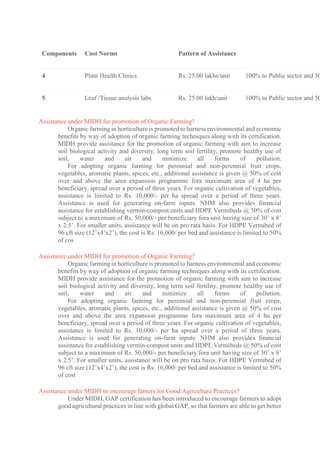
Components Cost Norms Pattern of Assistance
1 Promotion of IPM/INM 4000/ha % of cost subject to a maxim
2 Disease forecasting Unit (PSUs) 6.00 lakh/unit 100 % of costs.
3 Bio control lab Rs. 90.00 lakh/unit 100% to Public sector and 50
Components Cost Norms Pattern of Assistance
4 Plant Health Clinics Rs. 25.00 lakhs/unit 100% to Public sector and 50
5 Leaf /Tissue analysis labs Rs. 25.00 lakh/unit 100% to Public sector and 50
Assistance under MIDH for promotion of Organic Farming?
Organic farming in horticulture is promoted to harness environmental and economic
benefits by way of adoption of organic farming techniques along with its certification.
MIDH provide assistance for the promotion of organic farming with aim to increase
soil biological activity and diversity, long term soil fertility, promote healthy use of
soil, water and air and minimize all forms of pollution.
For adopting organic farming for perennial and non-perennial fruit crops,
vegetables, aromatic plants, spices, etc., additional assistance is given @ 50% of cost
over and above the area expansion programme fora maximum area of 4 ha per
beneficiary, spread over a period of three years. For organic cultivation of vegetables,
assistance is limited to Rs. 10,000/- per ha spread over a period of three years.
Assistance is used for generating on-farm inputs. NHM also provides financial
assistance for establishing vermin-compost units and HDPE Vermibeds @ 50% of cost
subject to a maximum of Rs. 50,000/- per beneficiary fora unit having size of 30’ x 8’
x 2.5’. For smaller units, assistance will be on pro rata basis. For HDPE Vermibed of
96 cft size (12’x4’x2’), the cost is Rs. 16,000/ per bed and assistance is limited to 50%
of cos
Assistance under MIDH for promotion of Organic Farming?
Organic farming in horticulture is promoted to harness environmental and economic
benefits by way of adoption of organic farming techniques along with its certification.
MIDH provide assistance for the promotion of organic farming with aim to increase
soil biological activity and diversity, long term soil fertility, promote healthy use of
soil, water and air and minimize all forms of pollution.
For adopting organic farming for perennial and non-perennial fruit crops,
vegetables, aromatic plants, spices, etc., additional assistance is given @ 50% of cost
over and above the area expansion programme fora maximum area of 4 ha per
beneficiary, spread over a period of three years. For organic cultivation of vegetables,
assistance is limited to Rs. 10,000/- per ha spread over a period of three years.
Assistance is used for generating on-farm inputs. NHM also provides financial
assistance for establishing vermin-compost units and HDPE Vermibeds @ 50% of cost
subject to a maximum of Rs. 50,000/- per beneficiary fora unit having size of 30’ x 8’
x 2.5’. For smaller units, assistance will be on pro rata basis. For HDPE Vermibed of
96 cft size (12’x4’x2’), the cost is Rs. 16,000/ per bed and assistance is limited to 50%
of cost
Assistance under MIDH to encourage famers for Good Agriculture Practices?
Under MIDH, GAP certification has been introduced to encourage farmers to adopt
good agricultural practices in line with global GAP, so that farmers are able to get better
price for their produce in domestic as well as international market. Assistance for this
is provided @ 50% of cost for maximum area of four ha per beneficiary. Certification
agencies to be involved for this will be as per list approved by APEDA.
Assistance under MIDH for promotion of pollination through bee keeping?
In order to maximize agricultural production, honey-bee can be used as an important
input. The responsibility of coordinating the bee-keeping development programme in
State will be vested in the identified State Designated Agency (SDA) or any
institution/society having capability. National Bee Board (NBB) is responsible for
coordinating beekeeping activity in states. Under MIDH, assistance is available for
activities on development of nucleus stock of honey bees, bee breeding, distribution of
honey bee colonies hives and bee keeping equipment.
Assistance under MIDH to support state horticulture mission/implementing agencies?
For managing various activities of Mission at State & District Mission offices and
implementing agencies for administrative expenses, Consultants at State & District
level, project preparation, computerization, contingency etc, 5% of total annual
expenditure is provided to State Horticulture Missions/implementing Agencies. State/
implementing agencies will make provision for this in their Annual Action Plan.
What is Protected Cultivation Technology?
Protected cultivation practices can be defined as a cropping technique wherein the
micro climate surrounding the plant body is controlled partially or fully as per the
requirement of the horticultural crops grown during their period of growth. With the
advancement in agriculture various types of protected cultivation practices suitable for
a specific type of agro-climatic zone have emerged. Among these protective cultivation
practices, Green house, Polyhouse, Shadenet house, walking tunnel, plastic tunnel,
Insect net house etc
What is a Poly House?
A Polyhouse is a framed structure made of GI pipe/MS angle/ Wood/ Bamboo and
covered with a transparent/translucent material fixed to frame with profile & grippers.
Besides irrigation, it has control/monitoring equipment, which is considered necessary
for controlling environmental factors such as temperature, light, relative humidity etc.
and is necessary for maximizing plant growth and productivity.
How does Poly house work?
Polyhouse is an enclosed area, in which crops are grown under partially or fully
controlled conditions. The cladding material is of plastic (Polyethylene) film and acts
like a selective radiation filter that allows solar radiation to pass through it but traps the
thermal radiation emitted by the inside objects to create Polyhouse effect. The
Polyhouse protects the plants from adverse climatic conditions and provides an
appropriate amount of light, temperature, humidity, carbon-dioxide etc. to achieve
optimum yield with excellent quality. The reason for building a Polyhouse is to get
faster growth by raising humidity and controlling temperatures. Labor, energy and
capital are the major three cost factors in a typical modern Polyhouse production
system. Polyhouse technology is highly relevant under Indian conditions due to variant
agro-climatic conditions of the country.
What are the Advantages of Polyhouse?
Polyhouse has the following advantages:
1. Provides favorable micro climatic conditions for the plants hence round the
year cultivation is possible.
2. Enhances yield with better quality per unit area.
3. More suitable for cultivating high value/ off - season crops.
4. Helps to control pest and diseases.
5. Helps in hardening of tissue cultured plants.
6. Helps in raising early nurseries.
7. Round the year propagation of planting material is possible.
8. Protects the crops from wind, rain, precipitation, snow, bird, hail etc.
9. Generates self- employment opportunities for educated youth
What are the types of Poly houses?
Keeping in view the Indian climatic conditions, two types of Polyhouse have been
taken into consideration under the Govt. of India schemes (NHM & HMNEHS) for
subsidy, and they are Naturally Ventilated Polyhouse and Polyhouse with Fan & Pad
Cooling System. There is also a provision of subsidy for the low cost Polyhouses
made of wooden and bamboo structure.
A. Naturally ventilated Polyhouse - best suited for areas where temperature
ranges between 15oC to 30oC. The structure should have a provision of sufficient
number of openings for ventilation. The percentage of ventilation will be up to 60%
of the floor area depending upon climatic conditions. The openings may be side wall
vent or roof vent or both to exchange air (hot/cold) flow inside the Polyhouse. During
the summer period the openings are provided need to ensure efficient air movement
and should be fully airtight during winter period.
B. Polyhouse with fan and pad cooling system - best suited for hot dry climatic
conditions such as Northern plains where temperature goes above 30oC. The system
is working on the principle that when water evaporates and heat is absorbed from
surroundings. This is possible by drawing cool air into Polyhouse through wet pad
located at one end of the wall, where hot air is replaced by co-axial fans mounted on
the opposite end of wall. The excessive temperature causes various damages to the
morphology and physiological processes of plants such as flower shedding, leaf
scorch, poor fruit quality, excessive transpiration, shortened life span of the plants and
low net photosynthesis due to excessive respiration etc. Hence, it is important to
maintain air temperature inside the Polyhouse ranging between 20ºC to 28ºC for
better crop growth.
Assistance under MIDH for promotion of Bio-pesticides?
MIDH envisages promotion of Integrated Nutrient Management (INM) and
Integrated Pest Management (IPM) measures. Assistance is provided for developing
facilities like Disease Forecasting Units, Bio-control Labs, Plant Health Clinics and
Leaf Tissue Analysis Labs. For promotion of IPN/INM, assistance is provided @30%
of cost to the maximum of Rs. 4000/ha. limited to 4 ha/ per beneficiary. Under INM
component, subsidy can be availed for use of liquid bio-fertilizers of N, P and K such
as Rhizobium/Azospirillum/Azotobactor, Phosphate Solubilising Bacteria (PSB) and
Potash Mobilizing Bacteria ( KMB), to be applied in combination, in demonstration
and other programmes, for which total assistance will be limited to 50% of cost or Rs.
300.00 per ha. for maximum of 4 ha./beneficiary
Assistance under MIDH for promoting Skill Development?
Mission supports skill development and creates employment generation
opportunities for rural youth in horticulture and post harvest management, especially in
the cold chain sector. Capacity buildings of farmers and technitions is also provided for
adopting improved technologies, through existing institutions like State Agriculture
Universities, Krishi Vigyan Kendras, institutes with Department of Horticulture in
States. Rural youth and farmers are imparted training under various farming techniques
for horticulture crops, mushroom, floriculture, beekeeping, protected cultivation, micro
irrigation, post harvest processing etc. The duration of training of farmers is 2-5 days.
Cost per trainee is Rs. 1000/- per farmer within state and project based in case of
training outside the state
Assistance under MIDH for promotion of protected cultivation like Green Houses?
Protected structures such as green house are used for production of virus-free high
quality hybrid seed of important high value vegetables. The seed yield of crops like
tomato, sweet pepper, cucumber etc. can be 3-4 times more in protected conditions
compared to their open field cultivation along with high quality of seed having cost of
seed production only one third of the seed produced under semi-climate controlled
green house conditions. Hybrid seed production under protected conditions can be
highly economical and profitable venture and also ensuring the regular supply of
vegetables for domestic market. Promotion of protected cultivation through poly houses
is being promoted under MIDH. The work relating to construction of poly houses are
undertaken by the approved/listed fabricators, approved by State Horticulture Missions.
Under the scheme, assistance is provided for establishment of green houses. For Fan &
Pad and Naturally ventilated system Green house (Tubular structure), assistance is
provided @ 50% of cost for a maximum area of 4000 sq. mtrs. per beneficiary. For
wooden and bamboo structure green house, assistance is provided @ 50% of cost
limited to 20 units per beneficiary and each unit not exceeding 200sq. mtrs
Assistance under MIDH for promotion of seed production?
Mission envisages promoting seed production for vegetables and spices. Estimated
cost of vegetable seed production is Rs. 35,000 per ha. for open pollinated crops and
Rs. 1.50 lakh per ha. for hybrid vegetable seeds. Assistance is provided @ 100% of
total cost to public sector. In case of Private sector, assistance is 50% of the cost as
credit linked back ended subsidy for a maximum area of 5 ha. per beneficiary. For
production of hybrid seeds, assistance is provided @ 100% for public sector to the
maximum of Rs. 35,000/ha. limited to 5 ha., for private sector, assistance is 35% in
general areas and 50% in NE & Himalayan states, Tribal Sub Plans (TSP) areas, A &
N and Lakshadweep Islands
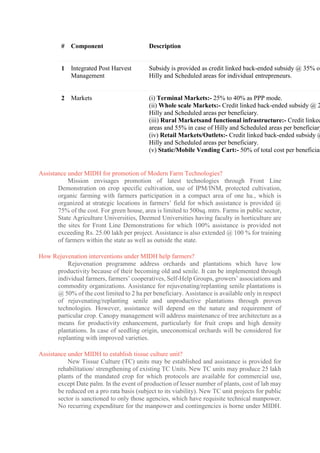
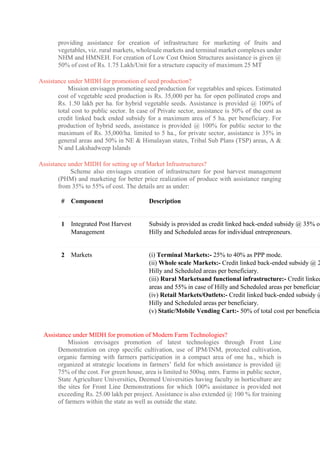
Assistance under MIDH for setting up of Market Infrastructures?
Scheme also envisages creation of infrastructure for post harvest management
(PHM) and marketing for better price realization of produce with assistance ranging
from 35% to 55% of cost. The details are as under:
# Component Description
1 Integrated Post Harvest
Management
Subsidy is provided as credit linked back-ended subsidy @ 35% of
Hilly and Scheduled areas for individual entrepreneurs.
2 Markets (i) Terminal Markets:- 25% to 40% as PPP mode.
(ii) Whole scale Markets:- Credit linked back-ended subsidy @ 2
Hilly and Scheduled areas per beneficiary.
(iii) Rural Marketsand functional infrastructure:- Credit linked
areas and 55% in case of Hilly and Scheduled areas per beneficiary
(iv) Retail Markets/Outlets:- Credit linked back-ended subsidy @
Hilly and Scheduled areas per beneficiary.
(v) Static/Mobile Vending Cart:- 50% of total cost per beneficiar
Assistance under MIDH for promotion of Modern Farm Technologies?
Mission envisages promotion of latest technologies through Front Line
Demonstration on crop specific cultivation, use of IPM/INM, protected cultivation,
organic farming with farmers participation in a compact area of one ha., which is
organized at strategic locations in farmers’ field for which assistance is provided @
75% of the cost. For green house, area is limited to 500sq. mtrs. Farms in public sector,
State Agriculture Universities, Deemed Universities having faculty in horticulture are
the sites for Front Line Demonstrations for which 100% assistance is provided not
exceeding Rs. 25.00 lakh per project. Assistance is also extended @ 100 % for training
of farmers within the state as well as outside the state.
How Rejuvenation interventions under MIDH help farmers?
Rejuvenation programme address orchards and plantations which have low
productivity because of their becoming old and senile. It can be implemented through
individual farmers, farmers’ cooperatives, Self-Help Groups, growers’ associations and
commodity organizations. Assistance for rejuvenating/replanting senile plantations is
@ 50% of the cost limited to 2 ha per beneficiary. Assistance is available only in respect
of rejuvenating/replanting senile and unproductive plantations through proven
technologies. However, assistance will depend on the nature and requirement of
particular crop. Canopy management will address maintenance of tree architecture as a
means for productivity enhancement, particularly for fruit crops and high density
plantations. In case of seedling origin, uneconomical orchards will be considered for
replanting with improved varieties.
Assistance under MIDH to establish tissue culture unit?
New Tissue Culture (TC) units may be established and assistance is provided for
rehabilitation/ strengthening of existing TC Units. New TC units may produce 25 lakh
plants of the mandated crop for which protocols are available for commercial use,
except Date palm. In the event of production of lesser number of plants, cost of lab may
be reduced on a pro rata basis (subject to its viability). New TC unit projects for public
sector is sanctioned to only those agencies, which have requisite technical manpower.
No recurring expenditure for the manpower and contingencies is borne under MIDH.
Each TC unit would get itself accredited as per standards and norms of Department of
Bio Technology within eighteen months from the date of receiving funds, failing which
the assistance provided under the scheme will have to be returned.
Assistance under MIDH to promote mushroom cultivation?
MIDH provides support to promote mushroom cultivation through setting up of
individual mushroom production, spawn production and compost making units. In case
of setting up of mushroom production unit and compost making unit assistance is
provided Rs. 20 lakh/unit and for spawn making unit Rs. 15 lakh/unit @100% of the
cost to public sector and 40% of cost for private sector, for meeting the expenditure on
infrastructure, as credit linked back ended subsidy
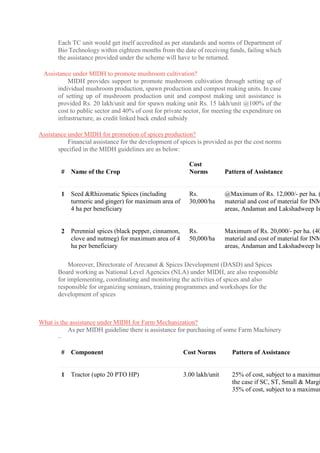
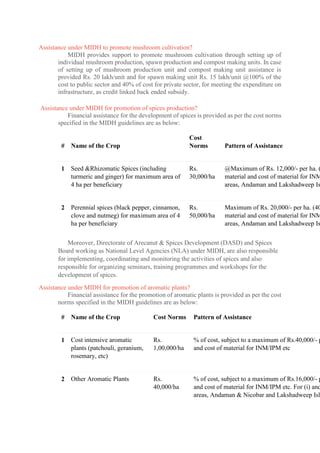
Assistance under MIDH for promotion of spices production?
Financial assistance for the development of spices is provided as per the cost norms
specified in the MIDH guidelines are as below:
# Name of the Crop
Cost
Norms Pattern of Assistance
1 Seed &Rhizomatic Spices (including
turmeric and ginger) for maximum area of
4 ha per beneficiary
Rs.
30,000/ha
@Maximum of Rs. 12,000/- per ha. (
material and cost of material for INM
areas, Andaman and Lakshadweep Is
2 Perennial spices (black pepper, cinnamon,
clove and nutmeg) for maximum area of 4
ha per beneficiary
Rs.
50,000/ha
Maximum of Rs. 20,000/- per ha. (40
material and cost of material for INM
areas, Andaman and Lakshadweep Is
Moreover, Directorate of Arecanut & Spices Development (DASD) and Spices
Board working as National Level Agencies (NLA) under MIDH, are also responsible
for implementing, coordinating and monitoring the activities of spices and also
responsible for organizing seminars, training programmes and workshops for the
development of spices
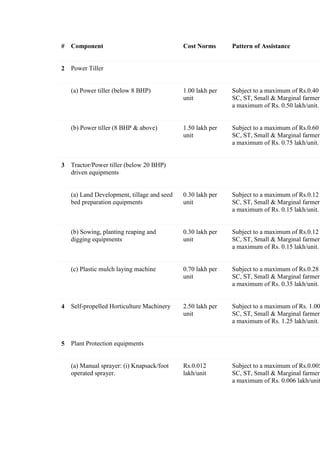
What is the assistance under MIDH for Farm Mechanization?
As per MIDH guideline there is assistance for purchasing of some Farm Machinery
–
# Component Cost Norms Pattern of Assistance
1 Tractor (upto 20 PTO HP) 3.00 lakh/unit 25% of cost, subject to a maximum
the case if SC, ST, Small & Margi
35% of cost, subject to a maximum
# Component Cost Norms Pattern of Assistance
2 Power Tiller
(a) Power tiller (below 8 BHP) 1.00 lakh per
unit
Subject to a maximum of Rs.0.40
SC, ST, Small & Marginal farmers
a maximum of Rs. 0.50 lakh/unit.
(b) Power tiller (8 BHP & above) 1.50 lakh per
unit
Subject to a maximum of Rs.0.60
SC, ST, Small & Marginal farmers
a maximum of Rs. 0.75 lakh/unit.
3 Tractor/Power tiller (below 20 BHP)
driven equipments
(a) Land Development, tillage and seed
bed preparation equipments
0.30 lakh per
unit
Subject to a maximum of Rs.0.12
SC, ST, Small & Marginal farmers
a maximum of Rs. 0.15 lakh/unit.
(b) Sowing, planting reaping and
digging equipments
0.30 lakh per
unit
Subject to a maximum of Rs.0.12
SC, ST, Small & Marginal farmers
a maximum of Rs. 0.15 lakh/unit.
(c) Plastic mulch laying machine 0.70 lakh per
unit
Subject to a maximum of Rs.0.28
SC, ST, Small & Marginal farmers
a maximum of Rs. 0.35 lakh/unit.
4 Self-propelled Horticulture Machinery 2.50 lakh per
unit
Subject to a maximum of Rs. 1.00
SC, ST, Small & Marginal farmers
a maximum of Rs. 1.25 lakh/unit.
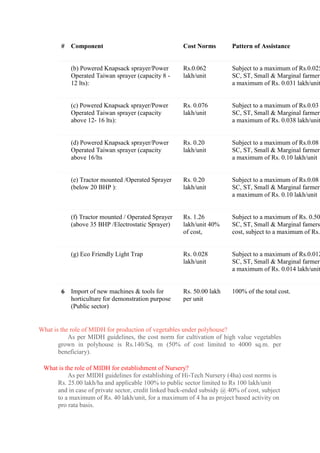
5 Plant Protection equipments
(a) Manual sprayer: (i) Knapsack/foot
operated sprayer.
Rs.0.012
lakh/unit
Subject to a maximum of Rs.0.005
SC, ST, Small & Marginal farmers
a maximum of Rs. 0.006 lakh/unit
# Component Cost Norms Pattern of Assistance
(b) Powered Knapsack sprayer/Power
Operated Taiwan sprayer (capacity 8 -
12 lts):
Rs.0.062
lakh/unit
Subject to a maximum of Rs.0.025
SC, ST, Small & Marginal farmers
a maximum of Rs. 0.031 lakh/unit
(c) Powered Knapsack sprayer/Power
Operated Taiwan sprayer (capacity
above 12- 16 lts):
Rs. 0.076
lakh/unit
Subject to a maximum of Rs.0.03
SC, ST, Small & Marginal farmers
a maximum of Rs. 0.038 lakh/unit
(d) Powered Knapsack sprayer/Power
Operated Taiwan sprayer (capacity
above 16/lts
Rs. 0.20
lakh/unit
Subject to a maximum of Rs.0.08
SC, ST, Small & Marginal farmers
a maximum of Rs. 0.10 lakh/unit
(e) Tractor mounted /Operated Sprayer
(below 20 BHP ):
Rs. 0.20
lakh/unit
Subject to a maximum of Rs.0.08
SC, ST, Small & Marginal farmers
a maximum of Rs. 0.10 lakh/unit
(f) Tractor mounted / Operated Sprayer
(above 35 BHP /Electrostatic Sprayer)
Rs. 1.26
lakh/unit 40%
of cost,
Subject to a maximum of Rs. 0.50
SC, ST, Small & Marginal famers,
cost, subject to a maximum of Rs.
(g) Eco Friendly Light Trap Rs. 0.028
lakh/unit
Subject to a maximum of Rs.0.012
SC, ST, Small & Marginal farmers
a maximum of Rs. 0.014 lakh/unit
6 Import of new machines & tools for
horticulture for demonstration purpose
(Public sector)
Rs. 50.00 lakh
per unit
100% of the total cost.
What is the role of MIDH for production of vegetables under polyhouse?
As per MIDH guidelines, the cost norm for cultivation of high value vegetables
grown in polyhouse is Rs.140/Sq. m (50% of cost limited to 4000 sq.m. per
beneficiary).
What is the role of MIDH for establishment of Nursery?
As per MIDH guidelines for establishing of Hi-Tech Nursery (4ha) cost norms is
Rs. 25.00 lakh/ha and applicable 100% to public sector limited to Rs 100 lakh/unit
and in case of private sector, credit linked back-ended subsidy @ 40% of cost, subject
to a maximum of Rs. 40 lakh/unit, for a maximum of 4 ha as project based activity on
pro rata basis.
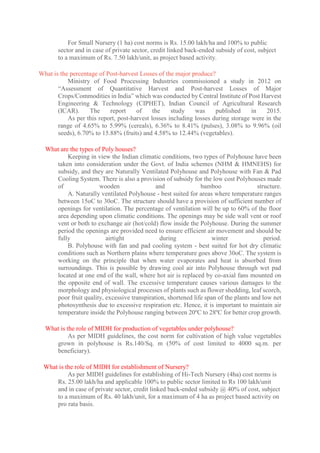
For Small Nursery (1 ha) cost norms is Rs. 15.00 lakh/ha and 100% to public
sector and in case of private sector, credit linked back-ended subsidy of cost, subject
to a maximum of Rs. 7.50 lakh/unit, as project based activity.
What is the percentage of Post-harvest Losses of the major produce?
Ministry of Food Processing Industries commissioned a study in 2012 on
“Assessment of Quantitative Harvest and Post-harvest Losses of Major
Crops/Commodities in India” which was conducted by Central Institute of Post Harvest
Engineering & Technology (CIPHET), Indian Council of Agricultural Research
(ICAR). The report of the study was published in 2015.
As per this report, post-harvest losses including losses during storage were in the
range of 4.65% to 5.99% (cereals), 6.36% to 8.41% (pulses), 3.08% to 9.96% (oil
seeds), 6.70% to 15.88% (fruits) and 4.58% to 12.44% (vegetables).
What are the types of Poly houses?
Keeping in view the Indian climatic conditions, two types of Polyhouse have been
taken into consideration under the Govt. of India schemes (NHM & HMNEHS) for
subsidy, and they are Naturally Ventilated Polyhouse and Polyhouse with Fan & Pad
Cooling System. There is also a provision of subsidy for the low cost Polyhouses made
of wooden and bamboo structure.
A. Naturally ventilated Polyhouse - best suited for areas where temperature ranges
between 15oC to 30oC. The structure should have a provision of sufficient number of
openings for ventilation. The percentage of ventilation will be up to 60% of the floor
area depending upon climatic conditions. The openings may be side wall vent or roof
vent or both to exchange air (hot/cold) flow inside the Polyhouse. During the summer
period the openings are provided need to ensure efficient air movement and should be
fully airtight during winter period.
B. Polyhouse with fan and pad cooling system - best suited for hot dry climatic
conditions such as Northern plains where temperature goes above 30oC. The system is
working on the principle that when water evaporates and heat is absorbed from
surroundings. This is possible by drawing cool air into Polyhouse through wet pad
located at one end of the wall, where hot air is replaced by co-axial fans mounted on
the opposite end of wall. The excessive temperature causes various damages to the
morphology and physiological processes of plants such as flower shedding, leaf scorch,
poor fruit quality, excessive transpiration, shortened life span of the plants and low net
photosynthesis due to excessive respiration etc. Hence, it is important to maintain air
temperature inside the Polyhouse ranging between 20ºC to 28ºC for better crop growth.
What is the role of MIDH for production of vegetables under polyhouse?
As per MIDH guidelines, the cost norm for cultivation of high value vegetables
grown in polyhouse is Rs.140/Sq. m (50% of cost limited to 4000 sq.m. per
beneficiary).
What is the role of MIDH for establishment of Nursery?
As per MIDH guidelines for establishing of Hi-Tech Nursery (4ha) cost norms is
Rs. 25.00 lakh/ha and applicable 100% to public sector limited to Rs 100 lakh/unit
and in case of private sector, credit linked back-ended subsidy @ 40% of cost, subject
to a maximum of Rs. 40 lakh/unit, for a maximum of 4 ha as project based activity on
pro rata basis.
For Small Nursery (1 ha) cost norms is Rs. 15.00 lakh/ha and 100% to public
sector and in case of private sector, credit linked back-ended subsidy of cost, subject
to a maximum of Rs. 7.50 lakh/unit, as project based activity.
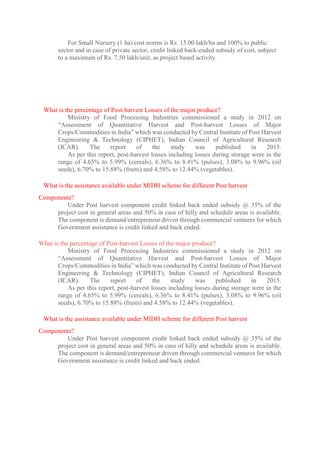
What is the percentage of Post-harvest Losses of the major produce?
Ministry of Food Processing Industries commissioned a study in 2012 on
“Assessment of Quantitative Harvest and Post-harvest Losses of Major
Crops/Commodities in India” which was conducted by Central Institute of Post Harvest
Engineering & Technology (CIPHET), Indian Council of Agricultural Research
(ICAR). The report of the study was published in 2015.
As per this report, post-harvest losses including losses during storage were in the
range of 4.65% to 5.99% (cereals), 6.36% to 8.41% (pulses), 3.08% to 9.96% (oil
seeds), 6.70% to 15.88% (fruits) and 4.58% to 12.44% (vegetables).
What is the assistance available under MIDH scheme for different Post harvest
Components?
Under Post harvest component credit linked back ended subsidy @ 35% of the
project cost in general areas and 50% in case of hilly and schedule areas is available.
The component is demand/entrepreneur driven through commercial ventures for which
Government assistance is credit linked and back ended.
What is the percentage of Post-harvest Losses of the major produce?
Ministry of Food Processing Industries commissioned a study in 2012 on
“Assessment of Quantitative Harvest and Post-harvest Losses of Major
Crops/Commodities in India” which was conducted by Central Institute of Post Harvest
Engineering & Technology (CIPHET), Indian Council of Agricultural Research
(ICAR). The report of the study was published in 2015.
As per this report, post-harvest losses including losses during storage were in the
range of 4.65% to 5.99% (cereals), 6.36% to 8.41% (pulses), 3.08% to 9.96% (oil
seeds), 6.70% to 15.88% (fruits) and 4.58% to 12.44% (vegetables).
What is the assistance available under MIDH scheme for different Post harvest
Components?
Under Post harvest component credit linked back ended subsidy @ 35% of the
project cost in general areas and 50% in case of hilly and schedule areas is available.
The component is demand/entrepreneur driven through commercial ventures for which
Government assistance is credit linked and back ended.
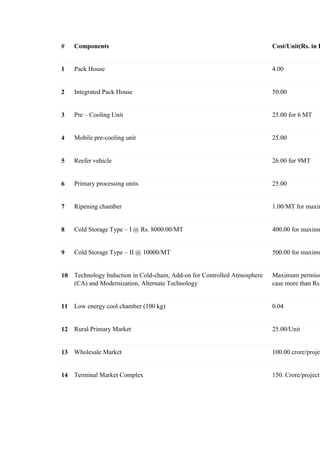
# Components Cost/Unit(Rs. in L
1 Pack House 4.00
2 Integrated Pack House 50.00
3 Pre – Cooling Unit 25.00 for 6 MT
4 Mobile pre-cooling unit 25.00
5 Reefer vehicle 26.00 for 9MT
6 Primary processing units 25.00
7 Ripening chamber 1.00/MT for maxim
8 Cold Storage Type – I @ Rs. 8000.00/MT 400.00 for maximu
9 Cold Storage Type – II @ 10000/MT 500.00 for maximu
10 Technology Induction in Cold-chain, Add-on for Controlled Atmosphere
(CA) and Modernization, Alternate Technology
Maximum permiss
case more than Rs.
11 Low energy cool chamber (100 kg) 0.04
12 Rural Primary Market 25.00/Unit
13 Wholesale Market 100.00 crore/projec
14 Terminal Market Complex 150. Crore/project
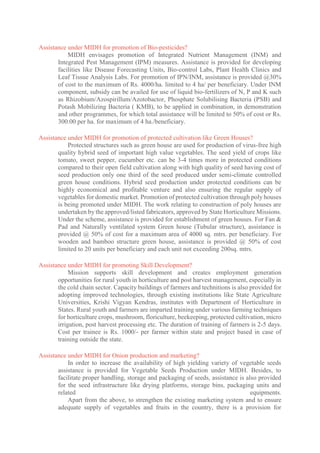
Assistance under MIDH for promotion of Bio-pesticides?
MIDH envisages promotion of Integrated Nutrient Management (INM) and
Integrated Pest Management (IPM) measures. Assistance is provided for developing
facilities like Disease Forecasting Units, Bio-control Labs, Plant Health Clinics and
Leaf Tissue Analysis Labs. For promotion of IPN/INM, assistance is provided @30%
of cost to the maximum of Rs. 4000/ha. limited to 4 ha/ per beneficiary. Under INM
component, subsidy can be availed for use of liquid bio-fertilizers of N, P and K such
as Rhizobium/Azospirillum/Azotobactor, Phosphate Solubilising Bacteria (PSB) and
Potash Mobilizing Bacteria ( KMB), to be applied in combination, in demonstration
and other programmes, for which total assistance will be limited to 50% of cost or Rs.
300.00 per ha. for maximum of 4 ha./beneficiary.
Assistance under MIDH for promotion of protected cultivation like Green Houses?
Protected structures such as green house are used for production of virus-free high
quality hybrid seed of important high value vegetables. The seed yield of crops like
tomato, sweet pepper, cucumber etc. can be 3-4 times more in protected conditions
compared to their open field cultivation along with high quality of seed having cost of
seed production only one third of the seed produced under semi-climate controlled
green house conditions. Hybrid seed production under protected conditions can be
highly economical and profitable venture and also ensuring the regular supply of
vegetables for domestic market. Promotion of protected cultivation through poly houses
is being promoted under MIDH. The work relating to construction of poly houses are
undertaken by the approved/listed fabricators, approved by State Horticulture Missions.
Under the scheme, assistance is provided for establishment of green houses. For Fan &
Pad and Naturally ventilated system Green house (Tubular structure), assistance is
provided @ 50% of cost for a maximum area of 4000 sq. mtrs. per beneficiary. For
wooden and bamboo structure green house, assistance is provided @ 50% of cost
limited to 20 units per beneficiary and each unit not exceeding 200sq. mtrs.
Assistance under MIDH for promoting Skill Development?
Mission supports skill development and creates employment generation
opportunities for rural youth in horticulture and post harvest management, especially in
the cold chain sector. Capacity buildings of farmers and technitions is also provided for
adopting improved technologies, through existing institutions like State Agriculture
Universities, Krishi Vigyan Kendras, institutes with Department of Horticulture in
States. Rural youth and farmers are imparted training under various farming techniques
for horticulture crops, mushroom, floriculture, beekeeping, protected cultivation, micro
irrigation, post harvest processing etc. The duration of training of farmers is 2-5 days.
Cost per trainee is Rs. 1000/- per farmer within state and project based in case of
training outside the state.
Assistance under MIDH for Onion production and marketing?
In order to increase the availability of high yielding variety of vegetable seeds
assistance is provided for Vegetable Seeds Production under MIDH. Besides, to
facilitate proper handling, storage and packaging of seeds, assistance is also provided
for the seed infrastructure like drying platforms, storage bins, packaging units and
related equipments.
Apart from the above, to strengthen the existing marketing system and to ensure
adequate supply of vegetables and fruits in the country, there is a provision for
providing assistance for creation of infrastructure for marketing of fruits and
vegetables, viz. rural markets, wholesale markets and terminal market complexes under
NHM and HMNEH. For creation of Low Cost Onion Structures assistance is given @
50% of cost of Rs. 1.75 Lakh/Unit for a structure capacity of maximum 25 MT
Assistance under MIDH for promotion of seed production?
Mission envisages promoting seed production for vegetables and spices. Estimated
cost of vegetable seed production is Rs. 35,000 per ha. for open pollinated crops and
Rs. 1.50 lakh per ha. for hybrid vegetable seeds. Assistance is provided @ 100% of
total cost to public sector. In case of Private sector, assistance is 50% of the cost as
credit linked back ended subsidy for a maximum area of 5 ha. per beneficiary. For
production of hybrid seeds, assistance is provided @ 100% for public sector to the
maximum of Rs. 35,000/ha. limited to 5 ha., for private sector, assistance is 35% in
general areas and 50% in NE & Himalayan states, Tribal Sub Plans (TSP) areas, A &
N and Lakshadweep Islands
Assistance under MIDH for setting up of Market Infrastructures?
Scheme also envisages creation of infrastructure for post harvest management
(PHM) and marketing for better price realization of produce with assistance ranging
from 35% to 55% of cost. The details are as under:
# Component Description
1 Integrated Post Harvest
Management
Subsidy is provided as credit linked back-ended subsidy @ 35% of
Hilly and Scheduled areas for individual entrepreneurs.
2 Markets (i) Terminal Markets:- 25% to 40% as PPP mode.
(ii) Whole scale Markets:- Credit linked back-ended subsidy @ 2
Hilly and Scheduled areas per beneficiary.
(iii) Rural Marketsand functional infrastructure:- Credit linked
areas and 55% in case of Hilly and Scheduled areas per beneficiary
(iv) Retail Markets/Outlets:- Credit linked back-ended subsidy @
Hilly and Scheduled areas per beneficiary.
(v) Static/Mobile Vending Cart:- 50% of total cost per beneficiar
Assistance under MIDH for promotion of Modern Farm Technologies?
Mission envisages promotion of latest technologies through Front Line
Demonstration on crop specific cultivation, use of IPM/INM, protected cultivation,
organic farming with farmers participation in a compact area of one ha., which is
organized at strategic locations in farmers’ field for which assistance is provided @
75% of the cost. For green house, area is limited to 500sq. mtrs. Farms in public sector,
State Agriculture Universities, Deemed Universities having faculty in horticulture are
the sites for Front Line Demonstrations for which 100% assistance is provided not
exceeding Rs. 25.00 lakh per project. Assistance is also extended @ 100 % for training
of farmers within the state as well as outside the state.
Assistance under MIDH to promote mushroom cultivation?
MIDH provides support to promote mushroom cultivation through setting up of
individual mushroom production, spawn production and compost making units. In case
of setting up of mushroom production unit and compost making unit assistance is
provided Rs. 20 lakh/unit and for spawn making unit Rs. 15 lakh/unit @100% of the
cost to public sector and 40% of cost for private sector, for meeting the expenditure on
infrastructure, as credit linked back ended subsidy.
Assistance under MIDH for promotion of spices production?
Financial assistance for the development of spices is provided as per the cost norms
specified in the MIDH guidelines are as below:
# Name of the Crop
Cost
Norms Pattern of Assistance
1 Seed &Rhizomatic Spices (including
turmeric and ginger) for maximum area of
4 ha per beneficiary
Rs.
30,000/ha
@Maximum of Rs. 12,000/- per ha. (
material and cost of material for INM
areas, Andaman and Lakshadweep Is
2 Perennial spices (black pepper, cinnamon,
clove and nutmeg) for maximum area of 4
ha per beneficiary
Rs.
50,000/ha
Maximum of Rs. 20,000/- per ha. (40
material and cost of material for INM
areas, Andaman and Lakshadweep Is
Moreover, Directorate of Arecanut & Spices Development (DASD) and Spices
Board working as National Level Agencies (NLA) under MIDH, are also responsible
for implementing, coordinating and monitoring the activities of spices and also
responsible for organizing seminars, training programmes and workshops for the
development of spices.
Assistance under MIDH for promotion of aromatic plants?
Financial assistance for the promotion of aromatic plants is provided as per the cost
norms specified in the MIDH guidelines are as below:
# Name of the Crop Cost Norms Pattern of Assistance
1 Cost intensive aromatic
plants (patchouli, geranium,
rosemary, etc)
Rs.
1,00,000/ha
% of cost, subject to a maximum of Rs.40,000/- p
and cost of material for INM/IPM etc
2 Other Aromatic Plants Rs.
40,000/ha
% of cost, subject to a maximum of Rs.16,000/- p
and cost of material for INM/IPM etc. For (i) and
areas, Andaman & Nicobar and Lakshadweep Isl
What is the role of MIDH for establishment of Nursery?
As per MIDH guidelines for establishing of Hi-Tech Nursery (4ha) cost norms is
Rs. 25.00 lakh/ha and applicable 100% to public sector limited to Rs 100 lakh/unit and
in case of private sector, credit linked back-ended subsidy @ 40% of cost, subject to a
maximum of Rs. 40 lakh/unit, for a maximum of 4 ha as project based activity on pro
rata basis.
For Small Nursery (1 ha) cost norms is Rs. 15.00 lakh/ha and 100% to public sector
and in case of private sector, credit linked back-ended subsidy of cost, subject to a
maximum of Rs. 7.50 lakh/unit, as project based activity.
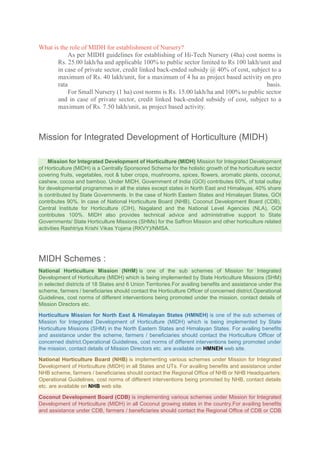
Mission for Integrated Development of Horticulture (MIDH)
Mission for Integrated Development of Horticulture (MIDH) Mission for Integrated Development
of Horticulture (MIDH) is a Centrally Sponsored Scheme for the holistic growth of the horticulture sector
covering fruits, vegetables, root & tuber crops, mushrooms, spices, flowers, aromatic plants, coconut,
cashew, cocoa and bamboo. Under MIDH, Government of India (GOI) contributes 60%, of total outlay
for developmental programmes in all the states except states in North East and Himalayas, 40% share
is contributed by State Governments. In the case of North Eastern States and Himalayan States, GOI
contributes 90%. In case of National Horticulture Board (NHB), Coconut Development Board (CDB),
Central Institute for Horticulture (CIH), Nagaland and the National Level Agencies (NLA), GOI
contributes 100%. MIDH also provides technical advice and administrative support to State
Governments/ State Horticulture Missions (SHMs) for the Saffron Mission and other horticulture related
activities Rashtriya Krishi Vikas Yojana (RKVY)/NMSA.
MIDH Schemes :
National Horticulture Mission (NHM) is one of the sub schemes of Mission for Integrated
Development of Horticulture (MIDH) which is being implemented by State Horticulture Missions (SHM)
in selected districts of 18 States and 6 Union Territories.For availing benefits and assistance under the
scheme, farmers / beneficiaries should contact the Horticulture Officer of concerned district.Operational
Guidelines, cost norms of different interventions being promoted under the mission, contact details of
Mission Directors etc.
Horticulture Mission for North East & Himalayan States (HMNEH) is one of the sub schemes of
Mission for Integrated Development of Horticulture (MIDH) which is being implemented by State
Horticulture Missions (SHM) in the North Eastern States and Himalayan States. For availing benefits
and assistance under the scheme, farmers / beneficiaries should contact the Horticulture Officer of
concerned district.Operational Guidelines, cost norms of different interventions being promoted under
the mission, contact details of Mission Directors etc. are available on HMNEH web site.
National Horticulture Board (NHB) is implementing various schemes under Mission for Integrated
Development of Horticulture (MIDH) in all States and UTs. For availing benefits and assistance under
NHB scheme, farmers / beneficiaries should contact the Regional Office of NHB or NHB Headquarters.
Operational Guidelines, cost norms of different interventions being promoted by NHB, contact details
etc. are available on NHB web site.
Coconut Development Board (CDB) is implementing various schemes under Mission for Integrated
Development of Horticulture (MIDH) in all Coconut growing states in the country.For availing benefits
and assistance under CDB, farmers / beneficiaries should contact the Regional Office of CDB or CDB
Headquarters. Operational Guidelines, cost norms of different interventions being by CDB, contact
details are available on CDB web site.
Central Institute for Horticulture (CIH) was established at Medizipehima, Nagaland in 2006-07 for
providing technical back stopping through capacity building and training of farmers and Field
functionaries in the North Eastern Region.CIH now one of the sub schemes of MIDH. However, CIH is
not implementing any schemes directly. contact details are available on CIH web site.

data ppt

  • 1.
    Frequently Asked Question(FAQ) What is the Mission for Integrated Development of Horticulture (MIDH) Mission for Integrated Development of Horticulture (MIDH) is a Centrally Sponsored Scheme is being implemented w.e.f. 2014-15 for holistic growth of the horticulture sector covering fruits, vegetables, root and tuber crops, mushrooms, spices, flowers, aromatic plants, coconut, cashew, cocoa. MIDH subsumed ongoing missions/schemes of the Ministry- National Horticulture Mission (NHM), Horticulture Mission for North East & Himalayan States (HMNEH), National Horticulture Board (NHB), Coconut Development Board (CDB) and Central Institute for Horticulture (CIH), Nagaland. All States including North Eastern States and UTs are covered under MIDH. Main objectives of Mission are to promote holistic growth of horticulture sector, including coconut through area based regionally differentiated strategies which include research, technology promotion, extension, post harvest management, processing and marketing in consonance with comparative advantage of each State/region and its diverse agri-climatic features, encourage aggregation of farmers into farmers groups like FIGs/FPOs and FPCs to bring economy of scale and scope, enhance horticulture production, augment farmer’s income, strengthen nutritional security, improve productivity by way of quality germ-plasm, planting material and water use efficiency through Micro Irrigation, support skill development and create employment generation opportunities for rural youth in horticulture and post harvest management, especially in the cold chain sector. Capacity buildings of farmers and technicians is also supported for adopting improved technologies through existing institutions like State Agriculture Universities, Krishi Vigyan Kendras and Institutes with Department of Horticulture in States. What are the schemes of MIDH? Mission has the following sub-schemes as its component: • National Horticulture Mission (NHM) • Horticulture Mission for North East & Himalayan States (HMNEH) • National Horticulture Board (NHB) • Coconut Development Board (CDB) • Central Institute for Horticulture (CIH), Nagaland What is the Strategy of the Mission? To achieve the objectives of the Mission, the broad strategy comprise the following: a. Adopt an end-to-end holistic approach covering production, post harvest management, processing and marketing to assure appropriate returns to growers/producers; b. Promote R&D technologies for production, post-harvest management and processing; c. Enhance acreage, coverage, and productivity through:- i. Diversification, from traditional crops to plantations, orchards, vineyards, flower and vegetable gardens.
  • 2.
    ii. Extension ofappropriate technology to farmers for high-tech horticulture cultivation and precision farming. d. Improve post harvest management, processing for value addition and marketing infrastructure. e. Adopt a coordinated approach and promote partnership, convergence and synergy among R&D, processing and marketing agencies in public as well as private sectors, at the national, regional, State and sub-State levels; f. Promote capacity-building and Human Resource Development at all levels, including, if need be, change in syllabus and curriculum of graduation courses at Colleges and Universities. What is the Structure of the Mission? The Mission has a three tier structure – National, State and District levels. At the National level, there is a General Council (GC) and an Executive Committee (EC). The GC, which provides overall direction, is chaired by the Union Agriculture Minister. The Executive Committee (EC) headed by the Secretary (Agriculture & Cooperation) oversees the activities of the Mission, approves the Annual Action (AAPs) of the States and National Level Agencies and reviews the progress. Similarly, at the State level, an Executive Committee under the Chairmanship of the Agriculture Production Commissioner, or Secretary Horticulture /Agriculture oversees the implementation of the Mission. At the District level, the District Mission Committee (DMC) under the Chairmanship of Chief Executive Officer (CEO) of Zila Parishad / CEO of District Rural Development Agency (DRDA) is responsible for project formulation and monitoring What is the mechanism for implementation of MIDH scheme? MIDH is Centrally Sponsored Scheme wherein the implementing agencies are State Horticulture Mission (SHM). In the total outlay of SHM, centre contributes 60% for general States and 90% for NE and Himalayan States whereas general States contribute 40 % and NE and Himalayan States contribute 10%. Government of India contributes 100% for UTs and National Level Agencies (NLAs). Executive Committee of MIDH decides the annual outlay to various implementing agencies (SHMs and NLAs). Accordingly, implementing agencies submit a Annual Action Plan (AAP) for the approval supported with data/write up on outcome of past interventions and also covering the details of various interventions proposed to be taken up during the current financial year. While finalizing the AAPs, due attention is paid for earmarking specific targets for Scheduled Caste, Scheduled Tribe and women beneficiaries. As an inbuilt provision under MIDH scheme, higher rates of subsidy have been envisaged for taking up activities like creation of infrastructure for post harvest management and marketing of horticulture produce along with area expansion by beneficiaries in the North Eastern States, Himalayan States, Tribal Sub Plan areas, Andaman & Nicobar and Lakshadweep Islands What is the Monitoring Mechanism of the Scheme?
  • 3.
    The Executive Committeeheaded by Secretary (DAC&FW) monitors the progress of Mission. The Empowered Committee under the Chairmanship of Additional Secretary (DAC& FW) also monitors the progress while approving project based proposals of State Governments on a quarterly basis. The Joint Inspection Teams (JITs), comprising officers from DAC & FW , State Agricultural Universities and Precision Farming Development Centers undertake regular visits to States for on –the-spot monitoring of the Mission. What are the Major Interventions of MIDH? Under MIDH, financial assistance is provided for following major interventions/activities: • Setting up of nurseries, tissue culture units for production of quality seed and planting material. • Area expansion i.e. Establishment of new orchards and gardens for fruits, vegetables, and flowers. • Rejuvenation of unproductive, old, and senile orchards. • Protected cultivation, i.e. poly-house, green-house, etc, to improve the productivity & grow off season high value vegetables and flowers. • Organic farming and certification. • Creation of water resources structures and watershed management. • Bee-keeping for pollination. • Horticulture Mechanization. • Creation of Post Harvest Management and Marketing infrastructure. How many districts are covered under the MIDH, across the country? A total of 384 districts from 23 States & UTs have been identified for implementation of NHM. All 117 districts of North East and Himalayan States (11) are covered under HMNEH (Thus. 501 districts are covered under NHM & HMNEH). ote: Horticulture Mission for North East and Himalayan States (HMNEH) : All the districts of North-Eastern and three Himalayan States namely Arunachal Pradesh, Assam, Manipur, Mizoram, Nagaland, Meghalaya, Sikkim, Tripura, Himachal Pradesh, Uttarakhand and Jammu & Kashmir are covered under HMNEH scheme Is there any provision for assistance to the Districts not covered under NHM? On this issue consistent view of the department is that while finalizing/identifying districts for inclusion under NHM, a cluster approaches for developing potential horticultural crops while ensuring backward and forwarded linkages was adopted. The selection of the District was decided on the comparative advantage of crops based on agro climatic conditions, potential for developing marketing opportunities were taken into consideration. No new districts are being added as this may result in thinning out of already limited resources. However, there is a provision under NHM scheme for setting up of infrastructure units relating to post harvest management, marketing and other project based activities
  • 4.
    in non NHMdistricts, provided there is a clear linkage of the units with the horticulture produce. Apart from this, activities for development of horticulture in non-NHM districts can be carried out under other Government schemes like Rashtriya Krishi Vikas Yojana (RKVY), Mahatma Gandhi National Rural Employment Guarantee Act (MGNREGA), Paramparagat Krishi Vikas Yojana (PKVY) etc. What are the other steps being taken under MIDH for promotion of horticulture in the country? Apart from providing assistance to the States for holistic development of horticulture, there are National Level Agencies (NLAs) like DCCD, DASD, NHRDF, NBB, Spices Board etc. for which 100% grant is provided under MIDH for carrying out various interventions like Research & Development, capacity building, Skill development leading to overall development of horticulture in the country. What is the pattern of Assistance under MIDH for organizing Seminars, Workshops and other HRD activities? Provision exists under MIDH for organizing seminars, conferences, workshops, exhibitions, Kisan Melas, horticulture shows etc for creating awareness among farmers. Assistance is provided for organizing event at international level @100% of the cost to the maximum of Rs. 7.50 lakh per event of 4 days. At national level, assistance is provided @ 100% of cost to the maximum of Rs 5.00 lakh per event of two days, at State level, assistance is provided @ 100% of cost to the maximum of Rs 3.00 lakh per event of two days and at district level, assistance is provided @ 100% of cost to the maximum of Rs 2.00 lakh per event of two days What is the pattern of Assistance under MIDH for promotion of FPOs? Promotion and strengthening of Farmer Interest Groups (FIG), Farmer Producer Organizations (FPO) and Growers Associations have been included as a component under MIDH. Assistance is provided to such groups, as per the norms specified by SFAC, for taking up of innovative projects in the area of horticulture development, post harvest management, processing and marketing. What is the pattern of Assistance under MIDH for promoting Women Farmers in Horticulture? All categories of farmers, including women beneficiaries, are covered under MIDH. As per directives of Planning Commission, implementing agencies viz. State Horticulture Missions have been directed to ensure that at least 30% of annual budget allocation is earmarked for women beneficiaries/ farmers. Activities such as floriculture including protected cultivation of flowers, mushroom production and beekeeping are some of the activities which are attractive to women farmers. Besides, under training and capacity building on horticulture, women beneficiaries are also covered. However, since the scheme is mainly area oriented for development of horticulture, gender wise and beneficiary wise information is not being maintained in the horticulture division
  • 5.
    What is CoordinatedProgramme on Horticulture Assessment and Management using geo- informatics (CHAMAN)? The Department of Agriculture and Cooperation, Ministry of Agriculture and Farmers Welfare had launched a project called Coordinated Programme on Horticulture Assessment and Management using geo-informatics (CHAMAN) under Mission for Integrated Development of Horticulture (MIDH) with an objective to develop and firm up scientific methodology for estimation of area and production under Horticulture crops. The programme also uses GIS (Geographical Information System) tools along with remote sensing data for generating action plans for horticultural development (site suitability, infrastructure development, crop intensification, orchard rejuvenation, aqua-horticulture, etc.). Another component of CHAMAN is to carry out research activities on horticultural crop condition studies, diseases assessment and precision farming. Duration of project was 2014- 2017 which was later extended to 2018. However, the CHAMAN Phase II has been launched on 20.09.2018 What is Horticulture Area Production Information System (HAPIS) Horticulture Statistics Division of Department of Agriculture and Cooperation has introduced a web enabled work flow based system namely Horticulture Area Production Information System (HAPIS) for ensuring the timely availability of relevant and latest data on horticulture crops at sub-national level. The system provides online interface enabling data flow from Districts to States and Thereon to the centre. It is accessible within the NIC network. web enabled work flow based system for monitoring area and production of horticultural crops. It was launched in 2015 What is HORTNET? HORTNET project is a unique intervention to accomplish e-Governance in NHM where-in total transparency has been envisaged in all the processes of workflow i.e., online application filing, authentication, processing and online payment to the beneficiary’s bank account through DBT. Web enabled work flow based system for providing financial assistance under MIDH What is the fund flow mechanism in MIDH scheme? Under MIDH scheme, while ongoing schemes of NHM, HMNEH, NHB, CDB and CIH will have distinct identity as sub-schemes of MIDH, fund flow for NHM and HMNEH beneficiaries will be routed through the State Horticulture Missions. However, release of funds from DAC to the SHMs will be routed through the State Government. In other words, in the case of NHM scheme, which involves 40% contribution by the State Government, GOI share of 60% will be released to the State Government. Thereafter, State Govt. will release 100% funds to the SHMs along with State share. In the case of HMNEH schemes, 90% funds will be released to the State Governments, who turn will make available funds to the SHMs / Implementing Agencies. In the case of NHB, CDB, CIH and NLAs, funds will be released directly to the respective Agencies. What is the effective date of implementation of MIDH scheme?
  • 6.
    The scheme becomesoperational from 1st April, 2014. New cost norms and pattern of assistance are applicable from 01.04.2014. However, assistance for spill over works of previous year and maintenance of area expansion activities taken up during 2012-13 and 2013-14 will be in accordance with pre-revised norms Can a beneficiary avail assistance for similar activity from two sub schemes of MIDH, like for cold storage? No. As a general principle subsidy assistance for similar activity cannot be availed from two different schemes. Moreover, there is distinct demarcation of crops and cut off level for availing assistance under different sub schemes of MIDH. In the case of cold storages, assistance will be available under NHM, HMNEH schemes for storage capacity upto 5000 MT and for cold storages above 5000 MT NHB would provide the assistance. Centre of Excellence (CoE) Centre of Excellence (CoE) is an approved component under Mission for Integrated Development of Horticulture (MIDH) to be established for different horticulture crops which will serve as demonstration and training centre as well as source of quality planting material and vegetable seedlings for farmers. Maximum eligible cost for setting up of CoE is Rs. 1000.00 lakh per centre with 100% assistance to be established only in public sector. The CoE can be established through bilateral Cooperation also. What is the role of MIDH in the improvement of production and productivity? Focus of Mission is primarily on increasing both production and productivity through adoption of improved and appropriate technologies for ensuring quality, including genetic upgradation of all horticultural crops and addressing challenges of climate change. Special emphasis is also given for adoption of area based cluster approach towards developing regionally differentiated crops, which are agro- climatically most suitable for the State/region. Cluster approach is also helpful in aggregation of farmers into FPOs/FPCs. Attention is given to the availability of good quality planting material and establishment and upgradation of nurseries and TC Units. It is supplemented through plantation development programmes through addition of new areas under improved varieties to meet market demand. Planting material of seed origin for fruit crops which can be vegetatively propagated is not qualified for subsidy assistance What is the role of MIDH in production and distribution of planting material? Production and distribution of good quality seeds and planting material is on top priority. States have a network of nurseries for producing planting material, which were established through Central or State assistance. To meet the requirement of planting material (for bringing additional area under improved varieties of horticultural crops and for rejuvenation programme for old/senile plantations), assistance is provided for setting up new hi-tech & small nurseries under the Public as well as Private sector, establishment of new Tissue Culture (TC) units, strengthening of existing TC units,
  • 7.
    vegetable seed production,import of planting material and establishment of seed infrastructure What is the role of MIDH in establishment of new garden? The Mission envisages coverage of area under improved varieties of horticultural crops. MIDH supports the production of horticultural crops through assistance under area expansion for fruits, vegetables, flowers, spices, aromatics and plantation crop. The major focus of mission under establishment of new garden is • To focus on high yielding varieties for productivity enhancement. • New areas to be taken up in identified clusters of mandated crop. • Micro Irrigation to be integrated for better survival • Planting material to be sourced from accredited nurseries • Payment to be released to the beneficiary as per norms prescribed Cost of raising new plantations vary from crop to crop which is taken into consideration while providing assistance to the beneficiary. What is the assistance under MIDH for creation of water infrastructure? MIDH provides assistance for creation of water resources through construction of community tanks, farm ponds/reservoirs/tubewells/dugwells etc. to ensure life saving irrigation to horticulture crops. For the construction of community tanks, farm ponds/reservoirs with plastic / RCC lining, MIDH provides assistance @100% of cost Rs.20 lakh/unit in case of plain areas and Rs.25 lakh/unit for hilly areas. Assistance is also provided for the construction of water harvesting system for individuals for storage of water @50% of cost Rs.1.50 lakh/unit in plain areas and Rs.1.80 lakh/unit in hilly areas. For smaller size of the ponds/tube wells/dug wells, cost is admissible on pro rata basis depending upon the command area What is the assistance under MIDH for protected cultivation? MIDH provides assistance for the promotion of protected cultivation through establishment of poly houses, shade net house, plastic tunnels, anti-bird/anti hail nets and plastic mulching. The work relating to construction of poly houses are undertaken by the approved/listed fabricators, approved by State Horticulture Missions. Under the scheme, assistance is provided for establishment of green houses. For Fan & Pad and Naturally ventilated system Green house (Tubular structure), assistance is provided @ 50% of cost for a maximum area of 4000 sq. mtrs. per beneficiary. For wooden and bamboo structure green house, assistance is provided @ 50% of cost limited to 20 units per beneficiary and each unit not exceeding 200sq. mtrs. For shade net houses, assistance is extended @50% of cost limited to 4000 sq .mtrs per beneficiary under tubular structures and in case of wooden and bamboo structures, 50% of cost limited to 20 units per beneficiary each unit not exceeding 200 sq. mtrs per beneficiary. For Plastic tunnels, assistance is provided 50% of cost limited to 1000 sq. mtr. per beneficiary. Assistance is provided @50% of cost limited to 5000 sq. mtr. per beneficiary for anti bird/hail nets. For plastic mulching, the assistance is 50% of the cost limited to 2 ha. per beneficiary to the maximum of Rs. 32,000/ha in plain areas and Rs. 36,800/ha in hilly areas.
  • 8.
    What is therole of MIDH for the precision farming development and extension? MIDH provides financial assistance to Precision Farming development Centres (PFDCs) which takes up the activities such as trials, demonstrations for plasticulture and precision farming technologies for horticulture crops, survey to ascertain field adoption of the technology, training of farmers/ officials, display centre, publicity etc. PFDCs have to submit annual plan for their activity to SHM with a copy to NCPAH, well in advance. Financial assistance is provided to PFDCs on project basis through the SHMs. Existing Precision Farming Development Centres (PFDC) is involved to develop regionally differentiated technologies for their validation and dissemination. Twenty two PFDCs are anchored in SAUs, ICAR Institute and IIT, Kharagpur. On account of their experience in conducting applied research on plasticulture application, they have expertise in terms of manpower and equipment. PFDCs is equipped with necessary hardware and software needed for generating information on precision farming techniques on the farmers’ field. The ultimate goal is to provide requisite information to farmers so that they are in a position to apply necessary inputs. Other organisations like ICAR Institutes and Institutes in Private sector is also involved in technology development What is the role of MIDH for the promotion of integrated nutrient management and integrated pest management? MIDH provides assistance for the promotion of Integrated Nutrient Management (INM) and Integrated Pest Management (IPM) measures for horticultural crops. Under INM/IPM, assistance is also available for developing facilities like Disease Forecasting Units (DFUs), Bio Control Labs, Plant Health Clinics and Leaf/Tissue Analysis labs, both under Public and Private sector except for DFUs, which is only in Public sector. It will be the responsibility of the beneficiary to get the bio control agents registered for commercial sale. Under INM component, subsidy can be availed for use of liquid bio-fertilizers of N, P and K such as Rhizobium/Azospirillum/Azotobactor, Phosphate Solubilising Bacteria (PSB) and Potash Mobilizing Bacteria (KMB), to be applied in combination, in demonstration and other programmes, for which total assistance is limited to 50% of cost, or Rs. 300.00 per ha., for a maximum area of four ha per beneficiary. Financial assistance for the promotion of INM/IPM is provided as per the cost norms specified in the MIDH a guideline is given below Components Cost Norms Pattern of Assistance 1 Promotion of IPM/INM 4000/ha % of cost subject to a maxim 2 Disease forecasting Unit (PSUs) 6.00 lakh/unit 100 % of costs. 3 Bio control lab Rs. 90.00 lakh/unit 100% to Public sector and 50
  • 9.
    Components Cost NormsPattern of Assistance 4 Plant Health Clinics Rs. 25.00 lakhs/unit 100% to Public sector and 50 5 Leaf /Tissue analysis labs Rs. 25.00 lakh/unit 100% to Public sector and 50 Assistance under MIDH for promotion of Organic Farming? Organic farming in horticulture is promoted to harness environmental and economic benefits by way of adoption of organic farming techniques along with its certification. MIDH provide assistance for the promotion of organic farming with aim to increase soil biological activity and diversity, long term soil fertility, promote healthy use of soil, water and air and minimize all forms of pollution. For adopting organic farming for perennial and non-perennial fruit crops, vegetables, aromatic plants, spices, etc., additional assistance is given @ 50% of cost over and above the area expansion programme fora maximum area of 4 ha per beneficiary, spread over a period of three years. For organic cultivation of vegetables, assistance is limited to Rs. 10,000/- per ha spread over a period of three years. Assistance is used for generating on-farm inputs. NHM also provides financial assistance for establishing vermin-compost units and HDPE Vermibeds @ 50% of cost subject to a maximum of Rs. 50,000/- per beneficiary fora unit having size of 30’ x 8’ x 2.5’. For smaller units, assistance will be on pro rata basis. For HDPE Vermibed of 96 cft size (12’x4’x2’), the cost is Rs. 16,000/ per bed and assistance is limited to 50% of cos Assistance under MIDH for promotion of Organic Farming? Organic farming in horticulture is promoted to harness environmental and economic benefits by way of adoption of organic farming techniques along with its certification. MIDH provide assistance for the promotion of organic farming with aim to increase soil biological activity and diversity, long term soil fertility, promote healthy use of soil, water and air and minimize all forms of pollution. For adopting organic farming for perennial and non-perennial fruit crops, vegetables, aromatic plants, spices, etc., additional assistance is given @ 50% of cost over and above the area expansion programme fora maximum area of 4 ha per beneficiary, spread over a period of three years. For organic cultivation of vegetables, assistance is limited to Rs. 10,000/- per ha spread over a period of three years. Assistance is used for generating on-farm inputs. NHM also provides financial assistance for establishing vermin-compost units and HDPE Vermibeds @ 50% of cost subject to a maximum of Rs. 50,000/- per beneficiary fora unit having size of 30’ x 8’ x 2.5’. For smaller units, assistance will be on pro rata basis. For HDPE Vermibed of 96 cft size (12’x4’x2’), the cost is Rs. 16,000/ per bed and assistance is limited to 50% of cost Assistance under MIDH to encourage famers for Good Agriculture Practices? Under MIDH, GAP certification has been introduced to encourage farmers to adopt good agricultural practices in line with global GAP, so that farmers are able to get better
  • 10.
    price for theirproduce in domestic as well as international market. Assistance for this is provided @ 50% of cost for maximum area of four ha per beneficiary. Certification agencies to be involved for this will be as per list approved by APEDA. Assistance under MIDH for promotion of pollination through bee keeping? In order to maximize agricultural production, honey-bee can be used as an important input. The responsibility of coordinating the bee-keeping development programme in State will be vested in the identified State Designated Agency (SDA) or any institution/society having capability. National Bee Board (NBB) is responsible for coordinating beekeeping activity in states. Under MIDH, assistance is available for activities on development of nucleus stock of honey bees, bee breeding, distribution of honey bee colonies hives and bee keeping equipment. Assistance under MIDH to support state horticulture mission/implementing agencies? For managing various activities of Mission at State & District Mission offices and implementing agencies for administrative expenses, Consultants at State & District level, project preparation, computerization, contingency etc, 5% of total annual expenditure is provided to State Horticulture Missions/implementing Agencies. State/ implementing agencies will make provision for this in their Annual Action Plan. What is Protected Cultivation Technology? Protected cultivation practices can be defined as a cropping technique wherein the micro climate surrounding the plant body is controlled partially or fully as per the requirement of the horticultural crops grown during their period of growth. With the advancement in agriculture various types of protected cultivation practices suitable for a specific type of agro-climatic zone have emerged. Among these protective cultivation practices, Green house, Polyhouse, Shadenet house, walking tunnel, plastic tunnel, Insect net house etc What is a Poly House? A Polyhouse is a framed structure made of GI pipe/MS angle/ Wood/ Bamboo and covered with a transparent/translucent material fixed to frame with profile & grippers. Besides irrigation, it has control/monitoring equipment, which is considered necessary for controlling environmental factors such as temperature, light, relative humidity etc. and is necessary for maximizing plant growth and productivity. How does Poly house work? Polyhouse is an enclosed area, in which crops are grown under partially or fully controlled conditions. The cladding material is of plastic (Polyethylene) film and acts like a selective radiation filter that allows solar radiation to pass through it but traps the thermal radiation emitted by the inside objects to create Polyhouse effect. The Polyhouse protects the plants from adverse climatic conditions and provides an appropriate amount of light, temperature, humidity, carbon-dioxide etc. to achieve optimum yield with excellent quality. The reason for building a Polyhouse is to get faster growth by raising humidity and controlling temperatures. Labor, energy and capital are the major three cost factors in a typical modern Polyhouse production system. Polyhouse technology is highly relevant under Indian conditions due to variant agro-climatic conditions of the country.
  • 11.
    What are theAdvantages of Polyhouse? Polyhouse has the following advantages: 1. Provides favorable micro climatic conditions for the plants hence round the year cultivation is possible. 2. Enhances yield with better quality per unit area. 3. More suitable for cultivating high value/ off - season crops. 4. Helps to control pest and diseases. 5. Helps in hardening of tissue cultured plants. 6. Helps in raising early nurseries. 7. Round the year propagation of planting material is possible. 8. Protects the crops from wind, rain, precipitation, snow, bird, hail etc. 9. Generates self- employment opportunities for educated youth What are the types of Poly houses? Keeping in view the Indian climatic conditions, two types of Polyhouse have been taken into consideration under the Govt. of India schemes (NHM & HMNEHS) for subsidy, and they are Naturally Ventilated Polyhouse and Polyhouse with Fan & Pad Cooling System. There is also a provision of subsidy for the low cost Polyhouses made of wooden and bamboo structure. A. Naturally ventilated Polyhouse - best suited for areas where temperature ranges between 15oC to 30oC. The structure should have a provision of sufficient number of openings for ventilation. The percentage of ventilation will be up to 60% of the floor area depending upon climatic conditions. The openings may be side wall vent or roof vent or both to exchange air (hot/cold) flow inside the Polyhouse. During the summer period the openings are provided need to ensure efficient air movement and should be fully airtight during winter period. B. Polyhouse with fan and pad cooling system - best suited for hot dry climatic conditions such as Northern plains where temperature goes above 30oC. The system is working on the principle that when water evaporates and heat is absorbed from surroundings. This is possible by drawing cool air into Polyhouse through wet pad located at one end of the wall, where hot air is replaced by co-axial fans mounted on the opposite end of wall. The excessive temperature causes various damages to the morphology and physiological processes of plants such as flower shedding, leaf scorch, poor fruit quality, excessive transpiration, shortened life span of the plants and low net photosynthesis due to excessive respiration etc. Hence, it is important to maintain air temperature inside the Polyhouse ranging between 20ºC to 28ºC for better crop growth. Assistance under MIDH for promotion of Bio-pesticides? MIDH envisages promotion of Integrated Nutrient Management (INM) and Integrated Pest Management (IPM) measures. Assistance is provided for developing facilities like Disease Forecasting Units, Bio-control Labs, Plant Health Clinics and Leaf Tissue Analysis Labs. For promotion of IPN/INM, assistance is provided @30% of cost to the maximum of Rs. 4000/ha. limited to 4 ha/ per beneficiary. Under INM component, subsidy can be availed for use of liquid bio-fertilizers of N, P and K such as Rhizobium/Azospirillum/Azotobactor, Phosphate Solubilising Bacteria (PSB) and Potash Mobilizing Bacteria ( KMB), to be applied in combination, in demonstration
  • 12.
    and other programmes,for which total assistance will be limited to 50% of cost or Rs. 300.00 per ha. for maximum of 4 ha./beneficiary Assistance under MIDH for promoting Skill Development? Mission supports skill development and creates employment generation opportunities for rural youth in horticulture and post harvest management, especially in the cold chain sector. Capacity buildings of farmers and technitions is also provided for adopting improved technologies, through existing institutions like State Agriculture Universities, Krishi Vigyan Kendras, institutes with Department of Horticulture in States. Rural youth and farmers are imparted training under various farming techniques for horticulture crops, mushroom, floriculture, beekeeping, protected cultivation, micro irrigation, post harvest processing etc. The duration of training of farmers is 2-5 days. Cost per trainee is Rs. 1000/- per farmer within state and project based in case of training outside the state Assistance under MIDH for promotion of protected cultivation like Green Houses? Protected structures such as green house are used for production of virus-free high quality hybrid seed of important high value vegetables. The seed yield of crops like tomato, sweet pepper, cucumber etc. can be 3-4 times more in protected conditions compared to their open field cultivation along with high quality of seed having cost of seed production only one third of the seed produced under semi-climate controlled green house conditions. Hybrid seed production under protected conditions can be highly economical and profitable venture and also ensuring the regular supply of vegetables for domestic market. Promotion of protected cultivation through poly houses is being promoted under MIDH. The work relating to construction of poly houses are undertaken by the approved/listed fabricators, approved by State Horticulture Missions. Under the scheme, assistance is provided for establishment of green houses. For Fan & Pad and Naturally ventilated system Green house (Tubular structure), assistance is provided @ 50% of cost for a maximum area of 4000 sq. mtrs. per beneficiary. For wooden and bamboo structure green house, assistance is provided @ 50% of cost limited to 20 units per beneficiary and each unit not exceeding 200sq. mtrs Assistance under MIDH for promotion of seed production? Mission envisages promoting seed production for vegetables and spices. Estimated cost of vegetable seed production is Rs. 35,000 per ha. for open pollinated crops and Rs. 1.50 lakh per ha. for hybrid vegetable seeds. Assistance is provided @ 100% of total cost to public sector. In case of Private sector, assistance is 50% of the cost as credit linked back ended subsidy for a maximum area of 5 ha. per beneficiary. For production of hybrid seeds, assistance is provided @ 100% for public sector to the maximum of Rs. 35,000/ha. limited to 5 ha., for private sector, assistance is 35% in general areas and 50% in NE & Himalayan states, Tribal Sub Plans (TSP) areas, A & N and Lakshadweep Islands Assistance under MIDH for setting up of Market Infrastructures? Scheme also envisages creation of infrastructure for post harvest management (PHM) and marketing for better price realization of produce with assistance ranging from 35% to 55% of cost. The details are as under:
  • 13.
    # Component Description 1Integrated Post Harvest Management Subsidy is provided as credit linked back-ended subsidy @ 35% of Hilly and Scheduled areas for individual entrepreneurs. 2 Markets (i) Terminal Markets:- 25% to 40% as PPP mode. (ii) Whole scale Markets:- Credit linked back-ended subsidy @ 2 Hilly and Scheduled areas per beneficiary. (iii) Rural Marketsand functional infrastructure:- Credit linked areas and 55% in case of Hilly and Scheduled areas per beneficiary (iv) Retail Markets/Outlets:- Credit linked back-ended subsidy @ Hilly and Scheduled areas per beneficiary. (v) Static/Mobile Vending Cart:- 50% of total cost per beneficiar Assistance under MIDH for promotion of Modern Farm Technologies? Mission envisages promotion of latest technologies through Front Line Demonstration on crop specific cultivation, use of IPM/INM, protected cultivation, organic farming with farmers participation in a compact area of one ha., which is organized at strategic locations in farmers’ field for which assistance is provided @ 75% of the cost. For green house, area is limited to 500sq. mtrs. Farms in public sector, State Agriculture Universities, Deemed Universities having faculty in horticulture are the sites for Front Line Demonstrations for which 100% assistance is provided not exceeding Rs. 25.00 lakh per project. Assistance is also extended @ 100 % for training of farmers within the state as well as outside the state. How Rejuvenation interventions under MIDH help farmers? Rejuvenation programme address orchards and plantations which have low productivity because of their becoming old and senile. It can be implemented through individual farmers, farmers’ cooperatives, Self-Help Groups, growers’ associations and commodity organizations. Assistance for rejuvenating/replanting senile plantations is @ 50% of the cost limited to 2 ha per beneficiary. Assistance is available only in respect of rejuvenating/replanting senile and unproductive plantations through proven technologies. However, assistance will depend on the nature and requirement of particular crop. Canopy management will address maintenance of tree architecture as a means for productivity enhancement, particularly for fruit crops and high density plantations. In case of seedling origin, uneconomical orchards will be considered for replanting with improved varieties. Assistance under MIDH to establish tissue culture unit? New Tissue Culture (TC) units may be established and assistance is provided for rehabilitation/ strengthening of existing TC Units. New TC units may produce 25 lakh plants of the mandated crop for which protocols are available for commercial use, except Date palm. In the event of production of lesser number of plants, cost of lab may be reduced on a pro rata basis (subject to its viability). New TC unit projects for public sector is sanctioned to only those agencies, which have requisite technical manpower. No recurring expenditure for the manpower and contingencies is borne under MIDH.
  • 14.
    Each TC unitwould get itself accredited as per standards and norms of Department of Bio Technology within eighteen months from the date of receiving funds, failing which the assistance provided under the scheme will have to be returned. Assistance under MIDH to promote mushroom cultivation? MIDH provides support to promote mushroom cultivation through setting up of individual mushroom production, spawn production and compost making units. In case of setting up of mushroom production unit and compost making unit assistance is provided Rs. 20 lakh/unit and for spawn making unit Rs. 15 lakh/unit @100% of the cost to public sector and 40% of cost for private sector, for meeting the expenditure on infrastructure, as credit linked back ended subsidy Assistance under MIDH for promotion of spices production? Financial assistance for the development of spices is provided as per the cost norms specified in the MIDH guidelines are as below: # Name of the Crop Cost Norms Pattern of Assistance 1 Seed &Rhizomatic Spices (including turmeric and ginger) for maximum area of 4 ha per beneficiary Rs. 30,000/ha @Maximum of Rs. 12,000/- per ha. ( material and cost of material for INM areas, Andaman and Lakshadweep Is 2 Perennial spices (black pepper, cinnamon, clove and nutmeg) for maximum area of 4 ha per beneficiary Rs. 50,000/ha Maximum of Rs. 20,000/- per ha. (40 material and cost of material for INM areas, Andaman and Lakshadweep Is Moreover, Directorate of Arecanut & Spices Development (DASD) and Spices Board working as National Level Agencies (NLA) under MIDH, are also responsible for implementing, coordinating and monitoring the activities of spices and also responsible for organizing seminars, training programmes and workshops for the development of spices What is the assistance under MIDH for Farm Mechanization? As per MIDH guideline there is assistance for purchasing of some Farm Machinery – # Component Cost Norms Pattern of Assistance 1 Tractor (upto 20 PTO HP) 3.00 lakh/unit 25% of cost, subject to a maximum the case if SC, ST, Small & Margi 35% of cost, subject to a maximum
  • 15.
    # Component CostNorms Pattern of Assistance 2 Power Tiller (a) Power tiller (below 8 BHP) 1.00 lakh per unit Subject to a maximum of Rs.0.40 SC, ST, Small & Marginal farmers a maximum of Rs. 0.50 lakh/unit. (b) Power tiller (8 BHP & above) 1.50 lakh per unit Subject to a maximum of Rs.0.60 SC, ST, Small & Marginal farmers a maximum of Rs. 0.75 lakh/unit. 3 Tractor/Power tiller (below 20 BHP) driven equipments (a) Land Development, tillage and seed bed preparation equipments 0.30 lakh per unit Subject to a maximum of Rs.0.12 SC, ST, Small & Marginal farmers a maximum of Rs. 0.15 lakh/unit. (b) Sowing, planting reaping and digging equipments 0.30 lakh per unit Subject to a maximum of Rs.0.12 SC, ST, Small & Marginal farmers a maximum of Rs. 0.15 lakh/unit. (c) Plastic mulch laying machine 0.70 lakh per unit Subject to a maximum of Rs.0.28 SC, ST, Small & Marginal farmers a maximum of Rs. 0.35 lakh/unit. 4 Self-propelled Horticulture Machinery 2.50 lakh per unit Subject to a maximum of Rs. 1.00 SC, ST, Small & Marginal farmers a maximum of Rs. 1.25 lakh/unit. 5 Plant Protection equipments (a) Manual sprayer: (i) Knapsack/foot operated sprayer. Rs.0.012 lakh/unit Subject to a maximum of Rs.0.005 SC, ST, Small & Marginal farmers a maximum of Rs. 0.006 lakh/unit
  • 16.
    # Component CostNorms Pattern of Assistance (b) Powered Knapsack sprayer/Power Operated Taiwan sprayer (capacity 8 - 12 lts): Rs.0.062 lakh/unit Subject to a maximum of Rs.0.025 SC, ST, Small & Marginal farmers a maximum of Rs. 0.031 lakh/unit (c) Powered Knapsack sprayer/Power Operated Taiwan sprayer (capacity above 12- 16 lts): Rs. 0.076 lakh/unit Subject to a maximum of Rs.0.03 SC, ST, Small & Marginal farmers a maximum of Rs. 0.038 lakh/unit (d) Powered Knapsack sprayer/Power Operated Taiwan sprayer (capacity above 16/lts Rs. 0.20 lakh/unit Subject to a maximum of Rs.0.08 SC, ST, Small & Marginal farmers a maximum of Rs. 0.10 lakh/unit (e) Tractor mounted /Operated Sprayer (below 20 BHP ): Rs. 0.20 lakh/unit Subject to a maximum of Rs.0.08 SC, ST, Small & Marginal farmers a maximum of Rs. 0.10 lakh/unit (f) Tractor mounted / Operated Sprayer (above 35 BHP /Electrostatic Sprayer) Rs. 1.26 lakh/unit 40% of cost, Subject to a maximum of Rs. 0.50 SC, ST, Small & Marginal famers, cost, subject to a maximum of Rs. (g) Eco Friendly Light Trap Rs. 0.028 lakh/unit Subject to a maximum of Rs.0.012 SC, ST, Small & Marginal farmers a maximum of Rs. 0.014 lakh/unit 6 Import of new machines & tools for horticulture for demonstration purpose (Public sector) Rs. 50.00 lakh per unit 100% of the total cost. What is the role of MIDH for production of vegetables under polyhouse? As per MIDH guidelines, the cost norm for cultivation of high value vegetables grown in polyhouse is Rs.140/Sq. m (50% of cost limited to 4000 sq.m. per beneficiary). What is the role of MIDH for establishment of Nursery? As per MIDH guidelines for establishing of Hi-Tech Nursery (4ha) cost norms is Rs. 25.00 lakh/ha and applicable 100% to public sector limited to Rs 100 lakh/unit and in case of private sector, credit linked back-ended subsidy @ 40% of cost, subject to a maximum of Rs. 40 lakh/unit, for a maximum of 4 ha as project based activity on pro rata basis.
  • 17.
    For Small Nursery(1 ha) cost norms is Rs. 15.00 lakh/ha and 100% to public sector and in case of private sector, credit linked back-ended subsidy of cost, subject to a maximum of Rs. 7.50 lakh/unit, as project based activity. What is the percentage of Post-harvest Losses of the major produce? Ministry of Food Processing Industries commissioned a study in 2012 on “Assessment of Quantitative Harvest and Post-harvest Losses of Major Crops/Commodities in India” which was conducted by Central Institute of Post Harvest Engineering & Technology (CIPHET), Indian Council of Agricultural Research (ICAR). The report of the study was published in 2015. As per this report, post-harvest losses including losses during storage were in the range of 4.65% to 5.99% (cereals), 6.36% to 8.41% (pulses), 3.08% to 9.96% (oil seeds), 6.70% to 15.88% (fruits) and 4.58% to 12.44% (vegetables). What are the types of Poly houses? Keeping in view the Indian climatic conditions, two types of Polyhouse have been taken into consideration under the Govt. of India schemes (NHM & HMNEHS) for subsidy, and they are Naturally Ventilated Polyhouse and Polyhouse with Fan & Pad Cooling System. There is also a provision of subsidy for the low cost Polyhouses made of wooden and bamboo structure. A. Naturally ventilated Polyhouse - best suited for areas where temperature ranges between 15oC to 30oC. The structure should have a provision of sufficient number of openings for ventilation. The percentage of ventilation will be up to 60% of the floor area depending upon climatic conditions. The openings may be side wall vent or roof vent or both to exchange air (hot/cold) flow inside the Polyhouse. During the summer period the openings are provided need to ensure efficient air movement and should be fully airtight during winter period. B. Polyhouse with fan and pad cooling system - best suited for hot dry climatic conditions such as Northern plains where temperature goes above 30oC. The system is working on the principle that when water evaporates and heat is absorbed from surroundings. This is possible by drawing cool air into Polyhouse through wet pad located at one end of the wall, where hot air is replaced by co-axial fans mounted on the opposite end of wall. The excessive temperature causes various damages to the morphology and physiological processes of plants such as flower shedding, leaf scorch, poor fruit quality, excessive transpiration, shortened life span of the plants and low net photosynthesis due to excessive respiration etc. Hence, it is important to maintain air temperature inside the Polyhouse ranging between 20ºC to 28ºC for better crop growth. What is the role of MIDH for production of vegetables under polyhouse? As per MIDH guidelines, the cost norm for cultivation of high value vegetables grown in polyhouse is Rs.140/Sq. m (50% of cost limited to 4000 sq.m. per beneficiary). What is the role of MIDH for establishment of Nursery? As per MIDH guidelines for establishing of Hi-Tech Nursery (4ha) cost norms is Rs. 25.00 lakh/ha and applicable 100% to public sector limited to Rs 100 lakh/unit and in case of private sector, credit linked back-ended subsidy @ 40% of cost, subject to a maximum of Rs. 40 lakh/unit, for a maximum of 4 ha as project based activity on pro rata basis.
  • 18.
    For Small Nursery(1 ha) cost norms is Rs. 15.00 lakh/ha and 100% to public sector and in case of private sector, credit linked back-ended subsidy of cost, subject to a maximum of Rs. 7.50 lakh/unit, as project based activity. What is the percentage of Post-harvest Losses of the major produce? Ministry of Food Processing Industries commissioned a study in 2012 on “Assessment of Quantitative Harvest and Post-harvest Losses of Major Crops/Commodities in India” which was conducted by Central Institute of Post Harvest Engineering & Technology (CIPHET), Indian Council of Agricultural Research (ICAR). The report of the study was published in 2015. As per this report, post-harvest losses including losses during storage were in the range of 4.65% to 5.99% (cereals), 6.36% to 8.41% (pulses), 3.08% to 9.96% (oil seeds), 6.70% to 15.88% (fruits) and 4.58% to 12.44% (vegetables). What is the assistance available under MIDH scheme for different Post harvest Components? Under Post harvest component credit linked back ended subsidy @ 35% of the project cost in general areas and 50% in case of hilly and schedule areas is available. The component is demand/entrepreneur driven through commercial ventures for which Government assistance is credit linked and back ended. What is the percentage of Post-harvest Losses of the major produce? Ministry of Food Processing Industries commissioned a study in 2012 on “Assessment of Quantitative Harvest and Post-harvest Losses of Major Crops/Commodities in India” which was conducted by Central Institute of Post Harvest Engineering & Technology (CIPHET), Indian Council of Agricultural Research (ICAR). The report of the study was published in 2015. As per this report, post-harvest losses including losses during storage were in the range of 4.65% to 5.99% (cereals), 6.36% to 8.41% (pulses), 3.08% to 9.96% (oil seeds), 6.70% to 15.88% (fruits) and 4.58% to 12.44% (vegetables). What is the assistance available under MIDH scheme for different Post harvest Components? Under Post harvest component credit linked back ended subsidy @ 35% of the project cost in general areas and 50% in case of hilly and schedule areas is available. The component is demand/entrepreneur driven through commercial ventures for which Government assistance is credit linked and back ended.
  • 19.
    # Components Cost/Unit(Rs.in L 1 Pack House 4.00 2 Integrated Pack House 50.00 3 Pre – Cooling Unit 25.00 for 6 MT 4 Mobile pre-cooling unit 25.00 5 Reefer vehicle 26.00 for 9MT 6 Primary processing units 25.00 7 Ripening chamber 1.00/MT for maxim 8 Cold Storage Type – I @ Rs. 8000.00/MT 400.00 for maximu 9 Cold Storage Type – II @ 10000/MT 500.00 for maximu 10 Technology Induction in Cold-chain, Add-on for Controlled Atmosphere (CA) and Modernization, Alternate Technology Maximum permiss case more than Rs. 11 Low energy cool chamber (100 kg) 0.04 12 Rural Primary Market 25.00/Unit 13 Wholesale Market 100.00 crore/projec 14 Terminal Market Complex 150. Crore/project
  • 20.
    Assistance under MIDHfor promotion of Bio-pesticides? MIDH envisages promotion of Integrated Nutrient Management (INM) and Integrated Pest Management (IPM) measures. Assistance is provided for developing facilities like Disease Forecasting Units, Bio-control Labs, Plant Health Clinics and Leaf Tissue Analysis Labs. For promotion of IPN/INM, assistance is provided @30% of cost to the maximum of Rs. 4000/ha. limited to 4 ha/ per beneficiary. Under INM component, subsidy can be availed for use of liquid bio-fertilizers of N, P and K such as Rhizobium/Azospirillum/Azotobactor, Phosphate Solubilising Bacteria (PSB) and Potash Mobilizing Bacteria ( KMB), to be applied in combination, in demonstration and other programmes, for which total assistance will be limited to 50% of cost or Rs. 300.00 per ha. for maximum of 4 ha./beneficiary. Assistance under MIDH for promotion of protected cultivation like Green Houses? Protected structures such as green house are used for production of virus-free high quality hybrid seed of important high value vegetables. The seed yield of crops like tomato, sweet pepper, cucumber etc. can be 3-4 times more in protected conditions compared to their open field cultivation along with high quality of seed having cost of seed production only one third of the seed produced under semi-climate controlled green house conditions. Hybrid seed production under protected conditions can be highly economical and profitable venture and also ensuring the regular supply of vegetables for domestic market. Promotion of protected cultivation through poly houses is being promoted under MIDH. The work relating to construction of poly houses are undertaken by the approved/listed fabricators, approved by State Horticulture Missions. Under the scheme, assistance is provided for establishment of green houses. For Fan & Pad and Naturally ventilated system Green house (Tubular structure), assistance is provided @ 50% of cost for a maximum area of 4000 sq. mtrs. per beneficiary. For wooden and bamboo structure green house, assistance is provided @ 50% of cost limited to 20 units per beneficiary and each unit not exceeding 200sq. mtrs. Assistance under MIDH for promoting Skill Development? Mission supports skill development and creates employment generation opportunities for rural youth in horticulture and post harvest management, especially in the cold chain sector. Capacity buildings of farmers and technitions is also provided for adopting improved technologies, through existing institutions like State Agriculture Universities, Krishi Vigyan Kendras, institutes with Department of Horticulture in States. Rural youth and farmers are imparted training under various farming techniques for horticulture crops, mushroom, floriculture, beekeeping, protected cultivation, micro irrigation, post harvest processing etc. The duration of training of farmers is 2-5 days. Cost per trainee is Rs. 1000/- per farmer within state and project based in case of training outside the state. Assistance under MIDH for Onion production and marketing? In order to increase the availability of high yielding variety of vegetable seeds assistance is provided for Vegetable Seeds Production under MIDH. Besides, to facilitate proper handling, storage and packaging of seeds, assistance is also provided for the seed infrastructure like drying platforms, storage bins, packaging units and related equipments. Apart from the above, to strengthen the existing marketing system and to ensure adequate supply of vegetables and fruits in the country, there is a provision for
  • 21.
    providing assistance forcreation of infrastructure for marketing of fruits and vegetables, viz. rural markets, wholesale markets and terminal market complexes under NHM and HMNEH. For creation of Low Cost Onion Structures assistance is given @ 50% of cost of Rs. 1.75 Lakh/Unit for a structure capacity of maximum 25 MT Assistance under MIDH for promotion of seed production? Mission envisages promoting seed production for vegetables and spices. Estimated cost of vegetable seed production is Rs. 35,000 per ha. for open pollinated crops and Rs. 1.50 lakh per ha. for hybrid vegetable seeds. Assistance is provided @ 100% of total cost to public sector. In case of Private sector, assistance is 50% of the cost as credit linked back ended subsidy for a maximum area of 5 ha. per beneficiary. For production of hybrid seeds, assistance is provided @ 100% for public sector to the maximum of Rs. 35,000/ha. limited to 5 ha., for private sector, assistance is 35% in general areas and 50% in NE & Himalayan states, Tribal Sub Plans (TSP) areas, A & N and Lakshadweep Islands Assistance under MIDH for setting up of Market Infrastructures? Scheme also envisages creation of infrastructure for post harvest management (PHM) and marketing for better price realization of produce with assistance ranging from 35% to 55% of cost. The details are as under: # Component Description 1 Integrated Post Harvest Management Subsidy is provided as credit linked back-ended subsidy @ 35% of Hilly and Scheduled areas for individual entrepreneurs. 2 Markets (i) Terminal Markets:- 25% to 40% as PPP mode. (ii) Whole scale Markets:- Credit linked back-ended subsidy @ 2 Hilly and Scheduled areas per beneficiary. (iii) Rural Marketsand functional infrastructure:- Credit linked areas and 55% in case of Hilly and Scheduled areas per beneficiary (iv) Retail Markets/Outlets:- Credit linked back-ended subsidy @ Hilly and Scheduled areas per beneficiary. (v) Static/Mobile Vending Cart:- 50% of total cost per beneficiar Assistance under MIDH for promotion of Modern Farm Technologies? Mission envisages promotion of latest technologies through Front Line Demonstration on crop specific cultivation, use of IPM/INM, protected cultivation, organic farming with farmers participation in a compact area of one ha., which is organized at strategic locations in farmers’ field for which assistance is provided @ 75% of the cost. For green house, area is limited to 500sq. mtrs. Farms in public sector, State Agriculture Universities, Deemed Universities having faculty in horticulture are the sites for Front Line Demonstrations for which 100% assistance is provided not exceeding Rs. 25.00 lakh per project. Assistance is also extended @ 100 % for training of farmers within the state as well as outside the state.
  • 22.
    Assistance under MIDHto promote mushroom cultivation? MIDH provides support to promote mushroom cultivation through setting up of individual mushroom production, spawn production and compost making units. In case of setting up of mushroom production unit and compost making unit assistance is provided Rs. 20 lakh/unit and for spawn making unit Rs. 15 lakh/unit @100% of the cost to public sector and 40% of cost for private sector, for meeting the expenditure on infrastructure, as credit linked back ended subsidy. Assistance under MIDH for promotion of spices production? Financial assistance for the development of spices is provided as per the cost norms specified in the MIDH guidelines are as below: # Name of the Crop Cost Norms Pattern of Assistance 1 Seed &Rhizomatic Spices (including turmeric and ginger) for maximum area of 4 ha per beneficiary Rs. 30,000/ha @Maximum of Rs. 12,000/- per ha. ( material and cost of material for INM areas, Andaman and Lakshadweep Is 2 Perennial spices (black pepper, cinnamon, clove and nutmeg) for maximum area of 4 ha per beneficiary Rs. 50,000/ha Maximum of Rs. 20,000/- per ha. (40 material and cost of material for INM areas, Andaman and Lakshadweep Is Moreover, Directorate of Arecanut & Spices Development (DASD) and Spices Board working as National Level Agencies (NLA) under MIDH, are also responsible for implementing, coordinating and monitoring the activities of spices and also responsible for organizing seminars, training programmes and workshops for the development of spices. Assistance under MIDH for promotion of aromatic plants? Financial assistance for the promotion of aromatic plants is provided as per the cost norms specified in the MIDH guidelines are as below: # Name of the Crop Cost Norms Pattern of Assistance 1 Cost intensive aromatic plants (patchouli, geranium, rosemary, etc) Rs. 1,00,000/ha % of cost, subject to a maximum of Rs.40,000/- p and cost of material for INM/IPM etc 2 Other Aromatic Plants Rs. 40,000/ha % of cost, subject to a maximum of Rs.16,000/- p and cost of material for INM/IPM etc. For (i) and areas, Andaman & Nicobar and Lakshadweep Isl
  • 23.
    What is therole of MIDH for establishment of Nursery? As per MIDH guidelines for establishing of Hi-Tech Nursery (4ha) cost norms is Rs. 25.00 lakh/ha and applicable 100% to public sector limited to Rs 100 lakh/unit and in case of private sector, credit linked back-ended subsidy @ 40% of cost, subject to a maximum of Rs. 40 lakh/unit, for a maximum of 4 ha as project based activity on pro rata basis. For Small Nursery (1 ha) cost norms is Rs. 15.00 lakh/ha and 100% to public sector and in case of private sector, credit linked back-ended subsidy of cost, subject to a maximum of Rs. 7.50 lakh/unit, as project based activity. Mission for Integrated Development of Horticulture (MIDH) Mission for Integrated Development of Horticulture (MIDH) Mission for Integrated Development of Horticulture (MIDH) is a Centrally Sponsored Scheme for the holistic growth of the horticulture sector covering fruits, vegetables, root & tuber crops, mushrooms, spices, flowers, aromatic plants, coconut, cashew, cocoa and bamboo. Under MIDH, Government of India (GOI) contributes 60%, of total outlay for developmental programmes in all the states except states in North East and Himalayas, 40% share is contributed by State Governments. In the case of North Eastern States and Himalayan States, GOI contributes 90%. In case of National Horticulture Board (NHB), Coconut Development Board (CDB), Central Institute for Horticulture (CIH), Nagaland and the National Level Agencies (NLA), GOI contributes 100%. MIDH also provides technical advice and administrative support to State Governments/ State Horticulture Missions (SHMs) for the Saffron Mission and other horticulture related activities Rashtriya Krishi Vikas Yojana (RKVY)/NMSA. MIDH Schemes : National Horticulture Mission (NHM) is one of the sub schemes of Mission for Integrated Development of Horticulture (MIDH) which is being implemented by State Horticulture Missions (SHM) in selected districts of 18 States and 6 Union Territories.For availing benefits and assistance under the scheme, farmers / beneficiaries should contact the Horticulture Officer of concerned district.Operational Guidelines, cost norms of different interventions being promoted under the mission, contact details of Mission Directors etc. Horticulture Mission for North East & Himalayan States (HMNEH) is one of the sub schemes of Mission for Integrated Development of Horticulture (MIDH) which is being implemented by State Horticulture Missions (SHM) in the North Eastern States and Himalayan States. For availing benefits and assistance under the scheme, farmers / beneficiaries should contact the Horticulture Officer of concerned district.Operational Guidelines, cost norms of different interventions being promoted under the mission, contact details of Mission Directors etc. are available on HMNEH web site. National Horticulture Board (NHB) is implementing various schemes under Mission for Integrated Development of Horticulture (MIDH) in all States and UTs. For availing benefits and assistance under NHB scheme, farmers / beneficiaries should contact the Regional Office of NHB or NHB Headquarters. Operational Guidelines, cost norms of different interventions being promoted by NHB, contact details etc. are available on NHB web site. Coconut Development Board (CDB) is implementing various schemes under Mission for Integrated Development of Horticulture (MIDH) in all Coconut growing states in the country.For availing benefits and assistance under CDB, farmers / beneficiaries should contact the Regional Office of CDB or CDB
  • 24.
    Headquarters. Operational Guidelines,cost norms of different interventions being by CDB, contact details are available on CDB web site. Central Institute for Horticulture (CIH) was established at Medizipehima, Nagaland in 2006-07 for providing technical back stopping through capacity building and training of farmers and Field functionaries in the North Eastern Region.CIH now one of the sub schemes of MIDH. However, CIH is not implementing any schemes directly. contact details are available on CIH web site.