HYDROGENATION
BY- AISHWARYA RAJPUT
M.PHARMA. (pharmaceutical chemistry)
BANASTHALI VIDHYAPITH
SUBMITTED TO- DR. SUMITRA NAIN
HYDROGENTAION
1. Catalytic Hydrogenation
2. Homogenous and heterogeneous catalytic
hydrogenation
3. Mechanism of catalytic hydrogenation
4. Advantage and disadvantages
5. Applications
HYDROGENATION
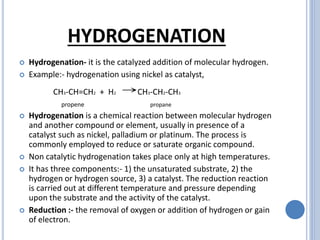
 Hydrogenation- it is the catalyzed addition of molecular hydrogen.
 Example:- hydrogenation using nickel as catalyst,
CH3-CH=CH2 + H2 →CH3-CH2-CH3
propene propane
 Hydrogenation is a chemical reaction between molecular hydrogen
and another compound or element, usually in presence of a
catalyst such as nickel, palladium or platinum. The process is
commonly employed to reduce or saturate organic compound.
 Non catalytic hydrogenation takes place only at high temperatures.
 It has three components:- 1) the unsaturated substrate, 2) the
hydrogen or hydrogen source, 3) a catalyst. The reduction reaction
is carried out at different temperature and pressure depending
upon the substrate and the activity of the catalyst.
 Reduction :- the removal of oxygen or addition of hydrogen or gain
of electron.
CATALYTIC HYDROGENATION
 Definition- The addition of hydrogen to unsaturated
system in the presence of catalyst or addition of
molecular hydrogen, as an reduction on metal.
 Almost all alkenes can be saturated in very high yield by
treatment with hydrogen and a metal catalyst.
WHAT IS THE NEED OF CATALYST?
 The reduction of alkenes with molecular hydrogen does
not occur at room temperature without a catalyst but
often takes place at room temperature if metal catalyst
is added.
 Also the catalyst is able to provide a new pathway for
the reaction with a lower free energy of activation.
CATALYST USED IN CATALYTIC
HYDROGENATION REACTION
 Palladium
 Adam’s catalyst
 Raney catalyst
 Copper chromite
 Rhodium
 Ruthenium
 Triethylamine
HETEROGENEOUS CATALYTIC HYDROGENATION
 Palladium- Active form of palladium is obtained from
palladium chloride. It is reduced in presence of charcoal
or any other solid support on which the metal is
deposited in a very finely divided state.
 Adam’s catalyst- Chloroplastinic acid is fused with
sodium nitrate to give a brown platinum oxide which can
be stored. When required it is treated with hydrogen to
give a very finely divided black suspension of the metal.
HOMOGENEOUS CATALYTIC
HYDROGENATION
There are several disadvantages of heterogeneous catalytic
hydrogenation:-
1. Lack of selectivity if more than one unsaturated center is
present.
2. Double bond migration may occur.
3. Several groups undergo an easy hydrogenolysis may occur.
 Many of these difficulties could be overcome by
homogenous catalytic hydrogenation in which the metal
gets replaced by a soluble complex of rhodium or
ruthenium and conduct the reduction in homogenous
solution.
 Many soluble catalyst have been used and the more
effective include the ones derived from rhodium and
ruthenium.
HOMOGENEOUS CATALYTIC
HYDROGENATION
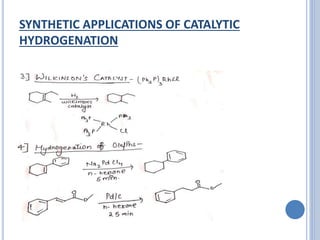
 The rhodium complex used is (Ph3P)3RhCl called as
Wilkinson’s catalyst [tris(triphenylphosphine)chlororhodium].
 Wilkinson’s catalyst has an advantage that where olefins and
acetylenes get reduced, other common group like C=O, C≡N,
NO2 remain unaffected. Thus selective reduction can be
carried out.
 Monsanto acetic acid process:- Monsanto developed the
rhodium catalyzed process for the carbonylation of methanol
to produce acetic acid.
 Wacker process:- this is one of the earliest industrial
processes developed in Germany for the conversion of
ethylene into acetaldehyde. Wacker process is more complex
than other catalytic processes.
 Hydroformylation:- The reaction of an alkene with carbon
monoxide and hydrogen, catalyzed by cobalt or rhodium salts
to form an aldehyde.
MECHANISM OF CATLYTIC
HYDROGENATION
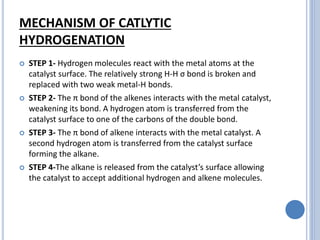
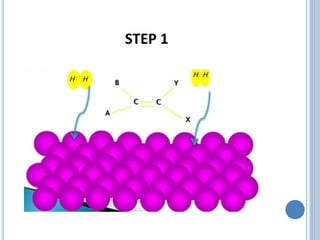
 STEP 1- Hydrogen molecules react with the metal atoms at the
catalyst surface. The relatively strong H-H σ bond is broken and
replaced with two weak metal-H bonds.
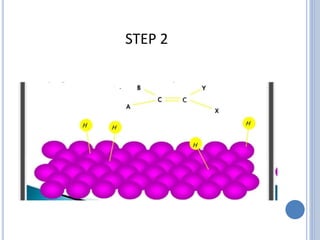
 STEP 2- The π bond of the alkenes interacts with the metal catalyst,
weakening its bond. A hydrogen atom is transferred from the
catalyst surface to one of the carbons of the double bond.
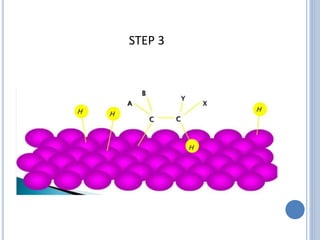
 STEP 3- The π bond of alkene interacts with the metal catalyst. A
second hydrogen atom is transferred from the catalyst surface
forming the alkane.
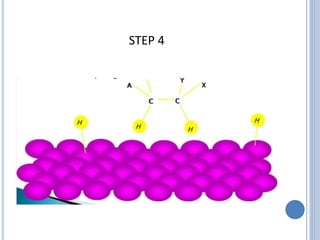
 STEP 4-The alkane is released from the catalyst’s surface allowing
the catalyst to accept additional hydrogen and alkene molecules.
STEP 1
STEP 2
STEP 3
STEP 4
CATALYTIC HYDROGENATION
Advantages :-
 Relatively high specificity.
 Relatively low reaction temperature.
 Generally far more selective for a single product.
 Far more active
Disadvantages :-
 Far more difficult to achieve product / catalyst
separation.
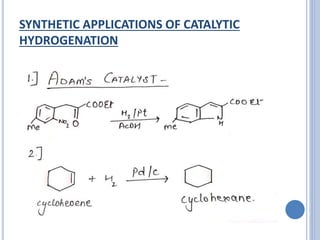
SYNTHETIC APPLICATIONS OF CATALYTIC
HYDROGENATION
SYNTHETIC APPLICATIONS OF CATALYTIC
HYDROGENATION
REFERENCES
 Chatwal G.R., “Reaction Mechanism and Reagents in Organic
Chemistry”,reprint-2003,Himalaya publishing house, page no. 1001-
1009.
 Kalsi P.S., “Organic Reaction and Their Mechanisms”, New age
publication, second addition, page no.- 453-462.
 https://www.slideshare.net/mobile/SonaliPimple1/hydrogenation-
reaction

Hydrogenation, catalytic hydrogenation

  • 1.
    HYDROGENATION BY- AISHWARYA RAJPUT M.PHARMA.(pharmaceutical chemistry) BANASTHALI VIDHYAPITH SUBMITTED TO- DR. SUMITRA NAIN
  • 2.
    HYDROGENTAION 1. Catalytic Hydrogenation 2.Homogenous and heterogeneous catalytic hydrogenation 3. Mechanism of catalytic hydrogenation 4. Advantage and disadvantages 5. Applications
  • 3.
    HYDROGENATION  Hydrogenation- itis the catalyzed addition of molecular hydrogen.  Example:- hydrogenation using nickel as catalyst, CH3-CH=CH2 + H2 →CH3-CH2-CH3 propene propane  Hydrogenation is a chemical reaction between molecular hydrogen and another compound or element, usually in presence of a catalyst such as nickel, palladium or platinum. The process is commonly employed to reduce or saturate organic compound.  Non catalytic hydrogenation takes place only at high temperatures.  It has three components:- 1) the unsaturated substrate, 2) the hydrogen or hydrogen source, 3) a catalyst. The reduction reaction is carried out at different temperature and pressure depending upon the substrate and the activity of the catalyst.  Reduction :- the removal of oxygen or addition of hydrogen or gain of electron.
  • 4.
    CATALYTIC HYDROGENATION  Definition-The addition of hydrogen to unsaturated system in the presence of catalyst or addition of molecular hydrogen, as an reduction on metal.  Almost all alkenes can be saturated in very high yield by treatment with hydrogen and a metal catalyst. WHAT IS THE NEED OF CATALYST?  The reduction of alkenes with molecular hydrogen does not occur at room temperature without a catalyst but often takes place at room temperature if metal catalyst is added.  Also the catalyst is able to provide a new pathway for the reaction with a lower free energy of activation.
  • 5.
    CATALYST USED INCATALYTIC HYDROGENATION REACTION  Palladium  Adam’s catalyst  Raney catalyst  Copper chromite  Rhodium  Ruthenium  Triethylamine
  • 6.
    HETEROGENEOUS CATALYTIC HYDROGENATION Palladium- Active form of palladium is obtained from palladium chloride. It is reduced in presence of charcoal or any other solid support on which the metal is deposited in a very finely divided state.  Adam’s catalyst- Chloroplastinic acid is fused with sodium nitrate to give a brown platinum oxide which can be stored. When required it is treated with hydrogen to give a very finely divided black suspension of the metal.
  • 7.
    HOMOGENEOUS CATALYTIC HYDROGENATION There areseveral disadvantages of heterogeneous catalytic hydrogenation:- 1. Lack of selectivity if more than one unsaturated center is present. 2. Double bond migration may occur. 3. Several groups undergo an easy hydrogenolysis may occur.  Many of these difficulties could be overcome by homogenous catalytic hydrogenation in which the metal gets replaced by a soluble complex of rhodium or ruthenium and conduct the reduction in homogenous solution.  Many soluble catalyst have been used and the more effective include the ones derived from rhodium and ruthenium.
  • 8.
    HOMOGENEOUS CATALYTIC HYDROGENATION  Therhodium complex used is (Ph3P)3RhCl called as Wilkinson’s catalyst [tris(triphenylphosphine)chlororhodium].  Wilkinson’s catalyst has an advantage that where olefins and acetylenes get reduced, other common group like C=O, C≡N, NO2 remain unaffected. Thus selective reduction can be carried out.  Monsanto acetic acid process:- Monsanto developed the rhodium catalyzed process for the carbonylation of methanol to produce acetic acid.  Wacker process:- this is one of the earliest industrial processes developed in Germany for the conversion of ethylene into acetaldehyde. Wacker process is more complex than other catalytic processes.  Hydroformylation:- The reaction of an alkene with carbon monoxide and hydrogen, catalyzed by cobalt or rhodium salts to form an aldehyde.
  • 9.
    MECHANISM OF CATLYTIC HYDROGENATION STEP 1- Hydrogen molecules react with the metal atoms at the catalyst surface. The relatively strong H-H σ bond is broken and replaced with two weak metal-H bonds.  STEP 2- The π bond of the alkenes interacts with the metal catalyst, weakening its bond. A hydrogen atom is transferred from the catalyst surface to one of the carbons of the double bond.  STEP 3- The π bond of alkene interacts with the metal catalyst. A second hydrogen atom is transferred from the catalyst surface forming the alkane.  STEP 4-The alkane is released from the catalyst’s surface allowing the catalyst to accept additional hydrogen and alkene molecules.
  • 10.
  • 11.
  • 12.
  • 13.
  • 14.
    CATALYTIC HYDROGENATION Advantages :- Relatively high specificity.  Relatively low reaction temperature.  Generally far more selective for a single product.  Far more active Disadvantages :-  Far more difficult to achieve product / catalyst separation.
  • 15.
    SYNTHETIC APPLICATIONS OFCATALYTIC HYDROGENATION
  • 16.
    SYNTHETIC APPLICATIONS OFCATALYTIC HYDROGENATION
  • 17.
    REFERENCES  Chatwal G.R.,“Reaction Mechanism and Reagents in Organic Chemistry”,reprint-2003,Himalaya publishing house, page no. 1001- 1009.  Kalsi P.S., “Organic Reaction and Their Mechanisms”, New age publication, second addition, page no.- 453-462.  https://www.slideshare.net/mobile/SonaliPimple1/hydrogenation- reaction