DISCOVER . LEARN . EMPOWER
Hop-field Network
UNIVERSITY INSTITUTE OF
SCIENCES
DIVISION: MATHEMATICS
Master of Science (Mathematics)
SOFT COMPUTING 20SDA-753
Prepared by: Er. Gagandeep(E9227)
Hopfield Network
• The Hopfield network is an implementation of a learning matrix with recurrent links. The
learning matrix is a weight matrix which actually stores associations between inputs and
targets.
• This network generalizes in the sense that it identifies general dependencies in the given
incomplete and noisy training data, in this sense it resembles a learning matrix.
• This kind of a network is a linear model as it can model only linearly separable data.
• The Hopfield Type Network is a multiple-loop feedback neural computation system.
• The neurons in this network are connected to all other neurons except to themselves
that is there are no self-feedbacks in the network.
Hopfield Network
• A connection between two neurons Ni and Nj is two way which is denoted by wij.
• The connection wij from the output of neuron i to the input of neuron j has the same
strength as the connection wji from the output of neuron j to the input of neuron i, in
other words the weight matrix is symmetric.
• Each neuron computes the summation:
si = ∑j=1
n wji x
where: n is the number of neurons in the network, wji are the weights, and xj are inputs,
1<=j<=n.
Hopfield Network: Architecture
• Following are some important points to keep in mind about discrete Hopfield
network −
• This model consists of neurons with one inverting and one non-inverting output.
• The output of each neuron should be the input of other neurons but not the input of self.
• Weight/connection strength is represented by wij.
• Connections can be excitatory as well as inhibitory. It would be excitatory, if the output of the
neuron is same as the input, otherwise inhibitory.
• Weights should be symmetrical, i.e. wij = wji
Hopfield Network: Architecture
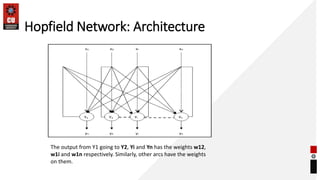
The output from Y1 going to Y2, Yi and Yn has the weights w12,
w1i and w1n respectively. Similarly, other arcs have the weights
on them.
Hopfield Network: Configuration
Hopfield networks can be implemented to operate in two modes:
• Synchronous mode of training Hopfield networks means that all neurons fire at
the same time.
• Asynchronous mode of training Hopfield networks means that the neurons fire at
random.
Hopfield Network: Stability Constraints
• The Hopfield networks are dynamical systems whose state changes with the time.
• The state of the neural network is the set of the outputs of all neurons at a particular moment,
time instant.
• When a neuron fires then its output changes and so the network state also changes. Therefore
the sequence of neuron firings leads to a corresponding sequence of modified neuron outputs,
and modified system states.
• Acquiring knowledge of the state space allows us to study the motion of the neural network in
time.
• The trajectories that the network leaves in the time may be taken to make a state portrait of the
system.
• A Hopfield net with n neurons has 2n possible states, assuming that each neuron output produces
two values 0 and 1.
• Performance analysis of the network behavior can be carried out by developing a state table that
lists all possible subsequent states.
THANK YOU
For queries
Email: gagandeep.e9227@cumail.in
8

PPT 3.1.3 Hop-field Network.pptx

  • 1.
    DISCOVER . LEARN. EMPOWER Hop-field Network UNIVERSITY INSTITUTE OF SCIENCES DIVISION: MATHEMATICS Master of Science (Mathematics) SOFT COMPUTING 20SDA-753 Prepared by: Er. Gagandeep(E9227)
  • 2.
    Hopfield Network • TheHopfield network is an implementation of a learning matrix with recurrent links. The learning matrix is a weight matrix which actually stores associations between inputs and targets. • This network generalizes in the sense that it identifies general dependencies in the given incomplete and noisy training data, in this sense it resembles a learning matrix. • This kind of a network is a linear model as it can model only linearly separable data. • The Hopfield Type Network is a multiple-loop feedback neural computation system. • The neurons in this network are connected to all other neurons except to themselves that is there are no self-feedbacks in the network.
  • 3.
    Hopfield Network • Aconnection between two neurons Ni and Nj is two way which is denoted by wij. • The connection wij from the output of neuron i to the input of neuron j has the same strength as the connection wji from the output of neuron j to the input of neuron i, in other words the weight matrix is symmetric. • Each neuron computes the summation: si = ∑j=1 n wji x where: n is the number of neurons in the network, wji are the weights, and xj are inputs, 1<=j<=n.
  • 4.
    Hopfield Network: Architecture •Following are some important points to keep in mind about discrete Hopfield network − • This model consists of neurons with one inverting and one non-inverting output. • The output of each neuron should be the input of other neurons but not the input of self. • Weight/connection strength is represented by wij. • Connections can be excitatory as well as inhibitory. It would be excitatory, if the output of the neuron is same as the input, otherwise inhibitory. • Weights should be symmetrical, i.e. wij = wji
  • 5.
    Hopfield Network: Architecture Theoutput from Y1 going to Y2, Yi and Yn has the weights w12, w1i and w1n respectively. Similarly, other arcs have the weights on them.
  • 6.
    Hopfield Network: Configuration Hopfieldnetworks can be implemented to operate in two modes: • Synchronous mode of training Hopfield networks means that all neurons fire at the same time. • Asynchronous mode of training Hopfield networks means that the neurons fire at random.
  • 7.
    Hopfield Network: StabilityConstraints • The Hopfield networks are dynamical systems whose state changes with the time. • The state of the neural network is the set of the outputs of all neurons at a particular moment, time instant. • When a neuron fires then its output changes and so the network state also changes. Therefore the sequence of neuron firings leads to a corresponding sequence of modified neuron outputs, and modified system states. • Acquiring knowledge of the state space allows us to study the motion of the neural network in time. • The trajectories that the network leaves in the time may be taken to make a state portrait of the system. • A Hopfield net with n neurons has 2n possible states, assuming that each neuron output produces two values 0 and 1. • Performance analysis of the network behavior can be carried out by developing a state table that lists all possible subsequent states.
  • 8.
    THANK YOU For queries Email:gagandeep.e9227@cumail.in 8