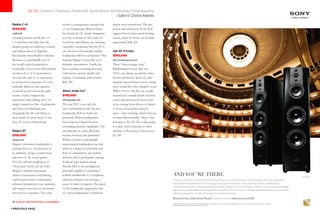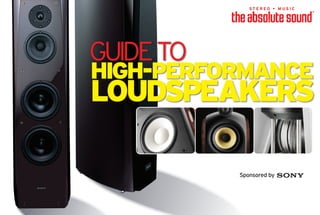
Sponsored by
S T E R E O • M U S I C
HIGH-PERFORMANCE
LOUDSPEAKERS
GUIDEto
Sponsored by
2 Guide to High-Performance Loudspeakers www.theabsolutesound.com
previous page NEXT page
Contents
Click on one of the links above to jump to that section, feature or review.
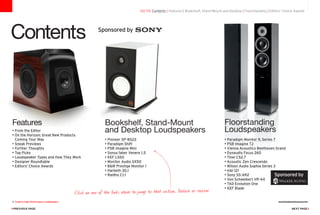
• From the Editor
• On the Horizon: Great New Products
Coming Your Way
• Sneak Previews
• Further Thoughts
• Top Picks
• Loudspeaker Types and How They Work
• Designer Roundtable
• Editors' Choice Awards
Features Floorstanding
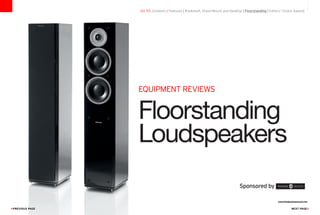
Loudspeakers
• Paradigm Monitor 9, Series 7
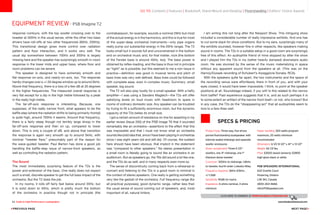
• PSB Imagine T2
• Vienna Acoustics Beethoven Grand
• Dynaudio Focus 260	
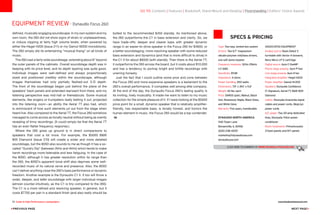
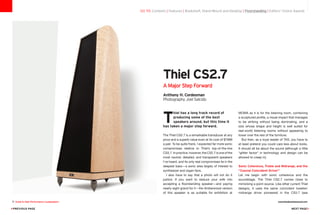
• Thiel CS2.7
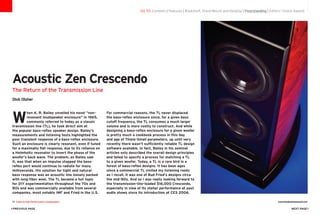
• Acoustic Zen Crescendo
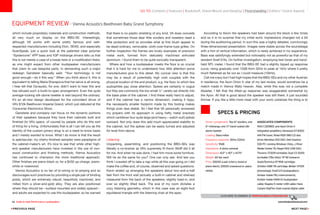
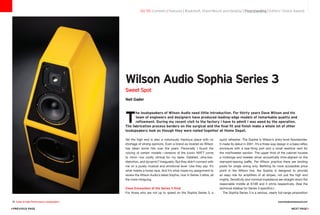
• Wilson Audio Sophia Series 3
• mbl 121
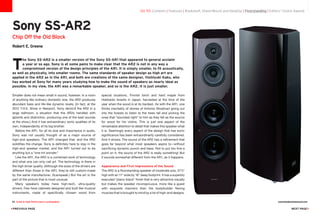
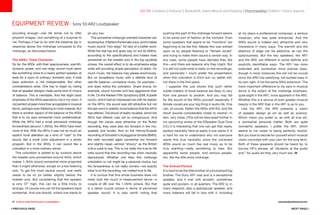
• Sony SS-AR2
• Von Schweikert VR-44
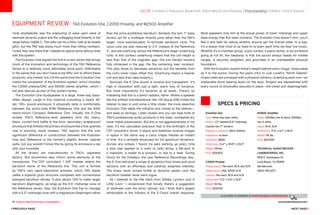
• TAD Evolution One
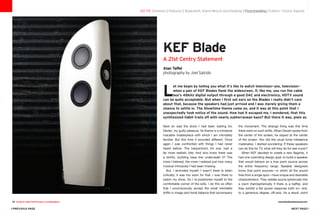
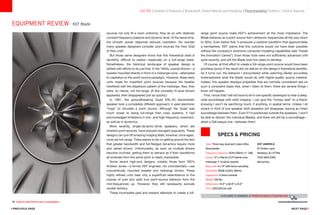
• KEF Blade
go to: Contents | Features | Bookshelf, Stand-Mount and Desktop | Floorstanding | Editors' Choice Awards
Bookshelf, Stand-Mount
and Desktop Loudspeakers
• Pioneer SP-BS22
• Paradigm Shift
• PSB Imagine Mini
• Sonus faber Venere 1.5
• KEF LS50
• Monitor Audio GX50
• BW Prestige Monitor 1
• Harbeth 30.1
• Raidho C1.1 Sponsored by
Sponsored by
3 Guide to High-Performance Loudspeakers www.theabsolutesound.com
previous page NEXT page
HIGH-PERFORMANCE
LOUDSPEAKERS
GUIDEto
go to: Contents | Features | Bookshelf, Stand-Mount and Desktop | Floorstanding | Editors' Choice Awards
publisher. . . . . . . . . . . . . . . . Jim Hannon
editor-in-chief. . . . . . . . . . . . Robert Harley
executive editor. . . . . . . . . . Jonathan Valin
acquisitions manager
and associate editor. . . . . . Neil Gader
music editor. . . . . . . . . . . . . Mark Lehman
creative director. . . . . . . . . Torquil Dewar
art director. . . . . . . . . . . . . . Shelley Lai
senior writers. . . . . . . . . . . . Anthony H. Cordesman
Wayne Garcia
Robert E. Greene
Jim Hannon
Chris Martens
Tom Martin
Dick Olsher
Andrew Quint
Paul Seydor
Steven Stone
Alan Taffel
reviewers 
contributing writers. . . . . . Duck Baker, Peter
Breuninger, Greg
Cahill, Stephen Estep,
Jacob Heilbrunn,
Sherri Lehman,
Ted Libbey, David
McGee, Kirk Midtskog,
Bill Milkowski, Derk
Richardson, Jeff Wilson	
nextscreen, LLC
chairman and ceo . . . . . . . . Tom Martin
vp/group publisher. . . . . . . Jim Hannon
advertising reps . . . . . . . . . Cheryl Smith
(512) 891-7775
Marvin Lewis
MTM Sales
(718) 225-8803
To sign up for Buyer’s Guides
alerts, click here
Address letters to the Editor:
The Absolute Sound,
8868 Research Blvd., Austin, TX 78758 or
rharley@nextscreen.com
©2013 NextScreen, LLC
S T E R E O • M U S I C
Sponsored by
4 Guide to High-Performance Loudspeakers www.theabsolutesound.com
previous page NEXT page
In addition to On The Horizon, our traditional report on newly introduced products, we’ve added some
special new features. Sneak Previews gives you an advance look at products under review before that
review appears in The Absolute Sound. The new Further Thoughts section provides you with additional
commentary on a product that has previously been reviewed. The reviewer might have additional insight
into the product, and can also tell you what it’s like to live long-term with the loudspeaker. Another new
feature is Our Top Picks. Four of our editors and reviewers each name the speaker that they would buy
for themselves at $1500, $5000, $10,000 to $15,000, and $25,000. Recommendations don’t come much
higher than that.
We’ve also included a fascinating look into the minds of the world’s foremost loudspeaker designers
in the Designer Roundtable: The Art of the Small Speaker. What goes into making a musically satisfying
sound from a small enclosure? These experts share their secrets. Finally, for the technically minded we
bring you “Loudspeaker Types and How They Work,” a crash course in speaker technology excerpted
from my book The Complete Guide to High-End Audio (fourth edition).
The product reviews in this Buyer’s Guide are notable for the sheer number of amazing values available
today at every price level. Can a $129-per-pair speaker be considered “high-end?” If that speaker is
designed by Andrew Jones, author of the magnificent $70,000 TAD Reference One it can. When Jones
Click here to turn the page.
Welcome to the 2013 edition of our Buyer’s Guide to High-Performance Loudspeakers,
brought to you by The Absolute Sound. Inside you’ll find reviews of 21 great
loudspeakers, priced to fit any budget. The reviews have been selected from the
pages of The Absolute Sound, but all are new for this Buyer’s Guide.
turned his attention to creating a $129 speaker for Pioneer (TAD’s parent
company), the results defied expectations in this price category. You’ll also find
Andrew’s work represented in this issue with Neil Gader’s review of the $29,800
TAD Evolution One. These two products prove the point that high-end audio isn’t
about price, but about the attitude and skill of the product’s designer. High-end
products are built by skilled enthusiasts to deliver real musical performance, not
as commodities to be sold in the greatest number.
Every time I attend a hi-fi show I’m amazed to discover a new small affordable
loudspeaker that delivers performance far above what its price and size would
suggest. The PSB Imagine Mini ($799), Sonus faber Venere 1.5 ($1198), and the
KEF LS50 ($1499) have all impressed me greatly at shows, and have pushed the
price-to-performance ratio on the category. You’ll find full reviews of these three
remarkable speakers in this Buyer’s Guide.
No matter what your budget or listening tastes, you’re sure to find a great
loudspeaker among those featured here. Remember that a review is just a
starting point for your own auditioning. Use the reviews and recommendations
in this Buyer’s Guide to create a short list of speakers you should audition
yourself. Choose wisely and you’ll enjoy your favorite music brought to life as
never before.
—Robert Harley
go to: Contents | Features | Bookshelf, Stand-Mount and Desktop | Floorstanding | Editors' Choice Awards
FROM THE Editor
GoldenEar Triton Seven
The GoldenEar Triton Seven brings award-
winning Triton Series performance to a
more compact size and more affordable
price range. It represents the first
Triton Tower without a built-in powered
subwoofer, yet it achieves subwoofer-like
bass performance by combining advanced-
technology drivers with GoldenEar’s
sophisticated bass-loading technologies.
Like the Triton Two, the Seven combines a
D’Appolito array of 5.25 mid/bass drivers,
a High Velocity Folded Ribbon Driver
(HVFR™), used in both the Triton Two and
Three, plus a pair of side-mounted sub-
bass radiators that are located on either
side of the cabinet down near the floor for
optimum coupling to the room. The Seven’s
crossover and unique cabinet shape not
only aligns the driver array for a coherent
wave-launch directed at the listening
position, but also results in better control of
internal standing waves. Sensitivity is rated
at 89dB; nominal impedance is 8 ohms.
Price: $1400. www.goldenear.com
Hot New Loudspeakers
Coming Your Way
Neil Gader
ON THE HORIZON
NEXT page
go to: Contents | Features | Bookshelf, Stand-Mount and Desktop | Floorstanding
| Editors' Choice Awards
SS-NA2ES
©2013 Sony Electronics Inc. Sony and the Sony make.believe logo are trademarks of Sony. All rights reserved. Reproduction in whole or in part without written permission is prohibited.
All other trademarks are trademarks of their respective owners.
and you’re there
Close your eyes and you’re there. Building on our award-winning AR series, Sony ES speakers
recreate the experience of hearing music performed in a live venue. Hand-crafted from 
Scandinavian birch selected for its acoustic resonance, the single cabinet, two-enclosure design
gives you unparalleled low-frequency isolation. The I-Array™ tweeter system delivers a true-to-life
listening experience. And the result is beyond words. 
Because You Care About Music™ Learn more at www.sony.com/ES
www.theabsolutesound.com
previous page
5 Guide to HIgh-Performance Loudspeakers
6 Guide to High-Performance Loudspeakers www.theabsolutesound.com
previous page NEXT page
ON THE HORIZON
Revel Performa3 F206
The Performa3 F206 is the mid-size floorstander in Revel’s latest and curvaceous, nine-speaker
multichannel lineup. Completely redesigned top to bottom, a key innovation is the aluminum tweeter
in a sophisticated acoustic lens waveguide. The acoustic lens waveguide is based on a breakthrough
mathematical approach that accurately matches the tweeter’s dispersion to that of the midrange
transducer in the crossover region. This gives the 41.4-tall loudspeaker very smooth sound far off-axis—
important to overall sound quality. The tweeter is joined by a 5.25 midrange and dual 6.5 woofers which
all sport ribbed aluminum cone diaphragms and cast aluminum frames designed to quell resonances. The
three-way, four-transducer speaker is capable of potent bass extension—down only 3dB at 42Hz and a
mere -6dB at 36Hz. It’s relatively easy to drive too with a sensitivity of 88dB and nominal impedance of 8
ohms. It’s also available in a two-way stand-mount, compact version, the M206.
Price: F206, $3500; M206, $2000. www.revelspeakers.com
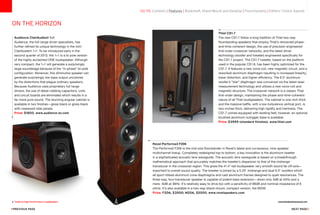
Thiel CS1.7
The new CS1.7 follow a long tradition of Thiel two-way
floorstanding speakers that employ Thiel’s renowned phase-
and-time-coherent design, the use of precision engineered
first-order crossover networks, and the latest driver
technology (woofer and tweeter) engineered specifically for
the CS1.7 project. The CS1.7 tweeter, based on the platform
used in the popular CS1.6, has been highly optimized for the
CS1.7. It features a new voice coil, new magnetic circuit, and a
reworked aluminum diaphragm resulting in increased linearity,
lower distortion, and higher efficiency. The 6.5 aluminum
woofer’s “star” diaphragm was conceived via the latest laser
measurement technology and utilizes a new voice coil and
magnetic structure. The crossover network is a classic Thiel
first-order design, maintaining the phase-and-time-coherent
nature of all Thiel loudspeakers. The cabinet is one-inch thick
and the massive baffle, with a low-turbulence vertical port, is
two-inches thick, delivering high rigidity and inertness. The
CS1.7 comes equipped with leveling feet; however, an optional
brushed aluminum outrigger base is available.
Price: $3999 (standard finishes). www.thiel.com
Audience ClairAudient 1+1
Audience, the full-range driver specialists, has
further refined its unique technology in the mini
ClairAudient 1+1. To be introduced early in the
second quarter of 2013, the 1+1 is a bi-pole version
of the highly acclaimed ONE loudspeaker. Although
very compact, the 1+1 will generate a surprisingly
large soundstage because of the “in-phase” bi-pole
configuration. Moreover, this diminutive speaker can
generate surprisingly low bass output uncolored
by the distortions that plague ordinary speakers.
Because Audience uses proprietary full range
drivers, the use of detail-robbing capacitors, coils
and circuit boards are eliminated which results in a
far more pure sound. The stunning angular cabinet is
available in two finishes—gloss black or gloss black
with rosewood side panels.
Price: $1800. www.audience-av.com
go to: Contents | Features | Bookshelf, Stand-Mount and Desktop | Floorstanding | Editors' Choice Awards
7 Guide to High-Performance Loudspeakers www.theabsolutesound.com
previous page NEXT page
Morel Octave 6
The Octave 6 is inspired by Morel’s reference speaker, The
Fat Lady. Like that innovative cabinet concept, the Octave 6
is devoid of internal damping. A new internal vertical baffle
with acoustic apertures is positioned in the middle to break
up standing waves, resulting in a speaker that sounds as
if there is no cabinet at all. At the heart of the Octave 6
are specially engineered drivers, based on Morel’s most
advanced technology. The new mid/bass unit employs
an oversized 3 aluminum voice coil over a titanium base
encapsulating a powerful hybrid motor, while the tweeter
features Morel’s renowned 1.1 Acuflex soft dome. The
innovative crossover topology preserves the life and
dynamics of the original sound, like in a live performance.
Available as a two-way compact or three-way floorstander
it can be finished in either piano white or a piano black.
Price: Octave 6 compact, $3500; Octave 6 floorstander,
$6500. www.morel.co.il
ON THE HORIZON
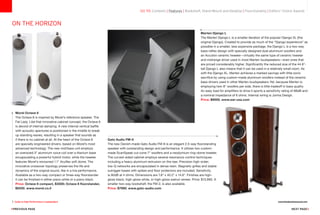
Marten Django L
The Marten Django L is a smaller iteration of the popular Django XL (the
original Django). Created to provide as much of the “Django experience” as
possible in a smaller, less expensive package, the Django L is a two-way
bass-reflex design with specially designed dual aluminum woofers and
an Accuton ceramic tweeter—virtually the same type of ceramic tweeter
and midrange driver used in most Marten loudspeakers—even ones that
are priced considerably higher. Significantly the reduced size of the 44.9-
tall Django L also means that it can be used in a relatively small room. As
with the Django XL, Marten achieves a marked savings with little sonic
sacrifice by using custom-made aluminum woofers instead of the ceramic
bass drivers used in other Marten loudspeakers Yet, because Marten is
employing twin 8 woofers per side, there is little tradeoff in bass quality
An easy load for amplifiers to drive it sports a sensitivity rating of 88dB and
a nominal impedance of 6 ohms. Internal wiring is Jorma Design.
Price: $9000. www.ear-usa.com
Gato Audio FM-6
The new Danish-made Gato Audio FM-6 is an elegant 2.5-way floorstanding
speaker with outstanding design and performance. It utilizes two custom-
made ScanSpeak cut-cone 7 woofers and a neodymium ring-dome tweeter.
The curved-sided cabinet employs several resonance-control techniques
including a heavy aluminum extrusion on the rear. Precision high-order,
low-Q networks are encapsulated in dense resin. Magnetic grilles and stable
outrigger bases with spikes and floor protectors are included. Sensitivity
is 90dB at 4 ohms. Dimensions are 7.8 x 40.2 x 14.6. Finishes are high-
gloss black, high-gloss white, or high-gloss walnut veneer. Price: $13,990. A
smaller two-way bookshelf, the FM-2, is also available.
Price: $7990. www.gato-audio.com
go to: Contents | Features | Bookshelf, Stand-Mount and Desktop | Floorstanding | Editors' Choice Awards
8 Guide to High-Performance Loudspeakers www.theabsolutesound.com
previous page NEXT page
ON THE HORIZON
Magico S1
As a relative newcomer to the high end Magico continues to astound
with the breadth and creativity of its offerings. Now comes the S1.
The floorstander is a two-way acoustic-suspension design that
continues the legacy of the famed Mini but at a much lower cost.
The uniquely contoured cabinet utilizes the world’s first monocoque
extruded aluminum enclosure that minimizes diffraction effects,
internal resonance, and damping requirements. At only 9 deep (46
tall) it accommodates any listening environment making it the most
versatile Magico product to date. The driver complement includes the
same beryllium tweeter found in the S5 plus an entirely new 7 Magico
Nano-Tec mid/bass transducer. That driver utilizes a dual-neodymium
underhung motor system with a pure titanium voice-coil former that
makes it powerful and efficient and low in distortion. Sensitivity is 86dB;
nominal impedance is 4 ohms.
Price: $12,600 www.magico.net
go to: Contents | Features | Bookshelf, Stand-Mount and Desktop | Floorstanding | Editors' Choice Awards
Vienna Acoustics Beethoven Imperial Grand
The new Beethoven Imperial Grand from Vienna Acoustic is
based on its flagship loudspeaker, The Music. VA’s goal was
to incorporate the sonic values of The Music into a smaller
and less expensive product while retaining the aesthetic
of VA’s vaunted Concert Grand Series. The narrow baffle
enclosure is a sophisticated construction with a sealed
upper enclosure, dual porting, and individual tuning, both
electrically and acoustically for the three Spider-Cone
woofer drivers. The four-way, Imperial Grand features a five-
driver array that includes the new 6 version of VA’s patented
Flat-Spider-Cone Coincident Driver system. Like The Music,
it’s mounted in a sealed enclosure and covers the human
vocal range and above (roughly 150Hz to 20kHz) as a true
point source. Above this “music center” is an all new in-
house designed (built by ScanSpeak) super-tweeter that
fills in the upper harmonic range beyond 17kHz.The bottom
end is handled by three patented 6 Spider Cone woofers
mounted in two individually tuned cabinets.
Price: $10,000. www.vanaltd.com
Sony SS-NA2ES
The Elevated Standard loudspeaker from Sony is back! Designed and created in the
spirit of the highly acclaimed AR Reference loudspeakers, the new Sony SS-NA2ES
captures the essence of a live music performance.  The 35.4 tall floorstander is a
fully isolated six driver, three-way bass reflex system that features Sony’s exclusive
I-ArrayTM tweeter (a vertical array featuring a 25mm tweeter flanked by two 19mm
tweeters) that reproduces music without coloration. A 5.25 midrange and dual
6.5** aluminum diaphragm woofers fill in the balance of the frequency spectrum.
The enclosure is crafted from Scandinavian birch specifically selected for its
acoustic properties. The NA2ES is also a part of a full line of ES Series models
that are ideal for high resolution music and advanced home-theater applications.
Sensitivity is rated at 90dB, nominal impedance is 4 ohms.
Price: $10,000. www.discover.store.sony.com/ES
9 Guide to High-Performance Loudspeakers www.theabsolutesound.com
previous page NEXT page
ON THE HORIZON
Dynaudio Evidence Platinum
The Evidence Platinum was first shown as a
concept study at the High End 2012 in Munich.
Enthusiastically received, Dynaudio turned concept
into reality. The eight-driver 76.4-tall Evidence
Platinum improves upon the original series by
combining Dynaudio’s Directivity Control technology
(DDC) with its latest drive units and advanced
crossover components. DDC consists of a finely-
tuned balance of symmetrically arrayed, precisely
positioned dual woofers, midrange drivers, and
tweeters, and an advanced crossover design to
reduce sound reflections from the floor and ceiling
of any room, and all without altering the music
signal—no electronic room-correction devices or
visually distracting room acoustic treatments. The
cabinet is divided into three sections; in addition,
a reinforced base plinth with improved plinth feet
has been incorporated into the loudspeaker. Newly
developed drivers, including a pair of Dynaudio’s
renowned Esotar tweeters, are mounted in a solid,
pure-aluminum front baffle aiding the implementation
of the DDC technology. Sensitivity is 89dB while
nominal impedance is 4 ohms. Weight: 253 lbs each.
Price: $85,000. www.dynaudio.com
go to: Contents | Features | Bookshelf, Stand-Mount and Desktop | Floorstanding | Editors' Choice Awards
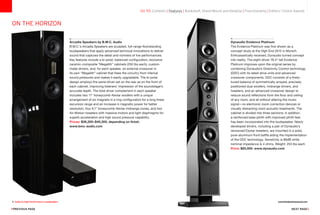
Arcadia Speakers by B.M.C. Audio
B.M.C.’s Arcadia Speakers are sculpted, full-range floorstanding
loudspeakers that apply advanced technical innovations to deliver
sound that captures the detail and richness of live performances.
Key features include a bi-polar, balanced configuration, exclusive
ceramic-composite “Megalith” cabinets (250 lbs each), custom-
made drivers, and, for each speaker, an external crossover in
its own “Megalith” cabinet that frees the circuitry from internal
sound pressures and makes it easily upgradable. The bi-polar
design employs the same driver set on the rear as on the front of
each cabinet, improving listeners’ impression of the soundstage’s
accurate depth. The total driver complement in each speaker
includes two 11 honeycomb-Kevlar woofers with a unique
arrangement of six magnets in a ring configuration for a long linear
excursion range and an increase in magnetic power for better
resolution, four 6.1 honeycomb-Kevlar midrange cones, and two
Air-Motion tweeters with massive motors and light diaphragms for
superb acceleration and high sound pressure capability.
Prices: $36,300–$40,300, depending on finish.
www.bmc-audio.com
10 Guide to High-Performance Loudspeakers
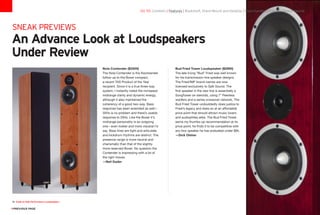
Nola Contender ($3500)
The Nola Contender is the floorstander
follow-up to the Boxer compact,
a recent TAS Product of the Year
recipient. Since it is a true three-way
system, I instantly noted the increased
midrange clarity and dynamic energy,
although it also maintained the
coherency of a good two-way. Bass
response has been extended as well—
35Hz is no problem and there’s usable
response to 25Hz. Like the Boxer it’s
midrange personality is an outgoing
one—even livelier and more visceral I’d
say. Bass lines are tight and articulate
and kickdrum rhythms are distinct. The
presence range is more neutral and
charismatic than that of the slightly
more reserved Boxer. No question the
Contender is impressing with a lot of
the right moves.
—Neil Gader
An Advance Look at Loudspeakers
Under Review
SNEAK PREVIEWS
previous page
Bud Fried Tower Loudspeaker ($2995)
The late Irving “Bud” Fried was well known
for his transmission-line speaker designs.
The Fried/IMF brand-names are now
licensed exclusively to Salk Sound. The
first speaker in the new line is essentially a
SongTower on steroids, using 7” Peerless
woofers and a series crossover network. The
Bud Fried Tower undoubtedly does justice to
Fried’s legacy and does so at an affordable
price point that should attract music lovers
and audiophiles alike. The Bud Fried Tower
earns my thumbs-up recommendation at its
price point; he finds it to be competitive with
any box speaker he has evaluated under $6k.
—Dick Olsher
go to: Contents | Features | Bookshelf, Stand-Mount and Desktop | Floorstanding | Editors' Choice Awards
11 Guide to High-Performance Loudspeakers www.theabsolutesound.com
NEXT page
YG Acoustics Kipod II Signature
($38,800)
YG’s new passive version of its
well-known, partially-active Kipod
II Signature replaces the bass
driver’s 400W amplifier with a
passive crossover. By foregoing
the adjustable bass amp, the
Passive yields slightly better
transparency and immediacy than
the partially-active version. On
its own terms, the Passive is a
neutral, tremendously revealing,
and eminently musical speaker. It
has remarkably deep-reaching, taut
bass and robust dynamic presence
for its size. A fairly stout amplifier
is required to tap its considerable
strengths. Properly powered and
set up, the Kipod II Signature
Passive makes stunning, full-range
performance possible in small to
medium rooms.
—Kirk Midtskog
SNEAK PREVIEWS
go to: Contents | Features | Bookshelf, Stand-Mount and Desktop | Floorstanding | Editors' Choice Awards
previous page
Raidho C 4.1 ($140,000)
Michael Børresen, chief engineer of Denmark’s Raidho
Acoustics, takes an unusually civilized approach to
designing loudspeakers. A world-class mechanical
engineer of astonishing versatility (among many other
things, he has developed running shoes for Olympic
contenders and bicycles for competitors in the Tour de
France), Børresen considers the human factor first. Thus
Raidho’s speakers are not just about acoustics; they are
equally about psychoacoustics—about the way human
beings actually hear and think about what they hear when
they listen to music. The results are transducers capable of
sounding uncannily like the real thing without sounding in
the least bit “hi-fi.”
Raidho’s flagship loudspeaker—the tall, spectacularly
graceful $140k C 4.1—is the epitome of Børresen’s
aesthetic. Like Raidho’s widely acclaimed two-way stand-
mount C 1.1 it is capable of sounding both ravishingly
beautiful and uncannily lifelike at once, but with seven
(Raidho-engineered-and-made) ceramic and ribbon drivers
in a D’Appolito array housed in a much larger enclosure
than the C 1.1, it has substantially deeper and more
powerful bass and considerably wider dynamic range than
the somewhat bandwidth-limited mini. Essentially a giant
nearfield monitor, the C 4.1 will appeal to music lovers,
accuracy fans, and absolute sound listeners in near-equal
measure, making it a state-of-the-art contender for those
shopping in the topmost reaches of the high end.
—Jonathan Valin
12 Guide to High-Performance Loudspeakers www.theabsolutesound.com
NEXT page
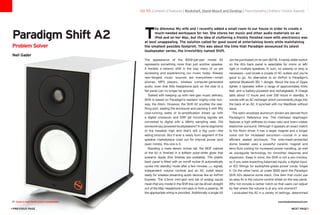
Paradigm Shift A2 ($279-$329)
Although I finished the review of the
nifty Shift A2 some months ago I’ve had
a chance to revisit it thanks to a relative
who bought a pair based in part on my
review. This family is heavy into computers
and loves wireless—their home is fully
networked. The missing variable was a
satisfying, go-anywhere, small speaker.
Enter the Shift A2— powered, versatile,
reasonably priced, and easy to setup. And
cool-looking, too. With an Airport Express
plugged into each speaker the Shift A2 fills
a high ceilinged living room with streaming
music. Each time I visit I especially
appreciate the solid low-end oomph and
rich vocal midrange.
—Neil Gader
A second look at previously
reviewed products.
Further Thoughts
go to: Contents | Features | Bookshelf, Stand-Mount and Desktop | Floorstanding | Editors' Choice Awards
previous page
Dynaudio Focus 260 ($4900)
Since reviewing Dynaudio’s small,
2.5-way floorstander in Issue 224,
I’ve found that it is one of those good
all-rounders with an artful balance
of qualities that, at sufficient levels,
makes it an easy speaker to like. This
loudspeaker has very good bass
clarity and extension for its price and
size, a lively an engaging midrange,
and a fairly detailed top end. The
Focus 260 also can be successfully
driven by medium-powered
amplifiers (including tubed ones), is
relatively easy to place in a room,
and has nice, understated looks.
While not necessarily exceptional in
every way, its appeal follows from its
well balanced, musical performance.
—Kirk Midtskog
13 Guide to High-Performance Loudspeakers www.theabsolutesound.com
NEXT page
Acoustic Zen Crescendo ($16,500)
There is something fundamentally right about the Crescendo, a three-
way, 5-driver transmission-line design. It speaks with one voice, a
rarity for any multi-driver system, and obviously the consequence of
superb driver integration. The transition from the bass to the midrange
is seamless. It maintains a realistic tonal weight while doing justice to
the power range of an orchestra. After reviewing the Crescendo in Issue
229, this loudspeaker continues to re-calibrate my expectations in the
bass range. Tympanic strikes are peerless in control and definition. While
the Crescendo lacks ultimate bass extension, it makes up for that by
superlative time-domain performance.
—Dick Olsher
previous page
Raidho C 1.1 ($18,000)
Alongside the $26k Magico Q 1, the $18k
Raidho C 1.1 is the finest two-way mini-monitor
I have heard. However, the two speakers do not
sound at all alike. The Magico sounds, well, like
a Magico—which is to say, that it is rigorously
neutral, leaning neither to the dark nor the light
side in balance, remarkably seamless in blend (in fact, the
best combination of a beryllium tweeter and carbon-sandwich
driver in the Magico line), and paradigmatically transparent to
sources ahead of it. The Raidho, on the other hand, is darker
and considerably richer in balance; though very well blended
its ribbon tweeter is not quite as much of a piece with its
ceramic mid/woof (you can hear a very slight discontinuity
between the two drivers, probably because of a difference in
dispersion patterns); and while transparent enough to reveal
tiny differences in musicianship, recording, and mastering, it
has more “personality” of its own than the Magico. And yet…
the Raidho is every bit as lifelike as the Magico (on great
recordings), if not more so. Indeed, outside the $140k Raidho
C 4.1, I haven’t heard a cone or cone-hybrid speaker that is
more jaw-droppingly realistic than this mini from Denmark.
That the Raidho C 1.1 is capable of sounding so much like the
real thing in spite of its deviations from “textbook” neutrality
raises a rather disturbing question—at least for a transparency-
to-sources kind of listener like me. How is it that, in spite of
my biases and convictions, I prefer a less (albeit only slightly
less) accurate loudspeaker to a more accurate one? I will
address this question when I review the C 4.1. In the nonce,
my enthusiasm for the C 1.1 has done anything but flag in the
year I’ve been listening to it. As I said in TAS, this is a truly great
loudspeaker, capable (with the right sources and ancillaries)
of nearly unparalleled realism—and (regardless of source)
consistently enjoyable to listen to.
—Jonathan Valin
Further Thoughts
go to: Contents | Features | Bookshelf, Stand-Mount and Desktop | Floorstanding | Editors' Choice Awards
14 Guide to High-Performance Loudspeakers
Von Schweikert Audio VR-44
($24,000)
Since I purchased the review pair
of Von Schweikert Audio VR-44
Aktive speakers ($25,000 MSRP),
I’ve come to admire them even more.
Though I wrote that break-in was in
excess of 300 hours, the speakers
kept improving up to about 1000
hours. They continued to open up,
get speedier with more sparkle, and
produce wondrously saturated yet
natural tone colors on instruments
ranging from orchestral strings to
jazz saxophones and vibes. And the
human voice—oh my god! Jazz and
operatic singers can sound like they’re
in the room, the speakers nimbly
rendering every nuance. They're now
showing delicacy and power to an
even higher degree than in the review
period. The VR-44s have brought me
so much closer to the music, and my
system has never sounded better—
more detailed, speedier, punchier,
airier, and more accomplished in
all the audiophile values, while still
remaining musical and coherent. —
Garrett Hongo
previous page
Further Thoughts
The Crescendo is eminently musical and
supremely well integrated from top to bottom.
It certainly pushed all my emotional buttons
and is currently my favorite box speaker
under $30k.
Make no mistake about it: The Crescendo is a
fantastic value at its asking price.
An enthusiastic five-star recommendation!
Dick Olsher, The Absolute Sound, Jan 2013
I do not want to proceed further without these
speakers.
And so stay they will, exactly where they now
reside: at the heart of my listening and
mastering universe… a place where simple
pleasure often is second to the hard work of
evaluating gear, including scrupulous
assessment of my own recordings.
I do not want to live without the Crescendos
and so I won't.
Jim Merod, Positive Feedback, Issue 46
Acoustic Zen
It’s time to... Crescendo
1-858-487-1988
www.acousticzen.com
Best Sound (Cost No Object) - CES Show
Dick Olsher, The Absolute Sound, Jan 2013
go to: Contents | Features | Bookshelf, Stand-Mount and Desktop | Floorstanding
| Editors' Choice Awards
Robert Harley
Under $1500
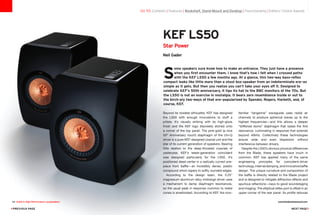
KEF LS50
$1499
Created to celebrate KEF’s 50th anniversary, the
LS50 packs a huge sound into a small enclosure.
The diminutive cube with the rounded edges
houses KEF’s famous Uni-Q coincident driver
for precise coherence at any listening height or
listening distance. As you might expect from
the design, the LS50 images like a champ,
completely disappearing into a huge soundstage.
But the LS50 also delivers deeper bass and wider
dynamics than its size would indicate. The tonal
balance is clean and pure, with an open and
extended treble. An amazing achievement.
Under $5000
PSB Imagine T2
$3500
No one designs better-sounding inexpensive
speakers than Paul Barton. A hallmark of his
creations is a smooth and uncolored tonal
balance that many expensive and esoteric
designs don’t match. One of the results of such
an accurate frequency response is the impression
that the sound exists in space independently of
the speakers. The T2, winner of our Product of the
Year Award in 2012 (Mid-Priced Loudspeakers)
combines these attributes with surprisingly deep
and powerful bass, the ability to play loudly
without strain, and spectacular soundstaging. The
PSB T2 is a stunning bargain.
Under $10,000
Magnepan MG3.7
$5495
No other loudspeaker anywhere under $10k
approaches the MG3.7’s resolution, transparency,
detail, soundstaging, coherence, and sheer ability
to disappear as a sound source. That said, the
MG3.7 isn’t for everyone. It’s a big panel that
must be positioned well out into the room. You’ll
also need a high-powered amplifier with plenty
of heft. But if you can accommodate these two
requirements, there isn’t a more realistic-sounding
speaker for the price than the Magnepan MG3.7.
Under $15,000
BW 802 Diamond
$15,000
How BW delivers this much loudspeaker for
$15,000 is beyond me. The 802D is a lot of
speaker physically for the money; the large
enclosure with its spherical midrange enclosure
and Nautilus-inspired diamond tweeter are
beautifully finished and solidly made. It’s also a lot
of speaker musically. The 802D has warm, rich,
full bass, a well-resolved midrange, and superb
treble performance courtesy of its diamond
tweeter. Soundstaging is also excellent, probably
due in part to the ultra-low-diffraction midrange
and tweeter mounting.
Under $25,000
Revel Salon2
$21,998
Although Revel’s top-of-the-line Salon2 has been
in the catalog for quite some time, I still think it’s
the speaker to beat at under $25k. This tall, thin
dynamic floorstander features all custom drivers
designed from scratch for the Salon2. Midrange
transparency and resolution are superb. Moreover,
the integration between the upper midrange and
treble is totally seamless—the best I’ve heard from
any multiway dynamic loudspeaker. The Salon2
is extremely neutral in tonal balance, uncolored,
open, fast, and has deep bass extension. This
loudspeaker is so good that it can hold its own
against much higher priced competition.
Neil Gader
Under $1500
KEF LS50
$1500
One of the most all-around satisfying, little
speakers I’ve reviewed in some time. An eleven-
inch cube with KEF’s pink-gold 5.25” Uni-Q and a
uniquely arched baffle, the LS50 captures hearts
with a prevailing upper midrange sweetness and
a harmonic saturation and bloom as pleasing
as a butterscotch sundae. Imaging is clean and
bulls-eye precise–as we’ve come to expect from
KEF’s Uni-Q. Tonality is right on pitch with a solid
presence range and a potent, punchy yet well
controlled mid-bass. Remarkably for such a small
profile speaker there’s very little in the way of port
coloration. The LS50 makes a statement like few
small speakers.
Under $5000
Revel Performa3 F206
$3500
For one reason or another Revel, a division of the
Harman Luxury Group, hasn’t gotten the “love”
in the high end that I think it deserves. However,
if there’s any justice the F206, the mid-sized
three-way floorstander in the rebooted Performa3
lineup, should change that. Bolstered by
curvaceous restyling and sumptuous build-quality,
the F206 has got the dynamic slam, midbass
extension, and pull-out-the-stops sonics that
deliver big time across the tonal spectrum and
with all genres of music. Its uncommonly even
15 Guide to High-Performance Loudspeakers www.theabsolutesound.com
NEXT page
OUR TOP PICKS
go to: Contents | Features | Bookshelf, Stand-Mount and Desktop | Floorstanding | Editors' Choice Awards
previous page
What loudspeakers would our writers choose for themselves at
$1500? $5000? $10,000? $15,000? $25,000? That’s exactly
what I asked Neil Gader, Dick Olsher, and Jonathan Valin.
Here are the results. —Robert Harley
16 Guide to High-Performance Loudspeakers www.theabsolutesound.com
NEXT page
OUR TOP PICKS
go to: Contents | Features | Bookshelf, Stand-Mount and Desktop | Floorstanding | Editors' Choice Awards
previous page
tonal balance and harmonious driver integration
can be credited in large part to Revel’s stunning
tweeter in acoustic-lens waveguide technology.
You might even call it a “revelation” of sorts.
Under $10,000
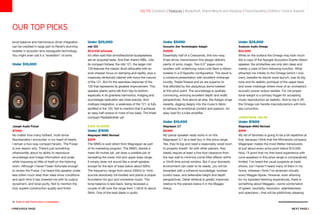
Joseph Audio Pulsar
$7000
No matter how many brilliant, multi-driver
floorstanders I encounter, in my heart of hearts
I remain a two-way compact fanatic. The Pulsar
is one reason why. There’s just something
otherworldly about its ability to reproduce
soundstage and image information and scale,
while imposing so little of itself on the listening
room. Although I haven’t been fortunate enough
to review the Pulsar, I’ve heard this speaker under
less (often much less) than ideal show conditions
and each time it has cheered me with its output,
dynamism, and tonal purity. Not to mention the
truly superb construction quality and finish.
Under $25,000
mbl 120
$23,030 w/stands
It’s often said that omnidirectional loudspeakers
are an acquired taste. And then there’s MBL. Like
its compact forbear, the mbl 121, the larger mbl
120 features the classic droid silhouette with an
even sharper focus on damping and rigidity, plus a
massively reinforced cabinet with twice the volume
of the 121. But it’s the seamless response of the
120 that represents its greatest improvement. This
speaker plainly spins silk from top-to-bottom,
especially in its grainless harmonics. Imaging and
soundstage replication are more precise. And
midbass integration, a weakness of the 121, is fully
rectified in the 120. Not to mention that it achieves
an easy half-octave or more of low bass. The finest
compact Radialstrahler yet.
Dick Olsher
Under $1500
Magnepan MMG Revised
$599
The MMG is sold direct from Magnepan as part
of its marketing program. The MMG, stands a
mere 48-inches tall, yet does a credible job of
recreating the lower mid and upper bass range.
It simply does not sound like a small speaker,
except for the lack of bass below about 60Hz.
The frequency range from about 200Hz to 1kHz
sounds absolutely full-bodied and plants a proper
foundation for jazz and orchestral music. The
tonal balance is laid-back, being recessed a
couple of dB over the range from 1.5kHz to about
5kHz. One of the best deals in audio.
Under $5000
Acoustic Zen Technologies Adagio
$4500
Essentially half of a Crescendo, this two-way,
three-driver, transmission-line design delivers
plenty of sonic magic. Two 6.5” paper-cone
woofers with underhung voice coils flank a ribbon
tweeter in a D’Appolito configuration. The result is
a cohesive presentation with excellent midrange
lucidity. Treble finesse and air are superior to
that afforded by the ubiquitous dome tweeter
at this price point. The soundstage is spatially
convincing, evincing excellent depth and width
perspectives. And above all else, the Adagio sings
sweetly, digging deeply into the music’s fabric
to retrieve its emotional content and passion. An
easy load for a tube amplifier.
Under $10,000
Magnepan 3.7
$5495
My planar speaker radar locks in on the
Magnepan 3.7 as a best buy in this price range.
Yes, they’re big and need a reasonably sized room
to properly breath. As with other planars, they
ideally require at least a five-foot clearance from
the rear wall to minimize comb-filter effects within
a 10mS time arrival window. But if your domestic
environment can cater to its needs, you will be
rewarded with a cohesive soundstage, boxless
tuneful bass, and believable height and depth
perspectives. Detail retrieval is greatly improved
relative to the planars below it in the Maggie
lineup.
Under $25,000
Analysis Audio Omega
$22,000
While on the surface the Omega may look much
like a copy of the Apogee Acoustics Duetta ribbon
speaker, the similarities are only skin deep and
merely a case of form following function. What
attracted me initially to the Omega (which I now
own), besides its dipole wave launch, was its big
tone and its realistic portrayal of the upper bass
and lower midrange where most of an orchestra’s
acoustic power output resides. For me proper
tonal weight is a primary trigger for accepting
music reproduction as realistic. And to top it off,
the Omega can handle macrodynamics with kick-
ass conviction.
Jonathan Valin
Under $1500
Magnepan MMG Revised
$599
My list of favorites is going to be a bit repetitive at
first, because I think that the Minnesota company
Magenpan makes the most lifelike transducers
at just about every price point below $10,000.
Now, I’ll grant that my first-hand experience with
cone speakers in this price range is comparatively
limited. I’ve heard the usual suspects at trade
shows, but I haven’t heard many of them in my
home, whereas I think I’ve reviewed virtually
every Maggie dipole. However, even allowing
for my lopsided listening experiences, there is
something about Maggies—some combination
of speed, neutrality, resolution, seamlessness,
and openness—that will be addictively pleasing
17 Guide to High-Performance Loudspeakers www.theabsolutesound.com
NEXT page
OUR TOP PICKS
go to: Contents | Features | Bookshelf, Stand-Mount and Desktop | Floorstanding | Editors' Choice Awards
previous page
to any music lover. Even Magnepan’s least
expensive offering, such as the two-way, quasi-
ribbon/planar-magnetic MMG Revised that I am
recommending here, is capable of doing the one
thing that most audiophiles listen for first: Make
voices sound real. As you go up the Maggie line,
that realism “sweet spot” gets wider and wider.
No, Maggies aren’t the easiest speakers to drive
(you need amps with power and punch). And yes,
they take up more room than some box speakers,
particularly two-way mini-monitors. The trade-off
is they sound more like the real thing than most
similarly priced cones in boxes. And that’s a
trade-off I’d make any day of the week.
Under $5000
Magnepan MG 1.7
$1995
Once again, I would pick a Maggie—this time
the $1995 MG 1.7. Larger and fuller-range than
the more demure MMG, the three-way dipole
MG 1.7 is perhaps the most perfectly coherent
Magnepan, perhaps because all of its drivers are
what Maggie calls “quasi-ribbon.” (For those of
you who don’t understand the difference between
“true” and “quasi” ribbons, in a nutshell the
incredibly lightweight foil in a true ribbon is the
driver—it simultaneously conducts the signal and
turns it into sound waves. In a “quasi-ribbon,” the
foil is not the driver—or not exactly. In a quasi-
ribbon, that strip of aluminum foil is itself attached
to an extremely lightweight strip of Mylar; the
foil, which is suspended between permanent bar
magnets, acts as the signal conductor (a planar
voice coil, if you will), transmitting the signal to the
entire surface of the Mylar, which, in turn, vibrates
to produce sound. As a point of comparison,
in a traditional planar-magnetic driver the Mylar
driver is not driven uniformly over its entire surface
by a foil of aluminum as it is in a quasi-ribbon;
instead, it is driven by a latticework of thick signal-
conducting wires that are attached to the Mylar
itself. The difference in the uniformity of drive
and in the relative mass of the driver should be
obvious.) Having the same kind of drivers top to
bottom makes for a peerless uniformity of sound.
It also makes for high resolution, better treble
extension, tighter imaging, superb soundstaging,
and intoxicating realism (with the right sources). In
sum, don’t think you can find a better loudspeaker
for the money.
Under $10,000
Magnepan MG 3.7 and Quad ESL-2805
$5495 and $9500
Here I will give you two choices. The first is
Maggie’s $5500 MG 3.7, a three-way ribbon/
quasi-ribbon dipole, which was, prior to the
advent of the much-more-expensive 20.7, the
best “true-ribbon” Maggie that Jim Winey and Co.
made. While Maggie’s true ribbon loudspeakers
(for an explanation of the differences between
“true” and “quasi,” see my pick for Best Under
$5000) are inherently superior because they are
lower in mass, they have not always blended
perfectly with Maggie’s planar-magnetic and
quasi-ribbon drivers. Here, thanks to considerable
work on correcting phase via a new crossover,
the blend is very nearly seamless. The result is a
superb transducer that improves upon every one
of the virtues of the 1.7 (though the 3.7 is not a
world-beater in the low bass).
For a somewhat more refined sound at low-to-
moderately-loud volumes, I would recommend
the $9500 Quad ESL-2805 full-range electrostatic.
As most of you already know, Quad is a company
with a long legacy of technical innovation and
sonic excellence, and the 2805 is perhaps the
most neutral and perfectly balanced of its current
offerings. This loudspeaker is a paragon of
musicality—high in resolution, low in coloration,
capable of gorgeous timbre, and also capable
of extraordinary realism. Though, like the 3.7,
it doesn’t have the deepest bass and also has
limitations at very loud levels, its virtues are so
sterling that it is widely used as a reference by
reviewers and listeners worldwide. For everyone
but the hardest of hard rock fans, this is a speaker
that is difficult to better for the money.
Under $25,000
Raidho C 1.1
$18,000
Here any number of choices makes sonic sense,
depending on your listening biases and listening
rooms. I could see recommending models from
Wilson, Rockport, Magico, and several others.
However, since I am primarily a chamber music
lover (and a lover of smaller-scale music in
general), I’m going to go with the $18k Raidho
C 1.1 stand-mounted, two-way, ribbon/ceramic-
cone mini-monitor. The reason for this is simple
(and explained in my review of this loudspeaker—
and in entries elsewhere in this Buyer’s Guide):
The C 1.1 is capable of sounding more realistic
(and for longer durations) than virtually any other
loudspeaker I’ve heard. At the same time it is also
capable of swooningly beautiful timbre, incredible
transient speed, and a terrific disappearing act.
No, it doesn’t plumb the bottom octaves and
because it’s a mini it doesn’t image with the
lifelike size of a Maggie. Still if you’re musical taste
is similar to mine, this is a speaker that will not
only consistently please you but also consistently
amaze you with its “you-are-there” realism on
better sources.
The Dynamic Driver
The most popular loudspeaker technology
is without question the dynamic driver.
Loudspeakers using dynamic drivers are
identifiable by their familiar cones and domes.
The dynamic driver’s popularity is due to its many
advantages: wide dynamic range, high power
handling, high sensitivity, relatively simple design,
and ruggedness. Dynamic drivers are also called
point-source transducers because the sound is
produced from a point in space.
Dynamic loudspeaker systems use a
combination of different-sized dynamic drivers.
The low frequencies are reproduced by a cone
woofer. High frequencies are generated by a
tweeter, usually employing a small metal or fabric
dome. Some loudspeakers use a third dynamic
driver, the midrange, to reproduce frequencies in
the middle of the audio band.
Despite the very different designs of these
drivers, they all operate on the same principle
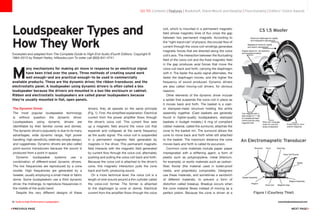
(Fig. 1). First, the simplified explanation: Electrical
current from the power amplifier flows through
the driver’s voice coil. This current flow sets
up a magnetic field around the voice coil that
expands and collapses at the same frequency
as the audio signal. The voice coil is suspended
in a permanent magnetic field generated by
magnets in the driver. This permanent magnetic
field interacts with the magnetic field generated
by current flow through the voice coil, alternately
pushing and pulling the voice coil back and forth.
Because the voice coil is attached to the driver’s
cone, this magnetic interaction pulls the cone
back and forth, producing sound.
On a more technical level, the voice coil is a
length of wire wound around a thin cylinder called
the voice-coil former. The former is attached
to the diaphragm (a cone or dome). Electrical
current from the amplifier flows through the voice
go to: Contents | Features | Bookshelf, Stand-Mount and Desktop | Floorstanding | Editors' Choice Awards
Loudspeaker Types and
How They Work
Excerpted and adapted from The Complete Guide to High-End Audio (Fourth Edition). Copyright ©
1994–2013 by Robert Harley. hifibooks.com To order call (800) 841-4741.
M
any mechanisms for making air move in response to an electrical signal
have been tried over the years. Three methods of creating sound work
well enough—and are practical enough—to be used in commercially
available products. These are the dynamic driver, the ribbon transducer, and the
electrostatic panel. A loudspeaker using dynamic drivers is often called a box
loudspeaker because the drivers are mounted in a box-like enclosure or cabinet.
Ribbon and electrostatic loudspeakers are called planar loudspeakers because
they’re usually mounted in flat, open panels.
coil, which is mounted in a permanent magnetic
field whose magnetic lines of flux cross the gap
between two permanent magnets. According to
the “right-hand rule” of physics, the circular flow of
current through the voice-coil windings generates
magnetic forces that are directed along the voice
coil’s axis. The interaction between the fluctuating
field of the voice coil and the fixed magnetic field
in the gap produces axial forces that move the
voice coil back and forth, carrying the diaphragm
with it. The faster the audio signal alternates, the
faster the diaphragm moves, and the higher the
frequency of sound produced. Dynamic drivers
are also called moving-coil drivers, for obvious
reasons.
Other elements of the dynamic driver include
a spider that suspends the voice coil in place as
it moves back and forth. The basket is a cast-
or stamped-metal structure holding the entire
assembly together. (Cast baskets are generally
found in higher-quality loudspeakers, stamped
baskets in budget models.) A ring of compliant
rubber material, called the surround, attaches the
cone to the basket rim. The surround allows the
cone to move back and forth while still attached
to the basket. The maximum distance the cone
moves back and forth is called its excursion.
Common cone materials include paper, paper
impregnated with a stiffening agent, a form of
plastic such as polypropylene, metal (titanium,
for example), or exotic materials such as carbon-
fiber, Kevlar (the material used in bullet-proof
vests), and proprietary composites. Designers
use these materials, and sometimes a sandwich
of different materials, to prevent a form of
distortion called breakup. Breakup occurs when
the cone material flexes instead of moving as a
perfect piston. Because the cone is driven at a
18 Guide to High-Performance Loudspeakers www.theabsolutesound.com
previous page NEXT page
small area at the inside (an area the size of the
voice coil), the cone tends to flex, which produces
non-linear distortion. Stiff cone materials help
prevent breakup. Although all dynamic drivers
exhibit breakup at a certain frequency, the
competent loudspeaker designer makes sure that
a driver is never driven by frequencies that would
cause breakup. For example, if a woofer has its
first breakup mode at 4kHz, the designer would
probably operate the driver only up to about
2kHz, well away from the breakup frequency.
The cone should be lightweight as well as
stiff. A lighter cone has less inertia, allowing it
to respond faster to transient signals and stop
faster after the drive signal has ceased. Think of
a bass-drum whack. A large and heavy cone may
not be able to move fast enough to reproduce the
sound’s attack, diminishing the drum’s dynamic
impact. Similarly, once the drum whack is over,
the heavy cone’s mass will want to continue
moving. Loudspeaker designers therefore search
for cone materials that combine high stiffness
with low mass. Many of the advances made in
loudspeaker design of the past 15 years have
been the result of materials research that has
yielded lighter yet stiffer diaphragms.
Tweeters work on the same principle, but
typically use a 1 dome instead of a cone.
Common dome materials include plastic, woven
fiber coated with a rubbery material, titanium,
aluminum and aluminum alloys, and gold-plated
aluminum. A recent trend has been toward
making tweeter diaphragms from materials such
as beryllium and even diamond. These materials,
once found only in a company’s expensive
flagship models, have found their way into less
costly products. Unlike cone drivers, which are
driven at the cone’s apex, dome diaphragms are
driven at the dome’s outer perimeter. Most dome
tweeters use Ferrofluid, a liquid cooling agent, to
remove heat from the tweeter’s small voice coil.
The first breakup mode of well-designed modern
dome tweeters is above 25kHz, well out of the
audible range.
Midrange drivers are smaller versions of
the cone woofer. Some, however, use dome
diaphragms instead of cones.
	
The Planar Magnetic Transducer
The next popular driver technology is the planar
magnetic transducer, also known as a ribbon
driver. Although the term “ribbon” and “planar
magnetic” are often used interchangeably, a true
ribbon driver is actually a sub-class of the planar
magnetic driver. Let’s look at a true ribbon first.
Instead of using a cone attached to a voice coil
suspended in a magnetic field, a ribbon driver
uses a strip of material (usually aluminum) as a
diaphragm suspended between the north-south
poles of two magnets (see Fig. 2). The ribbon is
often pleated for additional strength. The audio
signal travels through the electrically conductive
ribbon, creating a magnetic field around the ribbon
that interacts with the permanent magnetic field.
This causes the ribbon to move back and forth,
creating sound. In effect, the ribbon functions as
both the voice coil and the diaphragm. The ribbon
can be thought of as the voice coil stretched out
over the ribbon’s length.
In all other planar magnetic transducers, a
flat or slightly curved diaphragm is driven by
an electromagnetic conductor. This conductor,
which is bonded to the back of the diaphragm, is
analogous to a dynamic driver’s voice coil, here
stretched out in straight-line segments. In most
designs, the diaphragm is a sheet of plastic with
the electrical conductors bonded to its surface.
The flat metal conductor provides the driving force,
but it occupies only a portion of the diaphragm
area. Such drivers are also called quasi-ribbon
transducers. Fig. 3 shows the difference between
a true ribbon and a quasi-ribbon driver.
A planar driver is a true ribbon only if the
diaphragm is conductive and the audio signal
flows directly through the diaphragm, rather than
through conductors bonded to a diaphragm, as
in quasi-ribbon drivers. (Despite this semantic
distinction, I’ll use the term “ribbon” throughout
the rest of this section, with the understanding
that it covers both true ribbons and quasi-ribbon
drivers.)
Ribbon drivers like the one in Figs. 2 and
3 are called line-source transducers because
they produce sound over a line rather than
from a point, as does a dynamic loudspeaker.
Moreover, a ribbon’s radiation pattern changes
dramatically with frequency. At low frequencies,
when the ribbon’s length is short compared to the
wavelength of sound, the ribbon will act as a point
source and produce sound in a sphere around
the ribbon—just like a point-source woofer. As
the frequency increases and the wavelength of
sound approaches the ribbon’s dimensions, the
radiation pattern narrows until it looks more like a
cylinder around the ribbon than a sphere. At very
high frequencies, the ribbon radiates horizontally
but not vertically. This can be an advantage in the
listeningroom:thelistenerhearsmoredirectsound
from the loudspeaker and less reflection from the
sidewalls and ceiling. Reduced wall reflections aid
in soundstaging: Pinpoint imaging and the ability
to project a concert hall’s acoustic signature are
hallmarks of good ribbon loudspeakers.
The main technical advantage of a ribbon over
a moving-coil driver is the ribbon’s vastly lower
mass. Instead of using a heavy cone, voice coil,
and voice-coil former to move air, the only thing
moving in a ribbon is a very thin strip of aluminum.
A ribbon tweeter may have one quarter the mass
and 10 times the radiating area of a dome tweeter’s
diaphragm. Low mass is a high design goal: the
diaphragm can respond more quickly to transient
signals. In addition, a low-mass diaphragm will
stop moving immediately after the input signal
has ceased. The ribbon starts and stops faster
than a dynamic driver, allowing it to more faithfully
reproduce transient musical information.
The ribbon driver is usually mounted in a flat,
open-air panel that radiates sound to the rear as
well as to the front. A loudspeaker that radiates
sound to the front and rear is called a dipole,
go to: Contents | Features | Bookshelf, Stand-Mount and Desktop | Floorstanding | Editors' Choice Awards
Book Excerpt: Loudspeaker Types and How They Work
Figure 2
19 Guide to High-Performance Loudspeakers www.theabsolutesound.com
previous page NEXT page
which means “two poles.” Fig. 4 shows the
radiation patterns of a point-source loudspeaker
(left) and a dipolar loudspeaker.
Another great advantage enjoyed by ribbons
is the lack of a box or cabinet. An enclosure can
greatly degrade a loudspeaker’s performance.
Not having to compensate for an enclosure makes
it easier for a ribbon loudspeaker to achieve
stunning clarity and lifelike musical timbres.
A full-range quasi-ribbon loudspeaker is
illustrated in Fig. 5. The large panel extends the
system’s bass response: when the average panel
dimension approaches half the wavelength,
front-to-rear cancellation reduces bass output.
Consequently, the larger the panel, the deeper the
low-frequency extension.
Ribbon loudspeakers are characterized by a
remarkable ability to produce extremely clean
and quick transients—such as those of plucked
acoustic guitar strings or percussion instruments.
The sound seems to start and stop suddenly,
just as one hears from live instruments. Ribbons
sound vivid and immediate without being etched
or excessively bright. In addition, the sound has
an openness, clarity, and transparency often
unmatched by dynamic drivers. (Incidentally, these
qualities are shared by ribbon microphones.) Finally,
the ribbon’s dipolar nature produces a huge sense
of space, air, and soundstage depth (provided this
spatial information was captured in the recording).
Some argue, however, that this sense of depth is
artificially produced by ribbon loudspeakers, rather
than being a reproduction of the actual recording.
Despite their often stunning sound quality,
ribbon drivers have several disadvantages. The
first is low sensitivity; it takes lots of amplifier
power to drive them. Second, ribbons inherently
have a very low impedance, often a fraction of
an ohm. Most ribbon drivers therefore have an
impedance matching transformer in the crossover
to present a higher impedance to the power
amplifier. Design of the transformer is therefore
crucial to prevent it from degrading sound quality.
From a practical standpoint, ribbon-based
loudspeakers are more difficult to position in a
room. Small variations in placement can greatly
change the sound, due primarily to their dipolar
radiating pattern. This dipolar pattern requires
that the ribbon loudspeakers be placed well
away from the rear wall, and that the rear wall be
acoustically benign.
Low-profile, ribbon-based loudspeakers with
the ribbon top at the same height as the listener’s
ears will have a radically different treble balance
if the listener moves up or down a few inches.
That’s because ribbon loudspeakers have very
narrow vertical dispersion, meaning they radiate
very little sound above and below the ribbon
at high frequencies. If you sit too high or listen
while standing, you’ll hear less treble. Some
ribbon loudspeakers have a tilt adjustment that
allows you to set the correct treble balance for a
particular listening height.
Ribbons also have a resonant frequency that, if
excited, produces the horrible sound of crinkling
aluminum foil. Consequently, the ribbon must be
used within strict frequency-band limits. In addition,
ribbon drivers are tensioned at the factory for
optimum performance. If under too much tension,
a ribbon will produce less sound; if under too
little tension, a ribbon can produce distortion that
go to: Contents | Features | Bookshelf, Stand-Mount and Desktop | Floorstanding | Editors' Choice Awards
Book Excerpt: Loudspeaker Types and How They Work
Figure 4
Point-source radiation pattern (left) and
di-polar radiation pattern (right)
Figure 3
20 Guide to High-Performance Loudspeakers www.theabsolutesound.com
previous page NEXT page
sounds like the music is “breaking up.” This is most
noticeable on piano; the transient leading edges
sound “shattered” and distorted. A sudden increase
in ambient temperature can cause a ribbon driver to
lose some of its tension and introduce the distortion
described. If you hear this sound from your ribbon
loudspeakers, contact the manufacturer for advice.
The solution may be as simple as turning a few
tensioning bolts half a turn.
Ribbon drivers don’t necessarily have to be
long and thin. Variations on ribbon technology
have produced drivers having many of the
desirable characteristics of ribbons but few of the
disadvantages.
Finally, some loudspeakers use a combination
of dynamic and ribbon transducers to take
advantage of both technologies. These so-called
hybrid loudspeakers typically use a dynamic
woofer in an enclosure to reproduce bass, and a
ribbon midrange/tweeter. The hybrid technique
brings the advantages of ribbon drivers to a lower
price level (ribbon woofers are big and expensive),
and exploits the advantages of each technology
while avoiding the drawbacks. The challenge in
such a hybrid system is to achieve a seamless
transition between the dynamic woofer and the
ribbon tweeter, with no audible discontinuity
between the drivers.
The Electrostatic Driver
Like the ribbon transducer, an electrostatic driver
uses a thin membrane to make air move. But that’s
where the similarities end. While both dynamic
and ribbon loudspeakers are electromagnetic
transducers—they operate by electrically
induced magnetic interaction—the electrostatic
loudspeaker operates on the completely different
principle of electrostatic interaction.
No discussion of electrostatic loudspeakers
would be complete without mentioning the classic
electrostatic loudspeaker, the Quad ESL-57, created
in 1957 by Peter Walker. The ESL-57 revolutionized
the standard for transparency upon its introduction,
and still holds it own more than 50 years later.
Many listeners’ first exposure to high-quality
audio was through an ESL-57. A large number of
contemporary loudspeaker designers still have a
pair of ESL-57s on hand as a reference. The ESL-57
doesn’t have much low bass, won’t play very loudly,
and produces a very narrow sweet spot, but when
operated within its limitations, it’s magical.
In an electrostatic loudspeaker (sometimes
called an ESL), a thin moveable membrane—
usually made of transparent Mylar—is stretched
between two static elements called stators (Fig. 6).
The membrane is charged to a very high voltage
with respect to the stators. The audio signal is
applied to the stators, which create electrostatic
fields around them that vary in response to the
audio signal. The varying electrostatic fields
generated around the stators interact with the
membrane’s fixed electrostatic field, pushing and
pulling the membrane to produce sound. One
stator pulls the membrane, the other pushes it.
This illustration also shows a dynamic woofer as
part of a hybrid dynamic/electrostatic system.
The voltages involved in an electrostatic
loudspeaker are very high. The polarizing voltage
applied to the diaphragm may be as high as
go to: Contents | Features | Bookshelf, Stand-Mount and Desktop | Floorstanding | Editors' Choice Awards
Book Excerpt: Loudspeaker Types and How They Work
Figure 5
Figure 6
Courtesy MartinLogan
21 Guide to High-Performance Loudspeakers www.theabsolutesound.com
previous page NEXT page
10,000 volts (10kV). In addition, the audio signal
is stepped up from several tens of volts to several
thousand volts by a step-up transformer inside
the electrostatic loudspeaker. These high voltages
are necessary to produce the electrostatic fields
around the diaphragm and stators.
To prevent arcing—the electrical charge
jumping between elements—the stators are
often coated with an insulating material. Still, if
an electrostatic loudspeaker is overdriven, the
electrostatic field strips free electrons from the
oxygen in the air, making it ionized; this provides
a conductive path for the electrical charge. Large
diaphragm excursions— i.e., a loud playing
level—put the diaphragm closer to the stators
and also encourage arcing. Arcing can destroy
electrostatic panels by punching small holes
in the membrane. Arcing is a greater problem
in humid climates than in dry climates because
moisture makes the air between the stators more
electrically conductive.
Electrostatic panels are often divided into
several smaller panels to reduce the effects of
diaphragm resonances. Some panels are curved
to reduce the lobing effect (uneven radiation
pattern) at high frequencies. Lobing occurs when
the wavelength of sound is small compared
to the diaphragm. Lobing is responsible for
electrostatics’ uneven high-frequency dispersion
pattern, which Stereophile magazine founder J.
Gordon Holt has dubbed the vertical venetian-
blind effect, in which the tonal balance changes
rapidly and repeatedly as you move your head
from side to side.
Electrostatic panels are of even lighter weight
than planar magnetic transducers. Unlike the
ribbon driver, in which the diaphragm carries the
audio signal current, the electrostatic diaphragm
need not carry the audio signal. The diaphragm
can therefore be very thin, often less than 0.001.
Such a low mass allows the diaphragm to start
and stop very quickly, improving transient
response. And because the electrostatic panel is
driven uniformly over its entire area, the panel is
less prone to breakup. Both the electromagnetic
planar loudspeaker (a ribbon) and the electrostatic
planar loudspeaker enjoy the benefits of limited
dispersion, which means less reflected sound
arriving at the listening position. Like ribbon
loudspeakers, electrostatic loudspeakers also
have no enclosure to degrade the sound.
Electrostatic loudspeakers also inherently have a
dipolar radiation pattern. Because the diaphragm
is mounted in an open panel, the electrostatic
driver produces as much sound to the rear as to
the front. Finally, the electrostatic loudspeaker’s
huge surface area confers an advantage in
reproducing the correct size of instrumental
images.
In the debit column, electrostatic loudspeakers
must be plugged into an AC outlet to generate
the polarizing voltage. Because the electrostatic
is naturally a dipolar radiator, room placement
is more crucial to achieving good sound. The
electrostatic loudspeaker needs to be placed
well out into the room and away from the rear
wall to realize a fully developed soundstage.
Electrostatics also tend to be insensitive, requiring
large power amplifiers. The load impedance they
present to the amplifier is also more reactive than
that of dynamic loudspeakers, further taxing the
power amp. Nor will they play as loudly as dynamic
loudspeakers; electrostatics aren’t noted for their
dynamic impact, power, or deep bass. Instead,
electrostatics excel in transparency, delicacy,
transient response, resolution of detail, stunning
imaging, and overall musical coherence.
Electrostatic loudspeakers can be augmented
with separate dynamic woofers or a subwoofer to
extend the low-frequency response and provide
some dynamic impact. Other electrostatics
achieve the same result in a more convenient
package: dynamic woofers in enclosures mated
to the electrostatic panels. Some of these designs
achieve the best qualities of both the dynamic
driver and electrostatic panel. Audition such hybrid
speakers carefully; they sometimes exhibit an
audible discontinuity at the transition frequency at
which the woofer leaves off and the electrostatic
panel takes over. Listen, for example, for a change
in a piano’s timbre, bloom, projection, and image
size as it is played in different registers. Acoustic
bass in jazz is also a good test of woofer/panel
discontinuity in dynamic/electrostatic hybrid
loudspeakers.
One great benefit of full-range ribbons and
full-range electrostatics is the absence of a
crossover; the diaphragm is driven by the entire
audio signal. This prevents any discontinuities in
the sound as different frequencies are reproduced
by different drivers. In addition, removing the
resistors, capacitors, and inductors found in
crossovers greatly increases the full-range
planar’s transparency and harmonic accuracy.
Even hybrid planars put the crossover frequency
between the dynamic woofer and the planar
panel very low (below 800Hz, a frequency
nearly an octave above middle A), so there’s no
discontinuity between drivers through most of the
audible spectrum.
Finally, the large diaphragms of electrostatic
and ribbon drivers are gently driven over their
entire surface areas, rather than forcefully over the
relatively small voice-coil area of a dynamic driver.
This high force over a small area contributes to
the dynamic driver’s breakup described earlier, a
phenomenon less likely to occur with large planar
diaphragms.
Excerpted and adapted from The Complete
Guide to High-End Audio (Fourth Edition).
Copyright © 1994–2013 by Robert Harley.
hifibooks.com To order call (800) 841-4741.
go to: Contents | Features | Bookshelf, Stand-Mount and Desktop | Floorstanding | Editors' Choice Awards
Book Excerpt: Loudspeaker Types and How They Work
22 Guide to High-Performance Loudspeakers www.theabsolutesound.com
previous page NEXT page
24 Guide to High-Performance Loudspeakers www.theabsolutesound.com
previous page NEXT page
The Art of the
Small Speaker
Loudspeaker
Designer
Roundtable
Creating a musically satisfying loudspeaker
within the limits imposed by a small cabinet is a particular
challenge to loudspeaker designers.
Here the trade-offs are more acute, the design skills put to a greater test,
the aesthetic differences heightened. When done right, small loudspeakers
can be magical despite their limitations in bass extension and dynamics.
But just how does the designer go about creating that magic? What’s the
secret alchemy that results in great sound from a small enclosure? To shed
some light on the art of the small speaker, we’ve asked five of the world’s
best loudspeaker designers—Paul Barton of PSB Speakers, Michael
Børresen of Raidho Acoustics, Yoav Geva of YG Acoustics, Andrew
Jones of TAD and Pioneer, and Kevin Voecks of Revel—to weigh-in on
the same set of questions. — Robert Harley
Paul Barton
(PSB Speakers)
Michael Børresen
(Raidho Acoustics)
Yoav Geva
(YG Acoustics)
Andrew Jones
(TAD)
Kevin Voecks
(Revel)
go to: Contents | Features | Bookshelf, Stand-Mount and Desktop | Floorstanding | Editors' Choice Awards
25 Guide to High-Performance Loudspeakers www.theabsolutesound.com
previous page NEXT page
P
aul Barton, founder and chief designer of PSB Speakers, began designing
speakers more than 40 years ago for a Grade 10 Physics project. His
engineering bent coupled nicely (for speaker designer purposes) with his abilities
as a violinist, who as a young musician played with Canada’s National Youth Orchestra
and the University of Toronto’s Repertoire Orchestra. His two passions converged
permanently in 1972, when he founded PSB Speakers.
One of the first to use the anechoic chamber at Canada’s renowned National
Research Council facilities in Ottawa and other facilities there, Paul has combined
research into the correlation of measurements and audible performance with testing of
successive modifications of every speaker in process.
In the mid-1980s, PSB became part of the Lenbrook Group of Companies, whose
expertise in marketing specialized electronic products and widespread distribution in
North America and around the world has established PSB Speakers as one of the most
respected international loudspeaker manufacturers worldwide.
Paul Barton • PSB Speakers
Speaker Designer
Roundtable
What are the particular challenges and trade-offs of designing a
small loudspeaker? Which sonic qualities are you primarily trying to
optimize, and which qualities are you most willing (or compelled) to
give up?
The most challenging aspect of a small design is the ability for the
small form factor to produce full-scale musical events realistically, both
for loudness and dynamic range. This is even more challenging when
the music contains wide bandwidth especially at low frequencies. One
must remember that as the frequency is halved
the excursion requirements for the woofer must
double to maintain flat response. This means that
a small speaker can produce very low frequencies,
but can also be very strained if the low frequencies
it is asked to reproduce are played too loud. The
smaller size can also result in a design that is less
efficient than a larger design. This means that you
need more power to drive the small design to the
same volume level as a full-sized speaker system.
I am willing to compromise these things, but I
like to think of a small design as the challenge of
balancing all of these limitations. For me this has
come from a lot of trial and error over my 40-year
career in loudspeaker design.
Do you have your own design techniques that
maximize the performance of small designs?
One technique that I like to use to
overcome the small size and real-
ize a bigger sound than one would
expect from such a small enclosure
is the use of a Neodymium booster
magnet on top of the woofer’s pole
piece inside the voice-coil former.
What this does is increase the force
in the magnetic gap around the
voice coil and results in more sensi-
tivity and deeper bass response for
a given box volume/size. In theory,
if you increase the magnetic force
around the voice coil to an infinite
amount you can decrease the box’s
air volume to nothing and maintain
the same frequency response.
Has your design work on larger
loudspeakers informed your
approach to stand-mounted
ones?
I sort of see the reverse influence
because small two-way designs
have been helpful in keeping me
grounded as to the basic rules
that apply to good, cost-effective
designs of any size. For me, a
small-system design sets the bar
for what you can do for a given
amount of money and therefore
puts things in perspective for what
can be justified in cost for larger
speaker systems.
What, if any, sonic and technical
advantages do small two-ways
have over larger multiway
systems?
The main advantage, whether
intentional or by default, is the
fact that the drivers (woofer and
tweeter) must be close together,
and along with the selection of the
proper crossover frequency, can
produce a coherent integration
of the woofer and the tweeter at
the crossover frequency. What I
mean by this is if the drivers are
physically closer together than the
wavelength of the frequency that
they both produce at the crossover
point then the drivers together
behave as a single source,
which is what you want. It is also
desirable to choose the crossover
frequency where the woofer, at
its highest operating frequency,
has similar dispersion to the
tweeter at the same frequency
(its lowest operating frequency
in the system). This approach
always results in amazingly natural
timbre, wonderful soundstaging,
and very flexible positioning of the
listener (seated or standing) and
positioning of the speaker itself in
your listening environment.
go to: Contents | Features | Bookshelf, Stand-Mount and Desktop | Floorstanding | Editors' Choice Awards
26 Guide to High-Performance Loudspeakers www.theabsolutesound.com
previous page NEXT page
M
ichael Børresen majored in Materials and Vibration at Aalborg University.
Growing up in a workshop, Michael always had a curiosity about
knowing how to build and design things for his own use. This curiosity
has been Michael’s primary drive in all of his activities, whether it be sailing,
fishing, music, or triathlon. When sailing he designed rudders and dagger-boards
out of a fascination with flow and hydrodynamics. Later, through his interest in
triathlon, he founded Principia, a top brand of bicycles primarily used for racing.
The bicycles have been used in Tour de France and won Olympic medals. His
close-to-the-heart passion for music has been the driving force in a life full of
speakers. In 2003, Michael and Lars Kristensen founded Raidho as a joint quest
for creating speakers that would fulfill their very personal demands and needs for
musical satisfaction.
Michael Børresen • Raidho Acoustics
Speaker Designer
Roundtable
What are the particular challenges and trade-offs of designing a
small loudspeaker? Which sonic qualities are you primarily trying to
optimize, and which qualities are you most willing (or compelled) to
give up?
One of the major tasks in designing small loudspeakers is to find the right
performance values in the triangle of compromise that is so evident in the
low-frequency performance of small loudspeakers. The triangle consists
of low-frequency output, small driver size, and power handling.
The triangle is difficult to manage, because you really want all three!
When making the necessary compromises I always take the path of less
misinformation. Forcing a system to try to do something it is not really
capable of doing always leads to inferior results. It is clearly better to
sacrifice the lowest octave, and make sure the rest of the frequency band
is of the very highest standard. When we look at human psychoacoustic
capabilities, we must understand that misinformation takes twice the brain
power to process and remove, whereas an absence of misinformation
allows our ear/brain to recreate fundamentals that are not really there.
Get the overtones right, and your psychoacoustic hearing recreates the
fundamentals.
This is quite evident when listening to the differences between the
[Raidho] C1.1 and the D-1. While measuring the
same and objectively having exactly the same
low-frequency extension, the D-1 sounds like it
has a lot more of everything—more weight and
more low-frequency extension—than its ceramic-
coned sibling. Clearly, it is allowing more acoustic
images to form in the head of the listener.
Do you have your own design techniques that
maximize the performance of small designs?
An issue that is significant for small speakers is
that you have higher pressures than in similar
larger designs. This means that you have to deal
with internal cabinet standing wave reflections in
a more resolute manner than with bigger designs.
We do this by having long-haired sheep’s wool
fitted between the cross-bracings inside the
cabinet. This is positioned where the air has
maximum velocity, and where you can target
standing waves.
go to: Contents | Features | Bookshelf, Stand-Mount and Desktop | Floorstanding | Editors' Choice Awards
27 Guide to High-Performance Loudspeakers www.theabsolutesound.com
previous page NEXT pageNEXT page
Speaker Designer
Roundtable
The reality is that a speaker system can
be no better than the drivers. That is why we
at Raidho build all our drivers in-house. This
gives us tremendous freedom to shape and
design drivers which fit our needs, without
the technology limitations of other companies.
When we tried to work with OEM houses, we
discovered that “custom” drivers are simply
a combination of their in-house available
parts, membranes, motor-systems, etc. Our
speakers are built around our in-house-built
ribbon planar tweeter. Its moving mass is 30
to 50 times lower than that of any dome-based
driver. This lower mass translates to more
low-level information, less time smearing, and
lower resonances. The tweeter’s performance
drove us to develop cone drivers with similar
characteristics. This resulted in our lightweight
ceramic-coned drivers. Now we’ve taken the
next step by applying a very thin diamond
coating to the ceramic driver, which greatly
increases its stiffness.
Has your design work on larger
loudspeakers informed your approach to
stand-mounted ones?
Regardless of what you design, it will be
reflected in your future works. It seems as if
knowledge gained in one area is equally valid
in other areas. This can be induction issues
in drivers reflected into internal cabling, or
mechanical or resonance or energy-storage
issues related to materials and dimensions
that are then reflected into feet and decoupling
between speaker and speaker-stand.
What, if any, sonic and technical
advantages do small two-ways have over
larger multiway systems?
Setting up a system with a really good two-way
monitor is often a lot easier than with its bigger
sisters. Two-ways interact and work with
rooms in a friendlier way, making it possible
to create a truly breathtaking realism. But do
not be fooled into thinking that you can get
away with a less skillful setup than with large
loudspeakers. Small speakers care just as
much about system foundation, amplification,
sources, and cabling as big speakers do. But
get it right, and you are in for some real treats.
Get the overtones
right, and your
psychoacoustic
hearing recreates the
fundamentals.
go to: Contents | Features | Bookshelf, Stand-Mount and Desktop | Floorstanding |
Editors' Choice Awards
28 Guide to High-Performance Loudspeakers www.theabsolutesound.com
previous page NEXT page
Y
oav Geva’s love of audio stemmed from a musical upbringing, while his
professional background grew from the study of complex algorithms
for digital signal processing. Not content to accept the compromises of
conventional wisdom, Geva set out correct what he viewed as weaknesses in the
design process of loudspeakers. He found that his understanding of digital signals
could be applied to analog waveforms (as used in speakers). Geva thus set out to
write his own software for speaker design—the first to optimize both the frequency
and time (relative phase) domains simultaneously. This technology created the
DualCoherent crossover now used in YG Acoustics speakers. After receiving a
grant for this award-winning technology, Geva now had the impetus to create a
company around his designs. YG Acoustics was thus born, in 2002. As he is only
35 years old, the story of Yoav Geva is still being written.
Yoav Geva • YG Acoustics
Speaker Designer
Roundtable
What are the particular challenges and trade-offs of designing a
small loudspeaker? Which sonic qualities are you primarily trying to
optimize, and which qualities are you most willing (or compelled) to
give up?
A small speaker can be designed to offer excellent sound quality.
Compromises are typically limited to one or more of the following three
areas: maximal output volume, bass extension, and sensitivity. The
reasons are simple physics: high output volume requires moving lots of air,
which in turn means a large driver-area and/or high driver-excursion. Since
in a small speaker large drivers are ruled out by definition, high excursion
is necessitated. This in turn requires the drivers to be more rigid to resist
flexing at high excursion, and thus they are inevitably heavier than would
be required if they didn’t need to maintain such stability. A heavier driver
reduces sensitivity because more amplifier power is required to induce
cone movement. As far as bass extension goes, the lower the frequency
being played back by the speaker the greater the driver excursion required
to achieve a given volume level. Bass extension is always directly at odds
with the maximal achievable output volume from a given speaker size.
As far as balancing the benefits, we chose a slightly different approach
for each of our models, depending on their typical application. For Carmel,
we chose a balanced approach of sensitivity and
output volume combined with near-full-range
bass-extension (35Hz) to offer a near-universal
speaker. For Kipod II we felt that it was critical to
offer full-range bass-extension down to 20Hz, so
we settled on optimizing it for small to medium-
sized rooms. For Sonja and Anat III we maximized
all parameters, so the overall size is larger, but
we still kept their monitor-sections small enough
to be stand-mounted and used as a stand-alone
compact speaker.
Do you have your own design techniques that
maximize the performance of small designs?
We have developed specific technologies that
extract the most out of a speaker’s given size
in three main areas: drivers, cabinets, and
crossover circuitry. For drivers, as mentioned
above the key is high excursion coupled with
rigidity, while maintaining a low driver-mass to
go to: Contents | Features | Bookshelf, Stand-Mount and Desktop | Floorstanding | Editors' Choice Awards
29 Guide to High-Performance Loudspeakers www.theabsolutesound.com
previous page NEXT pageNEXT page
Speaker Designer
Roundtable
avoid losing sensitivity. Our BilletCore drivers,
with their sophisticated reinforced geometry
and machined stress-free surface, offer a
phenomenal strength-to-weight ratio. This
facilitates high excursions without distortion,
and therefore allows the speaker to move more
air for a given driver size.
For cabinets, we construct extremely rigid
enclosures out of aircraft-grade aluminum.
This avoids the need for excessive bracing,
thus allowing for free internal airflow which
makes the cabinet “feel” larger to the driver.
For the “gearheads” among the readers, this
means a higher QL measurement, i.e. lower
enclosure losses.
For crossovers, our DualCoherent technology
matches the relative phase of the drivers to
each other very precisely. They couple more
effectively to one another, which allows the
sum of their outputs to be maximized, thus
avoiding unnecessary losses in sensitivity.
This means that we can balance sensitivity
and bass-extension without being forced to
compensate for driver-cancellation.
Has your design work on larger
loudspeakers informed your approach to
stand-mounted ones?
Yes. Our larger speakers are modular, so their
monitor-section, which houses the mids and
tweeters, is in effect a smaller speaker that is
also usable as a stand-alone monitor.
What, if any, sonic and technical
advantages do small two-ways have over
larger multiway systems?
Small two-way speakers offer significant
advantages in circuitry (simpler circuits behave
closer to the theoretical ideal), cabinet-rigidity
(smaller panels don’t vibrate as easily), and
reduced diffraction (narrow front-baffles require
little curvature) compared to larger multi-way
speakers. Because of these advantages,
when we construct a large speaker we do
so in a modular fashion, with the monitor-
section (mids and tweeters) essentially being
a small two-way speaker. This maintains the
superior homogeneity and soundstaging ability
associated with small speakers even when
they’re part of a larger design. For the same
reason, we use modular crossovers where
the two-way circuitry is kept separate, and a
tapered shape with a narrow front-baffle for the
monitor-section.
The end result is the natural sound of a
live performance that we’ve become famous
for, and continue to strive towards with every
design.
info@kharma.com | www.kharma.com | facebook.com/KharmaInternational
The new Kharma Omega 7®
driver
for astonishing mid-range performance.
Kharma Signature cabinet treatment.
Triple Kharma diamond drivers.
HIGH-END AUDIO PRODUCTS
New materials and new techniques gave us the wings
to further approach reality as the absolute reference
in the Kharma Exquisite Collection. The systems are
developed, assembled and tested in the Netherlands,
with the utmost care, by a team of highly dedicated and
committed specialists. The Exquisite Grand, part of the
Flagship series of the Exquisite Collection, materializes
the absolute end of the high-end in audio, with only
reality as a real competitor.
During the HIGH-END in Munich 2013 Kharma will
showcase the Luxurious Grand Exquisite Limited
edition, with special features, a true premiere together
with the new Kharma Exquisite Electronics.
Kharma is represented by select dealers worldwide
For more information, visit: www.kharma.com
KHARMA EXQUISITE GRAND LOUDSPEAKER SYSTEM
DESIGNED WITHOUT
COMPROMISE
go to: Contents | Features | Bookshelf, Stand-Mount and Desktop | Floorstanding |
Editors' Choice Awards
30 Guide to High-Performance Loudspeakers www.theabsolutesound.com
previous page NEXT page
B
eing born in stereo (Andrew has an identical twin brother who is left
handed while he is right—making them a stereo pair from birth!) made a
career in audio perhaps pre-destined.
Gaining an interest in electronics and hi-fi in his pre-teens informed his decision
to study Physics at university, followed by six years of research in audio topics
such as computer modeling of crossover networks and active noise cancellation.
In 1983 he was invited to join KEF Electronics as a research engineer, progressing
to become Chief Engineer. After eleven years at KEF he moved to the USA to join
Infinity.
In 1997 he was invited to join Pioneer to lead the engineering group in designing
speakers. This culminated in the formation, 10 years ago, of the consumer division
of TAD, and the exploration of designs without compromise.
His spare time (what spare time?) is split between travel, tending to his dogs and
cats (yes, plural, very), and archery (he recently qualified as a coach and is to be
found teaching each weekend when he is home at the local archery range).
Andrew Jones • Technical Audio Devices (TAD)
Speaker Designer
Roundtable
What are the particular challenges and trade-offs of designing a
small loudspeaker? Which sonic qualities are you primarily trying to
optimize, and which qualities are you most willing (or compelled) to
give up?
Small speakers typically lack the sense of scale and dynamics of large
ones, the qualities that give you that sense of reality, effortlessness, and
ease. In contrast they can disappear in a way that is difficult to achieve
from large speakers. The challenge is in retaining both. Typically smaller
speakers are used in smaller rooms, so the designer can take advantage of
this to some degree and use the room gain to offset the loss of dynamics
in the midbass region. Also smaller speakers are normally equated with
lower-cost speakers and that brings its own set of compromises that are
independent of size. When cost is divorced from size then the performance
loss from small speakers can be made very small indeed, and be confined
only to very low, very loud bass.
 
Do you have your own design techniques that
maximize the performance of small designs?
Generally, the first thing to go from small speakers
is bass. In order to maximize bass extension, one
must necessarily give up efficiency. This means
that to get any degree of real-scale dynamics you
must put in a lot of power. The speaker not only has
to handle this power without damage, it must do
so without dynamic compression. Compression in
the mids and highs can be dealt with by designing
the drivers to have high inherent efficiency, but for
the bass driver this is not an option. Piling on more
magnet, or using a lighter cone, only gives less low
bass. For any size of cabinet and required bass
extension there is an optimum set of parameters of
mass and magnet strength that will give the correct
bass alignment, so the only solution is to design
go to: Contents | Features | Bookshelf, Stand-Mount and Desktop | Floorstanding | Editors' Choice Awards
31 Guide to High-Performance Loudspeakers www.theabsolutesound.com
previous page NEXT pageNEXT page
Speaker Designer
Roundtable
voice coils and magnet structures that can
take these high power inputs without thermal
compression. 
To solve the issue of high sound level at low
frequencies one must also design the bass
driver to have large linear excursion to make
up for the loss of cone area. A by-product of all
of this is that one cannot adequately balance
all of these requirements in a two-way design.
Has your design work on larger
loudspeakers informed your approach to
stand-mounted ones?
The large speaker serves as a reference for
the qualities one is seeking from the smaller
design. Starting with types of music that do not
overly stress the smaller speaker one can listen
back and forth to determine how close is the
essential sound quality of each. Then listen to
more stressful music to explore the limitations
of the smaller system. Beyond that, at least
for TAD designs, the smaller speakers are very
much identical in design and implementation
to the larger ones: three-way designs, identical
mid/treble drivers, and near-identical bass
drivers. This guarantees close sonic signature
throughout the TAD family.
One other advantage that a small speaker
can have is less cabinet vibration. Smaller
structures tend to be easier to control than
larger ones.
 
What, if any, sonic and technical
advantages do small two-ways have over
larger multiway systems?
I hinted at this earlier. I do not blindly believe that
simpler is always better. Small two-ways suffer
severe limitations and compromises in what
they can achieve compared to well-designed
three- or four-ways. There is a belief that the
greater the number of drivers the more one can
hear the transitions and the less homogeneous
the sound. I believe the exact opposite. The
compromises involved in a two-way make the
transitions more likely to be heard, particularly
so if we are comparing a small two-way to
a large three-way. Large long-throw bass
drivers do not do so well in the mids; their
off-axis performance is compromised making
the transition to the tweeter more variable
especially off-axis; their cone colorations are
more audible; internal standing waves in the
box are more of a problem; cabinet vibration is
more audible, and so on and so forth. My ideal
high-performance, small two-way speaker is a
three-way.
728 third street, unit c, mukilteo wa 98275 usa
e: sales@vanaltd.com / www.vanaltd.com
p: (425) 610-4532 / f: (425) 645-7985
go to: Contents | Features | Bookshelf, Stand-Mount and Desktop | Floorstanding |
Editors' Choice Awards
32 Guide to High-Performance Loudspeakers www.theabsolutesound.com
previous page NEXT page
A
fter selling high-end audio in high school, the quest for higher
fidelity led Kevin to Massachusetts for a formal engineering
education. He founded Natural Sound, a high-end audio
store, with a fellow student who remains a Revel dealer. With virtually
any high-end brand at his disposal, it was evident that loudspeakers
were at the same time the most important and most flawed part of
the audio-reproduction chain. After spending time doing research
into high-end loudspeakers, Kevin joined Mirage as chief engineer,
followed by becoming chief engineer at Snell Acoustics. A call from
Sidney Harman asking him to found a new loudspeaker company of
the caliber of which Mark Levinson was known for electronics, with
the resources of Harman International, resulted in the formation of
Revel in 1996.
Kevin Voecks • Revel
Speaker Designer
Roundtable
What are the particular challenges and trade-offs of
designing a small loudspeaker? Which sonic qualities
are you primarily trying to optimize, and which qualities
are you most willing (or compelled) to give up?
The challenge of maximizing the fidelity of a small
loudspeaker is an instance in which what appears obvious
is indeed the case. Low-frequency extension and output
capability make up almost the entirety of the challenges that
are particular to small loudspeakers. As is the case with any
loudspeaker, one need only look to the applicable physics to
understand the challenges and trade-offs. Also in common
with all speaker design, too narrow a vision will result in a
speaker that isn’t as good at the total task of fidelity as one
built with an eye toward the total result. For example, the
low-frequency bandwidth could be greatly extended if you
ignore output capability and sensitivity, but that would not
result in a very useful speaker. A superior design must keep
all characteristics that contribute to fidelity in balance.
Do you have your own design techniques that maximize the
performance of small designs?
First and foremost in the small speaker category is to optimize
every aspect that contributes to extension and low-frequency
output capability, while of course also staying true to what we
have learned about full-range sound quality. I am extremely
fortunate to be able to work with an outstanding group of
engineers, including specialists in transducer design. Being able
tomodelanddesigneverycomponentinthesystem,fromspiders
to surrounds to diaphragms, is absolutely essential to achieving
the best possible complete loudspeaker system. Instruments
such as the Klippel analyzer are instrumental in wringing-out the
best possible performance from the transducers. It should go
without saying, but probably bears stating that “tricks,” such as
designing a high-Q system with a midbass peak to simulate real
bass, are not acceptable. Neither of course is tilting the overall
response or limiting the high-frequency extension in order to
seem more balanced in a speaker attempting to claim fidelity.
 
Has your design work on larger
loudspeakers informed your
approach to stand-mounted
ones?
Usingtheresultsofourresearchers,
we have a sophisticated
understanding of which aspects of
sound quality are most audible—
and which are not. That is critical
to making informed choices in the
hundreds of decisions and trade-
offs that are part of every design.
Having access to high-resolution
anechoic chambers allows us to
properly characterize both the
transducers and the transducer-
enclosure combination to allow
high-precision filter (crossover)
synthesis. A good example that
applies to any size loudspeaker is
resonances. Our research group
has determined the threshold of
audibility of resonances, which
have been shown to be a critical
aspect of high fidelity. We take
pains to be sure that resonances—
regardless of the source—are
reduced to the level of inaudibility
in all of our loudspeakers. This
is the reason that we use stiff
diaphragms that push the first
mode (resonance) well above the
crossover frequency to make them
inaudible in all Revel loudspeakers.
go to: Contents | Features | Bookshelf, Stand-Mount and Desktop | Floorstanding | Editors' Choice Awards
33 Guide to High-Performance Loudspeakers www.theabsolutesound.com
previous page NEXT page
go to: Contents | Features | Bookshelf, Stand-Mount and Desktop | Floorstanding |
Editors' Choice Awards
www.theabsolutesound.com
NEXT page
Speaker Designer
Roundtable
One of the most important findings of our
research group is the critical importance of the
far off-axis response being similar to the on-
axis response. This relates to our research on
the audibility and psychoacoustic significance
of reflections. We learned that the first side-
wall reflections are of the greatest sonic
significance, and that it is usually a speaker’s
far off-axis response that contributes to these
critical reflections. That means taking a very
unusual approach to design that places great
weight on matching the response up to 60-75
degrees off-axis with the on-axis response. The
importance is clearly proven in blind listening
tests, as matching the response results in a
seamless characteristic that makes reproduced
music much more believable. This has led to
generations of high-frequency waveguides
that match the off-axis characteristics of the
tweeter to the midrange (or woofer in a two-
way design).
Position-independent, double-blind listening
tests are an essential part of any loudspeaker
design. Any audiophile knows that moving a
speaker changes its perceived character as its
interactions with room modes and boundaries
change. The problem cannot be solved by
placing speakers in close proximity with one
another, as they still cannot be in the same
place at the same time, and the presence of one
very close to the other will influence the sound
of both. Our use of a high-speed speaker-
mover is really essential to compare two
loudspeakers, as is the double-blind process
in which no one is aware of the identification of
the speaker under test.
What, if any, sonic and technical
advantages do small two-ways have over
larger multiway systems?
In my opinion, the characteristic that is most
appealing to listeners who prefer small two-
ways over larger loudspeakers is, in fact, a
coloration, although one of the very few that
can be defended. I am referring to the lack
of natural masking that occurs when low-
frequency sounds are present concurrent with
midrange and high-frequency sounds. Since
that natural masking is present in the original
signal if it is a “real” acoustic event, the lack
of masking is by definition a distortion. It
does often make the midrange sound cleaner
and more-detailed, which is the reason that
I think it is defensible. However, it should
be acknowledged as an artifact—however
pleasant it may be.
SS-NA2ES
©2013 Sony Electronics Inc. Sony and the Sony make.believe logo are trademarks of Sony. All rights reserved. Reproduction in whole or in part without written permission is prohibited.
All other trademarks are trademarks of their respective owners.
and you’re there
Close your eyes and you’re there. Building on our award-winning AR series, Sony ES speakers
recreate the experience of hearing music performed in a live venue. Hand-crafted from 
Scandinavian birch selected for its acoustic resonance, the single cabinet, two-enclosure design
gives you unparalleled low-frequency isolation. The I-Array™ tweeter system delivers a true-to-life
listening experience. And the result is beyond words. 
Because You Care About Music™ Learn more at www.sony.com/ES
34 Guide to High-Performance Loudspeakers www.theabsolutesound.com
previous page NEXT page
Equipment reviews
Bookshelf,
Stand-Mount
 Desktop
Loudspeakers
go to: Contents | Features | Bookshelf, Stand-Mount and Desktop | Floorstanding | Editors' Choice Awards
PioneerSP-BS22LR
The Devil and Mr. Jones
Neil Gader
So what’s in a name? This particular A. Jones
is Andrew Jones, the British gentleman known
principally for his exquisite designs for TAD Labs,
the high-end wing of parent company Pioneer
Electronics. However, he’s also the chief speaker
engineer for Pioneer, where the demands of that
global titan include a broader-based, budget-
conscious market. I can’t speak for Mr. Jones’
ability to compartmentalize, but it does speak
volumes about his creative range—a bit like
engineering a McLaren one day and tinkering with
a Mini the next. However, whether it’s designing
the latest beryllium coincident transducer, or
bringing the new TAD Evolution 1 ($29,000, review
to come) or, in this case, the modest SP-BS22 LR
to market—the influence of Mr. Jones’ design
cannot be taken lightly.
To look at, the SP-BS22 LR is as conventional
and unassuming as a speaker comes. It’s a two-
way bass-reflex design that tips the scales at
little more than nine pounds. If you imagined its
driver array as something along the lines of a
TAD-derived coincident driver trickling down to
the sub-$150 price point, think again. Mid/bass
duties are handled by a prosaic four-inch driver
with a structured-surface diaphragm to aid rigidity
and fend off breakup modes. The one-inch soft-
dome tweeter uses a large, custom-designed
waveguide to control dispersion and increase
sensitivity. Construction and fit and finish appear
solid, consistent with today’s “made in China”
workmanship. The SP-BS22 LR speakers utilize a
curved cabinet design, which adds stiffness to the
enclosure and is said to reduce internal standing
waves. (This last issue is less germane in small
boxes than full-range enclosures.) Although SP-
BS22 LR is small, its relatively low 85dB sensitivity
means that it requires more than minimal power.
Bass is better controlled and there’s more of it
with additional watts; plus, the added power
enlivens dynamics and enriches tonality.
But, like they say, the devil’s in the details, and
the wildcard is the not-to-be-underestimated
Jones Factor. What makes his concoction such
a delight to listen to is how well he applies high-
end values to such a small and (let’s face it) cheap
W
hat are your expectations for a $129/pair loudspeaker? Not all that high
I would guess. At the very least, you’d expect it to work reliably, play
reasonably loud, and not look too schlocky. But high-end sonics? That’s
setting the bar way up there. And that was pretty much what I thought when the
redesigned Pioneer SP-BS22 LR was presented to me for review. But there was one
significant difference—the new BS22 sports a discrete signature on its back panel
just above the binding posts: A. Jones.
35 Guide to High-Performance Loudspeakers www.theabsolutesound.com
previous page NEXT page
36 Guide to High-Performance Loudspeakers www.theabsolutesound.com
previous page NEXT page
EQUIPMENT review - Pioneer SP-BS22 LR
bundle. To be clear, my point is not that the BS22
somehow dethrones every loudspeaker below,
say, five grand, but that Jones has hit the bull’s-
eye (it figures he’s an archery buff) in the nature
and proportion of the speaker’s many inevitable
compromises.
The BS22 has an honest tonal signature that
doesn’t pander to the “let’s move ’em” sensibilities
of big-box-store salesmen. It is remarkably free
of sonic hype. From the outset I noted how quiet
the cabinet was. There was little sense of a veil
or cloud hanging over the soundstage, smudging
images and restricting acoustic boundaries.
The choristers of the Turtle Creek Chorale were
firmly rooted in position during Rutter’s “A Gaelic
Blessing” from his Requiem [Reference Recordings],
and there was a well-defined, dimensional
soundstage, albeit one that was somewhat
abbreviated in depth and size.
However, the essence of the BS22’s
performance is found in the quality of its
midrange. Jones has fashioned a smooth, tonally
ripe midband with just enough heft and weight
behind vocal and instrumental images to provide
reasonable dynamic and harmonic scale. The
treble is surprisingly open, which lends overtones
a fullness and dimensionality that are often
lacking in blue-plate loudspeakers. The BS22
does roll off the top treble to some degree, giving
sonics a darker and somewhat more forgiving
character, but credit the waveguide tweeter
for limiting dispersion at the lower end of the
tweeter's passband so its dispersion more closely
matches that of the upper end of the woofer's
passband. As a result, vocals of either gender are
tonally authentic rather than helium-breathing,
Munchkin-like caricatures. On a track like Linda
Ronstadt’s “Poor Poor Pitiful Me” from Simple
Dreams [Asylum] the BS22 demonstrated canny
balance, articulating low-level niceties while
producing the weight and dynamic energy of the
tracks’ rhythm section. Similarly Don Henley’s
high harmony during Jackson Browne’s “Colors
of The Sun” was fully realized with that distinctive
smoky character soon to be made famous when
he formed the mega-band, the Eagles, a couple
years later. And again during Jennifer Warnes’
“If It Be Your Will” on Famous Blue Raincoat [Impex]
the speaker managed to steer clear of peaky
treble behavior and again artfully straddle the line
between articulate reproduction of the graceful
12-string and the deep colors of the bass guitar.
The take-away here is that the BS22 is agile
enough not to bury musical delicacies beneath a
slurry of low-frequency cabinet resonances.
At first I thought it might be foolish to cue up
“Prof” Keith Johnson’s latest from Reference
Recordings, Horns for the Holidays [RR-126, review this
issue], but, beyond the obvious SPL limitations,
the BS22 supplied a rich sensation of bloom
from these spirited wind and brass sections with
discernable contrasts in energy.
The SP-BS22 doesn’t go especially deep
beyond the upper bass, but it remains composed
at higher outputs. There’s bit of port/cabinet noise
at its dynamic limits, but on Norah Jones’ “Sinkin
Soon” from Not Too Late [Bluenote], acoustic bass
was both tuneful and tight. For the most part,
the BS22 avoids the midbass boom that makes
potential subwoofer-matching such a nightmare.
Although not sonically cringe-worthy, there was
a bit too much sibilance for my taste. When Holly
Cole sings “Take me home/ You silly boy” from
Temptation, there was just a small helping more “sss”
than I prefer. There was also a general diminution
of top-end transparency the higher the speaker
went. Cymbals, for example, lacked the wide-
rimmed splash and decay of the real things. And,
lastly, beyond the absence of true low bass, the
most noticeable subtraction was a diminution of
macro-dynamics. The BS22 compresses gently
but firmly, and flattens out the larger swings as if
carefully measuring its own physical limitations,
self-censoring if you will.
I would never have guessed at the outset
that I’d be taking the BS22 so seriously when
it came time to write this review, but in the right
room this game little compact has in many areas
turned in a performance worthy of speakers well
beyond its almost laughably low price point. All
courtesy of the man behind that tiny back-panel
signature. The BS22 is simply one of the great
buys out there, without reservation.
Type: Two-way, bass-reflex	
Drivers: 1 tweeter, 4 mid/bass
Frequency response: 55Hz—20kHz
Sensitivity: 85dB
Impendence: 6 ohms
Dimensions: 12.6 x 7.2 x 8.5
Weight: 9.1 lbs.
Price: $129/pr.
Pioneer Electronics
P.O. Box 1540
Long Beach, CA 90810
(800) 421-1404
pioneerelectronics.com
CLICK HERE TO COMMENT at www.theabsolutesound.com
go to: Contents | Features | Bookshelf, Stand-Mount and Desktop | Floorstanding | Editors' Choice Awards
SPECS  PRICING
The appearance of the $559-per-pair model A2
represents something more than just another speaker.
It heralds a seismic shift in the way many of us are
accessing and experiencing our music today. Already
new-fangled music sources are everywhere—smart
phones, MP3 players, wireless computer-generated
audio, even that little headphone jack on the side of a
flat panel can no longer be ignored.
Tasked with keeping up with new-gen music delivery,
Shift is based on Paradigm’s resident mighty-mite two-
way, the Atom. However, the Shift A2 scuttles the rear-
firing port, sealing the enclosure and packing it with fifty
cool-running watts of bi-amplification linked up with
a digital crossover and DSP (all incoming signals are
converted to digital with a 48kHz sampling rate). Did
someone say powered loudspeakers? In some segments
of the tweakier high end that’s still a big yuck—like
eating broccoli. But if ever a newly born segment of the
speaker marketplace cried out for internal power (and
open minds), this one is it.
Standing a mere eleven inches tall, the MDF cabinet
of the A2 is finished in a brilliant polar-white gloss that
screams Apple (five finishes are available). The plastic
back panel is fitted with an on/off rocker (it automatically
cycles into standby mode after a few minutes sans signal);
independent volume controls and an AC outlet stand
ready for wireless streaming audio devices like an AirPort
Express. The 3.5mm mini-jack and set of analog inputs
mean that any model in the Shift line can be driven straight
out of the Mac headphone mini-jack or from a preamp. All
the appropriate wiring is provided. Additionally a single A2
can be purchased on its own ($279). A handy slider-switch
on the A2s back panel is selectable for mono or left/
right or multiple speakers. In sum, no preamp or amp is
necessary—just locate a couple of AC outlets and you’re
good to go. An alternative to an AirPort is Paradigm’s
optional Bluetooth BD 1 dongle. About the size of Zippo
lighter, it operates within a range of approximately thirty
feet, and is battery-powered and rechargeable. A charge
lasts about 12 hours and over 200 hours in standby. It
comes with an AC recharger which conveniently plugs into
the back of an A2. It synched with my MacBook without
issue.
The satin-anodized aluminum drivers are derived from
Paradigm’s Reference line. The mid/bass diaphragm
features a high stiffness-to-mass ratio and foam-rubber
elastomer surround. Although it appears an exact match
to the Atom driver, it has a larger magnet and a longer
voice coil for increased excursion—crucial in a less
efficient sealed enclosure. The wire-mesh-protected
dome tweeter uses a powerful ceramic magnet and
ferro-fluid cooling for increased power handling, as well
as waveguide technology for smoother response and
dispersion. Keep in mind, the Shift is not a pro-monitor,
so if you were expecting balanced inputs, a digital input,
or IEC fittings for audiophile-grade power cords, forget
it. On the other hand, at under $300 each the Paradigm
Shift A2s deserve some slack. One item that could use
an easy fix is the volume control wheel on the rear panel.
Why not include a center notch so that users can adjust
by feel where the volume is at any one moment?
I evaluated the A2 in a variety of settings, determined
go to: Contents | Features | Bookshelf, Stand-Mount and Desktop | Floorstanding | Editors' Choice Awards
Paradigm Shift A2
Problem Solver
Neil Gader
T
he dilemma: My wife and I recently added a small room to our house in order to create a
much-needed workspace for her. She stores her music and other audio materials on an
iPod and on her Mac, but the idea of cluttering a freshly finished room with electronics was
at best unappealing. The solution called for good sound at entertaining levels while maintaining
the smallest possible footprint. This was about the time that Paradigm announced its latest
loudspeaker series, the irresistibly named Shift.
37 Guide to High-Performance Loudspeakers www.theabsolutesound.com
previous page NEXT page
38 Guide to High-Performance Loudspeakers www.theabsolutesound.com
previous page NEXT page
EQUIPMENT review - Paradigm Shift A2 Powered Loudspeaker
go to: Contents | Features | Bookshelf, Stand-Mount and Desktop | Floorstanding | Editors' Choice Awards
to give it a workout. I listened to everything from Debussy to The Daily
Show, wirelessly from a Macbook, from the preamp outs of a NAD
C 390, and through the headphone jack of a flat-panel television.
Sonically the Shift takes a midrange-centered Everyman approach,
consistent with its wide-ranging crossover mission. There’s general
warmth to its personality­—a fuller, darker, almost voluptuous sound
that makes this little speaker particularly satisfying even without the
augmentation of a subwoofer. It communicates surprising weight
with orchestral material—a factor that is all the more significant
given that many of us might consider the A2 as an occasional movie
speaker system in lieu of a dedicated home theater. Dialogue and
effects are critical to that experience, and the tonal values that the
A2 espouses are consistent with good voice articulation and the
slam and immersion of special effects-driven soundtracks.
Even the in-room response I measured validated my impression
that the A2 is remarkably balanced throughout the midrange. There
are no significant tonal spikes or suckouts—especially in the highly
sensitive 1kHz–3kHz presence range. The character of the sound
is a bit forward, even in the upper midrange and presence region.
Although the lower/mid treble region has hints of added sibilance­­,
there’s an overall coolness and dryness to the tweeter—a reluctance
in the top octaves to open up fully, which accounts for the earlier
reference about the speaker’s darker sound. But even though the
upstage castanets were reproduced with a slight metallic bite during
the Saint-Saëns Samson and Delilah Bacchanale [Reference Recordings],
the personality of the treble turned out to be more complex than
that. During the same track the cymbals and other instruments were
reproduced with a bevy of fine-grained and specific detail. The Shift
A2’s imaging and soundstaging abilities are by and large average
for this range, but it has enough dynamic gradation and low-level
resolution to reproduce significant front-to-back depth. However, its
ability to retain ambience and lifelike image size in the vertical plane
is distinctly earthbound.
Bass quality, by which I mean timbre, timing, and pitch, was quite
good. At eleven inches tall I’d hardly expected Edgar Meyer’s stand-
up bass to be reproduced with much soundboard reverberation and
sophistication, but the A2 really caught me flat-footed. And the bass
drums during Copland’s Fanfare were not only presentable but very
nearly intimidating. Certainly the heaviest symphonic challenges
will illicit a slight rubbery quality from the 5.5 driver, which tends to
mask the articulation of individual images. But I can count on the
fingers of one hand the number of small inexpensive speakers that
produce such a startling amount of energy in the midbass. Indeed,
the 55Hz low-end extension that Paradigm specifies was accurate in
my smallish room, and there was perceivable response further down
the spectrum. Credit Paradigm’s extensive experience with subwoofer
bass management and DSP for the specific tailoring of the A2’s low-
frequency performance. Paradigm’s acoustical engineering manager
Oleg Bogdanov was forthright about the DSP employed in the A2:
“At higher volumes, where the woofer reaches its excursion limits,
the DSP starts gradually limiting amp output at low frequencies.
This effectively works as a dynamic high-pass filter. At 80dB SPL (at
1m distance), the low-frequency extension is about 30Hz, at 100dB
it is about 55Hz. Other products on the market typically use wide-
band compression to stop the driver from over-excursion and self-
destruction. However, this results in an uncomfortable phenomenon,
with the volume continuously changing depending on the amount
of bass that is present in the material being played.” I noted that at
high volumes the A2 did lose a little low-end heft but Paradigm has
achieved a very reasonable balance with its clever technology.
The Paradigm Shift A2 represents a very high order of value
and performance—incredibly versatile for small-room, family-
on-the-go, and impromptu listening anywhere there’s an
outlet. Frankly only a dog is more companionable than the A2.
And as for the dilemma I laid out at the beginning of this article: Take
it from the wife and me—problem solved.
Drivers: 1aluminumdometweeter,5.5aluminummidbass
Frequency response: 55Hz–20kHz
Integrated amp power: 50W
Dimensions: 11 x 6.5 x 8.75
Weight: 11.6 lbs
Price: $279–$329 each, depending on finish (BD 1, $59)
Paradigm Electronics
205 Annagem Blvd.
Mississauga, ON L5T 2V1
Canada
(905) 696-9479
CLICK HERE TO COMMENT at www.theabsolutesound.com
SPECS  PRICING
55Hz, a large and enveloping sound, macro-
dynamics that will startle you, and peer-into-
the-recording-session resolution. No surprises
here, as we are talking about small, sub-$800-
per-pair loudspeakers. Even so, I found the Mini
was able to play much “larger” and with greater
punch than I thought possible from a six-and-
a-half-pound loudspeaker you can hold in one
outstretched hand.
That artful performance springs from Paul
Barton and his adherence to some ongoing
psychoacoustic research at the National
Research Council in Ottawa, Canada.
According to Barton, many key elements of
sound reproduction, which nearly all people—
regardless of musical taste or background, age,
gender, listening habits, or audio expertise—
tend to regard as natural and accurate, have
common characteristics. While not revealing
all these characteristics, Barton did say that
his speakers are made to sound good whether
listeners are seated or standing, and that the
individual drivers have similar sonic qualities
in their crossover regions. Known as a value-
oriented company, PSB focuses on delivering
test-verified positive sonic attributes, thereby
reducing the effort to improve factors that have
been shown to be sonically less significant or
even deleterious.
My listening preferences must fall right in line
go to: Contents | Features | Bookshelf, Stand-Mount and Desktop | Floorstanding | Editors' Choice Awards
PSB Imagine Mini
Little Big Man
Kirk Midtskog
T
he vast majority of new speakers the size of the PSB Imagine Mini are likely
designed for a computer-desktop or a lifestyle A/V setup. PSB has gone one
better; it has created a tiny speaker that can also serve as a truly enjoyable
dedicated stereo speaker in a small room. I was pleasantly surprised to find out that
the Imagine Mini delivered genuinely engaging, musically valid performance, without
veering into the tinny and fatiguing—or, contrarily, overly polite and dull—territory that
most other very small speakers seem to own.
I shouldn’t have been all that surprised
because I’d heard the Mini sound quite good
at CES 2011. While I cannot claim the Mini
redefines the price/performance equation,
simply because I haven’t done a thorough
survey of $700-to-$1000 speakers, I can say
it appeals to me more than some considerably
more expensive speakers I’ve heard. The
Imagine Mini manages to convey the heart of
the music so artfully that I stopped worrying
about the elements the Mini can’t deliver and
just marveled at how rewarding the darn thing
is to listen to. You can guess what those non-
delivered elements are: bass below about
39 Guide to High-Performance Loudspeakers www.theabsolutesound.com
previous page NEXT page
40 Guide to High-Performance Loudspeakers www.theabsolutesound.com
previous page NEXT page
EQUIPMENT review - PSB Imagine Mini
with the NRC results (even though it pains me to admit to being
average and predictable), because I hear, in the Imagine Mini,
an overall quality that I almost instinctively recognize as “right.”
In broad strokes, the Mini has a well balanced (albeit bass-shy),
engaging personality with a level of resolution—and without any
upper midrange glare—that represents a new standard from a
$760 loudspeaker, in my experience. It also delivers truly size-
defying dynamics and overall impact when used in a system
that provides sufficient clean power. While unable to render the
ambient “air” of a venue the way much more expensive speakers,
the Mini still does a commendable job of recreating 3-D space.
Two small holes at the back of the cabinet, through which
you have to route the speaker cables (bananas or bare wire) to
binding posts recessed under the cabinet, will strike users as either
clever or a hassle. The arrangement hides the hardware and is
more attractive, but it also means you have to use cables small
enough to pass through the holes, turn the cabinet over, wiggle
the cables into place, and then tighten the lock nuts. I listened
with the grilles off and used 25-high Dynaudio stands.
Not surprisingly, the Mini’s sound-stage and dynamic envelope
were smaller than those of a larger speaker, but they were still
expansive enough to be proportionally credible. The soundstage
was roughly three feet high, stretching just beyond the outer
edges of the cabinets laterally for about seven-and-a-half feet,
and extending about three feet behind the front baffles (recording
permitting). The loudspeakers seemingly disappeared as sound
sources, and the overall perspective was a bit farther back than
mid-hall. You get a good impression of how instruments sound
from the midbass on up with a bit more emphasis on the bigger
picture than on individual players in massed stringed sections,
for example. The Mini does not congeal whole sections of the
orchestra into undifferentiated masses, however. Front-to-back
layering and rendering of 3-D images were quite good, if also a
bit foreshortened. This is true of nearly all speakers in this price
range—and often also so of some costing much more. I could not
place the Minis more than seven feet apart (tweeter-to-tweeter), or
the back center of the soundstage would not fill in convincingly.
Most people will probably be using the Mini in a small space, so
seven feet should be plenty wide. The Mini is also a very good
nearfield speaker. Moving them 3.5' apart, and sitting close proved
to be quite instructive. Unless there was a musical element panned
hard right or left in the mix, the Minis seemingly disappeared,
with a proportionally smaller soundstage floating well behind the
cabinets. No doubt, desktop, office, or den applications were
significant goals in the Mini’s design brief, and it should perform
admirably thus deployed.
I was cautious with the volume control at first because all other
small speakers I have worked with couldn’t take much juice,
becoming ragged when pushed. Not so with the Mini—to a point.
The Mini needed to be kicked into action and seemed to come
alive when I turned the volume higher than usual on the dial. This
experience, and its 85dB in an anechoic chamber (87dB in a
room) sensitivity rating, suggests the Mini is not exactly an easy
drive. Fortunately, the Mini has a remarkable clay/ceramic-filled
polypropylene cone unit, with a double-magnet arrangement, that
gives it much more control, power handling, and excursion than
a typical four-inch driver. I could turn up the volume to satisfying
levels in my 12' x 17' room without inducing strain. The PSB manual
recommends amplifiers of 10–80 watts. PSB has demonstrated
with NAD amplifiers ranging from 125 to 150 watts, and I had
fantastic results with the 200W Hegel H200 ($4400, Issue 212). The
tweeter is a wave-guide titanium unit that takes the prize for being
the smoothest, best integrated, most articulate, and sweetest-
sounding titanium tweeter in a speaker under $1000 I have ever
heard. I have also heard a pair of Minis mated with two small PSB
subwoofers with good results.
I tip my hat to Paul Barton and his team for the intelligent
choices they have made in the Mini. I give it high marks for its
sheer musicality and fidelity to the sound of live music within its
size and price constraints. I like the Imagine Mini so much that I
would choose it over some speakers that cost quite a bit more. It
gets enough right to make me not sweat the audiophile stuff and
just sit back and listen.
Type: Two-way, rear-ported, bass-
reflex mini-monitor
Drivers: One 1 titanium-dome
tweeter, one 4 clay/ceramic-filled
polypropylene cone mid/bass
Frequency response: 55Hz–23kHz
(+/-3dB)
Sensitivity: 85dB (anechoic
chamber), 87dB (listening room)
1W/1 meter
Impedance: 6 ohms (4 ohms
minimum)
Power handling: Not specified
Recommended amplifier power: 10 to
80 watts
Accessories: Optional Imagine Mini
PFS-27 Floor Stand and PWB-1 Wall
Bracket
Dimensions: 5.75 x 9.25 x 8.38
Weight: 6.5 lbs.
Price: $760 (pair) in dark cherry,
black ash, walnut veneers; $830
black gloss, white gloss
PSB Speakers
633 Granite Court
Pickering, Ontario L1W 3K1
Canada
(905) 831-6555
psbspeakers.com
ASSOCIATED EQUIPMENT
Analog Source: Basis Debut V
turntable with Vector 4 tonearm,
Benz-Micro LP-S cartridge
Digital Source: Ayre C-5xeMP
Phonostage preamp: Ayre P-5xe
Line stage preamp: Ayre K-1xe
Integrated amplifier: Hegel H200
Power amplifier: Gamut M-200
monos
Speakers: Dynaudio Confidence C1,
Aerial 7T, BW PM1
Cables: Audioquest Rockefeller
speaker wire, Shunyata Anaconda
interconnects and speaker wire,
Shunyata Anaconda power cords
A/C Power: Two 20-amp dedicated
lines, Shunyata Triton power
conditioner
Room Treatments: PrimeAcoustic
Z-foam panels and DIY panels
CLICK HERE TO COMMENT at www.theabsolutesound.com
go to: Contents | Features | Bookshelf, Stand-Mount and Desktop | Floorstanding | Editors' Choice Awards
SPECS  PRICING
S
onus faber, I thought I knew you—that we had an understanding. What
happened? You’ve seduced me for years with romantic, walnut-and-
leather-accented, lute-shaped loudspeakers inspired by the 18th century
craftsmanship of the Cremonese master luthiers. Speaker designs that were so
much a part of the fabric of this industry that they seemed destined to endure,
timeless in and of themselves. So when I caught my first glimpse of your sleek and
contemporary Venere line—available in six, modestly priced models (including center-
channel and wall-mounted numbers)—I felt the sting of betrayal. The Model 1.5,
the baby of the line and the subject of this review, looks as if stepped off a Milano
runway, quickly tossed back an espresso doppio, and bopped by MacWorld—so au
courant it could be in a Roche Bobois catalog. But the more time I spent with this
compact two-way, the more my longing for yesterday began slipping away. Venere,
Latin for Venus, the goddess of love and beauty, represents a new direction for Sonus
faber in this price category. And true to its name I think I’m smitten.
Whether it’s adorned in either a glossy arctic-
white or a piano-black hand-rubbed-lacquer
finish, Venere is all about flowing lines. It sports
multi-radius arched side panels, a gently angled
front baffle, and a playfully upswept “ducktail”
top panel of tempered glass with Sf’s logo
screen-printed on it in silver foil. However you
look at it, Venere is a game-changer for Sonus
faber, and its market positioning is clear. Entry-
level Millennials anxious to put the finishing
touches on their digital media systems or home
theaters should start lining up now.
go to: Contents | Features | Bookshelf, Stand-Mount and Desktop | Floorstanding | Editors' Choice Awards
Sonus faber Venere
Model 1.5
Tiny Goddess
Neil Gader
41 Guide to High-Performance Loudspeakers www.theabsolutesound.com
previous page NEXT page
42 Guide to High-Performance Loudspeakers www.theabsolutesound.com
previous page NEXT page
EQUIPMENT review - Sonus faber Venere Model 1.5
As refreshing and easy on the eye as the Venere lineup
appears to be, it didn’t just materialize out of nowhere—
many of its styling and design cues key off Sonus faber’s
lavish $120,000 Aida floorstander. Beyond the Aida-like side-
panel curves, there are the softly curved corners designed to
eliminate diffraction artifacts, the general driver architecture,
and the new, larger soft dome. Also the lack of parallel
surfaces not only increases structural rigidity but reduces
internal resonances. The Venere’s beauty is more than skin-
deep—the enclosure is an MDF composite sourced by Sf
not only for its acoustically inert properties but also to meet
California’s stringent emissions requirements. The base of
the front baffle houses a narrow, slotted, foam-filled port.
To the rear, speaker terminals are nicely offset from one
another for easy access and are doubled up for bi-wiring or
bi-amping. The quick-release magnetically-attached grilles
are also well done.
The twin drivers are entirely designed by Sonus faber Lab
and manufactured by its cadre of suppliers. Final assembly
and finishing occurs in China. Central is the silk-domed 29mm
tweeter (made by the German company DKM). It’s inset into
a deep oval-shaped waveguide to increase output, maintain
linearity, and make its dispersion at the lower end of its
passband more closely approximate the woofer’s dispersion
at the transition to the tweeter. The 6 mid/bass driver uses
a trademark Curv cone, and it too is set into a shallow of
the front baffle. “Curv” refers to the innovative variant of the
polypropylene cone Sonus faber developed. It’s a woven,
self-reinforcing material that features better internal damping
and higher rigidity than mineral-filled polypropylene. It also
offers higher resistance to temperature extremes with greater
stiffness and tensile strength. Its stiffness-to-weight ratio
results in exemplary roll-off properties.
The Venere’s crossover point is set at 2kHz, and sensitivity
is a relatively low 85dB, a predictable trade-off for a speaker
of modest internal volume that is expected to produce
authentic bass response.
The stands are purpose-built for the Model 1.5, constructed
of a tempered glass base and parallel MDF uprights that
terminate in a steel top-plate that mounts to the underside of
the Venere. They’re rigid; they establish the correct listening
height with the adjustable aluminum footers; and they
couple to the floor providing the proper amount of rearward
tilt to acoustically time-align the drivers. I consider them a
mandatory option. Caveat to D.I.Y. enthusiasts­: Due to the
convoluted instructions the stands may take more than a few
minutes to assemble, but I’m told a clearer guide is being
considered.
Going in, I assumed that the Model 1.5 would have the
default sonic traits of many small, two-way compacts:
There would be riveting detail, cavernous dimensionality,
and a cat burglar disappearing act. But such attributes are
often accompanied by wobbly bass and a lack of dynamic
reserves, deficits often masked by a brighter-than-bright top
end. (Fact is, it’s much easier for a small speaker to top-load
a tweeter with detail than pressure a little woofer to sputter
out a series of organ pedal points.)
Here’s what I didn’t expect. First was the darker, relatively
even midrange tonal balance and the refreshingly unhyped
treble, not the aforementioned rising top that I’ve learned to
dread. I also didn’t expect the volume of air that the Model
1.5 seemed to set into motion in my room particularly during
symphonic recordings. There was a sense of the physical
nature of music reproduction in the way it conveyed the
thicker body of a cello, the rippling skin of a timpani, the
darker resonances of a large piano soundboard, or the
complex textures of a contrabassoon.
Nor did I expect the midrange weight and bloom that
this fifteen-inch-tall monitor generated. The Model 1.5
reproduces the bottom half of the midband with a weight and
heft that most small-volume, narrow-baffle monitors cannot
muster. The thick blat of a trombone or a heavy bow across
the strings of an acoustic bass during Stravinsky’s Pulcinella
[Argo] is immediately identifiable for what it is and the brain
Type: Two-way, bass-reflex
Drivers: 1.2 tweeter, 6 mid/bass
Frequency response: 50Hz–25kHz
Sensitivity: 85dB
Impedance: 6 ohms
Dimensions: 15.5 x 8.1 x 11.8
Weight: 13 lbs.
Price: $1198 ($398/pr stands)
Sumiko Audio
(U.S. Distributor)
2431 Fifth Street
Berkeley, CA 94710
(510) 843-4500
sumikoaudio.net
Associated Equipment
Sota Cosmos Series IV turntable; SME
V tonearm; Sumiko Palo Santos, Air
Tight PC-3; Parasound JC 3 phono;
Hegel H300 and Vitus Audio RI-100
integrated amplifiers; Synergistic
Element Tungsten, Wireworld Platinum
interconnect  speaker cables;
AudioQuest Coffee USB  Firewire
digital cables, Synergistic Tesla,
Audience au24 powerChord, Wireworld
Platinum power cords.
CLICK HERE TO COMMENT at www.theabsolutesound.com
go to: Contents | Features | Bookshelf, Stand-Mount and Desktop | Floorstanding | Editors' Choice Awards
SPECS  PRICING
doesn’t have to suspend disbelief to enjoy the musical moment. In fact,
the Venere immediately called to mind a larger, multi-driver speaker.
The treble for its part, rather than sounding dry or brittle or over-etched
with false detail, had more than a hint of the darker acoustic signature that
reminded me of other Sonus fabers like the Liuto. And by darker I’m not
implying run-of-the-mill resolution. Just the opposite. During the Audra
McDonald lullaby “Lay Down Your Head,” the Venere expressed a wealth
of finely wrought, low-level transients and timbre as the string quartet
and accompanying harp delicately enter. When I began playing Leonard
Cohen’s “Darkness” from his new album Old Ideas [Columbia] I didn’t count
on the heavy core-resonance of his voice to be so richly reproduced.
Catching me equally off guard was Korngold’s Violin Concerto in D; the
sound was expansive, the output generous. The Venere threw a wide,
well-resolved, three-dimensional soundstage brimming with ambient
cues and the “feel” of the venue—of the sound reaching the corners and
back wall of the listening space.
Explosive is not a word that normally comes to mind when describing
43 Guide to High-Performance Loudspeakers www.theabsolutesound.com
previous page NEXT page
EQUIPMENT review - Sonus faber Venere Model 1.5
go to: Contents | Features | Bookshelf, Stand-Mount and Desktop | Floorstanding
| Editors' Choice Awards
the lower-frequency extension and dynamics
of an inexpensive compact monitor but within
rational limits the Venere constantly surprised
me in this area. Bass response is solid into
the 60Hz range and, depending on room size
and wall reinforcement, has usable response
even further down. And I didn’t have to worry
about softballing the Model 1.5 in the volume
department either. Often low bass from a
small speaker sounds vaguely orphaned from
the midrange—a sonic gap pops up where
the music goes soft in the power range of the
upper bass/lower mids and then regroups in the
midbass. The effect is disquieting and can be a
deal-breaker. While the Venere 1.5 can’t entirely
break free of its own physical constraints it does
so in a manner that is entirely reasonable and at
times utterly convincing.
What also stands out is the inter-driver
coherence of the Model 1.5, which produces
the sense that music is originating from a
single point, rather than alternating between
tweeter and mid/bass. Its midbass and upper-
bass response is surefooted and seamlessly
connected with the adjoining octaves.
Significantly, I never felt as if I were fidgeting
or otherwise subliminally cocking my head this
way or that in order to get an accurate tonal
fix on the speaker. It didn’t impart the dreaded
tweeter-on-top/bass-on-bottom discontinuity.
What I heard was a smooth, solid wall of
unbroken sound that easily adapted to a bit of
slouching or off-axis listening. Obviously the
Venere will sound its best in the sweet spot,
stereo being what it is, but clearly the Sf team
has put some serious thought into its ovular
waveguide technology.
As good as the Model 1.5 is however, two
drivers in a 15 box­, however alluring, ultimately
succumb to their own physical limitations. On a
minimalist track like Lyle Lovett’s “Baltimore,”
a small presence dip laid the vocal back in the
mix slightly. There was also a bit of constriction
in the lower treble during Sheryl Crow’s “I Shall
Believe” that emphasized the upper elements
of harmonized vocals and deemphasized the
more throaty and chesty aspect of those voices.
Larger, sweeping dynamics are tamped down a
bit, and while bass response in a smaller room
was very good, don’t expect the Venere to
reproduce a bass note’s decay to the full extent
before running out of wind. On a major plus
side, port interaction and box colorations were
virtually absent from my listening sessions.
At the end of any evaluation, I always ask
myself the same question­—am I sorry to
see this gear leave? The Model 1.5 was so
irresistible on a multitude of levels—concept,
design, cost, and sound—I concluded that I
not only didn’t want it to leave but also to call it
anything other than a TAS Product of the Year
would be an injustice. And I’m not done yet. I’ll
be reviewing its floorstanding sibling, the Model
2.5, in a forthcoming issue. I can’t wait.
S
ome speakers sure know how to make an entrance. They just have a presence
when you first encounter them. I know that’s how I felt when I crossed paths
with the KEF LS50 a few months ago. At a glance, this two-way bass-reflex
compact looks like little more than a stout box-speaker from an indeterminate era—as
simple as it gets. But then you realize you can’t take your eyes off it. Designed to
celebrate KEF’s 50th anniversary, it tips its hat to the BBC monitors of the 70s. But
the LS50 is not an exercise in nostalgia. It bears zero resemblance inside or out to
the birch-ply two-ways of that era—popularized by Spendor, Rogers, Harbeth, and, of
course, KEF.
go to: Contents | Features | Bookshelf, Stand-Mount and Desktop | Floorstanding | Editors' Choice Awards
KEF LS50
Star Power
Neil Gader
Beyond its modest silhouette, KEF has designed
the LS50 with enough innovations to stuff a
piñata. It’s visually striking with its high-gloss
finish and the KEF logo discreetly etched onto
a corner of the top panel. The pink-gold (a nice
50th
Anniversary touch) diaphragm of the Uni-Q
driver is a pure KEF-designed coaxial unit and the
star of its current generation of speakers. Bearing
little relation to the deep-throated coaxials of
yesteryear, KEF’s latest-generation coincident
was designed particularly for the LS50. It’s
positioned dead center in a radically curved one-
piece front baffle—an incredibly dense, plastic
compound which tapers to softly rounded edges.
According to the design team, the 5.25
magnesium-aluminum alloy midrange driver uses
a mechanism to damp diaphragm resonances,
so the usual peak in response common to metal
cones is ameliorated. According to KEF, the now-
familiar “tangerine” waveguide uses radial air
channels to produce spherical waves up to the
highest frequencies—and this allows a deeper
“stiffened dome” diaphragm that raises the first
resonance, culminating in response that extends
beyond 40kHz. Collectively these technologies
ensure wide and even dispersion without
interference between drivers.
Despite the LS50’s obvious physical differences
from the Blade, these speakers have much in
common. KEF has applied many of the same
engineering principles for coincident-driver
technology,internaldamping,andinnovativebaffle
design. The unique curvature and composition of
the baffle is directly related to the Blade project
and is designed to mitigate diffraction effects and
spurious reflections—keys to good soundstaging
and imaging. The elliptical reflex port is offset in an
upper corner of the rear panel. Its profile reduces
44 Guide to High-Performance Loudspeakers www.theabsolutesound.com
previous page NEXT page
45 Guide to High-Performance Loudspeakers www.theabsolutesound.com
previous page NEXT page
EQUIPMENT review - KEF LS50
high-level turbulence—sources of compression and distortion.
The ribbing associated with the Z-Flex surround ensures that the
surround does not cause any excessive discontinuity for sounds
radiated from the high-frequency driver.
The enclosure, including baffle, is as non-resonant as I’ve
experienced at this level. Cabinet construction is all MDF, but KEF
analysis has optimized placement of the internal bracing. Add to that
the constrained-layer damping placed between the internal bracing
struts and the inner walls of the cabinet, and the term “acoustically
dead” has rarely been more applicable.
When sizing up the potential of a coincident-driver eleven-inch
cube like the LS50, one might assume that it would likely be a
“voice” speaker—something more akin to a bridge monitor with
distinct, perhaps even serious, wideband limitations. But this isn’t
the case. Even under levels of dynamic stress that would send a
lot of other mini-monitors heading for the hills, the LS50’s output is
remarkably even. It hardly flinches, even when it’s pushed hard. This
is impressive, but high output alone is not much of a trick for small
speakers nowadays. What is much rarer is high output with linearity
and extension.
Sonically the LS50 doesn’t suggest the lighter, faster, and edgier
personality of the average compact with a five-incher for a driver.
This is an essentially neutral monitor throughout the midrange. But
there’s also a prevailing sweetness, a harmonic saturation that lends
it a dark, velvety overall character, and a bloom that is so pleasing
that I began affectionately dubbing it the butterscotch sundae of
small monitors.
When listening to a variety of symphonic music I noted image fo-
cus was excellent, as I’d expected from a coincident driver. But it’s
not hyper-focused. It provides a more spacious, open, and, in my
view, authentic representation of an orchestra. Yes, the LS50 has
quick transient reflexes, but that is not what grabbed my attention.
Rather, it was its bloom and tonal weight. Heavens to Betsy, this lit-
tle speaker has guts. As I listened to the Rutter Requiem [Reference
Recordings], overflowing with the huge Turtle Creek Chorale and the
massive voice of the pipe organ, the LS50 supplied a rich impres-
sion of large-speaker grandeur (although somewhat scaled back) as
it energized the room with ambience and provided the illusion of the
walls fading away as the musicians begin to materialize.
The mid- and upper-treble range is smooth; the sibilance region
is controlled—crisp and clean, but with compliance. As I listened to
the Bryn Terfel and Renée Fleming duet on “Not While I’m Around”
from Under the Stars [Decca], I felt the physical presence of these
superb singers, their voices seamlessly expressed. Their images
were pitched slightly forward, but only enough to grab your atten-
tion and not enough to overwhelm or minimize the musical accom-
paniment. There is probably a hint of energy fall-off in the presence
range, which, when combined with the heavier low end, adds a
darker hue to vocals and ever so slightly rounds the edges from
peakier recordings. As I listened to Leonard Cohen’s “Darkness”
from Old Ideas [Sony], I keyed on Cohen’s voice, whose deep, tired,
full-chested character seems dredged from the bottom of an old
whisky barrel. Here it sounded even darker than usual, as if it had
further sunk into his chest.
Ultimately, when pressed at higher volumes, the LS50 will give
away some of the finer low-level details. I felt that during the Bach
Toccata in C [RCA], Kissin’s piano sounded slightly dampened dur-
ing high-pursuit lines. As Kissin’s left hand descended into the lower
octaves there was a trace of soundboard plumminess that suggest-
ed the presence of a hard-working port. As with the Leonard Cohen
example, the 12-string guitar that ushers in “All Things Must Pass”
from Concert for George receded slightly in the mix, and during Jen
Chapin’s ReVisions [Chesky] baritone sax and acoustic bass shed
some weight and developed a more strictly midband character.
The heretic in me should add that owing to the wide dynamic
and spectral envelope of the LS50, it’s a very satisfying companion
when pressed into home-theater mode. I tend to break in speakers
with all kinds of material, so if there’s a Blu-ray movie I’ve been an-
gling to watch, whatever speaker I happen to be running-in will be
pressed into duty. In this case, the soundtrack to Wes Anderson’s
Moonrise Kingdom, which features Benjamin Britten pieces and
Britten-inspired pieces from Alexander Desplat and Devo’s Mark
Mothersbaugh, and further contributions from Leonard Bernstein
among others, proved to be a lush romantic workout for the KEFs,
with terrific orchestral and percussive selections that exploited the
speaker’s dynamic range and vivid timbral colors. Not to mention
excellent dialogue intelligibility, with no subwoofer or center channel
required. Throw anything at it, the LS50 takes on all comers.
The LS50 is tuned for smaller rooms and is meant to take ad-
vantage of the room gain that can give midbass response a boost.
However, there are always exceptions, and KEF provides elliptically
sculpted foam plugs that are effective in reducing bass output a few
decibels. These can be helpful in troublesome situations where the
speaker setup is optimized for soundstage and imaging but where
the room itself is over-boosting LF output, thickening the bass and
thus masking details in key regions of the frequency spectrum.
The KEF LS50 is one of the most all-around-satisfying little speak-
ers I’ve reviewed in some time. Construction and execution are ex-
emplary. It delivers the kind of performance that deserves to be on
a Wheaties box. And there’s an incalculable coolness factor that
makes it a breath of fresh air. The LS50 also answers the classic
question, “Who says you can’t teach an old box new tricks?”
Type: Two-way bass-reflex mini-
monitor
Drivers: Uni-Q array, 1 tweeter, 5.25
mid/bass
Frequency response: 79Hz–28kHz
(47Hz-45kHz, -6dB)
Nominal Impedance: 8 ohms
Sensitivity: 85dB
Dimensions: 11.9 x 7.9 x 10.9
Weight: 15.8 lbs.
Price: $1500
GP Acoustics Inc. (u.S.
Distributor)
10 Timber Lane
Marlboro, New Jersey 07746
(732) 683-2356
kef.com/us
CLICK HERE TO COMMENT at www.theabsolutesound.com
go to: Contents | Features | Bookshelf, Stand-Mount and Desktop | Floorstanding | Editors' Choice Awards
SPECS  PRICING
T
here’s an embarrassment of riches in the under-$2k loudspeaker category
and, fortunately for me, I’ve been able to experience firsthand some of those
bargains over the last few issues. For example, I recently wrote about a pair of
compacts, real performers both, the three-way Polk Audio LSiM and the three-way
KEF R-300 with concentric midrange/tweeter. On deck is the latest from Sonus faber,
the Venere Model 1.5.
go to: Contents | Features | Bookshelf, Stand-Mount and Desktop | Floorstanding | Editors' Choice Awards
Monitor Audio GX50
Beguiling
Neil Gader
However, unique among these entrants and
emblematic of the diversity in this segment is the
Monitor Audio GX50. The smallest member in the
GX Series, the GX50 is a two-way, stand-mount
loudspeaker in a bass-reflex enclosure. Visually
the GX50 strikes a premium pose from any angle.
Aluminum trim rings circumscribe the drivers, and
an inverted rubber surround rims the mid/bass.
There are no visible screws or bolts to mar the effect­
(an access panel is cleverly hidden at the base of
the speaker). The GX50 is a hybrid-driver design
that features a 5.5 mid/bass cone driver and a
ribbon tweeter—the C-CAM ribbon transducer,
which promises extension to 60kHz. It’s also worth
noting that these are not one-size-fits-all units­—
each driver in the GX range has been specifically
designed and optimized for the model it is used in,
taking into account cabinet volume, desired bass
extension, and efficiency. The crossover point of the
GX50 is specified at a relatively low 2.3kHz, with a
slope of 18dB per octave for both high- and low-
pass sections.
Construction quality and cabinet finish are as
good as they get in this price segment. Tolerances
appear tight—literally seamless, in fact. But breaking
with tradition the GX Series doesn’t secure the driver
to the front baffle via a handful of screws. Rather,
Monitor Audio employs an internal bolt-through
method which increases cabinet rigidity back-to-
front and maintains consistent tension around the
driver periphery thus improving driver/baffle de-
coupling in the bargain. The results speak (or don’t
speak) for themselves. The cabinet was effectively
invisible throughout my listening sessions. The
terminal plate on the back panel is a die-cast alloy
with high-quality bi-wire terminals. All internal parts
are wired with Monitor’s Pureflow Silver cabling.
The cabinet is 20mm-thick MDF throughout, with
46 Guide to High-Performance Loudspeakers www.theabsolutesound.com
previous page NEXT page
47 Guide to High-Performance Loudspeakers www.theabsolutesound.com
previous page NEXT page
EQUIPMENT review - Monitor Audio GX50
radial and cross-bracing techniques for rigidity
and reduced cabinet coloration. The grilles affix
magnetically, which preserves the clean, unbroken
visuals of the front baffle.
Always interested in the challenges an
engineer confronts in designing a coherent
hybrid loudspeaker, I asked Monitor Audio’s
technical director Dean Hartley for his take on the
subject. He pointed out that development of the
GX Series was an extension of Monitor’s work
on the flagship Platinum Series in 2007, so the
challenge of integrating moving coils and ribbons
was not unfamiliar territory. Hartley added, “It’s
still a bit tricky with passive crossovers to achieve
perfect alignment with regards to time. Rather
than designing the crossover in the frequency
domain, which is what some designers do (and
forget about the time), we concentrate on this
first. We then look to see if we can ensure there is
uniform frequency response…The C-CAM drivers
we use have very lightweight moving assemblies
that yield good overall transient response. We
then have to make sure we use powerful motors
and optimize the driver’s moving mass to yield
the best transient response from the electro-
mechanical section. We designed the ribbon
tweeter to go down lower than most by using a
special kind of flexible suspension system. This
means we can drive it lower down and ensure
that the integration with the mid/bass and also the
off-axis response is better. Crossing a 5.5 bass
driver over to a ribbon at 4–5kHz is not practical,
in our view. Of course, there is always going to be
a small difference in transient response since the
very low moving mass of the ribbon is impossible
to perfectly match to a dynamic driver.”
Sonically I have to say, with small reservations,
mission accomplished. The GX50 is a midrange-
dominant loudspeaker that shines brilliantly on
vocals, female especially as a cappella artist
Laurel Massé proved repeatedly [Feather and
Bone]. It relishes the delicacies of musical texture,
air, and bloom. It’s very effective for its size in
mid- and lower-level detail and dynamics with
an engaging sense of “being there”—an attribute
that encourages you want to keep listening.
Tonally it can sound a little polite in the upper
mids and there’s a bit of extra brilliance in the
sibilance range, but the openness of the ribbon
tweeter more than makes up for these relatively
minor colorations. The ribbon is, as I’d expected,
sweet, smooth, and superbly detailed in the
transient realm. In the case of piano reproduction,
it combines a sense of speed and edge detail
at the commencement of a note with little to no
impression of woolen overhang or smudging
at the note’s conclusion. Although the GX50 is
more a finesse loudspeaker than a headbanger’s
dream, that’s not to say it completely lacks low-
end punch; there’s genuine 60–70Hz capability
here, and perceivably a bit more further down. Its
small mid/bass driver is articulate and more than
capable of holding its own on tracks from the
Rutter Requiem [Reference Recordings], many
of which feature the undertow of a pipe organ
beneath the large chorus.
Driver integration was essentially very good
with only some minor height-related lobing in
my smaller listening room. Importantly there was
little sense of any “hare and turtle” discontinuity
between the ribbon and the cone transducers.
My take away from this is that they are somewhat
height sensitive, so establishing the correct height
for the small cabinet is important. In my smallish
room, the ideal was positioning them at ear level
to the listening position which means a stand
around 26 tall. Monitor Audio offers a 24-incher
for $495.
As previously alluded to, the GX50 tonal
balance is on the lighter side. A track like “All The
Roadrunning” is instructive in the way the GX50
captures the female voice more effectively than the
deeper male voice. This duet features Emmylou
Harris and Mark Knopfler, and it’s clear from the
outset that the reproduction of the barrel-chested
Knopfler’s vocal lacks the deeper resonances that
characterize his dark, throaty voice. Yet Harris’
vocal on the next verse is unwaveringly consistent
with previous experiences I’ve had with this
track and a variety of loudspeakers. Similarly
the full breadth of soundboard radiation from a
grand piano is somewhat truncated; the rippling
waves of ambience that fill a symphony hall and
reside around specific images and sections are
there, but the foundational weight that defines
the soundstage and extends it to the rafters is
reduced.
Bass extension is where compromises are most
keenly felt in smaller speakers. Giving the listener
a healthy impression of bass from a diminutive
transducer is the stock and trade of talented
engineers. And with only minor reservations,
Monitor Audio effectively walks the GX50 along this
fine line. Most of us are aware that the full weight of
an orchestra requires either really large drivers or a
whole bunch of smaller ones. Beyond the stout but
small mid/bass cone, the GX50 has only its port to
rely on, and there are moments when its upper-bass
emphasis can be both a good and a not-so-good
thing. It can effectively convey the beat and drive of
a rock rhythm section or a bass-viol ostinato, but,
especially at higher volumes, it can also sound a bit
labored and one-note in character. To be fair, this is
the way it is with almost all small compacts. Monitor
Audio has struck a fair balance.
The Monitor Audio GX50 was very much
at home in my small room. Bear in mind that
at under a foot in height it does have ultimate
SPL limitations, so don’t expect it to fill an
auditorium. However, taken on its own terms, the
GX50 is beguiling in its strengths and serious in
its intentions, and with that ribbon tweeter adds
a distinctively sweet flavor to the under-$2k
category of loudspeakers.
go to: Contents | Features | Bookshelf, Stand-Mount and Desktop | Floorstanding | Editors' Choice Awards
Type: Two way bass-reflex compact
Drivers: C-CAM ribbon tweeter, 5.5 mid/bass
Frequency response: 55Hz–60kHz
Impedance: 8 ohms
Sensitivity: 86dB
Dimensions: 11.75 x 6.75 x 10.4
Weight: 16.5 lbs.
Price: $1795
Kevro International
902 McKay Road, Suite 4
Pickering, Ontario, L1W 3X8
(905) 428-2800
monitoraudiousa.com
CLICK HERE TO COMMENT at www.theabsolutesound.com
SPECS  PRICING
I
had the pleasure of reviewing the BW 805 Diamond for Issue 210 and, as
a fan of good stand-mounted speakers, was pleased to receive the review
assignment for the less expensive Prestige Monitor 1—PM1 for short. BW felt
that a meaningful price point was vacated when the former 800 Series line’s least-
expensive model changed from $3500 (for the older 805 Signature) to $5000 (for
the new 805 Diamond). Enter the PM1, a beautiful, mocha brown and black mini-
monitor that costs $2800 per pair and $550 for a pair of matching stands. Rather
than “hot-rodding” an existing model to fill the void left by the discontinued 805
Signature, BW developed a whole new speaker from the ground up.
go to: Contents | Features | Bookshelf, Stand-Mount and Desktop | Floorstanding | Editors' Choice Awards
Bowers  Wilkins
Prestige Monitor 1
Easy To Like
Kirk Midtskog
The PM1 is much more than the culmination of a
shrewd marketplace calculation, though; it is unlike
any other BW speaker in its appearance and in
some of its technology. First, it is considerably
smaller than the 805 but delivers bass extension
similar to that of the 805 Diamond; it also packs
considerable dynamic punch for its size. Second,
the PM1 has a rubber-covered bottom plate,
arched top, and front baffle, whose top edge and
sides are more rounded than the 805D’s equivalent
surfaces, presumably to reduce diffraction.
(This also gives the PM1 a softer appearance
compared to the more muscular combination of
harder-edged and curved surfaces of the 805D.)
Third, a new carbon-ring-braced aluminum
tweeter—housed in a shorter version of BW’s
characteristic tapered tweeter pod on top of the
cabinet—makes its debut in the PM1. And, finally,
the long-throw 5 Kevlar mid/woofer employs a
new stiff, EVA polymer, foam-like center plug to
48 Guide to High-Performance Loudspeakers www.theabsolutesound.com
previous page NEXT page
49 Guide to High-Performance Loudspeakers www.theabsolutesound.com
previous page NEXT page
EQUIPMENT review - Bowers  Wilkins Prestige Monitor 1
reduce cone resonances better than a traditional dust cap. The
cabinet is larger and heavier than I normally encounter for a speaker
with a single 5 mid/woofer, which makes BW’s claims of extensive
resonance-reducing internal bracing and substantial construction
materials plausible. The small size and attractive appearance of
the speaker, together with its very nice looking stand, should make
the package easy to integrate in a wide variety of living situations. I
listened with the mid/bass grilles off, but left the tweeters’ protective
caps in place.
The sonic characteristic I first thought of when I began to get a
sense of the PM1’s sound was “fullness for its size.” In my setup, it
had an inviting warmth and rhythmic drive, and this carried through
whether I used the Hegel H200 integrated amp ($4400, Issue 211)
or my normal preamp-power combo. The PM1 does not have bass
much below the upper-40Hz zone, but my rather small and solidly-
constructed room does not require a speaker to produce a lot
of bass output to fill it, and thereby lay down a sense of musical
foundation. A room that tends to drain bass energy will most likely
tax the PM1 beyond its limits, because you may be inclined to
turn up the volume in an attempt to produce bass energy it simply
cannot deliver. In actuality, though, most listeners who would be
interested in the PM1 in the first place would be well aware of the
usual caveats concerning appropriate speaker and room (and
amplifier) matching. The pairing amplifier should be fairly robust,
as I found the PM1 somewhat difficult to drive. I had to turn it up
to the same levels I do with my Dynaudio Confidence C1 speakers
(also a difficult drive) to allow the music to “come alive.”
Compared to the 805 Diamond, the PM produces about the
same bass extension, or perhaps even a bit lower—a remarkable
achievement from the PM1’s 5 mid/bass unit and smaller cabinet
vs. the 805D’s 6.5 driver and larger cabinet. The PM1 also sounds
slightly warmer and fuller in the midbass. If the somewhat trickier-
to-position 805D is not set up optimally, it can sound just a hair
bass-shy. With less-than-optimal positioning, the 805D can sound
more fleshed out in its upper frequency range than in its lower end,
and this can make you wish you had a subwoofer to fill in the bottom
end more. Not so with the PM1, which may bump up the midbass
just a bit to help give listeners the impression of fullness and help
mitigate that sense of “small-speaker bass-shyness” we sometimes
perceive. In my opinion, BW made a wise voicing decision in this
case. The 805D is a noticeably more accomplished, transparent,
and refined transducer over all, but I would not be surprised if
the PM1 has greater appeal to some listeners for its more easily
integrated, “comfortable” personality. Please don’t get me wrong,
here; the more I have worked with the 805D over time, the more I
admire its coherency, resolution, and planar-like refinement. Also,
the 805D’s dynamics, pitch definition, and resolution in the bass
are noticeably better than those of the PM1, as is the 805D’s overall
resolution. It just took me more set-up experimentation to extract
all the positives from the 805D, but when it’s set up properly, it is a
very transparent and musically engaging speaker.
On its own terms, the PM1 has a coherent voice, favoring a rich,
lilting musical portrayal over a sparkling, crystalline one. The PM1
does not suffer from a rolled-off upper end or lack of resolution,
though. Its upper-frequency output is actually well fleshed out,
extended, and smooth, but the PM1’s slightly elevated midbass
shifted the overall tonal balance to the warm, lush side rather than
to the cool, lean side—or to the strictly neutral one, for that matter.
The PM1 may have a more even-handed balance in many other
rooms (mine tends to accentuate the bass with some speakers)
and may just be the ticket for many listeners. Again, its bass output
level is remarkable from a mini-monitor with a single 5 mid/bass
driver.
Compared to live music, the PM1’s general mix of detail and
warmth produce a mid-hall to rear-of-the-hall listener perspective.
In contrast, some speakers with warm tonal balances attempt to
goose up the “presence range,” which accents leading edges and
registersmorelikeaseatingpositionclosertothemusicians.Thetwo
competing characteristics—warmth and hyped-up leading edges—
come across as incongruous and therefore artificial. Fortunately,
the PM1 does not have a hint of such a schism. Soundstage width
did not extend much beyond the outer edges of the cabinets,
another contributor to the mid-to-rear-hall perspective. Recording
permitting, the PM1 has some airiness, but favors making images
sound more solid and weighty, which I consider to be more
reminiscent of live music than a more indistinct, gossamer-like
presentation. Individual images are not as three-dimensional as
they could be, but they are certainly competitive with those of the
Music Culture R21 [$2800, Issue 215], for example.
The PM1’s overall resolution is good, but not quite good enough
to really carry some recordings to the level that sweeps you away
(as the 805D can). Tord Gustavson’s “Draw Near” [Being There,
ECM] is an intimate Third Stream Jazz piece. The trio lays down the
go to: Contents | Features | Bookshelf, Stand-Mount and Desktop | Floorstanding | Editors' Choice Awards
Type: Two-way, vented-box system
Drivers: One 5 woven Kevlar mid/
bass, one 1 carbon-fiber-reinforced
aluminum dome tweeter
Frequency response: 48Hz–22kHz
+/-3dB
Sensitivity: 84dB (2.83V, 1m)
Impedance: 8 ohms
Power handling: Not stated
Recommended amplifier power:
30W–100W into 8 ohms
Dimensions: 10.6 x 13 x 11.8 (height
with dedicated stand, 25.6)
Weight: 20.5 lbs. each
Price: $2800, Mocha Gloss finish;
PM-1 stand, $550 (pair)
BW Group North America
54 Concord Street
North Reading, MA 01864
(978) 664 2870
marketing@bwgroupusa.com
bowers-wilkins.com
ASSOCIATED EQUIPMENT
Analog Source: Basis Debut V
turntable with Vector 4 tonearm,
Benz-Micro LP S cartridge
Digital Source: Ayre C-5xeMP
Phonostage preamp: Ayre P-5xe
Linestage preamp: Ayre K-1xe
Integrated amplifier: Hegel H200
Power amplifier: Gamut M-200
monos
Speakers: Dynaudio Confidence C1,
Aerial 7T, BW 805 Diamond
Cables: Shunyata Anaconda signal
cables and power cords, Wegrzyn
power cords
A/C Power: Two 20-amp dedicated
lines, Shunyata Triton power
conditioner
Room Treatments: PrimeAcoustic
Z-foam panels and DIY panels
CLICK HERE TO COMMENT at www.theabsolutesound.com
SPECS  PRICING
50 Guide to High-Performance Loudspeakers www.theabsolutesound.com
previous page NEXT page
EQUIPMENT review - Bowers  Wilkins Prestige Monitor 1
progression, but Gustavson, in particular, alters
his piano phrasing by gently softening some of
the notes (or leaving some out) so that you, the
listener, are drawn into the performance by filling
in the missing elements in your own mind. The
effect makes the music more intimate, in my
estimation, than if the trio had played the work
more straightforwardly. The PM1 gets some of
the “Draw Near” magic, but leaves some behind.
Perhaps it is unfair to ask so much from a $2800
speaker.
The PM1 makes a lot of music sound enjoyable,
even flawed recordings, and this should make it
appealing to many listeners looking for an easy-
to-use speaker. Alanis Morissette’s voice on
“That Particular Time” [Under Rug Swept,
Maverick] will veer toward brightness (or even
shrillness) through some speakers, but the PM1
kept Morissette’s upper register from painfully
popping out in the mix. Rather than attempt to
push the resolution envelope at its price level, it
artfully integrates musical details with
sonic solidity so that one is more likely
to listen to the music for its tunefulness
rather than for the documentation of
a musical event: “art reproduction”
over “archive retrieval,” if you will.
Please do not assume that the PM1
is a soft-focus, pillow-like speaker.
It has plenty of resolution; it just
doesn’t hurl details at you. The new
carbon-filament-braced aluminum
tweeter apparently extends the dome’s
breakup frequency (BW claims it to
be 40kHz) far enough beyond the limits
of human hearing to allow a linear and
smooth response. Such an extended
response supposedly removes tweeter breakup
effects from influencing the part of the spectrum
we can hear—at least in theory. The new tweeter
is impressive, but…it is no 800 Series Diamond,
either. Of course, one has to shell out another
$2200, over the price of the PM1, to buy a pair of
805 Diamond speakers, and the 805 Diamond’s
superior performance comes from a lot more than
merely its diamond tweeter.
While its limited absolute bass output and
dynamic range prevent it from portraying a large
orchestra with gusto or rocking out with abandon,
the PM1 nevertheless has enough resolution,
dynamic life, and bass presence to make many
recordings viable and enjoyable. I spent many an
hour simply listening to music for its own sake
and not really worrying about how much better it
could be. The PM1 gets more right than not. As
a speaker/stand package, I found the PM1 easy
to like, and I daresay it will appeal to many other
listeners as well. 	
go to: Contents | Features | Bookshelf, Stand-Mount and Desktop | Floorstanding
| Editors' Choice Awards
RAIDHO C1.1RAIDHO C1.1 RAIDHO C1.1
and
RAIDHO C4.1
A
lan Shaw’s Harbeth Monitor 30.1, which has been released in time to celebrate
the company’s thirty-fifth anniversary as a manufacturer of high-quality
loudspeakers, is the best compact two-way speaker system I have ever heard,
regardless of type, cost, or complexity. By this I mean, of course, that it does a
better job of doing the things that are most important to me when it comes to the
reproduction of music in the home: tonal neutrality, timbral accuracy, cohesiveness,
low distortion, and that elusive impression of vitality which makes recorded music
come alive. The speaker is an updated version of the Monitor 30, a studio monitor
intended for professional applications where high accuracy in a not large enclosure is
required. I say “not large” to indicate that the speaker is not a sub-compact, being
three to four times the size of mini-monitors like the fabled LS3/5a or Harbeth’s
own P3ES yet somewhat smaller than the standard two-cubic-feet of speakers like
Spendor’s SP1/2 or Harbeth’s own Super HL5. The size was in fact dictated a priori,
part of the brief to develop a drop-in replacement for the BBC’s Rogers LS5/9,
which became unavailable in the late nineties. As befits its monitor status, the 30.1
boasts high neutrality, superb resolution, and a matching of drivers with respect to
coherence and sonic character that is equaled by only a small handful of multiple-
driver dynamic loudspeakers in my experience. Speaking with a single voice in a way
reminiscent of Quad ESLs, it is also of similar seriously low coloration and distortion,
high transparency, and musical authority. The Monitor 30.1 is at once a never-ending
joy to listen to and highly revealing, its supremely natural tonal balance neither
accentuating the unpleasant qualities of bad recordings nor enhancing the pleasant
qualities of good ones. This is one speaker for which the cliché rings completely true:
You can listen to it without fatigue for literally hours on end.
go to: Contents | Features | Bookshelf, Stand-Mount and Desktop | Floorstanding | Editors' Choice Awards
Harbeth Monitor 30.1
Ravishing!
Paul Seydor
51 Guide to High-Performance Loudspeakers www.theabsolutesound.com
previous page NEXT page
52 Guide to High-Performance Loudspeakers www.theabsolutesound.com
previous page NEXT page
EQUIPMENT review - Harbeth Monitor 30.1
That said, let me hasten to add that the 30.1
is not a speaker for everyone, nor is it all things
to all music. In common with all other compact
(and smaller) speakers, it will not, unassisted,
reproduce the bottom octave at levels to match
the rest of the range, it’s practically flat to only
about 60Hz, and its specified 3dB point is 50Hz.
This means that while it actually does reproduce
the 32Hz organ pedal point at the beginning of
Also Sprach Zarathustra, it will do so only at
reduced amplitude (thus power) with respect to
the rest of the range. Room reinforcement will
provide some additional strength, but only some,
not least because optimal performance requires
placement away from boundaries. Dynamically it’s
very robust—amazingly so when you consider the
size of both the cabinet and midrange/woofer—
capable of clean, unstrained levels much too loud
for me to listen to comfortably for very long in my
plus-2500-cubic-foot (21' x 15' x 8') room. But
I wouldn’t—nor, I suspect, would its designer—
recommend it for very large spaces, say, baronial
living rooms or the like. But this still leaves a
wide spectrum of settings in which its loudness
limitations are effectively nonexistent; and
because the response of the drivers integrates so
seamlessly and so quickly beyond the plane of the
baffle, the 30.1 can be used in very small rooms
where proximate seating might be unavoidable.
Indeed, few speakers in my experience appear
to be this satisfactorily adaptable to so wide a
variety of environments.
Now that I’ve written an introduction that sounds
like a conclusion, allow me to introduce the design
and to elaborate upon its performance. The 30.1 is
a front-ported two-way with a specified frequency
response of 50Hz–20kHz +/-3dB in free space. Its
tweeter is a 25mm soft-domed SEAS unit, while
the eight-inch midrange/woofer is manufactured
in house and made from Harbeth’s RADIAL
compound, about which more anon. Sensitivity
is a low 85dB with a minimum recommended
power of 25 watts, though considerably more—I
alternated between a Quad 909 at 140 watts a
side and a Croft-designed Carver AV705x at 225
watts a side—is advised in anything but a small
room. Ideally the 30.1 should be stand-mounted
away from walls, with the tweeters around ear
height (the Canadian company Skylan makes a
dedicated aftermarket stand, available direct or
through FidelisAV, Harbeth’s U.S. importer).
As a designer and manufacturer, Alan Shaw
follows in the footsteps of the British Broadcasting
Corporation, where in the sixties and seventies
BBC engineers conducted quite a lot of research
into speaker design and performance toward
developing a range of monitors capable of
accurately revealing what was being broadcast.
Their primary interest was in voice and music,
largely classical, and their investigations involved
intensive research on everything from drivers and
crossovers to cone materials and enclosures,
careful experimentation by both measurement
and listening, and meticulous record keeping—
all practices Shaw observes to this day. (I refer
interested readers to my interview with Shaw in the
June/July 2009 issue of TAS, where he discusses
his working methods in great detail.) Inspired by
Dudley Harwood, the founder of Harbeth and a
pioneer in the use of polypropylene for drivers,
Shaw’s company developed a new synthetic
compound, which he calls RADIAL (the acronym
derives from “Research And Development Into
Advanced Loudspeakers”), a material claimed
to retain polypropylene’s smoothness without its
dulling effect and suppression of detail, Bextrene’s
consistency without its colorations, and none of
the vagaries of paper. All Harbeth woofers and
midrange drivers are now made from RADIAL. Apart
from this—a big “apart,” I should add, as when it
comes to vanishingly low coloration, there really is
something quite special about that material, at least
to judge from all the Harbeths I’ve heard—neither
Shaw nor his company is particularly “innovative.”
Instead, he draws upon a combination of tried-
and-true principles that he implements with rare
care, knowledge, and sophistication. He also
believes—“passionately,” he likes to put it—in the
use of computer models to simulate loudspeaker
behavior and performance. Of course, critical
listening plays an indispensable role, as it did at the
BBC, where, according to Shaw, “the designers
were in the unique position of being able to walk
between the studio and the control room and hear
for themselves the differences between the live
and the reproduced sound.” Shaw once told me
that his daughter’s voice, the sound of which he
obviously knows very well, constitutes some of
his most reliable source material. “It’s absolutely
crucial that the loudspeaker can reproduce the
human voice convincingly,” he argues.
“For me, speech/vocal quality is the real arbiter
because the human voice-box just doesn’t
produce the sort of colorations that speakers
do. It’s soft, wet, highly damped tissue and it
can’t produce spitty, gritty, beaky, wiry, quacky,
hollow sound—all those are speaker colorations.
Because of its emotional content, music is less
revealing of coloration than speech and voice. If
you get speech right, the rest falls pretty much
into place.”
It should hardly come as a surprise, then, that
the glory of Harbeth speakers is a near peerless
midrange. When it comes to the Monitor 30.1
there’s no sense using a lesser word: it’s simply
ravishing in its warmth, richness, vividness, and
beauty. The principal reasons are two. First is the
RADIAL material itself, second is how unusually
flat across the entire midrange the 30.1s are,
notably free from the usual irregularities you
find in most speakers. But more is needed than
a merely flat midrange. Equally important is that
this flatness extends down through the transition
from the lower midrange to the upper bass,
the two octaves or so from around 300Hz to
go to: Contents | Features | Bookshelf, Stand-Mount and Desktop | Floorstanding | Editors' Choice Awards
Type: Two-way vented
Frequency response: 50Hz–20kHz +/-3dB free
space, 1m with grille on
Impedance: 6 ohms
Sensitivity: 85dB 1W/1m, 25Wpc minimum power
recommended
Power handling: 150W program
Dimensions: 11 x 19 x 10.5
Finish: Cherry, tiger ebony, eucalyptus, maple,
rosewood, gun grey, arctic white, jet black
Weight: 30 lbs. each
Price: $5695–$6390 (per pair, depending on finish)
Fidelis AV (U.S. Distributor)
14 E. Broadway
Derry, NH 03038
fidelisav.com
(603) 437-4769
CLICK HERE TO COMMENT at www.theabsolutesound.com
SPECS  PRICING
53 Guide to High-Performance Loudspeakers www.theabsolutesound.com
previous page NEXT page
EQUIPMENT review - Harbeth Monitor 30.1
around 100Hz. If this region has a dip, trough, or
cancellation, music is robbed of body, warmth,
and the ability to render timbre properly. Yet an
astonishing number of speakers exhibit these
infelicitous characteristics, including many that
are very, very expensive, especially floorstanders
and other designs that don’t take account of the
floorbounce (i.e., a cancellation in the frequency
response owing to the first reflection off the
floor). The result is an excessively lean balance
that robs most instruments and all vocals of their
fundamentals. Speakers like this can sound really
punchy and “rhythmic” (or “pacey,” to use that
awful coinage so beloved of our British brethren),
but with respect to accuracy and the sound of real
instruments and voices, they are also wrong.
The most common complaint by my wife—
no audiophile but a fervent music lover—of so
many speakers she hear is, “There’s no depth,”
by which Danielle means not imaging depth, but
depth of tone in singers she is familiar with. (It’s
why she typically asks me to bring the Quads
back out as soon as possible once I’m through
evaluating other speakers.) Sinatra is one of
her acid tests, a particularly good one because
if the “wood” (i.e., the lower range) in his very
distinctive voice is missing or reduced, then the
head tone is accentuated and the nasality is
subtly emphasized. But any baritone will do—
hell, so will a tenor like Placido Domingo, whose
voice has darkened and deepened such that he
is essaying baritone roles these days, like Simon
Boccanegra.
But the real kicker is that even women’s voices
cannot be correctly reproduced if this critical
area of the frequency spectrum is deficient. The
range of a true contralto voice starts at around
200Hz, that of a soprano around 250Hz. Doris
Day, whose Hooray for Hollywood album often
figures in my evaluations, has an exceptionally
clear and light voice, but over too many speakers
her timbre often comes out too light and it is
robbed of a difficult to define but immediately
audible impression of color and body. However,
listen to her over a speaker flat throughout the
midrange, as the 30.1 is, and you’ll hear that real
substance grounds all that lightness. Even more a
singer like Ella Fitzgerald: On “Do Nothing till You
Hear it from Me” (The Duke Ellington Songbook,
II) she sounds some startlingly low chest tones. If
a speaker isn’t up to reproducing these correctly,
the voice just isn’t right.
You don’t necessarily have to agree with Shaw
that getting voices right gets everything else
right, but it’s surely true that if voices don’t sound
right, not much else will either. This is because
the fundamentals of most instruments fall where
voices do—middle C, after all, occurs at 261Hz.
Take pianos—at one point during the evaluations,
a close friend and seasoned audiophile, who
happens also to be one of the finest studio
musicians in Los Angeles, dropped by with a
new recording of piano music by Sebastian
Currier, a composer I’d never heard of before
[Naxos 8.559638]. The piano sound is incredibly
immediate and close enough that the effect is
to put the instrument in the room, which it does
quite effectively, with breathtaking transparency,
presence, and a really huge dynamic range. Yet
there is nothing harsh or edgy about the sonics
or soft or mushy either; as rendered by the 30.1s,
it sound just “Right!” my buddy exclaimed (which
made me laugh because exactly that adjective
recurs countless times in my notes).
My wife and I recently had the good fortune to
acquire a six-foot Bluthner, the smallest grand
suitable for performing venues. The entire lower
spectrum of this magnificent instrument is a
wonder to hear (not for nothing was Bluthner
Rachmaninoff’s piano of choice). Even though the
30.1 falls short in the lowest octave, it is so neutral
throughout midrange and upper bass that it goes
some distance toward doing this sound justice.
Yet I’ve heard speakers several times its size
and multitudes its price that don’t, though they
will play a whole lot louder and project a bigger
image.
Still, this compact speaker continually surprises
me with how really big it can sound. A sufficiently
powered pair in a normal-sized room will scale
many solo instruments and small ensembles
like trios, quartets, and vocal groups to virtually
lifelike size and they come close enough with
chamber ensembles suitable for baroque or
classical music. And for full orchestras? Well,
one of the first things I put on when the Monitor
30.1s arrived is a recording, again brought over
by a good friend and experienced audiophile,
of Bruckner’s Ninth Symphony conducted by
Guilini leading the Vienna Philharmonic [DG]. This
beautiful recording—of a magnificently played
performance, the strings notably sweet, the brass
mellow, the winds mellifluous, with terrific dynamic
range—offers a cohesive orchestral sound that
allows a good bit of the hall into the mix. Now,
as most of you (I hope) know, orchestral music
doesn’t get much bigger than Bruckner, with its
augmented brass, roaring tympani, and repeated
waves of extended, massive climaxes. We were
slackjawed by how tremendously the 30.1s
reproduced this recording.
Then, out of curiosity, I pulled Bernstein’s with
the same orchestra in the same venue on the
same label off the shelf. Wow. You’d swear you
were hearing wholly different pieces of music.
Bernstein’s is more closely miked, but what is
really stunning is difference in interpretive vision:
Guilini’s, Bruno Walter’s, all old-world melancholy
alternating with old-world grandeur, Bernstein’s
hardly less lyrical, but with an urgent intensity and
a high, tragic drama, the dynamic window of the
interpretation considerably wider, more powerful,
and almost frightening in the impact of the big
moments, qualities the speakers readily revealed
in the playing itself. Listen to the sustained climax
near the end of the first movement, the way the
trumpet soars above the full orchestra and then
gives way to the horns. Or take the scherzo—
by far Bruckner’s greatest, in my opinion—here
feral, ferocious, and terrifying, the passages of
massed brass against tympani impressive in their
weight, menace, and sheer piledriving force that
you can feel in your stomach. I must single out
the reproduction of the trombones, which really
do in their depth and “blattiness” sound like real
trombones. Or go to the last movement and listen
through the first big climax to the quiet passage
that follows it and note how truthful the dynamic
contrasts from very soft to very loud are rendered
with finesse and precision. Once my friend and
I had recovered from the comparison we had to
keep reminding ourselves, one, that this almost
shockingly powerful performance was recorded
in concert scant months before Bernstein’s death
when he was already very sick from the illness that
would kill him, and, two, that a pair of speakers
19 x 11 x 10.5 could handle such demanding
material at such levels without evident strain.
go to: Contents | Features | Bookshelf, Stand-Mount and Desktop | Floorstanding | Editors' Choice Awards
54 Guide to High-Performance Loudspeakers www.theabsolutesound.com
previous page NEXT page
EQUIPMENT review - Harbeth Monitor 30.1
I do not want to overstate this. When it comes
to big orchestral and choral music, the 30.1s do
not bring ensembles into your room and they do
not project them to life size (or more than life size,
if that happens to be your bag). What they do
is provide an uncommonly transparent window
onto the concert hall. Within the terms of that
metaphor, very few loudspeakers of any size or
price in my experience are able to reproduce so
convincing a simulacrum of an orchestra, albeit at
reduced size and amplitude, and even fewer with
as much faithfulness to the sound of real voices
and instruments. It is in this context that the deep-
bass limitations I noted at the outset should be
viewed. The Monitor 30.1 is a very honest speaker
inasmuch as Shaw has resorted to no trickery
with respect to crossover manipulation in order
to tease out more bass than it can produce. The
driver responds as low as is consistent with its
specifications, the port, and the enclosure size,
and thereafter rolls off smoothly. If the 30.1 has
a naturally warm and full sound, which it does,
and if it never, ever sounds thin or anemic,
which it doesn’t, this is because it remains flat in
the warmth region. And that, finally, is all that’s
really necessary to do a satisfactory job on much
orchestral music.
To be sure, bigger speakers with a bigger
woofers, like Harbeth’s own monitor 40.1, will
reap considerable rewards when it comes to
bass drums, pipe organs, tubas, and so forth,
and their large baffles will project greater weight
and force from the likes of string basses and
tympani, qualities that will be especially welcome
in larger rooms. That kind of projection these
Harbeths will not manage nor will they provide
anything like the sense of real bottom-end weight
and deep, deep foundation. But I’ve never heard
any compact speaker that can or does do these
things. If you demand them—and they certainly
constitute a reasonable demand—you should
pass over the 30.1 for something larger or more
extended or else investigate a subwoofer. (One
good candidate would be RELs, as they seem
to match up especially well with speakers in the
BBC mode; I would also take a good listen to
those from HSU Research.)
If I’ve been concentrating on a specific area of
reproduction in this review, it is because it’s an
issue I’ve been wanting to address for some time
now, and the 30.1, so outstanding in the midrange,
has provided an occasion to do so. But the speaker
is similarly outstanding throughout the rest of its
range. The original 30 exhibited a mild trough in the
presence region, which has been so substantially
reduced in the new version that you really have
to listen for it and even then it’s evident only
rarely. The sound in the topmost octave is smooth
and natural with only a very slight bit of extra
“texture,” for want of a better word, on exhibit in
the 8–10kHz region. The only reason this “texture”
is occasionally perceivable at all is that the slight
residue of remaining presence “politeness” subtly
accents the return to flat around 8–10k. But it is
so benign that most of the time on most music
it is not noticeable at all, and there is absolutely
no edginess, snap, crackle, pop, tizz, or sizz,
instead an entirely natural presentation of the way
percussion instruments, cymbals, hi-hats, bells,
etc. really do sound when you hear them live. One
cut I often use is Christy Baron’s “Mercy Street”
cover from her Steppin’ [Chesky, SACD] because
it features, along with several other high-pitched
percussion instruments (like bells), a rain stick.
I happen to have a collection of rain sticks, and
while none sounds quite like any other, this one
as reproduced by the 30.1s sounds recognizably
plausible. And these speakers do ambience
superlatively (as does every Harbeth I’ve heard).
As I am writing this I am listening to a program of
Christmas carols sung by the Huddersfield Choral
Society (it’s the Christmas season), a large chorus
accompanied by an orchestra and organ in a
big hall. The presentation is uncannily realistic,
with the chorus and orchestra occupying the
entire soundstage from side to side, the chorus
extending behind the orchestra, the vastness of
the space convincingly reproduced.
As for resolution, perhaps the most revealing
test I know is the a cappella introduction to title
track track on Jacintha’s Autumn Leaves [Groove
Note SACD]. I attended these sessions, where
the lid on the piano was closed and damped with
blankets and the singer, wearing headphones so
she could hear the pianist playing notes to help
her stay in tune, was placed in an isolation booth.
Despite these heroic efforts, tiny amounts of
the piano still bled through her headphones and
made their way onto her vocal tracks. All of these
are extremely low in level, a few, including one
near the beginning, close to inaudbility. Yet the
30.1s revealed every single one without requiring
earsplitting levels to do so. Better resolution than
this you can rarely get.
Hardly inexpensive at $6000 a pair, the Monitor
30.1 is so beautifully voiced, balanced, and
natural sounding as to make it one of the most
completely satisfying speaker systems I’ve ever
used. To give you some idea of just how much I
like it, most of the time when I review or otherwise
evaluate speakers I can’t wait to get them out of
the house and return to my Quad 2805s or 57s.
The occasion of this review is the first time in I
can’t remember when that I’m perfectly happy to
keep listening to the speakers under evaluation.
I don’t know how much longer the 30.1s will be
allowed to remain here now that I’ve finished, but
I fully intend to keep them up and running until
the deliveryman knocks at the door. And he can
bloody well wait while I box them up!
go to: Contents | Features | Bookshelf, Stand-Mount and Desktop | Floorstanding | Editors' Choice Awards
B
fore I start gurgling about Raidho Acoustics of Denmark’s outstanding, tiny
(7.87 x 14.6 x 14.2), handsome, newly improved, ribbon/dynamic, two-way
stand-mount mini-monitor, the $18k C 1.1, let me say a few words about
realism and stereo systems, because, when it comes down to it, nothing impresses
me more than an audio component (such as the Constellation Performance Series
electronics I reviewed in Issue 223 or this very Raidho speaker) that seems to take
me a step or two closer to the sound of the real thing.
go to: Contents | Features | Bookshelf, Stand-Mount and Desktop | Floorstanding | Editors' Choice Awards
Raidho C 1.1 Mini-Monitor
Mini Masterpiece!
Jonathan Valin
Of course, the “sound of the real thing” is a much-
debated subject when it is used as a criterion
for assessing stereo gear. One man’s “realistic”
bass, for example, is another’s “low-frequency-
restricted” bass. In other words, the absolute
sound is (and has always been) a relative thing—
relative, that is, to the listener.
However, I’m not talking about listening to
assess stereo gear with the absolute sound as
a model. I’m talking about listening for fun and
being surprised by the goosebump-raising
feeling that we all sometimes experience when
a stereo system seems to bring an instrument,
a vocalist, or an orchestra briefly to life. As I
said in my CES report (Issue 222), this fleeting
sense of “realism” isn’t the result of conscious
deliberation (where the mind cogitates and
decides, “Boy, that sounds like the absolute
sound!”). Instead, it begins as a visceral reaction
(hence the goosebumps); somehow the body
knows—well ahead of the mind—when a sound
isn’t fake (or isn’t as fake as it usually sounds via
a hi-fi system). Whatever the mechanism, getting
fooled by your stereo invariably comes as a
delightful surprise.
Why the surprise and the delight?
I wrote a little essay about this question in The
Perfect Vision many years ago and the conclusion
I reached then, which is the same conclusion
I’m coming to now, is that we are surprised and
delighted when the recorded thing sounds like
the real thing because, in spite of all the sermons
about stereos and the absolute sound, we don’t
really expect our stereos to sound like the real
thing. We expect them to sound like the recorded
one—to reproduce, with greater or lesser fidelity,
what’s on the LP, disc, or (nowadays) hard drive.
When they exceed this expectation, our senses
are fooled as if by a magic trick, and our brains
momentarily short-circuited.
I’ve spent a lot of years wondering what triggers
this “fool-you” sensation of realism. At one point
55 Guide to High-Performance Loudspeakers www.theabsolutesound.com
previous page NEXT page
56 Guide to High-Performance Loudspeakers www.theabsolutesound.com
previous page NEXT page
EQUIPMENT review - Raidho C 1.1 Mini-Monitor
I thought durations were the key. At another, dynamics. For a
while I thought it was what I called “action,” the way that imaging
changes with changes in intensity, pitch, and radiation pattern.
Though I still think that all of these things are important, now I’m
not so sure that there is any one specific answer. Instead, I think
there is a general one: Greater realism results from hearing
more of the sound of the instrument(s) and less of the sound
of the medium whereby the instrument is being reproduced.
Realism in hi-fi is always a matter of more and less.
This brings me, circuitously, to the Raidho C 1.1s, which (at
least when driven by Constellation Audio’s superb Performance
Series electronics) are from upper bass to the top treble
perhaps the most finely detailed loudspeakers I’ve auditioned
(and certainly one of the top two or three). Though I’m likely
to catch hell for this from some of our readers, the difference
between the C 1.1 and other extremely high-resolution
transducers is not insignificant. It is, in fact, considerable. To
put this plainly, with the C 1.1 the “more” side of the realism
equation means a lot more.
Once again, at the risk of catching flack about my taste in
music, let me talk about the Hungaraton LP of “Improvisations
for Zither,” which plays directly into the C 1.1’s awesome
strengths. (I will talk about its relative weaknesses in a moment.)
As you well know from my review of the Constellation
Performers, this is a test record that I use often because it is
exceedingly well-recorded and because its outstanding (albeit
strange) mix of transients, timbres, and long, complex decays
is like a window into the soul of a speaker or an amplifier or a
preamplifier. In addition, the performance style of Attila Bozay,
the zitherist, is so varied and quirky and amusing—and, once
again, so exceedingly well-captured—that with the right stuff
you not only hear every kind of sound a zither is capable of
making; you also hear every performance technique a zitherist
is capable of applying to the instrument. You get, as I noted
in the Constellation review, an amazing variety of sounds—
from the sharp snap of Bartók pizzicatos to pizzicatos with
glissandos that bend like blues-guitar notes to the rich paint-
can-swirl of lightly strummed chords to tinkly, glassy, toy-
piano-like arpeggios that are played sul ponticello (or, to be
more precise, immediately below the tuner pins of the zither)
to queasy scratches and percussive col legno-like knocks on
the instrument’s resonant body. All of this, BTW, as variations
on a tone row!
With the Constellation Performers driving them, the C 1.1s
reproduce all of these things with a clarity and completeness
that are unparalleled in my previous (and long) experience with
this recording. What I’m saying here is that you not only hear
more of everything that Bozay and his zither are doing more
clearly; you hear them much more clearly.
Take those glassy, tinkly arpeggios near the tuner pegs. Any
really good playback system will reproduce the way Bozay
runs his plectrum across these ultra-taut strings. And any really
good playback system will give you a sense of the individual
strings as they are being sounded sequentially. What other
great playback systems won’t do—and what the Raidho C 1.1
does do—is not only clarify the intensity, color, and duration
of each of these tiny tinkly little notes, but clarify these things
while also lowering (almost to the point of inaudibility) the noise
that other speakers seem to add before, between, and after
notes (almost like a form of intermodulation distortion). The
result is that notes that sounded just the slightest bit blurred
together (as if played legato) now sound completely distinct
and separate (as if played, as they in fact were, staccato).
Again, to put this plainly, with the C 1.1 the “less” side of the
realism equation is just as impressive as the “more.”
I can only make educated guesses about why the C 1.1
is so much clearer, cleaner, lower in noise, and more finely
detailed than other truly superb speakers, but the fact that
Raidho’s brilliant Michael Borresen, who (IMO) belongs among
the small handful of great speaker designers, is a world-class
mechanical engineer suggests that the obvious reduction of
noise, hash, and blur in the C 1.1 has a great deal to do with
the reduction of mechanical resonances throughout the entire
system, including resonances within the drivers themselves.
go to: Contents | Features | Bookshelf, Stand-Mount and Desktop | Floorstanding | Editors' Choice Awards
Type: Stand-mount two-way mini-
monitor
Drivers: One sealed ribbon tweeter, one
115mm ceramic mid/bass driver
Frequency response: 50Hz–50kHz
Impedance: 6 ohms
Sensitivity: 86dB 2.83V/m
Crossover: 3kHz, second-order
Recommended amplification: 50W
Enclosure: Vented design with port in
rear panel
Finish: Walnut burl veneer, piano-black,
white high-gloss, all possible paint
colors
Dimensions: 200 x 370 x 360mm
Weight: 12.5kg
Price: $18,000 (including stands)
Raidho Acoustics
Bransagervej 15
9490 Pandrup Denmark
+45 9824 7677
raidho.dk
JV’s Reference System
Loudspeakers: Magico Q5, Raidho C
1.1, MartinLogan CLX, Magnepan 1.7,
Magnepan 3.7, Magnepan 20.7
Linestage preamps: conrad-johnson GAT,
Constellation Virgo, Audio Research
Reference 5SE
Phonostage preamps: Audio Research
Corporation Reference Phono 2SE,
Constellation Perseus
Power amplifiers: conrad-johnson ART,
Lamm ML2, Constellation Centaur, Audio
Research Reference 250
Analog source: Walker Audio Proscenium
Black Diamond Mk III record player, Da
Vinci AAS Gabriel Mk II turntable with
DaVinci Grand Reference Grandezza Mk
II tonearm, Acoustic Signature Ascona
with Kuzma 4P tonearm
Phono cartridges: Clearaudio Goldfinger
Statement, Ortofon MC A90, Benz LP
S-MR,
Digital source: Mac Mini/Wavelength
Audio Crimson USB DAC
Cable and interconnect: Synergistic
Research Galileo
Power Cords: Synergistic Research Tesla,
Shunyata King Cobra
Power Conditioner: Syner-gistic
Research Tesla II
Accessories: Synergistic ART system,
Shakti Hallographs (6), A/V Room
Services Metu panels and traps, ASC
Tube Traps, Critical Mass MAXXUM
equipment and amp stands, Symposium
Isis and Ultra equipment platforms,
Symposium Rollerblocks and Fat Padz,
Walker Prologue Reference equipment
and amp stands, Walker Valid Points and
Resonance Control discs, Clearaudio
Double Matrix SE record cleaner, HiFi-
Tuning silver/gold fuses
CLICK HERE TO COMMENT at www.theabsolutesound.com
SPECS  PRICING
57 Guide to High-Performance Loudspeakers www.theabsolutesound.com
previous page NEXT page
EQUIPMENT review - Raidho C 1.1 Mini-Monitor
For instance, the magnetic motor of the ultra-
rigid ceramic/aluminum composite mid/bass
driver that Borresen designs and manufactures
isn’t located horizontally at the back of the
cone (as it is in virtually every other dynamic
driver I’ve seen); instead, two rows of very
strong neodymium magnets, in a push-pull
configuration, are arrayed around the magnetic
gap vertically. Why did Borresen make this
change? Because when a large magnet with a
flat faceplate is situated directly behind a driver
it acts a bit like an acoustic mirror, reflecting the
signal generated by the rearward movement of
the membrane (remember dynamic drivers pull
as well as push) back into and through the cone.
Borresen’s ingenious, patented vertical magnetic
system (called the Raidho Ceramix Magnet)
eliminates this source of resonant energy,
reducing the distortion and compression that
come with conventionally situated magnets and
increasing resolution and dynamic range.
Now, I can already hear some of you saying, “So
what? So the thing is a mechanical and analytical
marvel?” Well, yeah it is. But (and contrary to certain
otherRaidhoCSeriesreviewsI’veread,inwhichyou
have to seriously wonder what small havoc room
and electronics may have been playing with overall
tonal balance) the C 1.1 is, like the Constellation
Performance Series electronics driving them, that
rarest of ava, a speaker that is not only standard-
settingly finely detailed but also so transparent to
sources that, given a beautiful recording, it sounds
ravishingly dense in tone color. Indeed, the “.1”
version of the speaker was, according to Borresen,
designed not only to lower resonance and increase
resolution but to fill out tone color (particularly in the
midbass and lower midrange)—and so it does. (For
more on the differences between the C1 and C 1.1,
see the sidebar “A Chat with Michael Borresen.”)
If you want to get an idea of how gorgeous and,
yes, “realistic” this thing is capable of sounding
just listen to a great solo violin recording (such
as Charles Wuorinen’s The Long and the Short
on Mainstream, which is astonishing via the C
1.1) or a great piano recording (such as Vilnius
Noir on NoBusiness, reviewed in this issue)
or a great orchestral recording (such as the
Janácek Sinfonietta on Denon) or a great folk
recording (such as Joan Baez In Concert, Part 2
on Vanguard) or a great pop recording such as
“Lover, Lover, Lover” from Songs From The Road
(on Columbia, if you can believe it!), and feast on
the breathtaking beauty and naturalness of string,
wind, brass, percussion, and vocal timbre and
texture. Given the right source, the C 1.1 doesn’t
just sound lovely; it sounds exceedingly lovely.
So what are the “kickers,” to quote one of my
so-called fans? Well, the C 1.1 is a two-way—a
great two-way—but still a two-way. While it has
remarkable bass for a speaker its tiny size (with
useable response into the upper thirties and
more-or-less flat response into the upper 40s), it,
like the Magico Q1, simply won’t move the kind of
air that a bigger speaker with a separate woofer
moves. Oh, the C 1.1 will shake walls on big drum
strikes, such as those on Clearaudio’s Percussion
Record, but it won’t growl on Tina’s Fender
ostinato at the start of “Take Me To The River”
with the power that the Magico Q5 does. Don’t get
me wrong: As two-ways go, this tiny number has
exemplary bass, with exceptional articulation of
detail. It just doesn’t have all the power and punch
in the bottom octaves of a big multiway or planar.
Second, there is the tweeter. Borresen uses
what Maggie calls a “quasi-ribbon” (built, as is
everything save for the cabinet, by Raidho in-
house) for the upper mids and treble, coupled
to that extraordinary ceramic aluminum/metallic
aluminum mid/bass driver I just talked about, all
in an elegant ported enclosure. The C 1.1 tweeter
maybethefinestI’veheard,anditsimplementation
here is sensational. Where you would expect a
marked seam in the crossover region between
planar tweet and cone mid/bass there is none.
Zero. (As a point of comparison, the Raidho tweet
never stands out the way the beryllium tweet of the
Q5 or the Maggie ribbon can on-axis.) This said,
there is something subtly different—perhaps it is
a question of dispersion patterns, perhaps it is a
very, very low-level material coloration—about the
sound of the C 1.1’s two drivers. It’s as if they have
very slightly different textures, as if one were silk
and the other gabardine or one were color-slide
film and the other very fine grain color-negative
film. I don’t want to make a big deal about this
because these slight textural differences are way
too subtle to amount to a discontinuity (anymore
than the slight textural differences between a
ring-radiator and a carbon-fiber-sandwich cone
amount to a discontinuity). As noted, they certainly
don’t seem to affect the lifelike reproduction of
the color or intensity of notes, the retrieval of fine
detail, or imaging or staging. 
Third, there is the question of dynamics. In
my moderately-sized room, the C 1.1 seems
to lack little on large-scale swings (save in the
low bass)—and is a paradigm on small-scale
dynamics. But bigger speakers with more
drivers will undoubtedly give you more low-end
extension, more clout, more “floor.”
Fourth, there is the matter of image size and
height. Like the Magico Q1, the Raidho C 1.1 is
not a miniaturizing speaker, probably because
(like the Q1) it is perched relatively high on its
dedicated stand, is well-aligned in phase and
time thanks to the thick, angled, aluminum driver-
mounting plates on the front of its heavily braced
MDF enclosure, and has its port located at the
top back of its cabinet, mitigating floor-bounce
and the reduction in bass-range clarity and image
height that floor-bounce often entails. Still and
all, while instruments are not greatly reduced in
height they do tend to start imaging a little closer
to the floor with the C 1.1 than they do with larger
planar and dynamic speakers. Also, the C 1.1s
(like the Audio Physic Avanteras) prefer to be a
little more widely separated to achieve the room-
filling soundstaging they are capable of.
I started off by saying that greater “realism” in
hi-fi is a matter of more and less. The Raidho C
1.1 gives you both—more detail and less electro-
mechanical noise—to a truly astounding degree,
andwithoutanybleachingoftonecolor.Theresult,
on select great recordings, such as the Bozay and
the Wuorinen I’ve mentioned, is a “realism” that
not only raises goosebumps but that can actually
extend beyond the momentary to an entire cut.
Trust me: I have heard few (actually, no) other
speakers in my home reproduce a violin like the
one in the unbelievably well-recorded Wuorinen
piece with such unstinting, uninterrupted realism
as this Raidho.
If you’re looking for a highest-fidelity two-way
in a stylish package for a small-to-moderate
room, I can’t recommend the Raidho C 1.1 highly
enough. This is an honest-to-goodness great
loudspeaker. (BTW, the $18k price includes the
purpose-built and very handsome stands.)
go to: Contents | Features | Bookshelf, Stand-Mount and Desktop | Floorstanding | Editors' Choice Awards
58 Guide to High-Performance Loudspeakers www.theabsolutesound.com
previous page NEXT page
www.theabsolutesound.com
previous page NEXT pageprevious page
go to: Contents | Features | Bookshelf, Stand-Mount and Desktop | Floorstanding | Editors' Choice Awards
Equipment reviews
Floorstanding
Loudspeakers
Sponsored by
59 Guide to High-Performance Loudspeakers www.theabsolutesound.com
previous page NEXT page
N
ow in its seventh generation, Paradigm’s Monitor Series is one of the
benchmarks for good-sounding, affordable speakers that, while perhaps not
the last word in any one area, offer tremendous across-the-board performance,
musical satisfaction, and value. Which, of course, are the very traits that have made
this Canadian firm’s designs such a success over the past quarter-plus century.
For instance, put on a full-range, well-recorded
rock disc, such as Mobile Fidelity’s SACD
of Stevie Ray Vaughan’s The Sky Is Crying
(which I reviewed in Issue 220), and marvel
at the relatively compact $1198 Monitor 9s’
impactful low-frequency response. It’s not
that this speaker goes spectacularly low—its
spec’d response is a respectable 31Hz—but the
choices made by Paradigm’s design team, and
improvements made over the V.6 model, create
a feeling of bass—fast, tuneful, and reasonably
weighty—that’s nevertheless quite satisfying.
While I imagine that home-theater users, or
those into bass-heavy music might wish to add
a subwoofer (and Paradigm offers a range of
these, too), the walloping drums in, say, “Little
Wing,” were just that, with good snap from the
snare, and a nice recreation of size and power
from tom and kick drums. You’ll also hear how
Paradigm’s latest aluminum dome tweeter
seems altogether more open, dynamically free,
and less bright than past versions (though this
takes some time, as the tweeters are initially a
bit hard and edgy). Vaughan’s Strat peals and
shrieks as the late-great lets rip; yet it purrs
sweetly, too, during quieter passages. Dynamic
range is also impressive. Although the Monitor
9 may not be as fully nuanced as my reference
go to: Contents | Features | Bookshelf, Stand-Mount and Desktop | Floorstanding | Editors' Choice Awards
Paradigm Monitor 9,
Series 7
High in Musical Value
Wayne Garcia
60 Guide to High-Performance Loudspeakers www.theabsolutesound.com
previous page NEXT page
61 Guide to High-Performance Loudspeakers www.theabsolutesound.com
previous page NEXT page
EQUIPMENT review - Paradigm Model 9, Series 7
Maggie 1.7s during the quiet opening movement of Schumann’s
Märchenbilder with Martha Argerich at the piano and Nobuko Imai
playing viola [Phillips CD], the speaker steps out during the lively
second movement. Again, though, the Monitor 9’s designers did a
fine job of letting this speaker fly pretty high, without overtaxing the
relatively small drivers.
I’ll outline the many changes Paradigm has made to the 7
Series, but one that deserves mention right away is that, although
the company has put much effort into improving the sound and
frequency extension of the current Model 9, it has done so while
shrinking its profile by about 20%—only a quarter-inch in height
but nearly an inch in width and nearly three in depth. On paper
this may not seem like so much, but that sleeker frame makes the
new Model 9 easier to place and somewhat less visually obtrusive,
and I would think also results in more rigid cabinet construction.
The major challenge to this smaller enclosure is bass performance.
Especially since the low-frequency drivers have also lost some
inches, from 6.5 to 5.5 in diameter. But improved technology
seems to have bridged the performance gap. (In fact, the -2dB
point has improved over the V.6 from 51Hz to 46Hz.)
I can’t think of a speaker manufacturer—or perhaps one of
any other component type—that doesn’t boast of “trickle-down”
technology. And indeed, Paradigm makes something of a big
deal regarding technological tweaks and tricks it learned from its
Reference line.
Starting with the enclosure, Series 7 upgrades include something
Paradigm calls “the Roman Plinth,” a sleekly-integrated base
that increases stability for the new design’s smaller footprint, as
well as what the company calls its most rigid, low-noise Monitor
Series cabinet yet, as well as a thicker (.75) front baffle. Paradigm
has spiffed up the 7 Series’ appearance, too. In addition to the
more svelte profile, the honeycomb-patterned grilles are more
acoustically transparent and attach via magnets. And with the
grilles removed, no driver-mounting hardware is visible on the front
baffles, which makes for a nicely refined presentation.
Derived from the Reference Series, driver upgrades include
Paradigm’s trademarked S-Pal technology—a satin-anodized
pure aluminum—for the 1 ferro-fluid-cooled dome tweeter, as
well as the 5.5 bass/midrange driver. Paradigm says the high
stiffness-to-mass ratio combined with internal damping results in
lower resonance and distortion, and greater clarity and frequency
extension.
The twin 5.5 bass drivers have also been designed for high
rigidity; they’re made of injection-molded polypropylene, which
Paradigm feels also increases driver-to-driver consistency.
Paradigm claims bragging rights, too, at the 7 Series’ price-
points for its use of polypropylene film or bipolar electrolytic
capacitors, air core and laminated core inductors, and the high-
power resistors found in the crossover networks.
Needless to say, all of these swell upgrades wouldn’t mean
much unless they delivered the musical goods. And as I’ve already
written, the Monitor 9 certainly does.
I gather that one fundamental aspect of the 9’s sound has
changed since my colleague Neil Gader reviewed the V.6 edition a
few years back. Neil observed that that speaker presented a dark
tonal balance. On a range of music—Sinatra’s Only The Lonely
[MoFi], Jeff Buckley Live at Sin-é [Columbia/Legacy], Eric Dolphy’s
Out To Lunch [Music Matters 45rpm reissue], the abovementioned
Argerich disc—the Monitor 9 did a fine job with burnished brass,
the lower registers of Sinatra’s vocal, the darker character of
Buckley’s guitar, and so on, but in a way that, to my ears, was well
balanced by the new version’s greater openness and the tweeter’s
impressive airiness. Yes, it’s still a tad dark, but I suspect much
less so than the incarnation Neil reviewed. Neil also commented on
the earlier model’s somewhat vague imaging. In that regard, I’m not
sure if much has changed. The speakers I reviewed were okay with
their focus, more concert-hall-like than pinpoint. But then a stated
goal of this design is broad dispersion throughout a room, which
makes sense since these speakers are often sold in multichannel
packages.
With large-scale symphonic works such as a Mahler piece from
the San Francisco Symphony’s cycle [SFS Media], the Monitor 9
creates a nice, if not ultra-layered feeling of the third dimension,
with a good sense of air around instruments. I also found top-to-
bottom tonal coherence to be well managed, with just a touch of
discontinuity transitioning from mid-to-highs.
Due to Paradigm’s combination of engineering chops and musical
sensitivity, none of these imperfections are glaring. Indeed, this is a
cleverly balanced and involving design that ultimately lets the music
do the talking. It reminds me of one of those terrific, affordable
Barbera d’Albas from Italy that one enjoys without having to get
cerebral. Good stuff, excellent value.
Type: Two-and-half-way, bass-reflex,
floorstanding loudspeaker
Driver complement: Two 5.5 bass
drivers, one 5.5 midrange, one 1
tweeter
Frequency response: 46Hz–22kHz
+/-2dB
In-room sensitivity: 91dB
Nominal impedance: 8 ohms
Recommended amplifier power:
15–200W
Dimensions: 6.75 x 40 x 10.5
Weight: 42 lbs. each
Price: $1198 per pair
PARADIGM ELECTRONICS
205 Annagem Boulevard
Mississauga, ON L5T 2V1
Canada
(905) 564-1994
paradigm.com
Associated Equipment
TW-Acustic Raven One turntable;
Tri-Planar Ultimate VII arm; Benz
Gullwing and Transfiguration
Phoenix moving-coil cartridges;
Sutherland 20/20 and Simaudio
Moon 310LP phonostages; Cary
Audio Classic CD 303T SACD
player and SLP 05 linestage
preamplifier; Magnepan 1.7
loudspeakers, Tara Labs Zero
interconnects, Omega speaker
cables, The One power cords,
and BP-10 Power Screen; Finite
Elemente Spider equipment racks
CLICK HERE TO COMMENT at www.theabsolutesound.com
go to: Contents | Features | Bookshelf, Stand-Mount and Desktop | Floorstanding | Editors' Choice Awards
SPECS  PRICING
First of all, the T2s seem deliberately designed to get maximum bass
performance out of a really small speaker (small as floorstanders
go). The T2s are only 41 high and have an undersized footprint.
They fade elegantly into domestic décor, but they offer solid bass
to well below the effective bottom limits of the orchestra, in my
rooms anyway, although not down into subterranean frequencies.
Secondly, the T2 has an unusually narrow front for PSB—the
face being 6 wide compared to the Image T6 that I reviewed in
Issue 200, which is 7¾ wide. Even the mini-speaker Alpha B1 is
7 wide. (The curved sides of the T2s widen out behind the front
to a nominal 8½.) These may not seem like large differences, but
the narrow front seems to have significant effects sonically, in
particular in the direction of more of the soundstaging—expansive
stereo presentation—so beloved of most audiophiles, and a
higher frequency for the “baffle step.” (More on this later.) The
T2 is unusually elegant in appearance, with gracefully curvilinear
surfaces. By comparison, the (less expensive) Image T6 looks quite
strictly functional.
Third, while the T2s are surely neutral as speakers go and have an
overall flat response, they seem somewhat shaded towards warmth
and what one might call non-aggressiveness, with a slight dip in
response starting around 1–2kHz and some generosity in-room in
the 100Hz region. If the Canadian-school speakers influenced by
the NRC (Canada’s National Research Council) have as a whole a
bit of reputation for the analytic, the T2s, while finely detailed, belie
this in balance—and do so all to the musical good. The T2s are
accurate, indeed, as speakers go. But they are also quite often, for
lack of a more precise phrase, beautiful sounding.
How It Works
The T2 is a five-driver speaker, each speaker having three small
(5½) woofers, with individual internal enclosures and ports (on the
back), a 4½ midrange driver at the top of the speaker cabinet, and
a 1 titanium-dome tweeter just below. The multiple bass drivers
are used to generate more bass in a narrow-front/small-volume
cabinet and also to reduce problems of interaction with the floor
(like other PSB tower speakers). The crossover is what PSB calls
“transitional,” which means that the bass drivers have different
go to: Contents | Features | Bookshelf, Stand-Mount and Desktop | Floorstanding | Editors' Choice Awards
PSB Imagine T2
Tower of Power
Robert E. Greene
P
SB has an enviable reputation for offering speakers of extraordinary quality at reasonable prices. They are
one of the “go to” brands in any price range below the stratosphere, models that need to be checked out
before purchasing in the low-to-moderate price range. And, truth to tell, they really ought to be checked
out even if you have a lot of money to spend. You might be pleasantly surprised how well they stack up against
things that cost a lot more. The $3500-per-pair Imagine T2 towers definitely fit right in with this picture, offering
superb sound for the money. But at the same time, they represent something of a fresh departure for PSB in a few
directions and something truly exceptional in sound quality, too, even by usual PSB high standards.
62 Guide to High-Performance Loudspeakers www.theabsolutesound.com
previous page NEXT page
63 Guide to High-Performance Loudspeakers www.theabsolutesound.com
previous page NEXT page
EQUIPMENT review - PSB Imagine T2
response contours, with the top woofer crossing over to the
tweeter at 500Hz in the usual sense, while the other two bass
drivers have roll-offs at two other frequencies (80Hz, 200Hz).
This transitional design gives more control over radiation
pattern and floor interaction, and it works very well. The
usual dip somewhere between 100Hz and 300Hz is largely
missing here and the speaker has surprisingly smooth in-room
response in the lower mids and upper bass, where floor and
room problems can be severe.
The speaker is designed to have extremely smooth and
flat response on-axis, and nearly-on-axis, too. The response
hardly changes over a +/-30 degree window up to around 5kHz.
Above that frequency, there is a loss of a few dB at 30 degrees
in the higher frequencies. The measured overall response is
very flat except for a dip in the high treble followed by a peak
in the really high treble.
The far-off-axis response is interesting. Because, one
supposes, of the really narrow front, what appears to be the
baffle step (where the radiation shifts to being primarily frontal)
is quite high, around 700Hz it seems. Around that frequency,
there is a fairly steep though not terribly large droop in the
far-off-axis response and then on up, compared to lower
down. This is only a couple of dB, and above that transition
the response is again very smooth up to around 5kHz, with
minimal “tweeter flare,” presumably part of the reason for
the wave-guided tweeter. Paul Barton has done a good job
handling the baffle-step issue of narrow-front speakers, as
well as controlling the radiation pattern.
The Sound
The most immediately surprising feature of the T2s is the
power and extension of the bass. One really does not expect
such a small, discrete speaker to get the full bass impact of the
orchestra. But the T2 does the job.
In my rooms, it rolls off fairly fast below around 35Hz, but
it is solid down to 40Hz, which is pretty much the bottom
of the orchestra in practice though not in principle (the
contrabassoon, for example, sounds a nominal 29Hz but most
of the actual energy is in the harmonics, and this is true for most
of the super-deep orchestral instruments—only pipe organs
really pump out substantial energy in the 20Hz range). The T2
looks small but it sounds full and unconstrained in the bottom
end on orchestral music and, for that matter, rock (the bottom
of the Fender bass is around 40Hz, too). The bass power is
obtained by reflex-loading, and the bass is thus not in principle
as “tight” as is possible, but this seemed to me a non-issue in
practice—definition was good in musical terms and pitch of
bass lines was very well defined. Bass lines could be followed
with complete ease, even in complex music. Summary: small
speaker, big sound.
The T2 will also play loudly for a small speaker. With a hefty
amplifier—I was using a Sanders Magtech—the T2s will offer
satisfying levels on loud music with headroom to spare in
rooms of ordinary domestic size. Any speaker can be troubled
by trying to fill a sufficiently enormous room, but the dynamic
capacity of the T2s belies its small size.
I got a certain amount of resistance on-line for asserting in my
earlier review (Issue 200) of the PSB Image T6 that it sounded
remarkably like an orchestra—assertions to the effect that this
was impossible and that I must not know what an orchestra
sounds like (odd idea that, since I have been playing in orchestras
since I was eight years old and still do). Of course, the subtext
here should have been obvious: that implicit in the statement
was “compared to other speakers.” No stereo presentation in
a small room is literally going to sound like an orchestra in an
auditorium. But as speakers go, the T6s did sound a lot like one,
and the T2s do as well, and in many respects even more so.
The sense of discontinuity coming back from a rehearsal or
concert and listening to the T2s in a good room is minimal in
the context of stereo speakers. One really is getting something
very like the gestalt of the orchestra. Full frequency range (for
all practical purposes), good dynamic range, rather less than
the usual sense of sound coming out of speakers, and, most
important of all, natural timbre.
Product type: Three-way, five-driver,
ported floorstanding loudspeaker with
internal sealed midrange and separate
woofer enclosures
Driver complement: Three 5 1/2
woofers, one 4 midrange, one 1
titanium-dome tweeter
Crossover: 500Hz to midrange, 1.8kHz
to tweeter, fourth-order Linkwitz-Riley
Frequency response: 36Hz–20kHz ,
+/-1.5dB
Sensitivity: 90dB (in-room)
Impedance: 6 ohms nominal, 4 ohms
minimum
Power handling: 300 watts program
maximum, 20 watts minimum
recommended
Dimensions: 6 1/2–8 1/2 x 41 x 13 1/2
Weight: 42 1/2 lbs.
Price: $3500 (wood veneers); $3850
high-gloss black or white
PSB Speakers International
633 Granite Court
Pickering, Ontario
L1W 3K1, Canada
(800) 263-4666
info@PSBspeaker.com
CLICK HERE TO COMMENT at www.theabsolutesound.com
go to: Contents | Features | Bookshelf, Stand-Mount and Desktop | Floorstanding | Editors' Choice Awards
SPECS  PRICING
I am writing this not long after the Newport Show. This intriguing show
included a considerable number of really impressive exhibits. And one has
to cut some slack for show conditions. But to my ears, surprisingly many of
the exhibits sounded, however fine in other respects, like speakers making
sound in rooms. The T2s in a suitable setup in a good room are surprisingly
free of this effect. An audiophile friend of mine stopped by after the show
and I played him the T2s in my (rather heavily damped) downstairs audio
room. He was stunned by the sense of the music materializing in space
without any apparent sound from the speakers at all. (This was on the
Harnoy/Dussek recording of Schubert’s Arpeggione Sonata, RCA).
With the speakers quite far apart, the two instruments and the space of
the recording venue were effortlessly there in front of you, and with your
eyes closed, it would have been impossible, I think, to point at the speaker
positions at all. Soundstage indeed, if you will! Is this related to the narrow
front baffle? Past experience suggests that it is, and as such perhaps it is
to some extent an artifact of the narrow front itself—or not, who knows? But
in any case, the T2s do the “disappearing act” that all audiophiles seem to
love to a fare-thee-well.
64 Guide to High-Performance Loudspeakers www.theabsolutesound.com
previous page NEXT page
EQUIPMENT review - PSB Imagine T2
Similar things happened with larger-scaled
music. John Eargle’s recording of the Shchedrin
arrangement for percussion and strings of music
from Bizet’s Carmen [Delos] presented the
percussion in particular as totally detached from
the speakers and indeed from the listening room.
Of course, all well-set-up stereo speakers do this
to some extent. But the T2s do it rather better
than almost all others I’ve reviewed.
And on this Delos recording, the dynamic
power of the T2s came to the fore. There is a
good deal of banging around in this percussion
tour de force—along with, in other spots, many
delicate subtleties. Everything came through
remarkably well, the banging and the subtleties
both, with the speaker maintaining a relaxed,
clean, apparently distortion-less sound even at
the more extreme moments, and an unforced
clarity in the quiet spots.
I mentioned above how smooth the speaker was
off-axis. Now what all that techno stuff is likely to
add up in listening terms is that the speaker will
be quite neutral in almost any reasonable room
environment. Of course any speaker will change
sound in rooms of different liveliness, in a hard
room versus a soft room. As it happened, I tried
the T2s at length in both my living room—an
ordinary domestic room of medium liveliness—
and my audio room, which is heavily damped and
less lively in the top end than an ordinary room.
The T2s did well in both. But it was in the less live
room that the T2s really came into their own. The
sense of sound-from-no-speaker was intensified,
and the tonal truthfulness was extraordinary.
A Few Limitations
No speaker is perfect and all have certain
limitations. The T2’s list of negatives is short and
not very emphatic but here are a few points: First
of all, the bass and mid/treble do not entirely
coalesce at very close listening positions. The
bass drivers are spread out and contoured for
a purpose—the arrangement minimizes floor
interaction problems as already discussed.
But the physical separation and transitional
crossover mean that the T2s do not work well as
“nearfield monitors”—at extremely close range
they sound like a small mid/treble speakers with
bass attached separately. At normal listening
distances, this ceases to be an issue at all and
things become remarkably integrated.
Second, the speakers are very smooth but
not totally flat, having a slightly contoured sound
in the upper mids. (There is, as noted, the high
treble peak, but this is too high to affect timbre
in the usual sense, though removing it by EQ
smoothes the sound subtlety.) The T2s are in
measured and listening terms slightly pulled back
around 1–2kHz, relative to the frequencies just
below. This does not affect perceived neutrality
so much as cause a slight “backing off” of the
image, an effect much to the good on a great
many recordings. Musically, this is a desirable
choice to my mind.
With its near perfection of pattern, an ongoing
PSB design criterion especially well done here,
the T2 is one speaker that is definitely DSP-
correction-ready—not that it needs very much if
any correction, you understand. And one could
argue in this case that it really did not need any or
benefit much from any that was tried, depending
on the room. In the bass, only a rare, fortuitous
room/speaker combination does not benefit from
a bit of DSP touch-up. But in the midrange broadly
conceived I did not really want to change anything.
Few speakers get to that point on their own,
but here is one. Being as I am, I did experiment
with EQ settings, but flattening the speaker out
literally across the 1–6kHz region was not clearly
an improvement in listening terms: slightly more
accurate tonal character, but only slightly, and
rather less natural imaging behavior. Overall, I
tended to skip the EQ of anything in the midrange.
And even the slight bass emphasis from the room
seemed musically to the good, though of course
the bass would have needed correction to be
measurably perfect.
I seldom say this, being inclined to meddle and
in most cases finding things I think I can improve,
but in this case, letting well enough alone seemed
the way to go, except perhaps for getting rid of
the high-treble peak if you are so inclined.
In the live room, close to the walls of necessity
(the room is fairly narrow), with no corrections,
one heard a little midrange coloration, whether
from the slight 400–500Hz prominence or the
baffle step or something else it would be hard to
say for sure. But in the larger and deader room,
this went away.
One could really just revel in the realism of
the sound on good recordings. My old stand-
by, the Dallas Symphony/Mata recording of the
Rachmaninoff Symphonic Dances on ProArte
sounded remarkably convincing and rather more
spacious than with most speakers—really (dare I
say it) like an orchestra.
The Big Picture
Like their PSB predecessors, the T2s are
exceptionally well-designed and represent
extraordinary value at the price. Their
performance in terms of their fundamental design
criteria—in particular, neutral smooth response
on- and off-axis—is so extraordinarily good that
there is not that much obvious competition near
the price range, if these are the things that count
for you (as they are for me!). But, whereas the
PSB T6s I reviewed earlier were so inexpensive
that there was really essentially nothing I could
think of at the price that would be competitive
in a full-range speaker, the T2s cost enough that
there is actually is some competition in the same
price range: the Gradient Evidence and various
BBC-related box monitors (e.g., Harbeth M30.1,
Stirling Broadcast LS3/6, etc.) come immediately
to my mind, but there are quite a few others.
Once speakers reach a certain level of neutrality,
then one begins to have to listen for one’s self as
to which exact choices please the most.
Can the T2s really be all that good? Well, what
can I say? In many fundamental ways—ways
which often escape other speakers, even those
at very high prices—the T2s get things right. Paul
Barton has been designing speakers for a long
time. But he just keeps getting better. The T2 is
a speaker to listen to carefully before you buy
anything else—even things that cost a lot more.
Or you could wait for Paul Barton to produce a
big statement speaker, price-no-object and
domestic compatibility ignored (I am waiting for
this myself). But what you already have in hand
with the T2 is one remarkable transducer. PSB
has a lot of dealers. A stop-in at one is definitely
recommended, with open ears and open mind
and forgetting about the modest price. I think you
will be not only impressed in audio terms but also
deeply attracted to their sound in musical ones.
go to: Contents | Features | Bookshelf, Stand-Mount and Desktop | Floorstanding | Editors' Choice Awards
That train set was made in what used to be
called West Germany by the Märklin Company. I
still have the set and will probably give it to my
grandkids once I’m through playing with it. This
was my first experience with what seems to be
a Germanic flair for injecting something special
into even very ordinary things. My train was a
little gem in its astonishing level of craftsmanship
and, to an American, exoticism in the sheer
“European-ness” of the packaging and design.
The same could be said about the Volkswagen
Beetle, which in the 1960s and 1970s seemed
to occupy the driveways of every third house in
my town. Yes, it was like any other car in having
four wheels and seats, but beyond that the “Bug”
was a design unmatched in every other respect.
Somehow it was more than cheap transportation.
The Beetle made a statement; it pulled at the
heartstrings and went down its own path.
The “A” students in geography will rightly
note that Vienna, the home of Vienna Acoustics,
is in Austria and not Germany. Fair enough.
Nonetheless the qualities that I alluded to above—
practicality, superb design, unexcelled fit and
finish, distinctiveness—surely were incorporated
in the Vienna Acoustics Beethoven Baby Grand
Symphony Edition (BBG-SE from here on)
loudspeaker reviewed here.
For loudspeakers it’s not an easy thing to be
truly distinctive, especially at this price point. I
could accurately (if not faithfully) summarize the
BBG-SE as a compact, three-way, bass-reflex
floorstander, which would also describe hundreds
of other loudspeakers. But this would be like
categorizing a Mercedes E350 as a mid-sized V-6
sedan. While to a certain extent this is true, as you
and I know that’s not nearly the whole enchilada.
To understand what makes the BBG-SE distinctive
is to know that at the design helm is one laser-
focused Peter Gansterer, head honcho at VA, who
could probably go by the nickname “Dr. No” for
all the off-the-shelf drivers he approves of. Grand
total: none.
Instead, Gansterer designs his own drivers and
has them manufactured to his specifications,
Vienna Acoustics Beethoven Baby
Grand Symphony Edition
High-Value Hi-Fi
Ron Doering
go to: Contents | Features | Bookshelf, Stand-Mount and Desktop | Floorstanding | Editors' Choice Awards
I
t all started with trains. Toy trains that is. Toodling around the Christmas tree way back in 1970. Instead of the “proudly made
in the USA” Lionel trains that some of my friends had, giant things which were seemingly large and powerful enough for the
smaller children in the neighborhood to ride on, my little choo-choo could fit in the palm of your hand and was foreign-made.
As small as it was it impressed me even as a five year old. The engine, modeled after a pre-war German steam type, was delicately
and accurately detailed. The colors were varied and authentic, as were the tiny inscriptions that would appear in a full size train
as serial numbers and warning placards. Mechanically, it ran with the precision of a sewing machine and the accompanying
directions sheets and brochures had an exotic flavor, punctuated by umlauts, and funny looking symbols like Ø. It was a small kit,
only an engine, three cars, maybe eight feet of track, but as I found out much later this was quite a dear Christmas present—read
“expensive.”
65 Guide to High-Performance Loudspeakers www.theabsolutesound.com
previous page NEXT page
66 Guide to High-Performance Loudspeakers www.theabsolutesound.com
previous page NEXT page
According to Kevin the speakers had been around the block a few times
and so it is no surprise that my initial sonic impressions changed not a bit
during the auditioning period. In sum this was a highly detailed, convincingly
three-dimensioned presentation. Images were stable across the soundstage
with a hint of vertical information, which is rarely achieved in my experience.
Bass was satisfyingly extended but noticeably not as powerful as that of my
resident Snell E/IIs. On further investigation, employing test tones and hand-
held SPL meter, I found that the BBG-SE had a slightly tipped up response
curve, rising gradually over 13dB from 32Hz to peak at 1kHz where it pretty
much flattened as far out as I could measure (10kHz).
Call me crazy but I had high hopes that the BBG-SEs and my other Austrian
in residence, the Ayon Orion II, star of my last review, would somehow be a
match made in Vienna Waltz heaven. Alas, while this was not a complete
disaster, I felt that the tilted-up response was exaggerated somewhat by
the Ayon. All that is good about the speaker was still there, it just sounded
thinner. If you like a little more meat with your sonic potatoes the thing is to
EQUIPMENT review - Vienna Acoustics Beethoven Baby Grand Symphony
which include proprietary materials and construction methods,
all very much on display on the BBG-SE. Interestingly,
although VA works with some pretty famous and well-
respected manufacturers including Eton, SEAS, and especially
ScanSpeak, just a quick look at the patented clear polymer
“Spidercone” XPP bass and X3P midrange drivers tells us that
this is not merely a case of a tweak here or a modification there,
as one might expect from other loudspeaker manufacturers
that claim to use bespoke parts. In demanding such a major
redesign Gansterer basically said: “Your technology is not
good enough—do it this way.” When you think about it, this is
equivalent to telling Maria Sharapova that her serve is all wrong.
I hear tell that Dynaudio, for one, didn’t want to hear this and
has refused such a build-to-spec arrangement. Even the quite
average-looking silk-dome tweeter is well beyond the ordinary.
It’s an all-new design developed for the coincident driver of
VA’s $10k Beethoven Imperial Grand, which just debuted at the
Consumer Electronics Show.
Gansterer and company can focus on the dynamic portions
of their speakers because they have their cabinets built and
finished (to VA’s specs, of course) by people who do this sort
of thing for a living. Unfortunately that is all I can tell you as the
identity of the custom joinery shop is on a need-to-know basis
and I merely wanted to know. What I do know is that the result
is spectacular; my cherry-finished samples were paradigms of
the cabinet-maker’s art. It’s nice to see that while other high-
end speaker manufacturers have invested in the use of non-
wood construction and finishing methods, Vienna Acoustics
has continued to champion the more traditional approach.
Other finishes are piano-black or, for a $450 up-charge, piano-
white or rosewood.
Vienna Acoustics is no fan of bi-wiring or bi-amping and so
discourages such practices by providing a single pair of binding
posts, which are extremely robust, beautifully machined, and
milled from a silver-and-gold alloy. They are also positioned
where they should be—surface-mounted and widely spaced—
and adults are expected to use this loudspeaker, so be warned
that there is no plastic shielding of any kind. VA does concede
that sometimes those dear little woofers and tweeters need a
little protection and so provides what at first blush appear to
be dead-ordinary, removable, cloth-over-frame-type grilles. On
further inspection the frames are lovely examples of precision
metal work, formed from delicately machined extruded
aluminum. I found them to be quite soncially transparent.
Where and how a loudspeaker meets the floor is so crucial
that it is hard for me to understand how little attention some
manufacturers give to this detail. My cynical view is that this
may be a result of potentially high cost coupled with the
physical location of the end product, e.g. the floor, to which few
audiophiles pay close attention. Spikes are certainly in vogue
but they are commonly the too-small ¼ variety set directly into
the base plate of the cabinet. I find these really hard to adjust,
and if the cabinet has a narrow dimension, making it tippy,
the necessarily smaller footprint made by this footing makes
things even less stable. So I feel that VA personally answered
my prayers with its approach in using hefty metal brackets
which cantilever four quite large (and heavy—watch out!) spikes
outward. Not only does this add much appreciated stability to
the cabinet, but the spikes can be easily turned and adjusted
for level from above.
Listening
Unpacking, assembling, and positioning the BBG-SEs was
literally a no-brainer as VA’s supremely fit Kevin Wolff did it all
for me. And when he was done, I had him move some furniture.
Will he do the same for you? One can only ask. And lest you
think I crawled off to take a nap while all this was going on I did
make the coffee and, of course, observed and asked questions.
Kevin ended up arranging the speakers about two-and-a-half
feet from the front wall (actually a built-in cabinet and shelves)
measured from the back of the speakers, slightly toed-in, and
ever so slightly tilted back. The size of my room dictates a
cozy listening geometry, which in this case was an eight-foot
equilateral triangle with the listening chair at the apex.
Driver complement: Two 6 woofers, one
6 midrange, one 1.1 hand-coated silk-
dome tweeter
Loading: Bass-reflex
Frequency response: 30Hz–22kHz
Sensitivity: 91dB
Impedance: 4 ohms nominal
Dimensions: 8.5 x 40 x 14.75
Weight: 60 lbs. each
Price: $5000 a pair (cherry wood or
piano black), $5500 (rosewood or piano
white)
ASSOCIATED COMPONENTS
NAD C325BEE and Ayon Orion II
integrated amplifiers; Kenwood KT-8300
AM-FM tuner; Rotel RDD-980 CD disc
drive; Meridian 203 DAC; Dell Inspiron
530 PC running Windows Vista, J River
Media Center 15; Hegel HD2 USB DAC;
Thorens TD309 turntable; Dual CS 5000
turntable (78s Only); TP 92 tonearm;
AudioTechnica AT-95B cartridge;
Ortofon OMB 78 cartridge; Bellari VP129
phonostage; Snell E/II loudspeakers;
Kimber Kable PBJ interconnects;
Kimber Kable KWIK-12 loudspeaker
cable; Staples 5 meter USB cable; Have
Canare DigiFlex Gold coaxial digital cable
CLICK HERE TO COMMENT at www.theabsolutesound.com
go to: Contents | Features | Bookshelf, Stand-Mount and Desktop | Floorstanding | Editors' Choice Awards
SPECS  PRICING
67 Guide to High-Performance Loudspeakers www.theabsolutesound.com
previous page NEXT page
EQUIPMENT review - Vienna Acoustics Beethoven Baby Grand Symphony
give the BBG-SE current, which in this case was
much more readily provided by the solid state
NAD—and I have no reason to doubt that these
speakers would benefit greatly from even bigger
dollops of juice than I was able to provide. The 250
watts suggested by Vienna Acoustics as an outer
limit strikes me as a not unreasonable target—just
make sure these are quality watts. With a properly
matched amplifier the BBG-SEs are quick, throw
a wide and well-delineated soundstage, and are
detailed as all get-out. Yes those fancy drivers do
make a difference.
If you dabble in computer audio like I do or are
interested in hearing what the excitement (or fuss,
depending on your perspective) is all about, go
to HDTracks right now and download the Grateful
Dead’s American Beauty and Bill Evans’ Waltz
for Debby, both now available in 96/24. But be
warned, this can take a while—in my experience
an average of about 30 minutes per track—so
while you’re waiting you’ll have plenty of time to
order music-player software and a hi-res USB
DAC. The DAC might even be delivered before
you upload the last track. It’s all worth it, though,
because you get all the information, detail, and
psychoacoustic cues of good vinyl playback but
without the analog noise floor. High-resolution
speakers like the BBG-SEs just revel in this stuff.
The Dead’s “Friend of the Devil” opens with a
staggered entry of instruments—acoustic guitars
(Jerry, then Bob), bass, after a few measures
mandolin (courtesy of Dave Grisman) and, finally,
drums. Through the BBG-SEs every instrument
was full of character, remaining an identifiable
voice throughout the track in both position within
the soundstage and sonic signature. These
are real instruments played by living, breathing
people, so no note, let alone phrase, is played
the same way twice. Through a lesser system (I
first heard this album through my old JVC boom-
box) this is pleasantly hummable thing to listen
to, but it’s akin to viewing the Eifel Tower or the
Empire State Building from many miles away.
Stand a block away or walk right up next to these
structures and you now begin to see finer design
details and hints of how the buildings were actually
constructed. This is what listening to music is like
through a system with high resolving power.
Waltz for Debby was recorded live at the Village
Vanguard in the Mad Men era when people
not only drank and smoked too much, but also
evidently weren’t going to let a rare musical
genius playing live before them get in the way of
their own self-absorbed blathering. Yes, this is the
one with clinking glasses, waiters being called,
jokes being told, conversations carrying on most
likely, and incredibly, from the table nearest the
stage. Non-audiophile friends shake their heads.
“You paid how much for that?”
But the point is people have been purchasing
this album for over 50 years for the simple reason
that a summer night in 1961 at a New York
nightclub was captured forever. When viewed
that way, the boors at the table chatting about the
banalities of the time are as important a feature
of the record as Scott LaFaro’s lovely, lyrical bass
or Paul Motian’s exquisite brush work. In this way
the BBG-SEs performed a little bit of the magic
that some of us are only too happy to shell out
great wads of dough to get. On one particular
evening, sitting on the couch, I was transported
back to a time before I was born, to a place I’d
never actually been, to experience one of the
all-time-great jazz trios delicate interpretation of
Gershwin’s “I Loves you Porgy.” The obnoxious
table near the band didn’t bother me at all.
Finally, a further word on bass may be called for
given my observations above. Smart bass is very
difficult to achieve and so is usually expensive.
Stupid bass is easier and cheaper, which is why
you hear so much of it. Lots of watts and big
drivers—what’s so tough? And it’s not tough,
really, if the goal is to simply move air. But if rather
the objective is to launch a series of sound waves
with precise timing and in perfect coordination
with other very different drivers launching much
shorter waves at much higher frequencies, then
we suddenly find ourselves in pretty rarefied
territory. The Vienna Acoustics Beethoven Baby
Grands do smart bass—fast, tight, tuneful, and
well integrated into the total frequency spectrum
that the speakers are able to create. I never had
cause for complaint and the low E pedal at the
close of the “Uranus” movement from The Planets
[London 417 553-2] was wall-shakingly powerful;
more important the note was pitch-perfect, not
merely an approximation. While my reference
speakers do have a flatter response curve down
to the nether regions, the trade-offs employed to
achieve this—less focused imaging and a certain
dark character overall—are either acceptable to
the listener, or not.
Conclusion
Putting it all together—performance, build- and
parts-quality, progressive and sophisticated
design, fit and finish, the fact that it is European-
made by workers getting European-style wages
and benefits, and its sheer beauty—the Beethoven
Baby Grand Symphony Edition loudspeaker offers
a lot for its frankly not unreasonable asking price.
Indeed (yes, I’m writing this with a straight face)
this is one of the highest-value audio components
I’ve yet encountered. Gut gemacht!
go to: Contents | Features | Bookshelf, Stand-Mount and Desktop | Floorstanding | Editors' Choice Awards
M
y first TAS review assignment, around this time two years ago, was
Dynaudio’s Excite X32, a Danish speaker that outwardly resembles the
subject of this review. Both the Excite X32 and the brand-new Focus 260
($4900 per pair) are small, two-way floorstanders with a tweeter positioned above
two mid/bass drivers. And so, I have the pleasure of revisiting both a Dynaudio
speaker and my TAS beginnings.
go to: Contents | Features | Bookshelf, Stand-Mount and Desktop | Floorstanding | Editors' Choice Awards
Dynaudio Focus 260
Top Contender
Kirk Midtskog
Dynaudio has discontinued nearly all of its earlier
Focus models and issued new models with
revised cabinets, crossovers, and drivers. The
new model numbers don’t scream “new” or even
“update.” Unless one was familiar with earlier
Focus numbering, how would he know that the
260 is brand-new and that it more or less replaces
the older 220 II? I think most other companies
would have signaled such a significant change
by at least tweaking the name. Something like,
“Focus2.” (Maybe this is why I am not a marketing
guy.)
When I spoke to Dynaudio North America’s
Michael Manousselis, I could sense his
enthusiasm for the new speakers. He mentioned
that some of the technology in the new Focus
line was borrowed from the substantially higher-
priced Confidence line. The new 1 soft dome
tweeter features a damped rear chamber to
absorb backwave energy, and the dome benefits
from a new precision coating technique. This
technique is said to make the consistency of
the dome more uniform and therefore make
the dome’s performance more even across its
68 Guide to High-Performance Loudspeakers www.theabsolutesound.com
previous page NEXT page
69 Guide to High-Performance Loudspeakers www.theabsolutesound.com
previous page NEXT page
EQUIPMENT review - Dynaudio Focus 260
bandwidth. In typical Dynaudio fashion, the
tweeter uses large neodymium magnets and
pure aluminum voice-coil wire, the latter for a
lighter moving assembly, and thereby, more
accurate response.
The two new mid/bass units feature a 6.7
(17cm) cone made from MSP (magnesium
silicate polymer) which Dynaudio says combines
low mass, high rigidity, and very good internal
damping characteristics. (Dynaudio uses MSP
in most of its cones, I believe.) The driver has a
2.9 (75mm) aluminum voice coil, which is wound
around a former made from polyimide (DuPont
Black Kapton) for extra stiffness and low mass
while maintaining operating consistency even at
high temperatures. (The new former is one of the
Confidence line trickle-down parts.) The spider
has also been updated for more linear, pistonic
movement of the cone and former, and the first-
order crossover has been optimized for greater
phase linearity and a more uniform impedance.
The new cabinets have a sharper-angled front-
bafflebevel,andthecabinetsarethickerandstiffer,
with MDF damping panels instead of bitumen.
(Bitumen is apparently less environmentally
friendly.) Retained cabinet elements include non-
parallel side panels (narrower toward the back)
and a metal plinth, although more of the plinth
is now hidden for a subtler look. The only visual
differentiators to the new Focus line are the new
logo (now just silver on black), a slightly concave
tweeter fascia, narrower cone bezels, and shiny
mounting screws. Pretty subtle...much like the
Danes themselves.
Manousselis said the design goal of the 260
was to deliver the performance strengths of a
stand-mounted monitor but also improve bass
extension and dynamic range. The Focus 260
does, indeed, have the sort of sonic purity we
often associate with a mini-monitor, and it also
extends a good deal of that purity lower in the
bass—keeping the bass clear, agile, and defined
as it descends to frequencies that small stand-
mounts simply can’t plumb. Sometimes the
floor-standing sibling of a smaller stand-mount
design will sacrifice some bass clarity for more
extended bass and greater dynamic swings.
The Focus 260 seemingly just extends its overall
resolution to a greater portion of the bass than
any stand-mount speaker I know of, including my
own Dynaudio Confidence C1 II.
In fact, the 260 just plain outperformed the C1 II
in both bass extension and bass clarity, although
the C1 II still has remarkable bass extension for
a mini-monitor. Macro-dynamic range was also
bettered by the 260. The 260 is the first speaker
I have used that can outperform the C1 II in the
bass. By “outperform,” I mean extend lower than
the C1 and still provide taut, tuneful, focused,
pitch-defined bass, and do so at a lower price.
Several other speakers I have heard can go lower
and exhibit greater dynamic impact, but they
either have worse bass definition and clarity or
cost a lot more. In my small, solidly-built, and
slightly bass-augmenting room, the 260 could
recreate most of the low notes of a full orchestra,
including fairly low organ notes, but could not
approximate the bass power or anything close
to the dynamic force of an orchestra—very few
loudspeakers can, even very large ones. The
lower end -3dB point is listed as 32Hz (possibly
extending lower in my room), which is a credible
specification and impressive for the 260’s modest
dimensions (something Dynaudio is known for).
Still, the 260 will likely not be a rock ’n’ roller’s
cup of tea or satisfy devotees of full-range bass
and wide-open dynamics. As rewarding as I
found the 260’s bass and dynamic performance,
it has its limitations.
Putting aside further comparisons to the C1 for
the moment, the Focus 260 has a nearly dead-
on-neutral overall tonal balance: neither bright
nor dark. “Nearly” because I think some listeners
might regard the 260 as tipping the scale just a
smidgeon to the lighter side of neutral. I would
quickly add to that assessment: “in a very
appealing way.” Part of the 260’s draw is its
musical verve and momentum, and I believe a
good many of those qualities come from its tonal
balance as well as its sonic coherence throughout
its range. Compared to live acoustic music,
the 260 sounds perfectly neutral in my system.
But so many audiophiles are used to a slightly
polite-sounding downward trough in the 2kHz to
4kHz “harshness” range that they have become
accustomed to hearing such a presentation
as normal or neutral. So, I give the Focus 260
high marks for apparent tonal neutrality but
understand these sorts of perceptions can vary
depending on one’s reference. At any rate, I am
fairly confident that the Focus 260 will not be
difficult to integrate into most systems, both
tonally and functionally (by virtue of its relatively
easy load on the driving amplifier).
Why am I confident? I tested the 260 in a friend’s
system, one which tends toward brightness on
some recordings. The 260 performed admirably
with no harshness, painful forwardness, or
anything that would suggest an undue level of
upward tilt. This alternate system also provided
some good feedback about the speaker’s
driveability, because the amplifier was a Berning
ZH270, a 70-watt, output-transformerless design
that would typically have trouble driving the
4-ohm load and 87dB sensitivity of the Focus
260. Except for a bit of amplifier clipping on the
most demanding passages, like the crescendo
near the end of “A Call To Arms” from the Glory
soundtrack [Virgin], the Berning OTL/260 combo
filled my friend’s large listening space with a well-
go to: Contents | Features | Bookshelf, Stand-Mount and Desktop | Floorstanding | Editors' Choice Awards
70 Guide to High-Performance Loudspeakers www.theabsolutesound.com
previous page NEXT page
EQUIPMENT review - Dynaudio Focus 260
defined, musically engaging soundscape. In my own system and my
own room, the 260 did not show signs of strain or unpleasantness,
or induce clipping at fairly high volume levels, when powered by
either the Hegel H200 (Issue 211) or my Gamut M200 monoblocks.
The 260 simply did its entertaining “musical thang” on all kinds of
music.
The 260 cast a fairly wide soundstage, extending about 6 beyond
the outer panels of the cabinets. Overall soundstage depth was in
keeping with its price level, and its depth layering was quite good.
Individual images were well-defined and always proportionally
sized and positioned credibly within the soundscape, although
images themselves had only partially fleshed-out 3-D depth.
The front of the soundstage began just behind the plane of the
speakers’ back panels and extended rearward from there, and my
listening perspective was mid-hall or thereabouts. Some musical
elements, like singers or trumpeters really belting it out, projected
into the listening room—an ability the Aerial 7T also had, which
is reminiscent of how such elements jut out from the stage when
heard live. Also compared to the Aerial 7T, the Focus 260 somehow
managed to come across as tonally neutral without being as overtly
revealing of tinny recordings. (It could simply be that the Aerial 7T
has an even flatter frequency response.)
Where the 260 gives up ground is in direct comparisons to
speakers that cost a lot more. For example, the $5000 BW
805 Diamond (Issue 210) will create a wider and more detailed
soundstage, but the 805D also sounds to me as though it has a so-
called “Gundry Dip” (between 2kHz and 4kHz) which tends to make
harsh recordings more listenable and less fatiguing. In the case of
the 805D, although it has greater resolution within its range than
the 260, the 805D’s apparent tonal shift also deprives some well-
recorded music of its natural verve and presence. Also, the 805D
can’t deliver anything close the 260’s bass performance or dynamic
freedom. Another example is the Dynaudio C1 II. It too will throw a
wider, deeper, and taller soundstage with larger individual images
(almost counter-intuitively, as the C1 is tiny compared to the 260).
The C1 is a more refined and resolving speaker, in general, but it
costs $7700 per pair in a standard finish (and also really should be
bolted to the recommended $450 stands). As mentioned above,
the 260 outperforms the C1 in bass extension and clarity. So, we
have trade-offs: deeper and clearer bass with greater dynamic
range in an easier-to-drive speaker in the Focus 260 for $4900; or
a better soundstaging, more-resolving speaker with some reduced
bass extension and dynamics (and that is more difficult to drive) in
the C1 II for about $8000 (with stands). Then there is the Aerial 7T;
it outperforms the 260 across the board, but it costs about $10,000
and has a tendency to portray bright and brittle recordings with
unerring honesty.
Just the fact that I could outline some pros and cons between
the Focus 260 and more expensive speakers is a testament to the
260’s overall performance. It competes well among elite company.
At the end of the day, the Dynaudio Focus 260’s lasting quality is
its inviting, lively musicality. It made me want to listen to my music
collection for the simple pleasure of it. If I were looking at the $5000
price point for a small, dynamic speaker that is relatively amplifier-
friendly, has respectable bass, is tonally honest, and honors the
human element in music, the Focus 260 would be a top contender.
Type: Two-way, vented-box system
Drivers: Two 6.7 magnesium-
silicate-polymer mid/bass drivers,
one soft dome tweeter
Frequency response: 32Hz–25kHz
(+/-3dB)
Sensitivity: 87dB
Impedance: 4 ohms
Power handling: 250 watts
Dimensions: 7.9 x 39.1 x 11.6
Weight: 42 lbs. each
Price: $4900 (pair), Walnut, Black
Ash, Rosewood, Maple, Black Gloss,
and White Gloss
Warranty: Five years, transferable
Dynaudio North America
1140 Tower Lane
Bensenville, IL 60106
(630) 238-4200
marketing@dynaudiousa.com
dynaudiousa.com
ASSOCIATED EQUIPMENT
Analog source: Basis Debut V
turntable with Vector 4 tonearm,
Benz-Micro LP-S cartridge
Digital source: Ayre C-5xeMP
Phono stage preamp: Ayre P-5xe
Line stage preamp: Ayre K-1xe
Integrated amplifier: Hegel H200
Power amplifier: Gamut M-200
Speakers: Dynaudio Confidence
C1 Signature, Aerial 7T, BW 805
Diamond
Cables: Shunyata Anaconda signal
cables and power cords, Wegrzyn
power cords
A/C power: Two 20-amp dedicated
lines, Shunyata Triton power
conditioner
Room treatments: PrimeAcoustic
Z-foam panels and DIY panels
CLICK HERE TO COMMENT at www.theabsolutesound.com
go to: Contents | Features | Bookshelf, Stand-Mount and Desktop | Floorstanding | Editors' Choice Awards
SPECS  PRICING
T
hiel has a long track record of
producing some of the best
speakers around, but this time it
has taken a major step forward.
The Thiel CS2.7 is a remarkable transducer at any
price and a superb value even at its cost of $7999
a pair. To be quite frank, I expected far more sonic
compromises relative to Thiel’s top-of-the-line
CS3.7. In practice, however, the CS2.7 is one of the
most neutral, detailed, and transparent speakers
I’ve heard, and its only real compromises lie in the
deepest bass—a sonic area largely of interest to
synthesizer and organ fans.
I also have to say that a photo will not do it
justice. If you want to seduce your wife into
accepting a floorstanding speaker—and paying
nearly eight grand for it—the Amberwood version
of this speaker is as suitable for exhibition at
MOMA as it is for the listening room, combining
a sculptured profile, a visual impact that manages
to be striking without being dominating, and a
size whose shape and height is well suited for
real-world listening rooms without appearing to
tower over the rest of the furniture.
But then, as a loyal reader of TAS, you have to
at least pretend you could care less about looks.
It should all be about the sound (although a little
“glitter factor” in technology and design can be
allowed to creep in).
Sonic Coherence, Treble and Midrange, and the
“Coaxial Coincident Driver”
Let me begin with sonic coherence and the
soundstage. The Thiel CS2.7 comes close to
mimicking a point source. Like other current Thiel
designs, it uses the same coincident tweeter/
midrange driver pioneered in the CS3.7 (see
go to: Contents | Features | Bookshelf, Stand-Mount and Desktop | Floorstanding | Editors' Choice Awards
Thiel CS2.7
A Major Step Forward
Anthony H. Cordesman
Photography Joel Salcido
71 Guide to High-Performance Loudspeakers www.theabsolutesound.com
previous page NEXT page
72 Guide to High-Performance Loudspeakers www.theabsolutesound.com
previous page NEXT page
EQUIPMENT review - Thiel CS2.7
sidebar). As a result almost all of the music and soundstage
information emerge from a single driver. Whether this is
necessarily better than closely spaced separate drivers is
far from clear. There are many other speakers including my
reference Vandersteen Model 5 Carbons that achieve excellent
coherence with separate tweeters and midranges.
Nevertheless, what Thiel calls a “Coaxial Coincident Driver”
not only produces a remarkably integrated sound without tying
the imaging and soundstage to a location near the speaker or a
given driver; it also has the kind of unity and transparency that
full-range ribbons and electrostatics are praised for.
If you need a written description for techie (read “dork”)
status in bragging sessions with fellow audiophiles, Thiel
states that, “the midrange and tweeter diaphragms are formed
of anodized aluminum. The unique ribbed geometry of the
midrange is engineered to deliver immense rigidity and clarity.
An uncharacteristically large diameter voice coil further braces
the midrange against the out-of-phase bending common in
virtually all other loudspeaker drivers. Tremendous control and
high output capability is afforded by the massive neodymium
magnets powering the drivers. A very large ring magnet drives
the midrange, while 5 neodymium magnets drive the tweeter. As
with all Thiel designed and built drivers, this element utilizes
a short-coil/long-gap and copper stabilized motor system to
ensure ultra-low distortion and utter faithfulness to your music.”
Decades of listening to high-end speakers have taught me
that no single design approach is “best” or “right.” It has also
taught me, however, that the finest speakers do largely live up
to their hype.
In this case, the highs and midrange are truly revealing
without any tricks emphasizing the upper midrange or presence
areas, without creating any apparent peaks in the highs, and
without some sweet spot in loudness or dynamic detail. This
comes across clearly with massed strings and demanding solo
passages with clarinet, trumpet, and flute—instruments that
can all sound hard or lose some of their musical realism with
the wrong driver and speaker.
As is the case with the CS3.7 and all of today’s best
speakers, the CS2.7 is not forgiving, but it also does not harden
classical music or acoustic instruments. It is exceptionally
revealing of the detail in small (very well recorded) jazz groups
and demanding rock recordings. It also gets voice consistently
right, avoiding any coloration of male voice in the midrange and
artificial exaggeration of the upper range of soprano voice or
exaggeration of sibilants.
The Sound Stage, the Drivers, and the Cabinet
The radiation patterns of the Coaxial Coincident Driver are also
exceptionally well chosen, provided, as the instruction manual
states, that you keep the speakers a reasonable distance
away from sidewall reflections. The soundstage has very good
coherence from left to right, without gaps in the middle or
seeming to cut off to the left or right of the speakers.
The sound is consistent at any reasonable listening height and
loses very little upper-octave data and imaging detail when you
are standing. You can use an unusually wide spread between
the speakers without losing center fill or exaggerating the size
of solo instruments or small musical groups, and depth is
about as good as your room, speaker placement, and listening
material permit. I would recommend a carpeted floor over a
wood floor for listening to the CS2.7s at reasonable distances,
though it was no more vulnerable to floor reflections than other
floorstanding speakers of its size, and less so than many.
The cabinet shape and design obviously play a role here as
well. The front baffle is not as sculptured or physically “time-
aligned” as some other speaker designs, but the cabinet is
tapered at the top, relatively narrow (11), and relatively deep
(16.7).
The cabinet is also is exceptionally well-braced inside, and
replaces the one-inch-thick MDF cabinet walls in previous
CS2 Series models with much stronger curved plywood. It
uses a 3-thick front baffle to mount the drivers and three solid
1-thick internal braces, the top one of which seals the coaxial
enclosure from the bass chamber. No parallel surfaces exist
Bandwidth: (–3dB) 35Hz–20kHz
Frequency response: 35Hz–20 kHz
+/-2.5dB
Phase accuracy: +/-10°
Sensitivity: 87dB@2.8V/1m
Impedance: 4 ohms (2.4 ohms minimum
@160Hz)
Recommended power: 100—400 watts
Dimensions: 11 x 41 x 16.7
Weight: 77 lbs.
Price: $7999
THIEL Loudspeakers
1026 Nandino Blvd.
Lexington, KY 40511
(859) 254-9427
CLICK HERE TO COMMENT at www.theabsolutesound.com
go to: Contents | Features | Bookshelf, Stand-Mount and Desktop | Floorstanding | Editors' Choice Awards
SPECS  PRICING
anywhere inside the cabinet, limiting the development of standing waves. It is
not as mass-damped as some competing speakers. The CS2.7 weighs only
(“only?”) 77 pounds. However, its structure and an excellent spiking system
make it exceptionally vibration-free even at volumes above 90dB.
This almost certainly contributes to its exceptional midrange coherence, as
does what is clearly an exceptional crossover design that blends the treble
and midrange in the Coaxial Coincident Driver near seamlessly with the lower
midrange and bass.
The Bass
If there is any trade-off in cost and size, it lies in the deep bass, but the
trade-off is much smaller than I expected. The CS2.7 has only an 8 woofer,
but it is supported by an oval passive radiator. Thiel also claims that this
woofer has “distortion that is 1/10th that of typical woofers of this size. The
magnetic system is a Thiel proprietary short-coil/long-gap design whereby
the voice coil never exits the ultra-strong and stable magnetic field set up
inside the gap, thus helping the amplifier exert complete control over woofer
motion. The motor structure is stabilized by sheathing the center pole with
a copper sleeve, and by including a copper shorting-ring at the base of the
back plate. The first of these measures dramatically reduce the inductance
of the voice coil thereby ensuring that the frequency response of the driver is
73 Guide to High-Performance Loudspeakers www.theabsolutesound.com
previous page NEXT page
EQUIPMENT review - Thiel CS2.7
not modulated by the motion of the coil over the
pole. The copper shorting ring guarantees that the
voice coil’s magnetic field (again, analogous to the
signal from the amp) always reacts against a rigid
and fixed magnetic field as set up by the magnet.”
Once again, I can’t validate any given set of
technical or design claims, but Thiel has long
produced some exceptional woofers and passive
radiators, and the CS2.7 did meet its specification
of relatively flat power output down to nearly 35Hz
in the best location in my listening room when I
measured its response using a mix of pink noise,
bass warble tones, an AudioTools RTA and FFT
routine, and an iTestMic.
The bass was not only extended, it was also
very smooth with the right room location, and very
tight and detailed. As is usually the case, it also
initially sounded a bit limited until I ran it through
the usual range of bass spectaculars and test
tones. Unlike many other speakers, the fact that
the CS2.7's bass does not have some inherent
coloration or peak means that the deeper bass
really is deep, rarely produces massive power,
and does not have some form of “overhang” on
deep bass transients.
This is not the ideal speaker to try to blast
away with the opening organ tone in Thus Spake
Zarathustra, Saint-Saëns Symphony No 3, or the
kind of electronic music and rock whose main
musical virtue seems to be vibrating your house or
driving the neighbors in your apartment building
to manslaughter. You won’t get the same bass
with Kodo drums or the Telarc bass drum records
as you do with the CS3.7s or the subwoofer built
into my Vandersteen Model 5 Carbons, and you
won’t get the ultimate impact of an exaggerated
deep bass line in a vocal like the Jennifer Warnes’
recording of “Way Down Deep” (The Hunter).
But for the other 97% of music you will get
very extended bass that will take you to the real-
world limits of the bottom octaves and do so with
minimal coloration. I’d also suggest that for most
audiophiles who are not total bass freaks, this
can actually be better than speakers that do have
subwoofer-like bass.
The last 5 or 10Hz often come at a major cost
in room interactions the moment they actually
appear. This can sound dramatic for a while,
but resonance, room vibrations, etc. become a
pain in the, er, ear once you really start listening
for extended periods. (There is also enough
extraneous deep bass on some recordings to
produce low-level room-effects almost without
you realizing or expecting it.)
In short, the CS2.7 has real bass for real music
for real people in real listening rooms. It may
choose overall accuracy from the top treble
to deep bass over exaggerated output in the
deepest bass, but life is a series of tradeoffs and
this is a case where I feel Thiel has made all of the
right ones.
Compatibility and Interfaces
As for compatibility, the CS2.7 has no rear-panel
adjustments and no options for bi-amping or bi-
wiring—not that it seems to need such features.
It was not sensitive to any given speaker cable I
had, but clearly revealed the differences between
the ranges of AudioQuest and Kimber Cables
I use as references. It also produced the sound
I expect from a range of solid-state and tube
amplifiers, including my reference Pass Labs
XA160.5s and the Cary CAD 120S II, and did not
seem an unusually demanding load.
go to: Contents | Features | Bookshelf, Stand-Mount and Desktop | Floorstanding
| Editors' Choice Awards
74 Guide to High-Performance Loudspeakers www.theabsolutesound.com
previous page NEXT page
EQUIPMENT review - Thiel CS2.7
The CS2.7s’ bass performance did, however, benefit
from higher-current amplifiers with higher damping
factors. I’d recommend a solid-state amp with at least
100 watts and high current capability. As for listening
levels, the CS2.7 was clean with music to levels of
110dB, although I did not explore its possible use a
rock monitor driven consistently to levels of 120dB or
more—levels that have no place in high-end listening
where anyone cares about his hearing.
I recommend front ends, preamplifiers, and
amplifiers that are neutral to warm, and avoid ones
that are a bit hard or bright. As least with classical and
other acoustic music, the CS2.7s’ timbre is neutral
but does not have any added warmth or roll-off in the
upper midrange and highs.
I did, incidentally, get information from Thiel after I
completed the first draft of this review that the 2.7s
take some 300 hours to break-in. This is one hell of a
long practical break-in time. I also found that break-in
did not make a dramatic difference or affect the issue
of timbre I’ve just discussed. The speakers did seem
to get even more transparent and have a slightly higher
degree of midrange warmth with break-in, but there
is no way to exactly compare a speaker with the 200
hours I’d put on it when I began this review versus the
same speaker at 300 hours when I finished. Acoustic
memory simply is not that accurate.
I would strongly recommend you actually read the
instruction manual. It has unusually good speaker-
placement instructions, and it’s worth spending serious
time experimenting with placement. The Thiel CS2.7
is not particularly placement-sensitive if kept at a
reasonable distance from room boundaries, but it is
far too good to simply plunk down casually without a
long series of efforts to find the best mix of soundstage,
bass, overall timbre, and detail in a given room. I’d also
suggest that if you do hear any initial coloration, you
have a placement and not a speaker problem.
Finally, the Thiel 2.7 works as well with digital room-
compensation systems as any speaker around, and
worked very well with the very affordable DSPeaker
Anti-Mode 2.0 Dual Core unit [reviewed by Robert E.
Greene in Issue 230]. But don’t push the Thiel 2.7s
much below 30Hz, by using too much bass boost in
the lowest frequencies, or equalize them much above
200Hz, unless you really need to. The speakers already
have really good bass for transducers their size, and
trying to turn them into an electronic jukebox is not
going to improve their sound.
Summing Up
One hell of a speaker—and one your wife or partner is
likely to be happy to live with.
go to: Contents | Features | Bookshelf, Stand-Mount and Desktop | Floorstanding | Editors' Choice Awards
The Coaxial Coincident Driver that is at the
heart of the CS2.7 is the identical unit used
in the more expensive CS3.7. It mounts an
aluminum dome tweeter at the center of
a midrange diaphragm, ensuring that the
output of the drivers arrive at the listener’s
ears at the same time, no matter what the
listening distance or height. Moreover, there’s
no electrical crossover between the midrange
and tweeter; the tweeter is high-pass filtered
mechanically by the suspension surrounding
it. Removing crossover components from the
tweeter signal path has obvious advantages.
Jim Thiel told me several years ago at a
CES how he had conceptualized such a driver
and its advantages. When combined with
first-order crossovers, the system would be
time and phase coherent at any listening
angle, height, or distance. Jim thought about
the driver for more than a year, putting off
building a prototype because he believed
that he’d need to dedicate six months to
a year perfecting the driver. He had other,
more pressing, design commitments that
required his attention.
One Saturday, he was overcome with
curiosity and made what he thought
would be the first of dozens and dozens
of prototypes. A couple of hours later, he
had, to his great astonishment, a working
prototype that performed nearly flawlessly.
That driver became the cornerstone of the
Thiel line. What’s remarkable is that Jim had
worked out, purely in his head, every last
detail of the driver’s construction needed to
make it perform as intended. The trial and
error took place in his imagination.
The ribbed aluminum midrange diaphragm
is equally innovative. Jim had been working
with different materials and cone shapes in
an effort to produce the stiffest material
with the lowest mass. His efforts paid off
with about a 10% increase in stiffness and
a 10% reduction in mass. Most loudspeaker
designers would have been thrilled by
this advance and moved the driver into
production. But Jim told me that he asked
himself “Why settle for a 10% increase in
stiffness? Why not try for something with
ten times the stiffness?” This inspiration
resulted in the radically different ribbed
aluminum midrange diaphragm of the
coincident driver, as well as the flat ribbed
woofers in the CS3.7, which, according to
Thiel, are ten-times stiffer than conventional
diaphragms. —Robert Harley
The Thiel Coaxial
Coincident Driver
W
hen A. R. Bailey unveiled his novel “non-
resonant loudspeaker enclosure” in 1965,
commonly referred to today as a classic
transmission line (TL), he took direct aim at
the popular bass-reflex speaker design. Bailey’s
measurements and listening tests highlighted the
poor transient response of a bass-reflex enclosure.
Such an enclosure is clearly resonant, even if tuned
for a maximally flat response, due to its reliance on
a Helmholtz resonator to invert the phase of the
woofer’s back wave. The problem, as Bailey saw
it, was that when an impulse stopped the bass-
reflex port would continue to radiate for many
milliseconds. His solution for tight and natural
bass response was an acoustic line loosely packed
with long-fiber wool. The TL became a hot topic
for DIY experimentation throughout the 70s and
80s and was commercially available from several
companies, most notably IMF and Fried in the U.S.
For commercial reasons, the TL never displaced
the bass-reflex enclosure since, for a given bass
cutoff frequency, the TL consumes a much larger
volume and is more costly to construct. And while
designing a bass-reflex enclosure for a given woofer
is pretty much a cookbook process in this day
and age of Thiele-Small parameters, up until very
recently there wasn’t sufficiently reliable TL design
software available. In fact, Bailey in his seminal
articles only described the overall design principles
and failed to specify a process for matching a TL
to a given woofer. Today, a TL is a rare bird in a
forest of bass-reflex designs. It has been ages
since a commercial TL visited my listening room;
as I recall, it was one of Bud Fried’s designs circa
the mid-80s. And so I was really looking forward to
the transmission-line-loaded $16,000 Crescendo,
especially in view of its stellar performance at past
audio shows since its introduction at CES 2006.
go to: Contents | Features | Bookshelf, Stand-Mount and Desktop | Floorstanding | Editors' Choice Awards
Acoustic Zen Crescendo
The Return of the Transmission Line
Dick Olsher
75 Guide to High-Performance Loudspeakers www.theabsolutesound.com
previous page NEXT page
76 Guide to High-Performance Loudspeakers www.theabsolutesound.com
previous page NEXT page
EQUIPMENT review - Acoustic Zen Crescendo
There are two essential things you need to know about a
transmission-line speaker. First, it is a quarter-wave resonator.
Sound energy, which is reflected from the open end of the pipe,
sets up multiple standing waves. As with any pipe open at only one
end, its fundamental resonant frequency has a wavelength equal to
four times its physical length, which is to say that the longest sine
wave that fits into the pipe is four times as long as the pipe. That
means that the lowest frequency such a pipe can be energized by
corresponds to c/4L where c is the speed of sound and L is the length
of the pipe. An example from the musical instrument world would
be the clarinet. Its physical length is about two feet, but the clarinet
can produce a note whose fundamental wavelength is about eight
feet long, which corresponds to a frequency of 140Hz or C# below
middle C. Of course, there are higher-order pipe resonances at odd
multiples of the fundamental, which give the clarinet its distinctive
timbre. In a transmission-line speaker, these are largely damped out
by stuffing the line with absorbent material
The second thing to recognize is that the transmission line acts as
a delay line with respect to the backwave of the woofer. Since the
backwave is 180 degrees out of phase relative to the front wave, the
line needs to be sufficiently long to minimize destructive cancellation
down to a specified bass frequency. Only at frequencies where the
effective line length is equal to or greater than a half wavelength
does the line output reinforce the woofer’s front radiation. Short
lines simply can’t provide any deep bass augmentation. The
Crescendo’s physical line length is about 9 feet, which is effectively
stretched by the frictional effects of the stuffing material, a mix of
poly-fil micro-beads and cotton fibers, to an apparent length of 13
feet. This means that while the line’s output is extended to 20Hz, it
only adds constructively to the woofer’s front radiation down to a
frequency of about 40Hz.
Most classic TL designs take advantage of the fact that the
fundamental pipe resonance creates a pressure maximum at the
closed end of the pipe, and of course, a pressure minimum (nearly
atmospheric) at the open end. The line length is then chosen to
match the line’s fundamental resonant frequency to the woofer’s
free-air resonance in order to dampen the woofer’s excursion at
resonance. The Crescendo woofer’s free-air resonant frequency
happens to be 25Hz, and is consequently well damped by the
fundamental TL resonance which is around 20Hz.
The Crescendo is a three-way, five-driver design. The TL is
energized by a pair of 8-inch woofers which feature coated paper
cones and underhung voice coils. Although far less common than
the overhung voice coil, its advantages are reduced moving mass,
lower inductance, and a more linear motor strength over its excursion
range, which translates into lower distortion. On the downside, an
underhung design is costlier to manufacture, but that is hardly an
important consideration in the context of high-end audio. The two
5-inch midrange drivers and tweeter are arranged vertically in a
D’Appolito configuration in order to maximize response uniformity
in the vertical plane. The tweeter is a quasi-ribbon design with
an aluminum coating over Kapton and incorporates neodymium
magnets and horn loading. The woofers are crossed over at about
250Hz using a second-order low-pass network. The mids also use
coated paper cones and underhung voice coils. The tweeter is rolled
in around 2.1kHz and is well protected against over-excursion by a
third-order (18dB/octave) high-pass network. All internal wiring is
said to be 10-gauge single-crystal copper.
My measurements highlighted what in my book could only
be described as an extremely successful design. The in-room
frequency response was exceptionally uniform on axis, not only in
the nearfield, but also at the listening seat. Bass response was flat
nearfield (at about 4 feet) to about 50Hz with a strong contribution
from the transmission line port (but several dB less in level) in the
40 to 50Hz range. With room gain, response flatness was extended
to about 40Hz at the listening seat. The minimum impedance was
about 4 ohms, but the impedance magnitude and phase were
quite uniform over the speaker’s entire bandwidth, the impedance
magnitude only varying within a factor of two. That’s a far cry from
the impedance variations of a typical bass-reflex loudspeaker, which
can exceed an order of magnitude. And that makes the Crescendo
very accommodating of high-source-impedance amplifiers, as it
intrinsically minimizes amplifier-speaker load interactions. Zero-
feedback, single-ended triode (SET) amplifiers can be safely used
without impacting tonal neutrality.
While I expected the pairing of the Crescendo with the Triode
Corporation M845SE SET monoblocks to be compatible, I was
genuinely surprised by the extent to which it turned out to be a
match made in audio heaven. My first listen during CES 2012
(with all Triode Corporation tube electronics) impressed me
mightily, so I was pleased that Twin Audio-Video’s Santy Oropel,
the Triode Corporation distributor, joined Acoustic Zen’s Robert
Lee in delivering and setting up that exact system in my listening
room. Just when I thought that the SET genre had been exhausted
in terms of plausible design variations, the M845SE proved me
wrong. The output stage consists of a pair of parallel-connected
845 (or 211) directly heated triodes, driven by another 845 via an
go to: Contents | Features | Bookshelf, Stand-Mount and Desktop | Floorstanding | Editors' Choice Awards
Design: Three-way transmission line
Frequency response: 20Hz to 30kHz
(+/- 3dB)
Nominal Impedance: 6 ohms
Sensitivity: 90dB/2.83V/1m
Recommended amplifier power: 50
– 200W
Weight: 125 lbs.
Dimensions: 11 x 50 x 17
Price: $16,000 per pair
Acoustic Zen Technologies
16736 West Bernardo Dr.
San Diego, CA 92127
(858) 487-4088
acousticzen.com
Associated Equipment:
Sony XA-5400 SACD player with
ModWright Truth modification;
Kuzma Reference turntable;
Kuzma Stogi Reference 313 VTA
tonearm; Grado Reference phono
cartridge; Pass Labs XP-25 phono
stage; Experience Music Passive
Aggressive volume control, Pass
Labs XP-30 line preamplifier; Triode
Corporation M845SE, Lamm Audio
M1.2 Reference, and Bob Carver
Cherry 180 monoblock amplifiers;
FMS Nexus-2, Wire World, and
Kimber KCAG interconnects;
Kimber KCAG and Acoustic Zen
Hologram speaker cable; Bybee
Speaker Bullets; Sound Application
power line conditioners
CLICK HERE TO COMMENT at www.theabsolutesound.com
SPECS  PRICING
77 Guide to High-Performance Loudspeakers www.theabsolutesound.com
previous page NEXT page
EQUIPMENT review - Acoustic Zen Crescendo
interstage transformer. I tried both output stage
configurations and clearly preferred the sound of
the 845 as being more vivid harmonically, better
focused, and more dynamic. I experimented with
speaker toe-in angle and preferred to intersect the
tweeter axes in front of the listening seat in order
to obtain the widest sweet spot and soundstage
lateral extension.
While I usually leave any discussion of bass
performance toward the end of a review,
preferring to start with the midrange, there’s a
compelling reason to reverse that order in the
case of the Crescendo. To confess, it became
painfully obvious that I had been living in a state
of perpetual sin listening to bass reproduction all
of these years through bass-reflex loudspeakers.
The Crescendo made that crystal clear as it
recalibrated my expectations in the bass range.
The attack and decay of an impulsive input signal
such as a kettledrum strike is stretched in time
by a phase-inverter speaker because a resonator
takes time to build up and then decay the signal.
It’s a well-known psychoacoustical fact, and a
critical performance factor, that our ears interpret
transient signals primarily in the time domain. A
classic experiment involves reversing the signal’s
attack and decay by playing a transient backwards
in time. The result is total auditory confusion. As
a consequence, it’s fair to say that a bass-reflex
speaker reproduces an impulsive signal in slow
motion. It may not matter as much with organ
music, which lacks crisp attack and decay, but
as the Crescendo made clear, even when driven
by the M845SE, tympanic strikes on a properly
loaded transmission line are peerless in terms
of control and definition. What the Crescendo
lacked in ultimate bass extension it made up for
with superlative time-domain performance.
The transition from the bass to the midrange was
seamless and without any audible discontinuity.
The Crescendo maintained realistic tonal weight
while doing justice to the power range of an
orchestra. In these respects it performed with
greater conviction than the similarly priced
MartinLogan Summit X electrostatic hybrid, which
tends to sound leaner through the upper bass.
Of course, the Crescendo lacked the midrange
transparency and textural delicacy of the Summit
X, but it wasn’t that far behind. It was also adept
at re-creating a persuasive spatial impression
with excellent depth, width, and nicely focused
image outlines. However, my personal preference
is for a dipole midrange, which I find, at least in
my listening room, to provide an enhanced spatial
impression and a more immersive you-are-there
experience.
In speaker land, what separates the men
from the boys is typically how well a tweeter is
integrated with a mid or woofer. It’s often not so
much about the choice of tweeter as it is about
selection of an optimal crossover frequency
and a sufficiently steep high-pass network to
adequately protect a tweeter from over-excursion.
For me the sonic kiss of death is a tweeter whose
distortion spectrum rises with signal level. In
my many years of audio reviewing, I’ve endured
so many ruthless-sounding tweeters that I’ve
developed an extreme sensitivity, an allergic
reaction if you will, to any upper-midrange and
treble harshness, grit, or gratuitous brightness.
I’m happy to report that the Crescendo’s ribbon
tweeter is a winner, capable of reproducing sweet
and refined harmonic textures with convincing
transient finesse. Its level of purity gives full scope
to violin overtones and female voice even when
driven to loud playback levels. The treble is so
well integrated with the corpus of the midrange
that I found it hard to believe that it was actually
crossed over in the upper midrange around 2kHz.
The overall tonal balance was quite neutral
sounding, and did not display an inherent bias.
Of course, the balance could easily be tilted
toward midrange warmth by a tube front end or
overly tubey power amp. But to its credit, this is
a speaker that allows the end user to make those
sorts of editorial decisions. The Crescendo was
just as comfortable with solid-state amplification,
though it was at its microdynamic best, able
to plumb the emotional depth of a recording,
when partnered by the M845SE monoblocks.
However, the macrodynamic range was best
served by a higher-power amplifier such as the
Bob Carver Cherry 180. This was a partnership
that made it possible for the Crescendo to live
up to its name. Orchestral crescendi were scaled
effortlessly without compression or distortion.
In fact, the Crescendo brought out the best in
the Cherry 180. The resultant soundstage was
transparent, dimensional, and bubbling with
kinetic energy—the essential ingredients for a
goosebump-producing experience. It’s fair to
say that the Carver amplifier with its pentode-
connected output stage and a 1.7-ohm source
impedance benefitted from the Crescendo’s
uniform impedance magnitude and associated
linear phase. Pentode amps in general welcome
a resistive load, but unfortunately most real-world
loads are inductive and/or capacitive in nature.
As a consequence, pentode amps are difficult to
match successfully. The Crescendo comes about
as close to being an ideal resistive load as one
can expect from a box speaker. It’s the sort of
dream load every pentode amp would appreciate.
Acoustic Zen’s Robert Lee has crafted a
magnificent transmission-line speaker, truly a
perfectionist labor of love. The Crescendo is
eminently musical and supremely well-integrated
from top to bottom. It certainly pushed of all my
emotional buttons and is currently my favorite box
speaker under $30k. Make no mistake about it:
The Crescendo is a fantastic value at its asking
price. An enthusiastic five-star recommendation!
go to: Contents | Features | Bookshelf, Stand-Mount and Desktop | Floorstanding | Editors' Choice Awards
T
he loudspeakers of Wilson Audio need little introduction. For thirty years Dave Wilson and his
team of engineers and designers have produced leading-edge models of remarkable quality and
refinement. During my recent visit to the factory I have to admit I was awed by the operation.
The fabrication process borders on the surgical and the final fit and finish make a whole lot of other
loudspeakers look as though they were nailed together at Home Depot.
go to: Contents | Features | Bookshelf, Stand-Mount and Desktop | Floorstanding | Editors' Choice Awards
Wilson Audio Sophia Series 3
Sweet Spot
Neil Gader
Yet the high end is also a notoriously fractious place with no
shortage of strong opinions. Even a brand as revered as Wilson
has taken some hits over the years. Personally I found the
voicing of certain models—versions of the iconic WATT come
to mind—too coolly clinical for my taste. Detailed, ultra-low-
distortion, and dynamic? Inarguably. But they didn’t connect with
me on a purely musical and emotional level. Like they say: It’s
what makes a horse race. And it’s what made my assignment to
review the Wilson Audio’s latest Sophia, now in Series 3 attire, all
the more intriguing.
Close Encounters of the Series 3 Kind
For those who are not up to speed on the Sophia Series 3, a
quick refresher: The Sophia is Wilson’s entry-level floorstander.
It made its debut in 2001. It’s a three-way design in a bass-reflex
enclosure with a rear-firing port and a small resistive vent for
the mid/tweeter section. The upper third of the cabinet houses
a midrange and tweeter driver acoustically time-aligned on the
rearward-leaning baffle. Per Wilson practice there are binding
posts for single wiring only. Befitting its more accessible price
point in the Wilson line, the Sophia is designed to provide
an easy ride for amplifiers of all stripes, not just the high and
mighty. Sensitivity and nominal impedance are straight down the
reasonable middle at 87dB and 4 ohms respectively. (See the
technical sidebar for Series 3 specifics.)
The Sophia Series 3 is a serious, nearly full-range proposition
78 Guide to High-Performance Loudspeakers www.theabsolutesound.com
previous page NEXT page
79 Guide to High-Performance Loudspeakers www.theabsolutesound.com
previous page NEXT page
EQUIPMENT review - Wilson Audio Sophia Series 3
and tonally a resoundingly neutral one. Frequency response as
measured via my AudioTools RTA came up persuasively flat in my
room. And that flat response carries over to its sonic personality,
which is dominant and full-bodied, with a blush of warmth and bloom
in the mids, a natural sibilance range, and just a hint of sparkle on top.
The drivers cohere exceptionally well across the octaves, and most
critically they create a single voice—an alliance of output that never
hints at colorations due to the differing driver-cone materials that the
Sophia uses. There is little or no sense of tweeter localization, which
for me is deadly—the audio equivalent of a lighthouse beacon.
The Sophia 3 has an intense range of expression, tonally and
dynamically. In sheer output there’s no quit in this speaker. It plays
fiendishly loud (cue Metallica). The Sophia could easily be the
high-end poster child for inspiring bad behavior and other naughty
things. Yet it remains utterly composed under all conditions and
counterintuitively doesn’t even need to play loudly to get the blood
flowing, being nearly as expressive at softer listening levels.
From the first disc I played—Steve Winwood’s The Finer Things
in a superior 45rpm remix—to the last, there was no escaping the
resolving power at both micro and macro levels. For example, the
contrast between the initial strike of the snare on the Winwood album
and the sound of its long decay as it flutters the reverb plate was so
stunning that I felt like I was watching it disappear down a studio
hallway. In the micro sense, the Sophia captured the delicacy of a
solo violin clinging to a note at the top of its range and the soft drone
of Joni Mitchell’s dulcimer launched from the sweep of her plectrum.
The speaker is equally comfortable in both worlds.
Bass response extends into the upper 20Hz range in my room
and yields a bucketful of usable response deeper still. During the
“Serenata” from Stravinsky’s ballet Pulcinella [Argo], the trombone
was crisp, fast and authoritative, with the basses striking a fine balance
between pitch-control and big-bodied resonance. Even if the Sophia
won’t quite grasp the last third of an octave of the deepest bass,
I can guarantee no one will be disappointed when the pipe organ
kicks in during the waning moments of Vaughan Williams’ Antartica.
Mid and upper bass is resonant, fleshy, and well nigh pitch-perfect.
If the Sophia 3 has any character at all, it can be heard as glimmers
of some bonus articulation in the upper-mid (presence) range. It’s a
subtle character that may remind some of top studio monitors that
engineers rely on to see into the darkest recesses of a mix. Given
Wilson’s engineering roots and familiarity with the pro-audio world
this thought wouldn’t be a stretch.
These gray-matter descriptions are important but if there’s one
word to describe the most unexpected aspect of listening to the
Sophia 3, it’s physical. There’s something more underpinning each
instrument—a rigid framework that supports an instrument’s voice
and character. It doesn’t matter the note, the chord, the octave, the
instrument; the Sophia 3 reproduces each with dimensional body
and acoustic energy. This physicalization of sound begins at the
leading transient and continues unbroken through the body of the
instrument and out into the acoustic of the venue itself. Each stroke
of a drum, bow coursing strings, pressurization around a mouthpiece­
is weighted with intent.
A good example of this is the original Blood, Sweat Tears Direct
Disk Labs LP. I know this disc like I know my own face. Not a perfect
recording—in fact I had long written off this detailed but overly bright
hunk of vinyl. Lew Soloff’s trumpet blast that’s held at the end “More
and More” normally sounds like an over-baked electronic emulation
of a trumpet. However, for the first time this note was fully realized
from mouthpiece to bell­—no longer a sterile toot but a genuinely
brassy blast.
A few minutes with the Sophia and you become conscious of two
key issues—speed and decay. Music never seems to originate from
the Sophia’s enclosure. During Kissin’s reading of Pictures at an
Exhibition [RCA] there were long stretches when I was so mesmerized
by the performance that all critical listening vanished­. All that remained
were the Steinway and the pianist, the creaky bench, and the odd
rustle of the artist’s clothing when he poised his hands in anticipation
of the next measure.
Equally impressive is its range of dynamic energy. For classical
music this means the dancing micro-dynamics on a soft solo violin
or the baton-snapping crescendos from the tympani bombs thrown
from the back of the soundstage during Copland’s Fanfare for the
Common Man [Reference Recordings]. Or the way the Sophia 3 turns
hip-hop into a contact sport for adrenaline junkies. This speaker
moves air in voluminous amounts, and with it paints the listening
room with the warmth and ambience of the recorded venue. It soaks
the room with acoustic information, allowing the space in and around
players to further expand. Dynamically, and I mean down to the finest
gradations, the Sophia 3 shuts the door on nearly every other speaker
I’ve had in my room.
No doubt a large measure of the Sophia 3’s success is owed to
the enclosure’s careful tuning, the lack of resonant colorations that
muddy or “slow” the sound, and an absence of enclosure leakage
or absorption. One of the barometers I use to observe such speaker
variations is Tom Waits’ performance of “Take It With Me When I Go”
[Mule Variations], particularly the moment when his voice descends
into a deep chestiness. On lesser speakers a slight blurring effect
often occurs in this region, but the Sophia was unfazed and absolutely
clean in its reproduction. It left me with an important impression—that
I was hearing only what Wilson Audio had designed into the product.
Any deviations from the mission plan were detected and dispensed
with much earlier during Sophia’s development stages.
Sonically, Sophia is not a speaker that tosses any gutter balls. I
have no quibbles with the prodigious speed and dynamism and
integration of the inverted dome tweeter but I think there’s still some
vestigial dryness, a lack of give in the upper register of violin that
go to: Contents | Features | Bookshelf, Stand-Mount and Desktop | Floorstanding | Editors' Choice Awards
Drivers: 1 inverted dome, 7 cellulose
paper pulp, 10 aluminum cone
Frequency response: 20Hz–22kHz
+/-3dB
Sensitivity: 87dB
Impedance: 4 ohms (3.1 min)
Dimensions: 41.3 x 13.7 x 18.9
Weight: 165 lbs.
Price: $17,900
Wilson Audio Specialties
2233 Mountain Vista Lane
Provo, Utah 84606 USA
(801) 377-2233
wilsonaudio.com
CLICK HERE TO COMMENT at www.theabsolutesound.com
SPECS  PRICING
80 Guide to High-Performance Loudspeakers www.theabsolutesound.com
previous page NEXT page
EQUIPMENT review - Wilson Audio Sophia Series 3
can’t quite match the fullest bloom that the Sophia
communicates in the lower bands. This was the
one aspect that reminded me most keenly of a
studio control monitor, albeit unlike any studio
monitor I’ve ever heard before! I was also less
than over-the-moon regarding its ability to recreate
soundstage depth­, which was merely so-so in my
room.
A fair discussion of the Sophia 3 wouldn’t be
complete unless I referenced a couple other
speakers that I’ve written about in recent issues.
The Magico V2 and the TAD CRM-1 were reviewed
in Issues 202 and 205, respectively. Each competes
head-to-headwiththeSophia3butsonicallyarrives
at slightly different conclusions. The trio all boast
exceptional midrange transparency. The Magico
has superb tonal color, balance, and control.
Among other factors part and parcel of its acoustic
suspension design, the V2’s pitch and attack are
precise and measured. Though not as extended as
the Sophia 3, the V2 is pure magic when it comes
to deep stage dimensionality and the ability to
transport the listener into a purely acoustic world.
TheTAD,thankstoitsall-berylliumcoincidentdriver,
has a midrange/treble integration that is second
to none and probably the most open treble in the
trio. There’s an uncanny top-to-bottom coherence
that places images across the dimensional
soundspace with an unearthly precision. The
Sophia essentially splits these differences but its
combination of low-end extension and impact will
trump the V2 and the CRM-1. Take for example the
sound of a bass drum being struck. The Sophia 3
enters the spotlight with a heavier although looser
initial attack, deeper extension, greater bloom,
and lengthier decay. The V2 encapsulates and
tightens that fundamental tone, making it easy to
separate the timbral character and focus of the
instrument from its surrounding space. The TAD
falls somewhere between, neither extending as
deeply as the Sophia nor moving the same volume
of air but sounding less plummy compared to the
Sophia. That’s not to say this esteemed pair don’t
offer a significant war chest of other charms—they
most certainly do. But in terms of sheer concert
level, “Who’s your Daddy” slam and attack, the
Sophia 3 has few peers.
The Wilson Audio Sophia Series 3 is the complete
package. And dollar-for-dollar maybe the most
inspirational speaker Wilson has produced to date.
It performs at or near the highest levels, and it’s an
unquestionable crowd-pleaser. Can a loudspeaker
in this range be considered a best buy? I’ll leave
that to others, but I will say the Sophia sure makes
you want to throw caution to the wind and open up
your wallet. Like the Italian cinema bombshell of
the same name, Sophia is unforgettable.
go to: Contents | Features | Bookshelf, Stand-Mount and Desktop | Floorstanding | Editors' Choice Awards
Visually the Sophia 3 harmonizes with the rest
of the Wilson line, in spite of the fact that if it
weren’t for the extraordinarily lustrous finish
it would almost appear pedestrian—a lack of
ornamentation that reflects, in part, Dave Wilson’s
recording engineer roots. Construction tolerances
as they’re commonly known don’t even seem
to be tolerated at Wilson. Seams, lacquer peel,
rough edges? Please. I did some pretty intensive
sleuthing and couldn’t come up with a single
flaw. The 43 tall cabinet is a single box rather
than the decoupled/modular head-unit models
beginning with the Sasha and cresting with the
fully adjustable MAXX 3 and Alexandria. The
Sophia is built around general if exquisitely well-
measured box patterns with interesting angles
and delicately radiussed edges. For example, the
woofer section of the cabinet has angled non-
parallel sidewalls that bow outward progressively
as they reach the floor.
Key changes to the Series 3 include borrowing
the more advanced tweeter and midrange
transducers from the Sasha and MAXX 3. The
aluminum-diaphragm woofer receives a more
powerful motor design. The baffle angle is also
modified to optimize time-alignment and jibe
with the impulse response of the new midrange
driver. Construction is now Wilson’s proprietary,
engineered X-material throughout (a high-
pressure composite of mineral, polymer, carbon,
and paper) with the exception of the mid-range/
tweeter baffle, which is S-Material (which uses less
carbon in the composite and is 20% less rigid than
X). Both these substances are very monotonic but
have differing resonant frequencies appropriate
to each speaker/crossover combination. The
Sophia 3, while designed to be friendly to modest
amplification, thrives on the best power.
The Sophia Series 3 In Depth
With its iconic line of Radialstrahler omnidirectional
loudspeakers supported by superb Reference
Line source and amplification components, one
word that never comes to mind when you think
of an audio system by MBL is submissive. MBL is
among the most dominant, alpha-wolf players in
the high end. Whether it’s a system built around
the mbl 101 E Mk.II Radialstrahler or the four-
tower mbl 101 X-tremes, its products impose their
musical will on the listener and are the envy of
every eye in the house.
But what about audiophiles who long for the
full MBL treatment, have the financial resources,
but are limited to smaller environs? They’ve not
been forgotten. This is a full MBL system review.
The whole frankfurter. It’s composed of three of
the six all-new (and exquisite) Corona electronics
and the mbl 120 compact loudspeaker. My
impressions, except where noted, reflect the
sound of the system in its entirety. (LP sources
were reproduced courtesy of the Parasound JC
3 phonostage.)
This is not my first encounter with MBL
loudspeakers. The mbl 121 was one of a handful
of truly great reviewing experiences, and in spite
of a few small reservations I said as much in Issue
176. However, time doesn’t stand still and, though
the 121 has now been relegated to the past, in
its wake comes a new generation of compact
Radialstrahlers led by the mbl 120 and the slightly
smaller mbl 126.
In a way, this review turned into something
like a homecoming—like revisiting an old friend.
That is, an old friend who’d been putting in a
lot of time in the weight room. Visually the mbl
120 profile is mostly unchanged, but, in engine-
speak, it’s been heavily bored and stroked. It
remains a stand-mounted omnidirectional three-
way, now employing MBL’s latest cutting-edge,
radial, carbon-fiber midrange and tweeter drivers
known for their delicate petal-like diaphragms.
These are proprietary designs, manufactured
virtually by hand and not seen anywhere outside
of MBL. The midrange and tweeter drivers sit
atop one another in an array situated above
a new, much-more-rigid, bass-reflex cabinet.
There a pair of 6.5 side-firing aluminum, long-
stroke mid/bass drivers (increased in size from
the 121’s 5.5 drivers) are aligned in a push-push
configuration and mounted on a solid aluminum
block to eliminate spurious cabinet resonances.
Refinements abound, extending even to the head
plate of the speaker stand (optional but fairly
necessary), which disappears seamlessly into a
go to: Contents | Features | Bookshelf, Stand-Mount and Desktop | Floorstanding | Editors' Choice Awards
MBL 120 Loudspeaker and
Corona Line Electronics
Space Commander
Neil Gader
S
ome of the most noteworthy companies in the high end don’t do it. Magico doesn’t. Neither does Rockport nor Wilson
Audio nor Audio Research. But Burmester and TAD do. What I’m referring to are companies that produce a complete chain
of components from source components and amplification to loudspeakers—the soup-to-nuts manufacturers. Yes, they are
rarities; yet giving a buyer the opportunity to assemble a bespoke system built from a common vision by a single manufacturer
is an attractive proposition to many—just as it is for the manufacturer, where one-stop-shopping adds more to its bottom line.
It’s attractive for the allure of system integration and continuity. And there’s the implicit promise that everything having been
designed under the same roof, a synergy of performance is achieved that goes beyond the much more common mix-and-match
approach. MBL of Germany is one such company.
81 Guide to High-Performance Loudspeakers www.theabsolutesound.com
previous page NEXT page
82 Guide to High-Performance Loudspeakers www.theabsolutesound.com
previous page NEXT page
EQUIPMENT review - MBL 120 Loudspeaker and Corona Line Electronics
recess of the speaker enclosure, permitting the routing of speaker
cables through the stand to an exit at ground level–an extremely tidy
installation.
Sonically the 120 is a more refined speaker than the 121 in every
category. It’s more extended across the frequency spectrum and
far less colored in the mid and low bass, yet it retains an element of
warmth and romanticism that makes music physically come to life
in the listening room. Its overall sonic character is consistent with
every Radialstrahler I’ve experienced—a character that makes it a
standard-bearer for low-level resolution and micro-dynamic nuance.
Its rendering of dimensional space is nearly tactile. And when I play
back something like the virtuoso solo acoustic guitar of Lawrence
Juber [LJ Plays the Beatles, SolidAir], the speaker virtually dissolves
as a source within the soundfield, leaving something akin to an
invisible man fingerpicking in my room. With the lights down it’s
almost kind of creepy. I’ve heard the 101 E back-to-back with the
126, and except for the greater extension and dynamic output of the
101 E they were sonically indistinguishable.
The most impressive single achievement of the 120 in my view is
that MBL’s chief engineer Juergen Reis and his team have not simply
enlarged the cabinet and improved extension and output, they’ve also
reduced resonant colorations to a significant degree. The speaker is
more comfortable than ever before with heavily weighted orchestral
music. There’s greater fidelity to musical timbre. The cabinet is so
colorless that the full voice of an instrument from transient through
decay isn’t chained to the box or port. And for a speaker like the
MBL, where the midrange and tweeter array is not only baffle-less
but utterly transparent, the initial worry is whether the conventional
box enclosure will smudge and slow the presentation throughout
the crucial transition range from midrange octaves to bass. This is
something I listened for with interest during the Jen Chapin recordings
ReVisions [Chesky]. The amount of air that the baritone sax and
stand-up bass move in this recording can seriously overpower a good
loudspeaker, dampening transients and suffusing fundamentals with
rhythm-impairing overhang. It’s a pitfall similar to the discontinuity
sometimes noted when transducers of differing types—ribbons
and dynamic drivers or a powered sub and electrostatic panel for
example—are mixed and (mis)matched. The 120 manages the
transition with grace and gusto. It’s one of the most controlled reflex
enclosures I’ve encountered.
Bass not only extends into the mid-30Hz range but does so with
a musicality that few other stand-mounted speakers can muster.
The plucky 121, for example, had good firm punch that kept it in
the game into the forty-cycle range or so, but its roll-off below that
frequency was fairly severe. Not so the mbl 120, which not only
extends into the 30Hz range, but eliminates the brick-wall roll-
off below that. The 120 truly stands its ground, undaunted and
undisturbed by the onslaught of bass drum and tympani bursts
during the Copland Fanfare [Reference Recordings], reproducing
each salvo with a remarkable combination of impact, weight, and
grip. And when it finally begins rolling off in the low end, it does so
ever so gradually, without drawing attention to port or box. I could
not localize the enclosure in the room.
In my space at least, basic RTA measurements from the listening
position indicated only the smallest frequency deviations from flat.
Beyond the predictable room gain in the midbass there were no
significant bumps or dips. But I didn’t need a meter to hear the superb
tonal balance. A few short minutes with Stravinsky’s Pulcinella,
from the glorious Argo pressing, were all that was required. In my
listening room, no system worth its salt does not at some point have
to contend with this naturalistic and demanding LP. This is the kind
of material the MBL system cuts its teeth on. And in most instances
it is unmatched in its ability to retrieve ambience in an acoustic
setting, and to define timbral and tonal contrasts, running the gamut
from a soaring piccolo to a throaty trombone to a bellowing bass,
with all kinds of transient delicacies. No, it can’t quite summon the
full dynamic authority and deep bass reserves of a TAD Evolution
One or Wilson Sophia III, both brilliant floorstanders, but other than
that there’s no room for complaint.
Soundstaging is the bailiwick of all Radialstrahler models. Yet for
the uninitiated it also reminds one of the different philosophical camps
of music reproduction. Beyond tonal fidelity the MBL system draws
one into its unique ambient reality. With every note it reminds you that
you are no longer in the world of direct-radiating monopole speakers.
It’s a realignment that emphasizes the entirety of the music event first
and places a specific soloist in the context of that whole. And that
“whole” has never been more holographic and enveloping as when
reproduced by this system. It’s no exaggeration to state that the 120
exists to reproduce choral music like the Rutter Requiem. It gathers
together the extremes of low-level detail and macro-dynamics—from
the soaring soprano soloist and plummeting organ pedal points, to the
individual voices and sections of the Turtle Creek Chorale—into the
vastness of the hall acoustic. The harmonic interplay is complex and
silken, the overall impression profound and full of emotion.
go to: Contents | Features | Bookshelf, Stand-Mount and Desktop | Floorstanding | Editors' Choice Awards
mbl 120
Drivers: Radial tweeter and
midrange, (2) 6.5 aluminum woofer
Frequency response: 49Hz–30kHz
Impedance: 4 ohms
Sensitivity: 82dB
Weight: 57.3 lbs.
Price: $21,400 ($1630 for the
optional stands)
Corona Line
C31 CD player
Inputs: S/PDIF, TosLink, USB
Outputs: Analog, RCA, XLR: Digital,
S/PDIF
Dimensions: 17.7 x 5.7 x 17.5
Weight: 34.2 lbs.
Price: $9200
C11 preamplifer
Inputs: Five RCA, one XLR
Outputs: Two RCA, one XLR
Dimensions: 17.7 x 5.7 x 17.5
Weight: 34.2 lbs.
Price: $8800
C21 amplifier
Power: 180Wpc into 8 ohms
(300Wpc into 4 ohms)
Dimensions: 17.7 x 5.7 x 17.5
Weight: 48.5 lbs.
Price: $9200
MBL North America, Inc.
263 West End Avenue,
Suite 2F
New York, NY 10023
(212) 724-4870
mbl-northamerica.com
info@mbl-northamerica.com
mbl.de
CLICK HERE TO COMMENT at www.theabsolutesound.com
SPECS  PRICING
83 Guide to High-Performance Loudspeakers www.theabsolutesound.com
previous page NEXT page
EQUIPMENT review- MBL 120 Loudspeaker and Corona Line Electronics
One issue remains the same for me. The mbl
120 is more effective with some genres of music
than with others. In contrast with the traditional
direct-radiators its omnidirectional-design slightly
de-emphasizes the sweet spot. For classical music
and jazz ensembles and chorale work I find this
characteristic entirely compelling and natural. For
close-miked studio albums, which lack much in the
way of natural acoustics and ambience, individual
images become less fully realized and fleshed out,
less there. On the other hand, off-axis listeners
benefit from the omnidirectional behavior and quite
literally hear more music compared with traditional
designs (where sitting farther to one side of the ideal
listening position emphasizes the channel closer
to that listener). This is no small difference. I can’t
tell you the number of friends who unknowingly
fell in the love with MBLs because of how much
music they were “getting” at even the most absurd
listening positions in my room. Which is correct?
Omnis or standard forward-radiating monopoles?
They both have their own valid claims. And since
it’s an unwinnable argument, personal taste and
listening habits will have to be your guides.
While I have more to say about the Corona
electronics in the extended sidebar, in some ways
I can’t say enough. Prior to adding the Corona
ensemble to the mix I spent time listening with gear
that ran the gamut of price points all the way up
the mountain to TAD C2000/M2500 combo. The
more expensive TAD gear was exemplary in low-
end control, speed and dynamic thrust—some of
the best I’ve heard. And this makes a lot of sense
considering the fact that I’ve also recently taken
possession of the TAD Evolution One loudspeaker,
a true full-range product that needs a tight-fisted
dose of low-end attention to sound its best.
However, I also thought that musically the Corona
gear serves the mbl 120 more persuasively. It
retains the gravity and weight of MBL electronics
but it also brings out a more lush romantic aspect in
the loudspeaker. There’s just a little more sweetness
to Anne Sophie-Mutter’s violin and bloom to Edgar
Meyer’s acoustic bass and warmth in a lengthy
reverberation of a drum. There is not an octave
where astringency of any kind rears its head.
Final note: Like all omnidirectional loudspeakers
the mbl 120 can be a challenge to dial in.
Experimentation is encouraged: cheating this way
and that way until you fine-tune the balance of
direct sound and ambience that corresponds with
your own particular listening bias. The rewards
are magical, however. Suffice it to say this is no
blue-collar system. All in, buyers will be looking at
fifty grand or so, and that’s quite a splurge. (MBL’s
entry-level system comes in at $32k.)
But it’s still a fraction of the price of a full-bore
MBL Reference Line setup. Without a doubt MBL
has created a system competitive with its finest
efforts, but scaled down to accommodate smaller
spaces (not lesser aspirations). It’s complete, it’s
turnkey, and it’s an MBL. It’s hard to argue with
that.
go to: Contents | Features | Bookshelf, Stand-Mount and Desktop | Floorstanding
| Editors' Choice Awards
84 Guide to High-Performance Loudspeakers www.theabsolutesound.com
previous page NEXT page
EQUIPMENT review - MBL 120 Loudspeaker and Corona Line Electronics
go to: Contents | Features | Bookshelf, Stand-Mount and Desktop | Floorstanding | Editors' Choice Awards
Corona represents the fulfillment of a promise for
MBL. As president and CEO Christian Hermeling
said in a 2011 interview, “Our main goal for the
future is to be a major player in the industry that
not only offers single products but offers complete
solutions to audiophiles and music lovers around
the world. And complete solutions means MBL will
offer everything that is necessary to bring as close
to perfect sound as possible to our customer’s
living rooms, as the only viable alternative to
actually sitting in the concert hall. With our
Radialstrahler loudspeakers and our electronics
we are already very close to that aim. And with our
new Corona Line we offer this ability to an even
broader customer base.” It’s also worth noting that
MBL’s products are now distributed in the U.S. by
MBL’s wholly-owned U.S. subsidiary.
The Corona line is a six-component lineup that
includes the CD player, C61 tuner, C11 preamp,
C21 stereo amplifier, C15 monoblock (500W into
4 ohms), and C51 integrated. To my eye, Corona
electronics are a tour de force of stylistic bravado
and ergonomic elegance. Lines are fluid and
symmetrical from component to component.
The central polished top plate (a $1500 option)
flows unbroken into the front control panel, which
houses a fluorescent blue display. The components
are available in black or white, with gold or
Palinux-plated metal accents. The front panels of
all Corona-line electronics are piano lacquer as
standard. An MBL logo aboard each unit encircles
a 40mm top-mounted pushbutton (a panel-
display dimmer, in fact), its lighted circumference
producing a soft halo of light, literally a corona.
Engineered with a Mission Control mentality, the
components are linked via a Smartlink network
(you’ll need a couple of Ethernet cables) which
enables remote input selection plus sequential
on/off, the latter underlined by a simultaneous
“goodbye” from the front panel of each unit. Stand-
by power consumption is in the
environmentally friendly range of
below 1W.
Construction quality, as you
might expect, is superb. The
robust Corona chassis resembles
a double-hulled ship wherein the
outer bead-blasted aluminum
casing encloses a second
subassembly of reinforced steel,
which houses the internals. All
power supplies and transformers
are not only fully electrically
isolated but screened off by
magnetically shielded partitions
of MU-metal alloy.
The Corona mbl C11 preamp features a
sophisticatedanalogvolumecontrolviaamotorized
potentiometer. The back panels are laid out well;
RCA and XLR inputs are spaced conveniently, and
connectivity is excellent. Simple firmware updating
is possible via a standard SD slot on the back
panel. Important functions are accessed via small
soft-touch buttons; the only knob is the volume
control. All additional functions are shuttled off to
the remote control. My only operational complaint
was the front-panel volume indicator. For keen
eyes only, it was frustrating to make fine volume
adjustments. As visually arresting as the Corona
components are, this was the only feature that
seemed like an afterthought.
The C21 stereo power amp outputs 180Wpc
into 8 ohms and 300Wpc into 4 ohms. Power
aside, it represents MBL’s and Reis’ take on
Class D or switch-mode technology. Described as
LASA amp technology (Linear
Analog Switching Amplifier), it
features a robust linear power
supply (non-switch mode), and
a series of technologies, which
can be further explored in Reis’
illuminating white paper. In fact,
the only similarity MBL claims
with contemporary Class D is low
heat radiation. According to Reis,
in comparison to typical switching
amplification LASA technology
overcomes a key hurdle—it’s
capable of the same high damping
factor (low output impedance)
at high frequencies that typical
Class D designs enjoy at low frequencies, plus the
same very low harmonic distortion values across
the entire frequency bandwidth. The result is that
frequency response will not change with load and
THD will not vary with frequency. The take-away is
that the speaker load will not affect the LASA amp.
If Reis’ stated goal was to produce a switching
amp that acts and sounds more like a fine analog
amp, I’d say mission accomplished. Perhaps it is
not quite in the league of MBL’s own Reference
Line 9011 amps, which offer almost unfathomable
amounts of sweetness and swat, but in tandem with
the C11 preamp the C21 has much of the air and
dynamic energy that MBL’s big electronics output
in such abundance. As I listened to the chime of
upper harmonics from solo piano and the bursts
of high frequencies from Anne-Sophie Mutter’s
violin during the Tchaikovsky Violin Concerto, the
C21’s top end, the region where Class D struggles,
was smooth and extended, not glassy. It didn’t
invite comparisons to the low-ceiling, darker, drier
treble of earlier switching attempts. The low end
was elegantly controlled but not over-torqued;
rather it had a darkish velvety bloom, an attribute
that helped give acoustic music the full measure
of harmonic and ambient decay and timbral
resonance. This is an amp that can proudly stand
next to the best in its class–switching or not.
In today’s computer-driven marketplace the C31
CD Player can just as reasonably be considered
a DAC with transport. It features a high-quality
slot drive and has inputs for USB, TosLink, and S/
PDIF connections, plus RCA and XLR outputs. The
DAC supports sampling rates up to 24-bit/96kHz
resolution, perhaps a disappointment for the
number-driven, but MBL’s Reis emphasizes the
superior jitter performance of his DAC design,
the psychoacoustically optimized filtering, and
measured timing accuracy equivalent to a 192kHz
sampling rate. Additionally, all the digital inputs
and outputs employ galvanic isolation between
each other and ground to prevent high-frequency
eddy currents. In keeping with C31’s purist design,
only a single crystal oscillator is ever running at a
given moment.
MBL Corona Line
Electronics
Smaller does not mean small in sound, however. In a room
of anything like ordinary domestic size, the AR2 produces
abundant bass and life-like dynamic levels. (In fact, at the
2012 T.H.E. Show in Newport, Sony demo’d the AR2 in a
large ballroom, a situation that the AR2s handled with
aplomb and distinction, producing one of the best sounds
at the show.) And it has extraordinary sonic qualities of its
own, independently of its big brother.
Before the AR1, for all its size and importance in audio,
Sony was not usually thought of as a major source of
high-end speakers. The AR1 changed that, and the AR2
solidifies the change. Sony is definitely here to stay in the
high-end speaker market, and the AR1 turned out to be
anything but a “one-hit wonder.”
Like the AR1, the AR2 is a combined work of technology
and what one can only call art. The technology is there in
the high driver quality. (Although the sizes of the drivers are
different than those in the AR1, they’re still custom-made
by the same manufacturer, Scanspeak.) But the art is the
part of the picture that is most unusual. 
Many speakers today have high-tech, ultra-quality
drivers. Few have cabinets designed and built like musical
instruments, made of specifically chosen wood from
special locations, Finnish birch and hard maple from
Hokkaido forests in Japan, harvested at the time of the
year when the wood is at its hardest. As with the AR1, one
thinks inevitably of stories of Antonio Stradivari going out
into the forests to listen to the trees fall and picking the
ones that “sounded right” to him as they fell as the source
for wood for his violins. This is just one aspect of the
remarkable attention to detail that makes this speaker what
it is. Seemingly every aspect of the design that has sonic
significance has been extraordinarily carefully considered.
And it shows: The sound of the AR2 has a refinement that
goes far beyond what most speakers aspire to—without
sacrificing dynamic punch and bass. Not to put too fine a
point on it, the sound of the AR2 is really something! But
it sounds somewhat different from the AR1, as it happens.
Appearance and First Impressions of the Sound
The AR2 is a floorstanding speaker of moderate size, 37½
high with an 11 wide by 16 deep footprint. It has a superbly
executed “piano-black” finish that is very attractive visually
but makes the speaker inconspicuous, more like a guest
with exquisite manners than the bodybuilder flexing
muscles that is brought to mind by a lot of high-end designs.
Sony SS-AR2
Chip Off the Old Block
Robert E. Greene
go to: Contents | Features | Bookshelf, Stand-Mount and Desktop | Floorstanding | Editors' Choice Awards
T
he Sony SS-AR2 is a smaller version of the Sony SS-AR1 that appeared to general acclaim
a year or so ago. Sony is at some pains to make clear that the AR2 is not in any way a
compromised version of the design principles of the AR1. It is simply smaller, to fit acoustically,
as well as physically, into smaller rooms. The same standards of speaker design as high art are
applied in the AR2 as in the AR1, and both are creations of the same designer, Yoshiyuki Kaku, who
has worked at Sony for many years studying how to make the sound of speakers as nearly ideal as
possible. In my view, the AR1 was a remarkable speaker, and so is the AR2. It is just smaller.
85 Guide to High-Performance Loudspeakers www.theabsolutesound.com
previous page NEXT page
86 Guide to High-Performance Loudspeakers www.theabsolutesound.com
previous page NEXT page
EQUIPMENT review - Sony SS-AR2
The AR2 is a three-way speaker with two woofers, ported
at the rear of the enclosure. The nominal cut-off frequency is
42Hz. The grilles are easily removed and replaced, and they
should be removed for serious listening. With the grilles on,
the elegant AR2s are a discrete presence, content to fit into
the décor until the time comes for music. And then comes the
“wow!”
For a start, the AR2s have remarkable, glorious, warm, full,
and most of all musical bass and lower midrange. There is
none of the sonic effect of mini-speaker-plus-discontinuous-
subwoofer that is all too typical of floorstanders. Pianists have
strong left hands, as they should, orchestras have real cello,
doublebass, and trombone sections, and rock music has a
bass guitarist that makes his presence felt.
Music is what we are talking about here, in the most positive
sense. The AR2s do not quite go down literally to the bottom of
the audible range the way the AR1s did (in in-room response).
But in practice, this won’t be a problem. The strength—and the
precision—of the bass from the mid-30Hz range on up carries
the music to where it belongs. Only pipe organ enthusiasts
might want a subwoofer. Everyone else will just bask. It is quite
an experience to hear the bass of an orchestra coming out
of a speaker of such moderate size with its real power and
fullness intact. Gratifying, indeed. (Truth to tell, in technical
terms there was a little more energy around 100Hz in my
room than techno-correctness would call for, but musically I
never minded it. Better a couple of dB too much there than
the enervated, eviscerated sound that all too many high-end
speakers of moderate size—and even some really large ones
not designed to deal with the “floor dip”—produce in actual
listening rooms.)
Someorchestralfavorites—theDelosDvorákNewWorld(New
Jersey Symphony, Macal cond.) and the Telarc Rachmaninoff
Second Symphony (Baltimore Symphony, Zinman cond.) both
presented a solid, warm, appropriately Romantic orchestral
sound. If these pieces do not sound like Romanticism on the
hoof, something is wrong. Here it was right.
On up in the frequency range, the speakers sound very
smooth and uncolored overall. (Their exact tonal character will
be discussed later on.) They are also exceptionally coherent.
Even quite close up, the drivers continue to integrate and at
any reasonable listening distance, coherence is complete.
They are, however, sensitive to the vertical position of the
listener, and the most nearly neutral axis is quite low (more on
this later).
The AR2s also offer an extraordinary sense of quietness
behind the music and an associated clarity of detail without
edginess that is very pleasing. On something like that old
chestnut of a test disc for space and imaging, Opus 3’s
Tiden bar gaar, one hears not just the details of the voice and
instrument but also into the acoustic space of the recording
in a very convincing way. One not only hears what one almost
always hears—where the instruments and the voice are—but
one senses also the space in which the instruments are located.
Since there is nothing in that space of course (by definition),
where the instruments are not, it is a little hard to put in words
exactly what this means. The idea is that the instruments exist
not only in locations of their own but in a coherent space that
encompasses all of them. The description sounds like audio-
babble, but the effect is real. And of course it occurs in real life
as well. Spatial coherence and resolution, whatever you want
to call it, is here—unusually so—and quite fascinating to listen
to. Even after one gets used to it and stops listening to the
effect as such, it remains there and contributes to the sense of
being enveloped in the music in musical terms.
People who work on auditorium acoustics are very interested
in this matter of feeling enveloped by the sound. It turns out to
be musically crucial in the auditorium situation. Few speakers
in my experience do this as well as the AR2. Presumably the
technical explanations are a combination of the frequency
response, the way the speaker radiates into the room (with
its fairly wide front and curved sides), and perhaps the nature
of the cabinet itself. In any case, the effect is definitely worth
listening to and for.
Type: Four-driver, three-way
floorstanding speaker, bass-reflex
loaded
Driver complement: Two 6½ aluminum
woofers, one 5½ treated paper
midrange, one 1 fabric dome tweeter
Frequency response: 42Hz–60kHz
Sensitivity: 89dB
Impedance: 4 ohms
Dimensions: 11 x 37½ x 16
Weight: 84 lbs.
Price: $20,000
Sony Electronics Inc
16530 Via Esprillo
San Diego, CA 92127
sony.com
CLICK HERE TO COMMENT at www.theabsolutesound.com
go to: Contents | Features | Bookshelf, Stand-Mount and Desktop | Floorstanding | Editors' Choice Awards
SPECS  PRICING
This kind of spatial effect occurs a lot with these speakers, and people
do notice it. Even casual listeners remarked on the spaciousness and the
enveloping character of the sound. Symphonic music in particular sounded
more unconfined than usual. This is not really a question of ultra-wide
imaging of an artificial sort as much as a feeling that the sound is detached
from the speakers in an unusual way. If this sort of thing intrigues you, then
you owe it to yourself to listen to the AR2s, whether or not they are really in
your price range, just to find out the sort of things that can happen.
On recordings with convincing ambience, the presentation of space can
be very special. On Reference Recordings’ Rutter Requiem, one feels not
just in the presence of the chorus but immersed in the space of the whole
recording, almost as if one were in the auditorium with the performers. And
while the AR2s do not plumb the very deepest depths of the organ notes
there, they do provide a satisfying warmth and fullness to the overall sound.
Their presentation of the voices is very convincing and indeed beautiful. And
while this recording tends to be gorgeous on almost all good speakers, here
it is especially so.
This recording also illustrates well the ability of the AR2s to resolve detail
without sounding edgy or nasty in any way. The clarity of the words is superb,
for example, with articulation that is at once natural and yet very precise.
And one hears individual voices when one should, but not exaggeratedly.
For reasons that are not clear to me, the focus of images here and on Tiden
bar gaar was not quite as precise as one sometimes hears. This was natural
87 Guide to High-Performance Loudspeakers www.theabsolutesound.com
previous page NEXT page
EQUIPMENT review - Sony SS-AR2 Loudspeaker
sounding enough—real life tends not to offer
pinpoint images—but something of a surprise to
me. Perhaps it has to do with the (relative) dip in
response above the midrange compared to the
midrange, as discussed below.
The AR2s’ Tonal Character
So far, the AR2s, with their spaciousness, warmth,
dynamic power, and non-edgy sound must seem
like something close to a nearly perfect speaker, at
least for a room of ordinary domestic size, if total
bass extension is not indispensable. But other
considerations arise. One has to begin by noting
that all speaker designs make some kind of choice
of balance. This is inevitable. And the slight bass
emphasis of the AR2s seemed to me in my room, if
not perfect at least more than acceptable in musical
terms, perhaps even flattering to most material. But
there is another aspect of the balance of the AR2s
that is to my ears somewhat more problematical.
While the AR1s had a small perceived midrange
forwardness (around 1–2kHz), the AR2s have even
more of this. With the AR1s it was not so much an
explicit tonal alteration as a kind of “cast” to the
sound, like a small color adjustment in a photo
program. But in the AR2s, it can sound like a
coloration in a more ordinary sense.
This coloration is added to by suckout above
the tweeter axis somewhere around 4kHz, which
makes 1–2kHz sound somewhat more projected
than it might otherwise, except on a low listening
axis. To get the most neutral sound, one really
needs to be on (or better, slightly below) the
tweeter axis. But considering that the speaker
is only 37 high, this can be a little tricky to
arrange. Of course one can tilt the speakers back
somewhat. And one should, unless one wants to
sit very low.
This somewhat midrange-oriented character can
beattractive.Itflattersthefemalevoice,anditmakes
music sound “non-edgy” for lack of a better word.
While the real top end goes way on out (to 60kHz,
according to the specifications) and indeed rises
somewhat on the tweeter axis in the top (audible)
octave, the overall effect is to de-emphasize edge
while still providing ample perception of detail. On
much music, the balance may please enormously.
But on broadband music with a definite kind of
real-life balance—orchestral music, for example—
one does notice the coloration. Snare drums, for
example, sound rounder and less aggressive than
in life. On the Nielsen Fifth Symphony (EMI, Kubelik
cond.), which had so impressed me with its realism
on the AR1s, the sound was still attractive but not
the last word in realistic tonal balance that the AR1s
had offered. The shock of reality recalled, which the
AR1s had offered, was not so conspicuous. And
though the voices were attractive on the Rutter
recording, they were also too forward in the mix,
spatially and tonally. And on the Harnoy/Dussek
recording of Schubert’s Arpeggione Sonata (BMG),
the cello sounded again somewhat too forward
and slightly nasal—almost “shouty” as the British
critics used to say. This is not really the true-to-life
cello sound that this recording has when neutrally
reproduced. Whether one likes this midrange
orientation or not might be a personal choice, but
the forwardness is not really correct—not exactly
what is on the recording, nor indeed true to life.
It is curious that this whole business does not
really look like much in measurement terms—a
couple of dB over the 1–2kHz octave. But that
is a rather crucial octave in terms of perceived
speaker sound. It is also worth noting that
pushing this part of the midrange forward seems
to be some sort of fashion at the moment. Even
some speakers that aspire to be “monitors” are
beginning to be like this. Maybe this was wished
upon us by people listening to “female vocals”
and trying to make them sound a certain way. In
any case, some people have decided they like
this—and there are reasons why they might. But
it is still not quite what is really on the recordings,
and personally I much prefer the presentation
when this coloration is EQ’d out—or, better still,
not there in the first place.
I suppose this just shows that such rather
subtle matters of tonal balance are likely to vary
from one person to another. And you may fall
for the sound of the AR2s yourself, especially if
female vocals are your big thing in audio life. One
can, of course, flatten the AR2s with EQ, and the
result sounds considerably closer to neutral—in
fact, very close. (This will be discussed further in
my upcoming review of the DSpeaker Dual Core
2.0.) It is interesting that one can get that nearly
perfect neutrality here so easily if one wants it. It
is hard for me to understand why not everyone
wants this true neutrality since the corrected
AR2s sound so much like real music as to be
truly startling—really something to hear. But
apparently some people, and serious people,
too, like the little extra midrange.
The Overall Picture
It is hard to be the little brother of a triumphant big
brother. The Sony AR1 was and is a sensational
speaker, and it met with acclaim, sometimes
quite wild acclaim, in all quarters. The AR2 is, in
many respects, also a spectacular speaker, and
many listeners will fall in love with it, including
at my place a professional composer, a serious
musician, who was quite entranced. And the
AR2s sound is indeed very attractive and very
impressive in many ways. The warmth and the
absence of edge can be addictive, as can the
spaciousness. But the two speakers, the AR1
and the AR2, are different in some definite and
explicitly identifiable ways. The AR1 has more
extended and somewhat more precise bass,
though in most instances this will not be crucial
since the AR2 has satisfying, full-bodied bass in
its own right, if not the same 20Hz extension. The
more important difference to my ears in musical
terms is the extent of the midrange emphasis,
quite slight in the AR1, more apparent in the AR2.
Whether this is a source of even greater musical
beauty in the AR2 than in the AR1 is up to you.
Like the AR1, the AR2 presents a vision
of speaker design as art as well as science.
Which vision you prefer is, as with all true art,
a somewhat personal matter. Both are quite
wonderful speakers. I prefer the AR1, which
seems to me closer to being perfectly neutral.
But you have to decide for yourself which musical
vision coincides with your own for the long term.
Both of these speakers should be heard by, to
borrow HP’s phrase, all “students of the audio
arts,” for audio art they very much are.
go to: Contents | Features | Bookshelf, Stand-Mount and Desktop | Floorstanding | Editors' Choice Awards
After some months with it, I can confidently say that the VR-44
Aktive ($25,000) is sophisticated, oftentimes startling, and so different
from any speaker I’ve ever had in my listening room, that it challenged
the way I listened and set up my system, while also taking on the best
I had to give it in the way of music and electronics. It rewarded me
with superb sound on a completely new level than I was accustomed
to. This is an exciting speaker, powerful and yet capable of highly
nuanced playback.
A four-way, single-cabinet design, the VR-44 replaces the long-
standing VR-4—a speaker that has had a production run of over a
decade—in VSA’s lineup. While preserving the traditional VSA quasi-
transmission line approach that uses chambered labyrinths for the
midrange (sealed) and woofers (ported), the VR-44 Aktive incorporates
new technology in cabinet-wall construction, boasts completely new
O.E.M. drivers, and re-introduces self-powered woofers for the first
time since the VSA dB-99 in 2004. Like the old VR-4, the VR-44 has
a cabinet both large and deep, measuring 41 tall x 13 wide at the
bottom and 9 wide at the top, with a depth of 27. Unlike the two-
box VR-4, however, the new speaker mounts all the drivers in the
same, handsomely chamfered front baffle that flares at the bottom
for the woofers and tapers neatly at the top around the midrange and
tweeter. In addition, the raked-back design of the baffle time-aligns
Von Schweikert Audio VR-44
Aktive
Revealing!
go to: Contents | Features | Bookshelf, Stand-Mount and Desktop | Floorstanding | Editors' Choice Awards
O
ver a year ago at this writing, I first heard about Von Schweikert Audio’s new VR-44 Aktive on a Von
Schweikert Audio-sponsored forum on the Audio Circle Web site, where it was announced that the VR-44
was to be veteran designer Albert Von Schweikert’s response to the hi-res revolution in speakers that has
lately garnered a lot of positive attention. These hi-res speakers boast substantial, sophisticated cabinets to control
resonance, in the main have proprietary drivers, and provide presentations that are arguably neutral with extension
into the frequency extremes. Yet, most of them, at 4-ohm nominal impedances with sensitivities in the mid-to-
high 80s, require amplification beyond the level of low-to-medium-power tube amps. Into the breach steps the
VR-44 Aktive, expressly designed for lovers of valves. Being a longtime fan and owner of Von Schweikert speakers
(a pair of VR-5 SEs has been my longstanding reference), I was thrilled with the news, but wondered if Albert Von
Schweikert, an old pro, had gone too far, sacrificing the organicism I loved for neutrality and something called “high-
performance,” building an overly complex transducer partly dependent on what I read were “powered woofers.” I
called him up, we had a long, reassuring chat, and I quickly agreed to request a review as soon as the speaker got into
production. After its promising debut at RMAF 2011, TAS editor Robert Harley assigned it to me.
88 Guide to High-Performance Loudspeakers www.theabsolutesound.com
previous page NEXT page
89 Guide to High-Performance Loudspeakers www.theabsolutesound.com
previous page NEXT page
EQUIPMENT review - Von Schweikert Audio VR-44 Aktive
the front-firing drivers. The form factor vaguely resembles that
of the Sony SS-AR1, except the VSA speaker’s cabinets are
8 deeper. A smidge of that depth is taken up by the 8 x 5 x
1.75 black-painted metal heatsinks that jut like a cage from
the speaker’s bottom rear. These heatsinks cool the amps
tucked within the woofer cabinet. (By the way, there is a VR-
44 Passive version without powered woofers at $22,000.) Per
speaker, its weight is considerable—165 pounds. Sensitivity
is distinctly tube-friendly at 90dB/8-ohms, while claimed
frequency response is 16Hz to 40kHz, +/-6dB, 20Hz to 30kHz
+/- 3dB (1dB in the midband). Standard available finishes are a
Steinway piano-black and a Mercedes platinum-silver (custom
automotive finishes on request). I’ve had both finishes in my
room and can attest to their smoothness, glossy sheen, and
attractive depth. The paint jobs are first-rate.
The dense cabinets employ a patent-pending “triple-wall”
laminated construction exclusive to VSA, using three layers
of differing materials and pioneered in 2009 by the UniField 3
speakers which I reviewed for another magazine. First, the outer
walls are fashioned out of HDF in thicknesses from 1 to 3.
To these, VSA adds a layer of plasticene damping throughout
the inner walls. Finally, blocks of artificial stone are carefully
laid over the plasticene throughout the inside of the cabinet.
The three different materials possess opposing “Q” factors,
canceling each other as they resonate at different frequencies,
and produce a cabinet as fully inert as I’ve run across. Under a
simple knuckle-rap test, the cabinets feel completely solid and
never ring.
The VR-44 Aktive’s four different drivers are made in
Scandinavia to VSA specifications. They are carefully matched
in transient-response speed and low distortion characteristics,
and are engineered to work together without tonal differences.
The woofers are twin 8.8 ceramic-coated aluminum and
magnesium alloy cones damped with an additional layer of
electrostatically-applied oxide powder. The 6 midrange driver
is made from carbon-fiber and cellulose-acetate pulp, with
a liquid PVC coating to reduce cone breakup. Interestingly,
the midrange can handle a huge swath of signal from 51Hz
to 12kHz, and it’s deployed in a unique manner in the VR-44
design—something I’ll explain later. The dimpled 1 tweeter
is the latest dual ring-radiator from Denmark that boasts a
diaphragm pressed from a special fabric impregnated with
liquid PVC. The PVC ensures a rigid shape that will not deform
under high acceleration. Behind the tweet is a chamber filled
with a damping material to absorb the rear wave. Finally, in
keeping with the VSA tradition, near the top rear of each cabinet
is a rubberized-linen 1 mid-tweeter designed to suggest more
soundstage depth. Mounted inside of a waveguide, the tweet
has level controls accessed on the lower rear of the cabinet.
The crossover is technically fourth-order but features first-
order 6dB/octave slopes at the leading edge of the filter
frequencies, which then steepen to 24dB/octave at the second
octave. VSA claims this technique reduces distortion caused by
excess modulation. The design divides frequencies, but it also
has phase compensation, time-alignment, and equalization
among drivers to level their outputs to a standard flat response.
Simply put, the crossover is four circuits combined into one
circuit. All the drivers are wired in positive absolute polarity and
in phase with each other. Zobel conjugate networks (shunts to
ground) servo-control the motional driver impedances in order
to create a flat 8-ohm load for more linear operation. Internal
parts are of the highest quality. Capacitors are from V-Cap,
Clarity, and Mundorf. The foil resistors are also Mundorf. Solen
supplies the inductors. The hookup wire is Delphi Aerospace
single-crystal copper with Teflon insulation. Crossover points
are spaced widely apart—the low at 100Hz and high at
4kHz—to take advantage of the near-full-range driver used as
a midrange. But, in integrating the mid, the crossover points
actually start at 60Hz at the bottom end and 4kHz at the top—
before the filters hit their target descent rate.
Along with the wide frequency handling of the midrange
driver, by far the most intriguing aspect of the VR-44 Aktive is
its powered woofers. Expressly designed for use in concert with
low-to-moderate-output tube amps (20W–60W), this unique
Type: Five-driver, four-way floorstanding
speaker, quasi-transmission line
Frequency response: 16Hz–40kHz
Sensitivity: 90dB
Impedance: 8 ohms
Power rating: 20W–500W
Woofer amplifier: 300W RMS (600W
peak)
Crossover points: 100Hz and 4kHz
Dimensions: 13 x 41 x 27
Weight: 165 lbs. uncrated; 240 lbs. with
the shipping crates (per speaker)
Price: $25,000
Von Schweikert Audio
1040-A Northgate Street
Riverside, CA 92507
(951) 682-0706
info@vonschweikertaudio.com
ASSOCIATED EQUIPMENT
Analog sources: TW-Acustic Raven
Two turntable, TW-Acustic Raven 10.5
tonearm with Zyx Airy 3 cartridge
(0.24mV), Ortofon RS-309D tonearm
with Ortofon 90th Anniversary SPU
(0.3mV) and Ortofon GM Mono Mk II
(3.0mV)
Digital sources: Cary 303/300 CD
player, Apple iMac with Eximus DP1 USB
DAC
Preamplifiers: deHavilland Mercury 3,
Lamm LL2.1, and Citation 1 line stages,
VAC Signature IIa preamp (with phono);
Herron VTPH-2 phono stage; Music
First step up
Power amplifiers: deHavilland KE50A
monoblocks, VAC Phi-200, VAC PA-
100/100, Dynakit Stereo 70, McIntosh
MC240
Speakers: Von Schweikert Audio VR5
HSE
Speaker cables: Siltech 330L, 330L
jumpers; Shunyata Zitron Python with
jumpers; Audience Au24e with Au24
jumpers
RCA Interconnects: Siltech 330i,
Shunyata Zitron Python, Audience
Au24e, Auditorium 23
USB cables: Wireworld Silver Starlight
Power cords: Siltech Ruby Hill II, Siltech
SPX-800, Cardas Golden Reference,
Harmonix XDC Studio Master, Silent
Source Signature
Power conditioner: Audience Adept
Response aR6-TSS with Audience
Au24 PowerChord and Siltech Octopus
Signature 8 with 20A Siltech Ruby Hill
II power cord
Accessories: Box Furniture S5S five-
shelf rack in sapele, HRS damping
plates, edenSound FatBoy dampers,
Winds VTF gauge
CLICK HERE TO COMMENT at www.theabsolutesound.com
go to: Contents | Features | Bookshelf, Stand-Mount and Desktop | Floorstanding | Editors' Choice Awards
SPECS  PRICING
90 Guide to High-Performance Loudspeakers www.theabsolutesound.com
previous page NEXT page
EQUIPMENT review - Von Schweikert Audio VR-44 Aktive
VSA approach employs a 300W amp within the
woofer cabinet that boosts the power of whatever
amplifier you use, taking from that amp its first gain
stage and, theoretically, also its tonal character.
This internal plate amp of the Aktive has no driver
stage of its own and also no RCA jack connecting
it to the preamp the way a subwoofer has, but
instead functions only as a power booster in an
integrated loop with your main amp.
The plate amp is oriented through the speaker’s
crossover to the back electromotive force
(called back EMF) of the midrange. [Back EMF
is the voltage a dynamic driver produces as a
result of cone motion. In effect, the driver acts
like a microphone. —RH] Distinct from a servo-
controlled method that uses a sensor-chip, the
plate amp itself, wired into the speaker’s circuit,
reads the back EMF of the midrange and tracks
its total excursion, synchronizing the movement
of the woofers with the other driver’s movement.
Invented by Sansui engineers in the 80s, who
called it “feed-forward,” this design was once
licensed to Electrocompaniet, which used it in its
amps to reduce harmonic distortion. The license
expired and, now, the method is in the public
domain.
As though all these technological features
weren’t enough, VSA has incorporated
convenience, basic good sense, and a solid
warranty too. The black cloth-covered grilles
magnetically attach to the front baffles of the
speakers. Besides housing the aforementioned
heatsinks, the back panel on each speaker
features an IEC jack for the plate-amp power
cord, a burly on/off switch for the amp, a ratcheted
control for the rear ambient tweeter, two sets of
easy-to-use WBT five-way binding posts (for bi-
wiring), and a smooth-sweep control for bass
level. Beefy non-magnetic, non-resonant, screw-
in, carpet-piercing spikes efficiently couple the
speaker to the floor. The spikes aren’t the usual
brass or steel, but are made instead from a soft
metal alloy that is designed to absorb vibration.
The warranty is five years on the cabinet, drivers,
and crossover, including build-quality of all, and
three years on the Aktive’s internal amp.
I set up the VR-44 Aktives twice—once this
past winter when a pair of piano-black prototypes
arrived via Pilot Freight and another this summer
when Albert Von Schweikert himself drove a silver
production pair up from California to Oregon.
With one of the truckers to help, I placed the
first pair along the long wall in my smallish 12'
x 15' room just about where I had my VR-5 HSE
speakers—about 9' apart, only 22 from the back
wall, and toed in so the tweeters fired just on either
side of my ears from about 7' away. Hooking them
up to the speaker cables was a cinch, the WBT
binding posts having convenient slots that fit the
spades of my speaker wires perfectly and making
tightening by fingers easy. Then, I simply inserted
pairs of jumpers leading from the mid/tweet
posts to the bass ones. Finally, as the VR-44s
come with AC cables for the powered woofers,
I plugged these in and flipped the On switch on
the rear of each speaker. The lights glowed red
at standby, then turned to green once the power
was on. Albert informed me that it’s okay to keep
the amps on all the time because they draw little
power without a signal. But this initial placement
ended up not being optimum, as, almost
immediately, I noticed no bass coming from the
left channel! At first, I thought the plate amp was
malfunctioning, conjecturing that a switch in the
circuit had gotten inverted at the factory, but,
after speaking by phone with Albert, he explained
that mere positioning could sometimes cause a
canceling effect. Using a couple of classical CDs
I was most familiar with to help, I then moved the
speakers closer in, to just over 7' apart and toed
them in much less, so the tweeters fired about 4
outside each ear. Voîlà! Huge bass!
When Albert came up months later (my review
period was interrupted by a six-week Fulbright
fellowship residency in Italy), we moved the
piano-black prototypes out and put Mercedes
silver production models in. Despite their size
and weight, the unspiked cabinets were relatively
easy to move around my carpeted house and
study. With the help of a Chesky set-up CD Albert
brought (it output pink noise that shaped itself
into a ball midway between the two speakers,
signifying an optimum placement), we ended up
situating the new speakers in almost exactly the
same spots that I’d previously found by ear. Albert
pronounced my positioning perfect for the room
and the music I play, saying he himself might
position them to be more analytic in presentation,
but that imaging, soundstage, depth, left-right
channel balance, phase, and tonal balance were
all in order in the way I’d done it. We’d taken the
grilles off for the install, and I generally kept them
off for listening, though I couldn’t say there was
much of a difference with them on.
Break-in proved a long process that took over
300 hours by my count—over six weeks of almost
daily run-in before the drivers softened up and
presented a timbrally consistent and pleasing
sound. This was complicated by the other set-up
challenges along the way (see Sidebar). However,
once broken in and set up properly, with the critical
addition of an Audience Adept Response aR6-
TSS line conditioner to the system, the VR-44s
performed wonderfully with every combination
of electronics I tried, and each set of signal and
speaker wires too. Mainly, I used a pair of Siltech
330L speaker cables with Siltech 330L jumpers,
along with Siltech 330i interconnects and Siltech
SPX-800 and Ruby Hill II AC cables. Most of my
listening was done with my reference combination
of deHavilland KE50A triode tube monoblocks
(45W) and deHavilland Mercury 3 linestage. But
I also changed cabling and electronics freely
throughout the review period, trying vintage
amplification as well as tube amps with more
power.
At first, during break-in, the speakers were
chameleon-like, and I worried over the shifting
timbral balances and peakishness I heard, violins
sounding a tad lean, then congested, the tweeters
putting out too much energy at times. There was
an occasional electronic tinge to massed strings.
I even suspected there might be a lower treble
prominence at 1kHz or so. I fiddled with the
ambient tweeter controls, at first boosting them up
too much, then dialing them down just enough to
create bite in the violins and sparkle and shimmer
on cymbals and high-hats. The same with the
bass volume controls—too much, then too little,
then Goldilocks right. This took weeks to dial
in properly, as, along with break-in, I had to get
familiar with the integration of my room, music,
and the VR-44 speakers. Once everything was
settled, I played a lot of vinyl—piano concertos,
orchestral music, rhythm and blues, and jazz. The
VR-44s were impressive with each kind of music,
sounding exceedingly speedy and well-resolved
to my ears. There was great clarity yet also timbral
go to: Contents | Features | Bookshelf, Stand-Mount and Desktop | Floorstanding | Editors' Choice Awards
91 Guide to High-Performance Loudspeakers www.theabsolutesound.com
previous page NEXT page
EQUIPMENT review - Von Schweikert Audio VR-44 Aktive
richness, and I soon found the VR-44s
capable of complex textures and tonal
shadings, with a fine spectral balance
from top to bottom.
There was beautiful scaling on
Beethoven’s Piano Concerto No. 4
in G, Op. 58, performed by Claudio
Arrau with the Concertgebouw
Orchestra [Philips Universo]. Orchestral
dynamics were expressive with
pleasant tuttis, and Arrau’s arpeggios
in the first movement were elegant and
authoritative, his movement across the
keyboard seamless, demonstrating the
advantage of the wide-band midrange
driver that covered the frequency
spectrum from 100Hz–4kHz. Arrau’s
lovely runs culminated in brilliantly
articulate trills, preceded by sensitive
chords. The VR-44s were excellent
with low-level detail, yet scaled the
varied dynamics of the orchestra
from pianissimo accompaniment to
full fff climaxes in crescendos. What
I could really enjoy were Arrau’s deft,
overlapping, two-handed arpeggios
that led to solos in that poised, gentle
style of his that emphasizes chromatic
complexities and subtle shadings of
dynamic contrast over clichéd, falsely
expressive pounding on the keyboard.
I could hear the breath and sense of
spaciousness of the orchestra, as well,
in the intermittent exchange of phrases
with Arrau’s piano, lovely for their
different tonal qualities.
Complex in a different manner was
“Brother John/Iko Iko” from the Neville
Brothers on their Fiyo on the Bayou LP
[AM]. There were nice wails of sound
from the horns set against a jumping
rhythm section. It was a fantastic tonal
tapestry woven by electric guitars,
cowbells, a Fender Rhodes piano,
and a punchy bass drum setting the
groove. The lead vocal boosted by a
megaphone was counterpointed by a
chorus with shouts in Creole, setting
up an infectious call-and-response with
the horns strutting on the backbeat like
a crewe chief dressed in feathers and
fringe. And the soundstage was deep
and wide, a good four feet outside the
edges of the speakers, sensuous and
lifelike, with voices and instruments
peopling the area within as though it
were a side street in the French Quarter
jammed with revelers during Mardi
Gras.
Digital music did not disappoint
either. Recently, I borrowed a vintage
McIntosh MC240 stereo amp (40Wpc)
and paired it with a Citation 1 preamp
(a recent eBay purchase). I spun “For
an Unfinished Woman” from the Gerry
Mulligan Sextet [Jazz Haus CD], a 1977
live date, on my Cary CD player and got
a sound to die for, it was so palpable
and real. Again, the soundstage was
wide and deep, but this music was
full of pure, intense, and saturated
tones, solid drum thwacks from Bobby
Rosengarden’s floor tom and precise
chomping from his hi-hat. Mulligan’s
go to: Contents | Features | Bookshelf, Stand-Mount and Desktop | Floorstanding | Editors' Choice Awards
There were set-up challenges with the VR-44 Akitive that
involved the adjustable bass and ambient tweeter levels. It
proved tricky to adjust the bass output as, like a kid with a
new toy, I at first delighted in the amazing amounts of bass,
both tight and sublime, and had it cranked way too high,
the bass interfering with the mid and tweet, obscuring both
clarity and subtleties, resulting in some incoherence too.
Then, forcing myself into conservatism, I’d dialed it down too
low, leaching out tone color and denying the mids and trebles
their natural foundation. In the end, I ended up with the
settings adjusted to about one-quarter of their full sweep,
set about 3 o’clock in their right-to-left movement, with the
left speaker up a skosh more than the right, as it had more
free space around it than the right, which was in a corner.
The ambient tweeters too proved tricky to use at first, their
optimum settings quite a bit more difficult to find than they
were with my old VR-5 HSE speakers. At first, I again had
them dialed up too high—at about half their output, which
proved too much for my room and created a thinness and
dryness to violins on orchestral music. I ended up dialing the
left rear tweeter totally silent and the right at only about a
quarter of its full sweep. Why the difference? Violins are on
the left side of the orchestra. Given the relative small size
of my room, the ambient output interfered with their tone.
Other challenges proved more major than simply adjusting
the control settings on the rear of the speaker, however. For
the VR-44 proved such a revealing transducer that I heard
treble grit and upper-midrange raggedness that I eventually
deduced could only be line noise from dirty juice coming
through my dedicated lines. With the VR-5 HSE speakers,
far less resolving, I’d never heard issues except during the
summers with the grid polluted from all the A/C demands.
To combat that, I’d merely switch away from tube amps to
Herron M1 solid-state monoblocks, which seemed to filter
noise very well. But no matter which amp or amps I used
with the VR-44s, for a long while I’d hear raggedness, grain,
and grit in violins especially, and it vexed me no end until I
finally realized, after having wonderful late night sessions
with the same music, that dirty electricity was the problem.
My electronic gear picked up and transmitted this noise,
and the VR-44s, much more resolving and sensitive than
my older reference speakers, simply spat it back to me. I
auditioned a couple of line conditioners, therefore, settling
on the new Adept Response aR6-TSS from Audience (review
forthcoming), and, after a few days of burn-in, was treated
to supremely clean and airy highs and a resolving, well-
textured, and detailed midrange like I’d never heard before.
Finally, even as I enjoyed a smooth and detailed sound on
vinyl playback of classical LPs, I still heard raggedness and
a crushed top on treble string sound with orchestral music
on CD. By deduction, I hypothesized that the speakers were
so sensitive to what they were fed that they reacted even
to the varying levels (five) of upsampling available from my
Cary 303/300 CD player. Never having found it very crucial
before, I’d simply settled on the highest level of upsampling,
768/24, as my default setting and hardly ever bothered
changing. But, once I’d solved my line noise problems, I
found I still had treble raggedness as an occasional issue.
But I noticed it was confined to CD playback and did not crop
up with analog. So, I began to interrogate the digital side
of my playback system, clicking through the Cary player’s
various settings until I quickly found that the second from
the lowest, 192/24, was optimum. It amazed me that the VR-
44 Aktive speakers were so sensitive to everything that I
had to call into question various aspects of my system and
my default practices before I could optimize its sound. GH
Setup
92 Guide to High-Performance Loudspeakers www.theabsolutesound.com
previous page NEXT page
EQUIPMENT review - Von Schweikert Audio VR-44 Aktive
baritone sax possessed a big beautiful tone that
contrasted with Mike Santiago’s sparkling guitar
runs and Thomas Fay’s articulate piano work,
full of emphatic chording and ringing arpeggios.
George Duvivier’s bass was tight and tuneful.
There were lovely, coordinated crescendi from
both the drums and the rhythm section, and Dave
Samuel’s vibes rang purely, with rich harmonics
and lightly percussive mallet work. I thought the
audible, intimate qualities of the performance a
testament to the VR-44s outstanding ability to
retrieve subtle, live, and evanescent details. The
musical notes, no matter from what instrument,
went right through you and grabbed from the
inside, shaking you by the spine they were so
immaculately present. It was a pure revelation to
hear this vintage pentode sound combine with the
newly minted VR-44 to make a recording recently
lifted from the archives come so alive.
What could these speakers not do? Well, they
couldn’t make everything sound good. With
my reference deHavilland electronics in place,
DGG vinyl from the 70s could sound thinnish
and peaky, the lush strings of Albinoni’s Adagio
sounding occasionally glossy and opaque,
Pachebel’s Kanon in D (both from Adagio, DG)
sounding pleasant enough but not glorious or
completely open. Herbie Hancock’s title cut from
his Maiden Voyage LP [Blue Note 4195] could also
have a bright bite to it, limiting the sensuousness
of George Coleman’s tenor, crushing the brilliant
top of Freddie Hubbard’s roulades and triple-
tongued runs. And, with only two woofers, albeit
powered ones, I’d guess the VR-44s might not
play very loud in large rooms, though they lacked
for nothing in mine.
What about any flaws? Rarely, but on certain
recordings while the speakers were still breaking
in, I heard a chuffing or light slap behind the
woofers on passages with heavy bass, perhaps
from air pressure building up behind the voice
coils. This seemed to disappear with break-in.
Later, with the volume turned up so crescendi
might reach to triple fortes of over 92dB (measured
on my Phonic PAA-2), there was occasionally a
“pushed” kind of sound on some CDs, like the
midrange got too crowded with responsibilities
for such a wide range of signal. Orchestras in tutti
passages, for example, as on Beethoven’s 2nd
Symphony [Teldec], or during an aria from Verdi’s
Otello (from Sempre Libera, Abbado-Mahler
Chamber Orchesta), or on Mozart’s Jupiter
Symphony [Archiv], while never sounding crushed
or dynamically pinched, could nevertheless
sound a tad less open, not completely free and
easeful. An on-axis spectral balance analysis from
my listening seat, again using the PAA-2, showed
a slight upper bass bump of 2–3dB at 80Hz
(likely a room issue) and a 2dB suckout in the
lower mids between 200–315Hz. The latter might
cause some leanness that could account for that
occasional “pushed” sound I heard. Yet, neither
anomaly caused me much worry as, truthfully,
once everything was set up properly and the
system optimized, I found little to complain about.
In my room, SPL readings from 20Hz to 12kHz
were otherwise fairly flat.
In fact, on some of the most difficult music,
the wide-ranging, intensely variable sound of
the human voice, the speakers excelled. Using
the combination of a VAC Phi-200 (100Wpc) and
VAC Signature IIa preamp for my electronics, I got
extraordinarily pure, extended, and clean vocals
from both female and male singers, performing
opera arias and country gospel music with like
easefulness and aplomb.
Anna Nebtrenko, as celebrated a diva as there
is today, can sometimes sound thin and pinched,
with a dose of glare depending on the system
and recording. But I’ve always thought the Red
Book layer of Sempre Libera, a hybrid SACD
[DGG] one of the best sounding of her recordings.
Via the VR-44, her voice sounded liquid,
penetratingly pure, as well as open and extended
on top. It was a pleasure to listen to arias from
the bel canto repertoire—three from Bellini’s La
Somnambula, three more from I Puritani, and four
from Donizetti’s Lucia di Lammermoor. Netrebko
hit a high midway through “Ah! non giunge uman
pensiero” from La Sonnambula that’s a crazy
coloratura note, ornamented and vibrant, lyric
and sweetly piercing, testing the upper reach of
the 6 midrange and the handoff to the tweeter.
The speakers nailed it—no spike, no glare, no
hole in the voice, and no ornaments of melisma or
vibrato disappearing and breaking up Netrebko’s
supple rendering of the most dramatic moment
in the aria. This was a telling demonstration of
the speaker’s coherence, extension, speed,
microdynamics, and fine resolution.
Joseph Calleja’s powerful tenor voice on
Alfredo’s “O mio rimorso” from Verdi’s La Traviata
[Decca] had huge dynamic swings, but the VR-
44s handled them easily, without breakup or
dropoffs, shriek or hashiness. The orchestra was
deft in accompaniment and the cellos especially
dark and grave in contrast to Callejas’s brilliant
Caruso-like tones, full of body and an upper
sheen, attesting to the fine tonal palette of the
VSA speakers, their nimbleness and range in
handling widely varying, yet near simultaneous
overlapping tones and textures.
“Great Atomic Power,” a song written by the
Louvin Brothers and Buddy Bain in 1951, has
been a country and Cold War classic for the
span of sixty years since the Louvins recorded
it in 1952. It’s usually sung satirically nowadays,
but its message is fundamental—“Sinner repent
before the atomic bomb blasts us all!” Using
a VAC PA-100/100 stereo amp (100Wpc) in
combination with a Lamm LL2.1 preamp, I heard
Raul Malo apply his smooth tenor voice, honed
to a fine lyric beauty singing Mexican corridos,
to this humble but inventive gospel tune on The
Nashville Acoustic Sessions [CMH CD]. Malo’s
supple voice leapt naturally from the speakers,
which disappeared behind a tapestry of dawg
music from a mandolin and three acoustic guitars,
finely woven and arranged across the generous
soundstage. And the chorus behind was so clear,
I could hear the breath of one singer and then
another, the soft plosives in their mouths shaping
the notes. Transients were acute without being at
all edgy.
Throughout the review period, from the
beginning to its end, the issue that concerned
me most was string and orchestral sound, most
frequently on CD playback. As I mention in the
sidebar, the long break-in, the nuisance of noise
in the line, and my own improper default choice
of a high upsampling rate each compromised
a natural sound. Furthermore, that most of the
audible frequency range was handled by a single
driver, the wide-ranging midrange, also concerned
me, as I worried there would not be sufficient real
estate for the 6 driver to move enough air to
create the illusion of a full orchestra. I’m happy
to report that, once the issues were resolved, I
go to: Contents | Features | Bookshelf, Stand-Mount and Desktop | Floorstanding | Editors' Choice Awards
93 Guide to High-Performance Loudspeakers www.theabsolutesound.com
previous page NEXT page
EQUIPMENT review - Von Schweikert Audio VR-44 Aktive
was able to play a good deal of orchestral music and
the performance of the VR-44 Aktive was completely
convincing. I not only enjoyed a wonderful consistency
of orchestral string play, I was also moved to the point
of forgetting about technicalities and the deployment
of the drivers.
Beethoven’s 6th
Symphony, the “Pastoral,” is a good
illustration of what I mean. As performed by the period
orchestra Tafelmusik with Bruno Weil conducting
[Analekta CD], this recording, with my deHavilland
electronics back in, produced the most beautiful
string sound I’ve ever heard from any system. The first
movement had violins that were beautifully lyric and
delicate, demonstrating with a fine and audible clarity
the inner details of period instrument performance.
There were harmonics and micro-dynamics galore
and an overall sweetness like the real thing. The cellos
and basses put down a warm, lush foundation so that
the woodwinds could pipe purely and horns provide
a jaunty punctuation. And when the score called for
a blending of strings with woodwinds, it sounded
seamless, orchestral swellings into tuttis very natural
and grand. Within the soundstage, there was an
extraordinary feeling of space and an illusion of the
expanse of the entire orchestra. But it was in listening
to the third to fourth movements, the Allegro-Lustiges-
Gewitter, that I became thoroughly convinced that the
VR-44s and the integration of their complement of
drivers were very special. In this movement, about the
approach and sudden arrival of a rainstorm over the
land, a dancelike accelerando in strings gave way to
punctuated swellings alternating between strings and
woodwinds that were then joined by brass and horns
in a fanlike and grandiose crescendo. Then cellos,
contrabasses, and rattling, rumbling timpani came in
a succession of triple forte mallet strikes. The musical
effect was as though I were standing on the shore of
an inlet, beguiled by the increasing amplitudes of an
incoming tide and, across the skies, the spectacular
arrival of an accompanying storm suddenly conjoined
with pitching waters to converge violently at my feet.
Awesome!
Because I had the advantage of an extraordinarily
long review period, due, in great measure, to Albert
Von Schweikert’s generosity in accommodating
my spring sabbatical teaching at the University of
Florence, I was able to enjoy the VR-44s for some
months and explore every question they called to
mind, admiring their precision and versatility with a
variety of contemporary and vintage tube electronics,
interrogating what I initially felt to be shortcomings,
and coming to a decided opinion about them. The
VSA VR-44s acquitted themselves completely well
and take a legitimate place in the brave new world
of contemporary high-performance speakers. I found
Albert Von Schweikert’s approach to creating such a
speaker inventive and elegant, employing an ingenious
triple-wall method to dampen his cabinets, combining
it with the latest in Scandinavian driver technology,
adding the genius of power to the woofers, integrating
them with a unique crossover design that preserves
phase relationships and maintains signal purity across
the full bandwidth, and governing it all with lessons
learned from nearly forty years in the trade. To tell the
truth, I felt as though the speakers schooled me, and
I’d had to adapt my default methods of setup and even
improve my system (with addition of the Audience
aR6-TSS line conditioner) in order to take advantage
of all the VR-44 Aktive speakers had to offer. I ended
up loving them and they are now my new reference,
lending to my listening a bold, expressive beauty and
the capacity for delicate shadings of nuance, bringing
together a complex acoustic design with an aura of
magic that I will not give up.
go to: Contents | Features | Bookshelf, Stand-Mount and Desktop | Floorstanding | Editors' Choice Awards
This is a roundabout way of saying that I had such an “a-ha”
moment during T.H.E. Show in Newport Beach. I stepped
into the crowded TAD (Technical Audio Devices) room
and stood near the back. This is pretty much standard
operating procedure as TAD’s room is invariably packed
to the gills and the music demos run by the company’s
gregarious chief engineer Andrew Jones are always tasteful
and illuminating. What is also unique to these demos is
that you won’t hear a TAD speaker driven by just any big-
name set of electronics, as you would in a Focal, Rockport,
Magico, or Wilson demo. The systems are invariably all-
TAD—usually the Reference One or Compact Reference
speakers driven by TAD’s D600 CD player, C600 preamp,
and M600 monoblocks.
However, as the music was cued up—a cello concerto
no less—the crowd turned its attention to TAD’s latest
loudspeaker, the Evolution One. Normally cello is not an
instrument exhibiters use to show off their wares, at least not
for more than a few bars. It’s notoriously difficult to capture
the full character of this instrument—from the slightly gritty
transients off the bow, to the hints of nasality from an upper
register vibrato, to the deep, woody resonance of its body, so
reminiscent of that of a barrel-chested bass/baritone vocalist.
As the cellist launched into an extended solo, what struck me
TAD Evolution One
Loudspeaker, C2000 Preamp,
and M2500 Amplifier
Power-Lifter
Neil Gader
go to: Contents | Features | Bookshelf, Stand-Mount and Desktop | Floorstanding | Editors' Choice Awards
P
art of being an audiophile means that at one time or another we’ve all experienced a
pivotal event that extends our appreciation and understanding of music and high-end audio
reproduction, reigniting our passion for the hobby and raising it to new levels. For me, number
one was the summer of 1967, the year the Beatles released Sgt Pepper [August, 1967 saw the
release of not just Sgt Pepper but also Surrealistic Pillow and The Doors debut album—RH]. Another
was hearing for the first time HP’s IRS V reference system in Sea Cliff in the 1970s. Attending a
symphony at the Musikverein in Vienna was yet another.
94 Guide to High-Performance Loudspeakers www.theabsolutesound.com
previous page NEXT page
95 Guide to High-Performance Loudspeakers www.theabsolutesound.com
previous page NEXT page
EQUIPMENT review - TAD Evolution One, C2000 Preamp, and M2500 Amplifier
most emphatically was the outpouring of wave upon wave of
resonant dynamic output and the unflagging tonal linearity in the
range below middle C. The cello can hit a 65Hz note at its lowest
pitch, but the TAD was doing much more than hitting numbers.
I knew then and there that I needed to spend some serious time
with this system.
The Evolution One signals the first in a new series that brings
much of the innovation and technology of the TAD Reference
Series to a relatively more affordable price point. (Affordable
in the sense that you don’t have to be filthy rich to afford these
products, only merely rich.) At the same time the Evolution One
marks the completion of the Evolution system, which includes
the C2000 preamp/DAC and M2500 stereo amplifier, which I
will also discuss as part of this system review.
The Evolution One loudspeaker is a large, three-way bass-
reflex design. Large in this instance connoting a nearly 46
tall, 100+ pound enclosure. It physically slots in comfortably
between the sumo-wide $78k Reference One and the $42k
stand-mount Compact Reference One. Visually the E-One
evokes TAD’s Reference-level speakers from the heavy,
black, curved front baffle to the thick, secondary wraparound
enclosure that enfolds the primary enclosure like a fine-grained
vise in stunning wood veneers. TAD reports that the only
significant difference in construction between the Evolution
One and Reference is the former’s slightly thinner cabinet
walls, but you wouldn’t know this by giving its enclosure a rap
with your knuckles.
All the drivers are manufactured in TAD’s Japanese
factory. But economics also inform some elements of the
transducers. The CST coincident 1 3/8 tweeter retains the
beryllium dome of the Reference line. This unit is formed
by TAD’s own vapor-deposition process, which TAD states
yields a superior grain structure compared with conventional
stamped beryllium domes. It also allows TAD to make larger
beryllium diaphragms, as large as the 6.5 midrange cone of
the Reference series. Alas, the Evolution One has to manage
with a 5.5 midrange cone with a magnesium diaphragm rather
than the price-prohibitive beryllium. Similarly the twin 7 bass
drivers opt for a multilayer Aramid cone rather than the Ref’s
larger, more sophisticated, tri-laminate sandwich cone. The
voice coils are also reduced to 2.5 instead of the Reference
4, and are overhung versus the Reference’s larger underhung
coils. In this context underhung means that the coil height is
less than that of the magnetic gap—the coil literally remains
fully immersed in the gap, the flux remaining near constant.
This also tends to decrease sensitivity but the benefits from
the coil’s lower mass offset this. (Overhung means a heavier
coil and less than ideal linearity.)
Sonically the E-One sound is incisive and transparent. It’s
high in resolution with just a light, warm kiss of romance.
But most importantly it’s dynamic at all levels. There’s no
mistaking that this is a direct radiator, either. Where a speaker
like the brilliant omnidirectional mbl 120 (Issue 228) invites the
listener to lean in and come a little closer, the more assertive
Evolution One takes the initiative and comes to the listener—
and does so strongly. Listen closely and you can hear hints of
TAD’s professional-audio products in the clean, somewhat dry
lower treble presentation. But this is not aggressiveness in my
view; it’s the calculated precision that is the birthright of the
CST concentric driver. It aligns and stabilizes musical images
in space in the same way a Leica crisply freezes an instant
in time. It’s a veritable showcase for full-spectrum dynamics.
Across any octave, I found my ears perking up every time
a bow was applied to a violin or cello string, a flat-pick to
a mandolin, a mallet to a tympani, or lips to a reed. During
Horns for the Holidays, the new Reference Recordings disc,
the E-One delivered a range of dynamics from brass and wind
sections with an effortless and carefully weighted intensity.
The brass never turned brittle at dynamic peaks—and the
beryllium tweeter never went rogue.
As I listened to the title track from Shelby Lynne’s Just A
Little Lovin’ I conjectured that tonally there’s a suggestion
of darkness over the sonic canvas, but I think that’s largely
attributable to the fullness of the E-One’s overall response.
Evolution One
Type: Three-way bass reflex.
Drivers: 1.3 tweeter/5.5 midrange,
coaxial; two 7 woofers
Frequency response: 28Hz–100kHz
Impedance: 4 ohms
Sensitivity: 88dB
Dimensions: 13.2 x 45.9 x 20.2
Weight: 118 lbs.
Price: $29,800
C2000 Preamp
Analog inputs: Two each, RCA and XLR
Digital inputs: USB, SPDIF, XLR
Outputs: Two each, RCA and XLR
Dimensions: 17.3 x 5.5 x 15.5
Weight: 52 lbs.
Price: $29,000
M2500 Amplifier
Power: 250Wpc into 8 ohms, 500Wpc
into 4 ohms
Inputs: RCA, XLR
Dimensions: 17.3 x 6.7 x 18.4
Weight: 95 lbs.
Price: $24,000
Technical Audio Devices
Laboratories, Inc.
1925 E. Dominguez St.
Long Beach, CA 90810
tad-labs.com
(800) 745-3271
CLICK HERE TO COMMENT at www.theabsolutesound.com
go to: Contents | Features | Bookshelf, Stand-Mount and Desktop | Floorstanding | Editors' Choice Awards
SPECS  PRICING
Most speakers only hint at the actual power of lower midrange and upper
bass energy that this track contains. The Evolution One doesn’t hint—you’ll
feel it and later be asking whether anyone got the license plate. In a way,
it’s a lesson that most of us need to re-learn each time we hear live music.
Whether it’s a chamber group, a jazz combo, a piano recital, or an orchestra
going at full tilt, the takeaway is that live sound always heads for middle
ranges, is securely weighted, and grounded in an unshakeable physical
foundation.
With the Evolution system there’s weight behind every image, measurable
as if to the ounce. During the piano intro to Lyle Lovett’s “North Dakota”
single notes are conveyed with a physical vibrancy underlying each one—an
implacable force bearing down on the keys. Singers are represented with
every ounce of physicality securely in place—the chest and diaphragmatic
96 Guide to High-Performance Loudspeakers www.theabsolutesound.com
previous page NEXT page
EQUIPMENT review - TAD Evolution One, C2000 Preamp, and M2500 Amplifier
resonances that define the timbre and texture of
the performance are fully realized.
Perhaps the key strength of the TAD Evolution
System is the way it balances extremes like
the scope of large-scale musical events with
the finely articulated eloquence of small-scale
acoustic music. And it does so better than any
speaker I’ve had in my room up to this point.
Take for example, the piano soundboard during
Norah Jones’ “My Dear Country” [Bluenote]. It’s
the sound of sustained harmonics heaped on top
of harmonics, slowly filling and overwhelming
the surrounding acoustic space. Or take the
bass viol and trombone duet in Stravinsky’s
Pulcinella Suite [Argo]. More like an out and out
duel, these instruments converse back and forth
in an absolutely delightful display of grunts and
blats joined by waves of deep resonances. But
there is one particular image that gripped me
throughout—and that was the physical presence,
height, width, and depth of the chugging bass on
the right of the stage.
Bass is propulsive and extended but precisely
measured. It’s extremely linear with virtually no
drop-offs or flat spots in response from the lower
mids into the midbass, which allows the Evolution
One to display the darkest underpinnings of music.
Like the Reference models, the Ref One and CR-1,
the Evolution One is a bass-reflex design. There is
no evidence of port anomalies or specific tuning,
and certainly no overhang or chuffing effects. Yet
it doesn’t sound like a sealed-box, either. It has
a warmer and more naturally controlled sound.
There’s grip but it doesn’t sound over-tightened.
It descends mightily into the mid-20Hz range in
my room. Basically, you just gun this baby and it
goes. This speaker dredges the low end, picking
up timbral minutiae and micro-information like
buried treasure. If it’s possible to be explosive yet
nuanced, the Evolution One is it. A favorite test of
mine for low bass transients (only for full-range
speakers, by the way) is the last bar of Rutter’s
“A Gaelic Blessing,” when the organist suddenly
releases the pedal point. With the E-One it was
a heart-stopping suspension of low-frequency
energy that, in its wake, almost vacuumed the air
from the room.
But it’s the quality of the bass octaves that are
such a stand-out. To my mind the Evolution One
combines the slam of bass-reflex enclosures
with the nuance of acoustic-suspension designs
without sounding like either one. It mixes control
with just enough low-end slack that deep bass
has a chance to breathe. It follows a rhythmic
bass line with suppleness and control, yet it
doesn’t seem to be clamping down hard on the
note. It allows it to fully open, sustain, and decay
yet not over-bloom or cast a dark shade upon the
musical canvas.
In acknowledging the strengths of the
E-One I by no means mean to suggest that the
contributions of the C2000 and M2500 are minor
ones. They are not. This tandem offers a level of
background quiet, transient speed, and low-level
resolution and control that verges on the current
state of the art. The Evolution One is not an
especially difficult speaker to drive but it benefits
from the control that seems to characterize the
M2500. (Without it, it can sound a little loose in
the bass.)
I tried a couple other high-power amps on
the Evolution One, including the Vitus RI-100
integrated and the recently reviewed mbl C21,
and while these amps have their own specific
go to: Contents | Features | Bookshelf, Stand-Mount and Desktop | Floorstanding | Editors' Choice Awards
97 Guide to High-Performance Loudspeakers www.theabsolutesound.com
previous page NEXT page
EQUIPMENT review - TAD Evolution One, C2000 Preamp, and M2500 Amplifier
sets of virtues neither provided the same grip and pitch
articulation in that sub-40Hz range that the M2500 had.
The USB/DAC stage of the C2000 was among the best
I’ve heard in this rapidly evolving segment. It was quiet
and refined, and exhibited a focused and grounded sonic
picture, without any of the slightly phasey image artifacts or
slouchy soundstaging that earlier USB efforts were pinged
for.
Having now had the privilege of evaluating both the
Evolution One and the CR-1, how does it compare to the
CR-1, TAD’s flagship three-way stand mount? Would the
state-of-the-art midrange and nimble balance of the CR-1
carry over to the Evolution One intact? I would say mostly.
Without doubt the E-One scales images more grandly, digs
deeper, and mounts percussive onslaughts in ways that
the Compact Reference can not. The Evolution can easily
overdrive smaller rooms. But in my room, a smaller one
to be sure, the CR-1 is more of a single piece. Inter-driver
transitions were seamless, invisible to the ear. The E-One, on
the other hand, had a slightly more clinical, drier character
in the mids and up—the smaller coincident driver stepping a
bit more forward than it does in the CR-1. Is this attributable
to the downgrade in diaphragm materials or the smaller size
of the CST midrange versus the larger, all-beryllium CR-1
coincident? All I know is that the CR-1 conveys a slightly
warmer, fuller overall signature through the mids, and
slightly sweeter and better integrated upper midrange. But
it also has dynamic limits that the E-One merely laughs at.
Evolution is an apt name for this stellar system. By using
many of the physical assets, principles, and sonic gifts of
its Reference line, Andrew Jones and the TAD team have
adroitly brought the breed to a more accessible price point.
This is the kind of system that makes every listening moment
a special occasion. That’s what I call evolution.
go to: Contents | Features | Bookshelf, Stand-Mount and Desktop | Floorstanding | Editors' Choice Awards
The C2000 preamp and M2500 stereo amplifier are nothing short of vault-like
in design and execution. Simultaneously austere and posh, the casework exudes
an air of purpose and permanence. The textured and beveled aluminum is evenly
split between natural top and black anodized bottom sections. The chassis is
machined from solid blocks of aluminum (a 47-pound block in the case of the
M2500), with massive partitions rising up in its interior to maintain isolation for
specific circuitry and power supplies, and analog and digital sections. Internals
are affixed directly to this architecture eliminating the potential for vibration from
subchassis fixtures. Footers with cast-iron insulators support each component at
three points only, dampening vibrations; the mass-loading also adds to stability.
The C2000 is a linestage preamp bundled with a USB/DAC—a music-server-
based approach that is growing increasingly commonplace in the high end with
each new product cycle. The DAC stage uses a Burr-Brown 1794A chipset in a
dual-differential configuration. Data transfer is asynchronous, and sampling
rates up 24-bit/192kHz are accepted. It is a true dual-mono design; the fully
symmetrical analog circuitry is completely balanced from input to output. There
are separate boards for right and left channels and identical wire lengths for each
as well. The LCD-illuminated front-panel display is highly readable even from a
normal distance. One silken turn of the heavy input and volume knobs reinforces
the premium nature of these components. The back panel is easily navigable with
plenty of room between L/R inputs to accommodate the thickest of cables.
The M2500 amp outputs 250Wpc into 8 ohms which doubles into 4 ohms (the
Evolution One is nominally rated at 4 ohms) and uses a Class D output stage in
what it describes as “a completely balanced structure.” That includes not only
separating left and right channels throughout but also independent power supplies
and transformers separated between left and right channels and positive and
negative rails. Configured as a hybrid design—the prevailing direction for upper-
end Class D—it’s equipped with large power transformers, plus a linear power
supply that gives up little in the way of energy conversion loss due to the strong
coupling between primary and secondary windings of the power transformer. TAD
also selected very low on-resistance power MOSFETs. Amazingly for an amp of
such power it produces so little heat that no heat sinks are required. NG
TAD Power!
Next on was the show I had been waiting for,
Dexter, my guilty pleasure. Its theme is a miniature
macabre masterpiece with which I am intimately
familiar. But this time it sounded different. Once
again I was confronted with things I had never
heard before. The harpsichord, for one, had a
far more realistic bite. And who knew there was
a terrific, burbling bass line underneath it? The
more I listened, the more I realized just how many
musical intricacies I had been missing.
But, I reminded myself, I wasn’t there to listen
critically; it was too soon for that. I was there to
watch my show. So I re-positioned myself to the
comfortable corner of the sofa. I do this so often
that I unconsciously accept the small inevitable
shifts in image and tonal balance that accompany
the movement. The strange thing was this time
there were no such shifts. When Dexter spoke from
the center of the screen, he stayed at the center
of the screen. Nor did the usual tonal imbalance
materialize. I started wondering: If these speakers
can do this for TV, what will they do for real music?
When KEF decided to create a new flagship, it
had one overriding design goal: to build a speaker
that would behave as a true point source across
the entire frequency range. Speaker designers
know that point sources—in which all the sound
fires from a single spot—have unique and desirable
characteristics: They radiate sound spherically into
a room (hemispherically if there is a baffle), and
they exhibit a flat power response both on- and,
to a generous degree, off-axis. As a result, point
KEF Blade
A 21st Centry Statement
Alan Taffel
photography by Joel Salcido
go to: Contents | Features | Bookshelf, Stand-Mount and Desktop | Floorstanding | Editors' Choice Awards
L
et me begin by telling you what it’s like to watch television—yes, television—
when a pair of KEF Blades flank the widescreen. If, like me, you run the cable
box’s 48kHz digital output through a good DAC and electronics, HDTV sound
can be quite acceptable. But when I first set ears on the Blades I really didn’t care
about that, because the speakers had just arrived and I was merely giving them a
chance to settle in. The Showtime theme came on, and it was at this point that I
unexpectedly took notice of the sound. How had it escaped me, I wondered, that this
synthesized tidbit trails off with nearly subterranean bass? But there it was, plain as
98 Guide to High-Performance Loudspeakers www.theabsolutesound.com
previous page NEXT page
99 Guide to High-Performance Loudspeakers www.theabsolutesound.com
previous page NEXT page
EQUIPMENT review - KEF Blade
sources not only fill a room uniformly; they do so with relatively
constant frequency balance and dynamic level. At the same time,
the smooth power response reduces coloration. No wonder
many speaker designers consider point sources the Holy Grail
of their craft.
But those same designers know that this theoretical ideal is
devilishly difficult to realize—especially on a full-range basis.
Nonetheless, the historical landscape of speaker design is
dotted with efforts to do just that. In the 1940s, coaxial drivers—a
tweeter mounted directly in front of a midrange cone—attempted
to capitalize on the point-source paradigm. However, these early
units made for imperfect point sources because the tweeter
interfered with the dispersion pattern of the midrange. Also, they
were, by nature, not full-range. (A few unwieldy tri-axial drivers
appeared, then disappeared just as quickly.)
In 1981, the groundbreaking Quad ESL-63 electrostatic
speaker took a completely different approach; it used electronic
“rings” to simulate a point source. Although the Quad was
much closer to being full-range than coax systems, it had
acknowledged limitations in low- and high-frequency extension,
as well as in dynamics.
More recently, single-dynamic-driver speakers, which are
inherent point sources, have enjoyed resurgent popularity. These
designs can pull off amazing imaging feats; however, once again,
none are full-range. There seems to be no getting around the fact
that greater bandwidth and full-fledged dynamics require more
and varied drivers. Unfortunately, as soon as multiple drivers
become involved, getting them to behave as if their waveforms
all emanate from the same point is nearly impossible.
Some recent high-end designs, notably those from TAD’s
Andrew Jones—a former KEF engineer, not coincidentally—use
concentrically mounted tweeter and midrange drivers. These
highly refined units bear only a superficial resemblance to the
coaxes of yore and yield true point-source behavior from the
mid-frequencies up. However, they still necessarily exclude
woofer territory.
These incomplete past and present attempts to create a full-
Type: Three-way, dual-port, bass-reflex
floorstander
Frequency response: 40Hz-35kHz +/- 3dB
Drivers: 5 Li-Mg-Al /LCP hybrid cone
midrange; 1 Al dome tweeter
Bass units: 4 x 9 with force-canceling
Sensitivity: 90dB (2.83V, 1W/1m)
Impedance: 4 ohms nominal
Weight: 126 lbs.
Dimensions: 14.3 x 62.5 x 21.2
Price: $30,000 per pair
KEF America
10 Timber Lane
Marlboro, NJ 07746
(732) 683-2356
kef.com/us
CLICK HERE TO COMMENT at www.theabsolutesound.com
go to: Contents | Features | Bookshelf, Stand-Mount and Desktop | Floorstanding | Editors' Choice Awards
SPECS  PRICING
range point source make KEF’s achievement all the more impressive. The
Blade behaves as a point source from ultrasonic frequencies all the way down
to 30Hz. Even below that, it produces a cardioid waveform that approximates
a hemisphere. KEF claims that this outcome would not have been possible
without the company’s extensive computer-modeling capabilities (see “Inside
the Innovation Centre”). Even those tools were not sufficiently advanced until
quite recently, and still the Blade took five years to develop.
Of course, all that effort to create a full-range point source would have been
pointless (sorry) if the result did not deliver on the design’s theoretical benefits.
As it turns out, the behavior I encountered while watching Dexter accurately
foreshadowed what the Blade would do with higher-quality source material.
Indeed, this speaker displays properties that are normally considered rare on
such a consistent basis that, when I listen to them, there are several things I
know will happen.
First, I know that I will not have to sit in one specific sweetspot to hear a deep,
wide soundstage with solid imaging. I can give the “money seat” to a friend,
knowing I won’t be sacrificing much, if anything, in spatial terms. Unless I sit
smack in front of one speaker, both speakers will disappear, leaving an intact
soundstage between them. Even if I’m positioned outside the speakers, I won’t
be able to discern the individual Blades, and there will still be a soundstage—
albeit a Dali-esque one—between them.
100 Guide to High-Performance Loudspeakers www.theabsolutesound.com
previous page NEXT page
EQUIPMENT review - KEF Blade
This soundstage is also largely unaffected by
frequency. Many speakers can convincingly place
high-pitched instruments, like triangles, at the back
of the stage; yet when it comes to low frequencies,
their perspective flattens. In contrast, the Blade’s
uniform dispersion allows all frequencies to partake
of spatial feats. And so, when these speakers
launch into the ever-useful Dvorák Serenades
from Bohemia [Praga], the string bass, which
often appears to be in the same plane as the other
instruments, is properly behind them.
As liberating as this soundstage stability is, it is
even more gratifying to know that when I change
listening locations the sound’s timbral balance and
dynamics will also remain unchanged. Most of us
have become so accustomed (and resigned) to
timbral and dynamic shifts as we change positions
that it is quite a revelation when the phenomenon is
absent. With the Blades, you can not only shimmy
along the sofa, you can stand up or walk around
the room—in my home I could even venture into
the next room—and the music still sounds the
way it is supposed to. That means more musical
enjoyment more of the time.
Another thing I can be absolutely sure of when
listening to the Blades is that notes will stop and
start when they are supposed to. Folks, this is big.
The ability to start, stop, and decay notes accurately
is a rare quality, yet one that is fundamental to
realistic sound reproduction. Pulling it off is an
attribute of only the finest speakers, since it calls for
tremendous driver and cabinet control. The Blades
do this as well as any speaker I have heard. A good
example of how note timing affects music occurs
on the second track of the aforementioned Dvorák
disc. This particular serenade is underpinned by a
series of repeated piano chords. They are not quite
staccato, more marcato. Through the Blades, the
chords start right on time, so the pace is unerring.
They also stop when they’re supposed to, which
allows for a brief respite between them. Yet even
as the pianist lifts his fingers from the keyboard, the
hall reverb triggered by each chord decays ever so
naturally into the ether. This is the way real music in
a real space behaves.
The low distortion responsible for the Blade’s
accurate note timing pays two other huge
dividends: resolution and low listener fatigue.
These qualities may not be directly related to
point-source design, but they are nonetheless
important and unfailing. With the Blades, I enter
every listening session knowing it can last as long
as I like without my ears getting tired. And once
the music begins, I am equally confident that I will
be hearing things I never heard before, even with
extremely familiar material. For instance, when
I spin “Here Comes the Sun” from the Beatles’
remastered Abbey Road CD, I can discern with
newfound clarity exactly how the group tweaked
the synthesizer programming for each verse of
“Sun, sun, sun, here we come.” And I can hear this
without the slightest strain; it’s just there.
As I’ve already mentioned, bass is another area
where the Blades dole out previously unheard
information. In this case, though, the revelations are
not due to resolution but rather, once again, to that
smooth power response. The uniform dispersion of
frequencies is why, for example, I heard new bass
information in Dexter even though my reference
speakers have excellent bass extension. The
Blades simply have a unique way of putting low
frequencies into the room. Further, the Blade’s lows
never overshadow the rest of the sonic spectrum.
My standard tests for this are the guitar and vocals
on the Nils Lofgren Acoustic Live CD. Both should
sound rich and sweet. But beware: If the bass is
even slightly overbearing the guitar veers into
plumpness and Nils’ voice becomes chesty. The
Blades do not fall into either trap.
Imaging, tonal balance, and detail resolution are
all admirable qualities, but I find that dynamics can
affect musical enjoyment more than any of them.
Here, as elsewhere, the Blades do not disappoint.
Just listen to the gentle ocean-like swells at the
opening of the second movement of Vaughan
Williams’ Sea Symphony [Telarc]. The Blades
beautifully track these subtle dynamic undulations.
Yet the speaker can be dramatic, too, as when Nils
Lofgren thumps his guitar body on “Blue Skies.”
With the Blades, the impact is immediate—thanks
to the same start/stop transient precision that
serves note timing so well—and as powerful as a
punch to the gut.
To this point I have taken an analytical approach
to the Blade’s performance, pointing out how well
they perform in specific sonic categories. However,
I would be remiss not to indicate that the speakers
also create a cohesive whole that captures each
recording’s distinct “gestalt.” This leads to another
thing that I can be sure of when listening to the
Blades: Whatever I play will sound like nothing else
in my collection.
Is there anything consistent about the Blade’s
performance that is not positive? Yes, there is
one. For all the bass the Blades put out, how well
they deliver that bass to the room, their transient
response in the low end, and how deep they go
without the slightest hint of stress, bass is the one
segment of the musical range that could be better.
Specifically, I wish for better pitch definition in the
deepest bass. Entrances are not fuzzy, but the
pitches lack authority. As a result, while it is easy to
hear the Blade’s bass, it is less of a cinch to follow
the notes of a bass line. Alas, no speaker is perfect;
but the fact that this is my only significant caveat
to the Blade’s overall excellence is a statement in
itself.
Put all these sonic attributes together and how
does it sound? In a word: glorious. The Blades are
captivating, surprising, soothing, and refreshing.
It is impossible not to eagerly anticipate spending
time with them. They reveal but never showboat.
Their rhythms sweep you along, their dynamics
can move or stun you, their resolution informs you,
their timbres enrich you, and their clarity makes
delineating musical lines child’s play. Truly, with
the Blades, taking in the entirety of the musical
experience is effortless.
From a practical standpoint you should know
that driving the Blades is not as undemanding
as listening to them. Their sensitivity is a modest
90dB. Without adequate oomph behind them,
dynamics will not snap or swell—and that saps
music of a lot of its emotional power. Indeed, at
one point I was listening to the Blades marveling
at how riveting the sound was and yet how utterly
cold the music was leaving me. So, out went the
175Wpc Goldmund stereo amp, and in went the
350W Goldmund monoblocks. And just like that,
the emotional connection awoke as if from a deep
sleep.
No review of a $30,000 speaker would be
complete without a few words about the price.
Thirty grand is unquestionably a lot of money for
a pair of speakers. Yet I am constantly amazed by
the rash of releases at or above this price point.
(If you’ve ever seen Jonathan Valin breathlessly
running around CES trying to cover them all, you
go to: Contents | Features | Bookshelf, Stand-Mount and Desktop | Floorstanding | Editors' Choice Awards
101 Guide to High-Performance Loudspeakers www.theabsolutesound.com
previous page NEXT page
EQUIPMENT review - KEF Blade
know what I mean.) Indeed, other state-of-the-
art speakers from Wilson, Magico, YG, mbl, etc.,
tend to be dearer than the Blades. And yet I would
unhesitatingly put the Blades in their league. I won’t
call them a bargain—that would be the Maggie
3.7s—but I will say they deliver high value within
their class.
A speaker decision in this price range is bound
to take into account many factors. In the case of
the Blades, aesthetics are apt to be one of them.
Their visual design was driven by their ambitious
sonic goals (see “Behind the Blade’s Unique
Façade”) and by KEF’s desire to make a modern
industrial design statement. The result is one of
industry’s most unusual shapes. In my home the
big speaker evoked a variety of reactions. Some
observers found the Blades “weird” looking, while
others were intrigued. My kids immediately dubbed
them the “fisheyes.” Perhaps tellingly, the most
enthusiastic response came from a professional
interior designer friend of mine, who dubbed them
“awesome.” The fact that they can be custom-
ordered in sixteen colors sent her right over the
edge. Personally, I have grown to appreciate the
Blade’s form. Having lived with them for several
months, I find that traditional box speakers now
strike my eye as dull and dated.
Apparently I am not alone. KEF reports
significant early interest in the product based solely
on its looks. Perhaps the well-heeled Significant
Others of the world, who generally abhor big
box speakers, will take a shine to the Blades and
advocate their purchase. If that happens to you,
knowing what you now know about their sound, for
heaven’s sake consent.
KEF’s Blade is a statement speaker in so many
ways: as an aesthetic object; as a culmination of
knowledge and experience gained over fifty years;
as a demonstration that advanced technology can
solve certain problems that brute force and exotic
materials cannot; as the fulfillment of a theoretical
ideal—and proof that the predicted benefits are
real; and as the fruition of five years of work that
not only met but exceeded all of its design goals.
Above all, the Blade is a speaker that delivers an
inordinate quantity of sonic and musical delight—
no matter what you’re listening to.
go to: Contents | Features | Bookshelf, Stand-Mount and Desktop | Floorstanding | Editors' Choice Awards
The heart of the Blade’s design is the company’s familiar Uni-Q driver, in which the tweeter is located
at the center of the midrange cone. Unlike old-fashioned coaxial drivers, this coincident driver
arrangement avoids interference between each driver’s sonic spheres. Placing the tweeter right at the
apex of the midrange cone unifies the two dispersion patterns. Another advantage of the Uni-Q is that
its two component drivers are inherently time-aligned.
Although the concept of concentric drivers—and, indeed, the Uni-Q itself—is decades old, KEF has
continually refined it to more closely match the two drivers’ dispersion patterns. As always, the
midrange cone acts as a “waveguide” for the tweeter’s lower frequencies, but in the Blade that cone is
made from aluminum backed by a liquid crystal polymer skeleton. The extra rigidity conferred by those
skeletal ribs not only makes for a better midrange driver, it improves tweeter performance. Meanwhile,
a redesigned tweeter-dome shape, capped by the new “tangerine” waveguide, tames tweeter
dispersion at the uppermost frequencies, while also providing poke protection.
But how does bass get integrated into this carefully constructed mid/high point-source pattern?
The answer lies in the Blade’s use of four 9 woofers, two on each side of the cabinet. KEF chose side
drivers for a multitude of reasons. First, physically connecting opposing woofers back-to-back cancels
the cabinet vibrations a single woofer would induce. Second, the arrangement allows for a narrow front
baffle, which minimizes diffraction. Third, having two stacked woofers per side widens dispersion at
the top of their range, allowing the bass dispersion pattern to better blend with that of the midrange.
Fourth, the woofer placement moves their center point well away from floor, avoiding that early
reflection.
Most importantly, though, the configuration allows the four bass drivers to be as close as possible
to each other—and to the Uni-Q. This proximity to and symmetry around the Uni-Q is the key to the
Blade’s full-range point-source capability. The arrangement positions the woofer cluster’s acoustic
center such that it aligns precisely with that of the Uni-Q. The front baffle’s curved surface then serves
as a final waveguide for the entire ensemble.
Of course, the front baffle is not the only curved surface on the Blade. The entire cabinet (minus
the base plate) consists of just two large curved pieces; one comprises the sides and front, the other
forms the top and rear. KEF wanted a bold shape for its flagship for aesthetic reasons, but the curved
cabinet also enhances rigidity, thereby reducing vibrations. Rigidity is further increased by extensive,
computer-optimized internal bracing. Finally, the enclosure is made of glass-reinforced composite fiber,
which is similar in strength to carbon fiber, though not as light (as I can personally attest). AT
Behind the Blade’s Unique Façade
Loudspeakers
Desktop Loudspeakers
Paradigm Shift A2
$279-$329
paradigm.com
A 2012 Golden Ear recipient, the
Shift A2 is more than just a cleverly
named loudspeaker. Compact,
internally powered, and equipped
with DSP bass management and
enough back-panel inputs to
connect to almost any source, this
is what 21st century entry-level high
end is all about. A combination
of sound and value, it extends the
welcome mat to budding high-
enders who may have felt they
couldn’t afford the entrance fee.
Neil Gader, Issue 224
Focal XS Book
$399
audioplusservices.com
While functioning best as nearfield
monitors tethered to a good
computer-audio system, the XS
Book speakers also work beautifully
as part of a small-room bookshelf
system. For $399 these powered
speakers offer a lot of sound,
flexibility, and functionality. And
though, in the end, they are a
lifestyle rather than an audiophile
product, it’s a lifestyle that most
people won’t mind living. Steven
Stone, 224
BW MM-1
$499
bwspeakers.com
Small and attractive enough
to place on a desktop without
rearrangements, the MM-1 features
BW’s famed Nautilus tweeter
technology, a pair of 3 “woofers,”
and four miniature, Class D, 18-watt
amplifiers. The sound is notably
natural with vocals, well balanced,
and surprisingly open. Although
there is no deep bass, what’s there
will satisfy most, without the
need of a cumbersome add-on
subwoofer. Wayne Garcia, 204
Magnepan Mini-Maggie
$1490–$2285
magnepan.com
The Mini-Maggie system is a three-
piece, ribbon-tweeter-equipped,
planar-magnetic, dipole speaker
system intended primarily for
desktop use. Featuring small
tweeter/midrange panels that sit
atop the desk and a two-channel
mid/bass panel that sits in the
footwell below, the Mini-Maggie
package is arguably the finest
desktop speaker made. In detail,
resolution, purity, freedom from
grain, soundstage width and
depth, and, above all, coherence, it
sounds like a pair of Magnepan’s
exceptional 3.7s on a smaller scale.
Chris Martens, 223
Stand-Mount and
Floorstanding Loudspeakers
Under $500
Pioneer SP BS-22
$129
pioneerelectronics.com
Designed by Andrew Jones of
TAD, this two-way makes few
obvious sonic concessions to
the budget market. Its puts just
enough heft and weight behind
vocal and instrumental images to
provide reasonable dynamic scale
and imparts a flavor of low bass
without sounding stressed. One
of the most enticing best buys out
there. NG, 228
PSB Alpha B1
$300
psbspeakers.com
Yet another “how does he do
it?” loudspeaker from the prolific
mind of Paul Barton. The new,
more curvaceous Alpha combines
mind-bending dynamics and rich
mids in a speaker barely a foot tall.
Even the midbass has power and
pitch definition rare in this modest
price range. Only the nebulous
soundstaging is less than excellent.
NG, 170
go to: Contents | Features | Bookshelf, Stand-Mount and Desktop | Floorstanding | Editors' Choice Awards
Welcome to the 2013 edition of The Absolute Sound’s Editors’ Choice
Awards, our annual Recommended Products list. On the following
pages we present the gear that our editors and writers have selected
as most worthy of your consideration. These are the components we
ourselves would buy—or recommend to friends and family. Each product
category is divided into price ranges, with components listed in order of
ascending cost (though a few items, like cables and accessories, are listed
alphabetically). Each recommendation is also accompanied by a capsule
review, the original reviewer’s name or initials, and the issue the review
appeared in. Note that in a few cases a product may have been reviewed
in one of our sister publications, Playback or AVguide.com, or the review
may be pending publication, or the product may not have been formally
reviewed but earns a recommendation based on one or more writer’s
extensive experience with it.
Given that this is the high end, where components generally have long
lifespans, some of our recommendations look back several years. At the
same time, in an effort to be as selective and up-to-date as possible, we
have dropped some components that appeared on last year’s list, usually
because they have been discontinued but sometimes because fresh
competition has caused us to reconsider the choice.
102 Guide to High-Performance Loudspeakers www.theabsolutesound.com
previous page NEXT page
103 Guide to High-Performance Loudspeakers www.theabsolutesound.com
previous page NEXT page
go to: Contents | Features | Bookshelf, Stand-Mount and Desktop | Floorstanding | Editors' Choice Awards
Usher S520
$479
usheraudiousa.com
Four things distinguish Usher’s
S520 from run-of-the-mill, sub-
$400 mini-monitors: a crisp and
revealing treble, an unusually open
and dynamic midrange, taut and
surprisingly extended bass (no
midbass hump here), and eye-
popping build-quality. One caveat:
The S520 needs lots of break-in, so
be patient. CM, AVgM 10
Focal 705V/706V
$499/$699
audioplusservices.com
Although nominally a bookshelf
speaker, the Focal 706V delivers
an oversized presentation, with the
bass power, weight, and extension
of small floorstanding units.
Highly dynamic and visceral, it has
a forward perspective that puts
vocals right up front. If you can get
by with a little less bass extension
and output consider the 705V at a
savings of $150. Robert Harley, 173
(706V); SS, 183 (705V)
$500–$1000
Magnepan MMG Revised
$599
magnepan.com
At just under $600, it is hard to
imagine a better speaker for the
money than this mini-Maggie,
provided you have the space for it
and a powerful-enough amplifier.
Like all Maggie dipoles, the thing
sounds open, airy, and unusually
lifelike. Improved in overall
coherence in its “revised” version, it
is still not the last word in resolution,
low bass, or top treble (but who
cares?). Jonathan Valin, 177
BW 685
$650
bwspeakers.com
BW’s 685 has a fine balance,
tremendous rhythmic authority, an
open soundstage, impressive bass, a
singing treble, plays loudly without
strain, and, thanks to a forward-firing
port, can be mounted on a wall,
shelf, or stand. A slight, lingering
edge in the uppermost treble makes
it both exciting to listen to as well
as slightly sharp with female voices.
WG, 176
Silverline Minuet Supreme Plus
$699
silverlineaudio.com
The Supreme retains all of the
sonic strengths of the original
Minuet, but adds greater dynamic
range to the mix. It also does
a superb job of preserving the
locational cues imbedded in a
recording. While the Minuet
provides a remarkable amount of
lower-midrange and upper-bass
energy for its size, don’t expect it to
generate any low bass. Paul Seydor,
211
PSB Imagine Mini
$760 or $830 (depending on
finish)
psbspeakers.com
This tiny speaker plays much
“larger” than one might assume.
Rolled off below 55Hz and also a
bit on the very top end, the Mini
still delivers commendable imaging,
lively dynamics, and genuinely
engaging performance. Kirk
Midtskog, 221
REL T-5 2.1-Channel System
$998
sumikoaudio.net
An impressive alliance, the REL
T-5 sub ($699) and the T-5 two-
way monitor (by way of Pro-Ject)
solve the small-room challenge by
producing audiophile-quality stereo
and home-cinema excitement. The
two-way’s sonic character is nicely
balanced—the midrange offers
a rewarding amount of heft and
substance for its size range, plus
clean articulation of vocals and
dialogue. The T-5 sub makes an
excellent match. NG, 220
$1000–$1500
BW CM1
$1000
bwspeakers.com
Like many small speakers, this tiny,
jewel-like mini-monitor trades bass
extension and wide dynamics for
midrange purity. Through the mids,
the CM1 is magical, with a timbral
realism, freedom from grain,
palpability, and lack of coloration
that many five-figure loudspeakers
don’t deliver. Stunning on vocals
and acoustic music. RH, 173
Paradigm Reference
Studio 10
$1098
paradigm.com
Paradigm’s diminutive Studio 10
is inherently warm and full, with
a remarkably large presentation
that will appeal to a wide range
of listeners. It’s not the most
transparent design, but is
nevertheless lively and involving.
This front-ported two-way can sit
on a shelf, but performs best on a
rigid stand placed somewhat into
the room. Bass isn’t bad, but some
will want to add one of Paradigm’s
subwoofers to fill out the bottom
end. WG, 204
PSB Imagine B
$1100
psbspeakers.com
Think Imagine T minus a midbass
driver and a floorstanding
enclosure. There’s the same voice in
the expressive midrange and treble
and, with only minor exceptions,
the same superb balance. The B
can’t quite chew on bass lines like
the T can, but as if to compensate
the B seems a bit lighter and fleeter
of foot in the upper mids and lower
treble. NG, 189
Magnepan MG12/QR
$1195
magnepan.com
This affordable two-way quasi-
ribbon brings you remarkably close
to the best performance Magnepans
are capable of. When it is properly
placed—around 3' from walls—its
clarity is addictive, with a wide deep
soundstage and terrific transient
response. The MG12 performs
satisfyingly down to about 50Hz,
and because of its larger panel has
a slightly bigger soundfield than the
amazing bargain-basement MMGs.
JV, 177
Sonus faber Venere Model 1.5
$1198 (stands $398)
sumikoaudio.net
This compact Italiano two-way
with a narrow, slotted front
port, swooping top panel, and
curvilicious enclosure has Sf
tradition stamped all over its sound.
There’s an espresso rich and robust
midrange that makes vocals shine
and keeps dynamics lively, as well as
superior midbass response, minimal
colorations, and big-speaker
dynamic composure. Venere—Latin
for Venus—is love at first sight and
irresistible for the money. NG, 230
PSB Image T6
$1300
psbspeakers.com
Paul Barton’s latest creation again
sets a standard for performance
in this class. The T6’s dual 6.5
woofers deliver realistic bass down
to 35Hz (–3dB) coupled to a
very clean, pure, and transparent
midrange. The bass tends toward
the warm and “bloomy” rather
than dry and tight side. The treble
is clean and extended, albeit with
a bit of excess energy. Imaging is
outstanding. Robert E. Greene, 200
Electrocompaniet EBS-1
$1490
electrocompaniet.com/usa
The two-way EBS-1 impresses
with its top-to-bottom coherence
and ability to “speak” with a single
voice. Dynamic scaling, transient
speed, and image focus are also
strengths. The speaker’s okay but
not great with soundstage depth,
and of course its bass won’t shake
the house with large-scale music.
It works well on a stand or shelf,
thanks to tiny foam port plugs
supplied for the latter application.
WG, 209
$1500–$2000
KEF LS50
$1500
kef.com
With its pink-gold Uni-Q coincident
midrange/tweeter mounted in
bulls-eye fashion atop the uniquely
arched baffle of its beautifully
crafted high-density enclosure, the
LS50 is as visually arresting as it
is sonically satisfying. Imaging is
104 Guide to High-Performance Loudspeakers www.theabsolutesound.com
previous page NEXT page
go to: Contents | Features | Bookshelf, Stand-Mount and Desktop | Floorstanding | Editors' Choice Awards
clean and precise. Neutrality is high
with superb midrange sonics, nice
presence, potent midbass punch,
and very little in the way of port
coloration. NG, this issue
Nola Boxer
$1500
nolaspeakers.com
The Boxer is an unassuming, two-
way, bass-reflex compact with a
sound that’s unerringly musical—a
canny balance of warmth and detail.
Images are vivid, and transient
reflexes quick. This is not a shy
recessed presentation, nor is the
treble brittle or fatiguing. Except
for the slightest presence-range dip,
there’s substance to every octave
with very little dynamic compression.
NG, 203
Polk LSiM 703
$1500
polkaudio.com
Three-way compacts are relative
rarities in this price range, but the
LSiM 703’s terrific output and
dynamic headroom make it a winner.
With authoritative mids, a strong
presence range, and a powerful lower
octave, the 703 digs a bit deeper
and throws a heavier punch than
typical two-ways. Its midrange is a bit
forward and there’s a narrow band
of treble congestion, but overall the
LSiM703 is a rock-solid performer.
NG, 225
Gallo Classico CL-3 speaker
$1595
roundsound.com
Gallo’s CL-3 is a 31-inch tall, two-
way, 3-driver, transmission-line-
loaded floorstander that incorporates
three of the firm’s signature
“think-outside-the-box” design
features: an inherently crossover-less
architecture, a semi-cylindrical CDT
piezoelectric tweeter offering 180
degrees of horizontal dispersion,
and proprietary S2 enclosure
damping materials. The result is a
compact speaker that offers detailed,
refined, dynamically expressive, and
improbably expansive and full-range
sound. Now sold factory-direct. CM,
224
Klipsch Heresy III
$1700
klipsch.com
Klipsch’s most compact offering in
its Heritage Line features significant
driver improvements relative to
the original. It’s still a three-way
closed-box speaker, but with a more
powerful woofer, improved tweeter,
and midrange compression drivers
updated to titanium diaphragms.
High sensitivity (99dB) opens
up the realm of low-power tube
amplification. The horns start
beaming in the presence region
making it necessary to carefully adjust
toe-in. Tonal balance benefits from
raising the speakers off the floor by
about two feet. Dick Olsher, 228
Monitor Audio Gold GX50
$1700
monitoraudio.com
The smallest member in the GX
Series, this two-way stand-mount
with ribbon tweeter shines brilliantly
on vocals, with delicate texture, air,
and bloom. Tonally it’s a little polite
in the upper mids, and there’s a bit
of extra brilliance on top, but the
openness of the ribbon tweeter
more than makes up for these
minor colorations. More a finesse
loudspeaker than a headbanger’s
dream. NG, 229
Monitor Audio Silver RX8
$1750
monitoraudio.com
Monitor’s Silver RX8 floorstanders
leverage technologies originally
developed for the firm’s higher
priced Gold Series speakers. Positive
characteristics include fundamentally
neutral voicing, surprisingly good
resolution, and superb imaging.
Revealing, yet easy to drive, the RX8s
may need their included foam port
dampers to prevent bass overload in
smaller rooms. CM, 203
Reference 3A Dulcet
$1790
reference3a.com
True to its name, this Canadian
bonbon produces smooth and
melodious sound, and as a bonus is
reasonably well balanced through
the bass range. Its sonic demeanor
is such that it should happily partner
with an even-less-than-sterling digital
front end. DO, 171
Rega RS5
$1795
soundorg.com
With a Rega-designed silk dome
tweeter, midrange, and side-firing
woofer, the British-made RS5
presents an impressively transparent
window to recordings, excellent
clarity, an uncluttered stage, a large
soundfield, fine focus, and nearly
spot-on tonal balance. WG, 196
Sonist Recital 3	
$1795–$2195 (depending on
finish)
sonist.com
This slim floorstander with ribbon
tweeter is an overachiever in its price
class, demonstrating a terrific ability
to render fine shadings of timing
and tone. Its spectral character
leans toward the warm rather than
the analytic, but with outstanding
resolution and articulation. The bass
isn’t the last word in extension or
dynamic impact. An easy load, the
Recitalist 3 can be driven by modest
amplifiers. Garrett Hongo, 218
KEF R-300
$1800
kef.com
The stirring performance of this
three-way can be summed up in
four words—precision, pitch,
forward, and focused. Using the
latest iteration of KEF’s Uni-Q
coincident driver, the R-300 has
a smooth, gung-ho midrange,
impeccable image focus, and rock-
solid bass. It’s at its best reproducing
the human voice, where it achieves
a coherence that most compacts in
this range can’t quite muster. Only
under the full weight of an orchestra
does the R-300 give up some of its
transparency and resolving power.
NG, 226	
Fritz Speakers Carbon 7
$1895
fritzspeakers.com
A two-way compact that exhibits a
generously ripe, rich, dark midrange
alive with energy. Plus bass response
that plummets impressively into the
mid-40Hz range. One of the Carbon
7’s great traits is that doesn’t lose the
weight and resonance of real music.
Although it compresses mildly at
very loud volumes, it doesn’t over-
reach in the treble, which makes this
a speaker that will wear incredibly
well over the long haul. NG, 219
Magnepan 1.7
$1995
magnepan.com
Maggie’s first “all-ribbon” (which
is to say, “all-quasi-ribbon”)
loudspeaker, the 1.7, easily picks
up the mantle of the MG 1.6,
JV’s previous choice for the
best affordable loudspeaker, by
improving upon the 1.6 in every
area (particularly overall coherence).
Though lacking the bottom octave,
from the midbass up it can stand
comparison to some of the stalwarts
of the ultra-high-end. A superb
transducer and real bargain, provided
you have enough space to house it
and enough amp to drive it. JV, 205
Salk Sound SongTower Q WT
$1995
salksound.com
A successful and striking
implementation of a D’Appolito
MTM configuration, integrating
two mid/woofers and a ¾ soft
dome tweeter, the SongTower
sings cohesively and is capable
of performing a convincing
disappearing act. The soundstage is
exceptionally wide and stable. In-
room bass response is extended to
about 40Hz, but don’t expect the
punch of a 12 woofer. Perceived
tonal balance is slightly lean and
105 Guide to High-Performance Loudspeakers www.theabsolutesound.com
previous page NEXT page
go to: Contents | Features | Bookshelf, Stand-Mount and Desktop | Floorstanding
| Editors' Choice Awards
dark, but otherwise pretty neutral.
DO, 204
$2000–$3000
Definitive Technology BP8060
ST 		
$2000
definitivetech.com
A medium height, slim, versatile
speaker with a built-in, adjustable
amp to power its 10 side-firing
woofer, the BP8060 BP has a full,
pleasant sound and a very wide
effective listening area. KM, 212
Harbeth P3ESR
$2090–$2190 (depending on
finish)
fidelisav.com
This latest version of Alan Shaw’s
subcompact monitor is so cannily
designed it almost transcends the
limitations of its genre. Neutrality
and natural tonal balance reign
supreme, but this one can also play
loud and descend to depths in the
bass. Exceptional driver integration,
coherence, and openness also
characterize the design. PS’s favorite
mini-monitor. PS, 193
PSB Imagine T 

$2200

psbspeakers.com
Tonally neutral and dynamically
turbocharged, this short two-and-
a-half-way tower offers a balance
of audio virtues that is classic PSB.
From the vivid midrange to the
powerful midbass, nothing seems out
of joint—and that goes for the T’s
seamless curved enclosure. Not as
nuanced as the Synchrony but more
than good enough to make you feel
like a big spender. NG, 189
Vandersteen 2Ce Signature II
$2395
vandersteen.com
This classic three-way floorstander
delivers excellent top-to-bottom
balance and engaging musicality.
Moreover, Vandersteen’s baffle-less,
time-and-phase-coherent design
can suggest the spatial focus usually
heard with planars. It benefits from
bi-wiring and should be placed away
from walls. Shane Buettner, 139
GoldenEar Triton Two
$2500
goldenear.com
The Triton Two handles high
frequencies via a superb Heil-type
tweeter, the all-important middle
frequencies via dual ultra-wide-
bandwidth midrange drivers, and the
low end with a sophisticated 1200-
watt DSP-controlled subwoofer.
Together these elements give you
a slender, full-range floorstander
that sounds astonishingly refined,
and offers robust dynamics and
spectacular 3-D imaging. CM, 214
Spendor SA1
$2595
spendoraudio.com
Due to its not-insubstantial price of
$2395 a pair, the Spendor SA1 has
a lot of competition, but for a small
listening room it may well prove to
be a more musically rewarding choice
than the vast majority of larger
transducers. If you are assembling a
high-end nearfield computer-desktop
system, the Spendor SA1 definitely
deserves to be among your top-five
options. SS, 196
Studio Electric Monitor
$2650
studio-electric.com
The Studio Electric Monitor was
designed not only to fit into multi-use
rooms, but to look and sound good
while doing it. These $2600 speakers
are a savvy option if you listen to
music all day at high volumes and
want to enjoy the experience well into
the night. SS, 216
LSA 1 Statement
$2799
thelsagroup.com
This 13.5 tall, two-way compact
with three-inch ribbon tweeter is a
completely musical package, with no
inharmonious weaknesses. Its holistic
sound is mellow, warm, and rounded.
Plus it throws a larger amount of
energy into the room than the typical
compact. A speaker for the long run.
NG, 224	
RAIDHO C1.1RAIDHO C1.1 RAIDHO C1.1
and
RAIDHO C4.1
106 Guide to High-Performance Loudspeakers www.theabsolutesound.com
previous page NEXT page
go to: Contents | Features | Bookshelf, Stand-Mount and Desktop | Floorstanding | Editors' Choice Awards
BW PM-1
$2800
bwspeakers.com
As a small stand-mounted monitor,
it embodies the coherence, image
specificity, and soundstaging
strengths of the breed. The PM-1
also delivers surprisingly satisfying
bass foundation and dynamic impact
for its size. Beautifully balanced and
beautiful to look at, too. KM, 222
Dynaudio Excite X32
$2800
dynaudio.com
Sounding surprisingly large for its
relatively small dimensions and driver
complement, the Excite X32 also
delivers a fair amount of detail and
dynamic impact at its price point.
While it can’t keep up with more
expensive Dynaudio Confidence
C1 in soundstage size or the sense
of a continuously layered musical
event, the X32’s main attraction is its
engaging musical verve. KM, 205
Sonus faber Liuto Monitor
$2998 ($798, stands)
sumikoaudio.net
Sonus has successfully incorporated
the sonic virtues of the floorstanding
Liuto into the smaller Monitor.
Hewing to the Sf company line, the
Monitor first focuses on capturing
the natural richness and a bit of the
romance of live music throughout
the midrange. Part Renaissance
lute, part rocker, the Liuto Monitor
is one of the most elegant and
versatile small speakers available. The
purpose-built stands are optional but
worth every penny. NG, 214
$3000–$5000
Audio Physic Step 25
$3290-$3750
goernercommunication.com
Easily one of the most transparent
small speakers available, the Step’s
imaging and soundstaging are
exceptionally specific, and tonal
colors and micro-dynamics alive and
focused with a forward presentation
that captures every inflection
and nuance of a performance.
There’s just a hint of brightness in
the treble that accents the Step’s
transient speed and clarity. This
sprite does have physical limits, so
fully recreating the weight and scale
of an orchestra is a challenge. The
consummate “touch” speaker. NG,
224
Music Culture RL21	
$3495
music-culture.us
This beautiful two-way, vented mini-
monitor has curved, non-parallel
panels to reduce cabinet resonances.
It artfully balances dynamics,
detail, and tonal richness to deliver
a rewardingly musical listening
experience—seemingly above its
price level. KM, 215
ProAc Response D2
$3500
proac-loudspeakers.com
A return to form for ProAc’s
founder and chief designer Stewart
Tyler. The compact
two-way D2 channels the ghost
of the legendary Response 2 and
ups the ante with higher output
and improved extension at both
frequency extremes, along with the
stunning imaging and soundstaging
that have been hallmarks of ProAc.
Only a hint of the port and some
upper-treble brightness temper
what is otherwise a richly satisfying
listening experience. NG, 186
PSB Imagine T2
$3500
psbspeakers.com
These elegant moderately-sized
floorstanders offer a surprisingly
“big” sound, with dynamics
sufficient to present large-scaled
music convincingly and enough bass
to cover orchestral and rock music.
The T2s vanish into the soundfield
and present a suitably expansive
sonic picture when the recording
justifies it. They sound very low in
distortion with a pure midrange and
a very clean treble. And they have
a truth to timbre that is top-notch.
A masterpiece at a most reasonable
price. REG, 226
Vienna Acoustics Mozart Concert
Grand SE
$3500
vienna-acoustics.com
The SE or Symphony Edition of
the Mozart Grand offers a wideband
responsiveness and transparency that
create satiny string sections, clean
winds, and distinct placement cues
from deep within the symphony
orchestra. Finely boned in texture
with superb micro-detail, the SE
has the lightness and delicacy of a
monitor—only with genuine mid-
30Hz bass. A beautifully constructed
and appointed floorstander with the
soul and fast moves of a compact.
NG, 213
Harbeth C7ES-3
$3690–$4090
(depending on finish)
fidelisav.com
Arguably the ne plus ultra of BBC
two-way designs, with bass down
to 46Hz, an essentially perfect
midrange, and a top end that
reproduces ambience fantastically,
the 7ES-3 will play loud enough for
serious music listeners (though not
for head-bangers). With respect to
accuracy, neutrality, and natural tonal
balance the
7 establishes for PS a new
benchmark for compact two-ways.
PS, 171
Gallo Reference 3.5
$3999
roundsound.com
A smart revision of the well-received
Reference 3.1, the Ref 3.5 remains a
four-driver, three-way floorstander
that’s virtually baffle-less. Sonically
improved, its tonal balance is relaxed
and full-bodied with tuneful bass.
Its ease with micro-dynamics and its
dispersion are revelatory. If deep-
crafted soundscapes really stir your
imagination, then experiencing the
Gallo is an absolute must. NG, 209
		
Stirling Broadcast LS3/6
$4095
stirlingbroadcast.net
This modernized version of the
BBC-licensed LS3/6 (the BBC
version of the legendary Spendor
BC1) maintains the nearly perfect
midrange neutrality and startling
stereo imaging of its ancestor but
adds much greater dynamic capacity
and more extension at the frequency
extremes. REG, 228
Vandersteen 3A Signature
$4495
vandersteen.com
Like all Vandersteens, the 3A
Signature is time-and-phase accurate.
Its driver complement features the
patented midrange and tweeter
used in the vaunted Vandersteen
5. The 3A Signature has a relaxed
presentation, is musically seductive,
and will appeal to those who want
to forget about the sound and enjoy
the music, though it does trade off
some dynamic contrast and midrange
resolution for its overall ability to
involve the listener. RH, 122
Coincident Partial Eclipse II
$4499
coincidentspeaker.com
A three-way floorstander, the
Partial shares many of the same
sonic virtues that earned its big
brother, the Total Eclipse, a 2001
Golden Ear Award. The midband
is slightly warm, with highs that are
gloriously open, tight, and extended,
and bass that is well controlled.
Mirror-image side-firing 8 woofers
can be positioned facing in or out,
necessitating some experimentation
for proper room setup. Sue Kraft,
146
Acoustic Zen Technologies Adagio
$4500
acousticzen.com
The Adagio’s strength is a clarity that
spans its entire range. Elements of its
107 Guide to High-Performance Loudspeakers www.theabsolutesound.com
previous page NEXT page
design—transmission-line mid/bass
enclosures, modified circular ribbon
drivers—contribute not only to the
speaker’s overall lucidity, but also to its
seamlessness, tonal accuracy, sparkle in
the highs, richness and nuance in the
mids, and depth and detail in the bass.
The soundstage is satisfyingly wide,
deep, and high. Sallie Reynolds, 162
Dynaudio Focus 260
$4900
dynaudio.com
This three-driver, 2.5-way speaker
has a neutral tonal balance and
wonderfully articulate and extended
bass for its size and price. The 260
can’t keep up with speakers like the
Maggie 3.7 in overall resolution (not
many similarly-priced speakers can),
but it is easier to drive and doesn’t
require as much space to perform
well. The Focus 260’s main trait is its
beguiling musicality. An easy speaker
to like in every way. KM, 224
Usher Mini Dancer Two Diamond
DMD 
$4999
usheraudiousa.com
Mini in name only, the Mini Dancer
Two Diamond DMD is a 48.4-inch
tall, two-way, 3-driver, bass-reflex
floorstander that uses two of the
same mid/bass drivers found in
Usher’s stand-mount Be-718, only
configured in a D’Appolito array
flanking an all-new diamond-
metal-diamond (DMD) tweeter.
The speaker has all the purity and
musicality of the Be-718, but with
significantly deeper bass response, a
much broader dynamic envelope, and
a substantial increase in focus and
resolution. CM, 228
			
Volent Paragon VL-2
$4999
lauferteknik.com
The Paragon VL-2 is a tour de force
in stand-mount loudspeakers. Mating
a 7 graphite and titanium woofer
to a unique dual side-by-side ribbon
of Volent’s own design, the VL-2
combines the soundstage size of a
large planar loudspeaker, the imaging
precision of a mini-monitor, and the
bass extension, weight, and dynamics
of a floorstanding loudspeaker.
Somewhat forward upper midrange
and treble provide an upfront
palpability that favors resolution over
lush romanticism. RH, 201
$5000–$10,000	
Audience ClairAudient 2+2
$5000
audience-av.com
A unique mini-monitor featuring a
total of four aluminum-magnesium
3 full-range drivers, mounted
front and back to produce a bi-
pole radiation pattern. Its strengths
are cohesiveness, an exceedingly
wide and deep soundstage, and a
vocal range that is projected with
reach-out-and-touch-someone
transparency. A bit lean, the 2+2
benefits from being matched with
a medium-power tube amplifier.
It crushes other monitors when
it comes to playing loud with
low distortion and little-to-no
compression. DO, 214
BW 805 Diamond
$5000
bwspeakers.com
Now available with the latest BW
diamond tweeter, this stand-mounted
monitor offers abundant unforced
detail, a very large soundstage, and a
winning way of drawing the listener
into recordings. With sufficient
power feeding it, the new 805D
packs surprising dynamic punch but
lacks low bass. Other than that, it is a
compelling performer, mixing natural
detail with an inviting overall sound.
KM, 210
Vienna Acoustics Beethoven
Baby Grand Symphony Edition
$5000
vanaltd.com
This tall, slim three-way features
dual 6 woofers mated to a 6
midrange and the same 1.1 hand-
coated silk tweeter used in Vienna
Acoustics’ much more expensive
loudspeakers. The bass is particularly
tight, tuneful, resolving of nuance,
and perfectly integrated with the rest
of the spectrum. The overall sound
is high in resolution without being
analytical. The parts-quality, custom
drivers, progressive and sophisticated
go to: Contents | Features | Bookshelf, Stand-Mount and Desktop | Floorstanding
| Editors' Choice Awards
108 Guide to High-Performance Loudspeakers www.theabsolutesound.com
previous page NEXT page
go to: Contents | Features | Bookshelf, Stand-Mount and Desktop | Floorstanding | Editors' Choice Awards
design, fit and finish, and European
manufacture all add up to one of
the highest value loudspeakers in the
price category. (RD, 232)
Magnepan 3.7
$5495
magnepan.com
Maggie’s three-way, true-ribbon/
quasi-ribbon planar 3.7 successfully
addresses three issues that have long
plagued “true-ribbon” Maggies: the
seamless integration of that ribbon;
the retention of detail and dynamic
range at relatively low volume levels;
and the reduction of “Maggie grain.”
The solution of these problems
combined with the famous virtues
of true-ribbon Magnepans produces
what is, in JV’s opinion, a best buy.
Be aware that the 3.7s are large,
power-hungry, and limited in low
bass and ultimate SPLs. JV, 214
Monitor Audio Gold GX300
$5495
kevro.com 
Monitor Audio’s Gold GX recently
added an outstanding ribbon tweeter
derived from its top-end Platinum line.
A true three-way, bass-reflex design, the
ribbon mates with two 6.5 woofers
and a 4 midrange to create a bold and
upfront sound with a precise midrange,
excellent midbass weight, and lots
of rhythmic momentum. Though
the ribbon tweeter remains audibly a
step ahead of the other drivers, most
listeners aren’t likely to have an issue
with this. No doubt, the GX300 is a lot
of fun to listen to. WG, 219
Sonus faber Liuto
$5498
sumikoaudio.net
The all-new Liuto may be the best-
value speaker in the Sonus family.
A three-way, vented floorstander, it
combines warmth and detail with
earthy low-frequencies that dip
confidently into the 30Hz range.
But where it really turns up the heat
is in the lack of smearing during
complex orchestral passages. The
Liuto’s primary character shades a bit
to the dark side, and in some cases
it’s not as fast on transients as some
others. Nonetheless, it is a high-
voltage performer—entertaining and
musical. NG, 199
Reference 3A Episode
$5500
reference3a.com
The multi-driver floorstanding
Episode sounds coherent and
musical—felicitous on female
voice and in harmonic colors.
Bass definition and extension are
excellent—as good as they get at
this price point. The Murata super-
tweeter is superb. When the speaker
is driven within its dynamic comfort
zone, the overall presentation is lively
and engaging without being assertive.
DO, 200
Harbeth Monitor 30.1
$5695–$6395 (depending on
finish)
fidelisav.com
Released to coincide with Harbeth’s
30th anniversary, the new Monitor
30.1 is simply the best monitor
loudspeaker Paul Seydor has heard.
It excels in all the areas that are
important to conveying the music:
tonal neutrality, timbral accuracy,
cohesiveness, low distortion, and that
elusive impression of vitality which
makes recorded music come alive.
Speaking with a single voice in a way
reminiscent of Quad ESLs, it is also
of similar seriously low coloration
and distortion, high transparency,
and musical authority. The Monitor
30.1 is at once a never-ending joy
to listen to and highly revealing,
its supremely natural tonal balance
neither accentuating the unpleasant
qualities of bad recordings nor
enhancing the pleasant qualities of
good ones. This is one speaker for
which the cliché rings completely
true: You can listen to it without
fatigue for literally hours on end.
(PS, 232)
Pioneer S2-EX
$6000
tad-labs.com
Making TAD technology more
affordable, Pioneer offers a three-
way stand-mount with pinpoint
imaging and powerful dynamics that
put many floorstanders to shame.
The S2-EX’s coincident midrange/
beryllium tweeter is stunningly fast
and accurate. Maybe a bit clinical
up top, but remarkably uncolored
overall. You’ll never again feel
the same about a stand-mounted
speaker. NG, 169
DALI Helicon 400 Mk.II
$6995
soundorg.com
In addition to improved finish,
the Mk.II version of the original
Helicon 400 offers updated woofers
and better parts-quality. The design
strives for a realistic tonal balance
and succeeds in laying down a
solid orchestral foundation without
cheating the power range of 100
to 400Hz. The dual 6.5 woofers
are able to generate a reasonable
sense of slam and satisfying
levels of lower-midrange punch.
Harmonic textures are plush and
vivid, especially when driven by tube
amplification. Overall, a speaker you
can safely “marry” for life. DO, 205
Joseph Audio Pulsar
$7000
josephaudio.com
What’s special and perhaps even
unique about these two-way, bass-
reflex compacts is their ability
to combine all the best sonic
characteristics of a superb mini-
monitor with those of a larger
speaker. With a midrange purity that
equals ribbon and electrostatic designs
and the dynamic weight of a bigger
dynamic speaker, the Pulsar is the
closest thing to that impossible dream
of a small speaker that can generate
the SPLs of a much larger transducer
without sacrifices in inner detail or
harmonic purity. SS, 203
Thiel SCS4T/USS SmartSub
$7180 (the pair)
thielaudio.com

The SCS4T is an excellent, smaller-
room floorstander, equipped with
coincident driver. On its own it has
a fast, tight, controlled presentation
that leans a bit to the dry side in
the treble. Partnered with Thiel’s
powered USS SmartSub the SCS4T
takes on an entirely new character.
Bass frequencies are delicately
feathered in precisely where the
towers roll off, adding greater
ambience, dimensionality, and
acoustic warmth. NG, 225
Thiel CS2.7
$7995
thielaudio.com
This “trickle-down” speaker from
Thiel’s vaunted CS3.7 brings the
same coaxial driver from that
flagship to a more affordable price.
The combination of first-order
crossovers and the coincident
midrange/tweeter results in perfect
phase coherence at any listening
distance or listening height. The
CD2.7 is characterized by an
extremely neutral tonal balance
that allows the speaker to serve as a
transparent window on the music. A
lively treble balance is coupled with
smooth, tight, and detailed bass.
The CS2.7 is best driven by a fairly
powerful amplifier. American made
and available in a wide range of
beautiful wood veneers. (AHC, 232)
Legacy Focus SE
$8750–$9250 (depending on
finish)
legacyspeakers.com
The massive, six-driver, four-way
Focus SE is capable of creating a big
sound in every sense of the word,
while delivering the kind of speed
and resolution from the midrange
onwards that is customary in better
ribbon and electrostatic speakers,
as well as a seamless blend between
drivers. The upper mids and treble
have life and air, along with a slightly
forward midrange perspective. A
sensitivity of 94.5dB makes the
Focus SE easy to drive. A lot of
loudspeaker for the money. Anthony
H. Cordesman, 215
Quad ESL-2805
$9500
quad-hifi.co.uk
The addition of mass and bracing
to Peter Walker’s revolutionary ESL-
63 design and improvements in the
manufacture of the panels yields
bass that is more extended (but not
subterranean) and powerful, image
focus that is even more stable, and
109 Guide to High-Performance Loudspeakers www.theabsolutesound.com
previous page NEXT page
dynamic range that is enhanced.
Mated to the right amplifier, this
speaker is capable of reproducing
music with a realism and naturalness
that are compelling and addictive.
Jim Hannon/PS, 169
Aerial 7T 		
$9850
aerialacoustics.com
The 7T has a dynamically vivid
and revealing sound that expands
the soundfield beyond the outer
sides of the cabinets and well into
the listening space. Fairly easy to
drive, it has deep tight bass and can
be used in relatively small rooms
without bass bloat. Its sole potential
downside is its unflinching honesty,
which prevents it from flattering bad
recordings. KM, 218
Verity Audio Rienzi
$9995
verityaudio.com
A compact, two-piece, three-way
floorstanding design, Verity’s Rienzi
is a model of neutrality, resolution,
and transparency at its price point.
A refined speaker that can also rock,
the Rienzi’s unusual bass enclosure
allows owners to choose either a
front- or rear-firing arrangement,
which adds flexibility to room
placement. WG, 175
Coincident Super Victory
$9999
coincidentspeakers.com
A scaled-down version of the Total
Victory, the Super Victory uses
virtually the same mix of ribbons and
cones to make for a stunning high-
sensitivity floorstander of considerable
dynamic range and timbral nuance.
The ribbon tweeter is particularly
remarkable (in part because it never
sticks out). SK, 200
$10,000–$20,000	
KEF Reference 203/2
$10,000
kef.com
The 203/2, a three-way, four driver,
bass-reflex design, occupies the
sweet spot in KEF’s Reference line.
Except for the bottom-most octave
it provides a full-throttle, full-range
experience. However it’s the latest
generation of KEF’s proprietary
Uni-Q coincident midrange/tweeter
that has the star power. This focused
transducer permits timing, dynamics,
and harmonics to come to full boil.
Timbre rings with authority, although
on occasion a darker coloration can
thicken the midrange. NG, 204
Sonus faber Cremona M
$10,000
sumikoaudio.net
The Cremona M retains the lute-shape
enclosure that Sonus faber popularized
in its flagship Amati and Guarneri
models. The M is powerful and
passionate with a rich warm balance.
Yet it’s no wallflower dynamically. In its
timbral sophistication and impressive
dynamic range, even at orchestral
levels, it achieves the kind of top-
to-bottom fidelity that makes magic
happen. NG, 189
Usher 8571 MkII Dancer
$10,799
usheraudiousa.com
An overachieving floorstander poised
to eat any number of high-end sacred
cows for lunch, the Dancer produces
a big, finely focused, high-resolution
sound that is dynamically alive. Bass
power, extension, and clarity are
very good, too. The overall sonics
are reminiscent of Wilson’s Sophia
or WATT/Puppy speakers, but at a
fraction of the price. CM, 154
Quad ESL-2905
$12,500
quad-hifi.co.uk
Although JV would love to own
$37k TAD-CR1s or, if he really hit
the lottery, $140k Raidho C 4.1s, in
the real world these large Quads—
the biggest ’stats that the venerable
company has yet made—are one
of the high-end speakers he would
buy. No, they aren’t the last word in
dynamic range, deep bass, top treble,
or wall-to-wall soundstaging. And,
no, they don’t disappear like mini-
monitors. All they do is sound real
on just about any kind of music at
rational levels. JV, 186
go to: Contents | Features | Bookshelf, Stand-Mount and Desktop | Floorstanding
| Editors' Choice Awards
The Crescendo is eminently musical and
supremely well integrated from top to bottom.
It certainly pushed all my emotional buttons
and is currently my favorite box speaker
under $30k.
Make no mistake about it: The Crescendo is a
fantastic value at its asking price.
An enthusiastic five-star recommendation!
Dick Olsher, The Absolute Sound, Jan 2013
I do not want to proceed further without these
speakers.
And so stay they will, exactly where they now
reside: at the heart of my listening and
mastering universe… a place where simple
pleasure often is second to the hard work of
evaluating gear, including scrupulous
assessment of my own recordings.
I do not want to live without the Crescendos
and so I won't.
Jim Merod, Positive Feedback, Issue 46
Acoustic Zen
It’s time to... Crescendo
1-858-487-1988
www.acousticzen.com
Best Sound (Cost No Object) - CES Show
Dick Olsher, The Absolute Sound, Jan 2013
110 Guide to High-Performance Loudspeakers www.theabsolutesound.com
previous page NEXT page
go to: Contents | Features | Bookshelf, Stand-Mount and Desktop | Floorstanding | Editors' Choice Awards
Harbeth M40.1
$12,990–$14,990
fidelisav.com
The new version of the M40
(REG’s reference) has a slightly
more forward midrange, more
“domesticated” (less “pro”) tonal
balance, and higher sensitivity. A
BBC-style three-way monitor, with
Harbeth bass and mid drivers and
SEAS Excel tweeter. Neutral sound,
exceptional midrange clarity, refined
and extended treble, almost full bass
extension in room, and surprisingly
“outside the box” imaging. REG, 190
DALI Epicon 6
$13,495–$13,995
dali-speakers.com
This second from the largest of
DALI’s new Epicon Series is a
modern-looking speaker, which
features DALI’s latest developments
in driver technology, including mid/
bass drivers that are said to offer
lower distortion via special magnet
structures. The speaker sounds
extraordinarily even, unprecedentedly
pure, and grain-free. With full bass
(though not the whole bottom
octave) to cover both orchestral and
rock music convincingly, its balance
is somewhat on the warm side with
response contoured to recess the
upper mids. REG, 230
GamuT M’inenT M5
$13,500
gamutaudio.com
These elegant, narrow-front
floorstanders of moderate size
are optimized for presentation of
soundstage, and they do the job with
a convincing vanishing act and a
large and deep stereo presentation.
Though not quite neutrally balanced
due to some midrange forwardness,
they are clean and pure sounding and
have excellent resolution of fine detail
and an impressive dynamic capability
for speakers of moderate size. REG,
Issue 220
Magnepan 20.7
$13,850
magnepan.com
These Maggies’ magical ability to
transport listeners to a different
space and time and to there
realistically recreate (with lifelike
scope and size) the sound of
acoustic instruments and the
venue they were recorded in is
extraordinary. It almost goes without
saying (since these are Magnepans),
but the 20.7s are also incredibly good
values, although you’re going to have
to bring a lot of high-quality power
to this party, and you’re going to
need a good deal of room to house
two speakers the size and width of
a couple of NFL linebackers. JV,
forthcoming
Thiel CS3.7
$13,900
thielaudio.com
The best speaker yet from one of
the world’s top designers, with major
breakthroughs in driver design,
overall technology, and build-quality
for the money. More importantly,
it boasts reference-quality sound
with flat timbre, superb resolution
and transient response, bass depth
and power just short of the most
expensive super-speakers, and excellent
soundstaging and imaging. One of the
most coherent and realistic speakers
around without a touch of romance or
exaggerated highs. AHC, 186
		
MartinLogan Summit X
$14,995
martinlogan.com
A hybrid electrostatic and a techno-
logical triumph. A Curvilinear Line
Source is coupled to an active bass
system, which includes a pair of 10
aluminum cone woofers and two
200W Class D amplifiers. Expect
bass extension to 20Hz with plenty
of slam and no discontinuity at the
crossover. Exceptional soundstage
transparency is also on tap with
traditional ESL transient speed and
detail resolution. Tonal balance is
slightly on the lean side. Its capacitive
impedance mandates a solid-state
amplifier with a high damping fac-
tor for accurate treble reproduction.
DO, 209
BW 802 Diamond
$15,000
bwspeakers.com
The 802 Diamond redefines the
performance you can expect from a
$15,000 loudspeaker. It delivers many
of the qualities we associate with
the esoteric designs of small tweaky
manufacturers, but in a relatively
mainstream product. This significant
recasting of its predecessor features
new drivers including a diamond
tweeter that is outstandingly high in
resolution. Couple that to a warm,
rich, and full bass, along with a nicely
resolved midrange, and you have one
of the great values in loudspeakers
today. RH, 208
Marten Django
$15,000
marten.se
The Django wowed TAS editors
at last year’s CES, and the review
sample lives up to the promise. While
the Django breaks no design ground,
its canny choice of materials results
in a speaker that, on many tracks,
proved virtually indistinguishable
from AT’s reference. Warm in
character (lower piano notes are
ravishing), the Django offers
needle-sharp transients; details
emerge distinctly and naturally. Most
importantly, this is an unfailingly
engaging speaker. Alan Taffel, 228
		
Von Schweikert UniField 3 Mk2
$15,000
vonschweikert.com
Venerable speaker-designer Albert Von
Schweikert set out to produce a tiny,
full-range, single-voiced speaker for
small rooms that would not rob you of
the deep bass, image size, and dynamic
scale of big speakers. The design he
settled on is very nearly unique—an
“augmented” one-way. That you can
occasionally hear the augmentation
doesn’t change the fact that throughout
most of its range the UniField Three
really does speak with one beautiful
and persuasively lifelike voice. JV, 199
Burmester B30
$15,995
burmester.de
The B30 speakers offer tremendous
stage width and depth, with wholly
convincing imaging. However,
because they are less adept at
reproducing image height, the B30s
cannot conjure the grand scale that
larger speakers achieve. But their slim
profile does nothing to hamper deep,
detailed bass. AT, 212
Acoustic Zen Crescendo
$16,000
acousticzen.com
A superbly engineered transmission-
line speaker, the Crescendo is a
three-way, 5-driver design featuring
paper cone woofers with underhung
voice coils. Tonal balance is quite
neutral. And while the Crescendo
lacks the ultimate in bass extension,
it makes up for it with superlative
time-domain performance, easily
exceeding that of the ubiquitous
bass-reflex enclosure. The quasi-
ribbon tweeter is also a winner,
singing sweetly and with convincing
textural purity. DO’s favorite box
speaker under $30k. DO, 229
Nola Micro Grand
$16,500
nolaspeakers.com
Compact in size [24 x 9.5 x
9.5] the Micro Grand has only
four small drivers, a single true-
ribbon, one cone-type midrange,
and two four-inch woofers. It is
only marginally larger than many
a so-called “monitor” speaker, but
the first sonic impression it makes
is of anything but small sound.
It has a capacious soundstage, a
kind of sonic purity, and the ability
to unravel dense and complex
orchestral textures. It can easily cull
the sheep from the herd, losing
neither sight nor context of either.
HP, 210
Rockport Technologies Mira II
$16,500
rockporttechnologies.com
The Mira is seductively warm and
rich, yet gives up little in terms of
detail and openness. Perhaps its most
notable strength, because it usually
111 Guide to High-Performance Loudspeakers www.theabsolutesound.com
previous page NEXT page
go to: Contents | Features | Bookshelf, Stand-Mount and Desktop | Floorstanding | Editors' Choice Awards
comes with only the most costly
designs, is a dynamic energy in the
upper bass and lower treble regions
that brings tricky instruments such
as drums, bass, brass, and strings to
vivid life. WG, 149
Eficion F300
$16,900
eficion.com
A lovely loudspeaker that does not
attempt more than it can achieve,
which is to say that it will not deliver
souped-up bass or an enormous
soundstage at the expense of
true fidelity. Instead, it offers a
wonderfully transparent midrange
and preternaturally airy highs, thanks
to its air-motion tweeter. The F300
has many of the virtues of a planar
loudspeaker but adds dynamic punch
to the mix. JHb, 224
Wilson Audio Sophia Series 3
$17,900
wilsonaudio.com
The entry-level floorstander of the
Wilson line, the three-way Sophia
3 possesses a divine range of
expression, tonally and dynamically.
It can play fiendishly loud while
remaining utterly composed. Yet it
doesn’t need volume to get its blood
flowing. The listening experience
is physical in the sense that a solid
harmonic framework underpins
every instrument. Equally impressive
are its integrity, extension, slam, and
attack. NG, 220
Raidho C 1.1	
$18,000
raidho.dk
Greater “realism” in hi-fi is always
a matter of more and less. Where it
plays linearly (which is everywhere
but below 50Hz or so) Michael
Borresen’s elegant Raidho C 1.1 two-
way, ribbon/cone, stand-mount mini-
monitor gives you both—more detail
and less electro-mechanical noise—
to a truly astounding degree, and
without any bleaching of tone color.
The result, on select great recordings,
is a “realism” that not only raises
goosebumps but that can actually
extend beyond the momentary to an
entire cut. An honest-to-goodness
great loudspeaker. JV, 224
YG Acoustics Carmel
$18,000
ygacoustics.com
The two-way floorstanding Carmel
sports a milled aluminum enclosure,
has a crossover that optimizes
both frequency and phase response
simultaneously, and uses very
high-quality parts. The result is a
speaker that offers smooth, neutrally
balanced, near-full-range frequency
response, plus superb transient
speed, tonal purity, and resolution.
What is more, the Carmel serves up
tightly focused imaging and eerily
realistic 3-D soundstaging. At its best
when used with very high-quality
ancillary equipment in small-to-
midsized rooms. CM, 209
Amphion Krypton 3
$19,900
amphion.fi
This large speaker is the top of the
range of Amphion’s controlled-
radiation speakers. It is designed
to minimize adverse room effects
via a flow-resistance enclosure that
reduces side and rear radiation and
a wave-guided tweeter. And indeed
the speaker sounds unusually direct
in its sonic presentation, as if the
room around had all but vanished.
It is somewhat idiosyncratic in tonal
character, however. REG, 223
Steinway/Lyngdorf S Series
$19,900
steinwaylyngdorf.com
This all-in-one (everything but
sources) system is revolutionary in
concept and superlative in sonics.
Combining corner woofers with
wall-mount mid/tweeter units, tied
together with sophisticated DSP
processing and bi-amplification,
including adaptive room correction
via the RoomPerfect system, the
compact S Series system offers
almost completely neutral sound,
startling dynamic capacity, extreme
resolution without exaggerated top
end, and an open window into the
recorded acoustics at a surprisingly
reasonable price for a whole system.
REG, 219
$20,000 and above
Sonus faber Elipsa
$20,000
sumikoaudio.net
Yet another gorgeous speaker from
this outstanding Italian manufacturer,
the Elipsa’s tone colors are ravishing,
its overall sound smooth, warm,
and intensely seductive. At the same
time, it will easily show differences
in recordings as well as associated
components. WG, 173
Sony SS-AR2
$20,000
sony.com/ar1
This elegantly finished, moderately-
sized floorstander offers the same
design philosophy and methods as the
larger AR1, the AR2 being intended
for smaller rooms. The AR2 has
beautifully natural sound and enough
bass and dynamic capacity to do
justice to large-scaled music in rooms
of less than palatial size, while also
doing an exquisite job of small-scaled
music (think female vocals, if you
will). Somewhat midrange-oriented in
balance rather than ruler-flat neutral,
it is very convincing overall. REG, 229
Usher Be-20
$21,199
usheraudiousa.com
Offering true full-range frequency
response and a sound that is highly
dynamic, extremely detailed, and very
three-dimensional, this beryllium-
driver-equipped floorstander is
accurate enough to delight left-
brainers, yet soulful enough to capture
the hearts of right-brainers. It looks
stunning, too. Be aware that this hefty
speaker needs room to breathe and
works best in larger spaces. CM, 183
Revel Salon2
$21,998
revelspeakers.com
The result of five years of
intensive research into every aspect
of loudspeaker performance,
the Revel Salon2 represents a
genuine breakthrough in dynamic
loudspeakers. Although impressive
in every performance aspect, the
Salon2’s treble is the cleanest, most
natural, and best integrated RH has
heard from a dynamic transducer.
Extremely natural rendering of
timbre and dynamics. Bring a high-
powered amplifier. RH, 178
mbl 120
$23,030 (with stands)
mbl-northamerica.com
The new omnidirectional mbl120
has been specially engineered for
medium-sized rooms—and in such
environs it sounds fabulous. The
soundstage it throws has never been
more holographic or enveloping.
More extended across the frequency
spectrum and far less colored in the
bass than the 121, it is a more refined
speaker in every category. The best
small MBL yet. NG 228
Audio Physic Avantera
$24,000
audiophysic.de
This slender, stylish, seven-driver
three-and-a-half-way represents
German speaker manufacturer Audio
Physic’s latest attempt to live up to
its motto: “No loss of fine detail.”
To JV’s ear, the Avantera succeeds
impressively. Not only is the
Avantera exceptionally finely detailed;
it is also explosively dynamic, with
a power, weight, and impact that
are astonishing in such a demure
transducer. Capable of a superb
disappearing act, terrific treble, and
a paradigmatically seamless blend of
its many drivers. JV, 220
Vandersteen 5A Carbon
$24,000
vandersteen.com
This upgraded version of
Vandersteen’s Model 5 brings
the carbon-fiber-clad balsawood
midrange cones from the Model 7
to a much lower price point. Model
5 owners can upgrade to Carbon
status for $8650. Featuring a self-
powered 12 push-pull woofer with
EQ adjustments below 100Hz, the
5A Carbon can deliver extraordinary
bass extension. But the real magic is
in the carbon-fiber and balsawood
drivers, which deliver astonishingly
low coloration, high resolution,
and a sense of top-to-bottom
seamlessness. AHC, 219
112 Guide to High-Performance Loudspeakers www.theabsolutesound.com
previous page NEXT page
go to: Contents | Features | Bookshelf, Stand-Mount and Desktop | Floorstanding | Editors' Choice Awards
Von Schweikert Audio VR-44
Aktive
$25,000
vonschweikertaudio.com
The new VSA VR-44 Aktive
is a high-performance speaker
made for tube-lovers. A four-way,
single-cabinet, transmission-line
design, the VR-44 incorporates
new VSA technology in cabinet-
wall construction and O.E.M.
Scandinavian drivers. It also re-
introduces self-powered woofers,
last used by VSA in 2004. GH found
the approach inventive and the sonic
results completely satisfying. Albert
von Schweikert has blessed this
complex acoustic design with an aura
of magic. GH, 230
Sound Lab M-1PX
$25,170
soundlab-speakers.com
Like a CLX with really low end,
this huge and hugely wonderful
electrostat has the biggest soundfield,
far and away the deepest bass (true
20Hz extension), and most lifelike
dynamic range of any ’stat—in
addition to the traditional virtues of
’stats (gorgeous tone color, lightning
transient response, single-driver
coherence, and phenomenal inner
detail). It can sound a bit warm and
dark in balance and overblown in
the bottom octaves if placement and
amplification aren’t carefully minded.
JV, 122
MartinLogan CLX
$25,495
martinlogan.com
A long time coming, this successor
to MartinLogan’s one-and-only
previous full-range electrostat, the
CLS, bests the original in every way,
particularly in tonal balance where
its lower midrange and upper bass
are no longer sucked out. The most
transparent-to-sources loudspeaker
JV has yet auditioned, the CLX is the
very model of resolution, neutrality,
and realism. It is also, alas, limited to
about 50Hz in the bass, which means
you’ll need a pair of ML’s Descent-i
subs to get the whole orchestra. JV,
190
Magico Q1
$26,500
magico.net
The tiny, aluminum-bodied Magico
Q1 is not just a little better than its
celebrated predecessor, the Mini II,
it is a whole lot better. Switching
from the Mini II to the Q1 is
almost exactly like switching from a
wooden-bodied M5 to an aluminum-
bodied Q5, only in a couple regards
(the blending of its beryllium tweeter
and carbon-fiber mid/woofer, and its
overall “disappearing act”), the Q1
is better than the Q5—effortlessly
dynamic, surprisingly deep-reaching,
seamlessly neutral, and very high-
resolution. The best speaker Magico
has yet made for smaller rooms. JV,
219
Coincident Pure Reference
Extreme
$26,800
coincidentspeaker.com
This reference-level loudspeaker is a
breakthrough product. Not only is it
blindingly quick with huge dynamic
delivery, it can be powered with low-
wattage tube amps. Add to this some
of the most holographic imaging
you’ll hear, and you have Magico
sound for reasonable dollars. One
of the best-sounding easy-to-drive
dynamic loudspeakers on the market.
Peter Breuninger, 209
Nola Metro Grand
Reference II
$27,000
nolaspeakers.com
This model positioned between the
Micro Grand Reference and the
Baby Grand Reference features two
6.5 magnesium woofers coupled to
a 4.5 dipole midrange driver and
4 Raven tweeter, with the latter
two drivers mounted in an open
baffle. The Metro Grand offers a
tremendous sense of spaciousness,
air, and naturalness. Some slight bass
warmth has been ameliorated in the
II version. Works well in small-to-
medium-sized rooms. JH, 224
Sony SS AR-1
$27,000
sony.com
A work of speaker art from
designer Yoshiyuki Kaku, the
AR-1s combine advanced driver
technology with ideas reminiscent
of musical instrument design
(special wood choices, different
for front and back/sides). Musical,
indeed, in tonal character, with a
slight BBC-style midrange dip but
otherwise very smooth and neutral,
this exceptionally pure-sounding
floorstander of moderate size is
capable of everything from the
most exquisite delicacy to unstrained
orchestral dynamics, even in large
rooms. REG, 214
Vienna Acoustics “The Music”
$27,000
vienna-acoustics.com
Here’s a full-range, multi-driver unit
with ’stat-like coherence due to its
remarkable flat midrange driver with
coincident tweeter. Equally at home
with power music and small-scale
works, it has a reference-quality
ability to reproduce the complete
soundstage. A thrilling, accurate, yet
musical speaker. JH, 195
Wilson Audio Sasha
$27,900
wilsonaudio.com
As the replacement for the venerable
WATT/Puppy, the Sasha had
big shoes to fill. And fill them it
does, greatly improving upon its
distinguished predecessors. Featuring
a new midrange driver derived from
the $168,000 Alexandria X-2, in
the midband the Sasha combines
tremendous warmth and richness
of tone color with finely filigreed
resolution. The Sasha’s bass is classic
Wilson, an amalgam of weight,
warmth, extension, dynamic agility,
and outstanding articulation. RH,
204
TAD Evolution One
$29,800
tad-labs.com
The Evolution One is the first model
of a new series of loudspeakers
descended from TAD’s Reference
line. In spite of some modest
economizing the same exemplary
performance carries over with nary a
hitch. Thanks to the brilliance of the
CST coincident midrange/beryllium
tweeter the sound of this three-way
remains incisive and transparent—a
veritable showcase for precise
imaging and full-spectrum dynamics.
Bass response is propulsive and
extended. NG, 229
KEF Blade
$30,000
kef.com
A culmination of KEF’s 50 years
of innovation in speaker design, the
Blade is a rarity: a true full-range
point-source speaker. As such, it
promises benefits in coherence and
frequency-dispersion into the room.
That promise is fully met, with
superb imaging and neutral tonality
that does not vary with seating
position or even when standing
versus sitting. Further, thanks to its
superb resolution and vanishingly
low distortion, the Blade delivers
a wealth of musical detail without
fatigue. A sonic and technological
tour de force. AT, 222
Sonus faber Amati Futura
$36,000
sumikoaudio.net
This exquisite 3.5-way floorstanding
loudspeaker breaks new ground
for Sonus faber in transparency,
low-level detail, neutrality, transient
response, and top-to-bottom
coherence, bringing you closer to
the sound of a live performance.
The lute-shaped Italian cabinetry
is drop-dead gorgeous, and masks
an enclosure filled with technical
innovations designed to reduce
resonances and related colorations.
While the Amati is not as lush-
sounding as its predecessor, massed
strings and voices are more accurate
and natural. JH, 228
YG Acoustics Kipod II Signature
$38,800
yg-acoustics.com
This Kipod II aims to bring the
performance of the company’s
$119,000 Anat Professional to
listeners with smaller rooms. The
Kipod is scaled down in size, bass
extension, and playback-level from
the flagship, but not in fundamental
sound quality, with stunning
dynamics, resolution, and liveliness.
113 Guide to High-Performance Loudspeakers www.theabsolutesound.com
previous page NEXT page
Bass is quite extended for its small
footprint, thanks to the powered
woofer module. That midrange
driver is run full-range, which
confers greater purity at the expense
of the ability to play loudly—this is a
speaker for moderate playback levels.
Signature version (heard only at
shows) offers considerably upgraded
performance. RH, 199
TAD Compact Reference 1
$42,000 (w/o stands)
tad-labs.com
The CR1s are expensive, but think
of them as full-range speakers that
just happen to sit on stands, because
that is most certainly the way they
sound. Their bass is superb (and
flat down into the mid-30s), their
midrange and treble likewise (thanks
to TAD’s concentrically-mounted
beryllium midrange and tweeter
drivers), their disappearing act
second to none, their level of lifelike
fidelity exceptional. NG, 205
Vandersteen Model 7
$48,000
vandersteen.com
Based on new drivers made from
carbon-fiber-clad balsa wood, the
Model 7 strips away a layer of
coloration and artifacts, revealing an
absolutely glorious purity of timbre.
You simply don’t hear the cones
when listening to music through
the Model 7, which is electrostatic-
like in its clarity, transparency,
and openness. The extensive bass
adjustments, made possible by the
powered woofer, allow the Model 7’s
response below 120Hz to be tailored
to your room. RH, 206
Nola Baby Grand Reference II
$59,000
nolaspeakers.com
This large, ribbon/cone, quasi-line-
source floorstander, designed by
the redoubtable Carl Marchisotto,
may not cohere quite as well as
New School designs in the bass;
nonetheless, it is one of the more
lifelike speakers JV has reviewed—
and certainly one of the most
successful ribbon/cone hybrid in
his experience. With downright
breathtaking treble, resolution,
transient response, dynamic range,
power-handling, and soundstaging,
the Baby Grands invariably sound
like the real deal. JV, 205
Estelon X Diamond
$65,000
estelon.com
This beautiful, sculpturesque, three-
way, ported-box floorstander with
Eton drivers boasts what has to be
the best blend of a diamond tweeter
and ceramic midrange and woofer
JV has yet heard. Where diamond
tweets usually stick out like diamond
sore thumbs, here all is beautifully
of a piece, thanks to the engineering
smarts of speaker-maker Alfred
Vassilkov. Like many ceramic-driver
speakers, the Estelon is a model
of low-level resolution and finesse,
but unlike many ceramic speakers
it doesn’t compress dynamics (as
much) at higher volume levels.
This may, in part, be because it has
absolutely killer bass. JV, 228
Magico Q5
$65,000
magico.net
You may find it hard to believe,
but Magico’s massive, sealed-
aluminum-box, three-and-a-half-
way floorstander outperforms the
company’s previous flagship, the
M5, for $30k less dough. This is
a speaker that truly does comes
closer to achieving the impossible
dream of mating the transparency,
clarity, coherence, and resolution
of an electrostat with the frequency
extension, dimensionality, and
dynamic range of multiway cones.
Those looking for a more bespoke
sound, such as a built-in boost in
the mid-to-upper bass, should look
elsewhere. Those looking for the
sound of music as it was actually
recorded will be amazed. JV, 214
Wilson MAXX 3
$69,500
wilsonaudio.com
The venerable Maxx 3 supplies
deep bass—though not the very
deepest—and a wide soundstage,
coupled with the legendary Wilson
dynamics, which have the ability to
go to: Contents | Features | Bookshelf, Stand-Mount and Desktop | Floorstanding
| Editors' Choice Awards
114 Guide to High-Performance Loudspeakers www.theabsolutesound.com
previous page NEXT page
go to: Contents | Features | Bookshelf, Stand-Mount and Desktop | Floorstanding | Editors' Choice Awards
create a dauntingly realistic sense of
physical presence on both voice and
instruments. Careful setup is critical
as the modules containing the treble
and midrange must be accurately
placed in relation to the room and
listener. Some listeners may find its
inverted titanium tweeter too brash,
while others may prefer its added
zip to Wilson’s newer and more
sophisticated soft dome tweeter.
Jacob Heilbrunn, 194
mbl 101 E Mk. II
$70,500
mbl-northamerica.com
Always the thrill rides of the high-
end audio amusement park, with
sensational dynamic range, superb
transients, high resolution of inner
detail, and the most surround-like
soundstaging this side of a full-bore
home-theater system, the four-way,
omnidirectional mbl 101e’s had
three weaknesses: Their ported bass
was a bit overblown, their upper
midrange could be a bit bright, and
their imaging at centerstage could
be a little vague. The Mk II version
of this unique omni loudspeaker
ameliorates these problems, without
losing the unique Radialstrahler
virtues. The result is a genuine
improvement in a genuine classic.
PB, 218
Talon Audio Phoenix
$75,000 (passive), $95,000
(active)
talonspeakers.com
This unusual and ambitious
loudspeaker features dual 11
ceramic woofers, a 5 ceramic
midrange, and 1 ceramic tweeter.
The system can be ordered in a
passive version (93dB sensitivity) or
in a powered one with an integral
500W amplifier and a three-band
parametric equalizer to reduce the
effects of room interaction. The
active version brings the sensitivity
to 95dB. Driver integration is
outstanding, producing a near-
point-source sound that provides
stable imaging even with the most
demanding passages. The additional
$20,000 for the active version is
well worth the improved bass
performance and dynamics. AHC,
229
TAD Reference One
$78,000
tad-labs.com
This three-way, four-driver Reference
One is vanishingly low in coloration
quick and clean in transient
reproduction, and dynamically
agile. The dual 10 woofers deliver
solid extension to about 27Hz with
no port artifacts, with a midbass
that favors definition over weight.
The 1.25 beryllium-dome tweeter
is mounted concentrically inside
the 6.5 beryllium midrange cone,
allowing perfect time-alignment
between drivers. Perhaps because of
the beryllium, the concentric design,
or both, the Reference One has great
transparency, purity of timbre, spatial
precision, and resolution of detail.
This is not a forgiving loudspeaker.
RH, 218
Venture Audio Grand Ultimate
$89,000
precisionav.com
The Venture Audio Grand Ultimate
is a superb transducer that does
everything extremely well. It manages
to be exceptionally revealing of
sources without undue emphasis in
the treble, making it one of the best
of the best at finding the golden
mean in the upper octaves that
makes music come alive. It is also
superb in the midrange and the bass,
which is very tight, very detailed, and
goes very low. AHC, 213
Verity Audio Lohengrin II
$89,995
verityaudio.com
The Lohengrin has been substantially
reworked, featuring a new crossover
network, ribbon, and drivers. The
result is a fantastically dynamic,
energetic, and precise loudspeaker
whose 95dB sensitivity means that
it can be run with low-powered
amplifiers. Its potent ribbon tweeter
provides an airy and extended treble.
Bass is full and deep, but not the
last word in impact. This refined
loudspeaker loves tubed amplifiers
and is best-suited for classical and
jazz. JH, 205
Focal Stella Utopia EM
$95,000
audioplusservices.com
This next-to-top-of-the-line
loudspeaker from Focal is one
beautifully balanced loudspeaker,
from its deep full bass, through
its open detailed midrange, to
its smooth yet detailed treble.
Employing a 13 electro-magnetically
driven woofer, two 6.5 midrange
drivers, and an inverted beryllium
tweeter, the Stella Utopia is a big
speaker and sounds like it, with an
extended bottom end, tremendous
authority, and seemingly unlimited
dynamics. This is not a speaker that
calls attention to itself with sonic
fireworks. Rather, it makes the music
the star of the show. RH, 219
Rockport Altair
$97,500
rockporttechnologies.com
A tour de force in loudspeaker
design, the Rockport Altair
is staggeringly great in every
performance parameter. Its side-
firing 15 woofer and front-firing 8
driver combine to deliver a delicious
combination of bass weight, power,
and articulation. In the midrange and
treble, the Altair simply disappears
as a sound source, replaced by a
sense of music-making brought to
life. The design is heroic, from the
massive molded-composite cabinet
to the custom carbon-fiber drivers
(and beryllium tweeter). Next to
the $185,000 Magico Q7, the best
loudspeaker RH has heard in his
room. RH, 214
YG Acoustics Anat III Signature
$104,000
yg-acoustics.com
YG’s flagship boasts a first in
loudspeaker design: diaphragms
machined out of solid aluminum
billet. The three-way modular design
is built around an MTM monitor-
like loudspeaker mounted atop two
separate actively-driven woofers in
separate enclosures. This latter feature
allows you do dial-in the bass level to
your room. The enclosures, made in-
house, are precision-machined from
aluminum. The Anat III Signature has
tremendous midrange clarity, a “big”
overall presentation, and an uncanny
ability to disappear as a sound source.
The Anat III’s high resolution unravels
each musical line. A reference-grade
speaker. PB, 220
Lansche No.7
$108,000
aaudioimports.com
With its massless corona-plasma
tweeter, the Lansche No.7 brings
something different to the upper-
end-loudspeaker arena. This driver
works by modulating a plasma
field surrounding an electrical arc,
producing sound with no moving
parts. Transparency, delicacy,
resolution, and transient fidelity are
stunning. A pair of 4 midranges and
dual 8.7 woofers are optimized to
blend with the massless tweeter—
that is, to sound quick and clean, at
the expense of conveying a sense
of weight, body, and dynamic
impact. It’s a good trade-off; the
No.7 sounds totally coherent from
top to bottom. The overall sound is
breathtakingly beautiful, extremely
engaging musically, and remarkably
free from listening fatigue. RH, 226
Venture Ultimate Reference
$139,000
previsionav.com
This tall, gorgeous-looking three-
way features all custom drivers with
diaphragms made from a Venture-
developed material that embeds
graphite particles within a resin. The
Ultimate Reference, the second-
from-the-top-of-the-line, features
four 9 woofers, a 7 midrange, and
an unusual 2 cone tweeter, also of
Venture’s design. Crossover slopes
are first-order. Sonically, the Ultimate
Reference is capable of sounding
quite realistic and throwing a large and
well-defined soundstage. The tonal
balance leans toward the lively end of
the spectrum, and the sound can get a
bit hard when the speaker is pushed.
RH, 224
115 Guide to High-Performance Loudspeakers www.theabsolutesound.com
previous page NEXT page
Raidho C 4.1
$145,000
raidho.dk
Sounding almost exactly like a C
1.1 with bass and balls, this tall,
slender, gorgeous, multiway, ceramic-
and-ribbon-driver D’Appolito
floorstander from Raidho’s Michael
Borresen is undoubtedly one of
the world’s great loudspeakers.
Essentially a seven-foot-tall nearfield
monitor, the C 4.1’s presentation
isn’t just the sum of its superiority
in various hi-fi categories; it is also
markedly different and superior
in overall gestalt. Given the right
source, source components,
electronics, and cabling, the C 4.1
simply sounds less like a loudspeaker
and more eye-blinkingly, jaw-
droppingly like the real thing on
more kinds of music more of the
time. JV, review forthcoming
Magico Q7
$185,000
magico.net
Magico’s statement loudspeaker is
nothing short of revolutionary in
its ambition, design, construction,
and most of all, sound quality.
Five feet tall and weighing in at
750 pounds (each), the Q7 takes
Magico’s elaborate aluminum
cabinet construction and bracing,
sophisticated motor technologies,
advanced proprietary cone materials,
and unique crossovers to an entirely
new level of execution. The sonic
result is a transparency beyond that
of any loudspeaker Robert Harley
has heard; the Q7 simply disappears
in every meaning of that word. Its
resolution and delicacy are stunning,
especially considering that the Q7 is
also the most dynamically realistic
loudspeaker RH has auditioned. This
flagship Magico is horn-like in its
dynamic presentation. Finally, the
bass combines stunning precision
with massive power, depth, and
impact. A landmark achievement.
RH, 229
Wilson Audio XLF
$195,000
wilsonaudio.com
The new XLF is not only the
most substantial but also the best
loudspeaker Wilson Audio has
produced. Wilson loudspeakers
have long been famed for their
astounding dynamic capabilities. The
introduction of a new silk dome
tweeter, however, has permitted
Wilson to create a substantially
more musical loudspeaker, one that
achieves a degree of relaxation and
flow, of transparency and timbral
richness, that is profoundly enticing.
It almost goes without saying
that the XLF is also prodigiously
powerful, capable of recreating a
realistic simulacrum of a symphony
orchestra without ever creating a
sense of strain or urgency. The speed
of the loudspeaker approaches that
of a horn loudspeaker. Colorations
almost seem nonexistent. The size,
power, and refinement of the XLF
suggest that it is best suited for large
rooms, where its virtues can be fully
appreciated. JHb, 225
mbl 101 X-treme
$263,000
mbl-northamerica.com
These “mirror-image array”
Radialstrahler towers (like two
101e’s, one facing up and the other
downward directly above it), with
separate powered bass towers, simply
don’t sound like other speakers (even
MBL’s 101e’s). The Xes are tonally
neutral and sonically nearly invisible;
voices and instruments don’t seem
to be coming from drivers in frames
or boxes. Instead they hang in
space—free-standing objects that are
so three-dimensionally “there” that
listening to the 101 Xes is like going
to a play, where listening to other
speakers is like going to the movies.
JV, 189
go to: Contents | Features | Bookshelf, Stand-Mount and Desktop | Floorstanding
| Editors' Choice Awards
SS-NA2ES
©2013 Sony Electronics Inc. Sony and the Sony make.believe logo are trademarks of Sony. All rights reserved. Reproduction in whole or in part without written permission is prohibited.
All other trademarks are trademarks of their respective owners.
and you’re there
Close your eyes and you’re there. Building on our award-winning AR series, Sony ES speakers
recreate the experience of hearing music performed in a live venue. Hand-crafted from 
Scandinavian birch selected for its acoustic resonance, the single cabinet, two-enclosure design
gives you unparalleled low-frequency isolation. The I-Array™ tweeter system delivers a true-to-life
listening experience. And the result is beyond words. 
Because You Care About Music™ Learn more at www.sony.com/ES

Bg loudspeakers 2013

  • 1.
    Sponsored by S TE R E O • M U S I C HIGH-PERFORMANCE LOUDSPEAKERS GUIDEto Sponsored by
  • 2.
    2 Guide toHigh-Performance Loudspeakers www.theabsolutesound.com previous page NEXT page Contents Click on one of the links above to jump to that section, feature or review. • From the Editor • On the Horizon: Great New Products Coming Your Way • Sneak Previews • Further Thoughts • Top Picks • Loudspeaker Types and How They Work • Designer Roundtable • Editors' Choice Awards Features Floorstanding Loudspeakers • Paradigm Monitor 9, Series 7 • PSB Imagine T2 • Vienna Acoustics Beethoven Grand • Dynaudio Focus 260 • Thiel CS2.7 • Acoustic Zen Crescendo • Wilson Audio Sophia Series 3 • mbl 121 • Sony SS-AR2 • Von Schweikert VR-44 • TAD Evolution One • KEF Blade go to: Contents | Features | Bookshelf, Stand-Mount and Desktop | Floorstanding | Editors' Choice Awards Bookshelf, Stand-Mount and Desktop Loudspeakers • Pioneer SP-BS22 • Paradigm Shift • PSB Imagine Mini • Sonus faber Venere 1.5 • KEF LS50 • Monitor Audio GX50 • BW Prestige Monitor 1 • Harbeth 30.1 • Raidho C1.1 Sponsored by Sponsored by
  • 3.
    3 Guide toHigh-Performance Loudspeakers www.theabsolutesound.com previous page NEXT page HIGH-PERFORMANCE LOUDSPEAKERS GUIDEto go to: Contents | Features | Bookshelf, Stand-Mount and Desktop | Floorstanding | Editors' Choice Awards publisher. . . . . . . . . . . . . . . . Jim Hannon editor-in-chief. . . . . . . . . . . . Robert Harley executive editor. . . . . . . . . . Jonathan Valin acquisitions manager and associate editor. . . . . . Neil Gader music editor. . . . . . . . . . . . . Mark Lehman creative director. . . . . . . . . Torquil Dewar art director. . . . . . . . . . . . . . Shelley Lai senior writers. . . . . . . . . . . . Anthony H. Cordesman Wayne Garcia Robert E. Greene Jim Hannon Chris Martens Tom Martin Dick Olsher Andrew Quint Paul Seydor Steven Stone Alan Taffel reviewers contributing writers. . . . . . Duck Baker, Peter Breuninger, Greg Cahill, Stephen Estep, Jacob Heilbrunn, Sherri Lehman, Ted Libbey, David McGee, Kirk Midtskog, Bill Milkowski, Derk Richardson, Jeff Wilson nextscreen, LLC chairman and ceo . . . . . . . . Tom Martin vp/group publisher. . . . . . . Jim Hannon advertising reps . . . . . . . . . Cheryl Smith (512) 891-7775 Marvin Lewis MTM Sales (718) 225-8803 To sign up for Buyer’s Guides alerts, click here Address letters to the Editor: The Absolute Sound, 8868 Research Blvd., Austin, TX 78758 or rharley@nextscreen.com ©2013 NextScreen, LLC S T E R E O • M U S I C Sponsored by
  • 4.
    4 Guide toHigh-Performance Loudspeakers www.theabsolutesound.com previous page NEXT page In addition to On The Horizon, our traditional report on newly introduced products, we’ve added some special new features. Sneak Previews gives you an advance look at products under review before that review appears in The Absolute Sound. The new Further Thoughts section provides you with additional commentary on a product that has previously been reviewed. The reviewer might have additional insight into the product, and can also tell you what it’s like to live long-term with the loudspeaker. Another new feature is Our Top Picks. Four of our editors and reviewers each name the speaker that they would buy for themselves at $1500, $5000, $10,000 to $15,000, and $25,000. Recommendations don’t come much higher than that. We’ve also included a fascinating look into the minds of the world’s foremost loudspeaker designers in the Designer Roundtable: The Art of the Small Speaker. What goes into making a musically satisfying sound from a small enclosure? These experts share their secrets. Finally, for the technically minded we bring you “Loudspeaker Types and How They Work,” a crash course in speaker technology excerpted from my book The Complete Guide to High-End Audio (fourth edition). The product reviews in this Buyer’s Guide are notable for the sheer number of amazing values available today at every price level. Can a $129-per-pair speaker be considered “high-end?” If that speaker is designed by Andrew Jones, author of the magnificent $70,000 TAD Reference One it can. When Jones Click here to turn the page. Welcome to the 2013 edition of our Buyer’s Guide to High-Performance Loudspeakers, brought to you by The Absolute Sound. Inside you’ll find reviews of 21 great loudspeakers, priced to fit any budget. The reviews have been selected from the pages of The Absolute Sound, but all are new for this Buyer’s Guide. turned his attention to creating a $129 speaker for Pioneer (TAD’s parent company), the results defied expectations in this price category. You’ll also find Andrew’s work represented in this issue with Neil Gader’s review of the $29,800 TAD Evolution One. These two products prove the point that high-end audio isn’t about price, but about the attitude and skill of the product’s designer. High-end products are built by skilled enthusiasts to deliver real musical performance, not as commodities to be sold in the greatest number. Every time I attend a hi-fi show I’m amazed to discover a new small affordable loudspeaker that delivers performance far above what its price and size would suggest. The PSB Imagine Mini ($799), Sonus faber Venere 1.5 ($1198), and the KEF LS50 ($1499) have all impressed me greatly at shows, and have pushed the price-to-performance ratio on the category. You’ll find full reviews of these three remarkable speakers in this Buyer’s Guide. No matter what your budget or listening tastes, you’re sure to find a great loudspeaker among those featured here. Remember that a review is just a starting point for your own auditioning. Use the reviews and recommendations in this Buyer’s Guide to create a short list of speakers you should audition yourself. Choose wisely and you’ll enjoy your favorite music brought to life as never before. —Robert Harley go to: Contents | Features | Bookshelf, Stand-Mount and Desktop | Floorstanding | Editors' Choice Awards FROM THE Editor
  • 5.
    GoldenEar Triton Seven TheGoldenEar Triton Seven brings award- winning Triton Series performance to a more compact size and more affordable price range. It represents the first Triton Tower without a built-in powered subwoofer, yet it achieves subwoofer-like bass performance by combining advanced- technology drivers with GoldenEar’s sophisticated bass-loading technologies. Like the Triton Two, the Seven combines a D’Appolito array of 5.25 mid/bass drivers, a High Velocity Folded Ribbon Driver (HVFR™), used in both the Triton Two and Three, plus a pair of side-mounted sub- bass radiators that are located on either side of the cabinet down near the floor for optimum coupling to the room. The Seven’s crossover and unique cabinet shape not only aligns the driver array for a coherent wave-launch directed at the listening position, but also results in better control of internal standing waves. Sensitivity is rated at 89dB; nominal impedance is 8 ohms. Price: $1400. www.goldenear.com Hot New Loudspeakers Coming Your Way Neil Gader ON THE HORIZON NEXT page go to: Contents | Features | Bookshelf, Stand-Mount and Desktop | Floorstanding | Editors' Choice Awards SS-NA2ES ©2013 Sony Electronics Inc. Sony and the Sony make.believe logo are trademarks of Sony. All rights reserved. Reproduction in whole or in part without written permission is prohibited. All other trademarks are trademarks of their respective owners. and you’re there Close your eyes and you’re there. Building on our award-winning AR series, Sony ES speakers recreate the experience of hearing music performed in a live venue. Hand-crafted from  Scandinavian birch selected for its acoustic resonance, the single cabinet, two-enclosure design gives you unparalleled low-frequency isolation. The I-Array™ tweeter system delivers a true-to-life listening experience. And the result is beyond words.  Because You Care About Music™ Learn more at www.sony.com/ES www.theabsolutesound.com previous page 5 Guide to HIgh-Performance Loudspeakers
  • 6.
    6 Guide toHigh-Performance Loudspeakers www.theabsolutesound.com previous page NEXT page ON THE HORIZON Revel Performa3 F206 The Performa3 F206 is the mid-size floorstander in Revel’s latest and curvaceous, nine-speaker multichannel lineup. Completely redesigned top to bottom, a key innovation is the aluminum tweeter in a sophisticated acoustic lens waveguide. The acoustic lens waveguide is based on a breakthrough mathematical approach that accurately matches the tweeter’s dispersion to that of the midrange transducer in the crossover region. This gives the 41.4-tall loudspeaker very smooth sound far off-axis— important to overall sound quality. The tweeter is joined by a 5.25 midrange and dual 6.5 woofers which all sport ribbed aluminum cone diaphragms and cast aluminum frames designed to quell resonances. The three-way, four-transducer speaker is capable of potent bass extension—down only 3dB at 42Hz and a mere -6dB at 36Hz. It’s relatively easy to drive too with a sensitivity of 88dB and nominal impedance of 8 ohms. It’s also available in a two-way stand-mount, compact version, the M206. Price: F206, $3500; M206, $2000. www.revelspeakers.com Thiel CS1.7 The new CS1.7 follow a long tradition of Thiel two-way floorstanding speakers that employ Thiel’s renowned phase- and-time-coherent design, the use of precision engineered first-order crossover networks, and the latest driver technology (woofer and tweeter) engineered specifically for the CS1.7 project. The CS1.7 tweeter, based on the platform used in the popular CS1.6, has been highly optimized for the CS1.7. It features a new voice coil, new magnetic circuit, and a reworked aluminum diaphragm resulting in increased linearity, lower distortion, and higher efficiency. The 6.5 aluminum woofer’s “star” diaphragm was conceived via the latest laser measurement technology and utilizes a new voice coil and magnetic structure. The crossover network is a classic Thiel first-order design, maintaining the phase-and-time-coherent nature of all Thiel loudspeakers. The cabinet is one-inch thick and the massive baffle, with a low-turbulence vertical port, is two-inches thick, delivering high rigidity and inertness. The CS1.7 comes equipped with leveling feet; however, an optional brushed aluminum outrigger base is available. Price: $3999 (standard finishes). www.thiel.com Audience ClairAudient 1+1 Audience, the full-range driver specialists, has further refined its unique technology in the mini ClairAudient 1+1. To be introduced early in the second quarter of 2013, the 1+1 is a bi-pole version of the highly acclaimed ONE loudspeaker. Although very compact, the 1+1 will generate a surprisingly large soundstage because of the “in-phase” bi-pole configuration. Moreover, this diminutive speaker can generate surprisingly low bass output uncolored by the distortions that plague ordinary speakers. Because Audience uses proprietary full range drivers, the use of detail-robbing capacitors, coils and circuit boards are eliminated which results in a far more pure sound. The stunning angular cabinet is available in two finishes—gloss black or gloss black with rosewood side panels. Price: $1800. www.audience-av.com go to: Contents | Features | Bookshelf, Stand-Mount and Desktop | Floorstanding | Editors' Choice Awards
  • 7.
    7 Guide toHigh-Performance Loudspeakers www.theabsolutesound.com previous page NEXT page Morel Octave 6 The Octave 6 is inspired by Morel’s reference speaker, The Fat Lady. Like that innovative cabinet concept, the Octave 6 is devoid of internal damping. A new internal vertical baffle with acoustic apertures is positioned in the middle to break up standing waves, resulting in a speaker that sounds as if there is no cabinet at all. At the heart of the Octave 6 are specially engineered drivers, based on Morel’s most advanced technology. The new mid/bass unit employs an oversized 3 aluminum voice coil over a titanium base encapsulating a powerful hybrid motor, while the tweeter features Morel’s renowned 1.1 Acuflex soft dome. The innovative crossover topology preserves the life and dynamics of the original sound, like in a live performance. Available as a two-way compact or three-way floorstander it can be finished in either piano white or a piano black. Price: Octave 6 compact, $3500; Octave 6 floorstander, $6500. www.morel.co.il ON THE HORIZON Marten Django L The Marten Django L is a smaller iteration of the popular Django XL (the original Django). Created to provide as much of the “Django experience” as possible in a smaller, less expensive package, the Django L is a two-way bass-reflex design with specially designed dual aluminum woofers and an Accuton ceramic tweeter—virtually the same type of ceramic tweeter and midrange driver used in most Marten loudspeakers—even ones that are priced considerably higher. Significantly the reduced size of the 44.9- tall Django L also means that it can be used in a relatively small room. As with the Django XL, Marten achieves a marked savings with little sonic sacrifice by using custom-made aluminum woofers instead of the ceramic bass drivers used in other Marten loudspeakers Yet, because Marten is employing twin 8 woofers per side, there is little tradeoff in bass quality An easy load for amplifiers to drive it sports a sensitivity rating of 88dB and a nominal impedance of 6 ohms. Internal wiring is Jorma Design. Price: $9000. www.ear-usa.com Gato Audio FM-6 The new Danish-made Gato Audio FM-6 is an elegant 2.5-way floorstanding speaker with outstanding design and performance. It utilizes two custom- made ScanSpeak cut-cone 7 woofers and a neodymium ring-dome tweeter. The curved-sided cabinet employs several resonance-control techniques including a heavy aluminum extrusion on the rear. Precision high-order, low-Q networks are encapsulated in dense resin. Magnetic grilles and stable outrigger bases with spikes and floor protectors are included. Sensitivity is 90dB at 4 ohms. Dimensions are 7.8 x 40.2 x 14.6. Finishes are high- gloss black, high-gloss white, or high-gloss walnut veneer. Price: $13,990. A smaller two-way bookshelf, the FM-2, is also available. Price: $7990. www.gato-audio.com go to: Contents | Features | Bookshelf, Stand-Mount and Desktop | Floorstanding | Editors' Choice Awards
  • 8.
    8 Guide toHigh-Performance Loudspeakers www.theabsolutesound.com previous page NEXT page ON THE HORIZON Magico S1 As a relative newcomer to the high end Magico continues to astound with the breadth and creativity of its offerings. Now comes the S1. The floorstander is a two-way acoustic-suspension design that continues the legacy of the famed Mini but at a much lower cost. The uniquely contoured cabinet utilizes the world’s first monocoque extruded aluminum enclosure that minimizes diffraction effects, internal resonance, and damping requirements. At only 9 deep (46 tall) it accommodates any listening environment making it the most versatile Magico product to date. The driver complement includes the same beryllium tweeter found in the S5 plus an entirely new 7 Magico Nano-Tec mid/bass transducer. That driver utilizes a dual-neodymium underhung motor system with a pure titanium voice-coil former that makes it powerful and efficient and low in distortion. Sensitivity is 86dB; nominal impedance is 4 ohms. Price: $12,600 www.magico.net go to: Contents | Features | Bookshelf, Stand-Mount and Desktop | Floorstanding | Editors' Choice Awards Vienna Acoustics Beethoven Imperial Grand The new Beethoven Imperial Grand from Vienna Acoustic is based on its flagship loudspeaker, The Music. VA’s goal was to incorporate the sonic values of The Music into a smaller and less expensive product while retaining the aesthetic of VA’s vaunted Concert Grand Series. The narrow baffle enclosure is a sophisticated construction with a sealed upper enclosure, dual porting, and individual tuning, both electrically and acoustically for the three Spider-Cone woofer drivers. The four-way, Imperial Grand features a five- driver array that includes the new 6 version of VA’s patented Flat-Spider-Cone Coincident Driver system. Like The Music, it’s mounted in a sealed enclosure and covers the human vocal range and above (roughly 150Hz to 20kHz) as a true point source. Above this “music center” is an all new in- house designed (built by ScanSpeak) super-tweeter that fills in the upper harmonic range beyond 17kHz.The bottom end is handled by three patented 6 Spider Cone woofers mounted in two individually tuned cabinets. Price: $10,000. www.vanaltd.com Sony SS-NA2ES The Elevated Standard loudspeaker from Sony is back! Designed and created in the spirit of the highly acclaimed AR Reference loudspeakers, the new Sony SS-NA2ES captures the essence of a live music performance.  The 35.4 tall floorstander is a fully isolated six driver, three-way bass reflex system that features Sony’s exclusive I-ArrayTM tweeter (a vertical array featuring a 25mm tweeter flanked by two 19mm tweeters) that reproduces music without coloration. A 5.25 midrange and dual 6.5** aluminum diaphragm woofers fill in the balance of the frequency spectrum. The enclosure is crafted from Scandinavian birch specifically selected for its acoustic properties. The NA2ES is also a part of a full line of ES Series models that are ideal for high resolution music and advanced home-theater applications. Sensitivity is rated at 90dB, nominal impedance is 4 ohms. Price: $10,000. www.discover.store.sony.com/ES
  • 9.
    9 Guide toHigh-Performance Loudspeakers www.theabsolutesound.com previous page NEXT page ON THE HORIZON Dynaudio Evidence Platinum The Evidence Platinum was first shown as a concept study at the High End 2012 in Munich. Enthusiastically received, Dynaudio turned concept into reality. The eight-driver 76.4-tall Evidence Platinum improves upon the original series by combining Dynaudio’s Directivity Control technology (DDC) with its latest drive units and advanced crossover components. DDC consists of a finely- tuned balance of symmetrically arrayed, precisely positioned dual woofers, midrange drivers, and tweeters, and an advanced crossover design to reduce sound reflections from the floor and ceiling of any room, and all without altering the music signal—no electronic room-correction devices or visually distracting room acoustic treatments. The cabinet is divided into three sections; in addition, a reinforced base plinth with improved plinth feet has been incorporated into the loudspeaker. Newly developed drivers, including a pair of Dynaudio’s renowned Esotar tweeters, are mounted in a solid, pure-aluminum front baffle aiding the implementation of the DDC technology. Sensitivity is 89dB while nominal impedance is 4 ohms. Weight: 253 lbs each. Price: $85,000. www.dynaudio.com go to: Contents | Features | Bookshelf, Stand-Mount and Desktop | Floorstanding | Editors' Choice Awards Arcadia Speakers by B.M.C. Audio B.M.C.’s Arcadia Speakers are sculpted, full-range floorstanding loudspeakers that apply advanced technical innovations to deliver sound that captures the detail and richness of live performances. Key features include a bi-polar, balanced configuration, exclusive ceramic-composite “Megalith” cabinets (250 lbs each), custom- made drivers, and, for each speaker, an external crossover in its own “Megalith” cabinet that frees the circuitry from internal sound pressures and makes it easily upgradable. The bi-polar design employs the same driver set on the rear as on the front of each cabinet, improving listeners’ impression of the soundstage’s accurate depth. The total driver complement in each speaker includes two 11 honeycomb-Kevlar woofers with a unique arrangement of six magnets in a ring configuration for a long linear excursion range and an increase in magnetic power for better resolution, four 6.1 honeycomb-Kevlar midrange cones, and two Air-Motion tweeters with massive motors and light diaphragms for superb acceleration and high sound pressure capability. Prices: $36,300–$40,300, depending on finish. www.bmc-audio.com
  • 10.
    10 Guide toHigh-Performance Loudspeakers Nola Contender ($3500) The Nola Contender is the floorstander follow-up to the Boxer compact, a recent TAS Product of the Year recipient. Since it is a true three-way system, I instantly noted the increased midrange clarity and dynamic energy, although it also maintained the coherency of a good two-way. Bass response has been extended as well— 35Hz is no problem and there’s usable response to 25Hz. Like the Boxer it’s midrange personality is an outgoing one—even livelier and more visceral I’d say. Bass lines are tight and articulate and kickdrum rhythms are distinct. The presence range is more neutral and charismatic than that of the slightly more reserved Boxer. No question the Contender is impressing with a lot of the right moves. —Neil Gader An Advance Look at Loudspeakers Under Review SNEAK PREVIEWS previous page Bud Fried Tower Loudspeaker ($2995) The late Irving “Bud” Fried was well known for his transmission-line speaker designs. The Fried/IMF brand-names are now licensed exclusively to Salk Sound. The first speaker in the new line is essentially a SongTower on steroids, using 7” Peerless woofers and a series crossover network. The Bud Fried Tower undoubtedly does justice to Fried’s legacy and does so at an affordable price point that should attract music lovers and audiophiles alike. The Bud Fried Tower earns my thumbs-up recommendation at its price point; he finds it to be competitive with any box speaker he has evaluated under $6k. —Dick Olsher go to: Contents | Features | Bookshelf, Stand-Mount and Desktop | Floorstanding | Editors' Choice Awards
  • 11.
    11 Guide toHigh-Performance Loudspeakers www.theabsolutesound.com NEXT page YG Acoustics Kipod II Signature ($38,800) YG’s new passive version of its well-known, partially-active Kipod II Signature replaces the bass driver’s 400W amplifier with a passive crossover. By foregoing the adjustable bass amp, the Passive yields slightly better transparency and immediacy than the partially-active version. On its own terms, the Passive is a neutral, tremendously revealing, and eminently musical speaker. It has remarkably deep-reaching, taut bass and robust dynamic presence for its size. A fairly stout amplifier is required to tap its considerable strengths. Properly powered and set up, the Kipod II Signature Passive makes stunning, full-range performance possible in small to medium rooms. —Kirk Midtskog SNEAK PREVIEWS go to: Contents | Features | Bookshelf, Stand-Mount and Desktop | Floorstanding | Editors' Choice Awards previous page Raidho C 4.1 ($140,000) Michael Børresen, chief engineer of Denmark’s Raidho Acoustics, takes an unusually civilized approach to designing loudspeakers. A world-class mechanical engineer of astonishing versatility (among many other things, he has developed running shoes for Olympic contenders and bicycles for competitors in the Tour de France), Børresen considers the human factor first. Thus Raidho’s speakers are not just about acoustics; they are equally about psychoacoustics—about the way human beings actually hear and think about what they hear when they listen to music. The results are transducers capable of sounding uncannily like the real thing without sounding in the least bit “hi-fi.” Raidho’s flagship loudspeaker—the tall, spectacularly graceful $140k C 4.1—is the epitome of Børresen’s aesthetic. Like Raidho’s widely acclaimed two-way stand- mount C 1.1 it is capable of sounding both ravishingly beautiful and uncannily lifelike at once, but with seven (Raidho-engineered-and-made) ceramic and ribbon drivers in a D’Appolito array housed in a much larger enclosure than the C 1.1, it has substantially deeper and more powerful bass and considerably wider dynamic range than the somewhat bandwidth-limited mini. Essentially a giant nearfield monitor, the C 4.1 will appeal to music lovers, accuracy fans, and absolute sound listeners in near-equal measure, making it a state-of-the-art contender for those shopping in the topmost reaches of the high end. —Jonathan Valin
  • 12.
    12 Guide toHigh-Performance Loudspeakers www.theabsolutesound.com NEXT page Paradigm Shift A2 ($279-$329) Although I finished the review of the nifty Shift A2 some months ago I’ve had a chance to revisit it thanks to a relative who bought a pair based in part on my review. This family is heavy into computers and loves wireless—their home is fully networked. The missing variable was a satisfying, go-anywhere, small speaker. Enter the Shift A2— powered, versatile, reasonably priced, and easy to setup. And cool-looking, too. With an Airport Express plugged into each speaker the Shift A2 fills a high ceilinged living room with streaming music. Each time I visit I especially appreciate the solid low-end oomph and rich vocal midrange. —Neil Gader A second look at previously reviewed products. Further Thoughts go to: Contents | Features | Bookshelf, Stand-Mount and Desktop | Floorstanding | Editors' Choice Awards previous page Dynaudio Focus 260 ($4900) Since reviewing Dynaudio’s small, 2.5-way floorstander in Issue 224, I’ve found that it is one of those good all-rounders with an artful balance of qualities that, at sufficient levels, makes it an easy speaker to like. This loudspeaker has very good bass clarity and extension for its price and size, a lively an engaging midrange, and a fairly detailed top end. The Focus 260 also can be successfully driven by medium-powered amplifiers (including tubed ones), is relatively easy to place in a room, and has nice, understated looks. While not necessarily exceptional in every way, its appeal follows from its well balanced, musical performance. —Kirk Midtskog
  • 13.
    13 Guide toHigh-Performance Loudspeakers www.theabsolutesound.com NEXT page Acoustic Zen Crescendo ($16,500) There is something fundamentally right about the Crescendo, a three- way, 5-driver transmission-line design. It speaks with one voice, a rarity for any multi-driver system, and obviously the consequence of superb driver integration. The transition from the bass to the midrange is seamless. It maintains a realistic tonal weight while doing justice to the power range of an orchestra. After reviewing the Crescendo in Issue 229, this loudspeaker continues to re-calibrate my expectations in the bass range. Tympanic strikes are peerless in control and definition. While the Crescendo lacks ultimate bass extension, it makes up for that by superlative time-domain performance. —Dick Olsher previous page Raidho C 1.1 ($18,000) Alongside the $26k Magico Q 1, the $18k Raidho C 1.1 is the finest two-way mini-monitor I have heard. However, the two speakers do not sound at all alike. The Magico sounds, well, like a Magico—which is to say, that it is rigorously neutral, leaning neither to the dark nor the light side in balance, remarkably seamless in blend (in fact, the best combination of a beryllium tweeter and carbon-sandwich driver in the Magico line), and paradigmatically transparent to sources ahead of it. The Raidho, on the other hand, is darker and considerably richer in balance; though very well blended its ribbon tweeter is not quite as much of a piece with its ceramic mid/woof (you can hear a very slight discontinuity between the two drivers, probably because of a difference in dispersion patterns); and while transparent enough to reveal tiny differences in musicianship, recording, and mastering, it has more “personality” of its own than the Magico. And yet… the Raidho is every bit as lifelike as the Magico (on great recordings), if not more so. Indeed, outside the $140k Raidho C 4.1, I haven’t heard a cone or cone-hybrid speaker that is more jaw-droppingly realistic than this mini from Denmark. That the Raidho C 1.1 is capable of sounding so much like the real thing in spite of its deviations from “textbook” neutrality raises a rather disturbing question—at least for a transparency- to-sources kind of listener like me. How is it that, in spite of my biases and convictions, I prefer a less (albeit only slightly less) accurate loudspeaker to a more accurate one? I will address this question when I review the C 4.1. In the nonce, my enthusiasm for the C 1.1 has done anything but flag in the year I’ve been listening to it. As I said in TAS, this is a truly great loudspeaker, capable (with the right sources and ancillaries) of nearly unparalleled realism—and (regardless of source) consistently enjoyable to listen to. —Jonathan Valin Further Thoughts go to: Contents | Features | Bookshelf, Stand-Mount and Desktop | Floorstanding | Editors' Choice Awards
  • 14.
    14 Guide toHigh-Performance Loudspeakers Von Schweikert Audio VR-44 ($24,000) Since I purchased the review pair of Von Schweikert Audio VR-44 Aktive speakers ($25,000 MSRP), I’ve come to admire them even more. Though I wrote that break-in was in excess of 300 hours, the speakers kept improving up to about 1000 hours. They continued to open up, get speedier with more sparkle, and produce wondrously saturated yet natural tone colors on instruments ranging from orchestral strings to jazz saxophones and vibes. And the human voice—oh my god! Jazz and operatic singers can sound like they’re in the room, the speakers nimbly rendering every nuance. They're now showing delicacy and power to an even higher degree than in the review period. The VR-44s have brought me so much closer to the music, and my system has never sounded better— more detailed, speedier, punchier, airier, and more accomplished in all the audiophile values, while still remaining musical and coherent. — Garrett Hongo previous page Further Thoughts The Crescendo is eminently musical and supremely well integrated from top to bottom. It certainly pushed all my emotional buttons and is currently my favorite box speaker under $30k. Make no mistake about it: The Crescendo is a fantastic value at its asking price. An enthusiastic five-star recommendation! Dick Olsher, The Absolute Sound, Jan 2013 I do not want to proceed further without these speakers. And so stay they will, exactly where they now reside: at the heart of my listening and mastering universe… a place where simple pleasure often is second to the hard work of evaluating gear, including scrupulous assessment of my own recordings. I do not want to live without the Crescendos and so I won't. Jim Merod, Positive Feedback, Issue 46 Acoustic Zen It’s time to... Crescendo 1-858-487-1988 www.acousticzen.com Best Sound (Cost No Object) - CES Show Dick Olsher, The Absolute Sound, Jan 2013 go to: Contents | Features | Bookshelf, Stand-Mount and Desktop | Floorstanding | Editors' Choice Awards
  • 15.
    Robert Harley Under $1500 KEFLS50 $1499 Created to celebrate KEF’s 50th anniversary, the LS50 packs a huge sound into a small enclosure. The diminutive cube with the rounded edges houses KEF’s famous Uni-Q coincident driver for precise coherence at any listening height or listening distance. As you might expect from the design, the LS50 images like a champ, completely disappearing into a huge soundstage. But the LS50 also delivers deeper bass and wider dynamics than its size would indicate. The tonal balance is clean and pure, with an open and extended treble. An amazing achievement. Under $5000 PSB Imagine T2 $3500 No one designs better-sounding inexpensive speakers than Paul Barton. A hallmark of his creations is a smooth and uncolored tonal balance that many expensive and esoteric designs don’t match. One of the results of such an accurate frequency response is the impression that the sound exists in space independently of the speakers. The T2, winner of our Product of the Year Award in 2012 (Mid-Priced Loudspeakers) combines these attributes with surprisingly deep and powerful bass, the ability to play loudly without strain, and spectacular soundstaging. The PSB T2 is a stunning bargain. Under $10,000 Magnepan MG3.7 $5495 No other loudspeaker anywhere under $10k approaches the MG3.7’s resolution, transparency, detail, soundstaging, coherence, and sheer ability to disappear as a sound source. That said, the MG3.7 isn’t for everyone. It’s a big panel that must be positioned well out into the room. You’ll also need a high-powered amplifier with plenty of heft. But if you can accommodate these two requirements, there isn’t a more realistic-sounding speaker for the price than the Magnepan MG3.7. Under $15,000 BW 802 Diamond $15,000 How BW delivers this much loudspeaker for $15,000 is beyond me. The 802D is a lot of speaker physically for the money; the large enclosure with its spherical midrange enclosure and Nautilus-inspired diamond tweeter are beautifully finished and solidly made. It’s also a lot of speaker musically. The 802D has warm, rich, full bass, a well-resolved midrange, and superb treble performance courtesy of its diamond tweeter. Soundstaging is also excellent, probably due in part to the ultra-low-diffraction midrange and tweeter mounting. Under $25,000 Revel Salon2 $21,998 Although Revel’s top-of-the-line Salon2 has been in the catalog for quite some time, I still think it’s the speaker to beat at under $25k. This tall, thin dynamic floorstander features all custom drivers designed from scratch for the Salon2. Midrange transparency and resolution are superb. Moreover, the integration between the upper midrange and treble is totally seamless—the best I’ve heard from any multiway dynamic loudspeaker. The Salon2 is extremely neutral in tonal balance, uncolored, open, fast, and has deep bass extension. This loudspeaker is so good that it can hold its own against much higher priced competition. Neil Gader Under $1500 KEF LS50 $1500 One of the most all-around satisfying, little speakers I’ve reviewed in some time. An eleven- inch cube with KEF’s pink-gold 5.25” Uni-Q and a uniquely arched baffle, the LS50 captures hearts with a prevailing upper midrange sweetness and a harmonic saturation and bloom as pleasing as a butterscotch sundae. Imaging is clean and bulls-eye precise–as we’ve come to expect from KEF’s Uni-Q. Tonality is right on pitch with a solid presence range and a potent, punchy yet well controlled mid-bass. Remarkably for such a small profile speaker there’s very little in the way of port coloration. The LS50 makes a statement like few small speakers. Under $5000 Revel Performa3 F206 $3500 For one reason or another Revel, a division of the Harman Luxury Group, hasn’t gotten the “love” in the high end that I think it deserves. However, if there’s any justice the F206, the mid-sized three-way floorstander in the rebooted Performa3 lineup, should change that. Bolstered by curvaceous restyling and sumptuous build-quality, the F206 has got the dynamic slam, midbass extension, and pull-out-the-stops sonics that deliver big time across the tonal spectrum and with all genres of music. Its uncommonly even 15 Guide to High-Performance Loudspeakers www.theabsolutesound.com NEXT page OUR TOP PICKS go to: Contents | Features | Bookshelf, Stand-Mount and Desktop | Floorstanding | Editors' Choice Awards previous page What loudspeakers would our writers choose for themselves at $1500? $5000? $10,000? $15,000? $25,000? That’s exactly what I asked Neil Gader, Dick Olsher, and Jonathan Valin. Here are the results. —Robert Harley
  • 16.
    16 Guide toHigh-Performance Loudspeakers www.theabsolutesound.com NEXT page OUR TOP PICKS go to: Contents | Features | Bookshelf, Stand-Mount and Desktop | Floorstanding | Editors' Choice Awards previous page tonal balance and harmonious driver integration can be credited in large part to Revel’s stunning tweeter in acoustic-lens waveguide technology. You might even call it a “revelation” of sorts. Under $10,000 Joseph Audio Pulsar $7000 No matter how many brilliant, multi-driver floorstanders I encounter, in my heart of hearts I remain a two-way compact fanatic. The Pulsar is one reason why. There’s just something otherworldly about its ability to reproduce soundstage and image information and scale, while imposing so little of itself on the listening room. Although I haven’t been fortunate enough to review the Pulsar, I’ve heard this speaker under less (often much less) than ideal show conditions and each time it has cheered me with its output, dynamism, and tonal purity. Not to mention the truly superb construction quality and finish. Under $25,000 mbl 120 $23,030 w/stands It’s often said that omnidirectional loudspeakers are an acquired taste. And then there’s MBL. Like its compact forbear, the mbl 121, the larger mbl 120 features the classic droid silhouette with an even sharper focus on damping and rigidity, plus a massively reinforced cabinet with twice the volume of the 121. But it’s the seamless response of the 120 that represents its greatest improvement. This speaker plainly spins silk from top-to-bottom, especially in its grainless harmonics. Imaging and soundstage replication are more precise. And midbass integration, a weakness of the 121, is fully rectified in the 120. Not to mention that it achieves an easy half-octave or more of low bass. The finest compact Radialstrahler yet. Dick Olsher Under $1500 Magnepan MMG Revised $599 The MMG is sold direct from Magnepan as part of its marketing program. The MMG, stands a mere 48-inches tall, yet does a credible job of recreating the lower mid and upper bass range. It simply does not sound like a small speaker, except for the lack of bass below about 60Hz. The frequency range from about 200Hz to 1kHz sounds absolutely full-bodied and plants a proper foundation for jazz and orchestral music. The tonal balance is laid-back, being recessed a couple of dB over the range from 1.5kHz to about 5kHz. One of the best deals in audio. Under $5000 Acoustic Zen Technologies Adagio $4500 Essentially half of a Crescendo, this two-way, three-driver, transmission-line design delivers plenty of sonic magic. Two 6.5” paper-cone woofers with underhung voice coils flank a ribbon tweeter in a D’Appolito configuration. The result is a cohesive presentation with excellent midrange lucidity. Treble finesse and air are superior to that afforded by the ubiquitous dome tweeter at this price point. The soundstage is spatially convincing, evincing excellent depth and width perspectives. And above all else, the Adagio sings sweetly, digging deeply into the music’s fabric to retrieve its emotional content and passion. An easy load for a tube amplifier. Under $10,000 Magnepan 3.7 $5495 My planar speaker radar locks in on the Magnepan 3.7 as a best buy in this price range. Yes, they’re big and need a reasonably sized room to properly breath. As with other planars, they ideally require at least a five-foot clearance from the rear wall to minimize comb-filter effects within a 10mS time arrival window. But if your domestic environment can cater to its needs, you will be rewarded with a cohesive soundstage, boxless tuneful bass, and believable height and depth perspectives. Detail retrieval is greatly improved relative to the planars below it in the Maggie lineup. Under $25,000 Analysis Audio Omega $22,000 While on the surface the Omega may look much like a copy of the Apogee Acoustics Duetta ribbon speaker, the similarities are only skin deep and merely a case of form following function. What attracted me initially to the Omega (which I now own), besides its dipole wave launch, was its big tone and its realistic portrayal of the upper bass and lower midrange where most of an orchestra’s acoustic power output resides. For me proper tonal weight is a primary trigger for accepting music reproduction as realistic. And to top it off, the Omega can handle macrodynamics with kick- ass conviction. Jonathan Valin Under $1500 Magnepan MMG Revised $599 My list of favorites is going to be a bit repetitive at first, because I think that the Minnesota company Magenpan makes the most lifelike transducers at just about every price point below $10,000. Now, I’ll grant that my first-hand experience with cone speakers in this price range is comparatively limited. I’ve heard the usual suspects at trade shows, but I haven’t heard many of them in my home, whereas I think I’ve reviewed virtually every Maggie dipole. However, even allowing for my lopsided listening experiences, there is something about Maggies—some combination of speed, neutrality, resolution, seamlessness, and openness—that will be addictively pleasing
  • 17.
    17 Guide toHigh-Performance Loudspeakers www.theabsolutesound.com NEXT page OUR TOP PICKS go to: Contents | Features | Bookshelf, Stand-Mount and Desktop | Floorstanding | Editors' Choice Awards previous page to any music lover. Even Magnepan’s least expensive offering, such as the two-way, quasi- ribbon/planar-magnetic MMG Revised that I am recommending here, is capable of doing the one thing that most audiophiles listen for first: Make voices sound real. As you go up the Maggie line, that realism “sweet spot” gets wider and wider. No, Maggies aren’t the easiest speakers to drive (you need amps with power and punch). And yes, they take up more room than some box speakers, particularly two-way mini-monitors. The trade-off is they sound more like the real thing than most similarly priced cones in boxes. And that’s a trade-off I’d make any day of the week. Under $5000 Magnepan MG 1.7 $1995 Once again, I would pick a Maggie—this time the $1995 MG 1.7. Larger and fuller-range than the more demure MMG, the three-way dipole MG 1.7 is perhaps the most perfectly coherent Magnepan, perhaps because all of its drivers are what Maggie calls “quasi-ribbon.” (For those of you who don’t understand the difference between “true” and “quasi” ribbons, in a nutshell the incredibly lightweight foil in a true ribbon is the driver—it simultaneously conducts the signal and turns it into sound waves. In a “quasi-ribbon,” the foil is not the driver—or not exactly. In a quasi- ribbon, that strip of aluminum foil is itself attached to an extremely lightweight strip of Mylar; the foil, which is suspended between permanent bar magnets, acts as the signal conductor (a planar voice coil, if you will), transmitting the signal to the entire surface of the Mylar, which, in turn, vibrates to produce sound. As a point of comparison, in a traditional planar-magnetic driver the Mylar driver is not driven uniformly over its entire surface by a foil of aluminum as it is in a quasi-ribbon; instead, it is driven by a latticework of thick signal- conducting wires that are attached to the Mylar itself. The difference in the uniformity of drive and in the relative mass of the driver should be obvious.) Having the same kind of drivers top to bottom makes for a peerless uniformity of sound. It also makes for high resolution, better treble extension, tighter imaging, superb soundstaging, and intoxicating realism (with the right sources). In sum, don’t think you can find a better loudspeaker for the money. Under $10,000 Magnepan MG 3.7 and Quad ESL-2805 $5495 and $9500 Here I will give you two choices. The first is Maggie’s $5500 MG 3.7, a three-way ribbon/ quasi-ribbon dipole, which was, prior to the advent of the much-more-expensive 20.7, the best “true-ribbon” Maggie that Jim Winey and Co. made. While Maggie’s true ribbon loudspeakers (for an explanation of the differences between “true” and “quasi,” see my pick for Best Under $5000) are inherently superior because they are lower in mass, they have not always blended perfectly with Maggie’s planar-magnetic and quasi-ribbon drivers. Here, thanks to considerable work on correcting phase via a new crossover, the blend is very nearly seamless. The result is a superb transducer that improves upon every one of the virtues of the 1.7 (though the 3.7 is not a world-beater in the low bass). For a somewhat more refined sound at low-to- moderately-loud volumes, I would recommend the $9500 Quad ESL-2805 full-range electrostatic. As most of you already know, Quad is a company with a long legacy of technical innovation and sonic excellence, and the 2805 is perhaps the most neutral and perfectly balanced of its current offerings. This loudspeaker is a paragon of musicality—high in resolution, low in coloration, capable of gorgeous timbre, and also capable of extraordinary realism. Though, like the 3.7, it doesn’t have the deepest bass and also has limitations at very loud levels, its virtues are so sterling that it is widely used as a reference by reviewers and listeners worldwide. For everyone but the hardest of hard rock fans, this is a speaker that is difficult to better for the money. Under $25,000 Raidho C 1.1 $18,000 Here any number of choices makes sonic sense, depending on your listening biases and listening rooms. I could see recommending models from Wilson, Rockport, Magico, and several others. However, since I am primarily a chamber music lover (and a lover of smaller-scale music in general), I’m going to go with the $18k Raidho C 1.1 stand-mounted, two-way, ribbon/ceramic- cone mini-monitor. The reason for this is simple (and explained in my review of this loudspeaker— and in entries elsewhere in this Buyer’s Guide): The C 1.1 is capable of sounding more realistic (and for longer durations) than virtually any other loudspeaker I’ve heard. At the same time it is also capable of swooningly beautiful timbre, incredible transient speed, and a terrific disappearing act. No, it doesn’t plumb the bottom octaves and because it’s a mini it doesn’t image with the lifelike size of a Maggie. Still if you’re musical taste is similar to mine, this is a speaker that will not only consistently please you but also consistently amaze you with its “you-are-there” realism on better sources.
  • 18.
    The Dynamic Driver Themost popular loudspeaker technology is without question the dynamic driver. Loudspeakers using dynamic drivers are identifiable by their familiar cones and domes. The dynamic driver’s popularity is due to its many advantages: wide dynamic range, high power handling, high sensitivity, relatively simple design, and ruggedness. Dynamic drivers are also called point-source transducers because the sound is produced from a point in space. Dynamic loudspeaker systems use a combination of different-sized dynamic drivers. The low frequencies are reproduced by a cone woofer. High frequencies are generated by a tweeter, usually employing a small metal or fabric dome. Some loudspeakers use a third dynamic driver, the midrange, to reproduce frequencies in the middle of the audio band. Despite the very different designs of these drivers, they all operate on the same principle (Fig. 1). First, the simplified explanation: Electrical current from the power amplifier flows through the driver’s voice coil. This current flow sets up a magnetic field around the voice coil that expands and collapses at the same frequency as the audio signal. The voice coil is suspended in a permanent magnetic field generated by magnets in the driver. This permanent magnetic field interacts with the magnetic field generated by current flow through the voice coil, alternately pushing and pulling the voice coil back and forth. Because the voice coil is attached to the driver’s cone, this magnetic interaction pulls the cone back and forth, producing sound. On a more technical level, the voice coil is a length of wire wound around a thin cylinder called the voice-coil former. The former is attached to the diaphragm (a cone or dome). Electrical current from the amplifier flows through the voice go to: Contents | Features | Bookshelf, Stand-Mount and Desktop | Floorstanding | Editors' Choice Awards Loudspeaker Types and How They Work Excerpted and adapted from The Complete Guide to High-End Audio (Fourth Edition). Copyright © 1994–2013 by Robert Harley. hifibooks.com To order call (800) 841-4741. M any mechanisms for making air move in response to an electrical signal have been tried over the years. Three methods of creating sound work well enough—and are practical enough—to be used in commercially available products. These are the dynamic driver, the ribbon transducer, and the electrostatic panel. A loudspeaker using dynamic drivers is often called a box loudspeaker because the drivers are mounted in a box-like enclosure or cabinet. Ribbon and electrostatic loudspeakers are called planar loudspeakers because they’re usually mounted in flat, open panels. coil, which is mounted in a permanent magnetic field whose magnetic lines of flux cross the gap between two permanent magnets. According to the “right-hand rule” of physics, the circular flow of current through the voice-coil windings generates magnetic forces that are directed along the voice coil’s axis. The interaction between the fluctuating field of the voice coil and the fixed magnetic field in the gap produces axial forces that move the voice coil back and forth, carrying the diaphragm with it. The faster the audio signal alternates, the faster the diaphragm moves, and the higher the frequency of sound produced. Dynamic drivers are also called moving-coil drivers, for obvious reasons. Other elements of the dynamic driver include a spider that suspends the voice coil in place as it moves back and forth. The basket is a cast- or stamped-metal structure holding the entire assembly together. (Cast baskets are generally found in higher-quality loudspeakers, stamped baskets in budget models.) A ring of compliant rubber material, called the surround, attaches the cone to the basket rim. The surround allows the cone to move back and forth while still attached to the basket. The maximum distance the cone moves back and forth is called its excursion. Common cone materials include paper, paper impregnated with a stiffening agent, a form of plastic such as polypropylene, metal (titanium, for example), or exotic materials such as carbon- fiber, Kevlar (the material used in bullet-proof vests), and proprietary composites. Designers use these materials, and sometimes a sandwich of different materials, to prevent a form of distortion called breakup. Breakup occurs when the cone material flexes instead of moving as a perfect piston. Because the cone is driven at a 18 Guide to High-Performance Loudspeakers www.theabsolutesound.com previous page NEXT page
  • 19.
    small area atthe inside (an area the size of the voice coil), the cone tends to flex, which produces non-linear distortion. Stiff cone materials help prevent breakup. Although all dynamic drivers exhibit breakup at a certain frequency, the competent loudspeaker designer makes sure that a driver is never driven by frequencies that would cause breakup. For example, if a woofer has its first breakup mode at 4kHz, the designer would probably operate the driver only up to about 2kHz, well away from the breakup frequency. The cone should be lightweight as well as stiff. A lighter cone has less inertia, allowing it to respond faster to transient signals and stop faster after the drive signal has ceased. Think of a bass-drum whack. A large and heavy cone may not be able to move fast enough to reproduce the sound’s attack, diminishing the drum’s dynamic impact. Similarly, once the drum whack is over, the heavy cone’s mass will want to continue moving. Loudspeaker designers therefore search for cone materials that combine high stiffness with low mass. Many of the advances made in loudspeaker design of the past 15 years have been the result of materials research that has yielded lighter yet stiffer diaphragms. Tweeters work on the same principle, but typically use a 1 dome instead of a cone. Common dome materials include plastic, woven fiber coated with a rubbery material, titanium, aluminum and aluminum alloys, and gold-plated aluminum. A recent trend has been toward making tweeter diaphragms from materials such as beryllium and even diamond. These materials, once found only in a company’s expensive flagship models, have found their way into less costly products. Unlike cone drivers, which are driven at the cone’s apex, dome diaphragms are driven at the dome’s outer perimeter. Most dome tweeters use Ferrofluid, a liquid cooling agent, to remove heat from the tweeter’s small voice coil. The first breakup mode of well-designed modern dome tweeters is above 25kHz, well out of the audible range. Midrange drivers are smaller versions of the cone woofer. Some, however, use dome diaphragms instead of cones. The Planar Magnetic Transducer The next popular driver technology is the planar magnetic transducer, also known as a ribbon driver. Although the term “ribbon” and “planar magnetic” are often used interchangeably, a true ribbon driver is actually a sub-class of the planar magnetic driver. Let’s look at a true ribbon first. Instead of using a cone attached to a voice coil suspended in a magnetic field, a ribbon driver uses a strip of material (usually aluminum) as a diaphragm suspended between the north-south poles of two magnets (see Fig. 2). The ribbon is often pleated for additional strength. The audio signal travels through the electrically conductive ribbon, creating a magnetic field around the ribbon that interacts with the permanent magnetic field. This causes the ribbon to move back and forth, creating sound. In effect, the ribbon functions as both the voice coil and the diaphragm. The ribbon can be thought of as the voice coil stretched out over the ribbon’s length. In all other planar magnetic transducers, a flat or slightly curved diaphragm is driven by an electromagnetic conductor. This conductor, which is bonded to the back of the diaphragm, is analogous to a dynamic driver’s voice coil, here stretched out in straight-line segments. In most designs, the diaphragm is a sheet of plastic with the electrical conductors bonded to its surface. The flat metal conductor provides the driving force, but it occupies only a portion of the diaphragm area. Such drivers are also called quasi-ribbon transducers. Fig. 3 shows the difference between a true ribbon and a quasi-ribbon driver. A planar driver is a true ribbon only if the diaphragm is conductive and the audio signal flows directly through the diaphragm, rather than through conductors bonded to a diaphragm, as in quasi-ribbon drivers. (Despite this semantic distinction, I’ll use the term “ribbon” throughout the rest of this section, with the understanding that it covers both true ribbons and quasi-ribbon drivers.) Ribbon drivers like the one in Figs. 2 and 3 are called line-source transducers because they produce sound over a line rather than from a point, as does a dynamic loudspeaker. Moreover, a ribbon’s radiation pattern changes dramatically with frequency. At low frequencies, when the ribbon’s length is short compared to the wavelength of sound, the ribbon will act as a point source and produce sound in a sphere around the ribbon—just like a point-source woofer. As the frequency increases and the wavelength of sound approaches the ribbon’s dimensions, the radiation pattern narrows until it looks more like a cylinder around the ribbon than a sphere. At very high frequencies, the ribbon radiates horizontally but not vertically. This can be an advantage in the listeningroom:thelistenerhearsmoredirectsound from the loudspeaker and less reflection from the sidewalls and ceiling. Reduced wall reflections aid in soundstaging: Pinpoint imaging and the ability to project a concert hall’s acoustic signature are hallmarks of good ribbon loudspeakers. The main technical advantage of a ribbon over a moving-coil driver is the ribbon’s vastly lower mass. Instead of using a heavy cone, voice coil, and voice-coil former to move air, the only thing moving in a ribbon is a very thin strip of aluminum. A ribbon tweeter may have one quarter the mass and 10 times the radiating area of a dome tweeter’s diaphragm. Low mass is a high design goal: the diaphragm can respond more quickly to transient signals. In addition, a low-mass diaphragm will stop moving immediately after the input signal has ceased. The ribbon starts and stops faster than a dynamic driver, allowing it to more faithfully reproduce transient musical information. The ribbon driver is usually mounted in a flat, open-air panel that radiates sound to the rear as well as to the front. A loudspeaker that radiates sound to the front and rear is called a dipole, go to: Contents | Features | Bookshelf, Stand-Mount and Desktop | Floorstanding | Editors' Choice Awards Book Excerpt: Loudspeaker Types and How They Work Figure 2 19 Guide to High-Performance Loudspeakers www.theabsolutesound.com previous page NEXT page
  • 20.
    which means “twopoles.” Fig. 4 shows the radiation patterns of a point-source loudspeaker (left) and a dipolar loudspeaker. Another great advantage enjoyed by ribbons is the lack of a box or cabinet. An enclosure can greatly degrade a loudspeaker’s performance. Not having to compensate for an enclosure makes it easier for a ribbon loudspeaker to achieve stunning clarity and lifelike musical timbres. A full-range quasi-ribbon loudspeaker is illustrated in Fig. 5. The large panel extends the system’s bass response: when the average panel dimension approaches half the wavelength, front-to-rear cancellation reduces bass output. Consequently, the larger the panel, the deeper the low-frequency extension. Ribbon loudspeakers are characterized by a remarkable ability to produce extremely clean and quick transients—such as those of plucked acoustic guitar strings or percussion instruments. The sound seems to start and stop suddenly, just as one hears from live instruments. Ribbons sound vivid and immediate without being etched or excessively bright. In addition, the sound has an openness, clarity, and transparency often unmatched by dynamic drivers. (Incidentally, these qualities are shared by ribbon microphones.) Finally, the ribbon’s dipolar nature produces a huge sense of space, air, and soundstage depth (provided this spatial information was captured in the recording). Some argue, however, that this sense of depth is artificially produced by ribbon loudspeakers, rather than being a reproduction of the actual recording. Despite their often stunning sound quality, ribbon drivers have several disadvantages. The first is low sensitivity; it takes lots of amplifier power to drive them. Second, ribbons inherently have a very low impedance, often a fraction of an ohm. Most ribbon drivers therefore have an impedance matching transformer in the crossover to present a higher impedance to the power amplifier. Design of the transformer is therefore crucial to prevent it from degrading sound quality. From a practical standpoint, ribbon-based loudspeakers are more difficult to position in a room. Small variations in placement can greatly change the sound, due primarily to their dipolar radiating pattern. This dipolar pattern requires that the ribbon loudspeakers be placed well away from the rear wall, and that the rear wall be acoustically benign. Low-profile, ribbon-based loudspeakers with the ribbon top at the same height as the listener’s ears will have a radically different treble balance if the listener moves up or down a few inches. That’s because ribbon loudspeakers have very narrow vertical dispersion, meaning they radiate very little sound above and below the ribbon at high frequencies. If you sit too high or listen while standing, you’ll hear less treble. Some ribbon loudspeakers have a tilt adjustment that allows you to set the correct treble balance for a particular listening height. Ribbons also have a resonant frequency that, if excited, produces the horrible sound of crinkling aluminum foil. Consequently, the ribbon must be used within strict frequency-band limits. In addition, ribbon drivers are tensioned at the factory for optimum performance. If under too much tension, a ribbon will produce less sound; if under too little tension, a ribbon can produce distortion that go to: Contents | Features | Bookshelf, Stand-Mount and Desktop | Floorstanding | Editors' Choice Awards Book Excerpt: Loudspeaker Types and How They Work Figure 4 Point-source radiation pattern (left) and di-polar radiation pattern (right) Figure 3 20 Guide to High-Performance Loudspeakers www.theabsolutesound.com previous page NEXT page
  • 21.
    sounds like themusic is “breaking up.” This is most noticeable on piano; the transient leading edges sound “shattered” and distorted. A sudden increase in ambient temperature can cause a ribbon driver to lose some of its tension and introduce the distortion described. If you hear this sound from your ribbon loudspeakers, contact the manufacturer for advice. The solution may be as simple as turning a few tensioning bolts half a turn. Ribbon drivers don’t necessarily have to be long and thin. Variations on ribbon technology have produced drivers having many of the desirable characteristics of ribbons but few of the disadvantages. Finally, some loudspeakers use a combination of dynamic and ribbon transducers to take advantage of both technologies. These so-called hybrid loudspeakers typically use a dynamic woofer in an enclosure to reproduce bass, and a ribbon midrange/tweeter. The hybrid technique brings the advantages of ribbon drivers to a lower price level (ribbon woofers are big and expensive), and exploits the advantages of each technology while avoiding the drawbacks. The challenge in such a hybrid system is to achieve a seamless transition between the dynamic woofer and the ribbon tweeter, with no audible discontinuity between the drivers. The Electrostatic Driver Like the ribbon transducer, an electrostatic driver uses a thin membrane to make air move. But that’s where the similarities end. While both dynamic and ribbon loudspeakers are electromagnetic transducers—they operate by electrically induced magnetic interaction—the electrostatic loudspeaker operates on the completely different principle of electrostatic interaction. No discussion of electrostatic loudspeakers would be complete without mentioning the classic electrostatic loudspeaker, the Quad ESL-57, created in 1957 by Peter Walker. The ESL-57 revolutionized the standard for transparency upon its introduction, and still holds it own more than 50 years later. Many listeners’ first exposure to high-quality audio was through an ESL-57. A large number of contemporary loudspeaker designers still have a pair of ESL-57s on hand as a reference. The ESL-57 doesn’t have much low bass, won’t play very loudly, and produces a very narrow sweet spot, but when operated within its limitations, it’s magical. In an electrostatic loudspeaker (sometimes called an ESL), a thin moveable membrane— usually made of transparent Mylar—is stretched between two static elements called stators (Fig. 6). The membrane is charged to a very high voltage with respect to the stators. The audio signal is applied to the stators, which create electrostatic fields around them that vary in response to the audio signal. The varying electrostatic fields generated around the stators interact with the membrane’s fixed electrostatic field, pushing and pulling the membrane to produce sound. One stator pulls the membrane, the other pushes it. This illustration also shows a dynamic woofer as part of a hybrid dynamic/electrostatic system. The voltages involved in an electrostatic loudspeaker are very high. The polarizing voltage applied to the diaphragm may be as high as go to: Contents | Features | Bookshelf, Stand-Mount and Desktop | Floorstanding | Editors' Choice Awards Book Excerpt: Loudspeaker Types and How They Work Figure 5 Figure 6 Courtesy MartinLogan 21 Guide to High-Performance Loudspeakers www.theabsolutesound.com previous page NEXT page
  • 22.
    10,000 volts (10kV).In addition, the audio signal is stepped up from several tens of volts to several thousand volts by a step-up transformer inside the electrostatic loudspeaker. These high voltages are necessary to produce the electrostatic fields around the diaphragm and stators. To prevent arcing—the electrical charge jumping between elements—the stators are often coated with an insulating material. Still, if an electrostatic loudspeaker is overdriven, the electrostatic field strips free electrons from the oxygen in the air, making it ionized; this provides a conductive path for the electrical charge. Large diaphragm excursions— i.e., a loud playing level—put the diaphragm closer to the stators and also encourage arcing. Arcing can destroy electrostatic panels by punching small holes in the membrane. Arcing is a greater problem in humid climates than in dry climates because moisture makes the air between the stators more electrically conductive. Electrostatic panels are often divided into several smaller panels to reduce the effects of diaphragm resonances. Some panels are curved to reduce the lobing effect (uneven radiation pattern) at high frequencies. Lobing occurs when the wavelength of sound is small compared to the diaphragm. Lobing is responsible for electrostatics’ uneven high-frequency dispersion pattern, which Stereophile magazine founder J. Gordon Holt has dubbed the vertical venetian- blind effect, in which the tonal balance changes rapidly and repeatedly as you move your head from side to side. Electrostatic panels are of even lighter weight than planar magnetic transducers. Unlike the ribbon driver, in which the diaphragm carries the audio signal current, the electrostatic diaphragm need not carry the audio signal. The diaphragm can therefore be very thin, often less than 0.001. Such a low mass allows the diaphragm to start and stop very quickly, improving transient response. And because the electrostatic panel is driven uniformly over its entire area, the panel is less prone to breakup. Both the electromagnetic planar loudspeaker (a ribbon) and the electrostatic planar loudspeaker enjoy the benefits of limited dispersion, which means less reflected sound arriving at the listening position. Like ribbon loudspeakers, electrostatic loudspeakers also have no enclosure to degrade the sound. Electrostatic loudspeakers also inherently have a dipolar radiation pattern. Because the diaphragm is mounted in an open panel, the electrostatic driver produces as much sound to the rear as to the front. Finally, the electrostatic loudspeaker’s huge surface area confers an advantage in reproducing the correct size of instrumental images. In the debit column, electrostatic loudspeakers must be plugged into an AC outlet to generate the polarizing voltage. Because the electrostatic is naturally a dipolar radiator, room placement is more crucial to achieving good sound. The electrostatic loudspeaker needs to be placed well out into the room and away from the rear wall to realize a fully developed soundstage. Electrostatics also tend to be insensitive, requiring large power amplifiers. The load impedance they present to the amplifier is also more reactive than that of dynamic loudspeakers, further taxing the power amp. Nor will they play as loudly as dynamic loudspeakers; electrostatics aren’t noted for their dynamic impact, power, or deep bass. Instead, electrostatics excel in transparency, delicacy, transient response, resolution of detail, stunning imaging, and overall musical coherence. Electrostatic loudspeakers can be augmented with separate dynamic woofers or a subwoofer to extend the low-frequency response and provide some dynamic impact. Other electrostatics achieve the same result in a more convenient package: dynamic woofers in enclosures mated to the electrostatic panels. Some of these designs achieve the best qualities of both the dynamic driver and electrostatic panel. Audition such hybrid speakers carefully; they sometimes exhibit an audible discontinuity at the transition frequency at which the woofer leaves off and the electrostatic panel takes over. Listen, for example, for a change in a piano’s timbre, bloom, projection, and image size as it is played in different registers. Acoustic bass in jazz is also a good test of woofer/panel discontinuity in dynamic/electrostatic hybrid loudspeakers. One great benefit of full-range ribbons and full-range electrostatics is the absence of a crossover; the diaphragm is driven by the entire audio signal. This prevents any discontinuities in the sound as different frequencies are reproduced by different drivers. In addition, removing the resistors, capacitors, and inductors found in crossovers greatly increases the full-range planar’s transparency and harmonic accuracy. Even hybrid planars put the crossover frequency between the dynamic woofer and the planar panel very low (below 800Hz, a frequency nearly an octave above middle A), so there’s no discontinuity between drivers through most of the audible spectrum. Finally, the large diaphragms of electrostatic and ribbon drivers are gently driven over their entire surface areas, rather than forcefully over the relatively small voice-coil area of a dynamic driver. This high force over a small area contributes to the dynamic driver’s breakup described earlier, a phenomenon less likely to occur with large planar diaphragms. Excerpted and adapted from The Complete Guide to High-End Audio (Fourth Edition). Copyright © 1994–2013 by Robert Harley. hifibooks.com To order call (800) 841-4741. go to: Contents | Features | Bookshelf, Stand-Mount and Desktop | Floorstanding | Editors' Choice Awards Book Excerpt: Loudspeaker Types and How They Work 22 Guide to High-Performance Loudspeakers www.theabsolutesound.com previous page NEXT page
  • 24.
    24 Guide toHigh-Performance Loudspeakers www.theabsolutesound.com previous page NEXT page The Art of the Small Speaker Loudspeaker Designer Roundtable Creating a musically satisfying loudspeaker within the limits imposed by a small cabinet is a particular challenge to loudspeaker designers. Here the trade-offs are more acute, the design skills put to a greater test, the aesthetic differences heightened. When done right, small loudspeakers can be magical despite their limitations in bass extension and dynamics. But just how does the designer go about creating that magic? What’s the secret alchemy that results in great sound from a small enclosure? To shed some light on the art of the small speaker, we’ve asked five of the world’s best loudspeaker designers—Paul Barton of PSB Speakers, Michael Børresen of Raidho Acoustics, Yoav Geva of YG Acoustics, Andrew Jones of TAD and Pioneer, and Kevin Voecks of Revel—to weigh-in on the same set of questions. — Robert Harley Paul Barton (PSB Speakers) Michael Børresen (Raidho Acoustics) Yoav Geva (YG Acoustics) Andrew Jones (TAD) Kevin Voecks (Revel) go to: Contents | Features | Bookshelf, Stand-Mount and Desktop | Floorstanding | Editors' Choice Awards
  • 25.
    25 Guide toHigh-Performance Loudspeakers www.theabsolutesound.com previous page NEXT page P aul Barton, founder and chief designer of PSB Speakers, began designing speakers more than 40 years ago for a Grade 10 Physics project. His engineering bent coupled nicely (for speaker designer purposes) with his abilities as a violinist, who as a young musician played with Canada’s National Youth Orchestra and the University of Toronto’s Repertoire Orchestra. His two passions converged permanently in 1972, when he founded PSB Speakers. One of the first to use the anechoic chamber at Canada’s renowned National Research Council facilities in Ottawa and other facilities there, Paul has combined research into the correlation of measurements and audible performance with testing of successive modifications of every speaker in process. In the mid-1980s, PSB became part of the Lenbrook Group of Companies, whose expertise in marketing specialized electronic products and widespread distribution in North America and around the world has established PSB Speakers as one of the most respected international loudspeaker manufacturers worldwide. Paul Barton • PSB Speakers Speaker Designer Roundtable What are the particular challenges and trade-offs of designing a small loudspeaker? Which sonic qualities are you primarily trying to optimize, and which qualities are you most willing (or compelled) to give up? The most challenging aspect of a small design is the ability for the small form factor to produce full-scale musical events realistically, both for loudness and dynamic range. This is even more challenging when the music contains wide bandwidth especially at low frequencies. One must remember that as the frequency is halved the excursion requirements for the woofer must double to maintain flat response. This means that a small speaker can produce very low frequencies, but can also be very strained if the low frequencies it is asked to reproduce are played too loud. The smaller size can also result in a design that is less efficient than a larger design. This means that you need more power to drive the small design to the same volume level as a full-sized speaker system. I am willing to compromise these things, but I like to think of a small design as the challenge of balancing all of these limitations. For me this has come from a lot of trial and error over my 40-year career in loudspeaker design. Do you have your own design techniques that maximize the performance of small designs? One technique that I like to use to overcome the small size and real- ize a bigger sound than one would expect from such a small enclosure is the use of a Neodymium booster magnet on top of the woofer’s pole piece inside the voice-coil former. What this does is increase the force in the magnetic gap around the voice coil and results in more sensi- tivity and deeper bass response for a given box volume/size. In theory, if you increase the magnetic force around the voice coil to an infinite amount you can decrease the box’s air volume to nothing and maintain the same frequency response. Has your design work on larger loudspeakers informed your approach to stand-mounted ones? I sort of see the reverse influence because small two-way designs have been helpful in keeping me grounded as to the basic rules that apply to good, cost-effective designs of any size. For me, a small-system design sets the bar for what you can do for a given amount of money and therefore puts things in perspective for what can be justified in cost for larger speaker systems. What, if any, sonic and technical advantages do small two-ways have over larger multiway systems? The main advantage, whether intentional or by default, is the fact that the drivers (woofer and tweeter) must be close together, and along with the selection of the proper crossover frequency, can produce a coherent integration of the woofer and the tweeter at the crossover frequency. What I mean by this is if the drivers are physically closer together than the wavelength of the frequency that they both produce at the crossover point then the drivers together behave as a single source, which is what you want. It is also desirable to choose the crossover frequency where the woofer, at its highest operating frequency, has similar dispersion to the tweeter at the same frequency (its lowest operating frequency in the system). This approach always results in amazingly natural timbre, wonderful soundstaging, and very flexible positioning of the listener (seated or standing) and positioning of the speaker itself in your listening environment. go to: Contents | Features | Bookshelf, Stand-Mount and Desktop | Floorstanding | Editors' Choice Awards
  • 26.
    26 Guide toHigh-Performance Loudspeakers www.theabsolutesound.com previous page NEXT page M ichael Børresen majored in Materials and Vibration at Aalborg University. Growing up in a workshop, Michael always had a curiosity about knowing how to build and design things for his own use. This curiosity has been Michael’s primary drive in all of his activities, whether it be sailing, fishing, music, or triathlon. When sailing he designed rudders and dagger-boards out of a fascination with flow and hydrodynamics. Later, through his interest in triathlon, he founded Principia, a top brand of bicycles primarily used for racing. The bicycles have been used in Tour de France and won Olympic medals. His close-to-the-heart passion for music has been the driving force in a life full of speakers. In 2003, Michael and Lars Kristensen founded Raidho as a joint quest for creating speakers that would fulfill their very personal demands and needs for musical satisfaction. Michael Børresen • Raidho Acoustics Speaker Designer Roundtable What are the particular challenges and trade-offs of designing a small loudspeaker? Which sonic qualities are you primarily trying to optimize, and which qualities are you most willing (or compelled) to give up? One of the major tasks in designing small loudspeakers is to find the right performance values in the triangle of compromise that is so evident in the low-frequency performance of small loudspeakers. The triangle consists of low-frequency output, small driver size, and power handling. The triangle is difficult to manage, because you really want all three! When making the necessary compromises I always take the path of less misinformation. Forcing a system to try to do something it is not really capable of doing always leads to inferior results. It is clearly better to sacrifice the lowest octave, and make sure the rest of the frequency band is of the very highest standard. When we look at human psychoacoustic capabilities, we must understand that misinformation takes twice the brain power to process and remove, whereas an absence of misinformation allows our ear/brain to recreate fundamentals that are not really there. Get the overtones right, and your psychoacoustic hearing recreates the fundamentals. This is quite evident when listening to the differences between the [Raidho] C1.1 and the D-1. While measuring the same and objectively having exactly the same low-frequency extension, the D-1 sounds like it has a lot more of everything—more weight and more low-frequency extension—than its ceramic- coned sibling. Clearly, it is allowing more acoustic images to form in the head of the listener. Do you have your own design techniques that maximize the performance of small designs? An issue that is significant for small speakers is that you have higher pressures than in similar larger designs. This means that you have to deal with internal cabinet standing wave reflections in a more resolute manner than with bigger designs. We do this by having long-haired sheep’s wool fitted between the cross-bracings inside the cabinet. This is positioned where the air has maximum velocity, and where you can target standing waves. go to: Contents | Features | Bookshelf, Stand-Mount and Desktop | Floorstanding | Editors' Choice Awards
  • 27.
    27 Guide toHigh-Performance Loudspeakers www.theabsolutesound.com previous page NEXT pageNEXT page Speaker Designer Roundtable The reality is that a speaker system can be no better than the drivers. That is why we at Raidho build all our drivers in-house. This gives us tremendous freedom to shape and design drivers which fit our needs, without the technology limitations of other companies. When we tried to work with OEM houses, we discovered that “custom” drivers are simply a combination of their in-house available parts, membranes, motor-systems, etc. Our speakers are built around our in-house-built ribbon planar tweeter. Its moving mass is 30 to 50 times lower than that of any dome-based driver. This lower mass translates to more low-level information, less time smearing, and lower resonances. The tweeter’s performance drove us to develop cone drivers with similar characteristics. This resulted in our lightweight ceramic-coned drivers. Now we’ve taken the next step by applying a very thin diamond coating to the ceramic driver, which greatly increases its stiffness. Has your design work on larger loudspeakers informed your approach to stand-mounted ones? Regardless of what you design, it will be reflected in your future works. It seems as if knowledge gained in one area is equally valid in other areas. This can be induction issues in drivers reflected into internal cabling, or mechanical or resonance or energy-storage issues related to materials and dimensions that are then reflected into feet and decoupling between speaker and speaker-stand. What, if any, sonic and technical advantages do small two-ways have over larger multiway systems? Setting up a system with a really good two-way monitor is often a lot easier than with its bigger sisters. Two-ways interact and work with rooms in a friendlier way, making it possible to create a truly breathtaking realism. But do not be fooled into thinking that you can get away with a less skillful setup than with large loudspeakers. Small speakers care just as much about system foundation, amplification, sources, and cabling as big speakers do. But get it right, and you are in for some real treats. Get the overtones right, and your psychoacoustic hearing recreates the fundamentals. go to: Contents | Features | Bookshelf, Stand-Mount and Desktop | Floorstanding | Editors' Choice Awards
  • 28.
    28 Guide toHigh-Performance Loudspeakers www.theabsolutesound.com previous page NEXT page Y oav Geva’s love of audio stemmed from a musical upbringing, while his professional background grew from the study of complex algorithms for digital signal processing. Not content to accept the compromises of conventional wisdom, Geva set out correct what he viewed as weaknesses in the design process of loudspeakers. He found that his understanding of digital signals could be applied to analog waveforms (as used in speakers). Geva thus set out to write his own software for speaker design—the first to optimize both the frequency and time (relative phase) domains simultaneously. This technology created the DualCoherent crossover now used in YG Acoustics speakers. After receiving a grant for this award-winning technology, Geva now had the impetus to create a company around his designs. YG Acoustics was thus born, in 2002. As he is only 35 years old, the story of Yoav Geva is still being written. Yoav Geva • YG Acoustics Speaker Designer Roundtable What are the particular challenges and trade-offs of designing a small loudspeaker? Which sonic qualities are you primarily trying to optimize, and which qualities are you most willing (or compelled) to give up? A small speaker can be designed to offer excellent sound quality. Compromises are typically limited to one or more of the following three areas: maximal output volume, bass extension, and sensitivity. The reasons are simple physics: high output volume requires moving lots of air, which in turn means a large driver-area and/or high driver-excursion. Since in a small speaker large drivers are ruled out by definition, high excursion is necessitated. This in turn requires the drivers to be more rigid to resist flexing at high excursion, and thus they are inevitably heavier than would be required if they didn’t need to maintain such stability. A heavier driver reduces sensitivity because more amplifier power is required to induce cone movement. As far as bass extension goes, the lower the frequency being played back by the speaker the greater the driver excursion required to achieve a given volume level. Bass extension is always directly at odds with the maximal achievable output volume from a given speaker size. As far as balancing the benefits, we chose a slightly different approach for each of our models, depending on their typical application. For Carmel, we chose a balanced approach of sensitivity and output volume combined with near-full-range bass-extension (35Hz) to offer a near-universal speaker. For Kipod II we felt that it was critical to offer full-range bass-extension down to 20Hz, so we settled on optimizing it for small to medium- sized rooms. For Sonja and Anat III we maximized all parameters, so the overall size is larger, but we still kept their monitor-sections small enough to be stand-mounted and used as a stand-alone compact speaker. Do you have your own design techniques that maximize the performance of small designs? We have developed specific technologies that extract the most out of a speaker’s given size in three main areas: drivers, cabinets, and crossover circuitry. For drivers, as mentioned above the key is high excursion coupled with rigidity, while maintaining a low driver-mass to go to: Contents | Features | Bookshelf, Stand-Mount and Desktop | Floorstanding | Editors' Choice Awards
  • 29.
    29 Guide toHigh-Performance Loudspeakers www.theabsolutesound.com previous page NEXT pageNEXT page Speaker Designer Roundtable avoid losing sensitivity. Our BilletCore drivers, with their sophisticated reinforced geometry and machined stress-free surface, offer a phenomenal strength-to-weight ratio. This facilitates high excursions without distortion, and therefore allows the speaker to move more air for a given driver size. For cabinets, we construct extremely rigid enclosures out of aircraft-grade aluminum. This avoids the need for excessive bracing, thus allowing for free internal airflow which makes the cabinet “feel” larger to the driver. For the “gearheads” among the readers, this means a higher QL measurement, i.e. lower enclosure losses. For crossovers, our DualCoherent technology matches the relative phase of the drivers to each other very precisely. They couple more effectively to one another, which allows the sum of their outputs to be maximized, thus avoiding unnecessary losses in sensitivity. This means that we can balance sensitivity and bass-extension without being forced to compensate for driver-cancellation. Has your design work on larger loudspeakers informed your approach to stand-mounted ones? Yes. Our larger speakers are modular, so their monitor-section, which houses the mids and tweeters, is in effect a smaller speaker that is also usable as a stand-alone monitor. What, if any, sonic and technical advantages do small two-ways have over larger multiway systems? Small two-way speakers offer significant advantages in circuitry (simpler circuits behave closer to the theoretical ideal), cabinet-rigidity (smaller panels don’t vibrate as easily), and reduced diffraction (narrow front-baffles require little curvature) compared to larger multi-way speakers. Because of these advantages, when we construct a large speaker we do so in a modular fashion, with the monitor- section (mids and tweeters) essentially being a small two-way speaker. This maintains the superior homogeneity and soundstaging ability associated with small speakers even when they’re part of a larger design. For the same reason, we use modular crossovers where the two-way circuitry is kept separate, and a tapered shape with a narrow front-baffle for the monitor-section. The end result is the natural sound of a live performance that we’ve become famous for, and continue to strive towards with every design. info@kharma.com | www.kharma.com | facebook.com/KharmaInternational The new Kharma Omega 7® driver for astonishing mid-range performance. Kharma Signature cabinet treatment. Triple Kharma diamond drivers. HIGH-END AUDIO PRODUCTS New materials and new techniques gave us the wings to further approach reality as the absolute reference in the Kharma Exquisite Collection. The systems are developed, assembled and tested in the Netherlands, with the utmost care, by a team of highly dedicated and committed specialists. The Exquisite Grand, part of the Flagship series of the Exquisite Collection, materializes the absolute end of the high-end in audio, with only reality as a real competitor. During the HIGH-END in Munich 2013 Kharma will showcase the Luxurious Grand Exquisite Limited edition, with special features, a true premiere together with the new Kharma Exquisite Electronics. Kharma is represented by select dealers worldwide For more information, visit: www.kharma.com KHARMA EXQUISITE GRAND LOUDSPEAKER SYSTEM DESIGNED WITHOUT COMPROMISE go to: Contents | Features | Bookshelf, Stand-Mount and Desktop | Floorstanding | Editors' Choice Awards
  • 30.
    30 Guide toHigh-Performance Loudspeakers www.theabsolutesound.com previous page NEXT page B eing born in stereo (Andrew has an identical twin brother who is left handed while he is right—making them a stereo pair from birth!) made a career in audio perhaps pre-destined. Gaining an interest in electronics and hi-fi in his pre-teens informed his decision to study Physics at university, followed by six years of research in audio topics such as computer modeling of crossover networks and active noise cancellation. In 1983 he was invited to join KEF Electronics as a research engineer, progressing to become Chief Engineer. After eleven years at KEF he moved to the USA to join Infinity. In 1997 he was invited to join Pioneer to lead the engineering group in designing speakers. This culminated in the formation, 10 years ago, of the consumer division of TAD, and the exploration of designs without compromise. His spare time (what spare time?) is split between travel, tending to his dogs and cats (yes, plural, very), and archery (he recently qualified as a coach and is to be found teaching each weekend when he is home at the local archery range). Andrew Jones • Technical Audio Devices (TAD) Speaker Designer Roundtable What are the particular challenges and trade-offs of designing a small loudspeaker? Which sonic qualities are you primarily trying to optimize, and which qualities are you most willing (or compelled) to give up? Small speakers typically lack the sense of scale and dynamics of large ones, the qualities that give you that sense of reality, effortlessness, and ease. In contrast they can disappear in a way that is difficult to achieve from large speakers. The challenge is in retaining both. Typically smaller speakers are used in smaller rooms, so the designer can take advantage of this to some degree and use the room gain to offset the loss of dynamics in the midbass region. Also smaller speakers are normally equated with lower-cost speakers and that brings its own set of compromises that are independent of size. When cost is divorced from size then the performance loss from small speakers can be made very small indeed, and be confined only to very low, very loud bass.   Do you have your own design techniques that maximize the performance of small designs? Generally, the first thing to go from small speakers is bass. In order to maximize bass extension, one must necessarily give up efficiency. This means that to get any degree of real-scale dynamics you must put in a lot of power. The speaker not only has to handle this power without damage, it must do so without dynamic compression. Compression in the mids and highs can be dealt with by designing the drivers to have high inherent efficiency, but for the bass driver this is not an option. Piling on more magnet, or using a lighter cone, only gives less low bass. For any size of cabinet and required bass extension there is an optimum set of parameters of mass and magnet strength that will give the correct bass alignment, so the only solution is to design go to: Contents | Features | Bookshelf, Stand-Mount and Desktop | Floorstanding | Editors' Choice Awards
  • 31.
    31 Guide toHigh-Performance Loudspeakers www.theabsolutesound.com previous page NEXT pageNEXT page Speaker Designer Roundtable voice coils and magnet structures that can take these high power inputs without thermal compression.  To solve the issue of high sound level at low frequencies one must also design the bass driver to have large linear excursion to make up for the loss of cone area. A by-product of all of this is that one cannot adequately balance all of these requirements in a two-way design. Has your design work on larger loudspeakers informed your approach to stand-mounted ones? The large speaker serves as a reference for the qualities one is seeking from the smaller design. Starting with types of music that do not overly stress the smaller speaker one can listen back and forth to determine how close is the essential sound quality of each. Then listen to more stressful music to explore the limitations of the smaller system. Beyond that, at least for TAD designs, the smaller speakers are very much identical in design and implementation to the larger ones: three-way designs, identical mid/treble drivers, and near-identical bass drivers. This guarantees close sonic signature throughout the TAD family. One other advantage that a small speaker can have is less cabinet vibration. Smaller structures tend to be easier to control than larger ones.   What, if any, sonic and technical advantages do small two-ways have over larger multiway systems? I hinted at this earlier. I do not blindly believe that simpler is always better. Small two-ways suffer severe limitations and compromises in what they can achieve compared to well-designed three- or four-ways. There is a belief that the greater the number of drivers the more one can hear the transitions and the less homogeneous the sound. I believe the exact opposite. The compromises involved in a two-way make the transitions more likely to be heard, particularly so if we are comparing a small two-way to a large three-way. Large long-throw bass drivers do not do so well in the mids; their off-axis performance is compromised making the transition to the tweeter more variable especially off-axis; their cone colorations are more audible; internal standing waves in the box are more of a problem; cabinet vibration is more audible, and so on and so forth. My ideal high-performance, small two-way speaker is a three-way. 728 third street, unit c, mukilteo wa 98275 usa e: sales@vanaltd.com / www.vanaltd.com p: (425) 610-4532 / f: (425) 645-7985 go to: Contents | Features | Bookshelf, Stand-Mount and Desktop | Floorstanding | Editors' Choice Awards
  • 32.
    32 Guide toHigh-Performance Loudspeakers www.theabsolutesound.com previous page NEXT page A fter selling high-end audio in high school, the quest for higher fidelity led Kevin to Massachusetts for a formal engineering education. He founded Natural Sound, a high-end audio store, with a fellow student who remains a Revel dealer. With virtually any high-end brand at his disposal, it was evident that loudspeakers were at the same time the most important and most flawed part of the audio-reproduction chain. After spending time doing research into high-end loudspeakers, Kevin joined Mirage as chief engineer, followed by becoming chief engineer at Snell Acoustics. A call from Sidney Harman asking him to found a new loudspeaker company of the caliber of which Mark Levinson was known for electronics, with the resources of Harman International, resulted in the formation of Revel in 1996. Kevin Voecks • Revel Speaker Designer Roundtable What are the particular challenges and trade-offs of designing a small loudspeaker? Which sonic qualities are you primarily trying to optimize, and which qualities are you most willing (or compelled) to give up? The challenge of maximizing the fidelity of a small loudspeaker is an instance in which what appears obvious is indeed the case. Low-frequency extension and output capability make up almost the entirety of the challenges that are particular to small loudspeakers. As is the case with any loudspeaker, one need only look to the applicable physics to understand the challenges and trade-offs. Also in common with all speaker design, too narrow a vision will result in a speaker that isn’t as good at the total task of fidelity as one built with an eye toward the total result. For example, the low-frequency bandwidth could be greatly extended if you ignore output capability and sensitivity, but that would not result in a very useful speaker. A superior design must keep all characteristics that contribute to fidelity in balance. Do you have your own design techniques that maximize the performance of small designs? First and foremost in the small speaker category is to optimize every aspect that contributes to extension and low-frequency output capability, while of course also staying true to what we have learned about full-range sound quality. I am extremely fortunate to be able to work with an outstanding group of engineers, including specialists in transducer design. Being able tomodelanddesigneverycomponentinthesystem,fromspiders to surrounds to diaphragms, is absolutely essential to achieving the best possible complete loudspeaker system. Instruments such as the Klippel analyzer are instrumental in wringing-out the best possible performance from the transducers. It should go without saying, but probably bears stating that “tricks,” such as designing a high-Q system with a midbass peak to simulate real bass, are not acceptable. Neither of course is tilting the overall response or limiting the high-frequency extension in order to seem more balanced in a speaker attempting to claim fidelity.   Has your design work on larger loudspeakers informed your approach to stand-mounted ones? Usingtheresultsofourresearchers, we have a sophisticated understanding of which aspects of sound quality are most audible— and which are not. That is critical to making informed choices in the hundreds of decisions and trade- offs that are part of every design. Having access to high-resolution anechoic chambers allows us to properly characterize both the transducers and the transducer- enclosure combination to allow high-precision filter (crossover) synthesis. A good example that applies to any size loudspeaker is resonances. Our research group has determined the threshold of audibility of resonances, which have been shown to be a critical aspect of high fidelity. We take pains to be sure that resonances— regardless of the source—are reduced to the level of inaudibility in all of our loudspeakers. This is the reason that we use stiff diaphragms that push the first mode (resonance) well above the crossover frequency to make them inaudible in all Revel loudspeakers. go to: Contents | Features | Bookshelf, Stand-Mount and Desktop | Floorstanding | Editors' Choice Awards
  • 33.
    33 Guide toHigh-Performance Loudspeakers www.theabsolutesound.com previous page NEXT page go to: Contents | Features | Bookshelf, Stand-Mount and Desktop | Floorstanding | Editors' Choice Awards www.theabsolutesound.com NEXT page Speaker Designer Roundtable One of the most important findings of our research group is the critical importance of the far off-axis response being similar to the on- axis response. This relates to our research on the audibility and psychoacoustic significance of reflections. We learned that the first side- wall reflections are of the greatest sonic significance, and that it is usually a speaker’s far off-axis response that contributes to these critical reflections. That means taking a very unusual approach to design that places great weight on matching the response up to 60-75 degrees off-axis with the on-axis response. The importance is clearly proven in blind listening tests, as matching the response results in a seamless characteristic that makes reproduced music much more believable. This has led to generations of high-frequency waveguides that match the off-axis characteristics of the tweeter to the midrange (or woofer in a two- way design). Position-independent, double-blind listening tests are an essential part of any loudspeaker design. Any audiophile knows that moving a speaker changes its perceived character as its interactions with room modes and boundaries change. The problem cannot be solved by placing speakers in close proximity with one another, as they still cannot be in the same place at the same time, and the presence of one very close to the other will influence the sound of both. Our use of a high-speed speaker- mover is really essential to compare two loudspeakers, as is the double-blind process in which no one is aware of the identification of the speaker under test. What, if any, sonic and technical advantages do small two-ways have over larger multiway systems? In my opinion, the characteristic that is most appealing to listeners who prefer small two- ways over larger loudspeakers is, in fact, a coloration, although one of the very few that can be defended. I am referring to the lack of natural masking that occurs when low- frequency sounds are present concurrent with midrange and high-frequency sounds. Since that natural masking is present in the original signal if it is a “real” acoustic event, the lack of masking is by definition a distortion. It does often make the midrange sound cleaner and more-detailed, which is the reason that I think it is defensible. However, it should be acknowledged as an artifact—however pleasant it may be. SS-NA2ES ©2013 Sony Electronics Inc. Sony and the Sony make.believe logo are trademarks of Sony. All rights reserved. Reproduction in whole or in part without written permission is prohibited. All other trademarks are trademarks of their respective owners. and you’re there Close your eyes and you’re there. Building on our award-winning AR series, Sony ES speakers recreate the experience of hearing music performed in a live venue. Hand-crafted from  Scandinavian birch selected for its acoustic resonance, the single cabinet, two-enclosure design gives you unparalleled low-frequency isolation. The I-Array™ tweeter system delivers a true-to-life listening experience. And the result is beyond words.  Because You Care About Music™ Learn more at www.sony.com/ES
  • 34.
    34 Guide toHigh-Performance Loudspeakers www.theabsolutesound.com previous page NEXT page Equipment reviews Bookshelf, Stand-Mount Desktop Loudspeakers go to: Contents | Features | Bookshelf, Stand-Mount and Desktop | Floorstanding | Editors' Choice Awards
  • 35.
    go to: Contents| Features | Bookshelf, Stand-Mount and Desktop | Floorstanding | Editors' Choice Awards PioneerSP-BS22LR The Devil and Mr. Jones Neil Gader So what’s in a name? This particular A. Jones is Andrew Jones, the British gentleman known principally for his exquisite designs for TAD Labs, the high-end wing of parent company Pioneer Electronics. However, he’s also the chief speaker engineer for Pioneer, where the demands of that global titan include a broader-based, budget- conscious market. I can’t speak for Mr. Jones’ ability to compartmentalize, but it does speak volumes about his creative range—a bit like engineering a McLaren one day and tinkering with a Mini the next. However, whether it’s designing the latest beryllium coincident transducer, or bringing the new TAD Evolution 1 ($29,000, review to come) or, in this case, the modest SP-BS22 LR to market—the influence of Mr. Jones’ design cannot be taken lightly. To look at, the SP-BS22 LR is as conventional and unassuming as a speaker comes. It’s a two- way bass-reflex design that tips the scales at little more than nine pounds. If you imagined its driver array as something along the lines of a TAD-derived coincident driver trickling down to the sub-$150 price point, think again. Mid/bass duties are handled by a prosaic four-inch driver with a structured-surface diaphragm to aid rigidity and fend off breakup modes. The one-inch soft- dome tweeter uses a large, custom-designed waveguide to control dispersion and increase sensitivity. Construction and fit and finish appear solid, consistent with today’s “made in China” workmanship. The SP-BS22 LR speakers utilize a curved cabinet design, which adds stiffness to the enclosure and is said to reduce internal standing waves. (This last issue is less germane in small boxes than full-range enclosures.) Although SP- BS22 LR is small, its relatively low 85dB sensitivity means that it requires more than minimal power. Bass is better controlled and there’s more of it with additional watts; plus, the added power enlivens dynamics and enriches tonality. But, like they say, the devil’s in the details, and the wildcard is the not-to-be-underestimated Jones Factor. What makes his concoction such a delight to listen to is how well he applies high- end values to such a small and (let’s face it) cheap W hat are your expectations for a $129/pair loudspeaker? Not all that high I would guess. At the very least, you’d expect it to work reliably, play reasonably loud, and not look too schlocky. But high-end sonics? That’s setting the bar way up there. And that was pretty much what I thought when the redesigned Pioneer SP-BS22 LR was presented to me for review. But there was one significant difference—the new BS22 sports a discrete signature on its back panel just above the binding posts: A. Jones. 35 Guide to High-Performance Loudspeakers www.theabsolutesound.com previous page NEXT page
  • 36.
    36 Guide toHigh-Performance Loudspeakers www.theabsolutesound.com previous page NEXT page EQUIPMENT review - Pioneer SP-BS22 LR bundle. To be clear, my point is not that the BS22 somehow dethrones every loudspeaker below, say, five grand, but that Jones has hit the bull’s- eye (it figures he’s an archery buff) in the nature and proportion of the speaker’s many inevitable compromises. The BS22 has an honest tonal signature that doesn’t pander to the “let’s move ’em” sensibilities of big-box-store salesmen. It is remarkably free of sonic hype. From the outset I noted how quiet the cabinet was. There was little sense of a veil or cloud hanging over the soundstage, smudging images and restricting acoustic boundaries. The choristers of the Turtle Creek Chorale were firmly rooted in position during Rutter’s “A Gaelic Blessing” from his Requiem [Reference Recordings], and there was a well-defined, dimensional soundstage, albeit one that was somewhat abbreviated in depth and size. However, the essence of the BS22’s performance is found in the quality of its midrange. Jones has fashioned a smooth, tonally ripe midband with just enough heft and weight behind vocal and instrumental images to provide reasonable dynamic and harmonic scale. The treble is surprisingly open, which lends overtones a fullness and dimensionality that are often lacking in blue-plate loudspeakers. The BS22 does roll off the top treble to some degree, giving sonics a darker and somewhat more forgiving character, but credit the waveguide tweeter for limiting dispersion at the lower end of the tweeter's passband so its dispersion more closely matches that of the upper end of the woofer's passband. As a result, vocals of either gender are tonally authentic rather than helium-breathing, Munchkin-like caricatures. On a track like Linda Ronstadt’s “Poor Poor Pitiful Me” from Simple Dreams [Asylum] the BS22 demonstrated canny balance, articulating low-level niceties while producing the weight and dynamic energy of the tracks’ rhythm section. Similarly Don Henley’s high harmony during Jackson Browne’s “Colors of The Sun” was fully realized with that distinctive smoky character soon to be made famous when he formed the mega-band, the Eagles, a couple years later. And again during Jennifer Warnes’ “If It Be Your Will” on Famous Blue Raincoat [Impex] the speaker managed to steer clear of peaky treble behavior and again artfully straddle the line between articulate reproduction of the graceful 12-string and the deep colors of the bass guitar. The take-away here is that the BS22 is agile enough not to bury musical delicacies beneath a slurry of low-frequency cabinet resonances. At first I thought it might be foolish to cue up “Prof” Keith Johnson’s latest from Reference Recordings, Horns for the Holidays [RR-126, review this issue], but, beyond the obvious SPL limitations, the BS22 supplied a rich sensation of bloom from these spirited wind and brass sections with discernable contrasts in energy. The SP-BS22 doesn’t go especially deep beyond the upper bass, but it remains composed at higher outputs. There’s bit of port/cabinet noise at its dynamic limits, but on Norah Jones’ “Sinkin Soon” from Not Too Late [Bluenote], acoustic bass was both tuneful and tight. For the most part, the BS22 avoids the midbass boom that makes potential subwoofer-matching such a nightmare. Although not sonically cringe-worthy, there was a bit too much sibilance for my taste. When Holly Cole sings “Take me home/ You silly boy” from Temptation, there was just a small helping more “sss” than I prefer. There was also a general diminution of top-end transparency the higher the speaker went. Cymbals, for example, lacked the wide- rimmed splash and decay of the real things. And, lastly, beyond the absence of true low bass, the most noticeable subtraction was a diminution of macro-dynamics. The BS22 compresses gently but firmly, and flattens out the larger swings as if carefully measuring its own physical limitations, self-censoring if you will. I would never have guessed at the outset that I’d be taking the BS22 so seriously when it came time to write this review, but in the right room this game little compact has in many areas turned in a performance worthy of speakers well beyond its almost laughably low price point. All courtesy of the man behind that tiny back-panel signature. The BS22 is simply one of the great buys out there, without reservation. Type: Two-way, bass-reflex Drivers: 1 tweeter, 4 mid/bass Frequency response: 55Hz—20kHz Sensitivity: 85dB Impendence: 6 ohms Dimensions: 12.6 x 7.2 x 8.5 Weight: 9.1 lbs. Price: $129/pr. Pioneer Electronics P.O. Box 1540 Long Beach, CA 90810 (800) 421-1404 pioneerelectronics.com CLICK HERE TO COMMENT at www.theabsolutesound.com go to: Contents | Features | Bookshelf, Stand-Mount and Desktop | Floorstanding | Editors' Choice Awards SPECS PRICING
  • 37.
    The appearance ofthe $559-per-pair model A2 represents something more than just another speaker. It heralds a seismic shift in the way many of us are accessing and experiencing our music today. Already new-fangled music sources are everywhere—smart phones, MP3 players, wireless computer-generated audio, even that little headphone jack on the side of a flat panel can no longer be ignored. Tasked with keeping up with new-gen music delivery, Shift is based on Paradigm’s resident mighty-mite two- way, the Atom. However, the Shift A2 scuttles the rear- firing port, sealing the enclosure and packing it with fifty cool-running watts of bi-amplification linked up with a digital crossover and DSP (all incoming signals are converted to digital with a 48kHz sampling rate). Did someone say powered loudspeakers? In some segments of the tweakier high end that’s still a big yuck—like eating broccoli. But if ever a newly born segment of the speaker marketplace cried out for internal power (and open minds), this one is it. Standing a mere eleven inches tall, the MDF cabinet of the A2 is finished in a brilliant polar-white gloss that screams Apple (five finishes are available). The plastic back panel is fitted with an on/off rocker (it automatically cycles into standby mode after a few minutes sans signal); independent volume controls and an AC outlet stand ready for wireless streaming audio devices like an AirPort Express. The 3.5mm mini-jack and set of analog inputs mean that any model in the Shift line can be driven straight out of the Mac headphone mini-jack or from a preamp. All the appropriate wiring is provided. Additionally a single A2 can be purchased on its own ($279). A handy slider-switch on the A2s back panel is selectable for mono or left/ right or multiple speakers. In sum, no preamp or amp is necessary—just locate a couple of AC outlets and you’re good to go. An alternative to an AirPort is Paradigm’s optional Bluetooth BD 1 dongle. About the size of Zippo lighter, it operates within a range of approximately thirty feet, and is battery-powered and rechargeable. A charge lasts about 12 hours and over 200 hours in standby. It comes with an AC recharger which conveniently plugs into the back of an A2. It synched with my MacBook without issue. The satin-anodized aluminum drivers are derived from Paradigm’s Reference line. The mid/bass diaphragm features a high stiffness-to-mass ratio and foam-rubber elastomer surround. Although it appears an exact match to the Atom driver, it has a larger magnet and a longer voice coil for increased excursion—crucial in a less efficient sealed enclosure. The wire-mesh-protected dome tweeter uses a powerful ceramic magnet and ferro-fluid cooling for increased power handling, as well as waveguide technology for smoother response and dispersion. Keep in mind, the Shift is not a pro-monitor, so if you were expecting balanced inputs, a digital input, or IEC fittings for audiophile-grade power cords, forget it. On the other hand, at under $300 each the Paradigm Shift A2s deserve some slack. One item that could use an easy fix is the volume control wheel on the rear panel. Why not include a center notch so that users can adjust by feel where the volume is at any one moment? I evaluated the A2 in a variety of settings, determined go to: Contents | Features | Bookshelf, Stand-Mount and Desktop | Floorstanding | Editors' Choice Awards Paradigm Shift A2 Problem Solver Neil Gader T he dilemma: My wife and I recently added a small room to our house in order to create a much-needed workspace for her. She stores her music and other audio materials on an iPod and on her Mac, but the idea of cluttering a freshly finished room with electronics was at best unappealing. The solution called for good sound at entertaining levels while maintaining the smallest possible footprint. This was about the time that Paradigm announced its latest loudspeaker series, the irresistibly named Shift. 37 Guide to High-Performance Loudspeakers www.theabsolutesound.com previous page NEXT page
  • 38.
    38 Guide toHigh-Performance Loudspeakers www.theabsolutesound.com previous page NEXT page EQUIPMENT review - Paradigm Shift A2 Powered Loudspeaker go to: Contents | Features | Bookshelf, Stand-Mount and Desktop | Floorstanding | Editors' Choice Awards to give it a workout. I listened to everything from Debussy to The Daily Show, wirelessly from a Macbook, from the preamp outs of a NAD C 390, and through the headphone jack of a flat-panel television. Sonically the Shift takes a midrange-centered Everyman approach, consistent with its wide-ranging crossover mission. There’s general warmth to its personality­—a fuller, darker, almost voluptuous sound that makes this little speaker particularly satisfying even without the augmentation of a subwoofer. It communicates surprising weight with orchestral material—a factor that is all the more significant given that many of us might consider the A2 as an occasional movie speaker system in lieu of a dedicated home theater. Dialogue and effects are critical to that experience, and the tonal values that the A2 espouses are consistent with good voice articulation and the slam and immersion of special effects-driven soundtracks. Even the in-room response I measured validated my impression that the A2 is remarkably balanced throughout the midrange. There are no significant tonal spikes or suckouts—especially in the highly sensitive 1kHz–3kHz presence range. The character of the sound is a bit forward, even in the upper midrange and presence region. Although the lower/mid treble region has hints of added sibilance­­, there’s an overall coolness and dryness to the tweeter—a reluctance in the top octaves to open up fully, which accounts for the earlier reference about the speaker’s darker sound. But even though the upstage castanets were reproduced with a slight metallic bite during the Saint-Saëns Samson and Delilah Bacchanale [Reference Recordings], the personality of the treble turned out to be more complex than that. During the same track the cymbals and other instruments were reproduced with a bevy of fine-grained and specific detail. The Shift A2’s imaging and soundstaging abilities are by and large average for this range, but it has enough dynamic gradation and low-level resolution to reproduce significant front-to-back depth. However, its ability to retain ambience and lifelike image size in the vertical plane is distinctly earthbound. Bass quality, by which I mean timbre, timing, and pitch, was quite good. At eleven inches tall I’d hardly expected Edgar Meyer’s stand- up bass to be reproduced with much soundboard reverberation and sophistication, but the A2 really caught me flat-footed. And the bass drums during Copland’s Fanfare were not only presentable but very nearly intimidating. Certainly the heaviest symphonic challenges will illicit a slight rubbery quality from the 5.5 driver, which tends to mask the articulation of individual images. But I can count on the fingers of one hand the number of small inexpensive speakers that produce such a startling amount of energy in the midbass. Indeed, the 55Hz low-end extension that Paradigm specifies was accurate in my smallish room, and there was perceivable response further down the spectrum. Credit Paradigm’s extensive experience with subwoofer bass management and DSP for the specific tailoring of the A2’s low- frequency performance. Paradigm’s acoustical engineering manager Oleg Bogdanov was forthright about the DSP employed in the A2: “At higher volumes, where the woofer reaches its excursion limits, the DSP starts gradually limiting amp output at low frequencies. This effectively works as a dynamic high-pass filter. At 80dB SPL (at 1m distance), the low-frequency extension is about 30Hz, at 100dB it is about 55Hz. Other products on the market typically use wide- band compression to stop the driver from over-excursion and self- destruction. However, this results in an uncomfortable phenomenon, with the volume continuously changing depending on the amount of bass that is present in the material being played.” I noted that at high volumes the A2 did lose a little low-end heft but Paradigm has achieved a very reasonable balance with its clever technology. The Paradigm Shift A2 represents a very high order of value and performance—incredibly versatile for small-room, family- on-the-go, and impromptu listening anywhere there’s an outlet. Frankly only a dog is more companionable than the A2. And as for the dilemma I laid out at the beginning of this article: Take it from the wife and me—problem solved. Drivers: 1aluminumdometweeter,5.5aluminummidbass Frequency response: 55Hz–20kHz Integrated amp power: 50W Dimensions: 11 x 6.5 x 8.75 Weight: 11.6 lbs Price: $279–$329 each, depending on finish (BD 1, $59) Paradigm Electronics 205 Annagem Blvd. Mississauga, ON L5T 2V1 Canada (905) 696-9479 CLICK HERE TO COMMENT at www.theabsolutesound.com SPECS PRICING
  • 39.
    55Hz, a largeand enveloping sound, macro- dynamics that will startle you, and peer-into- the-recording-session resolution. No surprises here, as we are talking about small, sub-$800- per-pair loudspeakers. Even so, I found the Mini was able to play much “larger” and with greater punch than I thought possible from a six-and- a-half-pound loudspeaker you can hold in one outstretched hand. That artful performance springs from Paul Barton and his adherence to some ongoing psychoacoustic research at the National Research Council in Ottawa, Canada. According to Barton, many key elements of sound reproduction, which nearly all people— regardless of musical taste or background, age, gender, listening habits, or audio expertise— tend to regard as natural and accurate, have common characteristics. While not revealing all these characteristics, Barton did say that his speakers are made to sound good whether listeners are seated or standing, and that the individual drivers have similar sonic qualities in their crossover regions. Known as a value- oriented company, PSB focuses on delivering test-verified positive sonic attributes, thereby reducing the effort to improve factors that have been shown to be sonically less significant or even deleterious. My listening preferences must fall right in line go to: Contents | Features | Bookshelf, Stand-Mount and Desktop | Floorstanding | Editors' Choice Awards PSB Imagine Mini Little Big Man Kirk Midtskog T he vast majority of new speakers the size of the PSB Imagine Mini are likely designed for a computer-desktop or a lifestyle A/V setup. PSB has gone one better; it has created a tiny speaker that can also serve as a truly enjoyable dedicated stereo speaker in a small room. I was pleasantly surprised to find out that the Imagine Mini delivered genuinely engaging, musically valid performance, without veering into the tinny and fatiguing—or, contrarily, overly polite and dull—territory that most other very small speakers seem to own. I shouldn’t have been all that surprised because I’d heard the Mini sound quite good at CES 2011. While I cannot claim the Mini redefines the price/performance equation, simply because I haven’t done a thorough survey of $700-to-$1000 speakers, I can say it appeals to me more than some considerably more expensive speakers I’ve heard. The Imagine Mini manages to convey the heart of the music so artfully that I stopped worrying about the elements the Mini can’t deliver and just marveled at how rewarding the darn thing is to listen to. You can guess what those non- delivered elements are: bass below about 39 Guide to High-Performance Loudspeakers www.theabsolutesound.com previous page NEXT page
  • 40.
    40 Guide toHigh-Performance Loudspeakers www.theabsolutesound.com previous page NEXT page EQUIPMENT review - PSB Imagine Mini with the NRC results (even though it pains me to admit to being average and predictable), because I hear, in the Imagine Mini, an overall quality that I almost instinctively recognize as “right.” In broad strokes, the Mini has a well balanced (albeit bass-shy), engaging personality with a level of resolution—and without any upper midrange glare—that represents a new standard from a $760 loudspeaker, in my experience. It also delivers truly size- defying dynamics and overall impact when used in a system that provides sufficient clean power. While unable to render the ambient “air” of a venue the way much more expensive speakers, the Mini still does a commendable job of recreating 3-D space. Two small holes at the back of the cabinet, through which you have to route the speaker cables (bananas or bare wire) to binding posts recessed under the cabinet, will strike users as either clever or a hassle. The arrangement hides the hardware and is more attractive, but it also means you have to use cables small enough to pass through the holes, turn the cabinet over, wiggle the cables into place, and then tighten the lock nuts. I listened with the grilles off and used 25-high Dynaudio stands. Not surprisingly, the Mini’s sound-stage and dynamic envelope were smaller than those of a larger speaker, but they were still expansive enough to be proportionally credible. The soundstage was roughly three feet high, stretching just beyond the outer edges of the cabinets laterally for about seven-and-a-half feet, and extending about three feet behind the front baffles (recording permitting). The loudspeakers seemingly disappeared as sound sources, and the overall perspective was a bit farther back than mid-hall. You get a good impression of how instruments sound from the midbass on up with a bit more emphasis on the bigger picture than on individual players in massed stringed sections, for example. The Mini does not congeal whole sections of the orchestra into undifferentiated masses, however. Front-to-back layering and rendering of 3-D images were quite good, if also a bit foreshortened. This is true of nearly all speakers in this price range—and often also so of some costing much more. I could not place the Minis more than seven feet apart (tweeter-to-tweeter), or the back center of the soundstage would not fill in convincingly. Most people will probably be using the Mini in a small space, so seven feet should be plenty wide. The Mini is also a very good nearfield speaker. Moving them 3.5' apart, and sitting close proved to be quite instructive. Unless there was a musical element panned hard right or left in the mix, the Minis seemingly disappeared, with a proportionally smaller soundstage floating well behind the cabinets. No doubt, desktop, office, or den applications were significant goals in the Mini’s design brief, and it should perform admirably thus deployed. I was cautious with the volume control at first because all other small speakers I have worked with couldn’t take much juice, becoming ragged when pushed. Not so with the Mini—to a point. The Mini needed to be kicked into action and seemed to come alive when I turned the volume higher than usual on the dial. This experience, and its 85dB in an anechoic chamber (87dB in a room) sensitivity rating, suggests the Mini is not exactly an easy drive. Fortunately, the Mini has a remarkable clay/ceramic-filled polypropylene cone unit, with a double-magnet arrangement, that gives it much more control, power handling, and excursion than a typical four-inch driver. I could turn up the volume to satisfying levels in my 12' x 17' room without inducing strain. The PSB manual recommends amplifiers of 10–80 watts. PSB has demonstrated with NAD amplifiers ranging from 125 to 150 watts, and I had fantastic results with the 200W Hegel H200 ($4400, Issue 212). The tweeter is a wave-guide titanium unit that takes the prize for being the smoothest, best integrated, most articulate, and sweetest- sounding titanium tweeter in a speaker under $1000 I have ever heard. I have also heard a pair of Minis mated with two small PSB subwoofers with good results. I tip my hat to Paul Barton and his team for the intelligent choices they have made in the Mini. I give it high marks for its sheer musicality and fidelity to the sound of live music within its size and price constraints. I like the Imagine Mini so much that I would choose it over some speakers that cost quite a bit more. It gets enough right to make me not sweat the audiophile stuff and just sit back and listen. Type: Two-way, rear-ported, bass- reflex mini-monitor Drivers: One 1 titanium-dome tweeter, one 4 clay/ceramic-filled polypropylene cone mid/bass Frequency response: 55Hz–23kHz (+/-3dB) Sensitivity: 85dB (anechoic chamber), 87dB (listening room) 1W/1 meter Impedance: 6 ohms (4 ohms minimum) Power handling: Not specified Recommended amplifier power: 10 to 80 watts Accessories: Optional Imagine Mini PFS-27 Floor Stand and PWB-1 Wall Bracket Dimensions: 5.75 x 9.25 x 8.38 Weight: 6.5 lbs. Price: $760 (pair) in dark cherry, black ash, walnut veneers; $830 black gloss, white gloss PSB Speakers 633 Granite Court Pickering, Ontario L1W 3K1 Canada (905) 831-6555 psbspeakers.com ASSOCIATED EQUIPMENT Analog Source: Basis Debut V turntable with Vector 4 tonearm, Benz-Micro LP-S cartridge Digital Source: Ayre C-5xeMP Phonostage preamp: Ayre P-5xe Line stage preamp: Ayre K-1xe Integrated amplifier: Hegel H200 Power amplifier: Gamut M-200 monos Speakers: Dynaudio Confidence C1, Aerial 7T, BW PM1 Cables: Audioquest Rockefeller speaker wire, Shunyata Anaconda interconnects and speaker wire, Shunyata Anaconda power cords A/C Power: Two 20-amp dedicated lines, Shunyata Triton power conditioner Room Treatments: PrimeAcoustic Z-foam panels and DIY panels CLICK HERE TO COMMENT at www.theabsolutesound.com go to: Contents | Features | Bookshelf, Stand-Mount and Desktop | Floorstanding | Editors' Choice Awards SPECS PRICING
  • 41.
    S onus faber, Ithought I knew you—that we had an understanding. What happened? You’ve seduced me for years with romantic, walnut-and- leather-accented, lute-shaped loudspeakers inspired by the 18th century craftsmanship of the Cremonese master luthiers. Speaker designs that were so much a part of the fabric of this industry that they seemed destined to endure, timeless in and of themselves. So when I caught my first glimpse of your sleek and contemporary Venere line—available in six, modestly priced models (including center- channel and wall-mounted numbers)—I felt the sting of betrayal. The Model 1.5, the baby of the line and the subject of this review, looks as if stepped off a Milano runway, quickly tossed back an espresso doppio, and bopped by MacWorld—so au courant it could be in a Roche Bobois catalog. But the more time I spent with this compact two-way, the more my longing for yesterday began slipping away. Venere, Latin for Venus, the goddess of love and beauty, represents a new direction for Sonus faber in this price category. And true to its name I think I’m smitten. Whether it’s adorned in either a glossy arctic- white or a piano-black hand-rubbed-lacquer finish, Venere is all about flowing lines. It sports multi-radius arched side panels, a gently angled front baffle, and a playfully upswept “ducktail” top panel of tempered glass with Sf’s logo screen-printed on it in silver foil. However you look at it, Venere is a game-changer for Sonus faber, and its market positioning is clear. Entry- level Millennials anxious to put the finishing touches on their digital media systems or home theaters should start lining up now. go to: Contents | Features | Bookshelf, Stand-Mount and Desktop | Floorstanding | Editors' Choice Awards Sonus faber Venere Model 1.5 Tiny Goddess Neil Gader 41 Guide to High-Performance Loudspeakers www.theabsolutesound.com previous page NEXT page
  • 42.
    42 Guide toHigh-Performance Loudspeakers www.theabsolutesound.com previous page NEXT page EQUIPMENT review - Sonus faber Venere Model 1.5 As refreshing and easy on the eye as the Venere lineup appears to be, it didn’t just materialize out of nowhere— many of its styling and design cues key off Sonus faber’s lavish $120,000 Aida floorstander. Beyond the Aida-like side- panel curves, there are the softly curved corners designed to eliminate diffraction artifacts, the general driver architecture, and the new, larger soft dome. Also the lack of parallel surfaces not only increases structural rigidity but reduces internal resonances. The Venere’s beauty is more than skin- deep—the enclosure is an MDF composite sourced by Sf not only for its acoustically inert properties but also to meet California’s stringent emissions requirements. The base of the front baffle houses a narrow, slotted, foam-filled port. To the rear, speaker terminals are nicely offset from one another for easy access and are doubled up for bi-wiring or bi-amping. The quick-release magnetically-attached grilles are also well done. The twin drivers are entirely designed by Sonus faber Lab and manufactured by its cadre of suppliers. Final assembly and finishing occurs in China. Central is the silk-domed 29mm tweeter (made by the German company DKM). It’s inset into a deep oval-shaped waveguide to increase output, maintain linearity, and make its dispersion at the lower end of its passband more closely approximate the woofer’s dispersion at the transition to the tweeter. The 6 mid/bass driver uses a trademark Curv cone, and it too is set into a shallow of the front baffle. “Curv” refers to the innovative variant of the polypropylene cone Sonus faber developed. It’s a woven, self-reinforcing material that features better internal damping and higher rigidity than mineral-filled polypropylene. It also offers higher resistance to temperature extremes with greater stiffness and tensile strength. Its stiffness-to-weight ratio results in exemplary roll-off properties. The Venere’s crossover point is set at 2kHz, and sensitivity is a relatively low 85dB, a predictable trade-off for a speaker of modest internal volume that is expected to produce authentic bass response. The stands are purpose-built for the Model 1.5, constructed of a tempered glass base and parallel MDF uprights that terminate in a steel top-plate that mounts to the underside of the Venere. They’re rigid; they establish the correct listening height with the adjustable aluminum footers; and they couple to the floor providing the proper amount of rearward tilt to acoustically time-align the drivers. I consider them a mandatory option. Caveat to D.I.Y. enthusiasts­: Due to the convoluted instructions the stands may take more than a few minutes to assemble, but I’m told a clearer guide is being considered. Going in, I assumed that the Model 1.5 would have the default sonic traits of many small, two-way compacts: There would be riveting detail, cavernous dimensionality, and a cat burglar disappearing act. But such attributes are often accompanied by wobbly bass and a lack of dynamic reserves, deficits often masked by a brighter-than-bright top end. (Fact is, it’s much easier for a small speaker to top-load a tweeter with detail than pressure a little woofer to sputter out a series of organ pedal points.) Here’s what I didn’t expect. First was the darker, relatively even midrange tonal balance and the refreshingly unhyped treble, not the aforementioned rising top that I’ve learned to dread. I also didn’t expect the volume of air that the Model 1.5 seemed to set into motion in my room particularly during symphonic recordings. There was a sense of the physical nature of music reproduction in the way it conveyed the thicker body of a cello, the rippling skin of a timpani, the darker resonances of a large piano soundboard, or the complex textures of a contrabassoon. Nor did I expect the midrange weight and bloom that this fifteen-inch-tall monitor generated. The Model 1.5 reproduces the bottom half of the midband with a weight and heft that most small-volume, narrow-baffle monitors cannot muster. The thick blat of a trombone or a heavy bow across the strings of an acoustic bass during Stravinsky’s Pulcinella [Argo] is immediately identifiable for what it is and the brain Type: Two-way, bass-reflex Drivers: 1.2 tweeter, 6 mid/bass Frequency response: 50Hz–25kHz Sensitivity: 85dB Impedance: 6 ohms Dimensions: 15.5 x 8.1 x 11.8 Weight: 13 lbs. Price: $1198 ($398/pr stands) Sumiko Audio (U.S. Distributor) 2431 Fifth Street Berkeley, CA 94710 (510) 843-4500 sumikoaudio.net Associated Equipment Sota Cosmos Series IV turntable; SME V tonearm; Sumiko Palo Santos, Air Tight PC-3; Parasound JC 3 phono; Hegel H300 and Vitus Audio RI-100 integrated amplifiers; Synergistic Element Tungsten, Wireworld Platinum interconnect speaker cables; AudioQuest Coffee USB Firewire digital cables, Synergistic Tesla, Audience au24 powerChord, Wireworld Platinum power cords. CLICK HERE TO COMMENT at www.theabsolutesound.com go to: Contents | Features | Bookshelf, Stand-Mount and Desktop | Floorstanding | Editors' Choice Awards SPECS PRICING doesn’t have to suspend disbelief to enjoy the musical moment. In fact, the Venere immediately called to mind a larger, multi-driver speaker. The treble for its part, rather than sounding dry or brittle or over-etched with false detail, had more than a hint of the darker acoustic signature that reminded me of other Sonus fabers like the Liuto. And by darker I’m not implying run-of-the-mill resolution. Just the opposite. During the Audra McDonald lullaby “Lay Down Your Head,” the Venere expressed a wealth of finely wrought, low-level transients and timbre as the string quartet and accompanying harp delicately enter. When I began playing Leonard Cohen’s “Darkness” from his new album Old Ideas [Columbia] I didn’t count on the heavy core-resonance of his voice to be so richly reproduced. Catching me equally off guard was Korngold’s Violin Concerto in D; the sound was expansive, the output generous. The Venere threw a wide, well-resolved, three-dimensional soundstage brimming with ambient cues and the “feel” of the venue—of the sound reaching the corners and back wall of the listening space. Explosive is not a word that normally comes to mind when describing
  • 43.
    43 Guide toHigh-Performance Loudspeakers www.theabsolutesound.com previous page NEXT page EQUIPMENT review - Sonus faber Venere Model 1.5 go to: Contents | Features | Bookshelf, Stand-Mount and Desktop | Floorstanding | Editors' Choice Awards the lower-frequency extension and dynamics of an inexpensive compact monitor but within rational limits the Venere constantly surprised me in this area. Bass response is solid into the 60Hz range and, depending on room size and wall reinforcement, has usable response even further down. And I didn’t have to worry about softballing the Model 1.5 in the volume department either. Often low bass from a small speaker sounds vaguely orphaned from the midrange—a sonic gap pops up where the music goes soft in the power range of the upper bass/lower mids and then regroups in the midbass. The effect is disquieting and can be a deal-breaker. While the Venere 1.5 can’t entirely break free of its own physical constraints it does so in a manner that is entirely reasonable and at times utterly convincing. What also stands out is the inter-driver coherence of the Model 1.5, which produces the sense that music is originating from a single point, rather than alternating between tweeter and mid/bass. Its midbass and upper- bass response is surefooted and seamlessly connected with the adjoining octaves. Significantly, I never felt as if I were fidgeting or otherwise subliminally cocking my head this way or that in order to get an accurate tonal fix on the speaker. It didn’t impart the dreaded tweeter-on-top/bass-on-bottom discontinuity. What I heard was a smooth, solid wall of unbroken sound that easily adapted to a bit of slouching or off-axis listening. Obviously the Venere will sound its best in the sweet spot, stereo being what it is, but clearly the Sf team has put some serious thought into its ovular waveguide technology. As good as the Model 1.5 is however, two drivers in a 15 box­, however alluring, ultimately succumb to their own physical limitations. On a minimalist track like Lyle Lovett’s “Baltimore,” a small presence dip laid the vocal back in the mix slightly. There was also a bit of constriction in the lower treble during Sheryl Crow’s “I Shall Believe” that emphasized the upper elements of harmonized vocals and deemphasized the more throaty and chesty aspect of those voices. Larger, sweeping dynamics are tamped down a bit, and while bass response in a smaller room was very good, don’t expect the Venere to reproduce a bass note’s decay to the full extent before running out of wind. On a major plus side, port interaction and box colorations were virtually absent from my listening sessions. At the end of any evaluation, I always ask myself the same question­—am I sorry to see this gear leave? The Model 1.5 was so irresistible on a multitude of levels—concept, design, cost, and sound—I concluded that I not only didn’t want it to leave but also to call it anything other than a TAS Product of the Year would be an injustice. And I’m not done yet. I’ll be reviewing its floorstanding sibling, the Model 2.5, in a forthcoming issue. I can’t wait.
  • 44.
    S ome speakers sureknow how to make an entrance. They just have a presence when you first encounter them. I know that’s how I felt when I crossed paths with the KEF LS50 a few months ago. At a glance, this two-way bass-reflex compact looks like little more than a stout box-speaker from an indeterminate era—as simple as it gets. But then you realize you can’t take your eyes off it. Designed to celebrate KEF’s 50th anniversary, it tips its hat to the BBC monitors of the 70s. But the LS50 is not an exercise in nostalgia. It bears zero resemblance inside or out to the birch-ply two-ways of that era—popularized by Spendor, Rogers, Harbeth, and, of course, KEF. go to: Contents | Features | Bookshelf, Stand-Mount and Desktop | Floorstanding | Editors' Choice Awards KEF LS50 Star Power Neil Gader Beyond its modest silhouette, KEF has designed the LS50 with enough innovations to stuff a piñata. It’s visually striking with its high-gloss finish and the KEF logo discreetly etched onto a corner of the top panel. The pink-gold (a nice 50th Anniversary touch) diaphragm of the Uni-Q driver is a pure KEF-designed coaxial unit and the star of its current generation of speakers. Bearing little relation to the deep-throated coaxials of yesteryear, KEF’s latest-generation coincident was designed particularly for the LS50. It’s positioned dead center in a radically curved one- piece front baffle—an incredibly dense, plastic compound which tapers to softly rounded edges. According to the design team, the 5.25 magnesium-aluminum alloy midrange driver uses a mechanism to damp diaphragm resonances, so the usual peak in response common to metal cones is ameliorated. According to KEF, the now- familiar “tangerine” waveguide uses radial air channels to produce spherical waves up to the highest frequencies—and this allows a deeper “stiffened dome” diaphragm that raises the first resonance, culminating in response that extends beyond 40kHz. Collectively these technologies ensure wide and even dispersion without interference between drivers. Despite the LS50’s obvious physical differences from the Blade, these speakers have much in common. KEF has applied many of the same engineering principles for coincident-driver technology,internaldamping,andinnovativebaffle design. The unique curvature and composition of the baffle is directly related to the Blade project and is designed to mitigate diffraction effects and spurious reflections—keys to good soundstaging and imaging. The elliptical reflex port is offset in an upper corner of the rear panel. Its profile reduces 44 Guide to High-Performance Loudspeakers www.theabsolutesound.com previous page NEXT page
  • 45.
    45 Guide toHigh-Performance Loudspeakers www.theabsolutesound.com previous page NEXT page EQUIPMENT review - KEF LS50 high-level turbulence—sources of compression and distortion. The ribbing associated with the Z-Flex surround ensures that the surround does not cause any excessive discontinuity for sounds radiated from the high-frequency driver. The enclosure, including baffle, is as non-resonant as I’ve experienced at this level. Cabinet construction is all MDF, but KEF analysis has optimized placement of the internal bracing. Add to that the constrained-layer damping placed between the internal bracing struts and the inner walls of the cabinet, and the term “acoustically dead” has rarely been more applicable. When sizing up the potential of a coincident-driver eleven-inch cube like the LS50, one might assume that it would likely be a “voice” speaker—something more akin to a bridge monitor with distinct, perhaps even serious, wideband limitations. But this isn’t the case. Even under levels of dynamic stress that would send a lot of other mini-monitors heading for the hills, the LS50’s output is remarkably even. It hardly flinches, even when it’s pushed hard. This is impressive, but high output alone is not much of a trick for small speakers nowadays. What is much rarer is high output with linearity and extension. Sonically the LS50 doesn’t suggest the lighter, faster, and edgier personality of the average compact with a five-incher for a driver. This is an essentially neutral monitor throughout the midrange. But there’s also a prevailing sweetness, a harmonic saturation that lends it a dark, velvety overall character, and a bloom that is so pleasing that I began affectionately dubbing it the butterscotch sundae of small monitors. When listening to a variety of symphonic music I noted image fo- cus was excellent, as I’d expected from a coincident driver. But it’s not hyper-focused. It provides a more spacious, open, and, in my view, authentic representation of an orchestra. Yes, the LS50 has quick transient reflexes, but that is not what grabbed my attention. Rather, it was its bloom and tonal weight. Heavens to Betsy, this lit- tle speaker has guts. As I listened to the Rutter Requiem [Reference Recordings], overflowing with the huge Turtle Creek Chorale and the massive voice of the pipe organ, the LS50 supplied a rich impres- sion of large-speaker grandeur (although somewhat scaled back) as it energized the room with ambience and provided the illusion of the walls fading away as the musicians begin to materialize. The mid- and upper-treble range is smooth; the sibilance region is controlled—crisp and clean, but with compliance. As I listened to the Bryn Terfel and Renée Fleming duet on “Not While I’m Around” from Under the Stars [Decca], I felt the physical presence of these superb singers, their voices seamlessly expressed. Their images were pitched slightly forward, but only enough to grab your atten- tion and not enough to overwhelm or minimize the musical accom- paniment. There is probably a hint of energy fall-off in the presence range, which, when combined with the heavier low end, adds a darker hue to vocals and ever so slightly rounds the edges from peakier recordings. As I listened to Leonard Cohen’s “Darkness” from Old Ideas [Sony], I keyed on Cohen’s voice, whose deep, tired, full-chested character seems dredged from the bottom of an old whisky barrel. Here it sounded even darker than usual, as if it had further sunk into his chest. Ultimately, when pressed at higher volumes, the LS50 will give away some of the finer low-level details. I felt that during the Bach Toccata in C [RCA], Kissin’s piano sounded slightly dampened dur- ing high-pursuit lines. As Kissin’s left hand descended into the lower octaves there was a trace of soundboard plumminess that suggest- ed the presence of a hard-working port. As with the Leonard Cohen example, the 12-string guitar that ushers in “All Things Must Pass” from Concert for George receded slightly in the mix, and during Jen Chapin’s ReVisions [Chesky] baritone sax and acoustic bass shed some weight and developed a more strictly midband character. The heretic in me should add that owing to the wide dynamic and spectral envelope of the LS50, it’s a very satisfying companion when pressed into home-theater mode. I tend to break in speakers with all kinds of material, so if there’s a Blu-ray movie I’ve been an- gling to watch, whatever speaker I happen to be running-in will be pressed into duty. In this case, the soundtrack to Wes Anderson’s Moonrise Kingdom, which features Benjamin Britten pieces and Britten-inspired pieces from Alexander Desplat and Devo’s Mark Mothersbaugh, and further contributions from Leonard Bernstein among others, proved to be a lush romantic workout for the KEFs, with terrific orchestral and percussive selections that exploited the speaker’s dynamic range and vivid timbral colors. Not to mention excellent dialogue intelligibility, with no subwoofer or center channel required. Throw anything at it, the LS50 takes on all comers. The LS50 is tuned for smaller rooms and is meant to take ad- vantage of the room gain that can give midbass response a boost. However, there are always exceptions, and KEF provides elliptically sculpted foam plugs that are effective in reducing bass output a few decibels. These can be helpful in troublesome situations where the speaker setup is optimized for soundstage and imaging but where the room itself is over-boosting LF output, thickening the bass and thus masking details in key regions of the frequency spectrum. The KEF LS50 is one of the most all-around-satisfying little speak- ers I’ve reviewed in some time. Construction and execution are ex- emplary. It delivers the kind of performance that deserves to be on a Wheaties box. And there’s an incalculable coolness factor that makes it a breath of fresh air. The LS50 also answers the classic question, “Who says you can’t teach an old box new tricks?” Type: Two-way bass-reflex mini- monitor Drivers: Uni-Q array, 1 tweeter, 5.25 mid/bass Frequency response: 79Hz–28kHz (47Hz-45kHz, -6dB) Nominal Impedance: 8 ohms Sensitivity: 85dB Dimensions: 11.9 x 7.9 x 10.9 Weight: 15.8 lbs. Price: $1500 GP Acoustics Inc. (u.S. Distributor) 10 Timber Lane Marlboro, New Jersey 07746 (732) 683-2356 kef.com/us CLICK HERE TO COMMENT at www.theabsolutesound.com go to: Contents | Features | Bookshelf, Stand-Mount and Desktop | Floorstanding | Editors' Choice Awards SPECS PRICING
  • 46.
    T here’s an embarrassmentof riches in the under-$2k loudspeaker category and, fortunately for me, I’ve been able to experience firsthand some of those bargains over the last few issues. For example, I recently wrote about a pair of compacts, real performers both, the three-way Polk Audio LSiM and the three-way KEF R-300 with concentric midrange/tweeter. On deck is the latest from Sonus faber, the Venere Model 1.5. go to: Contents | Features | Bookshelf, Stand-Mount and Desktop | Floorstanding | Editors' Choice Awards Monitor Audio GX50 Beguiling Neil Gader However, unique among these entrants and emblematic of the diversity in this segment is the Monitor Audio GX50. The smallest member in the GX Series, the GX50 is a two-way, stand-mount loudspeaker in a bass-reflex enclosure. Visually the GX50 strikes a premium pose from any angle. Aluminum trim rings circumscribe the drivers, and an inverted rubber surround rims the mid/bass. There are no visible screws or bolts to mar the effect­ (an access panel is cleverly hidden at the base of the speaker). The GX50 is a hybrid-driver design that features a 5.5 mid/bass cone driver and a ribbon tweeter—the C-CAM ribbon transducer, which promises extension to 60kHz. It’s also worth noting that these are not one-size-fits-all units­— each driver in the GX range has been specifically designed and optimized for the model it is used in, taking into account cabinet volume, desired bass extension, and efficiency. The crossover point of the GX50 is specified at a relatively low 2.3kHz, with a slope of 18dB per octave for both high- and low- pass sections. Construction quality and cabinet finish are as good as they get in this price segment. Tolerances appear tight—literally seamless, in fact. But breaking with tradition the GX Series doesn’t secure the driver to the front baffle via a handful of screws. Rather, Monitor Audio employs an internal bolt-through method which increases cabinet rigidity back-to- front and maintains consistent tension around the driver periphery thus improving driver/baffle de- coupling in the bargain. The results speak (or don’t speak) for themselves. The cabinet was effectively invisible throughout my listening sessions. The terminal plate on the back panel is a die-cast alloy with high-quality bi-wire terminals. All internal parts are wired with Monitor’s Pureflow Silver cabling. The cabinet is 20mm-thick MDF throughout, with 46 Guide to High-Performance Loudspeakers www.theabsolutesound.com previous page NEXT page
  • 47.
    47 Guide toHigh-Performance Loudspeakers www.theabsolutesound.com previous page NEXT page EQUIPMENT review - Monitor Audio GX50 radial and cross-bracing techniques for rigidity and reduced cabinet coloration. The grilles affix magnetically, which preserves the clean, unbroken visuals of the front baffle. Always interested in the challenges an engineer confronts in designing a coherent hybrid loudspeaker, I asked Monitor Audio’s technical director Dean Hartley for his take on the subject. He pointed out that development of the GX Series was an extension of Monitor’s work on the flagship Platinum Series in 2007, so the challenge of integrating moving coils and ribbons was not unfamiliar territory. Hartley added, “It’s still a bit tricky with passive crossovers to achieve perfect alignment with regards to time. Rather than designing the crossover in the frequency domain, which is what some designers do (and forget about the time), we concentrate on this first. We then look to see if we can ensure there is uniform frequency response…The C-CAM drivers we use have very lightweight moving assemblies that yield good overall transient response. We then have to make sure we use powerful motors and optimize the driver’s moving mass to yield the best transient response from the electro- mechanical section. We designed the ribbon tweeter to go down lower than most by using a special kind of flexible suspension system. This means we can drive it lower down and ensure that the integration with the mid/bass and also the off-axis response is better. Crossing a 5.5 bass driver over to a ribbon at 4–5kHz is not practical, in our view. Of course, there is always going to be a small difference in transient response since the very low moving mass of the ribbon is impossible to perfectly match to a dynamic driver.” Sonically I have to say, with small reservations, mission accomplished. The GX50 is a midrange- dominant loudspeaker that shines brilliantly on vocals, female especially as a cappella artist Laurel Massé proved repeatedly [Feather and Bone]. It relishes the delicacies of musical texture, air, and bloom. It’s very effective for its size in mid- and lower-level detail and dynamics with an engaging sense of “being there”—an attribute that encourages you want to keep listening. Tonally it can sound a little polite in the upper mids and there’s a bit of extra brilliance in the sibilance range, but the openness of the ribbon tweeter more than makes up for these relatively minor colorations. The ribbon is, as I’d expected, sweet, smooth, and superbly detailed in the transient realm. In the case of piano reproduction, it combines a sense of speed and edge detail at the commencement of a note with little to no impression of woolen overhang or smudging at the note’s conclusion. Although the GX50 is more a finesse loudspeaker than a headbanger’s dream, that’s not to say it completely lacks low- end punch; there’s genuine 60–70Hz capability here, and perceivably a bit more further down. Its small mid/bass driver is articulate and more than capable of holding its own on tracks from the Rutter Requiem [Reference Recordings], many of which feature the undertow of a pipe organ beneath the large chorus. Driver integration was essentially very good with only some minor height-related lobing in my smaller listening room. Importantly there was little sense of any “hare and turtle” discontinuity between the ribbon and the cone transducers. My take away from this is that they are somewhat height sensitive, so establishing the correct height for the small cabinet is important. In my smallish room, the ideal was positioning them at ear level to the listening position which means a stand around 26 tall. Monitor Audio offers a 24-incher for $495. As previously alluded to, the GX50 tonal balance is on the lighter side. A track like “All The Roadrunning” is instructive in the way the GX50 captures the female voice more effectively than the deeper male voice. This duet features Emmylou Harris and Mark Knopfler, and it’s clear from the outset that the reproduction of the barrel-chested Knopfler’s vocal lacks the deeper resonances that characterize his dark, throaty voice. Yet Harris’ vocal on the next verse is unwaveringly consistent with previous experiences I’ve had with this track and a variety of loudspeakers. Similarly the full breadth of soundboard radiation from a grand piano is somewhat truncated; the rippling waves of ambience that fill a symphony hall and reside around specific images and sections are there, but the foundational weight that defines the soundstage and extends it to the rafters is reduced. Bass extension is where compromises are most keenly felt in smaller speakers. Giving the listener a healthy impression of bass from a diminutive transducer is the stock and trade of talented engineers. And with only minor reservations, Monitor Audio effectively walks the GX50 along this fine line. Most of us are aware that the full weight of an orchestra requires either really large drivers or a whole bunch of smaller ones. Beyond the stout but small mid/bass cone, the GX50 has only its port to rely on, and there are moments when its upper-bass emphasis can be both a good and a not-so-good thing. It can effectively convey the beat and drive of a rock rhythm section or a bass-viol ostinato, but, especially at higher volumes, it can also sound a bit labored and one-note in character. To be fair, this is the way it is with almost all small compacts. Monitor Audio has struck a fair balance. The Monitor Audio GX50 was very much at home in my small room. Bear in mind that at under a foot in height it does have ultimate SPL limitations, so don’t expect it to fill an auditorium. However, taken on its own terms, the GX50 is beguiling in its strengths and serious in its intentions, and with that ribbon tweeter adds a distinctively sweet flavor to the under-$2k category of loudspeakers. go to: Contents | Features | Bookshelf, Stand-Mount and Desktop | Floorstanding | Editors' Choice Awards Type: Two way bass-reflex compact Drivers: C-CAM ribbon tweeter, 5.5 mid/bass Frequency response: 55Hz–60kHz Impedance: 8 ohms Sensitivity: 86dB Dimensions: 11.75 x 6.75 x 10.4 Weight: 16.5 lbs. Price: $1795 Kevro International 902 McKay Road, Suite 4 Pickering, Ontario, L1W 3X8 (905) 428-2800 monitoraudiousa.com CLICK HERE TO COMMENT at www.theabsolutesound.com SPECS PRICING
  • 48.
    I had the pleasureof reviewing the BW 805 Diamond for Issue 210 and, as a fan of good stand-mounted speakers, was pleased to receive the review assignment for the less expensive Prestige Monitor 1—PM1 for short. BW felt that a meaningful price point was vacated when the former 800 Series line’s least- expensive model changed from $3500 (for the older 805 Signature) to $5000 (for the new 805 Diamond). Enter the PM1, a beautiful, mocha brown and black mini- monitor that costs $2800 per pair and $550 for a pair of matching stands. Rather than “hot-rodding” an existing model to fill the void left by the discontinued 805 Signature, BW developed a whole new speaker from the ground up. go to: Contents | Features | Bookshelf, Stand-Mount and Desktop | Floorstanding | Editors' Choice Awards Bowers Wilkins Prestige Monitor 1 Easy To Like Kirk Midtskog The PM1 is much more than the culmination of a shrewd marketplace calculation, though; it is unlike any other BW speaker in its appearance and in some of its technology. First, it is considerably smaller than the 805 but delivers bass extension similar to that of the 805 Diamond; it also packs considerable dynamic punch for its size. Second, the PM1 has a rubber-covered bottom plate, arched top, and front baffle, whose top edge and sides are more rounded than the 805D’s equivalent surfaces, presumably to reduce diffraction. (This also gives the PM1 a softer appearance compared to the more muscular combination of harder-edged and curved surfaces of the 805D.) Third, a new carbon-ring-braced aluminum tweeter—housed in a shorter version of BW’s characteristic tapered tweeter pod on top of the cabinet—makes its debut in the PM1. And, finally, the long-throw 5 Kevlar mid/woofer employs a new stiff, EVA polymer, foam-like center plug to 48 Guide to High-Performance Loudspeakers www.theabsolutesound.com previous page NEXT page
  • 49.
    49 Guide toHigh-Performance Loudspeakers www.theabsolutesound.com previous page NEXT page EQUIPMENT review - Bowers Wilkins Prestige Monitor 1 reduce cone resonances better than a traditional dust cap. The cabinet is larger and heavier than I normally encounter for a speaker with a single 5 mid/woofer, which makes BW’s claims of extensive resonance-reducing internal bracing and substantial construction materials plausible. The small size and attractive appearance of the speaker, together with its very nice looking stand, should make the package easy to integrate in a wide variety of living situations. I listened with the mid/bass grilles off, but left the tweeters’ protective caps in place. The sonic characteristic I first thought of when I began to get a sense of the PM1’s sound was “fullness for its size.” In my setup, it had an inviting warmth and rhythmic drive, and this carried through whether I used the Hegel H200 integrated amp ($4400, Issue 211) or my normal preamp-power combo. The PM1 does not have bass much below the upper-40Hz zone, but my rather small and solidly- constructed room does not require a speaker to produce a lot of bass output to fill it, and thereby lay down a sense of musical foundation. A room that tends to drain bass energy will most likely tax the PM1 beyond its limits, because you may be inclined to turn up the volume in an attempt to produce bass energy it simply cannot deliver. In actuality, though, most listeners who would be interested in the PM1 in the first place would be well aware of the usual caveats concerning appropriate speaker and room (and amplifier) matching. The pairing amplifier should be fairly robust, as I found the PM1 somewhat difficult to drive. I had to turn it up to the same levels I do with my Dynaudio Confidence C1 speakers (also a difficult drive) to allow the music to “come alive.” Compared to the 805 Diamond, the PM produces about the same bass extension, or perhaps even a bit lower—a remarkable achievement from the PM1’s 5 mid/bass unit and smaller cabinet vs. the 805D’s 6.5 driver and larger cabinet. The PM1 also sounds slightly warmer and fuller in the midbass. If the somewhat trickier- to-position 805D is not set up optimally, it can sound just a hair bass-shy. With less-than-optimal positioning, the 805D can sound more fleshed out in its upper frequency range than in its lower end, and this can make you wish you had a subwoofer to fill in the bottom end more. Not so with the PM1, which may bump up the midbass just a bit to help give listeners the impression of fullness and help mitigate that sense of “small-speaker bass-shyness” we sometimes perceive. In my opinion, BW made a wise voicing decision in this case. The 805D is a noticeably more accomplished, transparent, and refined transducer over all, but I would not be surprised if the PM1 has greater appeal to some listeners for its more easily integrated, “comfortable” personality. Please don’t get me wrong, here; the more I have worked with the 805D over time, the more I admire its coherency, resolution, and planar-like refinement. Also, the 805D’s dynamics, pitch definition, and resolution in the bass are noticeably better than those of the PM1, as is the 805D’s overall resolution. It just took me more set-up experimentation to extract all the positives from the 805D, but when it’s set up properly, it is a very transparent and musically engaging speaker. On its own terms, the PM1 has a coherent voice, favoring a rich, lilting musical portrayal over a sparkling, crystalline one. The PM1 does not suffer from a rolled-off upper end or lack of resolution, though. Its upper-frequency output is actually well fleshed out, extended, and smooth, but the PM1’s slightly elevated midbass shifted the overall tonal balance to the warm, lush side rather than to the cool, lean side—or to the strictly neutral one, for that matter. The PM1 may have a more even-handed balance in many other rooms (mine tends to accentuate the bass with some speakers) and may just be the ticket for many listeners. Again, its bass output level is remarkable from a mini-monitor with a single 5 mid/bass driver. Compared to live music, the PM1’s general mix of detail and warmth produce a mid-hall to rear-of-the-hall listener perspective. In contrast, some speakers with warm tonal balances attempt to goose up the “presence range,” which accents leading edges and registersmorelikeaseatingpositionclosertothemusicians.Thetwo competing characteristics—warmth and hyped-up leading edges— come across as incongruous and therefore artificial. Fortunately, the PM1 does not have a hint of such a schism. Soundstage width did not extend much beyond the outer edges of the cabinets, another contributor to the mid-to-rear-hall perspective. Recording permitting, the PM1 has some airiness, but favors making images sound more solid and weighty, which I consider to be more reminiscent of live music than a more indistinct, gossamer-like presentation. Individual images are not as three-dimensional as they could be, but they are certainly competitive with those of the Music Culture R21 [$2800, Issue 215], for example. The PM1’s overall resolution is good, but not quite good enough to really carry some recordings to the level that sweeps you away (as the 805D can). Tord Gustavson’s “Draw Near” [Being There, ECM] is an intimate Third Stream Jazz piece. The trio lays down the go to: Contents | Features | Bookshelf, Stand-Mount and Desktop | Floorstanding | Editors' Choice Awards Type: Two-way, vented-box system Drivers: One 5 woven Kevlar mid/ bass, one 1 carbon-fiber-reinforced aluminum dome tweeter Frequency response: 48Hz–22kHz +/-3dB Sensitivity: 84dB (2.83V, 1m) Impedance: 8 ohms Power handling: Not stated Recommended amplifier power: 30W–100W into 8 ohms Dimensions: 10.6 x 13 x 11.8 (height with dedicated stand, 25.6) Weight: 20.5 lbs. each Price: $2800, Mocha Gloss finish; PM-1 stand, $550 (pair) BW Group North America 54 Concord Street North Reading, MA 01864 (978) 664 2870 marketing@bwgroupusa.com bowers-wilkins.com ASSOCIATED EQUIPMENT Analog Source: Basis Debut V turntable with Vector 4 tonearm, Benz-Micro LP S cartridge Digital Source: Ayre C-5xeMP Phonostage preamp: Ayre P-5xe Linestage preamp: Ayre K-1xe Integrated amplifier: Hegel H200 Power amplifier: Gamut M-200 monos Speakers: Dynaudio Confidence C1, Aerial 7T, BW 805 Diamond Cables: Shunyata Anaconda signal cables and power cords, Wegrzyn power cords A/C Power: Two 20-amp dedicated lines, Shunyata Triton power conditioner Room Treatments: PrimeAcoustic Z-foam panels and DIY panels CLICK HERE TO COMMENT at www.theabsolutesound.com SPECS PRICING
  • 50.
    50 Guide toHigh-Performance Loudspeakers www.theabsolutesound.com previous page NEXT page EQUIPMENT review - Bowers Wilkins Prestige Monitor 1 progression, but Gustavson, in particular, alters his piano phrasing by gently softening some of the notes (or leaving some out) so that you, the listener, are drawn into the performance by filling in the missing elements in your own mind. The effect makes the music more intimate, in my estimation, than if the trio had played the work more straightforwardly. The PM1 gets some of the “Draw Near” magic, but leaves some behind. Perhaps it is unfair to ask so much from a $2800 speaker. The PM1 makes a lot of music sound enjoyable, even flawed recordings, and this should make it appealing to many listeners looking for an easy- to-use speaker. Alanis Morissette’s voice on “That Particular Time” [Under Rug Swept, Maverick] will veer toward brightness (or even shrillness) through some speakers, but the PM1 kept Morissette’s upper register from painfully popping out in the mix. Rather than attempt to push the resolution envelope at its price level, it artfully integrates musical details with sonic solidity so that one is more likely to listen to the music for its tunefulness rather than for the documentation of a musical event: “art reproduction” over “archive retrieval,” if you will. Please do not assume that the PM1 is a soft-focus, pillow-like speaker. It has plenty of resolution; it just doesn’t hurl details at you. The new carbon-filament-braced aluminum tweeter apparently extends the dome’s breakup frequency (BW claims it to be 40kHz) far enough beyond the limits of human hearing to allow a linear and smooth response. Such an extended response supposedly removes tweeter breakup effects from influencing the part of the spectrum we can hear—at least in theory. The new tweeter is impressive, but…it is no 800 Series Diamond, either. Of course, one has to shell out another $2200, over the price of the PM1, to buy a pair of 805 Diamond speakers, and the 805 Diamond’s superior performance comes from a lot more than merely its diamond tweeter. While its limited absolute bass output and dynamic range prevent it from portraying a large orchestra with gusto or rocking out with abandon, the PM1 nevertheless has enough resolution, dynamic life, and bass presence to make many recordings viable and enjoyable. I spent many an hour simply listening to music for its own sake and not really worrying about how much better it could be. The PM1 gets more right than not. As a speaker/stand package, I found the PM1 easy to like, and I daresay it will appeal to many other listeners as well. go to: Contents | Features | Bookshelf, Stand-Mount and Desktop | Floorstanding | Editors' Choice Awards RAIDHO C1.1RAIDHO C1.1 RAIDHO C1.1 and RAIDHO C4.1
  • 51.
    A lan Shaw’s HarbethMonitor 30.1, which has been released in time to celebrate the company’s thirty-fifth anniversary as a manufacturer of high-quality loudspeakers, is the best compact two-way speaker system I have ever heard, regardless of type, cost, or complexity. By this I mean, of course, that it does a better job of doing the things that are most important to me when it comes to the reproduction of music in the home: tonal neutrality, timbral accuracy, cohesiveness, low distortion, and that elusive impression of vitality which makes recorded music come alive. The speaker is an updated version of the Monitor 30, a studio monitor intended for professional applications where high accuracy in a not large enclosure is required. I say “not large” to indicate that the speaker is not a sub-compact, being three to four times the size of mini-monitors like the fabled LS3/5a or Harbeth’s own P3ES yet somewhat smaller than the standard two-cubic-feet of speakers like Spendor’s SP1/2 or Harbeth’s own Super HL5. The size was in fact dictated a priori, part of the brief to develop a drop-in replacement for the BBC’s Rogers LS5/9, which became unavailable in the late nineties. As befits its monitor status, the 30.1 boasts high neutrality, superb resolution, and a matching of drivers with respect to coherence and sonic character that is equaled by only a small handful of multiple- driver dynamic loudspeakers in my experience. Speaking with a single voice in a way reminiscent of Quad ESLs, it is also of similar seriously low coloration and distortion, high transparency, and musical authority. The Monitor 30.1 is at once a never-ending joy to listen to and highly revealing, its supremely natural tonal balance neither accentuating the unpleasant qualities of bad recordings nor enhancing the pleasant qualities of good ones. This is one speaker for which the cliché rings completely true: You can listen to it without fatigue for literally hours on end. go to: Contents | Features | Bookshelf, Stand-Mount and Desktop | Floorstanding | Editors' Choice Awards Harbeth Monitor 30.1 Ravishing! Paul Seydor 51 Guide to High-Performance Loudspeakers www.theabsolutesound.com previous page NEXT page
  • 52.
    52 Guide toHigh-Performance Loudspeakers www.theabsolutesound.com previous page NEXT page EQUIPMENT review - Harbeth Monitor 30.1 That said, let me hasten to add that the 30.1 is not a speaker for everyone, nor is it all things to all music. In common with all other compact (and smaller) speakers, it will not, unassisted, reproduce the bottom octave at levels to match the rest of the range, it’s practically flat to only about 60Hz, and its specified 3dB point is 50Hz. This means that while it actually does reproduce the 32Hz organ pedal point at the beginning of Also Sprach Zarathustra, it will do so only at reduced amplitude (thus power) with respect to the rest of the range. Room reinforcement will provide some additional strength, but only some, not least because optimal performance requires placement away from boundaries. Dynamically it’s very robust—amazingly so when you consider the size of both the cabinet and midrange/woofer— capable of clean, unstrained levels much too loud for me to listen to comfortably for very long in my plus-2500-cubic-foot (21' x 15' x 8') room. But I wouldn’t—nor, I suspect, would its designer— recommend it for very large spaces, say, baronial living rooms or the like. But this still leaves a wide spectrum of settings in which its loudness limitations are effectively nonexistent; and because the response of the drivers integrates so seamlessly and so quickly beyond the plane of the baffle, the 30.1 can be used in very small rooms where proximate seating might be unavoidable. Indeed, few speakers in my experience appear to be this satisfactorily adaptable to so wide a variety of environments. Now that I’ve written an introduction that sounds like a conclusion, allow me to introduce the design and to elaborate upon its performance. The 30.1 is a front-ported two-way with a specified frequency response of 50Hz–20kHz +/-3dB in free space. Its tweeter is a 25mm soft-domed SEAS unit, while the eight-inch midrange/woofer is manufactured in house and made from Harbeth’s RADIAL compound, about which more anon. Sensitivity is a low 85dB with a minimum recommended power of 25 watts, though considerably more—I alternated between a Quad 909 at 140 watts a side and a Croft-designed Carver AV705x at 225 watts a side—is advised in anything but a small room. Ideally the 30.1 should be stand-mounted away from walls, with the tweeters around ear height (the Canadian company Skylan makes a dedicated aftermarket stand, available direct or through FidelisAV, Harbeth’s U.S. importer). As a designer and manufacturer, Alan Shaw follows in the footsteps of the British Broadcasting Corporation, where in the sixties and seventies BBC engineers conducted quite a lot of research into speaker design and performance toward developing a range of monitors capable of accurately revealing what was being broadcast. Their primary interest was in voice and music, largely classical, and their investigations involved intensive research on everything from drivers and crossovers to cone materials and enclosures, careful experimentation by both measurement and listening, and meticulous record keeping— all practices Shaw observes to this day. (I refer interested readers to my interview with Shaw in the June/July 2009 issue of TAS, where he discusses his working methods in great detail.) Inspired by Dudley Harwood, the founder of Harbeth and a pioneer in the use of polypropylene for drivers, Shaw’s company developed a new synthetic compound, which he calls RADIAL (the acronym derives from “Research And Development Into Advanced Loudspeakers”), a material claimed to retain polypropylene’s smoothness without its dulling effect and suppression of detail, Bextrene’s consistency without its colorations, and none of the vagaries of paper. All Harbeth woofers and midrange drivers are now made from RADIAL. Apart from this—a big “apart,” I should add, as when it comes to vanishingly low coloration, there really is something quite special about that material, at least to judge from all the Harbeths I’ve heard—neither Shaw nor his company is particularly “innovative.” Instead, he draws upon a combination of tried- and-true principles that he implements with rare care, knowledge, and sophistication. He also believes—“passionately,” he likes to put it—in the use of computer models to simulate loudspeaker behavior and performance. Of course, critical listening plays an indispensable role, as it did at the BBC, where, according to Shaw, “the designers were in the unique position of being able to walk between the studio and the control room and hear for themselves the differences between the live and the reproduced sound.” Shaw once told me that his daughter’s voice, the sound of which he obviously knows very well, constitutes some of his most reliable source material. “It’s absolutely crucial that the loudspeaker can reproduce the human voice convincingly,” he argues. “For me, speech/vocal quality is the real arbiter because the human voice-box just doesn’t produce the sort of colorations that speakers do. It’s soft, wet, highly damped tissue and it can’t produce spitty, gritty, beaky, wiry, quacky, hollow sound—all those are speaker colorations. Because of its emotional content, music is less revealing of coloration than speech and voice. If you get speech right, the rest falls pretty much into place.” It should hardly come as a surprise, then, that the glory of Harbeth speakers is a near peerless midrange. When it comes to the Monitor 30.1 there’s no sense using a lesser word: it’s simply ravishing in its warmth, richness, vividness, and beauty. The principal reasons are two. First is the RADIAL material itself, second is how unusually flat across the entire midrange the 30.1s are, notably free from the usual irregularities you find in most speakers. But more is needed than a merely flat midrange. Equally important is that this flatness extends down through the transition from the lower midrange to the upper bass, the two octaves or so from around 300Hz to go to: Contents | Features | Bookshelf, Stand-Mount and Desktop | Floorstanding | Editors' Choice Awards Type: Two-way vented Frequency response: 50Hz–20kHz +/-3dB free space, 1m with grille on Impedance: 6 ohms Sensitivity: 85dB 1W/1m, 25Wpc minimum power recommended Power handling: 150W program Dimensions: 11 x 19 x 10.5 Finish: Cherry, tiger ebony, eucalyptus, maple, rosewood, gun grey, arctic white, jet black Weight: 30 lbs. each Price: $5695–$6390 (per pair, depending on finish) Fidelis AV (U.S. Distributor) 14 E. Broadway Derry, NH 03038 fidelisav.com (603) 437-4769 CLICK HERE TO COMMENT at www.theabsolutesound.com SPECS PRICING
  • 53.
    53 Guide toHigh-Performance Loudspeakers www.theabsolutesound.com previous page NEXT page EQUIPMENT review - Harbeth Monitor 30.1 around 100Hz. If this region has a dip, trough, or cancellation, music is robbed of body, warmth, and the ability to render timbre properly. Yet an astonishing number of speakers exhibit these infelicitous characteristics, including many that are very, very expensive, especially floorstanders and other designs that don’t take account of the floorbounce (i.e., a cancellation in the frequency response owing to the first reflection off the floor). The result is an excessively lean balance that robs most instruments and all vocals of their fundamentals. Speakers like this can sound really punchy and “rhythmic” (or “pacey,” to use that awful coinage so beloved of our British brethren), but with respect to accuracy and the sound of real instruments and voices, they are also wrong. The most common complaint by my wife— no audiophile but a fervent music lover—of so many speakers she hear is, “There’s no depth,” by which Danielle means not imaging depth, but depth of tone in singers she is familiar with. (It’s why she typically asks me to bring the Quads back out as soon as possible once I’m through evaluating other speakers.) Sinatra is one of her acid tests, a particularly good one because if the “wood” (i.e., the lower range) in his very distinctive voice is missing or reduced, then the head tone is accentuated and the nasality is subtly emphasized. But any baritone will do— hell, so will a tenor like Placido Domingo, whose voice has darkened and deepened such that he is essaying baritone roles these days, like Simon Boccanegra. But the real kicker is that even women’s voices cannot be correctly reproduced if this critical area of the frequency spectrum is deficient. The range of a true contralto voice starts at around 200Hz, that of a soprano around 250Hz. Doris Day, whose Hooray for Hollywood album often figures in my evaluations, has an exceptionally clear and light voice, but over too many speakers her timbre often comes out too light and it is robbed of a difficult to define but immediately audible impression of color and body. However, listen to her over a speaker flat throughout the midrange, as the 30.1 is, and you’ll hear that real substance grounds all that lightness. Even more a singer like Ella Fitzgerald: On “Do Nothing till You Hear it from Me” (The Duke Ellington Songbook, II) she sounds some startlingly low chest tones. If a speaker isn’t up to reproducing these correctly, the voice just isn’t right. You don’t necessarily have to agree with Shaw that getting voices right gets everything else right, but it’s surely true that if voices don’t sound right, not much else will either. This is because the fundamentals of most instruments fall where voices do—middle C, after all, occurs at 261Hz. Take pianos—at one point during the evaluations, a close friend and seasoned audiophile, who happens also to be one of the finest studio musicians in Los Angeles, dropped by with a new recording of piano music by Sebastian Currier, a composer I’d never heard of before [Naxos 8.559638]. The piano sound is incredibly immediate and close enough that the effect is to put the instrument in the room, which it does quite effectively, with breathtaking transparency, presence, and a really huge dynamic range. Yet there is nothing harsh or edgy about the sonics or soft or mushy either; as rendered by the 30.1s, it sound just “Right!” my buddy exclaimed (which made me laugh because exactly that adjective recurs countless times in my notes). My wife and I recently had the good fortune to acquire a six-foot Bluthner, the smallest grand suitable for performing venues. The entire lower spectrum of this magnificent instrument is a wonder to hear (not for nothing was Bluthner Rachmaninoff’s piano of choice). Even though the 30.1 falls short in the lowest octave, it is so neutral throughout midrange and upper bass that it goes some distance toward doing this sound justice. Yet I’ve heard speakers several times its size and multitudes its price that don’t, though they will play a whole lot louder and project a bigger image. Still, this compact speaker continually surprises me with how really big it can sound. A sufficiently powered pair in a normal-sized room will scale many solo instruments and small ensembles like trios, quartets, and vocal groups to virtually lifelike size and they come close enough with chamber ensembles suitable for baroque or classical music. And for full orchestras? Well, one of the first things I put on when the Monitor 30.1s arrived is a recording, again brought over by a good friend and experienced audiophile, of Bruckner’s Ninth Symphony conducted by Guilini leading the Vienna Philharmonic [DG]. This beautiful recording—of a magnificently played performance, the strings notably sweet, the brass mellow, the winds mellifluous, with terrific dynamic range—offers a cohesive orchestral sound that allows a good bit of the hall into the mix. Now, as most of you (I hope) know, orchestral music doesn’t get much bigger than Bruckner, with its augmented brass, roaring tympani, and repeated waves of extended, massive climaxes. We were slackjawed by how tremendously the 30.1s reproduced this recording. Then, out of curiosity, I pulled Bernstein’s with the same orchestra in the same venue on the same label off the shelf. Wow. You’d swear you were hearing wholly different pieces of music. Bernstein’s is more closely miked, but what is really stunning is difference in interpretive vision: Guilini’s, Bruno Walter’s, all old-world melancholy alternating with old-world grandeur, Bernstein’s hardly less lyrical, but with an urgent intensity and a high, tragic drama, the dynamic window of the interpretation considerably wider, more powerful, and almost frightening in the impact of the big moments, qualities the speakers readily revealed in the playing itself. Listen to the sustained climax near the end of the first movement, the way the trumpet soars above the full orchestra and then gives way to the horns. Or take the scherzo— by far Bruckner’s greatest, in my opinion—here feral, ferocious, and terrifying, the passages of massed brass against tympani impressive in their weight, menace, and sheer piledriving force that you can feel in your stomach. I must single out the reproduction of the trombones, which really do in their depth and “blattiness” sound like real trombones. Or go to the last movement and listen through the first big climax to the quiet passage that follows it and note how truthful the dynamic contrasts from very soft to very loud are rendered with finesse and precision. Once my friend and I had recovered from the comparison we had to keep reminding ourselves, one, that this almost shockingly powerful performance was recorded in concert scant months before Bernstein’s death when he was already very sick from the illness that would kill him, and, two, that a pair of speakers 19 x 11 x 10.5 could handle such demanding material at such levels without evident strain. go to: Contents | Features | Bookshelf, Stand-Mount and Desktop | Floorstanding | Editors' Choice Awards
  • 54.
    54 Guide toHigh-Performance Loudspeakers www.theabsolutesound.com previous page NEXT page EQUIPMENT review - Harbeth Monitor 30.1 I do not want to overstate this. When it comes to big orchestral and choral music, the 30.1s do not bring ensembles into your room and they do not project them to life size (or more than life size, if that happens to be your bag). What they do is provide an uncommonly transparent window onto the concert hall. Within the terms of that metaphor, very few loudspeakers of any size or price in my experience are able to reproduce so convincing a simulacrum of an orchestra, albeit at reduced size and amplitude, and even fewer with as much faithfulness to the sound of real voices and instruments. It is in this context that the deep- bass limitations I noted at the outset should be viewed. The Monitor 30.1 is a very honest speaker inasmuch as Shaw has resorted to no trickery with respect to crossover manipulation in order to tease out more bass than it can produce. The driver responds as low as is consistent with its specifications, the port, and the enclosure size, and thereafter rolls off smoothly. If the 30.1 has a naturally warm and full sound, which it does, and if it never, ever sounds thin or anemic, which it doesn’t, this is because it remains flat in the warmth region. And that, finally, is all that’s really necessary to do a satisfactory job on much orchestral music. To be sure, bigger speakers with a bigger woofers, like Harbeth’s own monitor 40.1, will reap considerable rewards when it comes to bass drums, pipe organs, tubas, and so forth, and their large baffles will project greater weight and force from the likes of string basses and tympani, qualities that will be especially welcome in larger rooms. That kind of projection these Harbeths will not manage nor will they provide anything like the sense of real bottom-end weight and deep, deep foundation. But I’ve never heard any compact speaker that can or does do these things. If you demand them—and they certainly constitute a reasonable demand—you should pass over the 30.1 for something larger or more extended or else investigate a subwoofer. (One good candidate would be RELs, as they seem to match up especially well with speakers in the BBC mode; I would also take a good listen to those from HSU Research.) If I’ve been concentrating on a specific area of reproduction in this review, it is because it’s an issue I’ve been wanting to address for some time now, and the 30.1, so outstanding in the midrange, has provided an occasion to do so. But the speaker is similarly outstanding throughout the rest of its range. The original 30 exhibited a mild trough in the presence region, which has been so substantially reduced in the new version that you really have to listen for it and even then it’s evident only rarely. The sound in the topmost octave is smooth and natural with only a very slight bit of extra “texture,” for want of a better word, on exhibit in the 8–10kHz region. The only reason this “texture” is occasionally perceivable at all is that the slight residue of remaining presence “politeness” subtly accents the return to flat around 8–10k. But it is so benign that most of the time on most music it is not noticeable at all, and there is absolutely no edginess, snap, crackle, pop, tizz, or sizz, instead an entirely natural presentation of the way percussion instruments, cymbals, hi-hats, bells, etc. really do sound when you hear them live. One cut I often use is Christy Baron’s “Mercy Street” cover from her Steppin’ [Chesky, SACD] because it features, along with several other high-pitched percussion instruments (like bells), a rain stick. I happen to have a collection of rain sticks, and while none sounds quite like any other, this one as reproduced by the 30.1s sounds recognizably plausible. And these speakers do ambience superlatively (as does every Harbeth I’ve heard). As I am writing this I am listening to a program of Christmas carols sung by the Huddersfield Choral Society (it’s the Christmas season), a large chorus accompanied by an orchestra and organ in a big hall. The presentation is uncannily realistic, with the chorus and orchestra occupying the entire soundstage from side to side, the chorus extending behind the orchestra, the vastness of the space convincingly reproduced. As for resolution, perhaps the most revealing test I know is the a cappella introduction to title track track on Jacintha’s Autumn Leaves [Groove Note SACD]. I attended these sessions, where the lid on the piano was closed and damped with blankets and the singer, wearing headphones so she could hear the pianist playing notes to help her stay in tune, was placed in an isolation booth. Despite these heroic efforts, tiny amounts of the piano still bled through her headphones and made their way onto her vocal tracks. All of these are extremely low in level, a few, including one near the beginning, close to inaudbility. Yet the 30.1s revealed every single one without requiring earsplitting levels to do so. Better resolution than this you can rarely get. Hardly inexpensive at $6000 a pair, the Monitor 30.1 is so beautifully voiced, balanced, and natural sounding as to make it one of the most completely satisfying speaker systems I’ve ever used. To give you some idea of just how much I like it, most of the time when I review or otherwise evaluate speakers I can’t wait to get them out of the house and return to my Quad 2805s or 57s. The occasion of this review is the first time in I can’t remember when that I’m perfectly happy to keep listening to the speakers under evaluation. I don’t know how much longer the 30.1s will be allowed to remain here now that I’ve finished, but I fully intend to keep them up and running until the deliveryman knocks at the door. And he can bloody well wait while I box them up! go to: Contents | Features | Bookshelf, Stand-Mount and Desktop | Floorstanding | Editors' Choice Awards
  • 55.
    B fore I startgurgling about Raidho Acoustics of Denmark’s outstanding, tiny (7.87 x 14.6 x 14.2), handsome, newly improved, ribbon/dynamic, two-way stand-mount mini-monitor, the $18k C 1.1, let me say a few words about realism and stereo systems, because, when it comes down to it, nothing impresses me more than an audio component (such as the Constellation Performance Series electronics I reviewed in Issue 223 or this very Raidho speaker) that seems to take me a step or two closer to the sound of the real thing. go to: Contents | Features | Bookshelf, Stand-Mount and Desktop | Floorstanding | Editors' Choice Awards Raidho C 1.1 Mini-Monitor Mini Masterpiece! Jonathan Valin Of course, the “sound of the real thing” is a much- debated subject when it is used as a criterion for assessing stereo gear. One man’s “realistic” bass, for example, is another’s “low-frequency- restricted” bass. In other words, the absolute sound is (and has always been) a relative thing— relative, that is, to the listener. However, I’m not talking about listening to assess stereo gear with the absolute sound as a model. I’m talking about listening for fun and being surprised by the goosebump-raising feeling that we all sometimes experience when a stereo system seems to bring an instrument, a vocalist, or an orchestra briefly to life. As I said in my CES report (Issue 222), this fleeting sense of “realism” isn’t the result of conscious deliberation (where the mind cogitates and decides, “Boy, that sounds like the absolute sound!”). Instead, it begins as a visceral reaction (hence the goosebumps); somehow the body knows—well ahead of the mind—when a sound isn’t fake (or isn’t as fake as it usually sounds via a hi-fi system). Whatever the mechanism, getting fooled by your stereo invariably comes as a delightful surprise. Why the surprise and the delight? I wrote a little essay about this question in The Perfect Vision many years ago and the conclusion I reached then, which is the same conclusion I’m coming to now, is that we are surprised and delighted when the recorded thing sounds like the real thing because, in spite of all the sermons about stereos and the absolute sound, we don’t really expect our stereos to sound like the real thing. We expect them to sound like the recorded one—to reproduce, with greater or lesser fidelity, what’s on the LP, disc, or (nowadays) hard drive. When they exceed this expectation, our senses are fooled as if by a magic trick, and our brains momentarily short-circuited. I’ve spent a lot of years wondering what triggers this “fool-you” sensation of realism. At one point 55 Guide to High-Performance Loudspeakers www.theabsolutesound.com previous page NEXT page
  • 56.
    56 Guide toHigh-Performance Loudspeakers www.theabsolutesound.com previous page NEXT page EQUIPMENT review - Raidho C 1.1 Mini-Monitor I thought durations were the key. At another, dynamics. For a while I thought it was what I called “action,” the way that imaging changes with changes in intensity, pitch, and radiation pattern. Though I still think that all of these things are important, now I’m not so sure that there is any one specific answer. Instead, I think there is a general one: Greater realism results from hearing more of the sound of the instrument(s) and less of the sound of the medium whereby the instrument is being reproduced. Realism in hi-fi is always a matter of more and less. This brings me, circuitously, to the Raidho C 1.1s, which (at least when driven by Constellation Audio’s superb Performance Series electronics) are from upper bass to the top treble perhaps the most finely detailed loudspeakers I’ve auditioned (and certainly one of the top two or three). Though I’m likely to catch hell for this from some of our readers, the difference between the C 1.1 and other extremely high-resolution transducers is not insignificant. It is, in fact, considerable. To put this plainly, with the C 1.1 the “more” side of the realism equation means a lot more. Once again, at the risk of catching flack about my taste in music, let me talk about the Hungaraton LP of “Improvisations for Zither,” which plays directly into the C 1.1’s awesome strengths. (I will talk about its relative weaknesses in a moment.) As you well know from my review of the Constellation Performers, this is a test record that I use often because it is exceedingly well-recorded and because its outstanding (albeit strange) mix of transients, timbres, and long, complex decays is like a window into the soul of a speaker or an amplifier or a preamplifier. In addition, the performance style of Attila Bozay, the zitherist, is so varied and quirky and amusing—and, once again, so exceedingly well-captured—that with the right stuff you not only hear every kind of sound a zither is capable of making; you also hear every performance technique a zitherist is capable of applying to the instrument. You get, as I noted in the Constellation review, an amazing variety of sounds— from the sharp snap of Bartók pizzicatos to pizzicatos with glissandos that bend like blues-guitar notes to the rich paint- can-swirl of lightly strummed chords to tinkly, glassy, toy- piano-like arpeggios that are played sul ponticello (or, to be more precise, immediately below the tuner pins of the zither) to queasy scratches and percussive col legno-like knocks on the instrument’s resonant body. All of this, BTW, as variations on a tone row! With the Constellation Performers driving them, the C 1.1s reproduce all of these things with a clarity and completeness that are unparalleled in my previous (and long) experience with this recording. What I’m saying here is that you not only hear more of everything that Bozay and his zither are doing more clearly; you hear them much more clearly. Take those glassy, tinkly arpeggios near the tuner pegs. Any really good playback system will reproduce the way Bozay runs his plectrum across these ultra-taut strings. And any really good playback system will give you a sense of the individual strings as they are being sounded sequentially. What other great playback systems won’t do—and what the Raidho C 1.1 does do—is not only clarify the intensity, color, and duration of each of these tiny tinkly little notes, but clarify these things while also lowering (almost to the point of inaudibility) the noise that other speakers seem to add before, between, and after notes (almost like a form of intermodulation distortion). The result is that notes that sounded just the slightest bit blurred together (as if played legato) now sound completely distinct and separate (as if played, as they in fact were, staccato). Again, to put this plainly, with the C 1.1 the “less” side of the realism equation is just as impressive as the “more.” I can only make educated guesses about why the C 1.1 is so much clearer, cleaner, lower in noise, and more finely detailed than other truly superb speakers, but the fact that Raidho’s brilliant Michael Borresen, who (IMO) belongs among the small handful of great speaker designers, is a world-class mechanical engineer suggests that the obvious reduction of noise, hash, and blur in the C 1.1 has a great deal to do with the reduction of mechanical resonances throughout the entire system, including resonances within the drivers themselves. go to: Contents | Features | Bookshelf, Stand-Mount and Desktop | Floorstanding | Editors' Choice Awards Type: Stand-mount two-way mini- monitor Drivers: One sealed ribbon tweeter, one 115mm ceramic mid/bass driver Frequency response: 50Hz–50kHz Impedance: 6 ohms Sensitivity: 86dB 2.83V/m Crossover: 3kHz, second-order Recommended amplification: 50W Enclosure: Vented design with port in rear panel Finish: Walnut burl veneer, piano-black, white high-gloss, all possible paint colors Dimensions: 200 x 370 x 360mm Weight: 12.5kg Price: $18,000 (including stands) Raidho Acoustics Bransagervej 15 9490 Pandrup Denmark +45 9824 7677 raidho.dk JV’s Reference System Loudspeakers: Magico Q5, Raidho C 1.1, MartinLogan CLX, Magnepan 1.7, Magnepan 3.7, Magnepan 20.7 Linestage preamps: conrad-johnson GAT, Constellation Virgo, Audio Research Reference 5SE Phonostage preamps: Audio Research Corporation Reference Phono 2SE, Constellation Perseus Power amplifiers: conrad-johnson ART, Lamm ML2, Constellation Centaur, Audio Research Reference 250 Analog source: Walker Audio Proscenium Black Diamond Mk III record player, Da Vinci AAS Gabriel Mk II turntable with DaVinci Grand Reference Grandezza Mk II tonearm, Acoustic Signature Ascona with Kuzma 4P tonearm Phono cartridges: Clearaudio Goldfinger Statement, Ortofon MC A90, Benz LP S-MR, Digital source: Mac Mini/Wavelength Audio Crimson USB DAC Cable and interconnect: Synergistic Research Galileo Power Cords: Synergistic Research Tesla, Shunyata King Cobra Power Conditioner: Syner-gistic Research Tesla II Accessories: Synergistic ART system, Shakti Hallographs (6), A/V Room Services Metu panels and traps, ASC Tube Traps, Critical Mass MAXXUM equipment and amp stands, Symposium Isis and Ultra equipment platforms, Symposium Rollerblocks and Fat Padz, Walker Prologue Reference equipment and amp stands, Walker Valid Points and Resonance Control discs, Clearaudio Double Matrix SE record cleaner, HiFi- Tuning silver/gold fuses CLICK HERE TO COMMENT at www.theabsolutesound.com SPECS PRICING
  • 57.
    57 Guide toHigh-Performance Loudspeakers www.theabsolutesound.com previous page NEXT page EQUIPMENT review - Raidho C 1.1 Mini-Monitor For instance, the magnetic motor of the ultra- rigid ceramic/aluminum composite mid/bass driver that Borresen designs and manufactures isn’t located horizontally at the back of the cone (as it is in virtually every other dynamic driver I’ve seen); instead, two rows of very strong neodymium magnets, in a push-pull configuration, are arrayed around the magnetic gap vertically. Why did Borresen make this change? Because when a large magnet with a flat faceplate is situated directly behind a driver it acts a bit like an acoustic mirror, reflecting the signal generated by the rearward movement of the membrane (remember dynamic drivers pull as well as push) back into and through the cone. Borresen’s ingenious, patented vertical magnetic system (called the Raidho Ceramix Magnet) eliminates this source of resonant energy, reducing the distortion and compression that come with conventionally situated magnets and increasing resolution and dynamic range. Now, I can already hear some of you saying, “So what? So the thing is a mechanical and analytical marvel?” Well, yeah it is. But (and contrary to certain otherRaidhoCSeriesreviewsI’veread,inwhichyou have to seriously wonder what small havoc room and electronics may have been playing with overall tonal balance) the C 1.1 is, like the Constellation Performance Series electronics driving them, that rarest of ava, a speaker that is not only standard- settingly finely detailed but also so transparent to sources that, given a beautiful recording, it sounds ravishingly dense in tone color. Indeed, the “.1” version of the speaker was, according to Borresen, designed not only to lower resonance and increase resolution but to fill out tone color (particularly in the midbass and lower midrange)—and so it does. (For more on the differences between the C1 and C 1.1, see the sidebar “A Chat with Michael Borresen.”) If you want to get an idea of how gorgeous and, yes, “realistic” this thing is capable of sounding just listen to a great solo violin recording (such as Charles Wuorinen’s The Long and the Short on Mainstream, which is astonishing via the C 1.1) or a great piano recording (such as Vilnius Noir on NoBusiness, reviewed in this issue) or a great orchestral recording (such as the Janácek Sinfonietta on Denon) or a great folk recording (such as Joan Baez In Concert, Part 2 on Vanguard) or a great pop recording such as “Lover, Lover, Lover” from Songs From The Road (on Columbia, if you can believe it!), and feast on the breathtaking beauty and naturalness of string, wind, brass, percussion, and vocal timbre and texture. Given the right source, the C 1.1 doesn’t just sound lovely; it sounds exceedingly lovely. So what are the “kickers,” to quote one of my so-called fans? Well, the C 1.1 is a two-way—a great two-way—but still a two-way. While it has remarkable bass for a speaker its tiny size (with useable response into the upper thirties and more-or-less flat response into the upper 40s), it, like the Magico Q1, simply won’t move the kind of air that a bigger speaker with a separate woofer moves. Oh, the C 1.1 will shake walls on big drum strikes, such as those on Clearaudio’s Percussion Record, but it won’t growl on Tina’s Fender ostinato at the start of “Take Me To The River” with the power that the Magico Q5 does. Don’t get me wrong: As two-ways go, this tiny number has exemplary bass, with exceptional articulation of detail. It just doesn’t have all the power and punch in the bottom octaves of a big multiway or planar. Second, there is the tweeter. Borresen uses what Maggie calls a “quasi-ribbon” (built, as is everything save for the cabinet, by Raidho in- house) for the upper mids and treble, coupled to that extraordinary ceramic aluminum/metallic aluminum mid/bass driver I just talked about, all in an elegant ported enclosure. The C 1.1 tweeter maybethefinestI’veheard,anditsimplementation here is sensational. Where you would expect a marked seam in the crossover region between planar tweet and cone mid/bass there is none. Zero. (As a point of comparison, the Raidho tweet never stands out the way the beryllium tweet of the Q5 or the Maggie ribbon can on-axis.) This said, there is something subtly different—perhaps it is a question of dispersion patterns, perhaps it is a very, very low-level material coloration—about the sound of the C 1.1’s two drivers. It’s as if they have very slightly different textures, as if one were silk and the other gabardine or one were color-slide film and the other very fine grain color-negative film. I don’t want to make a big deal about this because these slight textural differences are way too subtle to amount to a discontinuity (anymore than the slight textural differences between a ring-radiator and a carbon-fiber-sandwich cone amount to a discontinuity). As noted, they certainly don’t seem to affect the lifelike reproduction of the color or intensity of notes, the retrieval of fine detail, or imaging or staging.  Third, there is the question of dynamics. In my moderately-sized room, the C 1.1 seems to lack little on large-scale swings (save in the low bass)—and is a paradigm on small-scale dynamics. But bigger speakers with more drivers will undoubtedly give you more low-end extension, more clout, more “floor.” Fourth, there is the matter of image size and height. Like the Magico Q1, the Raidho C 1.1 is not a miniaturizing speaker, probably because (like the Q1) it is perched relatively high on its dedicated stand, is well-aligned in phase and time thanks to the thick, angled, aluminum driver- mounting plates on the front of its heavily braced MDF enclosure, and has its port located at the top back of its cabinet, mitigating floor-bounce and the reduction in bass-range clarity and image height that floor-bounce often entails. Still and all, while instruments are not greatly reduced in height they do tend to start imaging a little closer to the floor with the C 1.1 than they do with larger planar and dynamic speakers. Also, the C 1.1s (like the Audio Physic Avanteras) prefer to be a little more widely separated to achieve the room- filling soundstaging they are capable of. I started off by saying that greater “realism” in hi-fi is a matter of more and less. The Raidho C 1.1 gives you both—more detail and less electro- mechanical noise—to a truly astounding degree, andwithoutanybleachingoftonecolor.Theresult, on select great recordings, such as the Bozay and the Wuorinen I’ve mentioned, is a “realism” that not only raises goosebumps but that can actually extend beyond the momentary to an entire cut. Trust me: I have heard few (actually, no) other speakers in my home reproduce a violin like the one in the unbelievably well-recorded Wuorinen piece with such unstinting, uninterrupted realism as this Raidho. If you’re looking for a highest-fidelity two-way in a stylish package for a small-to-moderate room, I can’t recommend the Raidho C 1.1 highly enough. This is an honest-to-goodness great loudspeaker. (BTW, the $18k price includes the purpose-built and very handsome stands.) go to: Contents | Features | Bookshelf, Stand-Mount and Desktop | Floorstanding | Editors' Choice Awards
  • 58.
    58 Guide toHigh-Performance Loudspeakers www.theabsolutesound.com previous page NEXT page www.theabsolutesound.com previous page NEXT pageprevious page go to: Contents | Features | Bookshelf, Stand-Mount and Desktop | Floorstanding | Editors' Choice Awards Equipment reviews Floorstanding Loudspeakers Sponsored by
  • 59.
    59 Guide toHigh-Performance Loudspeakers www.theabsolutesound.com previous page NEXT page
  • 60.
    N ow in itsseventh generation, Paradigm’s Monitor Series is one of the benchmarks for good-sounding, affordable speakers that, while perhaps not the last word in any one area, offer tremendous across-the-board performance, musical satisfaction, and value. Which, of course, are the very traits that have made this Canadian firm’s designs such a success over the past quarter-plus century. For instance, put on a full-range, well-recorded rock disc, such as Mobile Fidelity’s SACD of Stevie Ray Vaughan’s The Sky Is Crying (which I reviewed in Issue 220), and marvel at the relatively compact $1198 Monitor 9s’ impactful low-frequency response. It’s not that this speaker goes spectacularly low—its spec’d response is a respectable 31Hz—but the choices made by Paradigm’s design team, and improvements made over the V.6 model, create a feeling of bass—fast, tuneful, and reasonably weighty—that’s nevertheless quite satisfying. While I imagine that home-theater users, or those into bass-heavy music might wish to add a subwoofer (and Paradigm offers a range of these, too), the walloping drums in, say, “Little Wing,” were just that, with good snap from the snare, and a nice recreation of size and power from tom and kick drums. You’ll also hear how Paradigm’s latest aluminum dome tweeter seems altogether more open, dynamically free, and less bright than past versions (though this takes some time, as the tweeters are initially a bit hard and edgy). Vaughan’s Strat peals and shrieks as the late-great lets rip; yet it purrs sweetly, too, during quieter passages. Dynamic range is also impressive. Although the Monitor 9 may not be as fully nuanced as my reference go to: Contents | Features | Bookshelf, Stand-Mount and Desktop | Floorstanding | Editors' Choice Awards Paradigm Monitor 9, Series 7 High in Musical Value Wayne Garcia 60 Guide to High-Performance Loudspeakers www.theabsolutesound.com previous page NEXT page
  • 61.
    61 Guide toHigh-Performance Loudspeakers www.theabsolutesound.com previous page NEXT page EQUIPMENT review - Paradigm Model 9, Series 7 Maggie 1.7s during the quiet opening movement of Schumann’s Märchenbilder with Martha Argerich at the piano and Nobuko Imai playing viola [Phillips CD], the speaker steps out during the lively second movement. Again, though, the Monitor 9’s designers did a fine job of letting this speaker fly pretty high, without overtaxing the relatively small drivers. I’ll outline the many changes Paradigm has made to the 7 Series, but one that deserves mention right away is that, although the company has put much effort into improving the sound and frequency extension of the current Model 9, it has done so while shrinking its profile by about 20%—only a quarter-inch in height but nearly an inch in width and nearly three in depth. On paper this may not seem like so much, but that sleeker frame makes the new Model 9 easier to place and somewhat less visually obtrusive, and I would think also results in more rigid cabinet construction. The major challenge to this smaller enclosure is bass performance. Especially since the low-frequency drivers have also lost some inches, from 6.5 to 5.5 in diameter. But improved technology seems to have bridged the performance gap. (In fact, the -2dB point has improved over the V.6 from 51Hz to 46Hz.) I can’t think of a speaker manufacturer—or perhaps one of any other component type—that doesn’t boast of “trickle-down” technology. And indeed, Paradigm makes something of a big deal regarding technological tweaks and tricks it learned from its Reference line. Starting with the enclosure, Series 7 upgrades include something Paradigm calls “the Roman Plinth,” a sleekly-integrated base that increases stability for the new design’s smaller footprint, as well as what the company calls its most rigid, low-noise Monitor Series cabinet yet, as well as a thicker (.75) front baffle. Paradigm has spiffed up the 7 Series’ appearance, too. In addition to the more svelte profile, the honeycomb-patterned grilles are more acoustically transparent and attach via magnets. And with the grilles removed, no driver-mounting hardware is visible on the front baffles, which makes for a nicely refined presentation. Derived from the Reference Series, driver upgrades include Paradigm’s trademarked S-Pal technology—a satin-anodized pure aluminum—for the 1 ferro-fluid-cooled dome tweeter, as well as the 5.5 bass/midrange driver. Paradigm says the high stiffness-to-mass ratio combined with internal damping results in lower resonance and distortion, and greater clarity and frequency extension. The twin 5.5 bass drivers have also been designed for high rigidity; they’re made of injection-molded polypropylene, which Paradigm feels also increases driver-to-driver consistency. Paradigm claims bragging rights, too, at the 7 Series’ price- points for its use of polypropylene film or bipolar electrolytic capacitors, air core and laminated core inductors, and the high- power resistors found in the crossover networks. Needless to say, all of these swell upgrades wouldn’t mean much unless they delivered the musical goods. And as I’ve already written, the Monitor 9 certainly does. I gather that one fundamental aspect of the 9’s sound has changed since my colleague Neil Gader reviewed the V.6 edition a few years back. Neil observed that that speaker presented a dark tonal balance. On a range of music—Sinatra’s Only The Lonely [MoFi], Jeff Buckley Live at Sin-é [Columbia/Legacy], Eric Dolphy’s Out To Lunch [Music Matters 45rpm reissue], the abovementioned Argerich disc—the Monitor 9 did a fine job with burnished brass, the lower registers of Sinatra’s vocal, the darker character of Buckley’s guitar, and so on, but in a way that, to my ears, was well balanced by the new version’s greater openness and the tweeter’s impressive airiness. Yes, it’s still a tad dark, but I suspect much less so than the incarnation Neil reviewed. Neil also commented on the earlier model’s somewhat vague imaging. In that regard, I’m not sure if much has changed. The speakers I reviewed were okay with their focus, more concert-hall-like than pinpoint. But then a stated goal of this design is broad dispersion throughout a room, which makes sense since these speakers are often sold in multichannel packages. With large-scale symphonic works such as a Mahler piece from the San Francisco Symphony’s cycle [SFS Media], the Monitor 9 creates a nice, if not ultra-layered feeling of the third dimension, with a good sense of air around instruments. I also found top-to- bottom tonal coherence to be well managed, with just a touch of discontinuity transitioning from mid-to-highs. Due to Paradigm’s combination of engineering chops and musical sensitivity, none of these imperfections are glaring. Indeed, this is a cleverly balanced and involving design that ultimately lets the music do the talking. It reminds me of one of those terrific, affordable Barbera d’Albas from Italy that one enjoys without having to get cerebral. Good stuff, excellent value. Type: Two-and-half-way, bass-reflex, floorstanding loudspeaker Driver complement: Two 5.5 bass drivers, one 5.5 midrange, one 1 tweeter Frequency response: 46Hz–22kHz +/-2dB In-room sensitivity: 91dB Nominal impedance: 8 ohms Recommended amplifier power: 15–200W Dimensions: 6.75 x 40 x 10.5 Weight: 42 lbs. each Price: $1198 per pair PARADIGM ELECTRONICS 205 Annagem Boulevard Mississauga, ON L5T 2V1 Canada (905) 564-1994 paradigm.com Associated Equipment TW-Acustic Raven One turntable; Tri-Planar Ultimate VII arm; Benz Gullwing and Transfiguration Phoenix moving-coil cartridges; Sutherland 20/20 and Simaudio Moon 310LP phonostages; Cary Audio Classic CD 303T SACD player and SLP 05 linestage preamplifier; Magnepan 1.7 loudspeakers, Tara Labs Zero interconnects, Omega speaker cables, The One power cords, and BP-10 Power Screen; Finite Elemente Spider equipment racks CLICK HERE TO COMMENT at www.theabsolutesound.com go to: Contents | Features | Bookshelf, Stand-Mount and Desktop | Floorstanding | Editors' Choice Awards SPECS PRICING
  • 62.
    First of all,the T2s seem deliberately designed to get maximum bass performance out of a really small speaker (small as floorstanders go). The T2s are only 41 high and have an undersized footprint. They fade elegantly into domestic décor, but they offer solid bass to well below the effective bottom limits of the orchestra, in my rooms anyway, although not down into subterranean frequencies. Secondly, the T2 has an unusually narrow front for PSB—the face being 6 wide compared to the Image T6 that I reviewed in Issue 200, which is 7¾ wide. Even the mini-speaker Alpha B1 is 7 wide. (The curved sides of the T2s widen out behind the front to a nominal 8½.) These may not seem like large differences, but the narrow front seems to have significant effects sonically, in particular in the direction of more of the soundstaging—expansive stereo presentation—so beloved of most audiophiles, and a higher frequency for the “baffle step.” (More on this later.) The T2 is unusually elegant in appearance, with gracefully curvilinear surfaces. By comparison, the (less expensive) Image T6 looks quite strictly functional. Third, while the T2s are surely neutral as speakers go and have an overall flat response, they seem somewhat shaded towards warmth and what one might call non-aggressiveness, with a slight dip in response starting around 1–2kHz and some generosity in-room in the 100Hz region. If the Canadian-school speakers influenced by the NRC (Canada’s National Research Council) have as a whole a bit of reputation for the analytic, the T2s, while finely detailed, belie this in balance—and do so all to the musical good. The T2s are accurate, indeed, as speakers go. But they are also quite often, for lack of a more precise phrase, beautiful sounding. How It Works The T2 is a five-driver speaker, each speaker having three small (5½) woofers, with individual internal enclosures and ports (on the back), a 4½ midrange driver at the top of the speaker cabinet, and a 1 titanium-dome tweeter just below. The multiple bass drivers are used to generate more bass in a narrow-front/small-volume cabinet and also to reduce problems of interaction with the floor (like other PSB tower speakers). The crossover is what PSB calls “transitional,” which means that the bass drivers have different go to: Contents | Features | Bookshelf, Stand-Mount and Desktop | Floorstanding | Editors' Choice Awards PSB Imagine T2 Tower of Power Robert E. Greene P SB has an enviable reputation for offering speakers of extraordinary quality at reasonable prices. They are one of the “go to” brands in any price range below the stratosphere, models that need to be checked out before purchasing in the low-to-moderate price range. And, truth to tell, they really ought to be checked out even if you have a lot of money to spend. You might be pleasantly surprised how well they stack up against things that cost a lot more. The $3500-per-pair Imagine T2 towers definitely fit right in with this picture, offering superb sound for the money. But at the same time, they represent something of a fresh departure for PSB in a few directions and something truly exceptional in sound quality, too, even by usual PSB high standards. 62 Guide to High-Performance Loudspeakers www.theabsolutesound.com previous page NEXT page
  • 63.
    63 Guide toHigh-Performance Loudspeakers www.theabsolutesound.com previous page NEXT page EQUIPMENT review - PSB Imagine T2 response contours, with the top woofer crossing over to the tweeter at 500Hz in the usual sense, while the other two bass drivers have roll-offs at two other frequencies (80Hz, 200Hz). This transitional design gives more control over radiation pattern and floor interaction, and it works very well. The usual dip somewhere between 100Hz and 300Hz is largely missing here and the speaker has surprisingly smooth in-room response in the lower mids and upper bass, where floor and room problems can be severe. The speaker is designed to have extremely smooth and flat response on-axis, and nearly-on-axis, too. The response hardly changes over a +/-30 degree window up to around 5kHz. Above that frequency, there is a loss of a few dB at 30 degrees in the higher frequencies. The measured overall response is very flat except for a dip in the high treble followed by a peak in the really high treble. The far-off-axis response is interesting. Because, one supposes, of the really narrow front, what appears to be the baffle step (where the radiation shifts to being primarily frontal) is quite high, around 700Hz it seems. Around that frequency, there is a fairly steep though not terribly large droop in the far-off-axis response and then on up, compared to lower down. This is only a couple of dB, and above that transition the response is again very smooth up to around 5kHz, with minimal “tweeter flare,” presumably part of the reason for the wave-guided tweeter. Paul Barton has done a good job handling the baffle-step issue of narrow-front speakers, as well as controlling the radiation pattern. The Sound The most immediately surprising feature of the T2s is the power and extension of the bass. One really does not expect such a small, discrete speaker to get the full bass impact of the orchestra. But the T2 does the job. In my rooms, it rolls off fairly fast below around 35Hz, but it is solid down to 40Hz, which is pretty much the bottom of the orchestra in practice though not in principle (the contrabassoon, for example, sounds a nominal 29Hz but most of the actual energy is in the harmonics, and this is true for most of the super-deep orchestral instruments—only pipe organs really pump out substantial energy in the 20Hz range). The T2 looks small but it sounds full and unconstrained in the bottom end on orchestral music and, for that matter, rock (the bottom of the Fender bass is around 40Hz, too). The bass power is obtained by reflex-loading, and the bass is thus not in principle as “tight” as is possible, but this seemed to me a non-issue in practice—definition was good in musical terms and pitch of bass lines was very well defined. Bass lines could be followed with complete ease, even in complex music. Summary: small speaker, big sound. The T2 will also play loudly for a small speaker. With a hefty amplifier—I was using a Sanders Magtech—the T2s will offer satisfying levels on loud music with headroom to spare in rooms of ordinary domestic size. Any speaker can be troubled by trying to fill a sufficiently enormous room, but the dynamic capacity of the T2s belies its small size. I got a certain amount of resistance on-line for asserting in my earlier review (Issue 200) of the PSB Image T6 that it sounded remarkably like an orchestra—assertions to the effect that this was impossible and that I must not know what an orchestra sounds like (odd idea that, since I have been playing in orchestras since I was eight years old and still do). Of course, the subtext here should have been obvious: that implicit in the statement was “compared to other speakers.” No stereo presentation in a small room is literally going to sound like an orchestra in an auditorium. But as speakers go, the T6s did sound a lot like one, and the T2s do as well, and in many respects even more so. The sense of discontinuity coming back from a rehearsal or concert and listening to the T2s in a good room is minimal in the context of stereo speakers. One really is getting something very like the gestalt of the orchestra. Full frequency range (for all practical purposes), good dynamic range, rather less than the usual sense of sound coming out of speakers, and, most important of all, natural timbre. Product type: Three-way, five-driver, ported floorstanding loudspeaker with internal sealed midrange and separate woofer enclosures Driver complement: Three 5 1/2 woofers, one 4 midrange, one 1 titanium-dome tweeter Crossover: 500Hz to midrange, 1.8kHz to tweeter, fourth-order Linkwitz-Riley Frequency response: 36Hz–20kHz , +/-1.5dB Sensitivity: 90dB (in-room) Impedance: 6 ohms nominal, 4 ohms minimum Power handling: 300 watts program maximum, 20 watts minimum recommended Dimensions: 6 1/2–8 1/2 x 41 x 13 1/2 Weight: 42 1/2 lbs. Price: $3500 (wood veneers); $3850 high-gloss black or white PSB Speakers International 633 Granite Court Pickering, Ontario L1W 3K1, Canada (800) 263-4666 info@PSBspeaker.com CLICK HERE TO COMMENT at www.theabsolutesound.com go to: Contents | Features | Bookshelf, Stand-Mount and Desktop | Floorstanding | Editors' Choice Awards SPECS PRICING I am writing this not long after the Newport Show. This intriguing show included a considerable number of really impressive exhibits. And one has to cut some slack for show conditions. But to my ears, surprisingly many of the exhibits sounded, however fine in other respects, like speakers making sound in rooms. The T2s in a suitable setup in a good room are surprisingly free of this effect. An audiophile friend of mine stopped by after the show and I played him the T2s in my (rather heavily damped) downstairs audio room. He was stunned by the sense of the music materializing in space without any apparent sound from the speakers at all. (This was on the Harnoy/Dussek recording of Schubert’s Arpeggione Sonata, RCA). With the speakers quite far apart, the two instruments and the space of the recording venue were effortlessly there in front of you, and with your eyes closed, it would have been impossible, I think, to point at the speaker positions at all. Soundstage indeed, if you will! Is this related to the narrow front baffle? Past experience suggests that it is, and as such perhaps it is to some extent an artifact of the narrow front itself—or not, who knows? But in any case, the T2s do the “disappearing act” that all audiophiles seem to love to a fare-thee-well.
  • 64.
    64 Guide toHigh-Performance Loudspeakers www.theabsolutesound.com previous page NEXT page EQUIPMENT review - PSB Imagine T2 Similar things happened with larger-scaled music. John Eargle’s recording of the Shchedrin arrangement for percussion and strings of music from Bizet’s Carmen [Delos] presented the percussion in particular as totally detached from the speakers and indeed from the listening room. Of course, all well-set-up stereo speakers do this to some extent. But the T2s do it rather better than almost all others I’ve reviewed. And on this Delos recording, the dynamic power of the T2s came to the fore. There is a good deal of banging around in this percussion tour de force—along with, in other spots, many delicate subtleties. Everything came through remarkably well, the banging and the subtleties both, with the speaker maintaining a relaxed, clean, apparently distortion-less sound even at the more extreme moments, and an unforced clarity in the quiet spots. I mentioned above how smooth the speaker was off-axis. Now what all that techno stuff is likely to add up in listening terms is that the speaker will be quite neutral in almost any reasonable room environment. Of course any speaker will change sound in rooms of different liveliness, in a hard room versus a soft room. As it happened, I tried the T2s at length in both my living room—an ordinary domestic room of medium liveliness— and my audio room, which is heavily damped and less lively in the top end than an ordinary room. The T2s did well in both. But it was in the less live room that the T2s really came into their own. The sense of sound-from-no-speaker was intensified, and the tonal truthfulness was extraordinary. A Few Limitations No speaker is perfect and all have certain limitations. The T2’s list of negatives is short and not very emphatic but here are a few points: First of all, the bass and mid/treble do not entirely coalesce at very close listening positions. The bass drivers are spread out and contoured for a purpose—the arrangement minimizes floor interaction problems as already discussed. But the physical separation and transitional crossover mean that the T2s do not work well as “nearfield monitors”—at extremely close range they sound like a small mid/treble speakers with bass attached separately. At normal listening distances, this ceases to be an issue at all and things become remarkably integrated. Second, the speakers are very smooth but not totally flat, having a slightly contoured sound in the upper mids. (There is, as noted, the high treble peak, but this is too high to affect timbre in the usual sense, though removing it by EQ smoothes the sound subtlety.) The T2s are in measured and listening terms slightly pulled back around 1–2kHz, relative to the frequencies just below. This does not affect perceived neutrality so much as cause a slight “backing off” of the image, an effect much to the good on a great many recordings. Musically, this is a desirable choice to my mind. With its near perfection of pattern, an ongoing PSB design criterion especially well done here, the T2 is one speaker that is definitely DSP- correction-ready—not that it needs very much if any correction, you understand. And one could argue in this case that it really did not need any or benefit much from any that was tried, depending on the room. In the bass, only a rare, fortuitous room/speaker combination does not benefit from a bit of DSP touch-up. But in the midrange broadly conceived I did not really want to change anything. Few speakers get to that point on their own, but here is one. Being as I am, I did experiment with EQ settings, but flattening the speaker out literally across the 1–6kHz region was not clearly an improvement in listening terms: slightly more accurate tonal character, but only slightly, and rather less natural imaging behavior. Overall, I tended to skip the EQ of anything in the midrange. And even the slight bass emphasis from the room seemed musically to the good, though of course the bass would have needed correction to be measurably perfect. I seldom say this, being inclined to meddle and in most cases finding things I think I can improve, but in this case, letting well enough alone seemed the way to go, except perhaps for getting rid of the high-treble peak if you are so inclined. In the live room, close to the walls of necessity (the room is fairly narrow), with no corrections, one heard a little midrange coloration, whether from the slight 400–500Hz prominence or the baffle step or something else it would be hard to say for sure. But in the larger and deader room, this went away. One could really just revel in the realism of the sound on good recordings. My old stand- by, the Dallas Symphony/Mata recording of the Rachmaninoff Symphonic Dances on ProArte sounded remarkably convincing and rather more spacious than with most speakers—really (dare I say it) like an orchestra. The Big Picture Like their PSB predecessors, the T2s are exceptionally well-designed and represent extraordinary value at the price. Their performance in terms of their fundamental design criteria—in particular, neutral smooth response on- and off-axis—is so extraordinarily good that there is not that much obvious competition near the price range, if these are the things that count for you (as they are for me!). But, whereas the PSB T6s I reviewed earlier were so inexpensive that there was really essentially nothing I could think of at the price that would be competitive in a full-range speaker, the T2s cost enough that there is actually is some competition in the same price range: the Gradient Evidence and various BBC-related box monitors (e.g., Harbeth M30.1, Stirling Broadcast LS3/6, etc.) come immediately to my mind, but there are quite a few others. Once speakers reach a certain level of neutrality, then one begins to have to listen for one’s self as to which exact choices please the most. Can the T2s really be all that good? Well, what can I say? In many fundamental ways—ways which often escape other speakers, even those at very high prices—the T2s get things right. Paul Barton has been designing speakers for a long time. But he just keeps getting better. The T2 is a speaker to listen to carefully before you buy anything else—even things that cost a lot more. Or you could wait for Paul Barton to produce a big statement speaker, price-no-object and domestic compatibility ignored (I am waiting for this myself). But what you already have in hand with the T2 is one remarkable transducer. PSB has a lot of dealers. A stop-in at one is definitely recommended, with open ears and open mind and forgetting about the modest price. I think you will be not only impressed in audio terms but also deeply attracted to their sound in musical ones. go to: Contents | Features | Bookshelf, Stand-Mount and Desktop | Floorstanding | Editors' Choice Awards
  • 65.
    That train setwas made in what used to be called West Germany by the Märklin Company. I still have the set and will probably give it to my grandkids once I’m through playing with it. This was my first experience with what seems to be a Germanic flair for injecting something special into even very ordinary things. My train was a little gem in its astonishing level of craftsmanship and, to an American, exoticism in the sheer “European-ness” of the packaging and design. The same could be said about the Volkswagen Beetle, which in the 1960s and 1970s seemed to occupy the driveways of every third house in my town. Yes, it was like any other car in having four wheels and seats, but beyond that the “Bug” was a design unmatched in every other respect. Somehow it was more than cheap transportation. The Beetle made a statement; it pulled at the heartstrings and went down its own path. The “A” students in geography will rightly note that Vienna, the home of Vienna Acoustics, is in Austria and not Germany. Fair enough. Nonetheless the qualities that I alluded to above— practicality, superb design, unexcelled fit and finish, distinctiveness—surely were incorporated in the Vienna Acoustics Beethoven Baby Grand Symphony Edition (BBG-SE from here on) loudspeaker reviewed here. For loudspeakers it’s not an easy thing to be truly distinctive, especially at this price point. I could accurately (if not faithfully) summarize the BBG-SE as a compact, three-way, bass-reflex floorstander, which would also describe hundreds of other loudspeakers. But this would be like categorizing a Mercedes E350 as a mid-sized V-6 sedan. While to a certain extent this is true, as you and I know that’s not nearly the whole enchilada. To understand what makes the BBG-SE distinctive is to know that at the design helm is one laser- focused Peter Gansterer, head honcho at VA, who could probably go by the nickname “Dr. No” for all the off-the-shelf drivers he approves of. Grand total: none. Instead, Gansterer designs his own drivers and has them manufactured to his specifications, Vienna Acoustics Beethoven Baby Grand Symphony Edition High-Value Hi-Fi Ron Doering go to: Contents | Features | Bookshelf, Stand-Mount and Desktop | Floorstanding | Editors' Choice Awards I t all started with trains. Toy trains that is. Toodling around the Christmas tree way back in 1970. Instead of the “proudly made in the USA” Lionel trains that some of my friends had, giant things which were seemingly large and powerful enough for the smaller children in the neighborhood to ride on, my little choo-choo could fit in the palm of your hand and was foreign-made. As small as it was it impressed me even as a five year old. The engine, modeled after a pre-war German steam type, was delicately and accurately detailed. The colors were varied and authentic, as were the tiny inscriptions that would appear in a full size train as serial numbers and warning placards. Mechanically, it ran with the precision of a sewing machine and the accompanying directions sheets and brochures had an exotic flavor, punctuated by umlauts, and funny looking symbols like Ø. It was a small kit, only an engine, three cars, maybe eight feet of track, but as I found out much later this was quite a dear Christmas present—read “expensive.” 65 Guide to High-Performance Loudspeakers www.theabsolutesound.com previous page NEXT page
  • 66.
    66 Guide toHigh-Performance Loudspeakers www.theabsolutesound.com previous page NEXT page According to Kevin the speakers had been around the block a few times and so it is no surprise that my initial sonic impressions changed not a bit during the auditioning period. In sum this was a highly detailed, convincingly three-dimensioned presentation. Images were stable across the soundstage with a hint of vertical information, which is rarely achieved in my experience. Bass was satisfyingly extended but noticeably not as powerful as that of my resident Snell E/IIs. On further investigation, employing test tones and hand- held SPL meter, I found that the BBG-SE had a slightly tipped up response curve, rising gradually over 13dB from 32Hz to peak at 1kHz where it pretty much flattened as far out as I could measure (10kHz). Call me crazy but I had high hopes that the BBG-SEs and my other Austrian in residence, the Ayon Orion II, star of my last review, would somehow be a match made in Vienna Waltz heaven. Alas, while this was not a complete disaster, I felt that the tilted-up response was exaggerated somewhat by the Ayon. All that is good about the speaker was still there, it just sounded thinner. If you like a little more meat with your sonic potatoes the thing is to EQUIPMENT review - Vienna Acoustics Beethoven Baby Grand Symphony which include proprietary materials and construction methods, all very much on display on the BBG-SE. Interestingly, although VA works with some pretty famous and well- respected manufacturers including Eton, SEAS, and especially ScanSpeak, just a quick look at the patented clear polymer “Spidercone” XPP bass and X3P midrange drivers tells us that this is not merely a case of a tweak here or a modification there, as one might expect from other loudspeaker manufacturers that claim to use bespoke parts. In demanding such a major redesign Gansterer basically said: “Your technology is not good enough—do it this way.” When you think about it, this is equivalent to telling Maria Sharapova that her serve is all wrong. I hear tell that Dynaudio, for one, didn’t want to hear this and has refused such a build-to-spec arrangement. Even the quite average-looking silk-dome tweeter is well beyond the ordinary. It’s an all-new design developed for the coincident driver of VA’s $10k Beethoven Imperial Grand, which just debuted at the Consumer Electronics Show. Gansterer and company can focus on the dynamic portions of their speakers because they have their cabinets built and finished (to VA’s specs, of course) by people who do this sort of thing for a living. Unfortunately that is all I can tell you as the identity of the custom joinery shop is on a need-to-know basis and I merely wanted to know. What I do know is that the result is spectacular; my cherry-finished samples were paradigms of the cabinet-maker’s art. It’s nice to see that while other high- end speaker manufacturers have invested in the use of non- wood construction and finishing methods, Vienna Acoustics has continued to champion the more traditional approach. Other finishes are piano-black or, for a $450 up-charge, piano- white or rosewood. Vienna Acoustics is no fan of bi-wiring or bi-amping and so discourages such practices by providing a single pair of binding posts, which are extremely robust, beautifully machined, and milled from a silver-and-gold alloy. They are also positioned where they should be—surface-mounted and widely spaced— and adults are expected to use this loudspeaker, so be warned that there is no plastic shielding of any kind. VA does concede that sometimes those dear little woofers and tweeters need a little protection and so provides what at first blush appear to be dead-ordinary, removable, cloth-over-frame-type grilles. On further inspection the frames are lovely examples of precision metal work, formed from delicately machined extruded aluminum. I found them to be quite soncially transparent. Where and how a loudspeaker meets the floor is so crucial that it is hard for me to understand how little attention some manufacturers give to this detail. My cynical view is that this may be a result of potentially high cost coupled with the physical location of the end product, e.g. the floor, to which few audiophiles pay close attention. Spikes are certainly in vogue but they are commonly the too-small ¼ variety set directly into the base plate of the cabinet. I find these really hard to adjust, and if the cabinet has a narrow dimension, making it tippy, the necessarily smaller footprint made by this footing makes things even less stable. So I feel that VA personally answered my prayers with its approach in using hefty metal brackets which cantilever four quite large (and heavy—watch out!) spikes outward. Not only does this add much appreciated stability to the cabinet, but the spikes can be easily turned and adjusted for level from above. Listening Unpacking, assembling, and positioning the BBG-SEs was literally a no-brainer as VA’s supremely fit Kevin Wolff did it all for me. And when he was done, I had him move some furniture. Will he do the same for you? One can only ask. And lest you think I crawled off to take a nap while all this was going on I did make the coffee and, of course, observed and asked questions. Kevin ended up arranging the speakers about two-and-a-half feet from the front wall (actually a built-in cabinet and shelves) measured from the back of the speakers, slightly toed-in, and ever so slightly tilted back. The size of my room dictates a cozy listening geometry, which in this case was an eight-foot equilateral triangle with the listening chair at the apex. Driver complement: Two 6 woofers, one 6 midrange, one 1.1 hand-coated silk- dome tweeter Loading: Bass-reflex Frequency response: 30Hz–22kHz Sensitivity: 91dB Impedance: 4 ohms nominal Dimensions: 8.5 x 40 x 14.75 Weight: 60 lbs. each Price: $5000 a pair (cherry wood or piano black), $5500 (rosewood or piano white) ASSOCIATED COMPONENTS NAD C325BEE and Ayon Orion II integrated amplifiers; Kenwood KT-8300 AM-FM tuner; Rotel RDD-980 CD disc drive; Meridian 203 DAC; Dell Inspiron 530 PC running Windows Vista, J River Media Center 15; Hegel HD2 USB DAC; Thorens TD309 turntable; Dual CS 5000 turntable (78s Only); TP 92 tonearm; AudioTechnica AT-95B cartridge; Ortofon OMB 78 cartridge; Bellari VP129 phonostage; Snell E/II loudspeakers; Kimber Kable PBJ interconnects; Kimber Kable KWIK-12 loudspeaker cable; Staples 5 meter USB cable; Have Canare DigiFlex Gold coaxial digital cable CLICK HERE TO COMMENT at www.theabsolutesound.com go to: Contents | Features | Bookshelf, Stand-Mount and Desktop | Floorstanding | Editors' Choice Awards SPECS PRICING
  • 67.
    67 Guide toHigh-Performance Loudspeakers www.theabsolutesound.com previous page NEXT page EQUIPMENT review - Vienna Acoustics Beethoven Baby Grand Symphony give the BBG-SE current, which in this case was much more readily provided by the solid state NAD—and I have no reason to doubt that these speakers would benefit greatly from even bigger dollops of juice than I was able to provide. The 250 watts suggested by Vienna Acoustics as an outer limit strikes me as a not unreasonable target—just make sure these are quality watts. With a properly matched amplifier the BBG-SEs are quick, throw a wide and well-delineated soundstage, and are detailed as all get-out. Yes those fancy drivers do make a difference. If you dabble in computer audio like I do or are interested in hearing what the excitement (or fuss, depending on your perspective) is all about, go to HDTracks right now and download the Grateful Dead’s American Beauty and Bill Evans’ Waltz for Debby, both now available in 96/24. But be warned, this can take a while—in my experience an average of about 30 minutes per track—so while you’re waiting you’ll have plenty of time to order music-player software and a hi-res USB DAC. The DAC might even be delivered before you upload the last track. It’s all worth it, though, because you get all the information, detail, and psychoacoustic cues of good vinyl playback but without the analog noise floor. High-resolution speakers like the BBG-SEs just revel in this stuff. The Dead’s “Friend of the Devil” opens with a staggered entry of instruments—acoustic guitars (Jerry, then Bob), bass, after a few measures mandolin (courtesy of Dave Grisman) and, finally, drums. Through the BBG-SEs every instrument was full of character, remaining an identifiable voice throughout the track in both position within the soundstage and sonic signature. These are real instruments played by living, breathing people, so no note, let alone phrase, is played the same way twice. Through a lesser system (I first heard this album through my old JVC boom- box) this is pleasantly hummable thing to listen to, but it’s akin to viewing the Eifel Tower or the Empire State Building from many miles away. Stand a block away or walk right up next to these structures and you now begin to see finer design details and hints of how the buildings were actually constructed. This is what listening to music is like through a system with high resolving power. Waltz for Debby was recorded live at the Village Vanguard in the Mad Men era when people not only drank and smoked too much, but also evidently weren’t going to let a rare musical genius playing live before them get in the way of their own self-absorbed blathering. Yes, this is the one with clinking glasses, waiters being called, jokes being told, conversations carrying on most likely, and incredibly, from the table nearest the stage. Non-audiophile friends shake their heads. “You paid how much for that?” But the point is people have been purchasing this album for over 50 years for the simple reason that a summer night in 1961 at a New York nightclub was captured forever. When viewed that way, the boors at the table chatting about the banalities of the time are as important a feature of the record as Scott LaFaro’s lovely, lyrical bass or Paul Motian’s exquisite brush work. In this way the BBG-SEs performed a little bit of the magic that some of us are only too happy to shell out great wads of dough to get. On one particular evening, sitting on the couch, I was transported back to a time before I was born, to a place I’d never actually been, to experience one of the all-time-great jazz trios delicate interpretation of Gershwin’s “I Loves you Porgy.” The obnoxious table near the band didn’t bother me at all. Finally, a further word on bass may be called for given my observations above. Smart bass is very difficult to achieve and so is usually expensive. Stupid bass is easier and cheaper, which is why you hear so much of it. Lots of watts and big drivers—what’s so tough? And it’s not tough, really, if the goal is to simply move air. But if rather the objective is to launch a series of sound waves with precise timing and in perfect coordination with other very different drivers launching much shorter waves at much higher frequencies, then we suddenly find ourselves in pretty rarefied territory. The Vienna Acoustics Beethoven Baby Grands do smart bass—fast, tight, tuneful, and well integrated into the total frequency spectrum that the speakers are able to create. I never had cause for complaint and the low E pedal at the close of the “Uranus” movement from The Planets [London 417 553-2] was wall-shakingly powerful; more important the note was pitch-perfect, not merely an approximation. While my reference speakers do have a flatter response curve down to the nether regions, the trade-offs employed to achieve this—less focused imaging and a certain dark character overall—are either acceptable to the listener, or not. Conclusion Putting it all together—performance, build- and parts-quality, progressive and sophisticated design, fit and finish, the fact that it is European- made by workers getting European-style wages and benefits, and its sheer beauty—the Beethoven Baby Grand Symphony Edition loudspeaker offers a lot for its frankly not unreasonable asking price. Indeed (yes, I’m writing this with a straight face) this is one of the highest-value audio components I’ve yet encountered. Gut gemacht! go to: Contents | Features | Bookshelf, Stand-Mount and Desktop | Floorstanding | Editors' Choice Awards
  • 68.
    M y first TASreview assignment, around this time two years ago, was Dynaudio’s Excite X32, a Danish speaker that outwardly resembles the subject of this review. Both the Excite X32 and the brand-new Focus 260 ($4900 per pair) are small, two-way floorstanders with a tweeter positioned above two mid/bass drivers. And so, I have the pleasure of revisiting both a Dynaudio speaker and my TAS beginnings. go to: Contents | Features | Bookshelf, Stand-Mount and Desktop | Floorstanding | Editors' Choice Awards Dynaudio Focus 260 Top Contender Kirk Midtskog Dynaudio has discontinued nearly all of its earlier Focus models and issued new models with revised cabinets, crossovers, and drivers. The new model numbers don’t scream “new” or even “update.” Unless one was familiar with earlier Focus numbering, how would he know that the 260 is brand-new and that it more or less replaces the older 220 II? I think most other companies would have signaled such a significant change by at least tweaking the name. Something like, “Focus2.” (Maybe this is why I am not a marketing guy.) When I spoke to Dynaudio North America’s Michael Manousselis, I could sense his enthusiasm for the new speakers. He mentioned that some of the technology in the new Focus line was borrowed from the substantially higher- priced Confidence line. The new 1 soft dome tweeter features a damped rear chamber to absorb backwave energy, and the dome benefits from a new precision coating technique. This technique is said to make the consistency of the dome more uniform and therefore make the dome’s performance more even across its 68 Guide to High-Performance Loudspeakers www.theabsolutesound.com previous page NEXT page
  • 69.
    69 Guide toHigh-Performance Loudspeakers www.theabsolutesound.com previous page NEXT page EQUIPMENT review - Dynaudio Focus 260 bandwidth. In typical Dynaudio fashion, the tweeter uses large neodymium magnets and pure aluminum voice-coil wire, the latter for a lighter moving assembly, and thereby, more accurate response. The two new mid/bass units feature a 6.7 (17cm) cone made from MSP (magnesium silicate polymer) which Dynaudio says combines low mass, high rigidity, and very good internal damping characteristics. (Dynaudio uses MSP in most of its cones, I believe.) The driver has a 2.9 (75mm) aluminum voice coil, which is wound around a former made from polyimide (DuPont Black Kapton) for extra stiffness and low mass while maintaining operating consistency even at high temperatures. (The new former is one of the Confidence line trickle-down parts.) The spider has also been updated for more linear, pistonic movement of the cone and former, and the first- order crossover has been optimized for greater phase linearity and a more uniform impedance. The new cabinets have a sharper-angled front- bafflebevel,andthecabinetsarethickerandstiffer, with MDF damping panels instead of bitumen. (Bitumen is apparently less environmentally friendly.) Retained cabinet elements include non- parallel side panels (narrower toward the back) and a metal plinth, although more of the plinth is now hidden for a subtler look. The only visual differentiators to the new Focus line are the new logo (now just silver on black), a slightly concave tweeter fascia, narrower cone bezels, and shiny mounting screws. Pretty subtle...much like the Danes themselves. Manousselis said the design goal of the 260 was to deliver the performance strengths of a stand-mounted monitor but also improve bass extension and dynamic range. The Focus 260 does, indeed, have the sort of sonic purity we often associate with a mini-monitor, and it also extends a good deal of that purity lower in the bass—keeping the bass clear, agile, and defined as it descends to frequencies that small stand- mounts simply can’t plumb. Sometimes the floor-standing sibling of a smaller stand-mount design will sacrifice some bass clarity for more extended bass and greater dynamic swings. The Focus 260 seemingly just extends its overall resolution to a greater portion of the bass than any stand-mount speaker I know of, including my own Dynaudio Confidence C1 II. In fact, the 260 just plain outperformed the C1 II in both bass extension and bass clarity, although the C1 II still has remarkable bass extension for a mini-monitor. Macro-dynamic range was also bettered by the 260. The 260 is the first speaker I have used that can outperform the C1 II in the bass. By “outperform,” I mean extend lower than the C1 and still provide taut, tuneful, focused, pitch-defined bass, and do so at a lower price. Several other speakers I have heard can go lower and exhibit greater dynamic impact, but they either have worse bass definition and clarity or cost a lot more. In my small, solidly-built, and slightly bass-augmenting room, the 260 could recreate most of the low notes of a full orchestra, including fairly low organ notes, but could not approximate the bass power or anything close to the dynamic force of an orchestra—very few loudspeakers can, even very large ones. The lower end -3dB point is listed as 32Hz (possibly extending lower in my room), which is a credible specification and impressive for the 260’s modest dimensions (something Dynaudio is known for). Still, the 260 will likely not be a rock ’n’ roller’s cup of tea or satisfy devotees of full-range bass and wide-open dynamics. As rewarding as I found the 260’s bass and dynamic performance, it has its limitations. Putting aside further comparisons to the C1 for the moment, the Focus 260 has a nearly dead- on-neutral overall tonal balance: neither bright nor dark. “Nearly” because I think some listeners might regard the 260 as tipping the scale just a smidgeon to the lighter side of neutral. I would quickly add to that assessment: “in a very appealing way.” Part of the 260’s draw is its musical verve and momentum, and I believe a good many of those qualities come from its tonal balance as well as its sonic coherence throughout its range. Compared to live acoustic music, the 260 sounds perfectly neutral in my system. But so many audiophiles are used to a slightly polite-sounding downward trough in the 2kHz to 4kHz “harshness” range that they have become accustomed to hearing such a presentation as normal or neutral. So, I give the Focus 260 high marks for apparent tonal neutrality but understand these sorts of perceptions can vary depending on one’s reference. At any rate, I am fairly confident that the Focus 260 will not be difficult to integrate into most systems, both tonally and functionally (by virtue of its relatively easy load on the driving amplifier). Why am I confident? I tested the 260 in a friend’s system, one which tends toward brightness on some recordings. The 260 performed admirably with no harshness, painful forwardness, or anything that would suggest an undue level of upward tilt. This alternate system also provided some good feedback about the speaker’s driveability, because the amplifier was a Berning ZH270, a 70-watt, output-transformerless design that would typically have trouble driving the 4-ohm load and 87dB sensitivity of the Focus 260. Except for a bit of amplifier clipping on the most demanding passages, like the crescendo near the end of “A Call To Arms” from the Glory soundtrack [Virgin], the Berning OTL/260 combo filled my friend’s large listening space with a well- go to: Contents | Features | Bookshelf, Stand-Mount and Desktop | Floorstanding | Editors' Choice Awards
  • 70.
    70 Guide toHigh-Performance Loudspeakers www.theabsolutesound.com previous page NEXT page EQUIPMENT review - Dynaudio Focus 260 defined, musically engaging soundscape. In my own system and my own room, the 260 did not show signs of strain or unpleasantness, or induce clipping at fairly high volume levels, when powered by either the Hegel H200 (Issue 211) or my Gamut M200 monoblocks. The 260 simply did its entertaining “musical thang” on all kinds of music. The 260 cast a fairly wide soundstage, extending about 6 beyond the outer panels of the cabinets. Overall soundstage depth was in keeping with its price level, and its depth layering was quite good. Individual images were well-defined and always proportionally sized and positioned credibly within the soundscape, although images themselves had only partially fleshed-out 3-D depth. The front of the soundstage began just behind the plane of the speakers’ back panels and extended rearward from there, and my listening perspective was mid-hall or thereabouts. Some musical elements, like singers or trumpeters really belting it out, projected into the listening room—an ability the Aerial 7T also had, which is reminiscent of how such elements jut out from the stage when heard live. Also compared to the Aerial 7T, the Focus 260 somehow managed to come across as tonally neutral without being as overtly revealing of tinny recordings. (It could simply be that the Aerial 7T has an even flatter frequency response.) Where the 260 gives up ground is in direct comparisons to speakers that cost a lot more. For example, the $5000 BW 805 Diamond (Issue 210) will create a wider and more detailed soundstage, but the 805D also sounds to me as though it has a so- called “Gundry Dip” (between 2kHz and 4kHz) which tends to make harsh recordings more listenable and less fatiguing. In the case of the 805D, although it has greater resolution within its range than the 260, the 805D’s apparent tonal shift also deprives some well- recorded music of its natural verve and presence. Also, the 805D can’t deliver anything close the 260’s bass performance or dynamic freedom. Another example is the Dynaudio C1 II. It too will throw a wider, deeper, and taller soundstage with larger individual images (almost counter-intuitively, as the C1 is tiny compared to the 260). The C1 is a more refined and resolving speaker, in general, but it costs $7700 per pair in a standard finish (and also really should be bolted to the recommended $450 stands). As mentioned above, the 260 outperforms the C1 in bass extension and clarity. So, we have trade-offs: deeper and clearer bass with greater dynamic range in an easier-to-drive speaker in the Focus 260 for $4900; or a better soundstaging, more-resolving speaker with some reduced bass extension and dynamics (and that is more difficult to drive) in the C1 II for about $8000 (with stands). Then there is the Aerial 7T; it outperforms the 260 across the board, but it costs about $10,000 and has a tendency to portray bright and brittle recordings with unerring honesty. Just the fact that I could outline some pros and cons between the Focus 260 and more expensive speakers is a testament to the 260’s overall performance. It competes well among elite company. At the end of the day, the Dynaudio Focus 260’s lasting quality is its inviting, lively musicality. It made me want to listen to my music collection for the simple pleasure of it. If I were looking at the $5000 price point for a small, dynamic speaker that is relatively amplifier- friendly, has respectable bass, is tonally honest, and honors the human element in music, the Focus 260 would be a top contender. Type: Two-way, vented-box system Drivers: Two 6.7 magnesium- silicate-polymer mid/bass drivers, one soft dome tweeter Frequency response: 32Hz–25kHz (+/-3dB) Sensitivity: 87dB Impedance: 4 ohms Power handling: 250 watts Dimensions: 7.9 x 39.1 x 11.6 Weight: 42 lbs. each Price: $4900 (pair), Walnut, Black Ash, Rosewood, Maple, Black Gloss, and White Gloss Warranty: Five years, transferable Dynaudio North America 1140 Tower Lane Bensenville, IL 60106 (630) 238-4200 marketing@dynaudiousa.com dynaudiousa.com ASSOCIATED EQUIPMENT Analog source: Basis Debut V turntable with Vector 4 tonearm, Benz-Micro LP-S cartridge Digital source: Ayre C-5xeMP Phono stage preamp: Ayre P-5xe Line stage preamp: Ayre K-1xe Integrated amplifier: Hegel H200 Power amplifier: Gamut M-200 Speakers: Dynaudio Confidence C1 Signature, Aerial 7T, BW 805 Diamond Cables: Shunyata Anaconda signal cables and power cords, Wegrzyn power cords A/C power: Two 20-amp dedicated lines, Shunyata Triton power conditioner Room treatments: PrimeAcoustic Z-foam panels and DIY panels CLICK HERE TO COMMENT at www.theabsolutesound.com go to: Contents | Features | Bookshelf, Stand-Mount and Desktop | Floorstanding | Editors' Choice Awards SPECS PRICING
  • 71.
    T hiel has along track record of producing some of the best speakers around, but this time it has taken a major step forward. The Thiel CS2.7 is a remarkable transducer at any price and a superb value even at its cost of $7999 a pair. To be quite frank, I expected far more sonic compromises relative to Thiel’s top-of-the-line CS3.7. In practice, however, the CS2.7 is one of the most neutral, detailed, and transparent speakers I’ve heard, and its only real compromises lie in the deepest bass—a sonic area largely of interest to synthesizer and organ fans. I also have to say that a photo will not do it justice. If you want to seduce your wife into accepting a floorstanding speaker—and paying nearly eight grand for it—the Amberwood version of this speaker is as suitable for exhibition at MOMA as it is for the listening room, combining a sculptured profile, a visual impact that manages to be striking without being dominating, and a size whose shape and height is well suited for real-world listening rooms without appearing to tower over the rest of the furniture. But then, as a loyal reader of TAS, you have to at least pretend you could care less about looks. It should all be about the sound (although a little “glitter factor” in technology and design can be allowed to creep in). Sonic Coherence, Treble and Midrange, and the “Coaxial Coincident Driver” Let me begin with sonic coherence and the soundstage. The Thiel CS2.7 comes close to mimicking a point source. Like other current Thiel designs, it uses the same coincident tweeter/ midrange driver pioneered in the CS3.7 (see go to: Contents | Features | Bookshelf, Stand-Mount and Desktop | Floorstanding | Editors' Choice Awards Thiel CS2.7 A Major Step Forward Anthony H. Cordesman Photography Joel Salcido 71 Guide to High-Performance Loudspeakers www.theabsolutesound.com previous page NEXT page
  • 72.
    72 Guide toHigh-Performance Loudspeakers www.theabsolutesound.com previous page NEXT page EQUIPMENT review - Thiel CS2.7 sidebar). As a result almost all of the music and soundstage information emerge from a single driver. Whether this is necessarily better than closely spaced separate drivers is far from clear. There are many other speakers including my reference Vandersteen Model 5 Carbons that achieve excellent coherence with separate tweeters and midranges. Nevertheless, what Thiel calls a “Coaxial Coincident Driver” not only produces a remarkably integrated sound without tying the imaging and soundstage to a location near the speaker or a given driver; it also has the kind of unity and transparency that full-range ribbons and electrostatics are praised for. If you need a written description for techie (read “dork”) status in bragging sessions with fellow audiophiles, Thiel states that, “the midrange and tweeter diaphragms are formed of anodized aluminum. The unique ribbed geometry of the midrange is engineered to deliver immense rigidity and clarity. An uncharacteristically large diameter voice coil further braces the midrange against the out-of-phase bending common in virtually all other loudspeaker drivers. Tremendous control and high output capability is afforded by the massive neodymium magnets powering the drivers. A very large ring magnet drives the midrange, while 5 neodymium magnets drive the tweeter. As with all Thiel designed and built drivers, this element utilizes a short-coil/long-gap and copper stabilized motor system to ensure ultra-low distortion and utter faithfulness to your music.” Decades of listening to high-end speakers have taught me that no single design approach is “best” or “right.” It has also taught me, however, that the finest speakers do largely live up to their hype. In this case, the highs and midrange are truly revealing without any tricks emphasizing the upper midrange or presence areas, without creating any apparent peaks in the highs, and without some sweet spot in loudness or dynamic detail. This comes across clearly with massed strings and demanding solo passages with clarinet, trumpet, and flute—instruments that can all sound hard or lose some of their musical realism with the wrong driver and speaker. As is the case with the CS3.7 and all of today’s best speakers, the CS2.7 is not forgiving, but it also does not harden classical music or acoustic instruments. It is exceptionally revealing of the detail in small (very well recorded) jazz groups and demanding rock recordings. It also gets voice consistently right, avoiding any coloration of male voice in the midrange and artificial exaggeration of the upper range of soprano voice or exaggeration of sibilants. The Sound Stage, the Drivers, and the Cabinet The radiation patterns of the Coaxial Coincident Driver are also exceptionally well chosen, provided, as the instruction manual states, that you keep the speakers a reasonable distance away from sidewall reflections. The soundstage has very good coherence from left to right, without gaps in the middle or seeming to cut off to the left or right of the speakers. The sound is consistent at any reasonable listening height and loses very little upper-octave data and imaging detail when you are standing. You can use an unusually wide spread between the speakers without losing center fill or exaggerating the size of solo instruments or small musical groups, and depth is about as good as your room, speaker placement, and listening material permit. I would recommend a carpeted floor over a wood floor for listening to the CS2.7s at reasonable distances, though it was no more vulnerable to floor reflections than other floorstanding speakers of its size, and less so than many. The cabinet shape and design obviously play a role here as well. The front baffle is not as sculptured or physically “time- aligned” as some other speaker designs, but the cabinet is tapered at the top, relatively narrow (11), and relatively deep (16.7). The cabinet is also is exceptionally well-braced inside, and replaces the one-inch-thick MDF cabinet walls in previous CS2 Series models with much stronger curved plywood. It uses a 3-thick front baffle to mount the drivers and three solid 1-thick internal braces, the top one of which seals the coaxial enclosure from the bass chamber. No parallel surfaces exist Bandwidth: (–3dB) 35Hz–20kHz Frequency response: 35Hz–20 kHz +/-2.5dB Phase accuracy: +/-10° Sensitivity: 87dB@2.8V/1m Impedance: 4 ohms (2.4 ohms minimum @160Hz) Recommended power: 100—400 watts Dimensions: 11 x 41 x 16.7 Weight: 77 lbs. Price: $7999 THIEL Loudspeakers 1026 Nandino Blvd. Lexington, KY 40511 (859) 254-9427 CLICK HERE TO COMMENT at www.theabsolutesound.com go to: Contents | Features | Bookshelf, Stand-Mount and Desktop | Floorstanding | Editors' Choice Awards SPECS PRICING anywhere inside the cabinet, limiting the development of standing waves. It is not as mass-damped as some competing speakers. The CS2.7 weighs only (“only?”) 77 pounds. However, its structure and an excellent spiking system make it exceptionally vibration-free even at volumes above 90dB. This almost certainly contributes to its exceptional midrange coherence, as does what is clearly an exceptional crossover design that blends the treble and midrange in the Coaxial Coincident Driver near seamlessly with the lower midrange and bass. The Bass If there is any trade-off in cost and size, it lies in the deep bass, but the trade-off is much smaller than I expected. The CS2.7 has only an 8 woofer, but it is supported by an oval passive radiator. Thiel also claims that this woofer has “distortion that is 1/10th that of typical woofers of this size. The magnetic system is a Thiel proprietary short-coil/long-gap design whereby the voice coil never exits the ultra-strong and stable magnetic field set up inside the gap, thus helping the amplifier exert complete control over woofer motion. The motor structure is stabilized by sheathing the center pole with a copper sleeve, and by including a copper shorting-ring at the base of the back plate. The first of these measures dramatically reduce the inductance of the voice coil thereby ensuring that the frequency response of the driver is
  • 73.
    73 Guide toHigh-Performance Loudspeakers www.theabsolutesound.com previous page NEXT page EQUIPMENT review - Thiel CS2.7 not modulated by the motion of the coil over the pole. The copper shorting ring guarantees that the voice coil’s magnetic field (again, analogous to the signal from the amp) always reacts against a rigid and fixed magnetic field as set up by the magnet.” Once again, I can’t validate any given set of technical or design claims, but Thiel has long produced some exceptional woofers and passive radiators, and the CS2.7 did meet its specification of relatively flat power output down to nearly 35Hz in the best location in my listening room when I measured its response using a mix of pink noise, bass warble tones, an AudioTools RTA and FFT routine, and an iTestMic. The bass was not only extended, it was also very smooth with the right room location, and very tight and detailed. As is usually the case, it also initially sounded a bit limited until I ran it through the usual range of bass spectaculars and test tones. Unlike many other speakers, the fact that the CS2.7's bass does not have some inherent coloration or peak means that the deeper bass really is deep, rarely produces massive power, and does not have some form of “overhang” on deep bass transients. This is not the ideal speaker to try to blast away with the opening organ tone in Thus Spake Zarathustra, Saint-Saëns Symphony No 3, or the kind of electronic music and rock whose main musical virtue seems to be vibrating your house or driving the neighbors in your apartment building to manslaughter. You won’t get the same bass with Kodo drums or the Telarc bass drum records as you do with the CS3.7s or the subwoofer built into my Vandersteen Model 5 Carbons, and you won’t get the ultimate impact of an exaggerated deep bass line in a vocal like the Jennifer Warnes’ recording of “Way Down Deep” (The Hunter). But for the other 97% of music you will get very extended bass that will take you to the real- world limits of the bottom octaves and do so with minimal coloration. I’d also suggest that for most audiophiles who are not total bass freaks, this can actually be better than speakers that do have subwoofer-like bass. The last 5 or 10Hz often come at a major cost in room interactions the moment they actually appear. This can sound dramatic for a while, but resonance, room vibrations, etc. become a pain in the, er, ear once you really start listening for extended periods. (There is also enough extraneous deep bass on some recordings to produce low-level room-effects almost without you realizing or expecting it.) In short, the CS2.7 has real bass for real music for real people in real listening rooms. It may choose overall accuracy from the top treble to deep bass over exaggerated output in the deepest bass, but life is a series of tradeoffs and this is a case where I feel Thiel has made all of the right ones. Compatibility and Interfaces As for compatibility, the CS2.7 has no rear-panel adjustments and no options for bi-amping or bi- wiring—not that it seems to need such features. It was not sensitive to any given speaker cable I had, but clearly revealed the differences between the ranges of AudioQuest and Kimber Cables I use as references. It also produced the sound I expect from a range of solid-state and tube amplifiers, including my reference Pass Labs XA160.5s and the Cary CAD 120S II, and did not seem an unusually demanding load. go to: Contents | Features | Bookshelf, Stand-Mount and Desktop | Floorstanding | Editors' Choice Awards
  • 74.
    74 Guide toHigh-Performance Loudspeakers www.theabsolutesound.com previous page NEXT page EQUIPMENT review - Thiel CS2.7 The CS2.7s’ bass performance did, however, benefit from higher-current amplifiers with higher damping factors. I’d recommend a solid-state amp with at least 100 watts and high current capability. As for listening levels, the CS2.7 was clean with music to levels of 110dB, although I did not explore its possible use a rock monitor driven consistently to levels of 120dB or more—levels that have no place in high-end listening where anyone cares about his hearing. I recommend front ends, preamplifiers, and amplifiers that are neutral to warm, and avoid ones that are a bit hard or bright. As least with classical and other acoustic music, the CS2.7s’ timbre is neutral but does not have any added warmth or roll-off in the upper midrange and highs. I did, incidentally, get information from Thiel after I completed the first draft of this review that the 2.7s take some 300 hours to break-in. This is one hell of a long practical break-in time. I also found that break-in did not make a dramatic difference or affect the issue of timbre I’ve just discussed. The speakers did seem to get even more transparent and have a slightly higher degree of midrange warmth with break-in, but there is no way to exactly compare a speaker with the 200 hours I’d put on it when I began this review versus the same speaker at 300 hours when I finished. Acoustic memory simply is not that accurate. I would strongly recommend you actually read the instruction manual. It has unusually good speaker- placement instructions, and it’s worth spending serious time experimenting with placement. The Thiel CS2.7 is not particularly placement-sensitive if kept at a reasonable distance from room boundaries, but it is far too good to simply plunk down casually without a long series of efforts to find the best mix of soundstage, bass, overall timbre, and detail in a given room. I’d also suggest that if you do hear any initial coloration, you have a placement and not a speaker problem. Finally, the Thiel 2.7 works as well with digital room- compensation systems as any speaker around, and worked very well with the very affordable DSPeaker Anti-Mode 2.0 Dual Core unit [reviewed by Robert E. Greene in Issue 230]. But don’t push the Thiel 2.7s much below 30Hz, by using too much bass boost in the lowest frequencies, or equalize them much above 200Hz, unless you really need to. The speakers already have really good bass for transducers their size, and trying to turn them into an electronic jukebox is not going to improve their sound. Summing Up One hell of a speaker—and one your wife or partner is likely to be happy to live with. go to: Contents | Features | Bookshelf, Stand-Mount and Desktop | Floorstanding | Editors' Choice Awards The Coaxial Coincident Driver that is at the heart of the CS2.7 is the identical unit used in the more expensive CS3.7. It mounts an aluminum dome tweeter at the center of a midrange diaphragm, ensuring that the output of the drivers arrive at the listener’s ears at the same time, no matter what the listening distance or height. Moreover, there’s no electrical crossover between the midrange and tweeter; the tweeter is high-pass filtered mechanically by the suspension surrounding it. Removing crossover components from the tweeter signal path has obvious advantages. Jim Thiel told me several years ago at a CES how he had conceptualized such a driver and its advantages. When combined with first-order crossovers, the system would be time and phase coherent at any listening angle, height, or distance. Jim thought about the driver for more than a year, putting off building a prototype because he believed that he’d need to dedicate six months to a year perfecting the driver. He had other, more pressing, design commitments that required his attention. One Saturday, he was overcome with curiosity and made what he thought would be the first of dozens and dozens of prototypes. A couple of hours later, he had, to his great astonishment, a working prototype that performed nearly flawlessly. That driver became the cornerstone of the Thiel line. What’s remarkable is that Jim had worked out, purely in his head, every last detail of the driver’s construction needed to make it perform as intended. The trial and error took place in his imagination. The ribbed aluminum midrange diaphragm is equally innovative. Jim had been working with different materials and cone shapes in an effort to produce the stiffest material with the lowest mass. His efforts paid off with about a 10% increase in stiffness and a 10% reduction in mass. Most loudspeaker designers would have been thrilled by this advance and moved the driver into production. But Jim told me that he asked himself “Why settle for a 10% increase in stiffness? Why not try for something with ten times the stiffness?” This inspiration resulted in the radically different ribbed aluminum midrange diaphragm of the coincident driver, as well as the flat ribbed woofers in the CS3.7, which, according to Thiel, are ten-times stiffer than conventional diaphragms. —Robert Harley The Thiel Coaxial Coincident Driver
  • 75.
    W hen A. R.Bailey unveiled his novel “non- resonant loudspeaker enclosure” in 1965, commonly referred to today as a classic transmission line (TL), he took direct aim at the popular bass-reflex speaker design. Bailey’s measurements and listening tests highlighted the poor transient response of a bass-reflex enclosure. Such an enclosure is clearly resonant, even if tuned for a maximally flat response, due to its reliance on a Helmholtz resonator to invert the phase of the woofer’s back wave. The problem, as Bailey saw it, was that when an impulse stopped the bass- reflex port would continue to radiate for many milliseconds. His solution for tight and natural bass response was an acoustic line loosely packed with long-fiber wool. The TL became a hot topic for DIY experimentation throughout the 70s and 80s and was commercially available from several companies, most notably IMF and Fried in the U.S. For commercial reasons, the TL never displaced the bass-reflex enclosure since, for a given bass cutoff frequency, the TL consumes a much larger volume and is more costly to construct. And while designing a bass-reflex enclosure for a given woofer is pretty much a cookbook process in this day and age of Thiele-Small parameters, up until very recently there wasn’t sufficiently reliable TL design software available. In fact, Bailey in his seminal articles only described the overall design principles and failed to specify a process for matching a TL to a given woofer. Today, a TL is a rare bird in a forest of bass-reflex designs. It has been ages since a commercial TL visited my listening room; as I recall, it was one of Bud Fried’s designs circa the mid-80s. And so I was really looking forward to the transmission-line-loaded $16,000 Crescendo, especially in view of its stellar performance at past audio shows since its introduction at CES 2006. go to: Contents | Features | Bookshelf, Stand-Mount and Desktop | Floorstanding | Editors' Choice Awards Acoustic Zen Crescendo The Return of the Transmission Line Dick Olsher 75 Guide to High-Performance Loudspeakers www.theabsolutesound.com previous page NEXT page
  • 76.
    76 Guide toHigh-Performance Loudspeakers www.theabsolutesound.com previous page NEXT page EQUIPMENT review - Acoustic Zen Crescendo There are two essential things you need to know about a transmission-line speaker. First, it is a quarter-wave resonator. Sound energy, which is reflected from the open end of the pipe, sets up multiple standing waves. As with any pipe open at only one end, its fundamental resonant frequency has a wavelength equal to four times its physical length, which is to say that the longest sine wave that fits into the pipe is four times as long as the pipe. That means that the lowest frequency such a pipe can be energized by corresponds to c/4L where c is the speed of sound and L is the length of the pipe. An example from the musical instrument world would be the clarinet. Its physical length is about two feet, but the clarinet can produce a note whose fundamental wavelength is about eight feet long, which corresponds to a frequency of 140Hz or C# below middle C. Of course, there are higher-order pipe resonances at odd multiples of the fundamental, which give the clarinet its distinctive timbre. In a transmission-line speaker, these are largely damped out by stuffing the line with absorbent material The second thing to recognize is that the transmission line acts as a delay line with respect to the backwave of the woofer. Since the backwave is 180 degrees out of phase relative to the front wave, the line needs to be sufficiently long to minimize destructive cancellation down to a specified bass frequency. Only at frequencies where the effective line length is equal to or greater than a half wavelength does the line output reinforce the woofer’s front radiation. Short lines simply can’t provide any deep bass augmentation. The Crescendo’s physical line length is about 9 feet, which is effectively stretched by the frictional effects of the stuffing material, a mix of poly-fil micro-beads and cotton fibers, to an apparent length of 13 feet. This means that while the line’s output is extended to 20Hz, it only adds constructively to the woofer’s front radiation down to a frequency of about 40Hz. Most classic TL designs take advantage of the fact that the fundamental pipe resonance creates a pressure maximum at the closed end of the pipe, and of course, a pressure minimum (nearly atmospheric) at the open end. The line length is then chosen to match the line’s fundamental resonant frequency to the woofer’s free-air resonance in order to dampen the woofer’s excursion at resonance. The Crescendo woofer’s free-air resonant frequency happens to be 25Hz, and is consequently well damped by the fundamental TL resonance which is around 20Hz. The Crescendo is a three-way, five-driver design. The TL is energized by a pair of 8-inch woofers which feature coated paper cones and underhung voice coils. Although far less common than the overhung voice coil, its advantages are reduced moving mass, lower inductance, and a more linear motor strength over its excursion range, which translates into lower distortion. On the downside, an underhung design is costlier to manufacture, but that is hardly an important consideration in the context of high-end audio. The two 5-inch midrange drivers and tweeter are arranged vertically in a D’Appolito configuration in order to maximize response uniformity in the vertical plane. The tweeter is a quasi-ribbon design with an aluminum coating over Kapton and incorporates neodymium magnets and horn loading. The woofers are crossed over at about 250Hz using a second-order low-pass network. The mids also use coated paper cones and underhung voice coils. The tweeter is rolled in around 2.1kHz and is well protected against over-excursion by a third-order (18dB/octave) high-pass network. All internal wiring is said to be 10-gauge single-crystal copper. My measurements highlighted what in my book could only be described as an extremely successful design. The in-room frequency response was exceptionally uniform on axis, not only in the nearfield, but also at the listening seat. Bass response was flat nearfield (at about 4 feet) to about 50Hz with a strong contribution from the transmission line port (but several dB less in level) in the 40 to 50Hz range. With room gain, response flatness was extended to about 40Hz at the listening seat. The minimum impedance was about 4 ohms, but the impedance magnitude and phase were quite uniform over the speaker’s entire bandwidth, the impedance magnitude only varying within a factor of two. That’s a far cry from the impedance variations of a typical bass-reflex loudspeaker, which can exceed an order of magnitude. And that makes the Crescendo very accommodating of high-source-impedance amplifiers, as it intrinsically minimizes amplifier-speaker load interactions. Zero- feedback, single-ended triode (SET) amplifiers can be safely used without impacting tonal neutrality. While I expected the pairing of the Crescendo with the Triode Corporation M845SE SET monoblocks to be compatible, I was genuinely surprised by the extent to which it turned out to be a match made in audio heaven. My first listen during CES 2012 (with all Triode Corporation tube electronics) impressed me mightily, so I was pleased that Twin Audio-Video’s Santy Oropel, the Triode Corporation distributor, joined Acoustic Zen’s Robert Lee in delivering and setting up that exact system in my listening room. Just when I thought that the SET genre had been exhausted in terms of plausible design variations, the M845SE proved me wrong. The output stage consists of a pair of parallel-connected 845 (or 211) directly heated triodes, driven by another 845 via an go to: Contents | Features | Bookshelf, Stand-Mount and Desktop | Floorstanding | Editors' Choice Awards Design: Three-way transmission line Frequency response: 20Hz to 30kHz (+/- 3dB) Nominal Impedance: 6 ohms Sensitivity: 90dB/2.83V/1m Recommended amplifier power: 50 – 200W Weight: 125 lbs. Dimensions: 11 x 50 x 17 Price: $16,000 per pair Acoustic Zen Technologies 16736 West Bernardo Dr. San Diego, CA 92127 (858) 487-4088 acousticzen.com Associated Equipment: Sony XA-5400 SACD player with ModWright Truth modification; Kuzma Reference turntable; Kuzma Stogi Reference 313 VTA tonearm; Grado Reference phono cartridge; Pass Labs XP-25 phono stage; Experience Music Passive Aggressive volume control, Pass Labs XP-30 line preamplifier; Triode Corporation M845SE, Lamm Audio M1.2 Reference, and Bob Carver Cherry 180 monoblock amplifiers; FMS Nexus-2, Wire World, and Kimber KCAG interconnects; Kimber KCAG and Acoustic Zen Hologram speaker cable; Bybee Speaker Bullets; Sound Application power line conditioners CLICK HERE TO COMMENT at www.theabsolutesound.com SPECS PRICING
  • 77.
    77 Guide toHigh-Performance Loudspeakers www.theabsolutesound.com previous page NEXT page EQUIPMENT review - Acoustic Zen Crescendo interstage transformer. I tried both output stage configurations and clearly preferred the sound of the 845 as being more vivid harmonically, better focused, and more dynamic. I experimented with speaker toe-in angle and preferred to intersect the tweeter axes in front of the listening seat in order to obtain the widest sweet spot and soundstage lateral extension. While I usually leave any discussion of bass performance toward the end of a review, preferring to start with the midrange, there’s a compelling reason to reverse that order in the case of the Crescendo. To confess, it became painfully obvious that I had been living in a state of perpetual sin listening to bass reproduction all of these years through bass-reflex loudspeakers. The Crescendo made that crystal clear as it recalibrated my expectations in the bass range. The attack and decay of an impulsive input signal such as a kettledrum strike is stretched in time by a phase-inverter speaker because a resonator takes time to build up and then decay the signal. It’s a well-known psychoacoustical fact, and a critical performance factor, that our ears interpret transient signals primarily in the time domain. A classic experiment involves reversing the signal’s attack and decay by playing a transient backwards in time. The result is total auditory confusion. As a consequence, it’s fair to say that a bass-reflex speaker reproduces an impulsive signal in slow motion. It may not matter as much with organ music, which lacks crisp attack and decay, but as the Crescendo made clear, even when driven by the M845SE, tympanic strikes on a properly loaded transmission line are peerless in terms of control and definition. What the Crescendo lacked in ultimate bass extension it made up for with superlative time-domain performance. The transition from the bass to the midrange was seamless and without any audible discontinuity. The Crescendo maintained realistic tonal weight while doing justice to the power range of an orchestra. In these respects it performed with greater conviction than the similarly priced MartinLogan Summit X electrostatic hybrid, which tends to sound leaner through the upper bass. Of course, the Crescendo lacked the midrange transparency and textural delicacy of the Summit X, but it wasn’t that far behind. It was also adept at re-creating a persuasive spatial impression with excellent depth, width, and nicely focused image outlines. However, my personal preference is for a dipole midrange, which I find, at least in my listening room, to provide an enhanced spatial impression and a more immersive you-are-there experience. In speaker land, what separates the men from the boys is typically how well a tweeter is integrated with a mid or woofer. It’s often not so much about the choice of tweeter as it is about selection of an optimal crossover frequency and a sufficiently steep high-pass network to adequately protect a tweeter from over-excursion. For me the sonic kiss of death is a tweeter whose distortion spectrum rises with signal level. In my many years of audio reviewing, I’ve endured so many ruthless-sounding tweeters that I’ve developed an extreme sensitivity, an allergic reaction if you will, to any upper-midrange and treble harshness, grit, or gratuitous brightness. I’m happy to report that the Crescendo’s ribbon tweeter is a winner, capable of reproducing sweet and refined harmonic textures with convincing transient finesse. Its level of purity gives full scope to violin overtones and female voice even when driven to loud playback levels. The treble is so well integrated with the corpus of the midrange that I found it hard to believe that it was actually crossed over in the upper midrange around 2kHz. The overall tonal balance was quite neutral sounding, and did not display an inherent bias. Of course, the balance could easily be tilted toward midrange warmth by a tube front end or overly tubey power amp. But to its credit, this is a speaker that allows the end user to make those sorts of editorial decisions. The Crescendo was just as comfortable with solid-state amplification, though it was at its microdynamic best, able to plumb the emotional depth of a recording, when partnered by the M845SE monoblocks. However, the macrodynamic range was best served by a higher-power amplifier such as the Bob Carver Cherry 180. This was a partnership that made it possible for the Crescendo to live up to its name. Orchestral crescendi were scaled effortlessly without compression or distortion. In fact, the Crescendo brought out the best in the Cherry 180. The resultant soundstage was transparent, dimensional, and bubbling with kinetic energy—the essential ingredients for a goosebump-producing experience. It’s fair to say that the Carver amplifier with its pentode- connected output stage and a 1.7-ohm source impedance benefitted from the Crescendo’s uniform impedance magnitude and associated linear phase. Pentode amps in general welcome a resistive load, but unfortunately most real-world loads are inductive and/or capacitive in nature. As a consequence, pentode amps are difficult to match successfully. The Crescendo comes about as close to being an ideal resistive load as one can expect from a box speaker. It’s the sort of dream load every pentode amp would appreciate. Acoustic Zen’s Robert Lee has crafted a magnificent transmission-line speaker, truly a perfectionist labor of love. The Crescendo is eminently musical and supremely well-integrated from top to bottom. It certainly pushed of all my emotional buttons and is currently my favorite box speaker under $30k. Make no mistake about it: The Crescendo is a fantastic value at its asking price. An enthusiastic five-star recommendation! go to: Contents | Features | Bookshelf, Stand-Mount and Desktop | Floorstanding | Editors' Choice Awards
  • 78.
    T he loudspeakers ofWilson Audio need little introduction. For thirty years Dave Wilson and his team of engineers and designers have produced leading-edge models of remarkable quality and refinement. During my recent visit to the factory I have to admit I was awed by the operation. The fabrication process borders on the surgical and the final fit and finish make a whole lot of other loudspeakers look as though they were nailed together at Home Depot. go to: Contents | Features | Bookshelf, Stand-Mount and Desktop | Floorstanding | Editors' Choice Awards Wilson Audio Sophia Series 3 Sweet Spot Neil Gader Yet the high end is also a notoriously fractious place with no shortage of strong opinions. Even a brand as revered as Wilson has taken some hits over the years. Personally I found the voicing of certain models—versions of the iconic WATT come to mind—too coolly clinical for my taste. Detailed, ultra-low- distortion, and dynamic? Inarguably. But they didn’t connect with me on a purely musical and emotional level. Like they say: It’s what makes a horse race. And it’s what made my assignment to review the Wilson Audio’s latest Sophia, now in Series 3 attire, all the more intriguing. Close Encounters of the Series 3 Kind For those who are not up to speed on the Sophia Series 3, a quick refresher: The Sophia is Wilson’s entry-level floorstander. It made its debut in 2001. It’s a three-way design in a bass-reflex enclosure with a rear-firing port and a small resistive vent for the mid/tweeter section. The upper third of the cabinet houses a midrange and tweeter driver acoustically time-aligned on the rearward-leaning baffle. Per Wilson practice there are binding posts for single wiring only. Befitting its more accessible price point in the Wilson line, the Sophia is designed to provide an easy ride for amplifiers of all stripes, not just the high and mighty. Sensitivity and nominal impedance are straight down the reasonable middle at 87dB and 4 ohms respectively. (See the technical sidebar for Series 3 specifics.) The Sophia Series 3 is a serious, nearly full-range proposition 78 Guide to High-Performance Loudspeakers www.theabsolutesound.com previous page NEXT page
  • 79.
    79 Guide toHigh-Performance Loudspeakers www.theabsolutesound.com previous page NEXT page EQUIPMENT review - Wilson Audio Sophia Series 3 and tonally a resoundingly neutral one. Frequency response as measured via my AudioTools RTA came up persuasively flat in my room. And that flat response carries over to its sonic personality, which is dominant and full-bodied, with a blush of warmth and bloom in the mids, a natural sibilance range, and just a hint of sparkle on top. The drivers cohere exceptionally well across the octaves, and most critically they create a single voice—an alliance of output that never hints at colorations due to the differing driver-cone materials that the Sophia uses. There is little or no sense of tweeter localization, which for me is deadly—the audio equivalent of a lighthouse beacon. The Sophia 3 has an intense range of expression, tonally and dynamically. In sheer output there’s no quit in this speaker. It plays fiendishly loud (cue Metallica). The Sophia could easily be the high-end poster child for inspiring bad behavior and other naughty things. Yet it remains utterly composed under all conditions and counterintuitively doesn’t even need to play loudly to get the blood flowing, being nearly as expressive at softer listening levels. From the first disc I played—Steve Winwood’s The Finer Things in a superior 45rpm remix—to the last, there was no escaping the resolving power at both micro and macro levels. For example, the contrast between the initial strike of the snare on the Winwood album and the sound of its long decay as it flutters the reverb plate was so stunning that I felt like I was watching it disappear down a studio hallway. In the micro sense, the Sophia captured the delicacy of a solo violin clinging to a note at the top of its range and the soft drone of Joni Mitchell’s dulcimer launched from the sweep of her plectrum. The speaker is equally comfortable in both worlds. Bass response extends into the upper 20Hz range in my room and yields a bucketful of usable response deeper still. During the “Serenata” from Stravinsky’s ballet Pulcinella [Argo], the trombone was crisp, fast and authoritative, with the basses striking a fine balance between pitch-control and big-bodied resonance. Even if the Sophia won’t quite grasp the last third of an octave of the deepest bass, I can guarantee no one will be disappointed when the pipe organ kicks in during the waning moments of Vaughan Williams’ Antartica. Mid and upper bass is resonant, fleshy, and well nigh pitch-perfect. If the Sophia 3 has any character at all, it can be heard as glimmers of some bonus articulation in the upper-mid (presence) range. It’s a subtle character that may remind some of top studio monitors that engineers rely on to see into the darkest recesses of a mix. Given Wilson’s engineering roots and familiarity with the pro-audio world this thought wouldn’t be a stretch. These gray-matter descriptions are important but if there’s one word to describe the most unexpected aspect of listening to the Sophia 3, it’s physical. There’s something more underpinning each instrument—a rigid framework that supports an instrument’s voice and character. It doesn’t matter the note, the chord, the octave, the instrument; the Sophia 3 reproduces each with dimensional body and acoustic energy. This physicalization of sound begins at the leading transient and continues unbroken through the body of the instrument and out into the acoustic of the venue itself. Each stroke of a drum, bow coursing strings, pressurization around a mouthpiece­ is weighted with intent. A good example of this is the original Blood, Sweat Tears Direct Disk Labs LP. I know this disc like I know my own face. Not a perfect recording—in fact I had long written off this detailed but overly bright hunk of vinyl. Lew Soloff’s trumpet blast that’s held at the end “More and More” normally sounds like an over-baked electronic emulation of a trumpet. However, for the first time this note was fully realized from mouthpiece to bell­—no longer a sterile toot but a genuinely brassy blast. A few minutes with the Sophia and you become conscious of two key issues—speed and decay. Music never seems to originate from the Sophia’s enclosure. During Kissin’s reading of Pictures at an Exhibition [RCA] there were long stretches when I was so mesmerized by the performance that all critical listening vanished­. All that remained were the Steinway and the pianist, the creaky bench, and the odd rustle of the artist’s clothing when he poised his hands in anticipation of the next measure. Equally impressive is its range of dynamic energy. For classical music this means the dancing micro-dynamics on a soft solo violin or the baton-snapping crescendos from the tympani bombs thrown from the back of the soundstage during Copland’s Fanfare for the Common Man [Reference Recordings]. Or the way the Sophia 3 turns hip-hop into a contact sport for adrenaline junkies. This speaker moves air in voluminous amounts, and with it paints the listening room with the warmth and ambience of the recorded venue. It soaks the room with acoustic information, allowing the space in and around players to further expand. Dynamically, and I mean down to the finest gradations, the Sophia 3 shuts the door on nearly every other speaker I’ve had in my room. No doubt a large measure of the Sophia 3’s success is owed to the enclosure’s careful tuning, the lack of resonant colorations that muddy or “slow” the sound, and an absence of enclosure leakage or absorption. One of the barometers I use to observe such speaker variations is Tom Waits’ performance of “Take It With Me When I Go” [Mule Variations], particularly the moment when his voice descends into a deep chestiness. On lesser speakers a slight blurring effect often occurs in this region, but the Sophia was unfazed and absolutely clean in its reproduction. It left me with an important impression—that I was hearing only what Wilson Audio had designed into the product. Any deviations from the mission plan were detected and dispensed with much earlier during Sophia’s development stages. Sonically, Sophia is not a speaker that tosses any gutter balls. I have no quibbles with the prodigious speed and dynamism and integration of the inverted dome tweeter but I think there’s still some vestigial dryness, a lack of give in the upper register of violin that go to: Contents | Features | Bookshelf, Stand-Mount and Desktop | Floorstanding | Editors' Choice Awards Drivers: 1 inverted dome, 7 cellulose paper pulp, 10 aluminum cone Frequency response: 20Hz–22kHz +/-3dB Sensitivity: 87dB Impedance: 4 ohms (3.1 min) Dimensions: 41.3 x 13.7 x 18.9 Weight: 165 lbs. Price: $17,900 Wilson Audio Specialties 2233 Mountain Vista Lane Provo, Utah 84606 USA (801) 377-2233 wilsonaudio.com CLICK HERE TO COMMENT at www.theabsolutesound.com SPECS PRICING
  • 80.
    80 Guide toHigh-Performance Loudspeakers www.theabsolutesound.com previous page NEXT page EQUIPMENT review - Wilson Audio Sophia Series 3 can’t quite match the fullest bloom that the Sophia communicates in the lower bands. This was the one aspect that reminded me most keenly of a studio control monitor, albeit unlike any studio monitor I’ve ever heard before! I was also less than over-the-moon regarding its ability to recreate soundstage depth­, which was merely so-so in my room. A fair discussion of the Sophia 3 wouldn’t be complete unless I referenced a couple other speakers that I’ve written about in recent issues. The Magico V2 and the TAD CRM-1 were reviewed in Issues 202 and 205, respectively. Each competes head-to-headwiththeSophia3butsonicallyarrives at slightly different conclusions. The trio all boast exceptional midrange transparency. The Magico has superb tonal color, balance, and control. Among other factors part and parcel of its acoustic suspension design, the V2’s pitch and attack are precise and measured. Though not as extended as the Sophia 3, the V2 is pure magic when it comes to deep stage dimensionality and the ability to transport the listener into a purely acoustic world. TheTAD,thankstoitsall-berylliumcoincidentdriver, has a midrange/treble integration that is second to none and probably the most open treble in the trio. There’s an uncanny top-to-bottom coherence that places images across the dimensional soundspace with an unearthly precision. The Sophia essentially splits these differences but its combination of low-end extension and impact will trump the V2 and the CRM-1. Take for example the sound of a bass drum being struck. The Sophia 3 enters the spotlight with a heavier although looser initial attack, deeper extension, greater bloom, and lengthier decay. The V2 encapsulates and tightens that fundamental tone, making it easy to separate the timbral character and focus of the instrument from its surrounding space. The TAD falls somewhere between, neither extending as deeply as the Sophia nor moving the same volume of air but sounding less plummy compared to the Sophia. That’s not to say this esteemed pair don’t offer a significant war chest of other charms—they most certainly do. But in terms of sheer concert level, “Who’s your Daddy” slam and attack, the Sophia 3 has few peers. The Wilson Audio Sophia Series 3 is the complete package. And dollar-for-dollar maybe the most inspirational speaker Wilson has produced to date. It performs at or near the highest levels, and it’s an unquestionable crowd-pleaser. Can a loudspeaker in this range be considered a best buy? I’ll leave that to others, but I will say the Sophia sure makes you want to throw caution to the wind and open up your wallet. Like the Italian cinema bombshell of the same name, Sophia is unforgettable. go to: Contents | Features | Bookshelf, Stand-Mount and Desktop | Floorstanding | Editors' Choice Awards Visually the Sophia 3 harmonizes with the rest of the Wilson line, in spite of the fact that if it weren’t for the extraordinarily lustrous finish it would almost appear pedestrian—a lack of ornamentation that reflects, in part, Dave Wilson’s recording engineer roots. Construction tolerances as they’re commonly known don’t even seem to be tolerated at Wilson. Seams, lacquer peel, rough edges? Please. I did some pretty intensive sleuthing and couldn’t come up with a single flaw. The 43 tall cabinet is a single box rather than the decoupled/modular head-unit models beginning with the Sasha and cresting with the fully adjustable MAXX 3 and Alexandria. The Sophia is built around general if exquisitely well- measured box patterns with interesting angles and delicately radiussed edges. For example, the woofer section of the cabinet has angled non- parallel sidewalls that bow outward progressively as they reach the floor. Key changes to the Series 3 include borrowing the more advanced tweeter and midrange transducers from the Sasha and MAXX 3. The aluminum-diaphragm woofer receives a more powerful motor design. The baffle angle is also modified to optimize time-alignment and jibe with the impulse response of the new midrange driver. Construction is now Wilson’s proprietary, engineered X-material throughout (a high- pressure composite of mineral, polymer, carbon, and paper) with the exception of the mid-range/ tweeter baffle, which is S-Material (which uses less carbon in the composite and is 20% less rigid than X). Both these substances are very monotonic but have differing resonant frequencies appropriate to each speaker/crossover combination. The Sophia 3, while designed to be friendly to modest amplification, thrives on the best power. The Sophia Series 3 In Depth
  • 81.
    With its iconicline of Radialstrahler omnidirectional loudspeakers supported by superb Reference Line source and amplification components, one word that never comes to mind when you think of an audio system by MBL is submissive. MBL is among the most dominant, alpha-wolf players in the high end. Whether it’s a system built around the mbl 101 E Mk.II Radialstrahler or the four- tower mbl 101 X-tremes, its products impose their musical will on the listener and are the envy of every eye in the house. But what about audiophiles who long for the full MBL treatment, have the financial resources, but are limited to smaller environs? They’ve not been forgotten. This is a full MBL system review. The whole frankfurter. It’s composed of three of the six all-new (and exquisite) Corona electronics and the mbl 120 compact loudspeaker. My impressions, except where noted, reflect the sound of the system in its entirety. (LP sources were reproduced courtesy of the Parasound JC 3 phonostage.) This is not my first encounter with MBL loudspeakers. The mbl 121 was one of a handful of truly great reviewing experiences, and in spite of a few small reservations I said as much in Issue 176. However, time doesn’t stand still and, though the 121 has now been relegated to the past, in its wake comes a new generation of compact Radialstrahlers led by the mbl 120 and the slightly smaller mbl 126. In a way, this review turned into something like a homecoming—like revisiting an old friend. That is, an old friend who’d been putting in a lot of time in the weight room. Visually the mbl 120 profile is mostly unchanged, but, in engine- speak, it’s been heavily bored and stroked. It remains a stand-mounted omnidirectional three- way, now employing MBL’s latest cutting-edge, radial, carbon-fiber midrange and tweeter drivers known for their delicate petal-like diaphragms. These are proprietary designs, manufactured virtually by hand and not seen anywhere outside of MBL. The midrange and tweeter drivers sit atop one another in an array situated above a new, much-more-rigid, bass-reflex cabinet. There a pair of 6.5 side-firing aluminum, long- stroke mid/bass drivers (increased in size from the 121’s 5.5 drivers) are aligned in a push-push configuration and mounted on a solid aluminum block to eliminate spurious cabinet resonances. Refinements abound, extending even to the head plate of the speaker stand (optional but fairly necessary), which disappears seamlessly into a go to: Contents | Features | Bookshelf, Stand-Mount and Desktop | Floorstanding | Editors' Choice Awards MBL 120 Loudspeaker and Corona Line Electronics Space Commander Neil Gader S ome of the most noteworthy companies in the high end don’t do it. Magico doesn’t. Neither does Rockport nor Wilson Audio nor Audio Research. But Burmester and TAD do. What I’m referring to are companies that produce a complete chain of components from source components and amplification to loudspeakers—the soup-to-nuts manufacturers. Yes, they are rarities; yet giving a buyer the opportunity to assemble a bespoke system built from a common vision by a single manufacturer is an attractive proposition to many—just as it is for the manufacturer, where one-stop-shopping adds more to its bottom line. It’s attractive for the allure of system integration and continuity. And there’s the implicit promise that everything having been designed under the same roof, a synergy of performance is achieved that goes beyond the much more common mix-and-match approach. MBL of Germany is one such company. 81 Guide to High-Performance Loudspeakers www.theabsolutesound.com previous page NEXT page
  • 82.
    82 Guide toHigh-Performance Loudspeakers www.theabsolutesound.com previous page NEXT page EQUIPMENT review - MBL 120 Loudspeaker and Corona Line Electronics recess of the speaker enclosure, permitting the routing of speaker cables through the stand to an exit at ground level–an extremely tidy installation. Sonically the 120 is a more refined speaker than the 121 in every category. It’s more extended across the frequency spectrum and far less colored in the mid and low bass, yet it retains an element of warmth and romanticism that makes music physically come to life in the listening room. Its overall sonic character is consistent with every Radialstrahler I’ve experienced—a character that makes it a standard-bearer for low-level resolution and micro-dynamic nuance. Its rendering of dimensional space is nearly tactile. And when I play back something like the virtuoso solo acoustic guitar of Lawrence Juber [LJ Plays the Beatles, SolidAir], the speaker virtually dissolves as a source within the soundfield, leaving something akin to an invisible man fingerpicking in my room. With the lights down it’s almost kind of creepy. I’ve heard the 101 E back-to-back with the 126, and except for the greater extension and dynamic output of the 101 E they were sonically indistinguishable. The most impressive single achievement of the 120 in my view is that MBL’s chief engineer Juergen Reis and his team have not simply enlarged the cabinet and improved extension and output, they’ve also reduced resonant colorations to a significant degree. The speaker is more comfortable than ever before with heavily weighted orchestral music. There’s greater fidelity to musical timbre. The cabinet is so colorless that the full voice of an instrument from transient through decay isn’t chained to the box or port. And for a speaker like the MBL, where the midrange and tweeter array is not only baffle-less but utterly transparent, the initial worry is whether the conventional box enclosure will smudge and slow the presentation throughout the crucial transition range from midrange octaves to bass. This is something I listened for with interest during the Jen Chapin recordings ReVisions [Chesky]. The amount of air that the baritone sax and stand-up bass move in this recording can seriously overpower a good loudspeaker, dampening transients and suffusing fundamentals with rhythm-impairing overhang. It’s a pitfall similar to the discontinuity sometimes noted when transducers of differing types—ribbons and dynamic drivers or a powered sub and electrostatic panel for example—are mixed and (mis)matched. The 120 manages the transition with grace and gusto. It’s one of the most controlled reflex enclosures I’ve encountered. Bass not only extends into the mid-30Hz range but does so with a musicality that few other stand-mounted speakers can muster. The plucky 121, for example, had good firm punch that kept it in the game into the forty-cycle range or so, but its roll-off below that frequency was fairly severe. Not so the mbl 120, which not only extends into the 30Hz range, but eliminates the brick-wall roll- off below that. The 120 truly stands its ground, undaunted and undisturbed by the onslaught of bass drum and tympani bursts during the Copland Fanfare [Reference Recordings], reproducing each salvo with a remarkable combination of impact, weight, and grip. And when it finally begins rolling off in the low end, it does so ever so gradually, without drawing attention to port or box. I could not localize the enclosure in the room. In my space at least, basic RTA measurements from the listening position indicated only the smallest frequency deviations from flat. Beyond the predictable room gain in the midbass there were no significant bumps or dips. But I didn’t need a meter to hear the superb tonal balance. A few short minutes with Stravinsky’s Pulcinella, from the glorious Argo pressing, were all that was required. In my listening room, no system worth its salt does not at some point have to contend with this naturalistic and demanding LP. This is the kind of material the MBL system cuts its teeth on. And in most instances it is unmatched in its ability to retrieve ambience in an acoustic setting, and to define timbral and tonal contrasts, running the gamut from a soaring piccolo to a throaty trombone to a bellowing bass, with all kinds of transient delicacies. No, it can’t quite summon the full dynamic authority and deep bass reserves of a TAD Evolution One or Wilson Sophia III, both brilliant floorstanders, but other than that there’s no room for complaint. Soundstaging is the bailiwick of all Radialstrahler models. Yet for the uninitiated it also reminds one of the different philosophical camps of music reproduction. Beyond tonal fidelity the MBL system draws one into its unique ambient reality. With every note it reminds you that you are no longer in the world of direct-radiating monopole speakers. It’s a realignment that emphasizes the entirety of the music event first and places a specific soloist in the context of that whole. And that “whole” has never been more holographic and enveloping as when reproduced by this system. It’s no exaggeration to state that the 120 exists to reproduce choral music like the Rutter Requiem. It gathers together the extremes of low-level detail and macro-dynamics—from the soaring soprano soloist and plummeting organ pedal points, to the individual voices and sections of the Turtle Creek Chorale—into the vastness of the hall acoustic. The harmonic interplay is complex and silken, the overall impression profound and full of emotion. go to: Contents | Features | Bookshelf, Stand-Mount and Desktop | Floorstanding | Editors' Choice Awards mbl 120 Drivers: Radial tweeter and midrange, (2) 6.5 aluminum woofer Frequency response: 49Hz–30kHz Impedance: 4 ohms Sensitivity: 82dB Weight: 57.3 lbs. Price: $21,400 ($1630 for the optional stands) Corona Line C31 CD player Inputs: S/PDIF, TosLink, USB Outputs: Analog, RCA, XLR: Digital, S/PDIF Dimensions: 17.7 x 5.7 x 17.5 Weight: 34.2 lbs. Price: $9200 C11 preamplifer Inputs: Five RCA, one XLR Outputs: Two RCA, one XLR Dimensions: 17.7 x 5.7 x 17.5 Weight: 34.2 lbs. Price: $8800 C21 amplifier Power: 180Wpc into 8 ohms (300Wpc into 4 ohms) Dimensions: 17.7 x 5.7 x 17.5 Weight: 48.5 lbs. Price: $9200 MBL North America, Inc. 263 West End Avenue, Suite 2F New York, NY 10023 (212) 724-4870 mbl-northamerica.com info@mbl-northamerica.com mbl.de CLICK HERE TO COMMENT at www.theabsolutesound.com SPECS PRICING
  • 83.
    83 Guide toHigh-Performance Loudspeakers www.theabsolutesound.com previous page NEXT page EQUIPMENT review- MBL 120 Loudspeaker and Corona Line Electronics One issue remains the same for me. The mbl 120 is more effective with some genres of music than with others. In contrast with the traditional direct-radiators its omnidirectional-design slightly de-emphasizes the sweet spot. For classical music and jazz ensembles and chorale work I find this characteristic entirely compelling and natural. For close-miked studio albums, which lack much in the way of natural acoustics and ambience, individual images become less fully realized and fleshed out, less there. On the other hand, off-axis listeners benefit from the omnidirectional behavior and quite literally hear more music compared with traditional designs (where sitting farther to one side of the ideal listening position emphasizes the channel closer to that listener). This is no small difference. I can’t tell you the number of friends who unknowingly fell in the love with MBLs because of how much music they were “getting” at even the most absurd listening positions in my room. Which is correct? Omnis or standard forward-radiating monopoles? They both have their own valid claims. And since it’s an unwinnable argument, personal taste and listening habits will have to be your guides. While I have more to say about the Corona electronics in the extended sidebar, in some ways I can’t say enough. Prior to adding the Corona ensemble to the mix I spent time listening with gear that ran the gamut of price points all the way up the mountain to TAD C2000/M2500 combo. The more expensive TAD gear was exemplary in low- end control, speed and dynamic thrust—some of the best I’ve heard. And this makes a lot of sense considering the fact that I’ve also recently taken possession of the TAD Evolution One loudspeaker, a true full-range product that needs a tight-fisted dose of low-end attention to sound its best. However, I also thought that musically the Corona gear serves the mbl 120 more persuasively. It retains the gravity and weight of MBL electronics but it also brings out a more lush romantic aspect in the loudspeaker. There’s just a little more sweetness to Anne Sophie-Mutter’s violin and bloom to Edgar Meyer’s acoustic bass and warmth in a lengthy reverberation of a drum. There is not an octave where astringency of any kind rears its head. Final note: Like all omnidirectional loudspeakers the mbl 120 can be a challenge to dial in. Experimentation is encouraged: cheating this way and that way until you fine-tune the balance of direct sound and ambience that corresponds with your own particular listening bias. The rewards are magical, however. Suffice it to say this is no blue-collar system. All in, buyers will be looking at fifty grand or so, and that’s quite a splurge. (MBL’s entry-level system comes in at $32k.) But it’s still a fraction of the price of a full-bore MBL Reference Line setup. Without a doubt MBL has created a system competitive with its finest efforts, but scaled down to accommodate smaller spaces (not lesser aspirations). It’s complete, it’s turnkey, and it’s an MBL. It’s hard to argue with that. go to: Contents | Features | Bookshelf, Stand-Mount and Desktop | Floorstanding | Editors' Choice Awards
  • 84.
    84 Guide toHigh-Performance Loudspeakers www.theabsolutesound.com previous page NEXT page EQUIPMENT review - MBL 120 Loudspeaker and Corona Line Electronics go to: Contents | Features | Bookshelf, Stand-Mount and Desktop | Floorstanding | Editors' Choice Awards Corona represents the fulfillment of a promise for MBL. As president and CEO Christian Hermeling said in a 2011 interview, “Our main goal for the future is to be a major player in the industry that not only offers single products but offers complete solutions to audiophiles and music lovers around the world. And complete solutions means MBL will offer everything that is necessary to bring as close to perfect sound as possible to our customer’s living rooms, as the only viable alternative to actually sitting in the concert hall. With our Radialstrahler loudspeakers and our electronics we are already very close to that aim. And with our new Corona Line we offer this ability to an even broader customer base.” It’s also worth noting that MBL’s products are now distributed in the U.S. by MBL’s wholly-owned U.S. subsidiary. The Corona line is a six-component lineup that includes the CD player, C61 tuner, C11 preamp, C21 stereo amplifier, C15 monoblock (500W into 4 ohms), and C51 integrated. To my eye, Corona electronics are a tour de force of stylistic bravado and ergonomic elegance. Lines are fluid and symmetrical from component to component. The central polished top plate (a $1500 option) flows unbroken into the front control panel, which houses a fluorescent blue display. The components are available in black or white, with gold or Palinux-plated metal accents. The front panels of all Corona-line electronics are piano lacquer as standard. An MBL logo aboard each unit encircles a 40mm top-mounted pushbutton (a panel- display dimmer, in fact), its lighted circumference producing a soft halo of light, literally a corona. Engineered with a Mission Control mentality, the components are linked via a Smartlink network (you’ll need a couple of Ethernet cables) which enables remote input selection plus sequential on/off, the latter underlined by a simultaneous “goodbye” from the front panel of each unit. Stand- by power consumption is in the environmentally friendly range of below 1W. Construction quality, as you might expect, is superb. The robust Corona chassis resembles a double-hulled ship wherein the outer bead-blasted aluminum casing encloses a second subassembly of reinforced steel, which houses the internals. All power supplies and transformers are not only fully electrically isolated but screened off by magnetically shielded partitions of MU-metal alloy. The Corona mbl C11 preamp features a sophisticatedanalogvolumecontrolviaamotorized potentiometer. The back panels are laid out well; RCA and XLR inputs are spaced conveniently, and connectivity is excellent. Simple firmware updating is possible via a standard SD slot on the back panel. Important functions are accessed via small soft-touch buttons; the only knob is the volume control. All additional functions are shuttled off to the remote control. My only operational complaint was the front-panel volume indicator. For keen eyes only, it was frustrating to make fine volume adjustments. As visually arresting as the Corona components are, this was the only feature that seemed like an afterthought. The C21 stereo power amp outputs 180Wpc into 8 ohms and 300Wpc into 4 ohms. Power aside, it represents MBL’s and Reis’ take on Class D or switch-mode technology. Described as LASA amp technology (Linear Analog Switching Amplifier), it features a robust linear power supply (non-switch mode), and a series of technologies, which can be further explored in Reis’ illuminating white paper. In fact, the only similarity MBL claims with contemporary Class D is low heat radiation. According to Reis, in comparison to typical switching amplification LASA technology overcomes a key hurdle—it’s capable of the same high damping factor (low output impedance) at high frequencies that typical Class D designs enjoy at low frequencies, plus the same very low harmonic distortion values across the entire frequency bandwidth. The result is that frequency response will not change with load and THD will not vary with frequency. The take-away is that the speaker load will not affect the LASA amp. If Reis’ stated goal was to produce a switching amp that acts and sounds more like a fine analog amp, I’d say mission accomplished. Perhaps it is not quite in the league of MBL’s own Reference Line 9011 amps, which offer almost unfathomable amounts of sweetness and swat, but in tandem with the C11 preamp the C21 has much of the air and dynamic energy that MBL’s big electronics output in such abundance. As I listened to the chime of upper harmonics from solo piano and the bursts of high frequencies from Anne-Sophie Mutter’s violin during the Tchaikovsky Violin Concerto, the C21’s top end, the region where Class D struggles, was smooth and extended, not glassy. It didn’t invite comparisons to the low-ceiling, darker, drier treble of earlier switching attempts. The low end was elegantly controlled but not over-torqued; rather it had a darkish velvety bloom, an attribute that helped give acoustic music the full measure of harmonic and ambient decay and timbral resonance. This is an amp that can proudly stand next to the best in its class–switching or not. In today’s computer-driven marketplace the C31 CD Player can just as reasonably be considered a DAC with transport. It features a high-quality slot drive and has inputs for USB, TosLink, and S/ PDIF connections, plus RCA and XLR outputs. The DAC supports sampling rates up to 24-bit/96kHz resolution, perhaps a disappointment for the number-driven, but MBL’s Reis emphasizes the superior jitter performance of his DAC design, the psychoacoustically optimized filtering, and measured timing accuracy equivalent to a 192kHz sampling rate. Additionally, all the digital inputs and outputs employ galvanic isolation between each other and ground to prevent high-frequency eddy currents. In keeping with C31’s purist design, only a single crystal oscillator is ever running at a given moment. MBL Corona Line Electronics
  • 85.
    Smaller does notmean small in sound, however. In a room of anything like ordinary domestic size, the AR2 produces abundant bass and life-like dynamic levels. (In fact, at the 2012 T.H.E. Show in Newport, Sony demo’d the AR2 in a large ballroom, a situation that the AR2s handled with aplomb and distinction, producing one of the best sounds at the show.) And it has extraordinary sonic qualities of its own, independently of its big brother. Before the AR1, for all its size and importance in audio, Sony was not usually thought of as a major source of high-end speakers. The AR1 changed that, and the AR2 solidifies the change. Sony is definitely here to stay in the high-end speaker market, and the AR1 turned out to be anything but a “one-hit wonder.” Like the AR1, the AR2 is a combined work of technology and what one can only call art. The technology is there in the high driver quality. (Although the sizes of the drivers are different than those in the AR1, they’re still custom-made by the same manufacturer, Scanspeak.) But the art is the part of the picture that is most unusual.  Many speakers today have high-tech, ultra-quality drivers. Few have cabinets designed and built like musical instruments, made of specifically chosen wood from special locations, Finnish birch and hard maple from Hokkaido forests in Japan, harvested at the time of the year when the wood is at its hardest. As with the AR1, one thinks inevitably of stories of Antonio Stradivari going out into the forests to listen to the trees fall and picking the ones that “sounded right” to him as they fell as the source for wood for his violins. This is just one aspect of the remarkable attention to detail that makes this speaker what it is. Seemingly every aspect of the design that has sonic significance has been extraordinarily carefully considered. And it shows: The sound of the AR2 has a refinement that goes far beyond what most speakers aspire to—without sacrificing dynamic punch and bass. Not to put too fine a point on it, the sound of the AR2 is really something! But it sounds somewhat different from the AR1, as it happens. Appearance and First Impressions of the Sound The AR2 is a floorstanding speaker of moderate size, 37½ high with an 11 wide by 16 deep footprint. It has a superbly executed “piano-black” finish that is very attractive visually but makes the speaker inconspicuous, more like a guest with exquisite manners than the bodybuilder flexing muscles that is brought to mind by a lot of high-end designs. Sony SS-AR2 Chip Off the Old Block Robert E. Greene go to: Contents | Features | Bookshelf, Stand-Mount and Desktop | Floorstanding | Editors' Choice Awards T he Sony SS-AR2 is a smaller version of the Sony SS-AR1 that appeared to general acclaim a year or so ago. Sony is at some pains to make clear that the AR2 is not in any way a compromised version of the design principles of the AR1. It is simply smaller, to fit acoustically, as well as physically, into smaller rooms. The same standards of speaker design as high art are applied in the AR2 as in the AR1, and both are creations of the same designer, Yoshiyuki Kaku, who has worked at Sony for many years studying how to make the sound of speakers as nearly ideal as possible. In my view, the AR1 was a remarkable speaker, and so is the AR2. It is just smaller. 85 Guide to High-Performance Loudspeakers www.theabsolutesound.com previous page NEXT page
  • 86.
    86 Guide toHigh-Performance Loudspeakers www.theabsolutesound.com previous page NEXT page EQUIPMENT review - Sony SS-AR2 The AR2 is a three-way speaker with two woofers, ported at the rear of the enclosure. The nominal cut-off frequency is 42Hz. The grilles are easily removed and replaced, and they should be removed for serious listening. With the grilles on, the elegant AR2s are a discrete presence, content to fit into the décor until the time comes for music. And then comes the “wow!” For a start, the AR2s have remarkable, glorious, warm, full, and most of all musical bass and lower midrange. There is none of the sonic effect of mini-speaker-plus-discontinuous- subwoofer that is all too typical of floorstanders. Pianists have strong left hands, as they should, orchestras have real cello, doublebass, and trombone sections, and rock music has a bass guitarist that makes his presence felt. Music is what we are talking about here, in the most positive sense. The AR2s do not quite go down literally to the bottom of the audible range the way the AR1s did (in in-room response). But in practice, this won’t be a problem. The strength—and the precision—of the bass from the mid-30Hz range on up carries the music to where it belongs. Only pipe organ enthusiasts might want a subwoofer. Everyone else will just bask. It is quite an experience to hear the bass of an orchestra coming out of a speaker of such moderate size with its real power and fullness intact. Gratifying, indeed. (Truth to tell, in technical terms there was a little more energy around 100Hz in my room than techno-correctness would call for, but musically I never minded it. Better a couple of dB too much there than the enervated, eviscerated sound that all too many high-end speakers of moderate size—and even some really large ones not designed to deal with the “floor dip”—produce in actual listening rooms.) Someorchestralfavorites—theDelosDvorákNewWorld(New Jersey Symphony, Macal cond.) and the Telarc Rachmaninoff Second Symphony (Baltimore Symphony, Zinman cond.) both presented a solid, warm, appropriately Romantic orchestral sound. If these pieces do not sound like Romanticism on the hoof, something is wrong. Here it was right. On up in the frequency range, the speakers sound very smooth and uncolored overall. (Their exact tonal character will be discussed later on.) They are also exceptionally coherent. Even quite close up, the drivers continue to integrate and at any reasonable listening distance, coherence is complete. They are, however, sensitive to the vertical position of the listener, and the most nearly neutral axis is quite low (more on this later). The AR2s also offer an extraordinary sense of quietness behind the music and an associated clarity of detail without edginess that is very pleasing. On something like that old chestnut of a test disc for space and imaging, Opus 3’s Tiden bar gaar, one hears not just the details of the voice and instrument but also into the acoustic space of the recording in a very convincing way. One not only hears what one almost always hears—where the instruments and the voice are—but one senses also the space in which the instruments are located. Since there is nothing in that space of course (by definition), where the instruments are not, it is a little hard to put in words exactly what this means. The idea is that the instruments exist not only in locations of their own but in a coherent space that encompasses all of them. The description sounds like audio- babble, but the effect is real. And of course it occurs in real life as well. Spatial coherence and resolution, whatever you want to call it, is here—unusually so—and quite fascinating to listen to. Even after one gets used to it and stops listening to the effect as such, it remains there and contributes to the sense of being enveloped in the music in musical terms. People who work on auditorium acoustics are very interested in this matter of feeling enveloped by the sound. It turns out to be musically crucial in the auditorium situation. Few speakers in my experience do this as well as the AR2. Presumably the technical explanations are a combination of the frequency response, the way the speaker radiates into the room (with its fairly wide front and curved sides), and perhaps the nature of the cabinet itself. In any case, the effect is definitely worth listening to and for. Type: Four-driver, three-way floorstanding speaker, bass-reflex loaded Driver complement: Two 6½ aluminum woofers, one 5½ treated paper midrange, one 1 fabric dome tweeter Frequency response: 42Hz–60kHz Sensitivity: 89dB Impedance: 4 ohms Dimensions: 11 x 37½ x 16 Weight: 84 lbs. Price: $20,000 Sony Electronics Inc 16530 Via Esprillo San Diego, CA 92127 sony.com CLICK HERE TO COMMENT at www.theabsolutesound.com go to: Contents | Features | Bookshelf, Stand-Mount and Desktop | Floorstanding | Editors' Choice Awards SPECS PRICING This kind of spatial effect occurs a lot with these speakers, and people do notice it. Even casual listeners remarked on the spaciousness and the enveloping character of the sound. Symphonic music in particular sounded more unconfined than usual. This is not really a question of ultra-wide imaging of an artificial sort as much as a feeling that the sound is detached from the speakers in an unusual way. If this sort of thing intrigues you, then you owe it to yourself to listen to the AR2s, whether or not they are really in your price range, just to find out the sort of things that can happen. On recordings with convincing ambience, the presentation of space can be very special. On Reference Recordings’ Rutter Requiem, one feels not just in the presence of the chorus but immersed in the space of the whole recording, almost as if one were in the auditorium with the performers. And while the AR2s do not plumb the very deepest depths of the organ notes there, they do provide a satisfying warmth and fullness to the overall sound. Their presentation of the voices is very convincing and indeed beautiful. And while this recording tends to be gorgeous on almost all good speakers, here it is especially so. This recording also illustrates well the ability of the AR2s to resolve detail without sounding edgy or nasty in any way. The clarity of the words is superb, for example, with articulation that is at once natural and yet very precise. And one hears individual voices when one should, but not exaggeratedly. For reasons that are not clear to me, the focus of images here and on Tiden bar gaar was not quite as precise as one sometimes hears. This was natural
  • 87.
    87 Guide toHigh-Performance Loudspeakers www.theabsolutesound.com previous page NEXT page EQUIPMENT review - Sony SS-AR2 Loudspeaker sounding enough—real life tends not to offer pinpoint images—but something of a surprise to me. Perhaps it has to do with the (relative) dip in response above the midrange compared to the midrange, as discussed below. The AR2s’ Tonal Character So far, the AR2s, with their spaciousness, warmth, dynamic power, and non-edgy sound must seem like something close to a nearly perfect speaker, at least for a room of ordinary domestic size, if total bass extension is not indispensable. But other considerations arise. One has to begin by noting that all speaker designs make some kind of choice of balance. This is inevitable. And the slight bass emphasis of the AR2s seemed to me in my room, if not perfect at least more than acceptable in musical terms, perhaps even flattering to most material. But there is another aspect of the balance of the AR2s that is to my ears somewhat more problematical. While the AR1s had a small perceived midrange forwardness (around 1–2kHz), the AR2s have even more of this. With the AR1s it was not so much an explicit tonal alteration as a kind of “cast” to the sound, like a small color adjustment in a photo program. But in the AR2s, it can sound like a coloration in a more ordinary sense. This coloration is added to by suckout above the tweeter axis somewhere around 4kHz, which makes 1–2kHz sound somewhat more projected than it might otherwise, except on a low listening axis. To get the most neutral sound, one really needs to be on (or better, slightly below) the tweeter axis. But considering that the speaker is only 37 high, this can be a little tricky to arrange. Of course one can tilt the speakers back somewhat. And one should, unless one wants to sit very low. This somewhat midrange-oriented character can beattractive.Itflattersthefemalevoice,anditmakes music sound “non-edgy” for lack of a better word. While the real top end goes way on out (to 60kHz, according to the specifications) and indeed rises somewhat on the tweeter axis in the top (audible) octave, the overall effect is to de-emphasize edge while still providing ample perception of detail. On much music, the balance may please enormously. But on broadband music with a definite kind of real-life balance—orchestral music, for example— one does notice the coloration. Snare drums, for example, sound rounder and less aggressive than in life. On the Nielsen Fifth Symphony (EMI, Kubelik cond.), which had so impressed me with its realism on the AR1s, the sound was still attractive but not the last word in realistic tonal balance that the AR1s had offered. The shock of reality recalled, which the AR1s had offered, was not so conspicuous. And though the voices were attractive on the Rutter recording, they were also too forward in the mix, spatially and tonally. And on the Harnoy/Dussek recording of Schubert’s Arpeggione Sonata (BMG), the cello sounded again somewhat too forward and slightly nasal—almost “shouty” as the British critics used to say. This is not really the true-to-life cello sound that this recording has when neutrally reproduced. Whether one likes this midrange orientation or not might be a personal choice, but the forwardness is not really correct—not exactly what is on the recording, nor indeed true to life. It is curious that this whole business does not really look like much in measurement terms—a couple of dB over the 1–2kHz octave. But that is a rather crucial octave in terms of perceived speaker sound. It is also worth noting that pushing this part of the midrange forward seems to be some sort of fashion at the moment. Even some speakers that aspire to be “monitors” are beginning to be like this. Maybe this was wished upon us by people listening to “female vocals” and trying to make them sound a certain way. In any case, some people have decided they like this—and there are reasons why they might. But it is still not quite what is really on the recordings, and personally I much prefer the presentation when this coloration is EQ’d out—or, better still, not there in the first place. I suppose this just shows that such rather subtle matters of tonal balance are likely to vary from one person to another. And you may fall for the sound of the AR2s yourself, especially if female vocals are your big thing in audio life. One can, of course, flatten the AR2s with EQ, and the result sounds considerably closer to neutral—in fact, very close. (This will be discussed further in my upcoming review of the DSpeaker Dual Core 2.0.) It is interesting that one can get that nearly perfect neutrality here so easily if one wants it. It is hard for me to understand why not everyone wants this true neutrality since the corrected AR2s sound so much like real music as to be truly startling—really something to hear. But apparently some people, and serious people, too, like the little extra midrange. The Overall Picture It is hard to be the little brother of a triumphant big brother. The Sony AR1 was and is a sensational speaker, and it met with acclaim, sometimes quite wild acclaim, in all quarters. The AR2 is, in many respects, also a spectacular speaker, and many listeners will fall in love with it, including at my place a professional composer, a serious musician, who was quite entranced. And the AR2s sound is indeed very attractive and very impressive in many ways. The warmth and the absence of edge can be addictive, as can the spaciousness. But the two speakers, the AR1 and the AR2, are different in some definite and explicitly identifiable ways. The AR1 has more extended and somewhat more precise bass, though in most instances this will not be crucial since the AR2 has satisfying, full-bodied bass in its own right, if not the same 20Hz extension. The more important difference to my ears in musical terms is the extent of the midrange emphasis, quite slight in the AR1, more apparent in the AR2. Whether this is a source of even greater musical beauty in the AR2 than in the AR1 is up to you. Like the AR1, the AR2 presents a vision of speaker design as art as well as science. Which vision you prefer is, as with all true art, a somewhat personal matter. Both are quite wonderful speakers. I prefer the AR1, which seems to me closer to being perfectly neutral. But you have to decide for yourself which musical vision coincides with your own for the long term. Both of these speakers should be heard by, to borrow HP’s phrase, all “students of the audio arts,” for audio art they very much are. go to: Contents | Features | Bookshelf, Stand-Mount and Desktop | Floorstanding | Editors' Choice Awards
  • 88.
    After some monthswith it, I can confidently say that the VR-44 Aktive ($25,000) is sophisticated, oftentimes startling, and so different from any speaker I’ve ever had in my listening room, that it challenged the way I listened and set up my system, while also taking on the best I had to give it in the way of music and electronics. It rewarded me with superb sound on a completely new level than I was accustomed to. This is an exciting speaker, powerful and yet capable of highly nuanced playback. A four-way, single-cabinet design, the VR-44 replaces the long- standing VR-4—a speaker that has had a production run of over a decade—in VSA’s lineup. While preserving the traditional VSA quasi- transmission line approach that uses chambered labyrinths for the midrange (sealed) and woofers (ported), the VR-44 Aktive incorporates new technology in cabinet-wall construction, boasts completely new O.E.M. drivers, and re-introduces self-powered woofers for the first time since the VSA dB-99 in 2004. Like the old VR-4, the VR-44 has a cabinet both large and deep, measuring 41 tall x 13 wide at the bottom and 9 wide at the top, with a depth of 27. Unlike the two- box VR-4, however, the new speaker mounts all the drivers in the same, handsomely chamfered front baffle that flares at the bottom for the woofers and tapers neatly at the top around the midrange and tweeter. In addition, the raked-back design of the baffle time-aligns Von Schweikert Audio VR-44 Aktive Revealing! go to: Contents | Features | Bookshelf, Stand-Mount and Desktop | Floorstanding | Editors' Choice Awards O ver a year ago at this writing, I first heard about Von Schweikert Audio’s new VR-44 Aktive on a Von Schweikert Audio-sponsored forum on the Audio Circle Web site, where it was announced that the VR-44 was to be veteran designer Albert Von Schweikert’s response to the hi-res revolution in speakers that has lately garnered a lot of positive attention. These hi-res speakers boast substantial, sophisticated cabinets to control resonance, in the main have proprietary drivers, and provide presentations that are arguably neutral with extension into the frequency extremes. Yet, most of them, at 4-ohm nominal impedances with sensitivities in the mid-to- high 80s, require amplification beyond the level of low-to-medium-power tube amps. Into the breach steps the VR-44 Aktive, expressly designed for lovers of valves. Being a longtime fan and owner of Von Schweikert speakers (a pair of VR-5 SEs has been my longstanding reference), I was thrilled with the news, but wondered if Albert Von Schweikert, an old pro, had gone too far, sacrificing the organicism I loved for neutrality and something called “high- performance,” building an overly complex transducer partly dependent on what I read were “powered woofers.” I called him up, we had a long, reassuring chat, and I quickly agreed to request a review as soon as the speaker got into production. After its promising debut at RMAF 2011, TAS editor Robert Harley assigned it to me. 88 Guide to High-Performance Loudspeakers www.theabsolutesound.com previous page NEXT page
  • 89.
    89 Guide toHigh-Performance Loudspeakers www.theabsolutesound.com previous page NEXT page EQUIPMENT review - Von Schweikert Audio VR-44 Aktive the front-firing drivers. The form factor vaguely resembles that of the Sony SS-AR1, except the VSA speaker’s cabinets are 8 deeper. A smidge of that depth is taken up by the 8 x 5 x 1.75 black-painted metal heatsinks that jut like a cage from the speaker’s bottom rear. These heatsinks cool the amps tucked within the woofer cabinet. (By the way, there is a VR- 44 Passive version without powered woofers at $22,000.) Per speaker, its weight is considerable—165 pounds. Sensitivity is distinctly tube-friendly at 90dB/8-ohms, while claimed frequency response is 16Hz to 40kHz, +/-6dB, 20Hz to 30kHz +/- 3dB (1dB in the midband). Standard available finishes are a Steinway piano-black and a Mercedes platinum-silver (custom automotive finishes on request). I’ve had both finishes in my room and can attest to their smoothness, glossy sheen, and attractive depth. The paint jobs are first-rate. The dense cabinets employ a patent-pending “triple-wall” laminated construction exclusive to VSA, using three layers of differing materials and pioneered in 2009 by the UniField 3 speakers which I reviewed for another magazine. First, the outer walls are fashioned out of HDF in thicknesses from 1 to 3. To these, VSA adds a layer of plasticene damping throughout the inner walls. Finally, blocks of artificial stone are carefully laid over the plasticene throughout the inside of the cabinet. The three different materials possess opposing “Q” factors, canceling each other as they resonate at different frequencies, and produce a cabinet as fully inert as I’ve run across. Under a simple knuckle-rap test, the cabinets feel completely solid and never ring. The VR-44 Aktive’s four different drivers are made in Scandinavia to VSA specifications. They are carefully matched in transient-response speed and low distortion characteristics, and are engineered to work together without tonal differences. The woofers are twin 8.8 ceramic-coated aluminum and magnesium alloy cones damped with an additional layer of electrostatically-applied oxide powder. The 6 midrange driver is made from carbon-fiber and cellulose-acetate pulp, with a liquid PVC coating to reduce cone breakup. Interestingly, the midrange can handle a huge swath of signal from 51Hz to 12kHz, and it’s deployed in a unique manner in the VR-44 design—something I’ll explain later. The dimpled 1 tweeter is the latest dual ring-radiator from Denmark that boasts a diaphragm pressed from a special fabric impregnated with liquid PVC. The PVC ensures a rigid shape that will not deform under high acceleration. Behind the tweet is a chamber filled with a damping material to absorb the rear wave. Finally, in keeping with the VSA tradition, near the top rear of each cabinet is a rubberized-linen 1 mid-tweeter designed to suggest more soundstage depth. Mounted inside of a waveguide, the tweet has level controls accessed on the lower rear of the cabinet. The crossover is technically fourth-order but features first- order 6dB/octave slopes at the leading edge of the filter frequencies, which then steepen to 24dB/octave at the second octave. VSA claims this technique reduces distortion caused by excess modulation. The design divides frequencies, but it also has phase compensation, time-alignment, and equalization among drivers to level their outputs to a standard flat response. Simply put, the crossover is four circuits combined into one circuit. All the drivers are wired in positive absolute polarity and in phase with each other. Zobel conjugate networks (shunts to ground) servo-control the motional driver impedances in order to create a flat 8-ohm load for more linear operation. Internal parts are of the highest quality. Capacitors are from V-Cap, Clarity, and Mundorf. The foil resistors are also Mundorf. Solen supplies the inductors. The hookup wire is Delphi Aerospace single-crystal copper with Teflon insulation. Crossover points are spaced widely apart—the low at 100Hz and high at 4kHz—to take advantage of the near-full-range driver used as a midrange. But, in integrating the mid, the crossover points actually start at 60Hz at the bottom end and 4kHz at the top— before the filters hit their target descent rate. Along with the wide frequency handling of the midrange driver, by far the most intriguing aspect of the VR-44 Aktive is its powered woofers. Expressly designed for use in concert with low-to-moderate-output tube amps (20W–60W), this unique Type: Five-driver, four-way floorstanding speaker, quasi-transmission line Frequency response: 16Hz–40kHz Sensitivity: 90dB Impedance: 8 ohms Power rating: 20W–500W Woofer amplifier: 300W RMS (600W peak) Crossover points: 100Hz and 4kHz Dimensions: 13 x 41 x 27 Weight: 165 lbs. uncrated; 240 lbs. with the shipping crates (per speaker) Price: $25,000 Von Schweikert Audio 1040-A Northgate Street Riverside, CA 92507 (951) 682-0706 info@vonschweikertaudio.com ASSOCIATED EQUIPMENT Analog sources: TW-Acustic Raven Two turntable, TW-Acustic Raven 10.5 tonearm with Zyx Airy 3 cartridge (0.24mV), Ortofon RS-309D tonearm with Ortofon 90th Anniversary SPU (0.3mV) and Ortofon GM Mono Mk II (3.0mV) Digital sources: Cary 303/300 CD player, Apple iMac with Eximus DP1 USB DAC Preamplifiers: deHavilland Mercury 3, Lamm LL2.1, and Citation 1 line stages, VAC Signature IIa preamp (with phono); Herron VTPH-2 phono stage; Music First step up Power amplifiers: deHavilland KE50A monoblocks, VAC Phi-200, VAC PA- 100/100, Dynakit Stereo 70, McIntosh MC240 Speakers: Von Schweikert Audio VR5 HSE Speaker cables: Siltech 330L, 330L jumpers; Shunyata Zitron Python with jumpers; Audience Au24e with Au24 jumpers RCA Interconnects: Siltech 330i, Shunyata Zitron Python, Audience Au24e, Auditorium 23 USB cables: Wireworld Silver Starlight Power cords: Siltech Ruby Hill II, Siltech SPX-800, Cardas Golden Reference, Harmonix XDC Studio Master, Silent Source Signature Power conditioner: Audience Adept Response aR6-TSS with Audience Au24 PowerChord and Siltech Octopus Signature 8 with 20A Siltech Ruby Hill II power cord Accessories: Box Furniture S5S five- shelf rack in sapele, HRS damping plates, edenSound FatBoy dampers, Winds VTF gauge CLICK HERE TO COMMENT at www.theabsolutesound.com go to: Contents | Features | Bookshelf, Stand-Mount and Desktop | Floorstanding | Editors' Choice Awards SPECS PRICING
  • 90.
    90 Guide toHigh-Performance Loudspeakers www.theabsolutesound.com previous page NEXT page EQUIPMENT review - Von Schweikert Audio VR-44 Aktive VSA approach employs a 300W amp within the woofer cabinet that boosts the power of whatever amplifier you use, taking from that amp its first gain stage and, theoretically, also its tonal character. This internal plate amp of the Aktive has no driver stage of its own and also no RCA jack connecting it to the preamp the way a subwoofer has, but instead functions only as a power booster in an integrated loop with your main amp. The plate amp is oriented through the speaker’s crossover to the back electromotive force (called back EMF) of the midrange. [Back EMF is the voltage a dynamic driver produces as a result of cone motion. In effect, the driver acts like a microphone. —RH] Distinct from a servo- controlled method that uses a sensor-chip, the plate amp itself, wired into the speaker’s circuit, reads the back EMF of the midrange and tracks its total excursion, synchronizing the movement of the woofers with the other driver’s movement. Invented by Sansui engineers in the 80s, who called it “feed-forward,” this design was once licensed to Electrocompaniet, which used it in its amps to reduce harmonic distortion. The license expired and, now, the method is in the public domain. As though all these technological features weren’t enough, VSA has incorporated convenience, basic good sense, and a solid warranty too. The black cloth-covered grilles magnetically attach to the front baffles of the speakers. Besides housing the aforementioned heatsinks, the back panel on each speaker features an IEC jack for the plate-amp power cord, a burly on/off switch for the amp, a ratcheted control for the rear ambient tweeter, two sets of easy-to-use WBT five-way binding posts (for bi- wiring), and a smooth-sweep control for bass level. Beefy non-magnetic, non-resonant, screw- in, carpet-piercing spikes efficiently couple the speaker to the floor. The spikes aren’t the usual brass or steel, but are made instead from a soft metal alloy that is designed to absorb vibration. The warranty is five years on the cabinet, drivers, and crossover, including build-quality of all, and three years on the Aktive’s internal amp. I set up the VR-44 Aktives twice—once this past winter when a pair of piano-black prototypes arrived via Pilot Freight and another this summer when Albert Von Schweikert himself drove a silver production pair up from California to Oregon. With one of the truckers to help, I placed the first pair along the long wall in my smallish 12' x 15' room just about where I had my VR-5 HSE speakers—about 9' apart, only 22 from the back wall, and toed in so the tweeters fired just on either side of my ears from about 7' away. Hooking them up to the speaker cables was a cinch, the WBT binding posts having convenient slots that fit the spades of my speaker wires perfectly and making tightening by fingers easy. Then, I simply inserted pairs of jumpers leading from the mid/tweet posts to the bass ones. Finally, as the VR-44s come with AC cables for the powered woofers, I plugged these in and flipped the On switch on the rear of each speaker. The lights glowed red at standby, then turned to green once the power was on. Albert informed me that it’s okay to keep the amps on all the time because they draw little power without a signal. But this initial placement ended up not being optimum, as, almost immediately, I noticed no bass coming from the left channel! At first, I thought the plate amp was malfunctioning, conjecturing that a switch in the circuit had gotten inverted at the factory, but, after speaking by phone with Albert, he explained that mere positioning could sometimes cause a canceling effect. Using a couple of classical CDs I was most familiar with to help, I then moved the speakers closer in, to just over 7' apart and toed them in much less, so the tweeters fired about 4 outside each ear. Voîlà! Huge bass! When Albert came up months later (my review period was interrupted by a six-week Fulbright fellowship residency in Italy), we moved the piano-black prototypes out and put Mercedes silver production models in. Despite their size and weight, the unspiked cabinets were relatively easy to move around my carpeted house and study. With the help of a Chesky set-up CD Albert brought (it output pink noise that shaped itself into a ball midway between the two speakers, signifying an optimum placement), we ended up situating the new speakers in almost exactly the same spots that I’d previously found by ear. Albert pronounced my positioning perfect for the room and the music I play, saying he himself might position them to be more analytic in presentation, but that imaging, soundstage, depth, left-right channel balance, phase, and tonal balance were all in order in the way I’d done it. We’d taken the grilles off for the install, and I generally kept them off for listening, though I couldn’t say there was much of a difference with them on. Break-in proved a long process that took over 300 hours by my count—over six weeks of almost daily run-in before the drivers softened up and presented a timbrally consistent and pleasing sound. This was complicated by the other set-up challenges along the way (see Sidebar). However, once broken in and set up properly, with the critical addition of an Audience Adept Response aR6- TSS line conditioner to the system, the VR-44s performed wonderfully with every combination of electronics I tried, and each set of signal and speaker wires too. Mainly, I used a pair of Siltech 330L speaker cables with Siltech 330L jumpers, along with Siltech 330i interconnects and Siltech SPX-800 and Ruby Hill II AC cables. Most of my listening was done with my reference combination of deHavilland KE50A triode tube monoblocks (45W) and deHavilland Mercury 3 linestage. But I also changed cabling and electronics freely throughout the review period, trying vintage amplification as well as tube amps with more power. At first, during break-in, the speakers were chameleon-like, and I worried over the shifting timbral balances and peakishness I heard, violins sounding a tad lean, then congested, the tweeters putting out too much energy at times. There was an occasional electronic tinge to massed strings. I even suspected there might be a lower treble prominence at 1kHz or so. I fiddled with the ambient tweeter controls, at first boosting them up too much, then dialing them down just enough to create bite in the violins and sparkle and shimmer on cymbals and high-hats. The same with the bass volume controls—too much, then too little, then Goldilocks right. This took weeks to dial in properly, as, along with break-in, I had to get familiar with the integration of my room, music, and the VR-44 speakers. Once everything was settled, I played a lot of vinyl—piano concertos, orchestral music, rhythm and blues, and jazz. The VR-44s were impressive with each kind of music, sounding exceedingly speedy and well-resolved to my ears. There was great clarity yet also timbral go to: Contents | Features | Bookshelf, Stand-Mount and Desktop | Floorstanding | Editors' Choice Awards
  • 91.
    91 Guide toHigh-Performance Loudspeakers www.theabsolutesound.com previous page NEXT page EQUIPMENT review - Von Schweikert Audio VR-44 Aktive richness, and I soon found the VR-44s capable of complex textures and tonal shadings, with a fine spectral balance from top to bottom. There was beautiful scaling on Beethoven’s Piano Concerto No. 4 in G, Op. 58, performed by Claudio Arrau with the Concertgebouw Orchestra [Philips Universo]. Orchestral dynamics were expressive with pleasant tuttis, and Arrau’s arpeggios in the first movement were elegant and authoritative, his movement across the keyboard seamless, demonstrating the advantage of the wide-band midrange driver that covered the frequency spectrum from 100Hz–4kHz. Arrau’s lovely runs culminated in brilliantly articulate trills, preceded by sensitive chords. The VR-44s were excellent with low-level detail, yet scaled the varied dynamics of the orchestra from pianissimo accompaniment to full fff climaxes in crescendos. What I could really enjoy were Arrau’s deft, overlapping, two-handed arpeggios that led to solos in that poised, gentle style of his that emphasizes chromatic complexities and subtle shadings of dynamic contrast over clichéd, falsely expressive pounding on the keyboard. I could hear the breath and sense of spaciousness of the orchestra, as well, in the intermittent exchange of phrases with Arrau’s piano, lovely for their different tonal qualities. Complex in a different manner was “Brother John/Iko Iko” from the Neville Brothers on their Fiyo on the Bayou LP [AM]. There were nice wails of sound from the horns set against a jumping rhythm section. It was a fantastic tonal tapestry woven by electric guitars, cowbells, a Fender Rhodes piano, and a punchy bass drum setting the groove. The lead vocal boosted by a megaphone was counterpointed by a chorus with shouts in Creole, setting up an infectious call-and-response with the horns strutting on the backbeat like a crewe chief dressed in feathers and fringe. And the soundstage was deep and wide, a good four feet outside the edges of the speakers, sensuous and lifelike, with voices and instruments peopling the area within as though it were a side street in the French Quarter jammed with revelers during Mardi Gras. Digital music did not disappoint either. Recently, I borrowed a vintage McIntosh MC240 stereo amp (40Wpc) and paired it with a Citation 1 preamp (a recent eBay purchase). I spun “For an Unfinished Woman” from the Gerry Mulligan Sextet [Jazz Haus CD], a 1977 live date, on my Cary CD player and got a sound to die for, it was so palpable and real. Again, the soundstage was wide and deep, but this music was full of pure, intense, and saturated tones, solid drum thwacks from Bobby Rosengarden’s floor tom and precise chomping from his hi-hat. Mulligan’s go to: Contents | Features | Bookshelf, Stand-Mount and Desktop | Floorstanding | Editors' Choice Awards There were set-up challenges with the VR-44 Akitive that involved the adjustable bass and ambient tweeter levels. It proved tricky to adjust the bass output as, like a kid with a new toy, I at first delighted in the amazing amounts of bass, both tight and sublime, and had it cranked way too high, the bass interfering with the mid and tweet, obscuring both clarity and subtleties, resulting in some incoherence too. Then, forcing myself into conservatism, I’d dialed it down too low, leaching out tone color and denying the mids and trebles their natural foundation. In the end, I ended up with the settings adjusted to about one-quarter of their full sweep, set about 3 o’clock in their right-to-left movement, with the left speaker up a skosh more than the right, as it had more free space around it than the right, which was in a corner. The ambient tweeters too proved tricky to use at first, their optimum settings quite a bit more difficult to find than they were with my old VR-5 HSE speakers. At first, I again had them dialed up too high—at about half their output, which proved too much for my room and created a thinness and dryness to violins on orchestral music. I ended up dialing the left rear tweeter totally silent and the right at only about a quarter of its full sweep. Why the difference? Violins are on the left side of the orchestra. Given the relative small size of my room, the ambient output interfered with their tone. Other challenges proved more major than simply adjusting the control settings on the rear of the speaker, however. For the VR-44 proved such a revealing transducer that I heard treble grit and upper-midrange raggedness that I eventually deduced could only be line noise from dirty juice coming through my dedicated lines. With the VR-5 HSE speakers, far less resolving, I’d never heard issues except during the summers with the grid polluted from all the A/C demands. To combat that, I’d merely switch away from tube amps to Herron M1 solid-state monoblocks, which seemed to filter noise very well. But no matter which amp or amps I used with the VR-44s, for a long while I’d hear raggedness, grain, and grit in violins especially, and it vexed me no end until I finally realized, after having wonderful late night sessions with the same music, that dirty electricity was the problem. My electronic gear picked up and transmitted this noise, and the VR-44s, much more resolving and sensitive than my older reference speakers, simply spat it back to me. I auditioned a couple of line conditioners, therefore, settling on the new Adept Response aR6-TSS from Audience (review forthcoming), and, after a few days of burn-in, was treated to supremely clean and airy highs and a resolving, well- textured, and detailed midrange like I’d never heard before. Finally, even as I enjoyed a smooth and detailed sound on vinyl playback of classical LPs, I still heard raggedness and a crushed top on treble string sound with orchestral music on CD. By deduction, I hypothesized that the speakers were so sensitive to what they were fed that they reacted even to the varying levels (five) of upsampling available from my Cary 303/300 CD player. Never having found it very crucial before, I’d simply settled on the highest level of upsampling, 768/24, as my default setting and hardly ever bothered changing. But, once I’d solved my line noise problems, I found I still had treble raggedness as an occasional issue. But I noticed it was confined to CD playback and did not crop up with analog. So, I began to interrogate the digital side of my playback system, clicking through the Cary player’s various settings until I quickly found that the second from the lowest, 192/24, was optimum. It amazed me that the VR- 44 Aktive speakers were so sensitive to everything that I had to call into question various aspects of my system and my default practices before I could optimize its sound. GH Setup
  • 92.
    92 Guide toHigh-Performance Loudspeakers www.theabsolutesound.com previous page NEXT page EQUIPMENT review - Von Schweikert Audio VR-44 Aktive baritone sax possessed a big beautiful tone that contrasted with Mike Santiago’s sparkling guitar runs and Thomas Fay’s articulate piano work, full of emphatic chording and ringing arpeggios. George Duvivier’s bass was tight and tuneful. There were lovely, coordinated crescendi from both the drums and the rhythm section, and Dave Samuel’s vibes rang purely, with rich harmonics and lightly percussive mallet work. I thought the audible, intimate qualities of the performance a testament to the VR-44s outstanding ability to retrieve subtle, live, and evanescent details. The musical notes, no matter from what instrument, went right through you and grabbed from the inside, shaking you by the spine they were so immaculately present. It was a pure revelation to hear this vintage pentode sound combine with the newly minted VR-44 to make a recording recently lifted from the archives come so alive. What could these speakers not do? Well, they couldn’t make everything sound good. With my reference deHavilland electronics in place, DGG vinyl from the 70s could sound thinnish and peaky, the lush strings of Albinoni’s Adagio sounding occasionally glossy and opaque, Pachebel’s Kanon in D (both from Adagio, DG) sounding pleasant enough but not glorious or completely open. Herbie Hancock’s title cut from his Maiden Voyage LP [Blue Note 4195] could also have a bright bite to it, limiting the sensuousness of George Coleman’s tenor, crushing the brilliant top of Freddie Hubbard’s roulades and triple- tongued runs. And, with only two woofers, albeit powered ones, I’d guess the VR-44s might not play very loud in large rooms, though they lacked for nothing in mine. What about any flaws? Rarely, but on certain recordings while the speakers were still breaking in, I heard a chuffing or light slap behind the woofers on passages with heavy bass, perhaps from air pressure building up behind the voice coils. This seemed to disappear with break-in. Later, with the volume turned up so crescendi might reach to triple fortes of over 92dB (measured on my Phonic PAA-2), there was occasionally a “pushed” kind of sound on some CDs, like the midrange got too crowded with responsibilities for such a wide range of signal. Orchestras in tutti passages, for example, as on Beethoven’s 2nd Symphony [Teldec], or during an aria from Verdi’s Otello (from Sempre Libera, Abbado-Mahler Chamber Orchesta), or on Mozart’s Jupiter Symphony [Archiv], while never sounding crushed or dynamically pinched, could nevertheless sound a tad less open, not completely free and easeful. An on-axis spectral balance analysis from my listening seat, again using the PAA-2, showed a slight upper bass bump of 2–3dB at 80Hz (likely a room issue) and a 2dB suckout in the lower mids between 200–315Hz. The latter might cause some leanness that could account for that occasional “pushed” sound I heard. Yet, neither anomaly caused me much worry as, truthfully, once everything was set up properly and the system optimized, I found little to complain about. In my room, SPL readings from 20Hz to 12kHz were otherwise fairly flat. In fact, on some of the most difficult music, the wide-ranging, intensely variable sound of the human voice, the speakers excelled. Using the combination of a VAC Phi-200 (100Wpc) and VAC Signature IIa preamp for my electronics, I got extraordinarily pure, extended, and clean vocals from both female and male singers, performing opera arias and country gospel music with like easefulness and aplomb. Anna Nebtrenko, as celebrated a diva as there is today, can sometimes sound thin and pinched, with a dose of glare depending on the system and recording. But I’ve always thought the Red Book layer of Sempre Libera, a hybrid SACD [DGG] one of the best sounding of her recordings. Via the VR-44, her voice sounded liquid, penetratingly pure, as well as open and extended on top. It was a pleasure to listen to arias from the bel canto repertoire—three from Bellini’s La Somnambula, three more from I Puritani, and four from Donizetti’s Lucia di Lammermoor. Netrebko hit a high midway through “Ah! non giunge uman pensiero” from La Sonnambula that’s a crazy coloratura note, ornamented and vibrant, lyric and sweetly piercing, testing the upper reach of the 6 midrange and the handoff to the tweeter. The speakers nailed it—no spike, no glare, no hole in the voice, and no ornaments of melisma or vibrato disappearing and breaking up Netrebko’s supple rendering of the most dramatic moment in the aria. This was a telling demonstration of the speaker’s coherence, extension, speed, microdynamics, and fine resolution. Joseph Calleja’s powerful tenor voice on Alfredo’s “O mio rimorso” from Verdi’s La Traviata [Decca] had huge dynamic swings, but the VR- 44s handled them easily, without breakup or dropoffs, shriek or hashiness. The orchestra was deft in accompaniment and the cellos especially dark and grave in contrast to Callejas’s brilliant Caruso-like tones, full of body and an upper sheen, attesting to the fine tonal palette of the VSA speakers, their nimbleness and range in handling widely varying, yet near simultaneous overlapping tones and textures. “Great Atomic Power,” a song written by the Louvin Brothers and Buddy Bain in 1951, has been a country and Cold War classic for the span of sixty years since the Louvins recorded it in 1952. It’s usually sung satirically nowadays, but its message is fundamental—“Sinner repent before the atomic bomb blasts us all!” Using a VAC PA-100/100 stereo amp (100Wpc) in combination with a Lamm LL2.1 preamp, I heard Raul Malo apply his smooth tenor voice, honed to a fine lyric beauty singing Mexican corridos, to this humble but inventive gospel tune on The Nashville Acoustic Sessions [CMH CD]. Malo’s supple voice leapt naturally from the speakers, which disappeared behind a tapestry of dawg music from a mandolin and three acoustic guitars, finely woven and arranged across the generous soundstage. And the chorus behind was so clear, I could hear the breath of one singer and then another, the soft plosives in their mouths shaping the notes. Transients were acute without being at all edgy. Throughout the review period, from the beginning to its end, the issue that concerned me most was string and orchestral sound, most frequently on CD playback. As I mention in the sidebar, the long break-in, the nuisance of noise in the line, and my own improper default choice of a high upsampling rate each compromised a natural sound. Furthermore, that most of the audible frequency range was handled by a single driver, the wide-ranging midrange, also concerned me, as I worried there would not be sufficient real estate for the 6 driver to move enough air to create the illusion of a full orchestra. I’m happy to report that, once the issues were resolved, I go to: Contents | Features | Bookshelf, Stand-Mount and Desktop | Floorstanding | Editors' Choice Awards
  • 93.
    93 Guide toHigh-Performance Loudspeakers www.theabsolutesound.com previous page NEXT page EQUIPMENT review - Von Schweikert Audio VR-44 Aktive was able to play a good deal of orchestral music and the performance of the VR-44 Aktive was completely convincing. I not only enjoyed a wonderful consistency of orchestral string play, I was also moved to the point of forgetting about technicalities and the deployment of the drivers. Beethoven’s 6th Symphony, the “Pastoral,” is a good illustration of what I mean. As performed by the period orchestra Tafelmusik with Bruno Weil conducting [Analekta CD], this recording, with my deHavilland electronics back in, produced the most beautiful string sound I’ve ever heard from any system. The first movement had violins that were beautifully lyric and delicate, demonstrating with a fine and audible clarity the inner details of period instrument performance. There were harmonics and micro-dynamics galore and an overall sweetness like the real thing. The cellos and basses put down a warm, lush foundation so that the woodwinds could pipe purely and horns provide a jaunty punctuation. And when the score called for a blending of strings with woodwinds, it sounded seamless, orchestral swellings into tuttis very natural and grand. Within the soundstage, there was an extraordinary feeling of space and an illusion of the expanse of the entire orchestra. But it was in listening to the third to fourth movements, the Allegro-Lustiges- Gewitter, that I became thoroughly convinced that the VR-44s and the integration of their complement of drivers were very special. In this movement, about the approach and sudden arrival of a rainstorm over the land, a dancelike accelerando in strings gave way to punctuated swellings alternating between strings and woodwinds that were then joined by brass and horns in a fanlike and grandiose crescendo. Then cellos, contrabasses, and rattling, rumbling timpani came in a succession of triple forte mallet strikes. The musical effect was as though I were standing on the shore of an inlet, beguiled by the increasing amplitudes of an incoming tide and, across the skies, the spectacular arrival of an accompanying storm suddenly conjoined with pitching waters to converge violently at my feet. Awesome! Because I had the advantage of an extraordinarily long review period, due, in great measure, to Albert Von Schweikert’s generosity in accommodating my spring sabbatical teaching at the University of Florence, I was able to enjoy the VR-44s for some months and explore every question they called to mind, admiring their precision and versatility with a variety of contemporary and vintage tube electronics, interrogating what I initially felt to be shortcomings, and coming to a decided opinion about them. The VSA VR-44s acquitted themselves completely well and take a legitimate place in the brave new world of contemporary high-performance speakers. I found Albert Von Schweikert’s approach to creating such a speaker inventive and elegant, employing an ingenious triple-wall method to dampen his cabinets, combining it with the latest in Scandinavian driver technology, adding the genius of power to the woofers, integrating them with a unique crossover design that preserves phase relationships and maintains signal purity across the full bandwidth, and governing it all with lessons learned from nearly forty years in the trade. To tell the truth, I felt as though the speakers schooled me, and I’d had to adapt my default methods of setup and even improve my system (with addition of the Audience aR6-TSS line conditioner) in order to take advantage of all the VR-44 Aktive speakers had to offer. I ended up loving them and they are now my new reference, lending to my listening a bold, expressive beauty and the capacity for delicate shadings of nuance, bringing together a complex acoustic design with an aura of magic that I will not give up. go to: Contents | Features | Bookshelf, Stand-Mount and Desktop | Floorstanding | Editors' Choice Awards
  • 94.
    This is aroundabout way of saying that I had such an “a-ha” moment during T.H.E. Show in Newport Beach. I stepped into the crowded TAD (Technical Audio Devices) room and stood near the back. This is pretty much standard operating procedure as TAD’s room is invariably packed to the gills and the music demos run by the company’s gregarious chief engineer Andrew Jones are always tasteful and illuminating. What is also unique to these demos is that you won’t hear a TAD speaker driven by just any big- name set of electronics, as you would in a Focal, Rockport, Magico, or Wilson demo. The systems are invariably all- TAD—usually the Reference One or Compact Reference speakers driven by TAD’s D600 CD player, C600 preamp, and M600 monoblocks. However, as the music was cued up—a cello concerto no less—the crowd turned its attention to TAD’s latest loudspeaker, the Evolution One. Normally cello is not an instrument exhibiters use to show off their wares, at least not for more than a few bars. It’s notoriously difficult to capture the full character of this instrument—from the slightly gritty transients off the bow, to the hints of nasality from an upper register vibrato, to the deep, woody resonance of its body, so reminiscent of that of a barrel-chested bass/baritone vocalist. As the cellist launched into an extended solo, what struck me TAD Evolution One Loudspeaker, C2000 Preamp, and M2500 Amplifier Power-Lifter Neil Gader go to: Contents | Features | Bookshelf, Stand-Mount and Desktop | Floorstanding | Editors' Choice Awards P art of being an audiophile means that at one time or another we’ve all experienced a pivotal event that extends our appreciation and understanding of music and high-end audio reproduction, reigniting our passion for the hobby and raising it to new levels. For me, number one was the summer of 1967, the year the Beatles released Sgt Pepper [August, 1967 saw the release of not just Sgt Pepper but also Surrealistic Pillow and The Doors debut album—RH]. Another was hearing for the first time HP’s IRS V reference system in Sea Cliff in the 1970s. Attending a symphony at the Musikverein in Vienna was yet another. 94 Guide to High-Performance Loudspeakers www.theabsolutesound.com previous page NEXT page
  • 95.
    95 Guide toHigh-Performance Loudspeakers www.theabsolutesound.com previous page NEXT page EQUIPMENT review - TAD Evolution One, C2000 Preamp, and M2500 Amplifier most emphatically was the outpouring of wave upon wave of resonant dynamic output and the unflagging tonal linearity in the range below middle C. The cello can hit a 65Hz note at its lowest pitch, but the TAD was doing much more than hitting numbers. I knew then and there that I needed to spend some serious time with this system. The Evolution One signals the first in a new series that brings much of the innovation and technology of the TAD Reference Series to a relatively more affordable price point. (Affordable in the sense that you don’t have to be filthy rich to afford these products, only merely rich.) At the same time the Evolution One marks the completion of the Evolution system, which includes the C2000 preamp/DAC and M2500 stereo amplifier, which I will also discuss as part of this system review. The Evolution One loudspeaker is a large, three-way bass- reflex design. Large in this instance connoting a nearly 46 tall, 100+ pound enclosure. It physically slots in comfortably between the sumo-wide $78k Reference One and the $42k stand-mount Compact Reference One. Visually the E-One evokes TAD’s Reference-level speakers from the heavy, black, curved front baffle to the thick, secondary wraparound enclosure that enfolds the primary enclosure like a fine-grained vise in stunning wood veneers. TAD reports that the only significant difference in construction between the Evolution One and Reference is the former’s slightly thinner cabinet walls, but you wouldn’t know this by giving its enclosure a rap with your knuckles. All the drivers are manufactured in TAD’s Japanese factory. But economics also inform some elements of the transducers. The CST coincident 1 3/8 tweeter retains the beryllium dome of the Reference line. This unit is formed by TAD’s own vapor-deposition process, which TAD states yields a superior grain structure compared with conventional stamped beryllium domes. It also allows TAD to make larger beryllium diaphragms, as large as the 6.5 midrange cone of the Reference series. Alas, the Evolution One has to manage with a 5.5 midrange cone with a magnesium diaphragm rather than the price-prohibitive beryllium. Similarly the twin 7 bass drivers opt for a multilayer Aramid cone rather than the Ref’s larger, more sophisticated, tri-laminate sandwich cone. The voice coils are also reduced to 2.5 instead of the Reference 4, and are overhung versus the Reference’s larger underhung coils. In this context underhung means that the coil height is less than that of the magnetic gap—the coil literally remains fully immersed in the gap, the flux remaining near constant. This also tends to decrease sensitivity but the benefits from the coil’s lower mass offset this. (Overhung means a heavier coil and less than ideal linearity.) Sonically the E-One sound is incisive and transparent. It’s high in resolution with just a light, warm kiss of romance. But most importantly it’s dynamic at all levels. There’s no mistaking that this is a direct radiator, either. Where a speaker like the brilliant omnidirectional mbl 120 (Issue 228) invites the listener to lean in and come a little closer, the more assertive Evolution One takes the initiative and comes to the listener— and does so strongly. Listen closely and you can hear hints of TAD’s professional-audio products in the clean, somewhat dry lower treble presentation. But this is not aggressiveness in my view; it’s the calculated precision that is the birthright of the CST concentric driver. It aligns and stabilizes musical images in space in the same way a Leica crisply freezes an instant in time. It’s a veritable showcase for full-spectrum dynamics. Across any octave, I found my ears perking up every time a bow was applied to a violin or cello string, a flat-pick to a mandolin, a mallet to a tympani, or lips to a reed. During Horns for the Holidays, the new Reference Recordings disc, the E-One delivered a range of dynamics from brass and wind sections with an effortless and carefully weighted intensity. The brass never turned brittle at dynamic peaks—and the beryllium tweeter never went rogue. As I listened to the title track from Shelby Lynne’s Just A Little Lovin’ I conjectured that tonally there’s a suggestion of darkness over the sonic canvas, but I think that’s largely attributable to the fullness of the E-One’s overall response. Evolution One Type: Three-way bass reflex. Drivers: 1.3 tweeter/5.5 midrange, coaxial; two 7 woofers Frequency response: 28Hz–100kHz Impedance: 4 ohms Sensitivity: 88dB Dimensions: 13.2 x 45.9 x 20.2 Weight: 118 lbs. Price: $29,800 C2000 Preamp Analog inputs: Two each, RCA and XLR Digital inputs: USB, SPDIF, XLR Outputs: Two each, RCA and XLR Dimensions: 17.3 x 5.5 x 15.5 Weight: 52 lbs. Price: $29,000 M2500 Amplifier Power: 250Wpc into 8 ohms, 500Wpc into 4 ohms Inputs: RCA, XLR Dimensions: 17.3 x 6.7 x 18.4 Weight: 95 lbs. Price: $24,000 Technical Audio Devices Laboratories, Inc. 1925 E. Dominguez St. Long Beach, CA 90810 tad-labs.com (800) 745-3271 CLICK HERE TO COMMENT at www.theabsolutesound.com go to: Contents | Features | Bookshelf, Stand-Mount and Desktop | Floorstanding | Editors' Choice Awards SPECS PRICING Most speakers only hint at the actual power of lower midrange and upper bass energy that this track contains. The Evolution One doesn’t hint—you’ll feel it and later be asking whether anyone got the license plate. In a way, it’s a lesson that most of us need to re-learn each time we hear live music. Whether it’s a chamber group, a jazz combo, a piano recital, or an orchestra going at full tilt, the takeaway is that live sound always heads for middle ranges, is securely weighted, and grounded in an unshakeable physical foundation. With the Evolution system there’s weight behind every image, measurable as if to the ounce. During the piano intro to Lyle Lovett’s “North Dakota” single notes are conveyed with a physical vibrancy underlying each one—an implacable force bearing down on the keys. Singers are represented with every ounce of physicality securely in place—the chest and diaphragmatic
  • 96.
    96 Guide toHigh-Performance Loudspeakers www.theabsolutesound.com previous page NEXT page EQUIPMENT review - TAD Evolution One, C2000 Preamp, and M2500 Amplifier resonances that define the timbre and texture of the performance are fully realized. Perhaps the key strength of the TAD Evolution System is the way it balances extremes like the scope of large-scale musical events with the finely articulated eloquence of small-scale acoustic music. And it does so better than any speaker I’ve had in my room up to this point. Take for example, the piano soundboard during Norah Jones’ “My Dear Country” [Bluenote]. It’s the sound of sustained harmonics heaped on top of harmonics, slowly filling and overwhelming the surrounding acoustic space. Or take the bass viol and trombone duet in Stravinsky’s Pulcinella Suite [Argo]. More like an out and out duel, these instruments converse back and forth in an absolutely delightful display of grunts and blats joined by waves of deep resonances. But there is one particular image that gripped me throughout—and that was the physical presence, height, width, and depth of the chugging bass on the right of the stage. Bass is propulsive and extended but precisely measured. It’s extremely linear with virtually no drop-offs or flat spots in response from the lower mids into the midbass, which allows the Evolution One to display the darkest underpinnings of music. Like the Reference models, the Ref One and CR-1, the Evolution One is a bass-reflex design. There is no evidence of port anomalies or specific tuning, and certainly no overhang or chuffing effects. Yet it doesn’t sound like a sealed-box, either. It has a warmer and more naturally controlled sound. There’s grip but it doesn’t sound over-tightened. It descends mightily into the mid-20Hz range in my room. Basically, you just gun this baby and it goes. This speaker dredges the low end, picking up timbral minutiae and micro-information like buried treasure. If it’s possible to be explosive yet nuanced, the Evolution One is it. A favorite test of mine for low bass transients (only for full-range speakers, by the way) is the last bar of Rutter’s “A Gaelic Blessing,” when the organist suddenly releases the pedal point. With the E-One it was a heart-stopping suspension of low-frequency energy that, in its wake, almost vacuumed the air from the room. But it’s the quality of the bass octaves that are such a stand-out. To my mind the Evolution One combines the slam of bass-reflex enclosures with the nuance of acoustic-suspension designs without sounding like either one. It mixes control with just enough low-end slack that deep bass has a chance to breathe. It follows a rhythmic bass line with suppleness and control, yet it doesn’t seem to be clamping down hard on the note. It allows it to fully open, sustain, and decay yet not over-bloom or cast a dark shade upon the musical canvas. In acknowledging the strengths of the E-One I by no means mean to suggest that the contributions of the C2000 and M2500 are minor ones. They are not. This tandem offers a level of background quiet, transient speed, and low-level resolution and control that verges on the current state of the art. The Evolution One is not an especially difficult speaker to drive but it benefits from the control that seems to characterize the M2500. (Without it, it can sound a little loose in the bass.) I tried a couple other high-power amps on the Evolution One, including the Vitus RI-100 integrated and the recently reviewed mbl C21, and while these amps have their own specific go to: Contents | Features | Bookshelf, Stand-Mount and Desktop | Floorstanding | Editors' Choice Awards
  • 97.
    97 Guide toHigh-Performance Loudspeakers www.theabsolutesound.com previous page NEXT page EQUIPMENT review - TAD Evolution One, C2000 Preamp, and M2500 Amplifier sets of virtues neither provided the same grip and pitch articulation in that sub-40Hz range that the M2500 had. The USB/DAC stage of the C2000 was among the best I’ve heard in this rapidly evolving segment. It was quiet and refined, and exhibited a focused and grounded sonic picture, without any of the slightly phasey image artifacts or slouchy soundstaging that earlier USB efforts were pinged for. Having now had the privilege of evaluating both the Evolution One and the CR-1, how does it compare to the CR-1, TAD’s flagship three-way stand mount? Would the state-of-the-art midrange and nimble balance of the CR-1 carry over to the Evolution One intact? I would say mostly. Without doubt the E-One scales images more grandly, digs deeper, and mounts percussive onslaughts in ways that the Compact Reference can not. The Evolution can easily overdrive smaller rooms. But in my room, a smaller one to be sure, the CR-1 is more of a single piece. Inter-driver transitions were seamless, invisible to the ear. The E-One, on the other hand, had a slightly more clinical, drier character in the mids and up—the smaller coincident driver stepping a bit more forward than it does in the CR-1. Is this attributable to the downgrade in diaphragm materials or the smaller size of the CST midrange versus the larger, all-beryllium CR-1 coincident? All I know is that the CR-1 conveys a slightly warmer, fuller overall signature through the mids, and slightly sweeter and better integrated upper midrange. But it also has dynamic limits that the E-One merely laughs at. Evolution is an apt name for this stellar system. By using many of the physical assets, principles, and sonic gifts of its Reference line, Andrew Jones and the TAD team have adroitly brought the breed to a more accessible price point. This is the kind of system that makes every listening moment a special occasion. That’s what I call evolution. go to: Contents | Features | Bookshelf, Stand-Mount and Desktop | Floorstanding | Editors' Choice Awards The C2000 preamp and M2500 stereo amplifier are nothing short of vault-like in design and execution. Simultaneously austere and posh, the casework exudes an air of purpose and permanence. The textured and beveled aluminum is evenly split between natural top and black anodized bottom sections. The chassis is machined from solid blocks of aluminum (a 47-pound block in the case of the M2500), with massive partitions rising up in its interior to maintain isolation for specific circuitry and power supplies, and analog and digital sections. Internals are affixed directly to this architecture eliminating the potential for vibration from subchassis fixtures. Footers with cast-iron insulators support each component at three points only, dampening vibrations; the mass-loading also adds to stability. The C2000 is a linestage preamp bundled with a USB/DAC—a music-server- based approach that is growing increasingly commonplace in the high end with each new product cycle. The DAC stage uses a Burr-Brown 1794A chipset in a dual-differential configuration. Data transfer is asynchronous, and sampling rates up 24-bit/192kHz are accepted. It is a true dual-mono design; the fully symmetrical analog circuitry is completely balanced from input to output. There are separate boards for right and left channels and identical wire lengths for each as well. The LCD-illuminated front-panel display is highly readable even from a normal distance. One silken turn of the heavy input and volume knobs reinforces the premium nature of these components. The back panel is easily navigable with plenty of room between L/R inputs to accommodate the thickest of cables. The M2500 amp outputs 250Wpc into 8 ohms which doubles into 4 ohms (the Evolution One is nominally rated at 4 ohms) and uses a Class D output stage in what it describes as “a completely balanced structure.” That includes not only separating left and right channels throughout but also independent power supplies and transformers separated between left and right channels and positive and negative rails. Configured as a hybrid design—the prevailing direction for upper- end Class D—it’s equipped with large power transformers, plus a linear power supply that gives up little in the way of energy conversion loss due to the strong coupling between primary and secondary windings of the power transformer. TAD also selected very low on-resistance power MOSFETs. Amazingly for an amp of such power it produces so little heat that no heat sinks are required. NG TAD Power!
  • 98.
    Next on wasthe show I had been waiting for, Dexter, my guilty pleasure. Its theme is a miniature macabre masterpiece with which I am intimately familiar. But this time it sounded different. Once again I was confronted with things I had never heard before. The harpsichord, for one, had a far more realistic bite. And who knew there was a terrific, burbling bass line underneath it? The more I listened, the more I realized just how many musical intricacies I had been missing. But, I reminded myself, I wasn’t there to listen critically; it was too soon for that. I was there to watch my show. So I re-positioned myself to the comfortable corner of the sofa. I do this so often that I unconsciously accept the small inevitable shifts in image and tonal balance that accompany the movement. The strange thing was this time there were no such shifts. When Dexter spoke from the center of the screen, he stayed at the center of the screen. Nor did the usual tonal imbalance materialize. I started wondering: If these speakers can do this for TV, what will they do for real music? When KEF decided to create a new flagship, it had one overriding design goal: to build a speaker that would behave as a true point source across the entire frequency range. Speaker designers know that point sources—in which all the sound fires from a single spot—have unique and desirable characteristics: They radiate sound spherically into a room (hemispherically if there is a baffle), and they exhibit a flat power response both on- and, to a generous degree, off-axis. As a result, point KEF Blade A 21st Centry Statement Alan Taffel photography by Joel Salcido go to: Contents | Features | Bookshelf, Stand-Mount and Desktop | Floorstanding | Editors' Choice Awards L et me begin by telling you what it’s like to watch television—yes, television— when a pair of KEF Blades flank the widescreen. If, like me, you run the cable box’s 48kHz digital output through a good DAC and electronics, HDTV sound can be quite acceptable. But when I first set ears on the Blades I really didn’t care about that, because the speakers had just arrived and I was merely giving them a chance to settle in. The Showtime theme came on, and it was at this point that I unexpectedly took notice of the sound. How had it escaped me, I wondered, that this synthesized tidbit trails off with nearly subterranean bass? But there it was, plain as 98 Guide to High-Performance Loudspeakers www.theabsolutesound.com previous page NEXT page
  • 99.
    99 Guide toHigh-Performance Loudspeakers www.theabsolutesound.com previous page NEXT page EQUIPMENT review - KEF Blade sources not only fill a room uniformly; they do so with relatively constant frequency balance and dynamic level. At the same time, the smooth power response reduces coloration. No wonder many speaker designers consider point sources the Holy Grail of their craft. But those same designers know that this theoretical ideal is devilishly difficult to realize—especially on a full-range basis. Nonetheless, the historical landscape of speaker design is dotted with efforts to do just that. In the 1940s, coaxial drivers—a tweeter mounted directly in front of a midrange cone—attempted to capitalize on the point-source paradigm. However, these early units made for imperfect point sources because the tweeter interfered with the dispersion pattern of the midrange. Also, they were, by nature, not full-range. (A few unwieldy tri-axial drivers appeared, then disappeared just as quickly.) In 1981, the groundbreaking Quad ESL-63 electrostatic speaker took a completely different approach; it used electronic “rings” to simulate a point source. Although the Quad was much closer to being full-range than coax systems, it had acknowledged limitations in low- and high-frequency extension, as well as in dynamics. More recently, single-dynamic-driver speakers, which are inherent point sources, have enjoyed resurgent popularity. These designs can pull off amazing imaging feats; however, once again, none are full-range. There seems to be no getting around the fact that greater bandwidth and full-fledged dynamics require more and varied drivers. Unfortunately, as soon as multiple drivers become involved, getting them to behave as if their waveforms all emanate from the same point is nearly impossible. Some recent high-end designs, notably those from TAD’s Andrew Jones—a former KEF engineer, not coincidentally—use concentrically mounted tweeter and midrange drivers. These highly refined units bear only a superficial resemblance to the coaxes of yore and yield true point-source behavior from the mid-frequencies up. However, they still necessarily exclude woofer territory. These incomplete past and present attempts to create a full- Type: Three-way, dual-port, bass-reflex floorstander Frequency response: 40Hz-35kHz +/- 3dB Drivers: 5 Li-Mg-Al /LCP hybrid cone midrange; 1 Al dome tweeter Bass units: 4 x 9 with force-canceling Sensitivity: 90dB (2.83V, 1W/1m) Impedance: 4 ohms nominal Weight: 126 lbs. Dimensions: 14.3 x 62.5 x 21.2 Price: $30,000 per pair KEF America 10 Timber Lane Marlboro, NJ 07746 (732) 683-2356 kef.com/us CLICK HERE TO COMMENT at www.theabsolutesound.com go to: Contents | Features | Bookshelf, Stand-Mount and Desktop | Floorstanding | Editors' Choice Awards SPECS PRICING range point source make KEF’s achievement all the more impressive. The Blade behaves as a point source from ultrasonic frequencies all the way down to 30Hz. Even below that, it produces a cardioid waveform that approximates a hemisphere. KEF claims that this outcome would not have been possible without the company’s extensive computer-modeling capabilities (see “Inside the Innovation Centre”). Even those tools were not sufficiently advanced until quite recently, and still the Blade took five years to develop. Of course, all that effort to create a full-range point source would have been pointless (sorry) if the result did not deliver on the design’s theoretical benefits. As it turns out, the behavior I encountered while watching Dexter accurately foreshadowed what the Blade would do with higher-quality source material. Indeed, this speaker displays properties that are normally considered rare on such a consistent basis that, when I listen to them, there are several things I know will happen. First, I know that I will not have to sit in one specific sweetspot to hear a deep, wide soundstage with solid imaging. I can give the “money seat” to a friend, knowing I won’t be sacrificing much, if anything, in spatial terms. Unless I sit smack in front of one speaker, both speakers will disappear, leaving an intact soundstage between them. Even if I’m positioned outside the speakers, I won’t be able to discern the individual Blades, and there will still be a soundstage— albeit a Dali-esque one—between them.
  • 100.
    100 Guide toHigh-Performance Loudspeakers www.theabsolutesound.com previous page NEXT page EQUIPMENT review - KEF Blade This soundstage is also largely unaffected by frequency. Many speakers can convincingly place high-pitched instruments, like triangles, at the back of the stage; yet when it comes to low frequencies, their perspective flattens. In contrast, the Blade’s uniform dispersion allows all frequencies to partake of spatial feats. And so, when these speakers launch into the ever-useful Dvorák Serenades from Bohemia [Praga], the string bass, which often appears to be in the same plane as the other instruments, is properly behind them. As liberating as this soundstage stability is, it is even more gratifying to know that when I change listening locations the sound’s timbral balance and dynamics will also remain unchanged. Most of us have become so accustomed (and resigned) to timbral and dynamic shifts as we change positions that it is quite a revelation when the phenomenon is absent. With the Blades, you can not only shimmy along the sofa, you can stand up or walk around the room—in my home I could even venture into the next room—and the music still sounds the way it is supposed to. That means more musical enjoyment more of the time. Another thing I can be absolutely sure of when listening to the Blades is that notes will stop and start when they are supposed to. Folks, this is big. The ability to start, stop, and decay notes accurately is a rare quality, yet one that is fundamental to realistic sound reproduction. Pulling it off is an attribute of only the finest speakers, since it calls for tremendous driver and cabinet control. The Blades do this as well as any speaker I have heard. A good example of how note timing affects music occurs on the second track of the aforementioned Dvorák disc. This particular serenade is underpinned by a series of repeated piano chords. They are not quite staccato, more marcato. Through the Blades, the chords start right on time, so the pace is unerring. They also stop when they’re supposed to, which allows for a brief respite between them. Yet even as the pianist lifts his fingers from the keyboard, the hall reverb triggered by each chord decays ever so naturally into the ether. This is the way real music in a real space behaves. The low distortion responsible for the Blade’s accurate note timing pays two other huge dividends: resolution and low listener fatigue. These qualities may not be directly related to point-source design, but they are nonetheless important and unfailing. With the Blades, I enter every listening session knowing it can last as long as I like without my ears getting tired. And once the music begins, I am equally confident that I will be hearing things I never heard before, even with extremely familiar material. For instance, when I spin “Here Comes the Sun” from the Beatles’ remastered Abbey Road CD, I can discern with newfound clarity exactly how the group tweaked the synthesizer programming for each verse of “Sun, sun, sun, here we come.” And I can hear this without the slightest strain; it’s just there. As I’ve already mentioned, bass is another area where the Blades dole out previously unheard information. In this case, though, the revelations are not due to resolution but rather, once again, to that smooth power response. The uniform dispersion of frequencies is why, for example, I heard new bass information in Dexter even though my reference speakers have excellent bass extension. The Blades simply have a unique way of putting low frequencies into the room. Further, the Blade’s lows never overshadow the rest of the sonic spectrum. My standard tests for this are the guitar and vocals on the Nils Lofgren Acoustic Live CD. Both should sound rich and sweet. But beware: If the bass is even slightly overbearing the guitar veers into plumpness and Nils’ voice becomes chesty. The Blades do not fall into either trap. Imaging, tonal balance, and detail resolution are all admirable qualities, but I find that dynamics can affect musical enjoyment more than any of them. Here, as elsewhere, the Blades do not disappoint. Just listen to the gentle ocean-like swells at the opening of the second movement of Vaughan Williams’ Sea Symphony [Telarc]. The Blades beautifully track these subtle dynamic undulations. Yet the speaker can be dramatic, too, as when Nils Lofgren thumps his guitar body on “Blue Skies.” With the Blades, the impact is immediate—thanks to the same start/stop transient precision that serves note timing so well—and as powerful as a punch to the gut. To this point I have taken an analytical approach to the Blade’s performance, pointing out how well they perform in specific sonic categories. However, I would be remiss not to indicate that the speakers also create a cohesive whole that captures each recording’s distinct “gestalt.” This leads to another thing that I can be sure of when listening to the Blades: Whatever I play will sound like nothing else in my collection. Is there anything consistent about the Blade’s performance that is not positive? Yes, there is one. For all the bass the Blades put out, how well they deliver that bass to the room, their transient response in the low end, and how deep they go without the slightest hint of stress, bass is the one segment of the musical range that could be better. Specifically, I wish for better pitch definition in the deepest bass. Entrances are not fuzzy, but the pitches lack authority. As a result, while it is easy to hear the Blade’s bass, it is less of a cinch to follow the notes of a bass line. Alas, no speaker is perfect; but the fact that this is my only significant caveat to the Blade’s overall excellence is a statement in itself. Put all these sonic attributes together and how does it sound? In a word: glorious. The Blades are captivating, surprising, soothing, and refreshing. It is impossible not to eagerly anticipate spending time with them. They reveal but never showboat. Their rhythms sweep you along, their dynamics can move or stun you, their resolution informs you, their timbres enrich you, and their clarity makes delineating musical lines child’s play. Truly, with the Blades, taking in the entirety of the musical experience is effortless. From a practical standpoint you should know that driving the Blades is not as undemanding as listening to them. Their sensitivity is a modest 90dB. Without adequate oomph behind them, dynamics will not snap or swell—and that saps music of a lot of its emotional power. Indeed, at one point I was listening to the Blades marveling at how riveting the sound was and yet how utterly cold the music was leaving me. So, out went the 175Wpc Goldmund stereo amp, and in went the 350W Goldmund monoblocks. And just like that, the emotional connection awoke as if from a deep sleep. No review of a $30,000 speaker would be complete without a few words about the price. Thirty grand is unquestionably a lot of money for a pair of speakers. Yet I am constantly amazed by the rash of releases at or above this price point. (If you’ve ever seen Jonathan Valin breathlessly running around CES trying to cover them all, you go to: Contents | Features | Bookshelf, Stand-Mount and Desktop | Floorstanding | Editors' Choice Awards
  • 101.
    101 Guide toHigh-Performance Loudspeakers www.theabsolutesound.com previous page NEXT page EQUIPMENT review - KEF Blade know what I mean.) Indeed, other state-of-the- art speakers from Wilson, Magico, YG, mbl, etc., tend to be dearer than the Blades. And yet I would unhesitatingly put the Blades in their league. I won’t call them a bargain—that would be the Maggie 3.7s—but I will say they deliver high value within their class. A speaker decision in this price range is bound to take into account many factors. In the case of the Blades, aesthetics are apt to be one of them. Their visual design was driven by their ambitious sonic goals (see “Behind the Blade’s Unique Façade”) and by KEF’s desire to make a modern industrial design statement. The result is one of industry’s most unusual shapes. In my home the big speaker evoked a variety of reactions. Some observers found the Blades “weird” looking, while others were intrigued. My kids immediately dubbed them the “fisheyes.” Perhaps tellingly, the most enthusiastic response came from a professional interior designer friend of mine, who dubbed them “awesome.” The fact that they can be custom- ordered in sixteen colors sent her right over the edge. Personally, I have grown to appreciate the Blade’s form. Having lived with them for several months, I find that traditional box speakers now strike my eye as dull and dated. Apparently I am not alone. KEF reports significant early interest in the product based solely on its looks. Perhaps the well-heeled Significant Others of the world, who generally abhor big box speakers, will take a shine to the Blades and advocate their purchase. If that happens to you, knowing what you now know about their sound, for heaven’s sake consent. KEF’s Blade is a statement speaker in so many ways: as an aesthetic object; as a culmination of knowledge and experience gained over fifty years; as a demonstration that advanced technology can solve certain problems that brute force and exotic materials cannot; as the fulfillment of a theoretical ideal—and proof that the predicted benefits are real; and as the fruition of five years of work that not only met but exceeded all of its design goals. Above all, the Blade is a speaker that delivers an inordinate quantity of sonic and musical delight— no matter what you’re listening to. go to: Contents | Features | Bookshelf, Stand-Mount and Desktop | Floorstanding | Editors' Choice Awards The heart of the Blade’s design is the company’s familiar Uni-Q driver, in which the tweeter is located at the center of the midrange cone. Unlike old-fashioned coaxial drivers, this coincident driver arrangement avoids interference between each driver’s sonic spheres. Placing the tweeter right at the apex of the midrange cone unifies the two dispersion patterns. Another advantage of the Uni-Q is that its two component drivers are inherently time-aligned. Although the concept of concentric drivers—and, indeed, the Uni-Q itself—is decades old, KEF has continually refined it to more closely match the two drivers’ dispersion patterns. As always, the midrange cone acts as a “waveguide” for the tweeter’s lower frequencies, but in the Blade that cone is made from aluminum backed by a liquid crystal polymer skeleton. The extra rigidity conferred by those skeletal ribs not only makes for a better midrange driver, it improves tweeter performance. Meanwhile, a redesigned tweeter-dome shape, capped by the new “tangerine” waveguide, tames tweeter dispersion at the uppermost frequencies, while also providing poke protection. But how does bass get integrated into this carefully constructed mid/high point-source pattern? The answer lies in the Blade’s use of four 9 woofers, two on each side of the cabinet. KEF chose side drivers for a multitude of reasons. First, physically connecting opposing woofers back-to-back cancels the cabinet vibrations a single woofer would induce. Second, the arrangement allows for a narrow front baffle, which minimizes diffraction. Third, having two stacked woofers per side widens dispersion at the top of their range, allowing the bass dispersion pattern to better blend with that of the midrange. Fourth, the woofer placement moves their center point well away from floor, avoiding that early reflection. Most importantly, though, the configuration allows the four bass drivers to be as close as possible to each other—and to the Uni-Q. This proximity to and symmetry around the Uni-Q is the key to the Blade’s full-range point-source capability. The arrangement positions the woofer cluster’s acoustic center such that it aligns precisely with that of the Uni-Q. The front baffle’s curved surface then serves as a final waveguide for the entire ensemble. Of course, the front baffle is not the only curved surface on the Blade. The entire cabinet (minus the base plate) consists of just two large curved pieces; one comprises the sides and front, the other forms the top and rear. KEF wanted a bold shape for its flagship for aesthetic reasons, but the curved cabinet also enhances rigidity, thereby reducing vibrations. Rigidity is further increased by extensive, computer-optimized internal bracing. Finally, the enclosure is made of glass-reinforced composite fiber, which is similar in strength to carbon fiber, though not as light (as I can personally attest). AT Behind the Blade’s Unique Façade
  • 102.
    Loudspeakers Desktop Loudspeakers Paradigm ShiftA2 $279-$329 paradigm.com A 2012 Golden Ear recipient, the Shift A2 is more than just a cleverly named loudspeaker. Compact, internally powered, and equipped with DSP bass management and enough back-panel inputs to connect to almost any source, this is what 21st century entry-level high end is all about. A combination of sound and value, it extends the welcome mat to budding high- enders who may have felt they couldn’t afford the entrance fee. Neil Gader, Issue 224 Focal XS Book $399 audioplusservices.com While functioning best as nearfield monitors tethered to a good computer-audio system, the XS Book speakers also work beautifully as part of a small-room bookshelf system. For $399 these powered speakers offer a lot of sound, flexibility, and functionality. And though, in the end, they are a lifestyle rather than an audiophile product, it’s a lifestyle that most people won’t mind living. Steven Stone, 224 BW MM-1 $499 bwspeakers.com Small and attractive enough to place on a desktop without rearrangements, the MM-1 features BW’s famed Nautilus tweeter technology, a pair of 3 “woofers,” and four miniature, Class D, 18-watt amplifiers. The sound is notably natural with vocals, well balanced, and surprisingly open. Although there is no deep bass, what’s there will satisfy most, without the need of a cumbersome add-on subwoofer. Wayne Garcia, 204 Magnepan Mini-Maggie $1490–$2285 magnepan.com The Mini-Maggie system is a three- piece, ribbon-tweeter-equipped, planar-magnetic, dipole speaker system intended primarily for desktop use. Featuring small tweeter/midrange panels that sit atop the desk and a two-channel mid/bass panel that sits in the footwell below, the Mini-Maggie package is arguably the finest desktop speaker made. In detail, resolution, purity, freedom from grain, soundstage width and depth, and, above all, coherence, it sounds like a pair of Magnepan’s exceptional 3.7s on a smaller scale. Chris Martens, 223 Stand-Mount and Floorstanding Loudspeakers Under $500 Pioneer SP BS-22 $129 pioneerelectronics.com Designed by Andrew Jones of TAD, this two-way makes few obvious sonic concessions to the budget market. Its puts just enough heft and weight behind vocal and instrumental images to provide reasonable dynamic scale and imparts a flavor of low bass without sounding stressed. One of the most enticing best buys out there. NG, 228 PSB Alpha B1 $300 psbspeakers.com Yet another “how does he do it?” loudspeaker from the prolific mind of Paul Barton. The new, more curvaceous Alpha combines mind-bending dynamics and rich mids in a speaker barely a foot tall. Even the midbass has power and pitch definition rare in this modest price range. Only the nebulous soundstaging is less than excellent. NG, 170 go to: Contents | Features | Bookshelf, Stand-Mount and Desktop | Floorstanding | Editors' Choice Awards Welcome to the 2013 edition of The Absolute Sound’s Editors’ Choice Awards, our annual Recommended Products list. On the following pages we present the gear that our editors and writers have selected as most worthy of your consideration. These are the components we ourselves would buy—or recommend to friends and family. Each product category is divided into price ranges, with components listed in order of ascending cost (though a few items, like cables and accessories, are listed alphabetically). Each recommendation is also accompanied by a capsule review, the original reviewer’s name or initials, and the issue the review appeared in. Note that in a few cases a product may have been reviewed in one of our sister publications, Playback or AVguide.com, or the review may be pending publication, or the product may not have been formally reviewed but earns a recommendation based on one or more writer’s extensive experience with it. Given that this is the high end, where components generally have long lifespans, some of our recommendations look back several years. At the same time, in an effort to be as selective and up-to-date as possible, we have dropped some components that appeared on last year’s list, usually because they have been discontinued but sometimes because fresh competition has caused us to reconsider the choice. 102 Guide to High-Performance Loudspeakers www.theabsolutesound.com previous page NEXT page
  • 103.
    103 Guide toHigh-Performance Loudspeakers www.theabsolutesound.com previous page NEXT page go to: Contents | Features | Bookshelf, Stand-Mount and Desktop | Floorstanding | Editors' Choice Awards Usher S520 $479 usheraudiousa.com Four things distinguish Usher’s S520 from run-of-the-mill, sub- $400 mini-monitors: a crisp and revealing treble, an unusually open and dynamic midrange, taut and surprisingly extended bass (no midbass hump here), and eye- popping build-quality. One caveat: The S520 needs lots of break-in, so be patient. CM, AVgM 10 Focal 705V/706V $499/$699 audioplusservices.com Although nominally a bookshelf speaker, the Focal 706V delivers an oversized presentation, with the bass power, weight, and extension of small floorstanding units. Highly dynamic and visceral, it has a forward perspective that puts vocals right up front. If you can get by with a little less bass extension and output consider the 705V at a savings of $150. Robert Harley, 173 (706V); SS, 183 (705V) $500–$1000 Magnepan MMG Revised $599 magnepan.com At just under $600, it is hard to imagine a better speaker for the money than this mini-Maggie, provided you have the space for it and a powerful-enough amplifier. Like all Maggie dipoles, the thing sounds open, airy, and unusually lifelike. Improved in overall coherence in its “revised” version, it is still not the last word in resolution, low bass, or top treble (but who cares?). Jonathan Valin, 177 BW 685 $650 bwspeakers.com BW’s 685 has a fine balance, tremendous rhythmic authority, an open soundstage, impressive bass, a singing treble, plays loudly without strain, and, thanks to a forward-firing port, can be mounted on a wall, shelf, or stand. A slight, lingering edge in the uppermost treble makes it both exciting to listen to as well as slightly sharp with female voices. WG, 176 Silverline Minuet Supreme Plus $699 silverlineaudio.com The Supreme retains all of the sonic strengths of the original Minuet, but adds greater dynamic range to the mix. It also does a superb job of preserving the locational cues imbedded in a recording. While the Minuet provides a remarkable amount of lower-midrange and upper-bass energy for its size, don’t expect it to generate any low bass. Paul Seydor, 211 PSB Imagine Mini $760 or $830 (depending on finish) psbspeakers.com This tiny speaker plays much “larger” than one might assume. Rolled off below 55Hz and also a bit on the very top end, the Mini still delivers commendable imaging, lively dynamics, and genuinely engaging performance. Kirk Midtskog, 221 REL T-5 2.1-Channel System $998 sumikoaudio.net An impressive alliance, the REL T-5 sub ($699) and the T-5 two- way monitor (by way of Pro-Ject) solve the small-room challenge by producing audiophile-quality stereo and home-cinema excitement. The two-way’s sonic character is nicely balanced—the midrange offers a rewarding amount of heft and substance for its size range, plus clean articulation of vocals and dialogue. The T-5 sub makes an excellent match. NG, 220 $1000–$1500 BW CM1 $1000 bwspeakers.com Like many small speakers, this tiny, jewel-like mini-monitor trades bass extension and wide dynamics for midrange purity. Through the mids, the CM1 is magical, with a timbral realism, freedom from grain, palpability, and lack of coloration that many five-figure loudspeakers don’t deliver. Stunning on vocals and acoustic music. RH, 173 Paradigm Reference Studio 10 $1098 paradigm.com Paradigm’s diminutive Studio 10 is inherently warm and full, with a remarkably large presentation that will appeal to a wide range of listeners. It’s not the most transparent design, but is nevertheless lively and involving. This front-ported two-way can sit on a shelf, but performs best on a rigid stand placed somewhat into the room. Bass isn’t bad, but some will want to add one of Paradigm’s subwoofers to fill out the bottom end. WG, 204 PSB Imagine B $1100 psbspeakers.com Think Imagine T minus a midbass driver and a floorstanding enclosure. There’s the same voice in the expressive midrange and treble and, with only minor exceptions, the same superb balance. The B can’t quite chew on bass lines like the T can, but as if to compensate the B seems a bit lighter and fleeter of foot in the upper mids and lower treble. NG, 189 Magnepan MG12/QR $1195 magnepan.com This affordable two-way quasi- ribbon brings you remarkably close to the best performance Magnepans are capable of. When it is properly placed—around 3' from walls—its clarity is addictive, with a wide deep soundstage and terrific transient response. The MG12 performs satisfyingly down to about 50Hz, and because of its larger panel has a slightly bigger soundfield than the amazing bargain-basement MMGs. JV, 177 Sonus faber Venere Model 1.5 $1198 (stands $398) sumikoaudio.net This compact Italiano two-way with a narrow, slotted front port, swooping top panel, and curvilicious enclosure has Sf tradition stamped all over its sound. There’s an espresso rich and robust midrange that makes vocals shine and keeps dynamics lively, as well as superior midbass response, minimal colorations, and big-speaker dynamic composure. Venere—Latin for Venus—is love at first sight and irresistible for the money. NG, 230 PSB Image T6 $1300 psbspeakers.com Paul Barton’s latest creation again sets a standard for performance in this class. The T6’s dual 6.5 woofers deliver realistic bass down to 35Hz (–3dB) coupled to a very clean, pure, and transparent midrange. The bass tends toward the warm and “bloomy” rather than dry and tight side. The treble is clean and extended, albeit with a bit of excess energy. Imaging is outstanding. Robert E. Greene, 200 Electrocompaniet EBS-1 $1490 electrocompaniet.com/usa The two-way EBS-1 impresses with its top-to-bottom coherence and ability to “speak” with a single voice. Dynamic scaling, transient speed, and image focus are also strengths. The speaker’s okay but not great with soundstage depth, and of course its bass won’t shake the house with large-scale music. It works well on a stand or shelf, thanks to tiny foam port plugs supplied for the latter application. WG, 209 $1500–$2000 KEF LS50 $1500 kef.com With its pink-gold Uni-Q coincident midrange/tweeter mounted in bulls-eye fashion atop the uniquely arched baffle of its beautifully crafted high-density enclosure, the LS50 is as visually arresting as it is sonically satisfying. Imaging is
  • 104.
    104 Guide toHigh-Performance Loudspeakers www.theabsolutesound.com previous page NEXT page go to: Contents | Features | Bookshelf, Stand-Mount and Desktop | Floorstanding | Editors' Choice Awards clean and precise. Neutrality is high with superb midrange sonics, nice presence, potent midbass punch, and very little in the way of port coloration. NG, this issue Nola Boxer $1500 nolaspeakers.com The Boxer is an unassuming, two- way, bass-reflex compact with a sound that’s unerringly musical—a canny balance of warmth and detail. Images are vivid, and transient reflexes quick. This is not a shy recessed presentation, nor is the treble brittle or fatiguing. Except for the slightest presence-range dip, there’s substance to every octave with very little dynamic compression. NG, 203 Polk LSiM 703 $1500 polkaudio.com Three-way compacts are relative rarities in this price range, but the LSiM 703’s terrific output and dynamic headroom make it a winner. With authoritative mids, a strong presence range, and a powerful lower octave, the 703 digs a bit deeper and throws a heavier punch than typical two-ways. Its midrange is a bit forward and there’s a narrow band of treble congestion, but overall the LSiM703 is a rock-solid performer. NG, 225 Gallo Classico CL-3 speaker $1595 roundsound.com Gallo’s CL-3 is a 31-inch tall, two- way, 3-driver, transmission-line- loaded floorstander that incorporates three of the firm’s signature “think-outside-the-box” design features: an inherently crossover-less architecture, a semi-cylindrical CDT piezoelectric tweeter offering 180 degrees of horizontal dispersion, and proprietary S2 enclosure damping materials. The result is a compact speaker that offers detailed, refined, dynamically expressive, and improbably expansive and full-range sound. Now sold factory-direct. CM, 224 Klipsch Heresy III $1700 klipsch.com Klipsch’s most compact offering in its Heritage Line features significant driver improvements relative to the original. It’s still a three-way closed-box speaker, but with a more powerful woofer, improved tweeter, and midrange compression drivers updated to titanium diaphragms. High sensitivity (99dB) opens up the realm of low-power tube amplification. The horns start beaming in the presence region making it necessary to carefully adjust toe-in. Tonal balance benefits from raising the speakers off the floor by about two feet. Dick Olsher, 228 Monitor Audio Gold GX50 $1700 monitoraudio.com The smallest member in the GX Series, this two-way stand-mount with ribbon tweeter shines brilliantly on vocals, with delicate texture, air, and bloom. Tonally it’s a little polite in the upper mids, and there’s a bit of extra brilliance on top, but the openness of the ribbon tweeter more than makes up for these minor colorations. More a finesse loudspeaker than a headbanger’s dream. NG, 229 Monitor Audio Silver RX8 $1750 monitoraudio.com Monitor’s Silver RX8 floorstanders leverage technologies originally developed for the firm’s higher priced Gold Series speakers. Positive characteristics include fundamentally neutral voicing, surprisingly good resolution, and superb imaging. Revealing, yet easy to drive, the RX8s may need their included foam port dampers to prevent bass overload in smaller rooms. CM, 203 Reference 3A Dulcet $1790 reference3a.com True to its name, this Canadian bonbon produces smooth and melodious sound, and as a bonus is reasonably well balanced through the bass range. Its sonic demeanor is such that it should happily partner with an even-less-than-sterling digital front end. DO, 171 Rega RS5 $1795 soundorg.com With a Rega-designed silk dome tweeter, midrange, and side-firing woofer, the British-made RS5 presents an impressively transparent window to recordings, excellent clarity, an uncluttered stage, a large soundfield, fine focus, and nearly spot-on tonal balance. WG, 196 Sonist Recital 3 $1795–$2195 (depending on finish) sonist.com This slim floorstander with ribbon tweeter is an overachiever in its price class, demonstrating a terrific ability to render fine shadings of timing and tone. Its spectral character leans toward the warm rather than the analytic, but with outstanding resolution and articulation. The bass isn’t the last word in extension or dynamic impact. An easy load, the Recitalist 3 can be driven by modest amplifiers. Garrett Hongo, 218 KEF R-300 $1800 kef.com The stirring performance of this three-way can be summed up in four words—precision, pitch, forward, and focused. Using the latest iteration of KEF’s Uni-Q coincident driver, the R-300 has a smooth, gung-ho midrange, impeccable image focus, and rock- solid bass. It’s at its best reproducing the human voice, where it achieves a coherence that most compacts in this range can’t quite muster. Only under the full weight of an orchestra does the R-300 give up some of its transparency and resolving power. NG, 226 Fritz Speakers Carbon 7 $1895 fritzspeakers.com A two-way compact that exhibits a generously ripe, rich, dark midrange alive with energy. Plus bass response that plummets impressively into the mid-40Hz range. One of the Carbon 7’s great traits is that doesn’t lose the weight and resonance of real music. Although it compresses mildly at very loud volumes, it doesn’t over- reach in the treble, which makes this a speaker that will wear incredibly well over the long haul. NG, 219 Magnepan 1.7 $1995 magnepan.com Maggie’s first “all-ribbon” (which is to say, “all-quasi-ribbon”) loudspeaker, the 1.7, easily picks up the mantle of the MG 1.6, JV’s previous choice for the best affordable loudspeaker, by improving upon the 1.6 in every area (particularly overall coherence). Though lacking the bottom octave, from the midbass up it can stand comparison to some of the stalwarts of the ultra-high-end. A superb transducer and real bargain, provided you have enough space to house it and enough amp to drive it. JV, 205 Salk Sound SongTower Q WT $1995 salksound.com A successful and striking implementation of a D’Appolito MTM configuration, integrating two mid/woofers and a ¾ soft dome tweeter, the SongTower sings cohesively and is capable of performing a convincing disappearing act. The soundstage is exceptionally wide and stable. In- room bass response is extended to about 40Hz, but don’t expect the punch of a 12 woofer. Perceived tonal balance is slightly lean and
  • 105.
    105 Guide toHigh-Performance Loudspeakers www.theabsolutesound.com previous page NEXT page go to: Contents | Features | Bookshelf, Stand-Mount and Desktop | Floorstanding | Editors' Choice Awards dark, but otherwise pretty neutral. DO, 204 $2000–$3000 Definitive Technology BP8060 ST $2000 definitivetech.com A medium height, slim, versatile speaker with a built-in, adjustable amp to power its 10 side-firing woofer, the BP8060 BP has a full, pleasant sound and a very wide effective listening area. KM, 212 Harbeth P3ESR $2090–$2190 (depending on finish) fidelisav.com This latest version of Alan Shaw’s subcompact monitor is so cannily designed it almost transcends the limitations of its genre. Neutrality and natural tonal balance reign supreme, but this one can also play loud and descend to depths in the bass. Exceptional driver integration, coherence, and openness also characterize the design. PS’s favorite mini-monitor. PS, 193 PSB Imagine T 
 $2200
 psbspeakers.com Tonally neutral and dynamically turbocharged, this short two-and- a-half-way tower offers a balance of audio virtues that is classic PSB. From the vivid midrange to the powerful midbass, nothing seems out of joint—and that goes for the T’s seamless curved enclosure. Not as nuanced as the Synchrony but more than good enough to make you feel like a big spender. NG, 189 Vandersteen 2Ce Signature II $2395 vandersteen.com This classic three-way floorstander delivers excellent top-to-bottom balance and engaging musicality. Moreover, Vandersteen’s baffle-less, time-and-phase-coherent design can suggest the spatial focus usually heard with planars. It benefits from bi-wiring and should be placed away from walls. Shane Buettner, 139 GoldenEar Triton Two $2500 goldenear.com The Triton Two handles high frequencies via a superb Heil-type tweeter, the all-important middle frequencies via dual ultra-wide- bandwidth midrange drivers, and the low end with a sophisticated 1200- watt DSP-controlled subwoofer. Together these elements give you a slender, full-range floorstander that sounds astonishingly refined, and offers robust dynamics and spectacular 3-D imaging. CM, 214 Spendor SA1 $2595 spendoraudio.com Due to its not-insubstantial price of $2395 a pair, the Spendor SA1 has a lot of competition, but for a small listening room it may well prove to be a more musically rewarding choice than the vast majority of larger transducers. If you are assembling a high-end nearfield computer-desktop system, the Spendor SA1 definitely deserves to be among your top-five options. SS, 196 Studio Electric Monitor $2650 studio-electric.com The Studio Electric Monitor was designed not only to fit into multi-use rooms, but to look and sound good while doing it. These $2600 speakers are a savvy option if you listen to music all day at high volumes and want to enjoy the experience well into the night. SS, 216 LSA 1 Statement $2799 thelsagroup.com This 13.5 tall, two-way compact with three-inch ribbon tweeter is a completely musical package, with no inharmonious weaknesses. Its holistic sound is mellow, warm, and rounded. Plus it throws a larger amount of energy into the room than the typical compact. A speaker for the long run. NG, 224 RAIDHO C1.1RAIDHO C1.1 RAIDHO C1.1 and RAIDHO C4.1
  • 106.
    106 Guide toHigh-Performance Loudspeakers www.theabsolutesound.com previous page NEXT page go to: Contents | Features | Bookshelf, Stand-Mount and Desktop | Floorstanding | Editors' Choice Awards BW PM-1 $2800 bwspeakers.com As a small stand-mounted monitor, it embodies the coherence, image specificity, and soundstaging strengths of the breed. The PM-1 also delivers surprisingly satisfying bass foundation and dynamic impact for its size. Beautifully balanced and beautiful to look at, too. KM, 222 Dynaudio Excite X32 $2800 dynaudio.com Sounding surprisingly large for its relatively small dimensions and driver complement, the Excite X32 also delivers a fair amount of detail and dynamic impact at its price point. While it can’t keep up with more expensive Dynaudio Confidence C1 in soundstage size or the sense of a continuously layered musical event, the X32’s main attraction is its engaging musical verve. KM, 205 Sonus faber Liuto Monitor $2998 ($798, stands) sumikoaudio.net Sonus has successfully incorporated the sonic virtues of the floorstanding Liuto into the smaller Monitor. Hewing to the Sf company line, the Monitor first focuses on capturing the natural richness and a bit of the romance of live music throughout the midrange. Part Renaissance lute, part rocker, the Liuto Monitor is one of the most elegant and versatile small speakers available. The purpose-built stands are optional but worth every penny. NG, 214 $3000–$5000 Audio Physic Step 25 $3290-$3750 goernercommunication.com Easily one of the most transparent small speakers available, the Step’s imaging and soundstaging are exceptionally specific, and tonal colors and micro-dynamics alive and focused with a forward presentation that captures every inflection and nuance of a performance. There’s just a hint of brightness in the treble that accents the Step’s transient speed and clarity. This sprite does have physical limits, so fully recreating the weight and scale of an orchestra is a challenge. The consummate “touch” speaker. NG, 224 Music Culture RL21 $3495 music-culture.us This beautiful two-way, vented mini- monitor has curved, non-parallel panels to reduce cabinet resonances. It artfully balances dynamics, detail, and tonal richness to deliver a rewardingly musical listening experience—seemingly above its price level. KM, 215 ProAc Response D2 $3500 proac-loudspeakers.com A return to form for ProAc’s founder and chief designer Stewart Tyler. The compact two-way D2 channels the ghost of the legendary Response 2 and ups the ante with higher output and improved extension at both frequency extremes, along with the stunning imaging and soundstaging that have been hallmarks of ProAc. Only a hint of the port and some upper-treble brightness temper what is otherwise a richly satisfying listening experience. NG, 186 PSB Imagine T2 $3500 psbspeakers.com These elegant moderately-sized floorstanders offer a surprisingly “big” sound, with dynamics sufficient to present large-scaled music convincingly and enough bass to cover orchestral and rock music. The T2s vanish into the soundfield and present a suitably expansive sonic picture when the recording justifies it. They sound very low in distortion with a pure midrange and a very clean treble. And they have a truth to timbre that is top-notch. A masterpiece at a most reasonable price. REG, 226 Vienna Acoustics Mozart Concert Grand SE $3500 vienna-acoustics.com The SE or Symphony Edition of the Mozart Grand offers a wideband responsiveness and transparency that create satiny string sections, clean winds, and distinct placement cues from deep within the symphony orchestra. Finely boned in texture with superb micro-detail, the SE has the lightness and delicacy of a monitor—only with genuine mid- 30Hz bass. A beautifully constructed and appointed floorstander with the soul and fast moves of a compact. NG, 213 Harbeth C7ES-3 $3690–$4090 (depending on finish) fidelisav.com Arguably the ne plus ultra of BBC two-way designs, with bass down to 46Hz, an essentially perfect midrange, and a top end that reproduces ambience fantastically, the 7ES-3 will play loud enough for serious music listeners (though not for head-bangers). With respect to accuracy, neutrality, and natural tonal balance the 7 establishes for PS a new benchmark for compact two-ways. PS, 171 Gallo Reference 3.5 $3999 roundsound.com A smart revision of the well-received Reference 3.1, the Ref 3.5 remains a four-driver, three-way floorstander that’s virtually baffle-less. Sonically improved, its tonal balance is relaxed and full-bodied with tuneful bass. Its ease with micro-dynamics and its dispersion are revelatory. If deep- crafted soundscapes really stir your imagination, then experiencing the Gallo is an absolute must. NG, 209 Stirling Broadcast LS3/6 $4095 stirlingbroadcast.net This modernized version of the BBC-licensed LS3/6 (the BBC version of the legendary Spendor BC1) maintains the nearly perfect midrange neutrality and startling stereo imaging of its ancestor but adds much greater dynamic capacity and more extension at the frequency extremes. REG, 228 Vandersteen 3A Signature $4495 vandersteen.com Like all Vandersteens, the 3A Signature is time-and-phase accurate. Its driver complement features the patented midrange and tweeter used in the vaunted Vandersteen 5. The 3A Signature has a relaxed presentation, is musically seductive, and will appeal to those who want to forget about the sound and enjoy the music, though it does trade off some dynamic contrast and midrange resolution for its overall ability to involve the listener. RH, 122 Coincident Partial Eclipse II $4499 coincidentspeaker.com A three-way floorstander, the Partial shares many of the same sonic virtues that earned its big brother, the Total Eclipse, a 2001 Golden Ear Award. The midband is slightly warm, with highs that are gloriously open, tight, and extended, and bass that is well controlled. Mirror-image side-firing 8 woofers can be positioned facing in or out, necessitating some experimentation for proper room setup. Sue Kraft, 146 Acoustic Zen Technologies Adagio $4500 acousticzen.com The Adagio’s strength is a clarity that spans its entire range. Elements of its
  • 107.
    107 Guide toHigh-Performance Loudspeakers www.theabsolutesound.com previous page NEXT page design—transmission-line mid/bass enclosures, modified circular ribbon drivers—contribute not only to the speaker’s overall lucidity, but also to its seamlessness, tonal accuracy, sparkle in the highs, richness and nuance in the mids, and depth and detail in the bass. The soundstage is satisfyingly wide, deep, and high. Sallie Reynolds, 162 Dynaudio Focus 260 $4900 dynaudio.com This three-driver, 2.5-way speaker has a neutral tonal balance and wonderfully articulate and extended bass for its size and price. The 260 can’t keep up with speakers like the Maggie 3.7 in overall resolution (not many similarly-priced speakers can), but it is easier to drive and doesn’t require as much space to perform well. The Focus 260’s main trait is its beguiling musicality. An easy speaker to like in every way. KM, 224 Usher Mini Dancer Two Diamond DMD  $4999 usheraudiousa.com Mini in name only, the Mini Dancer Two Diamond DMD is a 48.4-inch tall, two-way, 3-driver, bass-reflex floorstander that uses two of the same mid/bass drivers found in Usher’s stand-mount Be-718, only configured in a D’Appolito array flanking an all-new diamond- metal-diamond (DMD) tweeter. The speaker has all the purity and musicality of the Be-718, but with significantly deeper bass response, a much broader dynamic envelope, and a substantial increase in focus and resolution. CM, 228 Volent Paragon VL-2 $4999 lauferteknik.com The Paragon VL-2 is a tour de force in stand-mount loudspeakers. Mating a 7 graphite and titanium woofer to a unique dual side-by-side ribbon of Volent’s own design, the VL-2 combines the soundstage size of a large planar loudspeaker, the imaging precision of a mini-monitor, and the bass extension, weight, and dynamics of a floorstanding loudspeaker. Somewhat forward upper midrange and treble provide an upfront palpability that favors resolution over lush romanticism. RH, 201 $5000–$10,000 Audience ClairAudient 2+2 $5000 audience-av.com A unique mini-monitor featuring a total of four aluminum-magnesium 3 full-range drivers, mounted front and back to produce a bi- pole radiation pattern. Its strengths are cohesiveness, an exceedingly wide and deep soundstage, and a vocal range that is projected with reach-out-and-touch-someone transparency. A bit lean, the 2+2 benefits from being matched with a medium-power tube amplifier. It crushes other monitors when it comes to playing loud with low distortion and little-to-no compression. DO, 214 BW 805 Diamond $5000 bwspeakers.com Now available with the latest BW diamond tweeter, this stand-mounted monitor offers abundant unforced detail, a very large soundstage, and a winning way of drawing the listener into recordings. With sufficient power feeding it, the new 805D packs surprising dynamic punch but lacks low bass. Other than that, it is a compelling performer, mixing natural detail with an inviting overall sound. KM, 210 Vienna Acoustics Beethoven Baby Grand Symphony Edition $5000 vanaltd.com This tall, slim three-way features dual 6 woofers mated to a 6 midrange and the same 1.1 hand- coated silk tweeter used in Vienna Acoustics’ much more expensive loudspeakers. The bass is particularly tight, tuneful, resolving of nuance, and perfectly integrated with the rest of the spectrum. The overall sound is high in resolution without being analytical. The parts-quality, custom drivers, progressive and sophisticated go to: Contents | Features | Bookshelf, Stand-Mount and Desktop | Floorstanding | Editors' Choice Awards
  • 108.
    108 Guide toHigh-Performance Loudspeakers www.theabsolutesound.com previous page NEXT page go to: Contents | Features | Bookshelf, Stand-Mount and Desktop | Floorstanding | Editors' Choice Awards design, fit and finish, and European manufacture all add up to one of the highest value loudspeakers in the price category. (RD, 232) Magnepan 3.7 $5495 magnepan.com Maggie’s three-way, true-ribbon/ quasi-ribbon planar 3.7 successfully addresses three issues that have long plagued “true-ribbon” Maggies: the seamless integration of that ribbon; the retention of detail and dynamic range at relatively low volume levels; and the reduction of “Maggie grain.” The solution of these problems combined with the famous virtues of true-ribbon Magnepans produces what is, in JV’s opinion, a best buy. Be aware that the 3.7s are large, power-hungry, and limited in low bass and ultimate SPLs. JV, 214 Monitor Audio Gold GX300 $5495 kevro.com  Monitor Audio’s Gold GX recently added an outstanding ribbon tweeter derived from its top-end Platinum line. A true three-way, bass-reflex design, the ribbon mates with two 6.5 woofers and a 4 midrange to create a bold and upfront sound with a precise midrange, excellent midbass weight, and lots of rhythmic momentum. Though the ribbon tweeter remains audibly a step ahead of the other drivers, most listeners aren’t likely to have an issue with this. No doubt, the GX300 is a lot of fun to listen to. WG, 219 Sonus faber Liuto $5498 sumikoaudio.net The all-new Liuto may be the best- value speaker in the Sonus family. A three-way, vented floorstander, it combines warmth and detail with earthy low-frequencies that dip confidently into the 30Hz range. But where it really turns up the heat is in the lack of smearing during complex orchestral passages. The Liuto’s primary character shades a bit to the dark side, and in some cases it’s not as fast on transients as some others. Nonetheless, it is a high- voltage performer—entertaining and musical. NG, 199 Reference 3A Episode $5500 reference3a.com The multi-driver floorstanding Episode sounds coherent and musical—felicitous on female voice and in harmonic colors. Bass definition and extension are excellent—as good as they get at this price point. The Murata super- tweeter is superb. When the speaker is driven within its dynamic comfort zone, the overall presentation is lively and engaging without being assertive. DO, 200 Harbeth Monitor 30.1 $5695–$6395 (depending on finish) fidelisav.com Released to coincide with Harbeth’s 30th anniversary, the new Monitor 30.1 is simply the best monitor loudspeaker Paul Seydor has heard. It excels in all the areas that are important to conveying the music: tonal neutrality, timbral accuracy, cohesiveness, low distortion, and that elusive impression of vitality which makes recorded music come alive. Speaking with a single voice in a way reminiscent of Quad ESLs, it is also of similar seriously low coloration and distortion, high transparency, and musical authority. The Monitor 30.1 is at once a never-ending joy to listen to and highly revealing, its supremely natural tonal balance neither accentuating the unpleasant qualities of bad recordings nor enhancing the pleasant qualities of good ones. This is one speaker for which the cliché rings completely true: You can listen to it without fatigue for literally hours on end. (PS, 232) Pioneer S2-EX $6000 tad-labs.com Making TAD technology more affordable, Pioneer offers a three- way stand-mount with pinpoint imaging and powerful dynamics that put many floorstanders to shame. The S2-EX’s coincident midrange/ beryllium tweeter is stunningly fast and accurate. Maybe a bit clinical up top, but remarkably uncolored overall. You’ll never again feel the same about a stand-mounted speaker. NG, 169 DALI Helicon 400 Mk.II $6995 soundorg.com In addition to improved finish, the Mk.II version of the original Helicon 400 offers updated woofers and better parts-quality. The design strives for a realistic tonal balance and succeeds in laying down a solid orchestral foundation without cheating the power range of 100 to 400Hz. The dual 6.5 woofers are able to generate a reasonable sense of slam and satisfying levels of lower-midrange punch. Harmonic textures are plush and vivid, especially when driven by tube amplification. Overall, a speaker you can safely “marry” for life. DO, 205 Joseph Audio Pulsar $7000 josephaudio.com What’s special and perhaps even unique about these two-way, bass- reflex compacts is their ability to combine all the best sonic characteristics of a superb mini- monitor with those of a larger speaker. With a midrange purity that equals ribbon and electrostatic designs and the dynamic weight of a bigger dynamic speaker, the Pulsar is the closest thing to that impossible dream of a small speaker that can generate the SPLs of a much larger transducer without sacrifices in inner detail or harmonic purity. SS, 203 Thiel SCS4T/USS SmartSub $7180 (the pair) thielaudio.com
 The SCS4T is an excellent, smaller- room floorstander, equipped with coincident driver. On its own it has a fast, tight, controlled presentation that leans a bit to the dry side in the treble. Partnered with Thiel’s powered USS SmartSub the SCS4T takes on an entirely new character. Bass frequencies are delicately feathered in precisely where the towers roll off, adding greater ambience, dimensionality, and acoustic warmth. NG, 225 Thiel CS2.7 $7995 thielaudio.com This “trickle-down” speaker from Thiel’s vaunted CS3.7 brings the same coaxial driver from that flagship to a more affordable price. The combination of first-order crossovers and the coincident midrange/tweeter results in perfect phase coherence at any listening distance or listening height. The CD2.7 is characterized by an extremely neutral tonal balance that allows the speaker to serve as a transparent window on the music. A lively treble balance is coupled with smooth, tight, and detailed bass. The CS2.7 is best driven by a fairly powerful amplifier. American made and available in a wide range of beautiful wood veneers. (AHC, 232) Legacy Focus SE $8750–$9250 (depending on finish) legacyspeakers.com The massive, six-driver, four-way Focus SE is capable of creating a big sound in every sense of the word, while delivering the kind of speed and resolution from the midrange onwards that is customary in better ribbon and electrostatic speakers, as well as a seamless blend between drivers. The upper mids and treble have life and air, along with a slightly forward midrange perspective. A sensitivity of 94.5dB makes the Focus SE easy to drive. A lot of loudspeaker for the money. Anthony H. Cordesman, 215 Quad ESL-2805 $9500 quad-hifi.co.uk The addition of mass and bracing to Peter Walker’s revolutionary ESL- 63 design and improvements in the manufacture of the panels yields bass that is more extended (but not subterranean) and powerful, image focus that is even more stable, and
  • 109.
    109 Guide toHigh-Performance Loudspeakers www.theabsolutesound.com previous page NEXT page dynamic range that is enhanced. Mated to the right amplifier, this speaker is capable of reproducing music with a realism and naturalness that are compelling and addictive. Jim Hannon/PS, 169 Aerial 7T $9850 aerialacoustics.com The 7T has a dynamically vivid and revealing sound that expands the soundfield beyond the outer sides of the cabinets and well into the listening space. Fairly easy to drive, it has deep tight bass and can be used in relatively small rooms without bass bloat. Its sole potential downside is its unflinching honesty, which prevents it from flattering bad recordings. KM, 218 Verity Audio Rienzi $9995 verityaudio.com A compact, two-piece, three-way floorstanding design, Verity’s Rienzi is a model of neutrality, resolution, and transparency at its price point. A refined speaker that can also rock, the Rienzi’s unusual bass enclosure allows owners to choose either a front- or rear-firing arrangement, which adds flexibility to room placement. WG, 175 Coincident Super Victory $9999 coincidentspeakers.com A scaled-down version of the Total Victory, the Super Victory uses virtually the same mix of ribbons and cones to make for a stunning high- sensitivity floorstander of considerable dynamic range and timbral nuance. The ribbon tweeter is particularly remarkable (in part because it never sticks out). SK, 200 $10,000–$20,000 KEF Reference 203/2 $10,000 kef.com The 203/2, a three-way, four driver, bass-reflex design, occupies the sweet spot in KEF’s Reference line. Except for the bottom-most octave it provides a full-throttle, full-range experience. However it’s the latest generation of KEF’s proprietary Uni-Q coincident midrange/tweeter that has the star power. This focused transducer permits timing, dynamics, and harmonics to come to full boil. Timbre rings with authority, although on occasion a darker coloration can thicken the midrange. NG, 204 Sonus faber Cremona M $10,000 sumikoaudio.net The Cremona M retains the lute-shape enclosure that Sonus faber popularized in its flagship Amati and Guarneri models. The M is powerful and passionate with a rich warm balance. Yet it’s no wallflower dynamically. In its timbral sophistication and impressive dynamic range, even at orchestral levels, it achieves the kind of top- to-bottom fidelity that makes magic happen. NG, 189 Usher 8571 MkII Dancer $10,799 usheraudiousa.com An overachieving floorstander poised to eat any number of high-end sacred cows for lunch, the Dancer produces a big, finely focused, high-resolution sound that is dynamically alive. Bass power, extension, and clarity are very good, too. The overall sonics are reminiscent of Wilson’s Sophia or WATT/Puppy speakers, but at a fraction of the price. CM, 154 Quad ESL-2905 $12,500 quad-hifi.co.uk Although JV would love to own $37k TAD-CR1s or, if he really hit the lottery, $140k Raidho C 4.1s, in the real world these large Quads— the biggest ’stats that the venerable company has yet made—are one of the high-end speakers he would buy. No, they aren’t the last word in dynamic range, deep bass, top treble, or wall-to-wall soundstaging. And, no, they don’t disappear like mini- monitors. All they do is sound real on just about any kind of music at rational levels. JV, 186 go to: Contents | Features | Bookshelf, Stand-Mount and Desktop | Floorstanding | Editors' Choice Awards The Crescendo is eminently musical and supremely well integrated from top to bottom. It certainly pushed all my emotional buttons and is currently my favorite box speaker under $30k. Make no mistake about it: The Crescendo is a fantastic value at its asking price. An enthusiastic five-star recommendation! Dick Olsher, The Absolute Sound, Jan 2013 I do not want to proceed further without these speakers. And so stay they will, exactly where they now reside: at the heart of my listening and mastering universe… a place where simple pleasure often is second to the hard work of evaluating gear, including scrupulous assessment of my own recordings. I do not want to live without the Crescendos and so I won't. Jim Merod, Positive Feedback, Issue 46 Acoustic Zen It’s time to... Crescendo 1-858-487-1988 www.acousticzen.com Best Sound (Cost No Object) - CES Show Dick Olsher, The Absolute Sound, Jan 2013
  • 110.
    110 Guide toHigh-Performance Loudspeakers www.theabsolutesound.com previous page NEXT page go to: Contents | Features | Bookshelf, Stand-Mount and Desktop | Floorstanding | Editors' Choice Awards Harbeth M40.1 $12,990–$14,990 fidelisav.com The new version of the M40 (REG’s reference) has a slightly more forward midrange, more “domesticated” (less “pro”) tonal balance, and higher sensitivity. A BBC-style three-way monitor, with Harbeth bass and mid drivers and SEAS Excel tweeter. Neutral sound, exceptional midrange clarity, refined and extended treble, almost full bass extension in room, and surprisingly “outside the box” imaging. REG, 190 DALI Epicon 6 $13,495–$13,995 dali-speakers.com This second from the largest of DALI’s new Epicon Series is a modern-looking speaker, which features DALI’s latest developments in driver technology, including mid/ bass drivers that are said to offer lower distortion via special magnet structures. The speaker sounds extraordinarily even, unprecedentedly pure, and grain-free. With full bass (though not the whole bottom octave) to cover both orchestral and rock music convincingly, its balance is somewhat on the warm side with response contoured to recess the upper mids. REG, 230 GamuT M’inenT M5 $13,500 gamutaudio.com These elegant, narrow-front floorstanders of moderate size are optimized for presentation of soundstage, and they do the job with a convincing vanishing act and a large and deep stereo presentation. Though not quite neutrally balanced due to some midrange forwardness, they are clean and pure sounding and have excellent resolution of fine detail and an impressive dynamic capability for speakers of moderate size. REG, Issue 220 Magnepan 20.7 $13,850 magnepan.com These Maggies’ magical ability to transport listeners to a different space and time and to there realistically recreate (with lifelike scope and size) the sound of acoustic instruments and the venue they were recorded in is extraordinary. It almost goes without saying (since these are Magnepans), but the 20.7s are also incredibly good values, although you’re going to have to bring a lot of high-quality power to this party, and you’re going to need a good deal of room to house two speakers the size and width of a couple of NFL linebackers. JV, forthcoming Thiel CS3.7 $13,900 thielaudio.com The best speaker yet from one of the world’s top designers, with major breakthroughs in driver design, overall technology, and build-quality for the money. More importantly, it boasts reference-quality sound with flat timbre, superb resolution and transient response, bass depth and power just short of the most expensive super-speakers, and excellent soundstaging and imaging. One of the most coherent and realistic speakers around without a touch of romance or exaggerated highs. AHC, 186 MartinLogan Summit X $14,995 martinlogan.com A hybrid electrostatic and a techno- logical triumph. A Curvilinear Line Source is coupled to an active bass system, which includes a pair of 10 aluminum cone woofers and two 200W Class D amplifiers. Expect bass extension to 20Hz with plenty of slam and no discontinuity at the crossover. Exceptional soundstage transparency is also on tap with traditional ESL transient speed and detail resolution. Tonal balance is slightly on the lean side. Its capacitive impedance mandates a solid-state amplifier with a high damping fac- tor for accurate treble reproduction. DO, 209 BW 802 Diamond $15,000 bwspeakers.com The 802 Diamond redefines the performance you can expect from a $15,000 loudspeaker. It delivers many of the qualities we associate with the esoteric designs of small tweaky manufacturers, but in a relatively mainstream product. This significant recasting of its predecessor features new drivers including a diamond tweeter that is outstandingly high in resolution. Couple that to a warm, rich, and full bass, along with a nicely resolved midrange, and you have one of the great values in loudspeakers today. RH, 208 Marten Django $15,000 marten.se The Django wowed TAS editors at last year’s CES, and the review sample lives up to the promise. While the Django breaks no design ground, its canny choice of materials results in a speaker that, on many tracks, proved virtually indistinguishable from AT’s reference. Warm in character (lower piano notes are ravishing), the Django offers needle-sharp transients; details emerge distinctly and naturally. Most importantly, this is an unfailingly engaging speaker. Alan Taffel, 228 Von Schweikert UniField 3 Mk2 $15,000 vonschweikert.com Venerable speaker-designer Albert Von Schweikert set out to produce a tiny, full-range, single-voiced speaker for small rooms that would not rob you of the deep bass, image size, and dynamic scale of big speakers. The design he settled on is very nearly unique—an “augmented” one-way. That you can occasionally hear the augmentation doesn’t change the fact that throughout most of its range the UniField Three really does speak with one beautiful and persuasively lifelike voice. JV, 199 Burmester B30 $15,995 burmester.de The B30 speakers offer tremendous stage width and depth, with wholly convincing imaging. However, because they are less adept at reproducing image height, the B30s cannot conjure the grand scale that larger speakers achieve. But their slim profile does nothing to hamper deep, detailed bass. AT, 212 Acoustic Zen Crescendo $16,000 acousticzen.com A superbly engineered transmission- line speaker, the Crescendo is a three-way, 5-driver design featuring paper cone woofers with underhung voice coils. Tonal balance is quite neutral. And while the Crescendo lacks the ultimate in bass extension, it makes up for it with superlative time-domain performance, easily exceeding that of the ubiquitous bass-reflex enclosure. The quasi- ribbon tweeter is also a winner, singing sweetly and with convincing textural purity. DO’s favorite box speaker under $30k. DO, 229 Nola Micro Grand $16,500 nolaspeakers.com Compact in size [24 x 9.5 x 9.5] the Micro Grand has only four small drivers, a single true- ribbon, one cone-type midrange, and two four-inch woofers. It is only marginally larger than many a so-called “monitor” speaker, but the first sonic impression it makes is of anything but small sound. It has a capacious soundstage, a kind of sonic purity, and the ability to unravel dense and complex orchestral textures. It can easily cull the sheep from the herd, losing neither sight nor context of either. HP, 210 Rockport Technologies Mira II $16,500 rockporttechnologies.com The Mira is seductively warm and rich, yet gives up little in terms of detail and openness. Perhaps its most notable strength, because it usually
  • 111.
    111 Guide toHigh-Performance Loudspeakers www.theabsolutesound.com previous page NEXT page go to: Contents | Features | Bookshelf, Stand-Mount and Desktop | Floorstanding | Editors' Choice Awards comes with only the most costly designs, is a dynamic energy in the upper bass and lower treble regions that brings tricky instruments such as drums, bass, brass, and strings to vivid life. WG, 149 Eficion F300 $16,900 eficion.com A lovely loudspeaker that does not attempt more than it can achieve, which is to say that it will not deliver souped-up bass or an enormous soundstage at the expense of true fidelity. Instead, it offers a wonderfully transparent midrange and preternaturally airy highs, thanks to its air-motion tweeter. The F300 has many of the virtues of a planar loudspeaker but adds dynamic punch to the mix. JHb, 224 Wilson Audio Sophia Series 3 $17,900 wilsonaudio.com The entry-level floorstander of the Wilson line, the three-way Sophia 3 possesses a divine range of expression, tonally and dynamically. It can play fiendishly loud while remaining utterly composed. Yet it doesn’t need volume to get its blood flowing. The listening experience is physical in the sense that a solid harmonic framework underpins every instrument. Equally impressive are its integrity, extension, slam, and attack. NG, 220 Raidho C 1.1 $18,000 raidho.dk Greater “realism” in hi-fi is always a matter of more and less. Where it plays linearly (which is everywhere but below 50Hz or so) Michael Borresen’s elegant Raidho C 1.1 two- way, ribbon/cone, stand-mount mini- monitor gives you both—more detail and less electro-mechanical noise— to a truly astounding degree, and without any bleaching of tone color. The result, on select great recordings, is a “realism” that not only raises goosebumps but that can actually extend beyond the momentary to an entire cut. An honest-to-goodness great loudspeaker. JV, 224 YG Acoustics Carmel $18,000 ygacoustics.com The two-way floorstanding Carmel sports a milled aluminum enclosure, has a crossover that optimizes both frequency and phase response simultaneously, and uses very high-quality parts. The result is a speaker that offers smooth, neutrally balanced, near-full-range frequency response, plus superb transient speed, tonal purity, and resolution. What is more, the Carmel serves up tightly focused imaging and eerily realistic 3-D soundstaging. At its best when used with very high-quality ancillary equipment in small-to- midsized rooms. CM, 209 Amphion Krypton 3 $19,900 amphion.fi This large speaker is the top of the range of Amphion’s controlled- radiation speakers. It is designed to minimize adverse room effects via a flow-resistance enclosure that reduces side and rear radiation and a wave-guided tweeter. And indeed the speaker sounds unusually direct in its sonic presentation, as if the room around had all but vanished. It is somewhat idiosyncratic in tonal character, however. REG, 223 Steinway/Lyngdorf S Series $19,900 steinwaylyngdorf.com This all-in-one (everything but sources) system is revolutionary in concept and superlative in sonics. Combining corner woofers with wall-mount mid/tweeter units, tied together with sophisticated DSP processing and bi-amplification, including adaptive room correction via the RoomPerfect system, the compact S Series system offers almost completely neutral sound, startling dynamic capacity, extreme resolution without exaggerated top end, and an open window into the recorded acoustics at a surprisingly reasonable price for a whole system. REG, 219 $20,000 and above Sonus faber Elipsa $20,000 sumikoaudio.net Yet another gorgeous speaker from this outstanding Italian manufacturer, the Elipsa’s tone colors are ravishing, its overall sound smooth, warm, and intensely seductive. At the same time, it will easily show differences in recordings as well as associated components. WG, 173 Sony SS-AR2 $20,000 sony.com/ar1 This elegantly finished, moderately- sized floorstander offers the same design philosophy and methods as the larger AR1, the AR2 being intended for smaller rooms. The AR2 has beautifully natural sound and enough bass and dynamic capacity to do justice to large-scaled music in rooms of less than palatial size, while also doing an exquisite job of small-scaled music (think female vocals, if you will). Somewhat midrange-oriented in balance rather than ruler-flat neutral, it is very convincing overall. REG, 229 Usher Be-20 $21,199 usheraudiousa.com Offering true full-range frequency response and a sound that is highly dynamic, extremely detailed, and very three-dimensional, this beryllium- driver-equipped floorstander is accurate enough to delight left- brainers, yet soulful enough to capture the hearts of right-brainers. It looks stunning, too. Be aware that this hefty speaker needs room to breathe and works best in larger spaces. CM, 183 Revel Salon2 $21,998 revelspeakers.com The result of five years of intensive research into every aspect of loudspeaker performance, the Revel Salon2 represents a genuine breakthrough in dynamic loudspeakers. Although impressive in every performance aspect, the Salon2’s treble is the cleanest, most natural, and best integrated RH has heard from a dynamic transducer. Extremely natural rendering of timbre and dynamics. Bring a high- powered amplifier. RH, 178 mbl 120 $23,030 (with stands) mbl-northamerica.com The new omnidirectional mbl120 has been specially engineered for medium-sized rooms—and in such environs it sounds fabulous. The soundstage it throws has never been more holographic or enveloping. More extended across the frequency spectrum and far less colored in the bass than the 121, it is a more refined speaker in every category. The best small MBL yet. NG 228 Audio Physic Avantera $24,000 audiophysic.de This slender, stylish, seven-driver three-and-a-half-way represents German speaker manufacturer Audio Physic’s latest attempt to live up to its motto: “No loss of fine detail.” To JV’s ear, the Avantera succeeds impressively. Not only is the Avantera exceptionally finely detailed; it is also explosively dynamic, with a power, weight, and impact that are astonishing in such a demure transducer. Capable of a superb disappearing act, terrific treble, and a paradigmatically seamless blend of its many drivers. JV, 220 Vandersteen 5A Carbon $24,000 vandersteen.com This upgraded version of Vandersteen’s Model 5 brings the carbon-fiber-clad balsawood midrange cones from the Model 7 to a much lower price point. Model 5 owners can upgrade to Carbon status for $8650. Featuring a self- powered 12 push-pull woofer with EQ adjustments below 100Hz, the 5A Carbon can deliver extraordinary bass extension. But the real magic is in the carbon-fiber and balsawood drivers, which deliver astonishingly low coloration, high resolution, and a sense of top-to-bottom seamlessness. AHC, 219
  • 112.
    112 Guide toHigh-Performance Loudspeakers www.theabsolutesound.com previous page NEXT page go to: Contents | Features | Bookshelf, Stand-Mount and Desktop | Floorstanding | Editors' Choice Awards Von Schweikert Audio VR-44 Aktive $25,000 vonschweikertaudio.com The new VSA VR-44 Aktive is a high-performance speaker made for tube-lovers. A four-way, single-cabinet, transmission-line design, the VR-44 incorporates new VSA technology in cabinet- wall construction and O.E.M. Scandinavian drivers. It also re- introduces self-powered woofers, last used by VSA in 2004. GH found the approach inventive and the sonic results completely satisfying. Albert von Schweikert has blessed this complex acoustic design with an aura of magic. GH, 230 Sound Lab M-1PX $25,170 soundlab-speakers.com Like a CLX with really low end, this huge and hugely wonderful electrostat has the biggest soundfield, far and away the deepest bass (true 20Hz extension), and most lifelike dynamic range of any ’stat—in addition to the traditional virtues of ’stats (gorgeous tone color, lightning transient response, single-driver coherence, and phenomenal inner detail). It can sound a bit warm and dark in balance and overblown in the bottom octaves if placement and amplification aren’t carefully minded. JV, 122 MartinLogan CLX $25,495 martinlogan.com A long time coming, this successor to MartinLogan’s one-and-only previous full-range electrostat, the CLS, bests the original in every way, particularly in tonal balance where its lower midrange and upper bass are no longer sucked out. The most transparent-to-sources loudspeaker JV has yet auditioned, the CLX is the very model of resolution, neutrality, and realism. It is also, alas, limited to about 50Hz in the bass, which means you’ll need a pair of ML’s Descent-i subs to get the whole orchestra. JV, 190 Magico Q1 $26,500 magico.net The tiny, aluminum-bodied Magico Q1 is not just a little better than its celebrated predecessor, the Mini II, it is a whole lot better. Switching from the Mini II to the Q1 is almost exactly like switching from a wooden-bodied M5 to an aluminum- bodied Q5, only in a couple regards (the blending of its beryllium tweeter and carbon-fiber mid/woofer, and its overall “disappearing act”), the Q1 is better than the Q5—effortlessly dynamic, surprisingly deep-reaching, seamlessly neutral, and very high- resolution. The best speaker Magico has yet made for smaller rooms. JV, 219 Coincident Pure Reference Extreme $26,800 coincidentspeaker.com This reference-level loudspeaker is a breakthrough product. Not only is it blindingly quick with huge dynamic delivery, it can be powered with low- wattage tube amps. Add to this some of the most holographic imaging you’ll hear, and you have Magico sound for reasonable dollars. One of the best-sounding easy-to-drive dynamic loudspeakers on the market. Peter Breuninger, 209 Nola Metro Grand Reference II $27,000 nolaspeakers.com This model positioned between the Micro Grand Reference and the Baby Grand Reference features two 6.5 magnesium woofers coupled to a 4.5 dipole midrange driver and 4 Raven tweeter, with the latter two drivers mounted in an open baffle. The Metro Grand offers a tremendous sense of spaciousness, air, and naturalness. Some slight bass warmth has been ameliorated in the II version. Works well in small-to- medium-sized rooms. JH, 224 Sony SS AR-1 $27,000 sony.com A work of speaker art from designer Yoshiyuki Kaku, the AR-1s combine advanced driver technology with ideas reminiscent of musical instrument design (special wood choices, different for front and back/sides). Musical, indeed, in tonal character, with a slight BBC-style midrange dip but otherwise very smooth and neutral, this exceptionally pure-sounding floorstander of moderate size is capable of everything from the most exquisite delicacy to unstrained orchestral dynamics, even in large rooms. REG, 214 Vienna Acoustics “The Music” $27,000 vienna-acoustics.com Here’s a full-range, multi-driver unit with ’stat-like coherence due to its remarkable flat midrange driver with coincident tweeter. Equally at home with power music and small-scale works, it has a reference-quality ability to reproduce the complete soundstage. A thrilling, accurate, yet musical speaker. JH, 195 Wilson Audio Sasha $27,900 wilsonaudio.com As the replacement for the venerable WATT/Puppy, the Sasha had big shoes to fill. And fill them it does, greatly improving upon its distinguished predecessors. Featuring a new midrange driver derived from the $168,000 Alexandria X-2, in the midband the Sasha combines tremendous warmth and richness of tone color with finely filigreed resolution. The Sasha’s bass is classic Wilson, an amalgam of weight, warmth, extension, dynamic agility, and outstanding articulation. RH, 204 TAD Evolution One $29,800 tad-labs.com The Evolution One is the first model of a new series of loudspeakers descended from TAD’s Reference line. In spite of some modest economizing the same exemplary performance carries over with nary a hitch. Thanks to the brilliance of the CST coincident midrange/beryllium tweeter the sound of this three-way remains incisive and transparent—a veritable showcase for precise imaging and full-spectrum dynamics. Bass response is propulsive and extended. NG, 229 KEF Blade $30,000 kef.com A culmination of KEF’s 50 years of innovation in speaker design, the Blade is a rarity: a true full-range point-source speaker. As such, it promises benefits in coherence and frequency-dispersion into the room. That promise is fully met, with superb imaging and neutral tonality that does not vary with seating position or even when standing versus sitting. Further, thanks to its superb resolution and vanishingly low distortion, the Blade delivers a wealth of musical detail without fatigue. A sonic and technological tour de force. AT, 222 Sonus faber Amati Futura $36,000 sumikoaudio.net This exquisite 3.5-way floorstanding loudspeaker breaks new ground for Sonus faber in transparency, low-level detail, neutrality, transient response, and top-to-bottom coherence, bringing you closer to the sound of a live performance. The lute-shaped Italian cabinetry is drop-dead gorgeous, and masks an enclosure filled with technical innovations designed to reduce resonances and related colorations. While the Amati is not as lush- sounding as its predecessor, massed strings and voices are more accurate and natural. JH, 228 YG Acoustics Kipod II Signature $38,800 yg-acoustics.com This Kipod II aims to bring the performance of the company’s $119,000 Anat Professional to listeners with smaller rooms. The Kipod is scaled down in size, bass extension, and playback-level from the flagship, but not in fundamental sound quality, with stunning dynamics, resolution, and liveliness.
  • 113.
    113 Guide toHigh-Performance Loudspeakers www.theabsolutesound.com previous page NEXT page Bass is quite extended for its small footprint, thanks to the powered woofer module. That midrange driver is run full-range, which confers greater purity at the expense of the ability to play loudly—this is a speaker for moderate playback levels. Signature version (heard only at shows) offers considerably upgraded performance. RH, 199 TAD Compact Reference 1 $42,000 (w/o stands) tad-labs.com The CR1s are expensive, but think of them as full-range speakers that just happen to sit on stands, because that is most certainly the way they sound. Their bass is superb (and flat down into the mid-30s), their midrange and treble likewise (thanks to TAD’s concentrically-mounted beryllium midrange and tweeter drivers), their disappearing act second to none, their level of lifelike fidelity exceptional. NG, 205 Vandersteen Model 7 $48,000 vandersteen.com Based on new drivers made from carbon-fiber-clad balsa wood, the Model 7 strips away a layer of coloration and artifacts, revealing an absolutely glorious purity of timbre. You simply don’t hear the cones when listening to music through the Model 7, which is electrostatic- like in its clarity, transparency, and openness. The extensive bass adjustments, made possible by the powered woofer, allow the Model 7’s response below 120Hz to be tailored to your room. RH, 206 Nola Baby Grand Reference II $59,000 nolaspeakers.com This large, ribbon/cone, quasi-line- source floorstander, designed by the redoubtable Carl Marchisotto, may not cohere quite as well as New School designs in the bass; nonetheless, it is one of the more lifelike speakers JV has reviewed— and certainly one of the most successful ribbon/cone hybrid in his experience. With downright breathtaking treble, resolution, transient response, dynamic range, power-handling, and soundstaging, the Baby Grands invariably sound like the real deal. JV, 205 Estelon X Diamond $65,000 estelon.com This beautiful, sculpturesque, three- way, ported-box floorstander with Eton drivers boasts what has to be the best blend of a diamond tweeter and ceramic midrange and woofer JV has yet heard. Where diamond tweets usually stick out like diamond sore thumbs, here all is beautifully of a piece, thanks to the engineering smarts of speaker-maker Alfred Vassilkov. Like many ceramic-driver speakers, the Estelon is a model of low-level resolution and finesse, but unlike many ceramic speakers it doesn’t compress dynamics (as much) at higher volume levels. This may, in part, be because it has absolutely killer bass. JV, 228 Magico Q5 $65,000 magico.net You may find it hard to believe, but Magico’s massive, sealed- aluminum-box, three-and-a-half- way floorstander outperforms the company’s previous flagship, the M5, for $30k less dough. This is a speaker that truly does comes closer to achieving the impossible dream of mating the transparency, clarity, coherence, and resolution of an electrostat with the frequency extension, dimensionality, and dynamic range of multiway cones. Those looking for a more bespoke sound, such as a built-in boost in the mid-to-upper bass, should look elsewhere. Those looking for the sound of music as it was actually recorded will be amazed. JV, 214 Wilson MAXX 3 $69,500 wilsonaudio.com The venerable Maxx 3 supplies deep bass—though not the very deepest—and a wide soundstage, coupled with the legendary Wilson dynamics, which have the ability to go to: Contents | Features | Bookshelf, Stand-Mount and Desktop | Floorstanding | Editors' Choice Awards
  • 114.
    114 Guide toHigh-Performance Loudspeakers www.theabsolutesound.com previous page NEXT page go to: Contents | Features | Bookshelf, Stand-Mount and Desktop | Floorstanding | Editors' Choice Awards create a dauntingly realistic sense of physical presence on both voice and instruments. Careful setup is critical as the modules containing the treble and midrange must be accurately placed in relation to the room and listener. Some listeners may find its inverted titanium tweeter too brash, while others may prefer its added zip to Wilson’s newer and more sophisticated soft dome tweeter. Jacob Heilbrunn, 194 mbl 101 E Mk. II $70,500 mbl-northamerica.com Always the thrill rides of the high- end audio amusement park, with sensational dynamic range, superb transients, high resolution of inner detail, and the most surround-like soundstaging this side of a full-bore home-theater system, the four-way, omnidirectional mbl 101e’s had three weaknesses: Their ported bass was a bit overblown, their upper midrange could be a bit bright, and their imaging at centerstage could be a little vague. The Mk II version of this unique omni loudspeaker ameliorates these problems, without losing the unique Radialstrahler virtues. The result is a genuine improvement in a genuine classic. PB, 218 Talon Audio Phoenix $75,000 (passive), $95,000 (active) talonspeakers.com This unusual and ambitious loudspeaker features dual 11 ceramic woofers, a 5 ceramic midrange, and 1 ceramic tweeter. The system can be ordered in a passive version (93dB sensitivity) or in a powered one with an integral 500W amplifier and a three-band parametric equalizer to reduce the effects of room interaction. The active version brings the sensitivity to 95dB. Driver integration is outstanding, producing a near- point-source sound that provides stable imaging even with the most demanding passages. The additional $20,000 for the active version is well worth the improved bass performance and dynamics. AHC, 229 TAD Reference One $78,000 tad-labs.com This three-way, four-driver Reference One is vanishingly low in coloration quick and clean in transient reproduction, and dynamically agile. The dual 10 woofers deliver solid extension to about 27Hz with no port artifacts, with a midbass that favors definition over weight. The 1.25 beryllium-dome tweeter is mounted concentrically inside the 6.5 beryllium midrange cone, allowing perfect time-alignment between drivers. Perhaps because of the beryllium, the concentric design, or both, the Reference One has great transparency, purity of timbre, spatial precision, and resolution of detail. This is not a forgiving loudspeaker. RH, 218 Venture Audio Grand Ultimate $89,000 precisionav.com The Venture Audio Grand Ultimate is a superb transducer that does everything extremely well. It manages to be exceptionally revealing of sources without undue emphasis in the treble, making it one of the best of the best at finding the golden mean in the upper octaves that makes music come alive. It is also superb in the midrange and the bass, which is very tight, very detailed, and goes very low. AHC, 213 Verity Audio Lohengrin II $89,995 verityaudio.com The Lohengrin has been substantially reworked, featuring a new crossover network, ribbon, and drivers. The result is a fantastically dynamic, energetic, and precise loudspeaker whose 95dB sensitivity means that it can be run with low-powered amplifiers. Its potent ribbon tweeter provides an airy and extended treble. Bass is full and deep, but not the last word in impact. This refined loudspeaker loves tubed amplifiers and is best-suited for classical and jazz. JH, 205 Focal Stella Utopia EM $95,000 audioplusservices.com This next-to-top-of-the-line loudspeaker from Focal is one beautifully balanced loudspeaker, from its deep full bass, through its open detailed midrange, to its smooth yet detailed treble. Employing a 13 electro-magnetically driven woofer, two 6.5 midrange drivers, and an inverted beryllium tweeter, the Stella Utopia is a big speaker and sounds like it, with an extended bottom end, tremendous authority, and seemingly unlimited dynamics. This is not a speaker that calls attention to itself with sonic fireworks. Rather, it makes the music the star of the show. RH, 219 Rockport Altair $97,500 rockporttechnologies.com A tour de force in loudspeaker design, the Rockport Altair is staggeringly great in every performance parameter. Its side- firing 15 woofer and front-firing 8 driver combine to deliver a delicious combination of bass weight, power, and articulation. In the midrange and treble, the Altair simply disappears as a sound source, replaced by a sense of music-making brought to life. The design is heroic, from the massive molded-composite cabinet to the custom carbon-fiber drivers (and beryllium tweeter). Next to the $185,000 Magico Q7, the best loudspeaker RH has heard in his room. RH, 214 YG Acoustics Anat III Signature $104,000 yg-acoustics.com YG’s flagship boasts a first in loudspeaker design: diaphragms machined out of solid aluminum billet. The three-way modular design is built around an MTM monitor- like loudspeaker mounted atop two separate actively-driven woofers in separate enclosures. This latter feature allows you do dial-in the bass level to your room. The enclosures, made in- house, are precision-machined from aluminum. The Anat III Signature has tremendous midrange clarity, a “big” overall presentation, and an uncanny ability to disappear as a sound source. The Anat III’s high resolution unravels each musical line. A reference-grade speaker. PB, 220 Lansche No.7 $108,000 aaudioimports.com With its massless corona-plasma tweeter, the Lansche No.7 brings something different to the upper- end-loudspeaker arena. This driver works by modulating a plasma field surrounding an electrical arc, producing sound with no moving parts. Transparency, delicacy, resolution, and transient fidelity are stunning. A pair of 4 midranges and dual 8.7 woofers are optimized to blend with the massless tweeter— that is, to sound quick and clean, at the expense of conveying a sense of weight, body, and dynamic impact. It’s a good trade-off; the No.7 sounds totally coherent from top to bottom. The overall sound is breathtakingly beautiful, extremely engaging musically, and remarkably free from listening fatigue. RH, 226 Venture Ultimate Reference $139,000 previsionav.com This tall, gorgeous-looking three- way features all custom drivers with diaphragms made from a Venture- developed material that embeds graphite particles within a resin. The Ultimate Reference, the second- from-the-top-of-the-line, features four 9 woofers, a 7 midrange, and an unusual 2 cone tweeter, also of Venture’s design. Crossover slopes are first-order. Sonically, the Ultimate Reference is capable of sounding quite realistic and throwing a large and well-defined soundstage. The tonal balance leans toward the lively end of the spectrum, and the sound can get a bit hard when the speaker is pushed. RH, 224
  • 115.
    115 Guide toHigh-Performance Loudspeakers www.theabsolutesound.com previous page NEXT page Raidho C 4.1 $145,000 raidho.dk Sounding almost exactly like a C 1.1 with bass and balls, this tall, slender, gorgeous, multiway, ceramic- and-ribbon-driver D’Appolito floorstander from Raidho’s Michael Borresen is undoubtedly one of the world’s great loudspeakers. Essentially a seven-foot-tall nearfield monitor, the C 4.1’s presentation isn’t just the sum of its superiority in various hi-fi categories; it is also markedly different and superior in overall gestalt. Given the right source, source components, electronics, and cabling, the C 4.1 simply sounds less like a loudspeaker and more eye-blinkingly, jaw- droppingly like the real thing on more kinds of music more of the time. JV, review forthcoming Magico Q7 $185,000 magico.net Magico’s statement loudspeaker is nothing short of revolutionary in its ambition, design, construction, and most of all, sound quality. Five feet tall and weighing in at 750 pounds (each), the Q7 takes Magico’s elaborate aluminum cabinet construction and bracing, sophisticated motor technologies, advanced proprietary cone materials, and unique crossovers to an entirely new level of execution. The sonic result is a transparency beyond that of any loudspeaker Robert Harley has heard; the Q7 simply disappears in every meaning of that word. Its resolution and delicacy are stunning, especially considering that the Q7 is also the most dynamically realistic loudspeaker RH has auditioned. This flagship Magico is horn-like in its dynamic presentation. Finally, the bass combines stunning precision with massive power, depth, and impact. A landmark achievement. RH, 229 Wilson Audio XLF $195,000 wilsonaudio.com The new XLF is not only the most substantial but also the best loudspeaker Wilson Audio has produced. Wilson loudspeakers have long been famed for their astounding dynamic capabilities. The introduction of a new silk dome tweeter, however, has permitted Wilson to create a substantially more musical loudspeaker, one that achieves a degree of relaxation and flow, of transparency and timbral richness, that is profoundly enticing. It almost goes without saying that the XLF is also prodigiously powerful, capable of recreating a realistic simulacrum of a symphony orchestra without ever creating a sense of strain or urgency. The speed of the loudspeaker approaches that of a horn loudspeaker. Colorations almost seem nonexistent. The size, power, and refinement of the XLF suggest that it is best suited for large rooms, where its virtues can be fully appreciated. JHb, 225 mbl 101 X-treme $263,000 mbl-northamerica.com These “mirror-image array” Radialstrahler towers (like two 101e’s, one facing up and the other downward directly above it), with separate powered bass towers, simply don’t sound like other speakers (even MBL’s 101e’s). The Xes are tonally neutral and sonically nearly invisible; voices and instruments don’t seem to be coming from drivers in frames or boxes. Instead they hang in space—free-standing objects that are so three-dimensionally “there” that listening to the 101 Xes is like going to a play, where listening to other speakers is like going to the movies. JV, 189 go to: Contents | Features | Bookshelf, Stand-Mount and Desktop | Floorstanding | Editors' Choice Awards SS-NA2ES ©2013 Sony Electronics Inc. Sony and the Sony make.believe logo are trademarks of Sony. All rights reserved. Reproduction in whole or in part without written permission is prohibited. All other trademarks are trademarks of their respective owners. and you’re there Close your eyes and you’re there. Building on our award-winning AR series, Sony ES speakers recreate the experience of hearing music performed in a live venue. Hand-crafted from  Scandinavian birch selected for its acoustic resonance, the single cabinet, two-enclosure design gives you unparalleled low-frequency isolation. The I-Array™ tweeter system delivers a true-to-life listening experience. And the result is beyond words.  Because You Care About Music™ Learn more at www.sony.com/ES