Rebecca Reich
May 24 2011
   Who am I?
     h


   Audio / Acoustics around the clock
      d                    d h l k
1996 1997 1998 1999 2000 2001 2002 2003 2004 2005 2006 2007 2008 2009 2010


     B. Eng, electrical, Minor Arts
     NRC Women in Engineering and Science scholarship
                     g       g                       p
      • classroom and concert hall acoustics
     S.M., Media Arts and Sciences
     Cochlear implants
         hl        l
       how do they sound when music plays through them?
1996 1997 1998 1999 2000 2001 2002 2003 2004 2005 2006 2007 2008 2009 2010


     Programming 1’s and 0’s
     Programming user software

     Customer technical 
      support
1996 1997 1998 1999 2000 2001 2002 2003 2004 2005 2006 2007 2008 2009 2010


     One year in Copenhagen, DK
     Customer technical support
1996 1997 1998 1999 2000 2001 2002 2003 2004 2005 2006 2007 2008 2009 2010


     Customer technical support (five months)
      C          h i l           (fi       h )
     Manager, customer technical support team
       China, Japan, Canada
1996 1997 1998 1999 2000 2001 2002 2003 2004 2005 2006 2007 2008 2009 2010


                                                       • Flexible
                                                       • People job
www.mitacs.ca
                                                       • Learn new stuff!
•$7 500 industry
                                            75           y
                    $15 000               •$7 500 Mitacs/FQRNT


 $10 000                           $5000
min for student                    flexible


                                                          •$36 000 industry
                              $80 000                     •$44 000 Mitacs/FQRNT


 $10 000    $10 000      $10 000
                                              $20 000
 $10 000     $10 000     $10 000               flexible
           internships
Let’s get started…
Let’s get started
  Sound is a form of energy (like electricity or 
              f     f
  light)
 Sound is made when air molecules vibrate 
        d       d h            l l       b
  and move in a pattern waves


                   Animation courtesy of Dr. Dan Russell, Kettering University
Particle motion is a function of space
      (displacement, amplitude) 
               and time
Longitudinal wave: 
                    particle motion is parallel to motion of disturbance 
                                 created by moving object


   Wave causes areas of compression (high 
    pressure) and rarefaction (low pressure).  We 
              )  d    f i  (l              )   W  
    call this PRESSURE waves
c = 343m/s (air, 20oC)


                 we INTERPRET sound waves
Frequency:  
                   F
how often the particles are moving back and forth: 
    # of complete back‐and‐forth vibrations
                p
           of a particle of the medium                         Hertz:
                  per unit of time                      # cycles per second


                                                            20Hz – 20 000Hz
                                                              H           H
                                                      Sensation of frequency = pitch
   Greater amplitude of disturbance causes  
    G            li d   f di     b        
    greater displacement (amplitude) of particles
   More amplitude  more energy
   Intensity = power/area (Watts/m2)
   Move away from sound ,intensity decreases 
    (inverse square)
   Humans can detect as low as 1*10‐12 W/m2, ,
    and as high as 1 billion times this!
   Due to large range: dB
   1*10‐12 W/m2  = 0 dB
                      d
sleep


        work
                      work


               wake

               play
   Your alarm‐clock radio: fast facts
                                    f f
06:00
             Why does Boston Acoustics sound better 
             than Accurian?
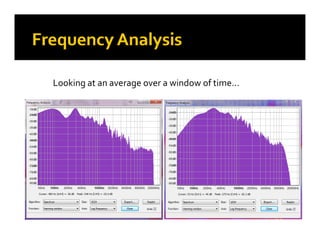
Looking at an average over a window of time…
Why does everyone sound good singing in the  
        Wh  d                 d    d  i i  i  th
         shower?
06:15
    5

           ACOUSTICS: study of waves in a medium


           Direct, Reflected, Refracted, Absorbed
                      fl    d    f     d b b d
   Hard surfaces
            f
     little sound absorbed (ceramic tile)
     many reflections reverberation

                                             ~50ms is threshold for 
                                                    i  th h ld f  
                                             hearing echo
   Small space
     accumulation of reflections 
      increases volume
     you sound more powerful!
   Resonant cavity
     Shower stall dimensions 
     cause standing waves at 
                d
     low frequencies; vocals in 
     this range will be boosted
   Car stereo acoustics
08:00
             “dead” sound environment, depends on materials 
              (leather vs. upholstry)
             transitory (windows open vs. closed)
             loud: riding the volume knob
   Single‐band compressor, loud bass information 
        l b d                l db         f
    modulates gain of the entire audio signal 
    suboptimal maximum perceived loudness & gain 
    pumping
   Listening to iPod
     [Portnuff] listening to earbuds for 90 minutes/day at 
       80% volume is probably safe for long‐term hearing 
       (softer is better: you can safely tune in at 70% 
       volume for about 4½ hours a day.)
       volume for about 4½ hours a day )
~ one in five teenagers had some kind of hearing loss in 
2005 2006, up from 15% of teenagers in the late 1980s and 
2005‐2006, up from 15% of teenagers in the late 1980s and 
early 90s, according to a study of nearly 5,000 people age 
12 to 19 published in the Journal of the American Medical 
Association.
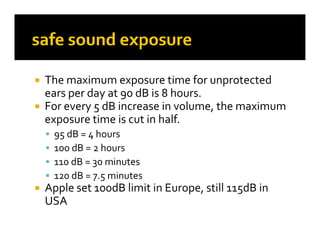
 The maximum exposure time for unprotected 
  Th       i                 ti  f       t t d 
  ears per day at 90 dB is 8 hours. 
 For every 5 dB increase in volume  the maximum 
  For every 5 dB increase in volume, the maximum 
  exposure time is cut in half.
       95
        95 dB = 4 hours
                4
       100 dB = 2 hours
       110 dB = 30 minutes
       120 dB = 7.5 minutes
   Apple set 100dB limit in Europe, still 115dB in 
    USA
 Dynamic compression a reality of modern 
                                   f
  music recordings (louder is better)
 Causes listener fatigue
         l        f
08:45
   45


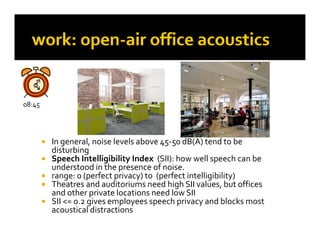
           In general, noise levels above 45‐50 dB(A) tend to be 
            I          l   i  l l   b              dB(A)  d   b  
            disturbing 
           Speech Intelligibility Index  (SII): how well speech can be 
            understood in the presence of noise.
                                p
           range: 0 (perfect privacy) to  (perfect intelligibility) 
           Theatres and auditoriums need high SII values, but offices 
            and other private locations need low SII
           SII <= 0.2 gives employees speech privacy and blocks most 
            SII <= 0 2 gives employees speech privacy and blocks most 
            acoustical distractions
   Ceiling and floor
    C ili   d fl
   Partitions (partial‐height screens)
   Workstation and Occupant Orientation
   Lighting fixtures (flat vs grill)
   Noise Masking System
   Noise‐cancellation headphones
        N i          ll ti  h d h
       Active vs. Passive
09:00
 9       Active: 
          ▪ produce “anti‐noise”
          ▪ require battery
          ▪ cancel low‐frequency  continuous 
            cancel low frequency, continuous 
            sound actively, high‐frequency through 
            design
         Passive
          ▪ physical block; works over wide range
          ▪ no battery
          ▪ weaker bass response (due to speaker 
            size)
   Your hearing… getting old…”eh?”
18:00

                              • outer/middle ear
                conductive
                              • often reversible


                             • inner ear
               sensorineural • not reversible
                             • can be age‐related
                                   b         l t d
   Symptoms
     Certain sounds seem overly loud
     Difficulty hearing things in noisy areas
     High‐pitched sounds such as "s" or 
        "th" are hard to distinguish from one 
        another
       Men's voices are easier to hear than 
        womens.
       Other people's voices sound mumbled 
               p p                                   20% over 65
        or slurred
       Ringing in the ears                        40% over 75
       “I hear but I can’t understand” 
                                                 80% nursing home 
                                                     residents
   Not just amplifiers
                  f
     ex. frequency translation
   Adapt to environment
     cocktail party effect
   Connected
     bluetooth
     bilateral communication
 36,000 people world‐
  36 000 people world
  wide received cochlear 
  implants over the last 
  two decades.
  t  d d
 FDA‐approved 1985 
  (adults), 1990 (children)
 Ad lt  
  Adults can now be 
                    b  
  considered candidates if 
  they have severe‐to‐
  profound hearing loss 
     f     d h i  l  
  and understand less 
  than 50% of sentences 
  spoken to them
     k  t  th
                              violin   violin, processed
noises off!
                ff
22:00

Acoustics Unplugged

  • 1.
  • 2.
    Who am I? h  Audio / Acoustics around the clock d d h l k
  • 4.
    1996 1997 19981999 2000 2001 2002 2003 2004 2005 2006 2007 2008 2009 2010  B. Eng, electrical, Minor Arts  NRC Women in Engineering and Science scholarship g g p • classroom and concert hall acoustics  S.M., Media Arts and Sciences  Cochlear implants hl l  how do they sound when music plays through them?
  • 5.
    1996 1997 19981999 2000 2001 2002 2003 2004 2005 2006 2007 2008 2009 2010  Programming 1’s and 0’s  Programming user software  Customer technical  support
  • 6.
    1996 1997 19981999 2000 2001 2002 2003 2004 2005 2006 2007 2008 2009 2010  One year in Copenhagen, DK  Customer technical support
  • 7.
    1996 1997 19981999 2000 2001 2002 2003 2004 2005 2006 2007 2008 2009 2010  Customer technical support (five months) C   h i l   (fi   h )  Manager, customer technical support team  China, Japan, Canada
  • 9.
    1996 1997 19981999 2000 2001 2002 2003 2004 2005 2006 2007 2008 2009 2010 • Flexible • People job www.mitacs.ca • Learn new stuff!
  • 10.
    •$7 500 industry 75 y $15 000 •$7 500 Mitacs/FQRNT $10 000 $5000 min for student flexible •$36 000 industry $80 000 •$44 000 Mitacs/FQRNT $10 000 $10 000 $10 000 $20 000 $10 000 $10 000 $10 000 flexible internships
  • 11.
  • 12.
     Sound is a form of energy (like electricity or  f f light)  Sound is made when air molecules vibrate  d d h l l b and move in a pattern waves Animation courtesy of Dr. Dan Russell, Kettering University
  • 13.
    Particle motion is a function of space (displacement, amplitude)  and time
  • 14.
    Longitudinal wave:  particle motion is parallel to motion of disturbance  created by moving object  Wave causes areas of compression (high  pressure) and rarefaction (low pressure).  We  )  d  f i  (l   )   W   call this PRESSURE waves
  • 15.
    c = 343m/s (air, 20oC) we INTERPRET sound waves
  • 16.
    Frequency:   F how often the particles are moving back and forth:  # of complete back‐and‐forth vibrations p of a particle of the medium Hertz: per unit of time # cycles per second 20Hz – 20 000Hz H     H Sensation of frequency = pitch
  • 18.
    Greater amplitude of disturbance causes   G   li d   f di b   greater displacement (amplitude) of particles  More amplitude  more energy  Intensity = power/area (Watts/m2)  Move away from sound ,intensity decreases  (inverse square)  Humans can detect as low as 1*10‐12 W/m2, , and as high as 1 billion times this!  Due to large range: dB  1*10‐12 W/m2  = 0 dB d
  • 20.
    sleep work work wake play
  • 21.
    Your alarm‐clock radio: fast facts f f 06:00  Why does Boston Acoustics sound better  than Accurian?
  • 23.
  • 24.
    Why does everyone sound good singing in the   Wh  d     d  d  i i  i  th shower? 06:15 5  ACOUSTICS: study of waves in a medium  Direct, Reflected, Refracted, Absorbed fl d f d b b d
  • 25.
    Hard surfaces f  little sound absorbed (ceramic tile)  many reflections reverberation ~50ms is threshold for   i  th h ld f   hearing echo
  • 26.
    Small space  accumulation of reflections  increases volume  you sound more powerful!  Resonant cavity  Shower stall dimensions  cause standing waves at  d low frequencies; vocals in  this range will be boosted
  • 28.
    Car stereo acoustics 08:00  “dead” sound environment, depends on materials  (leather vs. upholstry)  transitory (windows open vs. closed)  loud: riding the volume knob
  • 29.
    Single‐band compressor, loud bass information  l b d l db f modulates gain of the entire audio signal  suboptimal maximum perceived loudness & gain  pumping
  • 30.
    Listening to iPod  [Portnuff] listening to earbuds for 90 minutes/day at  80% volume is probably safe for long‐term hearing  (softer is better: you can safely tune in at 70%  volume for about 4½ hours a day.) volume for about 4½ hours a day ) ~ one in five teenagers had some kind of hearing loss in  2005 2006, up from 15% of teenagers in the late 1980s and  2005‐2006, up from 15% of teenagers in the late 1980s and  early 90s, according to a study of nearly 5,000 people age  12 to 19 published in the Journal of the American Medical  Association.
  • 31.
     The maximum exposure time for unprotected  Th   i    ti  f   t t d  ears per day at 90 dB is 8 hours.   For every 5 dB increase in volume  the maximum  For every 5 dB increase in volume, the maximum  exposure time is cut in half.  95 95 dB = 4 hours 4  100 dB = 2 hours  110 dB = 30 minutes  120 dB = 7.5 minutes  Apple set 100dB limit in Europe, still 115dB in  USA
  • 32.
     Dynamic compression a reality of modern  f music recordings (louder is better)  Causes listener fatigue l f
  • 34.
    08:45 45  In general, noise levels above 45‐50 dB(A) tend to be  I   l   i  l l   b    dB(A)  d   b   disturbing   Speech Intelligibility Index  (SII): how well speech can be  understood in the presence of noise. p  range: 0 (perfect privacy) to  (perfect intelligibility)   Theatres and auditoriums need high SII values, but offices  and other private locations need low SII  SII <= 0.2 gives employees speech privacy and blocks most  SII <= 0 2 gives employees speech privacy and blocks most  acoustical distractions
  • 35.
    Ceiling and floor C ili   d fl  Partitions (partial‐height screens)  Workstation and Occupant Orientation  Lighting fixtures (flat vs grill)  Noise Masking System
  • 36.
    Noise‐cancellation headphones N i ll ti  h d h  Active vs. Passive 09:00 9  Active:  ▪ produce “anti‐noise” ▪ require battery ▪ cancel low‐frequency  continuous  cancel low frequency, continuous  sound actively, high‐frequency through  design  Passive ▪ physical block; works over wide range ▪ no battery ▪ weaker bass response (due to speaker  size)
  • 37.
    Your hearing… getting old…”eh?” 18:00 • outer/middle ear conductive • often reversible • inner ear sensorineural • not reversible • can be age‐related  b   l t d
  • 38.
    Symptoms  Certain sounds seem overly loud  Difficulty hearing things in noisy areas  High‐pitched sounds such as "s" or  "th" are hard to distinguish from one  another  Men's voices are easier to hear than  womens.  Other people's voices sound mumbled  p p 20% over 65 or slurred  Ringing in the ears 40% over 75  “I hear but I can’t understand”  80% nursing home  residents
  • 39.
    Not just amplifiers f  ex. frequency translation  Adapt to environment  cocktail party effect  Connected  bluetooth  bilateral communication
  • 40.
     36,000 people world‐ 36 000 people world wide received cochlear  implants over the last  two decades. t  d d  FDA‐approved 1985  (adults), 1990 (children)  Ad lt   Adults can now be     b   considered candidates if  they have severe‐to‐ profound hearing loss  f d h i  l   and understand less  than 50% of sentences  spoken to them k  t  th violin violin, processed
  • 41.
    noises off! ff 22:00