BLU-RAY DISC   By  : Ankit Gupta
CD DVD BLU-RAY
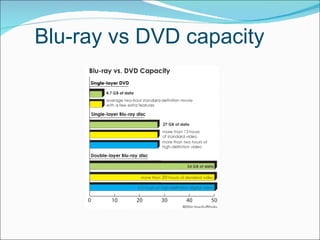
INTRODUCTION Blu-ray, also known as  Blu-ray Disc  (BD) is the name of a next-generation optical disc format. The format was developed to enable recording, rewriting and playback of high-definition video (HD), as well as  storing large amounts of data .  The format offers more than five times the storage capacity of traditional DVDs and can hold up to 25GB on a single-layer disc and 50GB on a  dual-layer disc.
Foundation Blu-ray disc (BD) is appropriately named after the blue laser used to write the data The first blue laser was developed in 1996 by Shuji Nakamura (Nichia Corporation) In 2002, an alliance was formed, called the Blu-ray Disc Association, including the likes of Sony, Samsung, Sharp, Hewlett-Packard, and Royal Phillips. It has One layer, Two layer, Three layer, Four layer  Five layer, Six layer.
Variations and Sizes A single-layer Blu-ray disc (BD) has enough storage capacity (25GB) for approximately two hours of high-definition video with audio.  A dual-layer (50GB) BD can hold enough data for approximately four hours of HD video.  TDK recently announced that they have created a working Blu-ray disc capable of holding 200GB of data (six 33GB data layers).
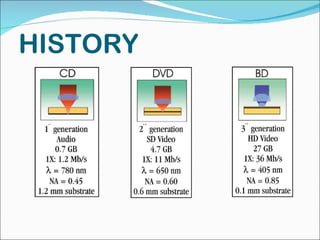
HISTORY                                                                                        
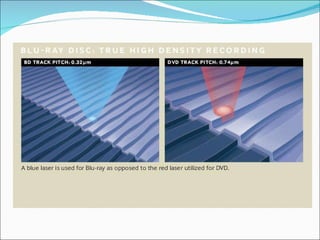
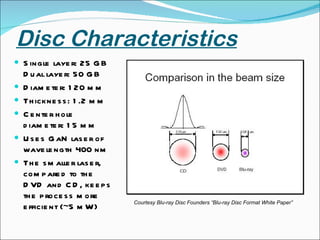
Laser and optics   Blu-ray systems use a blue-violet laser operating at a wavelength of 405 nm, similar to the one used for HD DVD, to read and write data. Conventional DVDs and CDs use red and infrared lasers at 650 nm and 780 nm respectively. Blu-ray has two types BD-R and BD-RE  with price $19.99 and $24.99 for 25GB and $47.99 and  $59.99 for 50GB respectively.
 
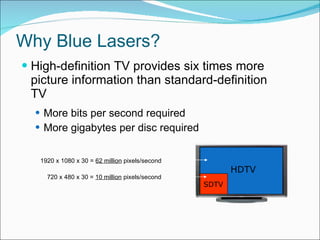
Why Blue Lasers? High-definition TV provides six times more picture information than standard-definition TV More bits per second required More gigabytes per disc required 1920 x 1080 x 30 =  62 million   pixels/second 720 x 480 x 30 =  10 million   pixels/second HDTV SDTV
Disc Characteristics Single layer: 25 GB Dual layer: 50 GB Diameter: 120 mm Thickness: 1.2 mm Center hole diameter: 15 mm Uses GaN laser of wavelength 400 nm The smaller laser, compared to the DVD and CD, keeps the process more efficient (~5 mW) Courtesy Blu-ray Disc Founders “Blu-ray Disc Format White Paper”
Hard-coating technology In January 2004 was introduced a clear polymer coating that gives Blu-ray Discs unprecedented scratch resistance. The coating was developed by TDK Corporation and is called "Durabis". It allows BDs to be cleaned safely with only a tissue.
Blu-ray vs DVD capacity
CD vs DVD vs Blu-ray writing
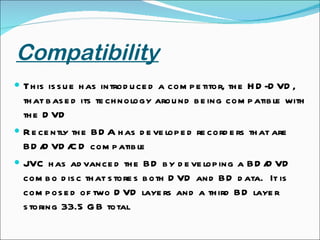
Compatibility This issue has introduced a competitor, the HD-DVD, that based its technology around being compatible with the DVD Recently the BDA has developed recorders that are BD/DVD/CD compatible JVC has advanced the BD by developing a BD/DVD combo disc that stores both DVD and BD data.  It is composed of two DVD layers and a third BD layer storing 33.5 GB total
Blu-ray Advantages   Record high-definition television (HDTV) without any quality loss  Instantly skip to any spot on the disc  Record one program while watching another on the disc Edit or reorder programs recorded on the disc  Automatically search for an empty space on the disc
Future Expect the BD to become more prevalent once the HDTV market establishes its presence Audio and video will reach higher qualities with larger storage space Look for BD with more than two layers as the technology is further refined
Conclusion Both DVD and BD would most likely co-exist for quiet some time until HDTVs become more widespread.
Thank you

Blue ray disc ppt

  • 1.
    BLU-RAY DISC By : Ankit Gupta
  • 2.
  • 3.
    INTRODUCTION Blu-ray, alsoknown as Blu-ray Disc (BD) is the name of a next-generation optical disc format. The format was developed to enable recording, rewriting and playback of high-definition video (HD), as well as storing large amounts of data . The format offers more than five times the storage capacity of traditional DVDs and can hold up to 25GB on a single-layer disc and 50GB on a dual-layer disc.
  • 4.
    Foundation Blu-ray disc(BD) is appropriately named after the blue laser used to write the data The first blue laser was developed in 1996 by Shuji Nakamura (Nichia Corporation) In 2002, an alliance was formed, called the Blu-ray Disc Association, including the likes of Sony, Samsung, Sharp, Hewlett-Packard, and Royal Phillips. It has One layer, Two layer, Three layer, Four layer Five layer, Six layer.
  • 5.
    Variations and SizesA single-layer Blu-ray disc (BD) has enough storage capacity (25GB) for approximately two hours of high-definition video with audio. A dual-layer (50GB) BD can hold enough data for approximately four hours of HD video. TDK recently announced that they have created a working Blu-ray disc capable of holding 200GB of data (six 33GB data layers).
  • 6.
    HISTORY                                                                                       
  • 7.
    Laser and optics Blu-ray systems use a blue-violet laser operating at a wavelength of 405 nm, similar to the one used for HD DVD, to read and write data. Conventional DVDs and CDs use red and infrared lasers at 650 nm and 780 nm respectively. Blu-ray has two types BD-R and BD-RE with price $19.99 and $24.99 for 25GB and $47.99 and $59.99 for 50GB respectively.
  • 8.
  • 9.
    Why Blue Lasers?High-definition TV provides six times more picture information than standard-definition TV More bits per second required More gigabytes per disc required 1920 x 1080 x 30 = 62 million pixels/second 720 x 480 x 30 = 10 million pixels/second HDTV SDTV
  • 10.
    Disc Characteristics Singlelayer: 25 GB Dual layer: 50 GB Diameter: 120 mm Thickness: 1.2 mm Center hole diameter: 15 mm Uses GaN laser of wavelength 400 nm The smaller laser, compared to the DVD and CD, keeps the process more efficient (~5 mW) Courtesy Blu-ray Disc Founders “Blu-ray Disc Format White Paper”
  • 11.
    Hard-coating technology InJanuary 2004 was introduced a clear polymer coating that gives Blu-ray Discs unprecedented scratch resistance. The coating was developed by TDK Corporation and is called "Durabis". It allows BDs to be cleaned safely with only a tissue.
  • 12.
  • 13.
    CD vs DVDvs Blu-ray writing
  • 14.
    Compatibility This issuehas introduced a competitor, the HD-DVD, that based its technology around being compatible with the DVD Recently the BDA has developed recorders that are BD/DVD/CD compatible JVC has advanced the BD by developing a BD/DVD combo disc that stores both DVD and BD data. It is composed of two DVD layers and a third BD layer storing 33.5 GB total
  • 15.
    Blu-ray Advantages Record high-definition television (HDTV) without any quality loss Instantly skip to any spot on the disc Record one program while watching another on the disc Edit or reorder programs recorded on the disc Automatically search for an empty space on the disc
  • 16.
    Future Expect theBD to become more prevalent once the HDTV market establishes its presence Audio and video will reach higher qualities with larger storage space Look for BD with more than two layers as the technology is further refined
  • 17.
    Conclusion Both DVDand BD would most likely co-exist for quiet some time until HDTVs become more widespread.
  • 18.

Editor's Notes

  • #10 High-definition television is about better picture quality and a better viewing experience. The reason people buy high-definition TVs is for a better picture. That improved viewing experience comes from the sixfold increase in picture information. But that increase in picture information also makes DVDs impractical for delivering high-definition content. They don’t hold enough content.