Hybrid Memory Cube

Developing Scalable and Resilient Memory Systems

Ryan Baxter
Senior Manager, Business Development
Server and Storage DRAM
rrbaxter@micron.com
©2013 Micron Technology, Inc. All rights reserved. Products are warranted only to meet Micron’s production data sheet specifications. Information, products, and/or specifications
are subject to change without notice. All information is provided on an ―AS IS‖ basis without warranties of any kind. Dates are estimates only. Drawings are not to scale. Micron and
the Micron logo are trademarks of Micron Technology, Inc. All other trademarks are the property of their respective owners.

©2013 Micron Technology, Inc.

|

1
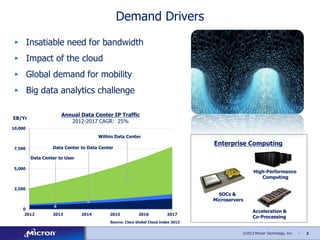
Demand Drivers
▶ Insatiable need for bandwidth
▶ Impact of the cloud

▶ Global demand for mobility
▶ Big data analytics challenge
Annual Data Center IP Traffic
2012-2017 CAGR: 25%

EB/Yr
10,000

Within Data Center

Enterprise Computing

Data Center to Data Center

7,500

Data Center to User
5,000

High-Performance
Computing

2,500

SOCs &
Microservers
0
2012

2013

2014

2015

2016

2017

Acceleration &
Co-Processing

Source: Cisco Global Cloud Index 2013
©2013 Micron Technology, Inc.

|

2
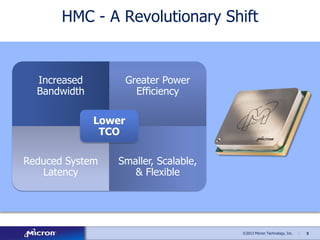
HMC - A Revolutionary Shift

Increased
Bandwidth

Greater Power
Efficiency
Lower
TCO

Reduced System
Latency

Smaller, Scalable,
& Flexible

©2013 Micron Technology, Inc.

|

3
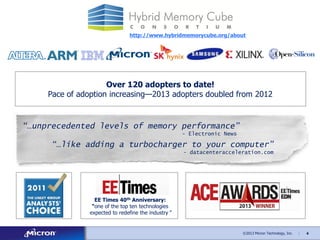
http://www.hybridmemorycube.org/about

Over 120 adopters to date!
Pace of adoption increasing—2013 adopters doubled from 2012

“…unprecedented levels of memory performance”
- Electronic News

“…like adding a turbocharger to your computer”
- datacenteracceleration.com

EE Times 40th Anniversary:
“one of the top ten technologies
expected to redefine the industry‖

©2013 Micron Technology, Inc.

|

4
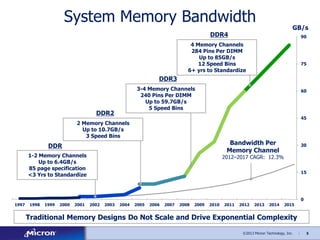
System Memory Bandwidth

GB/s

DDR4

90

4 Memory Channels
284 Pins Per DIMM
Up to 85GB/s
12 Speed Bins
6+ yrs to Standardize

75

DDR3
3-4 Memory Channels
240 Pins Per DIMM
Up to 59.7GB/s
5 Speed Bins

DDR2

60

45

2 Memory Channels
Up to 10.7GB/s
3 Speed Bins

Bandwidth Per
Memory Channel

DDR
1-2 Memory Channels
Up to 6.4GB/s
85 page specification
<3 Yrs to Standardize

30

2012–2017 CAGR: 12.3%
15

0
1997

1998

1999

2000

2001

2002

2003

2004

2005

2006

2007

2008

2009

2010

2011

2012

2013

2014

2015

Traditional Memory Designs Do Not Scale and Drive Exponential Complexity
©2013 Micron Technology, Inc.

|

5
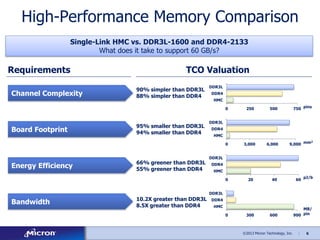
High-Performance Memory Comparison
Single-Link HMC vs. DDR3L-1600 and DDR4-2133
What does it take to support 60 GB/s?

Requirements
Channel Complexity

TCO Valuation
90% simpler than DDR3L
88% simpler than DDR4

DDR3L
DDR4
HMC
0

0

Energy Efficiency

66% greener than DDR3L
55% greener than DDR4

3,000

0

Board Footprint

95% smaller than DDR3L
94% smaller than DDR4

250

20

40

0

300

750 pins

500

600

DDR3L
DDR4
HMC
6,000

2
9,000 mm

DDR3L
DDR4
HMC
60

pJ/b

DDR3L

Bandwidth

10.2X greater than DDR3L
8.5X greater than DDR4

DDR4
HMC

©2013 Micron Technology, Inc.

MB/
900 pin

|

6
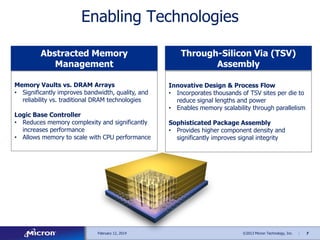
Enabling Technologies
Abstracted Memory
Management
Memory Vaults vs. DRAM Arrays
• Significantly improves bandwidth, quality, and
reliability vs. traditional DRAM technologies
Logic Base Controller
• Reduces memory complexity and significantly
increases performance
• Allows memory to scale with CPU performance

February 12, 2014

Through-Silicon Via (TSV)
Assembly
Innovative Design & Process Flow
• Incorporates thousands of TSV sites per die to
reduce signal lengths and power
• Enables memory scalability through parallelism
Sophisticated Package Assembly
• Provides higher component density and
significantly improves signal integrity

©2013 Micron Technology, Inc.

|

7
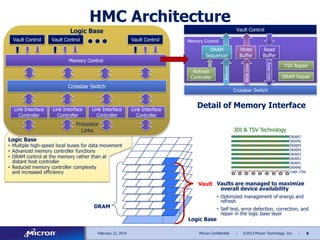
HMC Architecture
Vault Control

Logic Base
Vault Control

Memory Control

Refresh
Controller

Crossbar Switch

Link Interface
Controller

Link Interface
Controller

Link Interface
Controller

Read
Buffer
Read Data

DRAM
Sequencer

Memory Control

Write
Buffer
Write Data

Vault Control

Request

Vault Control

TSV Repair
DRAM Repair

Crossbar Switch

Link Interface
Controller

Detail of Memory Interface

Processor
Links

3DI & TSV Technology
DRAM7
DRAM6
DRAM5
DRAM4
DRAM3
DRAM2
DRAM1
DRAM0
Logic Chip

Logic Base

• Multiple high-speed local buses for data movement
• Advanced memory controller functions
• DRAM control at the memory rather than at
distant host controller
• Reduced memory controller complexity
and increased efficiency

Vault Vaults are managed to maximize
overall device availability
• Optimized management of energy and
refresh

DRAM
Logic Base
February 12, 2014

• Self test, error detection, correction, and
repair in the logic base layer

Micron Confidential

|

©2013 Micron Technology, Inc.

|

8
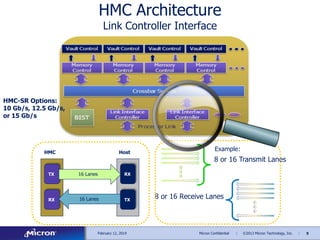
HMC Architecture
Link Controller Interface

HMC-SR Options:
10 Gb/s, 12.5 Gb/s,
or 15 Gb/s

HMC

Host

TX

16 Lanes

16 Lanes

TX

8 or 16 Transmit Lanes

RX

RX

Example:

February 12, 2014

8 or 16 Receive Lanes

Micron Confidential

|

©2013 Micron Technology, Inc.

|

9
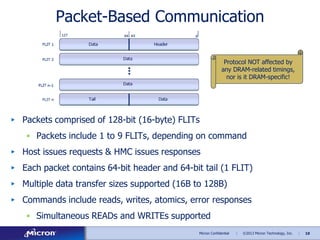
Packet-Based Communication
Protocol NOT affected by
any DRAM-related timings,
nor is it DRAM-specific!

▶ Packets comprised of 128-bit (16-byte) FLITs
 Packets include 1 to 9 FLITs, depending on command
▶ Host issues requests & HMC issues responses
▶ Each packet contains 64-bit header and 64-bit tail (1 FLIT)
▶ Multiple data transfer sizes supported (16B to 128B)
▶ Commands include reads, writes, atomics, error responses
 Simultaneous READs and WRITEs supported
Micron Confidential

|

©2013 Micron Technology, Inc.

|

10
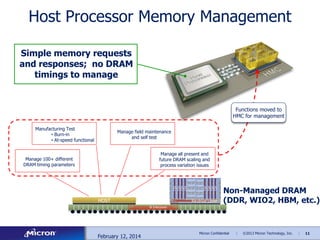
Host Processor Memory Management
Simple memory requests
and responses; no DRAM
timings to manage

Functions moved to
HMC for management
Manufacturing Test
• Burn-in
• At-speed functional

Manage field maintenance
and self test
Manage all present and
future DRAM scaling and
process variation issues

Manage 100+ different
DRAM timing parameters

DRAM Layer
TSV
TSV
TSV
TSV

TSV
TSV
TSV
TSV

DRAM Layer
DRAM Layer
DRAM Layer

HOST

Re-drive Layer

Non-Managed DRAM
(DDR, WIO2, HBM, etc.)

Si Interposer

February 12, 2014

Micron Confidential

|

©2013 Micron Technology, Inc.

|

11
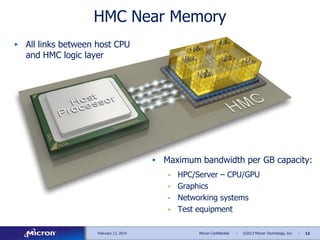
HMC Near Memory
▶ All links between host CPU

and HMC logic layer

▶ Maximum bandwidth per GB capacity:
HPC/Server – CPU/GPU
 Graphics
 Networking systems
 Test equipment


February 12, 2014

Micron Confidential

|

©2013 Micron Technology, Inc.

|

12
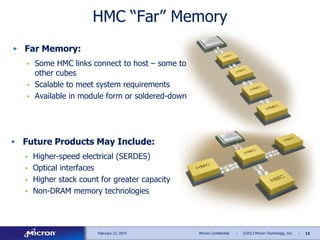
HMC ―Far‖ Memory
▶ Far Memory:
Some HMC links connect to host – some to
other cubes
 Scalable to meet system requirements
 Available in module form or soldered-down


▶ Future Products May Include:
Higher-speed electrical (SERDES)
 Optical interfaces
 Higher stack count for greater capacity
 Non-DRAM memory technologies


February 12, 2014

Micron Confidential

|

©2013 Micron Technology, Inc.

|

13
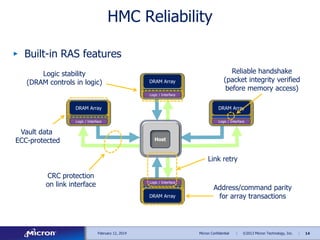
HMC Reliability
▶ Built-in RAS features
Logic stability
(DRAM controls in logic)

DRAM Array

Reliable handshake
(packet integrity verified
before memory access)

Logic / Interface

DRAM Array

DRAM Array

Logic / Interface

Logic / Interface

Vault data
ECC-protected

Host

Link retry
CRC protection
on link interface

Logic / Interface

DRAM Array

February 12, 2014

Address/command parity
for array transactions

Micron Confidential

|

©2013 Micron Technology, Inc.

|

14
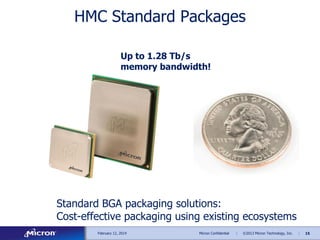
HMC Standard Packages
Up to 1.28 Tb/s
memory bandwidth!

Standard BGA packaging solutions:
Cost-effective packaging using existing ecosystems
February 12, 2014

Micron Confidential

|

©2013 Micron Technology, Inc.

|

15
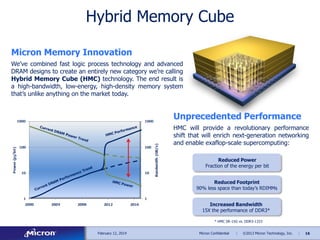
Hybrid Memory Cube
Micron Memory Innovation
We’ve combined fast logic process technology and advanced
DRAM designs to create an entirely new category we’re calling
Hybrid Memory Cube (HMC) technology. The end result is
a high-bandwidth, low-energy, high-density memory system
that’s unlike anything on the market today.

Unprecedented Performance
HMC will provide a revolutionary performance
shift that will enrich next-generation networking
and enable exaflop-scale supercomputing:
Reduced Power
Fraction of the energy per bit
Reduced Footprint
90% less space than today’s RDIMMs
Increased Bandwidth
15X the performance of DDR3*
* HMC SR-15G vs. DDR3-1333
February 12, 2014

Micron Confidential

|

©2013 Micron Technology, Inc.

|

16
Hybrid Memory Cube: Developing Scalable and Resilient Memory Systems

Hybrid Memory Cube: Developing Scalable and Resilient Memory Systems

  • 1.
    Hybrid Memory Cube DevelopingScalable and Resilient Memory Systems Ryan Baxter Senior Manager, Business Development Server and Storage DRAM rrbaxter@micron.com ©2013 Micron Technology, Inc. All rights reserved. Products are warranted only to meet Micron’s production data sheet specifications. Information, products, and/or specifications are subject to change without notice. All information is provided on an ―AS IS‖ basis without warranties of any kind. Dates are estimates only. Drawings are not to scale. Micron and the Micron logo are trademarks of Micron Technology, Inc. All other trademarks are the property of their respective owners. ©2013 Micron Technology, Inc. | 1
  • 2.
    Demand Drivers ▶ Insatiableneed for bandwidth ▶ Impact of the cloud ▶ Global demand for mobility ▶ Big data analytics challenge Annual Data Center IP Traffic 2012-2017 CAGR: 25% EB/Yr 10,000 Within Data Center Enterprise Computing Data Center to Data Center 7,500 Data Center to User 5,000 High-Performance Computing 2,500 SOCs & Microservers 0 2012 2013 2014 2015 2016 2017 Acceleration & Co-Processing Source: Cisco Global Cloud Index 2013 ©2013 Micron Technology, Inc. | 2
  • 3.
    HMC - ARevolutionary Shift Increased Bandwidth Greater Power Efficiency Lower TCO Reduced System Latency Smaller, Scalable, & Flexible ©2013 Micron Technology, Inc. | 3
  • 4.
    http://www.hybridmemorycube.org/about Over 120 adoptersto date! Pace of adoption increasing—2013 adopters doubled from 2012 “…unprecedented levels of memory performance” - Electronic News “…like adding a turbocharger to your computer” - datacenteracceleration.com EE Times 40th Anniversary: “one of the top ten technologies expected to redefine the industry‖ ©2013 Micron Technology, Inc. | 4
  • 5.
    System Memory Bandwidth GB/s DDR4 90 4Memory Channels 284 Pins Per DIMM Up to 85GB/s 12 Speed Bins 6+ yrs to Standardize 75 DDR3 3-4 Memory Channels 240 Pins Per DIMM Up to 59.7GB/s 5 Speed Bins DDR2 60 45 2 Memory Channels Up to 10.7GB/s 3 Speed Bins Bandwidth Per Memory Channel DDR 1-2 Memory Channels Up to 6.4GB/s 85 page specification <3 Yrs to Standardize 30 2012–2017 CAGR: 12.3% 15 0 1997 1998 1999 2000 2001 2002 2003 2004 2005 2006 2007 2008 2009 2010 2011 2012 2013 2014 2015 Traditional Memory Designs Do Not Scale and Drive Exponential Complexity ©2013 Micron Technology, Inc. | 5
  • 6.
    High-Performance Memory Comparison Single-LinkHMC vs. DDR3L-1600 and DDR4-2133 What does it take to support 60 GB/s? Requirements Channel Complexity TCO Valuation 90% simpler than DDR3L 88% simpler than DDR4 DDR3L DDR4 HMC 0 0 Energy Efficiency 66% greener than DDR3L 55% greener than DDR4 3,000 0 Board Footprint 95% smaller than DDR3L 94% smaller than DDR4 250 20 40 0 300 750 pins 500 600 DDR3L DDR4 HMC 6,000 2 9,000 mm DDR3L DDR4 HMC 60 pJ/b DDR3L Bandwidth 10.2X greater than DDR3L 8.5X greater than DDR4 DDR4 HMC ©2013 Micron Technology, Inc. MB/ 900 pin | 6
  • 7.
    Enabling Technologies Abstracted Memory Management MemoryVaults vs. DRAM Arrays • Significantly improves bandwidth, quality, and reliability vs. traditional DRAM technologies Logic Base Controller • Reduces memory complexity and significantly increases performance • Allows memory to scale with CPU performance February 12, 2014 Through-Silicon Via (TSV) Assembly Innovative Design & Process Flow • Incorporates thousands of TSV sites per die to reduce signal lengths and power • Enables memory scalability through parallelism Sophisticated Package Assembly • Provides higher component density and significantly improves signal integrity ©2013 Micron Technology, Inc. | 7
  • 8.
    HMC Architecture Vault Control LogicBase Vault Control Memory Control Refresh Controller Crossbar Switch Link Interface Controller Link Interface Controller Link Interface Controller Read Buffer Read Data DRAM Sequencer Memory Control Write Buffer Write Data Vault Control Request Vault Control TSV Repair DRAM Repair Crossbar Switch Link Interface Controller Detail of Memory Interface Processor Links 3DI & TSV Technology DRAM7 DRAM6 DRAM5 DRAM4 DRAM3 DRAM2 DRAM1 DRAM0 Logic Chip Logic Base • Multiple high-speed local buses for data movement • Advanced memory controller functions • DRAM control at the memory rather than at distant host controller • Reduced memory controller complexity and increased efficiency Vault Vaults are managed to maximize overall device availability • Optimized management of energy and refresh DRAM Logic Base February 12, 2014 • Self test, error detection, correction, and repair in the logic base layer Micron Confidential | ©2013 Micron Technology, Inc. | 8
  • 9.
    HMC Architecture Link ControllerInterface HMC-SR Options: 10 Gb/s, 12.5 Gb/s, or 15 Gb/s HMC Host TX 16 Lanes 16 Lanes TX 8 or 16 Transmit Lanes RX RX Example: February 12, 2014 8 or 16 Receive Lanes Micron Confidential | ©2013 Micron Technology, Inc. | 9
  • 10.
    Packet-Based Communication Protocol NOTaffected by any DRAM-related timings, nor is it DRAM-specific! ▶ Packets comprised of 128-bit (16-byte) FLITs  Packets include 1 to 9 FLITs, depending on command ▶ Host issues requests & HMC issues responses ▶ Each packet contains 64-bit header and 64-bit tail (1 FLIT) ▶ Multiple data transfer sizes supported (16B to 128B) ▶ Commands include reads, writes, atomics, error responses  Simultaneous READs and WRITEs supported Micron Confidential | ©2013 Micron Technology, Inc. | 10
  • 11.
    Host Processor MemoryManagement Simple memory requests and responses; no DRAM timings to manage Functions moved to HMC for management Manufacturing Test • Burn-in • At-speed functional Manage field maintenance and self test Manage all present and future DRAM scaling and process variation issues Manage 100+ different DRAM timing parameters DRAM Layer TSV TSV TSV TSV TSV TSV TSV TSV DRAM Layer DRAM Layer DRAM Layer HOST Re-drive Layer Non-Managed DRAM (DDR, WIO2, HBM, etc.) Si Interposer February 12, 2014 Micron Confidential | ©2013 Micron Technology, Inc. | 11
  • 12.
    HMC Near Memory ▶All links between host CPU and HMC logic layer ▶ Maximum bandwidth per GB capacity: HPC/Server – CPU/GPU  Graphics  Networking systems  Test equipment  February 12, 2014 Micron Confidential | ©2013 Micron Technology, Inc. | 12
  • 13.
    HMC ―Far‖ Memory ▶Far Memory: Some HMC links connect to host – some to other cubes  Scalable to meet system requirements  Available in module form or soldered-down  ▶ Future Products May Include: Higher-speed electrical (SERDES)  Optical interfaces  Higher stack count for greater capacity  Non-DRAM memory technologies  February 12, 2014 Micron Confidential | ©2013 Micron Technology, Inc. | 13
  • 14.
    HMC Reliability ▶ Built-inRAS features Logic stability (DRAM controls in logic) DRAM Array Reliable handshake (packet integrity verified before memory access) Logic / Interface DRAM Array DRAM Array Logic / Interface Logic / Interface Vault data ECC-protected Host Link retry CRC protection on link interface Logic / Interface DRAM Array February 12, 2014 Address/command parity for array transactions Micron Confidential | ©2013 Micron Technology, Inc. | 14
  • 15.
    HMC Standard Packages Upto 1.28 Tb/s memory bandwidth! Standard BGA packaging solutions: Cost-effective packaging using existing ecosystems February 12, 2014 Micron Confidential | ©2013 Micron Technology, Inc. | 15
  • 16.
    Hybrid Memory Cube MicronMemory Innovation We’ve combined fast logic process technology and advanced DRAM designs to create an entirely new category we’re calling Hybrid Memory Cube (HMC) technology. The end result is a high-bandwidth, low-energy, high-density memory system that’s unlike anything on the market today. Unprecedented Performance HMC will provide a revolutionary performance shift that will enrich next-generation networking and enable exaflop-scale supercomputing: Reduced Power Fraction of the energy per bit Reduced Footprint 90% less space than today’s RDIMMs Increased Bandwidth 15X the performance of DDR3* * HMC SR-15G vs. DDR3-1333 February 12, 2014 Micron Confidential | ©2013 Micron Technology, Inc. | 16