Digital Scholarly 
Communication 
@ Claremont Colleges 
Ashley Sanders 
PhD Candidate 
DH Specialist
What Now? 
1. Fast Trends (1-2 years): 
Increasing focus on research data management 
for publications 
Prioritize mobile content & delivery 
2. Mid-Range Trends (3-5 years): 
Evolution of scholarly record 
Increasing accessibility of research content 
3. Long-Range Trends (5+ years): 
Continual progress in technology, standards, and 
infrastructure 
New forms of multi-disciplinary research
Fast Trends: Research Data Management 
and Mobile Content Delivery 
@Claremont 
Suggestions 
Structured data: Using URIs 
to name digital objects and 
link related resources. 
Begin implementing now 
but it is also a long-range 
trend 
Access to research 
databases & data 
visualizations 
Integration of various media 
in scholarly publishing 
Mobile Apps 
Resources & Examples 
LOD for Newcomers: 
http://documentingcappadocia.newmedialab.cuny.e 
du/linked-data-for-the-uninitiated-part-1/ 
Visualizing historiography: 
http://clio.osu.edu/fhq/3d/ 
U-Mass Re-use & Re-distribution 
Guidelines:http://www.library.umass.edu/service 
s/services-for-faculty/data-management/data-management- 
plan-guidance/re-use-and-re-distribution/ 
University of 
AZhttp://www.library.arizona.edu/help/how-do-i/ 
mobile#other 
Mobile Brown University: 
http://library.brown.edu/m/ 
1.
Multiple Word http://Clouds clio.osu.edu/fhq/– 3d/ 
10-Year Spans 
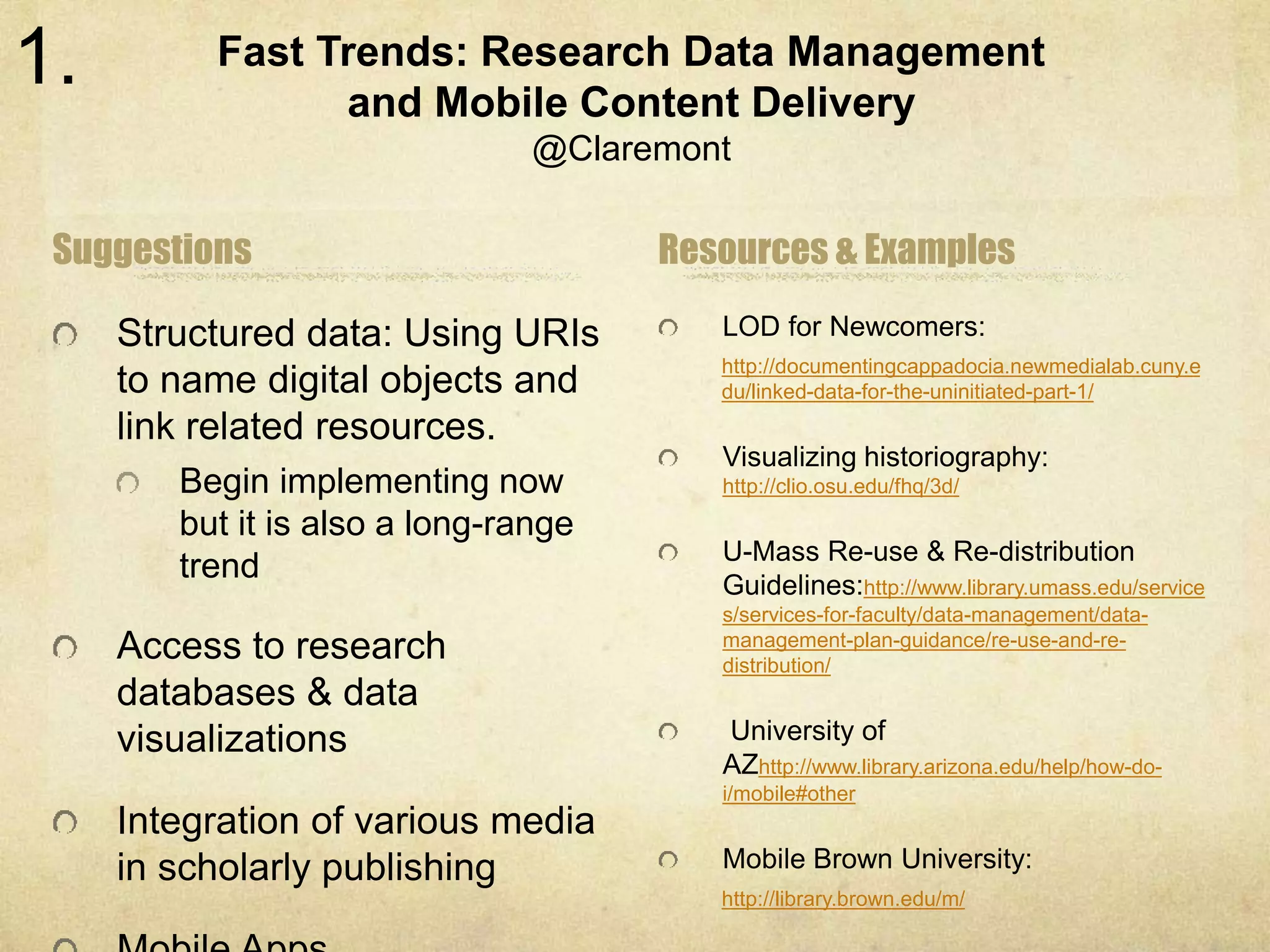
Data Visualizations 
David J. Staley, Scott A. 
French and Bill Ferster, “Visual 
Historiography: Visualizing 
‘The Literature of a Field’”, 
Poster Presented at DH2013 
and featured in JDH 3:1 
(Spring 2014). 
http://journalofdigitalhumanities 
.org/3-1/visual-historiography-visualizing- 
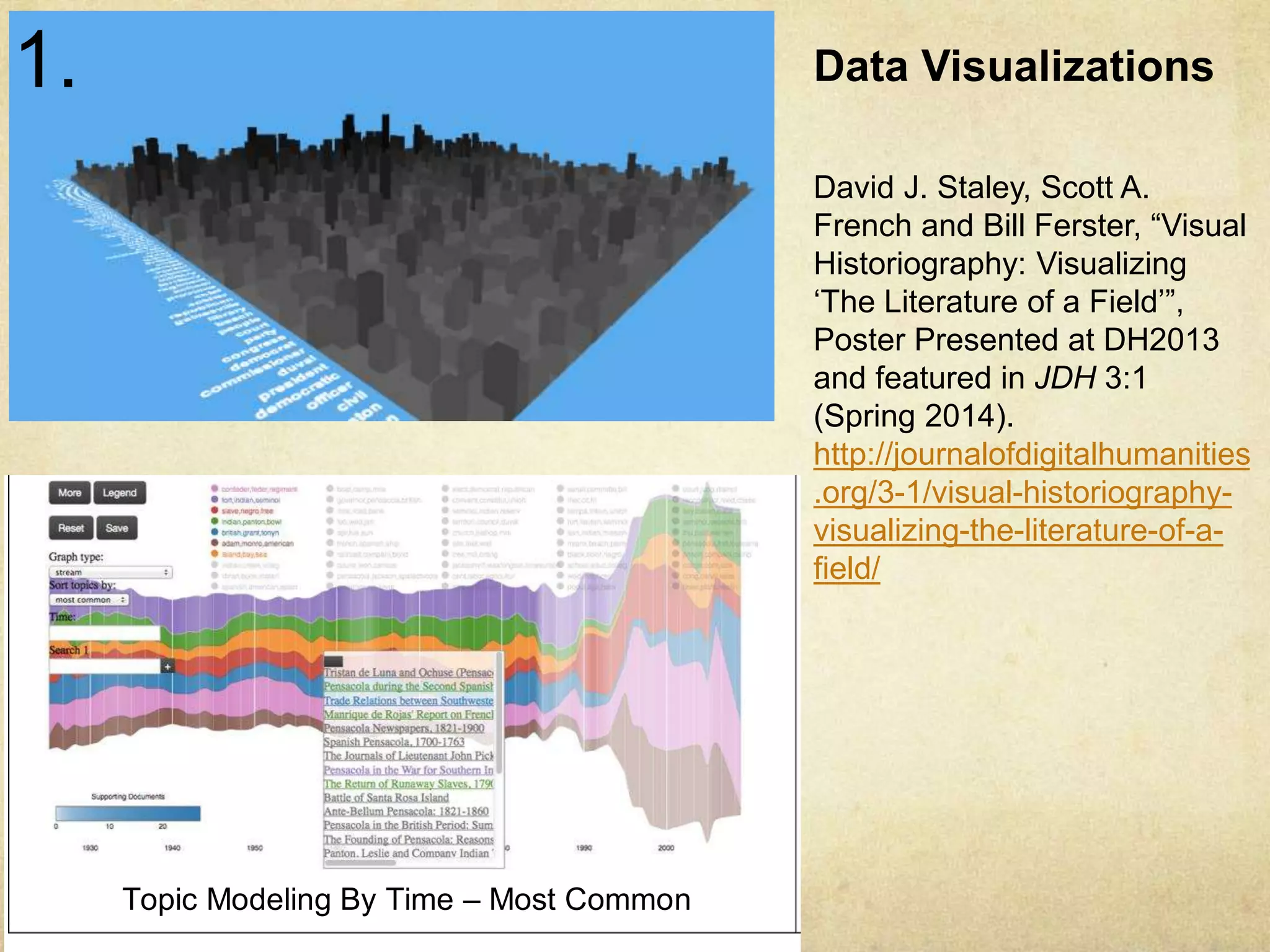
Phrase Net - x’s Topic Modeling By Time – Most Common 
The call for visualizing “Big Data” has generated a groundswell of interest among historians and humanities scholars, as 
demonstrated by the international response to the National Endowment for the Humanities’ 2010 and 2011 Digging into 
Data challenges. Exemplary efforts from the first two rounds of projects suggest the great potential for visualizing large 
repositories of primary sources for historical insight. 
Our project treats a peer-reviewed scholarly journal – Florida Historical Quarterly, housed at the University of Central 
Florida – as a dataset to be analyzed and visualized. In applying macro-level reading and text-mining tools to the 
secondary literature of a scholarly field, we are making visible patterns of topical coverage. 
In this poster, we present the results of our case study. We machine-read over 1500 research articles across the entire 
85 year run of the journal (1924-2009) and identified the top 100 key terms. (The top key term “Indian” is located at the 
center of the visualization; the rest of the key term list expands out from the middle.) We then arrayed each of these key 
terms according to the number of times the key term appears per year in order to develop a “macro-reading” of the 
journal. Key terms were identified using the Data For Research application developed by JSTOR. The key terms were 
determined using term frequency–inverse document frequency (TF-IDF), a statistical measure of how important a word is 
in a given document. We have generated two such visualizations from this data: a 2-D chart and the same data as a 3-D 
interactive “topology” (the latter soon to be “translated” into a physical sculpture.) 
the-literature-of-a-field/ 
Heat Map 
1.
Access to Research Data 
Sets 
Source: Left: C. Tenopir Et Al. Plos One 6, E21101 (2011); Right: 
Tenopir/Allard/Sandusky/Birch/NSF Dataone Project. In “Publishing Frontiers: The Library Reboot.” 
http://www.nature.com/news/publishing-frontiers-the-library-reboot-1.12664 
1.
Marketing 
Scholarship@Claremont 
Scholarship@Claremont on Twitter 
Link to it on the library home page 
Invite faculty and students to do lightning talks 
and longer interviews about their research 
Create a YouTube stream to feature them and 
embed it in the website 
Showcase multimedia publications, interactive 
digital projects & scholars’ websites 
Host an “induction” ceremony each term for 
scholars whose work has been added to the 
database 
*
Mid-Range Trends (3-5 years): 
Evolution of Scholarly Record 
@Claremont 
Suggestions 
Access to grey literature 
through 
Scholarship@Claremont: 
Conference proceedings, 
white papers, lab reports, 
etc. 
Stay current on digital 
publication trends to advise 
administrators, faculty & grad 
students. 
Blogs, Twitter, & 
Academia.edu 
Digital scholarship 
assessment: 
Resources & Examples 
Grey Lit Database: 
http://www.greylit.org/ 
Innovating Communication 
in Scholarship (ICIS) @UC 
Davis: 
http://icis.ucdavis.edu/?pag 
e_id=259 
microBEnet: The 
Microbiology of the Built 
Environment: 
http://microbe.net/ 
H-Net: 
http://networks.h-net.org 
2.
New Forms of Scholarly Communication & 
Publication 
2. 
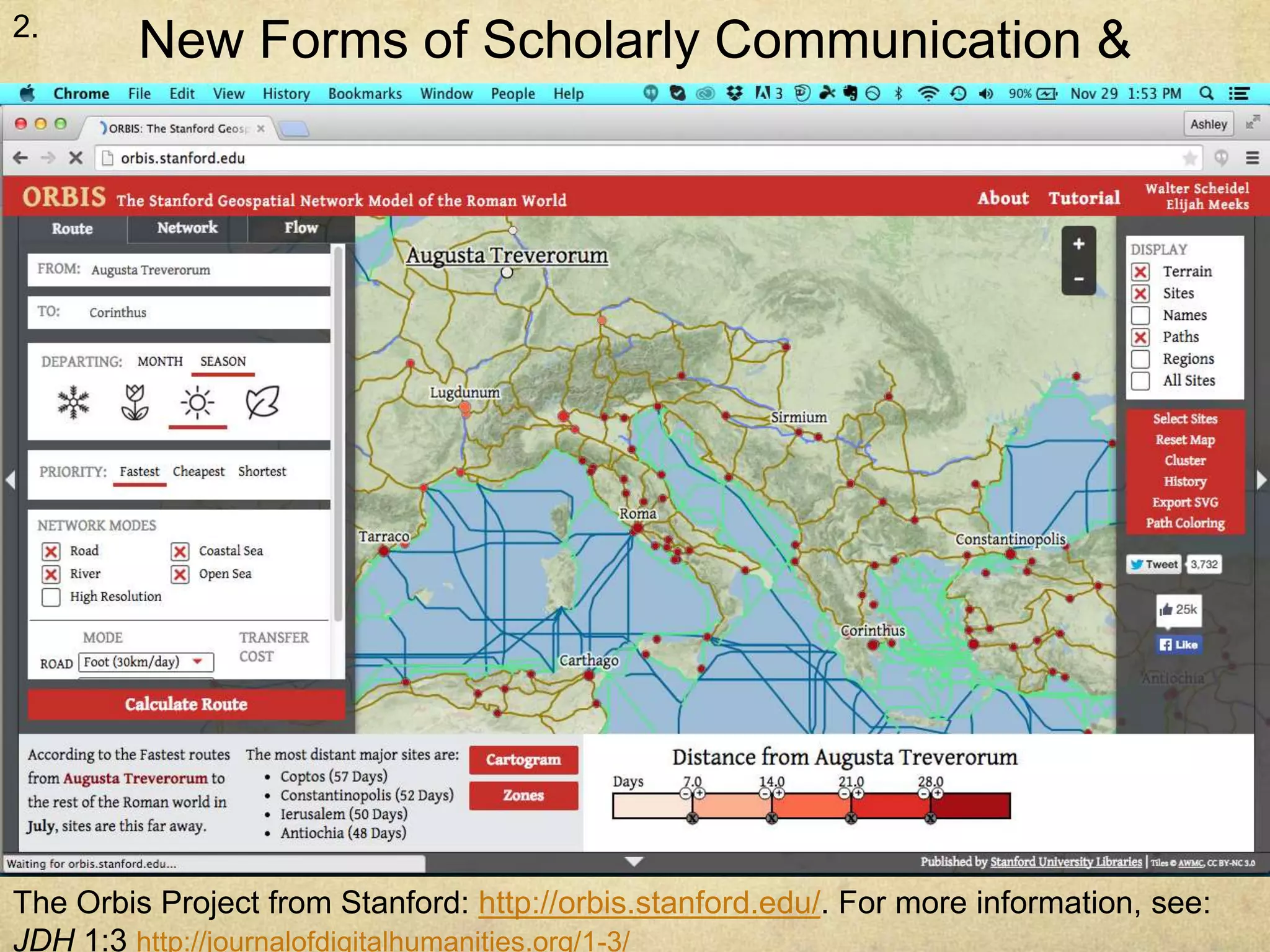
The Orbis Project from Stanford: http://orbis.stanford.edu/. For more information, see: 
JDH 1:3 http://journalofdigitalhumanities.org/1-3/
New Forms of Scholarly Communication & 
Publication 
2. 
Other examples of digital scholarship 
include: 
Mapping the Republic of Letters (Stanford): 
http://republicofletters.stanford.edu/ 
Shaping the West (Stanford): 
https://web.stanford.edu/group/spatialhistory/cgi-bin/ 
site/project.php?id=997 
Hypercities (UCLA): http://hypercities.ats.ucla.edu/ 
Van Gogh Letters (Van Gogh Museum): 
http://www.vangoghletters.org/vg/
Long-Range Trends (5+ years): 
Technology, Standards and Infrastructure 
@Claremont 
Suggestions 
Re-envisioning library 
services 
Maker-spaces 
DH Lab 
Virtual meeting & research 
collaboration platforms 
Facilitating multidisciplinary 
research 
Demo such research 
Create interactive spaces 
Host intercollegiate 
networking opportunities 
Resources & Examples 
GVSU Tech Showcase: 
http://www.gvsu.edu/techsh 
owcase/ 
LMU|LA Library: 
http://library.lmu.edu/usingth 
elibrary/spaces/#d.en.90115 
Scholars’ Lab Maker Space @ 
UVA: 
http://scholarslab.org/maker 
space/ 
Heurist Collaborative Digital 
Workspace 
http://heuristnetwork.org/ 
3.
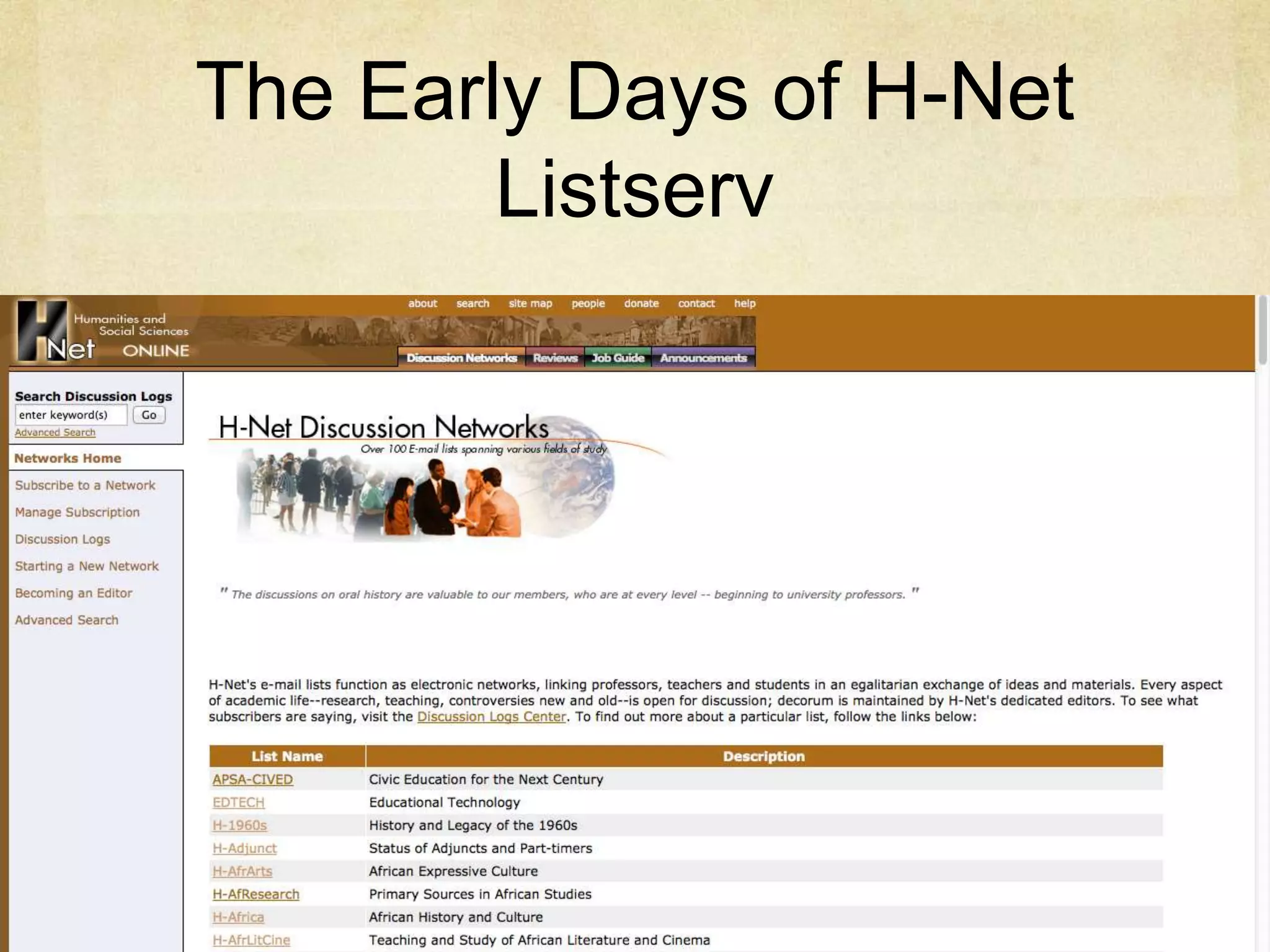
The Early Days of H-Net 
Listserv
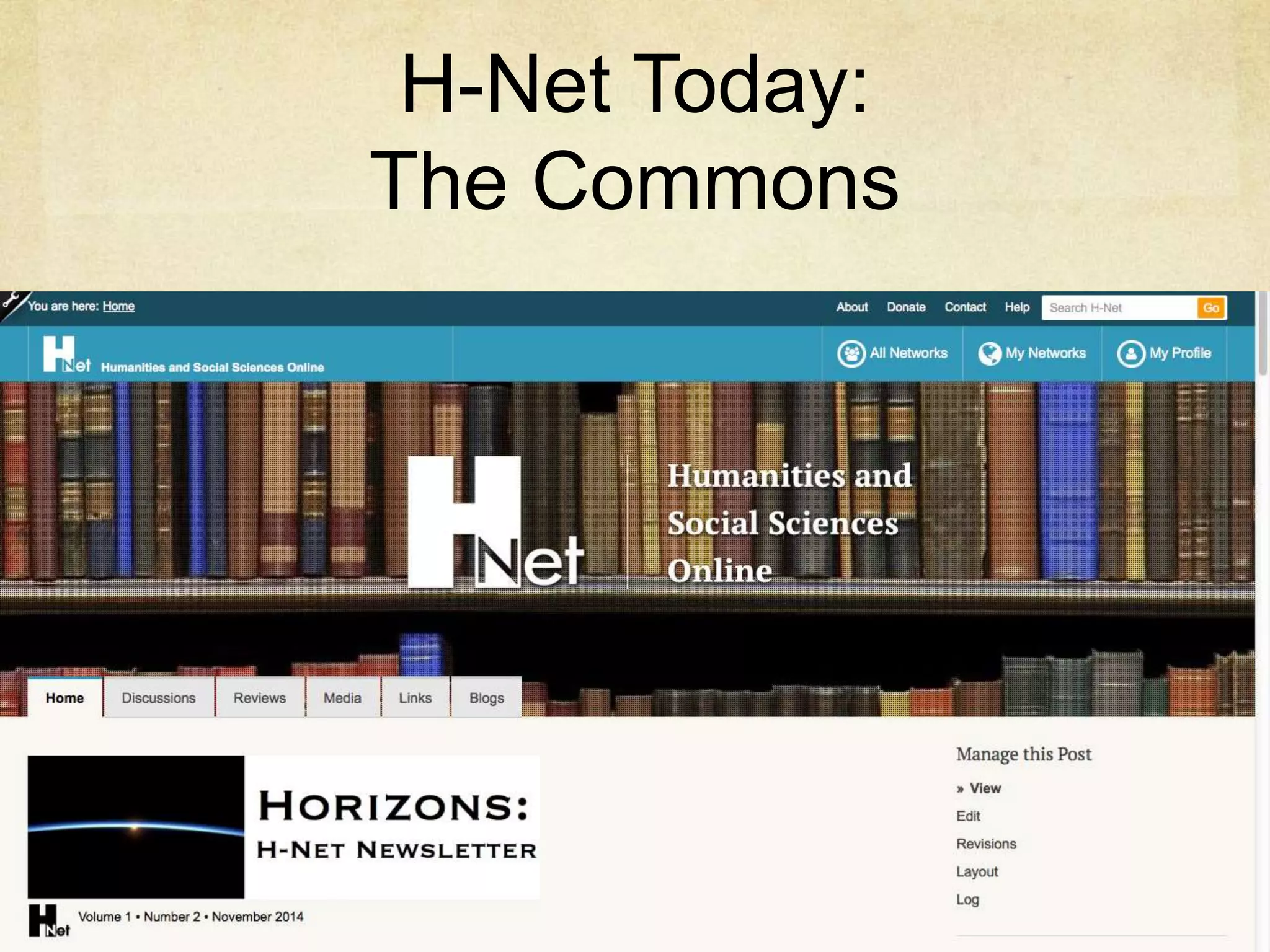
H-Net Today: 
The Commons
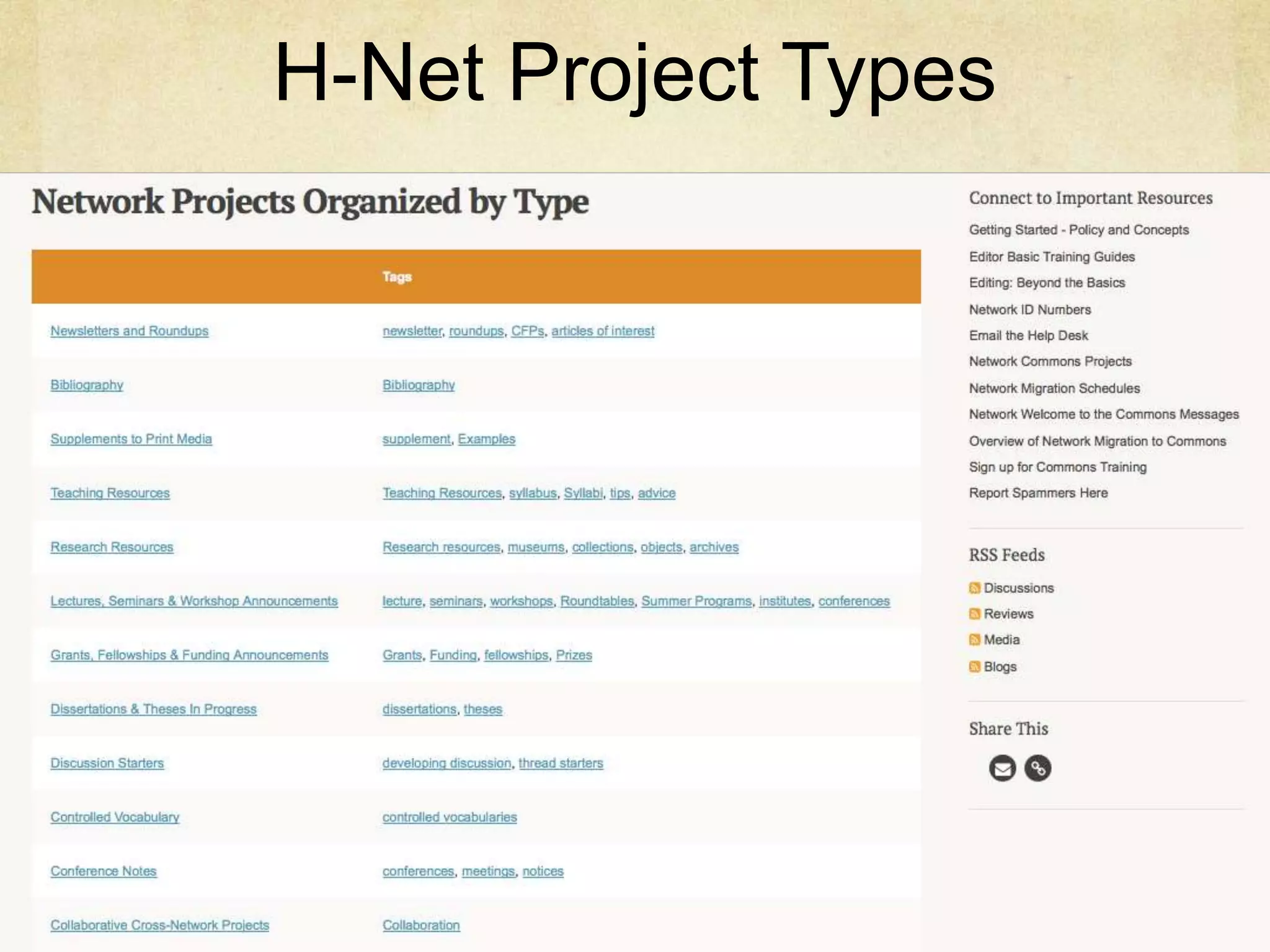
H-Net Project Types
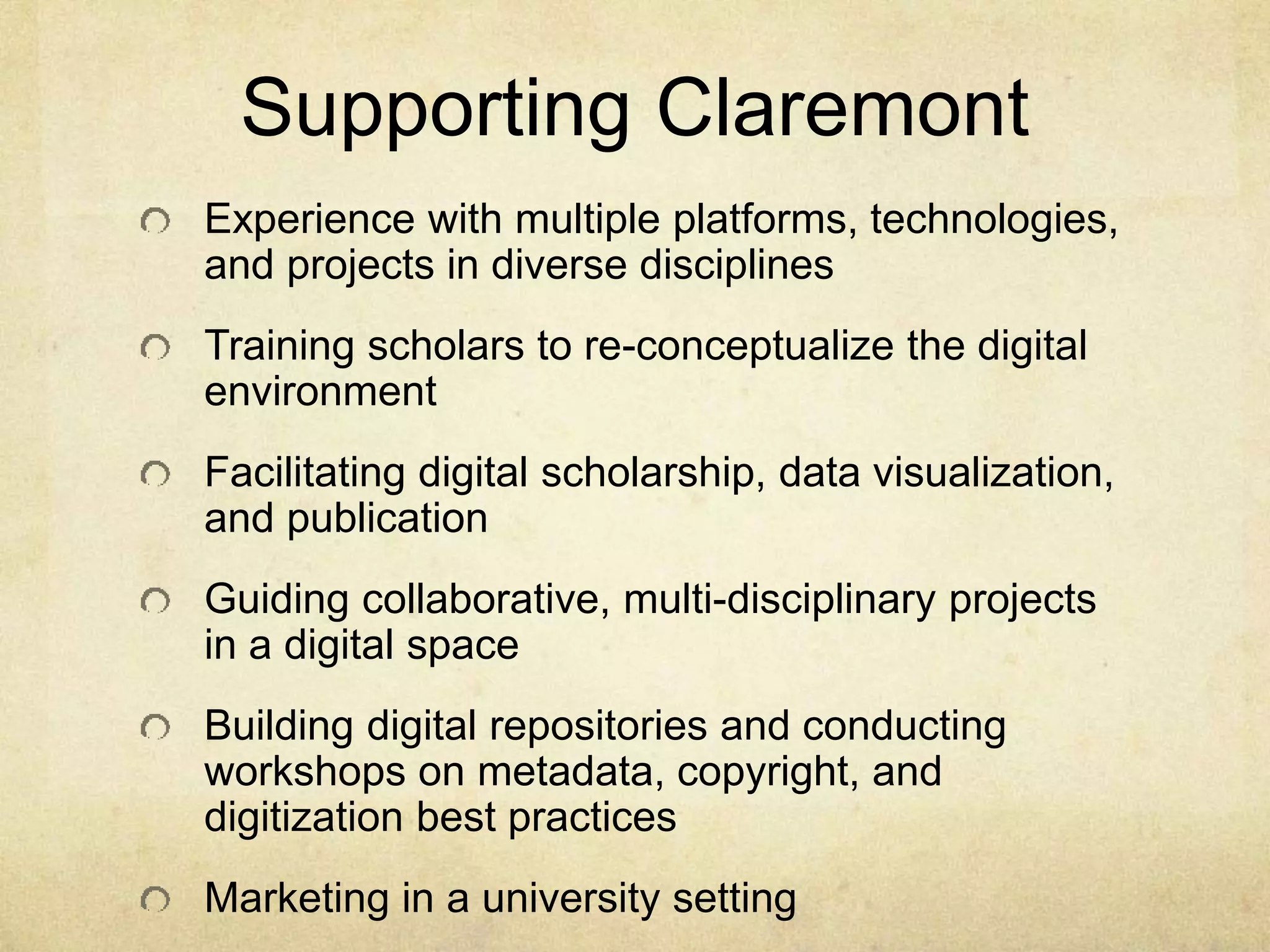
Supporting Claremont 
Experience with multiple platforms, technologies, 
and projects in diverse disciplines 
Training scholars to re-conceptualize the digital 
environment 
Facilitating digital scholarship, data visualization, 
and publication 
Guiding collaborative, multi-disciplinary projects 
in a digital space 
Building digital repositories and conducting 
workshops on metadata, copyright, and 
digitization best practices 
Marketing in a university setting
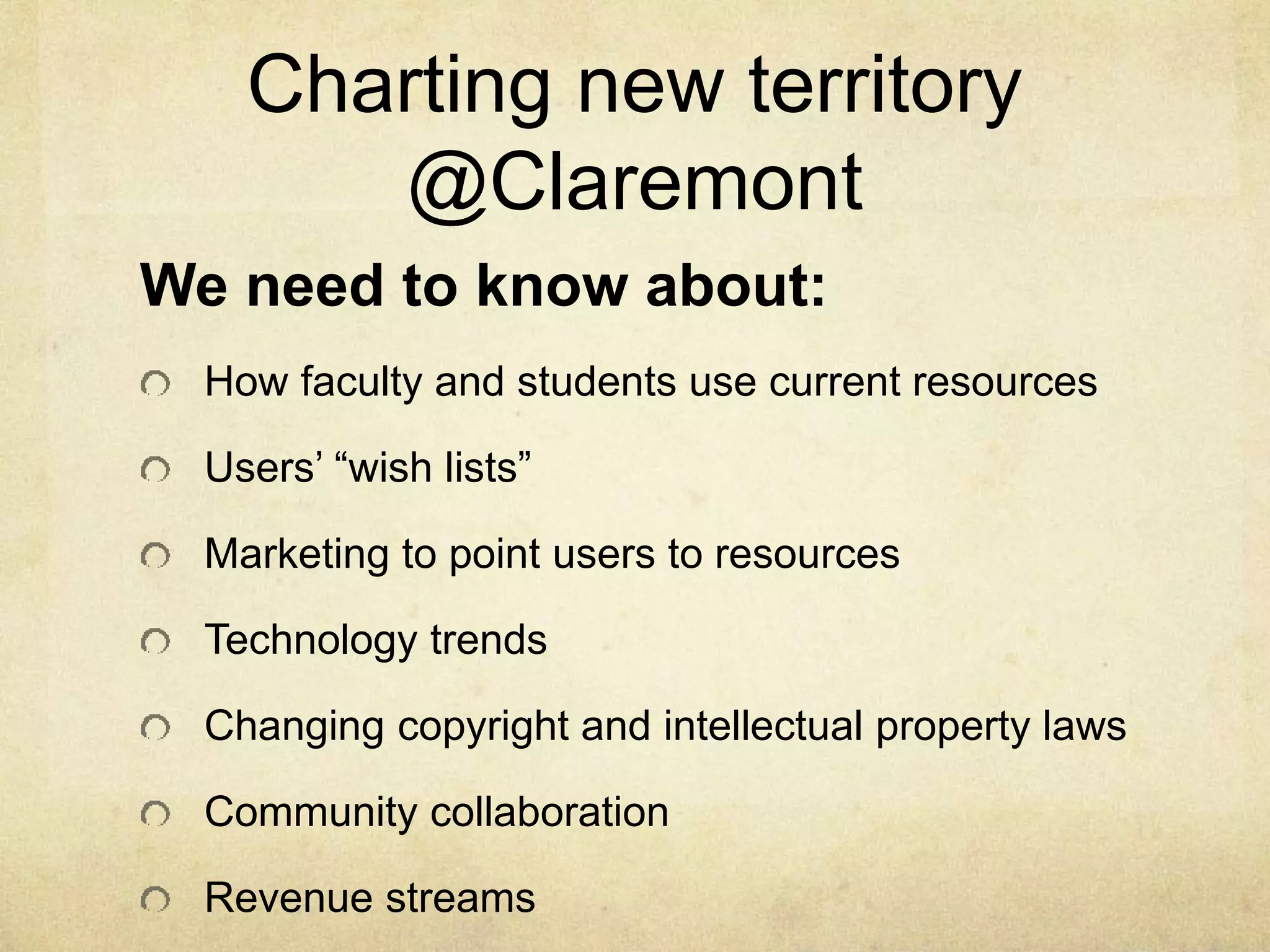
Charting new territory 
@Claremont 
We need to know about: 
How faculty and students use current resources 
Users’ “wish lists” 
Marketing to point users to resources 
Technology trends 
Changing copyright and intellectual property laws 
Community collaboration 
Revenue streams
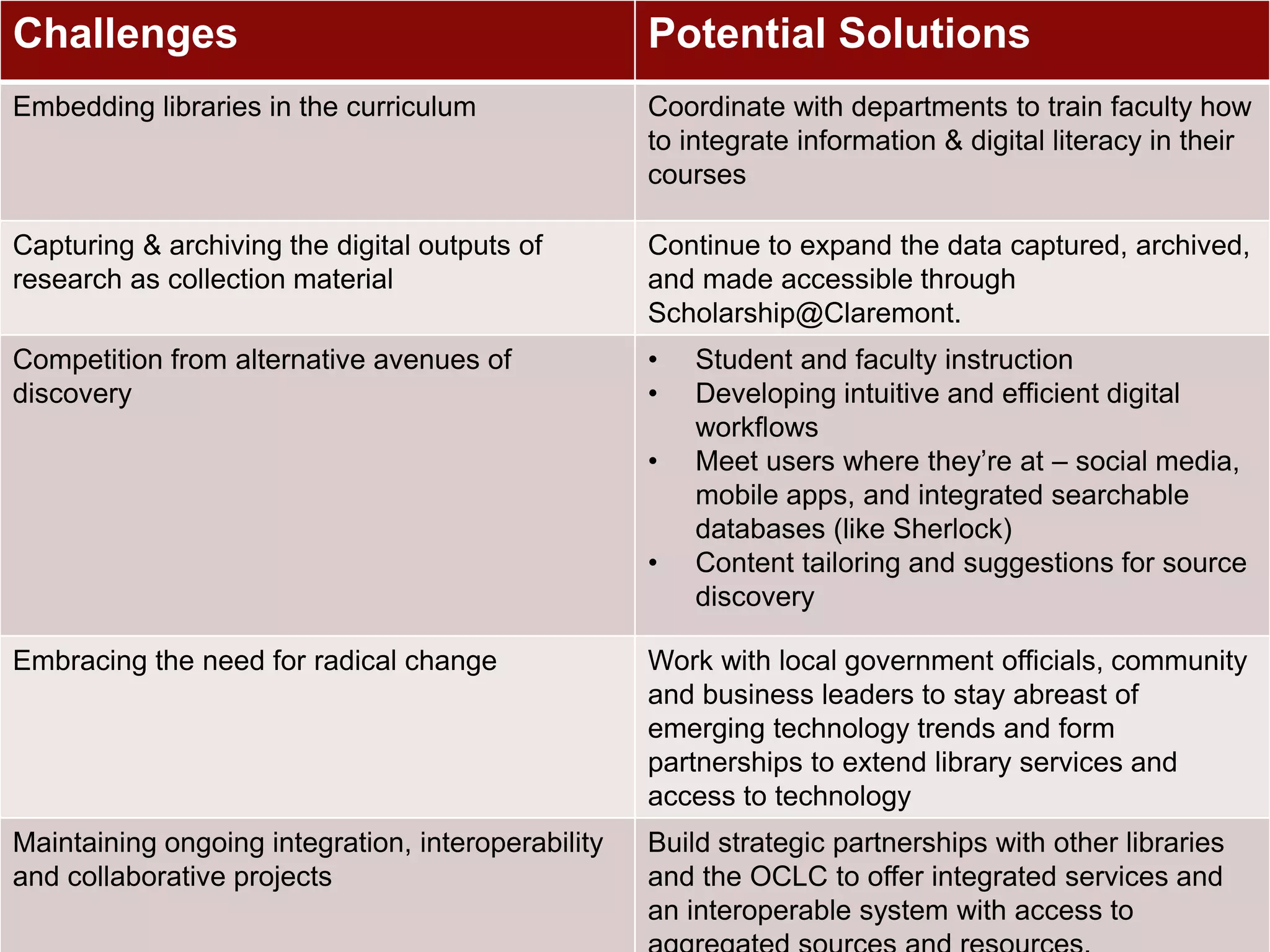
Challenges Potential Solutions 
Embedding libraries in the curriculum Coordinate with departments to train faculty how 
to integrate information & digital literacy in their 
courses 
Capturing & archiving the digital outputs of 
research as collection material 
Continue to expand the data captured, archived, 
and made accessible through 
Scholarship@Claremont. 
Competition from alternative avenues of 
discovery 
• Student and faculty instruction 
• Developing intuitive and efficient digital 
workflows 
• Meet users where they’re at – social media, 
mobile apps, and integrated searchable 
databases (like Sherlock) 
• Content tailoring and suggestions for source 
discovery 
Embracing the need for radical change Work with local government officials, community 
and business leaders to stay abreast of 
emerging technology trends and form 
partnerships to extend library services and 
access to technology 
Maintaining ongoing integration, interoperability 
and collaborative projects 
Build strategic partnerships with other libraries 
and the OCLC to offer integrated services and 
an interoperable system with access to 
aggregated sources and resources.
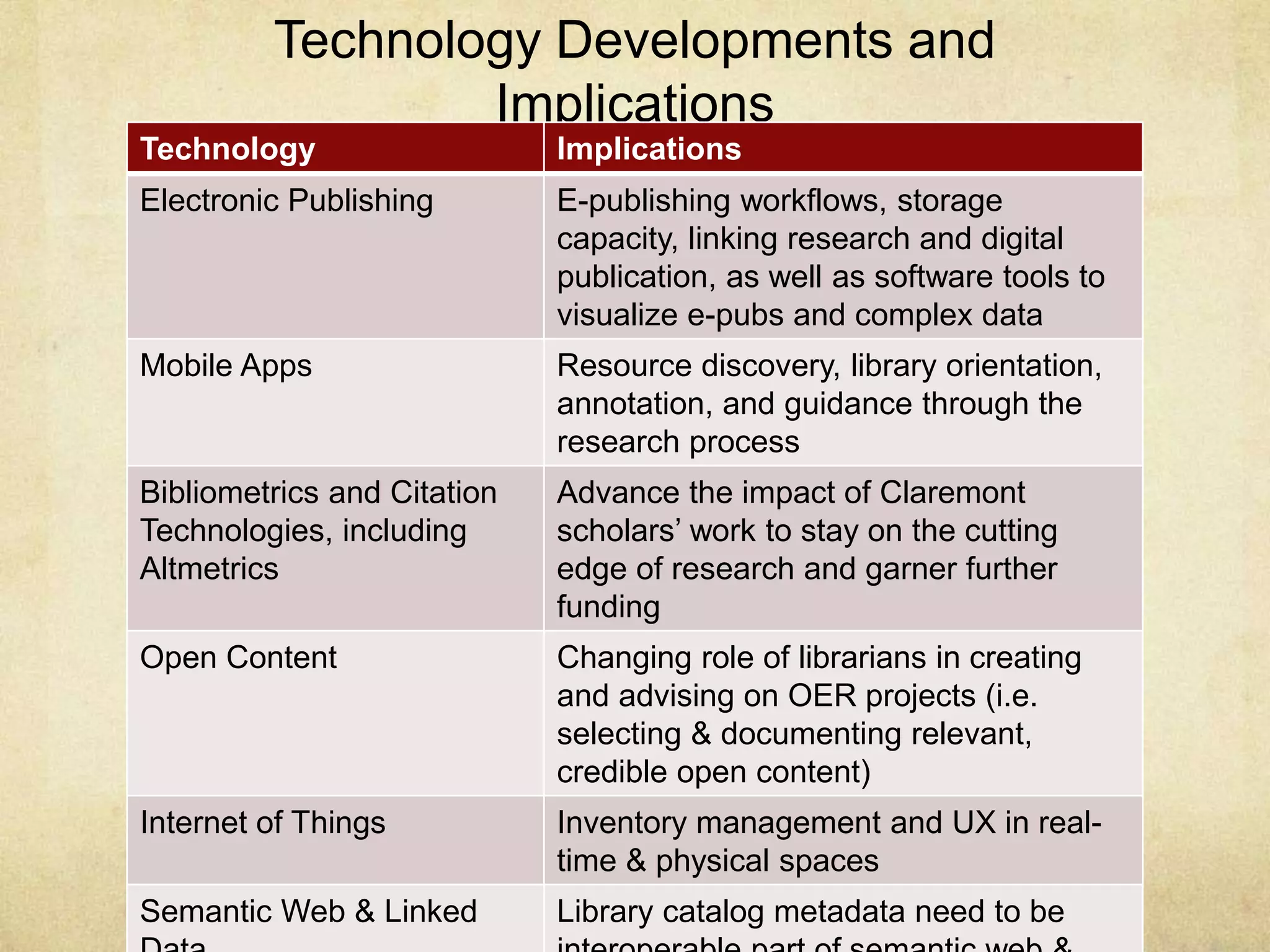
Technology Developments and 
Implications 
Technology Implications 
Electronic Publishing E-publishing workflows, storage 
capacity, linking research and digital 
publication, as well as software tools to 
visualize e-pubs and complex data 
Mobile Apps Resource discovery, library orientation, 
annotation, and guidance through the 
research process 
Bibliometrics and Citation 
Technologies, including 
Altmetrics 
Advance the impact of Claremont 
scholars’ work to stay on the cutting 
edge of research and garner further 
funding 
Open Content Changing role of librarians in creating 
and advising on OER projects (i.e. 
selecting & documenting relevant, 
credible open content) 
Internet of Things Inventory management and UX in real-time 
& physical spaces 
Semantic Web & Linked 
Data 
Library catalog metadata need to be 
interoperable part of semantic web &

Digital Scholarly Communication @Claremont Colleges

  • 1.
    Digital Scholarly Communication @ Claremont Colleges Ashley Sanders PhD Candidate DH Specialist
  • 2.
    What Now? 1.Fast Trends (1-2 years): Increasing focus on research data management for publications Prioritize mobile content & delivery 2. Mid-Range Trends (3-5 years): Evolution of scholarly record Increasing accessibility of research content 3. Long-Range Trends (5+ years): Continual progress in technology, standards, and infrastructure New forms of multi-disciplinary research
  • 3.
    Fast Trends: ResearchData Management and Mobile Content Delivery @Claremont Suggestions Structured data: Using URIs to name digital objects and link related resources. Begin implementing now but it is also a long-range trend Access to research databases & data visualizations Integration of various media in scholarly publishing Mobile Apps Resources & Examples LOD for Newcomers: http://documentingcappadocia.newmedialab.cuny.e du/linked-data-for-the-uninitiated-part-1/ Visualizing historiography: http://clio.osu.edu/fhq/3d/ U-Mass Re-use & Re-distribution Guidelines:http://www.library.umass.edu/service s/services-for-faculty/data-management/data-management- plan-guidance/re-use-and-re-distribution/ University of AZhttp://www.library.arizona.edu/help/how-do-i/ mobile#other Mobile Brown University: http://library.brown.edu/m/ 1.
  • 4.
    Multiple Word http://Cloudsclio.osu.edu/fhq/– 3d/ 10-Year Spans Data Visualizations David J. Staley, Scott A. French and Bill Ferster, “Visual Historiography: Visualizing ‘The Literature of a Field’”, Poster Presented at DH2013 and featured in JDH 3:1 (Spring 2014). http://journalofdigitalhumanities .org/3-1/visual-historiography-visualizing- Phrase Net - x’s Topic Modeling By Time – Most Common The call for visualizing “Big Data” has generated a groundswell of interest among historians and humanities scholars, as demonstrated by the international response to the National Endowment for the Humanities’ 2010 and 2011 Digging into Data challenges. Exemplary efforts from the first two rounds of projects suggest the great potential for visualizing large repositories of primary sources for historical insight. Our project treats a peer-reviewed scholarly journal – Florida Historical Quarterly, housed at the University of Central Florida – as a dataset to be analyzed and visualized. In applying macro-level reading and text-mining tools to the secondary literature of a scholarly field, we are making visible patterns of topical coverage. In this poster, we present the results of our case study. We machine-read over 1500 research articles across the entire 85 year run of the journal (1924-2009) and identified the top 100 key terms. (The top key term “Indian” is located at the center of the visualization; the rest of the key term list expands out from the middle.) We then arrayed each of these key terms according to the number of times the key term appears per year in order to develop a “macro-reading” of the journal. Key terms were identified using the Data For Research application developed by JSTOR. The key terms were determined using term frequency–inverse document frequency (TF-IDF), a statistical measure of how important a word is in a given document. We have generated two such visualizations from this data: a 2-D chart and the same data as a 3-D interactive “topology” (the latter soon to be “translated” into a physical sculpture.) the-literature-of-a-field/ Heat Map 1.
  • 5.
    Access to ResearchData Sets Source: Left: C. Tenopir Et Al. Plos One 6, E21101 (2011); Right: Tenopir/Allard/Sandusky/Birch/NSF Dataone Project. In “Publishing Frontiers: The Library Reboot.” http://www.nature.com/news/publishing-frontiers-the-library-reboot-1.12664 1.
  • 6.
    Marketing Scholarship@Claremont Scholarship@Claremonton Twitter Link to it on the library home page Invite faculty and students to do lightning talks and longer interviews about their research Create a YouTube stream to feature them and embed it in the website Showcase multimedia publications, interactive digital projects & scholars’ websites Host an “induction” ceremony each term for scholars whose work has been added to the database *
  • 7.
    Mid-Range Trends (3-5years): Evolution of Scholarly Record @Claremont Suggestions Access to grey literature through Scholarship@Claremont: Conference proceedings, white papers, lab reports, etc. Stay current on digital publication trends to advise administrators, faculty & grad students. Blogs, Twitter, & Academia.edu Digital scholarship assessment: Resources & Examples Grey Lit Database: http://www.greylit.org/ Innovating Communication in Scholarship (ICIS) @UC Davis: http://icis.ucdavis.edu/?pag e_id=259 microBEnet: The Microbiology of the Built Environment: http://microbe.net/ H-Net: http://networks.h-net.org 2.
  • 8.
    New Forms ofScholarly Communication & Publication 2. The Orbis Project from Stanford: http://orbis.stanford.edu/. For more information, see: JDH 1:3 http://journalofdigitalhumanities.org/1-3/
  • 9.
    New Forms ofScholarly Communication & Publication 2. Other examples of digital scholarship include: Mapping the Republic of Letters (Stanford): http://republicofletters.stanford.edu/ Shaping the West (Stanford): https://web.stanford.edu/group/spatialhistory/cgi-bin/ site/project.php?id=997 Hypercities (UCLA): http://hypercities.ats.ucla.edu/ Van Gogh Letters (Van Gogh Museum): http://www.vangoghletters.org/vg/
  • 10.
    Long-Range Trends (5+years): Technology, Standards and Infrastructure @Claremont Suggestions Re-envisioning library services Maker-spaces DH Lab Virtual meeting & research collaboration platforms Facilitating multidisciplinary research Demo such research Create interactive spaces Host intercollegiate networking opportunities Resources & Examples GVSU Tech Showcase: http://www.gvsu.edu/techsh owcase/ LMU|LA Library: http://library.lmu.edu/usingth elibrary/spaces/#d.en.90115 Scholars’ Lab Maker Space @ UVA: http://scholarslab.org/maker space/ Heurist Collaborative Digital Workspace http://heuristnetwork.org/ 3.
  • 11.
    The Early Daysof H-Net Listserv
  • 12.
  • 13.
  • 15.
    Supporting Claremont Experiencewith multiple platforms, technologies, and projects in diverse disciplines Training scholars to re-conceptualize the digital environment Facilitating digital scholarship, data visualization, and publication Guiding collaborative, multi-disciplinary projects in a digital space Building digital repositories and conducting workshops on metadata, copyright, and digitization best practices Marketing in a university setting
  • 16.
    Charting new territory @Claremont We need to know about: How faculty and students use current resources Users’ “wish lists” Marketing to point users to resources Technology trends Changing copyright and intellectual property laws Community collaboration Revenue streams
  • 17.
    Challenges Potential Solutions Embedding libraries in the curriculum Coordinate with departments to train faculty how to integrate information & digital literacy in their courses Capturing & archiving the digital outputs of research as collection material Continue to expand the data captured, archived, and made accessible through Scholarship@Claremont. Competition from alternative avenues of discovery • Student and faculty instruction • Developing intuitive and efficient digital workflows • Meet users where they’re at – social media, mobile apps, and integrated searchable databases (like Sherlock) • Content tailoring and suggestions for source discovery Embracing the need for radical change Work with local government officials, community and business leaders to stay abreast of emerging technology trends and form partnerships to extend library services and access to technology Maintaining ongoing integration, interoperability and collaborative projects Build strategic partnerships with other libraries and the OCLC to offer integrated services and an interoperable system with access to aggregated sources and resources.
  • 18.
    Technology Developments and Implications Technology Implications Electronic Publishing E-publishing workflows, storage capacity, linking research and digital publication, as well as software tools to visualize e-pubs and complex data Mobile Apps Resource discovery, library orientation, annotation, and guidance through the research process Bibliometrics and Citation Technologies, including Altmetrics Advance the impact of Claremont scholars’ work to stay on the cutting edge of research and garner further funding Open Content Changing role of librarians in creating and advising on OER projects (i.e. selecting & documenting relevant, credible open content) Internet of Things Inventory management and UX in real-time & physical spaces Semantic Web & Linked Data Library catalog metadata need to be interoperable part of semantic web &

Editor's Notes

  • #3 According the 2014 New Media Consortium Horizons Report Library Edition, an annual project that examines and identifies significant trends in emerging technologies and their implications, there are six trends we should pay close attention to. These are broken down into fast, mid-range, and long-range trends, depending on how quickly the trends will likely be implemented. They are determined by a group of international experts from library management, education, technology, and various additional fields who convene over the course of three months in the spring to come to a consensus about both the trends, the most pressing challenges, and the most important individual technologies, as well as their implications at three levels: policy, leadership, and practice. Today, I am going to focus almost exclusively on practice for the sake of time.
  • #4 Fast Trends (1): Archive the observations and data that led to the published ideas and open them up to others for further exploration. “Enhanced formats and workflows, within the realm of electronic publishing have enabled experiments, tests, and simulation data to be represented by audio, video, and other media and visualizations. The emergence of these formats has led to libraries rethinking their processes for managing data and linking them between various publications” (6). Furthermore, the development of the semantic web (LOD and structured data) has created a structure that reveals the connections between ideas and publications so scholars and students can more easily determine how ideas, theories, perspectives, and representations have evolved over time. To take advantage of these advances, we, as digital scholars and librarians must become even more familiar with the latest copyright and intellectual property laws as they continue to evolve and attempt to keep pace with the changing technological landscape. We also need to begin organizing our repositories and databases using LOD and rethink the interface to make the rich connections between sources apparent to users. (2) Mobile Content Delivery & Mobile Apps: Claremont already has a beautiful responsive web design. Here are some resources we can take advantage of to continue to improve our mobile content delivery: ** The American Library Association’s Tech Source offers information and training on how to improve a library’s mobile website. ** 23 Mobile Things is a self-paced online course that explores the potential for mobile tools for the delivery of library services ** Duke University Libraries are using the “BrowZine” app for tablets to make library resources more mobile-friendly, enabling library patrons to browse, read, and monitor current academic journals. ** Library Success: A Best Practices Wiki: go.nmc.org/m-li (3) OTHER: Better marketing for services like the trial access to databases – get students and faculty excited about this opportunity! What amazing resources!
  • #5 Here are just a couple of examples built to visualize trends in the secondary literature or historiography. Many other examples exist and point to new opportunities for big data and quantitative studies, even in fields that have traditionally embraced primarily qualitative study. Even in the field of art history, data visualization is allowing scholars, such as Lev Manovich to ask entirely new questions about the field, such as the use of various colors among all of the impressionists – which colors predominated the collective artwork produced in this movement? Which colors were used more by some painters than others. What about visual similarities among all of these paintings – a task far too time-consuming without the aid of computational analysis. What is the role of the library to provide researchers access to visualization tools and the products of such research? The argument is increasingly becoming that this now falls precisely in the library’s domain.
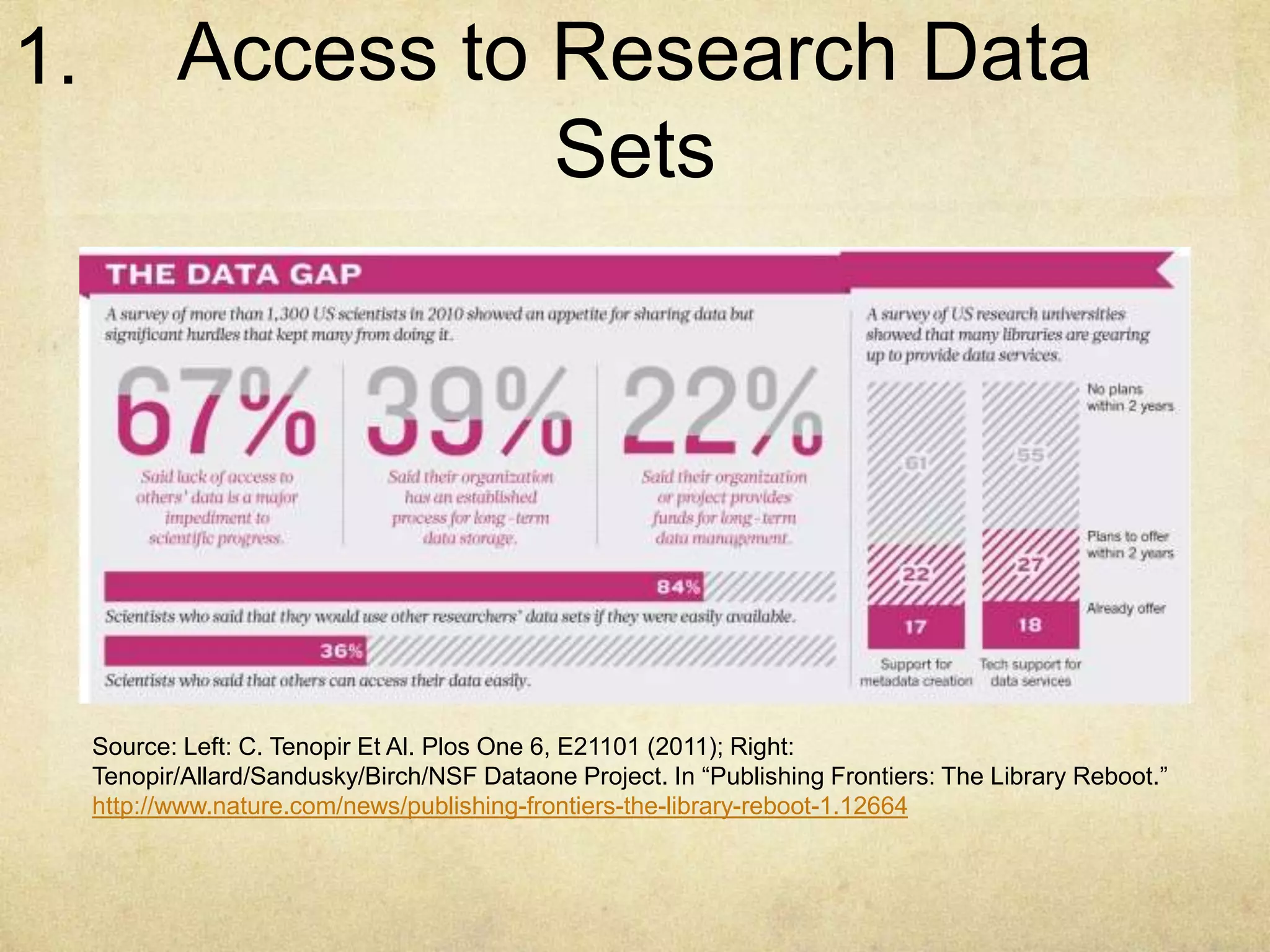
  • #6 This graphic from the article “Publishing Frontiers: The Library Reboot” reveals the vast majority of scientists who wish they had access to others’ research datasets to conduct their own investigations and the gap between this desire and actual access in practice. We will need to begin collaborating with researchers to archive their datasets, help them navigate copyright issues, and publicize this work as scholarship in its own right, as well as a resource for further examination. At the policy level, the NSF has recently (2013) released a report that discusses its data management requirements and examines repository responses. Resources are already available to help librarians navigate this new territory, including from Jisc (formerly known as Joint Information Systems Committee based in the UK), and the Council on Library and Information Resources, among others.
  • #8 “No longer limited to text-based final products, scholarly work can include research datasets, interactive programs, complex visualizations, lab articles, and other non-final outputs, as well as web-based exchanges such as blogging. There are profound implications for academic and research libraries, especially those that are seeking alternative routes to standard publishing venues, which are often expensive for disseminating scientific knowledge. As different types and methods of scholarly communication are becoming more prevalent on the web, librarians will be expected to stay up-to-date on the legitimacy of these innovative approaches and their impact in the greater research community” (10). Assessing Digital Scholarship: ** MLA: http://www.mla.org/guidelines_evaluation_digital ** http://digitalhumanities.unc.edu/resources/valuing-evaluating-dh-practice/ ** http://www.academiccommons.org/2014/07/24/digital-scholarship-and-the-tenure-and-promotion-process/ ICIS: (1) role & impact of social media on scholarly publishing. (2) Alternative metrics for assessing scholarly impact. (3) How openness of communication influences impact. Openness: (Ex – math & physics deposit pre-published articles in ArXiv before submission) More may be done in this arena, but further investigations into current practices, willingness, and faculty buy-in, as well as workshops to educate and advise administrators, faculty members, and graduate students will be necessary before determining the next best steps to take in this particular arena. **See Diane Dawson, “Making your publications open access: Resources to assist researchers and librarians,” College & Research Libraries News 74, no. 9 (October 2013): 473-476.
  • #9 Orbis: An Interactive, Digital Scholarly Publication on the Roman World It is a “digital archive of sites and routes, a tool for exploring Roman transportation, and an argument about the dynamic shape of the Roman world and the nature of transport within it.” (Elijah Meeks and Karl Grossner, “ORBIS: An Interactive Scholarly Work on the Roman World,” JDH 1, no. 3 (Summer 2012). http://journalofdigitalhumanities.org/1-3/orbis-an-interactive-scholarly-work-on-the-roman-world-by-elijah-meeks-and-karl-grossner/) Other examples of digital scholarship include: **Mapping the Republic of Letters (Stanford): http://republicofletters.stanford.edu/ **Shaping the West (Stanford): https://web.stanford.edu/group/spatialhistory/cgi-bin/site/project.php?id=997 **Hypercities (UCLA): http://hypercities.ats.ucla.edu/ **Van Gogh Letters (Van Gogh Museum): http://www.vangoghletters.org/vg/
  • #10 Publishing interactive data sets alongside and embedded within the scholarly argument – something that is only possible in a digital environment.
  • #11 Shift from focus on building print collections to “providing remotely accessed online resources and guiding students and researchers through new discovery services.” (14) Facility renovation and reconstruction Enhance digital infrastructures through digital preservation & curation, resource discovery, and managing the life cycle of digital content from acquisition through usage. “Digital humanities and computational social science research approaches are opening up pioneering areas of multidisciplinary research at libraries and innovative forms of scholarship and publication. Researchers, along with academic technologists and developers, are breaking new ground in data structures, visualization, geospatial applications, and innovative uses of open-source tools.” (15)
  • #12 H-Net began as a listserv in 1995 to connect scholars and students and facilitate an open exchange of information and ideas. It was groundbreaking for its time but quickly became outdated.
  • #13 Since 1995, H-Net has expanded to encompass nearly 200 scholarly networks and more than 200,000 subscribers from more than 90 countries. In the transition to the new Commons platform, built on Drupal, I have trained more than 200 network editors and have helped facilitate a number of collaborative scholarly projects. In addition to editor training, I also worked on the site’s new theme, depicted here.
  • #14 Here are just some of the types of academic projects around the new Commons…
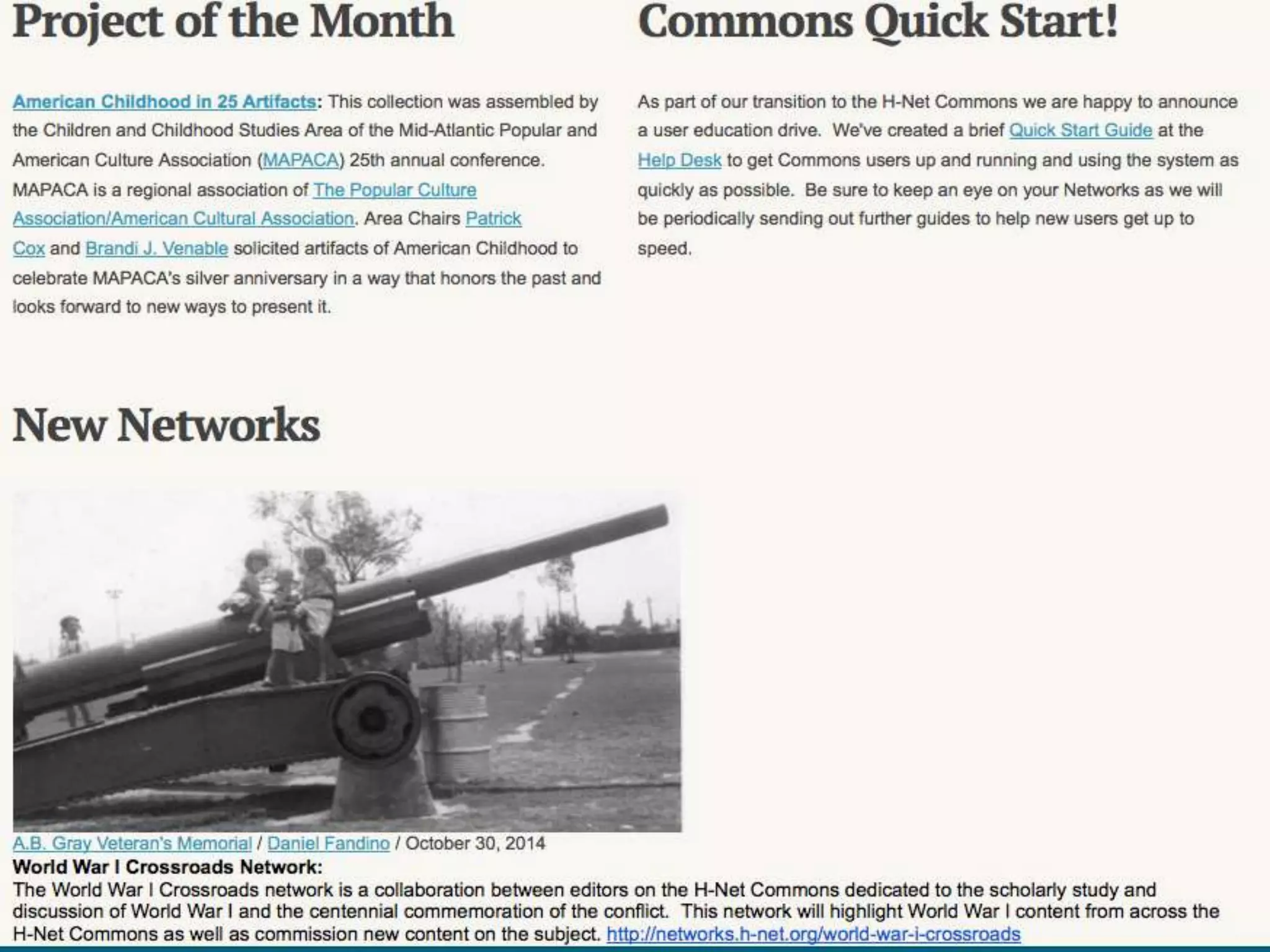
  • #15 I also edit our occasional newsletter. In our most recent edition – published just a couple of weeks ago, we featured H-Material-Culture’s “American Childhood in 25 Artifacts” and a new “Crossroads” collaborative network focusing on World War I scholarship. Our next major endeavor is an interactive mapping project for H-South that will include embedded multimedia files that highlights the intellectual and cultural life of nineteenth-century African –Americans in the Southern United States.
  • #18 “There is now an onus on library leaders to accurately understand how people prefer to learn and to incorporate those methods” (27). Authentic user experience in research – from discovery through notes and experiments to publication Training in skill acquisition (Georgetown University Library offers workshops on social media marketing, data visualization, video editing, and other emerging technologies)
  • #19 **Altmetrics: “takes into account a scholar’s online social media imprint as well as their ability to publish their own research in repositories and disseminate it through blogging or other avenues.” **Internet of Things: Network of connected objects that link the physical world with information world through the web **”Semantic-aware applications infer the meaning, or semantics, of information on the Internet using metadata to make connections and provide answers that would otherwise be elusive or altogether invisible.” (44)