Expanding opportunities for SGLT2i
in CKD Management
• CKD is defined as abnormalities of kidney
structure or function, present for >3 months
with implications for health
• CKD is classified based on Cause, GFR
category (G1–G5), and Albuminuria
category (A1–A3), abbreviated as CGA
Chronic Kidney Disease (CKD) – KDIGO 2022
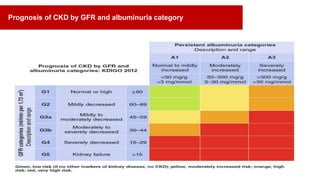
Prognosis of CKD by GFR and albuminuria category
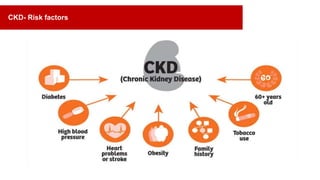
CKD- Risk factors
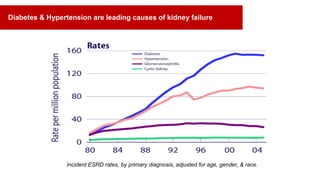
USRDS ADR, 2007
Incident ESRD rates, by primary diagnosis, adjusted for age, gender, & race.
Diabetes & Hypertension are leading causes of kidney failure
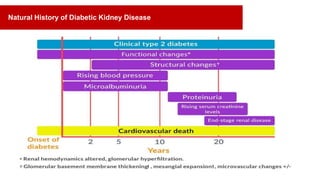
Natural History of Diabetic Kidney Disease
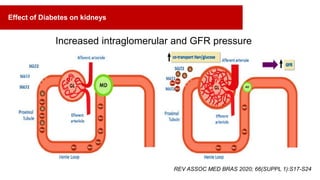
Increased intraglomerular and GFR pressure
REV ASSOC MED BRAS 2020; 66(SUPPL 1):S17-S24
Effect of Diabetes on kidneys
Nat Rev Nephrol 14, 361–377 (2018).
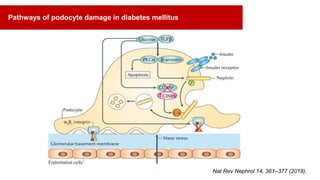
Pathways of podocyte damage in diabetes mellitus
Nat Rev Nephrol 14, 361–377 (2018)
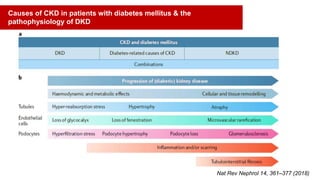
Causes of CKD in patients with diabetes mellitus & the
pathophysiology of DKD
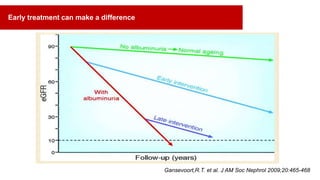
Early treatment can make a difference
Gansevoort,R.T. et al. J AM Soc Nephrol 2009;20:465-468
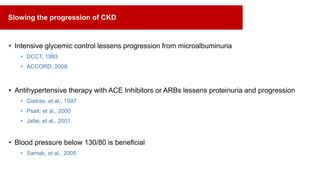
• Intensive glycemic control lessens progression from microalbuminuria
• DCCT, 1993
• ACCORD, 2008
• Antihypertensive therapy with ACE Inhibitors or ARBs lessens proteinuria and progression
• Giatras, et al., 1997
• Psait, et al., 2000
• Jafar, et al., 2001
• Blood pressure below 130/80 is beneficial
• Sarnak, et al., 2005
Slowing the progression of CKD
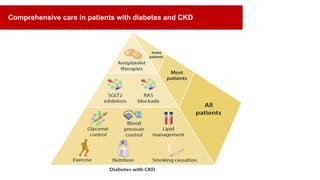
Comprehensive care in patients with diabetes and CKD
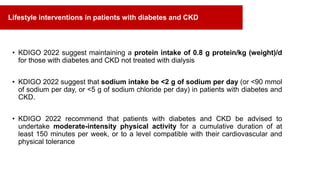
• KDIGO 2022 suggest maintaining a protein intake of 0.8 g protein/kg (weight)/d
for those with diabetes and CKD not treated with dialysis
• KDIGO 2022 suggest that sodium intake be <2 g of sodium per day (or <90 mmol
of sodium per day, or <5 g of sodium chloride per day) in patients with diabetes and
CKD.
• KDIGO 2022 recommend that patients with diabetes and CKD be advised to
undertake moderate-intensity physical activity for a cumulative duration of at
least 150 minutes per week, or to a level compatible with their cardiovascular and
physical tolerance
Lifestyle interventions in patients with diabetes and CKD
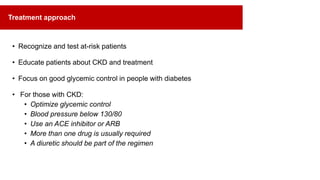
• Recognize and test at-risk patients
• Educate patients about CKD and treatment
• Focus on good glycemic control in people with diabetes
• For those with CKD:
• Optimize glycemic control
• Blood pressure below 130/80
• Use an ACE inhibitor or ARB
• More than one drug is usually required
• A diuretic should be part of the regimen
Treatment approach
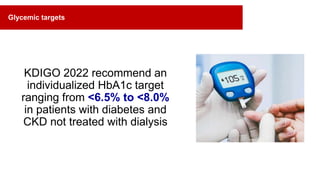
KDIGO 2022 recommend an
individualized HbA1c target
ranging from <6.5% to <8.0%
in patients with diabetes and
CKD not treated with dialysis
Glycemic targets
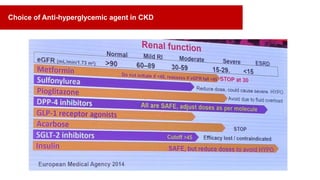
Choice of Anti-hyperglycemic agent in CKD
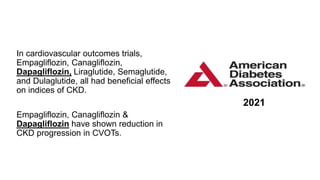
2021
In cardiovascular outcomes trials,
Empagliflozin, Canagliflozin,
Dapagliflozin, Liraglutide, Semaglutide,
and Dulaglutide, all had beneficial effects
on indices of CKD.
Empagliflozin, Canagliflozin &
Dapagliflozin have shown reduction in
CKD progression in CVOTs.
Novel
Treatment
Option for CKD
Sodium Glucose Co-Transporter 2 Inhibitor (SGLT2i)
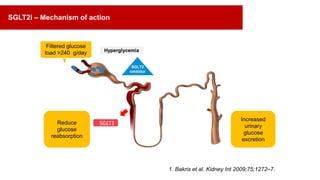
1. Bakris et al. Kidney Int 2009;75;1272–7.
SGLT2
inhibitor
Filtered glucose
load >240 g/day
Reduce
glucose
reabsorption
SGLT1
Increased
urinary
glucose
excretion
Hyperglycemia
SGLT2i – Mechanism of action
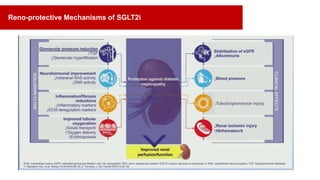
Reno-protective Mechanisms of SGLT2i
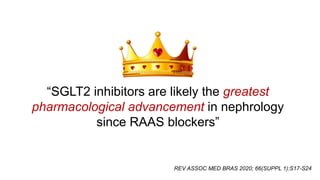
“SGLT2 inhibitors are likely the greatest
pharmacological advancement in nephrology
since RAAS blockers”
REV ASSOC MED BRAS 2020; 66(SUPPL 1):S17-S24
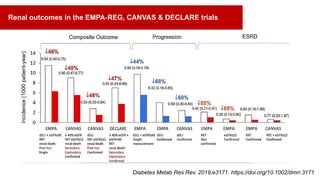
Diabetes Metab Res Rev. 2019;e3171. https://doi.org/10.1002/dmrr.3171
Renal outcomes in the EMPA‐REG, CANVAS & DECLARE trials
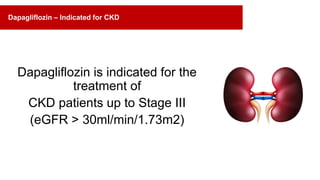
Dapagliflozin is indicated for the
treatment of
CKD patients up to Stage III
(eGFR > 30ml/min/1.73m2)
Dapagliflozin – Indicated for CKD
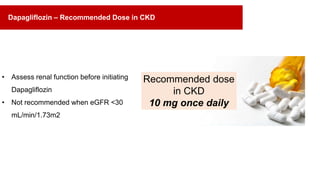
• Assess renal function before initiating
Dapagliflozin
• Not recommended when eGFR <30
mL/min/1.73m2
Recommended dose
in CKD
10 mg once daily
Dapagliflozin – Recommended Dose in CKD
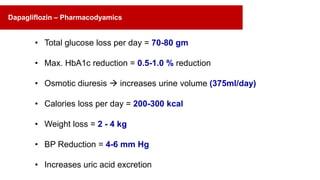
• Total glucose loss per day = 70-80 gm
• Max. HbA1c reduction = 0.5-1.0 % reduction
• Osmotic diuresis  increases urine volume (375ml/day)
• Calories loss per day = 200-300 kcal
• Weight loss = 2 - 4 kg
• BP Reduction = 4-6 mm Hg
• Increases uric acid excretion
Dapagliflozin – Pharmacodyamics
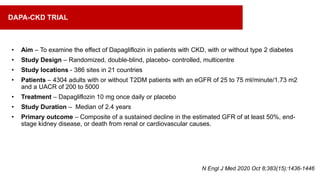
• Aim – To examine the effect of Dapagliflozin in patients with CKD, with or without type 2 diabetes
• Study Design – Randomized, double-blind, placebo- controlled, multicentre
• Study locations - 386 sites in 21 countries
• Patients – 4304 adults with or without T2DM patients with an eGFR of 25 to 75 ml/minute/1.73 m2
and a UACR of 200 to 5000
• Treatment – Dapagliflozin 10 mg once daily or placebo
• Study Duration – Median of 2.4 years
• Primary outcome – Composite of a sustained decline in the estimated GFR of at least 50%, end-
stage kidney disease, or death from renal or cardiovascular causes.
N Engl J Med 2020 Oct 8;383(15):1436-1446
DAPA-CKD TRIAL
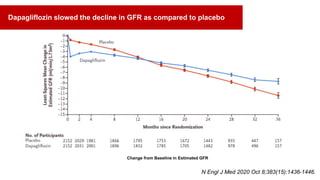
Change from Baseline in Estimated GFR
N Engl J Med 2020 Oct 8;383(15):1436-1446.
Dapagliflozin slowed the decline in GFR as compared to placebo
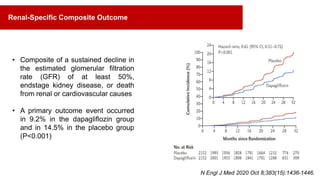
• Composite of a sustained decline in
the estimated glomerular filtration
rate (GFR) of at least 50%,
endstage kidney disease, or death
from renal or cardiovascular causes
• A primary outcome event occurred
in 9.2% in the dapagliflozin group
and in 14.5% in the placebo group
(P<0.001)
N Engl J Med 2020 Oct 8;383(15):1436-1446.
Renal-Specific Composite Outcome
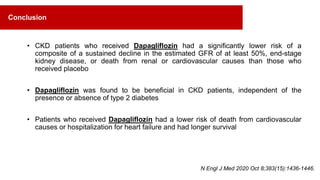
• CKD patients who received Dapagliflozin had a significantly lower risk of a
composite of a sustained decline in the estimated GFR of at least 50%, end-stage
kidney disease, or death from renal or cardiovascular causes than those who
received placebo
• Dapagliflozin was found to be beneficial in CKD patients, independent of the
presence or absence of type 2 diabetes
• Patients who received Dapagliflozin had a lower risk of death from cardiovascular
causes or hospitalization for heart failure and had longer survival
N Engl J Med 2020 Oct 8;383(15):1436-1446.
Conclusion
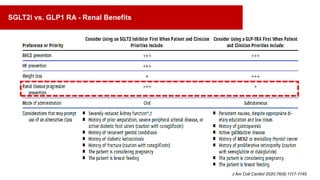
J Am Coll Cardiol 2020;76(9):1117-1145.
SGLT2i vs. GLP1 RA - Renal Benefits
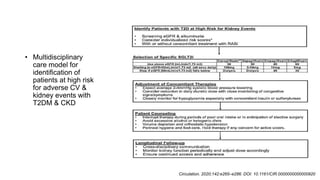
Circulation. 2020;142:e265–e286. DOI: 10.1161/CIR.0000000000000920
• Multidisciplinary
care model for
identification of
patients at high risk
for adverse CV &
kidney events with
T2DM & CKD
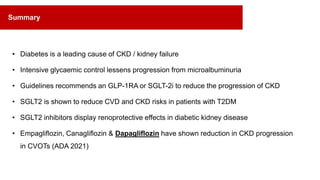
• Diabetes is a leading cause of CKD / kidney failure
• Intensive glycaemic control lessens progression from microalbuminuria
• Guidelines recommends an GLP-1RA or SGLT-2i to reduce the progression of CKD
• SGLT2 is shown to reduce CVD and CKD risks in patients with T2DM
• SGLT2 inhibitors display renoprotective effects in diabetic kidney disease
• Empagliflozin, Canagliflozin & Dapagliflozin have shown reduction in CKD progression
in CVOTs (ADA 2021)
Summary
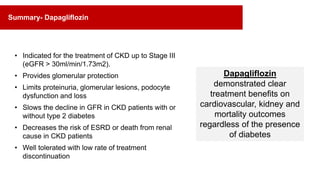
• Indicated for the treatment of CKD up to Stage III
(eGFR > 30ml/min/1.73m2).
• Provides glomerular protection
• Limits proteinuria, glomerular lesions, podocyte
dysfunction and loss
• Slows the decline in GFR in CKD patients with or
without type 2 diabetes
• Decreases the risk of ESRD or death from renal
cause in CKD patients
• Well tolerated with low rate of treatment
discontinuation
Dapagliflozin
demonstrated clear
treatment benefits on
cardiovascular, kidney and
mortality outcomes
regardless of the presence
of diabetes
Summary- Dapagliflozin
Dapagliflozin Ib CKD.pptx

Dapagliflozin Ib CKD.pptx

  • 1.
    Expanding opportunities forSGLT2i in CKD Management
  • 3.
    • CKD isdefined as abnormalities of kidney structure or function, present for >3 months with implications for health • CKD is classified based on Cause, GFR category (G1–G5), and Albuminuria category (A1–A3), abbreviated as CGA Chronic Kidney Disease (CKD) – KDIGO 2022
  • 4.
    Prognosis of CKDby GFR and albuminuria category
  • 5.
  • 6.
    USRDS ADR, 2007 IncidentESRD rates, by primary diagnosis, adjusted for age, gender, & race. Diabetes & Hypertension are leading causes of kidney failure
  • 7.
    Natural History ofDiabetic Kidney Disease
  • 8.
    Increased intraglomerular andGFR pressure REV ASSOC MED BRAS 2020; 66(SUPPL 1):S17-S24 Effect of Diabetes on kidneys
  • 9.
    Nat Rev Nephrol14, 361–377 (2018). Pathways of podocyte damage in diabetes mellitus
  • 10.
    Nat Rev Nephrol14, 361–377 (2018) Causes of CKD in patients with diabetes mellitus & the pathophysiology of DKD
  • 11.
    Early treatment canmake a difference Gansevoort,R.T. et al. J AM Soc Nephrol 2009;20:465-468
  • 12.
    • Intensive glycemiccontrol lessens progression from microalbuminuria • DCCT, 1993 • ACCORD, 2008 • Antihypertensive therapy with ACE Inhibitors or ARBs lessens proteinuria and progression • Giatras, et al., 1997 • Psait, et al., 2000 • Jafar, et al., 2001 • Blood pressure below 130/80 is beneficial • Sarnak, et al., 2005 Slowing the progression of CKD
  • 13.
    Comprehensive care inpatients with diabetes and CKD
  • 14.
    • KDIGO 2022suggest maintaining a protein intake of 0.8 g protein/kg (weight)/d for those with diabetes and CKD not treated with dialysis • KDIGO 2022 suggest that sodium intake be <2 g of sodium per day (or <90 mmol of sodium per day, or <5 g of sodium chloride per day) in patients with diabetes and CKD. • KDIGO 2022 recommend that patients with diabetes and CKD be advised to undertake moderate-intensity physical activity for a cumulative duration of at least 150 minutes per week, or to a level compatible with their cardiovascular and physical tolerance Lifestyle interventions in patients with diabetes and CKD
  • 15.
    • Recognize andtest at-risk patients • Educate patients about CKD and treatment • Focus on good glycemic control in people with diabetes • For those with CKD: • Optimize glycemic control • Blood pressure below 130/80 • Use an ACE inhibitor or ARB • More than one drug is usually required • A diuretic should be part of the regimen Treatment approach
  • 16.
    KDIGO 2022 recommendan individualized HbA1c target ranging from <6.5% to <8.0% in patients with diabetes and CKD not treated with dialysis Glycemic targets
  • 17.
  • 18.
    2021 In cardiovascular outcomestrials, Empagliflozin, Canagliflozin, Dapagliflozin, Liraglutide, Semaglutide, and Dulaglutide, all had beneficial effects on indices of CKD. Empagliflozin, Canagliflozin & Dapagliflozin have shown reduction in CKD progression in CVOTs.
  • 19.
    Novel Treatment Option for CKD SodiumGlucose Co-Transporter 2 Inhibitor (SGLT2i)
  • 20.
    1. Bakris etal. Kidney Int 2009;75;1272–7. SGLT2 inhibitor Filtered glucose load >240 g/day Reduce glucose reabsorption SGLT1 Increased urinary glucose excretion Hyperglycemia SGLT2i – Mechanism of action
  • 21.
  • 22.
    “SGLT2 inhibitors arelikely the greatest pharmacological advancement in nephrology since RAAS blockers” REV ASSOC MED BRAS 2020; 66(SUPPL 1):S17-S24
  • 23.
    Diabetes Metab ResRev. 2019;e3171. https://doi.org/10.1002/dmrr.3171 Renal outcomes in the EMPA‐REG, CANVAS & DECLARE trials
  • 24.
    Dapagliflozin is indicatedfor the treatment of CKD patients up to Stage III (eGFR > 30ml/min/1.73m2) Dapagliflozin – Indicated for CKD
  • 25.
    • Assess renalfunction before initiating Dapagliflozin • Not recommended when eGFR <30 mL/min/1.73m2 Recommended dose in CKD 10 mg once daily Dapagliflozin – Recommended Dose in CKD
  • 26.
    • Total glucoseloss per day = 70-80 gm • Max. HbA1c reduction = 0.5-1.0 % reduction • Osmotic diuresis  increases urine volume (375ml/day) • Calories loss per day = 200-300 kcal • Weight loss = 2 - 4 kg • BP Reduction = 4-6 mm Hg • Increases uric acid excretion Dapagliflozin – Pharmacodyamics
  • 27.
    • Aim –To examine the effect of Dapagliflozin in patients with CKD, with or without type 2 diabetes • Study Design – Randomized, double-blind, placebo- controlled, multicentre • Study locations - 386 sites in 21 countries • Patients – 4304 adults with or without T2DM patients with an eGFR of 25 to 75 ml/minute/1.73 m2 and a UACR of 200 to 5000 • Treatment – Dapagliflozin 10 mg once daily or placebo • Study Duration – Median of 2.4 years • Primary outcome – Composite of a sustained decline in the estimated GFR of at least 50%, end- stage kidney disease, or death from renal or cardiovascular causes. N Engl J Med 2020 Oct 8;383(15):1436-1446 DAPA-CKD TRIAL
  • 28.
    Change from Baselinein Estimated GFR N Engl J Med 2020 Oct 8;383(15):1436-1446. Dapagliflozin slowed the decline in GFR as compared to placebo
  • 29.
    • Composite ofa sustained decline in the estimated glomerular filtration rate (GFR) of at least 50%, endstage kidney disease, or death from renal or cardiovascular causes • A primary outcome event occurred in 9.2% in the dapagliflozin group and in 14.5% in the placebo group (P<0.001) N Engl J Med 2020 Oct 8;383(15):1436-1446. Renal-Specific Composite Outcome
  • 30.
    • CKD patientswho received Dapagliflozin had a significantly lower risk of a composite of a sustained decline in the estimated GFR of at least 50%, end-stage kidney disease, or death from renal or cardiovascular causes than those who received placebo • Dapagliflozin was found to be beneficial in CKD patients, independent of the presence or absence of type 2 diabetes • Patients who received Dapagliflozin had a lower risk of death from cardiovascular causes or hospitalization for heart failure and had longer survival N Engl J Med 2020 Oct 8;383(15):1436-1446. Conclusion
  • 31.
    J Am CollCardiol 2020;76(9):1117-1145. SGLT2i vs. GLP1 RA - Renal Benefits
  • 32.
    Circulation. 2020;142:e265–e286. DOI:10.1161/CIR.0000000000000920 • Multidisciplinary care model for identification of patients at high risk for adverse CV & kidney events with T2DM & CKD
  • 33.
    • Diabetes isa leading cause of CKD / kidney failure • Intensive glycaemic control lessens progression from microalbuminuria • Guidelines recommends an GLP-1RA or SGLT-2i to reduce the progression of CKD • SGLT2 is shown to reduce CVD and CKD risks in patients with T2DM • SGLT2 inhibitors display renoprotective effects in diabetic kidney disease • Empagliflozin, Canagliflozin & Dapagliflozin have shown reduction in CKD progression in CVOTs (ADA 2021) Summary
  • 34.
    • Indicated forthe treatment of CKD up to Stage III (eGFR > 30ml/min/1.73m2). • Provides glomerular protection • Limits proteinuria, glomerular lesions, podocyte dysfunction and loss • Slows the decline in GFR in CKD patients with or without type 2 diabetes • Decreases the risk of ESRD or death from renal cause in CKD patients • Well tolerated with low rate of treatment discontinuation Dapagliflozin demonstrated clear treatment benefits on cardiovascular, kidney and mortality outcomes regardless of the presence of diabetes Summary- Dapagliflozin