KERENDIA (Finerenone)
a new treatment option for CKD with T2D
1. Indications
2. Disease Overview
3. Mechanism of Action
4. Administration
5. Warnings
6. Patient resources
CONTENTS OF THIS PRESENTATION
Indications
Kerendia is a prescription medicine used in adults with chronic
kidney disease with associated type 2 diabetes to reuce the risk of:
 Worsening of the kidney function
 Kidney failure
 Death due to cardiovascular disease
 Heart attack
 Hospitalization for heart failure
Clinical Data
In the renal outcomes trial (FIDELIO-DKD) of adult patients with
CKD associated with T2D
 Kerendia significantly slowed CKD progression in addition to
an ACEi or ARB. The treatment effect reflected a reduction in
a sustained decline in eGFR of > 40% and progression to
kidney failure, or renal death
In the CV outcomes trial (FIGARO-DKD) the treatment effect
reflected a reduction of CV death, non-fatal MI, and
hospitalization for HF.
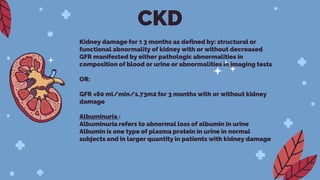
Kidney damage for ≥ 3 months as defined by: structural or
functional abnormality of kidney with or without decreased
GFR manifested by either pathologic abnormalities in
composition of blood or urine or abnormalities in imaging tests
OR:
GFR <60 ml/min/1.73m2 for 3 months with or without kidney
damage
Albuminuria :
Albuminuria refers to abnormal loss of albumin in urine
Albumin is one type of plasma protein in urine in normal
subjects and in larger quantity in patients with kidney damage
CKD
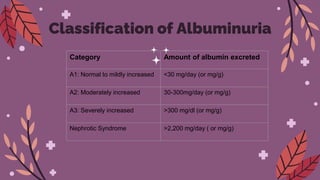
Classification of Albuminuria
Category Amount of albumin excreted
A1: Normal to mildly increased <30 mg/day (or mg/g)
A2: Moderately increased 30-300mg/day (or mg/g)
A3: Severely increased >300 mg/dl (or mg/g)
Nephrotic Syndrome >2,200 mg/day ( or mg/g)
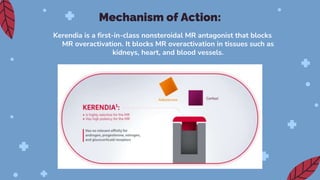
Kerendia is a first-in-class nonsteroidal MR antagonist that blocks
MR overactivation. It blocks MR overactivation in tissues such as
kidneys, heart, and blood vessels.
Mechanism of Action:
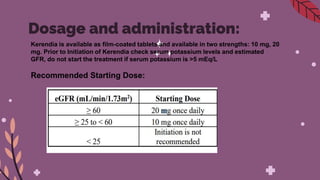
Dosage and administration:
Kerendia is available as film-coated tablets and available in two strengths: 10 mg, 20
mg. Prior to Initiation of Kerendia check serum potassium levels and estimated
GFR, do not start the treatment if serum potassium is >5 mEq/L
Recommended Starting Dose:
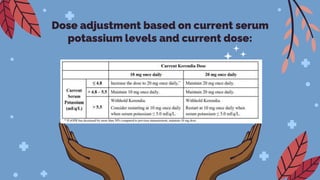
Dose adjustment based on current serum
potassium levels and current dose:
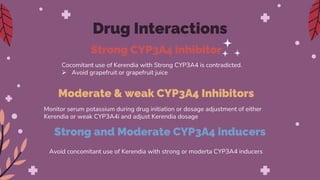
Drug Interactions
Strong CYP3A4 inhibitor
Cocomitant use of Kerendia with Strong CYP3A4 is contradicted.
 Avoid grapefruit or grapefruit juice
Moderate & weak CYP3A4 Inhibitors
Monitor serum potassium during drug initiation or dosage adjustment of either
Kerendia or weak CYP3A4i and adjust Kerendia dosage
Strong and Moderate CYP3A4 inducers
Avoid concomitant use of Kerendia with strong or moderta CYP3A4 inducers
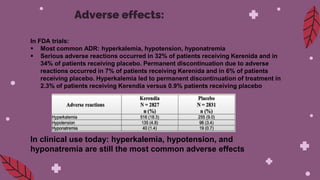
Adverse effects:
In FDA trials:
 Most common ADR: hyperkalemia, hypotension, hyponatremia
 Serious adverse reactions occurred in 32% of patients receiving Kerenida and in
34% of patients receiving placebo. Permanent discontinuation due to adverse
reactions occurred in 7% of patients receiving Kerenida and in 6% of patients
receiving placebo. Hyperkalemia led to permanent discontinuation of treatment in
2.3% of patients receiving Kerendia versus 0.9% patients receiving placebo
In clinical use today: hyperkalemia, hypotension, and
hyponatremia are still the most common adverse effects
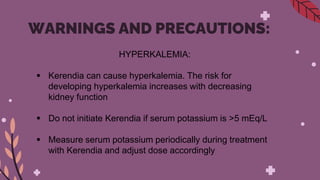
WARNINGS AND PRECAUTIONS:
HYPERKALEMIA:
 Kerendia can cause hyperkalemia. The risk for
developing hyperkalemia increases with decreasing
kidney function
 Do not initiate Kerendia if serum potassium is >5 mEq/L
 Measure serum potassium periodically during treatment
with Kerendia and adjust dose accordingly
CONTRADICTIONS:
 Concomitant use with strong CYP3A4
inhibitors
 Patients with adrenal insufficiency
Bakris GL, Agarwal R, Anker SD, Pitt B, Ruilope LM, Rossing P, Kolkhof P, Nowack C, Schloemer P, Joseph
A, Filippatos G; FIDELIO-DKD Investigators. Effect of Finerenone on Chronic Kidney Disease Outcomes in
Type 2 Diabetes. N Engl J Med. 2020 Dec 3;383(23):2219-2229. doi: 10.1056/NEJMoa2025845. Epub
2020 Oct 23. PMID: 33264825.
KDIGO – kidney disease | improving global outcomes. https://kdigo.org/wp-
content/uploads/2017/02/KDIGO_2012_CKD_GL.pdf. Accessed February 8, 2023.
Kerendia prescribing information - labeling.bayerhealthcare.com.
https://labeling.bayerhealthcare.com/html/products/pi/Kerendia_PI.pdf. Accessed February 8, 2023.
Kerendia® (finerenone): Healthcare Professionals (HCP). KERENDIA® (finerenone) | Healthcare
Professionals (HCP). https://www.kerendiahcp.com/. Accessed February 8, 2023.
Rico-Mesa JS, White A, Ahmadian-Tehrani A, Anderson AS. Mineralocorticoid Receptor Antagonists: a
Comprehensive Review of Finerenone. Curr Cardiol Rep. 2020 Sep 10;22(11):140. doi: 10.1007/s11886-
020-01399-7. PMID: 32910349.
Sources:
Any Questions?

Kerendia.pptx

  • 1.
    KERENDIA (Finerenone) a newtreatment option for CKD with T2D
  • 2.
    1. Indications 2. DiseaseOverview 3. Mechanism of Action 4. Administration 5. Warnings 6. Patient resources CONTENTS OF THIS PRESENTATION
  • 3.
    Indications Kerendia is aprescription medicine used in adults with chronic kidney disease with associated type 2 diabetes to reuce the risk of:  Worsening of the kidney function  Kidney failure  Death due to cardiovascular disease  Heart attack  Hospitalization for heart failure
  • 4.
    Clinical Data In therenal outcomes trial (FIDELIO-DKD) of adult patients with CKD associated with T2D  Kerendia significantly slowed CKD progression in addition to an ACEi or ARB. The treatment effect reflected a reduction in a sustained decline in eGFR of > 40% and progression to kidney failure, or renal death In the CV outcomes trial (FIGARO-DKD) the treatment effect reflected a reduction of CV death, non-fatal MI, and hospitalization for HF.
  • 5.
    Kidney damage for≥ 3 months as defined by: structural or functional abnormality of kidney with or without decreased GFR manifested by either pathologic abnormalities in composition of blood or urine or abnormalities in imaging tests OR: GFR <60 ml/min/1.73m2 for 3 months with or without kidney damage Albuminuria : Albuminuria refers to abnormal loss of albumin in urine Albumin is one type of plasma protein in urine in normal subjects and in larger quantity in patients with kidney damage CKD
  • 6.
    Classification of Albuminuria CategoryAmount of albumin excreted A1: Normal to mildly increased <30 mg/day (or mg/g) A2: Moderately increased 30-300mg/day (or mg/g) A3: Severely increased >300 mg/dl (or mg/g) Nephrotic Syndrome >2,200 mg/day ( or mg/g)
  • 7.
    Kerendia is afirst-in-class nonsteroidal MR antagonist that blocks MR overactivation. It blocks MR overactivation in tissues such as kidneys, heart, and blood vessels. Mechanism of Action:
  • 8.
    Dosage and administration: Kerendiais available as film-coated tablets and available in two strengths: 10 mg, 20 mg. Prior to Initiation of Kerendia check serum potassium levels and estimated GFR, do not start the treatment if serum potassium is >5 mEq/L Recommended Starting Dose:
  • 9.
    Dose adjustment basedon current serum potassium levels and current dose:
  • 10.
    Drug Interactions Strong CYP3A4inhibitor Cocomitant use of Kerendia with Strong CYP3A4 is contradicted.  Avoid grapefruit or grapefruit juice Moderate & weak CYP3A4 Inhibitors Monitor serum potassium during drug initiation or dosage adjustment of either Kerendia or weak CYP3A4i and adjust Kerendia dosage Strong and Moderate CYP3A4 inducers Avoid concomitant use of Kerendia with strong or moderta CYP3A4 inducers
  • 11.
    Adverse effects: In FDAtrials:  Most common ADR: hyperkalemia, hypotension, hyponatremia  Serious adverse reactions occurred in 32% of patients receiving Kerenida and in 34% of patients receiving placebo. Permanent discontinuation due to adverse reactions occurred in 7% of patients receiving Kerenida and in 6% of patients receiving placebo. Hyperkalemia led to permanent discontinuation of treatment in 2.3% of patients receiving Kerendia versus 0.9% patients receiving placebo In clinical use today: hyperkalemia, hypotension, and hyponatremia are still the most common adverse effects
  • 12.
    WARNINGS AND PRECAUTIONS: HYPERKALEMIA: Kerendia can cause hyperkalemia. The risk for developing hyperkalemia increases with decreasing kidney function  Do not initiate Kerendia if serum potassium is >5 mEq/L  Measure serum potassium periodically during treatment with Kerendia and adjust dose accordingly
  • 13.
    CONTRADICTIONS:  Concomitant usewith strong CYP3A4 inhibitors  Patients with adrenal insufficiency
  • 14.
    Bakris GL, AgarwalR, Anker SD, Pitt B, Ruilope LM, Rossing P, Kolkhof P, Nowack C, Schloemer P, Joseph A, Filippatos G; FIDELIO-DKD Investigators. Effect of Finerenone on Chronic Kidney Disease Outcomes in Type 2 Diabetes. N Engl J Med. 2020 Dec 3;383(23):2219-2229. doi: 10.1056/NEJMoa2025845. Epub 2020 Oct 23. PMID: 33264825. KDIGO – kidney disease | improving global outcomes. https://kdigo.org/wp- content/uploads/2017/02/KDIGO_2012_CKD_GL.pdf. Accessed February 8, 2023. Kerendia prescribing information - labeling.bayerhealthcare.com. https://labeling.bayerhealthcare.com/html/products/pi/Kerendia_PI.pdf. Accessed February 8, 2023. Kerendia® (finerenone): Healthcare Professionals (HCP). KERENDIA® (finerenone) | Healthcare Professionals (HCP). https://www.kerendiahcp.com/. Accessed February 8, 2023. Rico-Mesa JS, White A, Ahmadian-Tehrani A, Anderson AS. Mineralocorticoid Receptor Antagonists: a Comprehensive Review of Finerenone. Curr Cardiol Rep. 2020 Sep 10;22(11):140. doi: 10.1007/s11886- 020-01399-7. PMID: 32910349. Sources:
  • 15.

Editor's Notes

  • #4 Kerendia is a non-steroidal mineralocorticoid receptor antagonist. It is proven to slow the progression of CKD in adults with T2D that could lead to kidney failure, dialysis, or tx.
  • #5 Two large studies have looked at the effects of Kerendia in patients with T2D and CKD. The first study (FIDELIO-DKD) looked at kidney disease outcomes and second study (FIGARO-DKD) evaluated cardiovascular outcomes.
  • #6 CKD in T2D is a progressive disease which means it cannot be cured and the damage to your kidneys cannot be revered. CKD in T2D often has no symptoms until you reach later stages of CKD.
  • #8 To understand how Kerendia works, it helps to understand why CKD in T2D may progress over time. There are 3 main factors that contribute to the progression of CKD. Poorly controlled BG Poorly controlled BP Inflammation and scarring in the kidney, While diabetes/HTN meds can control to manage your BG and HTN. Kerendia is the only medication that blocks the overactivation in kidneys, heat and blood vessels. Mineral corticoid overactivation can lead to inflammation and scarring of the tissue lead to CKD, CVD