History of Instructional DesignAndrea ReederSeptember 8, 2011IDT 7052
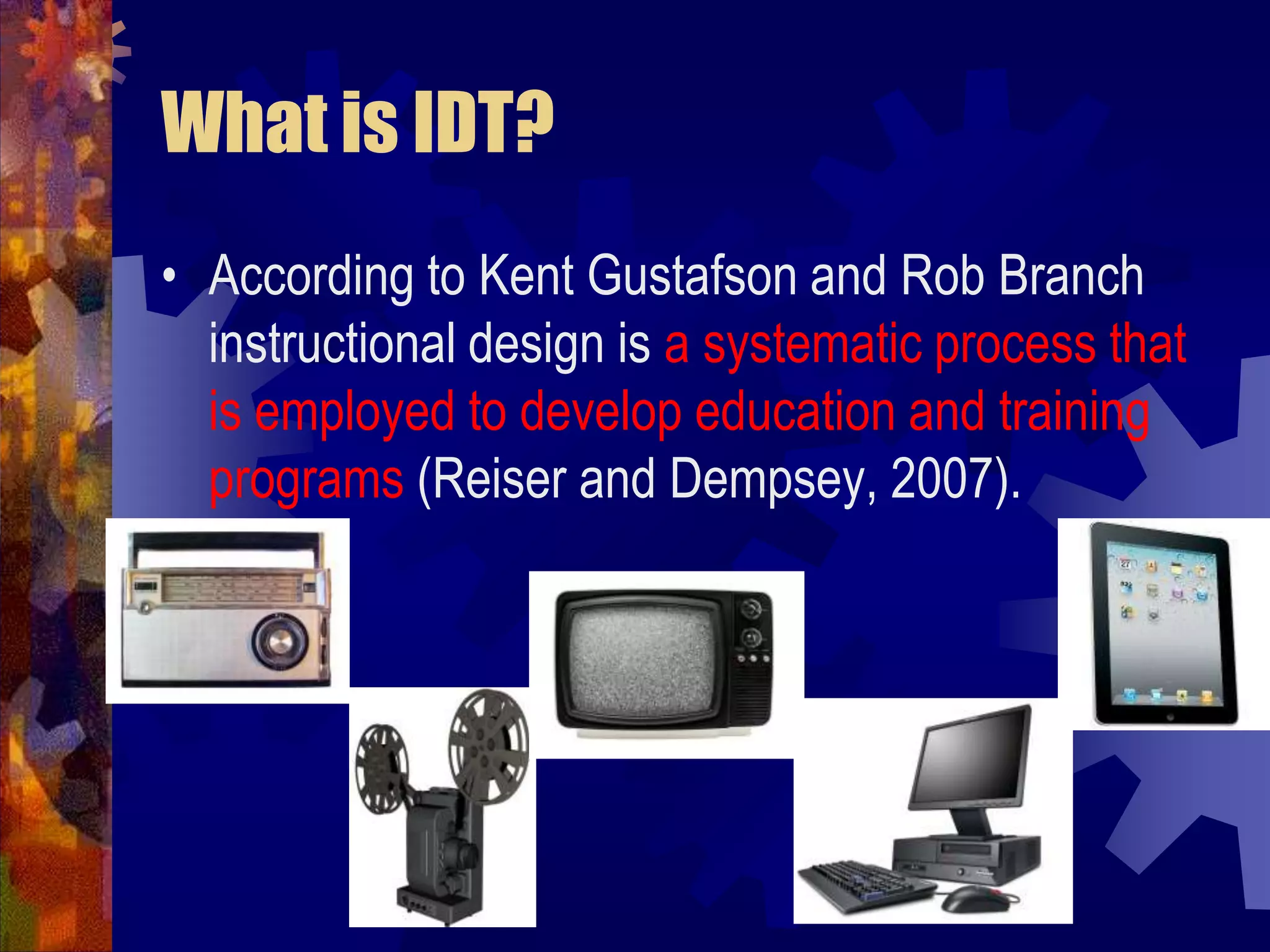
What is IDT?According to Kent Gustafson and Rob Branch instructional design is a systematic process that is employed to develop education and training programs (Reiser and Dempsey, 2007).
Contributing TheoriesGreek philosophers : writings on learning and memorySt. Thomas Aquinas:  free will in terms of teachingJohn Locke: gaining knowledge through experience    17th centuryJohn Dewey:  learning by doing13th century20th century
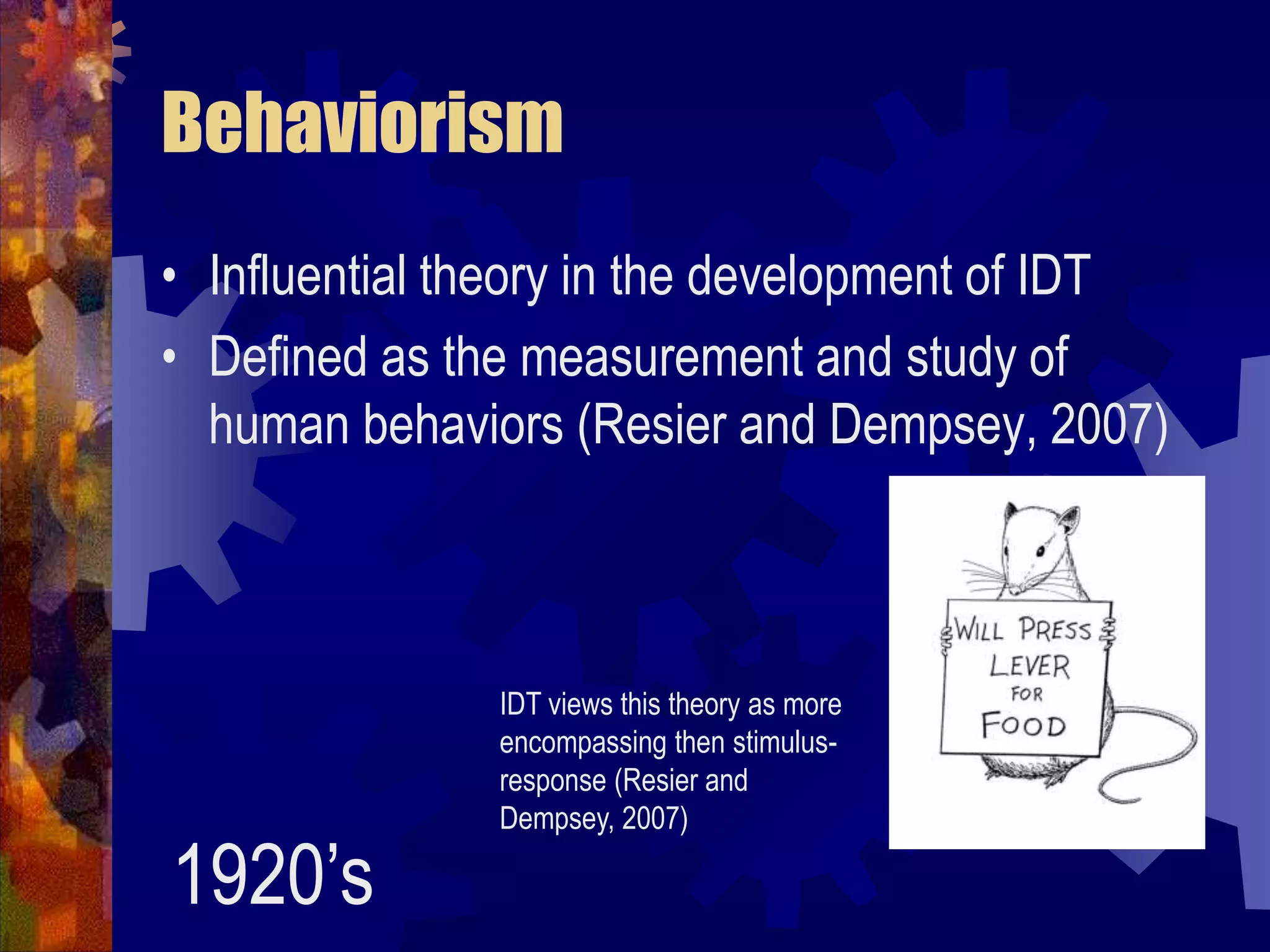
BehaviorismInfluential theory in the development of IDTDefined as the measurement and study of human behaviors (Resier and Dempsey, 2007)IDT views this theory as more encompassing then stimulus-response (Resier and Dempsey, 2007)1920’s
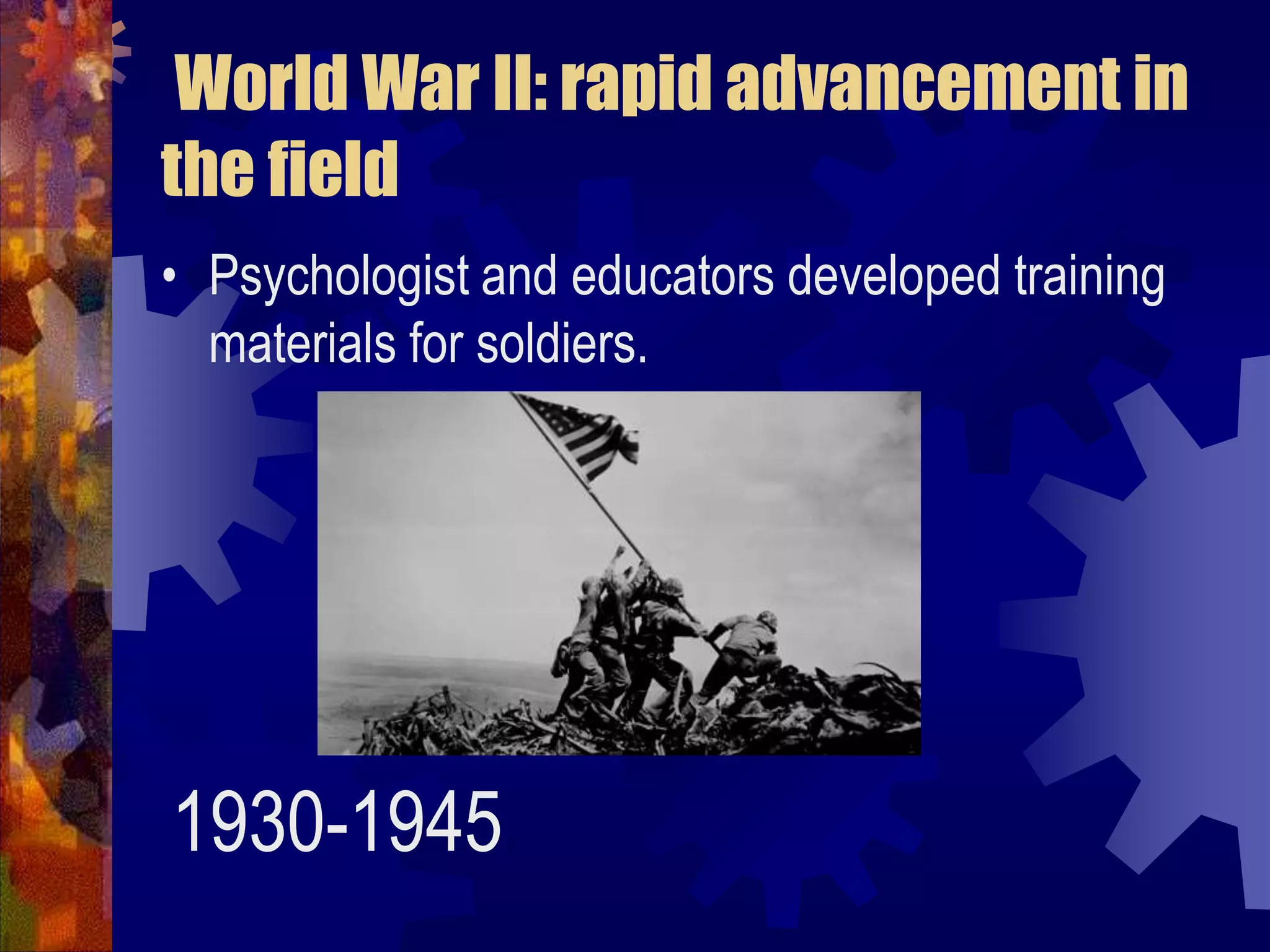
World War II: rapid advancement in the fieldPsychologist and educators developed training materials for soldiers.1930-1945
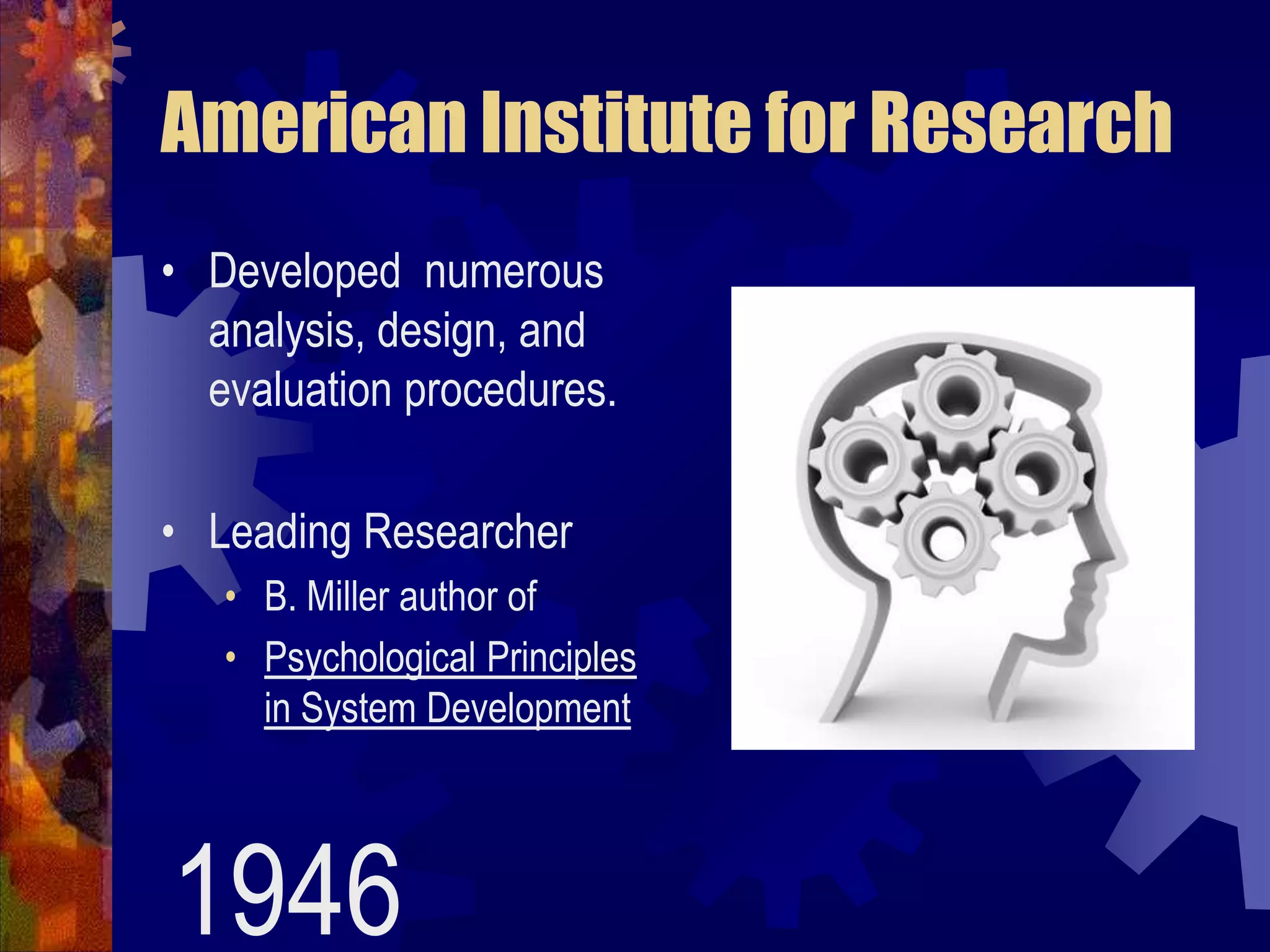
American Institute for ResearchDeveloped  numerous analysis, design, and evaluation procedures.Leading ResearcherB. Miller author ofPsychological Principles in System Development1946
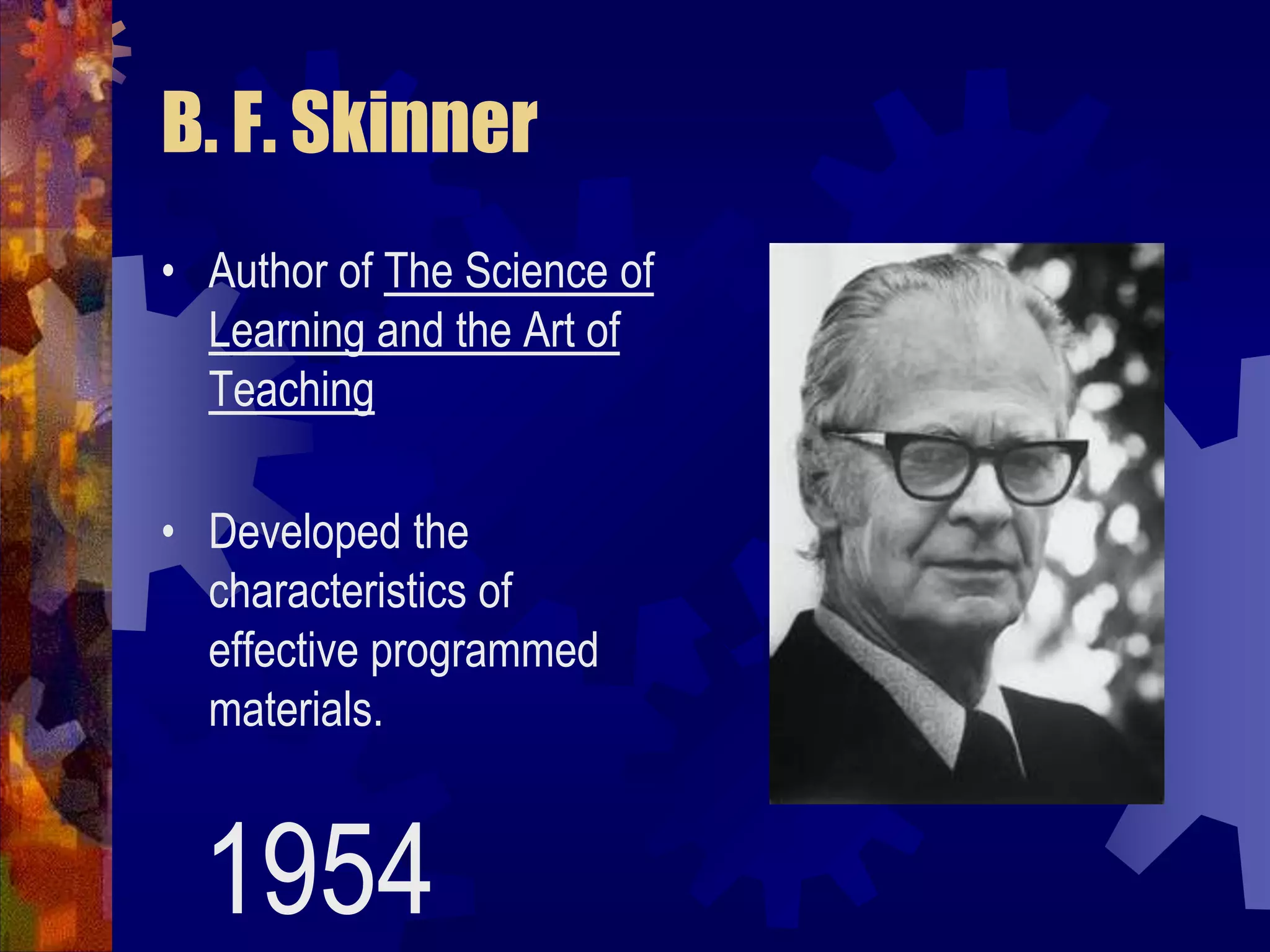
B. F. SkinnerAuthor of The Science of Learning and the Art of TeachingDeveloped the characteristics of effective programmed materials.1954
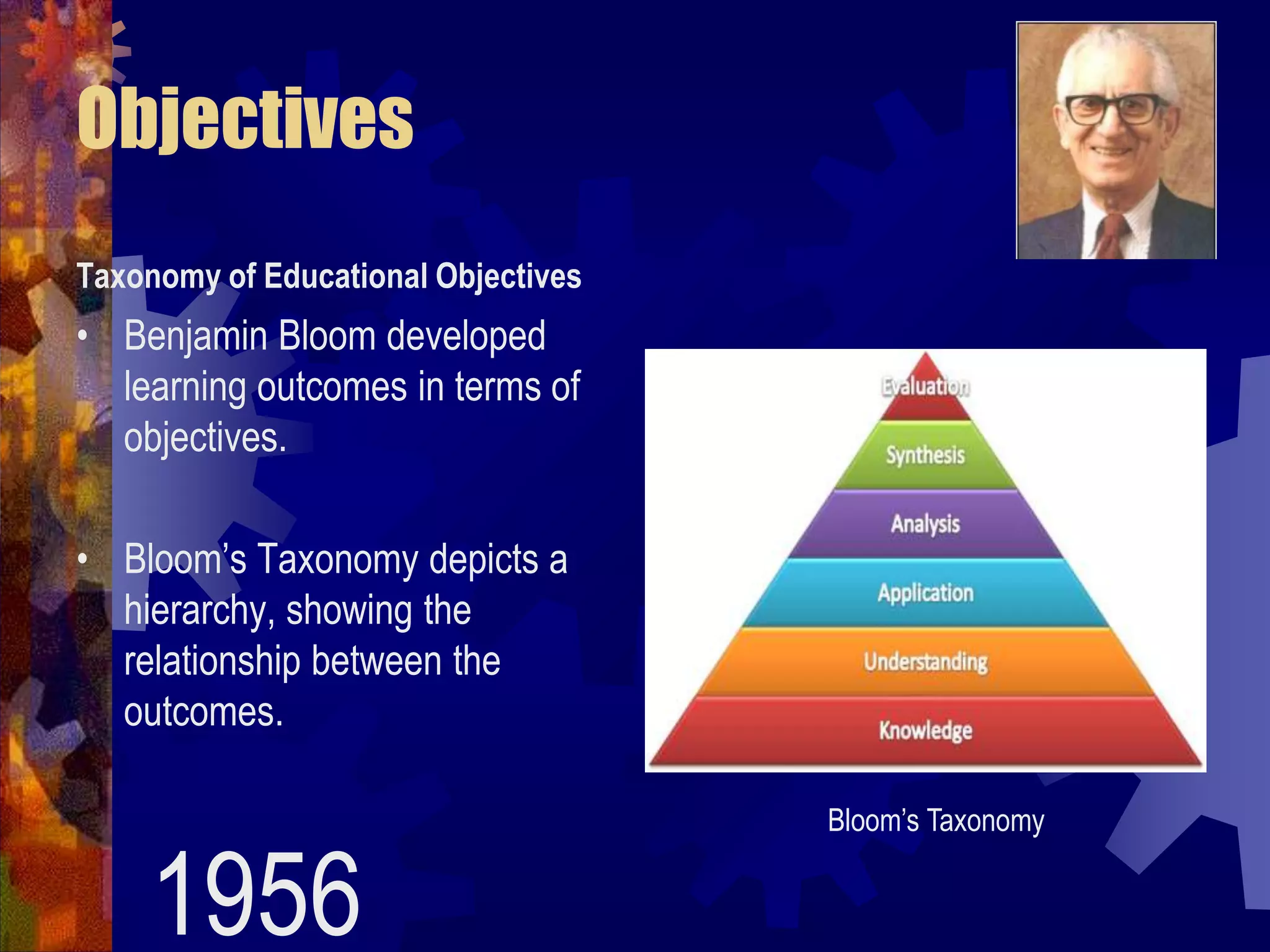
ObjectivesTaxonomy of Educational ObjectivesBenjamin Bloom developed learning outcomes in terms of objectives.Bloom’s Taxonomy depicts a hierarchy, showing the relationship between the outcomes.Bloom’s Taxonomy1956
SputnikThe launch of Sputnik, a Soviet space satellite, lead to reforms in math and science education. Science and math instructional materials developed using US government funding.1957
Early Instructional Design Models       A model for systemically designing material was developed by incorporatingTask Analysis,                    Objective Specification, &Criterion-Referenced Testing*1960’s *Robert Glaser developed the term criterion-reference.  His research  allowed educators to assess for previous knowledge and develop materials that are learner specific.
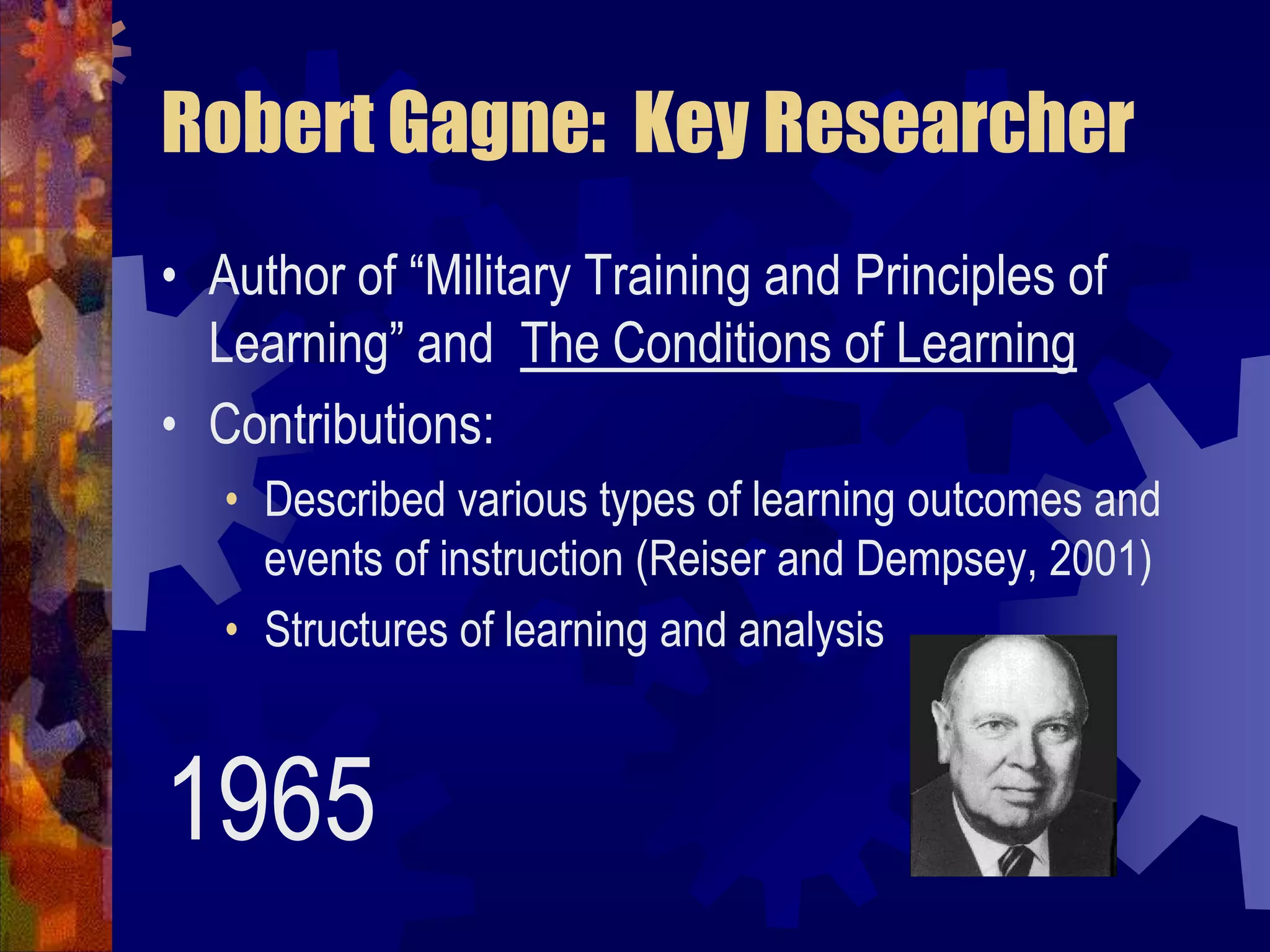
Robert Gagne:  Key ResearcherAuthor of “Military Training and Principles of Learning” and  The Conditions of LearningContributions:  Described various types of learning outcomes and events of instruction (Reiser and Dempsey, 2001)Structures of learning and analysis1965
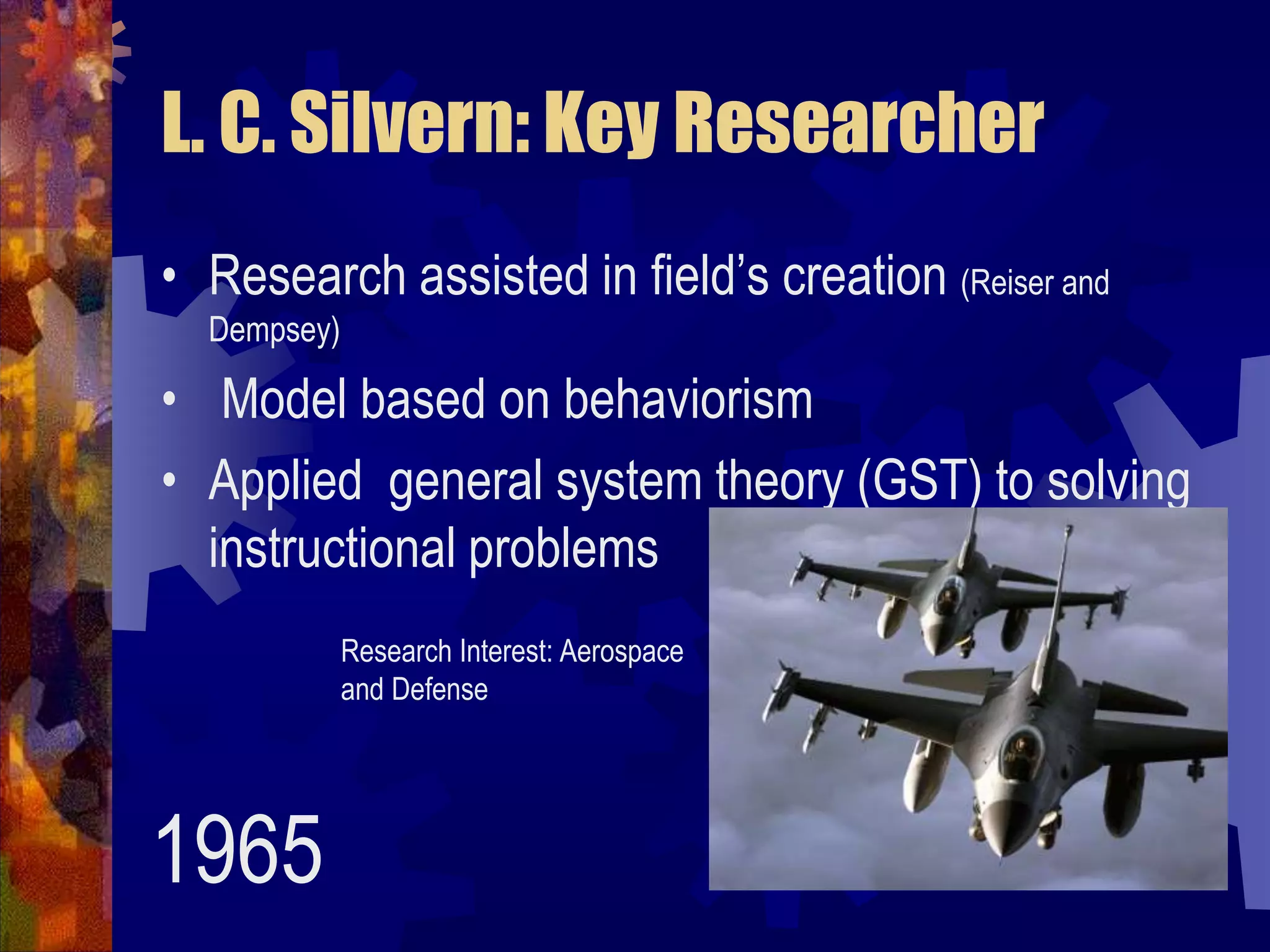
L. C. Silvern: Key ResearcherResearch assisted in field’s creation (Reiser and Dempsey) Model based on behaviorismApplied  general system theory (GST) to solving instructional problemsResearch Interest: Aerospace and Defense1965
Systems ApproachRapid growth and development in the creation of new models for systemically designing instruction.         1970’s
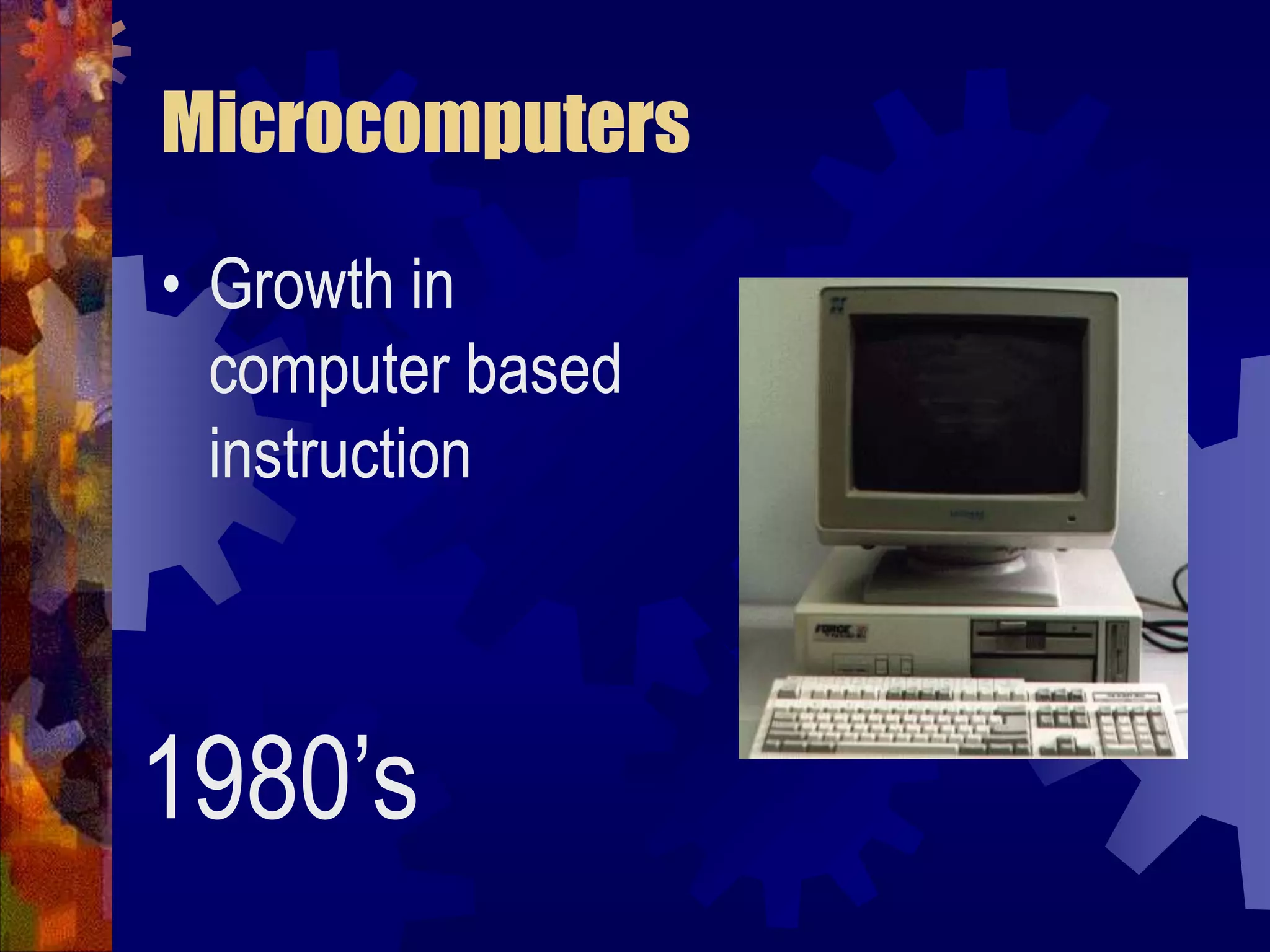
MicrocomputersGrowth in computer based instruction1980’s
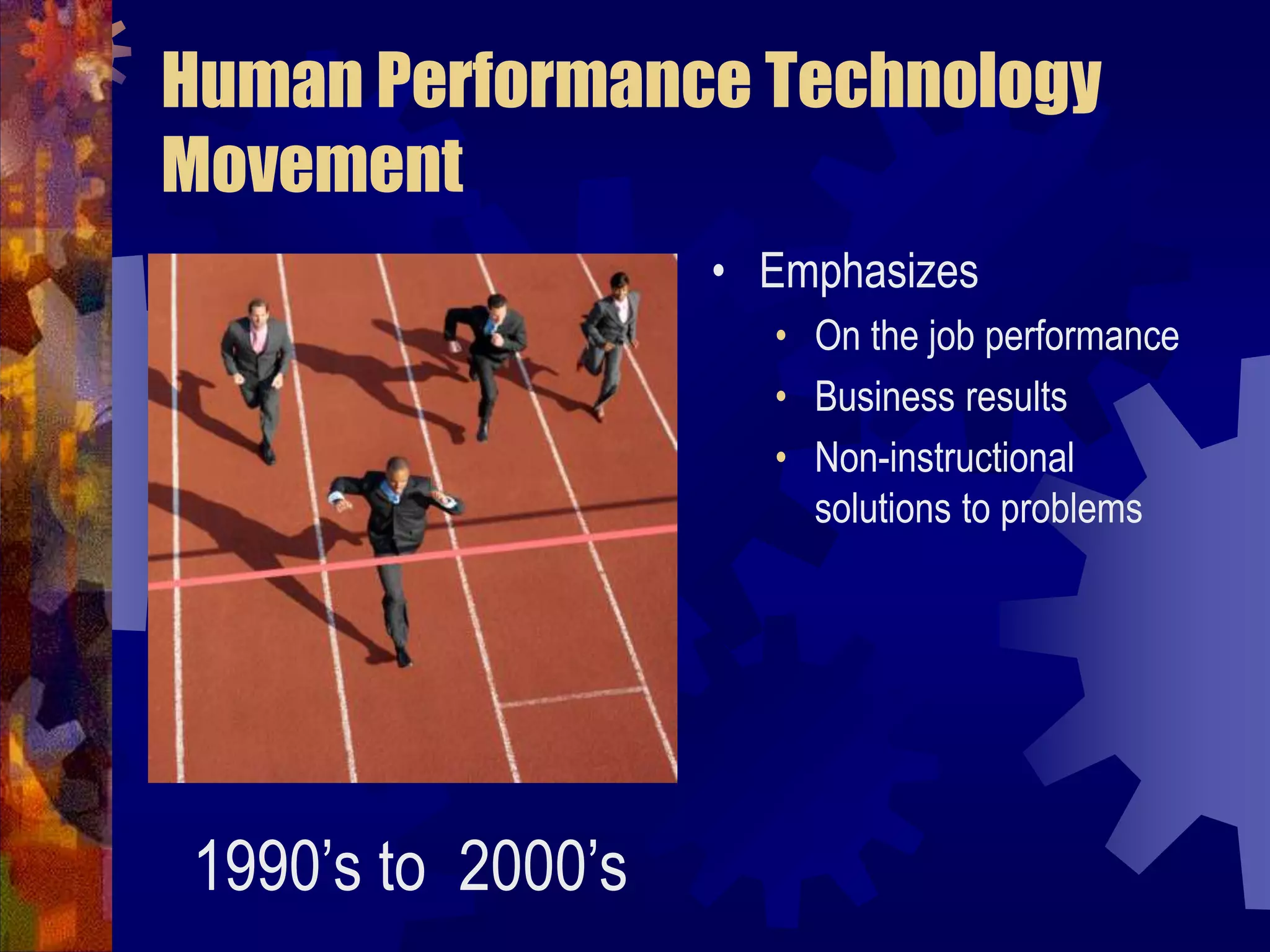
Human Performance Technology MovementEmphasizesOn the job performanceBusiness resultsNon-instructional solutions to problems1990’s to  2000’s
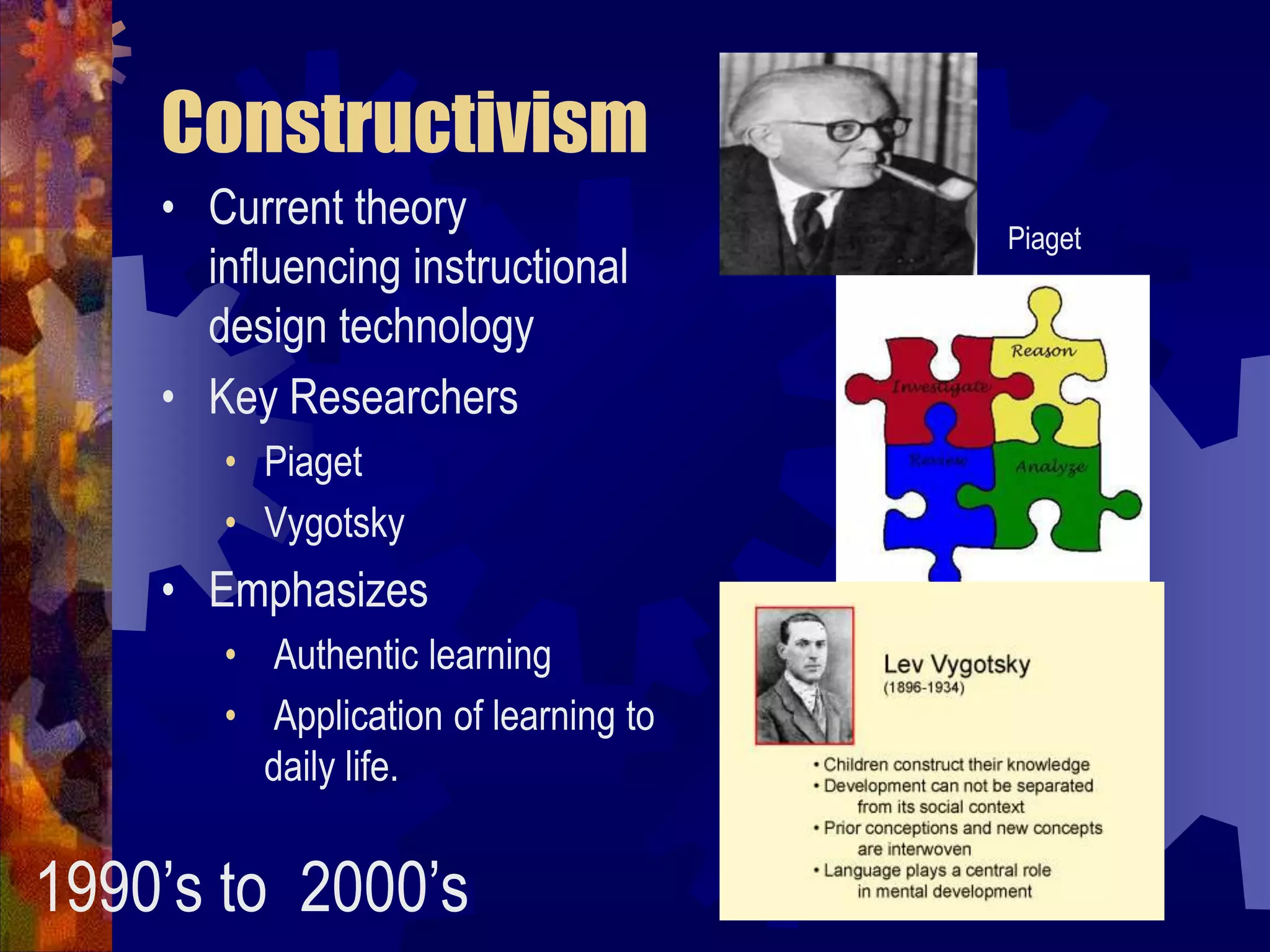
ConstructivismCurrent theory influencing instructional design technologyKey ResearchersPiagetVygotskyEmphasizes Authentic learning  Application of learning to daily life.Piaget1990’s to  2000’s
ReferencesDempsey, J.V., & Reiser, R. (2007).Trends and Issues in Instructional Design and Technology (2nd ed.).Upper Saddle River, NJ: Pearson.Leigh, D. (n.d.). A Brief History of Instructional Design. Retrieved September 5, 2011 from http://www.pignc-ispi.com/articles/education/brief%20history.htmReiser, R. (2001). A History of Instructional Design and Technology: Part II: A History of Instructional Design. ETR&D, 49, 57-67.
ReferencesThe History of Instructional Design. (n.d.). Retrieved August 31, 2011 from  Preceden Web site: http://www.preceden.com/timelines/8906-history-of-instructional-design.

History of instructional design

  • 1.
    History of InstructionalDesignAndrea ReederSeptember 8, 2011IDT 7052
  • 2.
    What is IDT?Accordingto Kent Gustafson and Rob Branch instructional design is a systematic process that is employed to develop education and training programs (Reiser and Dempsey, 2007).
  • 3.
    Contributing TheoriesGreek philosophers: writings on learning and memorySt. Thomas Aquinas: free will in terms of teachingJohn Locke: gaining knowledge through experience 17th centuryJohn Dewey: learning by doing13th century20th century
  • 4.
    BehaviorismInfluential theory inthe development of IDTDefined as the measurement and study of human behaviors (Resier and Dempsey, 2007)IDT views this theory as more encompassing then stimulus-response (Resier and Dempsey, 2007)1920’s
  • 5.
    World War II:rapid advancement in the fieldPsychologist and educators developed training materials for soldiers.1930-1945
  • 6.
    American Institute forResearchDeveloped numerous analysis, design, and evaluation procedures.Leading ResearcherB. Miller author ofPsychological Principles in System Development1946
  • 7.
    B. F. SkinnerAuthorof The Science of Learning and the Art of TeachingDeveloped the characteristics of effective programmed materials.1954
  • 8.
    ObjectivesTaxonomy of EducationalObjectivesBenjamin Bloom developed learning outcomes in terms of objectives.Bloom’s Taxonomy depicts a hierarchy, showing the relationship between the outcomes.Bloom’s Taxonomy1956
  • 9.
    SputnikThe launch ofSputnik, a Soviet space satellite, lead to reforms in math and science education. Science and math instructional materials developed using US government funding.1957
  • 10.
    Early Instructional DesignModels A model for systemically designing material was developed by incorporatingTask Analysis, Objective Specification, &Criterion-Referenced Testing*1960’s *Robert Glaser developed the term criterion-reference. His research allowed educators to assess for previous knowledge and develop materials that are learner specific.
  • 11.
    Robert Gagne: Key ResearcherAuthor of “Military Training and Principles of Learning” and The Conditions of LearningContributions: Described various types of learning outcomes and events of instruction (Reiser and Dempsey, 2001)Structures of learning and analysis1965
  • 12.
    L. C. Silvern:Key ResearcherResearch assisted in field’s creation (Reiser and Dempsey) Model based on behaviorismApplied general system theory (GST) to solving instructional problemsResearch Interest: Aerospace and Defense1965
  • 13.
    Systems ApproachRapid growthand development in the creation of new models for systemically designing instruction. 1970’s
  • 14.
    MicrocomputersGrowth in computerbased instruction1980’s
  • 15.
    Human Performance TechnologyMovementEmphasizesOn the job performanceBusiness resultsNon-instructional solutions to problems1990’s to 2000’s
  • 16.
    ConstructivismCurrent theory influencinginstructional design technologyKey ResearchersPiagetVygotskyEmphasizes Authentic learning Application of learning to daily life.Piaget1990’s to 2000’s
  • 17.
    ReferencesDempsey, J.V., &Reiser, R. (2007).Trends and Issues in Instructional Design and Technology (2nd ed.).Upper Saddle River, NJ: Pearson.Leigh, D. (n.d.). A Brief History of Instructional Design. Retrieved September 5, 2011 from http://www.pignc-ispi.com/articles/education/brief%20history.htmReiser, R. (2001). A History of Instructional Design and Technology: Part II: A History of Instructional Design. ETR&D, 49, 57-67.
  • 18.
    ReferencesThe History ofInstructional Design. (n.d.). Retrieved August 31, 2011 from Preceden Web site: http://www.preceden.com/timelines/8906-history-of-instructional-design.