Curriculum & 21st Century SkillsWeek 4: Whole Group Summary Fawn Brunson
~John Dewey"If we teach today as we taught yesterday, we rob our children of tomorrow."John Dewey, the 20th century philosopher and educational reformer made this comment about the state of education in the early 1900’s.Today, 21st century educators are still trying to address the needs of their learners with “antiquated mission statements reminiscent of the past century” (Jacobs, 2010, p. 8).  Source: Google Images
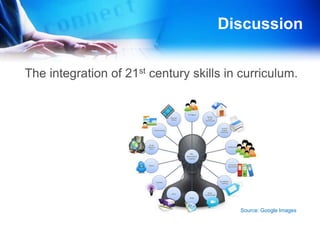
DiscussionThe integration of 21st century skills in curriculum.Source: Google Images
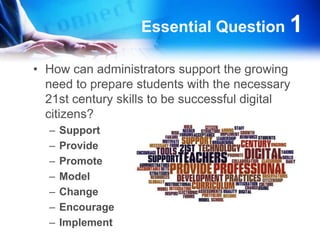
Essential Question 1How can administrators support the growing need to prepare students with the necessary 21st century skills to be successful digital citizens?SupportProvidePromoteModelChangeEncourageImplement
Key PointsSupport, encourage, and model collaborationProvide necessary resources Accountability measures Provide and support professional developmentPromote a culture of “risk taking” and acceptance of failureMore Key PointsModel digital citizenship in their leadership practices Broaden assessment tools to include digital formsImplement the NETS for students, teachers, and administrators into daily school practicesSupport quality curriculum
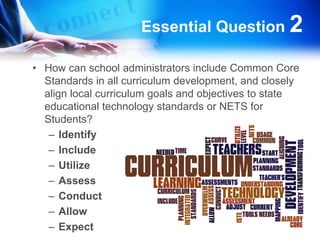
How can school administrators include Common Core Standards in all curriculum development, and closely align local curriculum goals and objectives to state educational technology standards or NETS for Students?IdentifyIncludeUtilize AssessConductAllow Expect Essential Question 2
Key PointsIdentify CCS and NETS that are already integrated in current curriculum, adjust as neededAllow time for learning, expect learning curveInclude teachers in the planning, development, and aligning of curriculum Utilize curriculum mapping and development toolsISTE Curriculum Planning Tool
More Key PointsStart with transforming assessmentsConduct a curriculum needs assessmentAssess teacher’s level of technology understanding and NETS usage
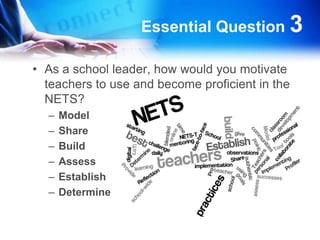
Essential Question 3As a school leader, how would you motivate teachers to use and become proficient in the NETS?ModelShareBuildAssessEstablishDetermine
Key PointsModel best practices dailyProvide authentic blended professional development: online, face-to-face, mentoring, teacher observations…Share best classroom practices of the NETS in your school and challenge teachers to build on those successes
More Key PointsTeachers assess their own implementation of NETS using digital tools: NETS Profiler ProSchool 2.0 Reflection Tool for NETS-TEstablish personal learning communities and give teachers time to collaborate Establish school-wide goals for implementing NETSDetermine a starting point (where are teachers) build from there
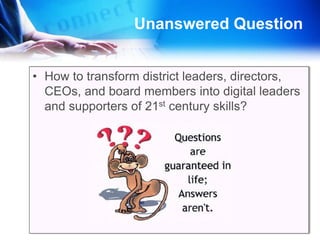
Unanswered QuestionHow to transform district leaders, directors, CEOs, and board members into digital leaders and supporters of 21st century skills?
Shared ResourcesCarnegie Foundation's Reading in the DisciplinesA New Essential Curriculum For a New timeReflection Tools for NETS-S-TsProfile for Technology-Literate TeachersLibrary Media Matrix OutcomesMTLSS VSC Alignment
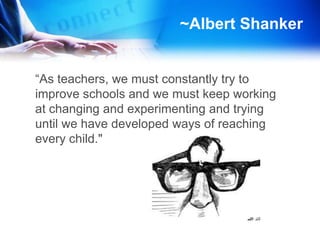
~Albert Shanker“As teachers, we must constantly try to improve schools and we must keep working at changing and experimenting and trying until we have developed ways of reaching every child."
Curriculum & 21st century skills

Curriculum & 21st century skills

  • 1.
    Curriculum & 21stCentury SkillsWeek 4: Whole Group Summary Fawn Brunson
  • 2.
    ~John Dewey"If weteach today as we taught yesterday, we rob our children of tomorrow."John Dewey, the 20th century philosopher and educational reformer made this comment about the state of education in the early 1900’s.Today, 21st century educators are still trying to address the needs of their learners with “antiquated mission statements reminiscent of the past century” (Jacobs, 2010, p. 8). Source: Google Images
  • 3.
    DiscussionThe integration of21st century skills in curriculum.Source: Google Images
  • 4.
    Essential Question 1Howcan administrators support the growing need to prepare students with the necessary 21st century skills to be successful digital citizens?SupportProvidePromoteModelChangeEncourageImplement
  • 5.
    Key PointsSupport, encourage,and model collaborationProvide necessary resources Accountability measures Provide and support professional developmentPromote a culture of “risk taking” and acceptance of failureMore Key PointsModel digital citizenship in their leadership practices Broaden assessment tools to include digital formsImplement the NETS for students, teachers, and administrators into daily school practicesSupport quality curriculum
  • 6.
    How can schooladministrators include Common Core Standards in all curriculum development, and closely align local curriculum goals and objectives to state educational technology standards or NETS for Students?IdentifyIncludeUtilize AssessConductAllow Expect Essential Question 2
  • 7.
    Key PointsIdentify CCSand NETS that are already integrated in current curriculum, adjust as neededAllow time for learning, expect learning curveInclude teachers in the planning, development, and aligning of curriculum Utilize curriculum mapping and development toolsISTE Curriculum Planning Tool
  • 8.
    More Key PointsStartwith transforming assessmentsConduct a curriculum needs assessmentAssess teacher’s level of technology understanding and NETS usage
  • 9.
    Essential Question 3Asa school leader, how would you motivate teachers to use and become proficient in the NETS?ModelShareBuildAssessEstablishDetermine
  • 10.
    Key PointsModel bestpractices dailyProvide authentic blended professional development: online, face-to-face, mentoring, teacher observations…Share best classroom practices of the NETS in your school and challenge teachers to build on those successes
  • 11.
    More Key PointsTeachersassess their own implementation of NETS using digital tools: NETS Profiler ProSchool 2.0 Reflection Tool for NETS-TEstablish personal learning communities and give teachers time to collaborate Establish school-wide goals for implementing NETSDetermine a starting point (where are teachers) build from there
  • 12.
    Unanswered QuestionHow totransform district leaders, directors, CEOs, and board members into digital leaders and supporters of 21st century skills?
  • 13.
    Shared ResourcesCarnegie Foundation'sReading in the DisciplinesA New Essential Curriculum For a New timeReflection Tools for NETS-S-TsProfile for Technology-Literate TeachersLibrary Media Matrix OutcomesMTLSS VSC Alignment
  • 14.
    ~Albert Shanker“As teachers,we must constantly try to improve schools and we must keep working at changing and experimenting and trying until we have developed ways of reaching every child."