TheGildedAge
1870-1890
TheSecondIndustrialRevolution
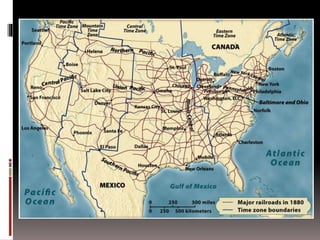
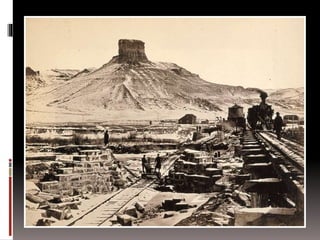
 Railroads essentially cause the Second
Industrial Revolution and become the
country’s first big business
 Stimulated the post-war national economy and
marketplace
 National rail network
 Promoted by federal loans, standardization, and
state aid
 Helped contribute to mass production,
distribution, and mass marketing of goods
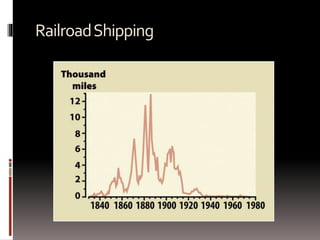
RailroadShipping
TheSecondIndustrialRevolution
 The Industrial Economy
 By 1913, the United States produced 1/3 of the
world’s industrial output
 The 1880 census indicated that a majority of the
U.S. workforce was engaged in non-farming jobs
(for the first time)
 Financing industrialization became an industry in
itself
 Pittsburgh and Chicago begin to grow as a result
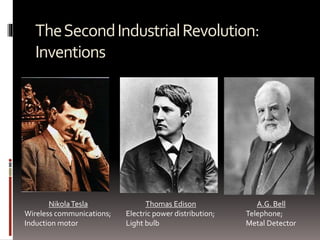
TheSecondIndustrialRevolution:
Inventions
NikolaTesla
Wireless communications;
Induction motor
Thomas Edison
Electric power distribution;
Light bulb
A.G. Bell
Telephone;
Metal Detector
TheSecondIndustrialRevolution
 Railroads and Politics
 Became a major political issue through the end of
the century
 Regulation was a hotly debated issue
 However, most people did not want to interfere with
progress
 Eventually, the SupremeCourt ruled that railroad
regulatory commissions were legal
 Interstate CommerceAct of 1877 allowed for a
commission to hear complaints against railroad
companies accused of charging outrageous rates
BigBusiness
 Competition and Consolidation
 Depression plagued the economy between 1873
and 1897
 Businesses engaged in cutthroat competition
 To avoid competition, large businesses battled to
control entire industries
 Between 1897 and 1904, 4,000 business
consolidated into larger corporations
 Many of these large corporations became
monopolies
BigBusiness
 Andrew Carnegie and Steel Manufacturing
 Worked for the Pennsylvania Railroad
 By the 1890s, Carnegie dominated the steel
industry
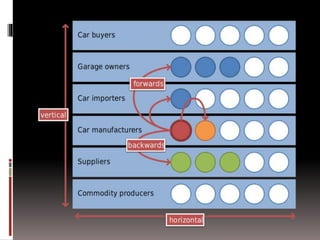
 Used vertical integration
 Buy everything that can be used to take a product
from raw material to finished
 His whole life was focused on success
 Also generously gave back to society
BigBusiness
 John D. Rockefeller and Standard Oil
 Ran a trust that bought everyone else in the oil
industry out by purchasing stocks
 Rockefeller slowly consolidated the oil business
 Lowered costs by paying attention to minute details
 Focused on production and marketing aspects of the
oil industry
 Utilized horizontal integration
 Buy everyone else out in the same industry
BigBusiness
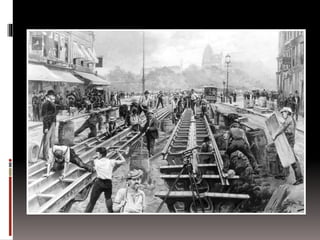
 Factory conditions
 35,000 factory and mining workers were killed each
year in work related accidents
 Highest rate in the industrial world
 Many skilled laborers had their jobs taken by machines
 Workers had few protections from mistreatment on
the job
 Economic insecurity was a fact of life
 Long work hours
 No workers’ compensation
ClassStratification
 Class divisions became more visible
 The rich get richer
 The poor get poorer
 Many wealthy American gave up their old
lives to pursue an aristocratic lifestyle
 Consumerism and consumption of goods became
the key to this new form of freedom
ClassStratification
 The working class lived in terrible conditions
 12 hour work days; 7 days a week
 1 of 115 workers died in work related accidents
 1 in 8 were injured on the job
 182,000 children under 16 were employed in
the mining or manufacturing industries
 Almost the population ofWaco
TheAmericanWest
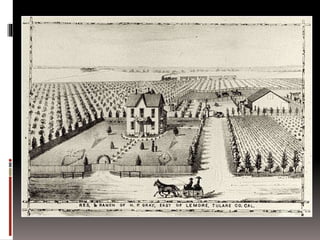
 Farming boomed; more land came into cultivation
in the 30 years after the CivilWar than the previous
2 and ½ centuries of American history combined;
one of the reasons why we have issues during the
1930s with the Dust Bowl; over farming
 A great deal of the farming burden fell on women
 Caused in part by the push by “Redeemers” in the
South who celebrated the end of Reconstruction and
wanted to bring industrialization and economic
improvements to the South by the expansion of
population and rail networks
TheAmericanWest
 Bonanza farms
 Powell stated that the arid region of the West would
require large-scale irrigation projects and cooperative,
communal farming
 Millions of farmers moving to the west to seek crop
bonanzas and a new way of life; by 1900, the west was
settled and it held 30% of the national population
 Small farms tuned in and realized that they had to
appeal to a national and international market
(beginning of the international American identity)
 Didn’t help the problems as crop production
increased, prices fell, small farmers suffered greatly
difficulties in the last quarter of the 1900s
TheAmericanWest
 Mining Boom and Bust
 California in 1849 was the big mining boom state
 Boom came to an end during the 1890s
 Western mines contributed millions to the economy,
helped finance the Civil War, supported
industrialization, changed relative value of gold
(leaving room for the amount of silver to change)
 Mining populations were primarily based of men;
sounds a lot like early colonialVirginia (men
outnumbered women 2:1)
 After towns became unprofitable, mining ventures
moved on leaving Indian reservations, hills, and ghost
towns
TheAmericanWest
 The ‘real’West; the Cowboys
 Cowboys became a symbol of a life of freedom
on the open range; no big cities issues to get
you down
 They governed themselves (like miners) and
typically weren’t as violent as OldWest films
portray.
 Short lived phenomena, on the way out by
1880s; cattle trails becoming local; regional
only; many cowboys switched to raising sheep
TheAmericanWest
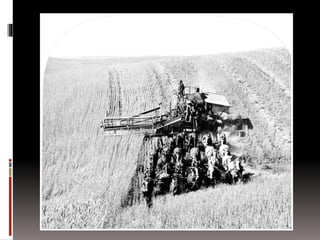
 New Farming Methods
 Barbed wire; fence in the wilderness!
 Mechanical technology
 What happens to the farmer?
 Settlers eventually abandon their farms; become
restless and angry (pre-cursor to the Populist
movement)
 Complaining about declining crop prices, rail rates
going up, and heavy mortgages
 The “Grange” takes on the issues as a lobby
organization; far from their original goal as one that
provided social, cultural, and educational
opportunities
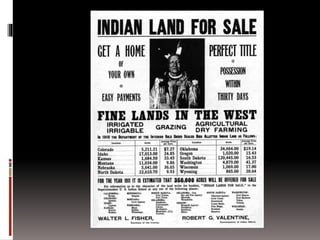
TheWestandIndians
 The true “last stand” for the Native Americas;
rights as they knew it were about to be taken
away
 Constant warfare between the Plains Indians
and military occurred between 1850 and 1890
 US army launches a campaign against the Navajo
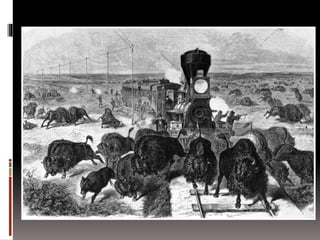
 One effective method of extermination: kill
off the buffalo
 Only 30 million in 1800; nearly extinct by hunting
in 1890
TheWestandIndians
 Land availability diminishing
 HomesteadAct of 1862 – gave farmers public
lands, roughly 160 acres, but that was too small
 Timber and Stone Act – help “civilize”
Washington, Oregon, California, and Nevada
 Land at $2.50 an acre
 Ten times the limit of the Homestead Act
 Railroads were making a killing because they’re
buying it up at discounted rates
 Is it any wonder why the Indians got in the way?
TheWestandIndians
 1871, Congress eliminates the treaty
system that dated back to the
revolutionary war with the Indians
 Forced American assimilation on the Indians;
no choice but to become American
 DawesAct – attacked tribalism, essentially
outlawing it in 1887
 The policy was one of biggest disasters for
Indians; trying to promote them as small
farmers
TheWestandIndians
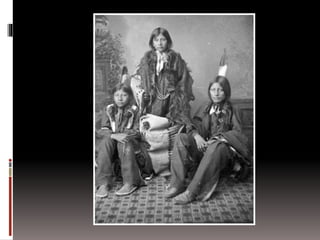
 Indian Citizenship
 Must give up tribal identity and be assimilated into
American culture
 However, no rights under the 14th and 15
amendments; thanks for playing, but no voting or
citizenship rights
 Ghost Dance (Wounded Knee)
 American soldiers kill between 150 and 200 women
and children Indians atWounded Knee Creek in SD as
they were taking part in a “Ghost Dance”
 Seen as primitive, backwards, etc.; something the
white man should fear
PoliticsintheGildedAge
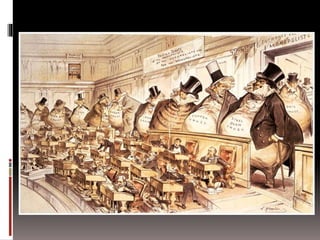
 Absolute corruption in politics
 NYC BossTweed
 Business interests influencing the House and Senate
 US was an island of democracy that needed to
help the ignorant nations of the world
 Democracy was definitely working; very close
elections throughout the 1880s
 State and national elections always very close
 The Republican Party dominated national
elections though
 Every Republican candidate was a Civil War veteran
from 1868 - 1900
PoliticsintheGildedAge
 Gilded Age presidents did little legislation except
for big business; did not exert executive
leadership at all
 Republican candidates for president had all
fought in the Union army from 1868 to 1900
 Democrats dominated the South and Catholic
votes
EconomicsintheGildedAge
 The government ran on standby was ill prepared to
deal with all the problems of rapid economic
growth
 Tariff policy in constant debate
 Return to gold standard in 1879 (would soon start
issues with the Populists)
 Interstate Commerce Commission
 Another oversight organization in the move toward
regulation
 Sherman Anti-TrustAct
 Building block for regulating big business in the 1900s
SocialDarwinism
 Survival of the fittest in business, society, etc.;
White people had to make a reason for why there
were rich and why some were poor
 Contends that business tycoons deserve everything
they get because “God is on their side” because they
worked hard and they had money
 Just have to accept inequality in the world
 Failure to advance in society is likely because of your
lack of wits and character
 Courts typically sided with business on everything;
just another reflection of this mentality
TheSocialGospel
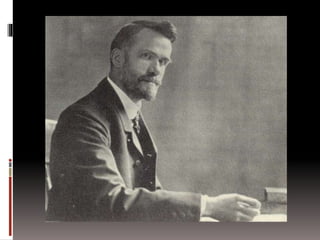
 Walter Rauschenbusch insisted that freedom and
spiritual development needed to be in harmony
with an equalization of wealth and power
 Fits hand in hand with social Darwinism
 Acres of Diamonds speech; needed to have wealth
in order to fulfill the duties of being a good
Christian
 Alternative theories included socialism,
communism (things going on in Russia at the time)
 Early introduction of socialism by Lawrence
Gronlund’s Cooperative Commonwealth
LaborintheGildedAge
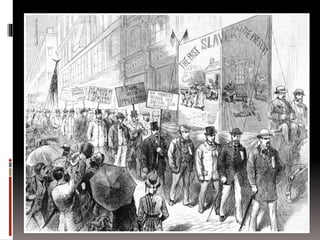
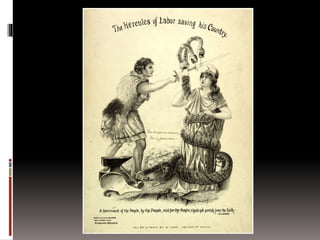
 1877 Great Railroad Strike
 Demonstrated that labor rights/regulations would
become an issue in the GildedAge and beyond
 Knights of Labor
 Organized workers to improve social conditions in
factories
 Conditions essential to liberty
 Labor raised the question whether meaningful
freedom could exist in extreme economic
inequality
LaborintheGildedAge
 Middle-Class Reformers
 Alarmed by fear of class warfare and the growing
concentration of wealth in a few
 The origins of Progressivism
 Henry George’s solution to the labor issue was a
single tax
 George also rejected the traditional equation of
liberty with ownership of land
LaborintheGildedAge
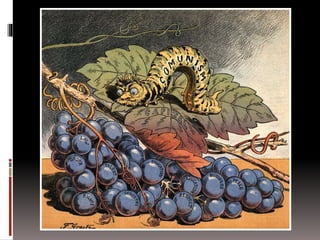
 Socialism
 Lawrence Gronlund’s Cooperative Commonwealth
was the first book to popularize socialist concepts and
ideas for an American audience
 It explained socialist concepts in common language
 Bellamy’s Utopia
 Edward Bellamy insisted that freedom was a social
condition
 Freedom rested on societal interdependence, not
autonomy
 Bellamy believed that material abundance made
possible by industrial capitalism could be maintained
while eliminating inequality
TheHaymarketAffair
 On 1 May 1886, roughly 350,000 workers across
the country demonstrated for 8 hours
 A riot ensued after a bomb killed a police officer
on 4 May
 7 of the 8 men accused of plotting the Haymarket
bombing were foreign-born
 Employers took the opportunity to use this
incident against the labor movement
 Depicted the labor movement as dangerous, un-
American, and prone to violence
 Also insisted that labor unions were controlled by
foreign-born radicals

HIST_1302_Ch_16_The Gilded Age

  • 1.
  • 2.
    TheSecondIndustrialRevolution  Railroads essentiallycause the Second Industrial Revolution and become the country’s first big business  Stimulated the post-war national economy and marketplace  National rail network  Promoted by federal loans, standardization, and state aid  Helped contribute to mass production, distribution, and mass marketing of goods
  • 4.
  • 6.
    TheSecondIndustrialRevolution  The IndustrialEconomy  By 1913, the United States produced 1/3 of the world’s industrial output  The 1880 census indicated that a majority of the U.S. workforce was engaged in non-farming jobs (for the first time)  Financing industrialization became an industry in itself  Pittsburgh and Chicago begin to grow as a result
  • 7.
    TheSecondIndustrialRevolution: Inventions NikolaTesla Wireless communications; Induction motor ThomasEdison Electric power distribution; Light bulb A.G. Bell Telephone; Metal Detector
  • 8.
    TheSecondIndustrialRevolution  Railroads andPolitics  Became a major political issue through the end of the century  Regulation was a hotly debated issue  However, most people did not want to interfere with progress  Eventually, the SupremeCourt ruled that railroad regulatory commissions were legal  Interstate CommerceAct of 1877 allowed for a commission to hear complaints against railroad companies accused of charging outrageous rates
  • 9.
    BigBusiness  Competition andConsolidation  Depression plagued the economy between 1873 and 1897  Businesses engaged in cutthroat competition  To avoid competition, large businesses battled to control entire industries  Between 1897 and 1904, 4,000 business consolidated into larger corporations  Many of these large corporations became monopolies
  • 11.
    BigBusiness  Andrew Carnegieand Steel Manufacturing  Worked for the Pennsylvania Railroad  By the 1890s, Carnegie dominated the steel industry  Used vertical integration  Buy everything that can be used to take a product from raw material to finished  His whole life was focused on success  Also generously gave back to society
  • 13.
    BigBusiness  John D.Rockefeller and Standard Oil  Ran a trust that bought everyone else in the oil industry out by purchasing stocks  Rockefeller slowly consolidated the oil business  Lowered costs by paying attention to minute details  Focused on production and marketing aspects of the oil industry  Utilized horizontal integration  Buy everyone else out in the same industry
  • 15.
    BigBusiness  Factory conditions 35,000 factory and mining workers were killed each year in work related accidents  Highest rate in the industrial world  Many skilled laborers had their jobs taken by machines  Workers had few protections from mistreatment on the job  Economic insecurity was a fact of life  Long work hours  No workers’ compensation
  • 17.
    ClassStratification  Class divisionsbecame more visible  The rich get richer  The poor get poorer  Many wealthy American gave up their old lives to pursue an aristocratic lifestyle  Consumerism and consumption of goods became the key to this new form of freedom
  • 18.
    ClassStratification  The workingclass lived in terrible conditions  12 hour work days; 7 days a week  1 of 115 workers died in work related accidents  1 in 8 were injured on the job  182,000 children under 16 were employed in the mining or manufacturing industries  Almost the population ofWaco
  • 20.
    TheAmericanWest  Farming boomed;more land came into cultivation in the 30 years after the CivilWar than the previous 2 and ½ centuries of American history combined; one of the reasons why we have issues during the 1930s with the Dust Bowl; over farming  A great deal of the farming burden fell on women  Caused in part by the push by “Redeemers” in the South who celebrated the end of Reconstruction and wanted to bring industrialization and economic improvements to the South by the expansion of population and rail networks
  • 21.
    TheAmericanWest  Bonanza farms Powell stated that the arid region of the West would require large-scale irrigation projects and cooperative, communal farming  Millions of farmers moving to the west to seek crop bonanzas and a new way of life; by 1900, the west was settled and it held 30% of the national population  Small farms tuned in and realized that they had to appeal to a national and international market (beginning of the international American identity)  Didn’t help the problems as crop production increased, prices fell, small farmers suffered greatly difficulties in the last quarter of the 1900s
  • 23.
    TheAmericanWest  Mining Boomand Bust  California in 1849 was the big mining boom state  Boom came to an end during the 1890s  Western mines contributed millions to the economy, helped finance the Civil War, supported industrialization, changed relative value of gold (leaving room for the amount of silver to change)  Mining populations were primarily based of men; sounds a lot like early colonialVirginia (men outnumbered women 2:1)  After towns became unprofitable, mining ventures moved on leaving Indian reservations, hills, and ghost towns
  • 24.
    TheAmericanWest  The ‘real’West;the Cowboys  Cowboys became a symbol of a life of freedom on the open range; no big cities issues to get you down  They governed themselves (like miners) and typically weren’t as violent as OldWest films portray.  Short lived phenomena, on the way out by 1880s; cattle trails becoming local; regional only; many cowboys switched to raising sheep
  • 25.
    TheAmericanWest  New FarmingMethods  Barbed wire; fence in the wilderness!  Mechanical technology  What happens to the farmer?  Settlers eventually abandon their farms; become restless and angry (pre-cursor to the Populist movement)  Complaining about declining crop prices, rail rates going up, and heavy mortgages  The “Grange” takes on the issues as a lobby organization; far from their original goal as one that provided social, cultural, and educational opportunities
  • 27.
    TheWestandIndians  The true“last stand” for the Native Americas; rights as they knew it were about to be taken away  Constant warfare between the Plains Indians and military occurred between 1850 and 1890  US army launches a campaign against the Navajo  One effective method of extermination: kill off the buffalo  Only 30 million in 1800; nearly extinct by hunting in 1890
  • 29.
    TheWestandIndians  Land availabilitydiminishing  HomesteadAct of 1862 – gave farmers public lands, roughly 160 acres, but that was too small  Timber and Stone Act – help “civilize” Washington, Oregon, California, and Nevada  Land at $2.50 an acre  Ten times the limit of the Homestead Act  Railroads were making a killing because they’re buying it up at discounted rates  Is it any wonder why the Indians got in the way?
  • 31.
    TheWestandIndians  1871, Congresseliminates the treaty system that dated back to the revolutionary war with the Indians  Forced American assimilation on the Indians; no choice but to become American  DawesAct – attacked tribalism, essentially outlawing it in 1887  The policy was one of biggest disasters for Indians; trying to promote them as small farmers
  • 32.
    TheWestandIndians  Indian Citizenship Must give up tribal identity and be assimilated into American culture  However, no rights under the 14th and 15 amendments; thanks for playing, but no voting or citizenship rights  Ghost Dance (Wounded Knee)  American soldiers kill between 150 and 200 women and children Indians atWounded Knee Creek in SD as they were taking part in a “Ghost Dance”  Seen as primitive, backwards, etc.; something the white man should fear
  • 34.
    PoliticsintheGildedAge  Absolute corruptionin politics  NYC BossTweed  Business interests influencing the House and Senate  US was an island of democracy that needed to help the ignorant nations of the world  Democracy was definitely working; very close elections throughout the 1880s  State and national elections always very close  The Republican Party dominated national elections though  Every Republican candidate was a Civil War veteran from 1868 - 1900
  • 36.
    PoliticsintheGildedAge  Gilded Agepresidents did little legislation except for big business; did not exert executive leadership at all  Republican candidates for president had all fought in the Union army from 1868 to 1900  Democrats dominated the South and Catholic votes
  • 37.
    EconomicsintheGildedAge  The governmentran on standby was ill prepared to deal with all the problems of rapid economic growth  Tariff policy in constant debate  Return to gold standard in 1879 (would soon start issues with the Populists)  Interstate Commerce Commission  Another oversight organization in the move toward regulation  Sherman Anti-TrustAct  Building block for regulating big business in the 1900s
  • 38.
    SocialDarwinism  Survival ofthe fittest in business, society, etc.; White people had to make a reason for why there were rich and why some were poor  Contends that business tycoons deserve everything they get because “God is on their side” because they worked hard and they had money  Just have to accept inequality in the world  Failure to advance in society is likely because of your lack of wits and character  Courts typically sided with business on everything; just another reflection of this mentality
  • 39.
    TheSocialGospel  Walter Rauschenbuschinsisted that freedom and spiritual development needed to be in harmony with an equalization of wealth and power  Fits hand in hand with social Darwinism  Acres of Diamonds speech; needed to have wealth in order to fulfill the duties of being a good Christian  Alternative theories included socialism, communism (things going on in Russia at the time)  Early introduction of socialism by Lawrence Gronlund’s Cooperative Commonwealth
  • 41.
    LaborintheGildedAge  1877 GreatRailroad Strike  Demonstrated that labor rights/regulations would become an issue in the GildedAge and beyond  Knights of Labor  Organized workers to improve social conditions in factories  Conditions essential to liberty  Labor raised the question whether meaningful freedom could exist in extreme economic inequality
  • 43.
    LaborintheGildedAge  Middle-Class Reformers Alarmed by fear of class warfare and the growing concentration of wealth in a few  The origins of Progressivism  Henry George’s solution to the labor issue was a single tax  George also rejected the traditional equation of liberty with ownership of land
  • 44.
    LaborintheGildedAge  Socialism  LawrenceGronlund’s Cooperative Commonwealth was the first book to popularize socialist concepts and ideas for an American audience  It explained socialist concepts in common language  Bellamy’s Utopia  Edward Bellamy insisted that freedom was a social condition  Freedom rested on societal interdependence, not autonomy  Bellamy believed that material abundance made possible by industrial capitalism could be maintained while eliminating inequality
  • 46.
    TheHaymarketAffair  On 1May 1886, roughly 350,000 workers across the country demonstrated for 8 hours  A riot ensued after a bomb killed a police officer on 4 May  7 of the 8 men accused of plotting the Haymarket bombing were foreign-born  Employers took the opportunity to use this incident against the labor movement  Depicted the labor movement as dangerous, un- American, and prone to violence  Also insisted that labor unions were controlled by foreign-born radicals