Immigration, Urbanization,
Populism and Issues with the
Gilded Age
Old v New Immigrants
Old Immigrants
• From western Europe (England,
France, Spain)
New Immigrants
• From eastern Europe and Asia
(Germany, Italy, Greece,
Yugoslavia, China, Japan)
Nativism
• Anti-Immigration attitude
• The United States is only for people from the United States
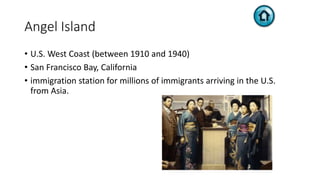
Angel Island
• U.S. West Coast (between 1910 and 1940)
• San Francisco Bay, California
• immigration station for millions of immigrants arriving in the U.S.
from Asia.
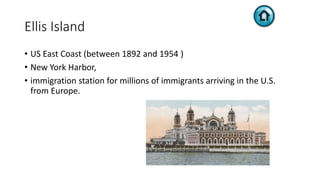
Ellis Island
• US East Coast (between 1892 and 1954 )
• New York Harbor,
• immigration station for millions of immigrants arriving in the U.S.
from Europe.
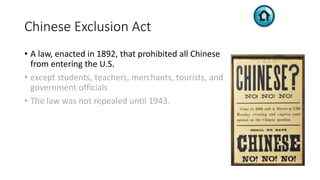
Chinese Exclusion Act
• A law, enacted in 1892, that prohibited all Chinese
from entering the U.S.
• except students, teachers, merchants, tourists, and
government officials
• The law was not repealed until 1943.
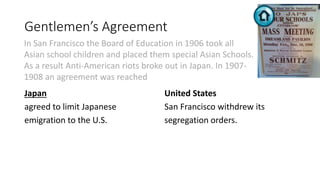
Gentlemen’s Agreement
Japan
agreed to limit Japanese
emigration to the U.S.
United States
San Francisco withdrew its
segregation orders.
In San Francisco the Board of Education in 1906 took all
Asian school children and placed them special Asian Schools.
As a result Anti-American riots broke out in Japan. In 1907-
1908 an agreement was reached
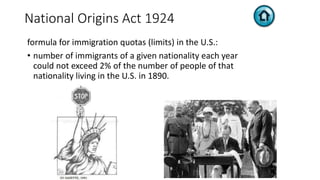
formula for immigration quotas (limits) in the U.S.:
• number of immigrants of a given nationality each year
could not exceed 2% of the number of people of that
nationality living in the U.S. in 1890.
National Origins Act 1924
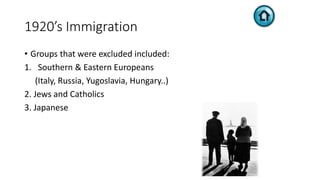
• Groups that were excluded included:
1. Southern & Eastern Europeans
(Italy, Russia, Yugoslavia, Hungary..)
2. Jews and Catholics
3. Japanese
1920’s Immigration
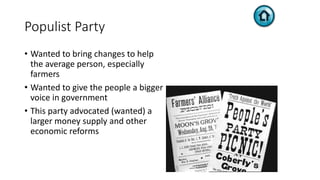
Populist Party
• Wanted to bring changes to help
the average person, especially
farmers
• Wanted to give the people a bigger
voice in government
• This party advocated (wanted) a
larger money supply and other
economic reforms
Farmers Problems
1. Low income (low prices for their food)
2. High Debt
3. Difficult to sell to other countries
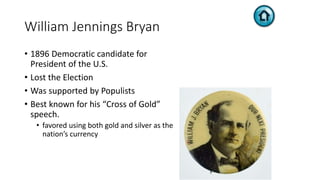
William Jennings Bryan
• 1896 Democratic candidate for
President of the U.S.
• Lost the Election
• Was supported by Populists
• Best known for his “Cross of Gold”
speech.
• favored using both gold and silver as the
nation’s currency
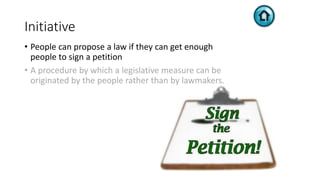
Initiative
• People can propose a law if they can get enough
people to sign a petition
• A procedure by which a legislative measure can be
originated by the people rather than by lawmakers.
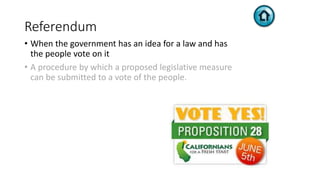
Referendum
• When the government has an idea for a law and has
the people vote on it
• A procedure by which a proposed legislative measure
can be submitted to a vote of the people.
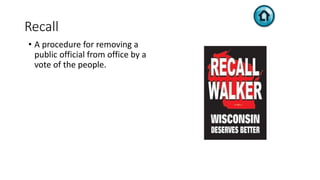
Recall
• A procedure for removing a
public official from office by a
vote of the people.
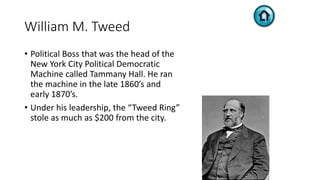
William M. Tweed
• Political Boss that was the head of the
New York City Political Democratic
Machine called Tammany Hall. He ran
the machine in the late 1860’s and
early 1870’s.
• Under his leadership, the “Tweed Ring”
stole as much as $200 from the city.
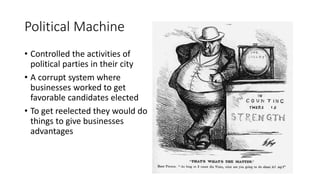
Political Machine
• Controlled the activities of
political parties in their city
• A corrupt system where
businesses worked to get
favorable candidates elected
• To get reelected they would do
things to give businesses
advantages
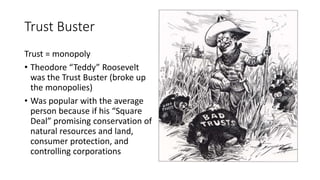
Trust Buster
Trust = monopoly
• Theodore “Teddy” Roosevelt
was the Trust Buster (broke up
the monopolies)
• Was popular with the average
person because if his “Square
Deal” promising conservation of
natural resources and land,
consumer protection, and
controlling corporations
Muckrakers
• Journalists who searched for and
publicized (wrote about) real or
alleged acts of corruption of public
officials, businessmen.
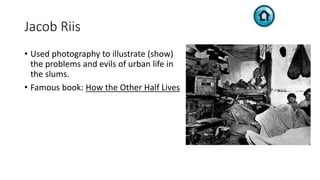
Jacob Riis
• Used photography to illustrate (show)
the problems and evils of urban life in
the slums.
• Famous book: How the Other Half Lives
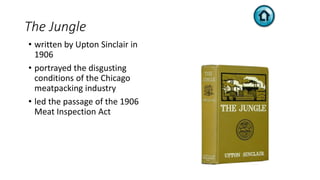
The Jungle
• written by Upton Sinclair in
1906
• portrayed the disgusting
conditions of the Chicago
meatpacking industry
• led the passage of the 1906
Meat Inspection Act
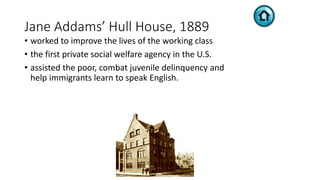
Jane Addams’ Hull House, 1889
• worked to improve the lives of the working class
• the first private social welfare agency in the U.S.
• assisted the poor, combat juvenile delinquency and
help immigrants learn to speak English.
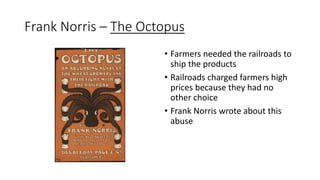
Frank Norris – The Octopus
• Farmers needed the railroads to
ship the products
• Railroads charged farmers high
prices because they had no
other choice
• Frank Norris wrote about this
abuse
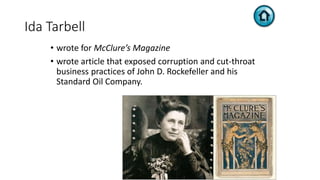
Ida Tarbell
• wrote for McClure’s Magazine
• wrote article that exposed corruption and cut-throat
business practices of John D. Rockefeller and his
Standard Oil Company.
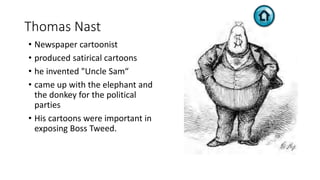
Thomas Nast
• Newspaper cartoonist
• produced satirical cartoons
• he invented "Uncle Sam“
• came up with the elephant and
the donkey for the political
parties
• His cartoons were important in
exposing Boss Tweed.
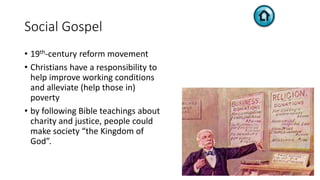
Social Gospel
• 19th-century reform movement
• Christians have a responsibility to
help improve working conditions
and alleviate (help those in)
poverty
• by following Bible teachings about
charity and justice, people could
make society “the Kingdom of
God”.
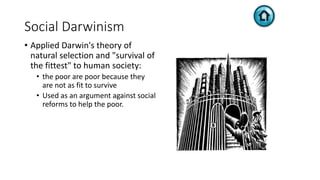
Social Darwinism
• Applied Darwin's theory of
natural selection and "survival of
the fittest" to human society:
• the poor are poor because they
are not as fit to survive
• Used as an argument against social
reforms to help the poor.
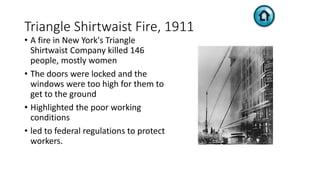
Triangle Shirtwaist Fire, 1911
• A fire in New York's Triangle
Shirtwaist Company killed 146
people, mostly women
• The doors were locked and the
windows were too high for them to
get to the ground
• Highlighted the poor working
conditions
• led to federal regulations to protect
workers.
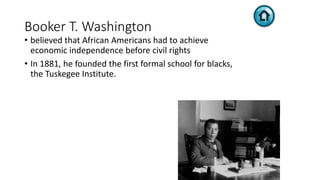
Booker T. Washington
• believed that African Americans had to achieve
economic independence before civil rights
• In 1881, he founded the first formal school for blacks,
the Tuskegee Institute.
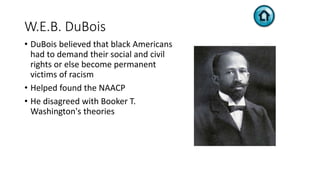
W.E.B. DuBois
• DuBois believed that black Americans
had to demand their social and civil
rights or else become permanent
victims of racism
• Helped found the NAACP
• He disagreed with Booker T.
Washington's theories
Progressives
Government must get involved in making sure that everybody gets a
chance at equal opportunities
• Limit the power and influence of big business
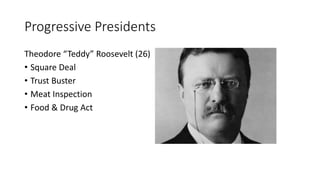
Progressive Presidents
Theodore “Teddy” Roosevelt (26)
• Square Deal
• Trust Buster
• Meat Inspection
• Food & Drug Act
Progressive Presidents
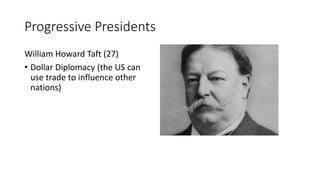
William Howard Taft (27)
• Dollar Diplomacy (the US can
use trade to influence other
nations)
Progressive Presidents
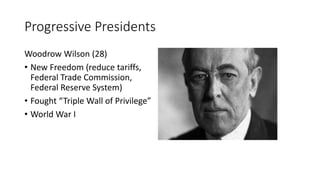
Woodrow Wilson (28)
• New Freedom (reduce tariffs,
Federal Trade Commission,
Federal Reserve System)
• Fought “Triple Wall of Privilege”
• World War I
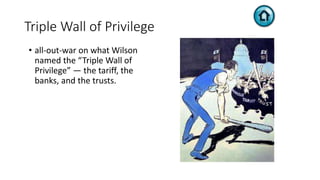
Triple Wall of Privilege
• all-out-war on what Wilson
named the “Triple Wall of
Privilege” — the tariff, the
banks, and the trusts.
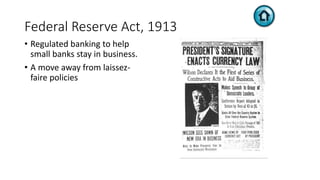
Federal Reserve Act, 1913
• Regulated banking to help
small banks stay in business.
• A move away from laissez-
faire policies
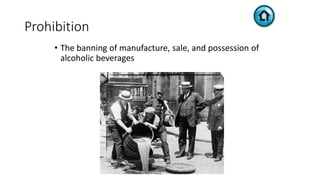
Prohibition
• The banning of manufacture, sale, and possession of
alcoholic beverages
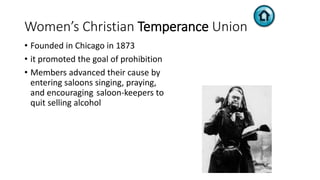
Women’s Christian Temperance Union
• Founded in Chicago in 1873
• it promoted the goal of prohibition
• Members advanced their cause by
entering saloons singing, praying,
and encouraging saloon-keepers to
quit selling alcohol
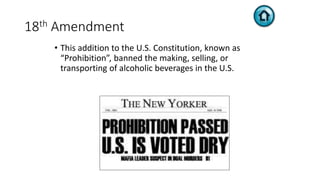
18th Amendment
• This addition to the U.S. Constitution, known as
“Prohibition”, banned the making, selling, or
transporting of alcoholic beverages in the U.S.
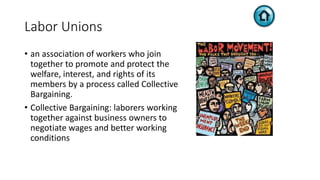
Labor Unions
• an association of workers who join
together to promote and protect the
welfare, interest, and rights of its
members by a process called Collective
Bargaining.
• Collective Bargaining: laborers working
together against business owners to
negotiate wages and better working
conditions
Examples of Labor Unions
• Knights of Labor
• An American labor union
• established as a secret fraternal
order
• the first union of all workers
• founded in 1869.
• American Federation of Labor
• a federation of different unions
• Began in 1886 with about
140,000 members; by 1917 it
had 2.5 million members
Labor Practices
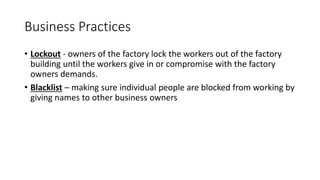
• Strike – refusing to work as a form of protest
• Boycott – refusing to buy a product as a form of protest
• Collective Bargaining - Discussions held between workers and their
employers over wages, hours, and conditions.
Business Practices
• Lockout - owners of the factory lock the workers out of the factory
building until the workers give in or compromise with the factory
owners demands.
• Blacklist – making sure individual people are blocked from working by
giving names to other business owners
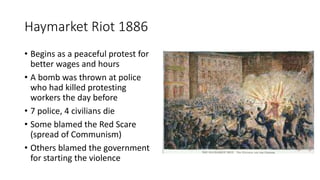
Haymarket Riot 1886
• Begins as a peaceful protest for
better wages and hours
• A bomb was thrown at police
who had killed protesting
workers the day before
• 7 police, 4 civilians die
• Some blamed the Red Scare
(spread of Communism)
• Others blamed the government
for starting the violence
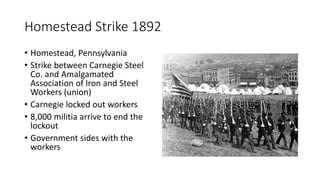
Homestead Strike 1892
• Homestead, Pennsylvania
• Strike between Carnegie Steel
Co. and Amalgamated
Association of Iron and Steel
Workers (union)
• Carnegie locked out workers
• 8,000 militia arrive to end the
lockout
• Government sides with the
workers
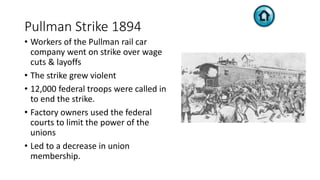
Pullman Strike 1894
• Workers of the Pullman rail car
company went on strike over wage
cuts & layoffs
• The strike grew violent
• 12,000 federal troops were called in
to end the strike.
• Factory owners used the federal
courts to limit the power of the
unions
• Led to a decrease in union
membership.

Immigration, Urbanization, Populism and Issues

  • 1.
    Immigration, Urbanization, Populism andIssues with the Gilded Age
  • 2.
    Old v NewImmigrants Old Immigrants • From western Europe (England, France, Spain) New Immigrants • From eastern Europe and Asia (Germany, Italy, Greece, Yugoslavia, China, Japan)
  • 3.
    Nativism • Anti-Immigration attitude •The United States is only for people from the United States
  • 4.
    Angel Island • U.S.West Coast (between 1910 and 1940) • San Francisco Bay, California • immigration station for millions of immigrants arriving in the U.S. from Asia.
  • 5.
    Ellis Island • USEast Coast (between 1892 and 1954 ) • New York Harbor, • immigration station for millions of immigrants arriving in the U.S. from Europe.
  • 6.
    Chinese Exclusion Act •A law, enacted in 1892, that prohibited all Chinese from entering the U.S. • except students, teachers, merchants, tourists, and government officials • The law was not repealed until 1943.
  • 7.
    Gentlemen’s Agreement Japan agreed tolimit Japanese emigration to the U.S. United States San Francisco withdrew its segregation orders. In San Francisco the Board of Education in 1906 took all Asian school children and placed them special Asian Schools. As a result Anti-American riots broke out in Japan. In 1907- 1908 an agreement was reached
  • 8.
    formula for immigrationquotas (limits) in the U.S.: • number of immigrants of a given nationality each year could not exceed 2% of the number of people of that nationality living in the U.S. in 1890. National Origins Act 1924
  • 9.
    • Groups thatwere excluded included: 1. Southern & Eastern Europeans (Italy, Russia, Yugoslavia, Hungary..) 2. Jews and Catholics 3. Japanese 1920’s Immigration
  • 10.
    Populist Party • Wantedto bring changes to help the average person, especially farmers • Wanted to give the people a bigger voice in government • This party advocated (wanted) a larger money supply and other economic reforms
  • 11.
    Farmers Problems 1. Lowincome (low prices for their food) 2. High Debt 3. Difficult to sell to other countries
  • 12.
    William Jennings Bryan •1896 Democratic candidate for President of the U.S. • Lost the Election • Was supported by Populists • Best known for his “Cross of Gold” speech. • favored using both gold and silver as the nation’s currency
  • 13.
    Initiative • People canpropose a law if they can get enough people to sign a petition • A procedure by which a legislative measure can be originated by the people rather than by lawmakers.
  • 14.
    Referendum • When thegovernment has an idea for a law and has the people vote on it • A procedure by which a proposed legislative measure can be submitted to a vote of the people.
  • 15.
    Recall • A procedurefor removing a public official from office by a vote of the people.
  • 16.
    William M. Tweed •Political Boss that was the head of the New York City Political Democratic Machine called Tammany Hall. He ran the machine in the late 1860’s and early 1870’s. • Under his leadership, the “Tweed Ring” stole as much as $200 from the city.
  • 17.
    Political Machine • Controlledthe activities of political parties in their city • A corrupt system where businesses worked to get favorable candidates elected • To get reelected they would do things to give businesses advantages
  • 18.
    Trust Buster Trust =monopoly • Theodore “Teddy” Roosevelt was the Trust Buster (broke up the monopolies) • Was popular with the average person because if his “Square Deal” promising conservation of natural resources and land, consumer protection, and controlling corporations
  • 19.
    Muckrakers • Journalists whosearched for and publicized (wrote about) real or alleged acts of corruption of public officials, businessmen.
  • 20.
    Jacob Riis • Usedphotography to illustrate (show) the problems and evils of urban life in the slums. • Famous book: How the Other Half Lives
  • 21.
    The Jungle • writtenby Upton Sinclair in 1906 • portrayed the disgusting conditions of the Chicago meatpacking industry • led the passage of the 1906 Meat Inspection Act
  • 22.
    Jane Addams’ HullHouse, 1889 • worked to improve the lives of the working class • the first private social welfare agency in the U.S. • assisted the poor, combat juvenile delinquency and help immigrants learn to speak English.
  • 23.
    Frank Norris –The Octopus • Farmers needed the railroads to ship the products • Railroads charged farmers high prices because they had no other choice • Frank Norris wrote about this abuse
  • 24.
    Ida Tarbell • wrotefor McClure’s Magazine • wrote article that exposed corruption and cut-throat business practices of John D. Rockefeller and his Standard Oil Company.
  • 25.
    Thomas Nast • Newspapercartoonist • produced satirical cartoons • he invented "Uncle Sam“ • came up with the elephant and the donkey for the political parties • His cartoons were important in exposing Boss Tweed.
  • 26.
    Social Gospel • 19th-centuryreform movement • Christians have a responsibility to help improve working conditions and alleviate (help those in) poverty • by following Bible teachings about charity and justice, people could make society “the Kingdom of God”.
  • 27.
    Social Darwinism • AppliedDarwin's theory of natural selection and "survival of the fittest" to human society: • the poor are poor because they are not as fit to survive • Used as an argument against social reforms to help the poor.
  • 28.
    Triangle Shirtwaist Fire,1911 • A fire in New York's Triangle Shirtwaist Company killed 146 people, mostly women • The doors were locked and the windows were too high for them to get to the ground • Highlighted the poor working conditions • led to federal regulations to protect workers.
  • 29.
    Booker T. Washington •believed that African Americans had to achieve economic independence before civil rights • In 1881, he founded the first formal school for blacks, the Tuskegee Institute.
  • 30.
    W.E.B. DuBois • DuBoisbelieved that black Americans had to demand their social and civil rights or else become permanent victims of racism • Helped found the NAACP • He disagreed with Booker T. Washington's theories
  • 31.
    Progressives Government must getinvolved in making sure that everybody gets a chance at equal opportunities • Limit the power and influence of big business
  • 32.
    Progressive Presidents Theodore “Teddy”Roosevelt (26) • Square Deal • Trust Buster • Meat Inspection • Food & Drug Act
  • 33.
    Progressive Presidents William HowardTaft (27) • Dollar Diplomacy (the US can use trade to influence other nations)
  • 34.
    Progressive Presidents Woodrow Wilson(28) • New Freedom (reduce tariffs, Federal Trade Commission, Federal Reserve System) • Fought “Triple Wall of Privilege” • World War I
  • 35.
    Triple Wall ofPrivilege • all-out-war on what Wilson named the “Triple Wall of Privilege” — the tariff, the banks, and the trusts.
  • 36.
    Federal Reserve Act,1913 • Regulated banking to help small banks stay in business. • A move away from laissez- faire policies
  • 37.
    Prohibition • The banningof manufacture, sale, and possession of alcoholic beverages
  • 38.
    Women’s Christian TemperanceUnion • Founded in Chicago in 1873 • it promoted the goal of prohibition • Members advanced their cause by entering saloons singing, praying, and encouraging saloon-keepers to quit selling alcohol
  • 39.
    18th Amendment • Thisaddition to the U.S. Constitution, known as “Prohibition”, banned the making, selling, or transporting of alcoholic beverages in the U.S.
  • 40.
    Labor Unions • anassociation of workers who join together to promote and protect the welfare, interest, and rights of its members by a process called Collective Bargaining. • Collective Bargaining: laborers working together against business owners to negotiate wages and better working conditions
  • 41.
    Examples of LaborUnions • Knights of Labor • An American labor union • established as a secret fraternal order • the first union of all workers • founded in 1869. • American Federation of Labor • a federation of different unions • Began in 1886 with about 140,000 members; by 1917 it had 2.5 million members
  • 42.
    Labor Practices • Strike– refusing to work as a form of protest • Boycott – refusing to buy a product as a form of protest • Collective Bargaining - Discussions held between workers and their employers over wages, hours, and conditions.
  • 43.
    Business Practices • Lockout- owners of the factory lock the workers out of the factory building until the workers give in or compromise with the factory owners demands. • Blacklist – making sure individual people are blocked from working by giving names to other business owners
  • 44.
    Haymarket Riot 1886 •Begins as a peaceful protest for better wages and hours • A bomb was thrown at police who had killed protesting workers the day before • 7 police, 4 civilians die • Some blamed the Red Scare (spread of Communism) • Others blamed the government for starting the violence
  • 45.
    Homestead Strike 1892 •Homestead, Pennsylvania • Strike between Carnegie Steel Co. and Amalgamated Association of Iron and Steel Workers (union) • Carnegie locked out workers • 8,000 militia arrive to end the lockout • Government sides with the workers
  • 46.
    Pullman Strike 1894 •Workers of the Pullman rail car company went on strike over wage cuts & layoffs • The strike grew violent • 12,000 federal troops were called in to end the strike. • Factory owners used the federal courts to limit the power of the unions • Led to a decrease in union membership.