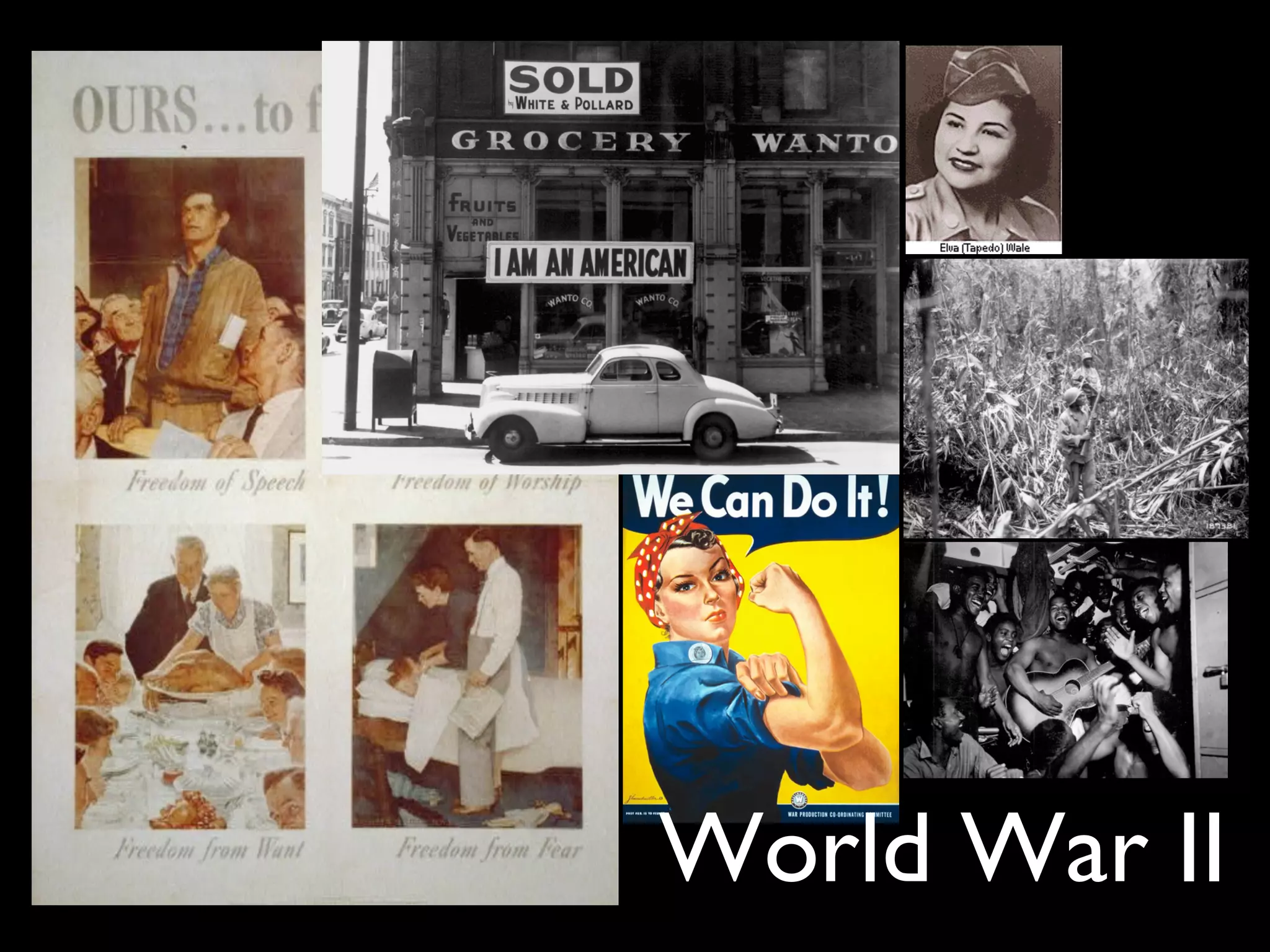
World War II
Key Questions
• How does the US get involved in WWII?
How is the lead-up to war similar to, or
different from, the lead-up to WWI?
• What are the international conditions that
lead to war?
• How does WWII change America,
economically and socially?
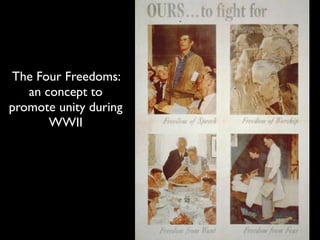
The Four Freedoms:
an concept to
promote unity during
WWII
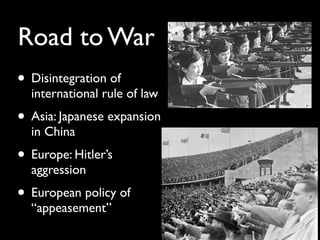
Road to War
• Disintegration of
international rule of law
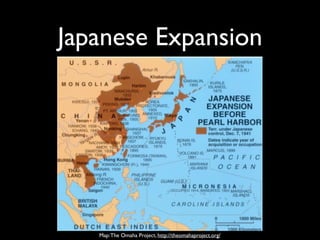
• Asia: Japanese expansion
in China
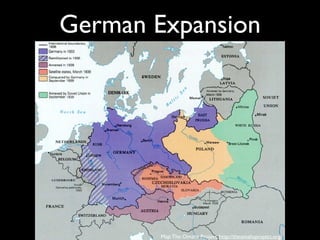
• Europe: Hitler’s
aggression
• European policy of
“appeasement”
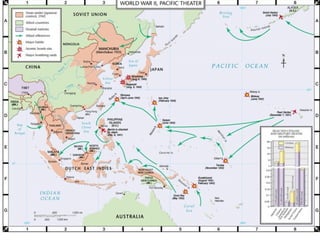
Japanese Expansion
Map:The Omaha Project, http://theomahaproject.org/
German Expansion
Map:The Omaha Project, http://theomahaproject.org/
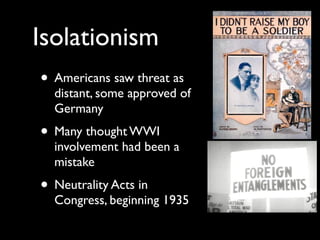
Isolationism
• Americans saw threat as
distant, some approved of
Germany
• Many thought WWI
involvement had been a
mistake
• Neutrality Acts in
Congress, beginning 1935
War in Europe
• 1938: Munich Agreement
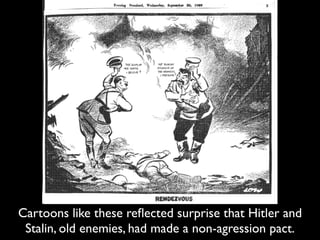
• 1939: Stalin proposes alliance to
oppose Germany, then signs non-
aggression pact with Hitler
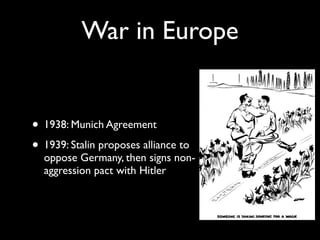
Cartoons like these reflected surprise that Hitler and
Stalin, old enemies, had made a non-agression pact.
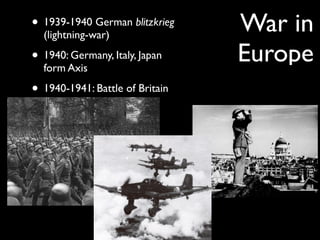
War in
Europe
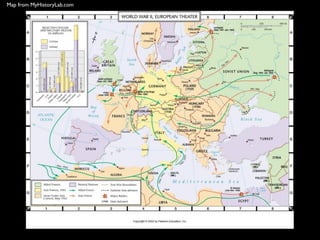
• 1939-1940 German blitzkrieg
(lightning-war)
• 1940: Germany, Italy, Japan
form Axis
• 1940-1941: Battle of Britain
Map from MyHistoryLab.com
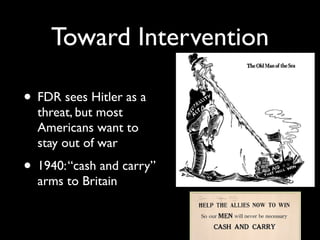
Toward Intervention
• FDR sees Hitler as a
threat, but most
Americans want to
stay out of war
• 1940:“cash and carry”
arms to Britain
Toward
Intervention
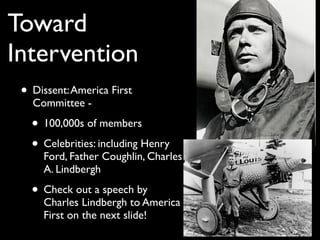
• Dissent:America First
Committee -
• 100,000s of members
• Celebrities: including Henry
Ford, Father Coughlin, Charles
A. Lindbergh
• Check out a speech by
Charles Lindbergh to America
First on the next slide!
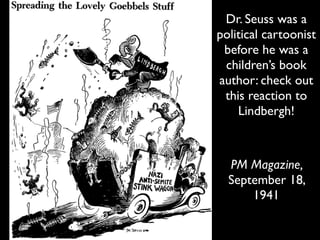
PM Magazine,
September 18,
1941
Dr. Seuss was a
political cartoonist
before he was a
children’s book
author: check out
this reaction to
Lindbergh!
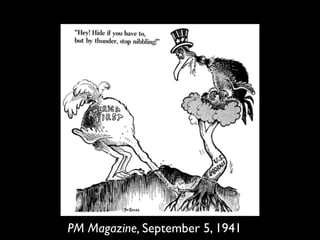
PM Magazine, September 5, 1941
Toward
Intervention
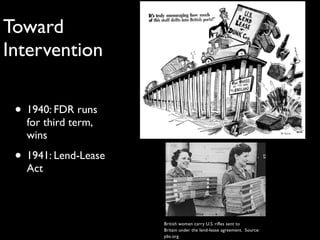
• 1940: FDR runs
for third term,
wins
• 1941: Lend-Lease
Act
British women carry U.S. rifles sent to
Britain under the lend-lease agreement. Source:
pbs.org
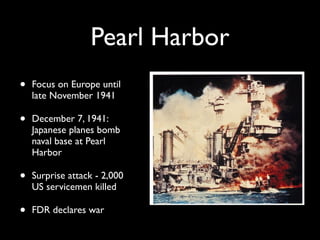
Pearl Harbor
• Focus on Europe until
late November 1941
• December 7, 1941:
Japanese planes bomb
naval base at Pearl
Harbor
• Surprise attack - 2,000
US servicemen killed
• FDR declares war
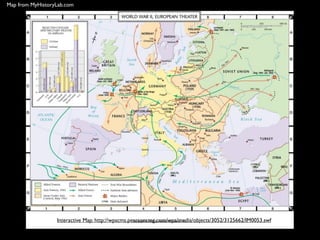
Map from MyHistoryLab.com
Interactive Map: http://wpscms.pearsoncmg.com/wps/media/objects/3052/3125662/IM0053.swf
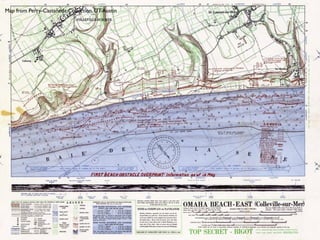
Map from Perry-Castañeda Collection, UT-Austin
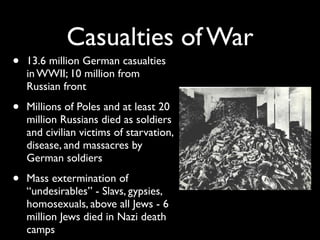
Casualties of War
• 13.6 million German casualties
in WWII; 10 million from
Russian front
• Millions of Poles and at least 20
million Russians died as soldiers
and civilian victims of starvation,
disease, and massacres by
German soldiers
• Mass extermination of
“undesirables” - Slavs, gypsies,
homosexuals, above all Jews - 6
million Jews died in Nazi death
camps
Conclusions: US in WWII
• As in WWI, public hesitant to get involved
in war
• FDR’s leadership is decisive in road to war
• As in WWI, US participation is decisive -
industrial capacity crucial in this “gross
national product” war
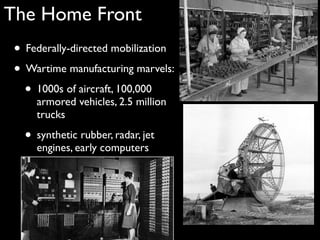
The Home Front
• Federally-directed mobilization
• Wartime manufacturing marvels:
• 1000s of aircraft, 100,000
armored vehicles, 2.5 million
trucks
• synthetic rubber, radar, jet
engines, early computers
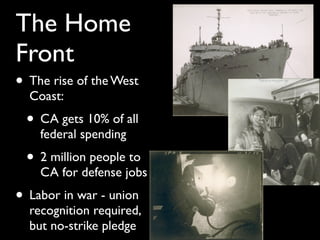
The Home
Front
• The rise of the West
Coast:
• CA gets 10% of all
federal spending
• 2 million people to
CA for defense jobs
• Labor in war - union
recognition required,
but no-strike pledge
Fighting for Freedom at Home
Key Themes
• WWII created opportunities for
disadvantaged and oppressed groups to
demand rights in the U.S.
• The major exception to this was Japanese
immigrants and Japanese Americans, who
were placed in internment camps during the
war.
• Unlike WWI,WWII moved us toward a
more inclusive society - partly because
Hitler’s racism was linked to such clear evil.
First, the exception:
Japanese and Japanese Americans during
WWII
• What stood out most to you in the video?
• What was the message the video was
trying to communicate? (Evidence?)
• Who do you think the video’s target
audience was? (Evidence?)
• Did you find the message convincing? Why
or why not? (Evidence?)
Watch the 9-minute propaganda film that
follows, and as you watch, think:
• What stands out most to you in these
images?
• Who do you think made them, and why?
• What are the messages they communicate
to you? (Evidence?)
• How do these images compare/contrast
with the view presented in the video?
What do they make you think about
Japanese internment?
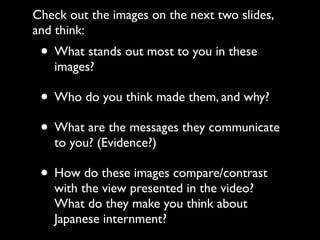
Check out the images on the next two slides,
and think:
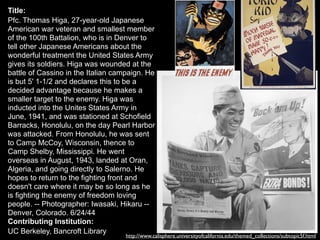
Title:
Pfc. Thomas Higa, 27-year-old Japanese
American war veteran and smallest member
of the 100th Battalion, who is in Denver to
tell other Japanese Americans about the
wonderful treatment the United States Army
gives its soldiers. Higa was wounded at the
battle of Cassino in the Italian campaign. He
is but 5' 1-1/2 and declares this to be a
decided advantage because he makes a
smaller target to the enemy. Higa was
inducted into the Unites States Army in
June, 1941, and was stationed at Schofield
Barracks, Honolulu, on the day Pearl Harbor
was attacked. From Honolulu, he was sent
to Camp McCoy, Wisconsin, thence to
Camp Shelby, Mississippi. He went
overseas in August, 1943, landed at Oran,
Algeria, and going directly to Salerno. He
hopes to return to the fighting front and
doesn't care where it may be so long as he
is fighting the enemy of freedom loving
people. -- Photographer: Iwasaki, Hikaru --
Denver, Colorado. 6/24/44
Contributing Institution:
UC Berkeley, Bancroft Library
http://www.calisphere.universityofcalifornia.edu/themed_collections/subtopic5f.html
Text
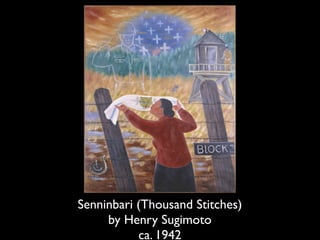
Senninbari (Thousand Stitches)
by Henry Sugimoto
ca. 1942
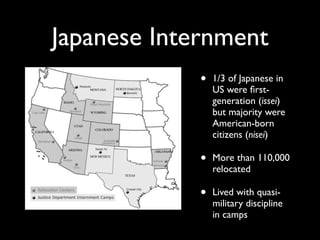
Japanese Internment
• 1/3 of Japanese in
US were first-
generation (issei)
but majority were
American-born
citizens (nisei)
• More than 110,000
relocated
• Lived with quasi-
military discipline
in camps
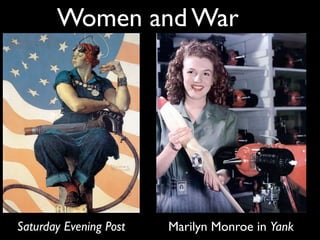
Women and War
Marilyn Monroe in YankSaturday Evening Post
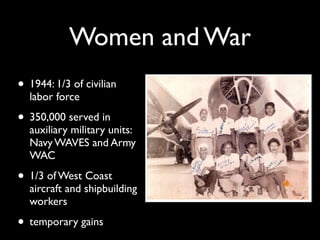
Women and War
• 1944: 1/3 of civilian
labor force
• 350,000 served in
auxiliary military units:
Navy WAVES and Army
WAC
• 1/3 of West Coast
aircraft and shipbuilding
workers
• temporary gains
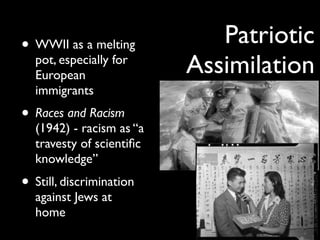
Patriotic
Assimilation
• WWII as a melting
pot, especially for
European
immigrants
• Races and Racism
(1942) - racism as “a
travesty of scientific
knowledge”
• Still, discrimination
against Jews at
home
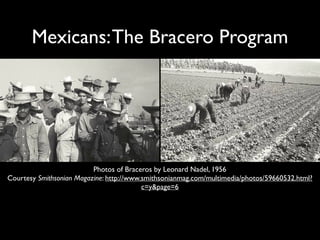
Mexicans:The Bracero Program
Photos of Braceros by Leonard Nadel, 1956
Courtesy Smithsonian Magazine: http://www.smithsonianmag.com/multimedia/photos/59660532.html?
c=y&page=6
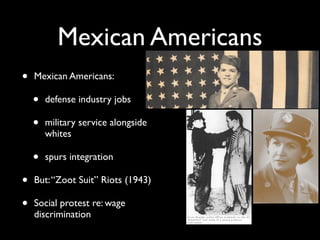
Mexican Americans
• Mexican Americans:
• defense industry jobs
• military service alongside
whites
• spurs integration
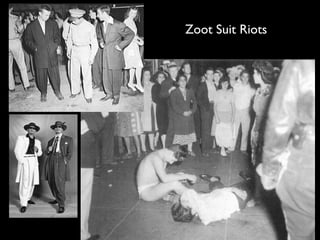
• But:“Zoot Suit” Riots (1943)
• Social protest re: wage
discrimination
Zoot Suit Riots
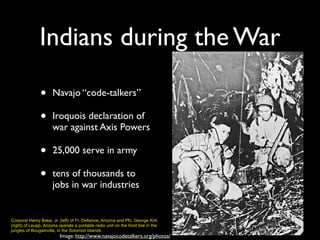
Indians during the War
Image: http://www.navajocodetalkers.org/photos/
Corporal Henry Bake, Jr. (left) of Ft. Defiance, Arizona and Pfc. George Kirk
(right) of Leupp, Arizona operate a portable radio unit on the front line in the
jungles of Bougainville, in the Solomon Islands
• Navajo “code-talkers”
• Iroquois declaration of
war against Axis Powers
• 25,000 serve in army
• tens of thousands to
jobs in war industries
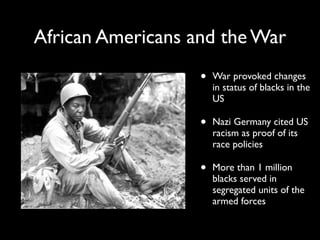
African Americans and the War
• War provoked changes
in status of blacks in the
US
• Nazi Germany cited US
racism as proof of its
race policies
• More than 1 million
blacks served in
segregated units of the
armed forces
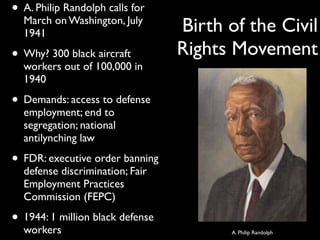
• A. Philip Randolph calls for
March on Washington, July
1941
• Why? 300 black aircraft
workers out of 100,000 in
1940
• Demands: access to defense
employment; end to
segregation; national
antilynching law
• FDR: executive order banning
defense discrimination; Fair
Employment Practices
Commission (FEPC)
• 1944: 1 million black defense
workers
Birth of the Civil
Rights Movement
A. Philip Randolph
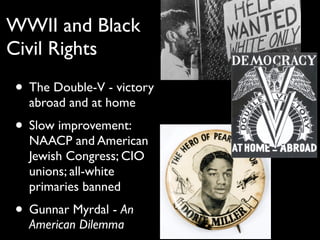
WWII and Black
Civil Rights
• The Double-V - victory
abroad and at home
• Slow improvement:
NAACP and American
Jewish Congress; CIO
unions; all-white
primaries banned
• Gunnar Myrdal - An
American Dilemma
Conclusions
• Progress in battles for equality during WWII because:
• Demands of wartime economy (women AND ethnic/
racial minorities)
• International climate: anti-Hitler = anti-racist
• After the war: discrimination does not end, but more
ideological/political support for racial equality
• After the war: women back home; Japanese economic
losses

Hist 12 online wwii pdf

  • 1.
  • 2.
    Key Questions • Howdoes the US get involved in WWII? How is the lead-up to war similar to, or different from, the lead-up to WWI? • What are the international conditions that lead to war? • How does WWII change America, economically and socially?
  • 3.
    The Four Freedoms: anconcept to promote unity during WWII
  • 4.
    Road to War •Disintegration of international rule of law • Asia: Japanese expansion in China • Europe: Hitler’s aggression • European policy of “appeasement”
  • 5.
    Japanese Expansion Map:The OmahaProject, http://theomahaproject.org/
  • 6.
    German Expansion Map:The OmahaProject, http://theomahaproject.org/
  • 7.
    Isolationism • Americans sawthreat as distant, some approved of Germany • Many thought WWI involvement had been a mistake • Neutrality Acts in Congress, beginning 1935
  • 8.
    War in Europe •1938: Munich Agreement • 1939: Stalin proposes alliance to oppose Germany, then signs non- aggression pact with Hitler
  • 9.
    Cartoons like thesereflected surprise that Hitler and Stalin, old enemies, had made a non-agression pact.
  • 10.
    War in Europe • 1939-1940German blitzkrieg (lightning-war) • 1940: Germany, Italy, Japan form Axis • 1940-1941: Battle of Britain
  • 11.
  • 12.
    Toward Intervention • FDRsees Hitler as a threat, but most Americans want to stay out of war • 1940:“cash and carry” arms to Britain
  • 13.
    Toward Intervention • Dissent:America First Committee- • 100,000s of members • Celebrities: including Henry Ford, Father Coughlin, Charles A. Lindbergh • Check out a speech by Charles Lindbergh to America First on the next slide!
  • 14.
    PM Magazine, September 18, 1941 Dr.Seuss was a political cartoonist before he was a children’s book author: check out this reaction to Lindbergh!
  • 15.
  • 16.
    Toward Intervention • 1940: FDRruns for third term, wins • 1941: Lend-Lease Act British women carry U.S. rifles sent to Britain under the lend-lease agreement. Source: pbs.org
  • 17.
    Pearl Harbor • Focuson Europe until late November 1941 • December 7, 1941: Japanese planes bomb naval base at Pearl Harbor • Surprise attack - 2,000 US servicemen killed • FDR declares war
  • 19.
    Map from MyHistoryLab.com InteractiveMap: http://wpscms.pearsoncmg.com/wps/media/objects/3052/3125662/IM0053.swf
  • 20.
    Map from Perry-CastañedaCollection, UT-Austin
  • 21.
    Casualties of War •13.6 million German casualties in WWII; 10 million from Russian front • Millions of Poles and at least 20 million Russians died as soldiers and civilian victims of starvation, disease, and massacres by German soldiers • Mass extermination of “undesirables” - Slavs, gypsies, homosexuals, above all Jews - 6 million Jews died in Nazi death camps
  • 22.
    Conclusions: US inWWII • As in WWI, public hesitant to get involved in war • FDR’s leadership is decisive in road to war • As in WWI, US participation is decisive - industrial capacity crucial in this “gross national product” war
  • 23.
    The Home Front •Federally-directed mobilization • Wartime manufacturing marvels: • 1000s of aircraft, 100,000 armored vehicles, 2.5 million trucks • synthetic rubber, radar, jet engines, early computers
  • 24.
    The Home Front • Therise of the West Coast: • CA gets 10% of all federal spending • 2 million people to CA for defense jobs • Labor in war - union recognition required, but no-strike pledge
  • 25.
  • 26.
    Key Themes • WWIIcreated opportunities for disadvantaged and oppressed groups to demand rights in the U.S. • The major exception to this was Japanese immigrants and Japanese Americans, who were placed in internment camps during the war. • Unlike WWI,WWII moved us toward a more inclusive society - partly because Hitler’s racism was linked to such clear evil.
  • 27.
    First, the exception: Japaneseand Japanese Americans during WWII
  • 28.
    • What stoodout most to you in the video? • What was the message the video was trying to communicate? (Evidence?) • Who do you think the video’s target audience was? (Evidence?) • Did you find the message convincing? Why or why not? (Evidence?) Watch the 9-minute propaganda film that follows, and as you watch, think:
  • 29.
    • What standsout most to you in these images? • Who do you think made them, and why? • What are the messages they communicate to you? (Evidence?) • How do these images compare/contrast with the view presented in the video? What do they make you think about Japanese internment? Check out the images on the next two slides, and think:
  • 30.
    Title: Pfc. Thomas Higa,27-year-old Japanese American war veteran and smallest member of the 100th Battalion, who is in Denver to tell other Japanese Americans about the wonderful treatment the United States Army gives its soldiers. Higa was wounded at the battle of Cassino in the Italian campaign. He is but 5' 1-1/2 and declares this to be a decided advantage because he makes a smaller target to the enemy. Higa was inducted into the Unites States Army in June, 1941, and was stationed at Schofield Barracks, Honolulu, on the day Pearl Harbor was attacked. From Honolulu, he was sent to Camp McCoy, Wisconsin, thence to Camp Shelby, Mississippi. He went overseas in August, 1943, landed at Oran, Algeria, and going directly to Salerno. He hopes to return to the fighting front and doesn't care where it may be so long as he is fighting the enemy of freedom loving people. -- Photographer: Iwasaki, Hikaru -- Denver, Colorado. 6/24/44 Contributing Institution: UC Berkeley, Bancroft Library http://www.calisphere.universityofcalifornia.edu/themed_collections/subtopic5f.html
  • 31.
  • 32.
    Japanese Internment • 1/3of Japanese in US were first- generation (issei) but majority were American-born citizens (nisei) • More than 110,000 relocated • Lived with quasi- military discipline in camps
  • 33.
    Women and War MarilynMonroe in YankSaturday Evening Post
  • 34.
    Women and War •1944: 1/3 of civilian labor force • 350,000 served in auxiliary military units: Navy WAVES and Army WAC • 1/3 of West Coast aircraft and shipbuilding workers • temporary gains
  • 35.
    Patriotic Assimilation • WWII asa melting pot, especially for European immigrants • Races and Racism (1942) - racism as “a travesty of scientific knowledge” • Still, discrimination against Jews at home
  • 36.
    Mexicans:The Bracero Program Photosof Braceros by Leonard Nadel, 1956 Courtesy Smithsonian Magazine: http://www.smithsonianmag.com/multimedia/photos/59660532.html? c=y&page=6
  • 37.
    Mexican Americans • MexicanAmericans: • defense industry jobs • military service alongside whites • spurs integration • But:“Zoot Suit” Riots (1943) • Social protest re: wage discrimination
  • 38.
  • 39.
    Indians during theWar Image: http://www.navajocodetalkers.org/photos/ Corporal Henry Bake, Jr. (left) of Ft. Defiance, Arizona and Pfc. George Kirk (right) of Leupp, Arizona operate a portable radio unit on the front line in the jungles of Bougainville, in the Solomon Islands • Navajo “code-talkers” • Iroquois declaration of war against Axis Powers • 25,000 serve in army • tens of thousands to jobs in war industries
  • 40.
    African Americans andthe War • War provoked changes in status of blacks in the US • Nazi Germany cited US racism as proof of its race policies • More than 1 million blacks served in segregated units of the armed forces
  • 41.
    • A. PhilipRandolph calls for March on Washington, July 1941 • Why? 300 black aircraft workers out of 100,000 in 1940 • Demands: access to defense employment; end to segregation; national antilynching law • FDR: executive order banning defense discrimination; Fair Employment Practices Commission (FEPC) • 1944: 1 million black defense workers Birth of the Civil Rights Movement A. Philip Randolph
  • 42.
    WWII and Black CivilRights • The Double-V - victory abroad and at home • Slow improvement: NAACP and American Jewish Congress; CIO unions; all-white primaries banned • Gunnar Myrdal - An American Dilemma
  • 43.
    Conclusions • Progress inbattles for equality during WWII because: • Demands of wartime economy (women AND ethnic/ racial minorities) • International climate: anti-Hitler = anti-racist • After the war: discrimination does not end, but more ideological/political support for racial equality • After the war: women back home; Japanese economic losses