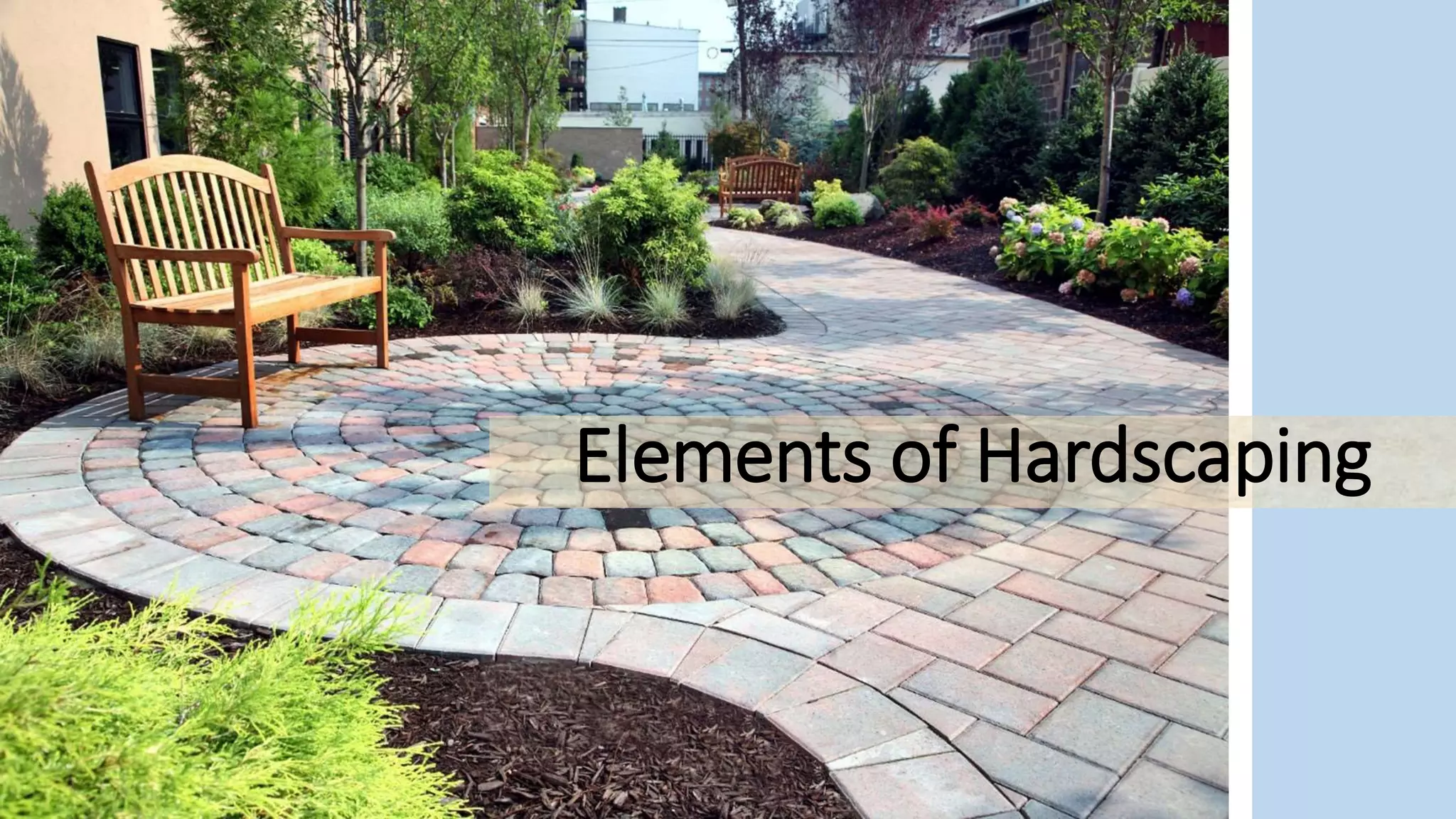
Elements of Hardscaping
Hardscaping in landscape
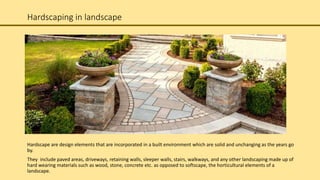
Hardscape are design elements that are incorporated in a built environment which are solid and unchanging as the years go
by.
They include paved areas, driveways, retaining walls, sleeper walls, stairs, walkways, and any other landscaping made up of
hard wearing materials such as wood, stone, concrete etc. as opposed to softscape, the horticultural elements of a
landscape.
Why Hardscaping?
To cater needs not accompanied by soft landscape elements.
To provide complimentary effects and to enhance the beauty of soft
landscape.
Hardscaping allows the erection of man-made landscaping features.
Some compensate for large amounts of human traffic that would
cause wear on bare earth or grass.
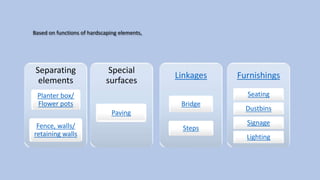
Separating
elements
Planter box/
Flower pots
Fence, walls/
retaining walls
Special
surfaces
Paving
Linkages
Bridge
Steps
Furnishings
Seating
Dustbins
Signage
Lighting
Based on functions of hardscaping elements,
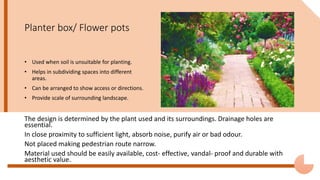
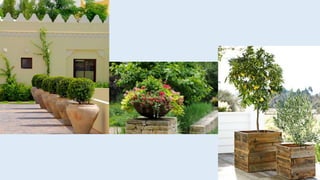
Planter box/ Flower pots
The design is determined by the plant used and its surroundings. Drainage holes are
essential.
In close proximity to sufficient light, absorb noise, purify air or bad odour.
Not placed making pedestrian route narrow.
Material used should be easily available, cost- effective, vandal- proof and durable with
aesthetic value.
• Used when soil is unsuitable for planting.
• Helps in subdividing spaces into different
areas.
• Can be arranged to show access or directions.
• Provide scale of surrounding landscape.
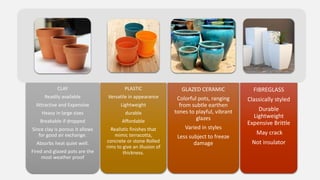
CLAY
Readily available
Attractive and Expensive
Heavy in large sizes
Breakable if dropped
Since clay is porous it allows
for good air exchange.
Absorbs heat quiet well.
Fired and glazed pots are the
most weather proof
PLASTIC
Versatile in appearance
Lightweight
durable
Affordable
Realistic finishes that
mimic terracotta,
concrete or stone Rolled
rims to give an illusion of
thickness.
GLAZED CERAMIC
Colorful pots, ranging
from subtle earthen
tones to playful, vibrant
glazes
Varied in styles
Less subject to freeze
damage
FIBREGLASS
Classically styled
Durable
Lightweight
Expensive Brittle
May crack
Not insulator
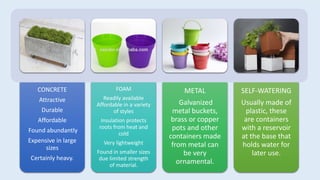
CONCRETE
Attractive
Durable
Affordable
Found abundantly
Expensive in large
sizes
Certainly heavy.
FOAM
Readily available
Affordable in a variety
of styles
Insulation protects
roots from heat and
cold
Very lightweight
Found in smaller sizes
due limited strength
of material.
METAL
Galvanized
metal buckets,
brass or copper
pots and other
containers made
from metal can
be very
ornamental.
SELF-WATERING
Usually made of
plastic, these
are containers
with a reservoir
at the base that
holds water for
later use.
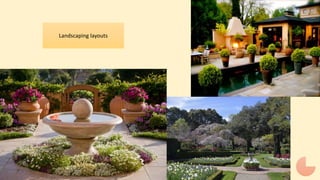
Landscaping layouts
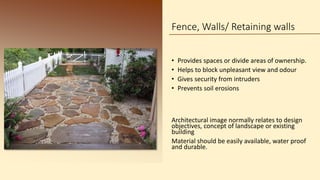
Fence, Walls/ Retaining walls
• Provides spaces or divide areas of ownership.
• Helps to block unpleasant view and odour
• Gives security from intruders
• Prevents soil erosions
Architectural image normally relates to design
objectives, concept of landscape or existing
building
Material should be easily available, water proof
and durable.
TYPES OF MATERIALS USED FOR RETAINING WALLS
There is a wide variety of many different retaining wall materials. The most important and most common
factor all retaining wall materials have is that they are enhance with resistance to; fire, water damage,
impact resistance etc. Proper drainage is also important for the wall material.
Timber is available in treated and enhanced types to ensure that the material will not rot, be infested with termites and
bugs. Timber is a relatively simple product to install and work with. This wall material can be painted or left in its natural
state. One of the beauties of timbers and woods is that some types have a natural resistance to termites, rot and other
common wood occurrences. Ensuring that the timber used for the retaining wall is properly treated will help lead to a long
lasting application whether it is for functional or decorative purposes.
Concrete blocks or units are also a common retaining wall material which has been used for many years. This material is
available in a wide variety of designs, types, shapes, colors and textures. Concrete blocks are light weight and suitable for
structural or decorative applications. It is also a low cost material which is easy to work with and install. There are many
different types of concrete blocks including; interlocking, hollow, solid and half hollow. They are also made in high density
and low density styles. Homeowners can customize concrete blocks to best suit the applications requirements.
Stone Walls are made from a Portland cement mixture therefore they are a man made material. They are produced in
shapes, designs and textures which replicate natural stone materials. Stone is most commonly used in applications where a
mortar is not required and the dry stack method is used. Most stone applications look just like natural stone walls but at a
lower price. This is a great alternate material for natural stone.
Natural stone blocks are the most expensive wall material. This material has a very unique and stylish outlook
which is hardly matched by any other. Natural stones are available in blocks, units, irregular and regular shapes
making them highly versatile for all types of applications.
S
P
E
C
I
A
L
F
E
A
T
U
R
E
S
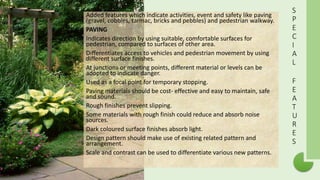
Added features which indicate activities, event and safety like paving
(gravel, cobbles, tarmac, bricks and pebbles) and pedestrian walkway.
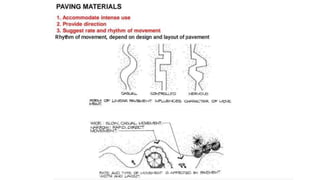
PAVING
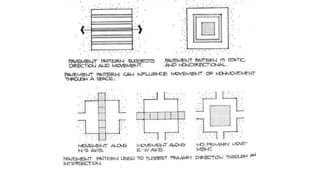
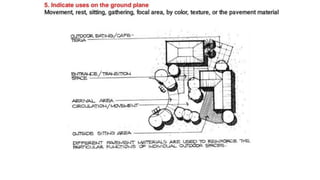
Indicates direction by using suitable, comfortable surfaces for
pedestrian, compared to surfaces of other area.
Differentiates access to vehicles and pedestrian movement by using
different surface finishes.
At junctions or meeting points, different material or levels can be
adopted to indicate danger.
Used as a focal point for temporary stopping.
Paving materials should be cost- effective and easy to maintain, safe
and sound.
Rough finishes prevent slipping.
Some materials with rough finish could reduce and absorb noise
sources.
Dark coloured surface finishes absorb light.
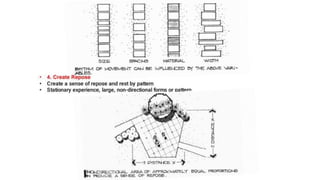
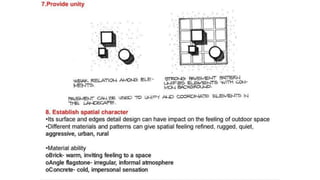
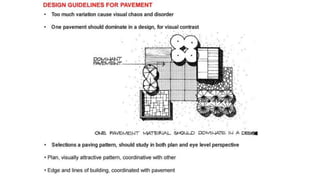
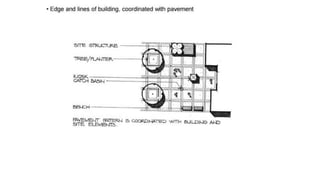
Design pattern should make use of existing related pattern and
arrangement.
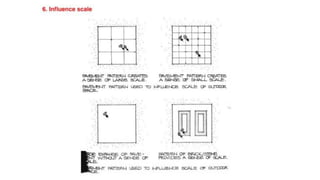
Scale and contrast can be used to differentiate various new patterns.
Sustainable Pavement materials
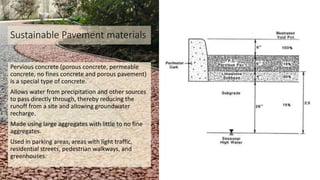
Pervious concrete (porous concrete, permeable
concrete, no fines concrete and porous pavement)
is a special type of concrete.
Allows water from precipitation and other sources
to pass directly through, thereby reducing the
runoff from a site and allowing groundwater
recharge.
Made using large aggregates with little to no fine
aggregates.
Used in parking areas, areas with light traffic,
residential streets, pedestrian walkways, and
greenhouses.
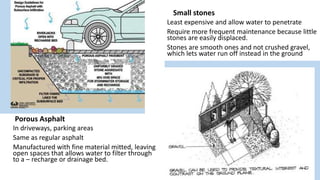
Porous Asphalt
In driveways, parking areas
Same as regular asphalt
Manufactured with fine material mitted, leaving
open spaces that allows water to filter through
to a – recharge or drainage bed.
Small stones
Least expensive and allow water to penetrate
Require more frequent maintenance because little
stones are easily displaced.
Stones are smooth ones and not crushed gravel,
which lets water run off instead in the ground
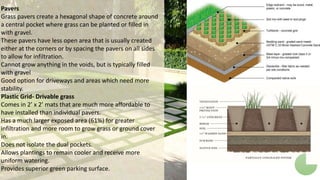
Pavers
Grass pavers create a hexagonal shape of concrete around
a central pocket where grass can be planted or filled in
with gravel.
These pavers have less open area that is usually created
either at the corners or by spacing the pavers on all sides
to allow for infiltration.
Cannot grow anything in the voids, but is typically filled
with gravel
Good option for driveways and areas which need more
stability.
Plastic Grid- Drivable grass
Comes in 2’ x 2’ mats that are much more affordable to
have installed than individual pavers.
Has a much larger exposed area (61%) for greater
infiltration and more room to grow grass or ground cover
in.
Does not isolate the dual pockets.
Allows plantings to remain cooler and receive more
uniform watering.
Provides superior green parking surface.
Linkages
Linkages or circulation systems are a combination of linear connectors
circulation paths, traffic generators and events along the connectors
like entrances, bridges, steps and gateways.
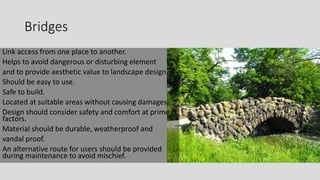
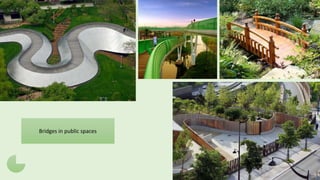
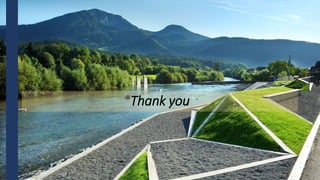
Bridges
Link access from one place to another.
Helps to avoid dangerous or disturbing element
and to provide aesthetic value to landscape design.
Should be easy to use.
Safe to build.
Located at suitable areas without causing damages.
Design should consider safety and comfort at prime
factors.
Material should be durable, weatherproof and
vandal proof.
An alternative route for users should be provided
during maintenance to avoid mischief.
Bridges in public spaces
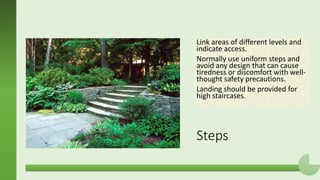
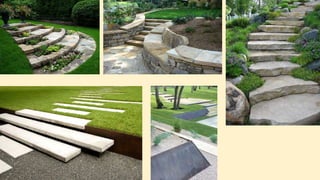
Steps
Link areas of different levels and
indicate access.
Normally use uniform steps and
avoid any design that can cause
tiredness or discomfort with well-
thought safety precautions.
Landing should be provided for
high staircases.
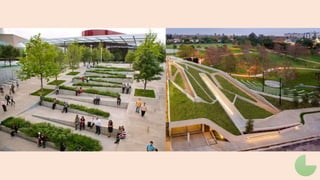
Ramps
An inclined plane, also known as a ramp, is a flat supporting surface tilted
at an angle, with one end higher than the other, used as an aid for raising
or lowering a load. The inclined plane is one of the six classical simple
machines defined by Renaissance scientists.
• Inclined planes are widely used in the form of loading ramps to load
and unload goods on trucks, ships, and planes.
• Wheelchair ramps are used to allow people in wheelchairs to get over
vertical obstacles without exceeding their strength.
• pedestrian paths and sidewalks have gentle ramps to limit their slope,
to ensure that pedestrians can keep traction
• Inclined planes are also used as entertainment for people to slide
down in a controlled way, in playground slides, water slides, ski slopes
and skateboard parks.
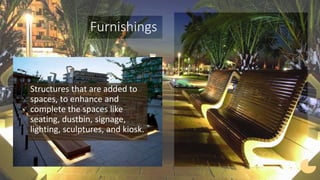
Furnishings
Structures that are added to
spaces, to enhance and
complete the spaces like
seating, dustbin, signage,
lighting, sculptures, and kiosk.
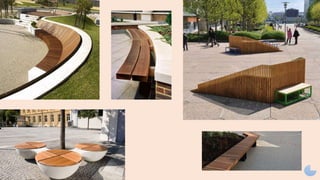
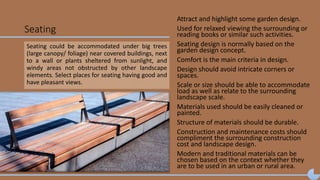
Seating
Attract and highlight some garden design.
Used for relaxed viewing the surrounding or
reading books or similar such activities.
Seating design is normally based on the
garden design concept.
Comfort is the main criteria in design.
Design should avoid intricate corners or
spaces.
Scale or size should be able to accommodate
load as well as relate to the surrounding
landscape scale.
Materials used should be easily cleaned or
painted.
Structure of materials should be durable.
Construction and maintenance costs should
compliment the surrounding construction
cost and landscape design.
Modern and traditional materials can be
chosen based on the context whether they
are to be used in an urban or rural area.
Seating could be accommodated under big trees
(large canopy/ foliage) near covered buildings, next
to a wall or plants sheltered from sunlight, and
windy areas not obstructed by other landscape
elements. Select places for seating having good and
have pleasant views.
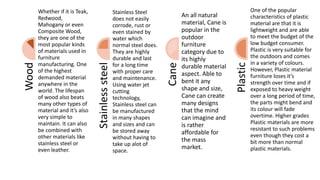
Wood
Whether if it is Teak,
Redwood,
Mahogany or even
Composite Wood,
they are one of the
most popular kinds
of materials used in
furniture
manufacturing. One
of the highest
demanded material
anywhere in the
world. The lifespan
of wood also beats
many other types of
material and it’s also
very simple to
maintain. It can also
be combined with
other materials like
stainless steel or
even leather.
Stainlesssteel
Stainless Steel
does not easily
corrode, rust or
even stained by
water which
normal steel does.
They are highly
durable and last
for a long time
with proper care
and maintenance.
Using water jet
cutting
technology,
Stainless steel can
be manufactured
in many shapes
and sizes and can
be stored away
without having to
take up alot of
space.
Cane
An all natural
material, Cane is
popular in the
outdoor
furniture
category due to
its highly
durable material
aspect. Able to
bent it any
shape and size,
Cane can create
many designs
that the mind
can imagine and
is rather
affordable for
the mass
market.
Plastic
One of the popular
characteristics of plastic
material are that it is
lightweight and are able
to meet the budget of the
low budget consumer.
Plastic is very suitable for
the outdoors and comes
in a variety of colours.
However, Plastic material
furniture loses it’s
strength over time and if
exposed to heavy weight
over a long period of time,
the parts might bend and
its colour will fade
overtime. Higher grades
Plastic materials are more
resistant to such problems
even though they cost a
bit more than normal
plastic materials.
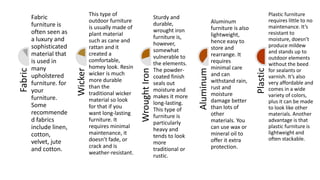
Fabric
Fabric
furniture is
often seen as
a luxury and
sophisticated
material that
is used in
many
upholstered
furniture. for
your
furniture.
Some
recommende
d fabrics
include linen,
cotton,
velvet, jute
and cotton.
Wicker
This type of
outdoor furniture
is usually made of
plant material
such as cane and
rattan and it
created a
comfortable,
homey look. Resin
wicker is much
more durable
than the
traditional wicker
material so look
for that if you
want long-lasting
furniture. It
requires minimal
maintenance, it
doesn’t fade, or
crack and is
weather-resistant.
WroughtIron
Sturdy and
durable,
wrought iron
furniture is,
however,
somewhat
vulnerable to
the elements.
The powder-
coated finish
seals out
moisture and
makes it more
long-lasting.
This type of
furniture is
particularly
heavy and
tends to look
more
traditional or
rustic.
Aluminum
Aluminum
furniture is also
lightweight,
hence easy to
store and
rearrange. It
requires
minimal care
and can
withstand rain,
rust and
moisture
damage better
than lots of
other
materials. You
can use wax or
mineral oil to
offer it extra
protection.
Plastic
Plastic furniture
requires little to no
maintenance. It’s
resistant to
moisture, doesn’t
produce mildew
and stands up to
outdoor elements
without the beed
for sealants or
varnish. It’s also
very affordable and
comes in a wide
variety of colors,
plus it can be made
to look like other
materials. Another
advantage is that
plastic furniture is
lightweight and
often stackable.
Dustbin
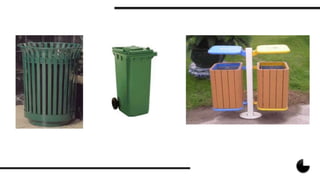
Dustbin should have easy access for garbage disposal and collection.
There are different types of dustbins like wall mounted, free standing,
removable, big sized where population is high.
Located near pedestrian access with other facilities such as toilets and
recreation area, where people gathers, picnic or relax.
Not located too close to each other to avoid bad odour or flies or bad view.
Design and material depends on location, method of collection, relationship
to the surrounding landscape elements and capacity.
Galvanized sheet metal, aluminum, timber, fiber- glass and concrete are
normally used.
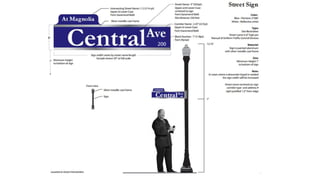
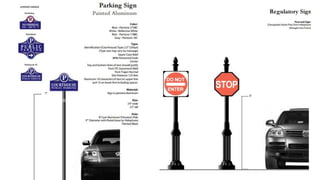
Signage
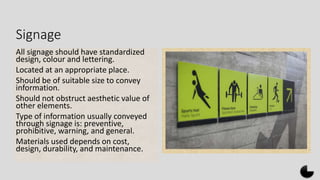
All signage should have standardized
design, colour and lettering.
Located at an appropriate place.
Should be of suitable size to convey
information.
Should not obstruct aesthetic value of
other elements.
Type of information usually conveyed
through signage is: preventive,
prohibitive, warning, and general.
Materials used depends on cost,
design, durability, and maintenance.
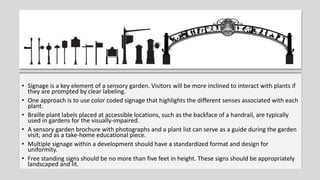
• Signage is a key element of a sensory garden. Visitors will be more inclined to interact with plants if
they are prompted by clear labeling.
• One approach is to use color coded signage that highlights the different senses associated with each
plant.
• Braille plant labels placed at accessible locations, such as the backface of a handrail, are typically
used in gardens for the visually-impaired.
• A sensory garden brochure with photographs and a plant list can serve as a guide during the garden
visit, and as a take-home educational piece.
• Multiple signage within a development should have a standardized format and design for
uniformity.
• Free standing signs should be no more than five feet in height. These signs should be appropriately
landscaped and lit.
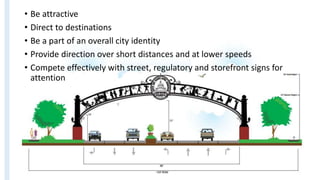
• Be attractive
• Direct to destinations
• Be a part of an overall city identity
• Provide direction over short distances and at lower speeds
• Compete effectively with street, regulatory and storefront signs for
attention
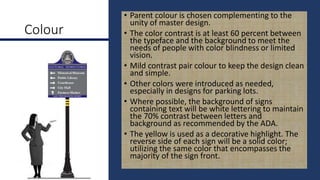
Colour
• Parent colour is chosen complementing to the
unity of master design.
• The color contrast is at least 60 percent between
the typeface and the background to meet the
needs of people with color blindness or limited
vision.
• Mild contrast pair colour to keep the design clean
and simple.
• Other colors were introduced as needed,
especially in designs for parking lots.
• Where possible, the background of signs
containing text will be white lettering to maintain
the 70% contrast between letters and
background as recommended by the ADA.
• The yellow is used as a decorative highlight. The
reverse side of each sign will be a solid color;
utilizing the same color that encompasses the
majority of the sign front.
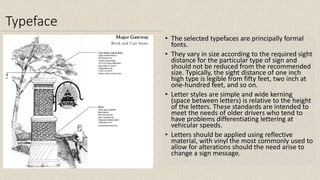
Typeface
• The selected typefaces are principally formal
fonts.
• They vary in size according to the required sight
distance for the particular type of sign and
should not be reduced from the recommended
size. Typically, the sight distance of one inch
high type is legible from fifty feet, two inch at
one-hundred feet, and so on.
• Letter styles are simple and wide kerning
(space between letters) is relative to the height
of the letters. These standards are intended to
meet the needs of older drivers who tend to
have problems differentiating lettering at
vehicular speeds.
• Letters should be applied using reflective
material, with vinyl the most commonly used to
allow for alterations should the need arise to
change a sign message.
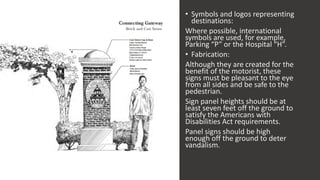
• Symbols and logos representing
destinations:
Where possible, international
symbols are used, for example,
Parking “P” or the Hospital “H”.
• Fabrication:
Although they are created for the
benefit of the motorist, these
signs must be pleasant to the eye
from all sides and be safe to the
pedestrian.
Sign panel heights should be at
least seven feet off the ground to
satisfy the Americans with
Disabilities Act requirements.
Panel signs should be high
enough off the ground to deter
vandalism.
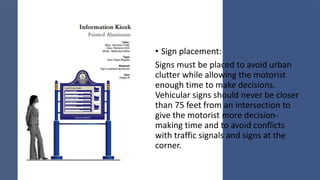
• Sign placement:
Signs must be placed to avoid urban
clutter while allowing the motorist
enough time to make decisions.
Vehicular signs should never be closer
than 75 feet from an intersection to
give the motorist more decision-
making time and to avoid conflicts
with traffic signals and signs at the
corner.
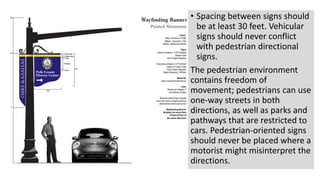
• Spacing between signs should
be at least 30 feet. Vehicular
signs should never conflict
with pedestrian directional
signs.
The pedestrian environment
contains freedom of
movement; pedestrians can use
one-way streets in both
directions, as well as parks and
pathways that are restricted to
cars. Pedestrian-oriented signs
should never be placed where a
motorist might misinterpret the
directions.
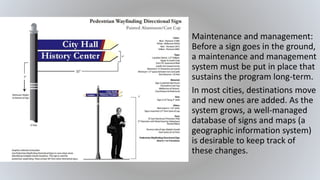
• Maintenance and management:
Before a sign goes in the ground,
a maintenance and management
system must be put in place that
sustains the program long-term.
• In most cities, destinations move
and new ones are added. As the
system grows, a well-managed
database of signs and maps (a
geographic information system)
is desirable to keep track of
these changes.
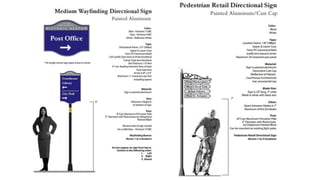
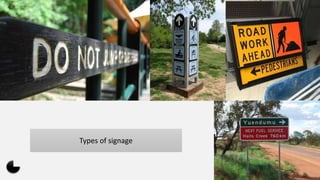
Types of signage
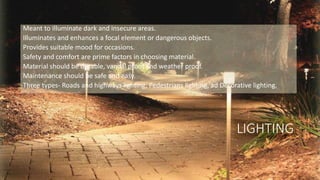
LIGHTING
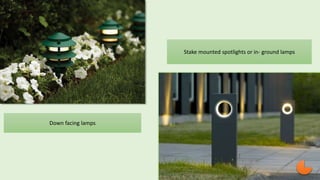
Meant to illuminate dark and insecure areas.
Illuminates and enhances a focal element or dangerous objects.
Provides suitable mood for occasions.
Safety and comfort are prime factors in choosing material.
Material should be durable, vandal proof and weather proof.
Maintenance should be safe and easy.
Three types- Roads and highways lighting, Pedestrians lighting, ad Decorative lighting.
Down facing lamps
Stake mounted spotlights or in- ground lamps
Thank you

Landscape Architecture- Hardscaping elements

  • 1.
  • 2.
    Hardscaping in landscape Hardscapeare design elements that are incorporated in a built environment which are solid and unchanging as the years go by. They include paved areas, driveways, retaining walls, sleeper walls, stairs, walkways, and any other landscaping made up of hard wearing materials such as wood, stone, concrete etc. as opposed to softscape, the horticultural elements of a landscape.
  • 3.
    Why Hardscaping? To caterneeds not accompanied by soft landscape elements. To provide complimentary effects and to enhance the beauty of soft landscape. Hardscaping allows the erection of man-made landscaping features. Some compensate for large amounts of human traffic that would cause wear on bare earth or grass.
  • 4.
    Separating elements Planter box/ Flower pots Fence,walls/ retaining walls Special surfaces Paving Linkages Bridge Steps Furnishings Seating Dustbins Signage Lighting Based on functions of hardscaping elements,
  • 5.
    Planter box/ Flowerpots The design is determined by the plant used and its surroundings. Drainage holes are essential. In close proximity to sufficient light, absorb noise, purify air or bad odour. Not placed making pedestrian route narrow. Material used should be easily available, cost- effective, vandal- proof and durable with aesthetic value. • Used when soil is unsuitable for planting. • Helps in subdividing spaces into different areas. • Can be arranged to show access or directions. • Provide scale of surrounding landscape.
  • 6.
    CLAY Readily available Attractive andExpensive Heavy in large sizes Breakable if dropped Since clay is porous it allows for good air exchange. Absorbs heat quiet well. Fired and glazed pots are the most weather proof PLASTIC Versatile in appearance Lightweight durable Affordable Realistic finishes that mimic terracotta, concrete or stone Rolled rims to give an illusion of thickness. GLAZED CERAMIC Colorful pots, ranging from subtle earthen tones to playful, vibrant glazes Varied in styles Less subject to freeze damage FIBREGLASS Classically styled Durable Lightweight Expensive Brittle May crack Not insulator
  • 7.
    CONCRETE Attractive Durable Affordable Found abundantly Expensive inlarge sizes Certainly heavy. FOAM Readily available Affordable in a variety of styles Insulation protects roots from heat and cold Very lightweight Found in smaller sizes due limited strength of material. METAL Galvanized metal buckets, brass or copper pots and other containers made from metal can be very ornamental. SELF-WATERING Usually made of plastic, these are containers with a reservoir at the base that holds water for later use.
  • 10.
  • 11.
    Fence, Walls/ Retainingwalls • Provides spaces or divide areas of ownership. • Helps to block unpleasant view and odour • Gives security from intruders • Prevents soil erosions Architectural image normally relates to design objectives, concept of landscape or existing building Material should be easily available, water proof and durable.
  • 12.
    TYPES OF MATERIALSUSED FOR RETAINING WALLS There is a wide variety of many different retaining wall materials. The most important and most common factor all retaining wall materials have is that they are enhance with resistance to; fire, water damage, impact resistance etc. Proper drainage is also important for the wall material.
  • 13.
    Timber is availablein treated and enhanced types to ensure that the material will not rot, be infested with termites and bugs. Timber is a relatively simple product to install and work with. This wall material can be painted or left in its natural state. One of the beauties of timbers and woods is that some types have a natural resistance to termites, rot and other common wood occurrences. Ensuring that the timber used for the retaining wall is properly treated will help lead to a long lasting application whether it is for functional or decorative purposes. Concrete blocks or units are also a common retaining wall material which has been used for many years. This material is available in a wide variety of designs, types, shapes, colors and textures. Concrete blocks are light weight and suitable for structural or decorative applications. It is also a low cost material which is easy to work with and install. There are many different types of concrete blocks including; interlocking, hollow, solid and half hollow. They are also made in high density and low density styles. Homeowners can customize concrete blocks to best suit the applications requirements. Stone Walls are made from a Portland cement mixture therefore they are a man made material. They are produced in shapes, designs and textures which replicate natural stone materials. Stone is most commonly used in applications where a mortar is not required and the dry stack method is used. Most stone applications look just like natural stone walls but at a lower price. This is a great alternate material for natural stone. Natural stone blocks are the most expensive wall material. This material has a very unique and stylish outlook which is hardly matched by any other. Natural stones are available in blocks, units, irregular and regular shapes making them highly versatile for all types of applications.
  • 14.
    S P E C I A L F E A T U R E S Added features whichindicate activities, event and safety like paving (gravel, cobbles, tarmac, bricks and pebbles) and pedestrian walkway. PAVING Indicates direction by using suitable, comfortable surfaces for pedestrian, compared to surfaces of other area. Differentiates access to vehicles and pedestrian movement by using different surface finishes. At junctions or meeting points, different material or levels can be adopted to indicate danger. Used as a focal point for temporary stopping. Paving materials should be cost- effective and easy to maintain, safe and sound. Rough finishes prevent slipping. Some materials with rough finish could reduce and absorb noise sources. Dark coloured surface finishes absorb light. Design pattern should make use of existing related pattern and arrangement. Scale and contrast can be used to differentiate various new patterns.
  • 24.
    Sustainable Pavement materials Perviousconcrete (porous concrete, permeable concrete, no fines concrete and porous pavement) is a special type of concrete. Allows water from precipitation and other sources to pass directly through, thereby reducing the runoff from a site and allowing groundwater recharge. Made using large aggregates with little to no fine aggregates. Used in parking areas, areas with light traffic, residential streets, pedestrian walkways, and greenhouses.
  • 25.
    Porous Asphalt In driveways,parking areas Same as regular asphalt Manufactured with fine material mitted, leaving open spaces that allows water to filter through to a – recharge or drainage bed. Small stones Least expensive and allow water to penetrate Require more frequent maintenance because little stones are easily displaced. Stones are smooth ones and not crushed gravel, which lets water run off instead in the ground
  • 26.
    Pavers Grass pavers createa hexagonal shape of concrete around a central pocket where grass can be planted or filled in with gravel. These pavers have less open area that is usually created either at the corners or by spacing the pavers on all sides to allow for infiltration. Cannot grow anything in the voids, but is typically filled with gravel Good option for driveways and areas which need more stability. Plastic Grid- Drivable grass Comes in 2’ x 2’ mats that are much more affordable to have installed than individual pavers. Has a much larger exposed area (61%) for greater infiltration and more room to grow grass or ground cover in. Does not isolate the dual pockets. Allows plantings to remain cooler and receive more uniform watering. Provides superior green parking surface.
  • 27.
    Linkages Linkages or circulationsystems are a combination of linear connectors circulation paths, traffic generators and events along the connectors like entrances, bridges, steps and gateways.
  • 28.
    Bridges Link access fromone place to another. Helps to avoid dangerous or disturbing element and to provide aesthetic value to landscape design. Should be easy to use. Safe to build. Located at suitable areas without causing damages. Design should consider safety and comfort at prime factors. Material should be durable, weatherproof and vandal proof. An alternative route for users should be provided during maintenance to avoid mischief.
  • 29.
  • 30.
    Steps Link areas ofdifferent levels and indicate access. Normally use uniform steps and avoid any design that can cause tiredness or discomfort with well- thought safety precautions. Landing should be provided for high staircases.
  • 32.
    Ramps An inclined plane,also known as a ramp, is a flat supporting surface tilted at an angle, with one end higher than the other, used as an aid for raising or lowering a load. The inclined plane is one of the six classical simple machines defined by Renaissance scientists.
  • 33.
    • Inclined planesare widely used in the form of loading ramps to load and unload goods on trucks, ships, and planes. • Wheelchair ramps are used to allow people in wheelchairs to get over vertical obstacles without exceeding their strength. • pedestrian paths and sidewalks have gentle ramps to limit their slope, to ensure that pedestrians can keep traction • Inclined planes are also used as entertainment for people to slide down in a controlled way, in playground slides, water slides, ski slopes and skateboard parks.
  • 35.
    Furnishings Structures that areadded to spaces, to enhance and complete the spaces like seating, dustbin, signage, lighting, sculptures, and kiosk.
  • 36.
    Seating Attract and highlightsome garden design. Used for relaxed viewing the surrounding or reading books or similar such activities. Seating design is normally based on the garden design concept. Comfort is the main criteria in design. Design should avoid intricate corners or spaces. Scale or size should be able to accommodate load as well as relate to the surrounding landscape scale. Materials used should be easily cleaned or painted. Structure of materials should be durable. Construction and maintenance costs should compliment the surrounding construction cost and landscape design. Modern and traditional materials can be chosen based on the context whether they are to be used in an urban or rural area. Seating could be accommodated under big trees (large canopy/ foliage) near covered buildings, next to a wall or plants sheltered from sunlight, and windy areas not obstructed by other landscape elements. Select places for seating having good and have pleasant views.
  • 37.
    Wood Whether if itis Teak, Redwood, Mahogany or even Composite Wood, they are one of the most popular kinds of materials used in furniture manufacturing. One of the highest demanded material anywhere in the world. The lifespan of wood also beats many other types of material and it’s also very simple to maintain. It can also be combined with other materials like stainless steel or even leather. Stainlesssteel Stainless Steel does not easily corrode, rust or even stained by water which normal steel does. They are highly durable and last for a long time with proper care and maintenance. Using water jet cutting technology, Stainless steel can be manufactured in many shapes and sizes and can be stored away without having to take up alot of space. Cane An all natural material, Cane is popular in the outdoor furniture category due to its highly durable material aspect. Able to bent it any shape and size, Cane can create many designs that the mind can imagine and is rather affordable for the mass market. Plastic One of the popular characteristics of plastic material are that it is lightweight and are able to meet the budget of the low budget consumer. Plastic is very suitable for the outdoors and comes in a variety of colours. However, Plastic material furniture loses it’s strength over time and if exposed to heavy weight over a long period of time, the parts might bend and its colour will fade overtime. Higher grades Plastic materials are more resistant to such problems even though they cost a bit more than normal plastic materials.
  • 38.
    Fabric Fabric furniture is often seenas a luxury and sophisticated material that is used in many upholstered furniture. for your furniture. Some recommende d fabrics include linen, cotton, velvet, jute and cotton. Wicker This type of outdoor furniture is usually made of plant material such as cane and rattan and it created a comfortable, homey look. Resin wicker is much more durable than the traditional wicker material so look for that if you want long-lasting furniture. It requires minimal maintenance, it doesn’t fade, or crack and is weather-resistant. WroughtIron Sturdy and durable, wrought iron furniture is, however, somewhat vulnerable to the elements. The powder- coated finish seals out moisture and makes it more long-lasting. This type of furniture is particularly heavy and tends to look more traditional or rustic. Aluminum Aluminum furniture is also lightweight, hence easy to store and rearrange. It requires minimal care and can withstand rain, rust and moisture damage better than lots of other materials. You can use wax or mineral oil to offer it extra protection. Plastic Plastic furniture requires little to no maintenance. It’s resistant to moisture, doesn’t produce mildew and stands up to outdoor elements without the beed for sealants or varnish. It’s also very affordable and comes in a wide variety of colors, plus it can be made to look like other materials. Another advantage is that plastic furniture is lightweight and often stackable.
  • 40.
    Dustbin Dustbin should haveeasy access for garbage disposal and collection. There are different types of dustbins like wall mounted, free standing, removable, big sized where population is high. Located near pedestrian access with other facilities such as toilets and recreation area, where people gathers, picnic or relax. Not located too close to each other to avoid bad odour or flies or bad view. Design and material depends on location, method of collection, relationship to the surrounding landscape elements and capacity. Galvanized sheet metal, aluminum, timber, fiber- glass and concrete are normally used.
  • 42.
    Signage All signage shouldhave standardized design, colour and lettering. Located at an appropriate place. Should be of suitable size to convey information. Should not obstruct aesthetic value of other elements. Type of information usually conveyed through signage is: preventive, prohibitive, warning, and general. Materials used depends on cost, design, durability, and maintenance.
  • 43.
    • Signage isa key element of a sensory garden. Visitors will be more inclined to interact with plants if they are prompted by clear labeling. • One approach is to use color coded signage that highlights the different senses associated with each plant. • Braille plant labels placed at accessible locations, such as the backface of a handrail, are typically used in gardens for the visually-impaired. • A sensory garden brochure with photographs and a plant list can serve as a guide during the garden visit, and as a take-home educational piece. • Multiple signage within a development should have a standardized format and design for uniformity. • Free standing signs should be no more than five feet in height. These signs should be appropriately landscaped and lit.
  • 44.
    • Be attractive •Direct to destinations • Be a part of an overall city identity • Provide direction over short distances and at lower speeds • Compete effectively with street, regulatory and storefront signs for attention
  • 45.
    Colour • Parent colouris chosen complementing to the unity of master design. • The color contrast is at least 60 percent between the typeface and the background to meet the needs of people with color blindness or limited vision. • Mild contrast pair colour to keep the design clean and simple. • Other colors were introduced as needed, especially in designs for parking lots. • Where possible, the background of signs containing text will be white lettering to maintain the 70% contrast between letters and background as recommended by the ADA. • The yellow is used as a decorative highlight. The reverse side of each sign will be a solid color; utilizing the same color that encompasses the majority of the sign front.
  • 46.
    Typeface • The selectedtypefaces are principally formal fonts. • They vary in size according to the required sight distance for the particular type of sign and should not be reduced from the recommended size. Typically, the sight distance of one inch high type is legible from fifty feet, two inch at one-hundred feet, and so on. • Letter styles are simple and wide kerning (space between letters) is relative to the height of the letters. These standards are intended to meet the needs of older drivers who tend to have problems differentiating lettering at vehicular speeds. • Letters should be applied using reflective material, with vinyl the most commonly used to allow for alterations should the need arise to change a sign message.
  • 47.
    • Symbols andlogos representing destinations: Where possible, international symbols are used, for example, Parking “P” or the Hospital “H”. • Fabrication: Although they are created for the benefit of the motorist, these signs must be pleasant to the eye from all sides and be safe to the pedestrian. Sign panel heights should be at least seven feet off the ground to satisfy the Americans with Disabilities Act requirements. Panel signs should be high enough off the ground to deter vandalism.
  • 48.
    • Sign placement: Signsmust be placed to avoid urban clutter while allowing the motorist enough time to make decisions. Vehicular signs should never be closer than 75 feet from an intersection to give the motorist more decision- making time and to avoid conflicts with traffic signals and signs at the corner.
  • 49.
    • Spacing betweensigns should be at least 30 feet. Vehicular signs should never conflict with pedestrian directional signs. The pedestrian environment contains freedom of movement; pedestrians can use one-way streets in both directions, as well as parks and pathways that are restricted to cars. Pedestrian-oriented signs should never be placed where a motorist might misinterpret the directions.
  • 50.
    • Maintenance andmanagement: Before a sign goes in the ground, a maintenance and management system must be put in place that sustains the program long-term. • In most cities, destinations move and new ones are added. As the system grows, a well-managed database of signs and maps (a geographic information system) is desirable to keep track of these changes.
  • 54.
  • 55.
    LIGHTING Meant to illuminatedark and insecure areas. Illuminates and enhances a focal element or dangerous objects. Provides suitable mood for occasions. Safety and comfort are prime factors in choosing material. Material should be durable, vandal proof and weather proof. Maintenance should be safe and easy. Three types- Roads and highways lighting, Pedestrians lighting, ad Decorative lighting.
  • 56.
    Down facing lamps Stakemounted spotlights or in- ground lamps
  • 57.