Trends and
Challenges to Future
Libraries: Exploring
Research Approaches
Sheila Webber
Information School, University of Sheffield
Plenary talk, QQML Conference, London, May 2016
Conference theme “Exploring
trends and challenges on building
the future libraries”
Sheila Webber, May 2016
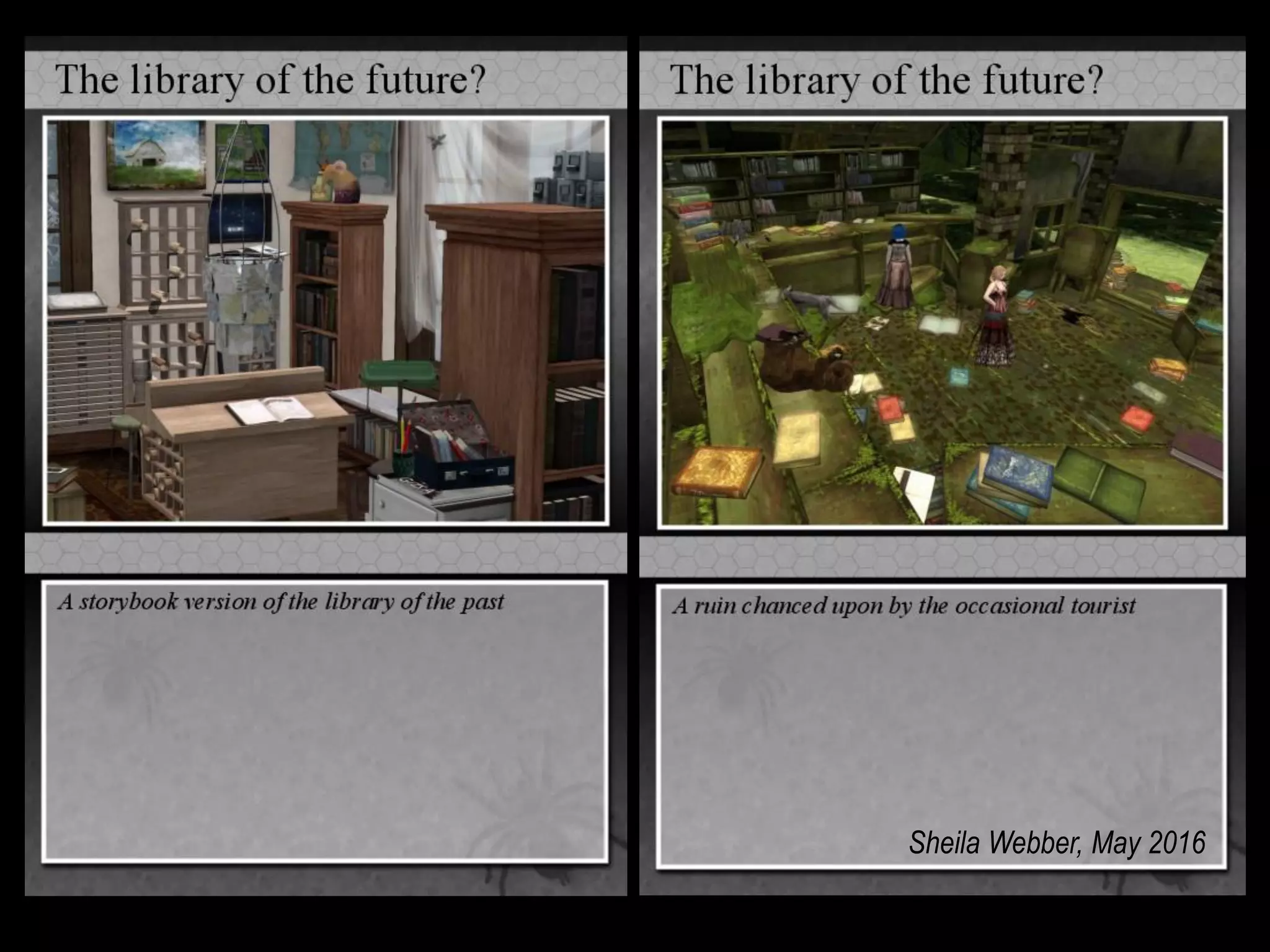
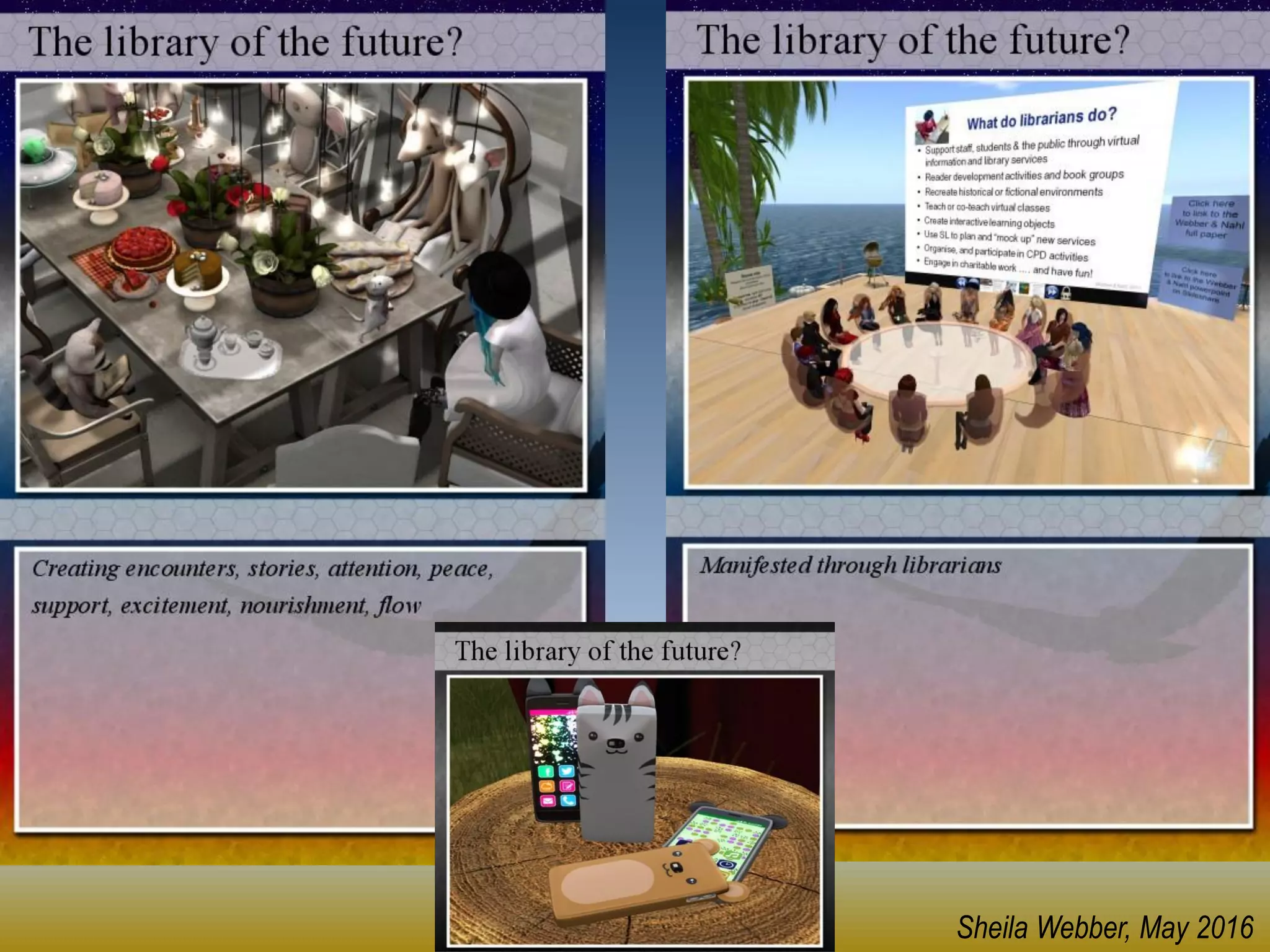
Pictures taken by Sheila Webber in the
3D virtual world, Second Life: where
libraries and books are treasured ;-)
• How “challenges to libraries” are framed
• Some qualitative research approaches that can be
used to explore what the issues actually are, and
tell compelling stories
• Relevance of qualitative research to developing
staff and the library
• Will focus primarily on the academic library sector
Sheila Webber, May 2016
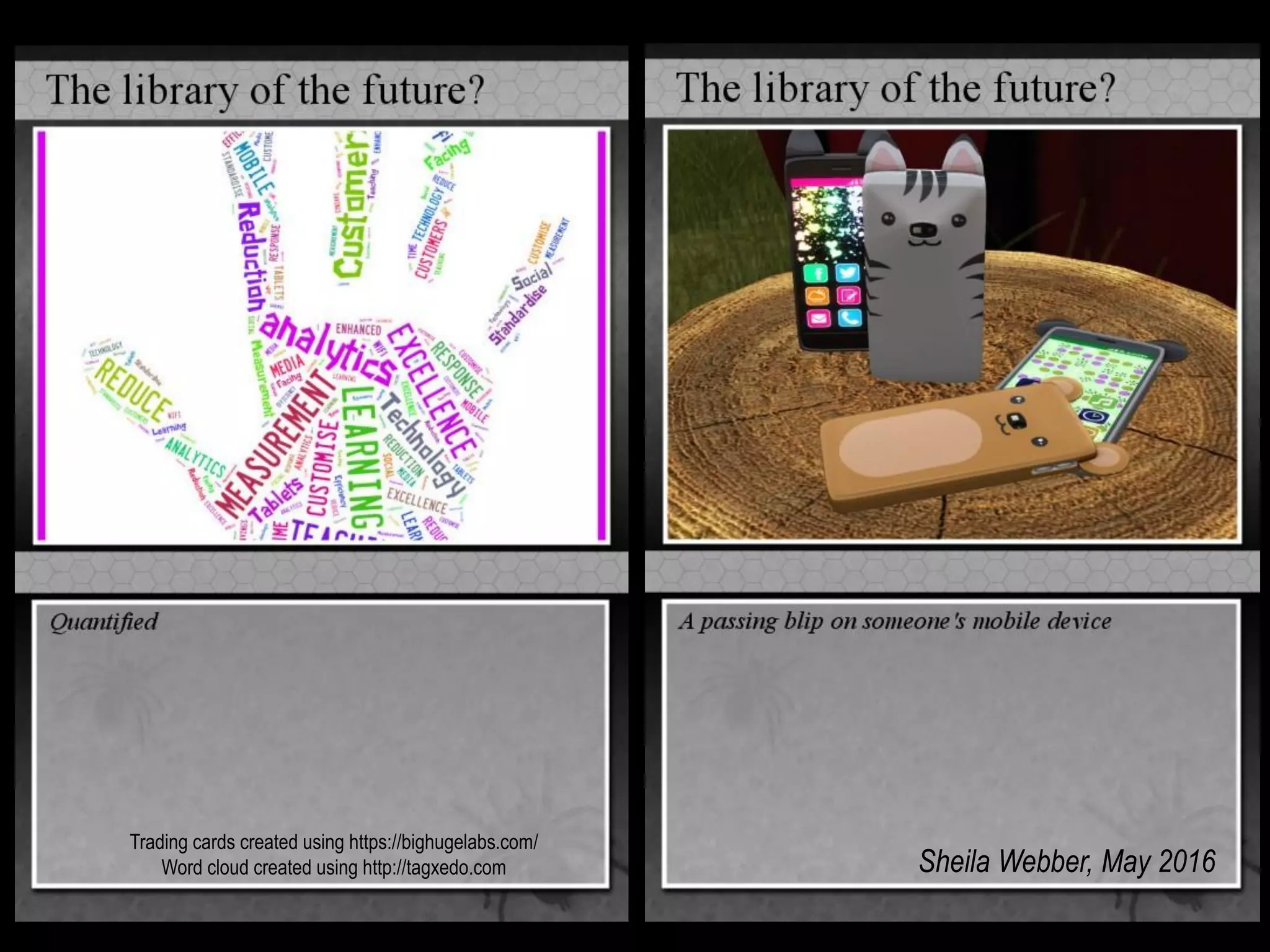
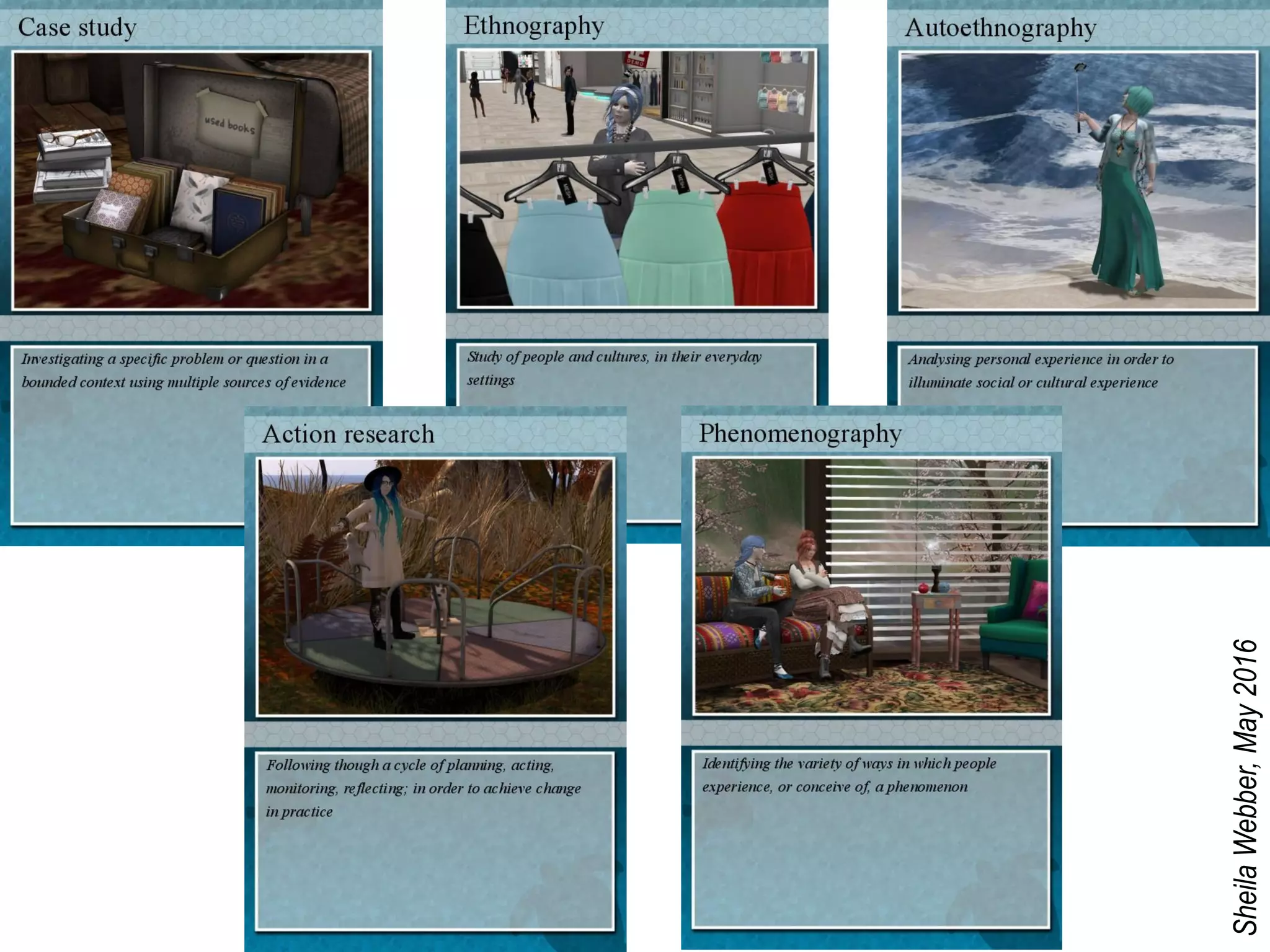
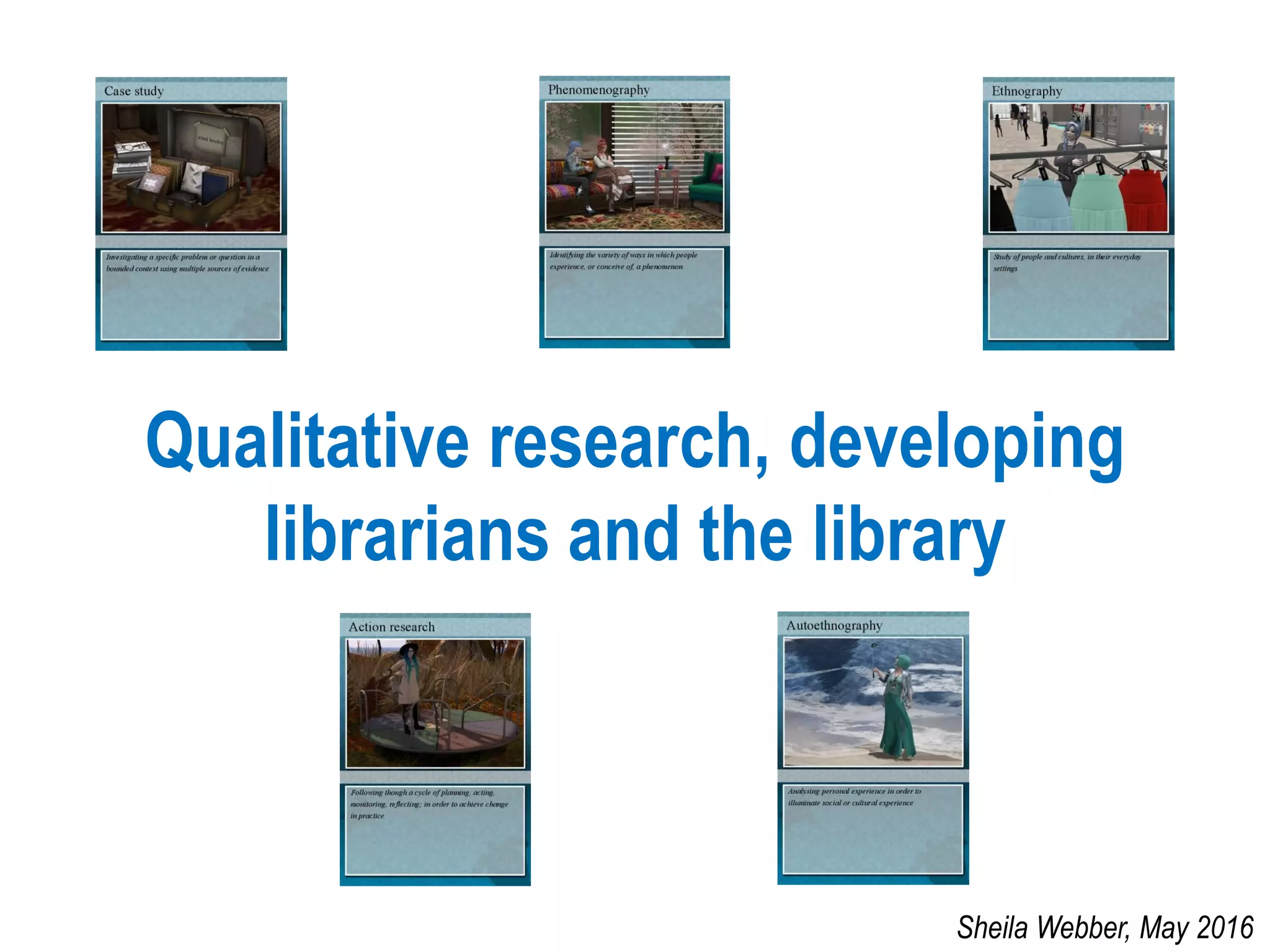
Trading cards created using https://bighugelabs.com/
Word cloud created using http://tagxedo.com Sheila Webber, May 2016
Sheila Webber, May 2016
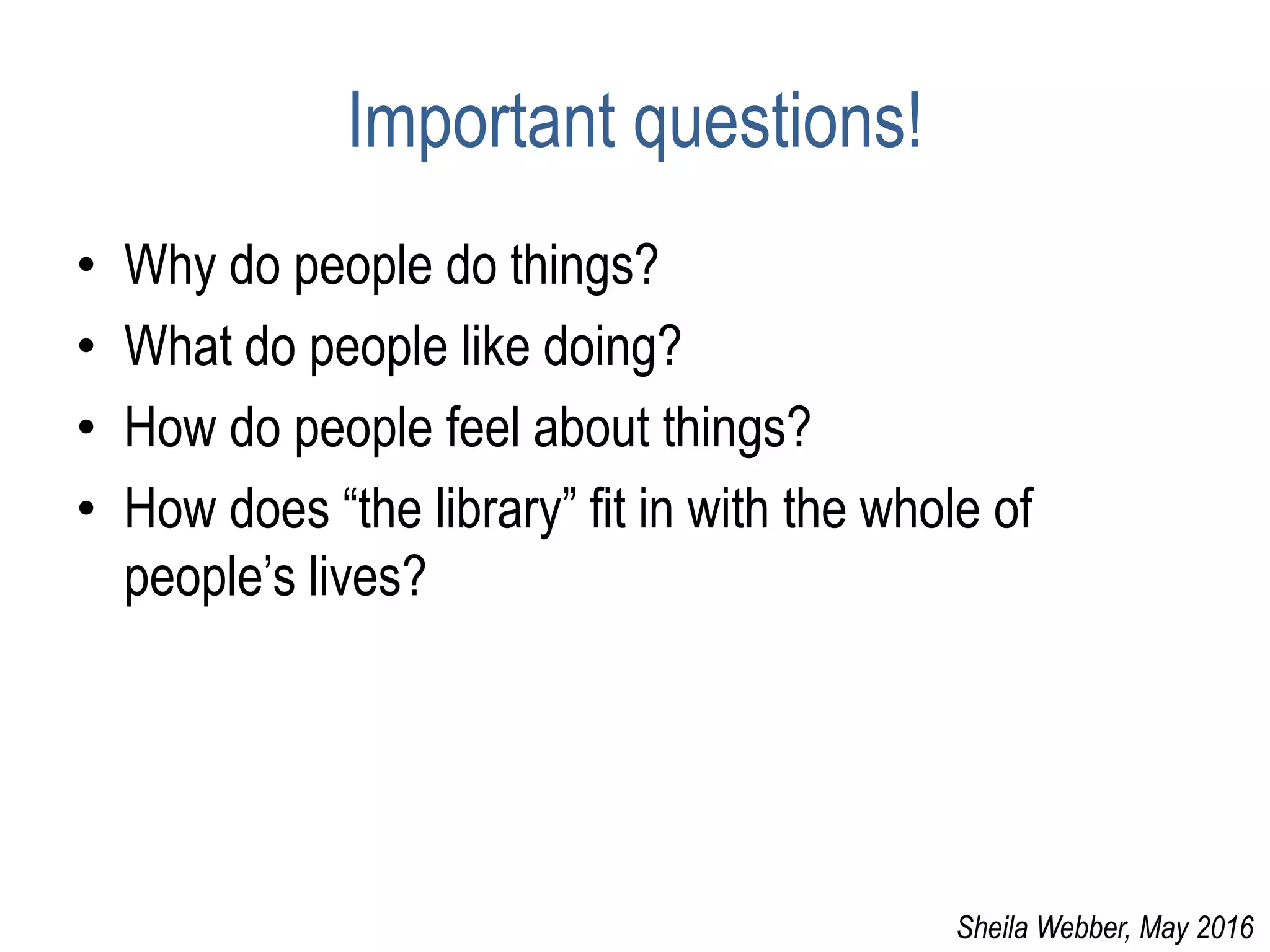
Important questions!
• Why do people do things?
• What do people like doing?
• How do people feel about things?
• How does “the library” fit in with the whole of
people’s lives?
Sheila Webber, May 2016
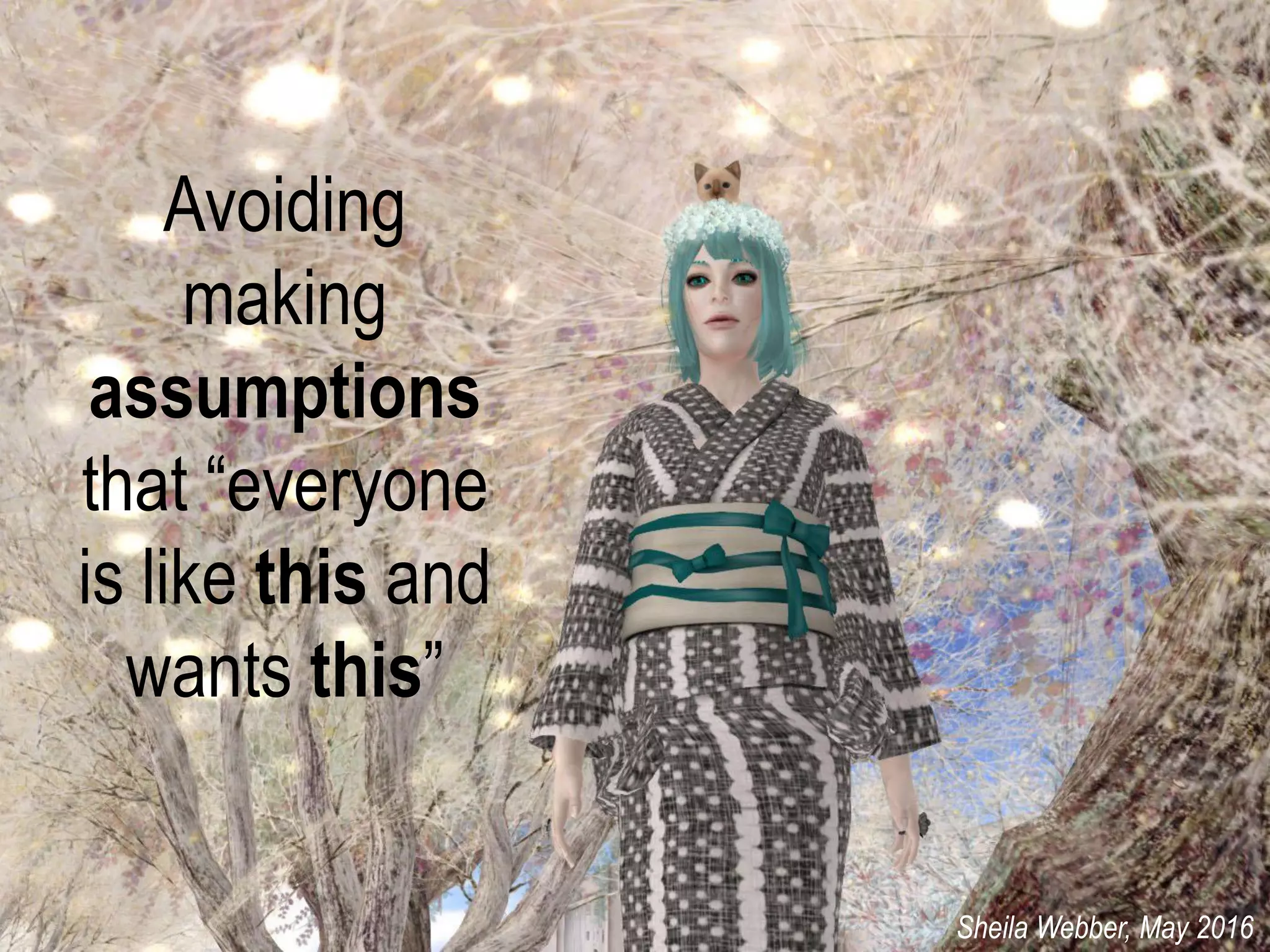
Avoiding
making
assumptions
that “everyone
is like this and
wants this”
Sheila Webber, May 2016
SheilaWebber,May2016
Case Study
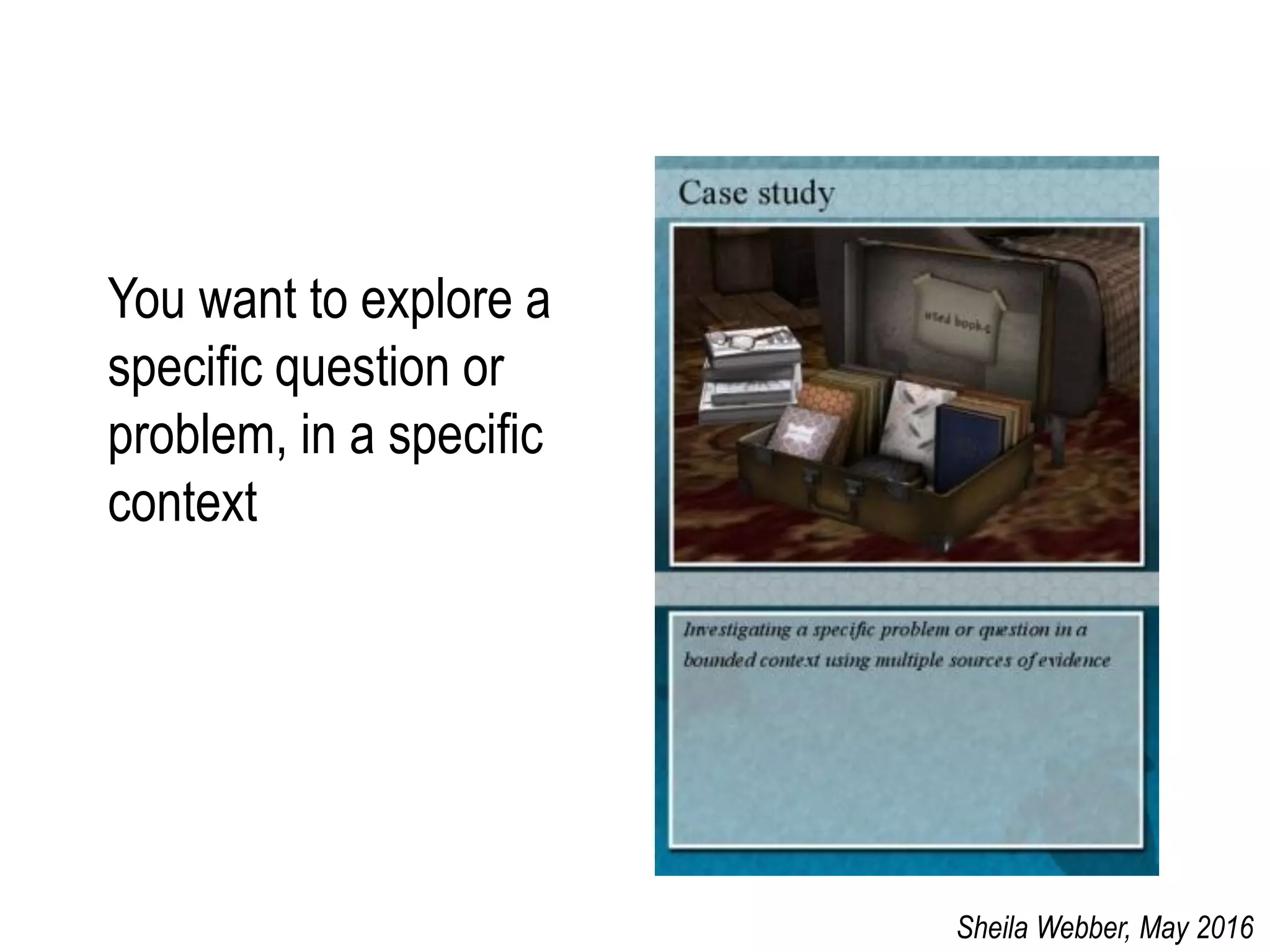
You want to explore a
specific question or
problem, in a specific
context
Sheila Webber, May 2016
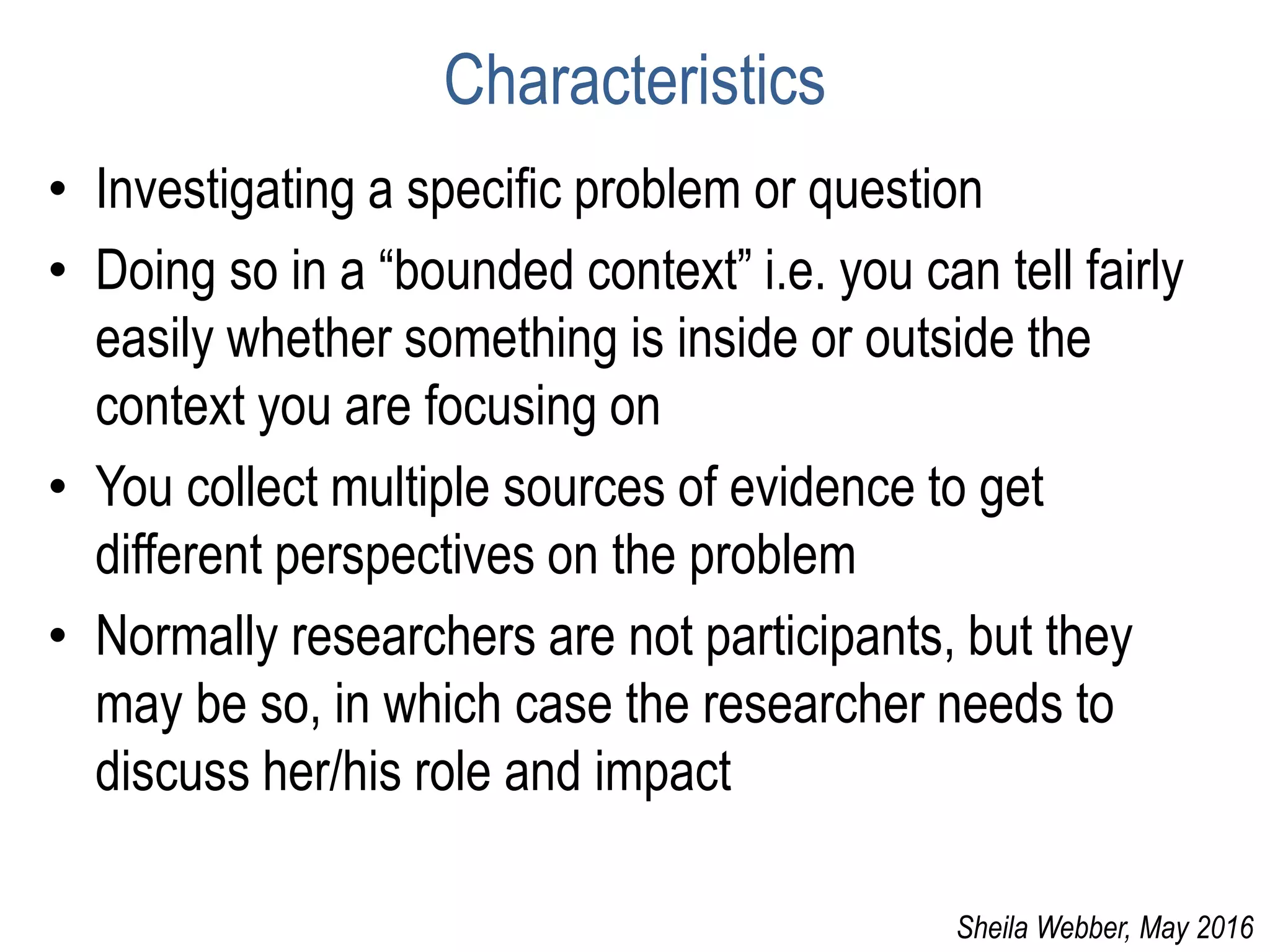
Characteristics
• Investigating a specific problem or question
• Doing so in a “bounded context” i.e. you can tell fairly
easily whether something is inside or outside the
context you are focusing on
• You collect multiple sources of evidence to get
different perspectives on the problem
• Normally researchers are not participants, but they
may be so, in which case the researcher needs to
discuss her/his role and impact
Sheila Webber, May 2016
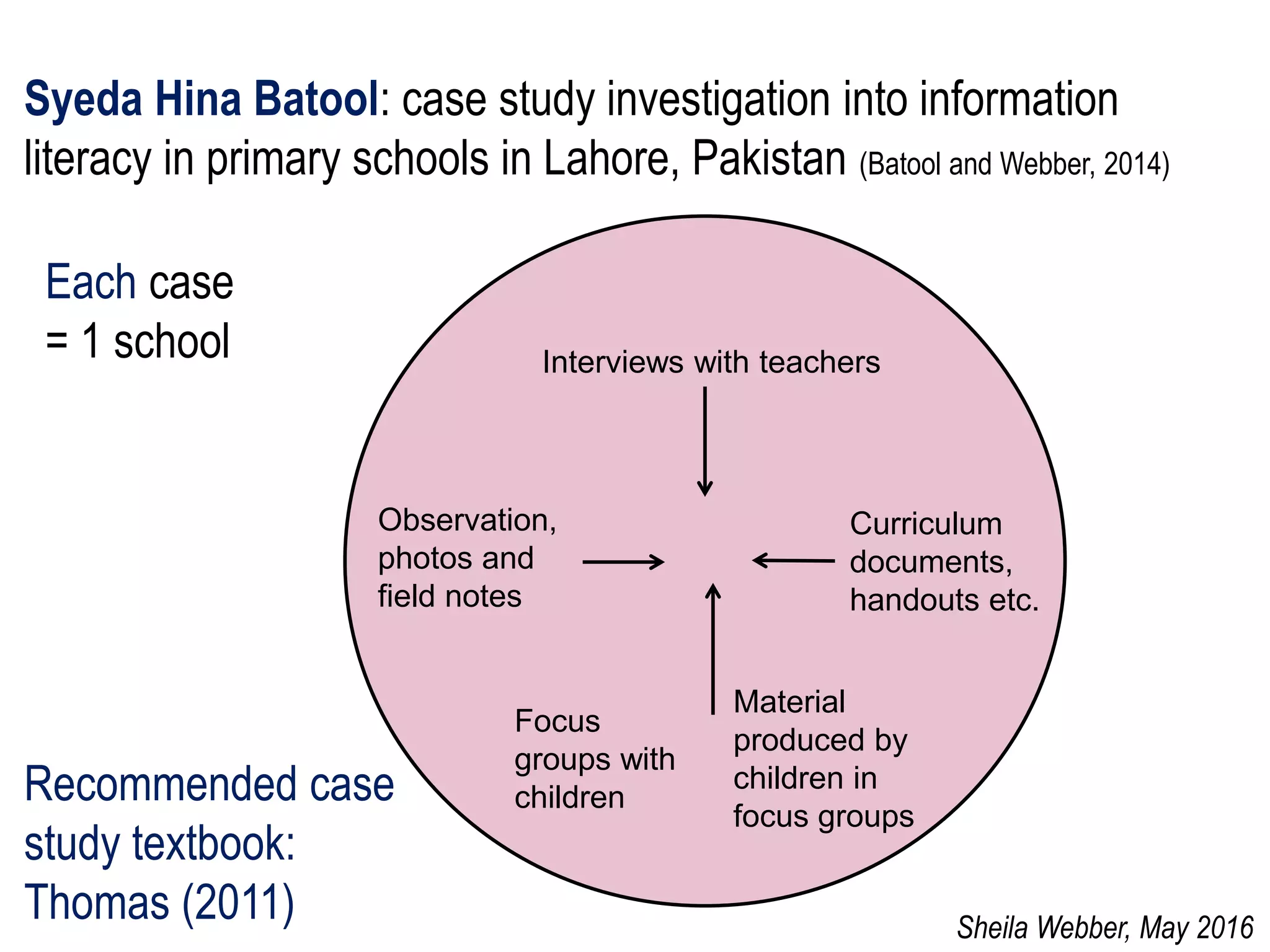
Interviews with teachers
Focus
groups with
children
Observation,
photos and
field notes
Curriculum
documents,
handouts etc.
Syeda Hina Batool: case study investigation into information
literacy in primary schools in Lahore, Pakistan (Batool and Webber, 2014)
Recommended case
study textbook:
Thomas (2011)
Each case
= 1 school
Material
produced by
children in
focus groups
Sheila Webber, May 2016
Characteristics
• Outcome may be a model or theory and/or practical
recommendations
• Start by describing relevant features of the context:
can be useful in helping you to “step back” from
familiar context
• Difference between systematically planned and
researched case study and just describing one
example
Sheila Webber, May 2016
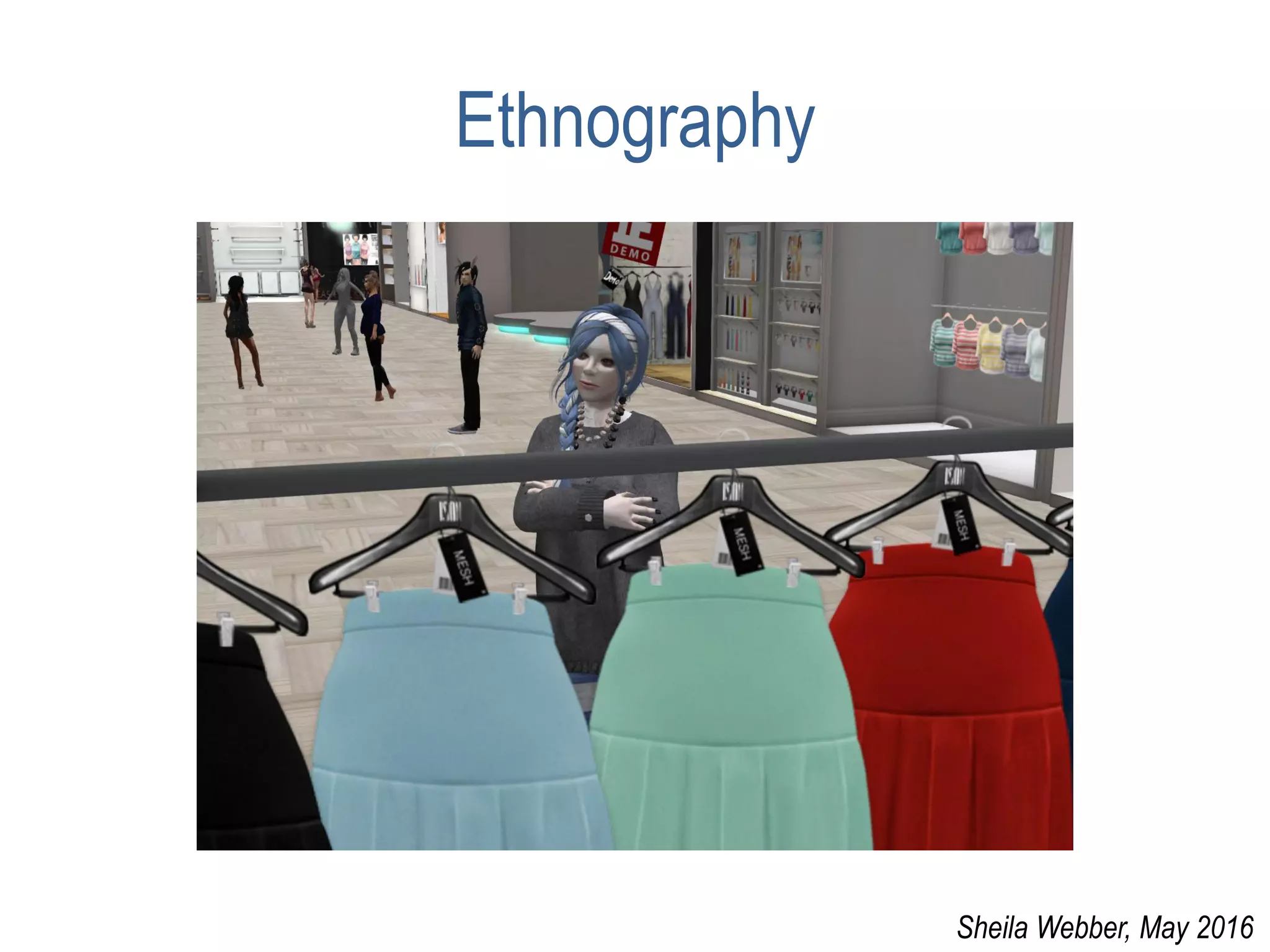
Ethnography
Sheila Webber, May 2016
• Dent Goodman (2011: 1) cites Fetterman as describing
ethnographic writing as “the art and science of
describing a group or culture”
• Observation, participation, field notes & memos,
interviews
• Popularised for librarians by the ERIAL (Ethnographic
Research in Illinois Academic Libraries) project (Asher
and Miller, 2010) & UX seminars (e.g.
http://uxlib.org/2015/09/30/bookings/)
(though, in particular, some significant
information behaviour studies well before this) Sheila Webber,
May 2016
Khoo, Rozaklis and Hall (2012: 86) talk about the
“growing complexity of the social and technological
environments within which libraries are situated” and
other factors “prompting libraries to think about how
to describe their strengths, not just in terms of
performance and metrics, but also in terms of the
wider social cultural value they offer to users and
communities”
Can be used directly to guide policy and improve services
Can provide vivid human stories which may convey
the library’s value more effectively than bare numbers
Sheila Webber, May 2016
• Regaldo and Smale (2015) investigated how
students used (or did not use) the library for their
coursework (City University of New York)
• Mapping diaries; student photos with elicitation
interviews; interviews about the process of doing an
assignment
• Notable finding: students liked private, individual
spaces e.g. carrels: a large number commuted and
did not have a quiet space to study at home
Sheila Webber, May 2016
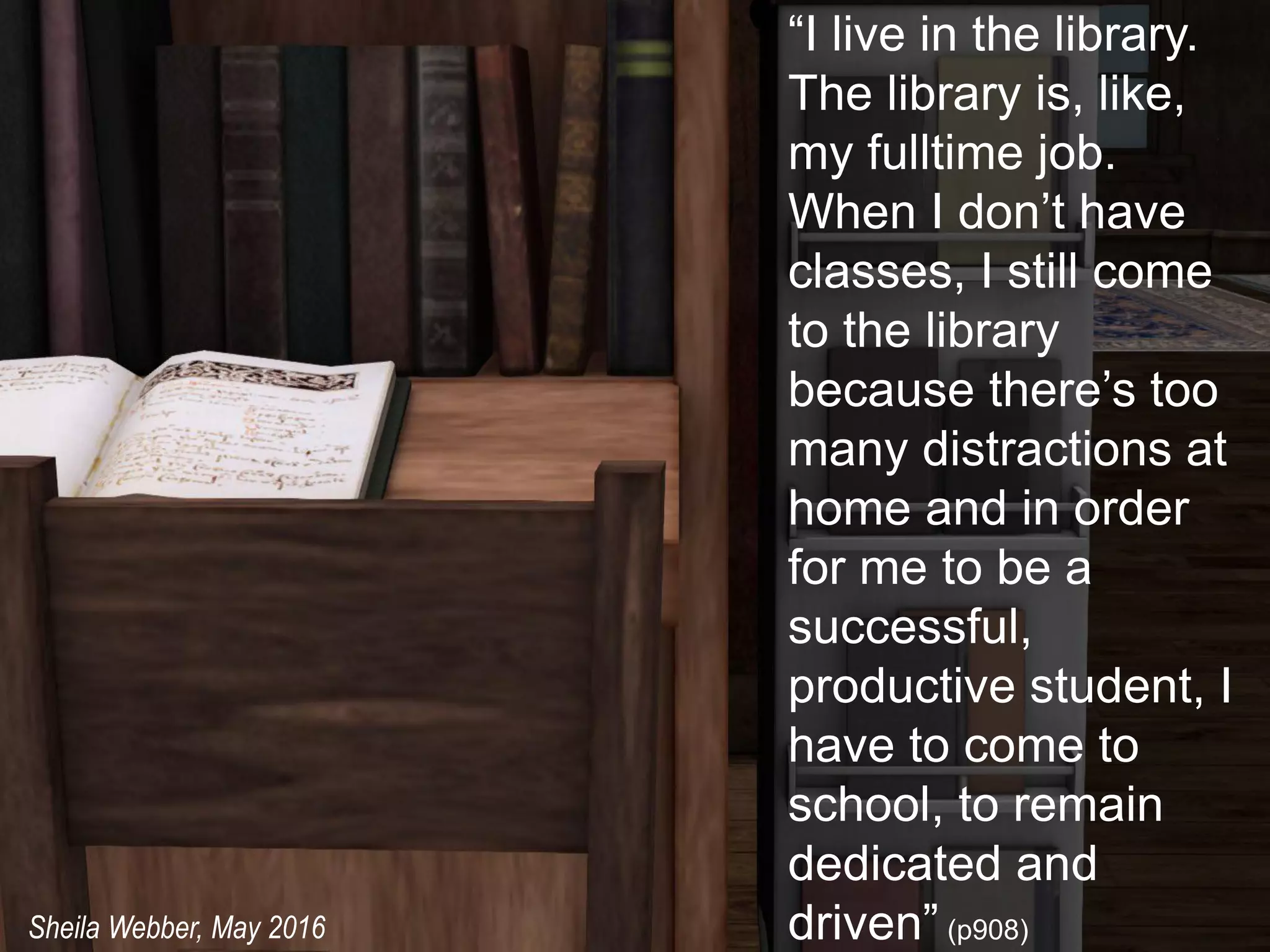
“I live in the library.
The library is, like,
my fulltime job.
When I don’t have
classes, I still come
to the library
because there’s too
many distractions at
home and in order
for me to be a
successful,
productive student, I
have to come to
school, to remain
dedicated and
driven” (p908)Sheila Webber, May 2016
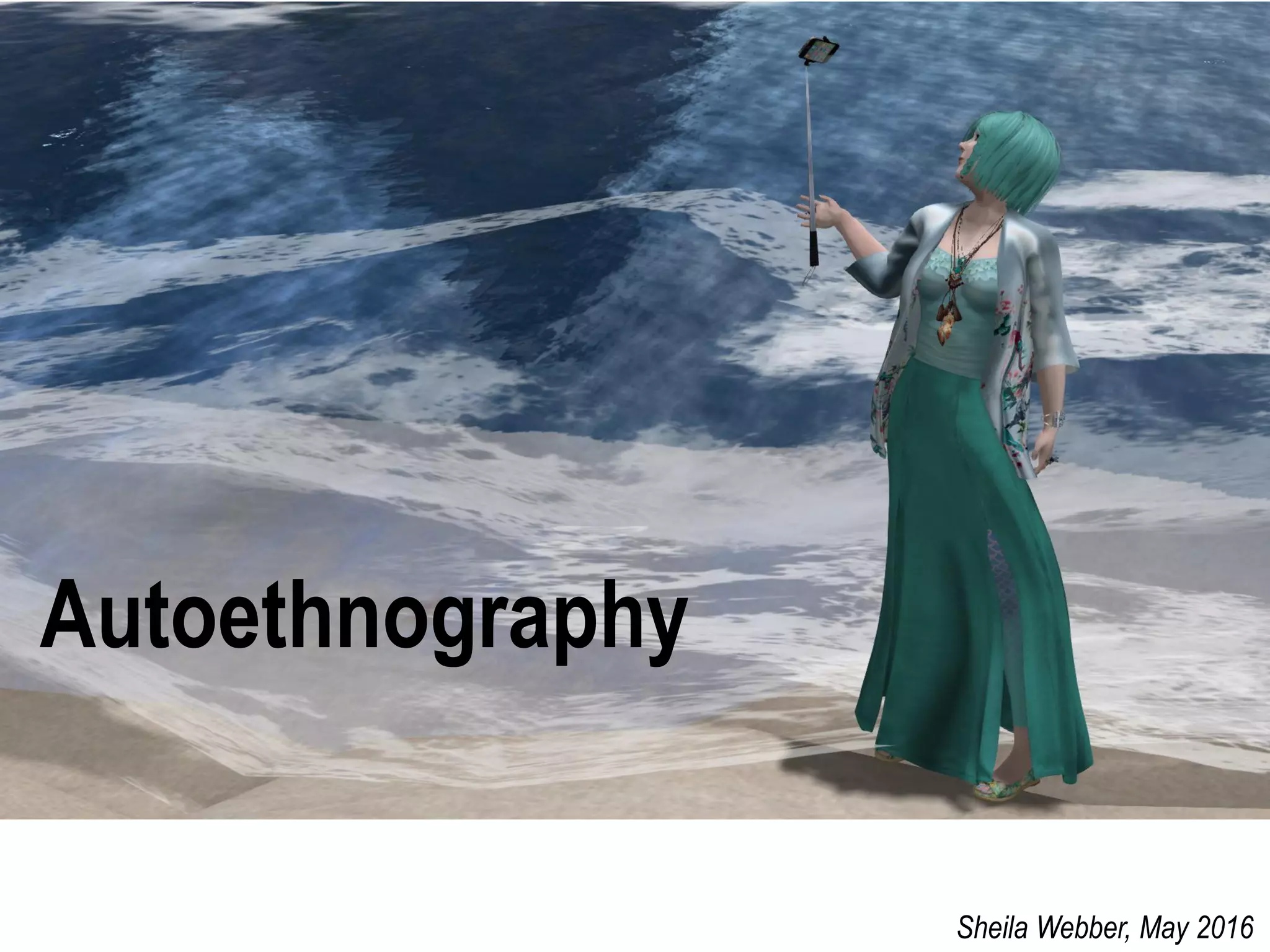
Autoethnography
Sheila Webber, May 2016
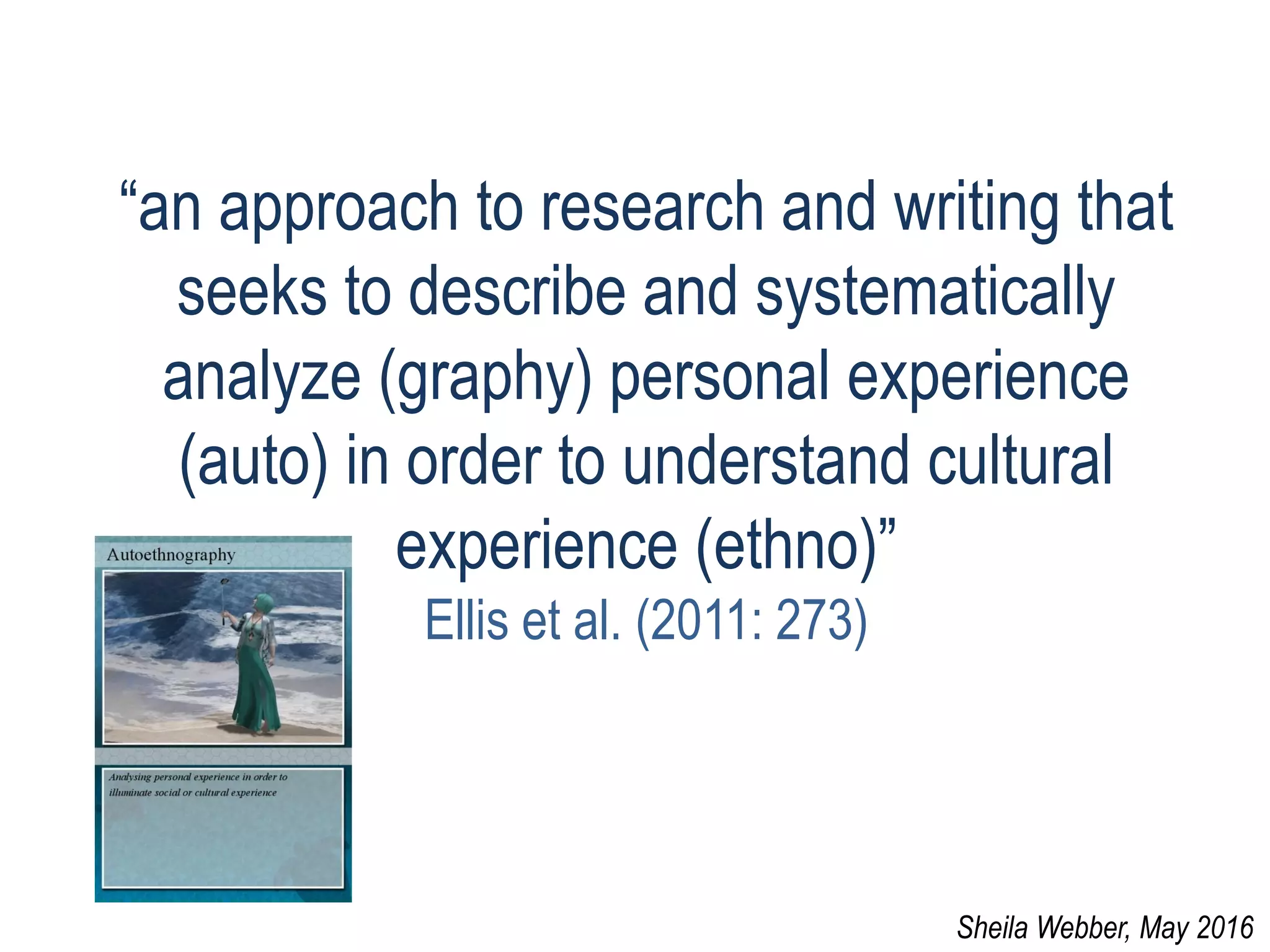
“an approach to research and writing that
seeks to describe and systematically
analyze (graphy) personal experience
(auto) in order to understand cultural
experience (ethno)”
Ellis et al. (2011: 273)
Sheila Webber, May 2016
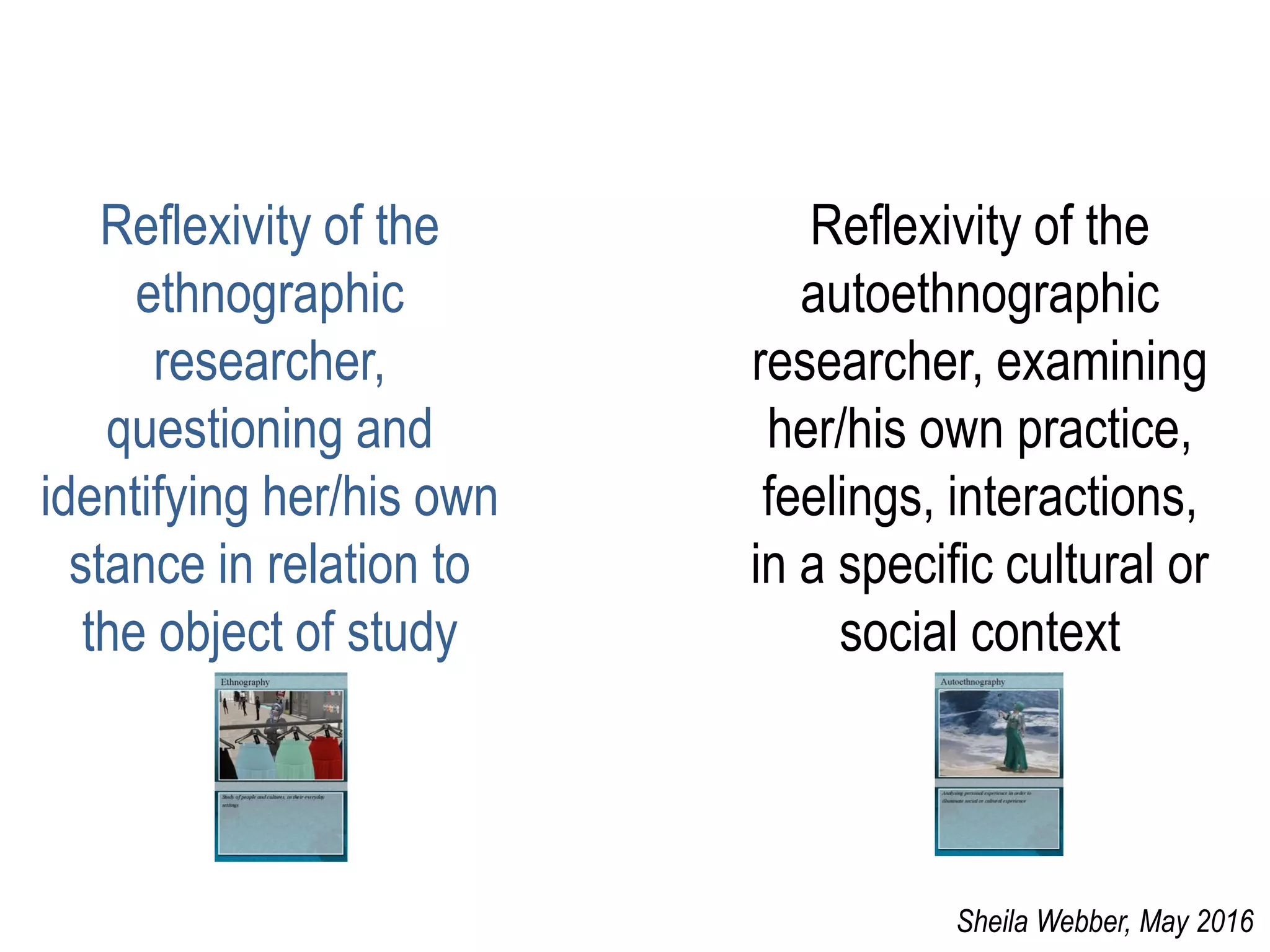
Reflexivity of the
ethnographic
researcher,
questioning and
identifying her/his own
stance in relation to
the object of study
Reflexivity of the
autoethnographic
researcher, examining
her/his own practice,
feelings, interactions,
in a specific cultural or
social context
Sheila Webber, May 2016
• Understanding one’s own practice, motivation,
feelings, place better
• Providing insight for others in a similar situation
• Making the librarian visible in the context
• Providing others with insight into the library’s and
librarian’s role
• Gaining better understanding of the social and
cultural context
Sheila Webber, May 2016
• Grace and Sen (2013): community resilience and
the role of the public library
• Wheeler, Graebner, Skelton and Patterson (2014):
collaborative autoethnography on experiences of
academic librarians serving on faculty associations
• Patin (2015): role of the school library during the
aftermath of hurricanes Katrina and Rita
• Anne-Marie Deitering’s autoethnography initiative:
– https://info-fetishist.org/2015/05/22/cfparticipation-
autoethnography-learning-community/
– https://info-fetishist.org/2015/09/04/phase-1-autoethnography-
learning-community/
Sheila Webber, May 2016
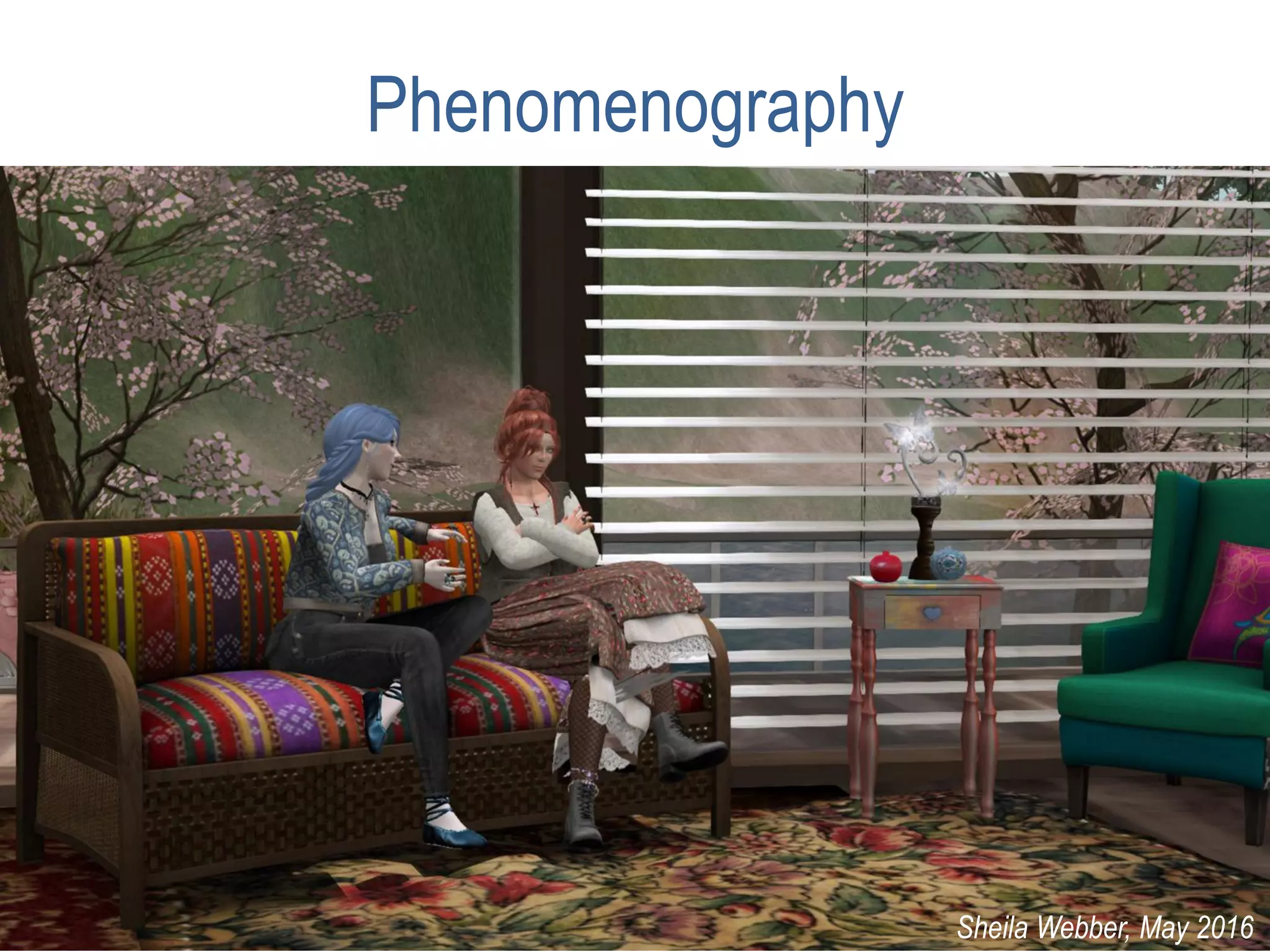
Phenomenography
Sheila Webber, May 2016
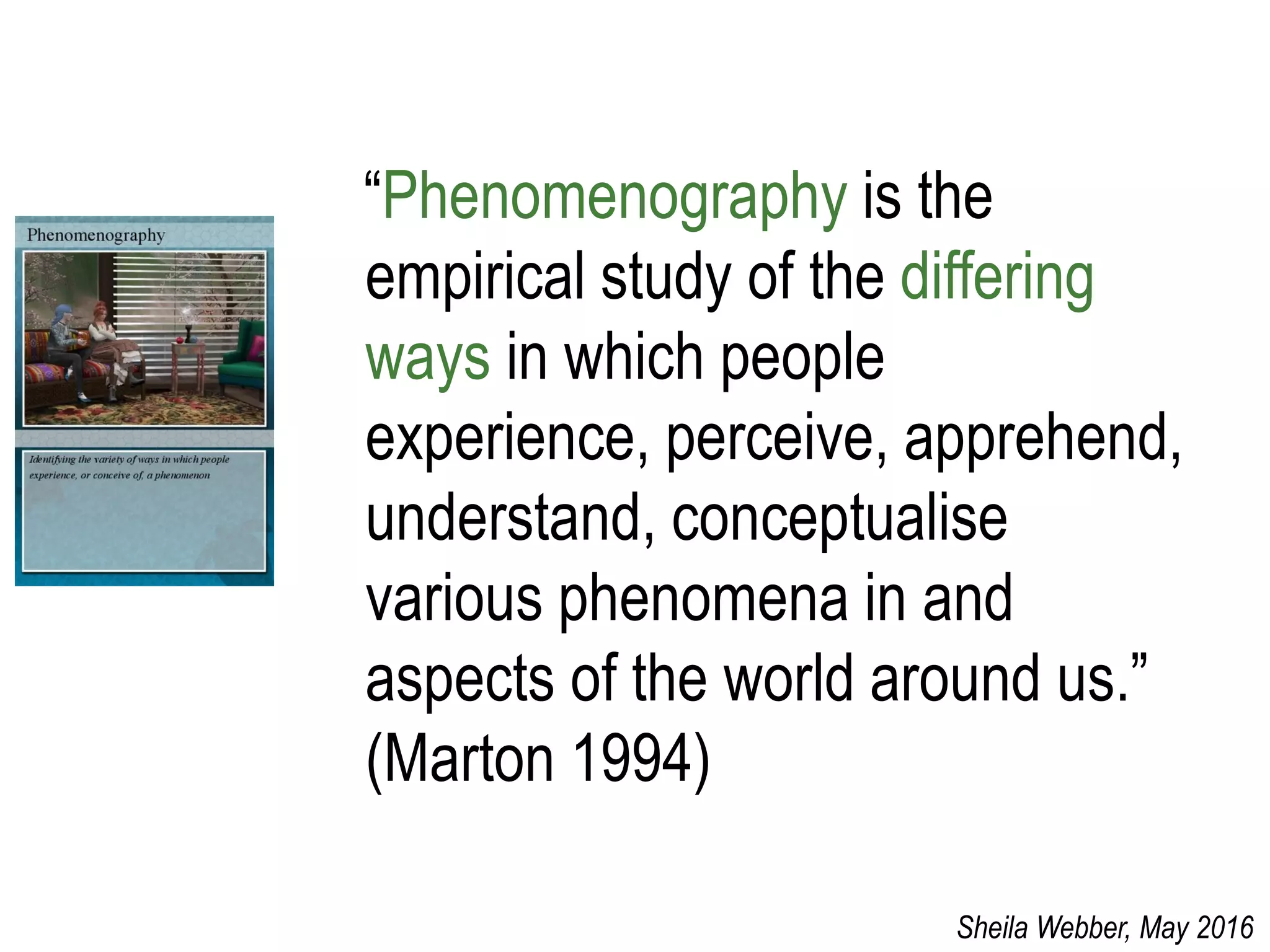
“Phenomenography is the
empirical study of the differing
ways in which people
experience, perceive, apprehend,
understand, conceptualise
various phenomena in and
aspects of the world around us.”
(Marton 1994)
Sheila Webber, May 2016
• So, useful if you want to find out about the different
ways in which people conceive of, or experience, a
phenomenon…
• The phenomenon could be: the library; a specific
learning experience; using the catalogue …
• Have to end up with a small number of categories,
that are distinct, and between them describe the
qualitatively different ways people think about or
experience the phenomenon
Sheila Webber, May 2016
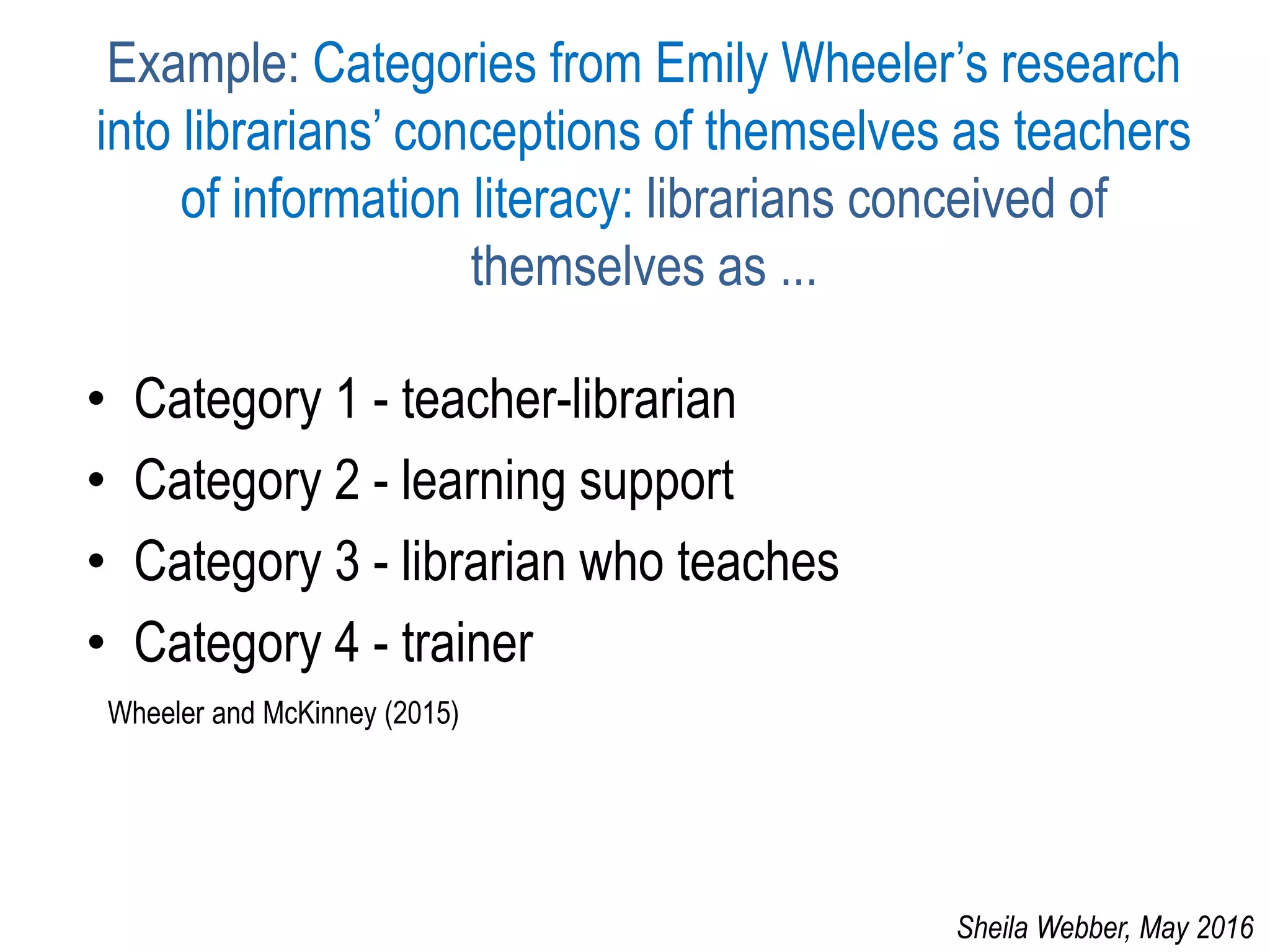
Example: Categories from Emily Wheeler’s research
into librarians’ conceptions of themselves as teachers
of information literacy: librarians conceived of
themselves as ...
• Category 1 - teacher-librarian
• Category 2 - learning support
• Category 3 - librarian who teaches
• Category 4 - trainer
Wheeler and McKinney (2015)
Sheila Webber, May 2016
Applications of phenomenographic research
• Variation theory: having identified how learners’
conceive of a subject, you design learning that enables
them to experience the variations
• Workplace training & education e.g. Masters students at
the Sheffield iSchool were able to use Wheeler’s
framework when reflecting on their own development as
teachers of information literacy
• Understanding people better, so you are better able to
engage with them
• The interview itself can be a learning experience for the
interviewee and interviewer
Sheila Webber, May 2016
Action Research
Sheila Webber, May 2016
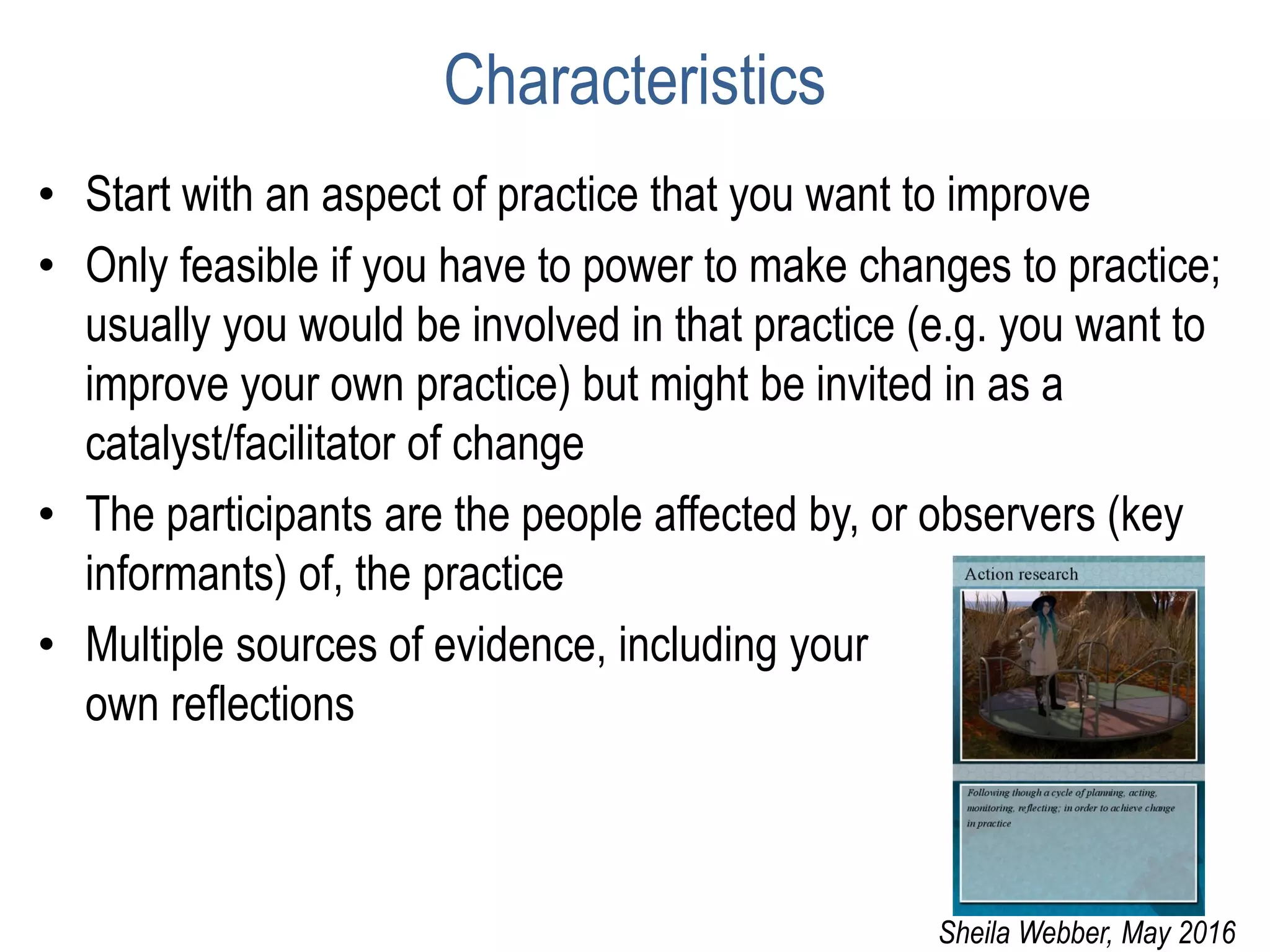
Characteristics
• Start with an aspect of practice that you want to improve
• Only feasible if you have to power to make changes to practice;
usually you would be involved in that practice (e.g. you want to
improve your own practice) but might be invited in as a
catalyst/facilitator of change
• The participants are the people affected by, or observers (key
informants) of, the practice
• Multiple sources of evidence, including your
own reflections
Sheila Webber, May 2016
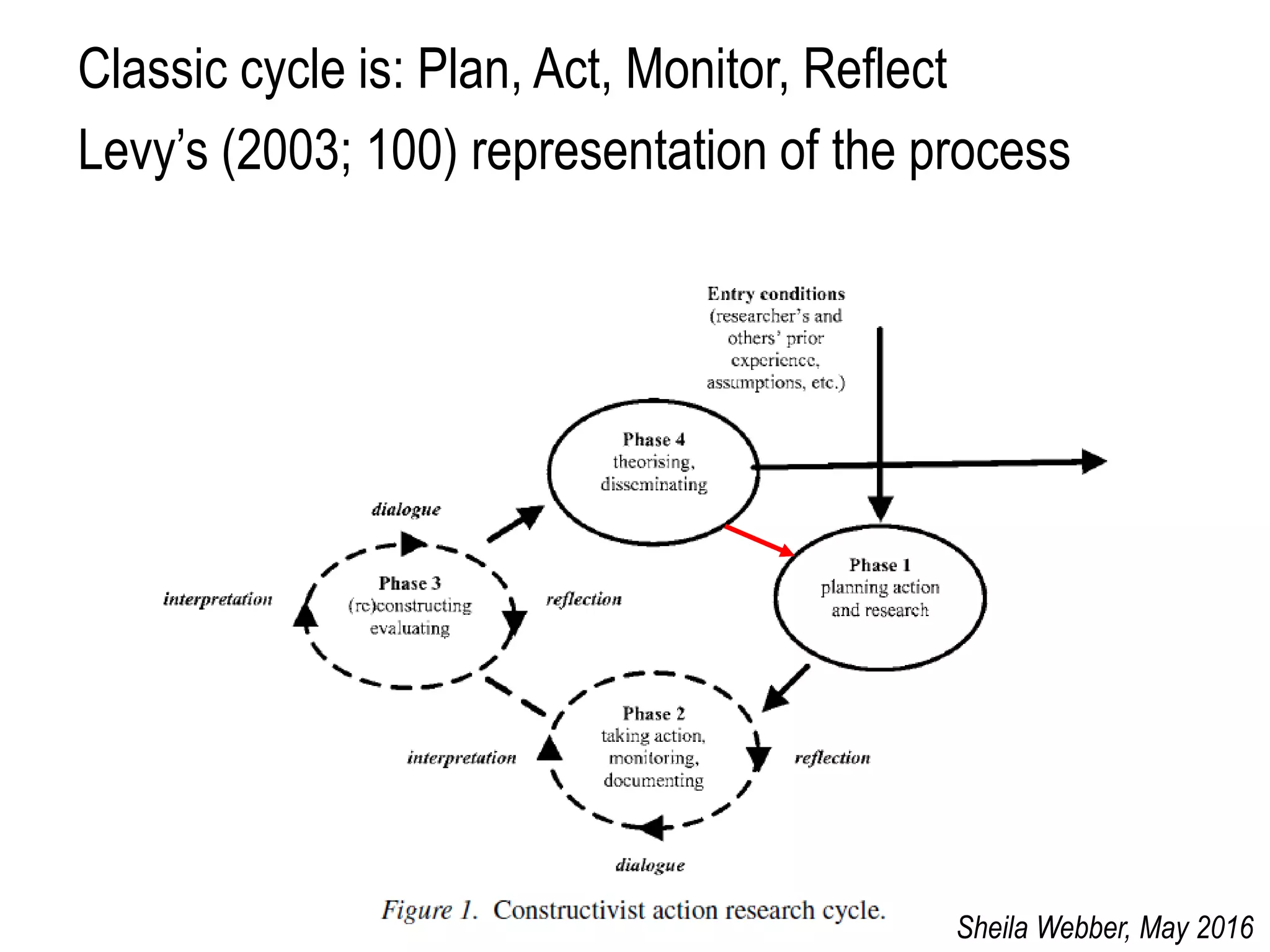
Classic cycle is: Plan, Act, Monitor, Reflect
Levy’s (2003; 100) representation of the process
Sheila Webber, May 2016
• Malenfant, Hinchliffe and Gilchrist (2016) introduce
special issue or C&RL with action research projects
from the Assessment in Action initiative
• Describe it as “an emergent developmental form”
(p143) (improving practice and developing the
community of inquiry involved in the action
research)
Sheila Webber, May 2016
Qualitative research, developing
librarians and the library
Sheila Webber, May 2016
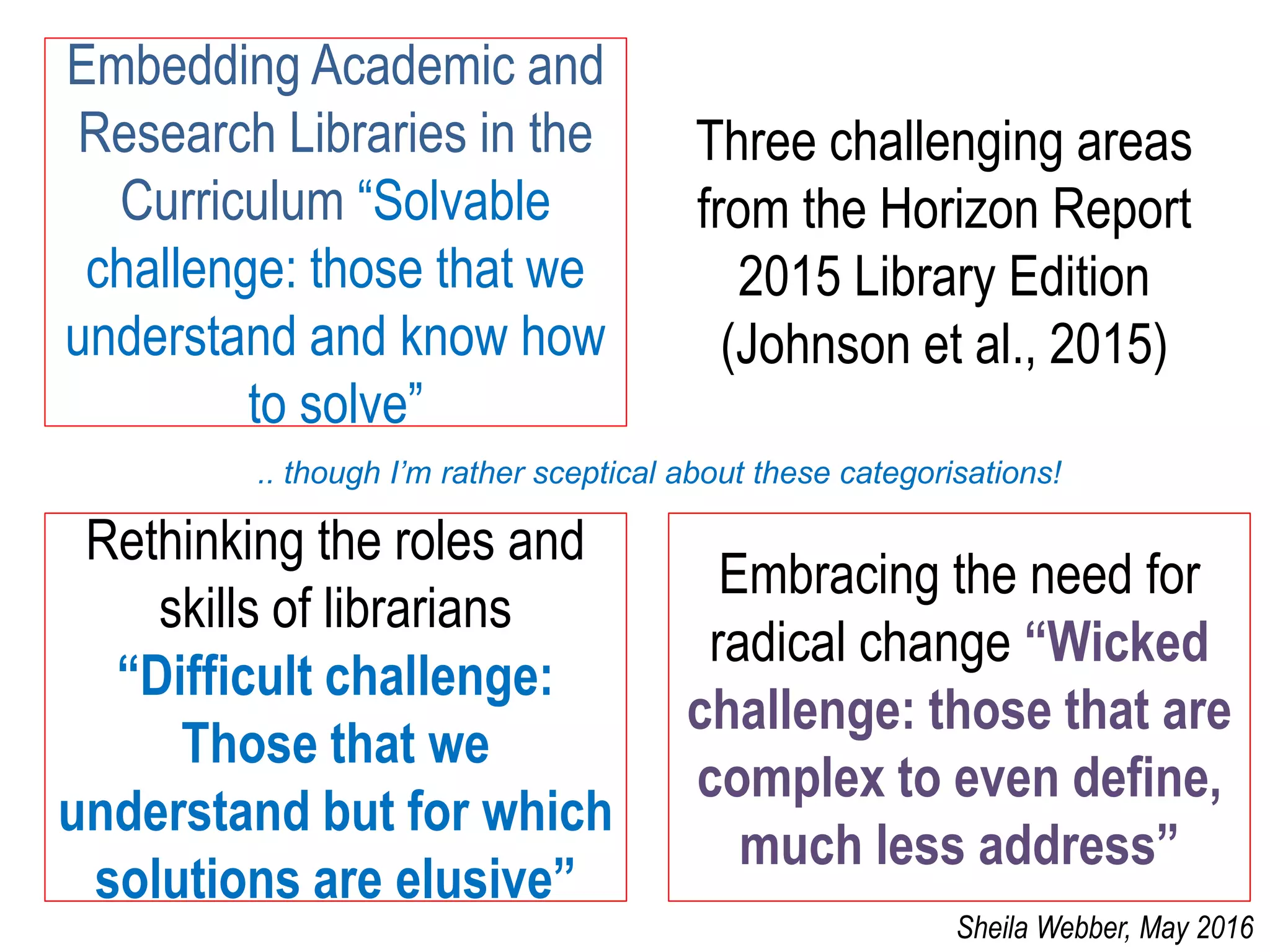
Embedding Academic and
Research Libraries in the
Curriculum “Solvable
challenge: those that we
understand and know how
to solve”
Rethinking the roles and
skills of librarians
“Difficult challenge:
Those that we
understand but for which
solutions are elusive”
Embracing the need for
radical change “Wicked
challenge: those that are
complex to even define,
much less address”
Three challenging areas
from the Horizon Report
2015 Library Edition
(Johnson et al., 2015)
.. though I’m rather sceptical about these categorisations!
Sheila Webber, May 2016
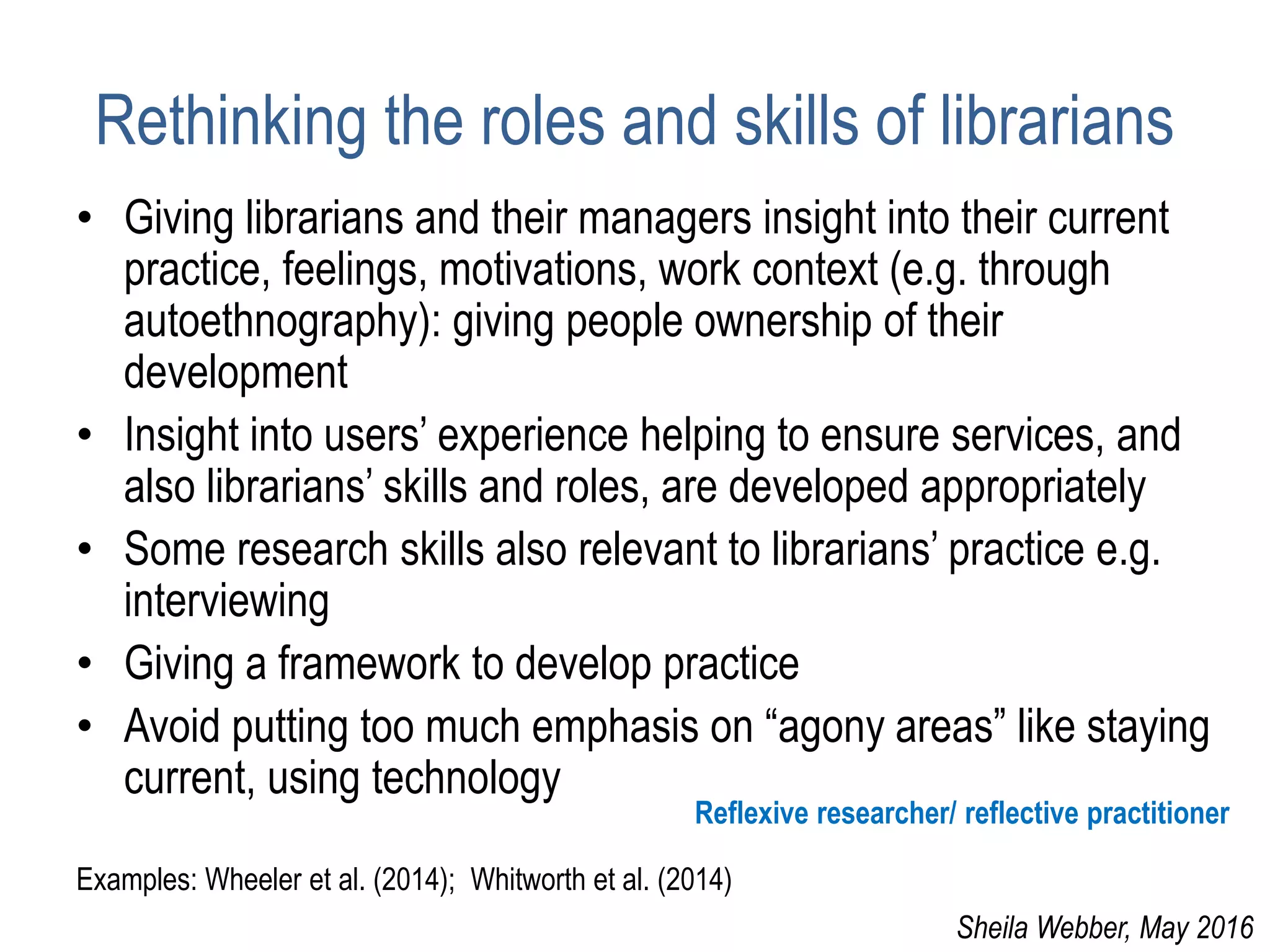
Rethinking the roles and skills of librarians
• Giving librarians and their managers insight into their current
practice, feelings, motivations, work context (e.g. through
autoethnography): giving people ownership of their
development
• Insight into users’ experience helping to ensure services, and
also librarians’ skills and roles, are developed appropriately
• Some research skills also relevant to librarians’ practice e.g.
interviewing
• Giving a framework to develop practice
• Avoid putting too much emphasis on “agony areas” like staying
current, using technology
Examples: Wheeler et al. (2014); Whitworth et al. (2014)
Reflexive researcher/ reflective practitioner
Sheila Webber, May 2016
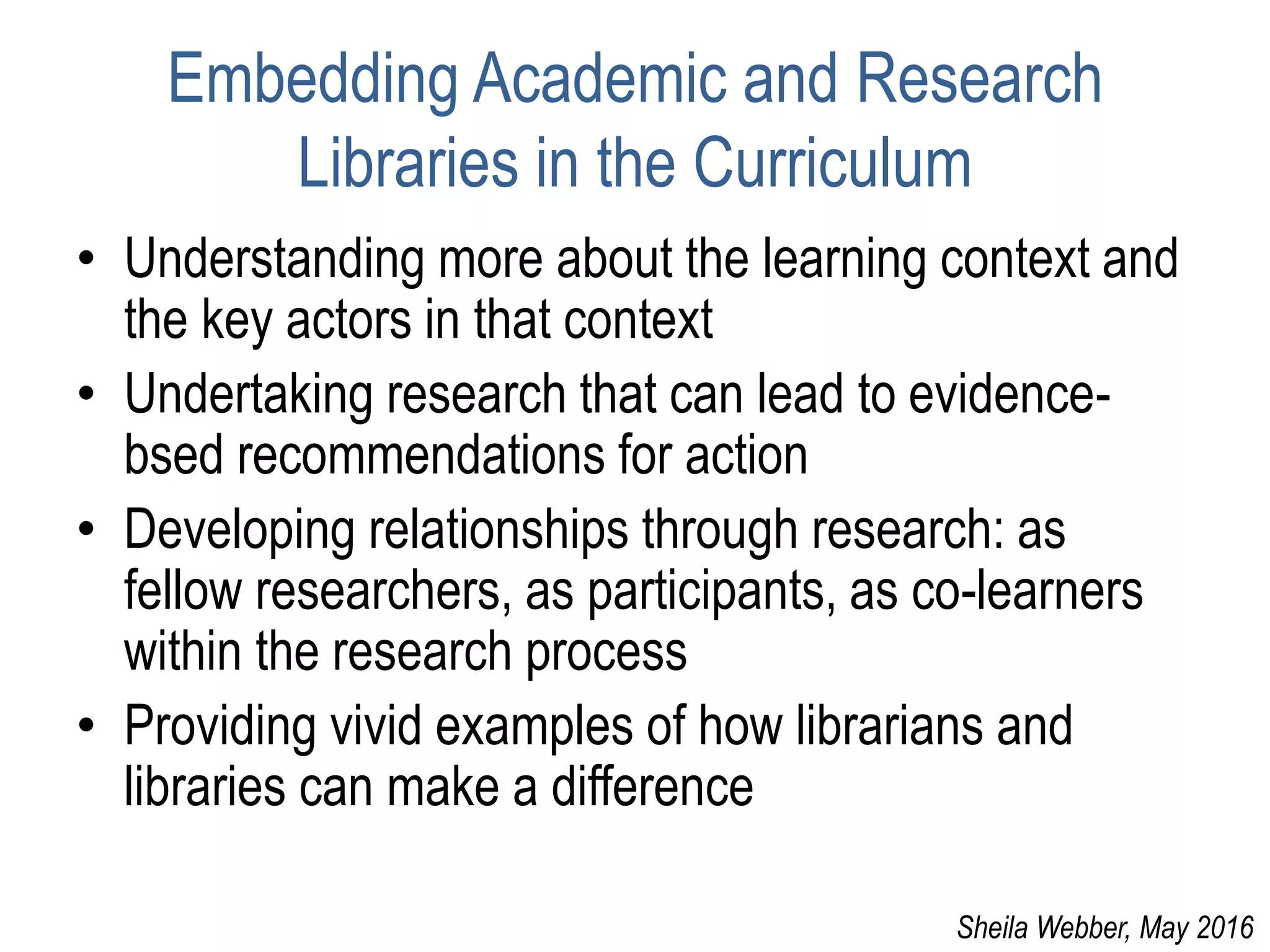
Embedding Academic and Research
Libraries in the Curriculum
• Understanding more about the learning context and
the key actors in that context
• Undertaking research that can lead to evidence-
bsed recommendations for action
• Developing relationships through research: as
fellow researchers, as participants, as co-learners
within the research process
• Providing vivid examples of how librarians and
libraries can make a difference
Sheila Webber, May 2016
Embracing the need for radical change
• Gaining insight into what the changes are (and
whether they really are radical)
• Grounding plans for change in knowledge of the
specific context, and the feelings and needs of the
human beings in that context
• Understanding technology as one part of a human’s
life world, rather than an unstoppable force of
nature which changes everything
Sheila Webber, May 2016
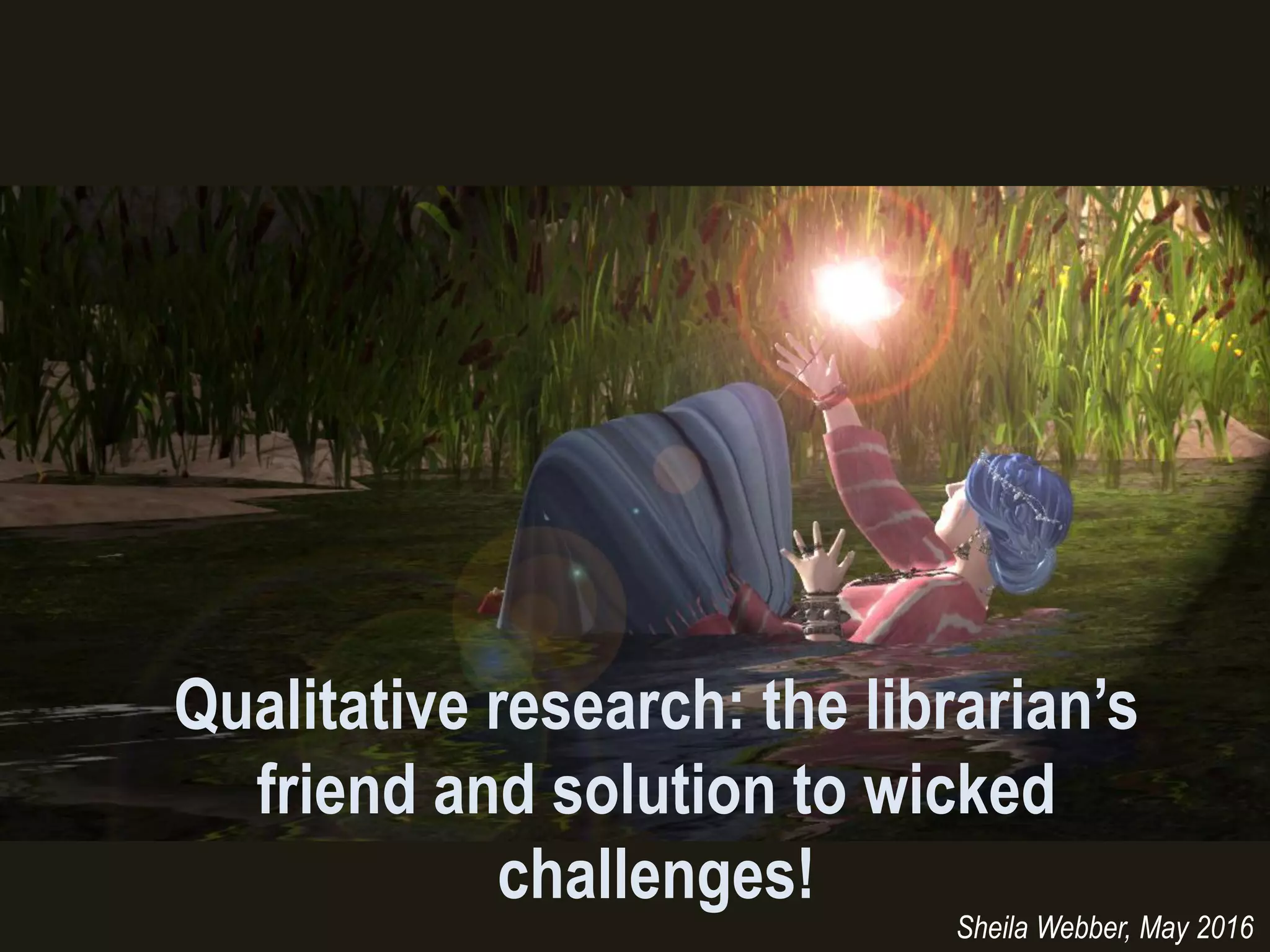
Qualitative research: the librarian’s
friend and solution to wicked
challenges!
Sheila Webber, May 2016
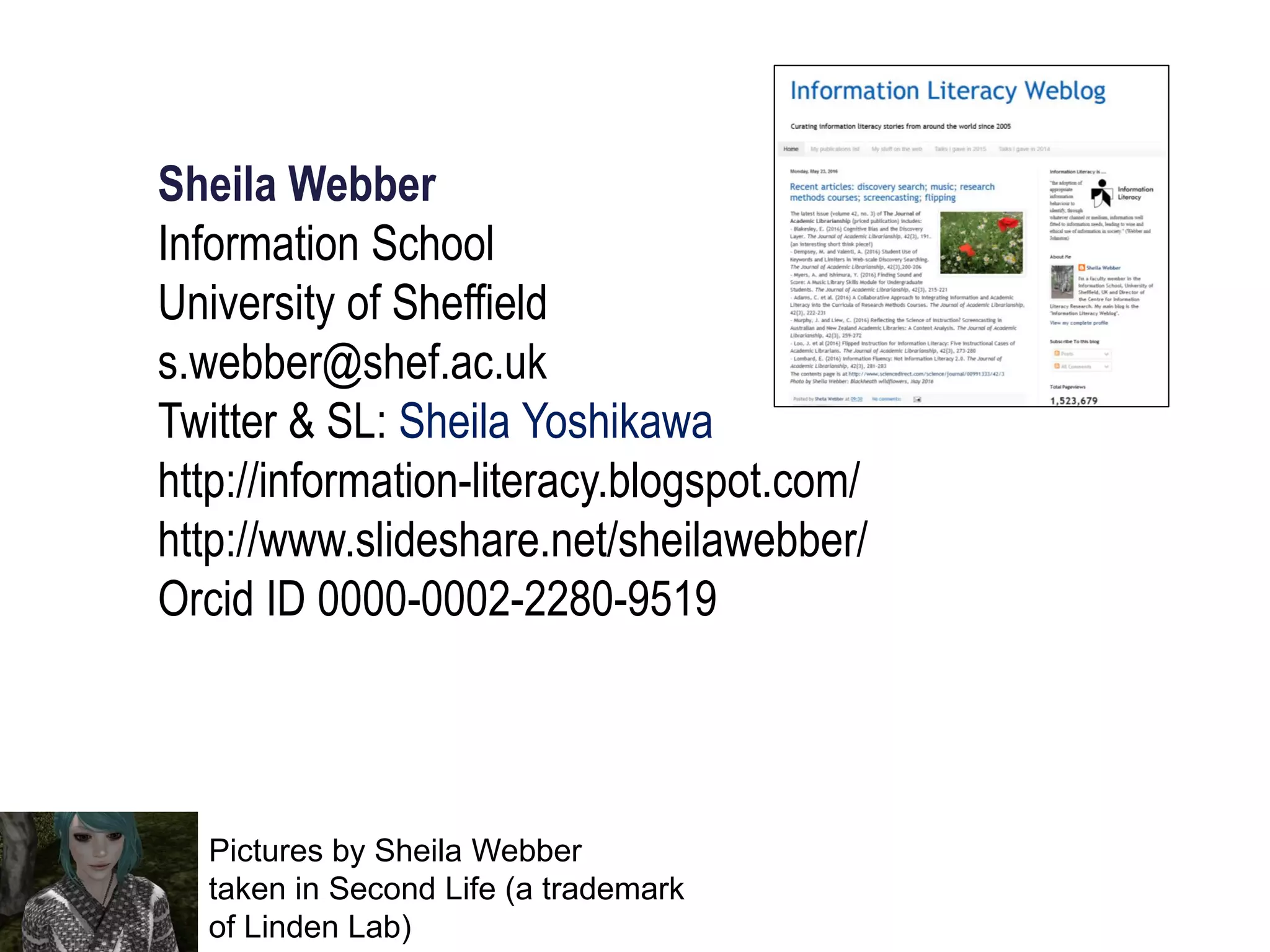
Sheila Webber
Information School
University of Sheffield
s.webber@shef.ac.uk
Twitter & SL: Sheila Yoshikawa
http://information-literacy.blogspot.com/
http://www.slideshare.net/sheilawebber/
Orcid ID 0000-0002-2280-9519
Pictures by Sheila Webber
taken in Second Life (a trademark
of Linden Lab)
References
• Anderson, L. (2006). Analytic autoethnography. Journal of contemporary
ethnography, 35 (4), 373-395.
• Asher, A. and Miller, S. (2010). So you want to do anthropology in your library? Or,
a practical guide to ethnographic research in academic libraries.
http://www.erialproject.org/
• Batool, S.H. and Webber, S. (2014). Early findings from a study of information
literacy practices in primary schools of Pakistan. In Information Literacy. Lifelong
Learning and Digital Citizenship in the 21st Century. (pp 282-290). Springer.
• Dent Goodman, V. (2011). Applying ethnographic research methods in library and
information settings. Libri, 61, 1-11.
• Dokphrom, P. (2013). Information literacy of undergraduate students in Thailand:
a case of the Faculty of Arts, Silpakorn University, Thailand. In M. Hepworth & G.
Walton (Eds.). Developing people’s information capabilities. (pp.111-126). Bingley,
England: Emerald.
• Eisenhardt, K. M. (1989). Building theories from case study research. The
Academy of Management Review, 14 (4), 532−550.
• Ellis, C., Adams, T.E. and Bochner, A.P. (2011). Autoethnography: an overview.
Historical social research, 36 (4), 273-290
• Farrell , R. (2014). Action research, assessment, and Institutional Review Boards
(IRB): conflicting demands or productive tension for the academic librarian? New
Review of Academic Librarianship, 20(2), 167-184.
Sheila Webber, May 2016
• Grace, D. and Sen, B. (2013). Community resilience and the role of the public
library. Library Trends, 61 (3), 513–541
• Klipfel, K.M. and Carroll, A. (2015). Librarians as action researchers: a practical
framework for evidence-based information literacy instruction. In LOEX 2015
Annual Conference, Denver, CO, May 1, 2015
• Levy, P. (2003). A methodological framework for practice-based research in
networked learning. Instructional science, 31, 87–109.
• Marton, F. (1994). Phenomenography. In T. Husén and T.N. Postlethwaite. (Eds.),
The international encyclopedia of education. (2nd ed.). (pp. 4424-4429) Oxford,
England: Pergamon Press.
• Malenfant, K. (2010). Leading change in the system of scholarly communication:
a case study of engaging liaison librarians for outreach to faculty. College and
Research Libraries, 71(1), 63-76.
• Malenfant, K., Hinchliffe, L. and Gilchrist, D. (2016). Assessment as action
research: bridging academic scholarship and everyday practice.College and
Research Libraries, 77(2), 140-143.
• Marton, F., & Booth, S. (1997). Learning and awareness. Mahwah, NJ: Lawrence
Erlbaum Associates.
• Nazari, M. (2010). Design and process of a contextual study of information
literacy: An Eisenhardt approach. Library & Information Science Research, 32(3),
179-191.
• Patin, B. (2015). Through hell and high water: a librarian’s autoethnography of
community resilience after Hurricane Katrina. Media Tropes, 5(2), 58-83.
SheilaWebber,May2016
• Reason, P. and Bradbury, H. (2008). The SAGE handbook of action research:
participatory inquiry and practice. (2nd ed.). London, England: Sage.
• Regaldo, M. and Smale, M. (2015). “I am more productive in the library because
it’s quiet”: commuter students in a college library. College and Research Libraries,
76(7), 899-913.
• Thomas, G. (2011). How to do your case study: a guide for students and
researchers. London, England: Sage.
• Webber, S., Boon, S. & Johnston, B. (2005). A comparison of UK academics’
conceptions of information literacy in two disciplines: English and Marketing.
Library and Information Research, 29 (93), 4-15.
• Wheeler, E. & McKinney, P. (2015). Are librarians teachers? Investigating
academic librarians’ perceptions of their own teaching roles. Journal of
Information Literacy, 9(2), pp. 111-128.
• Wheeler, J., Graebner, C., Skelton, M. And Patterson, M. (2014). Librarians as
faculty association participants: an autoethnography. In J. Dekker & M. Kandiuk
(Eds.), In solidarity: Academic librarian labour activism and union participation in
Canada (pp. 171-183). Sacramento, CA : Library Juice Press
• Whitworth, A. et al. (2014). Changing libraries: facilitating self-reflection and action
research on organizational change in academic libraries. New Review of
Academic Librarianship, 20(2), 251-274.
Sheila Webber, May 2016

Trends and Challenges to Future Libraries: Exploring Research Approaches

  • 1.
    Trends and Challenges toFuture Libraries: Exploring Research Approaches Sheila Webber Information School, University of Sheffield Plenary talk, QQML Conference, London, May 2016
  • 2.
    Conference theme “Exploring trendsand challenges on building the future libraries” Sheila Webber, May 2016 Pictures taken by Sheila Webber in the 3D virtual world, Second Life: where libraries and books are treasured ;-)
  • 3.
    • How “challengesto libraries” are framed • Some qualitative research approaches that can be used to explore what the issues actually are, and tell compelling stories • Relevance of qualitative research to developing staff and the library • Will focus primarily on the academic library sector Sheila Webber, May 2016
  • 4.
    Trading cards createdusing https://bighugelabs.com/ Word cloud created using http://tagxedo.com Sheila Webber, May 2016
  • 5.
  • 6.
  • 7.
    Important questions! • Whydo people do things? • What do people like doing? • How do people feel about things? • How does “the library” fit in with the whole of people’s lives? Sheila Webber, May 2016
  • 8.
    Avoiding making assumptions that “everyone is likethis and wants this” Sheila Webber, May 2016
  • 9.
  • 10.
  • 11.
    You want toexplore a specific question or problem, in a specific context Sheila Webber, May 2016
  • 12.
    Characteristics • Investigating aspecific problem or question • Doing so in a “bounded context” i.e. you can tell fairly easily whether something is inside or outside the context you are focusing on • You collect multiple sources of evidence to get different perspectives on the problem • Normally researchers are not participants, but they may be so, in which case the researcher needs to discuss her/his role and impact Sheila Webber, May 2016
  • 13.
    Interviews with teachers Focus groupswith children Observation, photos and field notes Curriculum documents, handouts etc. Syeda Hina Batool: case study investigation into information literacy in primary schools in Lahore, Pakistan (Batool and Webber, 2014) Recommended case study textbook: Thomas (2011) Each case = 1 school Material produced by children in focus groups Sheila Webber, May 2016
  • 14.
    Characteristics • Outcome maybe a model or theory and/or practical recommendations • Start by describing relevant features of the context: can be useful in helping you to “step back” from familiar context • Difference between systematically planned and researched case study and just describing one example Sheila Webber, May 2016
  • 15.
  • 16.
    • Dent Goodman(2011: 1) cites Fetterman as describing ethnographic writing as “the art and science of describing a group or culture” • Observation, participation, field notes & memos, interviews • Popularised for librarians by the ERIAL (Ethnographic Research in Illinois Academic Libraries) project (Asher and Miller, 2010) & UX seminars (e.g. http://uxlib.org/2015/09/30/bookings/) (though, in particular, some significant information behaviour studies well before this) Sheila Webber, May 2016
  • 17.
    Khoo, Rozaklis andHall (2012: 86) talk about the “growing complexity of the social and technological environments within which libraries are situated” and other factors “prompting libraries to think about how to describe their strengths, not just in terms of performance and metrics, but also in terms of the wider social cultural value they offer to users and communities” Can be used directly to guide policy and improve services Can provide vivid human stories which may convey the library’s value more effectively than bare numbers Sheila Webber, May 2016
  • 18.
    • Regaldo andSmale (2015) investigated how students used (or did not use) the library for their coursework (City University of New York) • Mapping diaries; student photos with elicitation interviews; interviews about the process of doing an assignment • Notable finding: students liked private, individual spaces e.g. carrels: a large number commuted and did not have a quiet space to study at home Sheila Webber, May 2016
  • 19.
    “I live inthe library. The library is, like, my fulltime job. When I don’t have classes, I still come to the library because there’s too many distractions at home and in order for me to be a successful, productive student, I have to come to school, to remain dedicated and driven” (p908)Sheila Webber, May 2016
  • 20.
  • 21.
    “an approach toresearch and writing that seeks to describe and systematically analyze (graphy) personal experience (auto) in order to understand cultural experience (ethno)” Ellis et al. (2011: 273) Sheila Webber, May 2016
  • 22.
    Reflexivity of the ethnographic researcher, questioningand identifying her/his own stance in relation to the object of study Reflexivity of the autoethnographic researcher, examining her/his own practice, feelings, interactions, in a specific cultural or social context Sheila Webber, May 2016
  • 23.
    • Understanding one’sown practice, motivation, feelings, place better • Providing insight for others in a similar situation • Making the librarian visible in the context • Providing others with insight into the library’s and librarian’s role • Gaining better understanding of the social and cultural context Sheila Webber, May 2016
  • 24.
    • Grace andSen (2013): community resilience and the role of the public library • Wheeler, Graebner, Skelton and Patterson (2014): collaborative autoethnography on experiences of academic librarians serving on faculty associations • Patin (2015): role of the school library during the aftermath of hurricanes Katrina and Rita • Anne-Marie Deitering’s autoethnography initiative: – https://info-fetishist.org/2015/05/22/cfparticipation- autoethnography-learning-community/ – https://info-fetishist.org/2015/09/04/phase-1-autoethnography- learning-community/ Sheila Webber, May 2016
  • 25.
  • 26.
    “Phenomenography is the empiricalstudy of the differing ways in which people experience, perceive, apprehend, understand, conceptualise various phenomena in and aspects of the world around us.” (Marton 1994) Sheila Webber, May 2016
  • 27.
    • So, usefulif you want to find out about the different ways in which people conceive of, or experience, a phenomenon… • The phenomenon could be: the library; a specific learning experience; using the catalogue … • Have to end up with a small number of categories, that are distinct, and between them describe the qualitatively different ways people think about or experience the phenomenon Sheila Webber, May 2016
  • 28.
    Example: Categories fromEmily Wheeler’s research into librarians’ conceptions of themselves as teachers of information literacy: librarians conceived of themselves as ... • Category 1 - teacher-librarian • Category 2 - learning support • Category 3 - librarian who teaches • Category 4 - trainer Wheeler and McKinney (2015) Sheila Webber, May 2016
  • 29.
    Applications of phenomenographicresearch • Variation theory: having identified how learners’ conceive of a subject, you design learning that enables them to experience the variations • Workplace training & education e.g. Masters students at the Sheffield iSchool were able to use Wheeler’s framework when reflecting on their own development as teachers of information literacy • Understanding people better, so you are better able to engage with them • The interview itself can be a learning experience for the interviewee and interviewer Sheila Webber, May 2016
  • 30.
  • 31.
    Characteristics • Start withan aspect of practice that you want to improve • Only feasible if you have to power to make changes to practice; usually you would be involved in that practice (e.g. you want to improve your own practice) but might be invited in as a catalyst/facilitator of change • The participants are the people affected by, or observers (key informants) of, the practice • Multiple sources of evidence, including your own reflections Sheila Webber, May 2016
  • 32.
    Classic cycle is:Plan, Act, Monitor, Reflect Levy’s (2003; 100) representation of the process Sheila Webber, May 2016
  • 33.
    • Malenfant, Hinchliffeand Gilchrist (2016) introduce special issue or C&RL with action research projects from the Assessment in Action initiative • Describe it as “an emergent developmental form” (p143) (improving practice and developing the community of inquiry involved in the action research) Sheila Webber, May 2016
  • 34.
    Qualitative research, developing librariansand the library Sheila Webber, May 2016
  • 35.
    Embedding Academic and ResearchLibraries in the Curriculum “Solvable challenge: those that we understand and know how to solve” Rethinking the roles and skills of librarians “Difficult challenge: Those that we understand but for which solutions are elusive” Embracing the need for radical change “Wicked challenge: those that are complex to even define, much less address” Three challenging areas from the Horizon Report 2015 Library Edition (Johnson et al., 2015) .. though I’m rather sceptical about these categorisations! Sheila Webber, May 2016
  • 36.
    Rethinking the rolesand skills of librarians • Giving librarians and their managers insight into their current practice, feelings, motivations, work context (e.g. through autoethnography): giving people ownership of their development • Insight into users’ experience helping to ensure services, and also librarians’ skills and roles, are developed appropriately • Some research skills also relevant to librarians’ practice e.g. interviewing • Giving a framework to develop practice • Avoid putting too much emphasis on “agony areas” like staying current, using technology Examples: Wheeler et al. (2014); Whitworth et al. (2014) Reflexive researcher/ reflective practitioner Sheila Webber, May 2016
  • 37.
    Embedding Academic andResearch Libraries in the Curriculum • Understanding more about the learning context and the key actors in that context • Undertaking research that can lead to evidence- bsed recommendations for action • Developing relationships through research: as fellow researchers, as participants, as co-learners within the research process • Providing vivid examples of how librarians and libraries can make a difference Sheila Webber, May 2016
  • 38.
    Embracing the needfor radical change • Gaining insight into what the changes are (and whether they really are radical) • Grounding plans for change in knowledge of the specific context, and the feelings and needs of the human beings in that context • Understanding technology as one part of a human’s life world, rather than an unstoppable force of nature which changes everything Sheila Webber, May 2016
  • 39.
    Qualitative research: thelibrarian’s friend and solution to wicked challenges! Sheila Webber, May 2016
  • 40.
    Sheila Webber Information School Universityof Sheffield s.webber@shef.ac.uk Twitter & SL: Sheila Yoshikawa http://information-literacy.blogspot.com/ http://www.slideshare.net/sheilawebber/ Orcid ID 0000-0002-2280-9519 Pictures by Sheila Webber taken in Second Life (a trademark of Linden Lab)
  • 41.
    References • Anderson, L.(2006). Analytic autoethnography. Journal of contemporary ethnography, 35 (4), 373-395. • Asher, A. and Miller, S. (2010). So you want to do anthropology in your library? Or, a practical guide to ethnographic research in academic libraries. http://www.erialproject.org/ • Batool, S.H. and Webber, S. (2014). Early findings from a study of information literacy practices in primary schools of Pakistan. In Information Literacy. Lifelong Learning and Digital Citizenship in the 21st Century. (pp 282-290). Springer. • Dent Goodman, V. (2011). Applying ethnographic research methods in library and information settings. Libri, 61, 1-11. • Dokphrom, P. (2013). Information literacy of undergraduate students in Thailand: a case of the Faculty of Arts, Silpakorn University, Thailand. In M. Hepworth & G. Walton (Eds.). Developing people’s information capabilities. (pp.111-126). Bingley, England: Emerald. • Eisenhardt, K. M. (1989). Building theories from case study research. The Academy of Management Review, 14 (4), 532−550. • Ellis, C., Adams, T.E. and Bochner, A.P. (2011). Autoethnography: an overview. Historical social research, 36 (4), 273-290 • Farrell , R. (2014). Action research, assessment, and Institutional Review Boards (IRB): conflicting demands or productive tension for the academic librarian? New Review of Academic Librarianship, 20(2), 167-184. Sheila Webber, May 2016
  • 42.
    • Grace, D.and Sen, B. (2013). Community resilience and the role of the public library. Library Trends, 61 (3), 513–541 • Klipfel, K.M. and Carroll, A. (2015). Librarians as action researchers: a practical framework for evidence-based information literacy instruction. In LOEX 2015 Annual Conference, Denver, CO, May 1, 2015 • Levy, P. (2003). A methodological framework for practice-based research in networked learning. Instructional science, 31, 87–109. • Marton, F. (1994). Phenomenography. In T. Husén and T.N. Postlethwaite. (Eds.), The international encyclopedia of education. (2nd ed.). (pp. 4424-4429) Oxford, England: Pergamon Press. • Malenfant, K. (2010). Leading change in the system of scholarly communication: a case study of engaging liaison librarians for outreach to faculty. College and Research Libraries, 71(1), 63-76. • Malenfant, K., Hinchliffe, L. and Gilchrist, D. (2016). Assessment as action research: bridging academic scholarship and everyday practice.College and Research Libraries, 77(2), 140-143. • Marton, F., & Booth, S. (1997). Learning and awareness. Mahwah, NJ: Lawrence Erlbaum Associates. • Nazari, M. (2010). Design and process of a contextual study of information literacy: An Eisenhardt approach. Library & Information Science Research, 32(3), 179-191. • Patin, B. (2015). Through hell and high water: a librarian’s autoethnography of community resilience after Hurricane Katrina. Media Tropes, 5(2), 58-83. SheilaWebber,May2016
  • 43.
    • Reason, P.and Bradbury, H. (2008). The SAGE handbook of action research: participatory inquiry and practice. (2nd ed.). London, England: Sage. • Regaldo, M. and Smale, M. (2015). “I am more productive in the library because it’s quiet”: commuter students in a college library. College and Research Libraries, 76(7), 899-913. • Thomas, G. (2011). How to do your case study: a guide for students and researchers. London, England: Sage. • Webber, S., Boon, S. & Johnston, B. (2005). A comparison of UK academics’ conceptions of information literacy in two disciplines: English and Marketing. Library and Information Research, 29 (93), 4-15. • Wheeler, E. & McKinney, P. (2015). Are librarians teachers? Investigating academic librarians’ perceptions of their own teaching roles. Journal of Information Literacy, 9(2), pp. 111-128. • Wheeler, J., Graebner, C., Skelton, M. And Patterson, M. (2014). Librarians as faculty association participants: an autoethnography. In J. Dekker & M. Kandiuk (Eds.), In solidarity: Academic librarian labour activism and union participation in Canada (pp. 171-183). Sacramento, CA : Library Juice Press • Whitworth, A. et al. (2014). Changing libraries: facilitating self-reflection and action research on organizational change in academic libraries. New Review of Academic Librarianship, 20(2), 251-274. Sheila Webber, May 2016
  • 44.