Lynda Kellam
Data Services & Gov Info Librarian
UNCG
11/03/2016
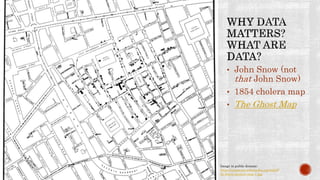
• John Snow (not
that John Snow)
• 1854 cholera map
• The Ghost Map
Image in public domain:
https://commons.wikimedia.org/wiki/F
ile:Snow-cholera-map-1.jpg
Hans Rosling’s 200 Countries,
200 Years, 4 Minutes
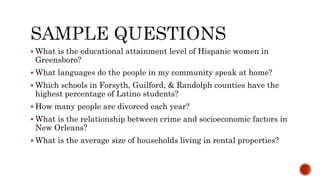
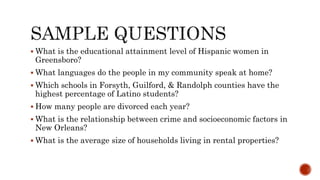
 What is the educational attainment level of Hispanic women in
Greensboro?
 What languages do the people in my community speak at home?
 Which schools in Forsyth, Guilford, & Randolph counties have the
highest percentage of Latino students?
 How many people are divorced each year?
 What is the relationship between crime and socioeconomic factors in
New Orleans?
 What is the average size of households living in rental properties?
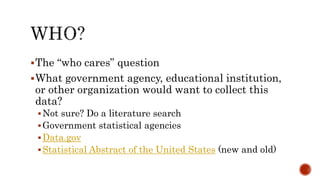
The “who cares” question
What government agency, educational institution,
or other organization would want to collect this
data?
The “who cares” question
What government agency, educational institution,
or other organization would want to collect this
data?
Not sure? Do a literature search
The “who cares” question
What government agency, educational institution,
or other organization would want to collect this
data?
Not sure? Do a literature search
Government statistical agencies
The “who cares” question
What government agency, educational institution,
or other organization would want to collect this
data?
Not sure? Do a literature search
Government statistical agencies
Data.gov
The “who cares” question
What government agency, educational institution,
or other organization would want to collect this
data?
Not sure? Do a literature search
Government statistical agencies
Data.gov
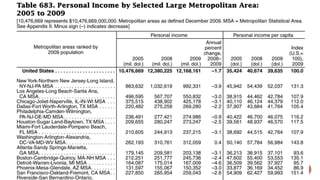
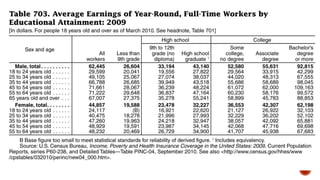
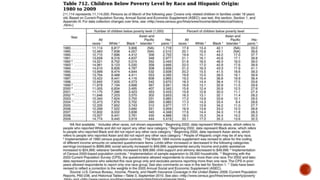
Statistical Abstract of the United States (new and old)
What type of data source are they
looking for?
What type of data source are they
looking for?
What indicators or variables do they
need?
 What type of data source are they
looking for?
 What indicators or variables do they
need?
 What populations are they examining?
What is the time frame of the request?
Is the time frame realistic?
What is the time frame of the request?
Is the time frame realistic?
What is the periodicity for collection
(quarterly, annually, every decade, or
infrequently)?
What geographic areas are realistically
available?
What geographic areas are realistically
available?
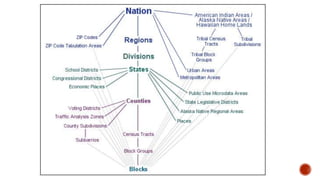
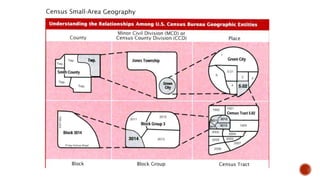
What are the other possible geographies
if the desired area is not available?
Are the data sets freely available or do they
require an application or fee?
Are the data sets freely available or do they
require an application or fee?
What are the limitations on the use of the
data?
Are the data sets freely available or do they
require an application or fee?
What are the limitations on the use of the
data?
How was the data collected?
Pair up and read a sample question.
Using the five data reference interview questions,
what information do you have and what
information would you need to help the patron?
What questions would you ask the patron?
 What is the educational attainment level of Hispanic women in
Greensboro?
 What languages do the people in my community speak at home?
 Which schools in Forsyth, Guilford, & Randolph counties have the
highest percentage of Latino students?
 How many people are divorced each year?
 What is the relationship between crime and socioeconomic factors in
New Orleans?
 What is the average size of households living in rental properties?
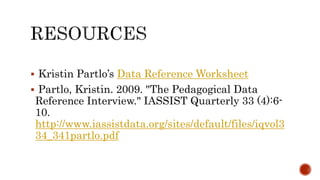
 Kristin Partlo’s Data Reference Worksheet
 Partlo, Kristin. 2009. "The Pedagogical Data
Reference Interview." IASSIST Quarterly 33 (4):6-
10.
http://www.iassistdata.org/sites/default/files/iqvol3
34_341partlo.pdf
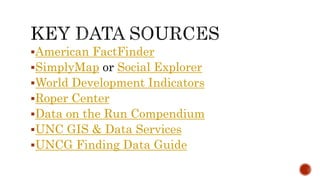
American FactFinder
SimplyMap or Social Explorer
World Development Indicators
Roper Center
Data on the Run Compendium
UNC GIS & Data Services
UNCG Finding Data Guide
 IASSIST – international organization for data professionals; primarily social
sciences but open to all
 Research Data Alliance – international organization; primarily data
management and science librarianship
 ICPSR boot camps
 Databrarians.org
 ACRL data groups
 NCLA GRS webinar series, “Help! I’m an Accidental Government
Information Librarian”
 Numeric Data Services and Sources for the General Reference Librarian
 Databrarianship: The Academic Data Librarian in Theory and Practice
 Data Information Literacy
Lynda Kellam
lmkellam@uncg.edu
@lyndamk

Data Librarianship

  • 1.
    Lynda Kellam Data Services& Gov Info Librarian UNCG 11/03/2016
  • 3.
    • John Snow(not that John Snow) • 1854 cholera map • The Ghost Map Image in public domain: https://commons.wikimedia.org/wiki/F ile:Snow-cholera-map-1.jpg
  • 4.
    Hans Rosling’s 200Countries, 200 Years, 4 Minutes
  • 5.
     What isthe educational attainment level of Hispanic women in Greensboro?  What languages do the people in my community speak at home?  Which schools in Forsyth, Guilford, & Randolph counties have the highest percentage of Latino students?  How many people are divorced each year?  What is the relationship between crime and socioeconomic factors in New Orleans?  What is the average size of households living in rental properties?
  • 8.
  • 9.
    The “who cares”question What government agency, educational institution, or other organization would want to collect this data?
  • 10.
    The “who cares”question What government agency, educational institution, or other organization would want to collect this data? Not sure? Do a literature search
  • 11.
    The “who cares”question What government agency, educational institution, or other organization would want to collect this data? Not sure? Do a literature search Government statistical agencies
  • 12.
    The “who cares”question What government agency, educational institution, or other organization would want to collect this data? Not sure? Do a literature search Government statistical agencies Data.gov
  • 13.
    The “who cares”question What government agency, educational institution, or other organization would want to collect this data? Not sure? Do a literature search Government statistical agencies Data.gov Statistical Abstract of the United States (new and old)
  • 19.
    What type ofdata source are they looking for?
  • 22.
    What type ofdata source are they looking for? What indicators or variables do they need?
  • 23.
     What typeof data source are they looking for?  What indicators or variables do they need?  What populations are they examining?
  • 25.
    What is thetime frame of the request?
  • 26.
    What is thetime frame of the request? Is the time frame realistic?
  • 27.
    What is thetime frame of the request? Is the time frame realistic? What is the periodicity for collection (quarterly, annually, every decade, or infrequently)?
  • 29.
    What geographic areasare realistically available?
  • 30.
    What geographic areasare realistically available? What are the other possible geographies if the desired area is not available?
  • 34.
    Are the datasets freely available or do they require an application or fee?
  • 35.
    Are the datasets freely available or do they require an application or fee? What are the limitations on the use of the data?
  • 36.
    Are the datasets freely available or do they require an application or fee? What are the limitations on the use of the data? How was the data collected?
  • 38.
    Pair up andread a sample question. Using the five data reference interview questions, what information do you have and what information would you need to help the patron? What questions would you ask the patron?
  • 39.
     What isthe educational attainment level of Hispanic women in Greensboro?  What languages do the people in my community speak at home?  Which schools in Forsyth, Guilford, & Randolph counties have the highest percentage of Latino students?  How many people are divorced each year?  What is the relationship between crime and socioeconomic factors in New Orleans?  What is the average size of households living in rental properties?
  • 40.
     Kristin Partlo’sData Reference Worksheet  Partlo, Kristin. 2009. "The Pedagogical Data Reference Interview." IASSIST Quarterly 33 (4):6- 10. http://www.iassistdata.org/sites/default/files/iqvol3 34_341partlo.pdf
  • 41.
    American FactFinder SimplyMap orSocial Explorer World Development Indicators Roper Center Data on the Run Compendium UNC GIS & Data Services UNCG Finding Data Guide
  • 42.
     IASSIST –international organization for data professionals; primarily social sciences but open to all  Research Data Alliance – international organization; primarily data management and science librarianship  ICPSR boot camps  Databrarians.org  ACRL data groups  NCLA GRS webinar series, “Help! I’m an Accidental Government Information Librarian”  Numeric Data Services and Sources for the General Reference Librarian  Databrarianship: The Academic Data Librarian in Theory and Practice  Data Information Literacy
  • 43.