
CHOOSING TECHNOLOGY FOR
COLLABORATIVE AND
INDIVIDUALISED LEARNING IN THE
ESL CR: FINDING OUR WAY
THROUGH THE WEB TANGLE.
Dr Kshema Jose
The English and Foreign Languages
University, Hyderabad
kshemajose@yahoo.com
Structure of this talk
1. Current state of affairs
2. Guidelines for a better education system
3. Changes in the ESL classroom vis-à-vis
• Pedagogy
• Learning tasks
• Choosing technology
• Designing tasks
• Assessing tasks
4. Benefits of a technology-enhanced classroom
Where are we now?
• Information Age: a period in which the
movement of information through networks
would overtake the circulation of goods as the
primary source of value in society (Manuel
Castells, 1996)
• Age of Globalisation: A world that is both
globalised and globalising, and therefore
interconnected (Kumaravadivelu, 2013)
So what are the implications of educational
globalisation?
Roadmap for higher education in the
21st century
• Develop ability to flourish in a world that is
fundamentally diverse and irredeemably different
• Focus on knowledge creation
• Solve the challenges of access, equity and quality
• Facilitate innovative use of information and
communication technologies (‘Making the Indian
Higher Education System Future Ready,’ Ernst &
Young-FICCI report)
-contd
Roadmap…
Skills for the 21st Century
• Communication acquiring and processing information
• Synthesising knowledge
• Creative thinking
• Communication and presentation skills
• Language skills
Source: EUA DOC-CAREERS Project
Roadmap…
EFF Standards for Adult Literacy and Lifelong
Learning
• EFF Communication Skills
• EFF Decision-Making Skills
• EFF Interpersonal Skills
• EFF Lifelong Learning Skills
– Use Information and Communications Technology
Use computers and other electronic tools to
explore, acquire, process, and manage information and
practice skills.
http://www.nifl.gov/lincs/collections/eff/standards/
eff
Shifting Paradigms
Changes in Content and Mode of Language
Education
• Collaborative education
• Interdisciplinarity
• Training in core transferable skills (European
University Association)
• Linguistic development linked with
Sociocultural development
How do we bring this into the ESL CR?
• Review pedagogies?
• Incorporate new perspectives?
– accommodate lifelong learning
– emphasise individual capacities and needs
– learners as active and not passive recipients of
knowledge and skills
– accommodate impact of social and cultural contexts
on people’s engagement with learning
Also change how we think, talk about, plan, and
structure activities of learning and teaching
But does this require reinventing
pedagogy?
• Changing nature of knowledge therefore
changing nature of learning
• Rearticulation of pedagogies
• Three fundamental shifts:
– From information to communication
– Passive to more interactive engagement
– Individual to more socially situative learning
How can this rearticulated pedagogy be
implemented in our classrooms?
Learning Objects and Learning Design
Learning Objects: Pieces of information that can be used
Types of technology-supported Learning objects in the ESL CR:
• Digital assets
• Information objects
• Learning activities
• Learning design
Learning Design: Learning objectives, roles, activities, support
activities, activity structures, environment resources and methods (Beetham
and Sharpe, 2007)
Considerations for choosing the right
Technology
Pedagogy before Technology
Three broad perspectives:
• Associationist: learning as gradual building of patterns of
associations or skill components
• Cognitive: perception, thinking, language, reasoning as
output of an individual’s attention, memory, concept
formation processes
• Situative: all learning is influenced by social and cultural
setting and the outcome is learning to participate in social
practices successfully
In different contexts people do learn in these three different
ways.
-contd
Choosing the right Technology
Make Learning a Dialogue
Allow interaction with
• concepts (leading to conceptualization)
• tasks (construction) and
• people (dialogue)
Essential requirement for interaction that builds
new understanding is feedback (Laurillard, 1993)
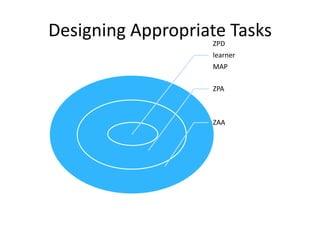
Designing Appropriate TasksZPD
learner
MAP
ZPA
ZAA
Designing Appropriate Tasks
Get learners to act and to think and Facilitate Dialogue
• Relate to what they know
• Provide Scaffolding, Fading, Contingent scaffolding
• Solve problems
• Construct answers
• Receive and Reflect on feedback
– Have I understood?
– What should I do next?
– How do I use my new knowledge?
How much can the computer do?
Solutions:
• Peer tutoring/ collaborative learning
• Vicarious learning (tertiary courseware, Mayes et al 2002)
-contd
Designing…
Teaching approaches that can be realized online
• Socio-cultural learning
• Resource-based
• Peer-led
• Content/ instructivist led
• Complex
• Problem-based
• Collaborative
• Instructor-led
(Weller, 2007)
Assessing Task Adequacy
Draw up a feature list to state pedagogic and
strategic requirements of the tool:
• Description of the tool
• Current provision
• Better prospects
• Related subjects/ topics
• Ease of implementation
• Scope
Benefits of Technology-enhanced ESL
CR
• CSCL, CSILE where focus is to promote
productive, collaborative interactions with a
range of technologies
• Provide tools to learners to support
construction, sharing, reflection, critiquing
and revision of information
• Support Lifelong Learning and Workplace Skills
Conclusion
No one factor makes use of technology effective
• Integration of technology with face-to-face
• Digitizing content alone does not ensure learning
• Link seamlessly with our current teaching-
learning behavior
• Allow Learning through interaction: with
others, with content and using tools
• Satisfy a pedagogical need: within a complex
socio-cultural context, either solving a problem or
amplifying a learning opportunity
Thank You
kshemajose@yahoo.com

Talk on use of technology in the esl classroom

  • 1.
    CHOOSING TECHNOLOGY FOR COLLABORATIVEAND INDIVIDUALISED LEARNING IN THE ESL CR: FINDING OUR WAY THROUGH THE WEB TANGLE. Dr Kshema Jose The English and Foreign Languages University, Hyderabad kshemajose@yahoo.com
  • 2.
    Structure of thistalk 1. Current state of affairs 2. Guidelines for a better education system 3. Changes in the ESL classroom vis-à-vis • Pedagogy • Learning tasks • Choosing technology • Designing tasks • Assessing tasks 4. Benefits of a technology-enhanced classroom
  • 3.
    Where are wenow? • Information Age: a period in which the movement of information through networks would overtake the circulation of goods as the primary source of value in society (Manuel Castells, 1996) • Age of Globalisation: A world that is both globalised and globalising, and therefore interconnected (Kumaravadivelu, 2013) So what are the implications of educational globalisation?
  • 4.
    Roadmap for highereducation in the 21st century • Develop ability to flourish in a world that is fundamentally diverse and irredeemably different • Focus on knowledge creation • Solve the challenges of access, equity and quality • Facilitate innovative use of information and communication technologies (‘Making the Indian Higher Education System Future Ready,’ Ernst & Young-FICCI report) -contd
  • 5.
    Roadmap… Skills for the21st Century • Communication acquiring and processing information • Synthesising knowledge • Creative thinking • Communication and presentation skills • Language skills Source: EUA DOC-CAREERS Project
  • 6.
    Roadmap… EFF Standards forAdult Literacy and Lifelong Learning • EFF Communication Skills • EFF Decision-Making Skills • EFF Interpersonal Skills • EFF Lifelong Learning Skills – Use Information and Communications Technology Use computers and other electronic tools to explore, acquire, process, and manage information and practice skills. http://www.nifl.gov/lincs/collections/eff/standards/ eff
  • 7.
    Shifting Paradigms Changes inContent and Mode of Language Education • Collaborative education • Interdisciplinarity • Training in core transferable skills (European University Association) • Linguistic development linked with Sociocultural development
  • 8.
    How do webring this into the ESL CR? • Review pedagogies? • Incorporate new perspectives? – accommodate lifelong learning – emphasise individual capacities and needs – learners as active and not passive recipients of knowledge and skills – accommodate impact of social and cultural contexts on people’s engagement with learning Also change how we think, talk about, plan, and structure activities of learning and teaching
  • 9.
    But does thisrequire reinventing pedagogy? • Changing nature of knowledge therefore changing nature of learning • Rearticulation of pedagogies • Three fundamental shifts: – From information to communication – Passive to more interactive engagement – Individual to more socially situative learning How can this rearticulated pedagogy be implemented in our classrooms?
  • 10.
    Learning Objects andLearning Design Learning Objects: Pieces of information that can be used Types of technology-supported Learning objects in the ESL CR: • Digital assets • Information objects • Learning activities • Learning design Learning Design: Learning objectives, roles, activities, support activities, activity structures, environment resources and methods (Beetham and Sharpe, 2007)
  • 11.
    Considerations for choosingthe right Technology Pedagogy before Technology Three broad perspectives: • Associationist: learning as gradual building of patterns of associations or skill components • Cognitive: perception, thinking, language, reasoning as output of an individual’s attention, memory, concept formation processes • Situative: all learning is influenced by social and cultural setting and the outcome is learning to participate in social practices successfully In different contexts people do learn in these three different ways. -contd
  • 12.
    Choosing the rightTechnology Make Learning a Dialogue Allow interaction with • concepts (leading to conceptualization) • tasks (construction) and • people (dialogue) Essential requirement for interaction that builds new understanding is feedback (Laurillard, 1993)
  • 13.
  • 14.
    Designing Appropriate Tasks Getlearners to act and to think and Facilitate Dialogue • Relate to what they know • Provide Scaffolding, Fading, Contingent scaffolding • Solve problems • Construct answers • Receive and Reflect on feedback – Have I understood? – What should I do next? – How do I use my new knowledge? How much can the computer do? Solutions: • Peer tutoring/ collaborative learning • Vicarious learning (tertiary courseware, Mayes et al 2002) -contd
  • 15.
    Designing… Teaching approaches thatcan be realized online • Socio-cultural learning • Resource-based • Peer-led • Content/ instructivist led • Complex • Problem-based • Collaborative • Instructor-led (Weller, 2007)
  • 16.
    Assessing Task Adequacy Drawup a feature list to state pedagogic and strategic requirements of the tool: • Description of the tool • Current provision • Better prospects • Related subjects/ topics • Ease of implementation • Scope
  • 17.
    Benefits of Technology-enhancedESL CR • CSCL, CSILE where focus is to promote productive, collaborative interactions with a range of technologies • Provide tools to learners to support construction, sharing, reflection, critiquing and revision of information • Support Lifelong Learning and Workplace Skills
  • 18.
    Conclusion No one factormakes use of technology effective • Integration of technology with face-to-face • Digitizing content alone does not ensure learning • Link seamlessly with our current teaching- learning behavior • Allow Learning through interaction: with others, with content and using tools • Satisfy a pedagogical need: within a complex socio-cultural context, either solving a problem or amplifying a learning opportunity
  • 19.