High Throughput, High Content 
Screening ‐ Automa6ng the Pipeline 
            Rajarshi Guha, Ph.D. 
    NIH Center for Transla:onal Therapeu:cs 

          San Francisco, January 2010 
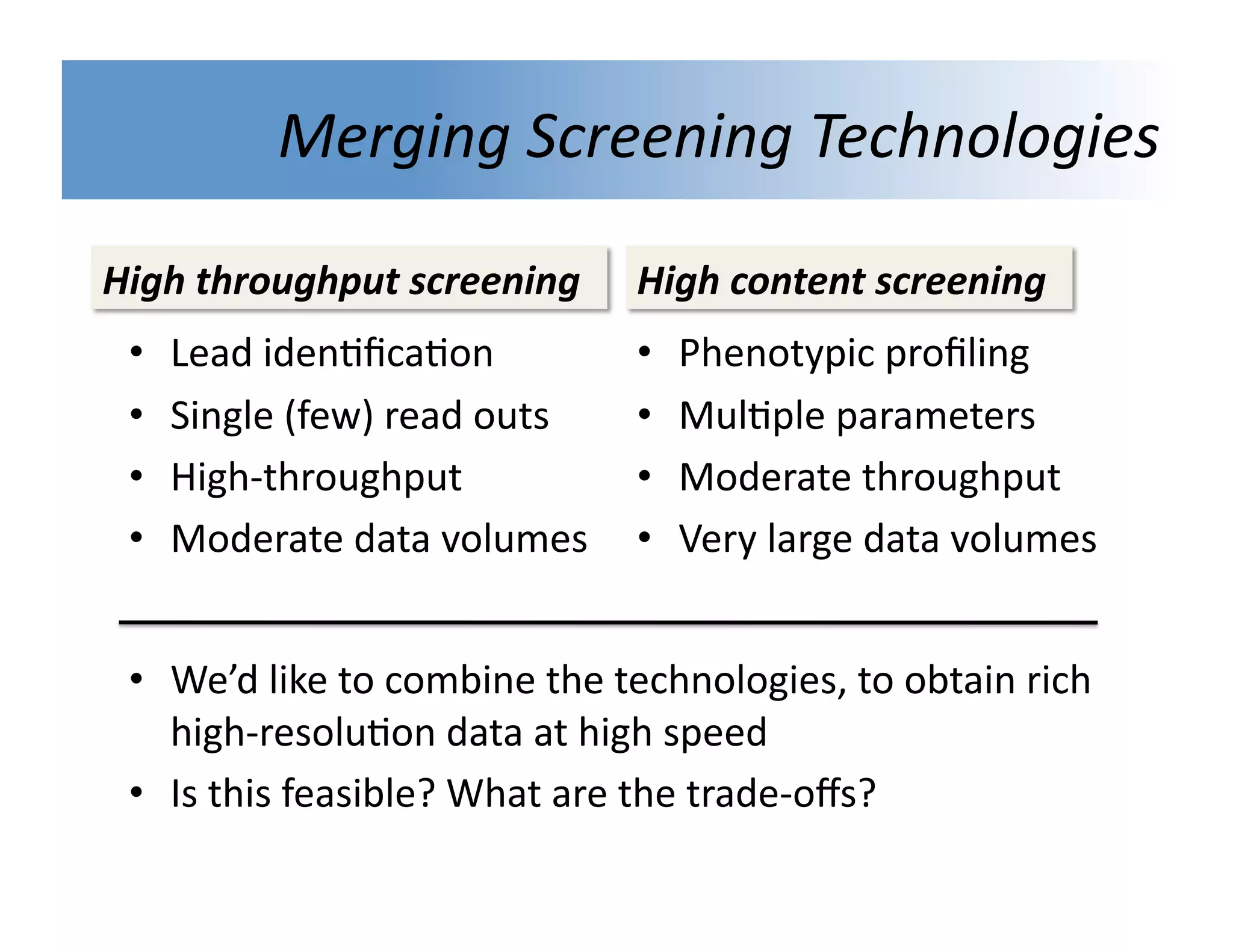
Merging Screening Technologies 

High throughput screening       High content screening 
 •    Lead iden:fica:on          •    Phenotypic profiling 
 •    Single (few) read outs    •    Mul:ple parameters 
 •    High‐throughput           •    Moderate throughput 
 •    Moderate data volumes     •    Very large data volumes 


 •  We’d like to combine the technologies, to obtain rich 
    high‐resolu:on data at high speed 
 •  Is this feasible? What are the trade‐offs? 
Merging Screening Technologies 
•  A simple solu:on is to run a HTS & HCS as 
   separate, primary & secondary screens 
•  Alterna:vely – Wells to Cells 
  –  Integrate HTS & HCS in a single screen using a 
     combined plaYorm for robo:cs & real :me 
     automated HTS analy:cs 
  –  Selec%ve imaging of interes%ng wells 
Wells to Cells Workflow 
                                                                           Acquisition Client
                                                                                                                                                                   •  Sequen:al qHTS using laser 
      HTS
      Laser Scanning Cytometry
                                                                                                                                          Selective HCS
                                                                                                                                                     Microscopy
                                                                                                                                                                      scanning cytometry followed 
                      Raw data
                     Population Definition                                                                                   Population Definition
                                                                                                                                                     Images           by high‐res microscopy 
                                                                                                                                                                   •  Unit of work is a plate series  
                       Object segmentation                                                                             Object segmentation
                       Parameters selection                                               Selected                 Parameters selection
                                                                                          wells
                       Thresholds definition                                                                          Thresholds definition


                      Population distribution                                                               Objects characterization
                                                                                                Morphological properties, localization

                     Response Curve Calculation

                       Normalization
                       Correction
                       Fitting                                                    Decision
                                                                                                        Response Curve Calculation

                                                                                                                                  Normalization
                                                                                                                                      Correction
                                                                                                                                           Fitting
                                                                                                                                                                   •  The same aliquot is analyzed 
                                                                                                                                                                      by both techniques 
                       Curve classification                                       Analytics                                  Curve classification

                      Curve class, AC50, Efficacy                                                        Curve class, AC50, Efficacy


                      Active                             Inactive                                                             0
                0                                   0
                                                                                                             Activity (%)
Activity (%)


                                   Activity (%)


                                                                                                                            - 25
               -25                                 -25                           SAR


                                                                                                                                                                   •  A message based system 
                                                                                                                            - 50
               -50                                 -50
                               b                                                          HCS                               - 75
               -75                                 -75                   HTS                                            - 100
         -100                 a                   -100                                                                      - 9 - 8 - 7 - 6 - 5 -4
            -9 -8 -7 -6 -5 -4                        -9 -8 -7 -6 -5 -4
               Log[Compound], M                   Log[Compound], M                                                          Log[Compound], M
                                                                               qHTS Database


                                                                                                                                                                   •  The key is deciding which 
                                                                                 Confirmation


                                                                                                                                                                      wells go through the 
                                                                                                                                                                      workflow 
                                                                         Integrated Chemical
                                                                           Genomics Client
Informa:cs Pla<orm 


                                          InCell Layout  
                                              File 


•  Advanced correc:on and 
   normaliza:on methods 
•  Sophis:cated curve fi]ng 
   algorithm 
•  Good performance, allows 
   paralleliza:on of the en:re 
   workflow 
Why Messaging? 
•  A messaging architecture allows for significant 
   flexibility 
  –  Persistent, can be kept for process tracking, 
     repor:ng 
  –  Asynchronous, allows individual components of 
     the workflow to proceed at their own pace 
  –  Modular, new components can be introduced at 
     any :me without redesigning the whole workflow 
•  We employ Oracle AQ, but any message 
   queue can be employed 
qHTS & Curve Classes 


                                             Inac%ve 
•  Heuris:c assessment of the significance 
   of a concentra:on response curve 
•  Prior valida:on screens 
   allow us to decide which 


                                             Inconclusive 
   types of curves should 
   be selected 


                                             Ac%ve 
Well Selec:on Criteria 
•  Generally, pre‐determined (from valida:on 
   assays) 
•  Selec:on criteria implemented as Java code 
  –  Easy to adapt for different assays 
  –  Currently only makes use of the :tra:on curve 
     parameters  
  –  Could easily involve  
     •  Chemical structure 
     •  Enrichments 
     •  Predic:ve models 
Well to Cells Assays  
•  Cell cycle, cell transloca:on, DNA 
   repreplica:on 
•  All assays run against LOPAC1280  
•  Consistency between cytometry & microscopy 
   is measured by the R2 between log AC50’s 
  –  Cell cycle, 0.94 – 0.96 
  –  Cell transloca:on, 0.66 – 0.94 
  –  DNA rereplica:on, s:ll in progress  
Cell Transloca:on Example Hits 
Data Access & Browsing 
•  In development 
•  An integrated tool to  
   manage and disseminate  
   data relevant to chemical  
   genomics  
•  A consistent/simple interface to register/
   import, browse, search, and annotate data 
•  An effec:ve tool for confirma:on of HTS and/
   or HCS data 
Handling Mul:ple Pla<orms 
•  Current examples employ InCell hardware 
•  We also use Molecular Devices hardware 
•  As a result we have two orthogonal image 
   stores / databases 
•  Need to integrate them 
  –  Support seamless data browsing  across mul:ple 
     screens irrespec:ve of imaging plaYorm used 
  –  Support analy:cs external to vendor code 
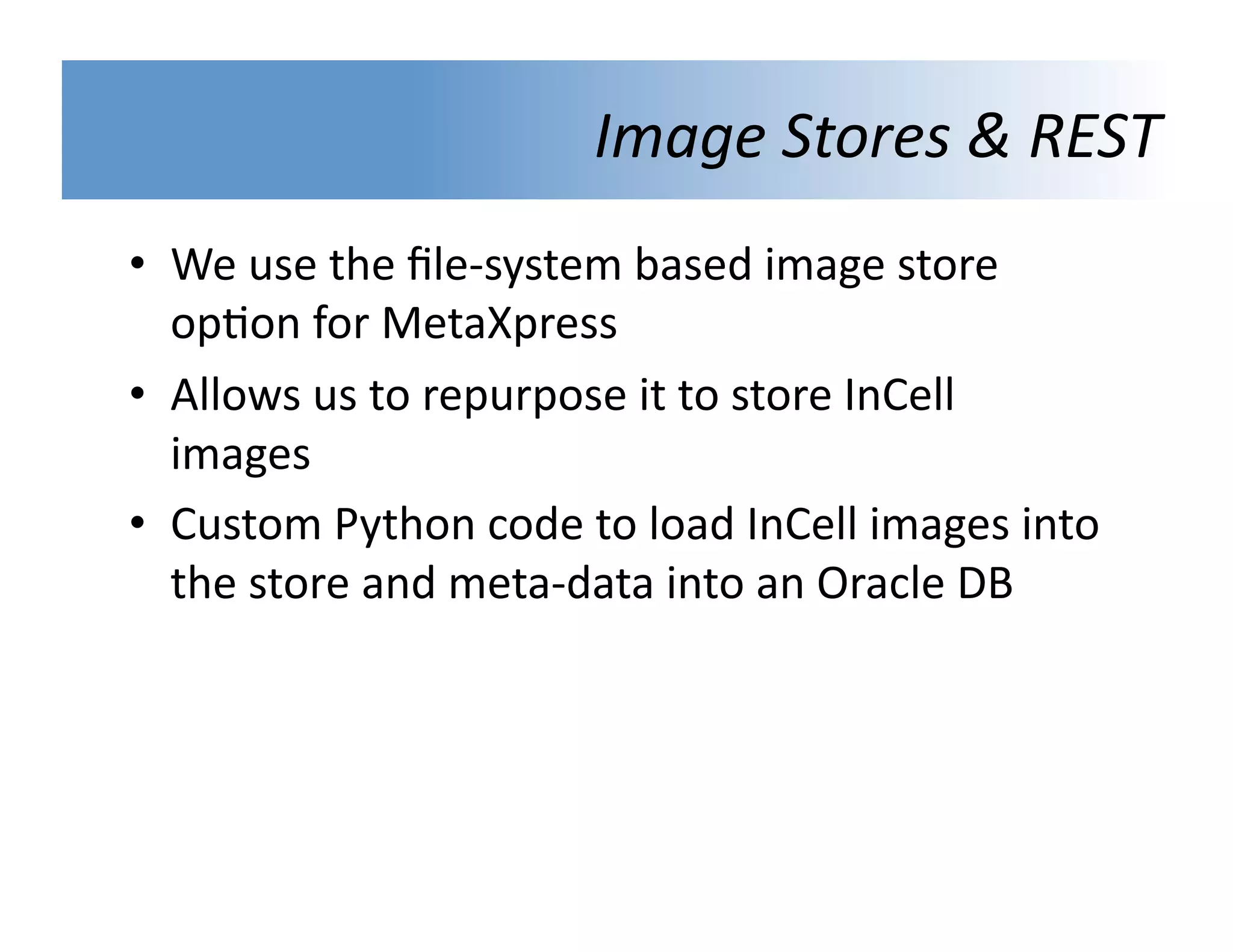
Image Stores & REST 
•  We use the file‐system based image store 
   op:on for MetaXpress 
•  Allows us to repurpose it to store InCell 
   images 
•  Custom Python code to load InCell images into 
   the store and meta‐data into an Oracle DB 
A Unified Interface 
•  A client sees a single, simple interface to 
   screening image data 
       h;p://host/rest/protocol/plate/well/image 

•  Transparently extract  
   image data via the  
   MetaXpress database  
   or via custom code 
•  Currently the interface address image serving 
•  Unified metadata interface in the works 
Trade‐offs & Opportuni:es 
•  Automa:on reduces the ability to handle 
   unforeseen errors 
  –  Dispense errors and other plate problems 
  –  Well selec:on based on curve classes may need to 
     be modified on the fly 
•  Well selec:on does not consider SAR 
  –  Wells are selected independently of each other 
  –  If we could model SAR on the fly (or from 
     valida:on screens), we’d select mul:ple wells, to 
     obtain posi:ve and nega6ve results 
Conclusions 
•  Automated mul:‐stage screening is a leap 
   forward 
  –  Saves money and :me 
  –  Requires good analy:cs to be robust to on‐the‐fly 
     errors 
•  Integra:on at all layers (data / image store, 
   data types) is key to making sense out of the 
   data 
•  Would be nice to have clean vendor API’s! 
Acknowledgments 
•    Doug Auld 
•    Jim Inglese 
•    Ronald Johnson 
•    Sam Michael 
•    Trung Nguyen 
•    Steve Titus 
•    Jennifer Wichterman 

High Throughput, High Content Screening - Automating the Pipeline

  • 1.
    High Throughput, High Content  Screening ‐ Automa6ng the Pipeline  Rajarshi Guha, Ph.D.  NIH Center for Transla:onal Therapeu:cs  San Francisco, January 2010 
  • 2.
    Merging Screening Technologies  High throughput screening  High content screening  •  Lead iden:fica:on  •  Phenotypic profiling  •  Single (few) read outs  •  Mul:ple parameters  •  High‐throughput  •  Moderate throughput  •  Moderate data volumes  •  Very large data volumes  •  We’d like to combine the technologies, to obtain rich  high‐resolu:on data at high speed  •  Is this feasible? What are the trade‐offs? 
  • 3.
    Merging Screening Technologies  •  A simple solu:on is to run a HTS & HCS as  separate, primary & secondary screens  •  Alterna:vely – Wells to Cells  –  Integrate HTS & HCS in a single screen using a  combined plaYorm for robo:cs & real :me  automated HTS analy:cs  –  Selec%ve imaging of interes%ng wells 
  • 4.
    Wells to Cells Workflow  Acquisition Client •  Sequen:al qHTS using laser  HTS Laser Scanning Cytometry Selective HCS Microscopy scanning cytometry followed  Raw data Population Definition Population Definition Images by high‐res microscopy  •  Unit of work is a plate series   Object segmentation Object segmentation Parameters selection Selected Parameters selection wells Thresholds definition Thresholds definition Population distribution Objects characterization Morphological properties, localization Response Curve Calculation Normalization Correction Fitting Decision Response Curve Calculation Normalization Correction Fitting •  The same aliquot is analyzed  by both techniques  Curve classification Analytics Curve classification Curve class, AC50, Efficacy Curve class, AC50, Efficacy Active Inactive 0 0 0 Activity (%) Activity (%) Activity (%) - 25 -25 -25 SAR •  A message based system  - 50 -50 -50 b HCS - 75 -75 -75 HTS - 100 -100 a -100 - 9 - 8 - 7 - 6 - 5 -4 -9 -8 -7 -6 -5 -4 -9 -8 -7 -6 -5 -4 Log[Compound], M Log[Compound], M Log[Compound], M qHTS Database •  The key is deciding which  Confirmation wells go through the  workflow  Integrated Chemical Genomics Client
  • 5.
    Informa:cs Pla<orm  InCell Layout   File  •  Advanced correc:on and  normaliza:on methods  •  Sophis:cated curve fi]ng  algorithm  •  Good performance, allows  paralleliza:on of the en:re  workflow 
  • 6.
    Why Messaging?  •  A messaging architecture allows for significant  flexibility  –  Persistent, can be kept for process tracking,  repor:ng  –  Asynchronous, allows individual components of  the workflow to proceed at their own pace  –  Modular, new components can be introduced at  any :me without redesigning the whole workflow  •  We employ Oracle AQ, but any message  queue can be employed 
  • 7.
    qHTS & Curve Classes  Inac%ve  •  Heuris:c assessment of the significance  of a concentra:on response curve  •  Prior valida:on screens  allow us to decide which  Inconclusive  types of curves should  be selected  Ac%ve 
  • 8.
    Well Selec:on Criteria  •  Generally, pre‐determined (from valida:on  assays)  •  Selec:on criteria implemented as Java code  –  Easy to adapt for different assays  –  Currently only makes use of the :tra:on curve  parameters   –  Could easily involve   •  Chemical structure  •  Enrichments  •  Predic:ve models 
  • 9.
    Well to Cells Assays   •  Cell cycle, cell transloca:on, DNA  repreplica:on  •  All assays run against LOPAC1280   •  Consistency between cytometry & microscopy  is measured by the R2 between log AC50’s  –  Cell cycle, 0.94 – 0.96  –  Cell transloca:on, 0.66 – 0.94  –  DNA rereplica:on, s:ll in progress  
  • 10.
  • 11.
    Data Access & Browsing  •  In development  •  An integrated tool to   manage and disseminate   data relevant to chemical   genomics   •  A consistent/simple interface to register/ import, browse, search, and annotate data  •  An effec:ve tool for confirma:on of HTS and/ or HCS data 
  • 12.
    Handling Mul:ple Pla<orms  •  Current examples employ InCell hardware  •  We also use Molecular Devices hardware  • As a result we have two orthogonal image  stores / databases  •  Need to integrate them  –  Support seamless data browsing  across mul:ple  screens irrespec:ve of imaging plaYorm used  –  Support analy:cs external to vendor code 
  • 13.
    Image Stores & REST  •  We use the file‐system based image store  op:on for MetaXpress  •  Allows us to repurpose it to store InCell  images  •  Custom Python code to load InCell images into  the store and meta‐data into an Oracle DB 
  • 14.
    A Unified Interface  •  A client sees a single, simple interface to  screening image data  h;p://host/rest/protocol/plate/well/image  •  Transparently extract   image data via the   MetaXpress database   or via custom code  •  Currently the interface address image serving  •  Unified metadata interface in the works 
  • 15.
    Trade‐offs & Opportuni:es  •  Automa:on reduces the ability to handle  unforeseen errors  –  Dispense errors and other plate problems  –  Well selec:on based on curve classes may need to  be modified on the fly  •  Well selec:on does not consider SAR  –  Wells are selected independently of each other  –  If we could model SAR on the fly (or from  valida:on screens), we’d select mul:ple wells, to  obtain posi:ve and nega6ve results 
  • 16.
    Conclusions  •  Automated mul:‐stage screening is a leap  forward  –  Saves money and :me  –  Requires good analy:cs to be robust to on‐the‐fly  errors  •  Integra:on at all layers (data / image store,  data types) is key to making sense out of the  data  •  Would be nice to have clean vendor API’s! 
  • 17.
    Acknowledgments  •  Doug Auld  •  Jim Inglese  •  Ronald Johnson  •  Sam Michael  •  Trung Nguyen  •  Steve Titus  •  Jennifer Wichterman