Fareast International University
report on high rise
case studypage no-01
case study(international project)
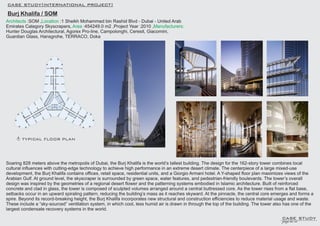
Burj Khalifa / SOM
TYPICAL FLOOR PLAN
case studypage no-02
case studypage no-03
case study(international project)
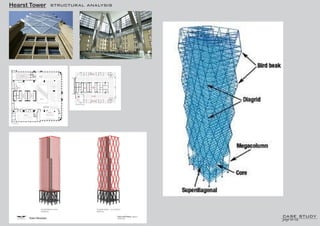
Hearst Tower
case studypage no-04
case studypage no-05
Hearst Tower structural analysis
standardspage no-06
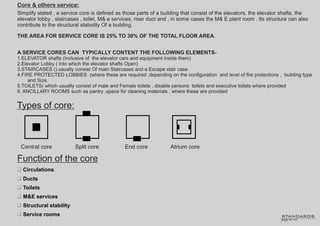
Core & others service:
Central core Split core End core Atrium core
Function of the core
q Circulations
q Ducts
q Toilets
q M&E services
q Structural stability
q Service rooms
standardspage no-07
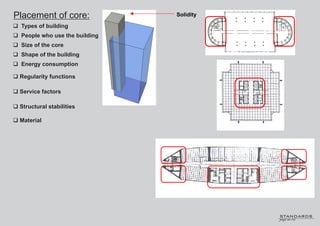
Placement of core:
q Types of building
q People who use the building
q Size of the core
q Shape of the building
q Energy consumption
q Regularity functions
q Service factors
q Structural stabilities
q Material
Solidity
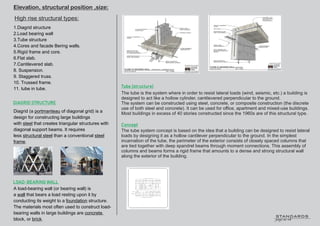
Elevation, structural position ,size:
High rise structural types:
6.Flat slab.
9. Staggered truss.
2.Load bearing wall
8. Suspension.
10. Trussed frame.
1.Diagrid structure
11. tube in tube.
3.Tube structure
4.Cores and facade Bering walls.
5.Rigid frame and core.
7.Cantilevered slab.
Diagrid (a portmanteau of diagonal grid) is a
design for constructing large buildings
with steel that creates triangular structures with
diagonal support beams. It requires
less structural steel than a conventional steel
frame.
A load-bearing wall (or bearing wall) is
a wall that bears a load resting upon it by
conducting its weight to a foundation structure.
The materials most often used to construct load-
bearing walls in large buildings are concrete,
block, or brick.
Concept
The tube system concept is based on the idea that a building can be designed to resist lateral
loads by designing it as a hollow cantilever perpendicular to the ground. In the simplest
incarnation of the tube, the perimeter of the exterior consists of closely spaced columns that
are tied together with deep spandrel beams through moment connections. This assembly of
columns and beams forms a rigid frame that amounts to a dense and strong structural wall
along the exterior of the building.
standardspage no-08
standardspage no-09
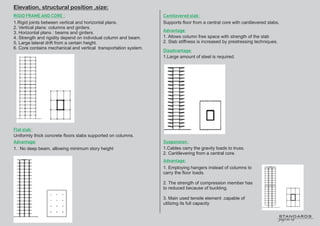
Elevation, structural position ,size:
5. Large lateral drift from a certain height.
4. Strength and rigidity depend on individual column and beam.
2. Vertical plans: columns and girders.
3. Horizontal plans : beams and girders.
6. Core contains mechanical and vertical transportation system.
1.Rigid joints between vertical and horizontal plans.
1. No deep beam, allowing minimum story height
1.Large amount of steel is required.
Suspension :
1.Cables carry the gravity loads to truss.
2. Cantilevering from a central core.
standardspage no-10
Elevation, structural position ,size:
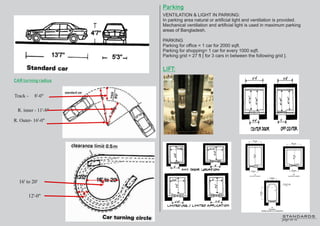
PARKING:
There are two types of car parking systems:
*A parking lot (British English: car park), also known as a car lot, is a
cleared area that is intended for parking vehicles. Usually, the term refers
to a dedicated area that has been provided with a durable or semi-
durable surface.
*Automated car parking system is a mechanical device that multiplies
parking capacity inside a parking lot. Parking systems are generally
powered by electric motors or hydraulic pumps that move vehicles into a
storage position.
***The standard calls for angle of departure is minimum of 10
The maximum ramp slope should be 20%.
RAMP
At 1 : 8 ratio, ramp
will starts minimum
3 meters or 10 ft
distance from road.
Parallel straight-ramp system withramp- wells on two structure sides.
Straight-ramp system with one ramp-well.
60° parking.
90° parking.
45° parking.
standardspage no-11
R. inner - 11'-8"
R. Outer- 16'-0"
- 8'-0"
12'-0"
16' to 20'
standardspage no-12
standardspage no-13
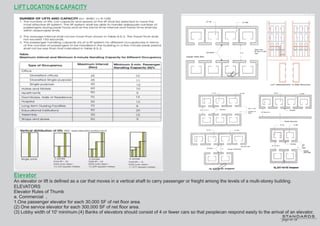
1.Traction elevators
2. Hydraulic elevators
There are three types of elevators
3. Climbing elevator.
Climbing elevator – They hold their own power device on them,
mostly electric or combustion engine. Climbing elevators are often
used in work and construction areas.
Two common performance criteria for elevator design:
the average waiting interval --- 30 sec. 5 min. holding capacity --- 13%.
[Recommended for good service in commercial building.]
a b
dc
standardspage no-14
In high-rise buildings generally We cant permit the natural air
Entrance due to the lateral pressureOf wind.
So we don’t use operable Glass.
Wind Flow
standardspage no-15
GUST VELOCITY
The dynamic gust velocities produce dynamic wind pressure that
create additional displacement of the building for slender buildings the
may become dominant-
If a building and its foundation were rigid, it would have same
acceleration as the ground, that is by newton's law - F=MA
WINDOW FOR
ENOUGH NATURAL LIGHT
SYSTEM
SUCH AS CENTRAL AC
standardspage no-16

High rise building study & report

  • 1.
  • 2.
    case studypage no-01 casestudy(international project) Burj Khalifa / SOM TYPICAL FLOOR PLAN
  • 3.
  • 4.
  • 5.
    case study(international project) HearstTower case studypage no-04
  • 6.
    case studypage no-05 HearstTower structural analysis
  • 7.
    standardspage no-06 Core &others service: Central core Split core End core Atrium core Function of the core q Circulations q Ducts q Toilets q M&E services q Structural stability q Service rooms
  • 8.
    standardspage no-07 Placement ofcore: q Types of building q People who use the building q Size of the core q Shape of the building q Energy consumption q Regularity functions q Service factors q Structural stabilities q Material Solidity
  • 9.
    Elevation, structural position,size: High rise structural types: 6.Flat slab. 9. Staggered truss. 2.Load bearing wall 8. Suspension. 10. Trussed frame. 1.Diagrid structure 11. tube in tube. 3.Tube structure 4.Cores and facade Bering walls. 5.Rigid frame and core. 7.Cantilevered slab. Diagrid (a portmanteau of diagonal grid) is a design for constructing large buildings with steel that creates triangular structures with diagonal support beams. It requires less structural steel than a conventional steel frame. A load-bearing wall (or bearing wall) is a wall that bears a load resting upon it by conducting its weight to a foundation structure. The materials most often used to construct load- bearing walls in large buildings are concrete, block, or brick. Concept The tube system concept is based on the idea that a building can be designed to resist lateral loads by designing it as a hollow cantilever perpendicular to the ground. In the simplest incarnation of the tube, the perimeter of the exterior consists of closely spaced columns that are tied together with deep spandrel beams through moment connections. This assembly of columns and beams forms a rigid frame that amounts to a dense and strong structural wall along the exterior of the building. standardspage no-08
  • 10.
    standardspage no-09 Elevation, structuralposition ,size: 5. Large lateral drift from a certain height. 4. Strength and rigidity depend on individual column and beam. 2. Vertical plans: columns and girders. 3. Horizontal plans : beams and girders. 6. Core contains mechanical and vertical transportation system. 1.Rigid joints between vertical and horizontal plans. 1. No deep beam, allowing minimum story height 1.Large amount of steel is required. Suspension : 1.Cables carry the gravity loads to truss. 2. Cantilevering from a central core.
  • 11.
    standardspage no-10 Elevation, structuralposition ,size: PARKING: There are two types of car parking systems: *A parking lot (British English: car park), also known as a car lot, is a cleared area that is intended for parking vehicles. Usually, the term refers to a dedicated area that has been provided with a durable or semi- durable surface. *Automated car parking system is a mechanical device that multiplies parking capacity inside a parking lot. Parking systems are generally powered by electric motors or hydraulic pumps that move vehicles into a storage position. ***The standard calls for angle of departure is minimum of 10 The maximum ramp slope should be 20%. RAMP At 1 : 8 ratio, ramp will starts minimum 3 meters or 10 ft distance from road.
  • 12.
    Parallel straight-ramp systemwithramp- wells on two structure sides. Straight-ramp system with one ramp-well. 60° parking. 90° parking. 45° parking. standardspage no-11
  • 13.
    R. inner -11'-8" R. Outer- 16'-0" - 8'-0" 12'-0" 16' to 20' standardspage no-12
  • 14.
  • 15.
    1.Traction elevators 2. Hydraulicelevators There are three types of elevators 3. Climbing elevator. Climbing elevator – They hold their own power device on them, mostly electric or combustion engine. Climbing elevators are often used in work and construction areas. Two common performance criteria for elevator design: the average waiting interval --- 30 sec. 5 min. holding capacity --- 13%. [Recommended for good service in commercial building.] a b dc standardspage no-14
  • 16.
    In high-rise buildingsgenerally We cant permit the natural air Entrance due to the lateral pressureOf wind. So we don’t use operable Glass. Wind Flow standardspage no-15
  • 17.
    GUST VELOCITY The dynamicgust velocities produce dynamic wind pressure that create additional displacement of the building for slender buildings the may become dominant- If a building and its foundation were rigid, it would have same acceleration as the ground, that is by newton's law - F=MA WINDOW FOR ENOUGH NATURAL LIGHT SYSTEM SUCH AS CENTRAL AC standardspage no-16