Author Name:
Nimra Khan
Biochemist
Topic:-
“High performance liquid
chromatography”
----------------------------------
Assignment
Definition
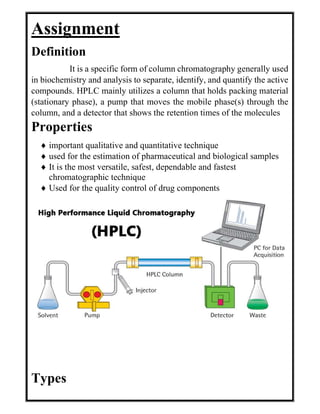
It is a specific form of column chromatography generally used
in biochemistry and analysis to separate, identify, and quantify the active
compounds. HPLC mainly utilizes a column that holds packing material
(stationary phase), a pump that moves the mobile phase(s) through the
column, and a detector that shows the retention times of the molecules
Properties
 important qualitative and quantitative technique
 used for the estimation of pharmaceutical and biological samples
 It is the most versatile, safest, dependable and fastest
chromatographic technique
 Used for the quality control of drug components
Types
Types of HPLC generally depend on phase system used in the
process. Following types of HPLC generally used in analysis-
 Normal phase chromatography
 Reversed phase chromatography
 Size exclusion chromatography
 Ion exchange chromatography
 Bio-affinity chromatography
 Normal phase chromatography:
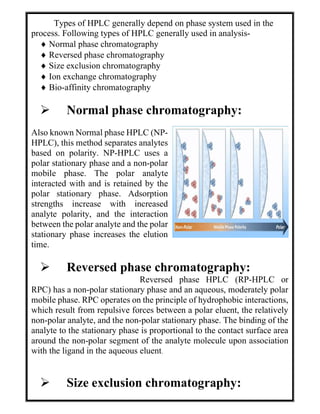
Also known Normal phase HPLC (NP-
HPLC), this method separates analytes
based on polarity. NP-HPLC uses a
polar stationary phase and a non-polar
mobile phase. The polar analyte
interacted with and is retained by the
polar stationary phase. Adsorption
strengths increase with increased
analyte polarity, and the interaction
between the polar analyte and the polar
stationary phase increases the elution
time.
 Reversed phase chromatography:
Reversed phase HPLC (RP-HPLC or
RPC) has a non-polar stationary phase and an aqueous, moderately polar
mobile phase. RPC operates on the principle of hydrophobic interactions,
which result from repulsive forces between a polar eluent, the relatively
non-polar analyte, and the non-polar stationary phase. The binding of the
analyte to the stationary phase is proportional to the contact surface area
around the non-polar segment of the analyte molecule upon association
with the ligand in the aqueous eluent.
 Size exclusion chromatography:
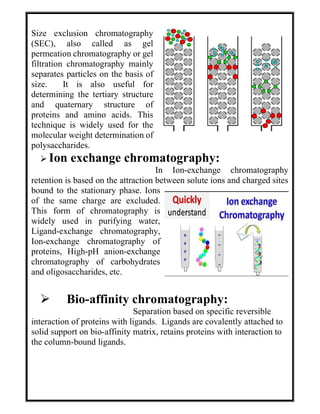
Size exclusion chromatography
(SEC), also called as gel
permeation chromatography or gel
filtration chromatography mainly
separates particles on the basis of
size. It is also useful for
determining the tertiary structure
and quaternary structure of
proteins and amino acids. This
technique is widely used for the
molecular weight determination of
polysaccharides.
 Ion exchange chromatography:
In Ion-exchange chromatography
retention is based on the attraction between solute ions and charged sites
bound to the stationary phase. Ions
of the same charge are excluded.
This form of chromatography is
widely used in purifying water,
Ligand-exchange chromatography,
Ion-exchange chromatography of
proteins, High-pH anion-exchange
chromatography of carbohydrates
and oligosaccharides, etc.
 Bio-affinity chromatography:
Separation based on specific reversible
interaction of proteins with ligands. Ligands are covalently attached to
solid support on bio-affinity matrix, retains proteins with interaction to
the column-bound ligands.
Proteins bound to a bio-affinity column
can be eluted in two ways:
 Bio specific elution: inclusion of free
ligand in elution buffer which competes
with column bound ligand.
 A specific elution: change in pH, salt,
etc. which weakens interaction protein
with column-bound substrate.
Because of specificity of the interaction, bio-affinity chromatography
can result in very high purification in a single step (10 - 1000-fold).
Parameters:
 Internal diameter:
The internal diameter (ID) of an HPLC column
is a critical aspect that determines quantity of analyte that can be loaded
onto the column and also influences sensitivity. Larger columns are
usually seen in industrial applications such as the purification of a drug
product for later use. Low ID columns have improved sensitivity and
lower solvent consumption at the expense of loading capacity.
 Particle size:
Most traditional HPLC is performed with the
stationary phase attached to the outside of small spherical silica particles (very
small beads). Smaller particles generally provide more surface area and better
separations, but the pressure required for optimum linear velocity increases by the
inverse of the particle diameter squared.
 Pore size:
Many stationary phases are porous to provide
greater surface area.Small pores provide greater surface area while larger
pore size has better kinetics especially for larger analytes. Pore size
defines an ability of the analyte molecules to penetrate inside the particle
and interact with its inner surface. This is especially important because
the ratio of the outer particle surface to its inner one is about 1:1000. The
surface molecular interaction mainly occurs on the inner particle surface.
 Pump pressure:
Pumps vary in pressure capacity, but their
performance is measured on their ability to yield a consistent and
reproducible flow rate. Modern HPLC systems have been improved to
work at much higher pressures, and therefore be able to use much smaller
particle sizes in the columns
Application
Pharmaceutical applications
• Tablet dissolution study of pharmaceutical
dosages form.
• Shelf-life determinations of pharmaceutical products
• Identification of active ingredients of
dosage forms
• Pharmaceutical quality control
Environmental applications
• Detection of phenolic compounds in
drinking Water
• Identification of diphenhydramine in
sedimented samples
• Bio-monitoring of pollutant
Forensics
• Quantification of the drug in biological samples.
• Identification of anabolic steroids in serum, urine, sweat, and hair
• Forensic analysis of textile dyes.
• Determination of cocaine and metabolites in blood
 Clinical
• Quantification of ions in human urine Analysis of antibiotics in blood
plasma.
• Estimation of bilirubin and bilivirdin in blood plasma in case of hepatic
disorders.
• Detection of endogenous neuropeptides in extracellular fluids of brain.
Food and Flavor
• Ensuring the quality of soft drink and drinking water.
• Analysis of beer.
• Sugar analysis in fruit juices.
• Analysis of polycyclic compounds in vegetables.
• Trace analysis of military high explosives in agricultural crops
Conclusion
It can be concluded from the entire review that HPLC is
a versatile, reproducible chromatographic technique for the estimation of
drug products. It has wide applications in different fields in term of
quantitative and qualitative estimation of active molecules.
------------------------------------------------------------
Reference
 Liu Y., Lee M.L. Ultrahigh pressure liquid chromatography using
elevated temperature. Journal of Chromatography. 2006;
 Ion-pair Chromatography. J. Liq. Chromatogram. 1984
 https://en.wikipedia.org/wiki/High-
performance_liquid_chromatography

HPLC

  • 1.
    Author Name: Nimra Khan Biochemist Topic:- “Highperformance liquid chromatography” ----------------------------------
  • 2.
    Assignment Definition It is aspecific form of column chromatography generally used in biochemistry and analysis to separate, identify, and quantify the active compounds. HPLC mainly utilizes a column that holds packing material (stationary phase), a pump that moves the mobile phase(s) through the column, and a detector that shows the retention times of the molecules Properties  important qualitative and quantitative technique  used for the estimation of pharmaceutical and biological samples  It is the most versatile, safest, dependable and fastest chromatographic technique  Used for the quality control of drug components Types
  • 3.
    Types of HPLCgenerally depend on phase system used in the process. Following types of HPLC generally used in analysis-  Normal phase chromatography  Reversed phase chromatography  Size exclusion chromatography  Ion exchange chromatography  Bio-affinity chromatography  Normal phase chromatography: Also known Normal phase HPLC (NP- HPLC), this method separates analytes based on polarity. NP-HPLC uses a polar stationary phase and a non-polar mobile phase. The polar analyte interacted with and is retained by the polar stationary phase. Adsorption strengths increase with increased analyte polarity, and the interaction between the polar analyte and the polar stationary phase increases the elution time.  Reversed phase chromatography: Reversed phase HPLC (RP-HPLC or RPC) has a non-polar stationary phase and an aqueous, moderately polar mobile phase. RPC operates on the principle of hydrophobic interactions, which result from repulsive forces between a polar eluent, the relatively non-polar analyte, and the non-polar stationary phase. The binding of the analyte to the stationary phase is proportional to the contact surface area around the non-polar segment of the analyte molecule upon association with the ligand in the aqueous eluent.  Size exclusion chromatography:
  • 4.
    Size exclusion chromatography (SEC),also called as gel permeation chromatography or gel filtration chromatography mainly separates particles on the basis of size. It is also useful for determining the tertiary structure and quaternary structure of proteins and amino acids. This technique is widely used for the molecular weight determination of polysaccharides.  Ion exchange chromatography: In Ion-exchange chromatography retention is based on the attraction between solute ions and charged sites bound to the stationary phase. Ions of the same charge are excluded. This form of chromatography is widely used in purifying water, Ligand-exchange chromatography, Ion-exchange chromatography of proteins, High-pH anion-exchange chromatography of carbohydrates and oligosaccharides, etc.  Bio-affinity chromatography: Separation based on specific reversible interaction of proteins with ligands. Ligands are covalently attached to solid support on bio-affinity matrix, retains proteins with interaction to the column-bound ligands.
  • 5.
    Proteins bound toa bio-affinity column can be eluted in two ways:  Bio specific elution: inclusion of free ligand in elution buffer which competes with column bound ligand.  A specific elution: change in pH, salt, etc. which weakens interaction protein with column-bound substrate. Because of specificity of the interaction, bio-affinity chromatography can result in very high purification in a single step (10 - 1000-fold). Parameters:  Internal diameter: The internal diameter (ID) of an HPLC column is a critical aspect that determines quantity of analyte that can be loaded onto the column and also influences sensitivity. Larger columns are usually seen in industrial applications such as the purification of a drug product for later use. Low ID columns have improved sensitivity and lower solvent consumption at the expense of loading capacity.  Particle size: Most traditional HPLC is performed with the stationary phase attached to the outside of small spherical silica particles (very small beads). Smaller particles generally provide more surface area and better separations, but the pressure required for optimum linear velocity increases by the inverse of the particle diameter squared.  Pore size: Many stationary phases are porous to provide greater surface area.Small pores provide greater surface area while larger pore size has better kinetics especially for larger analytes. Pore size defines an ability of the analyte molecules to penetrate inside the particle and interact with its inner surface. This is especially important because
  • 6.
    the ratio ofthe outer particle surface to its inner one is about 1:1000. The surface molecular interaction mainly occurs on the inner particle surface.  Pump pressure: Pumps vary in pressure capacity, but their performance is measured on their ability to yield a consistent and reproducible flow rate. Modern HPLC systems have been improved to work at much higher pressures, and therefore be able to use much smaller particle sizes in the columns Application Pharmaceutical applications • Tablet dissolution study of pharmaceutical dosages form. • Shelf-life determinations of pharmaceutical products • Identification of active ingredients of dosage forms • Pharmaceutical quality control Environmental applications • Detection of phenolic compounds in drinking Water • Identification of diphenhydramine in sedimented samples • Bio-monitoring of pollutant Forensics • Quantification of the drug in biological samples. • Identification of anabolic steroids in serum, urine, sweat, and hair • Forensic analysis of textile dyes. • Determination of cocaine and metabolites in blood
  • 7.
     Clinical • Quantificationof ions in human urine Analysis of antibiotics in blood plasma. • Estimation of bilirubin and bilivirdin in blood plasma in case of hepatic disorders. • Detection of endogenous neuropeptides in extracellular fluids of brain. Food and Flavor • Ensuring the quality of soft drink and drinking water. • Analysis of beer. • Sugar analysis in fruit juices. • Analysis of polycyclic compounds in vegetables. • Trace analysis of military high explosives in agricultural crops Conclusion It can be concluded from the entire review that HPLC is a versatile, reproducible chromatographic technique for the estimation of drug products. It has wide applications in different fields in term of quantitative and qualitative estimation of active molecules. ------------------------------------------------------------
  • 8.
    Reference  Liu Y.,Lee M.L. Ultrahigh pressure liquid chromatography using elevated temperature. Journal of Chromatography. 2006;  Ion-pair Chromatography. J. Liq. Chromatogram. 1984  https://en.wikipedia.org/wiki/High- performance_liquid_chromatography