High Endurance Hybrid Cache
Design with Access Aware
policies and Dynamic Cache
Partitioning
By Thallam Keerthi
Under Guidance of Mrs.Namitha Palecha
RVCE VLSI Design and Embedded systems
OverviewOverview
 Problem Description
 Introduction to STT-RAM
 Local Bank Hybrid Cache Architecture
 Access Aware Policies
 STT-RAM Write Management Policy (Algorithm)
 SRAM Read Management Policy (Algorithm)
 Dynamic Cache Partitioning (Algorithm)
 Performance Analysis
 Conclusion
Problem DescriptionProblem Description
 Increasing frequency of operations on one core-
increases the heat Dissipation
 CMP – Chip Multiprocessors solves the issue without
increasing the frequency of each core
 Last level cache(LLC) – Shared memory for cores –
Usually composed of SRAM’s – High leakage power
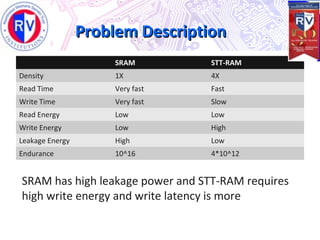
Problem DescriptionProblem Description
SRAM STT-RAM
Density 1X 4X
Read Time Very fast Fast
Write Time Very fast Slow
Read Energy Low Low
Write Energy Low High
Leakage Energy High Low
Endurance 10^16 4*10^12
SRAM has high leakage power and STT-RAM requires
high write energy and write latency is more
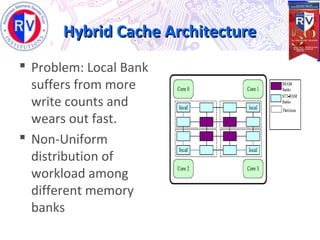
Hybrid Cache ArchitectureHybrid Cache Architecture
 Problem: Local Bank
suffers from more
write counts and
wears out fast.
 Non-Uniform
distribution of
workload among
different memory
banks
Hybrid Cache ArchitectureHybrid Cache Architecture
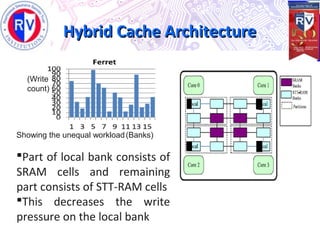
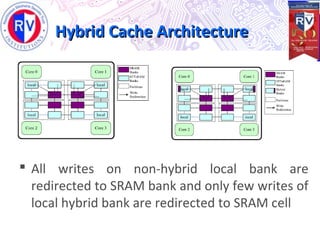
Part of local bank consists of
SRAM cells and remaining
part consists of STT-RAM cells
This decreases the write
pressure on the local bank
(Banks)
(Write
count)
Showing the unequal workload
Hybrid Cache ArchitectureHybrid Cache Architecture
 All writes on non-hybrid local bank are
redirected to SRAM bank and only few writes of
local hybrid bank are redirected to SRAM cell
Access Aware PoliciesAccess Aware Policies
 STT-RAM Write Management Policy
Access Aware PoliciesAccess Aware Policies
 SRAM Read Management Policy (Increases Write Utilization of SRAM)
Access Aware PoliciesAccess Aware Policies
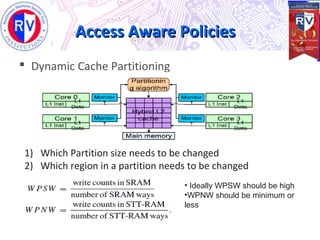
 Dynamic Cache Partitioning
1) Which Partition size needs to be changed
2) Which region in a partition needs to be changed
• Ideally WPSW should be high
•WPNW should be minimum or
less
Access Aware PoliciesAccess Aware Policies
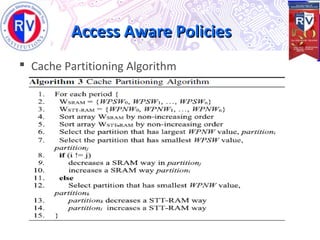
 Cache Partitioning Algorithm
Performance AnalysisPerformance Analysis
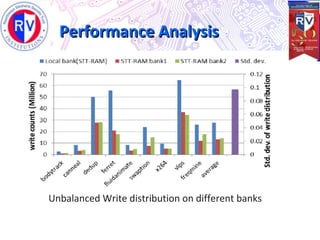
Unbalanced Write distribution on different banks
Performance AnalysisPerformance Analysis
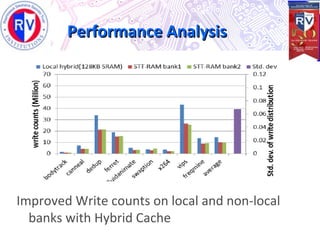
Improved Write counts on local and non-local
banks with Hybrid Cache
Performance AnalysisPerformance Analysis
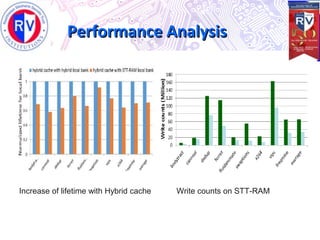
Increase of lifetime with Hybrid cache Write counts on STT-RAM
Performance AnalysisPerformance Analysis
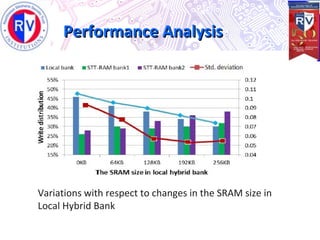
Variations with respect to changes in the SRAM size in
Local Hybrid Bank
ConclusionConclusion
 CMP Architecture – No. of operations can be
increased working with same frequency
 Hybrid Cache – Balances the write distribution
among the banks
 Access Aware Policies – increases the write
utilization of SRAM and decreases the
endurance problem of STT-RAM cells
 Dynamic Cache Partitioning – Decreases the
hit latency, decreases the cache miss rate.
Thank you
Any Questions?

High Endurance Last Level Hybrid Cache Design

  • 1.
    High Endurance HybridCache Design with Access Aware policies and Dynamic Cache Partitioning By Thallam Keerthi Under Guidance of Mrs.Namitha Palecha RVCE VLSI Design and Embedded systems
  • 2.
    OverviewOverview  Problem Description Introduction to STT-RAM  Local Bank Hybrid Cache Architecture  Access Aware Policies  STT-RAM Write Management Policy (Algorithm)  SRAM Read Management Policy (Algorithm)  Dynamic Cache Partitioning (Algorithm)  Performance Analysis  Conclusion
  • 3.
    Problem DescriptionProblem Description Increasing frequency of operations on one core- increases the heat Dissipation  CMP – Chip Multiprocessors solves the issue without increasing the frequency of each core  Last level cache(LLC) – Shared memory for cores – Usually composed of SRAM’s – High leakage power
  • 4.
    Problem DescriptionProblem Description SRAMSTT-RAM Density 1X 4X Read Time Very fast Fast Write Time Very fast Slow Read Energy Low Low Write Energy Low High Leakage Energy High Low Endurance 10^16 4*10^12 SRAM has high leakage power and STT-RAM requires high write energy and write latency is more
  • 5.
    Hybrid Cache ArchitectureHybridCache Architecture  Problem: Local Bank suffers from more write counts and wears out fast.  Non-Uniform distribution of workload among different memory banks
  • 6.
    Hybrid Cache ArchitectureHybridCache Architecture Part of local bank consists of SRAM cells and remaining part consists of STT-RAM cells This decreases the write pressure on the local bank (Banks) (Write count) Showing the unequal workload
  • 7.
    Hybrid Cache ArchitectureHybridCache Architecture  All writes on non-hybrid local bank are redirected to SRAM bank and only few writes of local hybrid bank are redirected to SRAM cell
  • 8.
    Access Aware PoliciesAccessAware Policies  STT-RAM Write Management Policy
  • 9.
    Access Aware PoliciesAccessAware Policies  SRAM Read Management Policy (Increases Write Utilization of SRAM)
  • 10.
    Access Aware PoliciesAccessAware Policies  Dynamic Cache Partitioning 1) Which Partition size needs to be changed 2) Which region in a partition needs to be changed • Ideally WPSW should be high •WPNW should be minimum or less
  • 11.
    Access Aware PoliciesAccessAware Policies  Cache Partitioning Algorithm
  • 12.
    Performance AnalysisPerformance Analysis UnbalancedWrite distribution on different banks
  • 13.
    Performance AnalysisPerformance Analysis ImprovedWrite counts on local and non-local banks with Hybrid Cache
  • 14.
    Performance AnalysisPerformance Analysis Increaseof lifetime with Hybrid cache Write counts on STT-RAM
  • 15.
    Performance AnalysisPerformance Analysis Variationswith respect to changes in the SRAM size in Local Hybrid Bank
  • 16.
    ConclusionConclusion  CMP Architecture– No. of operations can be increased working with same frequency  Hybrid Cache – Balances the write distribution among the banks  Access Aware Policies – increases the write utilization of SRAM and decreases the endurance problem of STT-RAM cells  Dynamic Cache Partitioning – Decreases the hit latency, decreases the cache miss rate.
  • 17.