Digital Radio Mondiale
Digital Broadcast Standards
• Digital Audio Broadcasting (DAB)
• Digital Radio Mondiale (DRM)
• Digital Multimedia Broadcast (DMB)
• Digital Audio Radio Service (DARS)
• High Definition Radio (HD Radio)
• Sirrius & XM Satellite Radio
• Worldspace Radio
Current use of AM Band
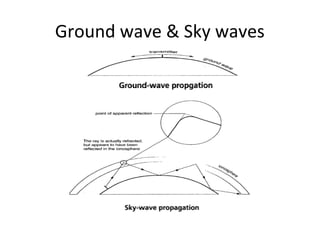
• LW – Uses ground wave for its extensive
coverage using single transmitter
• MW – In addition to ground wave, sky wave is
used for national coverage
• SW – Facilitates international broadcasting by
using sky wave propagation
Ground wave & Sky waves
Why DRM?
• Current AM broadcast have very low quality
audio
• High effects of interference and fading
• Frequent change of frequencies, who may find
receiver difficult to tune
• High power consumption
• High cost of operation
What is DRM?
• Digital Radio Mondiale (DRM) is a global open
digital radio standard for LW, MW, SW –
called DRM 30, DRM currently covers the
broadcasting bands below 30 MHz
• Originally developed as a digital broadcast
standard for the AM bands using similar
techniques developed for DAB
• DRM's success in standardization and
regulation with the IEC, ITU and ETSI
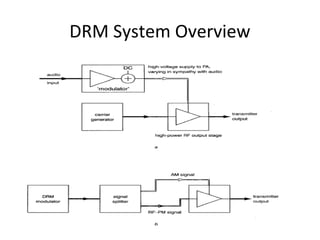
DRM System Overview
Main Processes
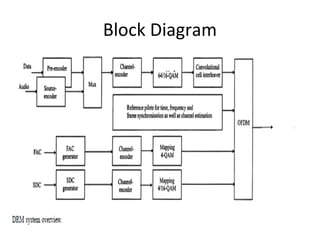
• The audio signal must first be converted to
digital form also called Source Coding
• The source coded data is then multiplexed
with any other data that is required
• The multiplexed data of the payload is
subjected to Channel Coding to increase its
ruggedness
• The channel coded data is modulated onto RF
signal for transmission
Block Diagram
DRM Frame
Conclusion
• It offers a dynamic improvement in audio
quality
• Better Signal to Noise Ratio (SNR)
• Less multipath distortion
• Automatic tuning
• Single frequency networks
• Auxiliary data services

Digital commercial broadcasting

  • 1.
  • 2.
    Digital Broadcast Standards •Digital Audio Broadcasting (DAB) • Digital Radio Mondiale (DRM) • Digital Multimedia Broadcast (DMB) • Digital Audio Radio Service (DARS) • High Definition Radio (HD Radio) • Sirrius & XM Satellite Radio • Worldspace Radio
  • 3.
    Current use ofAM Band • LW – Uses ground wave for its extensive coverage using single transmitter • MW – In addition to ground wave, sky wave is used for national coverage • SW – Facilitates international broadcasting by using sky wave propagation
  • 4.
    Ground wave &Sky waves
  • 5.
    Why DRM? • CurrentAM broadcast have very low quality audio • High effects of interference and fading • Frequent change of frequencies, who may find receiver difficult to tune • High power consumption • High cost of operation
  • 6.
    What is DRM? •Digital Radio Mondiale (DRM) is a global open digital radio standard for LW, MW, SW – called DRM 30, DRM currently covers the broadcasting bands below 30 MHz • Originally developed as a digital broadcast standard for the AM bands using similar techniques developed for DAB • DRM's success in standardization and regulation with the IEC, ITU and ETSI
  • 7.
  • 8.
    Main Processes • Theaudio signal must first be converted to digital form also called Source Coding • The source coded data is then multiplexed with any other data that is required • The multiplexed data of the payload is subjected to Channel Coding to increase its ruggedness • The channel coded data is modulated onto RF signal for transmission
  • 9.
  • 10.
  • 11.
    Conclusion • It offersa dynamic improvement in audio quality • Better Signal to Noise Ratio (SNR) • Less multipath distortion • Automatic tuning • Single frequency networks • Auxiliary data services