Highly available infrastructures based on Xen Björn Brundert
Disclaimer - All statements given in this presentation do not represent the opinion of the speakers company but only the personal opinion and experience of the speaker himself
Introduction, overview and scope Virtualization and high availability Hardware requirements and planning Available solutions today Future prospect Summary Q&A
1) Virtualization and high availability Standalone server does not meet HA-SLAs HA means redundancy    clustering Cluster means higher complexity: building and operating Dedicated hardware per HA-service becomes more and more expensive Hardware, infrastructure components, ETH/FC ports, rackspace, power, cooling Active/passive cluster    unused ressources
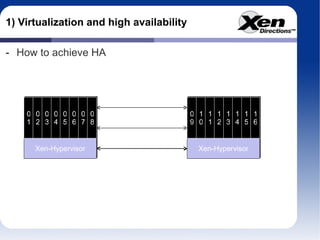
How to achieve HA 1) Virtualization and high availability Application Operating System Hardware Application Operating System Hardware Xen-Hypervisor Xen-Hypervisor Black Box Black Box 01 02 03 04 05 06 07 08 09 10 11 12 13 14 15 16
1) Virtualization and high availability Virtualization offers enourmous benefits Consolidation: multiple services on one hardware Higher flexibility through VM encapsulation and hardware independence Application does not require to be „cluster-ready“
2) Hardware requirements and planning Key rules when thinking about HA Be as paranoid as you want There is never enough redundancy Murphy is with you Identify single points-of-failure Consolidation means also higher impact in case of an outage
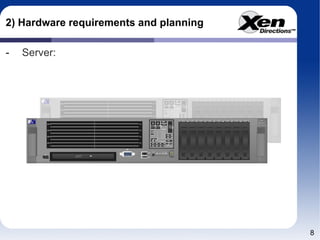
Server: 2) Hardware requirements and planning
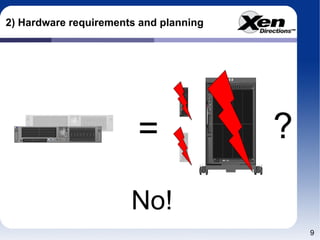
2) Hardware requirements and planning = ? No!
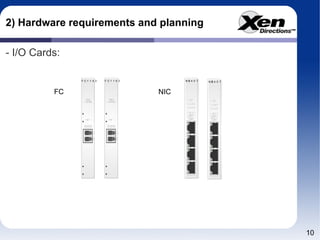
2) Hardware requirements and planning - I/O Cards: FC NIC
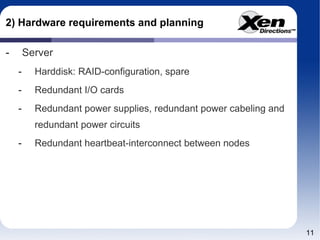
2) Hardware requirements and planning Server Harddisk: RAID-configuration, spare Redundant I/O cards Redundant power supplies, redundant power cabeling and redundant power circuits Redundant heartbeat-interconnect between nodes
2) Hardware requirements and planning Network components Redundant cabeling to server NICs Active/passive bonding needs to be set up in OS Redundant switch or redundant switch modules
2) Hardware requirements and planning Storage components: RAID configuration with hot-spare harddrives Redundant controllers Redundant cabeling to every node Terminating on different HBAs Storage based replication
3) Available solutions today Several implementations of Xen in the wild XenServer by Citrix Bundeled Hypervisor, out-of-the-box solution, including HA-mechanism Version 5.5 released on June 16 Free since Feburary 2009 Xen in Linux-Distributions different implementations of HA-mechanisms like Red Hat Cluster Suite
4) Future prospect HA was only the first step Encapsulation is the key to more flexibility Fault-Tolerance is entering the market Xen Summit 2008: Demonstration of Kemari Marathon everRun VM: Available VMworld 2009 Europe: Announcement of VMware FT
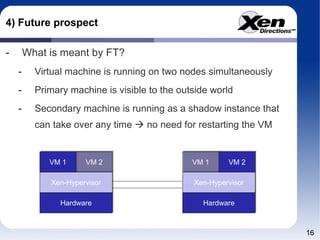
4) Future prospect What is meant by FT? Virtual machine is running on two nodes simultaneously Primary machine is visible to the outside world Secondary machine is running as a shadow instance that can take over any time    no need for restarting the VM Hardware Hardware Xen-Hypervisor Xen-Hypervisor VM 1 VM 2 VM 1 VM 2
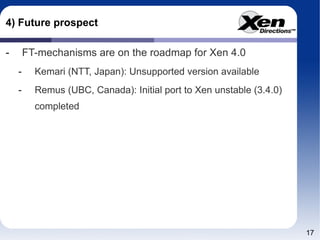
4) Future prospect FT-mechanisms are on the roadmap for Xen 4.0 Kemari (NTT, Japan): Unsupported version available  Remus (UBC, Canada):  Initial port to Xen unstable (3.4.0) completed
5) Summary Virtualization brings more complexity to the infrastructure But: virtualization also brings more flexibility to the infrastructure Obligatory redundant infrastructure for traditional cluster systems can be „recycled“ and used for multiple OS High availability through encapsulation and hardware-independence of OS as a virtual machine Fault-tolerance mechanisms are going to revolutionize availability of stand-alone-servers
6) Q&A - Any questions?
Thank you for your attention For further questions feel free to contact me at [email_address]

High Availability and Xen

  • 1.
    Highly available infrastructuresbased on Xen Björn Brundert
  • 2.
    Disclaimer - Allstatements given in this presentation do not represent the opinion of the speakers company but only the personal opinion and experience of the speaker himself
  • 3.
    Introduction, overview andscope Virtualization and high availability Hardware requirements and planning Available solutions today Future prospect Summary Q&A
  • 4.
    1) Virtualization andhigh availability Standalone server does not meet HA-SLAs HA means redundancy  clustering Cluster means higher complexity: building and operating Dedicated hardware per HA-service becomes more and more expensive Hardware, infrastructure components, ETH/FC ports, rackspace, power, cooling Active/passive cluster  unused ressources
  • 5.
    How to achieveHA 1) Virtualization and high availability Application Operating System Hardware Application Operating System Hardware Xen-Hypervisor Xen-Hypervisor Black Box Black Box 01 02 03 04 05 06 07 08 09 10 11 12 13 14 15 16
  • 6.
    1) Virtualization andhigh availability Virtualization offers enourmous benefits Consolidation: multiple services on one hardware Higher flexibility through VM encapsulation and hardware independence Application does not require to be „cluster-ready“
  • 7.
    2) Hardware requirementsand planning Key rules when thinking about HA Be as paranoid as you want There is never enough redundancy Murphy is with you Identify single points-of-failure Consolidation means also higher impact in case of an outage
  • 8.
    Server: 2) Hardwarerequirements and planning
  • 9.
    2) Hardware requirementsand planning = ? No!
  • 10.
    2) Hardware requirementsand planning - I/O Cards: FC NIC
  • 11.
    2) Hardware requirementsand planning Server Harddisk: RAID-configuration, spare Redundant I/O cards Redundant power supplies, redundant power cabeling and redundant power circuits Redundant heartbeat-interconnect between nodes
  • 12.
    2) Hardware requirementsand planning Network components Redundant cabeling to server NICs Active/passive bonding needs to be set up in OS Redundant switch or redundant switch modules
  • 13.
    2) Hardware requirementsand planning Storage components: RAID configuration with hot-spare harddrives Redundant controllers Redundant cabeling to every node Terminating on different HBAs Storage based replication
  • 14.
    3) Available solutionstoday Several implementations of Xen in the wild XenServer by Citrix Bundeled Hypervisor, out-of-the-box solution, including HA-mechanism Version 5.5 released on June 16 Free since Feburary 2009 Xen in Linux-Distributions different implementations of HA-mechanisms like Red Hat Cluster Suite
  • 15.
    4) Future prospectHA was only the first step Encapsulation is the key to more flexibility Fault-Tolerance is entering the market Xen Summit 2008: Demonstration of Kemari Marathon everRun VM: Available VMworld 2009 Europe: Announcement of VMware FT
  • 16.
    4) Future prospectWhat is meant by FT? Virtual machine is running on two nodes simultaneously Primary machine is visible to the outside world Secondary machine is running as a shadow instance that can take over any time  no need for restarting the VM Hardware Hardware Xen-Hypervisor Xen-Hypervisor VM 1 VM 2 VM 1 VM 2
  • 17.
    4) Future prospectFT-mechanisms are on the roadmap for Xen 4.0 Kemari (NTT, Japan): Unsupported version available Remus (UBC, Canada): Initial port to Xen unstable (3.4.0) completed
  • 18.
    5) Summary Virtualizationbrings more complexity to the infrastructure But: virtualization also brings more flexibility to the infrastructure Obligatory redundant infrastructure for traditional cluster systems can be „recycled“ and used for multiple OS High availability through encapsulation and hardware-independence of OS as a virtual machine Fault-tolerance mechanisms are going to revolutionize availability of stand-alone-servers
  • 19.
    6) Q&A -Any questions?
  • 20.
    Thank you foryour attention For further questions feel free to contact me at [email_address]