Xen PV Performance Status
    and Optimization Opportunities

           Author: Zhidong Yu
           Contributor: Ronghui Duan, Yuan Zhou, Jian Zhang

           Intel Corporation


1
Disclaimers
    INFORMATION IN THIS DOCUMENT IS PROVIDED IN CONNECTION WITH INTEL PRODUCTS. NO LICENSE, EXPRESS OR
    IMPLIED, BY ESTOPPEL OR OTHERWISE, TO ANY INTELLECTUAL PROPERTY RIGHTS IS GRANTED BY THIS DOCUMENT. EXCEPT
    AS PROVIDED IN INTEL'S TERMS AND CONDITIONS OF SALE FOR SUCH PRODUCTS, INTEL ASSUMES NO LIABILITY
    WHATSOEVER AND INTEL DISCLAIMS ANY EXPRESS OR IMPLIED WARRANTY, RELATING TO SALE AND/OR USE OF INTEL
    PRODUCTS INCLUDING LIABILITY OR WARRANTIES RELATING TO FITNESS FOR A PARTICULAR PURPOSE, MERCHANTABILITY,
    OR INFRINGEMENT OF ANY PATENT, COPYRIGHT OR OTHER INTELLECTUAL PROPERTY RIGHT.
    A "Mission Critical Application" is any application in which failure of the Intel Product could result, directly or indirectly, in
    personal injury or death. SHOULD YOU PURCHASE OR USE INTEL'S PRODUCTS FOR ANY SUCH MISSION CRITICAL
    APPLICATION, YOU SHALL INDEMNIFY AND HOLD INTEL AND ITS SUBSIDIARIES, SUBCONTRACTORS AND AFFILIATES, AND
    THE DIRECTORS, OFFICERS, AND EMPLOYEES OF EACH, HARMLESS AGAINST ALL CLAIMS COSTS, DAMAGES, AND EXPENSES
    AND REASONABLE ATTORNEYS' FEES ARISING OUT OF, DIRECTLY OR INDIRECTLY, ANY CLAIM OF PRODUCT LIABILITY,
    PERSONAL INJURY, OR DEATH ARISING IN ANY WAY OUT OF SUCH MISSION CRITICAL APPLICATION, WHETHER OR NOT
    INTEL OR ITS SUBCONTRACTOR WAS NEGLIGENT IN THE DESIGN, MANUFACTURE, OR WARNING OF THE INTEL PRODUCT OR
    ANY OF ITS PARTS.
    Intel may make changes to specifications and product descriptions at any time, without notice. Designers must not rely on the
    absence or characteristics of any features or instructions marked "reserved" or "undefined". Intel reserves these for future
    definition and shall have no responsibility whatsoever for conflicts or incompatibilities arising from future changes to them. The
    information here is subject to change without notice. Do not finalize a design with this information.
    The products described in this document may contain design defects or errors known as errata which may cause the product to
    deviate from published specifications. Current characterized errata are available on request.
    Contact your local Intel sales office or your distributor to obtain the latest specifications and before placing your product order.
    Copies of documents which have an order number and are referenced in this document, or other Intel literature, may be
    obtained by calling 1-800-548-4725, or go to: http://www.intel.com/design/literature.htm%20
    This document contains information on products in the design phase of development.
    Intel and the Intel logo are trademarks of Intel Corporation in the U.S. and/or other countries.
    *Other names and brands may be claimed as the property of others.
    Copyright © 2012 Intel Corporation. All rights reserved.


2
Agenda

    • HVM vs. PV guest comparison

    • PV disk driver performance and optimizations


3
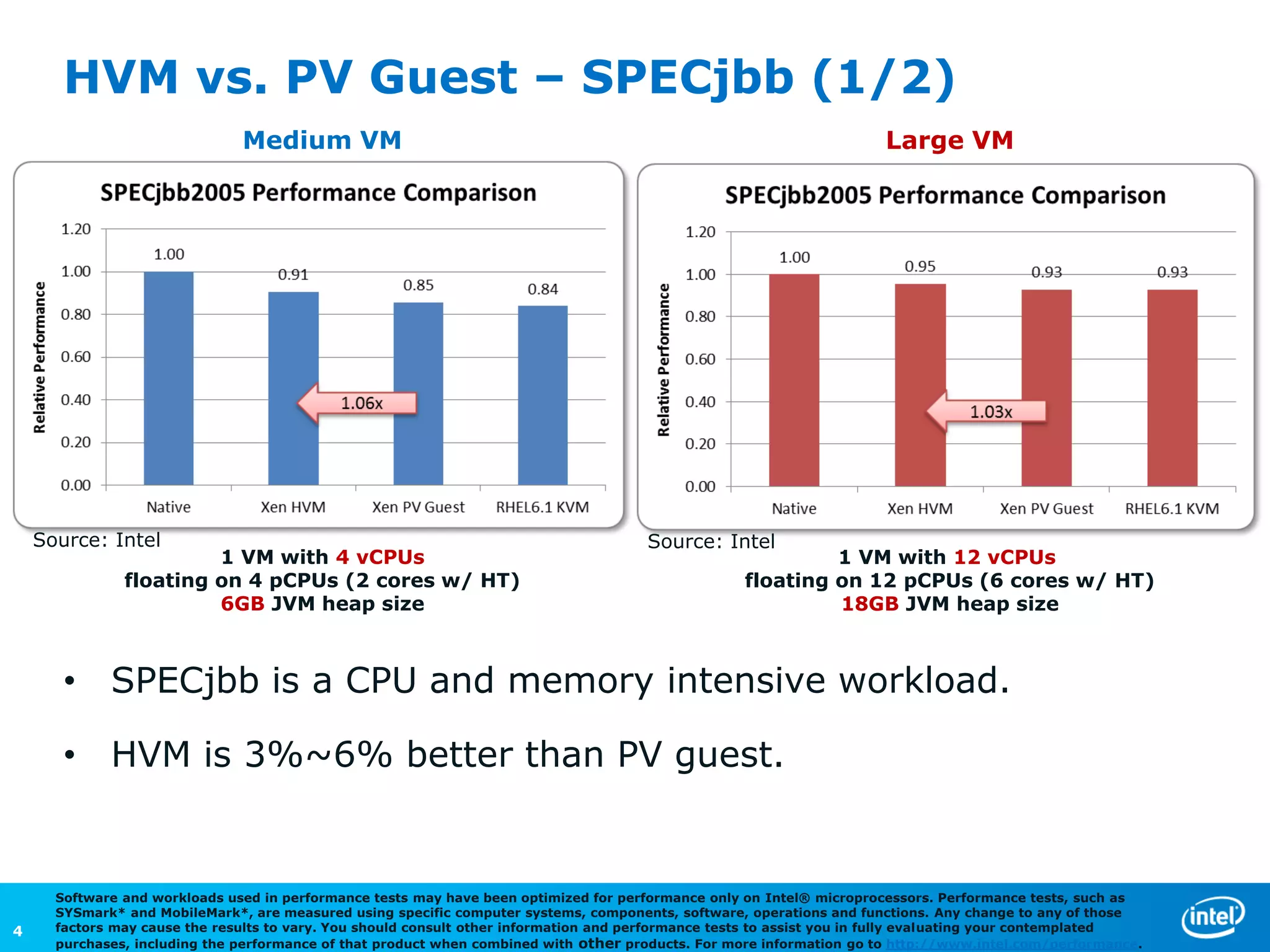
HVM vs. PV Guest – SPECjbb (1/2)
                               Medium VM                                                                               Large VM


    Source: Intel                                                                      Source: Intel
                        1 VM with 4 vCPUs                                                                    1 VM with 12 vCPUs
               floating on 4 pCPUs (2 cores w/ HT)                                                  floating on 12 pCPUs (6 cores w/ HT)
                        6GB JVM heap size                                                                    18GB JVM heap size


       • SPECjbb is a CPU and memory intensive workload.

       • HVM is 3%~6% better than PV guest.


      Software and workloads used in performance tests may have been optimized for performance only on Intel® microprocessors. Performance tests, such as
      SYSmark* and MobileMark*, are measured using specific computer systems, components, software, operations and functions. Any change to any of those
4     factors may cause the results to vary. You should consult other information and performance tests to assist you in fully evaluating your contemplated
      purchases, including the performance of that product when combined with other products. For more information go to http://www.intel.com/performance.
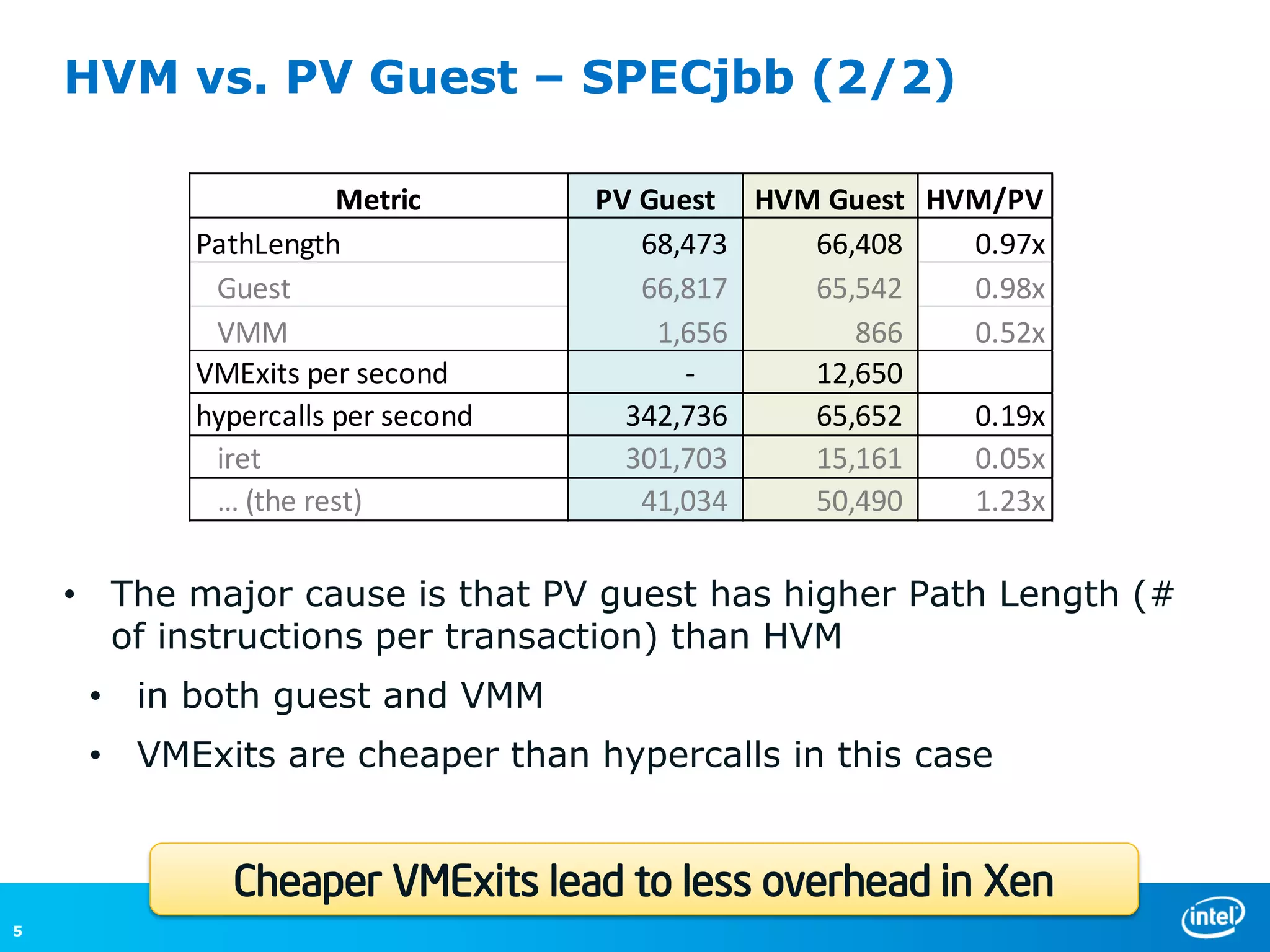
HVM vs. PV Guest – SPECjbb (2/2)

                      Metric       PV Guest HVM Guest HVM/PV
           PathLength                 68,473   66,408   0.97x
            Guest                     66,817   65,542   0.98x
            VMM                        1,656      866   0.52x
           VMExits per second            -     12,650
           hypercalls per second     342,736   65,652   0.19x
            iret                     301,703   15,161   0.05x
            … (the rest)              41,034   50,490   1.23x

    • The major cause is that PV guest has higher Path Length (#
      of instructions per transaction) than HVM
     • in both guest and VMM
     • VMExits are cheaper than hypercalls in this case


             Cheaper VMExits lead to less overhead in Xen
5
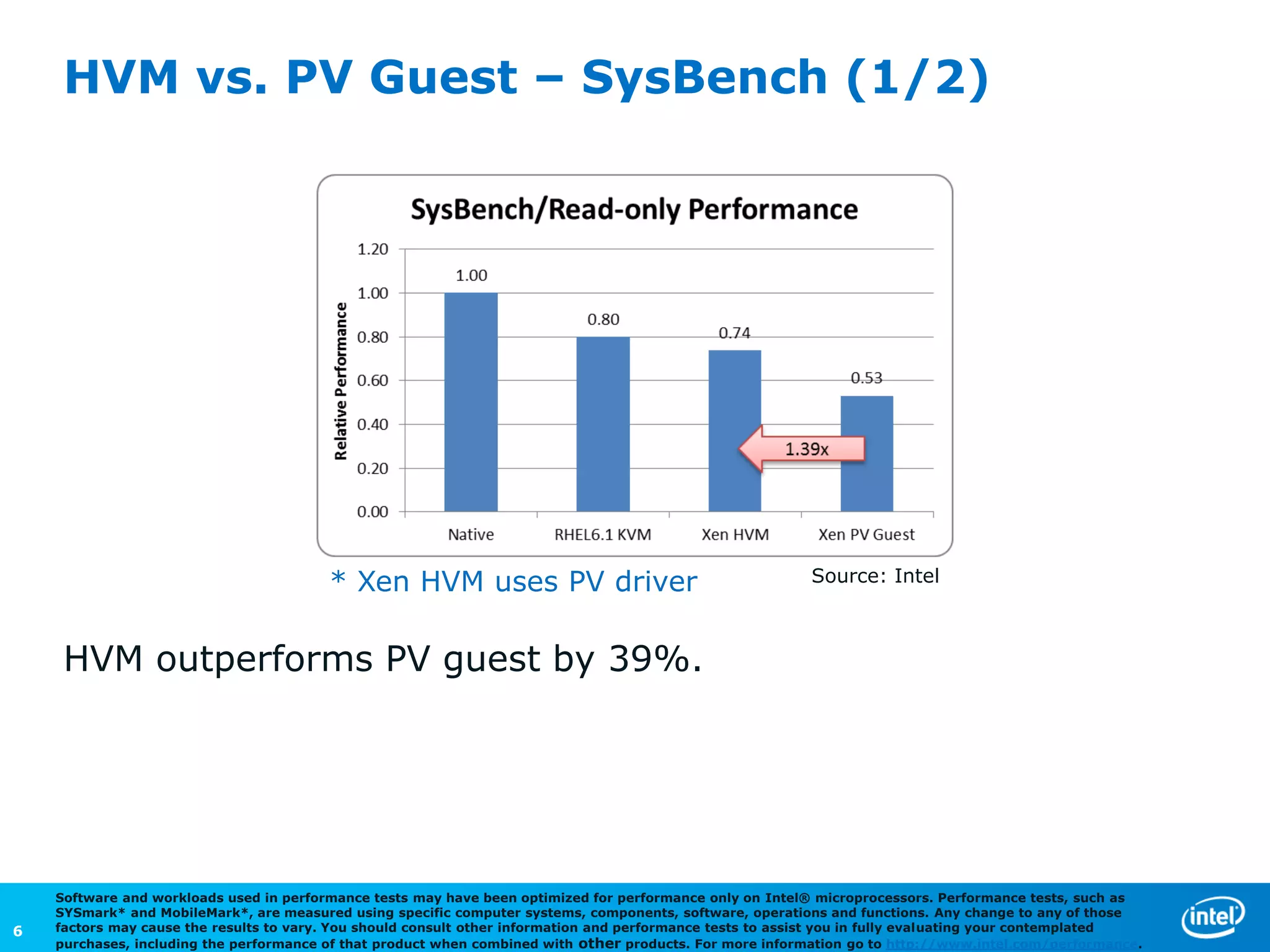
HVM vs. PV Guest – SysBench (1/2)


                                         * Xen HVM uses PV driver                                          Source: Intel


     HVM outperforms PV guest by 39%.


    Software and workloads used in performance tests may have been optimized for performance only on Intel® microprocessors. Performance tests, such as
    SYSmark* and MobileMark*, are measured using specific computer systems, components, software, operations and functions. Any change to any of those
6   factors may cause the results to vary. You should consult other information and performance tests to assist you in fully evaluating your contemplated
    purchases, including the performance of that product when combined with other products. For more information go to http://www.intel.com/performance.
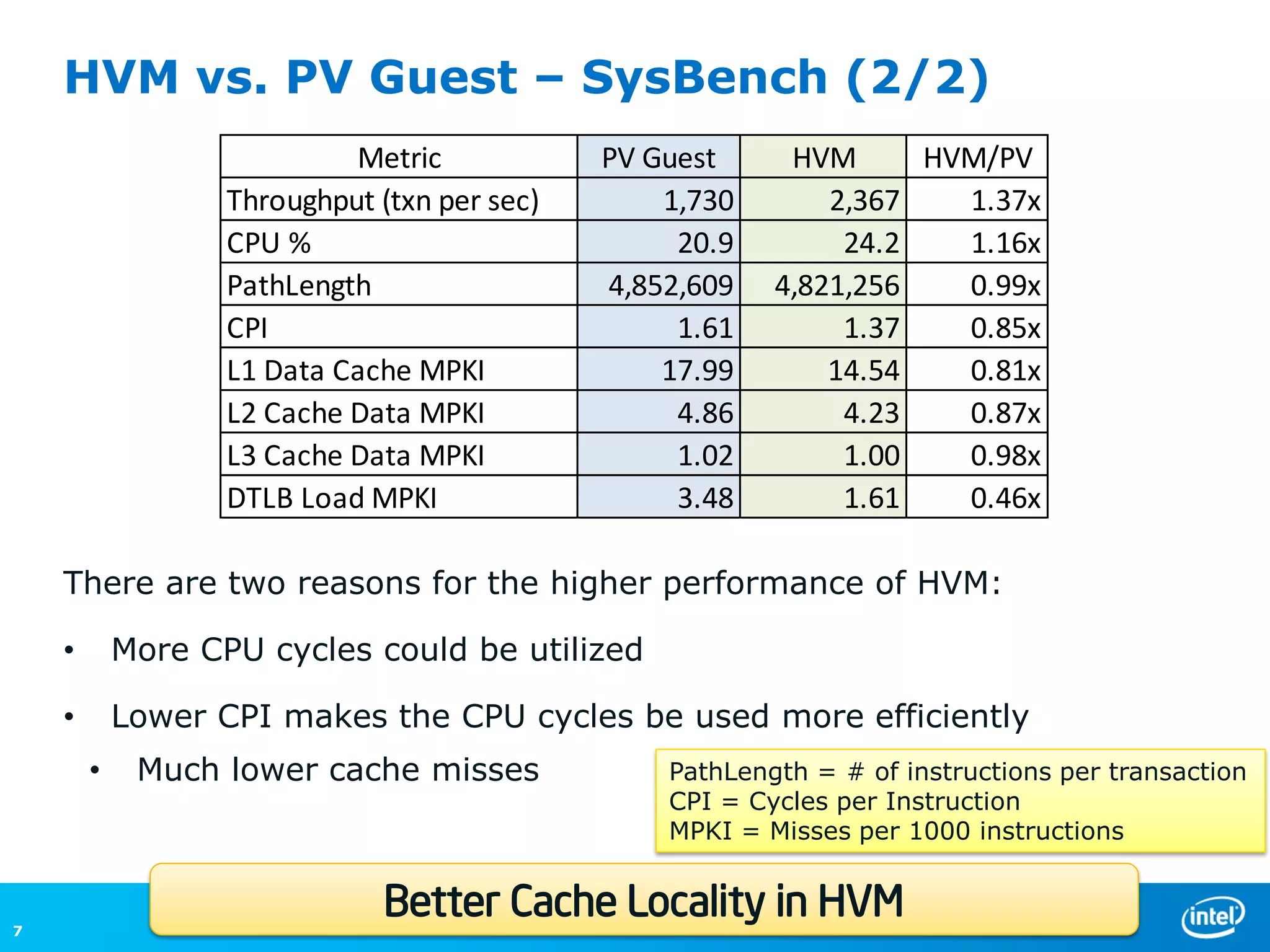
HVM vs. PV Guest – SysBench (2/2)
                            Metric            PV Guest     HVM      HVM/PV
                   Throughput (txn per sec)       1,730       2,367   1.37x
                   CPU %                           20.9        24.2   1.16x
                   PathLength                 4,852,609   4,821,256   0.99x
                   CPI                             1.61        1.37   0.85x
                   L1 Data Cache MPKI             17.99       14.54   0.81x
                   L2 Cache Data MPKI              4.86        4.23   0.87x
                   L3 Cache Data MPKI              1.02        1.00   0.98x
                   DTLB Load MPKI                  3.48        1.61   0.46x

    There are two reasons for the higher performance of HVM:

    •       More CPU cycles could be utilized

    •       Lower CPI makes the CPU cycles be used more efficiently
        •    Much lower cache misses              PathLength = # of instructions per transaction
                                                  CPI = Cycles per Instruction
                                                  MPKI = Misses per 1000 instructions


7
                               Better Cache Locality in HVM
Agenda

    • HVM vs. PV guest comparison

    • PV disk driver performance and optimizations


8
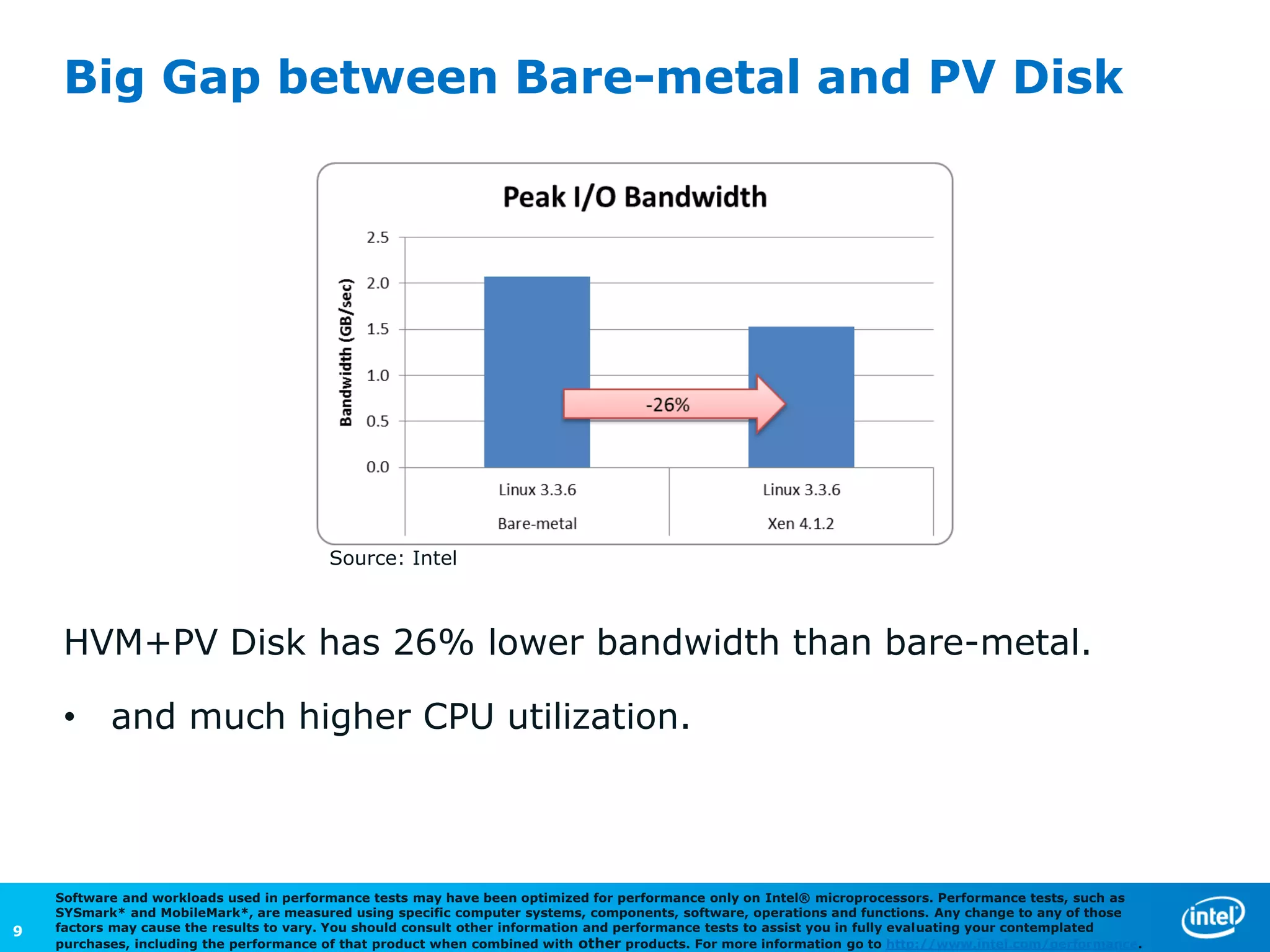
Big Gap between Bare-metal and PV Disk


                                         Source: Intel


     HVM+PV Disk has 26% lower bandwidth than bare-metal.

     • and much higher CPU utilization.


    Software and workloads used in performance tests may have been optimized for performance only on Intel® microprocessors. Performance tests, such as
    SYSmark* and MobileMark*, are measured using specific computer systems, components, software, operations and functions. Any change to any of those
9   factors may cause the results to vary. You should consult other information and performance tests to assist you in fully evaluating your contemplated
    purchases, including the performance of that product when combined with other products. For more information go to http://www.intel.com/performance.
Per-device blkif_io_lock

     Multiple PV disks were used to achieve a high b/w in our test.

     We found the global blkif_io_lock in the front-end seems to
     be the performance bottleneck.

     • Very high CPU utilization in the guest kernel.

     Luckily, this is a known issue and has been fixed already by
     Amazon:

     • Replace the global lock by per-device lock.

     • Commit (March 2012):
       http://git.kernel.org/?p=linux/kernel/git/axboe/linux-
       block.git;a=commit;h=3467811e26660eb46bc655234573d22d6876d5f9


10
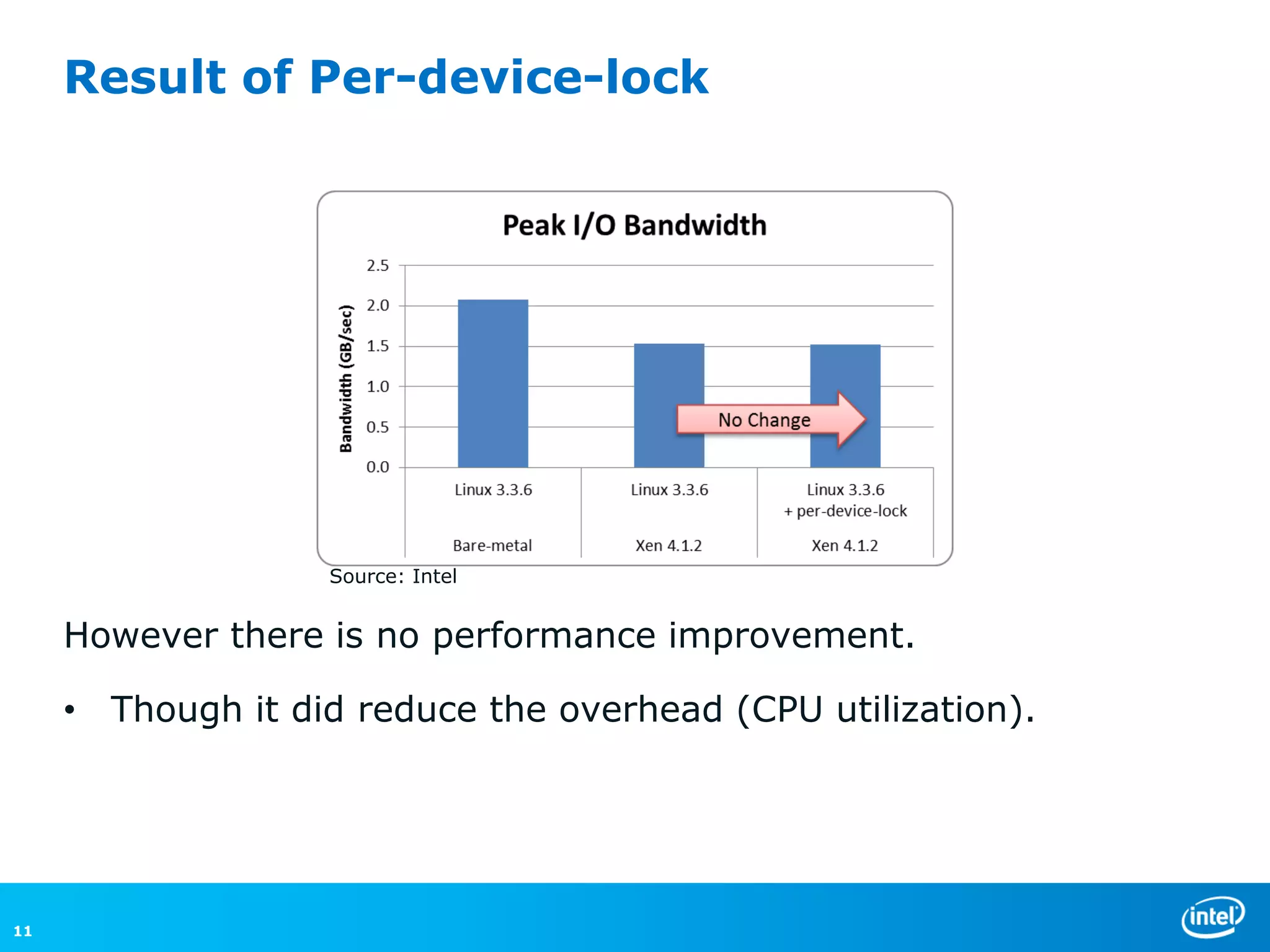
Result of Per-device-lock


                   Source: Intel


     However there is no performance improvement.

     • Though it did reduce the overhead (CPU utilization).


11
I/O Merging Issue

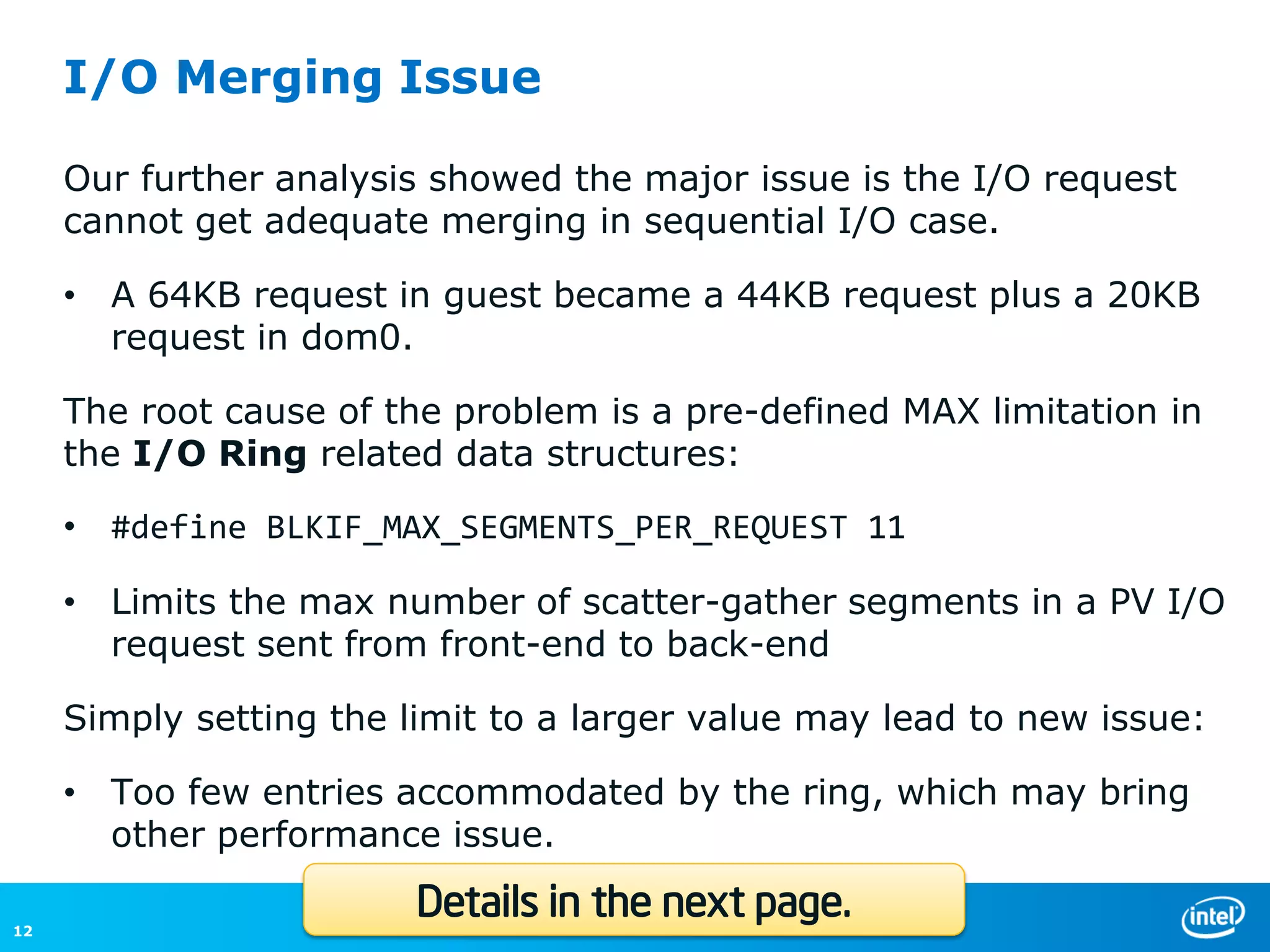
     Our further analysis showed the major issue is the I/O request
     cannot get adequate merging in sequential I/O case.

     • A 64KB request in guest became a 44KB request plus a 20KB
       request in dom0.

     The root cause of the problem is a pre-defined MAX limitation in
     the I/O Ring related data structures:

     • #define BLKIF_MAX_SEGMENTS_PER_REQUEST 11

     • Limits the max number of scatter-gather segments in a PV I/O
       request sent from front-end to back-end

     Simply setting the limit to a larger value may lead to new issue:

     • Too few entries accommodated by the ring, which may bring
       other performance issue.

12
                         Details in the next page.
define a
     BLKIF_MAX_SEGMENTS_PER_REQUEST
                                                                                     4KB ring
     File: linux/include/xen/interface/io/blkif.h
     DEFINE_RING_TYPES(blkif, struct blkif_request, struct blkif_response);

     struct blkif_request { refers to
              uint8_t         operation;    /* BLKIF_OP_???                           */
              uint8_t         nr_segments; /* number of segments                      */
              blkif_vdev_t    handle;       /* only for read/write requests           */
              uint64_t        id;           /* private guest value, echoed in resp    */
              union {
                        struct blkif_request_rw rw;
                        struct blkif_request_discard discard;
              } u;
     };             refers to
     struct blkif_request_rw {
              blkif_sector_t sector_number;/* start sector idx on disk (r/w only) */
              struct blkif_request_segment {
                        grant_ref_t gref;        /* reference to I/O buffer frame      */
                        /* @first_sect: first sector in frame to transfer (inclusive). */
                        /* @last_sect: last sector in frame to transfer (inclusive).   */
                        uint8_t     first_sect, last_sect;
              } seg[BLKIF_MAX_SEGMENTS_PER_REQUEST];
                                                                       Determines how
     };                                                                many requests
                                                  limited by          a ring can hold
     #define BLKIF_MAX_SEGMENTS_PER_REQUEST 11

     A segment usually be 4KB I/O block; 11 segments limits the max I/O size to be 44KB
13
Solution: Multi-Page-Ring


     Based on Citrix’s early work.
     •   http://lists.xen.org/archives/html/xen-devel/2012-03/msg00388.html

     Allow to use more than one page for a ring.
     • Still need to increase BLKIF_MAX_SEGMENTS_PER_REQUEST to support more segments in one
       request
     • Request structure size gets increased as a result

     Move seg[BLKIF_MAX_SEGMENTS_PER_REQUEST] out of the request structure and
     put them in a separate ring instead.
     •   More scalable
14
Result of Multi-page-ring


                                              Source: Intel


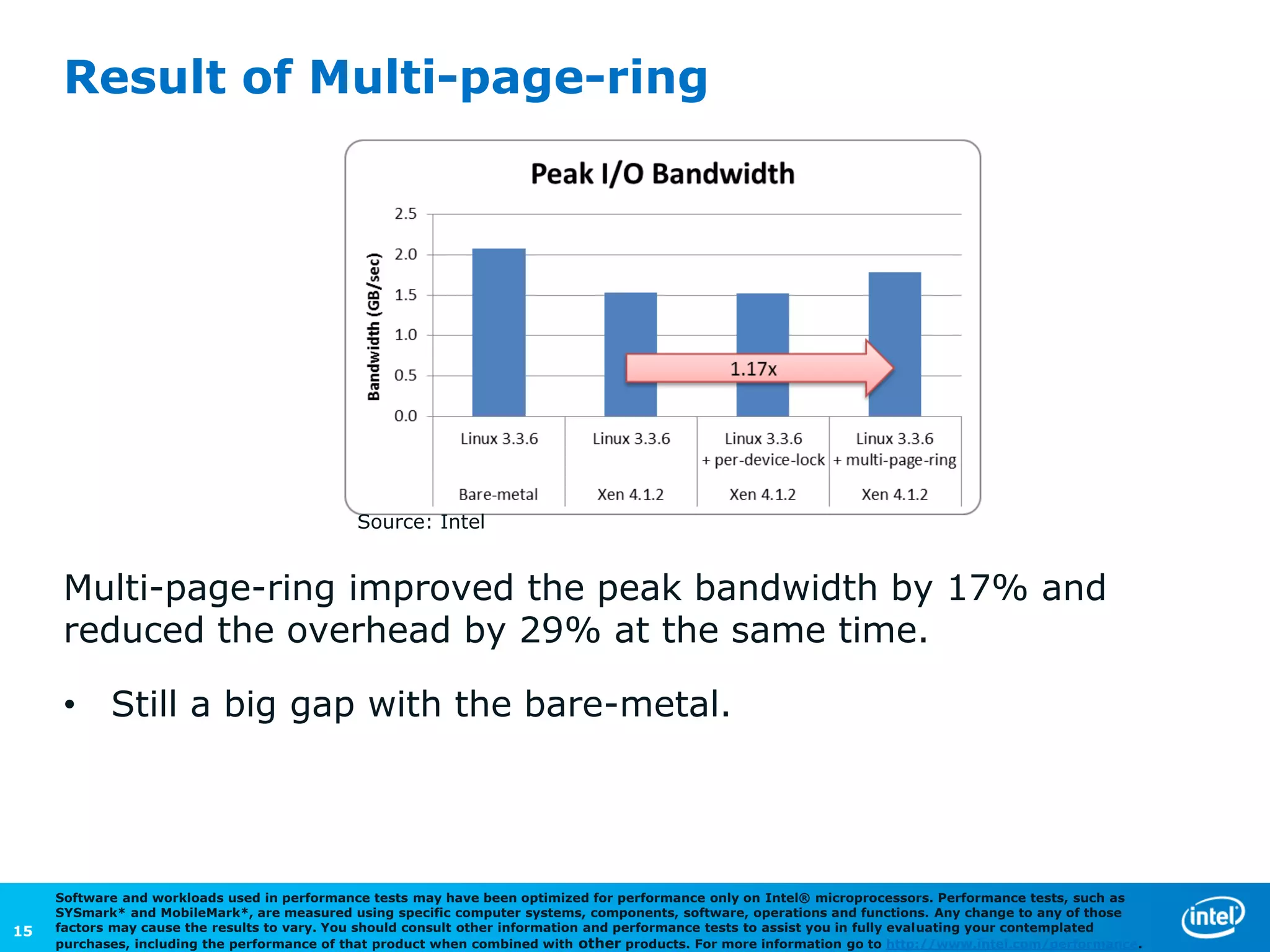
      Multi-page-ring improved the peak bandwidth by 17% and
      reduced the overhead by 29% at the same time.

      • Still a big gap with the bare-metal.


     Software and workloads used in performance tests may have been optimized for performance only on Intel® microprocessors. Performance tests, such as
     SYSmark* and MobileMark*, are measured using specific computer systems, components, software, operations and functions. Any change to any of those
15   factors may cause the results to vary. You should consult other information and performance tests to assist you in fully evaluating your contemplated
     purchases, including the performance of that product when combined with other products. For more information go to http://www.intel.com/performance.
Per-device-lock Again


                                 Source: Intel


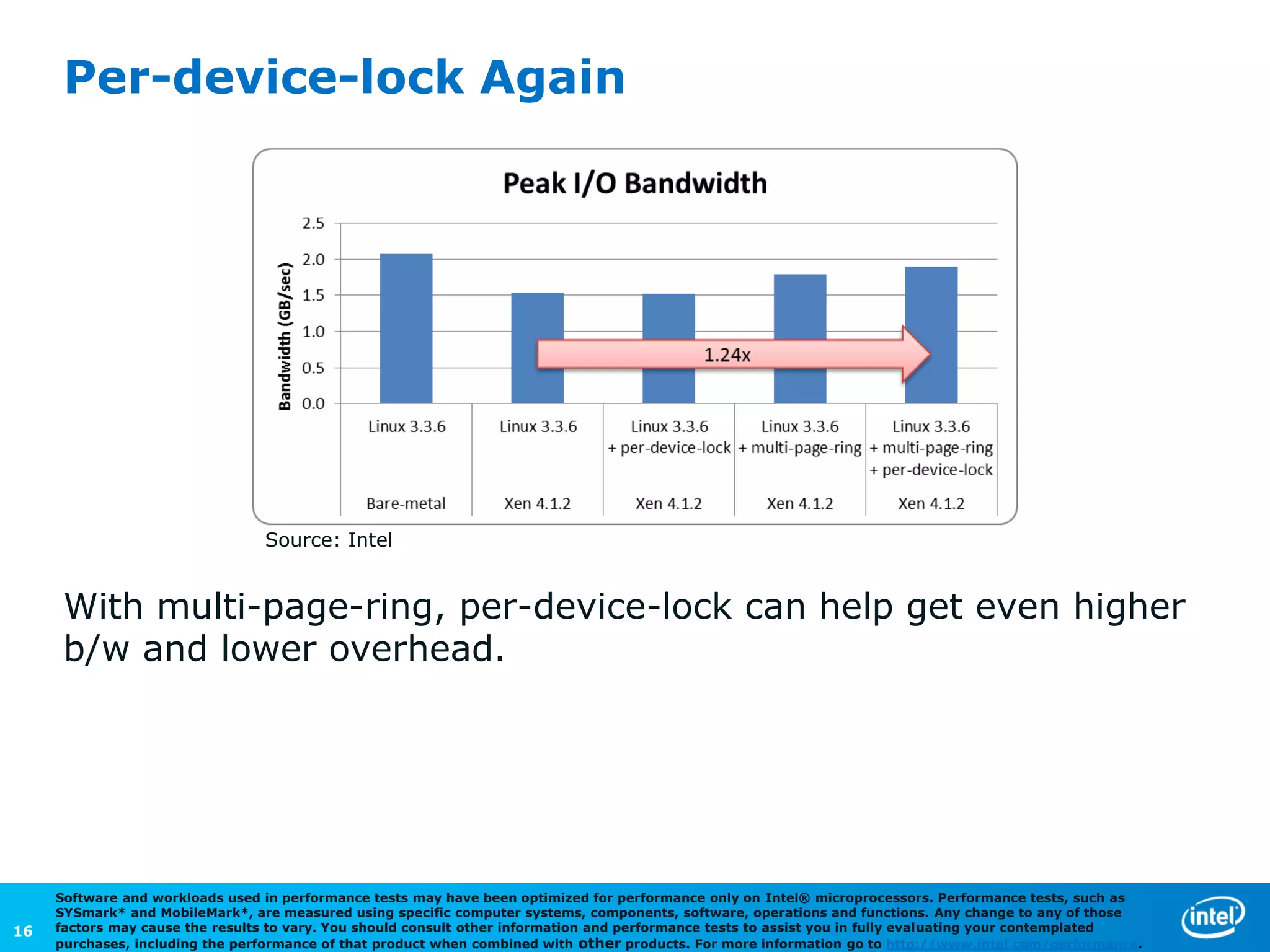
      With multi-page-ring, per-device-lock can help get even higher
      b/w and lower overhead.


     Software and workloads used in performance tests may have been optimized for performance only on Intel® microprocessors. Performance tests, such as
     SYSmark* and MobileMark*, are measured using specific computer systems, components, software, operations and functions. Any change to any of those
16   factors may cause the results to vary. You should consult other information and performance tests to assist you in fully evaluating your contemplated
     purchases, including the performance of that product when combined with other products. For more information go to http://www.intel.com/performance.
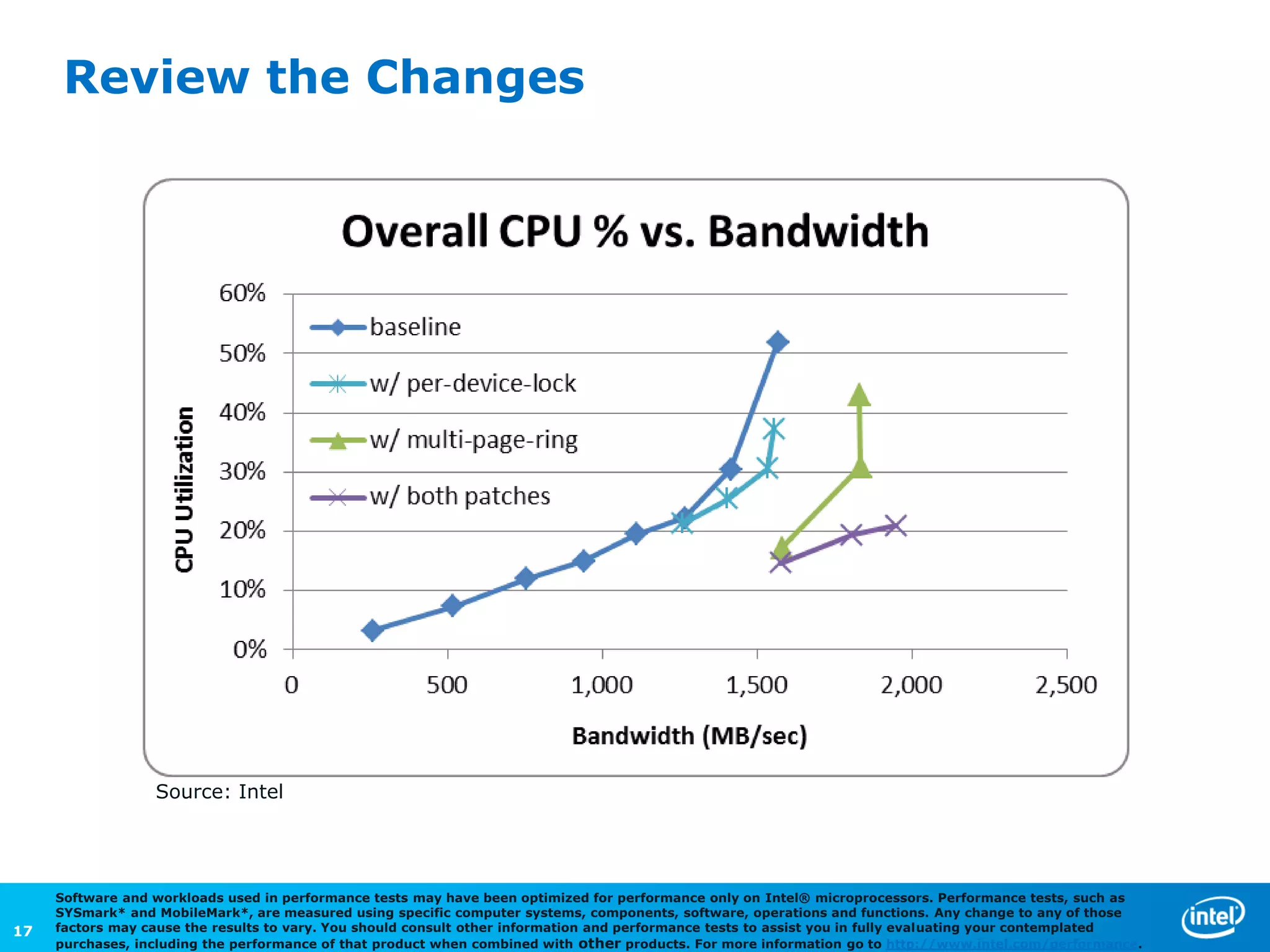
Review the Changes


                  Source: Intel


     Software and workloads used in performance tests may have been optimized for performance only on Intel® microprocessors. Performance tests, such as
     SYSmark* and MobileMark*, are measured using specific computer systems, components, software, operations and functions. Any change to any of those
17   factors may cause the results to vary. You should consult other information and performance tests to assist you in fully evaluating your contemplated
     purchases, including the performance of that product when combined with other products. For more information go to http://www.intel.com/performance.
Summary

     HVM outperforms PV guest in both CPU/memory intensive
     workload and disk I/O intensive workload.

     Xen PV disk performance is 26% worse than bare-metal in
     terms of peak bandwidth.

     We proposed a multi-page-ring patch that improves the PV disk
     performance by 24% and reduces the gap with bare-metal to
     single digit.


18
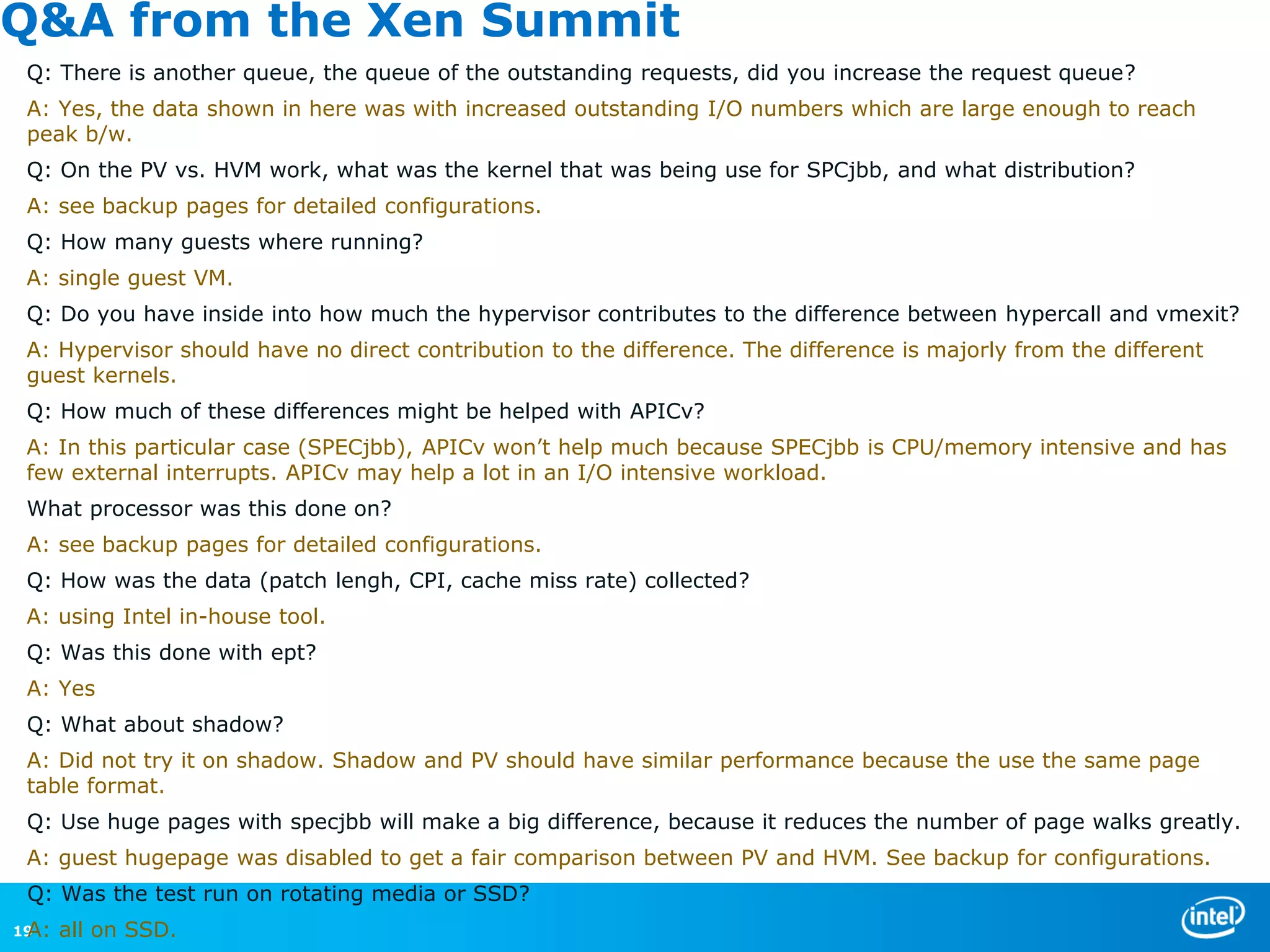
Q&A from the Xen Summit
 Q: There is another queue, the queue of the outstanding requests, did you increase the request queue?
 A: Yes, the data shown in here was with increased outstanding I/O numbers which are large enough to reach
 peak b/w.
 Q: On the PV vs. HVM work, what was the kernel that was being use for SPCjbb, and what distribution?
 A: see backup pages for detailed configurations.
 Q: How many guests where running?
 A: single guest VM.
 Q: Do you have inside into how much the hypervisor contributes to the difference between hypercall and vmexit?
 A: Hypervisor should have no direct contribution to the difference. The difference is majorly from the different
 guest kernels.
 Q: How much of these differences might be helped with APICv?
 A: In this particular case (SPECjbb), APICv won’t help much because SPECjbb is CPU/memory intensive and has
 few external interrupts. APICv may help a lot in an I/O intensive workload.
 What processor was this done on?
 A: see backup pages for detailed configurations.
 Q: How was the data (patch lengh, CPI, cache miss rate) collected?
 A: using Intel in-house tool.
 Q: Was this done with ept?
 A: Yes
 Q: What about shadow?
 A: Did not try it on shadow. Shadow and PV should have similar performance because the use the same page
 table format.
 Q: Use huge pages with specjbb will make a big difference, because it reduces the number of page walks greatly.
 A: guest hugepage was disabled to get a fair comparison between PV and HVM. See backup for configurations.
 Q: Was the test run on rotating media or SSD?
 A:
19    all on SSD.
BACKUP


20
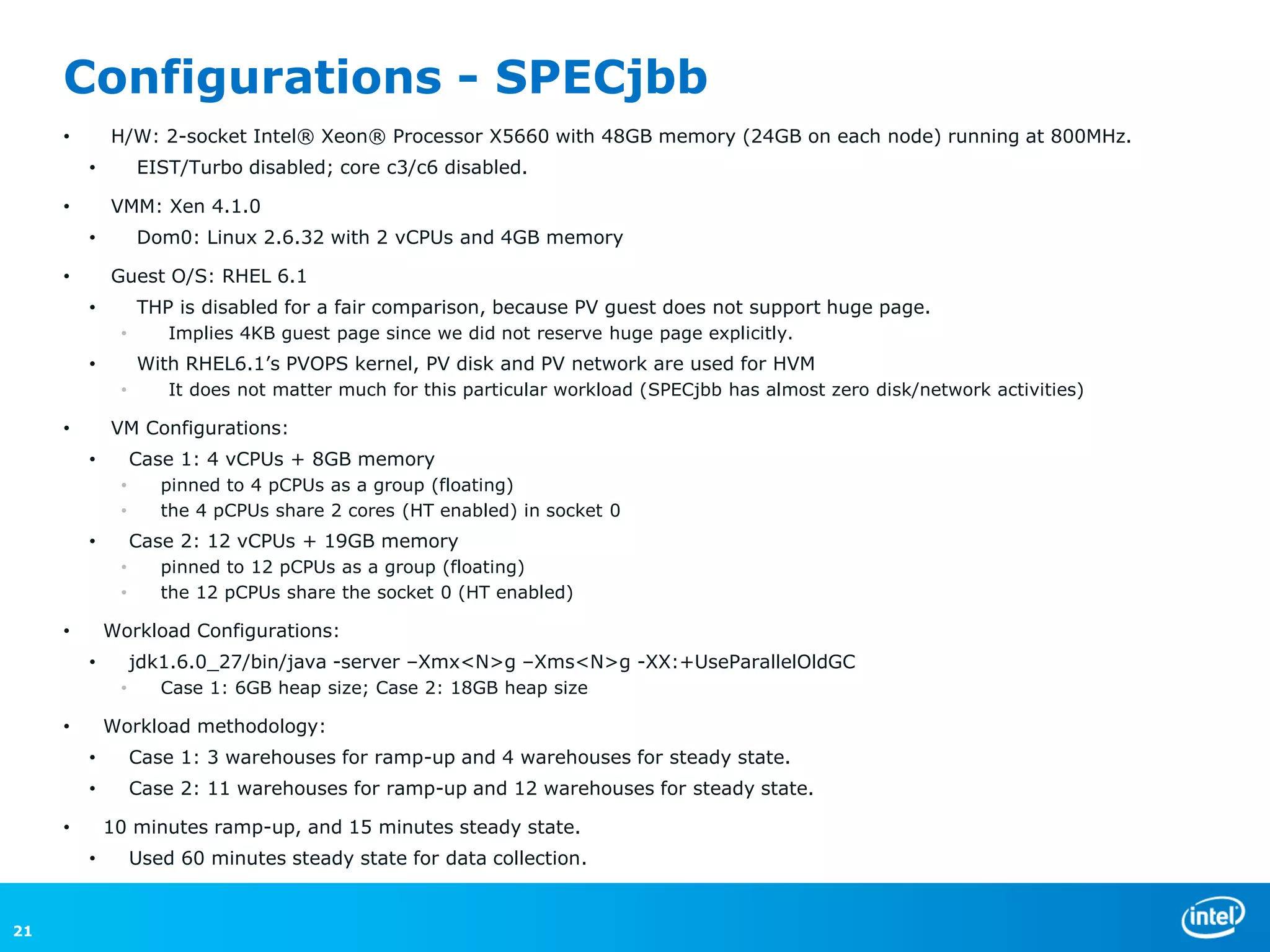
Configurations - SPECjbb
     •       H/W: 2-socket Intel® Xeon® Processor X5660 with 48GB memory (24GB on each node) running at 800MHz.
         •        EIST/Turbo disabled; core c3/c6 disabled.

     •       VMM: Xen 4.1.0
         •        Dom0: Linux 2.6.32 with 2 vCPUs and 4GB memory

     •       Guest O/S: RHEL 6.1
         •        THP is disabled for a fair comparison, because PV guest does not support huge page.
              •       Implies 4KB guest page since we did not reserve huge page explicitly.
         •        With RHEL6.1’s PVOPS kernel, PV disk and PV network are used for HVM
              •       It does not matter much for this particular workload (SPECjbb has almost zero disk/network activities)

     •       VM Configurations:
         •        Case 1: 4 vCPUs + 8GB memory
              •      pinned to 4 pCPUs as a group (floating)
              •      the 4 pCPUs share 2 cores (HT enabled) in socket 0
         •        Case 2: 12 vCPUs + 19GB memory
              •      pinned to 12 pCPUs as a group (floating)
              •      the 12 pCPUs share the socket 0 (HT enabled)

     •       Workload Configurations:
         •        jdk1.6.0_27/bin/java -server –Xmx<N>g –Xms<N>g -XX:+UseParallelOldGC
              •      Case 1: 6GB heap size; Case 2: 18GB heap size

     •       Workload methodology:
         •        Case 1: 3 warehouses for ramp-up and 4 warehouses for steady state.
         •        Case 2: 11 warehouses for ramp-up and 12 warehouses for steady state.

     •       10 minutes ramp-up, and 15 minutes steady state.
         •        Used 60 minutes steady state for data collection.


21
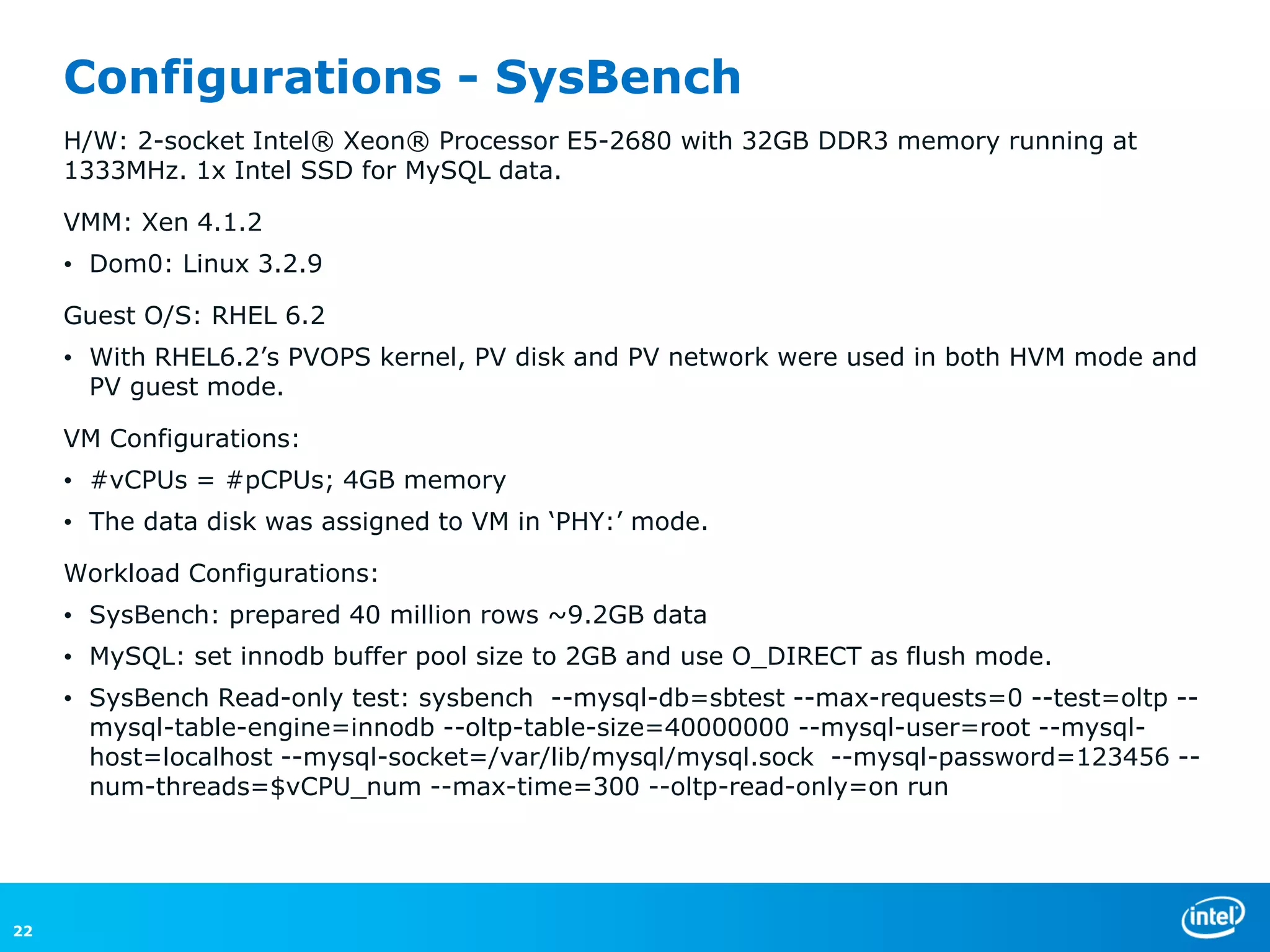
Configurations - SysBench
     H/W: 2-socket Intel® Xeon® Processor E5-2680 with 32GB DDR3 memory running at
     1333MHz. 1x Intel SSD for MySQL data.

     VMM: Xen 4.1.2
     • Dom0: Linux 3.2.9

     Guest O/S: RHEL 6.2
     • With RHEL6.2’s PVOPS kernel, PV disk and PV network were used in both HVM mode and
       PV guest mode.

     VM Configurations:
     • #vCPUs = #pCPUs; 4GB memory
     • The data disk was assigned to VM in ‘PHY:’ mode.

     Workload Configurations:
     • SysBench: prepared 40 million rows ~9.2GB data
     • MySQL: set innodb buffer pool size to 2GB and use O_DIRECT as flush mode.
     • SysBench Read-only test: sysbench --mysql-db=sbtest --max-requests=0 --test=oltp --
       mysql-table-engine=innodb --oltp-table-size=40000000 --mysql-user=root --mysql-
       host=localhost --mysql-socket=/var/lib/mysql/mysql.sock --mysql-password=123456 --
       num-threads=$vCPU_num --max-time=300 --oltp-read-only=on run


22
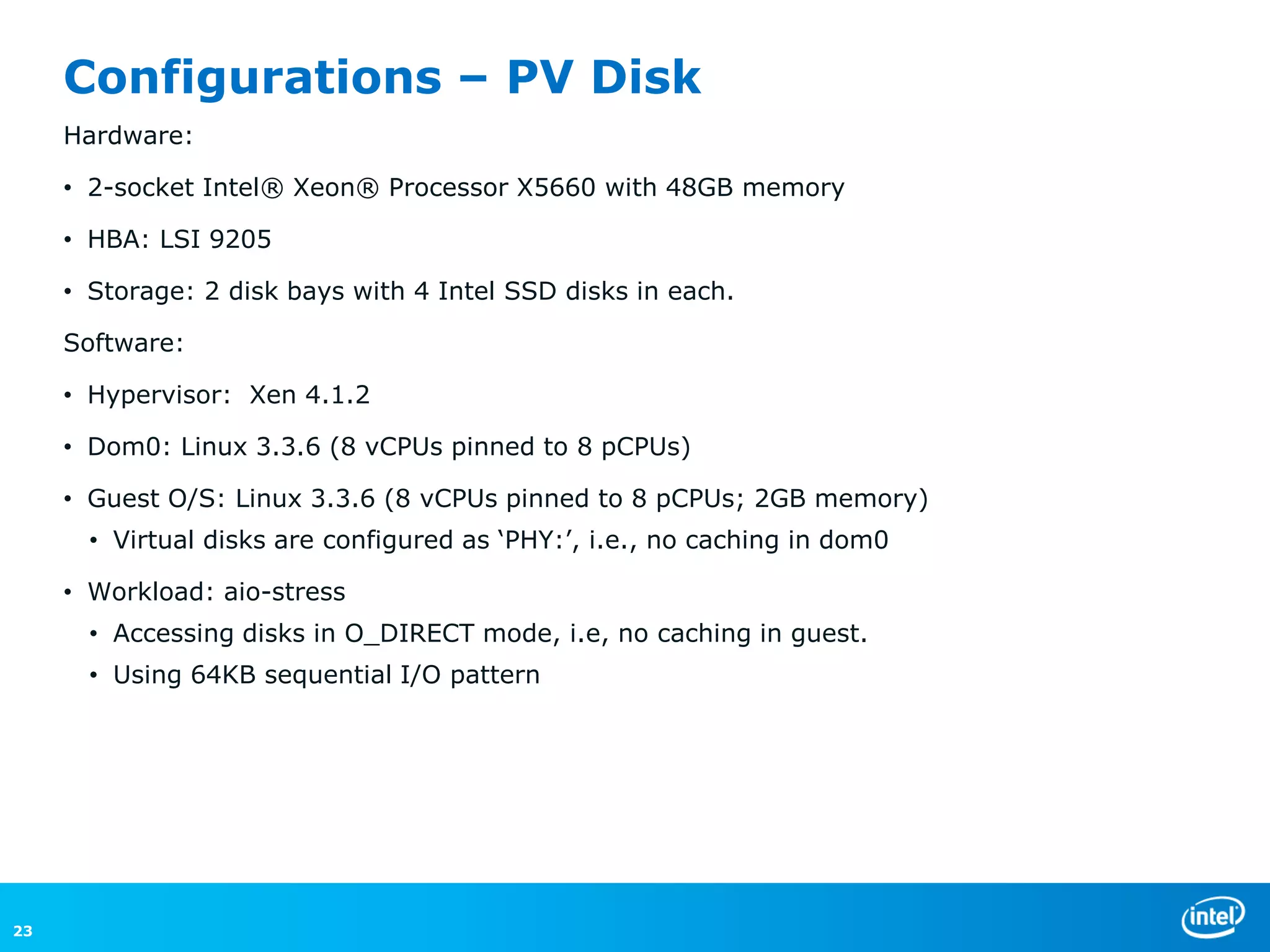
Configurations – PV Disk
     Hardware:

     • 2-socket Intel® Xeon® Processor X5660 with 48GB memory

     • HBA: LSI 9205

     • Storage: 2 disk bays with 4 Intel SSD disks in each.

     Software:

     • Hypervisor: Xen 4.1.2

     • Dom0: Linux 3.3.6 (8 vCPUs pinned to 8 pCPUs)

     • Guest O/S: Linux 3.3.6 (8 vCPUs pinned to 8 pCPUs; 2GB memory)
       • Virtual disks are configured as ‘PHY:’, i.e., no caching in dom0

     • Workload: aio-stress
       • Accessing disks in O_DIRECT mode, i.e, no caching in guest.
       • Using 64KB sequential I/O pattern


23
Xen PV Performance Status and Optimization Opportunities

Xen PV Performance Status and Optimization Opportunities

  • 1.
    Xen PV PerformanceStatus and Optimization Opportunities Author: Zhidong Yu Contributor: Ronghui Duan, Yuan Zhou, Jian Zhang Intel Corporation 1
  • 2.
    Disclaimers INFORMATION IN THIS DOCUMENT IS PROVIDED IN CONNECTION WITH INTEL PRODUCTS. NO LICENSE, EXPRESS OR IMPLIED, BY ESTOPPEL OR OTHERWISE, TO ANY INTELLECTUAL PROPERTY RIGHTS IS GRANTED BY THIS DOCUMENT. EXCEPT AS PROVIDED IN INTEL'S TERMS AND CONDITIONS OF SALE FOR SUCH PRODUCTS, INTEL ASSUMES NO LIABILITY WHATSOEVER AND INTEL DISCLAIMS ANY EXPRESS OR IMPLIED WARRANTY, RELATING TO SALE AND/OR USE OF INTEL PRODUCTS INCLUDING LIABILITY OR WARRANTIES RELATING TO FITNESS FOR A PARTICULAR PURPOSE, MERCHANTABILITY, OR INFRINGEMENT OF ANY PATENT, COPYRIGHT OR OTHER INTELLECTUAL PROPERTY RIGHT. A "Mission Critical Application" is any application in which failure of the Intel Product could result, directly or indirectly, in personal injury or death. SHOULD YOU PURCHASE OR USE INTEL'S PRODUCTS FOR ANY SUCH MISSION CRITICAL APPLICATION, YOU SHALL INDEMNIFY AND HOLD INTEL AND ITS SUBSIDIARIES, SUBCONTRACTORS AND AFFILIATES, AND THE DIRECTORS, OFFICERS, AND EMPLOYEES OF EACH, HARMLESS AGAINST ALL CLAIMS COSTS, DAMAGES, AND EXPENSES AND REASONABLE ATTORNEYS' FEES ARISING OUT OF, DIRECTLY OR INDIRECTLY, ANY CLAIM OF PRODUCT LIABILITY, PERSONAL INJURY, OR DEATH ARISING IN ANY WAY OUT OF SUCH MISSION CRITICAL APPLICATION, WHETHER OR NOT INTEL OR ITS SUBCONTRACTOR WAS NEGLIGENT IN THE DESIGN, MANUFACTURE, OR WARNING OF THE INTEL PRODUCT OR ANY OF ITS PARTS. Intel may make changes to specifications and product descriptions at any time, without notice. Designers must not rely on the absence or characteristics of any features or instructions marked "reserved" or "undefined". Intel reserves these for future definition and shall have no responsibility whatsoever for conflicts or incompatibilities arising from future changes to them. The information here is subject to change without notice. Do not finalize a design with this information. The products described in this document may contain design defects or errors known as errata which may cause the product to deviate from published specifications. Current characterized errata are available on request. Contact your local Intel sales office or your distributor to obtain the latest specifications and before placing your product order. Copies of documents which have an order number and are referenced in this document, or other Intel literature, may be obtained by calling 1-800-548-4725, or go to: http://www.intel.com/design/literature.htm%20 This document contains information on products in the design phase of development. Intel and the Intel logo are trademarks of Intel Corporation in the U.S. and/or other countries. *Other names and brands may be claimed as the property of others. Copyright © 2012 Intel Corporation. All rights reserved. 2
  • 3.
    Agenda • HVM vs. PV guest comparison • PV disk driver performance and optimizations 3
  • 4.
    HVM vs. PVGuest – SPECjbb (1/2) Medium VM Large VM Source: Intel Source: Intel 1 VM with 4 vCPUs 1 VM with 12 vCPUs floating on 4 pCPUs (2 cores w/ HT) floating on 12 pCPUs (6 cores w/ HT) 6GB JVM heap size 18GB JVM heap size • SPECjbb is a CPU and memory intensive workload. • HVM is 3%~6% better than PV guest. Software and workloads used in performance tests may have been optimized for performance only on Intel® microprocessors. Performance tests, such as SYSmark* and MobileMark*, are measured using specific computer systems, components, software, operations and functions. Any change to any of those 4 factors may cause the results to vary. You should consult other information and performance tests to assist you in fully evaluating your contemplated purchases, including the performance of that product when combined with other products. For more information go to http://www.intel.com/performance.
  • 5.
    HVM vs. PVGuest – SPECjbb (2/2) Metric PV Guest HVM Guest HVM/PV PathLength 68,473 66,408 0.97x Guest 66,817 65,542 0.98x VMM 1,656 866 0.52x VMExits per second - 12,650 hypercalls per second 342,736 65,652 0.19x iret 301,703 15,161 0.05x … (the rest) 41,034 50,490 1.23x • The major cause is that PV guest has higher Path Length (# of instructions per transaction) than HVM • in both guest and VMM • VMExits are cheaper than hypercalls in this case Cheaper VMExits lead to less overhead in Xen 5
  • 6.
    HVM vs. PVGuest – SysBench (1/2) * Xen HVM uses PV driver Source: Intel HVM outperforms PV guest by 39%. Software and workloads used in performance tests may have been optimized for performance only on Intel® microprocessors. Performance tests, such as SYSmark* and MobileMark*, are measured using specific computer systems, components, software, operations and functions. Any change to any of those 6 factors may cause the results to vary. You should consult other information and performance tests to assist you in fully evaluating your contemplated purchases, including the performance of that product when combined with other products. For more information go to http://www.intel.com/performance.
  • 7.
    HVM vs. PVGuest – SysBench (2/2) Metric PV Guest HVM HVM/PV Throughput (txn per sec) 1,730 2,367 1.37x CPU % 20.9 24.2 1.16x PathLength 4,852,609 4,821,256 0.99x CPI 1.61 1.37 0.85x L1 Data Cache MPKI 17.99 14.54 0.81x L2 Cache Data MPKI 4.86 4.23 0.87x L3 Cache Data MPKI 1.02 1.00 0.98x DTLB Load MPKI 3.48 1.61 0.46x There are two reasons for the higher performance of HVM: • More CPU cycles could be utilized • Lower CPI makes the CPU cycles be used more efficiently • Much lower cache misses PathLength = # of instructions per transaction CPI = Cycles per Instruction MPKI = Misses per 1000 instructions 7 Better Cache Locality in HVM
  • 8.
    Agenda • HVM vs. PV guest comparison • PV disk driver performance and optimizations 8
  • 9.
    Big Gap betweenBare-metal and PV Disk Source: Intel HVM+PV Disk has 26% lower bandwidth than bare-metal. • and much higher CPU utilization. Software and workloads used in performance tests may have been optimized for performance only on Intel® microprocessors. Performance tests, such as SYSmark* and MobileMark*, are measured using specific computer systems, components, software, operations and functions. Any change to any of those 9 factors may cause the results to vary. You should consult other information and performance tests to assist you in fully evaluating your contemplated purchases, including the performance of that product when combined with other products. For more information go to http://www.intel.com/performance.
  • 10.
    Per-device blkif_io_lock Multiple PV disks were used to achieve a high b/w in our test. We found the global blkif_io_lock in the front-end seems to be the performance bottleneck. • Very high CPU utilization in the guest kernel. Luckily, this is a known issue and has been fixed already by Amazon: • Replace the global lock by per-device lock. • Commit (March 2012): http://git.kernel.org/?p=linux/kernel/git/axboe/linux- block.git;a=commit;h=3467811e26660eb46bc655234573d22d6876d5f9 10
  • 11.
    Result of Per-device-lock Source: Intel However there is no performance improvement. • Though it did reduce the overhead (CPU utilization). 11
  • 12.
    I/O Merging Issue Our further analysis showed the major issue is the I/O request cannot get adequate merging in sequential I/O case. • A 64KB request in guest became a 44KB request plus a 20KB request in dom0. The root cause of the problem is a pre-defined MAX limitation in the I/O Ring related data structures: • #define BLKIF_MAX_SEGMENTS_PER_REQUEST 11 • Limits the max number of scatter-gather segments in a PV I/O request sent from front-end to back-end Simply setting the limit to a larger value may lead to new issue: • Too few entries accommodated by the ring, which may bring other performance issue. 12 Details in the next page.
  • 13.
    define a BLKIF_MAX_SEGMENTS_PER_REQUEST 4KB ring File: linux/include/xen/interface/io/blkif.h DEFINE_RING_TYPES(blkif, struct blkif_request, struct blkif_response); struct blkif_request { refers to uint8_t operation; /* BLKIF_OP_??? */ uint8_t nr_segments; /* number of segments */ blkif_vdev_t handle; /* only for read/write requests */ uint64_t id; /* private guest value, echoed in resp */ union { struct blkif_request_rw rw; struct blkif_request_discard discard; } u; }; refers to struct blkif_request_rw { blkif_sector_t sector_number;/* start sector idx on disk (r/w only) */ struct blkif_request_segment { grant_ref_t gref; /* reference to I/O buffer frame */ /* @first_sect: first sector in frame to transfer (inclusive). */ /* @last_sect: last sector in frame to transfer (inclusive). */ uint8_t first_sect, last_sect; } seg[BLKIF_MAX_SEGMENTS_PER_REQUEST]; Determines how }; many requests limited by a ring can hold #define BLKIF_MAX_SEGMENTS_PER_REQUEST 11 A segment usually be 4KB I/O block; 11 segments limits the max I/O size to be 44KB 13
  • 14.
    Solution: Multi-Page-Ring Based on Citrix’s early work. • http://lists.xen.org/archives/html/xen-devel/2012-03/msg00388.html Allow to use more than one page for a ring. • Still need to increase BLKIF_MAX_SEGMENTS_PER_REQUEST to support more segments in one request • Request structure size gets increased as a result Move seg[BLKIF_MAX_SEGMENTS_PER_REQUEST] out of the request structure and put them in a separate ring instead. • More scalable 14
  • 15.
    Result of Multi-page-ring Source: Intel Multi-page-ring improved the peak bandwidth by 17% and reduced the overhead by 29% at the same time. • Still a big gap with the bare-metal. Software and workloads used in performance tests may have been optimized for performance only on Intel® microprocessors. Performance tests, such as SYSmark* and MobileMark*, are measured using specific computer systems, components, software, operations and functions. Any change to any of those 15 factors may cause the results to vary. You should consult other information and performance tests to assist you in fully evaluating your contemplated purchases, including the performance of that product when combined with other products. For more information go to http://www.intel.com/performance.
  • 16.
    Per-device-lock Again Source: Intel With multi-page-ring, per-device-lock can help get even higher b/w and lower overhead. Software and workloads used in performance tests may have been optimized for performance only on Intel® microprocessors. Performance tests, such as SYSmark* and MobileMark*, are measured using specific computer systems, components, software, operations and functions. Any change to any of those 16 factors may cause the results to vary. You should consult other information and performance tests to assist you in fully evaluating your contemplated purchases, including the performance of that product when combined with other products. For more information go to http://www.intel.com/performance.
  • 17.
    Review the Changes Source: Intel Software and workloads used in performance tests may have been optimized for performance only on Intel® microprocessors. Performance tests, such as SYSmark* and MobileMark*, are measured using specific computer systems, components, software, operations and functions. Any change to any of those 17 factors may cause the results to vary. You should consult other information and performance tests to assist you in fully evaluating your contemplated purchases, including the performance of that product when combined with other products. For more information go to http://www.intel.com/performance.
  • 18.
    Summary HVM outperforms PV guest in both CPU/memory intensive workload and disk I/O intensive workload. Xen PV disk performance is 26% worse than bare-metal in terms of peak bandwidth. We proposed a multi-page-ring patch that improves the PV disk performance by 24% and reduces the gap with bare-metal to single digit. 18
  • 19.
    Q&A from theXen Summit Q: There is another queue, the queue of the outstanding requests, did you increase the request queue? A: Yes, the data shown in here was with increased outstanding I/O numbers which are large enough to reach peak b/w. Q: On the PV vs. HVM work, what was the kernel that was being use for SPCjbb, and what distribution? A: see backup pages for detailed configurations. Q: How many guests where running? A: single guest VM. Q: Do you have inside into how much the hypervisor contributes to the difference between hypercall and vmexit? A: Hypervisor should have no direct contribution to the difference. The difference is majorly from the different guest kernels. Q: How much of these differences might be helped with APICv? A: In this particular case (SPECjbb), APICv won’t help much because SPECjbb is CPU/memory intensive and has few external interrupts. APICv may help a lot in an I/O intensive workload. What processor was this done on? A: see backup pages for detailed configurations. Q: How was the data (patch lengh, CPI, cache miss rate) collected? A: using Intel in-house tool. Q: Was this done with ept? A: Yes Q: What about shadow? A: Did not try it on shadow. Shadow and PV should have similar performance because the use the same page table format. Q: Use huge pages with specjbb will make a big difference, because it reduces the number of page walks greatly. A: guest hugepage was disabled to get a fair comparison between PV and HVM. See backup for configurations. Q: Was the test run on rotating media or SSD? A: 19 all on SSD.
  • 20.
  • 21.
    Configurations - SPECjbb • H/W: 2-socket Intel® Xeon® Processor X5660 with 48GB memory (24GB on each node) running at 800MHz. • EIST/Turbo disabled; core c3/c6 disabled. • VMM: Xen 4.1.0 • Dom0: Linux 2.6.32 with 2 vCPUs and 4GB memory • Guest O/S: RHEL 6.1 • THP is disabled for a fair comparison, because PV guest does not support huge page. • Implies 4KB guest page since we did not reserve huge page explicitly. • With RHEL6.1’s PVOPS kernel, PV disk and PV network are used for HVM • It does not matter much for this particular workload (SPECjbb has almost zero disk/network activities) • VM Configurations: • Case 1: 4 vCPUs + 8GB memory • pinned to 4 pCPUs as a group (floating) • the 4 pCPUs share 2 cores (HT enabled) in socket 0 • Case 2: 12 vCPUs + 19GB memory • pinned to 12 pCPUs as a group (floating) • the 12 pCPUs share the socket 0 (HT enabled) • Workload Configurations: • jdk1.6.0_27/bin/java -server –Xmx<N>g –Xms<N>g -XX:+UseParallelOldGC • Case 1: 6GB heap size; Case 2: 18GB heap size • Workload methodology: • Case 1: 3 warehouses for ramp-up and 4 warehouses for steady state. • Case 2: 11 warehouses for ramp-up and 12 warehouses for steady state. • 10 minutes ramp-up, and 15 minutes steady state. • Used 60 minutes steady state for data collection. 21
  • 22.
    Configurations - SysBench H/W: 2-socket Intel® Xeon® Processor E5-2680 with 32GB DDR3 memory running at 1333MHz. 1x Intel SSD for MySQL data. VMM: Xen 4.1.2 • Dom0: Linux 3.2.9 Guest O/S: RHEL 6.2 • With RHEL6.2’s PVOPS kernel, PV disk and PV network were used in both HVM mode and PV guest mode. VM Configurations: • #vCPUs = #pCPUs; 4GB memory • The data disk was assigned to VM in ‘PHY:’ mode. Workload Configurations: • SysBench: prepared 40 million rows ~9.2GB data • MySQL: set innodb buffer pool size to 2GB and use O_DIRECT as flush mode. • SysBench Read-only test: sysbench --mysql-db=sbtest --max-requests=0 --test=oltp -- mysql-table-engine=innodb --oltp-table-size=40000000 --mysql-user=root --mysql- host=localhost --mysql-socket=/var/lib/mysql/mysql.sock --mysql-password=123456 -- num-threads=$vCPU_num --max-time=300 --oltp-read-only=on run 22
  • 23.
    Configurations – PVDisk Hardware: • 2-socket Intel® Xeon® Processor X5660 with 48GB memory • HBA: LSI 9205 • Storage: 2 disk bays with 4 Intel SSD disks in each. Software: • Hypervisor: Xen 4.1.2 • Dom0: Linux 3.3.6 (8 vCPUs pinned to 8 pCPUs) • Guest O/S: Linux 3.3.6 (8 vCPUs pinned to 8 pCPUs; 2GB memory) • Virtual disks are configured as ‘PHY:’, i.e., no caching in dom0 • Workload: aio-stress • Accessing disks in O_DIRECT mode, i.e, no caching in guest. • Using 64KB sequential I/O pattern 23