contact@techbrain.pl
@pchmielecki87
Dr Przemysław Chmielecki
Types of virtualization and
HA server architecture
Drinż.PrzemysławChmielecki
EnterpriseServerInfrastructureandCloudEngineerinASSAABLOYGroup
CEOinTechBrain
Specialized in:
 AWS and Azure Cloud;
 WindowsServer 2012R2/2016(AD, GPO,DNS, DHCP, WSUS, PowerShell scripting, etc.);
 Linux Debian distros and CentOS/RHEL;
 OS Virtualization (VMware vSphere, Citrix, Hyper-V);
 SQL DB (Microsoft, Oracle);
 Java EE;
 Ansible and Docker;
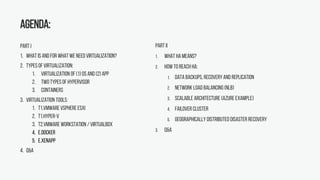
Agenda:
PART I
1. What is and for what we need virtualization?
2. Typesof virtualization:
1. Virtualization of (1) OS and (2) App
2. Two types of hypervisor
3. Containers
3. Virtualization tools:
1. T1.VMware VSphere ESXi
2. T1.Hyper-V
3. T2.VMware Workstation / Virtualbox
4. E.Docker
5. E.XenApp
4. Q&A
PART II
1. What HAmeans?
2. How to reach HA:
1. Data Backups, Recovery and Replication
2. Network Load Balancing (NLB)
3. Scalable Architecture (Azure example)
4. Failover Cluster
5. Geographically Distributed Disaster Recovery
3. Q&A
PartI. Types of virtualization
1.Whatisandforwhatweneedvirtualization?
Virtualizationrefers to the creation of avirtual resource such as a server, desktop, operating system, file,
storage or network
• Toencapsulate and isolate test environment from other apps/distractors
• Toeasy test solutions on many different systems
• ...
2.Typesofvirtualization
2.1.Virtualizationof(1)OSand(2)App
• OS:
• Oracle VirtualBox
• VMware ESXi/Workstation/vSphere
• MS Hyper-V
• MS System Center Virtual Machine Manager (VMM)
• Docker?
• App:
• MS App-V
• Citirix XenApp
• Docker?
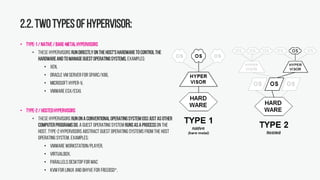
2.2.Twotypesofhypervisor:
• Type-1/native/bare-metalhypervisors
• These hypervisors rundirectlyonthehost'shardwaretocontrolthe
hardwareandtomanageguestoperatingsystems.Examples:
• Xen,
• Oracle VM Server for SPARC/x86,
• Microsoft Hyper-V,
• VMware ESX/ESXi.
• Type-2/ hostedhypervisors
• These hypervisors runona conventionaloperatingsystem(OS)justasother
computerprogramsdo.A guest operating system runsasaprocesson the
host. Type-2 hypervisors abstract guest operating systems from the host
operating system. Examples:
• VMware Workstation/Player,
• VirtualBox,
• Parallels Desktop for Mac
• KVM for Linux and bhyve for FreeBSD*.
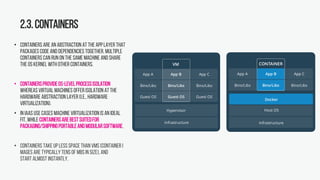
2.3.Containers
• Containers are an abstraction at the applayer that
packages code and dependencies together. Multiple
containers can run on the same machine and share
the OS kernel with other containers.
• ContainersprovideOS-levelprocessisolation
whereas virtual machines offer isolation at the
hardware abstraction layer (i.e., hardware
virtualization).
• In IaaS use cases machine virtualization is an ideal
fit, while containersarebestsuitedfor
packaging/shippingportableandmodularsoftware.
• Containers take up less space than VMs (container i
mages are typicallytens of MBsin size), and
start almost instantly.
3.Virtualizationtools
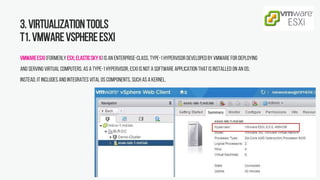
T1.VMwarevSphereESXi
VMwareESXi(formerly ESX;ElasticSkyX) is an enterprise-class, type-1hypervisor developed byVMware for deploying
and serving virtual computers. As a type-1hypervisor, ESXi is not a software application that is installed on an OS;
instead, it includes and integrates vital OS components, such as a kernel.
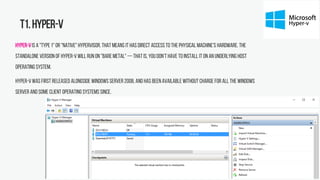
T1.Hyper-V
Hyper-Vis a "type1" or "native" hypervisor.That means it has direct access to the physical machine's hardware. The
standalone version of Hyper-Vwill run on "bare metal" — that is, you don't have to install it on an underlying host
operating system.
Hyper-Vwas first released alongside Windows Server 2008, and has been available without charge for all the Windows
Server and some client operating systems since.
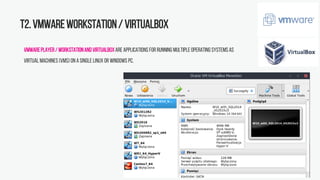
T2.VMwareWorkstation/ Virtualbox
VMwarePlayer/WorkstationandVirtualBoxare applications for running multiple operating systems as
virtual machines (VMs) ona single Linux or Windows PC.
E.Docker
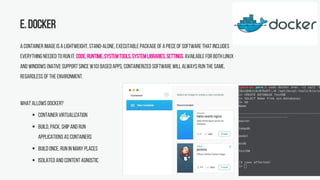
A container image is a lightweight, stand-alone, executable package of a pieceof software that includes
everything needed to run it: code,runtime,systemtools,systemlibraries,settings.Available for bothLinux
and Windows (native support since W10) basedapps, containerized software will always run the same,
regardless of the environment.
What allows Docker?
 Container virtualization
 Build, pack, ship and run
applications as containers
 Build once, run in many places
 Isolated and content agnostic
E.XenApp
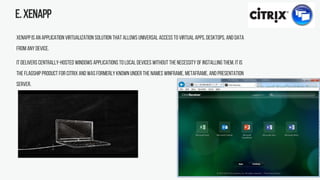
XenApp is an application virtualization solution that allows universal access to virtual apps,desktops, and data
from any device.
It delivers centrally-hosted Windows applications to local devices without the necessity of installing them. It is
the flagship product for Citrix and was formerly known under the names WinFrame, MetaFrame, and Presentation
Server.
4.Q&A
PartII. HA Server Architecture
1.WhatHAmeans?
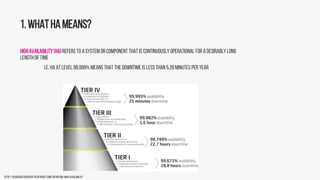
HighAvailability(HA)refers to a system or component that is continuously operational for a desirably long
length of time
i.e. HA at level 99.999% means that the downtime is less than 5.26 minutes per year
http://searchdatacenter.techtarget.com/definition/high-availability
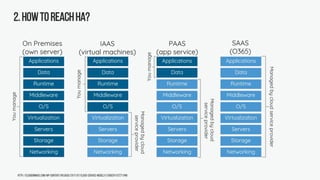
2.HowtoreachHA?
http://cloudonmove.com/wp-content/uploads/2017/07/Cloud-service-models-e1500291137271.png
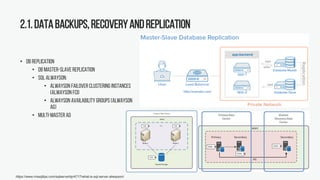
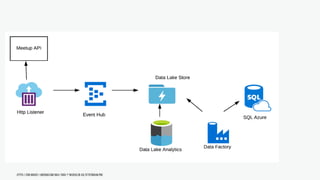
2.1.DataBackups,RecoveryandReplication
• DB replication
• DB master-slave replication
• SQL AlwaysOn:
• AlwaysOn Failover Clustering Instances
(AlwaysOn FCI)
• AlwaysOn Availability Groups (AlwaysOn
AG)
• Multi-master AD
https://www.mssqltips.com/sqlservertip/4717/what-is-sql-server-alwayson/
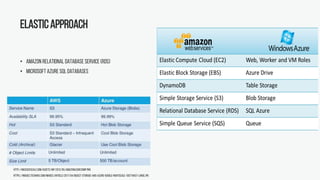
https://images.techhive.com/images/article/2017/04/object-storage-aws-azure-google-rightscale-100719437-large.jpg
http://massivescale.com/assets/wp/2012/05/AmazonAzureComp.png
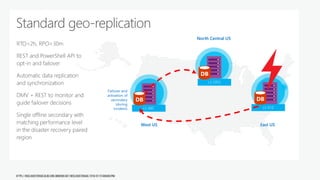
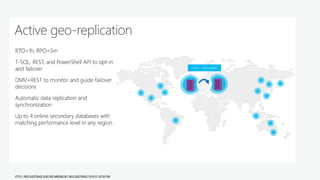
Elasticapproach
• Amazon Relational Database Service (RDS)
• Microsoft Azure SQL Databases
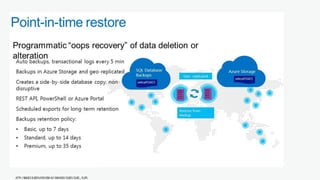
http://images.slideplayer.com/43/10844302/slides/slide_10.jpg
https://mscloudstorage.blob.core.windows.net/mscloudstorage/2016/07/standard.png
https://mscloudstorage.blob.core.windows.net/mscloudstorage/2016/07/active.png
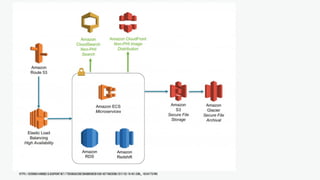
2.2.NetworkLoadBalancing(NLB)
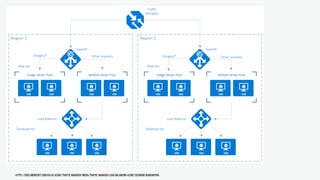
• NLB is a feature that distributes network traffic among multiple servers or virtual machines within a
cluster to avoid overloading any one host and improveperformance
• NLB as WS2012 built-in feature vshardware LB
• NLB vsALB (application)
• Small company vs bigenterprise
• NLB vsDBLB(DB Clustering)
http://searchservervirtualization.techtarget.com/definition/Network-Load-Balancing-NLB
https://docs.microsoft.com/en-us/azure/traffic-manager/media/traffic-manager-load-balancing-azure/scenario-diagram.png
https://d2908q01vomqb2.cloudfront.net/77de68daecd823babbb58edb1c8e14d7106e83bb/2017/02/15/HC1.com_-1024x775.png
https://cdn-images-1.medium.com/max/1600/1*wC8VOl3b-Asl7ktSFDnO4w.png
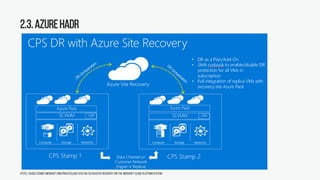
2.3.AzureHADR
https://blogs.technet.microsoft.com/privatecloud/2015/05/20/disaster-recovery-for-the-microsoft-cloud-platform-system/
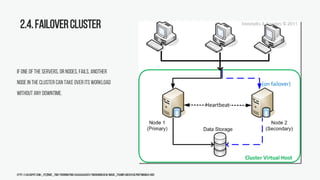
2.4.FailoverCluster
If one of the servers, or nodes, fails, another
node in the cluster can take over its workload
without any downtime.
http://lh4.ggpht.com/_p2ZBNGf_7w8/TbDNNN07n8I/AAAAAAAAGfo/TMKBHwMsAew/image_thumb%5B26%5D.png?imgmax=800
WindowsAzureHyper-VRecoveryManager
Hyper-V Recovery Manager uses the
capabilities provided by WindowsServer's
Hyper-VReplicafeaturetobackupVMs
froma primarydatacentertoa
secondarydatacenter.In the event of an
outage at the primary data center,
Hyper-V Recovery Manager automatesthe
failoverprocessto bring workloads
back up at the secondary site with
minimal downtime. Hyper-V Recovery
Manager can also beused to test the
recovery process
https://msdnshared.blob.core.windows.net/media/TNBlogsFS/prod.evol.blogs.technet.com/CommunityServer.Blogs.Components.WeblogFiles/00/00/00/65/88/metablogapi/7080.clip_image004[8].png
searchservervirtualization.techtarget.com/definition/Windows-Azure-Hyper-V-Recovery-Manager
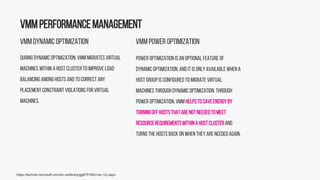
VMMperformancemanagement
VMMDynamic Optimization
During Dynamic Optimization, VMM migrates virtual
machines within a host cluster to improve load
balancing among hosts and to correct any
placement constraint violations for virtual
machines.
VMMPower Optimization
Power Optimization is an optional feature of
Dynamic Optimization, and it is only available when a
host group is configured to migrate virtual
machines through Dynamic Optimization. Through
Power Optimization, VMM helpstosaveenergyby
turningoffhoststhatarenotneededtomeet
resourcerequirementswithina hostclusterand
turns the hosts back on when they are needed again.
https://technet.microsoft.com/en-us/library/gg675109(v=sc.12).aspx
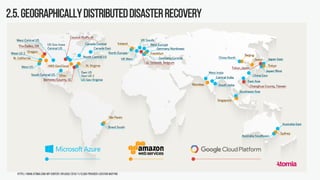
2.5.GeographicallyDistributedDisasterRecovery
https://www.atomia.com/wp-content/uploads/2016/11/cloud-provider-location-map.png
3.Q&A
Sources:
• https://www.atlantech.net/blog/hyper-v-vs.-vmware-which-is-best
• https://en.wikipedia.org/wiki/Hypervisor
• https://en.wikipedia.org/wiki/VMware_ESXi
• https://www.upguard.com/articles/docker-vs.-vmware-how-do-they-stack-up
• https://www.youtube.com/watch?v=mpdUDUVMNKM
• https://www.vladan.fr/vmware-docker-integration-and-more/
• https://www.docker.com/what-container
• https://www.citrix.com/products/xenapp-xendesktop/
• https://redmondmag.com/articles/2014/04/01/citrix-products-evolve.aspx
• https://www.techrepublic.com/blog/10-things/10-things-you-should-know-about-hyper-v/
Types of Virtualisation and High Available Server Infrastructure

Types of Virtualisation and High Available Server Infrastructure