Hereditary disorders 16.16
Dr. Shivani Gupta Borele
1
Hereditary disorders
• Genetic diseases are diseases in which
inherited genes predispose to increased risk.
The genetic disorders associated with cancer
often result from an alteration or mutation in
a single gene.
• Not all genetic disorders are hereditary
disorder.
2
Type of hereditary disorders
• Developmental defect
• Cytogenic (Karyotypic , Chromosomal) defect
• Single gene defect
• Multifactorial inheritance disorders
• Others
3
Developmental disorders
• Development defects are a group of abnormalities during
foetal life due to error in morphogenesis.
• The branch of science dealing with the study of
development anomalies is called teratology.
• Certain chemicals, drugs, physical and biological agents are
known to induce such birth defect and are called
teratogens.
• The morphological abnormalities or defect of an organ or
anatomic region of the body so produced is called
malformation.
• Various developmental anomalies…There could be
agenesis, aplasia, hypoplasia, atresia, developmental
displasia, dystraphic anomalies, ectopic or heterotropia.
4
Developmental disorders
• 1. Anencephaly-spina bifida complex. This is the
group of anomalies resulting from failure to fuse
(dys- traphy). While anencephaly results from failure
of neural tube closure, spina bifida occurs from
incomplete closure of the spinal cord and vertebral
column, often in the lumbar region. The later results
in meningocele or meningomyelocele.
• 2. Thalidomide malformations. Thalidomide is the
best known example of teratogenic drug used as a
seda- tive by pregnant women in 1960s in England
and Germany and resulted in high incidence of limb-
reduction anomalies (phocomelia) in the newborns. 5
Developmental disorders
• 3. Foetal hydantoin syndrome. Babies born to mothers on anti-epileptic
treatment with hydantoin have characteristic facial features and
congenital heart defects. (mental retardetion, microcephaly, growth
retardation-pre and post natal, ear-limb abnormality and positional
deformity
• 4. Foetal alcohol syndrome. Ethanol is another potent teratogen.
Consumption of alcohol by pregnant mother in first trimester increases
the risk of miscarriages, still births, growth retardation and mental
retardation in the newborn.
• 5. TORCH Complex. Infection with TORCH group organisms (Toxoplasma,
Rubella, Cytomegalovirus, and Herpes simplex) during pregnancy is
associated with multisystem anomalies and TORCH syndrome in the
newborn.
• 6. Congenital syphilis. vertical transmission of syphilis from mother to
foetus is characterised by Hutchinson's triad: interstitial keratitis,
sensorineural deafness and deformed Hutchinson's teeth(shorter, widely
spaced incisors), alongwith saddle-nose deformity.
6
Cytogenic (Karyotypic) Abnormalities
• Though chromosomes can be studied in any human
nucleated cells, circulating lymphocytes are more often
used for this purpose. The study is done by arresting the
dividing cells in metaphase by colchicine and then
spreading them on glass slide and staining them with
Giemsa stain.
• Karyotype is the photographic representation of the stained
preparation of chromosomes.
• Each chromosome is composed of a pair of identical double
helix of chromosomal DNA called chromatids. The
chromosomes are classified based on their length and
location of the centromere; centromere is the point where
the two chromatids cross each other. The distal end of each
chromosome is called telomere
7
Cytogenic (Karyotypic) Abnormalities
• Numerical Abnormalities
• As mentioned above, normal karyotype of a human nucleated somatic cell
is diploid or 2 N (46 chromosomes) while the germ cells have haploid or 1
N (23 chromosomes).
• 1. Polyploidy is the term used for the number of chromosomes which is a
multiple of haploid number e.g. triploid or 3 N (69 chromosomes),
tetraploid or 4 N(92 chromosomes). Polyploidy occurs normally
megakaryocytes and dividing liver cells. Polyploidy in somatic cells of
conceptus results in spontaneous abortions.
• 2. Aneuploidy is the number of chromosomes which is not an exact
multiple of haploid number e.g. hypo- diploid or 2N-1 (45 chromosomes)
monosomy, hyper- diploid or 2 N+1 (47 chromosomes) trisomy.
• The most common mechanism of aneuploidy is nondisjunction.
Nondisjunction is the failure of chromosomes to separate normally during
cell division during first or second stage of meiosis, or in mitosis.
8
Cytogenic (Karyotypic) Abnormalities
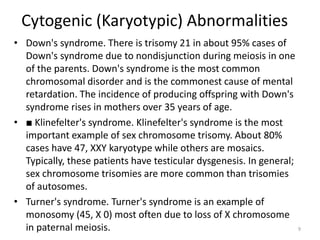
• Down's syndrome. There is trisomy 21 in about 95% cases of
Down's syndrome due to nondisjunction during meiosis in one
of the parents. Down's syndrome is the most common
chromosomal disorder and is the commonest cause of mental
retardation. The incidence of producing offspring with Down's
syndrome rises in mothers over 35 years of age.
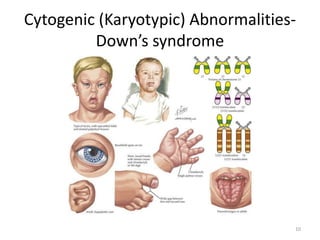
• ■ Klinefelter's syndrome. Klinefelter's syndrome is the most
important example of sex chromosome trisomy. About 80%
cases have 47, XXY karyotype while others are mosaics.
Typically, these patients have testicular dysgenesis. In general;
sex chromosome trisomies are more common than trisomies
of autosomes.
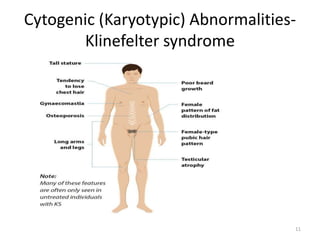
• Turner's syndrome. Turner's syndrome is an example of
monosomy (45, X 0) most often due to loss of X chromosome
in paternal meiosis. 9
Cytogenic (Karyotypic) Abnormalities-
Down’s syndrome
10
Cytogenic (Karyotypic) Abnormalities-
Klinefelter syndrome
11
Cytogenic (Karyotypic) Abnormalities-
Turner syndrome
12
Cytogenic (Karyotypic) Abnormalities
• Structural Abnormalities
• During cell division (meiosis as well as mitosis), certain
structural abnormalities of chromosomes may appear.
These may occur during gametogenesis and then
transmitted to all somatic cells and cause hereditary
transmissible disorders, or may produce somatic cell
mutations and result in changes varying from no effect
to some forms of cancers. Structural abnormalities may
be balanced or unbalanced.
• Deletion, inversion, ring chromosome, isochromosome.
13
Cytogenic (Karyotypic) Abnormalities
14
Cri-du-chat (cat's cry) syndrome
• also known as 5p- (5p minus) syndrome(deletion), is a
chromosomal condition that results when a piece of
chromosome 5 is missing. Infants with this
condition often have a high-pitched cry that sounds like
that of a cat. The disorder is characterized by
intellectual disability and delayed development, small
head size (microcephaly), low birth weight, and weak
muscle tone (hypotonia) in infancy. Affected
individuals also have distinctive facial features,
including widely set eyes (hypertelorism), low-set ears,
a small jaw, and a rounded face. Some children with
cri-du-chat syndrome are born with a heart defect.
15
Single gene defect- Mendelian
disorders- Hereditary disorders
• I.AUTOSOMAL RECESSIVE INHERITANCE
• 1. Thalassaemia- alpha-beta, major- monor.
• 2. Sickle cell anaemia
• 3. Haemochromatosis
• 4. Cystic fibrosis of pancreas
• 5. Albinism
• 6. Wilson's disease
• 7. Xeroderma pigmentosum
• 8. Inborn errors of metabolism (Lysosomal storage diseases, glycogenosis,
alkaptonuria, phenylketonuria)
• II. AUTOSOMAL CODOMINANT INHERITANCE
• 1. ABO blood group antigens
• 2. a 1-antitrypsin deficiency
• 3. HLA antigens (human Leukocyte antigens)
16
Single gene defect- Mendelian
disorders- Hereditary disorders
• III. AUTOSOMAL DOMINANT INHERITANCE
• 1. Familial polyposis coli
• 2. Adult polycystic kidney
• 3. Hereditary spherocytosis
• 4. Neurofibromatosis (von Recklinghausen's disease)
• 5. Marfan's syndrome
• 6. von Willebrand's disease
• 7. Hereditary haemorrhagic telangiectasia
• 8. Acute intermittent porphyria
• 9. Familial hypercholesterolaemia
• 10. Osteogenesis imperfecta
17
Single gene defect- Mendelian
disorders- Hereditary disorders
• IV. SEX-(X-) LINKED RECESSIVE INHERITANCE
• 1. Haemophilia A
• 2. G6PD deficiency
• 3. Diabetes insipidus
• 4. Chronic granulomatous disease
• 5. Colour blindness
• 6. Bruton's agammaglobulinaemia
• 7. Muscular dystrophies
• V. SEX-(X-) LINKED DOMINANT INHERITANCE
• 1. Hypophosphataemic rickets (Vitamin D resisitant Rickets)
• 2. Incontinentia pigmenti
18
DISORDERS WITH
MULTIFACTORIAL INHERITANCE
• These are disorders which result from the combined effect
of genetic composition and environmental influences.
Some normal phenotypic characteristics have also
multifactorial inheritance e.g. colour of hair, eye, skin,
height and intelligence. Examples of disorders where
environmental influences unmask the mutant genes are:
• 1. Cleft lip and cleft palate
• 2. Pyloric stenosis
• 3. Diabetes mellitus
• 4. Hypertension
• 5. Congenital heart disease
• 6. Coronary heart disease.
19
Congenital Disorders
• About 3 to 4 percent of babies are born with some
type of birth defect. A birth defect is a health problem
or a physical abnormality. It can be very mild or severe.
Some birth defects are life-threatening, in which case a
baby may only live for a few months. Birth defects are
also referred to as "congenital anomalies" or
"congenital abnormalities."
• The common birth defects are:
• heart defects, cleft lip/palate, Down syndrome, spina
bifida, juvenile cataract, congenital syphyllis,
microcephaly, albinism, marfan syndrome.
20
Marfan syndrome (e.g. Abraham
Lincoln)
• Marfan syndrome, there is a defect in the gene that encodes the
structure of fibrillin and the elastic fibers, a major component of
connective tissue. This gene is called fibrillin-1 or FBN1.
• Aortic aneurysm, Aortic dissection, heart valve issues, arrhythmias.
• A long, narrow face,Tall and thin body build, Arms, legs, fingers and
toes that may seem too long for the rest of your body, Curved
spine. Scoliosis affects 60% of people with Marfan syndrome,
Nearsightedness (blurring of objects far away). Crowded teeth.
• Lens subluxation (the lens of the eye moves away from its typical
position).
• Cataracts, A difference in the shape of the eye., Retinal
detachment.
• Glaucoma.
• Breastbone (sternum) that may either stick out or be indented.
• Joints that are weak and easily become dislocated. Flat feet.
21

Hereditary diseases-SGB -.pptx

  • 1.
    Hereditary disorders 16.16 Dr.Shivani Gupta Borele 1
  • 2.
    Hereditary disorders • Geneticdiseases are diseases in which inherited genes predispose to increased risk. The genetic disorders associated with cancer often result from an alteration or mutation in a single gene. • Not all genetic disorders are hereditary disorder. 2
  • 3.
    Type of hereditarydisorders • Developmental defect • Cytogenic (Karyotypic , Chromosomal) defect • Single gene defect • Multifactorial inheritance disorders • Others 3
  • 4.
    Developmental disorders • Developmentdefects are a group of abnormalities during foetal life due to error in morphogenesis. • The branch of science dealing with the study of development anomalies is called teratology. • Certain chemicals, drugs, physical and biological agents are known to induce such birth defect and are called teratogens. • The morphological abnormalities or defect of an organ or anatomic region of the body so produced is called malformation. • Various developmental anomalies…There could be agenesis, aplasia, hypoplasia, atresia, developmental displasia, dystraphic anomalies, ectopic or heterotropia. 4
  • 5.
    Developmental disorders • 1.Anencephaly-spina bifida complex. This is the group of anomalies resulting from failure to fuse (dys- traphy). While anencephaly results from failure of neural tube closure, spina bifida occurs from incomplete closure of the spinal cord and vertebral column, often in the lumbar region. The later results in meningocele or meningomyelocele. • 2. Thalidomide malformations. Thalidomide is the best known example of teratogenic drug used as a seda- tive by pregnant women in 1960s in England and Germany and resulted in high incidence of limb- reduction anomalies (phocomelia) in the newborns. 5
  • 6.
    Developmental disorders • 3.Foetal hydantoin syndrome. Babies born to mothers on anti-epileptic treatment with hydantoin have characteristic facial features and congenital heart defects. (mental retardetion, microcephaly, growth retardation-pre and post natal, ear-limb abnormality and positional deformity • 4. Foetal alcohol syndrome. Ethanol is another potent teratogen. Consumption of alcohol by pregnant mother in first trimester increases the risk of miscarriages, still births, growth retardation and mental retardation in the newborn. • 5. TORCH Complex. Infection with TORCH group organisms (Toxoplasma, Rubella, Cytomegalovirus, and Herpes simplex) during pregnancy is associated with multisystem anomalies and TORCH syndrome in the newborn. • 6. Congenital syphilis. vertical transmission of syphilis from mother to foetus is characterised by Hutchinson's triad: interstitial keratitis, sensorineural deafness and deformed Hutchinson's teeth(shorter, widely spaced incisors), alongwith saddle-nose deformity. 6
  • 7.
    Cytogenic (Karyotypic) Abnormalities •Though chromosomes can be studied in any human nucleated cells, circulating lymphocytes are more often used for this purpose. The study is done by arresting the dividing cells in metaphase by colchicine and then spreading them on glass slide and staining them with Giemsa stain. • Karyotype is the photographic representation of the stained preparation of chromosomes. • Each chromosome is composed of a pair of identical double helix of chromosomal DNA called chromatids. The chromosomes are classified based on their length and location of the centromere; centromere is the point where the two chromatids cross each other. The distal end of each chromosome is called telomere 7
  • 8.
    Cytogenic (Karyotypic) Abnormalities •Numerical Abnormalities • As mentioned above, normal karyotype of a human nucleated somatic cell is diploid or 2 N (46 chromosomes) while the germ cells have haploid or 1 N (23 chromosomes). • 1. Polyploidy is the term used for the number of chromosomes which is a multiple of haploid number e.g. triploid or 3 N (69 chromosomes), tetraploid or 4 N(92 chromosomes). Polyploidy occurs normally megakaryocytes and dividing liver cells. Polyploidy in somatic cells of conceptus results in spontaneous abortions. • 2. Aneuploidy is the number of chromosomes which is not an exact multiple of haploid number e.g. hypo- diploid or 2N-1 (45 chromosomes) monosomy, hyper- diploid or 2 N+1 (47 chromosomes) trisomy. • The most common mechanism of aneuploidy is nondisjunction. Nondisjunction is the failure of chromosomes to separate normally during cell division during first or second stage of meiosis, or in mitosis. 8
  • 9.
    Cytogenic (Karyotypic) Abnormalities •Down's syndrome. There is trisomy 21 in about 95% cases of Down's syndrome due to nondisjunction during meiosis in one of the parents. Down's syndrome is the most common chromosomal disorder and is the commonest cause of mental retardation. The incidence of producing offspring with Down's syndrome rises in mothers over 35 years of age. • ■ Klinefelter's syndrome. Klinefelter's syndrome is the most important example of sex chromosome trisomy. About 80% cases have 47, XXY karyotype while others are mosaics. Typically, these patients have testicular dysgenesis. In general; sex chromosome trisomies are more common than trisomies of autosomes. • Turner's syndrome. Turner's syndrome is an example of monosomy (45, X 0) most often due to loss of X chromosome in paternal meiosis. 9
  • 10.
  • 11.
  • 12.
  • 13.
    Cytogenic (Karyotypic) Abnormalities •Structural Abnormalities • During cell division (meiosis as well as mitosis), certain structural abnormalities of chromosomes may appear. These may occur during gametogenesis and then transmitted to all somatic cells and cause hereditary transmissible disorders, or may produce somatic cell mutations and result in changes varying from no effect to some forms of cancers. Structural abnormalities may be balanced or unbalanced. • Deletion, inversion, ring chromosome, isochromosome. 13
  • 14.
  • 15.
    Cri-du-chat (cat's cry)syndrome • also known as 5p- (5p minus) syndrome(deletion), is a chromosomal condition that results when a piece of chromosome 5 is missing. Infants with this condition often have a high-pitched cry that sounds like that of a cat. The disorder is characterized by intellectual disability and delayed development, small head size (microcephaly), low birth weight, and weak muscle tone (hypotonia) in infancy. Affected individuals also have distinctive facial features, including widely set eyes (hypertelorism), low-set ears, a small jaw, and a rounded face. Some children with cri-du-chat syndrome are born with a heart defect. 15
  • 16.
    Single gene defect-Mendelian disorders- Hereditary disorders • I.AUTOSOMAL RECESSIVE INHERITANCE • 1. Thalassaemia- alpha-beta, major- monor. • 2. Sickle cell anaemia • 3. Haemochromatosis • 4. Cystic fibrosis of pancreas • 5. Albinism • 6. Wilson's disease • 7. Xeroderma pigmentosum • 8. Inborn errors of metabolism (Lysosomal storage diseases, glycogenosis, alkaptonuria, phenylketonuria) • II. AUTOSOMAL CODOMINANT INHERITANCE • 1. ABO blood group antigens • 2. a 1-antitrypsin deficiency • 3. HLA antigens (human Leukocyte antigens) 16
  • 17.
    Single gene defect-Mendelian disorders- Hereditary disorders • III. AUTOSOMAL DOMINANT INHERITANCE • 1. Familial polyposis coli • 2. Adult polycystic kidney • 3. Hereditary spherocytosis • 4. Neurofibromatosis (von Recklinghausen's disease) • 5. Marfan's syndrome • 6. von Willebrand's disease • 7. Hereditary haemorrhagic telangiectasia • 8. Acute intermittent porphyria • 9. Familial hypercholesterolaemia • 10. Osteogenesis imperfecta 17
  • 18.
    Single gene defect-Mendelian disorders- Hereditary disorders • IV. SEX-(X-) LINKED RECESSIVE INHERITANCE • 1. Haemophilia A • 2. G6PD deficiency • 3. Diabetes insipidus • 4. Chronic granulomatous disease • 5. Colour blindness • 6. Bruton's agammaglobulinaemia • 7. Muscular dystrophies • V. SEX-(X-) LINKED DOMINANT INHERITANCE • 1. Hypophosphataemic rickets (Vitamin D resisitant Rickets) • 2. Incontinentia pigmenti 18
  • 19.
    DISORDERS WITH MULTIFACTORIAL INHERITANCE •These are disorders which result from the combined effect of genetic composition and environmental influences. Some normal phenotypic characteristics have also multifactorial inheritance e.g. colour of hair, eye, skin, height and intelligence. Examples of disorders where environmental influences unmask the mutant genes are: • 1. Cleft lip and cleft palate • 2. Pyloric stenosis • 3. Diabetes mellitus • 4. Hypertension • 5. Congenital heart disease • 6. Coronary heart disease. 19
  • 20.
    Congenital Disorders • About3 to 4 percent of babies are born with some type of birth defect. A birth defect is a health problem or a physical abnormality. It can be very mild or severe. Some birth defects are life-threatening, in which case a baby may only live for a few months. Birth defects are also referred to as "congenital anomalies" or "congenital abnormalities." • The common birth defects are: • heart defects, cleft lip/palate, Down syndrome, spina bifida, juvenile cataract, congenital syphyllis, microcephaly, albinism, marfan syndrome. 20
  • 21.
    Marfan syndrome (e.g.Abraham Lincoln) • Marfan syndrome, there is a defect in the gene that encodes the structure of fibrillin and the elastic fibers, a major component of connective tissue. This gene is called fibrillin-1 or FBN1. • Aortic aneurysm, Aortic dissection, heart valve issues, arrhythmias. • A long, narrow face,Tall and thin body build, Arms, legs, fingers and toes that may seem too long for the rest of your body, Curved spine. Scoliosis affects 60% of people with Marfan syndrome, Nearsightedness (blurring of objects far away). Crowded teeth. • Lens subluxation (the lens of the eye moves away from its typical position). • Cataracts, A difference in the shape of the eye., Retinal detachment. • Glaucoma. • Breastbone (sternum) that may either stick out or be indented. • Joints that are weak and easily become dislocated. Flat feet. 21