Dr. Shivani Gupta Borele
Associate Professor, Rognidan
 It is of two types –
 Sukha Sadhya- Easy to cure
 Krichra Sadhya - Difficult to cure.
 Su.Su.10/8- Shrotiya, Nrupa, Stree, Baal,
Vruddha, Bhiru, Rajsevak are probable to
incurable.
 Sarvaushadha ksham dehe - The body of patient is
able to tolerate all types of medicines
 Yuvaha - Young patient
 Jitatmanaha - Patient having good control over sense
organs, who follows abstinence
 Amarmagata - If the disease is not affected sensitive
areas like brain, heart, kidney
 Alpahetu - If the cause for disease is mild
 Alparoopa - Mild symptoms
 Anupadrava - no complications
 Atulya dushya desha rutu prakruti - If the Dosha involved,
Dhatu (body tissue) involved, Desha (place), Rutu (season)
and Prakruti (body type) are not influenced by one
particular Dosha,
 Pada sampadi - If qualities of Doctor, patient etc are
present,
 Graha anuguna - If astrology is in favour of the patient
 Eka Doshaja - Disease due to only one Dosha
 Eka Marga - If only one body channel is affected
 Nava - Disease of recent origin / onset
 Disease which require the use of sharp
instruments etc. in treatment and also those
which have mixture of factors enumerated in
previous verses are krcchra sadhya (curable with
difficulty ).
 Diseases which have features entirely opposite of
curable diseases, which have stayed for long
period of time, involving all the important
tissues and vital organs, which have produced
anxiety (fear of death), delusion and
restlessness; which are presenting fatal signs and
which causes loss of sense organs are impossible
to cure.
 (Anupakrama ), which require no therapy, fit to
be rejected, sure to cause death.
 It is of two types –
 Yapya (medicine is required for as long as
patient is alive)- DM, Psoriasis, HIV positive.
 Anupakrama (nothing can be done. ) terminal
stage of carcinoma, multiple organ failure,
AIDS.
 The physician should reject the patient-
 who is hated by physician and the king
 who hates them;
 who hates himself (dejected in life),
 who is not having the equipments and other facilities
required for treatment,
 who is busy with other activities, not having the required
attention, leisure etc. towards the treatment,
 who is disobedient (to the physician),
 whose life is coming to an end, who is of evil mind
(violent, destructive),
 who is afflicted with great grief, who is full of fear, who is
ungrateful and who thinks himself to be a physician (in
respect of deciding drug, therapies, food, activities etc
 Upadrava’s are those which develop after
the manifestation of main disease or during
the disease process itself, which implies
upadrava manifests in the disease process
itself but at the end of it.
 Upadravastu Khalu Rogottarakalajo
Rogashrayo Rog Av Sthuloanurva Rogat
Pashchatjayate Iti Upadravasangyah II
Ch.Chi.21/40
 Upadrava- That which arises after
development of the disease.
 Aoupasargika -That which is produced from
the disease.
 Direct explanation about types of upadrava
is not available in texts.
 But Acharya Charaka while explaining visarpa
chikitsa explains two types of upadrava’s for
visarpa vyadhi on the basis of number as
well as severity, which can be considered for
all the diseases on the basis of Pradesha
Tantrayukti, they are
 If the disease having more in number and
severe (in stage) complications then it is
known as sthoola upadrava.
 E.g.; 1) Visarpa has upadrava’s like
Praklinna, shirnasnayushiramamsa, shava
gandha.
2) Vrana has upadravas like Visarpa,
pakshaghata, sirastamba, apatanaka,
mohaunmada, rujavrana, jwara, trishna,
hanu graham, kasa, chardi, atisara, hikka,
shwasa and vepatu
 If the disease having less in number and
less severe complications then it is known
as anu upadrava.
 E.g.; 1) Trishna has upadravas like Jwara,
moha, kshaya, kasa, shwasa5 .
2) Hrudroga has upadravas like Bhrama,
klama, sada and sosha6 .
 These generally subside once the main disease is
cured.
 It modifies the course of the disease leading to
worse condition because it is manifested in the
patient, who is already debilitated due to
affliction by main disease.
 Rogamadhyakalaja it means upadrava’smanifests
in the course of disease after the actual
symptoms. Here one can observe difference
between lakshana and upadrva. Lakshanas of
the disease are which manifests early and the
latter one manifest after the lakshanas, so
upadravas are known as rogottarakalaja.
 It is mentioned as Rogasraya because the
manifestation of upadrava needs the Doshas
which were responsible for origin of main
disease i.e the cause of upadrava and vyadhi are
same.
 When compared with moolavyadhi, upadrva’s
become apradhana because the chikitsa of
moola vyadhi leads to alleviation of upadrava
too.
 Upadrava’s should is treated immediately
because due to the main disease patient is
become dhurbala, if he develops upadrava
means he further looses strength in turn it is
more difficult to treat.
 In Sadhya- asadhyata of Vyadhi’s In the
sadhya- asadhyata of shoola based on dosha
is, Eka doshaja shoola – sadhya, Dwi doshaja
shoola – kruchrasadhya, Tridoshaja,
upadravayukta shoola - asadhya.
 If the shoola is associated with upadravas
then it is asadhya, it means that it should
not be treated.
 In Chikitsa- Chikitsa can be divided to two types on
the basis severity of the disease they are
A. Moola vyadhi chikitsa
B. Upadrava chikitsa
Moolavyadhi Chikitsa is a treatment given to main
disease. Eg; In sthoola and balavan pramehi
treatment is samshodhana karma In krusha and
dhurbal pramehi treatment is brumhana karma.
Upadrava chikitsa is the treatment given in vyadhijanita
upadrava. Eg; Prameha has seven upadrava’s they
are Saravika, Kacchapika, Jaalani, Sarshapi, Alaji,
Vinatakhya and Vidradi. Treatment principle for
prameha pidaka is, Shastra karma is done after the
samshodhana and ropanakarma.
 Complications
 Sequel
 Comorbidity ( Athritis and DM2)
 Adverse events
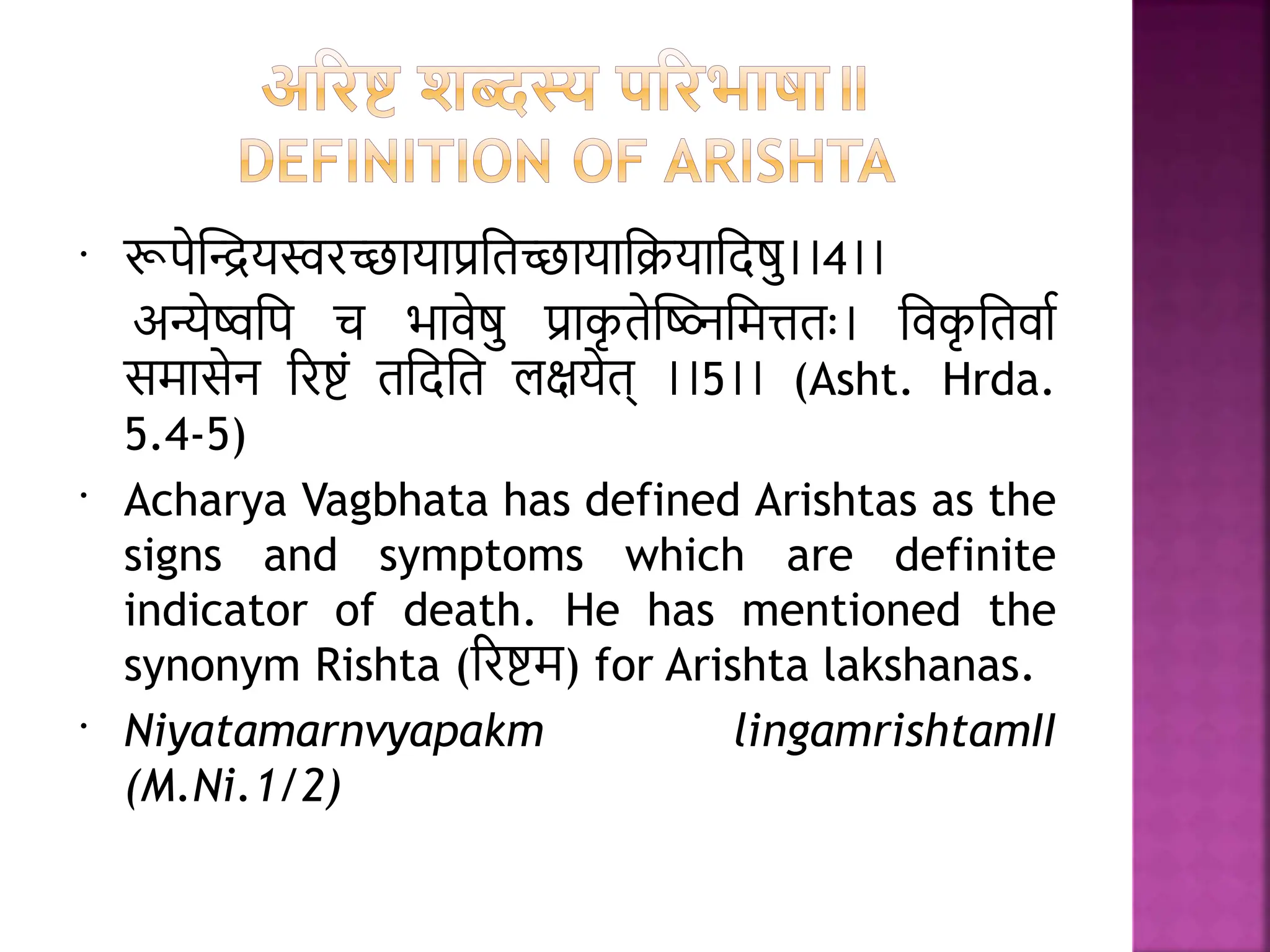
 रूपेन्द्रियस्वरच्छायाप्रतिच्छायातियातिषु।।4।।
अन्येष्वतप च भावेषु प्राक
ृ िेन्द्र्नितित्तिः। तवक
ृ तिवाा
सिासेि ररष्टं ितिति लक्षयेि् ।।5।। (Asht. Hrda.
5.4-5)
 Acharya Vagbhata has defined Arishtas as the
signs and symptoms which are definite
indicator of death. He has mentioned the
synonym Rishta (ररष्टि) for Arishta lakshanas.
 Niyatamarnvyapakm lingamrishtamII
(M.Ni.1/2)
 Similarly Achrya Charaka mentions that,
 अप्येवं िु भवेि् पुष्पं फलेिाििुबन्द्रि यि् । फलं चातप
भवेि् तकतिद्यस्य पुष्पं ि पूवाजि्।।
 ि त्वररष्टस्य जािस्य िाशोऽन्द्रि िरणादृिे । िरणं चातप
िन्नान्द्रि यन्नाररष्टपुरःसरि्।। (Char. Samh. 2.4-5)
 Rishtabhas- (A.Hr.Sa.5/3)
 The flower may sometimes be devoid of
fruits and sometimes even the fruits may be
produced without being preceded by
flowers.
 But once an arishta manifests, it doesn’t
depart without ensuing in death.
 Conversely, death can not occur without
earlier manifestation of arishta.
 Arishtas are classified in 2 types on the basis of
certainty of death.
 Nitaya-Aniyata, Purushashrit- Purushanashrit
 स्थायी अरिष्टानि॥ Sthayi arishta
Sthayi arishta means arishta lakshana which are
definite signs of death. E.g smoke before fire these
symptoms associated with physical constituent
 अस्थायी अरिष्टानि॥ Asthayi arishta
Asthayi arishta means arishta lakshan which are not
always resulted in diseased; for e.g. Cloud before
rain, Charaka acharya stated sometimes vitiated
doshas shows symptoms similar to arishta lakshan but
they will disappear with dosha saamya avashtha (िोष
साम्यावस्था । state of equilibrium of doshas).
 वणा अररष्ट । Varna Arishta
 स्वर अररष्ट । Swara Arishta
 गि अररष्ट । Gandha Arishta
 रस अररष्ट । Rasa Arishta
 स्पशा अररष्ट । Sprasha Arishta
 इन्द्रिय अररष्ट । Indriya Arishta
 पूवारूप अररष्ट । Arishtas related to Purvarupas :
Ominous prodromal symptoms of diseases
 आयु िात्रा तवषयक
् अररष्ट । Duration specific Arishtas
 व्याधीतियि अररष्ट । Disease specific Arishtas
 Ayu-lakhshanas (आयुलक्षणाति। sings of life)
were also stated and if physician see those
(Ayu-lakshana) signs and symptoms then
without wasting any time a physician should
start his treatment. Hence a physician must
have a keen observation in identifying the
arishta lakshana (अररष्ट लक्षणाति) as well as
ayulakshana (आयुलक्षणाति).
 Acharya Vagbhata in Ashtanga Hrdayam says
that,
 अररष्टं िान्द्रि िरणि् दृष्टररष्टं च जीतविि् । (Asht.
Hrda. 5.2)
 Acharya Vagbhata has clearly mentioned that
one may fail to recognize the Arishtas or
differentiate them from clinical features of
diseases.
 Arishta like clinical features might be seen
even when the Doshas (िोषाः) are present in
even more than their excess levels.
 िोषाणाितप बाहुल्यातिष्टाभासः सिुद्भवेि् । (Asht.
Hrda. 5.3)
 This inability to identify and differentiate
between Arishtas and clinical features of
excessive levels of Doshas might cause physician
to land in difficult situation.
 This happens because of Prajnaparadha
(प्रज्ञापराधः) of the physician making the Vaidya
and Rugna (रुग्णः। patient or diseased) suffer.
 Arishtas are wrongly interpreted due to subtle
nature of these symptoms, ignorance or
stupidity of the physician or because such
symptoms are very closely followed by the
death of the patient.
 तिथ्यादृष्टिररष्टाभििररष्टिजाििा| अररष्टं
वाऽप्यसम्बुद्धिेिि् प्रज्ञापराधजि्||६|| (Char.
Samh. 2.6)
 An ignorant person may sometimes wrongly
perceive symptoms presenting in an
individual as arishta lakshana and sometimes
he may even not recognize the arishta
lakshana presenting in an individual, all this
is the result of intellectual errors.
 Acharya Sushruta has briefly mentioned the
exceptions for every death followed by
appearance of Arishta lakshanas.
 He says that even though the death is
certain once Arishtas appear, there are
certain exceptions or ways which have
capacity to ward off this impending death.
 ब्राह्मणैिि् तकलािलैः | रसायििपोजप्यिपरैरैवाा
तिवायािे ||५|| (Sush. Samh. 28.5)
Sadhya Asadhya including  upadrava SGB.pptx

Sadhya Asadhya including upadrava SGB.pptx

  • 1.
    Dr. Shivani GuptaBorele Associate Professor, Rognidan
  • 2.
     It isof two types –  Sukha Sadhya- Easy to cure  Krichra Sadhya - Difficult to cure.  Su.Su.10/8- Shrotiya, Nrupa, Stree, Baal, Vruddha, Bhiru, Rajsevak are probable to incurable.
  • 3.
     Sarvaushadha kshamdehe - The body of patient is able to tolerate all types of medicines  Yuvaha - Young patient  Jitatmanaha - Patient having good control over sense organs, who follows abstinence  Amarmagata - If the disease is not affected sensitive areas like brain, heart, kidney  Alpahetu - If the cause for disease is mild  Alparoopa - Mild symptoms
  • 4.
     Anupadrava -no complications  Atulya dushya desha rutu prakruti - If the Dosha involved, Dhatu (body tissue) involved, Desha (place), Rutu (season) and Prakruti (body type) are not influenced by one particular Dosha,  Pada sampadi - If qualities of Doctor, patient etc are present,  Graha anuguna - If astrology is in favour of the patient  Eka Doshaja - Disease due to only one Dosha  Eka Marga - If only one body channel is affected  Nava - Disease of recent origin / onset
  • 5.
     Disease whichrequire the use of sharp instruments etc. in treatment and also those which have mixture of factors enumerated in previous verses are krcchra sadhya (curable with difficulty ).  Diseases which have features entirely opposite of curable diseases, which have stayed for long period of time, involving all the important tissues and vital organs, which have produced anxiety (fear of death), delusion and restlessness; which are presenting fatal signs and which causes loss of sense organs are impossible to cure.  (Anupakrama ), which require no therapy, fit to be rejected, sure to cause death.
  • 6.
     It isof two types –  Yapya (medicine is required for as long as patient is alive)- DM, Psoriasis, HIV positive.  Anupakrama (nothing can be done. ) terminal stage of carcinoma, multiple organ failure, AIDS.
  • 7.
     The physicianshould reject the patient-  who is hated by physician and the king  who hates them;  who hates himself (dejected in life),  who is not having the equipments and other facilities required for treatment,  who is busy with other activities, not having the required attention, leisure etc. towards the treatment,  who is disobedient (to the physician),  whose life is coming to an end, who is of evil mind (violent, destructive),  who is afflicted with great grief, who is full of fear, who is ungrateful and who thinks himself to be a physician (in respect of deciding drug, therapies, food, activities etc
  • 8.
     Upadrava’s arethose which develop after the manifestation of main disease or during the disease process itself, which implies upadrava manifests in the disease process itself but at the end of it.  Upadravastu Khalu Rogottarakalajo Rogashrayo Rog Av Sthuloanurva Rogat Pashchatjayate Iti Upadravasangyah II Ch.Chi.21/40
  • 9.
     Upadrava- Thatwhich arises after development of the disease.  Aoupasargika -That which is produced from the disease.
  • 10.
     Direct explanationabout types of upadrava is not available in texts.  But Acharya Charaka while explaining visarpa chikitsa explains two types of upadrava’s for visarpa vyadhi on the basis of number as well as severity, which can be considered for all the diseases on the basis of Pradesha Tantrayukti, they are
  • 11.
     If thedisease having more in number and severe (in stage) complications then it is known as sthoola upadrava.  E.g.; 1) Visarpa has upadrava’s like Praklinna, shirnasnayushiramamsa, shava gandha. 2) Vrana has upadravas like Visarpa, pakshaghata, sirastamba, apatanaka, mohaunmada, rujavrana, jwara, trishna, hanu graham, kasa, chardi, atisara, hikka, shwasa and vepatu
  • 12.
     If thedisease having less in number and less severe complications then it is known as anu upadrava.  E.g.; 1) Trishna has upadravas like Jwara, moha, kshaya, kasa, shwasa5 . 2) Hrudroga has upadravas like Bhrama, klama, sada and sosha6 .
  • 13.
     These generallysubside once the main disease is cured.  It modifies the course of the disease leading to worse condition because it is manifested in the patient, who is already debilitated due to affliction by main disease.  Rogamadhyakalaja it means upadrava’smanifests in the course of disease after the actual symptoms. Here one can observe difference between lakshana and upadrva. Lakshanas of the disease are which manifests early and the latter one manifest after the lakshanas, so upadravas are known as rogottarakalaja.
  • 14.
     It ismentioned as Rogasraya because the manifestation of upadrava needs the Doshas which were responsible for origin of main disease i.e the cause of upadrava and vyadhi are same.  When compared with moolavyadhi, upadrva’s become apradhana because the chikitsa of moola vyadhi leads to alleviation of upadrava too.  Upadrava’s should is treated immediately because due to the main disease patient is become dhurbala, if he develops upadrava means he further looses strength in turn it is more difficult to treat.
  • 15.
     In Sadhya-asadhyata of Vyadhi’s In the sadhya- asadhyata of shoola based on dosha is, Eka doshaja shoola – sadhya, Dwi doshaja shoola – kruchrasadhya, Tridoshaja, upadravayukta shoola - asadhya.  If the shoola is associated with upadravas then it is asadhya, it means that it should not be treated.
  • 16.
     In Chikitsa-Chikitsa can be divided to two types on the basis severity of the disease they are A. Moola vyadhi chikitsa B. Upadrava chikitsa Moolavyadhi Chikitsa is a treatment given to main disease. Eg; In sthoola and balavan pramehi treatment is samshodhana karma In krusha and dhurbal pramehi treatment is brumhana karma. Upadrava chikitsa is the treatment given in vyadhijanita upadrava. Eg; Prameha has seven upadrava’s they are Saravika, Kacchapika, Jaalani, Sarshapi, Alaji, Vinatakhya and Vidradi. Treatment principle for prameha pidaka is, Shastra karma is done after the samshodhana and ropanakarma.
  • 17.
     Complications  Sequel Comorbidity ( Athritis and DM2)  Adverse events
  • 18.
     रूपेन्द्रियस्वरच्छायाप्रतिच्छायातियातिषु।।4।। अन्येष्वतप चभावेषु प्राक ृ िेन्द्र्नितित्तिः। तवक ृ तिवाा सिासेि ररष्टं ितिति लक्षयेि् ।।5।। (Asht. Hrda. 5.4-5)  Acharya Vagbhata has defined Arishtas as the signs and symptoms which are definite indicator of death. He has mentioned the synonym Rishta (ररष्टि) for Arishta lakshanas.  Niyatamarnvyapakm lingamrishtamII (M.Ni.1/2)
  • 19.
     Similarly AchryaCharaka mentions that,  अप्येवं िु भवेि् पुष्पं फलेिाििुबन्द्रि यि् । फलं चातप भवेि् तकतिद्यस्य पुष्पं ि पूवाजि्।।  ि त्वररष्टस्य जािस्य िाशोऽन्द्रि िरणादृिे । िरणं चातप िन्नान्द्रि यन्नाररष्टपुरःसरि्।। (Char. Samh. 2.4-5)  Rishtabhas- (A.Hr.Sa.5/3)
  • 20.
     The flowermay sometimes be devoid of fruits and sometimes even the fruits may be produced without being preceded by flowers.  But once an arishta manifests, it doesn’t depart without ensuing in death.  Conversely, death can not occur without earlier manifestation of arishta.
  • 21.
     Arishtas areclassified in 2 types on the basis of certainty of death.  Nitaya-Aniyata, Purushashrit- Purushanashrit  स्थायी अरिष्टानि॥ Sthayi arishta Sthayi arishta means arishta lakshana which are definite signs of death. E.g smoke before fire these symptoms associated with physical constituent  अस्थायी अरिष्टानि॥ Asthayi arishta Asthayi arishta means arishta lakshan which are not always resulted in diseased; for e.g. Cloud before rain, Charaka acharya stated sometimes vitiated doshas shows symptoms similar to arishta lakshan but they will disappear with dosha saamya avashtha (िोष साम्यावस्था । state of equilibrium of doshas).
  • 22.
     वणा अररष्ट। Varna Arishta  स्वर अररष्ट । Swara Arishta  गि अररष्ट । Gandha Arishta  रस अररष्ट । Rasa Arishta  स्पशा अररष्ट । Sprasha Arishta  इन्द्रिय अररष्ट । Indriya Arishta  पूवारूप अररष्ट । Arishtas related to Purvarupas : Ominous prodromal symptoms of diseases  आयु िात्रा तवषयक ् अररष्ट । Duration specific Arishtas  व्याधीतियि अररष्ट । Disease specific Arishtas
  • 23.
     Ayu-lakhshanas (आयुलक्षणाति।sings of life) were also stated and if physician see those (Ayu-lakshana) signs and symptoms then without wasting any time a physician should start his treatment. Hence a physician must have a keen observation in identifying the arishta lakshana (अररष्ट लक्षणाति) as well as ayulakshana (आयुलक्षणाति).  Acharya Vagbhata in Ashtanga Hrdayam says that,  अररष्टं िान्द्रि िरणि् दृष्टररष्टं च जीतविि् । (Asht. Hrda. 5.2)
  • 24.
     Acharya Vagbhatahas clearly mentioned that one may fail to recognize the Arishtas or differentiate them from clinical features of diseases.  Arishta like clinical features might be seen even when the Doshas (िोषाः) are present in even more than their excess levels.  िोषाणाितप बाहुल्यातिष्टाभासः सिुद्भवेि् । (Asht. Hrda. 5.3)
  • 25.
     This inabilityto identify and differentiate between Arishtas and clinical features of excessive levels of Doshas might cause physician to land in difficult situation.  This happens because of Prajnaparadha (प्रज्ञापराधः) of the physician making the Vaidya and Rugna (रुग्णः। patient or diseased) suffer.  Arishtas are wrongly interpreted due to subtle nature of these symptoms, ignorance or stupidity of the physician or because such symptoms are very closely followed by the death of the patient.
  • 26.
     तिथ्यादृष्टिररष्टाभििररष्टिजाििा| अररष्टं वाऽप्यसम्बुद्धिेिि्प्रज्ञापराधजि्||६|| (Char. Samh. 2.6)  An ignorant person may sometimes wrongly perceive symptoms presenting in an individual as arishta lakshana and sometimes he may even not recognize the arishta lakshana presenting in an individual, all this is the result of intellectual errors.
  • 27.
     Acharya Sushrutahas briefly mentioned the exceptions for every death followed by appearance of Arishta lakshanas.  He says that even though the death is certain once Arishtas appear, there are certain exceptions or ways which have capacity to ward off this impending death.  ब्राह्मणैिि् तकलािलैः | रसायििपोजप्यिपरैरैवाा तिवायािे ||५|| (Sush. Samh. 28.5)