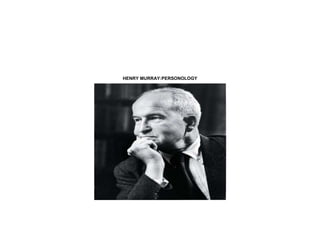
MURRAY: PERSONOLOGY
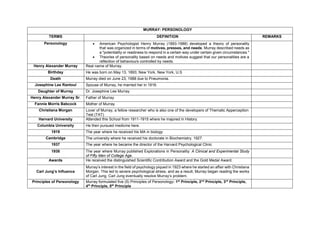
TERMS DEFINITION REMARKS
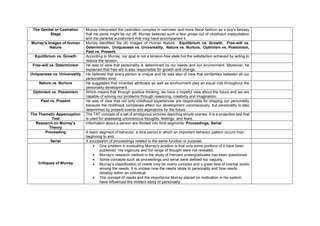
Personology  American Psychologist Henry Murray (1893-1988) developed a theory of personality
that was organized in terms of motives, presses, and needs. Murray described needs as
a "potentiality or readiness to respond in a certain way under certain given circumstances."
 Theories of personality based on needs and motives suggest that our personalities are a
reflection of behaviours controlled by needs.
Henry Alexander Murray Real name of Murray.
Birthday He was born on May 13, 1893; New York, New York, U.S
Death Murray died on June 23, 1988 due to Pneumonia.
Josephine Lee Rantoul Spouse of Murray, he married her in 1916.
Daughter of Murray Dr. Josephine Lee Murray
Henry Alexander Murray Sr. Father of Murray
Fannie Morris Babcock Mother of Murray
Christiana Morgan Lover of Murray, a fellow researcher who is also one of the developers of Thematic Apperception
Test (TAT)
Harvard University Attended this School from 1911-1915 where he majored in History.
Columbia University He then pursued medicine here.
1919 The year where he received his MA in biology
Cambridge The university where he received his doctorate in Biochemistry, 1927.
1937 The year where he became the director of the Harvard Psychological Clinic
1938 The year where Murray published Explorations in Personality: A Clinical and Experimental Study
of Fifty Men of College Age.
Awards He received the distinguished Scientific Contribution Award and the Gold Medal Award.
Carl Jung’s Influence
Murray’s interest in the field of psychology piqued in 1923 where he started an affair with Christiana
Morgan. This led to severe psychological stress, and as a result, Murray began reading the works
of Carl Jung. Carl Jung eventually resolve Murray’s problem.
Principles of Personology Murray formulated five (5) Principles of Personology: 1st
Principle, 2nd
Principle, 3rd
Principle,
4th
Principle, 5th
Principle
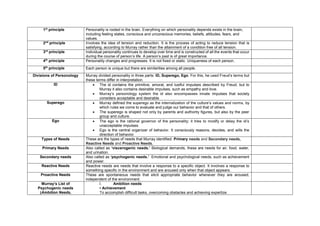
1st
principle Personality is rooted in the brain. Everything on which personality depends exists in the brain,
including feeling states, conscious and unconscious memories, beliefs, attitudes, fears, and
values.
2nd
principle Involves the idea of tension and reduction. It is the process of acting to reduce tension that is
satisfying, according to Murray rather than the attainment of a condition free of all tension.
3rd
principle Individual personality continues to develop over time and is constructed of all the events that occur
during the course of person’s life. A person’s past is of great importance.
4th
principle Personality changes and progresses. It is not fixed or static. Uniqueness of each person.
5th
principle Each person is unique but there are similarities among all people.
Divisions of Personology Murray divided personality in three parts: ID, Superego, Ego. For this, he used Freud’s terms but
these terms differ in interpretation.
ID  The id contains the primitive, amoral, and lustful impulses described by Freud; but to
Murray it also contains desirable impulses, such as empathy and love.
 Murray’s personology system the id also encompasses innate impulses that society
considers acceptable and desirable
Superego  Murray defined the superego as the internalization of the culture’s values and norms, by
which rules we come to evaluate and judge our behavior and that of others.
 The superego is shaped not only by parents and authority figures, but also by the peer
group and culture.
Ego  The ego is the rational governor of the personality; it tries to modify or delay the id’s
unacceptable impulses.
 Ego is the central organizer of behavior. It consciously reasons, decides, and wills the
direction of behavior
Types of Needs These are the types of needs that Murray identified: Primary needs and Secondary needs,
Reactive Needs and Proactive Needs.
Primary Needs Also called as ‘viscerogenic needs.’ Biological demands, these are needs for air, food, water,
and urination.
Secondary needs Also called as ‘psychogenic needs.’ Emotional and psychological needs, such as achievement
and power.
Reactive Needs Reactive needs are needs that involve a response to a specific object. It involves a response to
something specific in the environment and are aroused only when that object appears.
Proactive Needs These are spontaneous needs that elicit appropriate behavior whenever they are aroused,
independent of the environment.
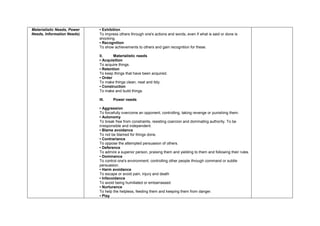
Murray’s List of
Psychogenic needs
(Ambition Needs,
I. Ambition needs
• Achievement
To accomplish difficult tasks, overcoming obstacles and achieving expertize.
Materialistic Needs, Power
Needs, Information Needs)
• Exhibition
To impress others through one's actions and words, even if what is said or done is
shocking.
• Recognition
To show achievements to others and gain recognition for these.
II. Materialistic needs
• Acquisition
To acquire things.
• Retention
To keep things that have been acquired.
• Order
To make things clean, neat and tidy.
• Construction
To make and build things.
III. Power needs
• Aggression
To forcefully overcome an opponent, controlling, taking revenge or punishing them.
• Autonomy
To break free from constraints, resisting coercion and dominating authority. To be
irresponsible and independent.
• Blame avoidance
To not be blamed for things done.
• Contrariance
To oppose the attempted persuasion of others.
• Deference
To admire a superior person, praising them and yielding to them and following their rules.
• Dominance
To control one's environment, controlling other people through command or subtle
persuasion.
• Harm avoidance
To escape or avoid pain, injury and death
• Infavoidance
To avoid being humiliated or embarrassed.
• Nurturance
To help the helpless, feeding them and keeping them from danger.
• Play
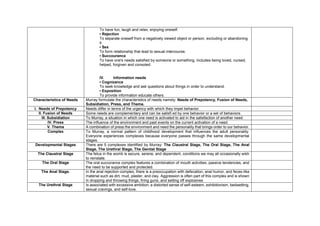
To have fun, laugh and relax, enjoying oneself.
• Rejection
To separate oneself from a negatively viewed object or person, excluding or abandoning
it.
• Sex
To form relationship that lead to sexual intercourse.
• Succourance
To have one's needs satisfied by someone or something. Includes being loved, nursed,
helped, forgiven and consoled.
IV. Information needs
• Cognizance
To seek knowledge and ask questions about things in order to understand.
• Exposition
To provide information educate others.
Characteristics of Needs Murray formulate the characteristics of needs namely: Needs of Prepotency, Fusion of Needs,
Subsidiation, Press, and Thema.
I. Needs of Prepotency Needs differ in terms of the urgency with which they impel behavior.
II. Fusion of Needs Some needs are complementary and can be satisfi ed by one behavior or a set of behaviors.
III. Subsidiation To Murray, a situation in which one need is activated to aid in the satisfaction of another need.
IV. Press The influence of the environment and past events on the current activation of a need.
V. Thema A combination of press the environment and need the personality that brings order to our behavior.
Complex To Murray, a normal pattern of childhood development that influences the adult personality.
Everyone experiences complexes because everyone passes through the same developmental
stages.
Developmental Stages There are 5 complexes identified by Murray: The Claustral Stage, The Oral Stage, The Anal
Stage, The Urethral Stage, The Genital Stage
The Claustral Stage The fetus in the womb is secure, serene, and dependent, conditions we may all occasionally wish
to reinstate.
The Oral Stage The oral succorance complex features a combination of mouth activities, passive tendencies, and
the need to be supported and protected.
The Anal Stage. In the anal rejection complex, there is a preoccupation with defecation, anal humor, and feces-like
material such as dirt, mud, plaster, and clay. Aggression is often part of this complex and is shown
in dropping and throwing things, firing guns, and setting off explosives
The Urethral Stage Is associated with excessive ambition, a distorted sense of self-esteem, exhibitionism, bedwetting,
sexual cravings, and self-love.
The Genital or Castration
Stage
Murray interpreted the castration complex in narrower and more literal fashion as a boy’s fantasy
that his penis might be cut off. Murray believed such a fear grows out of childhood masturbation
and the parental punishment that may have accompanied it.
Murray’s Images of Human
Nature
Murray identified Six (6) Images of Human Nature: Equilibrium vs. Growth, Free-will vs.
Determinism, Uniqueness vs. Universality, Nature vs. Nurture, Optimism vs. Pessimism,
Past vs. Present.
Equilibrium vs. Growth According to Murray, our goal is not a tension-free state but the satisfaction achieved by acting to
reduce the tension.
Free-will vs. Determinism He was of view that personality is determined by our needs and our environment. Moreover, he
explained that free-will is also responsible for growth and change.
Uniqueness vs. Universality He believed that every person is unique and he was also of view that similarities between all our
personalities exist.
Nature vs. Nurture He suggested that inherited attributes as well as environment play an equal role throughout the
personality development.
Optimism vs. Pessimism Which means that through positive thinking, we have a hopeful view about the future and we are
capable of solving our problems through reasoning, creativity and imagination.
Past vs. Present He was of view that not only childhood experiences are responsible for shaping our personality
because the childhood complexes affect our development unconsciously, but personality is also
determined by present events and aspirations for the future.
The Thematic Apperception
Test
The TAT consists of a set of ambiguous pictures depicting simple scenes. It is a projective test that
is used for assessing unconscious thoughts, feelings, and fears.
Research on Murray’s
Theory
Information about a person are divided into time segments: Proceedings, Serial.
Proceeding A basic segment of behavior; a time period in which an important behavior pattern occurs from
beginning to end.
Serial A succession of proceedings related to the same function or purpose.
Critiques of Murray
 One problem in evaluating Murray’s position is that only some portions of it have been
published. His ingenuity and full range of thought were not revealed.
 Murray’s research method in the study of Harvard undergraduates has been questioned.
 Some concepts such as proceedings and serial were defined too vaguely.
 Murray’s classification of needs may be overly complex and a great deal of overlap exists
among the needs. It is unclear how the needs relate to personality and how needs
develop within an individual.
 The concept of needs and the importance Murray placed on motivation in his system
have influenced the modern study of personality.
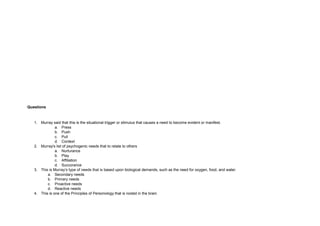
Questions
1. Murray said that this is the situational trigger or stimulus that causes a need to become evident or manifest.
a. Press
b. Push
c. Pull
d. Context
2. Murray's list of psychogenic needs that to relate to others
a. Nurturance
b. Play
c. Affiliation
d. Succorance
3. This is Murray’s type of needs that is based upon biological demands, such as the need for oxygen, food, and water.
a. Secondary needs
b. Primary needs
c. Proactive needs
d. Reactive needs
4. This is one of the Principles of Personology that is rooted in the brain.
a. 2nd Principles
b. 5th Principle
c. 1st Principle
d. 3rd Principle
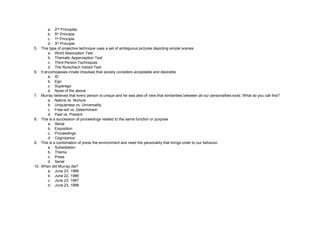
5. This type of projective technique uses a set of ambiguous pictures depicting simple scenes.
a. Word Association Test
b. Thematic Apperception Test
c. Third-Person Techniques
d. The Rorschach Inkblot Test
6. It encompasses innate impulses that society considers acceptable and desirable
a. ID
b. Ego
c. Superego
d. None of the above
7. Murray believed that every person is unique and he was also of view that similarities between all our personalities exist. What do you call this?
a. Nature vs. Nurture
b. Uniqueness vs. Universality
c. Free-will vs. Determinism
d. Past vs. Present
8. This is a succession of proceedings related to the same function or purpose
a. Serial
b. Exposition
c. Proceedings
d. Cognizance
9. This is a combination of press the environment and need the personality that brings order to our behavior.
a. Subsidiation
b. Thema
c. Press
d. Serial
10. When did Murray die?
a. June 23, 1989
b. June 22, 1986
c. June 23, 1987
d. June 23, 1988
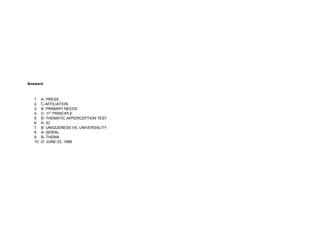
Answers
1. A- PRESS
2. C-AFFILIATION
3. B- PRIMARY NEEDS
4. C- 1ST PRINCIPLE
5. B- THEMATIC APPERCEPTION TEST
6. A- ID
7. B- UNIQUENESS VS. UNIVERSALITY
8. A- SERIAL
9. B- THEMA
10. D- JUNE 23, 1988
HENRY MURRAY:PERSONOLOGY
CONCEIVED BY:
HONEY RUTH GULA
ANGEL MERREN LEGASPI
CAROL LAYOG
ABEGAIL JOY MANLUNAS
RHEXIE SHEEN MARBANO

murray-personologyfinalll.docx

  • 1.
    MURRAY: PERSONOLOGY TERMS DEFINITIONREMARKS Personology  American Psychologist Henry Murray (1893-1988) developed a theory of personality that was organized in terms of motives, presses, and needs. Murray described needs as a "potentiality or readiness to respond in a certain way under certain given circumstances."  Theories of personality based on needs and motives suggest that our personalities are a reflection of behaviours controlled by needs. Henry Alexander Murray Real name of Murray. Birthday He was born on May 13, 1893; New York, New York, U.S Death Murray died on June 23, 1988 due to Pneumonia. Josephine Lee Rantoul Spouse of Murray, he married her in 1916. Daughter of Murray Dr. Josephine Lee Murray Henry Alexander Murray Sr. Father of Murray Fannie Morris Babcock Mother of Murray Christiana Morgan Lover of Murray, a fellow researcher who is also one of the developers of Thematic Apperception Test (TAT) Harvard University Attended this School from 1911-1915 where he majored in History. Columbia University He then pursued medicine here. 1919 The year where he received his MA in biology Cambridge The university where he received his doctorate in Biochemistry, 1927. 1937 The year where he became the director of the Harvard Psychological Clinic 1938 The year where Murray published Explorations in Personality: A Clinical and Experimental Study of Fifty Men of College Age. Awards He received the distinguished Scientific Contribution Award and the Gold Medal Award. Carl Jung’s Influence Murray’s interest in the field of psychology piqued in 1923 where he started an affair with Christiana Morgan. This led to severe psychological stress, and as a result, Murray began reading the works of Carl Jung. Carl Jung eventually resolve Murray’s problem. Principles of Personology Murray formulated five (5) Principles of Personology: 1st Principle, 2nd Principle, 3rd Principle, 4th Principle, 5th Principle
  • 2.
    1st principle Personality isrooted in the brain. Everything on which personality depends exists in the brain, including feeling states, conscious and unconscious memories, beliefs, attitudes, fears, and values. 2nd principle Involves the idea of tension and reduction. It is the process of acting to reduce tension that is satisfying, according to Murray rather than the attainment of a condition free of all tension. 3rd principle Individual personality continues to develop over time and is constructed of all the events that occur during the course of person’s life. A person’s past is of great importance. 4th principle Personality changes and progresses. It is not fixed or static. Uniqueness of each person. 5th principle Each person is unique but there are similarities among all people. Divisions of Personology Murray divided personality in three parts: ID, Superego, Ego. For this, he used Freud’s terms but these terms differ in interpretation. ID  The id contains the primitive, amoral, and lustful impulses described by Freud; but to Murray it also contains desirable impulses, such as empathy and love.  Murray’s personology system the id also encompasses innate impulses that society considers acceptable and desirable Superego  Murray defined the superego as the internalization of the culture’s values and norms, by which rules we come to evaluate and judge our behavior and that of others.  The superego is shaped not only by parents and authority figures, but also by the peer group and culture. Ego  The ego is the rational governor of the personality; it tries to modify or delay the id’s unacceptable impulses.  Ego is the central organizer of behavior. It consciously reasons, decides, and wills the direction of behavior Types of Needs These are the types of needs that Murray identified: Primary needs and Secondary needs, Reactive Needs and Proactive Needs. Primary Needs Also called as ‘viscerogenic needs.’ Biological demands, these are needs for air, food, water, and urination. Secondary needs Also called as ‘psychogenic needs.’ Emotional and psychological needs, such as achievement and power. Reactive Needs Reactive needs are needs that involve a response to a specific object. It involves a response to something specific in the environment and are aroused only when that object appears. Proactive Needs These are spontaneous needs that elicit appropriate behavior whenever they are aroused, independent of the environment. Murray’s List of Psychogenic needs (Ambition Needs, I. Ambition needs • Achievement To accomplish difficult tasks, overcoming obstacles and achieving expertize.
  • 3.
    Materialistic Needs, Power Needs,Information Needs) • Exhibition To impress others through one's actions and words, even if what is said or done is shocking. • Recognition To show achievements to others and gain recognition for these. II. Materialistic needs • Acquisition To acquire things. • Retention To keep things that have been acquired. • Order To make things clean, neat and tidy. • Construction To make and build things. III. Power needs • Aggression To forcefully overcome an opponent, controlling, taking revenge or punishing them. • Autonomy To break free from constraints, resisting coercion and dominating authority. To be irresponsible and independent. • Blame avoidance To not be blamed for things done. • Contrariance To oppose the attempted persuasion of others. • Deference To admire a superior person, praising them and yielding to them and following their rules. • Dominance To control one's environment, controlling other people through command or subtle persuasion. • Harm avoidance To escape or avoid pain, injury and death • Infavoidance To avoid being humiliated or embarrassed. • Nurturance To help the helpless, feeding them and keeping them from danger. • Play
  • 4.
    To have fun,laugh and relax, enjoying oneself. • Rejection To separate oneself from a negatively viewed object or person, excluding or abandoning it. • Sex To form relationship that lead to sexual intercourse. • Succourance To have one's needs satisfied by someone or something. Includes being loved, nursed, helped, forgiven and consoled. IV. Information needs • Cognizance To seek knowledge and ask questions about things in order to understand. • Exposition To provide information educate others. Characteristics of Needs Murray formulate the characteristics of needs namely: Needs of Prepotency, Fusion of Needs, Subsidiation, Press, and Thema. I. Needs of Prepotency Needs differ in terms of the urgency with which they impel behavior. II. Fusion of Needs Some needs are complementary and can be satisfi ed by one behavior or a set of behaviors. III. Subsidiation To Murray, a situation in which one need is activated to aid in the satisfaction of another need. IV. Press The influence of the environment and past events on the current activation of a need. V. Thema A combination of press the environment and need the personality that brings order to our behavior. Complex To Murray, a normal pattern of childhood development that influences the adult personality. Everyone experiences complexes because everyone passes through the same developmental stages. Developmental Stages There are 5 complexes identified by Murray: The Claustral Stage, The Oral Stage, The Anal Stage, The Urethral Stage, The Genital Stage The Claustral Stage The fetus in the womb is secure, serene, and dependent, conditions we may all occasionally wish to reinstate. The Oral Stage The oral succorance complex features a combination of mouth activities, passive tendencies, and the need to be supported and protected. The Anal Stage. In the anal rejection complex, there is a preoccupation with defecation, anal humor, and feces-like material such as dirt, mud, plaster, and clay. Aggression is often part of this complex and is shown in dropping and throwing things, firing guns, and setting off explosives The Urethral Stage Is associated with excessive ambition, a distorted sense of self-esteem, exhibitionism, bedwetting, sexual cravings, and self-love.
  • 5.
    The Genital orCastration Stage Murray interpreted the castration complex in narrower and more literal fashion as a boy’s fantasy that his penis might be cut off. Murray believed such a fear grows out of childhood masturbation and the parental punishment that may have accompanied it. Murray’s Images of Human Nature Murray identified Six (6) Images of Human Nature: Equilibrium vs. Growth, Free-will vs. Determinism, Uniqueness vs. Universality, Nature vs. Nurture, Optimism vs. Pessimism, Past vs. Present. Equilibrium vs. Growth According to Murray, our goal is not a tension-free state but the satisfaction achieved by acting to reduce the tension. Free-will vs. Determinism He was of view that personality is determined by our needs and our environment. Moreover, he explained that free-will is also responsible for growth and change. Uniqueness vs. Universality He believed that every person is unique and he was also of view that similarities between all our personalities exist. Nature vs. Nurture He suggested that inherited attributes as well as environment play an equal role throughout the personality development. Optimism vs. Pessimism Which means that through positive thinking, we have a hopeful view about the future and we are capable of solving our problems through reasoning, creativity and imagination. Past vs. Present He was of view that not only childhood experiences are responsible for shaping our personality because the childhood complexes affect our development unconsciously, but personality is also determined by present events and aspirations for the future. The Thematic Apperception Test The TAT consists of a set of ambiguous pictures depicting simple scenes. It is a projective test that is used for assessing unconscious thoughts, feelings, and fears. Research on Murray’s Theory Information about a person are divided into time segments: Proceedings, Serial. Proceeding A basic segment of behavior; a time period in which an important behavior pattern occurs from beginning to end. Serial A succession of proceedings related to the same function or purpose. Critiques of Murray  One problem in evaluating Murray’s position is that only some portions of it have been published. His ingenuity and full range of thought were not revealed.  Murray’s research method in the study of Harvard undergraduates has been questioned.  Some concepts such as proceedings and serial were defined too vaguely.  Murray’s classification of needs may be overly complex and a great deal of overlap exists among the needs. It is unclear how the needs relate to personality and how needs develop within an individual.  The concept of needs and the importance Murray placed on motivation in his system have influenced the modern study of personality.
  • 6.
    Questions 1. Murray saidthat this is the situational trigger or stimulus that causes a need to become evident or manifest. a. Press b. Push c. Pull d. Context 2. Murray's list of psychogenic needs that to relate to others a. Nurturance b. Play c. Affiliation d. Succorance 3. This is Murray’s type of needs that is based upon biological demands, such as the need for oxygen, food, and water. a. Secondary needs b. Primary needs c. Proactive needs d. Reactive needs 4. This is one of the Principles of Personology that is rooted in the brain.
  • 7.
    a. 2nd Principles b.5th Principle c. 1st Principle d. 3rd Principle 5. This type of projective technique uses a set of ambiguous pictures depicting simple scenes. a. Word Association Test b. Thematic Apperception Test c. Third-Person Techniques d. The Rorschach Inkblot Test 6. It encompasses innate impulses that society considers acceptable and desirable a. ID b. Ego c. Superego d. None of the above 7. Murray believed that every person is unique and he was also of view that similarities between all our personalities exist. What do you call this? a. Nature vs. Nurture b. Uniqueness vs. Universality c. Free-will vs. Determinism d. Past vs. Present 8. This is a succession of proceedings related to the same function or purpose a. Serial b. Exposition c. Proceedings d. Cognizance 9. This is a combination of press the environment and need the personality that brings order to our behavior. a. Subsidiation b. Thema c. Press d. Serial 10. When did Murray die? a. June 23, 1989 b. June 22, 1986 c. June 23, 1987 d. June 23, 1988
  • 8.
    Answers 1. A- PRESS 2.C-AFFILIATION 3. B- PRIMARY NEEDS 4. C- 1ST PRINCIPLE 5. B- THEMATIC APPERCEPTION TEST 6. A- ID 7. B- UNIQUENESS VS. UNIVERSALITY 8. A- SERIAL 9. B- THEMA 10. D- JUNE 23, 1988
  • 9.
  • 10.
    CONCEIVED BY: HONEY RUTHGULA ANGEL MERREN LEGASPI CAROL LAYOG ABEGAIL JOY MANLUNAS RHEXIE SHEEN MARBANO