ENTREPRENEURSHIP BOOK
ASSIGNMENT
SUBMITTED BY-
DIVYANSH KAUSHIK
501904011
1MBA1
SUBMITTED TO-
DR.KARMINDER GHUMAN
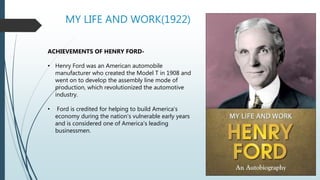
MY LIFE AND WORK(1922)
ACHIEVEMENTS OF HENRY FORD-
• Henry Ford was an American automobile
manufacturer who created the Model T in 1908 and
went on to develop the assembly line mode of
production, which revolutionized the automotive
industry.
• Ford is credited for helping to build America's
economy during the nation's vulnerable early years
and is considered one of America's leading
businessmen.
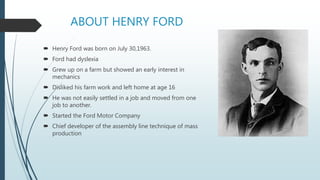
ABOUT HENRY FORD
 Henry Ford was born on July 30,1963.
 Ford had dyslexia
 Grew up on a farm but showed an early interest in
mechanics
 Disliked his farm work and left home at age 16
 He was not easily settled in a job and moved from one
job to another.
 Started the Ford Motor Company
 Chief developer of the assembly line technique of mass
production
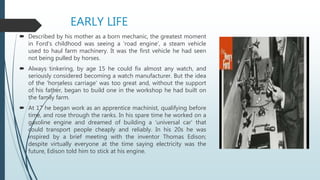
EARLY LIFE
 Described by his mother as a born mechanic, the greatest moment
in Ford's childhood was seeing a 'road engine', a steam vehicle
used to haul farm machinery. It was the first vehicle he had seen
not being pulled by horses.
 Always tinkering, by age 15 he could fix almost any watch, and
seriously considered becoming a watch manufacturer. But the idea
of the 'horseless carriage' was too great and, without the support
of his father, began to build one in the workshop he had built on
the family farm.
 At 17 he began work as an apprentice machinist, qualifying before
time, and rose through the ranks. In his spare time he worked on a
gasoline engine and dreamed of building a 'universal car' that
could transport people cheaply and reliably. In his 20s he was
inspired by a brief meeting with the inventor Thomas Edison;
despite virtually everyone at the time saying electricity was the
future, Edison told him to stick at his engine.
LEAVING JOB AND PURSUING HIS DREAM
 Ford had joined up with a group of investors to form the Detroit Automobile Company. He
quickly found that they were more interested in quick profits than engineering a better machine,
so he resigned.
 He began The Ford Motor Company. Over 1700 cars were built in the first year of operation, and
the 'Model A' gained a reputation for reliability. The second year, giving into pressure from
business associates, Ford brought out three models and raised prices. They sold fewer vehicles.
He realized he had to have ownership in order to have full control.
 In 1908-09 the firm sold over 10,000 cars, and again there was pressure to 'expand the range'.
Ford went in exactly the opposite direction that Ford would now sell only one model: the Model
T. What's more, it would be available in only one colour.
 FAMOUS QUOTE-
"Any customer can have a car painted any colour that he wants so long as it is black“ –HENRY FORD
SUCCESS STORY
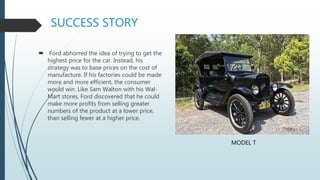
 Ford abhorred the idea of trying to get the
highest price for the car. Instead, his
strategy was to base prices on the cost of
manufacture. If his factories could be made
more and more efficient, the consumer
would win. Like Sam Walton with his Wal-
Mart stores, Ford discovered that he could
make more profits from selling greater
numbers of the product at a lower price,
than selling fewer at a higher price.
MODEL T
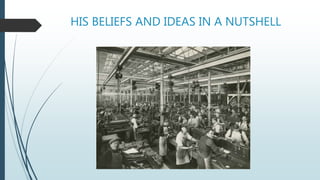
HIS BELIEFS AND IDEAS IN A NUTSHELL
What he realized about business:
 That finance is given a place ahead of work and therefore tends to kill the work
and destroy the fundamental of service.
 That thinking first of money instead of work brings on fear of failure and this fear
blocks every avenue of business—it makes a man afraid of competition, of
changing his methods, or of doing anything which might change his condition.
 That the way is clear for any one who thinks first of service—of doing the work in
the best possible way.
WORK AND WAGES
 Ford believed that high wages increased the stability of the workforce and helped
the men to concentrate, knowing that their families were taken care of. It also
allowed them to be consumers, not just for Ford cars but for other goods and
services which kept the economy buoyant.
 Ford's hiring methods were unusual. Of prospective workers, the firm wanted to
know little more than their name, age, marital status and whether they were willing
to work. Not speaking English and having a criminal record were not a problem. He
did not hire 'experts' because they usually only knew what could not be done; he
preferred 'fools who would rush in' to tackle problems with an open mind.
 Blind people, deaf and dumb people, men with only one leg or arm - all were
employed by Ford at the same wage of the able-bodied.
SOLVING THE PROBLEM OF RED TAPISM
 Earlier, It takes about six weeks for the message
of a man living in the lower left-hand corner of
the department to reach the president or
chairman of the board.
 the Ford factories and enterprises had no
organization, no specific duties attaching to any
position, no line of succession or of authority,
very few titles, and no conferences. We have only
the clerical help that is absolutely required; we
have no elaborate records of any kind, and
consequently no red tape.
 Because there are no titles and no limits of
authority, there is no question of red tape or
going over a man's head.
IDEOLOGY OF SERVICE
 There was no 'after sales service‘ at that time. Car makers were totally focused on
the selling rather than building a relationship with customers, and it was
considered 'good business' to charge a lot for spare parts because the owner had
no choice but to buy them.
 Ford believed that the sale of a car was just the beginning of a relationship with a
buyer. He built his cars to last, but also made sure parts were transferable across
models, cheap, and easy to install.
 This ideal of service might have seemed crazy to other manufacturers, but the trust
it built up among the public was priceless.
SAVINGS AND INVESTMENT IDEA
 He counsels against worrying too much about savings and investments as we
normally think of them.
 He says: "You are not 'saving' when you prevent yourself from becoming more
productive. You are really taking away from your ultimate capital; you are taking
away the value of one of nature's investments." He is talking about YOU. Refining
your ability to think, investing in yourself, should be your investment priority; it
always provides the best returns.
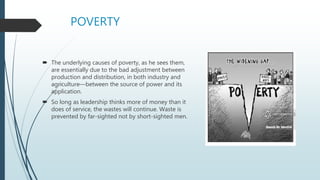
POVERTY
 The underlying causes of poverty, as he sees them,
are essentially due to the bad adjustment between
production and distribution, in both industry and
agriculture—between the source of power and its
application.
 So long as leadership thinks more of money than it
does of service, the wastes will continue. Waste is
prevented by far-sighted not by short-sighted men.
CHARITY
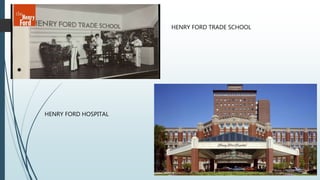
 To meet this condition—to fulfill the boy's educational
possibilities and at the same time begin his industrial
training along constructive lines—the Henry Ford Trade
School was incorporated in 1916.
 The school is incorporated as a private school and is
open to boys between the ages of twelve and eighteen. It
is organized on the basis of scholar2ships and each boy is
awarded an annual cash scholarship of four hundred
dollars at his entrance. This is gradually increased to a
maximum of six hundred dollars if his record is
satisfactory.
 He thought that there are plenty of hospitals for the rich.
There are plenty of hospitals for the poor. There are no
hospitals for those who can afford to pay only a
moderate amount and yet desire to pay without a feeling
that they are recipients of charity. So he made a hospital
named Detroit General Hospital.
HENRY FORD TRADE SCHOOL
HENRY FORD HOSPITAL
THE PRINCIPLES HE TRIES TO SAY DURING
THE COURSE OF THE BOOK
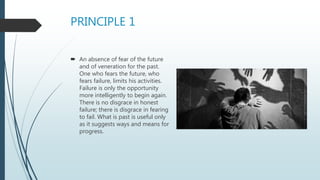
PRINCIPLE 1
 An absence of fear of the future
and of veneration for the past.
One who fears the future, who
fears failure, limits his activities.
Failure is only the opportunity
more intelligently to begin again.
There is no disgrace in honest
failure; there is disgrace in fearing
to fail. What is past is useful only
as it suggests ways and means for
progress.
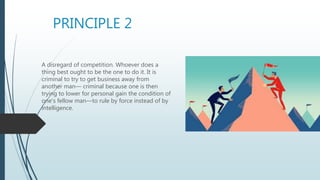
PRINCIPLE 2
A disregard of competition. Whoever does a
thing best ought to be the one to do it. It is
criminal to try to get business away from
another man— criminal because one is then
trying to lower for personal gain the condition of
one's fellow man—to rule by force instead of by
intelligence.
PRINCIPLE 3
 The putting of service before profit. Without
a profit, business cannot extend. There is
nothing inherently wrong about making a
profit. Well conducted business enterprise
cannot fail to return a profit, but profit must
and inevitably will come as a reward for
good service. It cannot be the basis—it must
be the result of service.
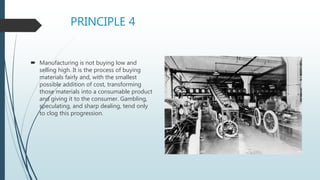
PRINCIPLE 4
 Manufacturing is not buying low and
selling high. It is the process of buying
materials fairly and, with the smallest
possible addition of cost, transforming
those materials into a consumable product
and giving it to the consumer. Gambling,
speculating, and sharp dealing, tend only
to clog this progression.
SUMMARY
 Ford combined two traits often seen in the super-successful person: an original,
far-reaching vision that carries with it the potential to change the world; and an
obsessive attention to detail that can drive other people mad.
 He counsels against worrying too much about savings and investments as we
normally think of them.
 He was of the belief that education should not be about remembering facts, but
teaching people how to think better.
 He believes that refining your ability to think, investing in yourself, should be your
investment priority; it always provides the best returns.
THANK YOU!

My life and Work-Henry Ford

  • 1.
    ENTREPRENEURSHIP BOOK ASSIGNMENT SUBMITTED BY- DIVYANSHKAUSHIK 501904011 1MBA1 SUBMITTED TO- DR.KARMINDER GHUMAN
  • 2.
    MY LIFE ANDWORK(1922) ACHIEVEMENTS OF HENRY FORD- • Henry Ford was an American automobile manufacturer who created the Model T in 1908 and went on to develop the assembly line mode of production, which revolutionized the automotive industry. • Ford is credited for helping to build America's economy during the nation's vulnerable early years and is considered one of America's leading businessmen.
  • 3.
    ABOUT HENRY FORD Henry Ford was born on July 30,1963.  Ford had dyslexia  Grew up on a farm but showed an early interest in mechanics  Disliked his farm work and left home at age 16  He was not easily settled in a job and moved from one job to another.  Started the Ford Motor Company  Chief developer of the assembly line technique of mass production
  • 4.
    EARLY LIFE  Describedby his mother as a born mechanic, the greatest moment in Ford's childhood was seeing a 'road engine', a steam vehicle used to haul farm machinery. It was the first vehicle he had seen not being pulled by horses.  Always tinkering, by age 15 he could fix almost any watch, and seriously considered becoming a watch manufacturer. But the idea of the 'horseless carriage' was too great and, without the support of his father, began to build one in the workshop he had built on the family farm.  At 17 he began work as an apprentice machinist, qualifying before time, and rose through the ranks. In his spare time he worked on a gasoline engine and dreamed of building a 'universal car' that could transport people cheaply and reliably. In his 20s he was inspired by a brief meeting with the inventor Thomas Edison; despite virtually everyone at the time saying electricity was the future, Edison told him to stick at his engine.
  • 5.
    LEAVING JOB ANDPURSUING HIS DREAM  Ford had joined up with a group of investors to form the Detroit Automobile Company. He quickly found that they were more interested in quick profits than engineering a better machine, so he resigned.  He began The Ford Motor Company. Over 1700 cars were built in the first year of operation, and the 'Model A' gained a reputation for reliability. The second year, giving into pressure from business associates, Ford brought out three models and raised prices. They sold fewer vehicles. He realized he had to have ownership in order to have full control.  In 1908-09 the firm sold over 10,000 cars, and again there was pressure to 'expand the range'. Ford went in exactly the opposite direction that Ford would now sell only one model: the Model T. What's more, it would be available in only one colour.  FAMOUS QUOTE- "Any customer can have a car painted any colour that he wants so long as it is black“ –HENRY FORD
  • 6.
    SUCCESS STORY  Fordabhorred the idea of trying to get the highest price for the car. Instead, his strategy was to base prices on the cost of manufacture. If his factories could be made more and more efficient, the consumer would win. Like Sam Walton with his Wal- Mart stores, Ford discovered that he could make more profits from selling greater numbers of the product at a lower price, than selling fewer at a higher price. MODEL T
  • 7.
    HIS BELIEFS ANDIDEAS IN A NUTSHELL
  • 8.
    What he realizedabout business:  That finance is given a place ahead of work and therefore tends to kill the work and destroy the fundamental of service.  That thinking first of money instead of work brings on fear of failure and this fear blocks every avenue of business—it makes a man afraid of competition, of changing his methods, or of doing anything which might change his condition.  That the way is clear for any one who thinks first of service—of doing the work in the best possible way.
  • 9.
    WORK AND WAGES Ford believed that high wages increased the stability of the workforce and helped the men to concentrate, knowing that their families were taken care of. It also allowed them to be consumers, not just for Ford cars but for other goods and services which kept the economy buoyant.  Ford's hiring methods were unusual. Of prospective workers, the firm wanted to know little more than their name, age, marital status and whether they were willing to work. Not speaking English and having a criminal record were not a problem. He did not hire 'experts' because they usually only knew what could not be done; he preferred 'fools who would rush in' to tackle problems with an open mind.  Blind people, deaf and dumb people, men with only one leg or arm - all were employed by Ford at the same wage of the able-bodied.
  • 10.
    SOLVING THE PROBLEMOF RED TAPISM  Earlier, It takes about six weeks for the message of a man living in the lower left-hand corner of the department to reach the president or chairman of the board.  the Ford factories and enterprises had no organization, no specific duties attaching to any position, no line of succession or of authority, very few titles, and no conferences. We have only the clerical help that is absolutely required; we have no elaborate records of any kind, and consequently no red tape.  Because there are no titles and no limits of authority, there is no question of red tape or going over a man's head.
  • 11.
    IDEOLOGY OF SERVICE There was no 'after sales service‘ at that time. Car makers were totally focused on the selling rather than building a relationship with customers, and it was considered 'good business' to charge a lot for spare parts because the owner had no choice but to buy them.  Ford believed that the sale of a car was just the beginning of a relationship with a buyer. He built his cars to last, but also made sure parts were transferable across models, cheap, and easy to install.  This ideal of service might have seemed crazy to other manufacturers, but the trust it built up among the public was priceless.
  • 12.
    SAVINGS AND INVESTMENTIDEA  He counsels against worrying too much about savings and investments as we normally think of them.  He says: "You are not 'saving' when you prevent yourself from becoming more productive. You are really taking away from your ultimate capital; you are taking away the value of one of nature's investments." He is talking about YOU. Refining your ability to think, investing in yourself, should be your investment priority; it always provides the best returns.
  • 13.
    POVERTY  The underlyingcauses of poverty, as he sees them, are essentially due to the bad adjustment between production and distribution, in both industry and agriculture—between the source of power and its application.  So long as leadership thinks more of money than it does of service, the wastes will continue. Waste is prevented by far-sighted not by short-sighted men.
  • 14.
    CHARITY  To meetthis condition—to fulfill the boy's educational possibilities and at the same time begin his industrial training along constructive lines—the Henry Ford Trade School was incorporated in 1916.  The school is incorporated as a private school and is open to boys between the ages of twelve and eighteen. It is organized on the basis of scholar2ships and each boy is awarded an annual cash scholarship of four hundred dollars at his entrance. This is gradually increased to a maximum of six hundred dollars if his record is satisfactory.  He thought that there are plenty of hospitals for the rich. There are plenty of hospitals for the poor. There are no hospitals for those who can afford to pay only a moderate amount and yet desire to pay without a feeling that they are recipients of charity. So he made a hospital named Detroit General Hospital.
  • 15.
    HENRY FORD TRADESCHOOL HENRY FORD HOSPITAL
  • 16.
    THE PRINCIPLES HETRIES TO SAY DURING THE COURSE OF THE BOOK
  • 17.
    PRINCIPLE 1  Anabsence of fear of the future and of veneration for the past. One who fears the future, who fears failure, limits his activities. Failure is only the opportunity more intelligently to begin again. There is no disgrace in honest failure; there is disgrace in fearing to fail. What is past is useful only as it suggests ways and means for progress.
  • 18.
    PRINCIPLE 2 A disregardof competition. Whoever does a thing best ought to be the one to do it. It is criminal to try to get business away from another man— criminal because one is then trying to lower for personal gain the condition of one's fellow man—to rule by force instead of by intelligence.
  • 19.
    PRINCIPLE 3  Theputting of service before profit. Without a profit, business cannot extend. There is nothing inherently wrong about making a profit. Well conducted business enterprise cannot fail to return a profit, but profit must and inevitably will come as a reward for good service. It cannot be the basis—it must be the result of service.
  • 20.
    PRINCIPLE 4  Manufacturingis not buying low and selling high. It is the process of buying materials fairly and, with the smallest possible addition of cost, transforming those materials into a consumable product and giving it to the consumer. Gambling, speculating, and sharp dealing, tend only to clog this progression.
  • 21.
    SUMMARY  Ford combinedtwo traits often seen in the super-successful person: an original, far-reaching vision that carries with it the potential to change the world; and an obsessive attention to detail that can drive other people mad.  He counsels against worrying too much about savings and investments as we normally think of them.  He was of the belief that education should not be about remembering facts, but teaching people how to think better.  He believes that refining your ability to think, investing in yourself, should be your investment priority; it always provides the best returns.
  • 22.