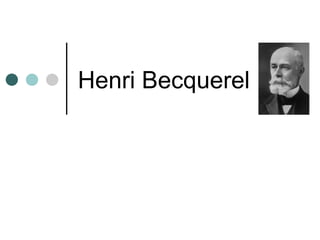

Henri Becquerel discovered radioactivity in 1896 almost by accident. While experimenting with uranium salts and their effect on photographic plates, he discovered that the plates were exposed even when not in direct sunlight, showing that uranium emitted radiation without an external energy source. This led to his discovery of radioactivity, the spontaneous emission of radiation by a material without external energy. For this discovery, which helped establish the field of nuclear physics, Becquerel shared the 1903 Nobel Prize in Physics with the Curies.


![5G Explained! A High Level Overview [Introduction]](https://cdn.slidesharecdn.com/ss_thumbnails/5gexplainedahighleveloverview-260119165306-cc137a3e-thumbnail.jpg?width=640&height=640&fit=bounds)


